INTRODUCTION
Bluetongue (BT) is a widespread viral disease of ruminants, inflicting mortality rates of up to 13% and 41% in cattle and sheep, respectively (Conraths et al. Reference Conraths, Gethmann, Staubach, Mettenleiter, Beer and Hoffmann2009). The pathogen agent is an Orbivirus that is transmitted by competent vector species of Culicoides Latreille biting midges. A number of species can transmit the bluetongue virus (BTV) but Culicoides imicola Kieffer is considered the main vector of BTV in Africa and southern Europe (Boorman et al. Reference Boorman, Jennings, Mellor, Wilkinson, Barber and Jochim1985; Mellor et al. Reference Mellor, Jennings, Wilkinson and Boorman1985) while Culicoides pulicaris Linnaeus, Culicoides dewulfi Goetghebuer, Culicoides obsoletus (Meigen) and Culicoides chiopterus (Meigen) are considered vectors in northern Europe (Purse et al. Reference Purse, Caracappa, Marino, Tatem, Rogers, Mellor, Baylis and Torina2004; Conte et al. Reference Conte, Goffredo, Ippoliti and Meiswinkel2007; Balenghien, Reference Balenghien2008; Meiswinkel et al. Reference Meiswinkel, Goffredo, Leijs and Conte2008; Stephan et al. Reference Stephan, Clausen, Bauer and Steuber2009). Of these species, C. obsoletus is the most abundant in Europe (EFSA, 2008) and is considered as the main vector species in Europe (Jennings and Mellor, Reference Jennings and Mellor1988; Carpenter et al. Reference Carpenter, Lunt, Arav, Venter and Mellor2006; Hoffmann et al. Reference Hoffmann, Bauer, Bauer, Bätza, Beer, Clausen, Geier, Gethmann, Kiel, Liebisch, Liebisch, Mehlhorn, Schaub, Werner and Conraths2009). This species, as well as C. chiopterus and Culicoides scoticus Downes & Kettle, has also been implicated in the transmission of Schmallenberg virus, which emerged recently in northern Europe (Elbers et al. Reference Elbers, Meiswinkel, van Weezep, van Oldruitenborgh-Oosterbaan and Kooi2013).
The insecticide susceptibility of European species of Culicoides to deltamethrin is poorly documented. The responses of several species of Culicoides to a range of organochlorines, organophosphates, carbamates and pyrethroids has been documented (Hill and Roberts, Reference Hill and Roberts1947; Kline and Roberts, Reference Kline and Roberts1981; Floore, Reference Floore1985; Holbrook, Reference Holbrook1994; Braverman et al. Reference Braverman, Chizov-Ginzburg and Wilamowski2004; Schmahl et al. Reference Schmahl, Sven, Walldorf, Al-Quraishi, Schumacher, Jatzlau and Melhorn2008, Reference Schmahl, Klimpel, Walldorf, Schumacher, Jatzlau, Al-Quraishy and Mehlhorn2009; Venail et al. Reference Venail, Mathieu, Setier-Rio, Borba, Alexandre, Viudes, Garros, Allene, Carpenter and Baldet2011) and the results obtained with insecticides based on pyrethroids – such as deltamethrin – show promise for the control of Culicoides midges (Mehlhorn et al. Reference Mehlhorn, Schmahl, D'Haese and Schumacher2008a , Reference Mehlhorn, Schmahl, Schumacher, D'Haese, Walldorf and Klimpel b ; Schmahl et al. Reference Schmahl, Sven, Walldorf, Al-Quraishi, Schumacher, Jatzlau and Melhorn2008, Reference Schmahl, Klimpel, Walldorf, Schumacher, Jatzlau, Al-Quraishy and Mehlhorn2009; Venail et al. Reference Venail, Mathieu, Setier-Rio, Borba, Alexandre, Viudes, Garros, Allene, Carpenter and Baldet2011).
In an attempt to standardize the technique of assessing the response of insects to chemical treatments, the World Health Organization (WHO, 1981) developed an in vitro method that proved successful for mosquitoes and was subsequently adapted to work on biting midges (Venail et al. Reference Venail, Mathieu, Setier-Rio, Borba, Alexandre, Viudes, Garros, Allene, Carpenter and Baldet2011). The present work could aid to standardize a protocol to assess the sensitivity of Culicoides to insecticides and the results obtained could be used to develop commercial products with the correct doses of deltamethrin, thus avoiding the misuse of active components in the field that may be toxic to non-target insects or that might lead to the rapid development of resistance in Culicoides populations.
This study evaluates the sensitivity to deltamethrin of a field population of C. obsoletus using the standardized World Health Organization (WHO) test.
MATERIALS AND METHODS
Insect collection
Adult Culicoides midges were collected at a dairy farm named Ca's Boter (39°30′N; 3°7′S,) located in Felanitx on the Balearic Island of Majorca, Spain. Insects were collected using either Onderstepoort (Agricultural Research Council-OVI, South Africa) or Mini-CDC (John Hock Company, USA) light traps, which were operated from dusk to dawn (19:30 to 7:00) between April and June 2010. A piece of roughly folded paper towel was placed inside the collection container of the trap to shelter trapped insects from the air flow of the fan. Early in the morning captured midges were taken to the insectary inside a thermally insulated container. At the insectary, midges were transferred to WHO chambers (WHO, 1981) in batches of ≈100 individuals and maintained in a dim light environment at 25±2 °C and 75–85% relative humidity (RH) with 5% sucrose solution for 24 h. After this time, any dead Culicoides were discarded and live ones were used to assess the insecticide.
Insecticide susceptibility test
The standard WHO test procedure (WHO, 1981) was modified to assess the lethal effects of differing doses of deltamethrin on C. obsoletus. Filter papers (Whatman # 1, 90 g m−2, 12×25 cm) impregnated with different doses of deltamethrin (0·0001, 0·0005, 0·001, 0·005 and 0·01%) in acetone-silicone solution – 2 mL per paper; 67% acetone, 33% silicone – were supplied by a WHO collaborative centre (Vector Control Research Unit, Universiti Sains Malaysia). Nets supplied along with the WHO test kit were replaced by fine gauze to avoid escape of midges and their transfer from the maintenance to the test chambers (and vice versa) was easily conducted after cold anaesthetizing the insects for 3 min at −4 °C.
Papers without insecticide and impregnated only with 2 mL of acetone-silicone mixture were supplied by the same institution and used as a control.
WHO treated chambers with batches of ≈100 unsorted Culicoides were held horizontally for 1 h at 25±2 °C, 75–85% RH. At least three replicates per concentration were conducted although more replicates were performed when some of the insects survived the treatment (Table 1). After exposure, insects killed by the immediate action of the insecticide were counted and identified, while those still alive were transferred to clean chambers and maintained in the insectary with 5% sucrose solution. After 24 h, alive and dead midges were again counted and identified. If the mortality of control groups was between 5 and 20%, the mortality rate of the treatment groups was corrected by applying the Abbot formula (Abbott, Reference Abbott1925). If mortality of control groups was >20%, the results were discarded. Data of the tested samples were pooled if mortality <5% was noted for the control. All midges were identified using the key of Rawlings (Reference Rawlings1996) although a subsample of 793 specimens belonging to the Obsoletus complex were sent to CIRAD (Centre International de Recherche de l'Agriculture et du Dévéloppement) for molecular analysis as females of this complex are difficult to identify morphologically.
Effect of deltamethrin on the mortality of Culicoides obsoletus under laboratory conditions

Means in rows with the same letter are not significantly different (P <0·05).
Data analysis
Data obtained from the different assays were pooled and subjected to Probit analysis (Finney, Reference Finney1971) with the program XLStat 2011 (Addinsoft) and the Lethal Dose 50 (LD50) and LD90 (Raymond, Reference Raymond1985) were obtained. Only the numbers collected of C. obsoletus were high enough to analyse statistically as individual species. Statistical differences were considered significant at P<0·05. Cumulative per cent mortality was transformed into probit units and plotted against the logarithm of dose of toxicant with the analytic program Statplus 2009. The log-dose probit (Ld-P) mortality line obtained was used to measure the variability of the strain.
RESULTS
A total of 2737 Culicoides midges belonging to 11 different species were assayed, namely: Obsoletus complex (78·4%), C. circumscriptus Kieffer (15·1%), C. newsteadi Austen (3·6%), C. maritimus Kieffer (0·9%), C. univittatus Vimmer (0·8%), C. cataneii Clastrier (0·6%), C. longipennis Khalaf (0·3%), C. pictipennis Staeger (0·1%), C. puncticollis Becker (0·1%) and C. imicola (0·1%). 2145 specimens belonged to the Obsoletus complex. Molecular analyses on specimens belonging to the Obsoletus complex revealed that only five (0·63%) of the 793 tested belonged to C. scoticus Downes & Kettle, while the remaining (788 individuals; 99·37%) belonged to C. obsoletus.
The mean mortality observed for the Obsoletus complex was >50% at a deltamethrin concentration of 0·0005% and >90% at a deltamethrin concentration of 0·001%. Doses ⩾0·005% led invariably to 100% mortality. At 24 h post-exposure the mortality observed ranged from 1·8 (delt. conc. = 0·0001%) to 1·01 (delt. conc. = 0·001%) times higher than the mortality observed at 1 h post-exposure (Table 1).
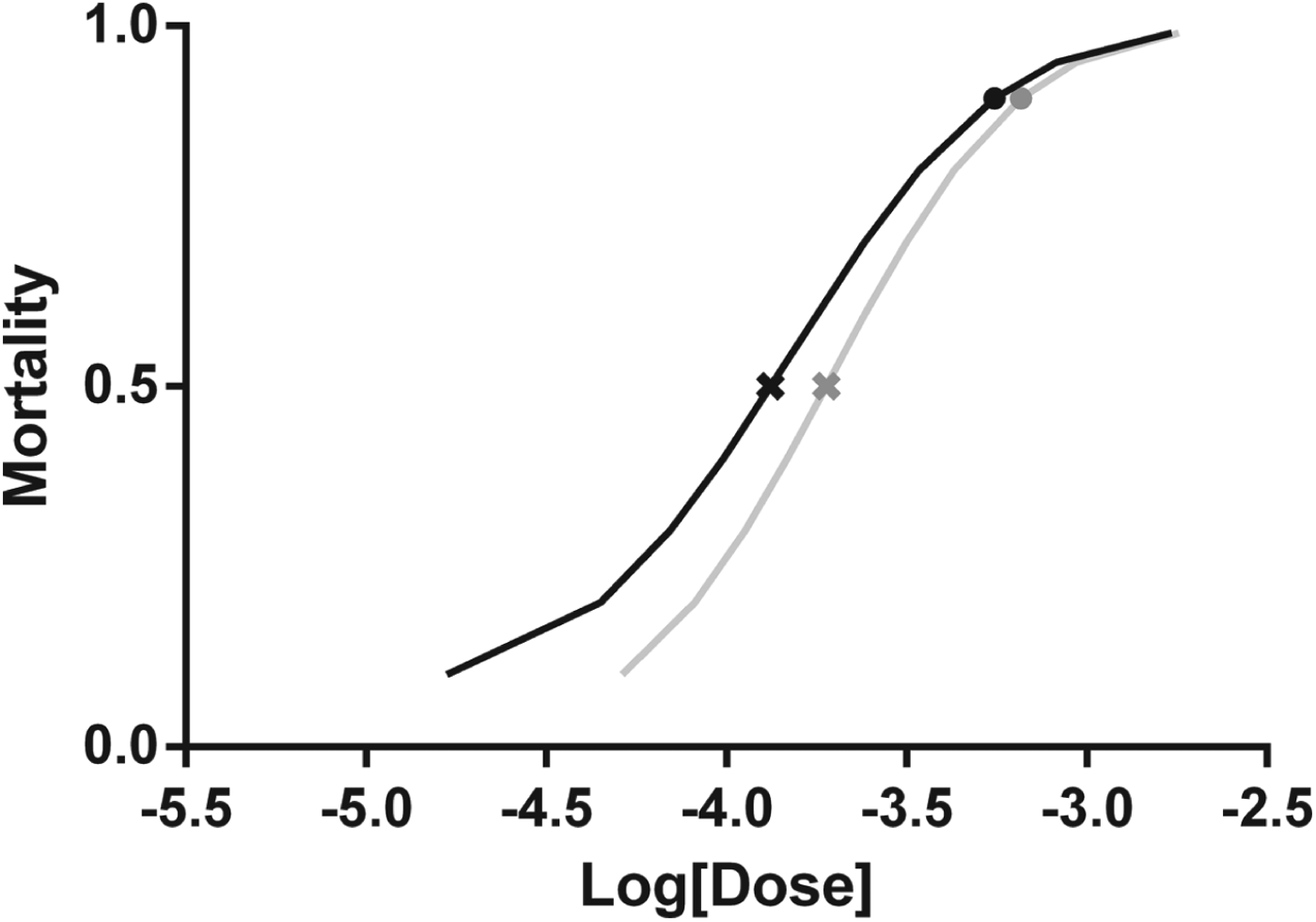
After 1 h exposure, and following correction using the Abbot formula, the deltamethrin LD50 observed for the Obsoletus complex was LD50 = 1·89×10−4% and a LD90 = 6·57×10−4% (Fig. 1). LD50 and LD90 were slightly lower at 24 h post-exposure (LD50 = 1·33×10−4% and LD90 = 5·55×10−4%) than after 1 h exposure (Fig. 1).
Sensitivity of C. obsoletus when exposed to various concentrations of deltamethrin for 1 h (grey line) and after 24 h post exposure (black line) indicating LD50 (crosses) and LD90 (dots).

The natural mortality observed was close to 2% at 1 h post-exposure and lower than 10% 24 h post-exposure (Table 1).
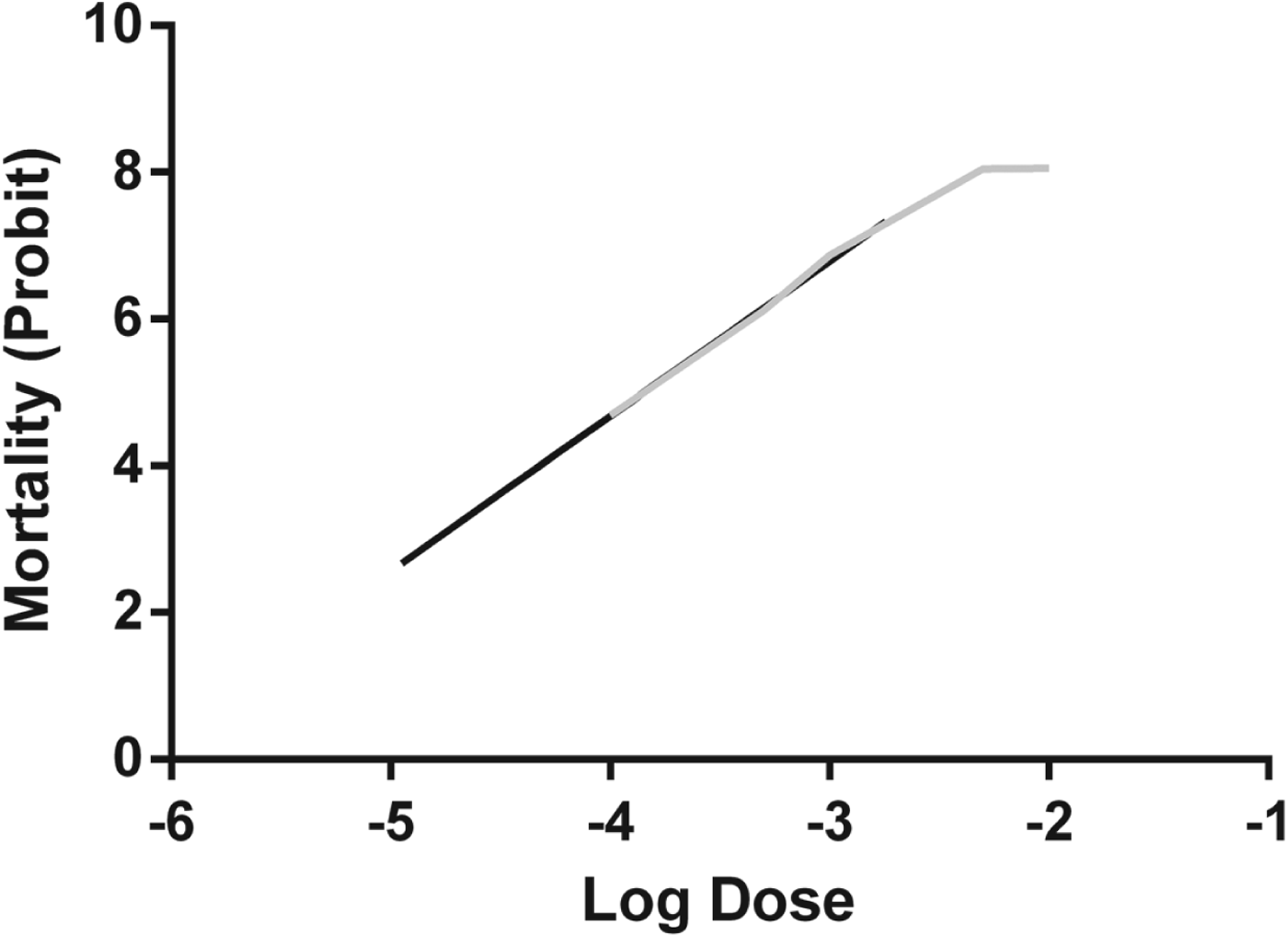
Slope values of the Log. Dose-Probit Line (Ldp) showed homogeneity in population response to the insecticide treatment (slope 2·11; R 2 = 0·96). The straight line observed for the Ldp indicated a unimodal response of the population to the treatments (Fig. 2).
Regression model showing the variability of response to deltamethrin of the Culicoides population assayed. Grey line represents the experimental points while black line represents the regression line (Ld-P).

DISCUSSION
The population of C. obsoletus studied showed a high sensitivity to deltamethrin. The lowest concentration tested increased the mortality rate of the population by approximately 40% and concentrations ⩾0·005% killed all midges assayed in less than 1 h, thus indicating the effectiveness of this insecticide in laboratory conditions. Deltamethrin affected the insects mainly during the first hour of contact and any residual effect was only evident when the lowest concentrations were applied.
The results obtained in the present work are consistent with other bioassays that demonstrate the highly potent effect of deltamethrin on Culicoides populations (Bishop et al. Reference Bishop, McKenzie, Spohr and Barchia2001; Doherty et al. Reference Doherty, Johnson and Reid2001; Melville et al. Reference Melville, Hunt, Bellis and Pinch2001; Mehlhorn et al. Reference Mehlhorn, Schmahl, D'Haese and Schumacher2008a ; Schmahl et al. Reference Schmahl, Sven, Walldorf, Al-Quraishi, Schumacher, Jatzlau and Melhorn2008). Furthermore, the protocol used in the present bioassay offers a reproducible and standardized method to test Culicoides midges to insecticides. In a similar study, Venail et al. (Reference Venail, Mathieu, Setier-Rio, Borba, Alexandre, Viudes, Garros, Allene, Carpenter and Baldet2011) obtained a LD90 = 2·03×10−3% 24 h post-treatment, thus indicating that the population of C. obsoletus assayed in the present trial was 3·5 times more susceptible to deltamethrin than the population studied by Venail et al. (Reference Venail, Mathieu, Setier-Rio, Borba, Alexandre, Viudes, Garros, Allene, Carpenter and Baldet2011). This difference in tolerance observed between populations of the same species suggests that previous exposure to deltamethrin due to farm practices could have had an effect on the susceptibility of the Culicoides populations to this insecticide.
Standardized WHO tests are used to assess the susceptibility and possible resistances of certain insects – especially mosquitoes – to insecticides in laboratory conditions. However, field studies are essential to determine the real effect of the insecticide over the target population and associated fauna. The environmental temperature should also be considered since pyrethroids can exhibit lower toxicity at higher temperatures (Hodjati and Curtis, Reference Hodjati and Curtis1999). Knowledge of the temperature effects on deltamethrin toxicity could avoid the continuous use of sub-lethal doses of pyrethroids during the summer season in southern Europe that may lead to resistance development.
In the present work we have assessed the sensitivity of one of the main vector species – C. obsoletus – of BTV in Europe. However, assessment of the other important species in Europe – C. imicola, C. pulicaris or C. chiopterus – should be conducted in future works to contrast the results with previous studies (Venail et al. Reference Venail, Mathieu, Setier-Rio, Borba, Alexandre, Viudes, Garros, Allene, Carpenter and Baldet2011) and establish its susceptibility to the insecticide. Furthermore, more field trials with discriminating doses of insecticide applied on animals should be conducted since the results obtained so far with permethrins have shown limited efficacy (Mullens et al. Reference Mullens, Gerry and Velten2001; Venail et al. Reference Venail, Mathieu, Setier-Rio, Borba, Alexandre, Viudes, Garros, Allene, Carpenter and Baldet2011). The repellent and insecticide effect of deltamethrin could, however, decrease the biting rate of the midges or reduce the size of the vector population thus affecting the infection rate and preventing the transmission of BTV.
The results obtained in the present trial showed that the population of C. obsoletus assayed is highly susceptible to deltamethrin treatments. Field trials with this insecticide would reveal its potential for the control of the Culicoides populations and determine if the reduction of the biting rate would be high enough to generate a significant impact on the transmission of BTV.
ACKNOWLEDGEMENTS
This study was partly initiated by the European Union as part of a project entitled ‘Surveillance Network of Reoviruses, Bluetongue and African Horse Sickness in the Mediterranean basin and Europe’ (MedReoNet) (contract no. 044285). The authors also thank Margalida Frontera for her constructive comments on earlier drafts of the manuscript, and Joan Huguet and family for their help, allowing us to collect the midges in their property.
FINANCIAL SUPPORT
We thank Conselleria d'Innovació, Interior i Justicia and the Ministerio de Agricultura, Alimentación y Medio Ambiente for financial support.