Introduction
The family Uranoscopide, commonly called stargazers, comprises 7 genera and 53 species that are most common in tropical and temperate seas (Fricke et al., Reference Fricke, Jawad, Al-Kharusi and Al-Mamry2013, Reference Fricke, Eschmeyer and Van der Laan2025). Of these, the genera Uranoscopus and Ichthyscopus have been documented in Indian waters. The genus Xenocephalus is characterised by large non-telescopic eyes located on dorsolateral edges of the head; a lateral line not running very close to the dorsal fin base; a reduced cleithral spine; lips with short and poorly developed cutaneous cirri; dentary of the lower jaw projecting with growth forming a plate-like dilatation; a single dorsal fin; dorsal-fin rays 12–14; and pectoral-fin rays 21–25 (Pietsch, Reference Pietsch1989; Kishimoto, Reference Kishimoto, Carpenter and Niem2001; Vilasri, Reference Vilasri2013).
The genus Xenocephalus has historically been subject of considerable taxonomic ambiguity, primarily due to overlapping morphological characteristics and ambiguous species boundaries. The diagnostic features that define species within this genus are often subtle and can lead to misidentification or erroneous classification. In addition, they exhibit phenotypic plasticity; they change morphologically with growth, which had led to descriptions of juveniles and adults as being two separate species (Kishimoto, Reference Kishimoto1989; Vilasri, Reference Vilasri2013). There have been various revisions in the group, validation of species, and synonymising of species. Currently five species in the genus, namely, Xenocephalus armatus (Kaup, Reference Kaup1858); X. australiensis (Kishimoto, Reference Kishimoto1989); X. cribratus (Kishimoto, Reference Kishimoto1989); X. egregius (Jordan and Thompson, Reference Jordan and Thompson1905); and X. elongatus (Temminck and Schlegel, Reference Temminck, Schlegel and Von Siebold1843) are recognised. Most of the species in the genus have restricted distribution (Fricke et al., Reference Fricke, Eschmeyer and Van der Laan2025), and there is uncertainty regarding the distributions of the species in the Indian Ocean.
The genus Xenocephalus has not been reported from Indian waters with proper descriptions. Some authors have listed Xenocephalus spp. as a bycatch from demersal trawlers, but without any taxonomic details (Arnold, Reference Arnold, Heemstra, Heemstra, Ebert, Holleman and Randall2022; Manilo and Bogorodsky, Reference Manilo and Bogorodsky2003; Sajeevan et al., Reference Sajeevan, Somvanshi and Nair2009; Venu, Reference Venu2009). The current study reports the first recorded occurrence of X. australiensis in the Arabian Sea and Western Indian Ocean, extending its known distribution from the Eastern Indian Ocean and enhancing our understanding of stargazer diversity within Indian waters.
Material and methods
A single specimen of Xenocephalus australiensis was collected from the bycatch landing at the Colachel landing centre, Tamil Nadu, Arabian Sea, collected at a depth of 250–300 m (Figure 1). All the measurements were made with the digital vernier calliper to the nearest 0.01 mm, following Hubbs and Lagler (Reference Hubbs and Lagler1947) and Kishimoto (Reference Kishimoto1984). The body proportions were expressed in terms of standard length (SL: length from the snout tip to the base of the caudal fin) and head length (HL: length from the snout tip to the rear end of gill flap). The vertebral counts were taken from radiographs. The specimen is deposited in the National Fish Repository of the ICAR, National Bureau of Fish Genetic Resources, Lucknow, India (Accession number: URAXAUS.1/NBFGR).
Xenocephalus australiensis, URAXAUS.1/NBFGR, 126.3 mm SL, collected off Kanyakumari coast Arabian Sea, Western Indian Ocean. Scale bar: 1 cm.

Results
Family Uranoscopidae Bonaparte, 1831
Xenocephalus (Kaup, Reference Kaup1858)
Xenocephalus australiensis (Kishimoto, Reference Kishimoto1989)
Common name: Australian stargazer
Xenocephalus australiensis, URAXAUS.1/NBFGR, 126.3 mm SL: (a) dorsal view of whole body; (b) dorsal and (c) lateral views of the head. Scale bars: 1 cm.

Records of Xenocephalus australiensis in Indian Ocean: ( ) present study; (
 ) previous records.

Morphometric and meristic characters of Xenocephalus australiensis (n = 1), URAXAUS.1/NBFGR, collected from Arabian Sea, compared with type specimens of X. australiensis based on Kishimoto (Reference Kishimoto1989) indicated in asterisk

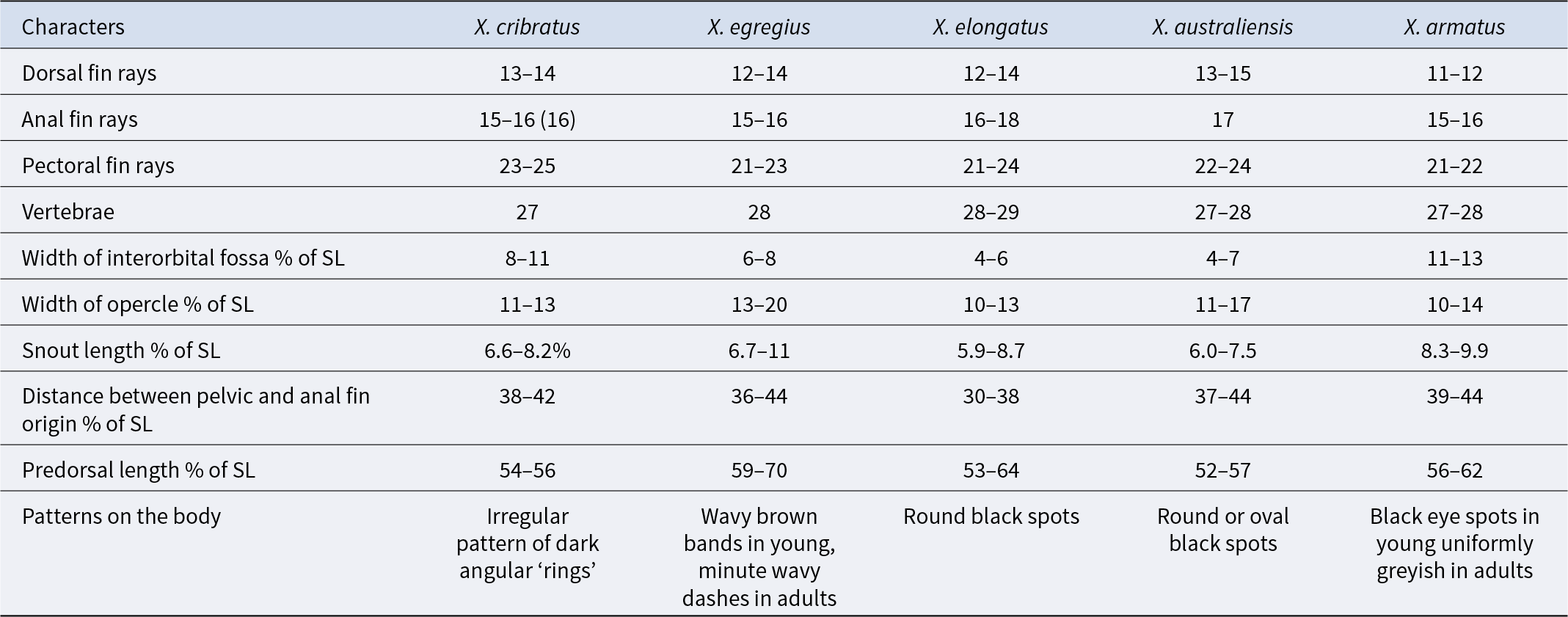
Comparison of morphometric and meristic characters among Xenocephalus species

Materials examined: URAXAUS/NBFGR (total length 155.7 mm; standard length 126.3 mm), Colachel fishing harbour, Tamil Nadu, west coast of India, Arabian Sea (7°91′49″ N, 76°98′44″ E), collector Teena Jayakumar T.K., on 17 February 2024.
Diagnosis
The species is distinguished from other congeners in having absence of subopercular knob; fusion of lower hypural plate and parhypural; post orbital distance 62–67% HL; width of opercle 96–108% of opercular height; distance between pelvic and anal fin origins 37–44% SL (Kishimoto, Reference Kishimoto1989; Vilasri, Reference Vilasri2013; present study).
Description
Morphometric and meristic data are summarised in Tables 1 and 2.
Body depressed, and dorsally flattened, tapering towards the tail. Body broader than depth, covered with small randomly arranged cycloid scales. Head broad, weakly concave behind interorbital fossa, bones exposed, sculptured composed of tubercles united to radial ridges, separated by smooth intervals. Dorsal surface of head nearly flattened. Horizontal bony ridges developed on parietal and pterotic bones. Prominent semi-circular ridge poorly developed on posterior rim of orbit. Interorbital broad and wide, short deep, and U-shaped fossa for receiving the ascending processes of premaxillae. The fossa almost extends to the level to line joining the posterior margins of the cornea. Large eyes, positioned dorsolaterally, non-telescopic without membranous tentacles and grainy rows. Infraorbital bones extensive, lachrymal larger than other infraorbitals, elongated with three anterior knobs. Nasal bone minute and ossified, elongated longitudinally under the skin. Tubiform nasal valve with a slender filament, slit-like posterior nostril without internal naris and electric organ. Plectroid dilatations of dentaries meet narrowly on the upper part of medial rims. Mental barbels are absent. Large protractile, vertical mouth; lips with short and poorly developed fimbriae. Central tip of respiratory valve slightly produced inside lower jaw. Biserial caniniform teeth in pre-maxilla and anterior part of dentary. Uniserial caniniform teeth on posterior part of dentary. Patch of several conical teeth in prevomer and palatine.
Gill opening ending dorsally above origin of pectoral fin, posterior margin of gill flap smooth. Gill membranes united to isthmus with a connecting fold. Six branchiostegal rays and branchiostegal membrane without papillae. Opercle broader than height with opercle width 107.7% of opercle height. Opercle broad with radiating striae and a blunt spine-like projection; upper edge directed downwards without bony ridge. Preopercle smooth on angle and lower edge. Subopercle with smooth edge ossified on about two-thirds of the anterior lower part; remaining portion cartilaginous, enlarged along lower edge of opercle posteriorly to a small projection of its end. Interopercle ossified with smooth edge, not covered by preopercle. Pseudobranchiae present. Cleithral spine rudimentary, slightly flat and triangular, not covered with fringed dermal appendage; cleithral processes covered with connecting fold of gill membranes. Supracleithrum without spine. Basipterygium is hidden under skin without exposed processes.
Head, cheek, and belly scaleless. Lateral line beginning at posteromesial margin of supracleithrum gradually approaching end of dorsal fin base, middle portion of caudal fin. Lateral lines embedded with tubiform scales. Belly and lower tail without dermal folds. Single dorsal fin, base longer than height, middle ray longest. Anal fin base longer than height; posterior ray longest. Pectoral fin very broad with middle ray longest. Pelvic fins close, situated on isthmus; spine short. Membranes of the anal, pelvic, and lower half of pectoral fins fleshy and thickened. Caudal peduncle slightly compressed. Vertebrae 27.
Colouration
In fresh specimen, body dark greenish brown with small dark spots above the lateral line till the posterior end of the dorsal fin base. Dark spots are present on the dorsal side of the head, including the maxilla and mandible. The ventral half of the body is pale. Dorsal and caudal fins are blackish brown with pale margins. Pectoral fin black with whitish margin. Pelvic fin and anal fin pale distally and blackish basally.
Geographical distribution
The species was described from the continental slope of north-western Australia (Kishimoto, Reference Kishimoto1989). It has been reported from Myanmar coast, Eastern Indian Ocean (Psomadakis et al., Reference Psomadakis, Thein, Russell and Mya2020). The current study extends the distribution range to the Arabian Sea, Western Indian Ocean and provides the first record of the species from Indian waters (Figure 3).
Discussion
Xenocephalus australiensis is a little-known species, with its description based exclusively on the voucher specimens and original description. The morphometric range and meristic counts of the current specimen closely aligned with the range from the holotype and paratypes. The specimen obtained from Arabian Sea agreed well with X. australiensis in having opercular width 107.7% of opercular height, width of interorbital fossa 6.9% SL, distance between pelvic and anal fin origins 42.8% SL, predorsal length 55% SL, snout length 6.6%, and anal fin rays 17, although its postorbital length 67.0% HL was in that reported range of X. elongatus. Moreover, the specimen has similar body colouration and spots as reported in the type specimens. Few morphometric differences between the present specimen from the Arabian Sea and the specimens described by Kishimoto (Reference Kishimoto1989) were observed, such as interorbital fossa width, opercle height, opercle width, pectoral fin height, body depth, and vertebrae count. We assume that these differences between the specimens might be due to geographical variation or stock delineation.
Among species of Xenocephalus, X. australiensis shares similarities with X. elongatus and was even considered a subspecies of X. elongatus until validated as a new species. X. australiensis differs from X. elongatus in having lower postorbital distance (62–67% vs. 65–69% HL in X. elongatus); higher opercular width (95–108% of opercle height vs. 85–95% in X. elongatus); and higher distance between pelvic and anal fin origin (37–44% vs. 30–38% SL in X. elongatus) (Table 2). X. australiensis can be easily distinguished from X. egregius and X. cribratus in having 17 anal fin rays (vs. 15–16 in X. egregius and X. cribratus). Furthermore, X. cribratus has a higher width of interorbital fossa (8–11% vs. 4–7% SL in X. australiensis), and the body of X. cribratus is covered with an irregular pattern of dark angular ‘rings’, whereas the upper part of the body of X. australiensis has small dark spots. Moreover, X. egregius differs from X. australiensis in having higher predorsal length (59–60% vs. 52–57% SL in X. australiensis) and presence of the preopercular flange (absence of the flange in X. australiensis). X. armatus differs from X. australiensis in having lower counts of dorsal rays (11–12 vs. 13–15 in X. australiensis), anal rays (15–16 vs. 17 in X. australiensis), a higher width of the interorbital fossa (11–13% vs. 4–7% SL in X. australiensis), and a higher snout length (8.3–9.9% vs. 6.0–7.5% SL in X. australiensis) (Gomon et al., Reference Gomon, Bray and Kuiter2008; Kishimoto, Reference Kishimoto1989; Vilasri, Reference Vilasri2013).
Since its original description, Xenocephalus australiensis has been reported from the waters of Australia (Gloerfelt-Tarp and Kailola, Reference Gloerfelt-Tarp and Kailola2022; Hutchins, Reference Hutchins2001; Hutchins and Smith, Reference Hutchins and Smith1991; Vilasri, Reference Vilasri2013) and Myanmar (Psomadakis et al., Reference Psomadakis, Thein, Russell and Mya2020), with the present study extending the known distributional range to Indian waters and the Western Indian Ocean. In general, Xenocephalus spp. have restricted distributions, with X. cribatus occurring of north-western Australia (Kishimoto, Reference Kishimoto1989), X. armatus occurring off southern Australia and New Zealand (Gomon et al., Reference Gomon, Bray and Kuiter2008; Kailola, Reference Kailola1987; Vilasri, Reference Vilasri2013), and X. egregius occurring on the coasts of the Gulf of Mexico and Florida (Robins and Ray, Reference Robins and Ray1986). In contrast, X. elongatus has a broader range, being found in the East China Sea, Ryukyu Islands, and the coasts of Korea, Philippines, Hong Kong, and Japan (Gloerfelt-Tarp and Kailola, Reference Gloerfelt-Tarp and Kailola2022; Kim et al., Reference Kim, Choi, Lee, Lee, Kim and Kim2005; la Paz Rm and Interior, Reference La Paz Rm and Interior1979; Masuda et al., Reference Masuda, Amaoka, Uyeno and Yoshino1984; Ni and Kwok, Reference Ni and Kwok1999; Vilasri, Reference Vilasri, Koeda and Ho2019; Yu et al., Reference Yu, Zeng, Li, Lin, Li and Gao2023).
The Indian Ocean, with the adjacent Red Sea, has the highest diversity of uranoscopids, with 68% of the currently recognised species reported from the area (Fricke et al., Reference Fricke, Jawad, Al-Kharusi and Al-Mamry2013). Xenocephalus spp. are nocturnal ambush predators that are known to bury themselves into the substrate. This behaviour may limit catchability in fishing gears, potentially leading to them being under-represented in catch records. Their rarity is compounded by their minimal economic value in commercial markets. Thus, the paucity of records may be attributed to their secretive nature, habitat preferences, low population densities, and limited economic value.
This specimen could potentially represent a resident population of these species in Indian waters, although obtaining further specimens is challenging because these fish are often discarded as bycatch. The combination of these factors underscores the need for specialised research techniques and increased efforts to better understand and document this group of fish. More extensive research on the bycatch composition of demersal fisheries is needed to better understand the taxonomic diversity, occurrence, speciation, biogeography, population status, and biology of this lesser-known genus in the Indian Ocean.
Data availability statement
The datasets generated during and/or analysed during the current study are included in this published article.
Acknowledgements
The authors thank the Director, ICAR-National Bureau of Fish Genetic Resources for providing financial support (under institute project on Taxonomic studies of the deep-sea fish resources along southern coasts of India), guidance, and encouragement. The first author extends sincere gratitude to Mr. Athul Suresh for his invaluable assistance in the sampling process.
Author contributions
TJTK performed taxonomic investigation and manuscript preparation. TTAK edited manuscript, and overall conceptual guidance was given by UKS. All authors read, approved, and contributed to the manuscript.
Funding
The present work was supported financially by ICAR-National Bureau of Fish Genetic Resources, Lucknow, Uttar Pradesh 226 002, India under the Institute project on ‘Taxonomic studies of deep-sea fishes along the southern coasts of India’.
Competing interests
The authors declare no conflict of interest.
Ethical approval
All applicable international, national, and/or institutional guidelines for the care and use of animals were followed by the authors.