

Introduction
Dementia is a global phenomenon and currently some 27.7 million of the world's population live with the condition in one form or another (Wimo, Jonsson and Winblad Reference Wimo, Jonsson and Winblad2006), a figure that will substantially increase over the next 40 years as the world's population ages (Alzheimer's Disease International 2009). At present, there is no cure for any of the dementias and advancing age is the most notable risk factor for their acquisition (Alzheimer's Society 2007). Surveys from across the developed world suggest that prevalence rates increase from 1.4 per cent at age 65 years to 23.6 per cent at age 85 or more years (Alzheimer's Disease International 2009) and prevalence data from Ferri et al. (Reference Ferri, Prince, Brayne, Brodaty, Fratiglioni, Ganguli, Hall, Hasegawa, Hendrie, Huang, Jorm, Mathers, Menezes, Rimmer and Scazufca2005) identified that the majority of people with dementia live in the developing world: 60 per cent in 2001 rising to 71 per cent by 2040. In these areas, the rate of increase is predicted to be four times greater than in developed regions. Their study also revealed the highest prevalence of dementia to be in China and its Western Pacific neighbours (6 million in 2001 increasing to 26.1 million by 2040), ahead of Western Europe (4.8 million in 2001 increasing to 9.9 million by 2040) and North America (3.4 million in 2001 increasing to 9.2 million by 2040).
In European and North American populations, Alzheimer's disease is the most common of the dementias whereas the vascular dementias seem to be more prevalent in Japan and the former Soviet Union (Alzheimer's Disease International 1999). In the United Kingdom (UK), the Alzheimer's Society (2007) has suggested that there are around 700,000 people living with dementia, representing one person in every 88, and that the total will rise to 940,110 by 2021 and 1,735,087 by 2051, an increase of 38 per cent over the next 15 years and 154 per cent over the next 45 years.
Whilst the statistics tell one story, another belongs to the person behind each figure, their family, social networks, beliefs, values, identity and life story. Indeed, as Kitwood (Reference Kitwood1997) articulated in the promotion of personhood and person-centred care, viewing an individual in the context of their life story is essential to finding meaning in the present and in the act of living with a dementia. The narrative process of constructing life as a series of connected and interconnected stories has gained popularity in recent years (Kramer Reference Kramer2005; Plummer Reference Plummer2001; Roberts Reference Roberts2002; Williams and Keady Reference Williams, Keady, Watson, McKenna, Cowman and Keady2008) with Frank (Reference Frank, Feastherstone, Hepworth and Turner1991) considering how the experience of illness is converted into narrative storytelling. Frank (Reference Frank, Feastherstone, Hepworth and Turner1991) developed his discourse by suggesting that all contemporary illness accounts involve the primary theme of ‘self-change’ and, as Charmaz (Reference Charmaz, Conrad and Roth1987) and Sabat (Reference Sabat2001) have both pointed out, such identities are constantly in the process of transformation as enduring illness(es) make former identities unsustainable.
For people living with long-term conditions, this transformative process constantly challenges preconceived notions of self and selfhood (Sabat and Harré Reference Sabat and Harré1992), and for people with dementia the (re)construction of a ‘new identity’ is maintained only in the sense that it brings change in the self with a different set of goals, assumptions and aspirations (Sabat Reference Sabat2001). This was recently evinced in a two-year longitudinal study by Keady, Williams and Hughes-Roberts (Reference Keady, Williams and Hughes-Roberts2007), during which the authors helped Sarah, a person with mild Alzheimer's disease, put together a comprehensive life story using Gubrium's (Reference Gubrium1993) life-story interview as a narrative guide. By attentively listening to Sarah and giving her editorial control over her presented life story, Keady, Williams and Hughes-Roberts (Reference Keady, Williams and Hughes-Roberts2007) suggested that detailed (auto) biographical knowledge of the person with dementia is crucial to understanding the cognitive and life changes that take place, especially when life storylines are mis-remembered and/or mis-sequenced. In other words, the person with dementia's narrative identity is primarily located in the ‘here and now’ with the past subject to re-editing and revision at any time in the process of its telling. Consequently, narrative accounts of everyday living with dementia can present as a complex mix of new, revised and disconnected storylines that combine to create a person's sense of self and identity (see alsoKierkegaard Reference Kierkegaard1987; Mills Reference Mills1998). In an attempt to explore this discourse further, we have applied a meta-ethnographic analysis (Noblit and Hare Reference Noblit and Hare1988) to 12 autobiographies written by people with dementia about their experience of living with the condition. This approach and its accompanying methodological rationale are developed in the next section.
Narrative voices in dementia: procedures and processes
There are essentially two types of narrative involving people with dementia. The first are those authored by the person with dementia him or herself and that set out to tell their story. The second are those written by another person and so are third person accounts; many authors are the spouse or child of the person with dementia but increasingly social scientists or researchers have attempted to capture these experiences in their reflective writings (for an accessible review of such studies, seeSteeman et al. Reference Steeman, Dierckx de Casterlé, Godderis and Grypdonck2006).
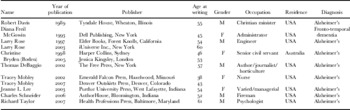
This article takes as its starting point first-authored accounts by people with dementia, as they offer a highly specific insight into the lived experience. The following four inclusion criteria were applied as a framework for the meta-ethnographic analysis: (a) only published books written by people with dementia (with any diagnosis) of sufficient depth and length to be analysed; (b) written in the first person and in English; (c) available for purchase through a publishing house or similar external source; and (4) autobiographical accounts published between 1989 (publication of the first book by a person with dementia; Davis Reference Davis1989) and November 2007. Whilst first-person accounts are available in diverse formats, from conference presentations to blogs, it was found that many were of insufficient length and depth for inclusion in a meta-ethnographic analysis. Eligible autobiographies were identified from the reading lists of Alzheimer's Societies and Alzheimer's Associations in many countries (predominantly the UK, United States of America (USA), Canada and Australia); libraries at the Dementia Advocacy and Support Network International (DASNI) website (http://www.dasninternational.org/); major book publishing websites; and iteratively from narratives cited within other narratives. By following this search strategy, 12 books were identified as meeting the inclusion criteria (Table 1). The table includes additional background information to set each contribution in an appropriate context.
Published autobiographies of people with dementia (chronologically ordered)

Notes: M: male. F: female.
Of the 12 books, three authors had been published twice, five were male, eight were from the USA, one was Australian and all nine had a professional background (predominantly in some form of public service). Eight of the authors had Alzheimer's disease and one had fronto-temporal dementia. As Table 1 reveals, an unexpected outcome of the search process was that all the reviewed books were written by younger people with dementia, for the average age of the narrator was 51.5 years (age range 38–61 years).
Following the format suggested by Noblit and Hare (Reference Noblit and Hare1988) and Thorne et al. (Reference Thorne, Jensen, Kearney, Noblit and Sandelowski2004), and using the Davis (Reference Davis1989) autobiography as the starting point, we undertook a meta-ethnographic analysis of the 12 books. Meta-ethnography focuses on understanding and interpretation and is seen as involving six phases that often overlap and interact. According to Thorne et al. (Reference Thorne, Jensen, Kearney, Noblit and Sandelowski2004: 1347), these phases are: deciding on relevant material; reading selected reports; determining the relationship between the materials; translating the reports into one another; synthesising the translation; and writing up. Both authors of this article separately worked through these procedures using the recommended format.
The Davis autobiography was analysed first, which identified the initial themes and, in chronological order, the other 11 narratives were compared and contrasted with the original themes. When new themes emerged, they were translated back to the previous narratives to test their significance. Both authors met frequently to negotiate and agree the analytical process. From this approach, five themes were identified: (a) awareness of change; (b) experiencing loss; (c) standing up and bearing witness; (d) sustaining continuity; and (e) liberation and death. Each of these themes will now be elaborated and exemplified.
Awareness of change
The Reverend Robert Davis describes how, before he received a diagnosis of Alzheimer's disease, he experienced an intuitive feeling that something fearful was happening to him:
Deep within me I knew that something was terribly wrong with my mental processes. As I appealed to the teams of doctors they reassured me that time would take care of it or urged me to accept the fact that I was getting older. … I knew there was something far more seriously wrong with my mind than these surface replies addressed. (Davis Reference Davis1989: 49)
Subsequent stories in each autobiographical account suggest that this was not a unique experience and many individuals suspected, often well before diagnosis, that not only was ‘something significant’ happening to them, but that this ‘something’ was a real and vivid threat. DeBaggio (Reference DeBaggio2002: 3) eloquently captured this unease:
There was something else that spring and it was unnameable … it was an anonymous presence, yet I could feel its uneasy cadence. My memory … was failing long before I expected. … I was fifty-seven this year and not eager to acknowledge that I might be tied to a teetering mind that had begun a slow descent into silence.
Uniquely among the narrators, Lee (Reference Lee2003: 19) intuitively sensed that ‘what I really had was Alzheimer's disease’, whilst many of the other reflections were accounts of a (personal) struggle to make sense of a shifting reality, as these examples attest:
Managing a printing shop and increasingly delegating work to others as simple and familiar tasks became increasingly difficult (Lee Reference Lee2003).
Forgetting she owned a dog and wondering why one was playing in the garden (Mobley Reference Mobley2002).
Encountering physical symptoms that left him exhausted and unable to function (Schneider Reference Schneider2006).
Overhearing the whispered concerns of his daughter (Taylor Reference Taylor2007).
Driving in a usually familiar place and unable to recognise where she was (McGowin Reference McGowin1993).
All of the authors eventually sought a medical explanation of these ‘unexplained events’ even though the process of assessment and investigation that eventually led to a diagnosis of dementia was frequently described as ‘arduous’.
Experiencing loss
At the point of diagnosis, when imagined fears were realised, all authors expressed worry about the future and thoughts frequently turned to the experience of loss and, in particular, to the loss of self-identity. For instance, as a Christian pastor, Davis's (Reference Davis1989) need to feel the presence of God was imperilled by his Alzheimer's disease owing to an inability to participate in religious services that had given him role, status and purpose throughout his life. A similar experience was shared by McGowin (Reference McGowin1993) who, as a previously independent, capable and efficient para-legal professional, offered a story that described her slow, insidious, loss of ability to work and to feel an equal partner in her marriage. Lee (Reference Lee2003: 37) also experienced a similar spiral of occupational decline that compelled her to question her abilities and value:
What can someone diagnosed with dementia do? Am I capable of working again? Who would want me?
Unsurprisingly, all the narratives are inherently stories associated with the anticipated and actual loss of the sense of ‘who one is’. For example, DeBaggio (Reference DeBaggio2002), a retired journalist and author, described his loss of self in terms of his loss of language; as the words are lost so he is lost. Such perspectives are reinforced in the other books when everyday life for people with dementia becomes preoccupied with finding answers to questions, such as: ‘Will I soon forget who I am?’ (Rose Reference Rose1997: 12); and ‘Who will I be when I die?’ (Bryden Reference Bryden1998). For all the authors, the sense of self was intrinsically linked to how one functions: as functioning was affected through the progression of dementia (Wattis and Curran Reference Wattis and Curran2006), so the senses of value, utility and purpose were undermined.
Standing up and bearing witness
No stranger to the concept of bearing witness, Davis (Reference Davis1989: 21) told his story through deeply-held religious convictions and the knowledge that he retained his communication skills:
Why has God left me this window of ability? As I pondered this, I thought that perhaps it happened so that I can be the voice for the voiceless who suffer from this devastating disease.
It is this act of ‘bearing witness’ that permitted Davis (Reference Davis1989) to regain a sense of meaning and purpose in life as he offered to become a ‘voice for the voiceless’. Interestingly, in most of the autobiographies, the authors suggested that they had a ‘duty’ to bring attention to the lived experience of dementia and to ‘speak up’ on behalf of others who are not able to do so. Mobley (Reference Mobley2007: 90) developed this point further:
Here I am now in the middle stages of the disease and I thank God that I was given the opportunity to see the curtains rise and the future that will be so much easier on others. I hope that our story gives new hope to other families and gives them the insight and the courage to pick up where our voices leave off.
For other authors not obviously motivated by religious beliefs, the mission became personal and compelled by the need to keep dementia in the public eye for a variety of reasons, as these four examples attest:
I saw their eyes brighten and sometimes fill with tears as they read of some of their own experiences in my writings. It was then that I decided to share my writings with others. I wanted others to know that they are not alone with an Alzheimer's changing mind. There are others with them on the road less travelled (Taylor Reference Taylor2007: 4).
I feel compelled to write about my feelings, my experiences, my fears and frustrations. Maybe someday the world will care about how an Alzheimer's patient copes (Rose Reference Rose2003: 8).
At times I have felt alone, and yet I know from the statistics that I'm not. That is one of the main reasons that I was driven to complete this book; as a means of sharing what I have learned with others; to help open things up for all of us, and if not for us, for those who will follow (Lee Reference Lee2003: 43).
Early onset patient-support groups are spreading like a wildfire across our nation. If they put anything on my epitaph, I want it to be that I began that movement (McGowin Reference McGowin1993: 137).
Such thoughts are compelling in their construction and immediately draw the reader into the narrative. They also evince the knowledge that dementia has a limited window of opportunity from which written thoughts can be documented by the person experiencing the condition; Davis's (Reference Davis1989) book, for instance, was concluded by his wife. Accordingly, the stories are both altruistic and deeply personal, and help the person find meaning in their present (and future) existence.
Sustaining continuity
As outlined under the previous theme, Davis (Reference Davis1989) offered himself and his experience as an instrument, or channel, through which others could, and can, ascribe resolution and meaning to their suffering and be better understood by others. Through such a sacrificial act, Davis (Reference Davis1989) once again ministered a pastoral role and a biographical connection to his life's work. As each of the books reveal, living with dementia is about achieving a similar balance to sustain continuity in the face of the malignant power of dementia, a power arrestingly described by Schneider (Reference Schneider2006: 47) in the following way:
It does not ask permission. It can change your language, steal any words it wants to and give you profanity in their place. It can cast a spell of fear and hopelessness on many of its victims. It is not content to slowly kill you. It wants to torture, humiliate, embarrass and confine you. It refuses to ease your suffering by allowing you a quick death. It not only delights at abusing its victim, it also wants to torture their loved ones.
When faced with such a tidal wave of despair, the storied accounts reveal that most did not let such emotions overwhelm them. Rather, the authors attempted to hold on to some sense of ‘who they are’ and aimed for a degree of continuity over their identity and their presentation to others. In the face of an overwhelming and common ‘enemy’ (dementia), each book passionately positions the author as a resistor, with resilience the driving force that enables the processes of regrouping and re-positioning to occur.
Indeed, the books suggest that it is frequently the very act of narration, of writing it down, that offers an opportunity to re-position oneself and, in some way, to further resist the disease process. For instance, McGowin (Reference McGowin1993), after taking to early retirement, searched for an occupation that helped to restore her shattered sense of self. The solution to her own personal life crisis, and that of her family, was to write about living with her Alzheimer's disease. This focus allowed McGowin (Reference McGowin1993) to exercise previous skills on her terms and embrace the identity of narrator; a sense of continuity taken from her previous office job and sustained in her role of author. Taylor (Reference Taylor2007: 220) used narrative construction as a means of holding on to something fundamental to one's sense of self when living in the continual presence of dementia:
Since I started writing, I am more confident and comfortable with who I believe I am. I am marginally less afraid of the future. I have, I think, a better understanding of why and how I am changing.
Rose (Reference Rose2003), in his second book, comments on how his strong personality reasserted itself in his daily life as he reflected on his earlier thoughts around suicide. By tackling his dementia ‘head on’ – in the same way as he always dealt with other difficult aspects of his life – he was able to reach the following conclusion:
I thought along those lines for quite some time. I slowly came to realize that I am still enjoying life. … I was never a quitter and I am not going to start now. There are many hard things you must do in life (Rose Reference Rose2003: 12).
Facing up to the ‘hard things’ in life is not always without cost, or, as Bryden (Reference Bryden2005) phrased it, ‘battling the stereotype’, a stereotype that expects a person with dementia to have no valid voice, no credibility and no right to speak on behalf of others.
Liberation and death
Towards the end of Davis's (Reference Davis1989) book there is a sense of the story approaching its end. He alludes to himself as no longer one who ‘serves’ but as one who ‘is served’, suggesting that he, formally the helper, is now in need of help from others. Davis (Reference Davis1989) describes spending his days in ‘partial moonlight’ whilst he awaited salvation and heavenly reward. Within the discourse of loss, death becomes a release from the relentless ‘stripping away’ of those things that make one a unique person, and the authors frequently described an invidious position where neither life with dementia nor death are useful alternatives. For example, Schneider (Reference Schneider2006) described the dilemma of being ‘captured’ by his Alzheimer's disease and ‘forced’ to live with the knowledge that his future ‘deterioration’ will cause suffering to his family, whilst his death will cause his wife an equal amount of pain and upset. It is an unenviable position and a theme also considered by Mobley (Reference Mobley2002: 31):
The saddest part of this story is that one day when I am gone, I know that my family must go on without me. … I will no longer be here to cause them pain by them having to watch me slowly slip away.
Lee (Reference Lee2003: 75), consistently the most positive of the narrators, outlines her plan to ‘just keep chugging along with a happy heart and soul’, accepting her increasing challenges and diminishing abilities. Others were less content and what accompanied the shock of diagnosis at a young age was an awareness that life, as one may know it, could soon be over. Death is inherently connected to life and yet the stories rarely address the physical process of dying. In most of the accounts, thoughts about death are present, often significantly so, but death itself is alluded to through the use of metaphor and most often the loss of one's life is described in terms of the loss of quality of life:
I think about dying a lot. There has to be a line drawn somewhere … when it is time to go, when life is not quality (Rose Reference Rose1997: 76).
DeBaggio (Reference DeBaggio2002) moved beyond dependency and talked about his fear of death, but he was able to rise above this to conceptualise how the inevitable progression of his dementia could free him from his fears:
Getting used to the idea of dying is difficult, emotionally and physically, but what awaits me is losing the idea of dying and that is incomprehensible and at the same time it may be liberating (DeBaggio Reference DeBaggio2002: 18).
For some there were thoughts about a doorway to heavenly reward that contrasted with those of awaiting death. The personal satisfaction of a ‘job well done’ (as evinced in the theme of Standing up and bearing witness) suggests that some reward has been earned in this life which served to mitigate the reality that it may be harder to maintain the effort required for any ‘survivor mission’ to continue, as these four extracts suggest:
Now when I am having a bad day … I go for a walk to the park by the beach, and especially enjoy it when the fresh-cut grass smells and reminds me of my dad, my guardian angel, and I hear his voice whispering in the wind, ‘you're doing good my girl’. Then I lay down and look at the clouds (Lee Reference Lee2003: 75).
Well I plan to spend the rest of my days with my husband and my son enjoying each moment to its fullest until I can no longer see the sunset (Mobley Reference Mobley2007: 91).
I must now wait for the silence to engulf me and take me to the place where there is no memory left and there remains no reflexive will to live. It is lonely here waiting for memory to stop and I am afraid and tired. Hug me Joyce, and then let me sleep (DeBaggio Reference DeBaggio2002: 207).
I am feeling burnt-out, exhausted, no longer able to make this type of sustained effort any more. It is time to move away from the bright lights to a corner of the floor where the rhythm is slower and the music quieter, but still sweet. All I can do now is sit quietly and listen, and hope for a cure (Bryden Reference Bryden2005: 173).
The eventual sense of (public) withdrawal is eloquently captured in Bryden's (Reference Bryden2005) extract, a movement away from the centre stage to a quieter corner, allowing time and space for reflection and a re-drawing of life's boundaries. This withdrawal may also be found in a change of relationship between ‘illness’ and ‘person who is ill’, the two in effect drawing closer together and forging one shared identity.
Discussion
This meta-ethnographic analysis reveals that first-person dementia narratives are authored almost exclusively by North American middle-class, well-educated people who have been involved in some form of public service (for example education, church ministry, administration and policing). Whilst one may therefore question the relationship between their experience of dementia and that of older, less articulate or disadvantaged people, such questions are possibly mitigated by the insistence of the narrators (particularly the activists) who feel that those with the ability also have the duty to speak out on behalf of those who would otherwise be denied a voice. The narratives do lack voices that reflect the diversity of the lived experience of dementia. In particular, issues around culture, ethnicity and sexual orientation are under-represented.
We should also reflect upon why it is that younger people with dementia are responsible for all the published autobiographies that are currently available, but perhaps the answer is the most obvious – the age of diagnosis. The onset of dementia in mid-life is a truly devastating and life-changing event and engenders a powerful range of emotions in all those caught up in the process, as reflected in the literature (Alzheimer's Association 2006; Alzheimer's Society 2005; Beattie et al. Reference Beattie, Daker-White, Gilliard and Means2002; Williams, Keady and Nolan Reference Williams, Keady and Nolan1995). Young-onset dementia also has a human interest and curiosity value as readers can, perhaps unwittingly, identify more closely with the authors and project their own sense of self into the world of the narrator. Arguably, this sense of identification stems more from a paucity of public information about dementia and a lack of a targeted public health (and work-based) education programme about its salient issues (Harris and Keady Reference Harris and Keady2004).
Prevalence should not be a mitigating circumstance as studies from across the world, whilst acknowledging methodological limitations, consistently report that the number of those living with young-onset dementia is greater than many realise – in the region of between 67 and 81 per 100,000 in an age-matched population (Elberling et al. Reference Elberling, Stokholm, High and Waldemar2002; Jorm et al. Reference Jorm, Korten and Henderson1987) – and that this aspect of the dementia syndrome is a relatively common but often missed diagnosis (Mendez Reference Mendez2006). In the UK there are at least 15,000 people with dementia who are aged less than 65 years, and the figure will rise to 17,279 by 2021 and 17,584 by 2051, by just under 17 per cent over the next 45 years (Alzheimer's Society 2007: 24; see alsoHarvey, Skelton-Robinson and Rossor Reference Harvey, Skelton-Robinson and Rossor2003).
Additionally, it has been suggested that young-onset dementia is recognised earlier in its course as its symptoms begin to impact upon work performance and active lifestyles rather than being discounted (or rationalised) as a ‘normal’ part of ageing (Beattie et al. Reference Beattie, Daker-White, Gilliard and Means2002, Reference Beattie, Daker-White, Gilliard and Means2004); the former position was raised by all authors in this meta-ethnographic analysis. Therefore, a diagnosis of young-onset dementia may be arrived at earlier in its trajectory than that for older people, although obtaining the diagnosis is often described as an ‘arduous’ and ‘lengthy’ experience, which must be rectified in future general practitioner and primary care training (see alsoKeady et al. Reference Keady, Williams and Hughes-Roberts2007).
Within the presented accounts, particularly under the ‘Standing up and bearing witness’ theme, authors displayed a deep-rooted rejection of the stigma associated with having ‘dementia’ and displayed a refusal to feel ashamed of ‘what they have’ – indeed, the act of authoring your life story and opening this up for public consumption is a testament to such a belief. Being open about the condition is a powerful medium for social change and it was no coincidence that seven of the 12 book titles included the words ‘Alzheimer's’ or ‘dementia’ prominently in the titles. This awareness of the potent role that stigma plays in the lives of people with dementia chimes with other studies (Manthorpe, Iliffe and Eden Reference Manthorpe, Iliffe and Eden2003; Sabat Reference Sabat2001) and with the commentators who are influencing the field through their promotion of person-centred values (Brooker Reference Brooker2006; Sterin Reference Sterin2002). Indeed, within the European Union, a recent consensus paper on mental health in older people by Jané-Llopis and Gabilondo (Reference Jané-Llopis and Gabilondo2008) places tackling stigma as the number one priority in promoting mental wellbeing. It is hoped that the messages contained in the books act as an inspiration for change.
The meta-ethnographic analysis also suggested that when faced with the deconstruction of the self, people with dementia attempted to construct something new through their narration. In particular, they created new identities for themselves, e.g. ‘activist’, ‘survivor’ or ‘a voice for others’. There are undoubted echoes here of the work of Ricoeur (Reference Ricoeur, Doeser and Kray1986: 132), who argued that the self only comes into being through the process of ‘telling of the life story’. These new identities were all about storytelling and they ultimately served a single purpose; for people with dementia to document their struggle. Undoubtedly, issues of balance are important in the presentation of living with dementia and, at times, this started at the point of diagnosis. For instance, Lee (Reference Lee2003: 23) stated that the diagnosis of Alzheimer's was the ‘best news I've heard in my life’ as it enabled her to tell others she ‘wasn't stupid’.
This positive personal meaning attributed to the act diagnosis is also seen in the wider dementia care literature and in UK national policy initiatives (see e.g. Department of Health 2001: 98) in which ‘explaining the diagnosis to the older person’ is seen as a measure of good practice. However, despite these encouraging advances, there is still a vacuum between good practice and what actually happens in primary and secondary care services. This concern was recently captured in the UK by the National Audit Office (2007), which comments that the time taken to arrive at a correct diagnosis of dementia and subsequently be provided with appropriate treatment was one (of two) most commonly identified concerns raised by people with dementia. The second concern was forged around the need to ensure that the care provided enhanced the ability of the person with dementia to maintain a level of independence (National Audit Office 2007). Such advice will need careful consideration if roles such as ‘voice for others’ are to be preserved along with a reconstituted sense of self, particularly when applied to younger people.
All accounts suggested that there is awareness (intuitive or emergent) that one has a dementia and a formal diagnosis only acts as a confirmation of what is already suspected. As such, the processes around awareness and anticipation are perhaps fundamental to the dementia experience and require heightened emphasis in policy and service provision. This process of generating awareness about awareness in early dementia has been discussed previously by Clare (Reference Clare2002) who emphasised that public health information is essential if people living with these (undiagnosed) signs are to translate their existence into an illness script and then seek an early diagnosis of their cause, as recommended by the National Institute for Health and Clinical Excellence/Social Care Institute for Excellence (2006) and in the National Dementia Strategy for England (Department of Health 2008). There is still a long way to go for public awareness about the early signs of dementia to become commonplace, but certainly this area is a priority for future service delivery.
Finally, the stories shared by each of the authors in this article do not refute the belief that the dementias are terminal illnesses, associated with multiple losses and that ultimately result in a reconfigured – and reconfiguring – sense of selfhood. What appears to be influential in this process is the possession of religious or spiritual beliefs from which the strength to ‘stand up and bear witness’ is found. It is perhaps no surprise that over half of the authors included in this meta-ethnographic analysis expressed strongly-held religious beliefs. Moreover, in many ways, these narratives resonate with the humanitarian and moral beliefs of the civil rights movement: the few who stand up and speak for the many. It is a testimony that deserves the respect of us all.