Introduction
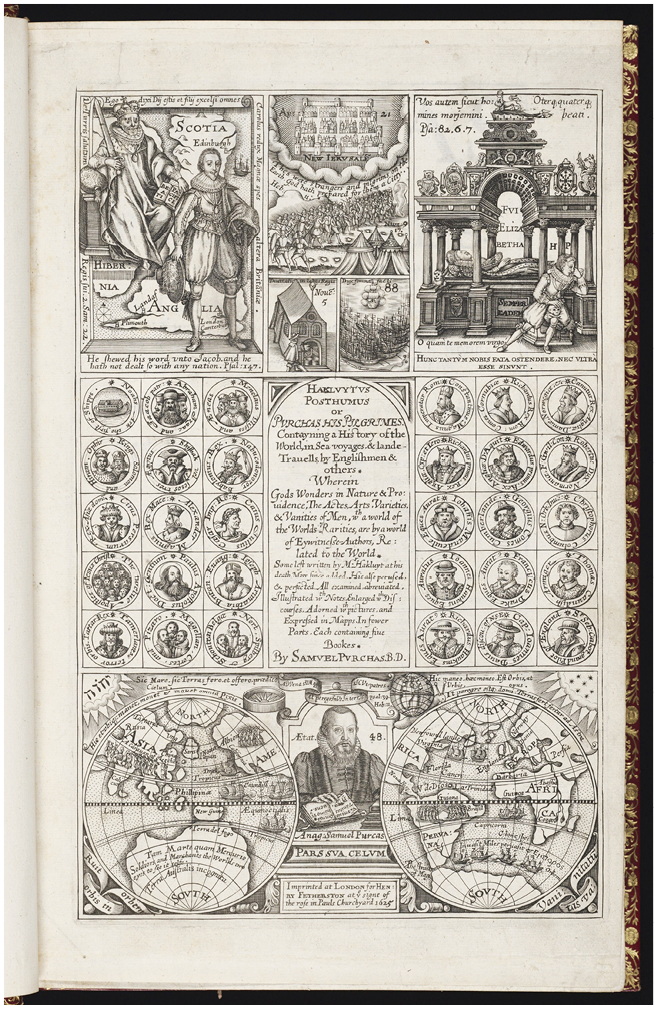
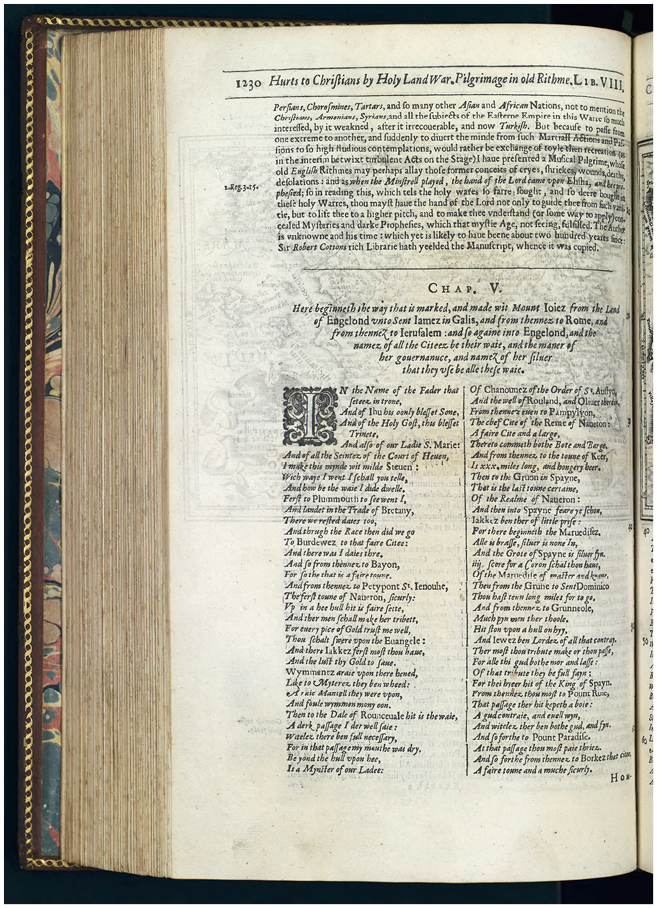
On 16 March 1852, the American naturalist and philosopher Henry David Thoreau was sitting in Gore Hall, then home of Harvard College Library. On his desk were the four volumes of the English Protestant cleric, editor and translator Samuel Purchas’s (1577–1626) final work, Hakluytus Posthumus or Purchas His Pilgrimes, published in 1625. Spanning over 4,000 folio pages, at the time of its publication Pilgrimes was the largest work ever seen through the English printing press and the result of Purchas’s accumulation over two decades of oral and written accounts of travellers who journeyed to and through Asia, Africa and the Americas. Writing in his diary later that day, Thoreau described how he felt perusing its contents:
When I looked into Purchas’s Pilgrims, it affected me like looking into an impassable swamp, ten feet deep with sphagnum, where the monarchs of the forest, covered with mosses and stretched along the ground, were making haste to become peat. Those old books suggested a certain fertility, an Ohio soil … for new literatures to spring in. I heard the bellowing of bullfrogs and the hum of mosquitoes reverberating through the thick embossed covers when I had closed the book.
When this passage has been quoted by scholars, it has largely been as a figure for the generative richness of the archive and the ‘fertility’ of ‘decayed literature’ forming the ‘richest of all soils’ for new writing (Pennington, Reference Pennington1997, Vol. 1, pp. 3–4). Nobody seems to have been much concerned with this aural image of Thoreau, sitting with the sound of bullfrogs and mosquitoes reverberating in his mind’s ear, seemingly coming from the books themselves.
Thoreau’s experience can be described as ‘audiation’, which, simply put, is the aural equivalent of imagination. Lucía Martínez Valdivia’s theorisation of audiation for early modern poetry (developing a concept coined by Edwin Gordon for music education in 1975) gives scholars a precise vocabulary for the reader’s dual role as both a ‘performer and listener’ in encounters with texts and for detecting the shifting interplay between these positions (Valdivia, Reference Valdivia2022, p. 567). Building on the work of Jennifer Richards (Reference Richards2019), who has persuasively argued that early modern books were fundamentally shaped by the sound of the human voice, Valdivia foregrounds the vocabulary of audiation to consider the sonic elements of texts that operated beyond vocalisation. Audiation, this Element contends, was also vital to the experience of reading travel narratives.
The central argument of this Element is that the epistemic value of hearing and listening (both physically perceived and audiated) is fundamental to early modern travel writing. That epistemic value can be described as acoustemology, which, as theorised by musician and ethnographer Steven Feld, fuses ‘acoustics’ and ‘epistemology’ to inquire into ‘what is knowable, and how it becomes known, through sound and listening’. Acoustemology frames listening not as passive reception but ‘knowing-in-action’ and a ‘knowing-with and knowing-through the audible’ that shapes how people apprehend and organise their worlds (Feld, Reference Feld, Novak and Sakakeeny2015, p. 12). Within that framework, audiation shows how acoustemological knowledge can be produced by reading; early modern travel narratives repeatedly present sounds as evidence, as catalysts of affect and as ways of organising information.
Listening to Early Modern Travel Writing demonstrates how travel writers and their editors were highly attuned to, and intentionally stimulated, the audiation of their readers. In his Itinerary (Reference Moryson1617), the English traveller Fynes Moryson (1565/6–1630) dwelt on the ‘delight’ he felt in hearing foreign sounds and lamented the plight of those who might never go abroad and were left to ‘heare the same voices and sounds beate in their eares’ (Vol. 3, p. 10). At the same time, he recognised that the majority of his readers would never leave England and to assist their imaginative journeys he filled his narratives with the sounds he encountered. By drawing attention to what they heard, travellers like Moryson and his contemporaries fashioned themselves as ‘earwitnesses’. Earwitnessing, as Keith Botelho explains, is ‘the sifting and distilling of information that comes to the ear’ and was vital to early modern constructions of informational authority (Botelho, Reference Botelho2009, p. 2). It was also endorsed in contemporary travel advice. As the Welsh travel writer James Howell (c. 1594–c. 1666) emphasised, a traveller should ‘alwaies have a Diary about him, when he is in motion of Journeys, to set downe what either his eares heare, or his Eyes meet’ (Howell, Reference Howell1650, p. 17).
By positioning sound and listening at the centre of travel writing, this Element sits at the intersection of three substantial bodies of scholarship. First, of course, it contributes to histories of travel writing and recent approaches to experience and embodiment. Melanie Ord’s focus on ‘textual experience’ explained how reading could function as a mode of mediated travel, capable of competing with and reshaping first-hand encounters (Ord, Reference Ord2008). Jonathan Sell similarly demonstrated that the embodied labour of travel itself was inextricable from its rhetorical preservation (Sell, Reference Sell2012). Most recently, Eva Johanna Holmberg has extended these approaches by treating travel accounts as forms of life writing, foregrounding travellers’ ‘inner worlds’, emotions and bodily self-presentation as central both to self-fashioning and to the making of credibility (Holmberg, Reference Holmberg2021; Holmberg, Reference Holmberg2024).
This Element builds on this work to show that such embodied claims to authority are also repeatedly articulated through sound, and Section 1 sets out the intellectual context for this acoustemological culture. Drawing on travel advice literature, known as ars apodemica, and travel narratives from Fynes Moryson, William Biddulph (fl. 1609), Henry Blount (1602–1682), and William Lithgow (1582–c. 1645), it shows how travel knowledge was framed as embodied and multisensory, and how hearing was central to the authorisation of experience. In doing so, the section builds on work by Elizabeth Swann (Reference Swann2020) and others on the epistemological importance of the whole sensorium and argues that a humanist, analogical impulse was not antithetical to emergent empiricism. Rather, the embodied labour of travel, and especially of disciplined hearing, became inextricable from its rhetorical preservation.
Second, this Element speaks directly to histories of embodiment and sensory history, and to recent efforts to de-centre sight in wider histories of mobility, colonialism and empire (see, e.g., Rotter, Reference Rotter2019). Feld’s work has particularly influenced recent pioneering scholarship on early modern cross-cultural interaction by musicologists and literary critics such as Olivia Bloechl and Jennifer Linhart Wood, who have approached past embodied experiences and contact zones through their auditory effects (Bloechl, Reference Bloechl2004). Wood’s recent work has particularly influenced this Element; Wood offers a distinctive reading of both early modern travel and dramatic texts to draw attention to the role of sound’s vibratory wave, which could undo the boundary between a listening subject and a sounding object, and argues that the theatre was the ‘laboratory in which the protocols for travel writing’s soundings of otherness were tested, rehearsed and complicated’ (Wood, Reference Wood2019, p. 50). Recent edited collections such as Daniela Hacke and Paul Musselwhite’s Empire of the Senses (Reference Hacke and Musselwhite2018) and Emily Wilbourne and Suzanne Cusick’s Acoustemologies in Contact (Reference Wilbourne and Cusick2021) have also demonstrated that early modern colonial projects were lived through particular ‘sensescapes’ and that listening practices helped to mediate subjectivity, sovereignty and alterity.
In centring how perception ‘organised and shaped representations of cultural encounters and foreign worlds’ (Hacke and Musselwhite, Reference Hacke and Musselwhite2018, p. 4), this Element focuses on the English travel texts preserved by Samuel Purchas in Pilgrimes and argues that they should be read as acoustic scripts: texts designed to make knowledge reproducible by training how readers listen. Their authority depended on disciplined listening, readers’ audiation and habits of comparative judgement. In this respect, the Element extends Jonathan Sterne’s (Reference Sterne2003) account of how nineteenth-century audio technologies (like the stethoscope and phonograph) helped stabilise hearing as a vehicle of objective knowledge, by tracing an earlier genealogy of the epistemic elevation of listening.
The hundreds of accounts compiled by Samuel Purchas offer an apt case study for this analysis. Purchas was well aware of the acoustic power of narrative, and with Pilgrimes intended to offer his readers the experiential rewards of global travel without its immediate bodily perils, even as he worked hard to manage the spiritual risks associated with reading about foreign rites, bodies and beliefs. He drew attention to the power of the written word for achieving this outcome by emphasising its ability to stimulate both eyes and ears together: ‘And whereas speech pierceth the Eare … Writing also entertaineth the Eyes; and so long, by our owne or others reading, speakes to either of those nobler Senses’ (Vol. 1, Book 1, p. 176).Footnote 1 As he had explained in his first independent work of speculative theology, Purchas his Pilgrim: Microcosmus, or the Historie of Man, the ears were the ‘Learning Sense’ (Purchas, Reference Purchas1619, p. 92):
Man is a learned Man by his EARE; Man is a religious and holy Man from hence: For the EYE usually is an impediment … but Faith … comes by hearing; and Christ, which dwells in the heart by faith, enters at the EARE. Moses begins the Law with Heare Israel; God promulgates the Gospell with, This is my beloved Sonne, heare him.
For Purchas, hearing was the privileged route to both knowledge and faith, and Pilgrimes was built on, and designed to exploit, this way of understanding sound and listening. It is, as this Element argues, a work that depended both upon travellers’ hearing and on embodied editorial labour to make its readers’ ears the medium of credible, godly knowledge.
Based on five years of reading the entirety of Pilgrimes and demonstrated through a close reading of a representative sample of texts from across each of Purchas’s four volumes, Section 2 traces how sound operates in these collected narratives across three main domains: the natural world, human others and the travellers themselves. By following sounds from the scene to their inscription on the page, and to their activation in readers’ audiating bodies, the section shows how listening practices were folded into regimes of nation, confession and race. At the same time, this section is attentive to friction and mishearing, and foregrounds scenes in which sonic meaning slips and where both travellers and their editor strain to contain acoustemological alternatives that their narratives nonetheless preserve.
Third, Listening to Early Modern Travel Writing intervenes in histories of reading and reception by developing recent scholarship that takes seriously the sound of writing and the embodied, audiating reader (Smith, Reference Smith2010; Richards, Reference Richards2019; Valdivia, Reference Valdivia2022). Reconstructing past experiences of embodied reading and audiation is not straightforward. Explicit testimony of the sort Thoreau provided in my opening example is rare. One early seventeenth-century reader, however, has left a sustained record of his engagement with travel texts: Samuel Purchas himself. His extensive prefaces, essays, marginalia, translation choices and selection strategies reveal not only his own embodied reception of travel narratives, but also how he intended others to hear his editorial project. Based on my reading of every single one of Purchas’s prefatory narratives, extended editorial commentaries and marginal comments across Pilgrimes, combined with a case study of Purchas’s translation of Jean de Léry’s Histoire d’un Voyage fait en la terre du Brésil (published in Pilgrimes, Vol. 4), Section 3 approaches the reception of travel writing in a double sense. It treats Purchas both as an audiating subject whose mind and body were moved by the materials he compiled, and as an editor who consciously managed his readers’ sensory and affective experiences. It examines how he presented his own labouring body as guarantor of authenticity; how he managed his readers’ bodies through abridgement, selection and sonic ‘interludes’; and how he staged travellers’ bodies as actors on an ‘open Theatre’, whose knowledge is appropriated.
In doing so, this Element responds to the standard scholarly narrative in which Purchas still stands somewhat in Richard Hakluyt’s (1553–1616) shadow.Footnote 2 In the Purchas Handbook from 1997 (which remains the most sustained account of his life and work), Carol Urness challenged the caricature of Purchas as a careless mutilator of texts and urged that his stated principles of abridgement should be taken as the basis for further research (Urness, Reference Urness and Pennington1997). This Element takes up that invitation. It treats Pilgrimes as an ambitious editorial performance that mediated between travelling and reading bodies, and that uses sound as one of its criteria for arranging and annotating the global archive. It reads Pilgrimes not simply as a repository that scholars can mine for information about individual travellers and their voyages, but as an instrument for training early modern readers’ bodies and imaginations.
The significance of that project is suggested by the work’s subsequent circulation. Although Pilgrimes was not reprinted until the early twentieth century, it continued to be read, excerpted and reused across the seventeenth century. Loren Pennington has traced the debt of later travel writers to Purchas, noting, for example, that Luke Foxe prefaced his 1635 Northwest Passage narrative with extracts from Pilgrimes, and that John Milton drew heavily on Volume 3 for his Brief History of Moscovia (Pennington, Vol. 1, Reference Pennington1997, pp. 6; 9–10). John Ogilby also engaged with Purchas’s editorial discussion in the first volume of Pilgrimes, ‘Of America, whether it were then peopled’, in his own America (Reference Ogilby1671, pp. 11–13). Benjamin Worsley, mentor to Robert Boyle, also praised the possibilities that Purchas’s compilations offered as a model for systematic natural history (Rovira, Reference Rovira2023, p. 211), while the compiler of British Library Harley MS 6494 excerpted Pilgrimes extensively in manuscript – particularly sections on the natural world (Armstrong, Reference Armstrong2014). The work also travelled overseas. The 1638 estate inventory of the merchant John Kynnaston at Aleppo lists a copy of ‘Purchas’s Pilgrims’, and Alison Games has also noted that trading companies supplied Hakluyt and Purchas to merchants abroad (Games, Reference Games2008, p. 113). Pilgrimes, then, moved through literary, scholarly and commercial settings substantial enough to make Purchas’s efforts to train readers’ perceptions historically consequential.
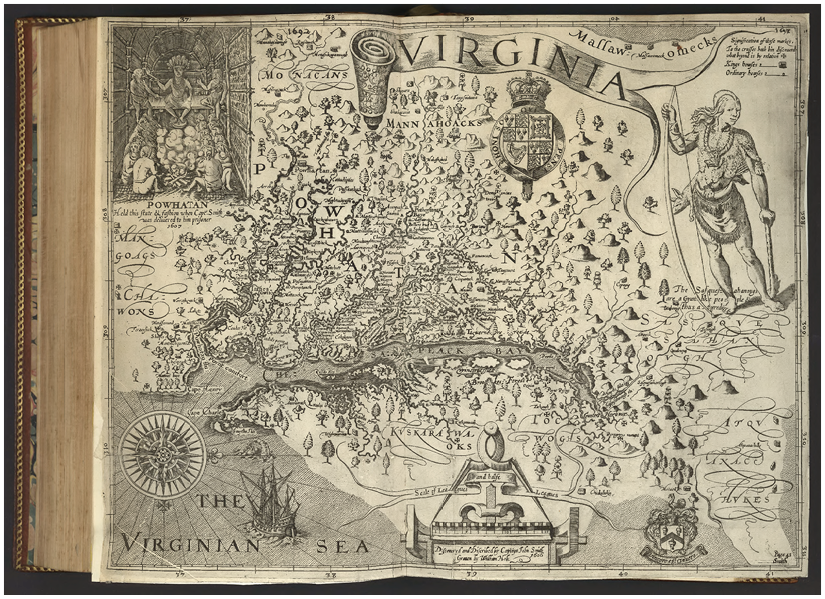
This training, I argue, was particularly aimed at fostering an English imperial imaginary in which claims to dominion were articulated through bodies and senses. I have dubbed this ‘embodied empire’ to describe the way in which hearing, feeling and suffering became ways of naturalising English Protestant authority over others. The Epilogue makes this explicit by turning to Purchas’s treatise ‘Virginias Verger’, which comes in the closing pages of Pilgrimes, and considers how Purchas’s sensory and bodily language underwrites his vision of plantation and tenure. It suggests that the corporeal rhetoric that pervaded travel accounts and Purchas’s editorial practices also naturalised hierarchies in which white, Protestant, literate bodies are authorised to hear, judge and command, while other bodies are plotted as servile, expendable or legitimately dispossessed.
This Element therefore begins with sound, but it does not end at the ear. Early moderns understood sensory experience as operating within an integrated body–soul–spirit model (as opposed to later dualistic separations of mind and body) and this understanding was rooted in a physiology where sensory perception was intricately linked to the body’s fluid systems. Sound was a material force that could penetrate the body; it could directly alter the flow of humours and agitate the vital spirits (Varwig, Reference Varwig2023). Hearing, put simply, was a ‘whole-body’ experience (Smith, Reference 78Smith and Erlmann2004, p. 37). By tracing how sounds travelled from scene to page to reader, therefore, Listening to Early Modern Travel Writing argues that early modern acoustemologies cannot be fully understood without attending to the bodies that hear, record and are governed through them. To understand how English Protestant empire imagined itself into being, we must attend not only to what early modern travellers saw, but to what they heard, and to how those sounds were made to reverberate in the minds and bodies of readers at home.
1 Earwitnessing and the Authentication of Experience
1.1 Knowledge and Experience
In his oration on the benefits of travel, the German humanist Hermann Kirchner (1562–1620) explained how the human body had been created by God to travel the world and observe the ‘admirable workmanship of nature in the heaven, earth, and sea’. The senses, he wrote (Kirchnerus, Reference Kirchnerus and Coryate1611, sigs. C4r-v. My emphasis):
were given unto us that we might survey and contemplate all these things … these feete, these ankles, these motions, and of running were graunted unto us, that we might goe unto and seeke for the most remote places: these handes, these fingers, these sinews were given unto us that we might touch and feele the miracles of the Omnipotent.
Kirchner’s image of the mobile, sentient and purposeful body reflects a widespread belief that travelling abroad was a vital means of acquiring knowledge, which, from the sixteenth century, was increasingly codified within the formalised genre of advice literature known as ars apodemica or the ‘art of travel’. Aimed at young men, apodemic texts offered practical guidance, and shaped how travellers should perceive the world, what forms of evidence to trust, and how to turn experience into credible knowledge. Widely read by prospective travellers, this literature influenced both how people travelled and how they later narrated their journeys; in many cases, travellers not only absorbed apodemic advice but authored such texts themselves, reinforcing the authority of experience – derived from the entire sensorium – as a source of knowledge within the genre. Read heuristically through Bruno Latour’s claim that to have a body is to ‘learn to be affected’, ars apodemica appears as a pedagogy for cultivating sensitivities and rendering perception articulable (Latour, Reference Latour2004, p. 205). This pairing underlines experience as an embodied mode of knowing and a process by which world and body come together through training and encounter. It is the conception and function of experience within these apodemic texts, and in travel writing, that forms the focus of this section.
These texts were written during a period characterised by a profound expansion of European engagement with the wider world. From the late fifteenth century, global exploration, trade, and colonisation generated an unprecedented flood of new information. Reports of flora, fauna and entire civilisations not mentioned in classical texts or the Bible forced readers to confront the limits of the knowledge that they had inherited from antiquity. At the same time, cosmological upheavals prompted by Copernicus’s De revolutionibus orbium coelestium (1543) altered European comprehension of the entire universe, as his heliocentric model (sun at the centre) replaced the long-dominant geocentric model (earth at the centre) and undermined Christendom’s interpretation of creation. New geographical and proto-ethnographic knowledge was therefore produced and consumed with an urgency that reflected the religious, political, commercial and colonial concerns of European elites, and by those that served their interests.
By the seventeenth century, the authority of personal experience and observation had become central to these transformations. This is exemplified in Francis Bacon’s Novum Organum (1620), which championed inductive reasoning and empiricism over traditional scholasticism. Travel writing, grounded in personal witnessing, was particularly suited to these new cultures of information. Scholars such as Gerald Maclean (Reference MacLean, Das and Youngs2019) and Joan-Pau Rubiés (Reference Hulme, Youngs, Hulme and Youngs2002) have argued that travel accounts became key sites for empirical enquiry, and Peter Hulme and Tim Youngs have even suggested that it was travel writing, as the primary means of disseminating new forms of global knowledge, which laid the very foundations for the scientific and philosophical revolutions of the seventeenth century (Hulme and Youngs, Reference Hulme, Youngs, Hulme and Youngs2002, p. 4).
This emphasis on first-hand observation was traditionally framed in visualist terms, with historians such as Lucien Febvre treating sight as the ‘intellectual sense par excellence’ (Febvre, Reference Febvre1982, p. 428). The argument that early modern European culture developed a bias toward vision at the expense of other sensory experiences remains influential. New technologies like the printing press, the telescope and the microscope have been credited with reshaping how the West imagined the world (see, e.g., McLuhan, Reference McLuhan1962 and Wilson, Reference Wilson1995).Footnote 3 Much scholarship on early modern travel writing has also largely focused on the genre’s role as the ‘domain of the eyewitness’ (Netzloff, Reference Netzloff2020, p. 53) in recognition of the ways travellers articulated their credibility as contributors to new forms of geographical and proto-ethnographic knowledge.Footnote 4
It should be stressed, of course, that travel writing in the age of print did not somehow overthrow all forms of inherited knowledge. As scholars such as Anthony Grafton have shown, the shift from textual to experiential knowledge was neither linear nor absolute (Grafton, Reference Grafton1991; see also Grafton, Reference Grafton1992; Pomata and Siraisi, Reference Pomata and Siraisi2005). Scholastic traditions and classical rhetoric continued to shape how travellers recorded their encounters. Natalya Din-Kariuki, for example, has demonstrated that rhetorical invention remained central to seventeenth-century English travel writing, complicating narratives of a straightforward empirical turn, and claims that humanism and empiricism were somehow oppositional (Din-Kariuki, Reference Din-Kariuki2018). Moreover, while first-hand experience and personal witnessing emerged as a new authoritative standard in early modern society and culture, this experience had multiple and complex meanings (see, e.g., Hellawell, Reference 75Hellawell2019). The authority of this experience (based on the perception of an individual’s credibility) also derived from much more than just what travellers said they observed with their eyes.
As many recent scholars have shown, all the senses (which early moderns figured as the ‘higher senses’ of sight and hearing, and the ‘lower senses’ of taste, smell and touch) had great intellectual and epistemological significance in this period. Holly Dugan (Reference Dugan2011) and Will Tullett (Reference Tullett2021), for example, have established the significance of smell to forms of social, religious, medical and commercial knowledge. Elizabeth Swann (Reference Swann2020) has demonstrated the centrality of taste to literary, spiritual, experimental and intersubjective knowledge. Viktoria von Hoffmann (Reference Von Hoffmann2022) has articulated the way that haptic epistemologies were at the heart of both religious and medical understanding of the body, and, in the history of science, Andrés Vélez-Posada and Gregorio Saldarriaga (Reference 79Vélez-Posada and Saldarriaga2022) have shown how taste and smell were both used in the examination of minerals, particularly metals, in the early modern Spanish world. In the context of travel writing, contributors to the recent Routledge Research Companion to Travel Writing (Pettinger and Youngs, Reference 77Pettinger and Youngs2020) have also drawn attention to the ways that evidence from the entire sensorium connotes more than just straightforward descriptive detail in modern and contemporary travel writing, and could demarcate differences, as well as similarities, between peoples.
Eva Johanna Holmberg’s recent Element in this series, Writing Mobile Lives, has made an important intervention in this field for the early modern period by explaining how sensory and embodied experiences, particularly of illness and grief, shaped travel, and were vital to ‘commemorative impulses and aims of self-description’ in the texts they produced (Holmberg, Reference Holmberg2024, p. 11). Building on this work, this section demonstrates how the acquisition and authorisation of knowledge was reliant on widespread forms of sensory and embodied experiences, particularly hearing, as much as it was on sight. Although, as I explain in Section 1.3, there does occasionally appear to be a visualist bias in the ways that individuals recorded their experiences, this was not at the expense of the other senses. Instead, reference to ‘seeing’ and ‘observing’ was understood by early moderns as both a multisensory and intersensory experience. Moreover, the authority of travel narratives was not solely derived from personal sensory encounters but also from textual sensory witnesses – earlier accounts that reinforced the credibility of the traveller’s claims.
1.2 Teaching the Ear to Hear
Knowledge was understood by early modern travellers, and their editors, not as passively acquired but as actively constructed through the senses. As Samuel Purchas explained (Vol. 1, Book 1, p. 176):
GOD the giver of every good gift, hath endowed Man (created after his owne Image) with divers priviledges above other sensitive Creatures, not onely with dominion over them, but with Reason and Speech … By the one he composeth naturall syllogismes in himselfe … of those things, which the externall Senses, as the Cinque-Port-Intelligencers have brought in, and the Internall, the Common sense, Phantasie, and Memory, as Reasons handmaids have prepared to Discourse. By the other, as a Sociable creature, hee imparteth those Mind-conceptions unto other men, and those which are many persons, are made as it were one body reasonable.
Purchas represented the senses as ‘intelligencers’ and agents tasked with gathering information from the external world and delivering it to the internal faculties of the mind: common sense, ‘phantasie’ (from the Greek phantasia, often translated as ‘imagination’, but best understood as the mental representation of sensory experiences broadly) and memory. After processing, this information was then related to others, imparting the individual’s ‘mind-conceptions’ until the ideas formed collectively into ‘one body’ of shared knowledge. Purchas’s invocation of the Cinque Ports (the historic confederation of English coastal towns – Hastings, New Romney, Hythe, Dover and Sandwich, which facilitated trade and military defence, as well as safeguarding England’s physical borders) underscores how sensory perception was both an individual and a national concern. Travel was not merely a personal pursuit but an act of intellectual and political significance that could enrich both the traveller and the English body politic.
To enrich the body politic of states as well as the minds and bodies of individual travellers, the question of how best to observe and record the knowledge acquired through travel became an increasing preoccupation across early modern Europe. The resulting literary tradition of ars apodemica was shaped by humanist endeavours to formalise and refine travel to emphasise its moral, educational and practical benefits.Footnote 5 These works were written in order ‘to teach Europeans how to see the world’ (Rubiés, Reference Rubiés1996, p. 140. My emphasis). It was also a genre that instructed Europeans how to hear the world and experience it through all their senses.
First-hand sensory experience was widely valorised in apodemic writing. In 1592, Sir John Stradling’s translation of Justus Lipsius’s Direction for Travailers, dedicated to the Earl of Bedford, stressed that the entirety of the young Earl’s ‘senses’ would be ‘greatly affected, and marvellously delighted’ through the experience of travel (Stradling, Reference Stradling1592, sig.Br). In 1617, Fynes Moryson had also emphasised ‘the delight of visiting forraigne Countreys, charming all our sences with most sweet variety’ (Moryson, Reference Moryson1617, Vol. 3, p. 10). Yet with such charms and delights came anxieties over the dangers to English bodies through both misperception and overindulgence. The Protestant Robert Dallington (1561–1637) stressed the need ‘to beware how he heare any thing repugnant to his religion’ and to ‘stop his eares, least they be open to the smooth incantations of an insinuating seducer, or the suttle arguments of a sophisticall adversarie’. Dallington explicitly forbade travellers from consorting with Jesuits, although other monks or friars were often ‘good companions’ for language learning or other local knowledge (Dallington, Reference Dallington1598, sigs. B2r-v). Moryson also advised travellers to guard against sensory excesses, including bad smells aboard ships: ‘[H]ee may in Summer carry red Roses, or the dried leaves thereof, Lemmons, Oranges, and like things of good odour, and in Winter hee may carry the roote or leaves of Angelica, Cloves, Rosemary, and the foresaid Lemmons, Oranges, and Rose leaves’ (Moryson, Reference Moryson1617, Vol. 3, p. 23). Collectively, this was part of a broader strategy of moderation and self-discipline. For example, although ‘sharpe sences, subtill wits, [and] curious behaviour’ were ‘nice properties’, Moryson continued, ‘savouring of either extreme, are to be accounted among the owners calamities, and that a certaine dulnesse (in some meane, not in extremity) doth give the owner great ease and quietnesse’. Tempering the senses was advised to avoid causing offence or other ‘calamities’ (Moryson, Reference Moryson1617, Vol. 3, p. 35).
This emphasis on tempering sensory experiences reflected a broader preoccupation with how travellers processed and transmitted the knowledge they acquired. While hearing was understood as an essential means of gathering information, travel advice literature cautioned that not all auditory knowledge carried the same weight. A distinction was frequently drawn between knowledge gained through direct observation and that obtained through hearsay, requiring travellers to assess the credibility of what they heard. The German humanist Jerome Turler (1550–1602), for example, framed his discussion of travel in explicitly Aristotelian terms, arguing that it was the ‘peculier nature of mankind to be evermore desirous of knowlege, and never to bée contented with one thing only, whether that knowledge come by hearinge or séeinge, for man hath these sences whereby he attayneth skill’. However, he stressed: ‘Yea they are of greater force and efficacie, and are more firmely reteyned in memorie which wée se before our eies: then the report or only hearesay of any thinge’ (Turler, Reference Turler1575, pp. 112–113).
Yet this did not mean that the knowledge acquired from reports or hearsay had no significance at all, as Samuel Purchas explained in Microcosmus (Purchas, Reference Purchas1619, p. 94):
The EYE … seeth onely things present; the EARE, by Tradition of Fathers to their children, receives the wisedome of our Fore-fathers, and of those that are furthest remote both in time and place from us: and by Speech, and Writing (a visible Speech) the Learning of the World is continued, from the first Man to the last; and this short age of Man is by the Eare, in manner, made immortall.
Here, Purchas not only affirmed the value of hearing but reconfigured writing itself as an auditory phenomenon and ‘a visible speech’. The formulation recognised that knowledge itself was reliant on aural testimony passed down across generations and it was by the ear that humanity was immortalised via the written record.
The knowledge derived from travel, therefore, was to be shared to ensure the ‘Learning of the World’ continued. Apodemic treatises, like that by James Howell, stressed that travellers should carefully record what they observed, particularly what ‘either his eares heare, or his Eyes meet’ (Howell, Reference Howell1650, p. 17. My emphasis). Notes should be made by travellers every day on their journeys, as Moryson had explained: ‘at morne and at even in his Inne, within writing Tables carried about him, and after at leasure into a paper booke, that many yeers after he may looke over them at his pleasure’. Nothing ‘worth the knowledge’ should pass the traveller’s ‘eyes or eares’ without being recorded for posterity (Moryson, Reference Moryson1617, Vol. 3, p. 12). These notes should be taken within carefully defined analytical categories that generally included physical and human geography; government and political history; people (including religious beliefs and practices); along with an account of the traveller’s personal journey and its various circumstances (Rubiés, Reference Rubiés1996). These categories had been carefully outlined by apodemic writers like Albrecht Meier, whose pamphlet Methodus describendi regiones was translated into English by Philip Jones in 1589. As Jones had stressed in his dedicatory epistle to Sir Francis Drake, some ‘by passing the seas, change ayres but not mindes, returning with brains nothing better’. Yet by the ‘reading, portage, and practise of this pamphlet of notes … the thicke mistes of ignorance, and harde conception will soone be scattered, and the same converted into a quicke sight, and illumination of the senses’ (Jones, Reference 72Meierus and Jones1589, A2v–A3r).
1.3 Reliable Earwitnesses
Such disciplined observation was intended not only to refine the traveller’s senses, but to enable him to return as a credible authority and someone whose direct experience would be trusted. A central function of early modern travel writing was therefore to communicate such first-hand knowledge convincingly. Credibility and truth have been the focus of much historiographical conversation in recent decades. Steven Shapin’s thesis that social hierarchy was vital in how truth claims were made and determined has been particularly influential (Shapin, Reference Shapin1994). However, in the case of travel accounts, as Julia Schleck has argued, as ‘critical as the social hierarchy was, it did not always determine the form in which truth claims were made, nor the ultimate allocation of credit to a particular tale’ (Schleck, Reference Schleck and Hayden2012, p. 55). By following apodemic advice, and drawing attention to what they saw and heard, travellers fashioned themselves in their accounts as both eye and ‘earwitnesses’. Fynes Moryson referred to himself explicitly as an ‘eye and eare witnes’ in his Itinerary’s prefatory address to William Herbert, Earl of Pembroke (Moryson, Reference Moryson1617). His reputation as both an ‘eye and eare-witnesse’ was also acknowledged by his later readers, highlighting the importance of sensory testimony in shaping a traveller’s authority (Kellett, Reference Kellett1635, p. 30).
By preserving what their ears heard, travellers supported their truth claims as part of the early modern information economy. Travellers routinely drew attention to their credible earwitness testimony and made statements throughout their narratives such as: ‘myselfe with these eares have heard’ (Moryson, c. Reference Moryson1626, p. 1096); ‘oft have I heard’ (Lithgow, Reference Lithgow1640, p. 76); or ‘we heard’ (Vol. 1, Book 1, p. 78).Footnote 6 These statements signalled direct engagement with auditory knowledge and served as markers of experiential authority. Travel writers also frequently addressed their readers with directives such as ‘as you shal afterwards heare’, which was employed in anticipation of their readers’ acoustic experience of their texts.Footnote 7 Indeed, the regular employment of ‘you have heard’ as a rhetorical device in early modern literature made plain that writers viewed their works not as silent artefacts but as ‘instruments for the conveyance of their authorial voice to a public which in turn was conceived of as an audience’ (Woolf, Reference Woolf1986, p. 160).Footnote 8 To ‘observe’, for armchair and actual travellers alike, was firmly understood as an acoustic and embodied activity as much as an ocular one.
By drawing attention to what they heard and saw, individual travel writers elevated sight and hearing due to their association with the ‘higher senses’ in early modern scientific discourse. This was not merely a rhetorical strategy for reinforcing credibility; rather, the reality was (and is) that the senses worked (and work) together. This is particularly stark when travellers referred to ‘seeing’ and ‘eyewitnessing’ when they were actually referring to the knowledge obtained through the other senses. A notable example appears in the travel writings of Henry Blount, who in 1634 conducted an experiment while travelling through the Balkans. In Zemun (present-day Belgrade, Serbia) Blount was told ‘two rarities’ about the confluence of the Danube and Sava rivers, which through ‘his owne experience, found true’. The first rarity was confirmed through acoustic observation, testing the claim that at midday and midnight the stream ran more slowly than at other times. Blount confirmed this by listening to the rhythm of the ‘noyse of those Boat-milles, whereof there are about twentie, like those upon the Rhoane at Lyons; their clakkers beate much slower, at those times then else, which argues like difference in the motion of the wheele’. The second experiment tested the claim that ‘where those two great currents meete, their waters mingle no more then water, and oyle … but joyne unmixed’. Blount described how he went out on a boat to the middle of the river ‘and tasted of the Danuby as cleare, and pure as a well, then putting my hand not an inch further, I have taken of the Sava as troubled as a streete channell, tasting the gravel in my teeth’.Footnote 9 Despite relying on multiple senses of hearing, taste, and touch, Blount concluded his account by asserting that he had been an ‘eye-witnesse thereof’ (Blount, Reference Blount1636, pp. 9–10).
By emphasising his role as an eyewitness, Blount’s testimony accorded with contemporary understanding of sight as ‘first in the order of knowing’ (Clark, Reference Clark2007, p. 9). However, Blount had employed numerous forms of sensory evidence to discern whether what he had been told was true or not. This exemplified the common rhetorical position, maintained since antiquity, ‘to think of perception as a visual process, whatever the particular source of data’ (Clark, Reference Clark2007, p. 10). As Stuart Clark has argued, anxieties about the eye and the evidence it could provide were persistent throughout the period and evidence should, therefore, be derived from the whole sensorium to support knowledge claims, and caution and discernment were paramount.
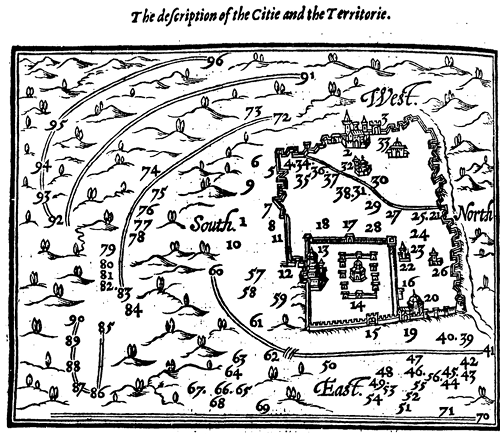
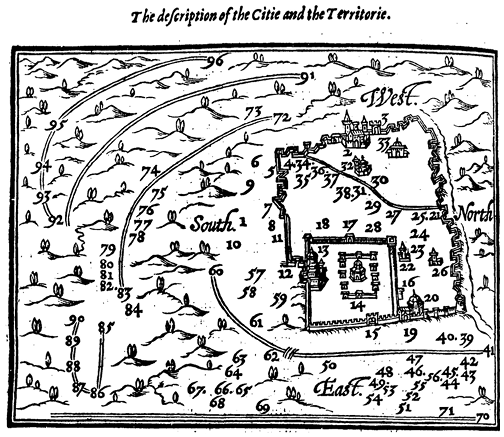
Early modern travel writing frequently applied the humanist insistence on caution and discernment when making claims, and this extended to the evidence from their ears. Travellers often demonstrated their critical engagement with what they heard by openly questioning certain claims or signalling scepticism to their readers. The travels of both Fynes Moryson in 1596 and William Biddulph in 1601 to Jerusalem illustrate this process. Both stayed at the Monastery of Franciscan Friars on Mount Calvary and were given a tour of Jerusalem’s major monuments and its environs with their Catholic hosts as guides. Moryson detailed 100 points (with a map for reference, see Figure 1) of all the things he was told, and drew attention in point 22, for example, to the house of Pontius Pilate, where the Turkish military governor was living: ‘The Fryars say that in this house are heard noises, whippings, and sighes, nightly to this very time, and each man the more superstitious he is, the more incredible things he tels thereof’ (Moryson, Reference Moryson1617, Vol. 1, p. 221). Moryson made plain his disbelief and firmly discredited his Catholic guide as superstitious. At the same time, by recounting this story and drawing attention to the supernatural sounds supposedly heard ‘nightly to this very time’, Moryson reinforced an auditory connection between the current Turkish governor and the biblical governor and executioner of Christ. Thus, even as he rejected the friars’ testimony, he strategically retained the auditory imagery for his Protestant audience.
Moryson’s map of the key sites he was shown in Jerusalem. Itinerary, Vol. 1, p. 220.
Biddulph was even more explicit in his framework for assessing credibility, and grouped the information he received into three distinct categories: ‘[W]ee had our guide with us, who had dwelt there fourteen yeeres, and shewed us all such places as are worthy viewing or visiting … and we gave him the hearing of all, but did not beleeve all, for they seemed to me to be of three sorts. 1 Either apparant Truths. 2 Manifest Untruths. 3 Or things Doubtfull’ (Biddulph, Reference Biddulph1609, p. 123). Biddulph confirmed the ‘apparant truths’ spoken by the friars because either he and his companions had personal experience of what was being said, explaining ‘we there saw and heard’, or it was supported by scripture (Biddulph, Reference Biddulph1609, p. 130). Things ‘doubtfull’ were ‘other things’ on which ‘man may suspend his judgement whether they be true or false, untill he either sée them, or receive further confirmation by reading, than he can by the affirmations of some few superstitious persons’ (Biddulph, Reference Biddulph1609, p. 140). The manifest untruths were rejected outright by Biddulph as ‘false and ridiculous’ usually because there was no scriptural precedent. For example, the friars had said that at the place of Christ’s birth (formerly a stable in Bethlehem but ‘now a beautifull place made of stone’) the star had fallen through the roof of the house, but Biddulph made the comment that scripture ‘saith, not that it fell downe, but stood over the place where the babe was’ (Biddulph, Reference Biddulph1609, p. 131). Thus, Biddulph presented himself as a reliable, discerning earwitness to testimony and, supported by a plethora of biblical references, a reliable Protestant one at that.
1.4 Textual Earwitnesses
As well as using firsthand sensory experience to authenticate their accounts, early modern travellers often reinforced their eye- and earwitness testimony by citing scripture and other written authorities. Although apodemic texts clearly distinguished between the value of hearsay or ‘book-knowledge’, and first-hand experience, these two forms of knowledge were not mutually exclusive. As Natalya Din-Kariuki has argued, travellers ‘frequently set textual witnesses … within records of their own eye-witnessing’, blending personal testimony with inherited knowledge to enhance credibility (Din-Kariuki, Reference Din-Kariuki2018, p. 25). Henry Blount’s description of drinking coffee, as Din-Kariuki notes, is presented as his own experience and ‘based on his own seeing and tasting’ but was an amalgamation of earlier accounts by Francis Bacon and George Sandys (1578–1644), supplying particulars on which other observers could draw (Din-Kariuki, Reference Din-Kariuki2018, pp. 104–110). A similar process occurred with earwitness testimony. Travellers frequently incorporated earlier descriptions of sounds, chants and spoken words into their own narratives, using these inherited sonic scripts as a form of textual earwitnessing that stabilised their own listening and instructed readers how to interpret it.
One instance appears in William Lithgow’s account of Islamic ritual from the summer of 1611, when he was residing with the English ambassador in Constantinople (Lithgow, Reference Lithgow1640, pp. 142–143):
In signe of reverence, and in a superstitious devotion, before they goe into their Mosquées, they wash themselves in a Lavatoire, beginning at the privy members, next their mouthes, faces, féet and handes: And entring, they incline their heads downeward to the earth; and falling on their knées, doe kisse the ground thrée times. Then the Talasumany, which is the chiefe Priest, mounteth upon a high stone where hee maketh many Orations to Mahomet: and the rest to assist him, continue a long time shaking their heads, as though they were out of all their naturall understanding, repeating oft this word Haylamo, Haylamo; and after that will sigh grievously, saying, Houpek. And somtimes will abruptly sing the Psalmes of David in the Arabick tongue, but to no sense, nor veritie of the Scriptures.
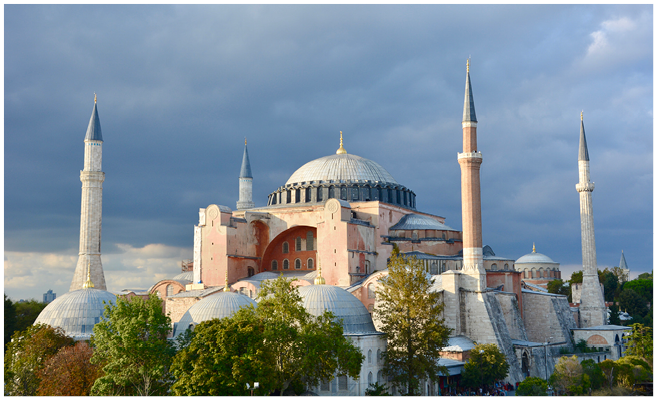
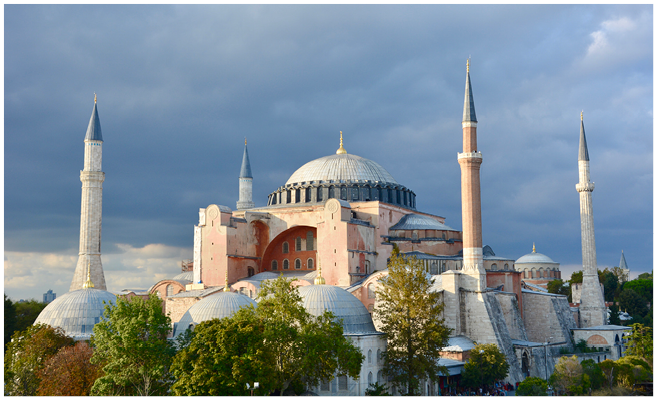
Lithgow’s phonetic transcription of the sounds from inside the mosque (potentially the Hagia Sophia, see Figure 2) appears to be an attempt to record an unfamiliar auditory experience.Footnote 10 Yet, crucially, Lithgow was not solely a direct earwitness in this instance because his description is almost identical to that of the French Catholic traveller Jacques de Villamont (1558–1628?) who had recorded a similar scene in Lebanon decades earlier (Villamont, Reference Villamont1609, pp. 169–170). Rather than a spontaneous personal observation, Lithgow’s account was therefore filtered through a textual earwitness.
Hagia Sophia, Istanbul.
The inclusion of such sonic traces reinforced the sense of the travellers having ‘been there’, on which their credibility was dependent (Carey, Reference Carey2019). The repetitive chant, the heavy sigh of prayer and the singing are all used to emphasise religious and cultural difference. The men at prayer are presented as ‘out of all natural understanding’, a claim which undermined their devotions as both mechanical and excessive, and by implication idolatrous. Even when the sound was translated into a familiar Christian framework and glossed as the ‘psalmes of David in the Arabick tongue’ (despite this almost certainly not being the case), it is then immediately rejected as alien: ‘to no sense, nor veritie of the scriptures’. Together this served to perpetuate European Christian superiority to their readers and reinforced the idea that Islam was, at best, a distorted imitation of the ‘true faith’.
This portrayal of Islamic devotion as simultaneously excessive and empty of true meaning played into broader European anxieties about the sensory, and sensual, excesses of non-Christian worship and practices. This was made particularly stark in this account, which began with the claim that the ritual ablutions of the wudu (pre-prayer purification) included washing the ‘privy members’. This was a deliberate distortion that primed the reader from the outset to view the ritual as improperly carnal. This priming was then fully activated by transcribing the sounds of prayer phonetically to encourage European readers to voice the foreign syllables while marking them as nonsense.Footnote 11 The strategy heightened the exoticism of the scene whilst positioning the European observer as both rational and literate, and able to translate the unfamiliar into textual and aural form.
This implicit assumption of European aural superiority was made explicit in other contexts. ‘What eares but European’, Purchas exclaimed in the opening pages of Pilgrimes, ‘have heard so many musical inventions for the chamber, the field the church?’ (Vol. 1, Book 1, p. 93). Purchas framed European auditory experience as uniquely refined and aligned musical sophistication with civilisational superiority. Here Purchas makes explicit the hierarchy that underwrote Lithgow’s description. Hearing was not a neutral channel of knowledge but a ranked faculty through which religious difference was apprehended and evaluated. These hierarchies were asserted through claims of experience and were also sustained through inherited authorities that supplied travellers with ready-made acoustic topoi.
The myth of the Catadupi offers a significant example of how book-knowledge encoded difference through auditory hierarchies. In Cicero’s Somnium Scipionis, the Roman general Scipio Aemilianus is transported to the heavens and is told by his grandfather Scipio Africanus that the ‘Harmony of the Spheres’ remains imperceptible to humans, who, ‘filled with this sound, have become deaf to it’ (Cicero ed. Keyes, 2014, p. 273). Africanus likens this to the people of Catadupa, living near the Nile cataracts, who allegedly lost their hearing from the roar of the falls. This passage generated an enduring belief that those dwelling near the Nile were physically deafened by their environment. The myth circulated widely in early modern Europe and appeared in at least forty different English texts printed between 1555 and 1640, spanning satire, moral philosophy, and drama.Footnote 12 Henry Peacham, in his Merry Discourse of Meum and Tuum, evoked the image to describe the cacophony of watermen on the Thames, noting that their ‘thunder of severall tones’ was ‘able to make a man more deafe then the Cataracts of Nilus’ (Peacham, Reference Peacham1639, p. 17). Lifted from Cicero, the Catadupi thus became a portable reference point that could be deployed far from the Nile.
The topos functioned as an inherited authority, part of what Purchas described as the ‘wisedome of our Fore-fathers’, within travel narratives. When William Bedwell (c. 1561–1632) translated Ortelius’s Theatrum Orbis Terrarum into English in 1606, he added a reference to the Catadupi on the reverse of the Map of Egypt, claiming the ‘nere inhabitants thereabout … are all deafe or very thicke of hearing’ (Bedwell, Reference Bedwell1606, p. xxxi). Lithgow and Biddulph similarly invoked the myth in their descriptions of distant landscapes, aligning their accounts with classical authority through a recognisable auditory claim (Lithgow, Reference Lithgow1640, p. 318; Biddulph, Reference Biddulph1609, p. 129).
Beyond a geographical curiosity, from the early seventeenth century the Catadupi increasingly became a potent metaphor for moral and spiritual degeneracy. From the pulpits and the presses, the deafness of the Catadupi was wielded as a warning to others. Preachers frequently referred to spiritual deafness to describe those who listened to sermons without inward understanding (Oates, Reference Oates2022) and the Catadupi became a recurring trope. Robert Cawdray’s (1537–1604) manual of godly rhetoric A Treasurie or Store-house of Similes included the Catadupi as a warning against ‘dull hearers’ of the ‘Word of God’ (Cawdray, Reference Cawdray1600, sig. A6v; p. 802). The image was deployed by Magdalen College chaplain Richard Jefferay in his sermon at St Paul’s Cross on 7 October 1604 (Jefferay, Reference Jefferay1605, p. 40) and it can be found in William Leigh’s (1550–1639) first sermon on ‘the dreadfull day dolorous to the wicked’, printed in 1610 (Leigh, Reference Leigh1610, pp. 90–91). As the period progressed the image of the Catadupi, sitting in darkness and inextricably tainted by wickedness, became increasingly widespread. On 8 September 1634 Henry Valentine (d.1643) declared that the ‘invincible and incorrigible wickednesse of our hearts’ was ‘like the Catadupi continually hearing the falls of the Nilus’, who ‘grow deafe and heare nothing’ (Valentine, Reference Valentine1635, p. 51). Within this auditory theology, spiritual insensibility was figured as literal, external deafness and projected onto a distant people and naturalised as their condition.
This moralised acoustics inflects travel accounts in which Nile dwellers are drawn into a repertoire already thick with connotations of darkness and degeneracy. In Richard Eden’s (1520–1576) translation of Peter Martyr’s (1499–1562) Decades of the New World, when Andreas Moralis was wandering in ‘darkeness’ on the island of Hispaniola, the ‘violence’ of the falls of water was compared with the ‘faule of the famous river of Nilus’ (Martyr, Reference Martyr1555, p. 129). This description of Hispaniola was echoed and enhanced by Samuel Purchas in His Pilgrimage (Reference Purchas1613, p. 742): ‘Cloudes, engendred of those waterie conflicts, and Darkenesse, layed hold on his eyes; terrible noyse, as of the falls of Nilus, made deafe his eares, that when with labour he had gotten out, he seemed to have escaped the barkings of Cerberus, and the obscure Vaults of Hell’. As Kim Hall has powerfully shown, the ‘language of dark and light’ aggressively colours travel writing and creates a language of estrangement where ideas about difference become embedded in ‘aesthetic notions of color’ and ‘the central trope for expressing fears about the confrontation of cultures’ (Hall, Reference Hall1995, p. 48; pp. 41–42). This kind of estranging vocabulary is also acoustic and operating in the accounts of the Catadupi; the Nile dwellers were used as a warning against sinfulness, and the image was associated with spiritual deafness and moral inferiority.
This association was also exploited in confessional polemic. John Stoughton (1593?–1639), in a sermon printed in 1640, used the Catadupi to frame contemporary Catholics as not just misguided but fundamentally incapable of perceiving divine truth: ‘They sute at the Catadupes of Nilus, and their heavy eares were made deafe with his barbarous language, and (as it were) rockt asleep’ (Stoughton, Reference Stoughton1640, p. 89). By aligning barbarous language with auditory impairment, Stoughton extended the metaphor beyond physical deafness into linguistic and doctrinal incomprehension. His invocation of the Catadupi myth thus demonstrates how early modern polemicists weaponised sensory hierarchies.
The use of earwitnessing, and its failure, as a mechanism to construct both cultural and confessional otherness illustrates how hearing functioned as both an epistemological and polemical tool. Hearing was both a means of acquiring knowledge and a rhetorical device for constructing authority. Just as travellers drew on earlier descriptions of taste or sight to validate their observations, references to the deafened Nile dwellers positioned hearing as central to both the authentication of experience and the construction of difference. By encoding deafness and acoustic incomprehensibility as markers of spiritual and intellectual inferiority, early modern writers reinforced the notion that proper perception was a privilege of the rational European observer. Yet these examples also point to the pervasiveness of non-visual forms of discernment; earwitnessing was never purely empirical, and it is to the cultural and confessional work of sonic phenomena that Section 2 now turns.
2 Embodied Travellers
2.1 Collective Auditory Knowledge
On 20 May 2020, thousands of residents in the western Turkish province of Izmir were surprised to hear something unexpected from their local minarets. Instead of the familiar sound of the adhan, the Islamic call to prayer, mosque loudspeakers broadcast the anti-fascist Italian resistance anthem ‘Bella Ciao’.Footnote 13 Left-wing protesters, opposed to President Erdoğan’s regime, had hacked the sound systems and made their dissatisfaction plain to all who could hear them. Four hundred years earlier, around 1616, the English traveller Thomas Coryate (c. 1577–1617) staged a similar act of acoustic defiance at the Mughal court. Hearing the muezzin perform the adhan, Coryate climbed another of the mosque’s minarets and shouted over him: ‘La Alla, illa Alla, Hazaret-Eesa Ebn-Alla, No God but one God, and Christ the Sonne of God; and further added, that Mahomet was an Impostor’ (Vol. 2, p. 1476). Despite their vastly different contexts, both episodes underline the enduring use of sound as a medium of confrontation and identity.Footnote 14
In each case, the sonic disruption was designed to resonate far beyond its immediate environment. In 2020, videos of the ‘Bella Ciao’ protest spread rapidly on social media. In around 1616 Edward Terry (1590–1660, chaplain to Thomas Roe, then English ambassador to the Mughal court), who witnessed Coryate’s outburst, circulated news of the event through his networks before it was later published in Purchas His Pilgrimes. Although separated by time and place, both sets of actors understood acoustic defiance as a legitimate form of demonstration and that their intended listeners would understand what they sought to convey. ‘Bella Ciao’ is the most well-known Italian song in the world; the song has become symbolic of resistance against oppression in its many forms, and the protestors in Izmir trusted that their listeners would recognise this.Footnote 15 When Coryate’s words were phonetically transcribed by Terry, this invited readers to intone the chant for themselves and perform the sounds of the Mughal court from thousands of miles away. These acoustic acts, both by Coryate and then by Terry for subsequent listener-readers, would underline the truth of Christianity for all to hear.
Both cases highlight the way that sound was intended to mobilise collective affect and align listeners with a shared worldview. Such intentions and responses to sonic phenomena, assumed and actual, form the basis of what I have dubbed collective auditory knowledge. Collective auditory knowledge is the shared cultural expectations, codes and affective responses that shape how sound is heard and understood within a particular community. This kind of knowledge is not static; it can be subverted at the same time as being created, adapted and exploited. Best known, perhaps, is its association with capitalism, where today we advertise particular products alongside specific melodies. This was no less true in the early modern period, when, for example, news sheets were sold and circulated to familiar and regularly recycled melodies. As Una McIlvenna has shown, balladeers deliberately chose specific tunes to heighten their ballad’s ‘affective potency’ as sensationalist songs offered a lucrative source of income (McIlvenna, Reference McIlvenna2015, p. 49).
This section explores how early modern English travel writers constructed and manipulated collective auditory knowledge in their representations of foreign lands. Their authority often rested on their claims to have heard what others had not. Travellers in Pilgrimes used sound in three interconnected ways: first, to render the natural world as marvellous and intelligible through analogy, multisensory observation and embodied listening; second, to code foreign human sounds, particularly language and ritual, as ‘barbarous’, ‘incomprehensible’ or diabolical, reinforcing cultural and confessional hierarchies; and third, to perform their own English and Christian identities through sound, often in ritualised acts of differentiation. Yet this acoustic authority was not always stable. Some encounters prompted confusion, fear or epistemological crisis; the very sounds meant to assert forms of Christian truth might be resisted or rendered unintelligible.
The narratives in Pilgrimes were not just records of experience; they were instruments of affect and persuasion, designed to stage encounters for readers and assert the supremacy of English Protestant modes of knowing. As a result, these texts both described foreign sound and endeavoured to make it audible for readers. Phonetic transcriptions and sonic analogies encouraged readers to recreate and audiate the world through English ears. In doing so, however, travellers sometimes exposed the fragility of those ears, and this section closes by gesturing to a few examples of how auditory encounters could also be sites of tension and epistemological unease. Travellers used sound to understand the world, but sometimes the world responded in ways they could not fully control or explain.
2.2 Wonder and the Natural World
For early moderns, wonder was a cognitive passion and as much an act of knowing as of feeling. It constituted a ‘nexus where the physiological and the psychological converged’ (Varwig, Reference Varwig2023, p. 119). Depending on the context, it could serve as ‘a prelude to divine contemplation, a shaming admission of ignorance, a cowardly flight into fear of the unknown, or a plunge into energetic investigation’ (Daston and Park, Reference Daston and Park2001, p. 14).Footnote 16 Early modern travellers routinely experienced these forms of wonder in their encounters, and wonder was presented in their written accounts as a mode of understanding the natural world. Sound was central to this, and aural marvels such as singing toads, fish that snorted like pigs, or creatures that made absolutely no noise at all were deployed as part of an experiential rhetoric that encouraged readers to audiate and participate in these wonders vicariously.Footnote 17
This is clear in the ‘Treatise of Brazil’, written by the Portuguese Jesuit Fernão Cardim (1540–1625), where readers are treated to a lengthy exposition of the wondrous sound of the region’s indigenous birds. They were described in ways that tapped into the collective auditory knowledge of their European readers, using familiar reference points such as bells. The ‘Guirapanga’ for instance, was ‘white, and not being very big it crieth so loude that it sounds like a Bell, and it is heard halfe a league, and their singing is like the ringing of Bells’. The evocation of a bell, central to Christian European soundscapes, grounded the unfamiliar within a recognisable sonic register. This sound was both spectacular and instrumental – Cardim claimed, for example, that the horn on the beak of one impossibly loud bird could cure muteness (Pilgrimes, Vol. 4, p. 1306). Such descriptions presented sound as both marvellous and efficacious, capable of affecting human bodies, and thus revealing the power of nature.
Travellers like Cardim gained clear authority from such earwitness accounts. They modelled a multisensory way of knowing the world and deployed both analogy and similitude to exploit the collective auditory knowledge of readers, making the unfamiliar both legible and wondrous. Nowhere is this more explicit in Pilgrimes than in the account of Gonzalo Fernández de Oviedo. Oviedo (1478–1557) wrote the first printed natural history of the New World, based on his long residence in the West Indies, particularly Hispaniola. His De la natural historia de las Indias (1526), also known as the Sumario, was translated into English by Richard Eden in 1555 and reproduced by Samuel Purchas in Pilgrimes (Vol. 3, pp. 970–1000). Oviedo’s observations affirmed the epistemic importance of sound in perceiving and classifying the natural world. For example, he described the ‘many Nightingales, and other Birds which sing marvellously with great melodie and difference in singing’, offering aesthetic judgement and a comment on musical structure, while also noting their variation. Doing so framed the acoustic phenomena he encountered as meaningful evidence. Such moments were not isolated, and Oviedo’s work was filled with creatures whose sounds communicated danger, beauty and mystery. For example, the Picuti, birds with outsized beaks, emitted a ‘great hissing’ with tongues described like quills. This description tied the sound directly to anatomical structure and invited both tactile and auditory curiosity.
Oviedo’s empirical authority was built through embodied observation and experimentation. To cite just one of many examples, when describing iguanas (‘yuanas, which some call Iuannas’) he explained how ‘they are dumbe, and have no voice, or make any noise, or crie’, based on what he had directly witnessed: ‘although they be kept tied to the foote of a chest … for the space of twentie or five and twentie daies, without any thing to eate or drinke’. Even in the absence of explicit sound, Oviedo drew attention to sensory gaps that prompted epistemological reflection, and silence was not absence but evidence. The animal’s noiselessless (even when bound, starved and watched) became a form of acoustic data.
Oviedo consistently strengthened his credibility by translating unfamiliar phenomena into familiar frames. Mary Baine Campbell has argued that for travellers faced with the challenge of ‘describing the unknown, similitudes based on features of the known inevitably result in such perverse collages, destroying the coherence of the alien subject in order to transmit a visualizable image’ (Campbell, Reference Campbell1988, p. 70. My emphasis). What travellers encountered and described, however, was much more than visual. Oviedo’s analogical method was multisensory and collective. He saw, but also heard, tasted, measured, touched, weighed and tested.Footnote 18 He recorded the warmth of snake blood and the stinging pain of tiny parasitic worms. The skin of land crabs was likened to human skin, the bones of toads to those of cats, and the branches of trees to ladders and masts. A hummingbird flew with such velocity ‘that who so seeth her flying in the aire, cannot see her slap or beate her wings’, and Oviedo compared them to ‘the little birds which the lymners of bookes are accustomed to paint on the margent of Church Bookes, and other Bookes of Divine Service’. Their beaks were ‘as fine and subtile as a sowing needle’ and he marvelled at their aggression, noting how if the birds saw anyone climbing in the trees where they nested ‘they flye at his face, and strike him in the eyes, coming, going, and returning with such swiftnesse, that no man would lightly beleeve it, that hath not seen it’. Oviedo underscored his authority by noting that ‘divers others which have seene them as well as I, can beare witnesse of my saying’. His epistemic credibility was validated therefore not only through personal observation but also in a community of witnesses.
Oviedo’s analogies were cognitive strategies that turned perception into knowledge. When Oviedo described a spider whose body was as large as a sparrow and whose eyes were even bigger, he anchored his monstrous observation in familiar dimensions. Analogies also allowed him to make universalising claims. For example, he described ants in human political terms, with ant hills compared with fortresses made of ‘lime and stone’, which could be ‘scarce broken with Pikes of Iron’. Their main predator, the ‘ante-beare’, was presented proverbially as every creature’s oppressor: ‘There is no man so free, that hath not his Persecutor or privie Enemie.’ The ant’s struggle became a metaphor for human adversity but also for the divine, when, echoing medieval precedent, Oviedo encouraged his readers to ‘consider the marvellous providence which Nature hath given to these little bodies’.Footnote 19 This particular encounter also prompted Oviedo to reflect on whether the world could ever truly be known. Quoting Pliny, he wrote:
Why doe we marvell at the Towre-bearing shoulders of Elephants, and not rather where Nature hath placed so many senses and such industry in such little bodies? Where is Hearing, Smelling, Seeing, and Feeling, yea, where are the Veines and Arteries (without which no beast can live or move) in these so little bodies, wherof some are so small that their whole bodies can scarsly bee seene of our eyes.
Oviedo marvelled at the concentration of sensory and vital faculties in such minute creatures, meditating on the complexity of life beyond the capacity of human vision. Wonder emerged from what he experienced, and from what remained inaccessible.
Describing encounters in the New World was a means of tracing human invention back to divine nature. This is clear in Oviedo’s description of the sound of a sloth:
their voice is much differing from other beasts, for they sing onely in the night, and that continually from time to time, singing ever sixe notes one higher then another, so falling with the same, that the first note is the highest, and the other in a baser tune, as if a man should say, La, sol, fa, mi, re, ut, so this beast saith, Ha, ha, ha, ha, ha, ha.
This earwitness report is remarkable for its musical transcription, using solmisation and onomatopoeia, which was deployed to guide the reader’s own audiation, collapsing the distance between observer and audience. Oviedo even speculated that the sloth’s song might have inspired the very origins of music. He stated that ‘the first invention of Musicke might seeme by the hearing of this beast, to have the first principles of that Science, rather then by any other thing in the World’. His reflections on the sloth reached a theological apex in his conclusion. Having failed to find any practical utility in the creature (they are ‘utterly unprofitable, and without commoditie yet knowne to men’) he asserted that the sloth must exist solely ‘to moove their minds to contemplate the infinite power of God, who delighteth in the varietie of creatures, whereby appeareth the power of his incomprehensible wisdome and maiestie, so farre to exceed the capacitie of mans understanding’. Even useless creatures, therefore, become epistemologically meaningful. In this formulation, natural history merged with theology and the failure to find economic use led not to dismissal but to reverence. The absence of utility revealed divine design.
Oviedo interpreted the environment, then, as a field of dynamic sensory relationships. Knowledge was depicted as distributed among beings and systems, and not possessed by the human alone. In this sense, his writings anticipated what later theorists have described as a sensory ecology and an understanding of perception as relational, embodied and environmentally co-produced (e.g. Abram, Reference Abram1996; Ingold, Reference Ingold2000). Sound in this system was not merely heard; it was translated into data, tested through repetition, compared by analogy and used to reinforce or challenge existing hierarchies of value and meaning. For Oviedo, earwitnessing was an authoritative mode of knowing; hearing was both a source of wonder and a model of truth.
2.3 Listening to the Other
At the same time that sound in the natural world revealed divine ingenuity, sound in human encounters posed a more urgent and often unsettling challenge. Where a sloth might confirm the marvellous wonders of creation, the ritual cries, chants and unfamiliar languages of the peoples that Europeans met across Africa, Asia and the Americas were frequently interpreted as signs of confusion, danger or demonic influence. The shift from listening to the natural world to listening to other people was therefore both a change in subject and a reorientation of the epistemological stakes. Encountering and recording the sound of other people became a battleground through which Europeans sought to assert the validity of their perceptions, and to defend the exclusivity of their religious truth, alongside their claims to civility and authority.Footnote 20 This was moulded by the collective auditory knowledge of early modern readers and writers, and their culturally embedded expectations about what meaningful and intelligible sound should be. That framework, shaped in the following examples by Protestant theology, literacy and even on occasion humanist musical theory, influenced the way that listener-readers distinguished between speech and noise, order and disorder, worship and superstition. It was within this framework that the soundscapes of non-Europeans were interpreted, categorised and, more often than not, dismissed.
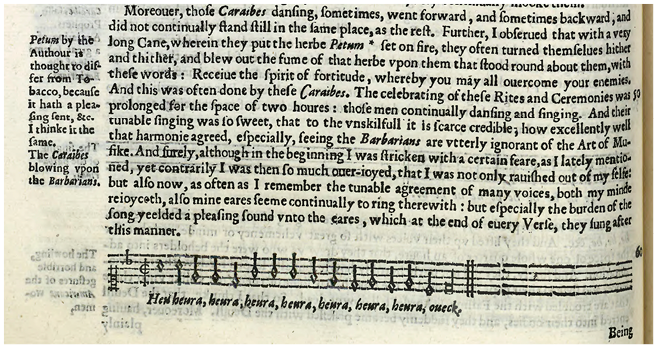
This dynamic recurs across Pilgrimes, where descriptions of the vocal sound of non-Europeans from across the world were used to generate auditory knowledge for readers, while simultaneously fashioning forms of religious and cultural difference. The sounds were often rendered phonetically, and Pilgrimes includes European impressions of voices from Japan and China (Vol. 1, p. 366 and Vol. 3, p. 261); choirboys in Russia (Vol. 3, p. 459); the ‘ancient Indigenae, called Momese’ in present-day Denmark (Vol. 3, p. 628); the Mughal court at Agra (Vol. 2, p. 1476); the Tupinamba in Brazil (Vol. 4, p. 1188 and pp. 1135–1146); the Algonquin in what is now Quebec (Vol. 4, pp. 1607–1608); the Wabanaki in Acadia (Vol. 4, pp. 1633–1635); and several different Indigenous groups in ‘New England’ (Vol. 4, pp. 1655, 1662, 1847 and 1861). Inclusions like the ‘cries’ of Powhatans, ‘Bowh, waugh’, or the sound of the Shahada in Eastern India ‘La Alla, illa Alla, Mahomet Resul-Alla’, allowed writers to convey what they themselves had heard and also to invite readers into auditory participation. By phonetically describing these earwitness encounters, travel writers imagined that their readers might recreate the sounds at home, which would help convey something of what they had experienced, becoming a form of aural proof.Footnote 21 This is explicit in Thomas Coryate’s letter from Agra on 31 October 1616, which includes copies of a speech he made to the Mughal Emperor Jahangir (r.1605–1627) in both Persian and English (Coryate, Reference Coryate1618, sig. B2.) Coryate transcribed the Persian phonetically for his readers, explaining that this might allow them to ‘take some pleasure in reading so rare and unusuall a tongue as this’, as well as underlining his own linguistic expertise and resulting credibility. As Jennifer Linhart Wood has argued, in ‘forming lips, vocal cords, tongues, and brain waves, into different shapes’ the ‘English readers of his speech not only make the sounds of Persian otherness, but are able to hear it as well’ (Wood, Reference Wood2019, p. 266). Sound thus became a verifiable means of both witnessing and embodying otherness.
Despite the desire to make foreign sound legible, such representations were almost always negatively encoded. Their accounts were profoundly shaped by their Christian identities and their belief, as a result, in their superiority over virtually all the peoples they encountered. This was grounded in their conviction that they alone possessed an absolute and exclusive religious truth, which had been revealed through scripture. For Purchas and his contemporaries, literacy was therefore key to Europeans’ ‘literall advantage’ over others. Amongst ‘Men’, he wrote, ‘some are accounted Civill, and more both Sociable and Religious, by the Use of letters and Writing, which others wanting are esteemed Brutish, Savage, Barbarous’ (Vol. 1, Book 1, p. 176). Language was key to defining barbarism during this period (etymologically, barbaros was a babbling outsider unable to speak Greek); it was widely understood that there was a causal connection between civil society and comprehensible language, and barbarous, unsophisticated society with incomprehensible, unnatural speech or melody.Footnote 22 Such incivility was demarcated by frequent reference throughout travel narratives to non-Europeans roaring, yelling and whooping, and descriptions of non-Christian ritual practices reduced to ‘howls’, ‘cries’ and ‘harsh’ noise.Footnote 23 Their aim was both descriptive and epistemological because to strip such sounds of meaning was to invalidate the systems of belief they carried. As Bruce Smith has argued, transliteration functioned as an effort to impose literate authority over foreign vocalisations that they did not, in practice, have any control over (Smith, Reference Smith1999, p. 324). Rendered phonetically yet still dismissed as unintelligible, these sounds became signs of theological error and cultural inferiority.
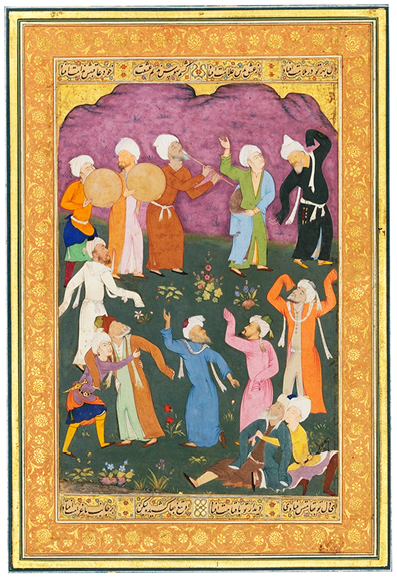
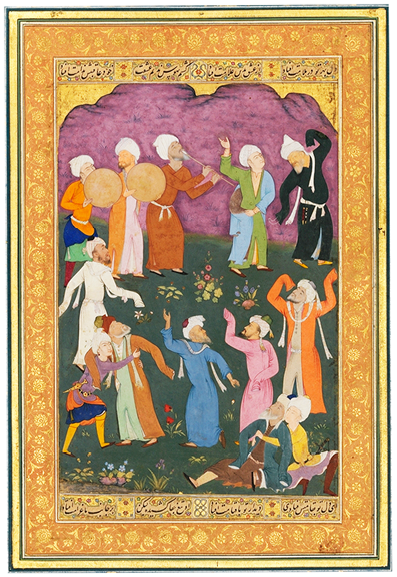
European travellers thus asserted both religious and acoustic supremacy by casting non-European sound as unnatural, incoherent or demonic, and routinely did so by making explicit comparisons with their own religious practices. Thomas Coryate describes in detail the religious rituals of the Dervishes (Figure 3) he witnessed in Galata in the Ottoman Empire, which he contrasted to ‘our Christian Church singing … for the yelling and disorderly squeaking of them did even grate mine ears’ (Vol. 2, p. 1821). The Jamestown settler George Percy (1580–1632) reduced Powhatan ritual practice to ‘making noise like so many Wolves or Devils’, while their speech was said to be ‘a foule noise’ (Vol. 4, p. 1687). Edmund Scot (who accompanied James Lancaster, the first director of the East India Company, on his voyage to Java in 1602) described Javanese pageantry during a royal circumcision as both elaborate and disturbing. The processional ensemble included ‘huge pannes made of a mettall called Tombaga, which make a most hellish sound’, alongside a complex array of tuned instruments which were played in formation (Vol. 1, Book 3, pp. 180–181). That this music was immediately likened to hell also reveals the discomfort evoked by powerful ritual sound unmoored from Christian frames of reference.
‘Dancing Dervishes’, c. 1530–1550.
Protestant depictions of the sound of non-European others echoed with contemporary criticism of the sound of Roman Catholic ritual (see Bloechl, Reference Bloechl2008; Holmberg, Reference Holmberg2011). William Lithgow’s dismissal of the Catholic pilgrims in Loreto was typical: ‘walking bare-footed through the streetes, to this tenne thousand times polluted Chappell mumbling Pater nosters, and Ave mariaes on their Beades’ (Vol. 3, p. 1833). When observing Chinese rites in Java, Scot described their ‘mumbling prayers’ and the ‘ting’ of a bell, ‘which at the end of every Prayer, they ring out as fast as they can’. This, along with their other ritual practices, was dismissed bluntly as empty formalism: ‘many such like things they doe, not knowing why, or wherefore’ (Vol. 1, Book 3, pp. 166–167). Thomas Coryate also referred repeatedly to the ‘murmuring’ of the Dervishes, and at one point described ‘a most hideous kind of murmuring that did in a manner terrifie and astonish us that were meere strangers to these Ceremonies’ (Vol. 3, p. 1821).
Yet Coryate’s own framing here undermines the initial clarity of this reaction and hints at a deeper instability. His admission that the ceremonies terrified and astonished them because they were ‘strangers’ suggests that the failure lay not in the sound itself but in the limits of their own understanding.Footnote 24 In such moments, the supposed authority of Christian ears faltered and exposed an unsettling awareness that their ears might mislead them. This instability surfaces clearly in moments of admiration or emotional resonance. Describing the ‘Rites and Ceremonies’ of the Tupinamba peoples he encountered in the Bay of Rio, Jean de Léry (1536–1613) had observed that ‘their tunable singing was so sweet, that to the unskilfull it is scarce credible, how excellently well that harmonie agreed’ despite the fact that ‘the Barbarians, are utterly ignorant of the Art of Musike’ (Vol. 4, p. 1339).Footnote 25 Here, pleasure is admitted, but then carefully circumscribed.
Drawing attention to non-European ignorance of the ‘Art of Musicke’ was one way that travellers could reassert their cultural superiority by referencing European musical expertise. The ‘Art of Music’ was a humanistic discipline, and its perfection was mastered as part of a classical education, with knowledge grounded in texts. John Taverner’s (1584–1638) lectures ‘On the Origin and Progress of the Art of Music’, composed for Gresham College in around 1611, make clear that understanding the ‘art’ of music was as important as practical education, because musical ‘idolatry’ or ‘superstition’ comes when its creators do not emphasise that the main purpose of music is for disseminating God’s truth. Taverner, moreover, was explicit that when non-Christians perform music in their ritual practices it does not ‘delight’ the mind but is only intended to ‘fill the eare’ (Taverner, ed. Ortiz, Reference Taverner and Ortiz2018, pp. 79–80). This outlook reinforced what is present in travel narratives because even when travellers acknowledged enjoying foreign sound, they often felt compelled to disqualify it as spiritually unprofitable.
This tension is clear in Edward Winslow’s (1595–1655) journal from the Plymouth plantation ‘Good newes from New England’, where on one occasion he described how at Mattapoisett, they witnessed the Wampanoag peoples engaged ‘in charmes’ for healing Massasoit (their sachem – leader) during an illness, which produced ‘such a hellish noise, as it distempered us that were well, and therefore unlike to ease him that was sicke’ (Vol. 4, p. 1861). Yet on another occasion, the ‘Note Musicall, which they take one from another, and altogether’ performed ‘when any are visited with sicknesse’, was so moving that it drew ‘teares from their eyes, and almost from ours also’ (Vol. 4, p. 1869). What was dismissed as infernal in one context was emotionally affecting in another. These moments in Winslow’s account expose the underlying tension in Protestant travel writing between the desire to classify foreign sound as meaningless and the reality of its affective power.
2.4 Listening to Themselves
Early moderns were well aware of the affective power of sound, especially music, and as a result it was vital to forms of global diplomacy (Arendt et al., Reference Arendt, Ferraguto and Mahiet2014). Perhaps the most famous example comes from 1599, when the organ maker Thomas Dallam (1575–c. 1630) travelled to the court of Sultan Mehmed III in Istanbul to present him with an extravagant, self-playing organ, complete with chiming clock and a nest of mechanical singing birds, on behalf of Elizabeth I and the Levant Company (Dallam, c. Reference Dallam1599–1600; Danson, Reference Danson2009; Wood, Reference Wood2015). While less elaborate, there is detailed evidence throughout Pilgrimes of music being used in forms of negotiation across linguistic, religious and cultural boundaries. The first moment of contact was usually musical, as professional musicians and trumpeters performed from European boats (or at times on the shore) to reassure (and lure in) otherwise guarded and cautious peoples (Woodfield, Reference Woodfield1995; Seth, Reference Seth2022). Close contact then facilitated the gifting and trading of objects such as bells, and examples of this pervade Pilgrimes. Bells jingled throughout the narratives and acted, as Jennifer Linhart Wood has argued, as a ‘sonic point of cultural commonality’ between Europeans and the rest of the world (Wood, Reference Wood2019, p. 152). These seemingly simple objects enacted what Wood has termed the ‘sonic uncanny’; for Europeans when familiar English bells were placed on Indigenous bodies, the sound modulated from the familiar to the foreign (Wood, Reference Wood2019, p. 188). Conversely, for Indigenous peoples, these initially foreign objects became uncannily familiar as they were integrated into their existing soundscapes and ceremonial practices (Wood, Reference Wood2019, pp. 188–189, 261). This bidirectional sonic transformation underscores the complex nature of transatlantic acoustic exchange.
On some occasions, as European travellers met with local and Indigenous leaders and groups, musical encounter extended to an intentional and explicit ‘mutuall exchange’ of songs and instrumental performances that were intended to foster cross-cultural bonds.Footnote 26 Edward Winslow described how in 1621, during the Massasoit’s first formal visit to Plymouth to conclude the peace treaty, the leader of the Wampanoag peoples, and his companions, marvelled at the Englishmen’s trumpets, and were even allowed to play them, trying to ‘sound it [the trumpets] as well as they could’ (Vol. 4, pp. 1850–1851). In 1602 James Lancaster (1554–1618) was received in Aceh, Sumatra by Sultan Ala-ud-din Ri’ayat Syah al-Mukammil (r.1598–1604) and secured the right to trade on behalf of the East India Company and Elizabeth I. After delivering cloth and jewelled rings as presents to the Queen, the Sultan made a surprising request (Vol. 1, Book 3, p. 160):
the King said unto him: have you the Psalmes of David extant among you? the Generall [Lancaster] answered: yea, and wee sing them daily. Then said the King: I, and the rest of these Nobles about me, will sing a Psalme to God for your prosperitie, and so they did very solemnly. And after it was ended, the King said: I would heare you sing another Psalme, although in your owne language. So there being in the company some twelve of us, we sung another Psalme; And after the Psalme ended, the Generall tooke his leave of the King, the King shewing him much kindnesse at his departure: desiring God to blesse us in our journey, and to guide us safely into our owne Countrey.
As David Irving has argued, such an encounter highlights ‘the potential for representatives of the Abrahamic faiths to participate in reciprocal acts of devotional performance’ (Irving, Reference Irving2016, p. 54). Although this encounter ultimately remains a mystery (the psalms occupy an enigmatic place within Islam, and it is very rare for Muslims to read them, let alone sing them), as memorialised in print it represents a powerful act of mutual recognition of shared theological contexts, which cast Protestant psalm-singing as both a marker of identity and a bridge across confessional division. This kind of sonic encounter stands in stark contrast to the disorderly or demonic sounds that were usually attributed to non-Europeans elsewhere in Pilgrimes.
English and Christian sound reverberated in these narratives with clarity and divine purpose. Europeans firmly believed that ‘music had special power to convey their being – their potency, their majesty, their spirituality, their gentility, and their violence’ (Shields, Reference Shields, Canny and Morgan2011, p. 139; see also Bloechl, Reference Bloechl, Fenlon and Wistreich2019). English voices, prayer and music were deployed to demarcate difference, assert control and construct identity for those in earshot and for readers at home. One of the most vivid examples of this occurs in Java in 1603, and in Edmund Scot’s account of his time there with the East India Company, when the English merchant-settlers in Bantam staged a dramatic assertion of national identity through sound and spectacle (Vol. 1, Book 3, p. 171). At the time, confusion had arisen among the local population about how to distinguish between the English and the Dutch. This was a significant issue for the English, not least because there had been a ‘falling out betweene the Flemmings and the Countrey people, by meanes of the rude behaviour of the Flemmings’. To make matters worse, the Dutch had actually been passing themselves off as English ‘at their first coming thither to trade, wherein they did our Nation much wrong, for wee were ever ashamed of their behaviour’. Scot explained how passing through the street, they heard ‘the people in the Market, rayling and exclayming on the English men, although they meant the Hollanders’. Fearing that they ‘might be slaine in stead of them’, the English ‘began to thinke how wee might make our selves knowne from the Hollanders’.
An opportune moment arose on 17 November and the Accession Day celebrations for Elizabeth I. The merchant-settlers donned new silk garments, and white and red taffeta scarves edged with golden fringe. They raised a ‘banner of Saint George’ on the top of their house, and ‘with our Drumme and Shot wee marched up and downe’ within their compound. The sound drew the attention of local dignitaries and crowds: ‘The Sabindar and divers of the Chiefest of the Land, hearing our Peeces, came to see us and to enquire the cause of our triumph, we told them, that that day seven and fortie yeare, our Queene was crowned, wherfore all English men, in what Countrey soever they were did triumph on that day’. In response, many asked them ‘why the English men at the other house did not so’, to which they responded that ‘they were no English men, but Hollanders’. Faced with the retort from the locals that the Dutch had claimed ‘to bee English men at first’, Scot and his men reiterated that ‘they were of another Countrey neere England, and spake another Language, and that if they did talke with them now, they should heare they were of another Nation’. To drive home the point, Scot and his men then walked around the town and the market ‘whereby the people might take notice of them’. Their methods were effective, as Scot explained how ‘ever after that day, wee were knowne from the Hollanders, and many times, the children in the streets would runne after us, crying, Oran Engrees bayk, oran Hollanda Iahad, which is, the English men are good, the Hollanders are naught’. The ability to create and control sound became an audible proof of national difference; their Englishness was asserted and then echoed back by others.
The sonic performance of English national and religious sovereignty was a recurring feature of their travel narratives. Sound staged political hierarchy and aurally inscribed power into unfamiliar environments. In June 1579, Francis Drake and his men landed on the Pacific Coast in what is now Northern California and met the Coast Miwok people. Drake’s men described hearing a ritual led by a speaker who ‘wearyed himselfe with making a long Oration’ (Vol. 1, Book 2, p. 53). After this speech, the visitors reportedly set down their bows and approached with gifts, while women remained on a nearby hill ‘torment[ing] themselves lamentably’, an action the English interpreted as preparation for a ‘Sacrifice’. After this, the English narrative introduced a counter-performance. Drake and his companions withdrew ‘to Prayer, and to reading of Scriptures’, an ‘Exercise’, it was claimed, to which the Miwok men were ‘attentive’ and ‘seemed greatly to be affected’. The juxtaposition was rhetorically loaded as scripture and prayer were presented as a sonic corrective that displaced perceived disorder with Protestant order, translating encounter into a public claim to spiritual authority.
The account then expanded from first contact to political theatre. News of the English arrival prompted the entrance of a Miwok ‘king’ and a formal procession, accompanied by people ‘crying continually after their manner’ (although apparently at the sight of the English, the narrative continued, the people did ‘strive to behave themselves in their actions with comeliness’). The King’s sceptre-bearer then initiated ‘a Song, observing his Measures in a Dance’, in which the king, his guard and successive ranks joined, while women ‘danced and kept silence’. The Indigenous political hierarchy was therefore rendered in full sonic ritual in the narrative, but it was swiftly followed by a performative transfer of sovereignty. After the visitors ‘had satisfied themselves … the King, and divers others made several Orations, or rather Supplications’, allegedly urging Drake ‘to take their Province and Kingdome into his hand’. To persuade him, ‘joyfully singing a Song, [the Miwok] did set the Crowne upon his head, inriched his necke with all their Chaines, and offered unto him [Drake] many other things, honouring him by the name of Hioh, adding thereunto as it seemed, a signe of Triumph’. The English narrative presented this as voluntary submission, rendered through gift, gesture and unified, vocal assent. The emphasis on joy here is also important. For early moderns, expressions of joy were a potent form of political legitimation; joyful public spectacles were understood as performative consent and a ritualised political contract where the populace publicly affirmed a ruler’s authority (Hunt, Reference Hunt2008). By portraying the Miwok as ‘joyfully’ and unanimously offering the crown to Drake, the English narrative framed this transfer of sovereignty as a legitimate and divinely sanctioned event, mirroring the rituals of assent that validated power back in England. Through a sequence of sonic acts – oration, song, supplication – the Miwok peoples, and their land, were imagined as yielding themselves to English possession.
The sound of Christian prayer and performance, presented as both spiritually true and politically effective, repeats across Pilgrimes. At the Plymouth plantation, Winslow reported an occasion when the colonists were faced with severe drought and in response, they decided to dedicate an entire day to fasting and collective prayer. The next day, Winslow reported, they were rewarded with ‘soft, sweete, and moderate showers of raine … Such was the bountie and goodnesse of our God’ (Vol. 4, p. 1867). The efficacy of their prayer was unambiguous, but the event gained further power from its audibility: both the communal nature of their own prayer and its hearing by non-Christians. The Wampanoag sachem Hobbamock, listening to the unexpected midweek prayer gathering, had asked why it had taken place. Once informed, and having observed the effects, he and others ‘admired the goodnesse of our God towards us, that wrought so great a change in so short a time’. They noted in particular ‘the difference between their Conjuration, and our Invocation on the Name of God for raine; theirs being mixed with such stormes and tempests, as sometimes in stead of doing them good, it laieth the Corne flat on the ground, to their prejudice: but ours in so gentle and seasonable a manner, as they never observed the like’. Where Indigenous ritual summoned tempests, English prayers were depicted as measured and divinely answered. Through their preservation on the page, English writers staged these acts as demonstrations of religious truth and spiritual authority, confirming Protestant supremacy and reinforcing the framing of Protestant sound as a tool of both conversion and colonisation in the Americas (see also Bloechl, Reference Bloechl2008).
Psalm-singing was a particularly resonant form of this kind of acoustic sovereignty. Psalms saturated the routines of travellers’ lives. They were performed in liturgical services and on ships, where provisions were made as soon as they embarked: in 1627, for example, the East India Company in London had ‘ordered 50 Psalters for every ship with Singing Psalms in them’ (Woodfield, Reference Woodfield1995, p. 43). They were performed in times of crisis and to give thanks for deliverance, for example at sea during storms.Footnote 27 Psalms also featured in the everyday routines of life on land. Edmund Scot noted that the English would sing a psalm when setting the night watch, embedding religious sound into the rhythms of military vigilance (Vol. 1, Book 3, p. 169). The evangelical consequences of listening to the psalms were also proudly recorded, as travellers presented their desire that the Indigenous peoples they encountered might be converted. Jean de Léry’s psalm-singing during his time with the Tupinamba includes reference to an occasion when he sang Psalm 104 specifically on request and subsequently ‘declared the sense and antiquitie thereof’ to the Indigenous listeners (Vol. 4, p. 1340). The Jamestown colonist Thomas Studley also noted the efficacious response of the Powhatans to English psalm-singing: ‘Our order was daily to have prayer, with a Psalme; at which solemnity, the poore Savages much wondered’ (Vol. 4, p. 1715). The responses from non-Europeans to the sound of psalm-singing were almost always recorded positively, and reading about these acoustic acts of evangelisation served to underline the truth of Christianity.
The authority of Christian sound was not always accepted, however. A striking moment of acoustemological and theological friction in Pilgrimes occurred when Thomas Roe’s (c. 1581–1644) ship stopped at the island of Socotra en route to India in 1615. As Roe’s boat approached the shore, wind instruments were accompanying the sung performance of psalms. Sultan Amr-bin-Said, ruler of the island, greeted the English but responded critically to the music. ‘Hearing our hoy-boyes in the Generals boat’, Roe reported, ‘he asked if they were the Psalmes of David? and being answered yes: hee replyed, it was the invention of the Devill … for King David, who before praysed God with his lips and heart in devotion, but after it was left to sencelesse Instruments’ (Vol. 1, pp. 539–540). Reports of this interaction soon spread, and it was described the following year by Edward Terry in his travel narrative as an ‘Apothegme’ (Vol. 2, p. 1467).Footnote 28 Terry repeated the encounter, including the claim that ‘it was an ill invention of him that first mingled Musicke with Religion; for before (said he) God was worshipped in heart, but by this in sound’. Yet to this Terry immediately added a defensive aside, ‘I insert not this relation to condemne musick in Churches’ and then paraphrased Psalm 150, ‘Let him that bids us prayse the Lord with stringed Instruments and Organs, plead the Cause’ in an attempt to contain the force of the critique.
This moment, which interrupts the narrative flow of Terry’s account, is significant for its articulation of a rival theology of sound. The sultan does not question the content of the psalms but the very act of mediating devotion with instruments. For him, true worship should remain inward, sincere and unperformed, and once externalised through musical instruments it became suspect. This was an astonishing application of the very logic that English Protestants routinely wielded against Catholics and non-Christians, who were often depicted as ‘adicted to Musicke’ in their religious practices.Footnote 29 Terry thus preserved a moment in which the authority of Protestant sound faltered. For all the efforts of English travellers to present their own sounds as universally compelling, such moments disclose competing frameworks of meaning. They expose a crucial instability at the heart of European sonic representation abroad: the same sounds meant to proclaim divine order could be heard as signs of corruption. Christian travellers, in other words, encountered alternative acoustemologies. These were systems in which sound meant differently, and in which both sound (and its absence) could constitute resistance.
2.5 Alternative Acoustemologies
The auditory authority established in early modern English travel writing, which was both based on the intention to create as well as exploit existing forms of collective auditory knowledge, was often premised on a binary between expressive Christian sound and the perceived disorder, unintelligibility or threatening excess of non-Christian sound. This, as Jennifer Linhart Wood has demonstrated, was ‘sounding otherness’ and an ‘attempt to colonize noise with logic and meaning’ (Wood, Reference Wood2019, p. 16). Yet, as she has explained, ‘vibrant acoustic activity simultaneously destabilizes any such project, as well as these binary distinctions’ (Wood, Reference Wood2019, p. 9), and moments in the narratives compiled by Purchas also reveal something more complex: sound that unsettled, silence that defied and responses to sound that subverted the logic of English Protestant listening, as Thomas Roe had experienced in Socotra. These forms of sounding otherness ‘disorient the listener even as she may attempt to convert sounds into sense’ (Wood, Reference Wood2019, p. 17). In such moments, the existing auditory knowledge that English Protestant listeners brought to their encounters proved inadequate to contain or explain what they heard.
In 1611, William Strachey (1572–1621), the secretary of the Virginia Company of London, phonetically transcribed a victorious four-verse song that Powhatan warriors had sung after they had killed several Englishmen and taken others captive after the siege of Fort La Warre (cited in Clements, Reference Clements and Swann2011, pp. 405–406). The ‘scorneful song’, Strachey suggested in the accompanying gloss, ‘maye signifie how they killed us for all our poccasacks, this is our guns’ and that their repeated refrain after each verse (‘Whe whe, yah haha nehe wittowa, wittowa’) was intended to mock the ‘lamentation our people made’ when they were killed. He acknowledged, nonetheless, that ‘it is true they [the Powhatans] never bemoane themselves nor cry out, giving up so much as a groane for any death, how cruell soever and full of torment’ (Clements, Reference Clements and Swann2011, p. 406). It is clear, then, as William Clements has argued of this encounter, that the Powhatans were using song as a ‘strategy to undermine the confidence of their adversaries and bolster their own self-image’ (Clements, Reference Clements and Swann2011, p. 415). This was typical across the Americas from the moment of first encounter. As Gary Tomlinson has argued, ‘early accounts of warfare between Europeans and Native Americans abound in references to music either frightening or intended to frighten’, as the heightened utterances of music, beyond speech, ‘showed a special capacity to threaten’ (Tomlinson, Reference Tomlinson2007, p. 173; p. 176). Strachey’s gloss also recorded a Powhatan acoustemological manoeuvre, as the song not only celebrated a victory but also ridiculed the English. Moreover, the absence of lamentation from the Powhatans functioned in Strachey’s framing as an acoustic index of alterity and a refusal of vocal signs through which English Protestant culture often rendered suffering legible and intelligible.
Returning to Pilgrimes, Scot’s account of English settler-merchant life in Bantam shows that sound was not simply a marker of English national and religious identity, as we have heard in the previous section, but also became a medium of fear, violence and psychological disintegration. At one point in his narrative, Scot lamented that his pen could ‘speake of little else, but Murther, Theft, Warres, Fire and Treason, and … Tragedie’ (Vol. 1, Book 3, p. 172). This was no exaggeration. In September 1603, the English settler-merchants had been warned that some of the local Javanese had plotted to murder them at night and steal their goods. Their plot was foiled, Scot explained, because ‘so soone as they came within sight of our Lights and might heare our Drumme sound at the end of every watch, their hearts failed them’ (Vol. 1, Book 3, p. 170). The sound of the drum on this occasion had warded off danger.
However, the threat had merely shifted. The Javanese attackers decided to turn their attention to nearby Chinese households, many of which were ‘ful of our [English] goods, which they had bought’. Sound subsequently filled the night with terror as Scot described how ‘every night for a long time’ the English heard the relentless noise of ‘grievous crying out, and we looking every houre when we should be assaulted, durst take no rest in the night’. Although many ‘Chinois about us were slaine’, Scot noted that far more would have died ‘if wee had not defended them with our shot’. The English intervened with their gunfire, and the sound itself was weaponised: ‘the singing of a Bullet is as terrible to a Javan, as the cry of the Hounds is in the eares of the Hare: for they will not abide if once they heare it’. The English were cast as hunters, and the Javanese were prey.
While the sound of English drums and musket fire might have driven off these external threats, they could not contain the internal strain. The nightly violence, ‘continuall alarmes, and grievous out-cryes of men, women and children grew so rife in our eares’ and began to corrode the Englishmen’s minds. Scot recorded how his companions would ‘dreame they were pursuing the Javans, and suddenly would leape out of their Beds and catch their weapons; his next fellow hearing the dolefull noyse he made, would bussell vp, and in their sleepe have wounded one another, before those that had the watch could come to part them’. Scot even confessed that he was more afraid of accidental violence from his own men than from the Javans: ‘I have stood many times more in feare of mine owne men than of any other.’ In these scenes, sound no longer secured order or credible witnessing but became the medium through which authority unravelled.
Scot’s account also offers glimpses of forms of auditory trauma extending into language itself. The word ‘fire’ became a sonic trigger so powerful that even when whispered ‘in English, Mallayse, Javanes, or China’ it roused Scot and his companions from sleep in a panic. He explained how drums beaten at their chamber doors might sometimes not have woken them, but they would all ‘have runne out of our Chambers’ at even the faintest utterance of the word (Vol. 1, Book 3, p. 171). Such moments fracture the sonic confidence established in other travel accounts and complicate the binary of English order versus non-European disorder; in parts of Scot’s account, English sound and listening frays under the weight of trauma and fear.
Another kind of sonic disruption unfolded later in Scot’s account, but this time through silence rather than noise. Scot described the foiled attempt of local Chinese residents to tunnel beneath and set fire to the English warehouse. When the main arsonist was captured and tortured, his refusal to speak or even cry out became a form of embodied defiance. Scot gave a harrowing account of extensive physical torture, and yet, Scot exclaimed, ‘for all this he never shed teare, no nor once turned his head aside, nor stirred hand nor foote; but when we demanded any question, he would put his tongue between his teeth, and strike his chin upon his knees to bite it off’ (Vol. 1, Book 3, p. 175). In a narrative otherwise saturated with sound, its absence here is arresting. The tortured man’s silence resisted not only physical domination but also the epistemic function of English hearing when he refused to be made into a source of knowledge. The tortured man would rather bite off his own tongue than answer the Englishmen’s questions.
Other forms of acoustic and embodied resistance in Pilgrimes were subtler. Edward Winslow described an incident involving the Nauset sachem who returned stolen goods to the Plymouth colonists. As a supposed gesture of reconciliation, the sachem greeted Captain Standish using a performance that, Winslow explained, had been taught to him by Tisquantum (a member of the Patuxet who, after being kidnapped by the English enslaver Thomas Hunt, had spent time in England):
He [the sachem] thrust out his tongue, that one might see the root thereof, and therewith licked his hand from the wrist to the fingers end, withall bowing the knee, striving to imitate the English gesture … his men did the like, but in so rude and Savage a manner, as our men could scarce forbeare to breake out in open laughter.
The sachem’s vastly exaggerated version of a courtly gesture of obeisance, similar (presumably) to bowing on one knee and kissing a person’s hand, was then imitated by the rest of the Nauset, and revealed a moment of embodied mimicry that bordered on caricature. The English may well have laughed at what they perceived as a failed imitation, but this could also be read as a parody of Englishness while appearing to comply. The result is a moment of mutual theatricality and contested authority.
Another reversal appears in an encounter recorded by Peter Williamson Floris (d.1615) at the court of the Raja Hijau in Patani (r.1584–1616, Vol. 1, p. 323). The encounter between Dutch and English merchants, and the formidable female ruler of the sultanate, offers a compelling moment of cross-cultural sonic and performative exchange. After witnessing a courtly dance by twelve women and children, the ‘Queen’ commanded that all the assembled gentry, including the English and Dutch, must also ‘dance, or at least make shew thereof: which caused no small laughter’. Raja Hijau’s enjoyment, and the Europeans’ awkward compliance, invert the usual hierarchy of observer and observed, as it was the bodies and gestures of Europeans that became the source of amusement. Laughter here, as both sound and response, indexes a disruption of the observational power that otherwise structures much English (and wider European) travel writing.
Elsewhere, even seemingly trivial instances of laughter marked deeper moments of potential acoustemological misalignment. In autumn 1612, John Guy (governor of the English plantation at Cuper’s Cove, Newfoundland) sailed into Trinity Bay in the hope of establishing friendly relations with the Beothuk peoples to facilitate trade. After days of tracing signs of habitation, Guy’s party made direct contact and the meeting became a carefully staged exchange, which included reciprocal gift-giving, followed by collective dancing and singing. The English had handed the Beothuk ‘Bread, Butter, and Reasons [raisins] of the Sunne to eate, and Beere, and Aquavitae to drinke’ (Vol. 4, p. 1881, see Figure 4). After the aquavitae bottle was blown into, the Beothuk ‘fell all into a laughing’ at the sound. While this might be dismissed as spontaneous amusement, it may also reflect a disjuncture between sonic expectation and experience, and an interpretive reaction rooted in a different framework of meaning-making. Laughter in these contexts becomes a subtle but significant marker of acoustic agency: Indigenous listeners are not always passive recipients of English sonic performance but respond, judge and sometimes potentially ridicule it.Footnote 30
Example of a case bottle (from Jamestown, c. 1608–1610) made in the Netherlands and which likely contained aquavitae.
A final arresting example of alternative perception appears in Winslow’s description of Wampanoag memory practice (Vol. 4, p. 1870). In the absence of written records, significant events were commemorated by digging small circular holes in the ground. These acted as mnemonic markers for oral transmission: ‘when others passing by behold, they enquire the cause’, and so the stories were retold and transmitted. This practice, Winslow explained, ensured that ‘many things of great Antiquitie are fresh in memory’, creating a living archive inscribed into the land itself and perpetuated and shaped by subsequent individuals. As Winslow noted, a traveller accompanied by a knowledgeable guide may find his journey enriched by these ‘historicall Discourses’ and it is also a reminder that narrative, place, and orality were intimately connected in Indigenous knowledge systems (Mahuika, Reference Mahuika2019).Footnote 31 This embodied, environmental mode of history and memory quietly unsettles the epistemic structure of the very narrative Winslow was writing, as well as the vast collection of Pilgrimes that his account was preserved in. It demonstrates its own sophisticated acoustemology that relied on asking, listening and remembering aloud.
Taken together, these moments of fear, laughter, mimicry and alternative memory subtly complicated the dominant hierarchy that English travel narratives, and Pilgrimes, sought to construct. Through encounters with the natural world, and their contrasting descriptions of non-European noise and English sound, writers aimed to affirm both the truth of Christianity and their own civilisational authority. However, sound and listening, which for many was a reliable medium of witnessing and authority, could nonetheless prove volatile. From the panic prompted by a whispered ‘fire’ to the silence of a tortured man, and to performative gestures that verged on parody, sonic experience sometimes unsettled the audible and auditory certainties that these texts attempted to secure. Crucially, readers were not passive recipients of such accounts. They too were acoustic agents, attuned to the resonances and dissonances within the narratives they consumed. One such reader was Samuel Purchas. In compiling Pilgrimes, Purchas did not merely transmit the voices of travellers but reshaped their reception through his own embodied experience; and while this section has examined how sound from abroad was recorded, Section 3 to how Purchas organised and mediated these acoustic and embodied encounters for readers at home.
3 Embodied Readers
3.1 Bodies and Books
Along with his contemporaries, Purchas understood the human body as a ‘book of nature’ (Purchas, Reference Purchas1619, p. 29).Footnote 32 He articulated this explicitly in Microcosmus (Purchas, Reference Purchas1619), which was an extended meditation on Psalm 39.5: ‘Verily, every Man at his best state is altogether Vanitie.’ The work began as Lenten sermon notes but was then expanded amidst a series of family bereavements so that his own private grief would become ‘a publike good’. Heavily influenced by his Calvinism, alongside contemporary science, the work was structured as a devotional anatomy of man. It was a handbook for understanding life as vain, fleeting (and even ephemeral, as Helen Smith has argued) so that his readers would be driven to Christ (Smith, Reference Smith, Davies, Lilley and Richardson2023).
The body, Purchas explained, is a ‘little Model of the greater World’ mapped through correspondences: ‘Is not the Haire as Grasse? the Flesh as Earth? the Bones as Mineralls? the Veines as Rivers? the Liver, a Sea? Are not the Lungs and Heart correspondent to the ayrie and fierie Elements? the Braines, to the Clouds and Meteors … the Eyes, to Starres, or those two Eyes of Heaven, the greater Lights?’ (Purchas, Reference Purchas1619, p. 30). Although this breathless list reflected traditional understanding of the commonalities between landscapes and bodies, it also reflected newer scientific knowledge, circulatory and skeletal, being investigated by individuals such as William Harvey. Purchas’s chapter on the ear owed much to his witnessing of one of Harvey’s lectures and accompanying dissections. ‘How was my soule ravished with admiration’, he recalled, ‘to see this Inlet and bodily Entry so exactly wrought, as hee then, both to the Eare and Eye, delivered?’ (Purchas, Reference Purchas1619, pp. 98–99). For Purchas, such observations deepened the body’s spiritual significance. Purchas glossed Psalm 139.14–16 to call the body ‘a marvellous curious Worke, fashioned all by booke’, and he extended this metaphor further by comparing it to a text ‘as it were in print’ (Purchas, Reference Purchas1619, p. 25). The image situated divine inscription within the material world of the press: the body was both written by God and then impressed like type on paper.
This print-inflected anthropology underwrote Purchas’s editorial methods and is key to understanding why Purchas engineered auditory and embodied engagement with his text. As outlined in the Introduction, sound for early moderns was not merely heard but felt; sound penetrated the body, altered the flow of humours and agitated the vital spirits. To manage how readers encountered these texts was therefore to manage their listening bodies. When readers felt a response to what they read, it affirmed the link between their own God-given body and the wider world. This experience was therefore not just for the straightforward entertainment of armchair travellers and the ‘leisure class’, but was intended as means to know and appreciate God’s work (cf. Helfers, Reference Helfers1997). This section traces these aims through the three main bodies central to Purchas’s work: his own, the reader’s and the traveller’s. Purchas repeatedly figures his editorial labour through reference to his toiling body to add authority and credibility to his project. He was also acutely aware of his readers’ bodies, which could be wearied or refreshed by the pacing of his narratives, and he managed their experiences to shape what, and how, they read. Moreover, as Section 2 outlined, Purchas and his contemporaries were well aware that the bodies of travellers were the most important form of empirical proof, and despite claiming to allow the texts to ‘speak of their owne affaires’ (Vol. 4, p. 1773) and ‘in their owne words’ (Vol. 1, Book 1, ‘To the Reader’), Purchas staged their encounters in ways that aligned with his own agenda. Across the volumes, compilation becomes a problem of rhythm and measure: how to avoid cloying excess, how to pace attention and how to keep sensory pleasure from outrunning godly interpretation. Purchas’s editing works like musical arrangement. He selected, abridged, annotated and re-ordered so that potentially discordant materials were brought into a Protestant concord.
This section therefore complicates views of Pilgrimes as ‘more theoretical than empirical’ (Rubiés, Reference Rubiés2000, p. 350) merely because its editorial aims were overtly religious. Assertions that such motivations make the work ‘medievally religious’ and therefore ‘different from the promotion of colonisation’ (Helfers, Reference Helfers1997, pp. 175–178) lose their force once Purchas is placed within the corporate world, recently reconstructed by Haig Smith, in which religion operated as a structure of governance, policing personnel, legitimising jurisdiction and cultivating reputation in the service of commercial expansion (Smith, Reference Smith2022). Purchas did not stand outside that world: he was formally admitted to the Virginia Company on 22 May 1622, and before Pilgrimes went to press he received £100 from the East India Company (Pennington, Reference Pennington1997, Vol. 1, p. 5; p. 367). The volumes, in turn, presented the first substantial printed corpus on the East India Company, from its charter to detailed accounts of voyages and expeditions (Neville-Sington, Reference Neville-Sington and Loren1997, pp. 519–527). To read Purchas as ‘medieval’ or merely ‘theoretical’ is therefore to miss how confessional purpose and empirical practice were brought together in an apparatus designed to manage bodies and texts in the pursuit of a global English Protestant hegemony.
3.2 Purchas’s Labouring Body
The reader first encounters this apparatus, and Purchas’s body, on the title page (Figure 5). His seated portrait anchors the frontispiece, which, in an elaborate visual architecture of history and authority, sets out the programme of Pilgrimes. Purchas’s right hand is on an open book, where the lines of Psalm 39 link this new project and Microcosmus, reminding readers of their ultimate insignificance before God. Purchas’s position on the page gestures towards mortality, his age as he sat for the portrait is written to the side of him (48), and beneath him is the anagrammatic device PARS SUA CAELUM (‘his portion is heaven’). That life itself was a pilgrimage is clear from the Latin banner above his head, which combined Psalm 39 and Hebrews 11, and translates to ‘I am a stranger and a pilgrim on the Earth.’ The intermittent capitalised letters formed a chronogram for 1624, which was the year the title page was created, and then circulated on its own, to advertise the forthcoming volumes. Purchas is flanked by paired hemispheres (Figure 6). On the left, ‘Tam Marte quam Mercurio / Soldiers and Marchants the Worlds two eyes to see it self’, yoked the book’s spiritual mission to the commercial and military aims of English expansion. Above, the statement ‘Sic Mare, sic Terras fero et offero; praedico Caelum’ (Thus I bear and offer the sea and lands; I proclaim heaven) reoriented his global survey to an act of Christian witness. On the right hemisphere a snail, with a globe for a shell, crawls up across the edge of North America and spells out Purchas’s purpose in miniature: ‘It peregre estque domi: terras fert, fertur ad astra’. Purchas is the sedentary traveller (‘abroad and yet at home’ – it peregre estque domi) who carries the world to readers and orients it heavenward. His confident gaze looks out from the page, assuring readers that the materials they are about to handle have been weighed and oriented by credible, godly labour.
Title page of Purchas His Pilgrimes, 1624.
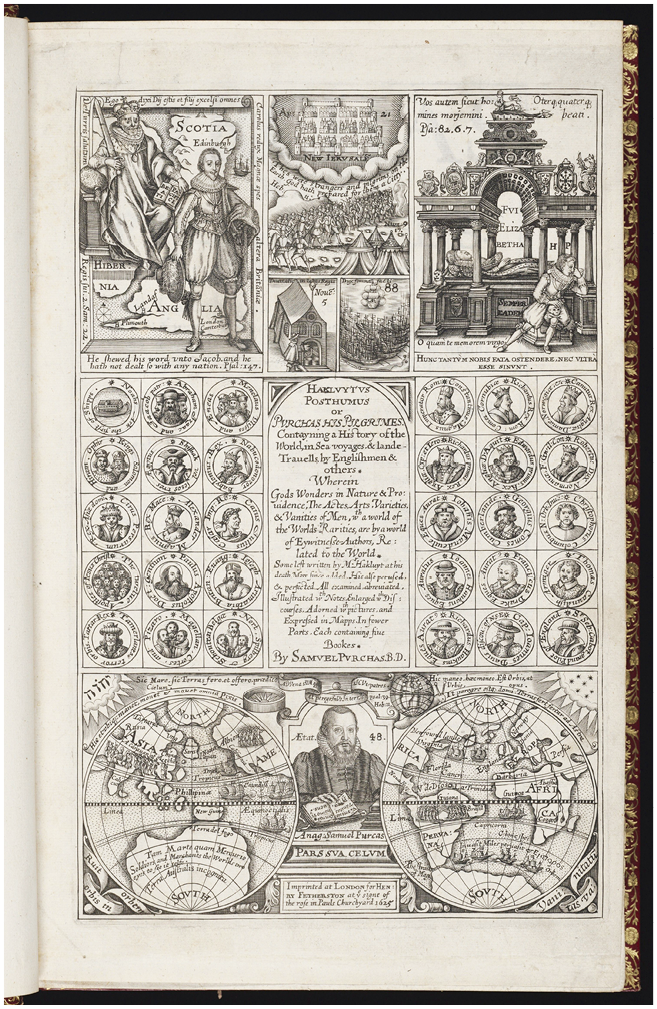
Title page of Purchas His Pilgrimes. Bottom third of title page.
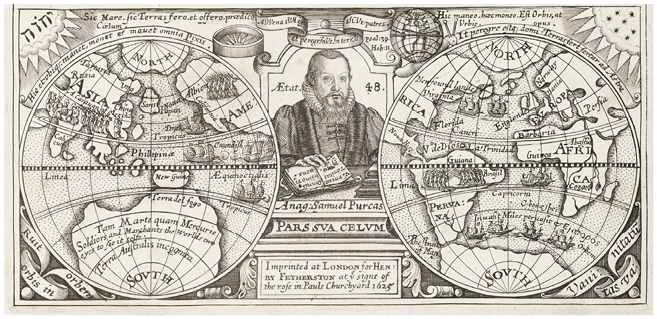
This visual staging sits somewhat uneasily within David Armitage’s account of Purchas’s political theology. Armitage argues that Purchas’s vision was defined by a ‘cosmopolitan refusal’ to identify England, or Britain, as a uniquely elect nation (Armitage, Reference Armitage2000, p. 98). Purchas subsumed the Stuart kingdoms within a broader vision of Europe, defined religiously and culturally by a primacy in ‘Men, Arts [and] Armes’, and where Christianity was a primary marker of European distinction against the rest of the world (Armitage, Reference Armitage2000, p. 86). British Protestants were a ‘saving remnant within a contracting Christendom’, and Purchas was operating in the spirit of a ‘Jacobean Protestant irenicism’ that prioritised a shared front against the Papacy over a singular national election, a stance that Armitage maintains prevented works like Pilgrimes from serving subsequently as an apocalyptic millennial vehicle for empire (Armitage, Reference Armitage2000, pp. 86–87; 90; 98–99). However, the title page solicits a more direct providential-national reading than Armitage’s position might suggest. The top of the page cast the monarchy within an eschatological script (Figure 7). To the left, James VI/I sits enthroned with his heir Charles, styled the ‘second hope’ of Great Britain (‘Carolus redux Magnae spes altera Britanniae’). That hope is legible against the image on the right of the late Prince Henry, leaning against Elizabeth I’s funerary monument: Virgil’s lament (‘Hunc tantum nobis fata ostendere, nec ultra esse sinunt’ – The fates permit us only to behold him, and do not allow him to remain longer) and Psalm 82:6–7 (‘Vos autem sicut homines moriemini’ – But you shall die like men) registered both dynastic loss and mortal limit.Footnote 33 Around James and Charles, ‘Ego dixi Dii estis et filii excelsi omnes’ (‘I said, you are gods, and all of you are sons of the Most High’) exalted royal office and the citation of 2 Samuel 22 framed the Stuart monarchy as the anointed protected by God. Along the base, Purchas evoked Psalm 147, ‘He shewed his word unto Jacob … he hath not dealt so with any nation’, which explicitly constructed the Stuart polity as a uniquely elect nation and a new Israel entrusted with divine teaching.
Title page of Purchas His Pilgrimes. Top third of title page.
This providential script is intensified in the central panel. Below, scenes of the Armada (1588) and the Gunpowder Plot (1605) figured national deliverance. Above, under the citation of Numbers 9:17, the Israelites are visualised as an early modern army wielding pikes and muskets. At the summit, Apocalypse 21 and Hebrews 11 (‘Thes were strangers and pilgrims on the earth. God hath prepared for them a Citty’) presented a New Jerusalem as the eschatological horizon. Read bottom to top, the central panel invited viewers to see recent English preservations and future arrival in the heavenly city as a continuous providential ascent. Armitage’s claim that Purchas’s work collectively resists easy assimilation into a ‘millennial vehicle’ sits in slight tension with this visual spectacle. Purchas’s programmatic paratext mobilised the hard idiom of election and an apocalyptic horizon to frame the Stuart realms within salvation history and to discipline the reader’s interpretative posture at the threshold of the compilation. This also supports Matthew Dimmock’s interpretation of Purchas’s earlier work His Pilgrimage (Reference Purchas1613), which treated Christian imperial expansion as providentially opening ‘a window’ for New World conversion and cast English Protestant plantation and navigation as labour within such an eschatological harvest. The apocalyptic scripting of Pilgrimes’ title page, when read alongside Purchas’s imagining of imperial motion as an ‘engine for millenarian evangelism’ (Dimmock, Reference Dimmock2014, p. 270), demonstrates Purchas’s position as accommodating both irenic European positioning and a conversionist, end-directed providentialism.
The thirty medallions above Purchas, either side of the central title (Figure 8), further legitimate this design. They compress universal history into emblematic bodies, from Noah and the patriarchs through Alexander and Caesar to apostles, crusaders, Columbus and English navigators such as Francis Drake. Set between the royal theatre above and the mapped globe below, they legitimated contemporary English enterprise by stitching it to sacred origins and, through reference to Virgil, classical empire. Taken together, the page staged Purchas’s project without ambiguity: new knowledge from global travel confirmed and extended a divine plan. By placing his own body on the title page to preside over it all, Purchas’s editorial work, enacted in and through his body, lent credibility to the texts, wielded in the service of a global, Protestant design.
Title page of Purchas His Pilgrimes. Central panel.
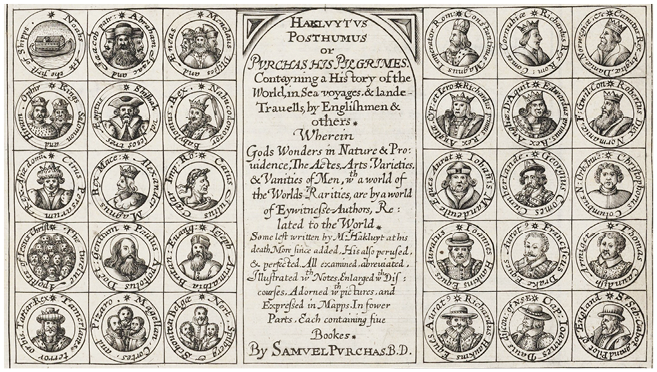
The visual staging of his body as the project’s credible anchor is reinforced textually throughout Pilgrimes, where Purchas repeatedly invokes his own body to explain editorial choices, and he underlined the physicality of his embodied labour. In his opening address to the reader in Volume 1, Book 1, Purchas notes how he and his Pilgrimes together ‘minister individual and sensible materials (as it were with Stones, Brickes and Mortar)’, ‘as Pione[e]rs … and Labourers’. Purchas asserts with a token gesture of humility that he might perhaps be thought of as a ‘Master-Builder’ also, despite having been ‘forced as much to the Hod, Barrow and Trowel, as to contemplative surveying’, because he ‘was ever [not] enabled to maintain a Vicarian or Subordinate Scribe’, save ‘some few Transcriptions and Translations … by his sonne’. The sheer scale of his task was also referred to in his dedication of the fourth volume of Pilgrimes to George Abbot, Archbishop of Canterbury (1562–1633). Here he referred to himself as a pilot whose ‘Body [is] more leakie then his Ship’, and whose body and the work were inextricable: ‘My selfe am the Epistle, this Worke the Seale.’ He likened its compilation to a hazardous circumnavigation, which was sometimes ‘in danger to be overset’ by the press of materials, and this explained the ‘leakes of unwitting errors’ that might still be present despite his best efforts (Vol. 4, Dedicatory Epistle).
Purchas also used his own bodily fatigue and hesitation as a rhetorical tool, which signalled the labour of sifting texts and justifying omissions. He referred to his ‘wearie’ hands when bearing and sorting other men’s observations, and the monumental labour of compiling the narratives is stark throughout.Footnote 34 His weariness often emerged when expressing doubts over credibility. When narrating some of the ‘truth which lied buried under poeticall rubbish’ in the ‘fabulous antiquities’ of the journeys of, for example, Troy and Hercules, he ended his accounts by explaining how he was ‘weary of travelling in such a loose sandy soile where so few footeprints and paths of truth are to be found’ (Vol. 1, Book 1, pp. 68; 71). Purchas’s weary, uncertain body was also wielded to explain why he had omitted the Portuguese Catholic Fernam Mendez Pinto’s (1509–1583) account of his journey to Japan: he was ‘afraid to wander in places and affaires so uncouth. Wearie already of things so strange, and therefore uncertaine, I will passe to other Authors’ (Vol. 3, p. 281). Purchas’s fatigue was an editorial strategy that cast his omissions as the judicious act of a discerning (and exhausted) scholar.
Elsewhere Purchas’s body emerges as the authorising force for the texts, which grounded his editorial authority in physical proximity and personal contact. He was always careful to explain his sources, noting that the accounts had physically ‘comme to my hand’ (Vol. 1, Book 1, Preface) or were in front of him when editing: ‘I have many written Treatises lying by me’ (Vol. 4, p. 1705). On occasion it is Purchas that is the sole source of an account he includes, as individuals have dictated their experiences to him orally, such as the ‘Relations’ of Thomas Turner, who ‘lived the best part of two yeeres in Brasill &c’ and which Purchas ‘received of him in conference’ (Vol. 4, p. 1243). Purchas also speaks to individuals to verify aspects of either their own accounts, or that of others, with marginal annotations such as ‘I have heard Sir R. S. affirme this’ (Vol. 2, p. 1805). By inserting his own physical presence into the narrative chain, Purchas’s ear was tuned as a tool of verification, anchoring these distant events within the trusted testimony of the editor himself.
Purchas’s own encounters with the natural world also shaped the texts he presented. For example, alongside the Spanish Jesuit José de Acosta’s (1539/40 – 1600) discussion of ‘maíz’ as the staple grain of the Americas he noted: ‘I have had it ripen reasonably in my Garden in Essex’ (Vol. 3, p. 953). Purchas corroborated Acosta’s natural history with his own direct observation, domesticating the ‘Indian wheat’ as not merely a New World curiosity but something familiar and useful. Similarly, next to Gonzalo Ferdinando de Oviedo’s evocative description of the coconut, in which Ovideo declares its water to be ‘doubtlesse one of the most excellent things that may bee tasted upon the earth, and such as I am not able by writing or tongue to expresse’, Purchas adds a calm, empirical aside: ‘I have seene one of these Fruits opened, the which when it was whole, if it were shaken the water was hard shogge therein as it were in a Bottle, but in time it consumed & was partly congealed into a salt substance’ (Vol. 3, p. 981). By noting the sound of the water within the coconut and observing how it gradually evaporated and left a residue when left to stand, Purchas anchored the marvellous in the credible and participated in the epistemology of sensory observation that underpinned the value of the texts themselves, strengthening the authority of the entire collection.
3.3 Managing the Reader’s Body
Purchas was clear how he expected his readers to engage with his work. In his opening address to the Reader, he noted that (Vol. 1, Book 1, Preface):
[E]xcept where the Author or Worke it selfe permitted not … these vast Volumes are contracted, and Epitomised, that the nicer reader not be cloyed. Here also both Elephants may swimme in deepe voluminous Seas, and such as want either lust or leisure may single out, as in a Library of Bookes, what Author or Voyage shall best fit to his profit or pleasure.
Abridgement, then, was a deliberate editorial method to prevent over-satiating his readers, and the volumes were built to accommodate different capacities and commitments. The library simile explicitly authorised selective consultation, and Purchas therefore placed Pilgrimes within familiar early modern practices of excerpting and epitomising (see Blair, Reference Blair2010).
When assembling his materials, Purchas was conscious of his readers’ sensory and affective experience. This is clear in repeated references to concerns over ‘wearying’ them. For example, while still abroad, Thomas Coryate had sent Purchas his journal describing his travels through Constantinople and his onward journey to Aleppo, Damascus and Jerusalem. Purchas, however, chose not to reproduce the account in full. He explained that ‘wee have travelled with so many Travellers to Damascus, and thence to Jerusalem, and observed so much on those parts, that I dare not to obtrude Master Coryats prolixitie on the patientest Reader’ (Vol. 2, p. 1830). Fearing that readers might ‘grow weary of him and mee’, Purchas included only a short extract and ‘a little of Jerusalem that yee may know hee was there’. It is noteworthy that in this excerpt Purchas decided to focus predominantly on Coryate’s earwitness account of how he was roused from sleep by the ‘turbulent cries of the Greekes … men, women, children confusedly, crying, Kyrie eleeson’ and the multi-confessional clamour of Palm Sunday, where ‘drums’, ‘clappers of brasse and wood’ and ‘vociferations’ of competing sects filled the Church of the Holy Sepulchre for four hours (Vol. 2, pp. 1830–1831).
Purchas’s management of readers is particularly explicit in his translation of the French Protestant Jean de Léry’s Histoire d’un Voyage fait en la terre du Brésil (first published in 1578). This was a detailed record of Léry’s time among the Tupinamba in the Bay of Rio in 1557. The work was widely read and repeatedly revised during Léry’s lifetime (in 1580, 1585, 1594, 1600 and 1611) and Purchas’s translation, taken from the 1600 edition, was the first and only English version until the late twentieth century.Footnote 35 In his preface to the excerpts, Purchas explains that although he had translated the whole text, he had withheld the majority: ‘Store hath bred a sore; and the most of it I have omitted … though all Englished and readie for the Presse’ (Vol. 4, p. 1325).
Inverting the well-known proverb (‘store is no sore’) to justify omitting the vast majority of Léry’s narrative, Purchas presents lengthy sections from his chapters on fauna, flora, warfare, religion, marriage, education, hospitality, the treatment of disease and the care for the dead, while excising much of the contextual information for why Léry was in Brazil in the first place. Readers do not hear about his journey from France to Brazil, nor the subsequent religious dispute that resulted in the disintegration of the French colony, and which had prompted Léry and his Huguenot companions to flee and settle with the Tupi until a ship came to take them back to France. Purchas also excludes the account of his nightmarish return journey back across the Atlantic, which included the French men nearly starving to death and eating everything on board, including some old leather hides that the Tupi used as shields. The management of the reader’s response here was deliberate, as many of the narrative’s most visceral and affective moments were withheld.
Purchas’s excerpting and translation of Léry had significant consequences for how readers would encounter the Frenchman’s text. This kind of editorial shaping was not confined to the Brazilian material; as Linda McJannet has demonstrated, Purchas’s ‘pruning’ of accounts of the Ottomans in Pilgrimes, by ‘privileging empirical “information” but eliminating experiential context and authorial commentary … contributed – consciously or unconsciously – to the reification of anti-Ottoman stereotypes’ (McJannet, Reference McJannet2011, p. 224).Footnote 36 This is evident in Purchas’s editorial interventions in Léry’s account on the Tupinamba. Purchas omits many of Léry’s more sympathetic reflections on the people among whom he lived and reduced the tone of curiosity that characterises much of the Frenchman’s text. Whilst this might be explained away as potentially ‘unconscious’, when combined with Purchas’s translation choices it suggests a more deliberate attempt to enhance the reader’s perception of the Tupinamba’s ‘savagery’. For example, in a passage describing the taming of small monkeys, Léry explains that when the animals bite the Tupinamba’s fingers they are then struck to make them release their grip. The verb Léry uses is ‘assommer’, meaning to stun or knock senseless (Léry, Reference Léry1600, p. 166). However, Purchas has rendered this instead as ‘being bitten, they are very often compelled through paine, to kill them with strokes’ (Vol. 4, p. 1328. My emphasis). Such changes heighten the scene’s violence, and the alteration recalibrated the tone and embodied affect of the episode, as sympathy is moved away from the body of the Tupi, and instead to the monkeys.
Purchas also guided readers’ perception and interpretation of the texts through his marginal annotations. When describing a Tupi religious ritual, Léry recounts how a group of women (Vol. 4, p. 1337)
lifted up their voices with so great vehemency of minde, and that for the space of one whole quarter of an houre, that they drew us who were the beholders into admiration. And surely, they did not onely horribly howle, but also leaped forth with great violence, and shaked their paps, and fomed at the mouth, nay some of them … fell downe dead. So that I thinke, that the Devill entred into their bodies, and they suddenly became possessed.
Purchas signalled this passage to the reader with a marginal note: ‘The howling and horrible gestures of the American women’. A version of this was in the margins of Léry’s text as well, ‘Hurlements et contenances estranges des femmes Sauvages’ (Léry, Reference Léry1600, p. 307) but Purchas’s decision to translate ‘estranges’ as ‘horrible’ sharpened Léry’s tone from one of astonished observation to moral condemnation, while his substitution of ‘American’ for ‘sauvage’ replaced Léry’s label with a broad geographic one that collapsed distinctions between different Indigenous peoples and groups.Footnote 37
This elision anticipated his marginalia on the next page, where Purchas corroborated Léry’s description with his own witness testimony, recording that he ‘once saw Tomocomo a Virginian dance, with such extatical visages and diabolicall behaviour, as if the Devill had beene in him’. Purchas placed this comment about the Powhatan spiritual leader (who had accompanied Pocahontas to London in 1616) directly beside Léry’s subsequent observation that the Tupi men sang ‘so sweetly, and with so great harmonie, that I was wonderfully desirous to see them’ (Vol. 4, p. 1338). The juxtaposition is revealing, because where Léry’s attention had moved from disturbance to delight, Purchas’s intervention recalled the diabolical, and prompted the reader to register disorder rather than musical skill.
Léry’s ambivalence over these rituals seems, therefore, to have disconcerted Purchas. Further down the same page, Purchas again tries to steer the reader’s appraisal of Léry’s sensory testimony by contesting his remarks on the herb Petum. In the margins he notes that Léry elsewhere distinguishes the herb from tobacco on the grounds that it had a ‘pleasing sent’. This part of text was not printed by Purchas, which makes the cross-reference oddly destabilising, especially when he adds, without explanation or justification, ‘I thinke it the same’ (Vol. 4, 1338; Figure 9). The intervention is striking because Purchas elsewhere made sure to evidence his assertions, either through personal observation (growing maize in his garden) or through reference to other authors and biblical or classical authority. The main purpose of this unsubstantiated comment, therefore, seems only to directly undermine the reader’s confidence in Léry immediately before a pivotal moment in his text, and his account of being moved by Tupi music during their ritual performance:
The celebrating of these Rites and Ceremonies was prolonged for the space of two hours: those men continually dancing and singing. And their tunable singing was so sweet, that to the unskilful it is scarce credible, how excellent well that harmonie agreed, especially, seeing the Barbarians are utterly ignorant of the Art of Musike. And surely, although in the beginning I was stricken with a certain feare … yet contrariliy I was then so much over-joyed, that I was not only ravished out of my selfe: but also now, as often as I remember the tunable agreement of many voices, both my minde rejoyceth, also mine eares seeme continually to ring therewith.
Placed immediately before Léry’s senses were ravished by the sounds, Purchas’s marginal aside operated like a deliberate discord struck to undermine Léry and framed his embodied response to the Tupi music as suspect and unreliable.
Pilgrimes, Vol. 4, p. 1338.
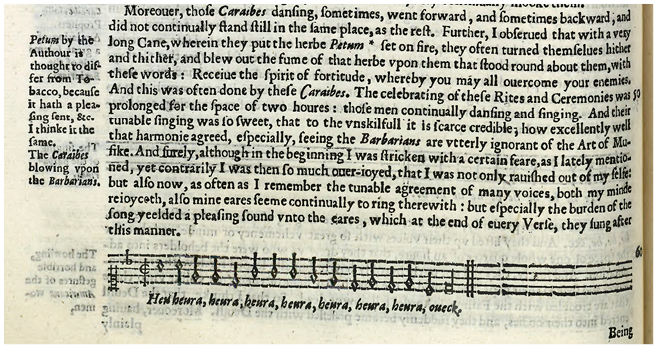
Nonetheless it was important for Purchas to ensure that Léry’s account overall was presented as credible in terms of the empirical information it transmitted, despite his clear misgivings over Léry’s response to it. Some of the clearest forms of proof of his encounters come in Léry’s transcriptions of his memory and interpretation of the Tupinamba singing, which Purchas (and his printer) endeavoured to reproduce by including the notated staves that Léry presents in his own publications. Although the melodic transcriptions do not actually accurately replicate Léry’s (whether this is Purchas’s fault or his printer’s is impossible to say), by including them Purchas allowed readers to engage with the sensory evidence and audiate the music for themselves.
Purchas was well aware of the power of music. Its devotional and curative force was central to early modern understandings of the body and soul, supported by the Bible and the Church Fathers. As Augustine had exclaimed, music could stir the mind ‘to great religious fervour’ and kindle ‘a more ardent flame of piety’ than words simply spoken. But, as Augustine had warned, individuals must take care to not allow their minds to be ‘paralysed’ by the ‘gratification’ of their senses, ‘which often leads it astray’ (Augustine ed. Pine-Coffin, Reference Pine-Coffin1961, p. 238). Purchas’s contemporary Robert Burton (1577–1640) had underlined the healing power of music in The Anatomy of Melancholy (Reference Burton1621), when he declared that ‘Musicke’ was ‘a remedy’, ‘prescribed to exhilerate a sorrowfull heart’ and ‘besides that excellent power it hath to expell many other diseases, it is a soveraigne remedy against Despaire and Melancholy, and will drive away the Divell himselfe’ (Burton, Reference Burton1621, pp. 372–373).
Purchas’s preface ‘To the Reader’, before Pinto’s observations on ‘China, Tartaria and other Easterne parts’, demonstrates how he conceived of music as a harmonising force, one that, as an extension of narrative, gives shape and meaning to human experience (Vol. 3, p. 251). Weighing Pinto’s credibility, acknowledging that his Peregrination contained many things that seem ‘stupendious’ and ‘not seconded in many things’ and sometimes even ‘contraried by other Authors’, Purchas justified its inclusion by appealing to the value of the narrative itself, which contained some useful information, and he advised the reader to ‘gather the Rose notwithstanding the prickles’. Moreover, Purchas adds that ‘their best musicke in their chaines and wandrings [was] the mutuall recountings of things seene, done, suffered’. Here, the consoling act of narration becomes a kind of music which, despite errors or dissonances, could still produce harmony.
This harmonising logic motivated Purchas’s attempts elsewhere to regulate his readers’ responses to the volumes through sound and explains why he inserted a 10,000-word Middle English verse poem into Volume 2, Book 8 of Pilgrimes (Figure 10). After scores of pages of crusading violence taken from Matthew Paris and others, Purchas interrupted ‘these fields of bloud’ with what he has dubbed ‘a Musical Pilgrime, whose old English Rithmes may perhaps allay those former conceits of cryes, shrickes, wounds, deaths, desolations’ (Vol. 2, pp. 1229–1230). This demonstrates explicitly that Purchas understood his readers would audiate the accounts he presented to them and, moreover, is evidence of his concern that the relentless din of bloodshed might weary and distress them. Purchas’s solution was to deploy more sound to modulate these negative effects.
Pilgrimes, Vol. 2, p. 1230.
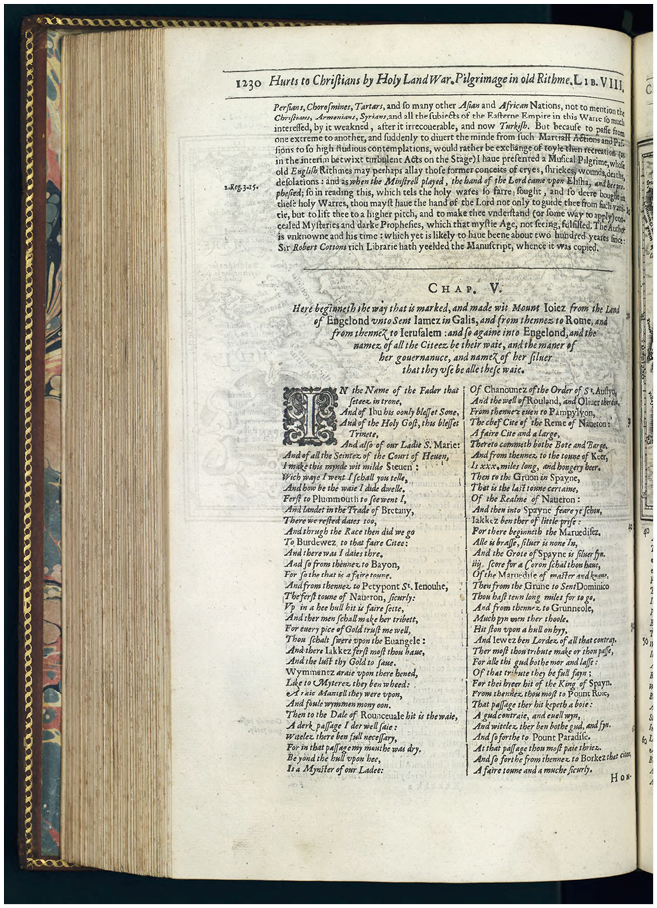
The verses chosen for this purpose were transcribed from a 200-year-old manuscript then in Sir Robert Cotton’s library, but which is now lost.Footnote 38 It charted an extensive pilgrimage from England to Santiago de Compostela, Rome and Jerusalem, and back again. Purchas’s chosen antidote to the tumult of the preceding narratives was a repetitive four-beat rhythm in rhyming couplets, which created a steady, almost processional cadence, arguably mimicking the physical motion of walking itself. He suggested that this ordering of sound might ‘allay’ the auditory and emotional excesses and compared its effect to the moment in 2 Kings 3:15 ‘when the Minstrell played, [and] the hand of the lord came upon Elisha’ (Vol. 2, p. 1230). In that biblical scene, music calmed the prophet and made him receptive to divine inspiration, and Purchas invoked it to imply that the rhythmic regularity of the poem might likewise prepare his readers’ minds for a more elevated and spiritually attentive mode of perception.
That aim governed his inclusion of the medieval Catholic narrative, even though it catalogued the indulgences associated with each holy site and itemised the exact remission a pilgrim might gain through each visit. Purchas therefore prayed that the reader ‘mayst have the hand of the Lord not only to guide thee from such vanitie, but to lift thee to a higher pitch, and make thee understand (or some way to apply) concealed Mysteries and Prophesies, which that mystie Age, not seeing, fulfilled’ (Vol. 2, p. 1230). By reproducing the poem, while warning readers against its assumptions, Purchas turned reading and audiating the narrative into an exercise in Protestant discernment. The same cadence that calms and focuses the reader must also sharpen judgement, enabling them to recognise superstition’s residue while apprehending the ‘concealed Mysteries and Prophesies’ that the ‘mystie Age’ enacted. The ‘higher pitch’ to which Purchas would have them lifted is therefore both spiritual and intellectual, a disciplined attentiveness in which a literary form shapes perception even as its theology has been superseded.
The ‘Musical Pilgrime’ (Vol. 2, pp. 1230–1245) was positioned between the crusading chronicles (Vol. 2, pp. 1189–1230) and then Purchas’s own lengthy anti-papal narrative on the ‘Mysterie of Papal Iniquity revealed’ (Vol. 2, pp. 1245–1271). The verses were therefore a hinge in both tone and method. Purchas knew that to move directly ‘from such Martiall Actions and Passions to so high studious contemplations’ would be, as he put it, ‘an exchange of toyle then recreation’ (Vol. 2, p. 1230). The interlude therefore offered a necessary interval that restored measure before the reader encountered his sustained critique of papal corruption. Where the crusaders’ ‘cryes, shrickes, wounds’ agitated the passions, measured pilgrimage was respite and preparation, training the reader for moral attentiveness. Purchas himself compared the effect to an ‘interim betwixt turbulent Acts on the Stage’, signalling his theatrical control over sequence and response, and a staging that exemplified his broader orchestration of travellers and voices throughout Pilgrimes, to which this section now turns.
3.4 Staging Travellers’ Bodies
At the beginning of his long prefatory treatise on King Solomon’s navy to Ophir, in the first volume of Pilgrimes, Purchas instructed readers how the vast collection that followed should be understood (Vol. 1, Book 1, pp. 1–2):
Lo here then … in open Theatre presented a Shew of Discoveries on an English Stage, wherein the World is both the Spectacle and Spectator; the Actors are the Authors themselves; each presenting his owne actions and passions in that kind, kindly (in generous and genuine History) acting their acts; not affectedly straining, or scenically playing their part; the Arts indeed of the Poet, Maker, or Composer, aiming at delight more then truth … seeking to please the vulgar with fabulous wonders, and wonder-foole fables.
The narratives are not fictions penned by poets but enacted testimonies in ‘genuine History’. The men who had been there now ‘act’ what they have seen and done. The traveller’s body is therefore the warrant of the report, and each presented his own ‘actions and passions’. Yet even as Purchas insists on their authority, the performances he presents are not spontaneous or unmanaged. Just a few pages earlier in his general preface to the reader, Purchas had made clear that the ‘whole Artifice (such as it is)’ is his own. From the outset, then, Purchas underlines that embodied experience is the ground of truth, but his work is the theatre that makes this truth public and, crucially, it is Purchas who directs the stage.
The theatrical idiom recurs throughout Pilgrimes, as Purchas describes narratives as ‘acts’ and ‘scenes’ within a larger history, and at moments explicitly casts sequences as comedy or tragedy. This is particularly stark in his long Ottoman sequence in Volume 2 (pp. 1274–1360) where, after several relations, Purchas admits that ‘I feare my Reader will bee wearie of Turkie’ (Vol. 2, p. 1360). Yet he refuses to release them, exclaiming ‘ye may not, shall not depart, till yee have beene made spectators of a Tragicall Comedie, and a Comicall Tragedie’. Purchas then names the two men who will perform these shows. In the first, ‘the same man is both Author and Actor’; John Smith’s narrative of his ‘travels’ and ‘adventures’ from 1596 recounts a sequence of betrayals, captivity and escape that constantly veers between mortal peril and providential deliverance – it is aptly figured as a tragic comedy. In the second, Purchas explains, ‘you have a Choragus’; Thomas Roe’s manuscript relation of Sultan Osman’s (r.1618–1622) deposition and regicide is figured as a ‘comicall tragedie’ in which the bloody destruction of an Ottoman ruler reads as tragic for the Turks themselves, but comic for an English Protestant spectator, as the Ottomans destroyed one another.
Purchas’s decision to refer to Roe as a choragus is significant because it positioned the Ottoman material within a vocabulary he elsewhere uses for those who sponsor and set whole dramas in motion. In its classical sense, the choragus was the wealthy sponsor who funded and organised the chorus and, by extension, oversaw crucial elements of theatrical production in ancient Greece. Early modern English uses of the term in print seem rare.Footnote 39 The OED currently cites the first figurative use of the term in the eighteenth century, but Purchas is using it metaphorically across Pilgrimes. In his prefatory treatise, Solomon’s expedition becomes an historical and theological template for the lawfulness, providential character and global scope of the voyages that follow in Pilgrimes. Here, Purchas invites Solomon to ‘bee our Choragus, whose ayme in this long Worke to fetch from Ophir Materialls for the Temples structure’ (Vol. 1, Book 1, p. 2). Solomon’s role in sending out a fleet to gather gold and timber for the Temple is aligned with Purchas’s own work of gathering travellers’ reports and staging them in his own vast textual edifice.
Later in the same volume in his ‘Animadversions’ on the ‘Bull of Pope Alexander’, Purchas emphasised that he ‘delight not in such Tragaedies, I onely show the Choragus, the Westerne Alexander his Bull, or Bucephalus, the very Cerberus which produced those Dogges which hunted and devoured the Indians’ (Vol. 1, Book 1, p. 24). Here Pope Alexander’s 1493 bull, which divided the newly ‘discovered’ non-Christian world between Spain and Portugal, and authorised their conquest, was the principal sponsor (choragus) of a blood-soaked spectacle, Cerberus-like as it unleashed violent ‘dogges’ onto the New World stage. In Volume 3, Purchas’s narrative on Russia’s ‘changes and manifold alterations’ since the time of Ivan Vasilowich (r.1547–1584) offered an extensive account of Ivan’s cruelties, Boris Godunov’s usurpation (r.1598–1605) after the death of the childless Tsar Feodor (r.1584–1598), the Great Famine (1601–1603), the appearance of the False Dmitris (r.1605–1606) and the incursions of Polish and Swedish forces, all during the ‘Time of Troubles’ (1598–1613). These episodes are editorialised by Purchas in overtly providential terms: civil war, pretenders and foreign occupations are read as divine judgements on tyranny and confessional error. Having rehearsed these successive catastrophes, Purchas then reflected on a country where ‘every man was an Actor: and oh had they beene but Actors! Too really did they present (not represent) bloudie Tragedies, of which their whole Countrey was become the Theatre; the Devill the Choragus (a Murtherer from the beginning) and the whole World Spectator’ (Vol. 3, p. 782). This was a realm in which almost everyone had been involved in the violence, and Purchas lamented that these ‘bloudie Tragedies’ were not confined to the stage but enacted in earnest, so that Satan himself emerges as the choragus, sponsor and enabler of civil slaughter.
Across these examples, Purchas’s use of choragus consistently named the figure who underwrites, equips and marshals the action while remaining off-stage. They are sometimes godly (Solomon), sometimes institutional (the papal bull) and sometimes even diabolical (the Devil). Roe’s manuscript relation of Osman’s deposition, then, occupies this marshalling role in the Ottoman sequence. He is not both actor and author like Smith, but his account supplied the detail through which the regicide becomes visible to English readers. To call him a choragus is therefore to mark his relation as the leading voice and organising account of this ‘Comicall Tragedie’, even as Purchas quietly retains the higher order of control by deciding when the choragus enters, how long he speaks and what his materials are made to perform.
On an occasion where Purchas names his own role within that theatre explicitly, he referred to himself as the ‘Attirer’. In early modern playhouses the attiring- or tiring- house was the space behind the stage where actors were dressed, equipped, and readied; the attirer controlled how bodies appeared before the audience. Purchas’s adoption of the term is particularly apt, then, as a figure for his editorial labour. It appeared in his introductory address to Edward Terry’s relation of his voyage to Eastern India (Vol. 2, p. 1464). Having already presented Roe and the East India Company materials in Volume 1, Purchas explained that Terry’s account reached him late and had to be fitted in accordingly: ‘forced to place him as he comes, in a lower messe, but with equall cheere’. Terry’s ‘rich Cates of Sea and Land varieties farre fetched and deere bought by him’ were presented to the reader, but, Purchas explains, some of ‘his rayes are by the Attirer taken away to prevent retterations of things delivered in the former relations of Sir Tho. Roe or other’. Purchas has dressed Terry, ushered him on stage, but has had to partially trim and dim ‘his rayes’ for the sake of the larger show.
Elsewhere Purchas’s staging of travellers’ bodies is described in medicalised terms. In Volume 4, when he turns from the Earl of Cumberland, George Clifford’s (1558–1605) brief account of his 1596 privateering expedition to San Juan, Puerto Rico (Vol. 4, pp. 1150–1154) to the much larger narration of the voyage by Clifford’s chaplain, John Layfield (d. c. 1617; Vol. 4, pp. 1155–1176), he paused to warn the reader that the original text is ‘a copious discourse, which we have somewhat abridged … in some superfluities or digressions’ (Vol. 4, p. 1154). He has done so, he explains, ‘providing neverthelesse that not a drop of necessary bloud be lost, or strange injected, how often soever we seeme to open a vaine to our redundant Author bleed’. Layfield’s narrative of the assault, occupation and eventual withdrawal from San Juan thus appears as a literalised body, swollen with ‘journeys, dangers, storms, counsels, and miseries’, so much so that some of that blood must be let. Not because the experience is untrue, but because it is too much for print, and because it contains, as Purchas also notes, things ‘uttered in private counsell’, that ought not to be openly published. Abridgement, in this idiom, is phlebotomy: the healthy, evidential blood is retained, the ‘superfluities or digressions’ are released. Significantly, this is also the moment at which Purchas openly removes a ‘politicall discourse and State-morall mysterie’ from the narrative, explaining that ‘the times are altered’, that he does not wish to ‘pry into the Arke’. Theatrical costuming and medical bleeding, therefore, name the same operation for Purchas, which was to make the traveller’s body legible, proportionate and safe for a Protestant, public stage.
This editorial apparatus is not confined to English materials. The same authority that lets Purchas abridge and ‘bleed’ English narratives also shapes how he absorbs foreign, Catholic and Iberian accounts, which are captured, translated and reframed so they can be added to ‘English Voyages’ without surrendering the stage. When opening his ‘Voyages to and about the Southerne America’, he introduces what he calls ‘the exactest Treatise of Brasil which I have seene written by any man, especially in the Historie of the multiplied and diversified Nations and customes of men’ (Vol. 4, p. 1289). The treatise, he explains, was written by an unnamed ‘Portugall Frier (or Jesuite) which had lived thirtie yeares in those parts’. The manuscript book (the Jesuit Fernão Cardim’s) was taken ‘much against his will’ by the English captain Francis Cooke of Dartmouth in 1601, ‘in a Voyage outward bound for Brasil’. Cooke sold it on to Hakluyt for twenty shillings and it was then translated from Portuguese into English. Purchas then ‘compared [the translation] with the written Originall, and in many places supplied defects, amended errours, illustrated with notes, and thus finished and furnished [it] to the publike view’. On this basis he can conclude: ‘I may well adde this Jesuite to the English Voyages, as being an English prize and captive’ (Vol. 4, p. 1289. My emphasis). The Portuguese priest’s expertise, thirty years’ residence and close observation of ‘multiplied and diversified Nations’ is acknowledged, but only after his book has been seized, sold, translated, corrected, annotated and bound into an English collection. The foreign travellers’ body is staged as a prize, the knowledge domesticated by seizure and possession, and redeployed on the English stage.Footnote 40
To return to the quote I started with, although Purchas insists that the men he prints ‘act … their owne actions and passions’, he never allows those embodied encounters to appear unmediated. He queues them (the ‘Musical Pilgrime’ between turbulent acts), dresses them, bleeds them and appropriates them. The theatre was the mechanism by which embodied, empirical, sometimes Catholic, sometimes Ottoman, sometimes Russian, sometimes Iberian experience could be made public to a Protestant English readership without losing confessional control.Footnote 41 The truth of travel remained in the bodies of the travellers, but that truth was only communicable, and only governable, once Purchas had ordered it for an English stage. This is a logic that Elisa Oh has described as ‘colonial choreography’ and it is here, then, that the larger stakes of Pilgrimes are clear (Oh, Reference Oh, Akhimie and Andrea2019). In the Epilogue that follows, this Element concludes with a discussion of Purchas’s conception of what I have dubbed ‘embodied empire’. For just as his corporeal rhetoric underwrote his editorial project, it also naturalised hierarchies (confessional and racial) that converted his readers’ sensory imagination into assent for Protestant, imperial projects.
Epilogue: Embodied Empire
In the final volume of Pilgrimes, Samuel Purchas’s tract ‘Virginias Verger’ (Vol. 4, pp. 1809–1826) is his most explicit reflection on the theological and economic rationale for English colonisation. The very title cued a sonic register, as the verger belonged to the choreography of English Protestant parish worship, ordering space and attention. Written, as he noted, at the request of ‘some worthy friends’ and later abridged to serve as the final chapter of Book 9, it functions as the coda to his assembled narratives on Virginia and Bermuda from 1606 to 1624.Footnote 42 The tract weaved together biblical exegesis, providential history and promotional argument to answer two opening questions: whether the English have ‘Commission from [God] to plant’, and whether such planting will ‘bring glory to him’. From this premise, Purchas rehearsed creation, the imago Dei, and the renewed grant of dominion to Noah, distinguishing between the ‘naturall right’ held by ‘Hypocrites and Heathens’ and the fuller evangelical ‘Charter’ enjoyed by true Christians. Dominion is thus double: all humans possess a basic tenure in the earth, but reformed Christians hold a superior, spiritualised title. Only once this hierarchy of tenures has been laid down does he turn to Virginia itself:
But looke upon Virginia; view her lovely lookes (howsoever like a modest Virgin she is now vailed with wild Coverts and shadie Woods, expecting rather ravishment then Mariage from her Native Savages) survay her Heavens, Elements, Situation; her divisions by armes of Bayes and Rivers into so goodly and well proportioned limmes and members; her Virgin portion nothing empaired, nay not yet improoved, in Natures best Legacies … and in all these you shall see, that she is worth the wooing and loves of the best Husband.
The fragile, crisis-ridden plantation was refigured as a providentially endowed bride awaiting the ‘best Husband’ in the form of English Protestant settlers. The feminised, personified body of Virginia (Figure 11) crystallised in miniature the purpose of Pilgrimes by translating a theology in which God-given dominion is known and exercised through bodies and senses into a blueprint for colonial settlement.
John Smith’s 1612 map of Virginia, which was included as a large fold-out in Pilgrimes, Vol. 4 pp. 1702–1703.
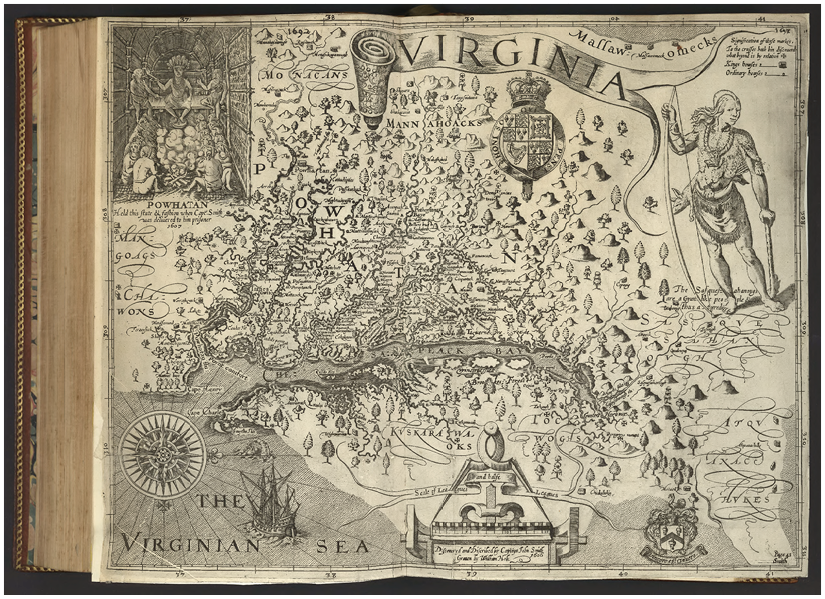
As Lauren Working (Reference Working2020) has shown, Purchas’s tract is deeply invested in sensual appeal, harnessing the ‘Twinnes of Profit and Pleasure’ to legitimise plantation and redirect metropolitan wit and eroticised language toward godly husbandry. Moralists and colonial promoters, she argues, recognised that the senses were crucial tools in advancing colonisation. This Element has attempted to trace how, across Pilgrimes, those tools were systematised, and how both a regime of ‘earwitness’ authority, combined with carefully staged reading experience, taught English Protestants to trust what travelling bodies felt and heard, and to map that sensorial confidence onto global projects of dominion. When, in ‘Virginias Verger’, Purchas instructed readers to ‘survay her Heavens … and well proportioned limmes’, he was inviting them to read Virginia as a providentially inscribed body whose elements demanded ordering by English Protestants.
Within this framework, Indigenous peoples are explicitly conceptualised as part of the plantation’s embodied ‘materials’. God, Purchas suggests, had ‘enriched the Savage Countries, that those riches might be attractives for Christian suters’, who may there ‘sowe spirituals and reape temporals’. When he enumerated Virginia’s ‘portion’ and her woods, rivers, minerals, and, crucially, ‘the bodies of Natives servile and serviceable’, Indigenous labour was folded, without transition, into the same catalogue as timber and ore, becoming a form of embodied resource whose proper end is service to Christian masters. Because the right to ‘subdue’ the earth is grounded in the divine image and, in Purchas’s account, perfected in English Protestants, their bodies were implicitly cast as those who give law to land and labour, while Indigenous bodies become the compliant, exploited limbs of an expanded English body politic.
The devastating co-ordinated Powhatan attack on English settlements in 1622 was the hinge on which this hierarchy was juridically ratified. In ‘Virginias Verger’ the uprising was figured as rape: the ‘damnable trechery and massacre’ by the ‘unnaturall Naturalls’ had ‘ravished’ Virginia and dyed her ‘Virgin cheekes’ with English blood. Their ‘disloyall treason hath now confiscated whatsoever remainders of right the unnaturall Naturalls had, and made both them and their Countrey wholly English’. At this point, Purchas turned explicitly to the bodies of dead English colonists to sacralise the territory. Despite ‘being dead’ they ‘speake, proclaime and cry, This our earth is truly English, and therefore this Land is justly yours’. English bodies, literally buried in American soil, were made to testify that the land now belongs, by right of blood, to England.
This, then, is ‘embodied empire’, and a colonial imaginary in which theological claims about the human body, sensory hierarchies and narrative techniques combine to naturalise confessional and racialised orderings of the world. Purchas’s corporeal rhetoric underwrites his entire project. It teaches readers to feel as well as to think, to desire Virginia’s ‘lovely lookes’, to recoil from Indigenous ‘trechery’, to mourn English suffering and to assent to the transformation of a contested space into land ‘wholly English’. Seen in this light, the hierarchies articulated in Pilgrimes are not solely ‘national’, and W. E. Washburn’s argument that Purchas’s language was, overall, ‘neutral rather than pejorative’ is inadequate (Washburn, Reference Washburn and Pennington1997, p. 167). As Kim Hall has argued, the language of darkness, degeneration and ‘unnatural’ behaviour in early modern writing is never simply descriptive; it participated in an emerging racial imaginary in which non-white bodies are marked as morally and ontologically deficient, and in which whiteness is tacitly aligned with divinely ordered civility (Hall, Reference Hall1995).
In the conclusion of Pilgrimes, Purchas reflected that ‘wee have now compassed the World in the Courses of so many Planets’ (Vol. 4, p. 1971 [p. 1980 – misprint in edition]). He offered the image of the compass to gloss what he and his authors had done: ‘as in Geometricall compasses one foote is fixed in the Centre, whiles the other mooveth in the Circumference, so is it with Purchas and his Pilgrimes’. The travellers’ bodies are the wandering feet; his own body, which has ‘never travelled two hundred miles from Thaxted in Essex’, remains fixed at the centre. Purchas also deployed a choreographic image: ‘All Nations dance in this Round to doe the English service, and English Travellers here enjoy the Mayne, others the By, to attend, and with their Travels to perfect the English.’ The image is masque-like in its assumptions. Bodies are arranged into serviceable motion around an English centre, and dance in disciplined, courtly measure. Purchas then binds this choreography of bodies to the Stuart polity and to American colonisation. James VI/I is praised as the king who has ‘disposed the overflowing numbers of his Subjects … to breed New Britaines in another World’ (Vol. 4, p. 1972), what Purchas in his very first Volume and dedication to Prince Charles had called ‘Englands out of England’, and who now sends a ‘Running Armie of Souldiers to scoure the Countrey of the unneighbourly malicious Naturalls’ (Vol. 1, Book 1). He closes by declaring that ‘wee have brought all the World to England, England it selfe to the greatest of her Soveraignes, King IAMES … here I hang up my Pilgrims weeds; here I fixe my Tabernacle, it is good to bee here’ (Vol 4, p. 1972). Pilgrimage ends once the world has been successfully re-centred on king and kingdom.
The significance of Pilgrimes thus lies not only in the quantity of information it transmitted or in its value as a repository for now-lost texts, but in the way it orchestrates bodies and senses into an imperial formation. The collection authenticates travel by foregrounding bodily risk and sensorial labour; it teaches readers how to distinguish true from false wonder, meaningful speech from dangerous noise, godly music from diabolical sound. It scripts English bodies as auditors, judges and rulers, and plots Indigenous and other non-European bodies as objects of knowledge, instruments of labour or obstacles to be removed. In doing so, it helps to naturalise an English Protestant imperial imaginary, an imaginary that is auditory, in which dominion appears as the fulfilment of a divine charter and in which the violence of colonisation is recast as the necessary exercise of ‘Temperance and Justice’, as Purchas had explained in ‘Virginias Verger’.
Finally, the arguments developed here intersect suggestively with later histories of racialised listening, responding to the call made by Rubiés that early modern scholars should identify ‘the potential for racism of certain ideas, and the kinds of contexts in which they flourished’ (Rubiés, Reference Rubiés, Morris-Reich and Rupnow2017, p. 65). It is my contention, then, that Pilgrimes points towards a longer history of what Jennifer Lynn Stoever has theorised as the “Sonic Color Line”. Stoever defines this as a socially constructed boundary that racially codes sonic phenomena such as vocal timbre, accent and musical style, and trains listening to function as an ‘organ of racial discernment, categorization, and resistance in the shadow of vision’s alleged cultural dominance’ (Stoever, Reference Stoever2016, p. 4). Throughout Pilgrimes, the bodies and voices of non-Europeans are repeatedly reduced to a narrow range of racialised acoustic descriptors: cries, yells, ‘hellish’ noise, ‘bestial’ or ‘barbarous’ harmony. Such tropes flatten the complex range of sounds produced into a manageable set of racialised signs, while English and Protestant utterances such as psalm-singing and ordered prayer consistently carry the marks of intelligibility, civility, efficacy and divine favour. This worked to cultivate specific modes of listening. Phonetic transcriptions of ‘strange’ cries, musical notation of Tupi song, and marginalia that gloss Indigenous ritual as ‘howling’ or ‘magicall rites’ invite readers to rehearse difference with their own lips and inner ears. There is an almost fetishised attention to the non-European voice: a desire to reproduce it, to take pleasure in its strangeness and simultaneously to fix it as evidence of a lack of civility and right worship.
What Stoever identifies in the modern United States thus finds a striking early modern analogue here and a set of listening practices in which racialising tendencies, religion and sound are mutually constitutive. Tracing in detail how those practices travel lies beyond the scope of this Element. It is, however, a direction in which the argument points. If future scholars might like to take up the mantle, we may begin to hear more precisely how early modern English ears contributed to the making of racialised listening in the centuries that followed.
Acknowledgements
This project was conceived in the midst of the Covid-19 pandemic. In March 2020 I had returned to work nine months after the birth of our second child and managed just a few days of childcare before the UK was plunged into the first national lockdown. Without access to the archives that I had hoped to visit in the coming months (and, if I’m honest, feeling totally overwhelmed and trapped at home with a toddler and a baby) I did what I imagine many others did during this strange time: I immersed myself in literature that would take me out of the house and across the world. As I turned to Early English Books Online and started reading travel narratives, I had in mind my previous work on religion and sensory experience. In this work I had argued that the sounds made and heard by English Catholic exiles in Continental Europe demarcated their distinctive place within the landscape, while at the same time marking their assimilation (Murphy, Reference Murphy, Macdonald, Murphy and Swann2018). Music allowed English Catholics to articulate a sense of place in a foreign land and feel both spiritually and physically located amongst their co-religionists at home and abroad. Sound played a vital role in fostering forms of religious and national identity, and my starting point with these (predominantly Protestant) travel narratives was whether sound had a similar function for these mobile individuals as well. This little ‘pandemic project’ then became the ‘side project’ that has stayed with me in the years that have followed, and which I’ve picked up and put down intermittently as various demands on my time and energies have waxed and waned. I am grateful to Nandini Das and Tim Youngs for seeing the potential of this project as an Element, and I have many others to thank too who have read drafts and offered advice along the way.
Thank you to all the wonderful scholars of travel and mobility who have shared their expertise with me, an interloper in the field, for the last few years. Especial thanks are due to Jennifer Linhart Wood, whose work is an inspiration, and whose Zoom-based friendship over lockdown and beyond has brought me so much joy and intellectual stimulation. I am also grateful to Natalya Din-Kariuki, John Gallagher, Eva Johanna Holmberg and Anders Ingram for that initial chat about Fynes Moryson over a Zoom-drink in lockdown, and particular thanks to Hanna and Natalya for reading some of the earliest iterations of the project in the years that followed (I hope you enjoy how it has finally ended up!). Thanks to Ofer Gal, Miriam Jacobson, William Kolbrener, Yaakov Mascetti, Stephanie Shirilan and Elizabeth Swann. It was during our year together talking about the senses at the Israel Institute for Advanced Studies (IIAS) in Jerusalem, as I followed in the footsteps of many earlier English travellers to the ‘Holy Land’, that the idea for the ‘final’ version of this project was born. I am grateful for our conversations. I’d also like to thank the IIAS director, Yitzhak Hen, and Keren Rechnitzer and Iris Avivi for all their support during the fellowship.
A particular thank you to my colleague Lauren Working for her thoughtful and useful feedback on a full draft of this Element. Heartfelt thanks too to my other York colleagues and ‘Second Book Club’ crew (especially for letting me join despite not in fact having a ‘first book’!): Dilnoza Duturaeva, Laura Forster, Eliza Hartrich, Purba Hossain, Hannah Jeans, Stephanie Mawson, Ana Otero-Cleves, Elizabeth Spencer, Will Tullett and Sam Wetherell. Extra thanks to Hannah and Will for reading so much of this, and to my PhD student Sam Dominy, for all their useful suggestions. Finally, and most importantly, I would like to thank my longtime mentor, friend and colleague Professor Simon Ditchfield. I cannot adequately put into words how grateful I am for your support, your guidance and your unyielding encouragement throughout my professional career. There’s scarcely a word of mine in print that you have not read and commented on, offering me a wealth of insights from your treasure-trove of a mind. This ‘little book’ on travel is for you.
Nandini Das
University of Oxford
Nandini Das is a literary scholar and cultural historian, Professor of Early Modern Literature and Culture at the University of Oxford, and Fellow of Exeter College, Oxford. With Tim Youngs, she has co-edited The Cambridge History of Travel Writing (2019), and published widely on early modern English literature, cross-cultural encounters, and travel accounts.
Tim Youngs
Nottingham Trent University
Tim Youngs is Professor of English and Travel Studies at Nottingham Trent University. His books include The Cambridge Companion to Travel Writing (edited with Peter Hulme, 2002), The Cambridge Introduction to Travel Writing (2013), and The Cambridge History of Travel Writing (edited with Nandini Das, 2019). He edits the journal Studies in Travel Writing.
About the Series
Travel writing is enormously varied. It consists of several different forms and has a long history across many cultures. This series aims to reflect that diversity, offering exciting studies of a range of travel texts and topics. The Elements further advance the latest thinking in travel writing, extending previous work and opening up the field to fresh readings and subjects of inquiry.