Implications
The high dietary level of WB was not found healthy from a rumen and urine pH perspective. Results suggest that the sheep industry can carefully increase dietary grain levels (especially corn grain) to improve feed intake and milk production. Diets containing ground corn grain instead of combined ground wheat and barley grains may be fed to periparturient ewes to reduce the severity of negative energy balance and improve insulin action. Findings provide evidence on the biological and economical importance of periparturient sheep cereal management. This information could be utilized to advance sheep nutrition and husbandry globally. Future research could investigate cereal processing techniques for pariparturient sheep.
Introduction
Periparturient ruminants undergo severe metabolic pressures when transitioning from a pregnant, non-lactating to a non-pregnant, lactating state (National Research Council (NRC), 2001 and 2007; Nikkhah, Reference Nikkhah2015). The past research on transition physiology has shed some light on some aspects of the periparturient challenges in different animal, organ, cell and gene levels (Janovick-Guretzky et al., Reference Janovick-Guretzky, Dann, Carlson, Murphy, Loor and Drackley2007; Nikkhah et al., Reference Nikkhah, Loor, Wallace, Graugnard, Vasquez, Richards and Drackley2009). However, cereal nutritional management in periparturient sheep has not been well studied.
Effects of late gestation nutritional programs on periparturient sheep metabolism and production have long been recognized (Treacher, Reference Treacher1970; Hall et al., Reference Hall, Holst and Shutt1992; Charismiadou et al., Reference Charismiadou, Bizelis and Rogdakis2000; Banchero et al., Reference Banchero, Quintans, Vazquez, Gigena, Manna, Lindsay and Milton2007). Nevertheless, there is a need to formulate global and regional guidelines especially on sheep energy nutrition for optimal intermediary metabolism, health and productivity (NRC, 2007; Nikkhah, Reference Nikkhah2015). The rumen fermentability of corn grain (40% to 70%) is lower than that of wheat and barley grains (80% to 100%) (Huntington, Reference Huntington1997; Nikkhah et al., Reference Nikkhah, Ehsanbakhsh, Zahmatkesh and Amanlou2010). The average wheat grain is more rapidly degradable than barley grain (Huntington, Reference Huntington1997). The physical and chemical properties of cereal grains and rumen fermentation characteristics may be considerably altered by processing (Yang et al., Reference Yang, Beauchemin and Rode2000; Nikkhah, Reference Nikkhah2010). In addition, prepartal dietary starch source influences peripartal metabolism (Dann et al., Reference Dann, Varga and Putnam1999; Banchero et al., Reference Banchero, Quintans, Vazquez, Gigena, Manna, Lindsay and Milton2007). Prepartal replacement of ground barley grain by wheat grain has improved energy and calcium status in periparturient cows (Amanlou et al., Reference Amanlou, Zahmatkesh and Nikkhah2008) and heifers (Nikkhah et al., Reference Nikkhah, Karam Babaei and Mirzaei2011). In contrast, dairy cows fed ground corn v. ground barley-based diets performed similarly (Sadri et al., Reference Sadri, Ghorbani, Rahmani, Samie, Khorvash and Bruckmaier2009). Wheat (Hunter, Reference Hunter1978; Guessous et al., Reference Guessous, Rihani, Kabbali and Johnson1989) and barley (Thomas et al., Reference Thomas, Soder, Kott and Schuldt1992; Hatfield et al., Reference Hatfield, Thomas and Kott1997) grains have long been fed to pregnant ewes. In situ ruminal and intestinal digestibility of differently processed cereal grains in sheep has also been studied (Gonzalez et al., Reference Gonzalez, Faria-Marmal, Matesanz, Rorriguez and Alvir2003; Nikkhah et al., Reference Nikkhah, Alikhani and Amanlou2004). However, wheat, barley and corn grains have not been comparatively investigated in vivo in periparturient ewes.
As reviewed by Nikkhah (Reference Nikkhah2015), feeding rapidly v. slowly fermentable cereal grains (e.g. barley v. corn) alters rumen degradation patterns and physically effective fiber requirements for optimal production and health (Beauchemin and Rode, Reference Beauchemin and Rode1997). Owing to the beneficial effects of wheat grain feeding on transition cow energy and calcium status (Nikkhah et al., Reference Nikkhah, Ehsanbakhsh, Zahmatkesh and Amanlou2010), and to decrease risks of too-rapid starch fermentation and subacute rumen acidosis (SARA) incidence (Stone, Reference Stone2004), peripartal feeding of combined wheat and barley grains could be more desirable than feeding either grain alone. Pregnant ewes can effectively chew whole grains except for when diets contain silage (Vipond et al., Reference Vipond, Huntera and Kinga1985). Post-weaning ewes can produce greater milk fat when fed cereals as whole v. pelleted or ground (Economides et al., Reference Economides, Georghiades, Koumas and Hadjipanayiotou1989). It was hypothesized that feeding ground corn grain (CN) instead of combined ground wheat and barley grains (WB) would improve feed intake, rumen fermentation, milk properties and metabolism of periparturient sheep. As a result, CN feeding would attenuate negative energy balance. It was also hypothesized that a higher level of CN v. WB would increase rumen pH and reduce acids concentrations. Therefore, the main objective of this study was to determine effects of feeding diets with high v. low levels of CN v. WB on feed intake, rumen fermentation, colostrum and milk properties, and blood metabolites of periparturient ewes. The preliminary results were published as abstracts (Nikkhah et al., Reference Nikkhah, Karam Babaei and Mirzaei2011; Nikkhah, Reference Nikkhah2012).
Material and methods
Experimental design and ewe management
Twenty late pregnant Afshari×Merino ewes (80.3±2.0 kg BW; 3.0±0.45 body condition score; mean ± SD) were used in a completely randomized design study from 24±3-day prepartum through 21-day postpartum. The pregnancy days were estimated according to the time-frame of ram introduction into different ewe plots during the earlier breeding season. Ewes were housed indoors in individual boxes (1.5×2.5 m) and were fed once daily at 0900 h total mixed rations (TMR) containing either (1) high or (2) low level of concentrate based on either (1) ground CN or (2) a 50 : 50 ratio of ground wheat : barley grains (Table 1). Each treatment group had five ewes including two twin-lamb ewes and three single-lamb ewes. The twinning status was diagnosed with sonography. Ewes were stepped into the postpartum diet having been on two prepartum diets (Table 1). The first prepartum diets (Pr1) were fed from 24 days until 10-day prepartum. The forage to concentrate ratios (F : C) for the low and high grain diets were 75 : 25 and 65 : 35, respectively. The second prepartum diets (Pr2) were fed from 10-day prepartum until lambing, and had F : C of 70 : 30 for the low grain diet and 60 : 40 for the high grain diet. The postpartum ration (Po) was fed for 21 days starting at lambing, with F : C of 65 : 35 for the low grain diet and 50 : 50 for the high grain diet (Table 1). Dry matter (DM)-based dietary forage had 3 : 1 ratio of chopped alfalfa hay : corn silage. Before the beginning of the experiment, ewes were fed on a farm diet containing 80% forage and 20% concentrate with ingredients proportions similar to the experimental diets. Rations were offered to permit 5% to 10% daily orts. The peripartum ewes were randomly assigned to one of four treatments at the commencement of the study. Diets were formulated using the Cornell Net Carbohydrate and Protein System’s program for sheep (CNCPS, v.1, Cannas et al., Reference Cannas, Fox, Tedeschi, Pell and Van Soest2004). Within each grain level, diets were balanced to have similar net energy (NE), metabolizable energy, CP and NDF densities (Table 1). Each box was bedded with clean wood shavings and equipped with a concrete feed bunker and a metal waterer. Manure was collected and bedding was cleaned daily. Before the experiment, all ewes were placed in their boxes for adaptation to experimental conditions for a 4-day period. Lambs were weighed immediately after parturition (following drying) and at week-3. The experiment was conducted at the Sheep Farm Facilities of the University of Zanjan (Zanjan, Iran) under the guidelines of the Iranian Council of Animal Care (1995).
Periparturient ewe dietary ingredients (%) and nutrient composition (dry matter-based)

Pr1=the first prepartum diet fed from 24 days until 10-day prepartum; Pr2=the second prepartum diet fed from 10-day prepartum until lambing; Po=the postpartum diet fed from lambing through 21-day postpartum; WB=the 50 : 50 combination of ground wheat : ground barley grains; NEL=net energy for lactation; ME=metabolizable energy; EE=ether extract.
1 Contained 500 000 IU vitamin A, 100 000 IU vitamin D3, 0.1 mg vitamin E, 180 g Ca, 90 g P, 20 g Mg, 60 g Na, 2 g Mn, 3 g Fe, 0.3 g Cu, 0.1 g CO, 0.1 g I, 0.001 g Se and 3 g antioxidants per kilogram.
2 Estimated from Cornell Net Carbohydrate and Protein System (Cannas et al., Reference Cannas, Fox, Tedeschi, Pell and Van Soest2004).
Cereal and forage properties and processing
Wheat (Triticum spp.), barley (Hordeum spp.) and corn (Zea mays L. ssp.) grains were obtained from bulked sources distributed in broad regions of Iran. Corn, wheat and barley grains contained respectively 70%, 75% and 58% starch; 8.5%, 13% and 11% CP; 11%, 10% and 20% NDF; 3.2%, 3% and 7% ADF; and 4%, 2.3% and 2.2% ether extract (DM-based). Whole corn, barley and wheat grains densities were 540, 500 and 550 g/l, respectively. All grains were ground by a commercial hammer mill (sieve size of 2 mm) most commonly used in ruminant farms in Iran (Nikkhah et al., Reference Nikkhah, Alikhani and Amanlou2004 and Reference Nikkhah, Ehsanbakhsh, Zahmatkesh and Amanlou2010). Alfalfa hay contained 13.1% CP and 45.6% NDF, and was chopped using an on-farm chopper machine (Agricultural Machinery Co., Tabriz, Iran) for an average theoretical chop length of 4 cm before mixing with concentrate. Corn silage had 8% CP and 50% NDF. Chopped alfalfa hay, processed corn silage and concentrate for individual ewes were weighed and mixed thoroughly to prepare TMRs just before the daily feed delivery.
Fecal and urinary pH
For 2 days during the prelambing week, fecal samples were collected from rectum twice in morning and evening. Each fecal sample was mixed with an equal portion of distilled water and stirred for sufficient uniformity before immediate pH measurement using a portable pH meter (HI 8314 membrane pH meter; Hanna Instruments, Villafranca, Italy). A portion of the grab fecal sample was stored at −20°C for later DM digestibility measurement (Nikkhah et al., Reference Nikkhah, Alikhani and Amanlou2004). At day-7 prepartum and day-14 postpartum, urine was collected by manual stimulation of lower vulva into plastic vials twice in morning and evening. Urine samples were stirred and analyzed for pH immediately upon sampling.
Nutrient analysis and digestibility
The amount of TMR offered and orts were measured daily for individual ewes. Samples of TMR and orts were taken daily to obtain DM after oven-drying at 100°C for 24 h. Weekly feed and fecal samples were dried and ground to pass through 1 mm screen using a Wiley mill (Arthur H. Thomas Co., Philadelphia, PA, USA) for storage at −20°C for later nutrient analysis. Feed samples were analyzed for CP (method 984.13; Association of Official Analytical Chemists (AOAC), 2004), NDF (Van Soest et al., Reference Van Soest, Robertson, Lewis and Akin1991; using heat-stable α-amylase and sodium sulfite), ADF (method 973.18; AOAC, 2004) and ether extract (method 920.39; AOAC, 2004). The acid insoluble ash (AIA; Nikkhah et al., Reference Nikkhah, Alikhani and Amanlou2004) was measured in feed and fecal samples as an internal marker to determine coefficient of total tract apparent DM digestibility with the following formula: 1 − [(Fecal DM/Feed DM) × (Feed AIA/Fecal AIA)] × 100. Feed and fecal DM and AIA concentrations are in g/kg.
Colostrum and milk properties and analysis
Colostrum was obtained within 1-h post-lambing and following a single intramuscular injection of 10 IU oxytocin. Mammary secretions were not considered as milk until after 3-day post-lambing. Lambs received colostrum at 10% of BW. Lambs received colostrum by administration from a bottle. Each lamb received colostrum from its mother. Colostrum from individual ewes was sampled and frozen at −20°C until analyzed for fat and protein by Milk-O-Scan (134 BN Foss Electric, Hillerّ d, Denmark). Lambs had no access to dam feeds. They had their own troughs and feeders with concentrate and high-quality alfalfa meal. For animal welfare reasons, lambs were allowed to stay with dam while the mammary gland was covered to avoid any possible lamb suckling that would affect milk production response. Milk production was measured at 5-, 12- and 19-day postpartum after a subcutaneous 10 IU dose of oxytocin. Milking was performed manually in individual ewe boxes by trained same individuals at 0800 h. Ewes were milked by hand every day with lambs never suckling. Before milking, teats were cleaned and disinfected with once-use cleaners that were put in warm water. After thorough mixing, 30 ml of milk was sampled from individual ewes, added with potassium dichromate, stored at 4°C for fat and protein analysis using the Milk-O-Scan.
Blood sampling and analysis
Blood from individual ewes was obtained weekly at 4 h post-feeding from the jugular vein. Blood was collected into ethylendiaminetetraacetic acid-containing 5 ml tubes, put in the ice and centrifuged within 30 min at 3000×g for 15 min to harvest plasma. Plasma was stored at −20°C until analyzed for metabolites. Glucose (GOD-PAR enzymatic method), urea and albumin (Bromcresol Green method) were measured using spectrophotometer (Perkin-Elmer, Colemen Instruments Division, Oak Brook, IL, USA) and commercial kits (Pars Azmun Laboratory, Tehran, Iran). Plasma levels of β-hydroxybutyric acid (BHBA; Ultraviolet method; Catalogue No. RB1007; Randox Kits, Randox laboratories ltd, Antrim, UK), non-esterified fatty acids (NEFA; Colorimetric method; Catalogue No. FA115; Randox Kits) and insulin (radioimmunoassays; ELISA Kits, Randox laboratories ltd) were measured at the Veterinary Clinical Laboratory of Mabna (Karaj, Iran). The absorbance was red using a spectrophotometer.
BW and placenta weight
Body weight was measured weekly and shortly before feeding. Placenta was weighed for individual ewes immediately upon expulsion postpartum.
Rumen fluid collection and metabolite analysis
Rumen fluid was sampled at 21-day postpartum at 4-h post-feeding using a 1.5–m length stomach tube. To minimize saliva contamination, the first 20 ml aspirated was removed. Rumen fluid samples were passed through a four-layer cheese cloth and analyzed immediately for pH (HI 8314 membrane pH meter). A rumen fluid sample of 10 ml mixed with 2 ml of 25% metaphosphoric acid was stored at −20°C for later volatile fatty acids (VFA) analysis (Nikkhah et al., Reference Nikkhah, Alikhani and Amanlou2004). Frozen rumen fluid samples were thawed at room temperature. The tubes were vortexed and placed in a −20°C freezer for 17 h. Thawed samples were centrifuged for 10 min at 1900×g. Approximately 2 ml of supernatant were placed into the autosampler device (model 8100; Varian, Walnut Creek, CA, USA) for analysis. Concentrations of VFA were determined by gas chromatography (Hewlett Packard Series 25890, Palo Alto, CA, USA) using a 1.83-m packed glass column (model 2-1721; Supelco, Oakville, Ontario, Canada). The injector and detector temperatures were set at 170°C and 195°C, respectively, with initial and final column temperatures set at 120°C and 165°C, respectively. Another rumen fluid sample of 10 ml added with 1 ml of 50% sulfuric acid was stored for ammonia analysis (Novozamsky et al., Reference Novozamsky, Van Eck, Schouwenburg and Walinga1974).
Statistical analysis
Data were analyzed using the MIXED MODELS procedure of SAS program (SAS, 2003). The REML method was set to estimate least squares means, and Kenward–Roger method was used to calculate denominator degrees of freedom. The model for repeated blood parameters included fixed effects of grain source, grain level, grain source×grain level, week, week×grain source, week×grain level and week×grain source×grain level. Random effects were ewe within week×treatment, plus residuals. Due to non-significance, the effect of ‘week×grain source×grain level’ was excluded from final models. As a result, blood metabolites are presented in the same format as non-repeated measures. To account for unequal correlations between repeated measures on the same subject, models were run with various covariance structures (e.g. variance component, compound symmetry, compound symmetry heterogeneous, autoregressive (1), autoregressive heterogeneous (1), unstructured) (Littell et al., Reference Littell, Milliken, Stroup, Wolfinger and Schabenberger2006). The autoregressive (1) and autoregressive heterogeneous (1) were found optimum choices that produced the least fit criteria (Wang and Goonewardene, Reference Wang and Goonewardene2004). For non-repeated parameters, final models consisted of fixed effects of grain source, grain level and grain source×grain level, plus random effects of ewe within treatment, and residuals. Normality of distribution and homogeneity of variance for residuals were tested and ensured using Proc Univariate (SAS, 2003). The P-values<0.05 were declared as significant and those⩽0.10 were declared as trends for significance.
Results
Lamb and ewe BW and placenta mass
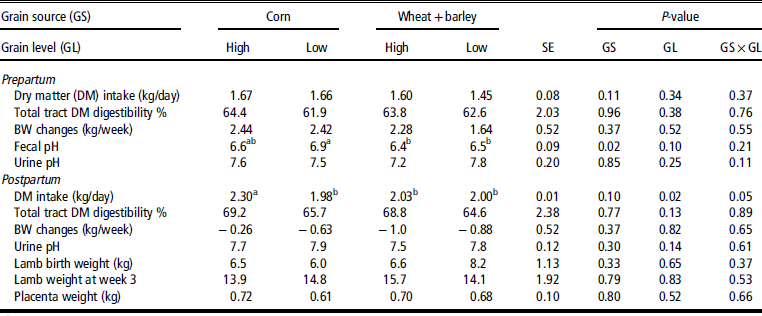
Neither grain source nor grain feeding level affected placental weight, lamb birth weight or lamb BW at 3 weeks of age (Table 2). Lamb weight at 3 weeks of age was similar among treatments, being 14.4 kg for CN and 14.8 kg for WB. Ewe BW changes prepartum and postpartum were similar among treatments (Table 2). The average BW change for all the animals was 2.2 kg from 24-day prepartum until lambing, and −0.69 kg from lambing until 21-day postpartum.
Peripartum ewe performance and lamb weight

a,bDifferent superscripts within a row indicate statistical significance at P<0.05.
Ewe dry matter intake and nutrient digestibility
Treatments did not significantly affect prepartal dry matter intake (DMI) (Table 2). An interaction of dietary grain source and level existed postpartum (P=0.05), such that feeding the high v. low level of CN (2.30 v. 1.98 kg/day) and not of WB (2.03 v. 2.00 kg/day) improved DMI. Total tract apparent DM digestibility was similar among diets, both prepartum and postpartum. The average across-treatment DM digestibility coefficients were 63.2% and 67.1% for prepartal and postpartal diets, respectively.
Fecal and urinary pH
Prepartum fecal pH was higher for CN than for WB (P=0.02). The high v. low grain diets tended to decrease fecal pH peripartum (P=0.10). Increased dietary grain reduced urine pH for WB but not for CN prepartum. Postpartal urine pH was similar among treatments (Table 2).
Milk and colostrum properties
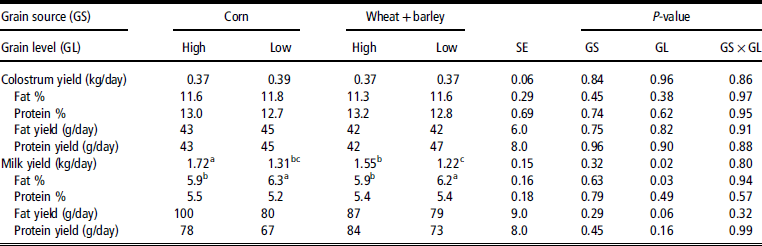
Colostrum volume, and its content and yield of fat and protein were not affected (Table 3). The average colostrum yield was 374 g, and the average colostrum fat and protein contents were 11.6% and 12.9%, respectively (Table 3). Dietary grain level (P=0.02) and not grain source (P=0.32) affected milk yield. Milk yield was 1.64 kg/day for the high grain diet and 1.27 kg/day for the low grain diet. Inversely, milk fat content was decreased by feeding the high instead of the low grain diet (5.9 v. 6.3%, P=0.03). Milk fat yield tended to increase by the high v. low grain diet (95 v. 80 g/day; P=0.06). Milk content and yield of protein was comparable among treatments, values being on average 5.4% and 76 g/day, respectively (Table 3).
Ewe milk and colostrum production and composition

a,b,cDifferent superscripts within a row indicate statistical significance at P<0.05.
Rumen fermentation parameters
Dietary grain source and level interacted on rumen fluid pH (P<0.01). Increasing grain inclusion rate did not affect rumen pH for CN (6.28 v. 6.25), but reduced it for WB (5.70 v. 6.23) (Table 4). Rumen fluid ammonia and total VFA concentrations were unaffected, mean values being 17.6 mg/dl and 106 mmol/l, respectively. Rumen fluid concentrations of propionate were higher (20.5 v. 18.9 mmol/L) and those of acetate were lower (67.1 v. 70.0 mmol/l) for the high v. low grain diet (P<0.05; Table 4). Rumen fluid acetate to propionate ratio was lower for high v. low grain diet (3.3 v. 3.7, P=0.02).
Postpartum ewe rumen fermentation parameters

VFA=volatile fatty acids.
a,bDifferent superscripts within a row indicate statistical significance at P<0.05.
Peripheral blood metabolites
Increasing dietary grain increased plasma glucose for WB (57.6 v. 52.2 mg/dl) but not for CN (56.0 v. 54.5 mg/dl). Ewes fed CN tended to have lower plasma NEFA concentrations (0.25 v. 0.28 mmol/l; P=0.06) and had higher plasma insulin to NEFA ratio (2.4 v. 1.8, P<0.01) compared with ewes fed WB, with similar plasma insulin levels (0.38 v. 0.35 ng/l) (Table 5). Plasma concentrations of urea, BHBA and albumin were unaffected (Table 5).
Periparturient ewe peripheral blood metabolites and insulin concentrations

NEFA=Non-esterified fatty acids; BHBA=β-hydroxy butyric acid.
a,b,cDifferent superscripts within a row indicate statistical significance at P<0.05.
Discussion
The current study provides evidence that feeding periparturient ewes TMRs based on ground CN v. combined WB can improve feed intake and some peripheral indicators of intermediary metabolism. The positive effect on DMI of feeding CN v. WB was more evident at the higher dietary grain level and in the postpartum period. It was especially important that insulin action was improved by CN v. WB feeding as reflected in the higher insulin to NEFA ratio in the CN v. WB fed ewes. This suggests that the CN v. WB fed ewes experienced an attenuated negative energy balance. This in turn implies that feeding CN v. WB could improve sheep immunity and health in the periparturient period. It should be noted that since blood samples were taken only at 4-h post-feeding, the results should be interpreted in light of this sampling timing. The interaction of dietary grain source and level is established to affect peripartal ewe performance. The greater prepartum DMI of ewes fed high and low CN v. low WB could suggest that ground CN is a better choice over WB at high and low levels in improving feed intake. The greater DMI of postpartum ewes at higher CN levels supports this suggestion. Recently, ground wheat grain was shown to be more effective than ground barley grain in improving energy and Ca status of periparturient cows and nulliparous pregnant heifers (Amanlou et al., Reference Amanlou, Zahmatkesh and Nikkhah2008; Nikkhah et al., Reference Nikkhah, Ehsanbakhsh, Zahmatkesh and Amanlou2010). Wheat (Hunter, Reference Hunter1978; Guessous et al., Reference Guessous, Rihani, Kabbali and Johnson1989) and barley (Thomas et al., Reference Thomas, Soder, Kott and Schuldt1992; Hatfield et al., Reference Hatfield, Thomas and Kott1997) grains have been fed to pregnant ewes to improve energy metabolism. The positive effect of CN on DMI became more noticeable in the postpartum period when the higher CN level increased DMI by about 300 g/day. The lower prepartal fecal pH for WB v. CN was suggestive of a more extensive hindgut fermentation for WB (Nikkhah et al., Reference Nikkhah, Alikhani and Amanlou2004).
Feeding cows ground corn v. ground barley-based prepartum (21% grain) and postpartum (28% grain) diets did not affect DMI, milk production and energy balance (Sadri et al., Reference Sadri, Ghorbani, Rahmani, Samie, Khorvash and Bruckmaier2009). Corn and barley-based diets had exactly the same proportion of grains. As a result, contents of NEL, CP, NDF and non-fiber carbohydrates between corn and barley-based diets were dissimilar. It is probable that cow response to dietary grain source was confounded with altered dietary nutrient composition in the study of Sadri et al. (Reference Sadri, Ghorbani, Rahmani, Samie, Khorvash and Bruckmaier2009). Taking into consideration the minor changes in alfalfa hay and soybean meal inclusion rates, diets in the current study were formulated to be similar in nutrient composition, so ewe response would be optimally attributable to major differences in grain source and level. These plus feeding ‘barley+wheat’ can partly explain the different results between the two studies. Moreover, sheep chew and ruminate grains more effectively than cattle (Vipond et al., Reference Vipond, Huntera and Kinga1985; Van Soest, Reference Van Soest1994). Such abilities can alter rumen kinetics of degradation and passage, and may render sheep more responsive to periparturient dietary treatments.
Ewes fed a high (110% of energy requirements) instead of a low (90% of energy requirements) nutrition level had a larger udder at the 140th day of pregnancy and more secretory cells, suggesting a higher DNA content (Bizelis et al., Reference Bizelis, Charismiadou and Rogdakis2000; Charismiadou et al., Reference Charismiadou, Bizelis and Rogdakis2000). Milk yield was higher in the ewes that were on the high level of nutrition prelambing, which was likely due to the greater mammary secretory cells as well as an increased availability of body reserves (Bizelis et al., Reference Bizelis, Charismiadou and Rogdakis2000; Charismiadou et al., Reference Charismiadou, Bizelis and Rogdakis2000). The increased milk and milk fat yield by feeding high v. low grain level in the current study agrees with those reports. Increased dietary energy density and higher grain feeding probably increased the ewe mammary function, since differences in BW changes were statistically non-significant.
The lower rumen pH at the high WB level v. other treatments suggests a possible occurrence of SARA (Krause and Oetzel, Reference Krause and Oetzel2006), supporting the lower fecal pH. The higher rumen fermentation rate of WB reduced rumen pH and may have consequently disturbed normal rumen environment that would turn increase the passage of partially digested starch and protein to the lower gut. These would increase hindgut fermentation and lower fecal pH, as observed for WB v. CN.
The reduced prepartum urine pH for the high v. low WB suggests an increased acidity of extracellular body fluids. Recently, ground wheat grain was fed to prepartal dairy cattle at 10% and 20% of diet DM to reduce extracellular alkalinity and improve blood Ca (Amanlou et al., Reference Amanlou, Zahmatkesh and Nikkhah2008; Nikkhah et al., Reference Nikkhah, Ehsanbakhsh, Zahmatkesh and Amanlou2010), which suggests increased bone resorption and intestinal Ca absorption by feeding wheat grain. Reduced urine pH and increased DMI and blood Ca improved milk production. As such, feeding high WB in the current study might have reduced extracellular alkalinity. These data are consistent with the reduced rumen pH by feeding higher WB.
Despite the increased rumen propionate and reduced acetate levels postpartum with high v. low dietary grains, the total VFA levels remained similar. Rumen VFA concentrations and pH do not essentially represent rumen VFA production and direct pH changes because a multitude of factors (i.e. pH, saliva flow, rumen fluid and solids passage rate, buffering capacity and absorption rate) affect VFA concentrations at any given time (Allen, Reference Allen1997; France and Dijkstra, Reference France and Dijkstra2005). These data suggest that grain source had not or little effects on rumen acids concentration. The results also suggest that ground corn may be increased from 24.5% (17% cereal starch) up to 30% (21% cereal starch) of the postpartal diet DM without compromising rumen pH. However, such increases in WB starch supply reduced rumen pH considerably.
Increasing dietary grain increased milk fat output by 20 g for CN and by 8 g for WB. These suggest that mammary fat precursors availability was greater for high v. low grain diets, which agrees with the increased DMI of about 300 g by feeding high v. low CN. The increase in DMI by increasing grain was only about 30 g for WB; nonetheless, milk fat yield was increased by 8 g. These changes suggest (1) more efficient nutrient use for milk secretion, and (2) more reliance on body reserves to sustain milk secretion for WB when compared to CN. These two likelihoods are consistent with the higher blood glucose (52.2 to 57.6 mg/dl) for high v. low WB. The increased milk fat yield by feeding the high v. low WB could be partly due to an increased mammary NEFA inflow (Bauman and Griinari, Reference Bauman and Griinari2003), since DMI rose by only 30 g. Given the similar plasma insulin levels, the higher insulin : NEFA ratio for CN v. WB suggests that insulin efficiency was likely improved by feeding CN v. WB (Nikkhah et al., Reference Nikkhah, Loor, Wallace, Graugnard, Vasquez, Richards and Drackley2009). By increased DMI, feeding CN v. WB may have improved insulin action and immunity through increased energy intake. Increased energy intake may have consequently reduced dependence on internal body fat stores (Vernon et al., Reference Vernon, Faulkner, Hay, Calvert and Flint1990). Supplementing grazing ewe diets with cereal grains plus protein meals improved pregnant ewe tissue gain and early lactation milk fat yield (Thomas et al., Reference Thomas, Soder, Kott and Schuldt1992; Hatfield et al., Reference Hatfield, Thomas and Kott1997). In contrast, feeding solely barley grain to grazing pregnant ewes has caused tissue weight loss (Vipond et al., Reference Vipond, Hunter and King1982).
Unaltered plasma albumin and urea are inter-supportive, suggesting little treatment effects on liver N metabolism and protein synthesis (Nikkhah et al., Reference Nikkhah, Karam Babaei and Mirzaei2011). The performance and metabolic data collectively suggest a nutritional advantage of CN over WB for periparturient ewes, particularly with high grain diets. Corn grain-based rations improved postpartal nutrient intake and attenuated negative energy balance without increasing the risk of SARA. Where reasonably priced and more accessible than corn grain, mixtures of wheat and barley grains may be effectively fed to periparturient ewes, however, at lower levels. The findings of this study could serve in advancing global sheep nutrition and husbandry, particularly at metabolically important and challenging periods.
Acknowledgements
The Ministry of Science, Research and Technology, and National Elite Foundation, Iran, are acknowledged. The University of Zanjan’s Sheep Research Farm employees are thanked for diligent help with animal care.
Declaration of interest
There are no conflicts of interest.
Ethics committee
The experiment was conducted under the ethical guidelines of the Iranian Council of Animal Care (1995).
Software and data repository resources
None of the data were deposited in an official repository.