INTRODUCTION
The Syllidae Grube, 1850 is a very diverse family of Polychaetes, with about 74 genera and more than 700 known species (Aguado & San Martín, Reference Aguado and San Martín2009; San Martín & Aguado, Reference San Martín, Aguado and Schmidt- Rhaesa2014). This family is currently divided into five subfamilies: Syllinae Grube, 1850; Exogoninae Langerhans, 1879; Eusyllinae Malaquin, 1893; Autolytinae Langerhans, 1879 and Anoplosyllinae Aguado & San Martín, Reference Aguado and San Martín2009 (Aguado & San Martín, Reference Aguado and San Martín2009; Aguado et al., Reference Aguado, San Martín and Siddall2012; San Martín & Aguado, Reference San Martín, Aguado and Schmidt- Rhaesa2014). In recent classifications of the family (Aguado et al., Reference Aguado, San Martín and Siddall2012; San Martín & Aguado, Reference San Martín, Aguado and Schmidt- Rhaesa2014), a number of genera was considered as incertae sedis, without any clear relationship with any of the subfamilies. Among them, is the genus Acritagasyllis.
Contributions regarding the Syllidae in Arctic and sub-Arctic areas are scarce and many of them are old. Ørsted (Reference Ørsted1845) described Syllides longocirrata Ørsted, Reference Ørsted1845 and reported Syllis armillaris (O. F. Müller, 1771) in areas off Denmark. Malgren (Reference Malmgren1867) described 12 new taxa of Syllidae in Greenland and Scandinavia. Later, Fauvel (Reference Fauvel1911) described five new species of syllids in the Kara Sea and the Barents Sea. Wesenberg-Lund (Reference Wesenberg-Lund1947, Reference Wesenberg-Lund1950a, Reference Wesenberg-Lundb, Reference Wesenberg-Lund1951, Reference Wesenberg-Lund1953) studied the polychaetes in areas of the Arctic Ocean and the North-West Atlantic, reporting 15 species of the family Syllidae. Ushakov (Reference Ushakov1955) conducted a study reporting 30 species of the family Syllidae to the area off Russia and sub-Arctic regions of the North Atlantic, adding identification keys and descriptions. Eliason (Reference Eliason1962) described some species of polychaetes between southern Scandinavia (Norway) and Jutland's peninsula (Denmark), reporting 40 species of Syllidae. Ramos et al. (Reference Ramos, San Martín and Sikorski2010) reported 16 species of Syllidae from arctic and subarctic coasts off Norway including the descriptions of two new species; Lucas et al. (Reference Lucas, San Martín and Sikorski2010) described Acritagasyllis longichaetosus, Lucas, San Martín & Sikorski, Reference Lucas, San Martín and Sikorski2010. Finally, Nygren & Pleijel (Reference Nygren and Pleijel2015) recently reported 28 species of Syllidae from Sweden.
MATERIALS AND METHODS
The company Akvaplan-Niva collected the samples off Norway. Specimens were obtained at stations Njord (64.27274 N 7.197683 E, 337 m depth); Norne (66.011 N 8.046586 E, 380 m depth); and LØ−1-I (59.485802 N 10.377934 E, 67 m depth). Specimens were examined by means of a binocular and a light microscope Nikon XN, and a light microscope Olympus CH−2. Drawings were made using a camera lucida drawing tube. One adult specimen was dissected to examine the structure of the pharynx. Specimens are deposited at the ‘Museo Nacional de Ciencias Naturales de Madrid’ (MNCNM 16.01/15334; MNCNM 16.01/15335), Spain. In order to obtain the phylogenetic placement of Acritagasyllis, we performed a cladistic analysis with both new morphological and reproductive information, basing the analysis on the previous phylogeny for the whole family Syllidae (Aguado & San Martín, Reference Aguado and San Martín2009). The software used was TNT v.1.1 (Goloboff et al., Reference Goloboff, Farris and Nixon2008), which allows a phylogenetic analysis under parsimony algorithms. Unfortunately, the specimens were not available for molecular analysis.
Selection of taxa
For the phylogenetic analysis, the taxa used as ingroup and outgroup were selected based on the tables provided by Aguado & San Martín (Reference Aguado and San Martín2009). We introduced certain modifications on the table of characters that the authors presented and we removed from the Ingroup those taxa considered by the authors as incertae sedis, which information is largely incomplete. We also added to the matrix all the information concerning the species Acritagasyllis longichaetosus, which is absent in their analysis since the genus had not been described yet.
Ingroup
We included 55 terminal taxa representing all well-known genera of the Syllidae, assuming their monophyly. Character information is based on the review of the characters made by Aguado & San Martín (Reference Aguado and San Martín2009), adding the information about Acritagasyllis provided by Lucas et al. (Reference Lucas, San Martín and Sikorski2010) and the new morphological and reproductive data reported herein.
Outgroups
Taking into account that the analysis was conducted following the guidelines of Aguado & San Martín (Reference Aguado and San Martín2009), for outgroups we also used the same taxa representatives of the families Nereididae Blainville, 1818; Pilargidae Saint-Joseph, 1899; Hesionidae Grube, 1850, and Chrysopetallidae Ehlers, 1864. We excluded the family Sphaerodoridae Malmgren, Reference Malmgren1867 by its uncertain relationship with Syllidae.
Characters and character states
We used the C-method proposed by Pleijel (Reference Pleijel1995). The coding scheme was the absence-presence of the characters and multistate characters. The autapomorphies and invariant characters were excluded, to follow the consensus of Aguado & San Martín (Reference Aguado and San Martín2009).
We also used characters related to reproductive biology, as it provides an important source of information in the family, which has been extensively studied by several authors (Nygren, Reference Nygren1999, Reference Nygren2004; Nygren & Sundberg, Reference Nygren and Sundberg2003; Aguado et al., Reference Aguado, Nygren and Sidall2007, Reference Aguado, San Martín and Siddall2012; Aguado & San Martín, Reference Aguado and San Martín2009).
Phylogenetic analysis
For maximum parsimony analysis, the software TNT version 1.1 (Goloboff et al., Reference Goloboff, Farris and Nixon2008) was used; each analysis was run to a maximum of 10,000 trees and 3000 replicates as the default. The support of clades was also calculated with TnT, using the Bootstrap method assigning a value of 1000 replicate trees. Cladograms and tree topologies were examined with the software MEGA 5 (Tamura et al., Reference Tamura, Peterson, Peterson, Stecher, Nei and Kumar2011).
TAXONOMY
Subfamily Autolytinae Langerhans, 1879
Diagnosis (modified from San Martín & Aguado, Reference San Martín, Aguado and Schmidt- Rhaesa2014). Body cylindrical, medium to long in size. Palps fused to prostomium, usually folded ventrally (apparently absent in Acritagasyllis and Levidorum). Three antennae, usually long, extending beyond palps (antennae absent in Levidorum Hartman, 1967; median antenna absent in Acritagasyllis). Four eyes (a genus without eyes, Acritagasyllis) and sometimes two anterior eyespots. Two pairs of tentacular (peristomial) cirri, usually long and thin (single pair in Acritagasyllis, absent in Levidorum). Two nuchal organs as nuchal epaulettes, indistinct in some genera. Pharynx slender, long, winding, with a trepan. Dorsal cirri smooth, sometimes with a distinctive cirrophore (absent in Levidorum; only present on first chaetiger in Procerastea). Ventral cirri apparently absent (clearly present but fused to parapodial lobes in Acritagasyllis). Dorsal simple chaetae bayonet-shaped. Ventral simple chaetae absent. Reproduction by epigamy (in Epigamia), schizogamous gemmiparity (in Myrianida), or by schizogamous anterior scissiparity; stolons dimorphic, with segments grouped in several regions.
Remarks. The subfamily includes 13 genera and about 91 species.
Genus Acritagasyllis Lucas, San Martín & Sikorski, Reference Lucas, San Martín and Sikorski2010
Acritagasyllis Lucas, San Martín & Sikorski, Reference Lucas, San Martín and Sikorski2010, p. 251.
Type species: Acritagasyllis longichaetosus Lucas, San Martín & Sikorski, Reference Lucas, San Martín and Sikorski2010, by monotypy.
Diagnosis (modified from Lucas et al., Reference Lucas, San Martín and Sikorski2010). Body long and slender, dorsally arched, ventrally flattened, white to yellowish, without colour pattern, opaque; anterior segments apparently fused into groups. Prostomium conical to semicircular, eyes absent. Apparently, without median antenna; lateral antennae smooth, 3.5 times longer than prostomium. Two spherical nuchal epaulettes, extending from posterior margin of prostomium to beginning of first chaetiger. Palps absent. Peristomium shorter than subsequent segments. Pair of smooth tentacular cirri, about 2/3 length of lateral antennae. Dorsal cirri smooth, somewhat longer on anterior chaetigers, shorter posteriorly. Cirrophores short, thick. Parapodia bilobed, with pre- and post-chaetal short lobes. Ventral cirri well defined, completely fused to parapodial lobes, with dark, conspicuous, granular material inside. Chaetal fascicles with numerous compound heterogomph chaetae. Shafts distinctly long and slender, with tip enlarged, and numerous small spines, one thicker and longer. Blades slender, elongated, delicate, usually curved and even spiraled, unidentate and smooth on margin. Dorsal simple chaetae thin, bayonet-shape, with filiform tip, on some posterior parapodia. Two slender, straight aciculae in each parapodium. Pygidium small, with two short anal cirri. Pharynx slender, more or less convoluted, through six segments, distally opening in a crown of 8 soft papillae; trepan small, with 9 large teeth, alternating with 2–3 small teeth. Proventricle barrel-shaped, shorter than pharynx, through three segments with about 27–28 muscle cell rows. Reproduction with schizogamy by anterior scissiparity.
Remarks. Only the type-species is known (off Norway).
Acritagasyllis longichaetosus Lucas, San Martín & Sikorski, Reference Lucas, San Martín and Sikorski2010
Acritagasyllis longichaetosus Lucas, San Martín & Sikorski, Reference Lucas, San Martín and Sikorski2010, pp. 251–257, Figures 1 & 2.
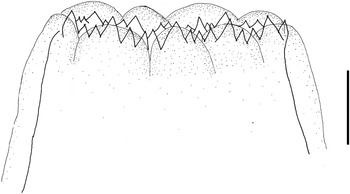
Trepan of Acritagasyllis longisetosus, surrounded by a crown of papillae. Scale: 20 µm.

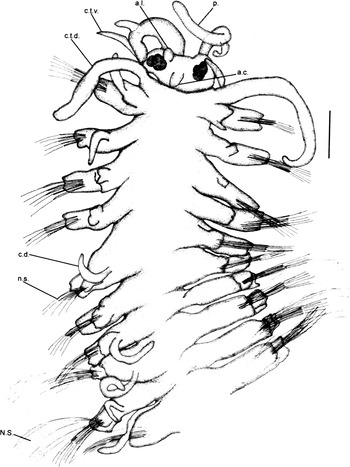
Male stolon of Acritagasyllis longichaetosus, anterior end, dorsal view. Legend: a.c., central antenna; a. l., lateral antenna; p., palps; c.t.v., ventral tentacular cirri; c.t.d., dorsal tentacular cirri; c.d., dorsal cirrus; n.s., nerurochaetae; N.S., swimming chaetae. Scale: 1 mm.

Material examined. Two specimens (MNCNM 16.01/15335) and two stolons (MNCNM 16.01/15334).
Additional material. Holotype (MNCNM 16.01/11601) and paratype (MNCNM 16.01/11602).
Remarks.
This species is characterized by the absence of palps (probably reduced and fused to prostomium), eyes, and median antenna, presence of a single pair of tentacular cirri and especially by the presence of a kind of compound chaetae unique among syllids, with long, filiform blades, and shafts distally inflated and spinous, more similar to those of the family Phyllodocidae. The examined specimens agree with the original description except for the pharyngeal armature. One specimen was dissected to allow the study of the anterior end of the pharynx; it has a tiny trepan with 9 large teeth, alternating with 2–3 small teeth (Figure 1).
No information about reproduction was included in the original description. We have found two detached reproductive stolons, one male and another female. The male stolon (‘Polybostrichus’, Figure 2) has 23 segments and 4 mm in length, posterior part broken, incomplete. The ‘prostomium’ is bilobed, with two pairs of eyes, one pair in dorsal position slightly larger than the ventral pair, two forked palps, one pair of lateral antennae and one median antenna, all small and globose, but the left one is barely distinguishable. Two pairs of ‘tentacular cirri’, the dorsal pair distinctly longer than the ventral pair. The six anteriormost segments are not modified, but the parapodia have long, swimming chaetae from the seventh segment. Neurochaetae are like those of parental individuals, with shafts distally spinose, and blades long, thin, slender and delicate, smooth on margin. The dorsal cirri are slender and short, most of them lost, only cirrophores remaining. The ventral cirri are completely fused to the parapodial lobes but, in the adults, the cirri are perfectly distinguishable.
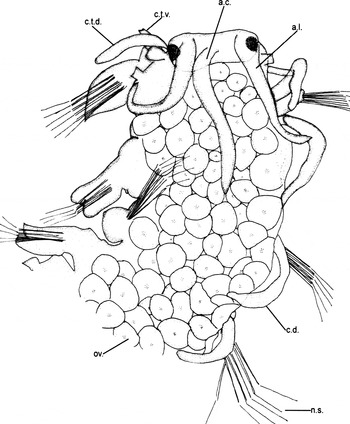
The female stolon (Figure 3), has 36 segments, 7 mm in length, ending in a pygidium with two anal cirri. The ‘prostomium’ is bilobed, with two very small palps at the base, hardly visible in dorsal view, two pairs of eyes, one dorsal and another ventral, one pair of lateral antennae and a median antenna, all long and backwards directed. One pair of dorsal ‘tentacular’ cirri. Ventral tentacular cirri slightly smaller in comparison with those of the Polybostrichus. Dorsal cirri of most segments only the cirrophores remaining. The neurochaetae are the characteristic of the species; natatory chaetae absent. Specimen filled with ova inside the coelom, ova about 8 µm in diameter.
Female stolon of Acritagasyllis longichaetosus, anterior end, dorsal view. Legend: a.c., central antenna; a. l., lateral antenna; c.t.v., ventral tentacular cirri; c.t.d., dorsal tentacular cirrus, c.d., dorsal cirrus; n.s., nerurochaetae; ov., ova. Scale: 1 mm.

Among the characters originally described, the absence of a trepan and the presence of a middorsal pharyngeal tooth were remarkable features. Observations of these characters were due to mistakes in the examination. In fact, this species has a minute trepan with 9 large alternating with 2–3 smaller teeth, as shown in Figure 1.
Furthermore, the reproduction of this species was unknown up to now. Also, its systematic position was uncertain, presenting some similarities with the subfamily Autolytinae, such as the sinuous pharynx, the shape of the nuchal organs and the bayonet-shaped dorsal simple chaetae. However, the ventral cirri are well defined, although distinctly fused to parapodial lobes.
In this study we have obtained two specimens and two stolons, with the typical sexual dimorphism of the stolons of the subfamily Autolytinae (Nygren, Reference Nygren2004; Aguado & San Martín, Reference Aguado and San Martín2009).
These stolons, however do not exhibit the same characteristics of the appendages of atokous specimens, because they have 3 antennae, which is not the case of the atokous, since the median antenna is absent in all specimens so far examined; also stolons present two pairs of ‘tentacular cirri’, while the atokous individuals seem to have lost one of these pairs.
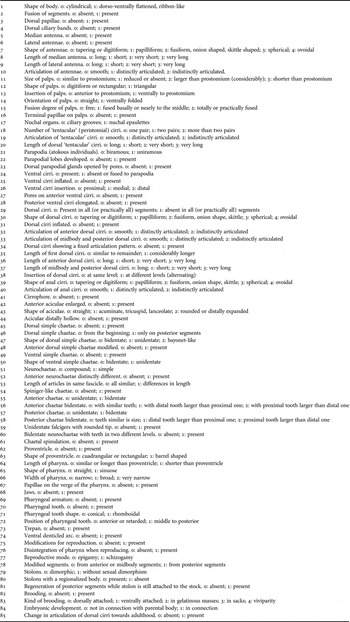
In order to search about the systematic position of this genus, we have performed a maximum parsimony analysis using binary morphological characters (Table 1). It was not possible to use the specimens for analysis of genetic information because the samples were fixed in formalin.
Morphological characters and character states used in the phylogenetic analysis.

Based on Aguado & San Martín (Reference Aguado and San Martín2009), we have compiled a table with some of the characters that were used by these authors taking into account species representing the five subfamilies of the Syllidae (Appendix 1).
Phylogenetic analysis
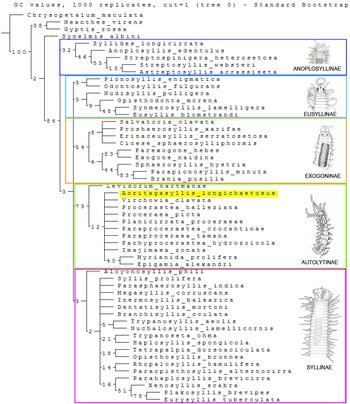
The consensus tree is shown in Figure 4. Four of the five subfamilies (Autolytinae, Exogoninae, Syllinae and Anoplosyllinae) have been found clearly monophyletic in accordance with Nygren (Reference Nygren1999), Nygren & Sundberg (Reference Nygren and Sundberg2003), Aguado et al. (Reference Aguado, Nygren and Sidall2007) and Aguado & San Martín (Reference Aguado and San Martín2009).
Consensus cladogram showing the systematic position of Acritagasyllis within the Syllidae; numbers at nodes refer to bootstrap support values.

Acritagasyllis, with its single species represented, Acritagasyllis longichaetosus, is clearly located within the subfamily Autolytinae. The main character that relates Acritagasyllis to this subfamily is linked to their reproductive biology: the presence of stolons with sexual dimorphism.
Nygren & Sundberg (Reference Nygren and Sundberg2003), defined the subfamily Autolytinae as clearly separated into three main groups: one with species of Myrianida that reproduce by epigamy, a second group comprising some Myrianida with reproduction by schizogamy by scissiparity, and a third group with Proceraea Ehlers, 1864, Procerastea Langerhans, 1884, and Virchowia Langerhans, 1879, with anterior scissiparity.
With the inclusion of Acritagasyllis in the subfamily Autolytinae, we had to slightly modify the diagnosis of the genus and the subfamily Autolytinae.
SUPPLEMENTARY MATERIAL
To view supplementary material for this article, please visit http://dx.doi.org/10.1017/S0025315415002118
ACKNOWLEDGEMENTS
We want to express our gratitude to Akvaplan Niva for the collection of the syllids among which the specimens herein analysed were found. We also thank Patricia Álvarez-Campos for taking the time to read this article, and for her suggestions. The comments and suggestions of two anonymous referees greatly improved the quality of the paper.