In 1997, the Advisory Committee on Immunization Practices (ACIP) of the Centers for Disease Control and Prevention (CDC) first recommended universal influenza vaccination for healthcare personnel (HCP), barring any contraindication.1 Due to traditionally low HCP influenza vaccination rates, various professional societies have increasingly supported mandatory condition of employment HCP vaccination policies over the past decade, including the Society for Healthcare Epidemiology of America (SHEA), the American College of Physicians (ACP), and the Infectious Disease Society of America (IDSA).Reference Talbot, Babcock and Caplan2-4 Although the importance of HCP influenza vaccination has been conveyed over the years, the best mechanism to maximize HCP vaccination rates has not been so apparent. Over the past 15 years, many institutions have implemented successful mandatory and condition-of-employment immunization policies that require HCP to receive the influenza vaccine in the absence of specific exclusions.Reference Antommaria and Prows5-Reference Pitts, Maruthur, Millar, Perl and Segal11 The CDC has affirmed the positive effect of such policies; the national HCP influenza vaccination rate in institutions with mandates reached 94.8% in the 2017–2018 season compared to the overall national average of 78.4%.Reference Black, Yue and Ball12 The consequences of noncompliance with mandatory policies are variable, ranging from mask wearing during influenza season to employment termination; however, the implementation of a mandatory vaccination policy with consequences for noncompliance has been associated with twice the increase in vaccination compared to the effect of mandatory policies without consequences.Reference Nowalk, Lin, Raymund, Bialor and Zimmerman13 Vanderbilt University Medical Center (VUMC) has shared this experience. In the 3 influenza seasons leading up to the current study, the VUMC employee influenza vaccination rates were 72.0% for 2012–2013, 80.0% for 2013–2014, and 91.7% for 2014–2015. The 2014–2015 season was the first to involve a formal exemption review committee, and the 2015–2016 season was the first with consequences for being noncompliant with vaccination or an approved exemption. In the subsequent 3 seasons, HCP influenza vaccination rates were 97.7% in 2015–2016, 97.6% in 2016–2017, and 97.8% in 2017–2018.Reference Talbot, Schimmel and Swift14
Two important variations in reported mandatory programs are the types of requested exemptions from influenza vaccination, as well as the process for evaluating these requests. The review processes vary widely and often go unreported. Of those who report their methods, they range from a simple review by the human resources departmentReference Babcock, Gemeinhart, Jones, Dunagan and Woeltje8 to the use of large, multidisciplinary committees.Reference Leibu and Maslow7,Reference Rakita, Hagar, Crome and Lammert10,Reference Huynh, Poduska, Mallozzi and Culler15,Reference Smith and Van Cleave16
With regard to the types of requested exemptions, institutions tend to consider exemption from vaccination in 2 general categories: (1) medical contraindication and (2) personal belief or religious reasons. Medical exemptions typically include prior allergic reaction to the vaccine or its ingredients, a severe nonallergic adverse reaction, or other compelling medical reasons provided by an HCP’s primary care clinician. The various personal reasons for which HCP decline vaccination have been well described: concerns over vaccine side effects, a perceived lack of vaccine efficacy, confidence in one’s own health, and inadequate vaccine access.Reference Antommaria and Prows5,Reference O’Reilly, Cran and Stevens17-Reference Song, Park, Jeong, Cheong, Kim and Kim26 Although many facilities include a general category for religious reasons against vaccination, some may require a linkage to a formal religion, and some have allowed broader personal-belief exemptions.Reference Opel, Sonne and Mello27 In all their complexity, the precise nature of these religious objections as a part of a large mandatory program is largely undescribed. We analyzed the trends regarding the religious and personal-belief exemptions submitted by HCP as part of a large, mandatory influenza vaccination program and noted their interaction with a multidisciplinary exemption review process. This project was approved by the VUMC Institutional Review Board.
Methods
Exemption request and approval process
The VUMC requires that all faculty and staff members, both clinical and nonclinical, receive the seasonal influenza vaccine on an annual basis or receive an approved vaccine exemption. An exception is granted for either (1) a medical reason, which requires attestation by a separate licensed healthcare clinician, or (2) a deeply held religious or personal belief against vaccination. Medical exemptions are permanent, but those for deeply held religious or personal beliefs must be submitted on an annual basis. Requests for exemption are submitted in a free-text format before influenza season or upon hire if an HCP is a new employee during influenza season. These are reviewed on a rolling basis by a multidisciplinary review committee comprised of representatives from occupational health, infection prevention, infectious diseases, risk management, legal affairs, human resources, and allergy. Reviewers see only the exemption text itself and are blinded to all details related to the employee submitting the exemption. A request is either granted or denied. If denied, the reasoning for denial is provided to the requestor, with clarification on the rationale for denial. After denial, an appeal can be made in which further information can be provided to the review committee. A second appeal can be submitted to the institutional executive sponsors if the first appeal is denied. If an exemption is ultimately granted, requestors are required to wear a surgical mask whenever in patient care and public areas during the influenza season. Faculty who refuse vaccination and are not granted an exemption have their institutional access to all electronic systems (including those used for patient care and research administration) revoked, effectively impeding their ability to work in their designated roles (clinical, research, or administrative). Nonfaculty employees who refuse vaccination and are not granted an exemption are placed on unpaid leave until the end of influenza season, when they can return to work if they choose. All of the exemption requests were recorded in a database that included for each request a unique employee identifier, job title, free-text reason requesting exemption, and ultimate approval or denial status. To fully describe and analyze the submitted religious and personal-belief exemption requests, the database information covering the 2015–2016 through 2017–2018 influenza seasons were included in the current study analysis. For the purposes of analysis and because new employees are subject to the vaccination policy as they are hired on a rolling schedule, the seasons for vaccine requirement were selected to begin on July 1 and end on June 30 of each year.
Job categorization
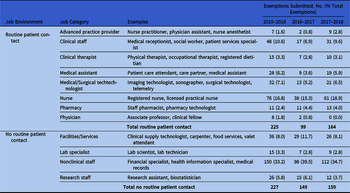
Well over 100 unique job titles were submitted with exemption requests. To facilitate our analysis of exemptions by employees with similar type of role, each job title was reviewed by a single reviewer (B.C.B.) and then sorted into 1 of 12 general job categories. Each job category was then generalized by the presence or absence of patient contact (Table 1). A human resources database of employees by job type was used to serve as a denominator, when possible, of these job titles submitting requests as a percentage of the overall number of employees.
Categories and Number of Healthcare Personnel who Requested Religious/Personal Belief Exemption from the Mandatory Influenza Vaccination Policy, 2015–2018

Categorization of exemption requests
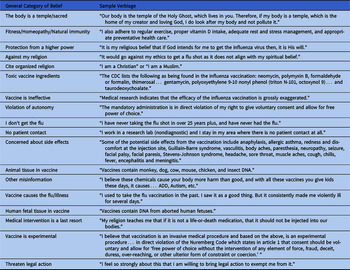
When submitting an exemption request for deeply held religious or personal beliefs, requestors are allowed to explain these reasons without word limitation. All of the exemption requests were reviewed by a single reviewer (B.C.B.), and the fundamental reasons against vaccination within each exemption request were generalized into at least 1 of 18 exemption categories, with no category excluding or taking priority over another (Table 2).
Categories and Examples of Exemption Requests

Analysis of exemption approval and reasons against vaccination
Once each exemption request had been characterized by employee and exemption categories, the prevalence of each particular exemption category was then calculated as a simple percentage of the total requests submitted in a given season. Similarly, the number of faculty or staff within each job category submitting exemption requests was totaled for each year of the study. The reviewer did not have access to personally identifiable information and was blinded to the identity of the individuals who submitted the exemption requests.
Statistical analysis
Comparison of the annual exemption approval rates was performed using test of proportions with Stata version 16.0 software (StataCorp, College Station, TX).
Results
Exemption submissions and approvals
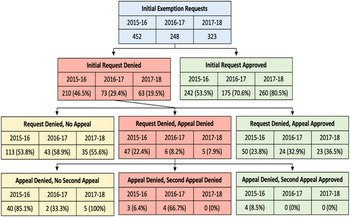
In the 2015–2016, 2016–2017, and 2017–2018 seasons, the numbers of VUMC faculty or staff who submitted deeply held religious or personal belief vaccination exemption requests were 452 (2.1% of all HCP), 248 (1.1%), and 323 (1.4%), respectively. The frequency of exemption approval increased each year from 296 of 452 (65.5%) to 196 of 248 (80.2%) to 283 of 323 (87.6%; P < .05 for each annual change) (Fig. 1).
The total number of exemptions for each season is shown in the first tier, expressed also as a percentage of total faculty and staff in parentheses. In tiers 2–4, the approval, denial, and appeal processes are conveyed. Total numbers are also expressed as percentages of the denominator of the tier above.

Reasons for requesting exemption from vaccination
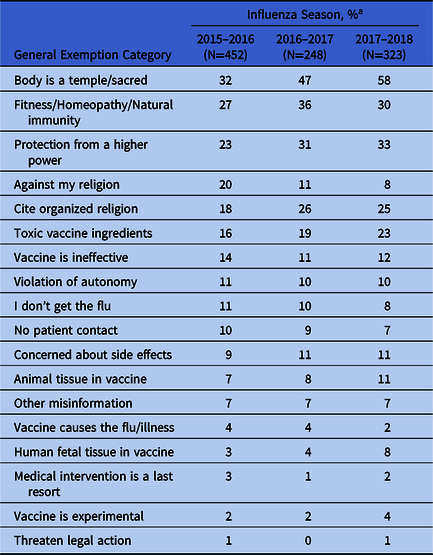
The number of general reasons provided within a single exemption request ranged from as few as 1 to as many as 11 of the 18 categories (mean, 2.47 for 2015–2016; 2.60 for 2016–2017; and 2.71 for 2017–2018). The prevalence of each reason given for exemption requests is shown in Table 3. The most common reason provided stemmed from a belief that the human body is sacred or a temple and that vaccination would violate the sacredness of the person’s body. Although many submissions were less specific in making such statements, many of the submissions cited verses from the Bible to support their reasoning. These verses included 1 Corinthians 6:19–20, which states: “Or do you not know that your body is a temple of the Holy Spirit within you, whom you have from God? You are not your own, for you were bought with a price. So glorify God in your body.” Other verses cited which express similar convictions were 1 Corinthians 3:16–17, 2 Corinthians 7:1, and Romans 12:1. Not only was this reason the most commonly cited, the frequency with which it was cited increased in total requested exemptions each successive year from 146 of 452 (32%) in 2015–2016, to 117 of 248 (47%) in 2016–2017, to 188 of 323 (58%) in 2017–2018 of (P < .01 with each annual increase).
Frequency of Reasons Included in Exemption Requests, by Influenza Season

a N, no. of exemptions.
After the sacred-temple reasoning, 3 of the next 4 most common reasons for exemption requests were also religious in nature. These included, in decreasing order of frequency, (1) the belief in protection from influenza by a higher power, (2) an opinion that influenza vaccination was against one’s generic religious beliefs, and (3) that one’s belonging to a specific organized religion precluded vaccination. The frequency of citing a higher power increased year after year from 105 of 452 (23%) in 2015–2016 to 77 of 248 (31%) in 2016–2017 to 105 of 323 (33%) in 2017–2018 (P < .002). A similar trend occurred among those mentioning a particular organized religion, save for the final season, with the frequency changing from 81 of 452 (18%) in 2015–2016, to 65 of 248 (26%) in 2016–2017, to 80 of 323 (25%) in 2017–2018 (P < .02). This finding contrasts with the less specific reasoning of vaccination standing against one’s generic religious beliefs, which decreased in frequency each year from 89 of 452 (20%) in 2015–2016, to 28 of 248 (11%) in 2016–2017, to 26 of 323 (8%) in 2017–2018 (P < .001 from year 1 to year 2, but nonsignificantly from year 2 to 3).
Exemption requests by job category
The distribution of exemption requests across all job categories is noted in Table 1. Most exemption requests all 3 years of analysis were submitted by nonclinical staff, who submitted 33.2% of all exemptions in 2015–2016, 39.5% in 2016–2017, and 34.7% in 2017–2018. Nurses submitted the second highest number of exemptions to vaccination all 3 years, submitting 16.8%, 15.3%, and 18.9% of exemptions in the same respective years. The nurses submitting exemptions represented 1.5%, 0.7%, and 1.1% of all employed nurses in those years. When job categories were grouped into those with routine patient contact and those without routine patient contact, the proportions of exemption requests for each group were similar in both the 2015–2016 and 2017–2018 seasons. In the 2016–2017 season, however, non–patient-care job categories comprised a disproportionate number of exemptions compared to patient-contact job categories (149 of 248; P < .01).
Discussion
The results of our study highlight in detail the types of religious and personal beliefs that form requests for exemption to mandatory influenza vaccination polices at a large academic medical center. Notably, in contrast to prior studies noting that the most common reasons for objection to the vaccine had to do with misinformation and misconceptions regarding the vaccine, 4 of the 5 most common reasons in this study were religious in nature.Reference Hollmeyer, Hayden, Poland and Buchholz28 Because of their subjectivity, religious and personal belief exemptions provide a unique challenge to the reviewers. The various lawsuits brought by HCP whose religious exemptions were denied by healthcare facility leaders highlight the importance of an explicit, multidisciplinary, and reasonable exemption approval process for this phenomenon, like the one described in this study.Reference Opel, Sonne and Mello27 Moreover, an appeals process allows for both clarification of HCP reasoning as well as education directed toward misinformation.
After religious reasons, one of the most common reasons for exemption was an opinion that vaccine ingredients were toxic (Table 3). The CDC publishes a list of standard vaccine ingredients.29 Most of the ingredients cited by exemption requests were either intimidating names for innocuous buffers (eg, sodium phosphate–buffered isotonic sodium chloride solution) or otherwise toxic ingredients that are present in negligible concentrations (eg, formaldehyde). The most controversial vaccine ingredient cited was thimerosal, which is notably absent from the vaccine formulations used by VUMC. A different contention asserted that the vaccine contains human fetal tissue, which is not true for this or any other FDA-approved vaccine.29 Finally, many submissions were both lengthy and conspicuously identical, suggesting that they originated from a single common source. At least 1 institution has encountered a similar problem.Reference Leibu and Maslow7 Indeed, we found at least 7 websites that publish examples designed to assist employees seeking exemptions from mandatory vaccination policies. We have decided not to name these websites to preserve the integrity of the exemption system.
The percentage of HCP who submitted vaccination exemption requests ranged from 1.1% to 2.2% in the 3 years of this study. This finding contrasts with those of other institutions that have reported this information, such as Cincinnati Children’s Hospital, which reported a mere 0.08% of employees submitting such requests.Reference Antommaria and Prows5 A St Louis healthcare institution of similar size to VUMC has reported that only 0.3% of employees received a religious exemption for vaccination.Reference Babcock, Gemeinhart, Jones, Dunagan and Woeltje8 Although personal and religious reasons against vaccination are by nature subjective to the individual, they may stem from some degree of misconception about the vaccine. Therefore, efforts are underway at VUMC to address common misconceptions to mitigate their effects on the frequency of vaccination exemption requests. Despite the higher rate of exemption requests, the HCP influenza vaccination rate at VUMC is substantially higher than the national average.Reference Black, Yue and Ball12
The exemption request approval rate increased year after year, from 65.5% to 80.2% to 87.6%. Given that the criteria for exemption approval did not change over this time, one possible reason for this increase could be an increasing realization among requestors of verbiage that does not sufficiently convey a deeply held belief. This hypothesis is supported by the annually decreasing percentage of exemption requests that include the generic reasoning “against my religion,” which decreased from 20% to 11% to 8% and coincided with an increase in more specific descriptive language in the 3 most common reasons submitted (Table 3). Notably, the frequency of approval increased annually, but the number of exempted employees did not. Whether employees exempted in prior years subsequently went on to become vaccinated or stopped working at VUMC is unclear.
Nurses submitted the most exemption requests of any job category with routine patient contact; 1.5%, 0.7%, and 1.1% of all nurses submitted exemptions in each year of our study. This is not entirely surprising, as nurses represent the largest category of employees with routine patient contact. Nurses submitted exemptions less frequently than the overall employee population, however, whose rates were 2.1%, 1.1%, and 1.4% those same years. For reference, nonclinical staff submitted more than twice the number of exemption requests than nurses over the 3-year period, despite being a job category of similar size.
In the 2017–2018 influenza season in the United States as a whole, the vaccination rate among nurses was 90.5%, trailing only physicians (96.1%) and pharmacists (92.2%). All of these are notably higher than the overall HCP vaccination rate (78.6%) and that of nonclinical HCP (72.8%).Reference Black, Yue and Ball12 These national averages are lower than the VUMC vaccination rate, which was >97% in all 3 years of our study. This finding suggests that mandatory vaccination policies may increase vaccination rates, given that the VUMC vaccination rate in the 3 years prior to initiating the mandate ranged much closer to the national average, from 72.0% to 91.7%.
First and foremost, this study was intended to be a descriptive analysis of the many reasons HCP have for objecting to receipt of the seasonal influenza vaccine. The liberty given by VUMC to its HCP to describe these reasons in detail is meant to give HCP an opportunity to express their convictions without restriction. Although this open forum gives requestors the best chance to be understood, it makes perfect classification of their reasoning a challenging task. We believe that the 18 exemption categories adequately convey the subjective reasons provided by requestors against vaccination, but they are admittedly generalizations of motivations unique to each individual.
We had access to precise job descriptions of all individuals submitting exemption requests. However, because HCP are often grouped by their department rather than their specific role in the human resources database, the precise job descriptions of all VUMC personnel were not available for this study. This limitation prevented us from calculating the exact numbers of exemptions as a percentage of all individuals in a given job category. A notable exception to this was nurses, whose collective numbers were precisely known. Finally, the process of categorization of the exemption requests was made by a single investigator, which may have led to biases of classification. The investigator did regularly review his methodology and specific examples with a second investigator, which helped to limit this bias.
In conclusion, our results demonstrate how detailed the personal and religious convictions behind vaccine avoidance can be among HCP, and how vaccine avoidance stems from much more than simple misinformation regarding vaccination. The intersection between misinformation and personal and religious beliefs provides a unique opportunity to address HCP opinions toward vaccination in an exemption and appeals process. Maintaining a fair process for navigating HCP dissent regarding mandatory vaccination will increase in importance as such programs become increasingly prevalent.
Acknowledgments
Financial support
Institutional funds supported this study.
Conflicts of interest
T.R.T. reports that his spouse has received research funding from Sanofi Pasteur, Sequirus, and Medimmune. All other authors report no relevant conflicts of interest.