One puzzling feature of the comparative economic history of China and Europe is their human capital divergence from the fifteenth century on. Europe experienced the Scientific Revolution and the Enlightenment, which produced “useful knowledge” that levered modern economic growth (Mokyr Reference Mokyr2017). China, however, became entrenched in Confucian scholasticism. Its intelligentsia was dominated by literati, cultural elites who focused on the study of Confucian classics, philosophy, and literature rather than science or concrete knowledge (Landes Reference Landes2006).
Thanks to the missionary expansion of the Jesuits, China and Europe experienced their first wave of mutual intellectual contact (Tsien Reference Tsien1954; Gernet Reference Gernet and Lloyd1985). A scholarly Catholic order, the Jesuits managed to enter China in the early 1580s. To facilitate their missionary work in a Confucian culture, the Jesuits introduced European sciences to win over the Confucian literati. Given that China had remained autarkic for centuries,Footnote 1 this constituted a knowledge shock for the literati. This knowledge diffusion in China facilitated by the Jesuits was sustained until the 1720s when the emperors began to expel them due to the Chinese Rites Controversy with the Pope.
There has been a long debate on China’s intellectual response to this knowledge shock from the West. A conventional view is that the conservative nature of Confucian scholasticism made the literati lack interest in sciences and learning from the West.Footnote 2 Such lack of interest might have been compounded by the imperial examination system, which acted as an incentive scheme by facilitating social mobility (Cipolla Reference Cipolla1967; Needham Reference Needham1969; Lin Reference Lin1995; Landes Reference Landes2006).Footnote 3 An opposite view, however, argues that the Jesuits’ introduction of European sciences shocked China’s learned elites, stimulating their interest in scientific research. Many literati even began to criticize the metaphysical nature of Confucian classics and to emphasize studies of natural phenomena (Tsien Reference Tsien1954; Henderson Reference Henderson1984; Gernet Reference Gernet and Lloyd1985; Black Reference Black1989; Elman Reference Elman2005). However, to the best of my knowledge, little quantitative work has been done to assess the merit of these different views.
This paper examines the impact of Jesuit knowledge diffusion on intellectual change in China. I constructed a panel data of 254 Chinese prefectures between the years 1501 and 1780. Given that Jesuits were the only knowledge intermediary between China and Europe at the time, I can clearly measure European knowledge diffusion based on the distribution of the Jesuits in China. There were a total of 433 recorded Jesuits who came to China. Their distributions are identified based on their biographies. I used the distribution of the Jesuit scientists to measure the diffusion of European science. The term “Jesuit scientists” refers to those Jesuits who were involved in scientific activities while they were preaching in China. The other Jesuits, who did only missionary work, are designated as “Jesuit priests” for the purpose of comparison.
Difference-in-differences (DID) estimations show that, after the Jesuits came to China (1581–1720), Chinese scholars in prefectures with Jesuit scientists wrote more works of science than those in prefectures without Jesuit scientists. Moreover, the number of Chinese scientific works increased with the number (and duration) of the Jesuit scientists in a prefecture. Jesuit scientists did not merely promote local Chinese scientific production but also had a regional spillover: after 1580, prefectures close to those that housed a Jesuit scientist residence also produced more Chinese scientific works relative to those further afar. These effects were not driven by economic conditions (urbanization and potential agricultural productivity), geographic factors, or outlier authors. No pre-Jesuit difference in the number of Chinese scientific works, nor pre-Jesuit difference in the literati’s inclination toward science or new schools of thought is observed if we compare the prefectures that eventually had Jesuit scientists and those without.
To mitigate the possible effect of unobserved local factors on the distributions of Jesuit scientists and Chinese scientific works, I excluded the prefectures where there were no Jesuits throughout the sample period. I thus only compare, in terms of Chinese scientific production, those prefectures with Jesuit scientists to the prefectures that had Jesuit priests. Given that the distributions of Jesuit scientists and Jesuit priests were subject to similar factors, this restricted sample rules out most if not all correlates of Jesuit distribution. This approach produced consistent results with that of the full sample. The Jesuit scientists’ contribution to Chinese science is reaffirmed by the placebo finding that they did not affect the number of Chinese works on history and literature.
The importance of knowledge diffusion in scientific production is further evidenced by the negative effect of the Jesuits’ retreat from China. The Chinese Rites Controversy over whether Chinese Catholics could worship ancestors (a traditional Confucian ritual practice) led several popes to rule against ancestor worship, and the Qing Emperor Yongzheng began to expel Catholic missionaries from 1723. The intellectual contact between China and Europe declined and was finally broken off after the Pope dismissed the Society of Jesus in 1773. Consequently, the literati produced fewer scientific works after the expulsion of the Jesuits.
The findings of this paper indicate the importance of the opening to (Western) knowledge flow in the intellectual history of China. The Jesuits’ scientific influence in China was confined to only a small circle of Confucian elites.Footnote 4 Nevertheless, the literati’s active response to European sciences indicates that they were not intrinsically “closed-minded” as conventional wisdom suggests, but that they were open to Western learning where and when there was a chance of communication. This illuminates the modernization efforts of Confucian elites following the Western model in the late nineteenth to early twentieth centuries, a time when China was opened and influenced by the Western powers (Spence Reference Spence1990; Jia Reference Jia2014; Bai and Kung Reference Bai and Kung2015; Yuchtman Reference Yuchtman2017; Bai Reference Bai2019). In this connection, this paper speaks to the literature on the importance of an environment open to idea flow in the European Scientific Revolution and the Enlightenment from the fifteenth century on (Mokyr Reference Mokyr2017; Dittmar Reference Dittmar2019) and, more broadly, in human capital and economic change in different contexts (F. Waldinger Reference Waldinger2010, Reference Waldinger2016; Becker and Woessmann Reference Becker2009; Dittmar Reference Dittmar2011; Borjas and Doran Reference Borjas and Kirk B.2012; Cantoni and Yuchtman Reference Cantoni and Noam2014; Hornung Reference Hornung2014; Moser, Voena, and Waldinger Reference Moser, Alessandra and Fabian2014; Squicciarini and Voigtländer Reference Squicciarini and Nico2015; Chaney Reference Chaney2016; Iaria, Schwarz, and Waldinger Reference Iaria, Carlo and Fabian2018; Giorcelli Reference Giorcelli2019).
By examining the history of the Jesuit mission to China, this study provides new evidence on the economic impacts of the Jesuit global enterprise and other missions since the sixteenth century (Nunn Reference Nunn, Akyeampong, Nunn and James2014; Wantchekon, Klašnja, and Novita Reference Wantchekon, Marko and Natalija2015; M. Waldinger Reference Waldinger2017; Castelló-Climent, Chaudhary, and Mukhopadhyay Reference Castelló-Climent, Latika and Abhiroop2017; Calvi and Mantovanelli Reference Calvi and Mantovanelli2018; Valencia Caicedo Reference Valencia2019a; see also Valencia Caicedo (Reference Valencia, Mitch and Cappelli2019b) and Becker, Rubin, and Woessmann (Reference Becker, Jared and Ludger2020) for surveys). The distinction is that when the Jesuits came to China, they were facing a powerful Confucian elite entrenched in a highly institutionalized civil service system. Without a colonial power backing them up, the Jesuits could not bring change to China’s scholar-official system. The literati’s career mobility, fortune, and fame were still provided by officialdom rather than by a market for ideas as in contemporaneous Europe. Therefore, although the literati were attracted by the Jesuits’ sciences, their primary purpose for studying science was to serve the demands of statecraft (particularly calendar adjustment, cartography, military defense, and other bureaucratic needs), but they had little incentive to apply the new knowledge to commercial or industrial fields. Consequently, unlike the significant economic legacy the Jesuits left in Latin America (Valencia Caicedo Reference Valencia2019a), the Jesuits’ knowledge diffusion in China did not translate into economic progress.
HISTORICAL BACKGROUND
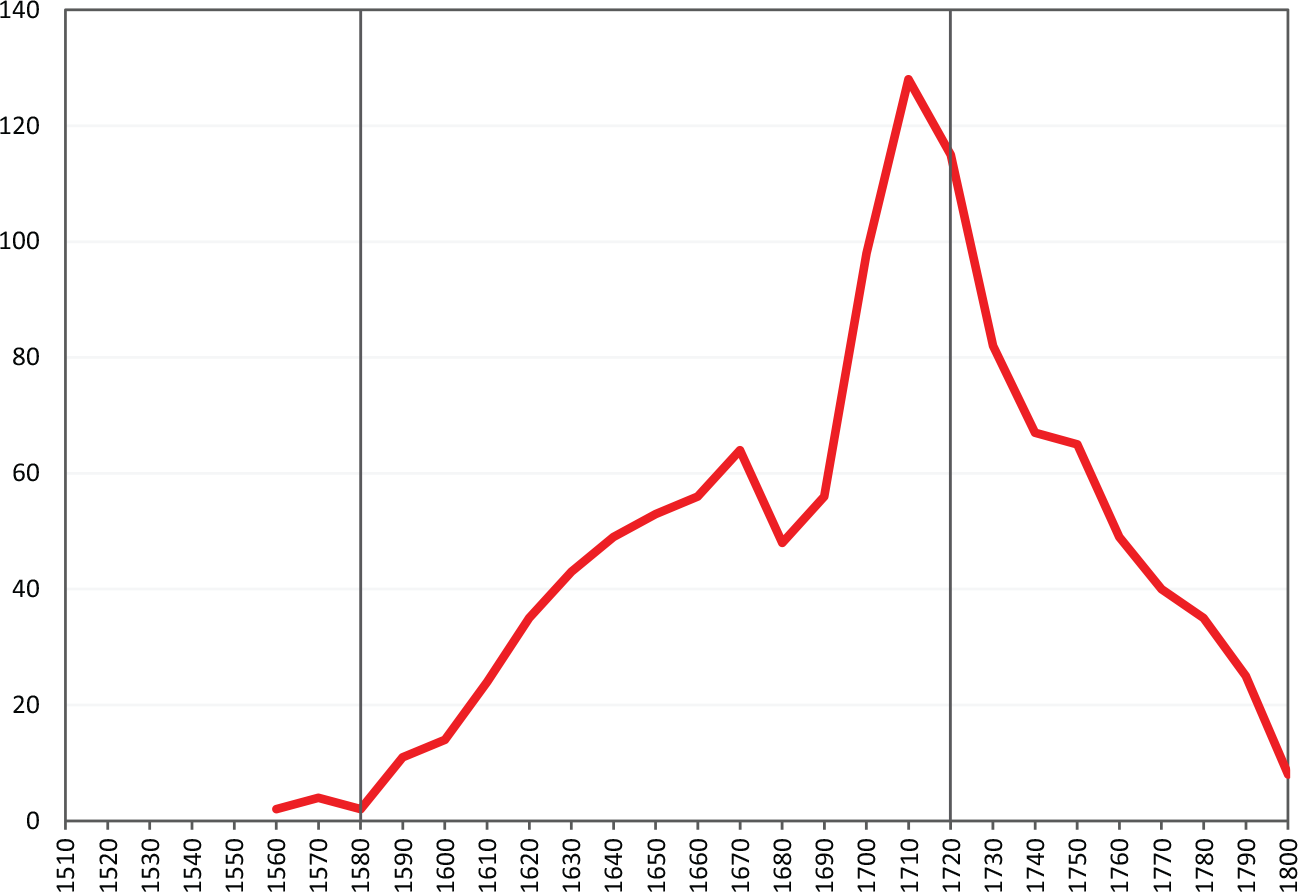
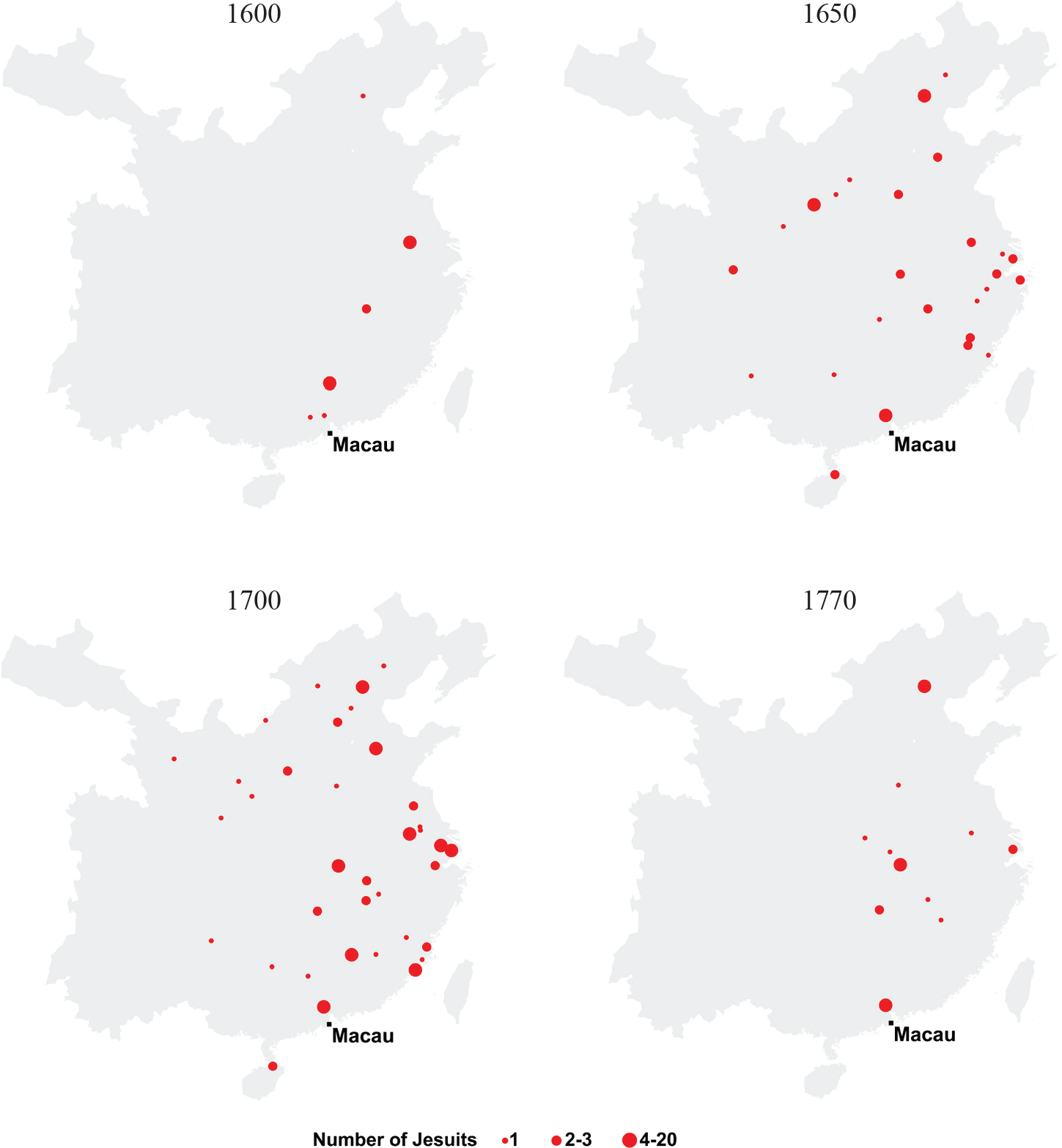
A European Catholic order, the Society of Jesus began its global mission in the mid-sixteenth century. That Macau was occupied by Portugal in 1557 facilitated the Jesuits’ expansion into East Asia. The Jesuits first arrived at Macau in 1562. Later, they were allowed by the local officials of Guangdong Province to enter mainland China in 1582. With the help of some Chinese officials, they managed to expand their mission northward. After they were allowed by the Ming Emperor to reside in the imperial capital Beijing in 1601, the Jesuit mission in China stabilized and flourished (Brockey Reference Brockey2007). By 1700, their number had reached 128 (Figure 1). The spatial expansion of the Jesuits is shown in Figure 2. By 1700, the Jesuits had missionized a total of 81 out of the 254 prefectures (32%) of China proper.Footnote 5 Before the termination of their China mission in 1773, there were in total 433 Jesuits who missionized in China (Dehergne Reference Dehergne1973).Footnote 6
NUMBER OF JESUITS IN CHINA BY DECADE
Notes: Six Jesuits entered mainland China before 1580 but they failed to settle there. The first Jesuit residence in mainland China was established at Zhaoqing in 1582. The Jesuits’ Asian base, Macau, was excluded from analysis.
Source: The data are based on Dehergne (Reference Dehergne1973).

EXPANSION OF THE JESUITS IN CHINA PROPER, 1600–1770
Source: The data on Jesuits are based on Dehergne (Reference Dehergne1973).

Science as the Instrument of the Jesuit Mission
To facilitate their missions in China, the Jesuits sought the support of the literati. In communicating with the literati, the Jesuit pioneer Matteo Ricci (1552–1610) found that he was welcomed, not because of his Catholicism, but because of his scientific knowledge and instruments. Ricci began to use the European sciences to cultivate the literati. Such novel, superior knowledge could attract the interest of these learned elites and help establish the prestige of the Catholic Church. Moreover, a unique feature of the Jesuits was their distinct academic qualifications. Most Jesuits were well-educated in science and philosophy. Prior to being sent to mainland China, the Jesuits also learned the Chinese language and culture in academies in Europe and Macau (Xiong Reference Xiong1994). For these reasons, science became the principal instrument of the Jesuits’ missionary expansion in China (Gernet Reference Gernet and Lloyd1985).
The Jesuits translated more than 130 European scientific titles into Chinese. The majority pertained to astronomy, followed by mathematics. The other titles were in geography, medicine, physics, chemistry, and engineering, among other fields. Most translations introduced the scientific achievements that had arisen since the Renaissance (Tsien Reference Tsien1954). In astronomy, for instance, after the Chinese astronomer Guo Shoujing (1231–1316) published Shoushi Li (Seasons-Granting Astronomical System) in 1281, no new astronomical work was produced in China until the coming of the Jesuits three centuries later. By compiling Tian Wen Lüe (Summary of Astronomy) in 1615, Manuel Dias Júnior introduced Galileo’s astronomy and his design for the telescope to China. Chinese scholars also found the European celestial system to be more accurate than that used in China. Similarly, in mathematics, Matteo Ricci translated Christopher Clavius’ Commentary on Euclid’s Elements into Chinese (Jihe Yuanben) in 1607. Clavius’ Commentary was regarded by Chinese scholars as “the crown of Western studies” (Tsien Reference Tsien1954, p. 308).
The Jesuits also introduced many European inventions and scientific instruments to China. For example, Ferdinand Verbiest (1623–1688) re-equipped the ancient observatory in Beijing with new celestial instruments from Europe. Another well-known example is the mechanical clock. The workings and mechanism of these clocks were not only well-received but impressed the Chinese so much so that many literati wrote poems to express their love for and admiration of the clocks. The Jesuits also brought with them many other novel things; these included the triple prism, microscope, thermometer, cannon, music box, globe, glasses, and other manufactured goods (Tan Reference Tan2011).
From the early 1680s, the diffusion of European sciences to China reached new heights. This was largely due to the arrival of French Jesuit scientists, known as the King’s Mathematicians, from the Royal Academy of Sciences in Paris.Footnote 7 They brought more than 30 new scientific instruments with them to China; these included quadrants, micrometers, telescopes, equatorial scale plates, and barometers, among others. Using these instruments, they conducted large-scale celestial observations and ground mapping across China (Landry-Deron Reference Landry-Deron2001). They also taught Chinese scholars mathematics and astronomy at the imperial palace, and introduced the logarithmic table, the iterative method for higher-order equations, and the calculation of infinite series.
Unlike in Latin America, the Jesuits’ influence in China remained confined to an elite circle of scholar-officials. Although the number of Jesuits was small, they could still influence a considerable swathe of the Chinese elite. This is because a single Jesuit could stay in different cities of China for many years. If we take Matteo Ricci as an example, he spent 27 years in China and lived in six cities. During this period, he translated 20 European scientific books and introduced many scientific instruments to China, all while maintaining close relationships with a number of Chinese scholars.Footnote 8
Relative to their success in knowledge diffusion, the Jesuits’ missionary achievements are considered trivial. It was a challenge for the 433 Jesuits to preach to a huge population of 200 million at the time. Even in the heyday of their China mission (around 1700), the total number of Chinese Catholic converts was alleged to be approximately 200,000 (Standaert Reference Standaert1991),Footnote 9 which accounted for merely 0.1 percent of the Chinese population.
Chinese Response to European Sciences
Despite its early success, Chinese science gradually fell behind that of Europe after the fourteenth century (Needham Reference Needham1969). Instead, Confucian moral philosophy dominated the Chinese intellectual realm (Bol Reference Bol2008). Meanwhile, China had become autarkic upon the establishment of the Ming dynasty in 1368, and hence China had little intellectual contact with the West before the arrival of the Jesuits. The Jesuits’ introduction of European sciences gave the Chinese Confucian scholars a new impetus to learning and knowledge acquisition (Gernet Reference Gernet and Lloyd1985).
The introduction of the novel European sciences shocked China’s Confucian literati. This stimulated the literati’s curiosity for new knowledge. Having recognized the backwardness of Chinese science, the literati learned European science from the Jesuits and attempted to revisit Chinese classical sciences using European methods. Overall, China saw an intellectual wave that emphasized science and “concrete learning” (shixue) from the late sixteenth century, though this movement was less revolutionary than that of contemporaneous Europe (Gernet Reference Gernet and Lloyd1985; Elman Reference Elman2005).
A representative case is a relationship between Matteo Ricci and the Ming literatus Xu Guangqi (1562–1633). The chronological account of Xu Guangqi clearly demonstrates the change in his academic pursuits after coming into contact with Ricci. Through Ricci, Xu was able to appreciate the rationale and methodology behind European science. In the Ke Tongwen Suanzhi Xu, a preface to a mathematical treatise by Matteo Ricci and Li Zhizao in 1614, Xu said:
In addition to the discoursing on Catholicism, Father Ricci often taught me the principle of mathematics. His religiosity and reasoning are truthful and stripped of rhetoric. Just as leaves adhere to branches, his scholarship in astronomy and mathematics are solidly rooted in sound theoretical foundations. The truly well-rounded scholars like them are those who have been studying Western subjects for many years. Father Ricci and his colleagues’ mathematical talents are many times those of their peers in the Han and Tang dynasties. We should all learn and benefit from their teaching (Xu Reference Xu1963, p. 80) [translated by the author].
Having recognized the lack of logical reasoning and the mathematical backwardness of Chinese science, Xu applied European sciences to the Chinese studies of mathematics, astronomy, agriculture, and military sciences. Between 1605 and 1633, he finished about 12 works on various sciences.Footnote 10
Xu Guangqi was by no means an exception among the Chinese literati. In fact, many other Ming and Qing scholars who were students of the Confucian classics, such as Li Zhizao (1565–1630), Wang Zheng (1571–1644), and Dai Zhen (1724–1777), all embraced European science after coming into contact with the Jesuits. They attempted to absorb European mathematical methods in re-constructing Chinese classical astronomy and mathematics and to apply scientific methods to study natural phenomena (Tsien Reference Tsien1954; Black Reference Black1989; Schafer Reference Schafer2011). For example, in the monumental work on Chinese astronomy, Lixiang Kaocheng Houbian (Continuation to An Investigation on the Calendar and Astronomy), Giovanni Cassini’s calendar calculation methods were emphasized (Gernet Reference Gernet and Lloyd1985).
Throughout this process, the communication with the Jesuits was crucial to the scientific achievements of Chinese scholars, who received systematic, nuanced instruction in the novel European sciences from their Jesuit friends. This was especially true of the collaboration between Chinese scholars and the Jesuits that occurred as part of translation. To ensure their Chinese writings were acceptable, the Jesuits needed the aid of Chinese scholars. “It was the usual practice for the text to be orally translated by the foreigners, and for a Chinese then to dictate a correct version” (Tsien Reference Tsien1954, p. 307). This provided the Chinese literati with a good opportunity to systematically study the European sciences. Moreover, Chinese scholars learned from the Jesuits’ academic lectures and demonstrations of European inventions.Footnote 11 Those Chinese literati who could not meet the Jesuits personally could still learn European science through the circulation of Jesuit translations (Zou Reference Zou2011).
Why did the Confucian literati not disparage science or Western learning? There is no doubt that a scholar’s pursuit of science could be driven by his inherent hunger for new knowledge. In any case, the degree holders selected through the highly competitive imperial examinations were an elite among the scholars in Ming-Qing China. They would have been qualified for scientific research by their intelligence, literacy, and years of profound philosophical training.
Beyond their curiosity and qualifications, Chinese literati had also an inclination to study science. The Jesuits’ knowledge supply met the demand of these scholar-officials for useful knowledge in the realm of statecraft. Historically, many administrative affairs in China required knowledge of science and technology. The emperors, for instance, needed astronomers and mathematicians to develop an accurate calendar (otherwise known as nongli or “agricultural calendar”); the latter was crucial for agricultural production, as well as to establish the emperor’s legitimacy as the “Son of Heaven.” The empire also needed experts in topography to map territories and borders and engineers for the production of clocks, glasses, and other luxury goods in the royal factories (Schafer Reference Schafer2011). Officials who were capable of statecraft would undoubtedly have been valued by the emperor.Footnote 12 No wonder the imperial examinations also tested the knowledge of statecraft in addition to the Confucian classics.Footnote 13 To answer these questions, candidates had to master concrete knowledge beyond the scope of Confucian classics (Elman Reference Elman2000).
In a nutshell, although these demand factors were not market-driven and were insufficient to generate scientific revolution as happened in contemporaneous Europe, they had prepared the literati, at least those of the elite circle, to embrace the new scientific knowledge from the West.
DATA
Jesuit Scientists and Jesuit Priests
In his Répertoire des Jésuites de Chine de 1552 à 1800, the Jesuit Joseph Dehergne (Reference Dehergne1973) collected the biographies of all the 433 Jesuits sent from Europe to China. This is the most systematic record of Jesuits and their activities in China for that period (Standaert Reference Standaert1991). Based on the time and place of every Jesuit’s activities in China, I enumerated the total number of Jesuits in each prefecture over the decades. Since some Jesuits moved across prefectures, the same Jesuit may be counted for different prefectures if he ever lived there.
To identify the knowledge diffusion effect, I distinguish the Jesuits who were involved in scientific activities in China and those who were not. According to Li and Zha’s (Reference Li and Yongping2002) collection of information on the Jesuits who made scientific contributions in Ming-Qing China, a total of 56 Jesuits participated in scientific activities; these included translating or compiling books about European sciences, introducing European inventions, and conducting scientific surveys, among others.Footnote 14 These 56 Jesuits are designated as Jesuit scientists. The other 377 Jesuits only did missionary work and thus are designated as Jesuit priests. I use the distribution of the Jesuit scientists to measure the diffusion of European science while using the distribution of the Jesuit priests for comparison.
Chinese Scientific Production
To measure Chinese scientific production, I referenced the number of scientific works (book titles) written by Chinese scholars at the prefecture-level in each decade. The Chinese literati had a culture of writing books and used this platform to publish their scholarly achievements. These works were recorded by a variety of historical compilations, for instance, the local gazetteers, collectanea, and the official chronicles compiled by the imperial authorities.
I obtained the list of Chinese scientific works from Zhongguo Kexue Jishu Dianji Tonghui (Collection of Chinese Classic Works in Science and Technology). Compiled by the Institute for the History of Natural Science of the Chinese Academy of Sciences in 1994, the Collection includes a comprehensive record of the scientific works in Chinese history. A total of 305 book titles were recorded between 1501 and 1780.Footnote 15 The topics included astronomy, mathematics, geography, agriculture, medicine, physics, chemistry, engineering (e.g., irrigation and military sciences), and general sciences, in which astronomy and mathematics dominated (Online Appendix Figure A1). All the books included in the analysis are original works written by Chinese scholars. Their Chinese translations of foreign works were excluded.Footnote 16 I manually checked each author’s biography and identified the author’s place(s) of residence and the approximate period of publication. For books that have an indeterminate publication period, I imputed it according to the year of the author’s age at midlife.Footnote 17 Based on the authors’ places of residence and period of publication, I counted the number of book titles by prefecture and decade.
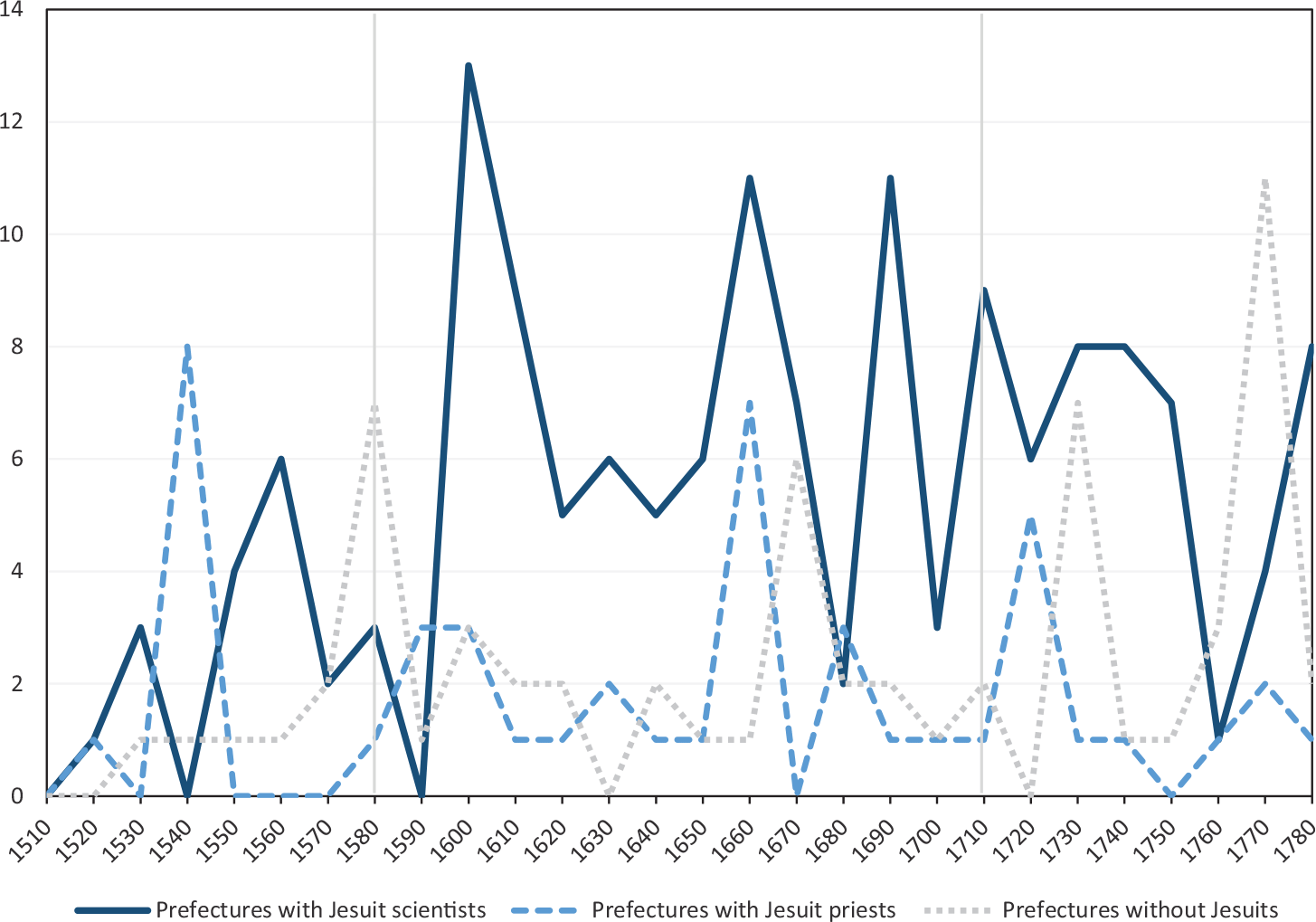
Figure 3 shows the temporal change in the number of Chinese scientific works by three groups of prefectures: prefectures with Jesuit scientists, prefectures with Jesuit priests only, and prefectures without any Jesuits. After the Jesuits entered China in the 1580s, Chinese scientific works increased significantly in the prefectures where there were Jesuit scientists, but not in the prefectures where there were only Jesuit priests or prefectures without any Jesuits. Before 1580, there was not a clear difference or trend in the number of scientific books among the three types of prefectures.
NUMBER OF CHINESE SCIENTIFIC WORKS BY DECADE AND JESUIT RESIDENCES
Notes: The works refer to book titles. Data are obtained from Zhongguo Kexue Jishu Dianji Tonghui (Collection of Chinese Classic Works in Science and Technology). “Jesuit scientists” refers to the Jesuits who were involved in scientific activities in China. “Jesuit priests” refers to the Jesuits who only did missionary work.
Source: See the text.

The advantage of the Collection is that it was compiled by experts in the history of Chinese science. However, as a twentieth-century source, it may not accurately reflect the distribution of scientific production in the sixteenth to eighteenth centuries. For instance, it is possible that some books may have been lost, were never recorded, or stopped being recorded in the inventing centuries. A related concern is that prefectures with Jesuit scientists might have kept better records of books on science relative to the other prefectures. To address these concerns, I employed a historical source on Chinese scientific books, Chouren Zhuan (Biographies of Astronomers), to check the consistency of its records with those of the Collection.
Written by the eminent Qing scholar (and scientist) Ruan Yuan in the years 1795 to 1799, Chouren Zhuan was an influential compendium of Chinese science in the eighteenth to nineteenth centuries, reflecting scholars’ recognition and evaluation of Chinese science at the time (Elman Reference Elman2005). It introduced 143 Chinese scientists and their 377 scientific books between 1501 and 1780.Footnote 18 The time-series pattern in the number of scientific works is consistent between Chouren Zhuan and the Collection (Online Appendix Figure A2). Likewise, the two sources are consistent in the regional distribution of scientific works written during the Jesuit period (Online Appendix Figure A3). A majority of works were produced in eastern China, in particular the Lower Yangtze Delta region and the greater Beijing area. These two areas were also important bases of the Jesuits’ scientific activities (Elman Reference Elman2005).
However, when identifying Chinese scientists and their works, Chouren Zhuan may have criteria different from those of the Collection. For example, literati in the eighteenth century may have had a loose definition of science or adopted a definition on their own term (Elman Reference Elman2005). Moreover, Chouren Zhuan, given its title (literally, Biographies of Astronomers), may focus on the introduction of Chinese astronomers and mathematicians rather than scientists of other disciplines. For these reasons, the analyses of this paper mainly draw upon the data of the Collection while using the data of Chouren Zhuan for a robustness check.
Control Variables
I control for the following observables that may simultaneously affect both the distributions of Jesuits and Chinese scientific production.
The first and foremost is economic prosperity. The Jesuits might have tended to missionize prosperous regions. Meanwhile, prosperous areas were also more likely to produce scientific works. I use the urbanization rate around 1580 as the measure of economic prosperity. Historically, the urbanization rate was closely related to the level of commercialization in China (Skinner Reference Skinner1977). Moreover, most Jesuits and Chinese literati tended to live in big cities simply because the cities were political and cultural centers in imperial China. The urbanization rate was measured by the share of the urban population in the local prefectural population. This data was obtained from Cao (Reference Cao2017).Footnote 19 In addition, given that Ming-Qing China was an agriculture-dominated society, economic prosperity was also determined by agricultural productivity. Given the lack of data on actual agricultural output, I used a prefecture’s suitability for planting the prevailing major staple crops (wheat, rice, potatoes, and maize) to measure its potential agricultural productivity.Footnote 20
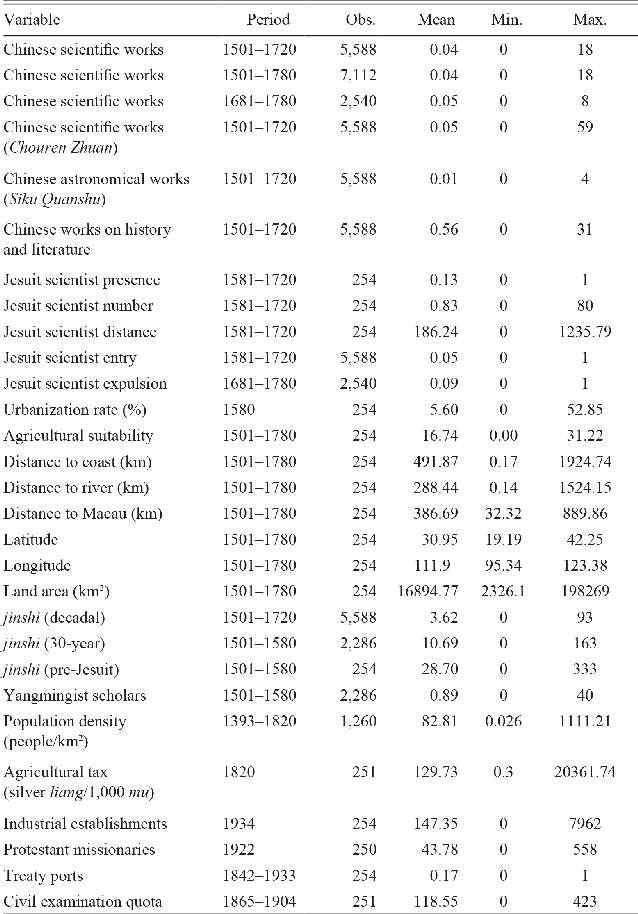
The Jesuits’ locational choices in China might have been shaped by certain geographic factors. The first is the distance to the coast because coastal areas were economically prosperous and convenient for transportation. To measure the distance to the coast, I calculated the shortest great circle distance from a prefecture’s centroid to the nearest point on the coastline. Second, as a major form of inland transportation conduit in Ming-Qing China, rivers may have facilitated the Jesuits’ missionary activities and knowledge diffusion. To measure access to rivers, I calculated the shortest great circle distance from a prefecture’s centroid to the nearest point on a major navigable river.Footnote 21 In light of the fact that the Jesuits expanded to mainland China from Macau and that Macau was an important trade port at the time, I control for the shortest (great circle) distance from a prefecture to Macau. Last but not least, I control for the prefectural land area and the locational effect arising from latitude and longitude. The descriptive statistics of all the variables are reported in Table 1.Footnote 22
DESCRIPTIVE STATISTICS

Note: Refer to the text for definition.
Source: See the text.
THE EFFECT OF THE JESUITS ON CHINESE SCIENCE
The sample includes 254 prefectures of China proper in the Ming and Qing dynasties. I set the period of analysis between 1501 and 1720. The pre-Jesuit period, 1501 to 1580, is the reference period. The treatment period is 1581 to 1720 when the Jesuits entered mainland China and expanded their presence. It ends in 1720, three years before the Qing Emperor began to expel the Jesuits. The estimation follows a DID approach. It examines whether the number of Chinese scientific works increased more in prefectures with Jesuit scientists than in prefectures without Jesuit scientists after 1580. Using the cut-off of 1580, I examine the overall effect of the Jesuit scientists on Chinese scientific production.Footnote 23 Then I explore the prefectural variations in the time of Jesuit entry to check the robustness. The specification is:
 $$Scienc{e_{it}} = \alpha + Post1580 \times J{S_i} + Post1580 \times {X_i} + {p_i} + {d_t} + {\varepsilon _{it}}$$
The variable of interest, JS i, is the distribution of Jesuit scientists in each prefecture. Its baseline measure is a dummy variable that indicates whether a prefecture had Jesuit scientists between 1581 and 1720 (hereafter, Jesuit scientist presence). In prefectures with Jesuit scientists, there were variations in the strength of their presence and hence their influence on Chinese science. The strength of presence may be determined by the number and duration of residence of the Jesuit scientists. To gauge this variation, I use the aggregation of the decades of the presence of all the Jesuit scientists in each prefecture between 1581 and 1720 as the measure (hereafter, Jesuit scientist number). The number ranges from 0 to a maximum of 80.
Both the presence and the number measure the local intellectual effect of the Jesuit scientists. Over time, European sciences might have diffused to areas beyond those where Jesuit scientists resided, allowing the Chinese literati who did not have the opportunity to meet the Jesuit scientists also to have access to the European sciences. Such diffusion was most likely through the circulation of European scientific translations, correspondence, and word of mouth in literati circles (Xiong Reference Xiong1994), although there are no systematic records on it. As a second-best alternative, I use a prefecture’s shortest great circle distance to the nearest prefecture where there were Jesuit scientists between 1581 and 1720 as the proxy for the regional spillover of European science knowledge (hereafter, Jesuit scientist distance). The distance is measured in kilometers, and its logarithm is taken to capture its possible nonlinear effect on Chinese scientific works.
Prefectural controls are denoted by Xi. Its interaction terms specifically with the Post1580 dummy capture the possible effects of prefectural characteristics on the distributions of Jesuit scientists and Chinese science after the arrival of the Jesuits. The prefectural fixed-effects (p i) capture time-invariant effects of all the prefectural characteristics. The common shocks faced by all prefectures are absorbed by the decade fixed-effects (d t).
Standard errors are clustered at the prefectural level by pre- and post-1580 periods.Footnote 24 To account for potential spatial correlation (particularly between the adjacent prefectures), I also report the spatial standard errors that are clustered within a radius of 136 kilometers based on the method of Colella et al. (Reference Colella, Rafael, Seyhun O and Mathias2019). The 136-kilometer is the average distance between two adjacent prefectural seats in the sample, and hence basically, covers a prefecture’s adjacent prefectures. Meanwhile, within each prefecture, I arbitrarily cluster the standard errors within a time window of a century to account for possible auto-correlation.Footnote 25
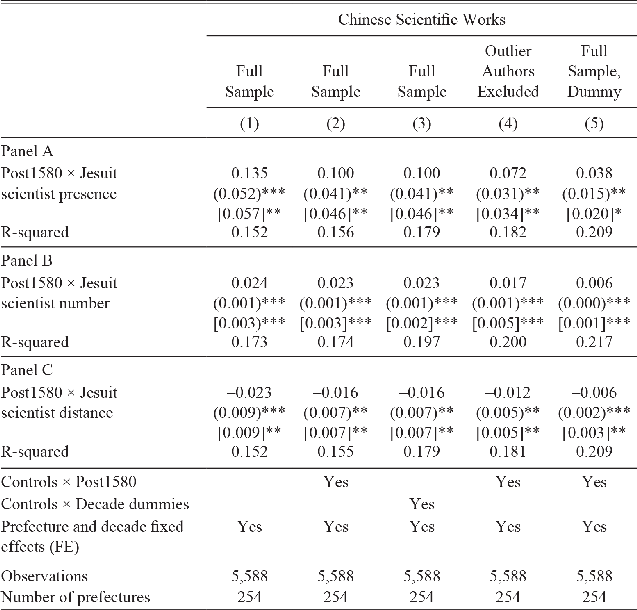
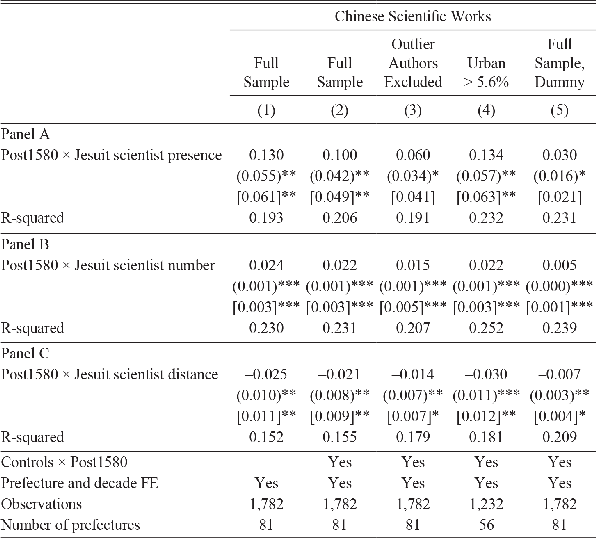
The regression results are reported in Table 2. Panel A compares the change in the number of Chinese scientific works between the prefectures with and without Jesuit scientists after 1580. Relative to the pre-Jesuit period (1501–1580), prefectures with Jesuit scientists produced significantly more Chinese scientific works than did the prefectures without Jesuit scientists. On average, the difference in the number of Chinese scientific works (per prefecture per decade) is 0.135 (Column (1)). After the inclusion of prefectural controls, the difference becomes smaller (0.1) but still statistically significant (Column (2)). The difference remains unchanged when I interact prefectural controls with a full set of decade dummies instead of with the Post1580 dummy, assuming that the effects of these prefectural factors on Chinese science may vary by decade (Column (3)). The difference is substantial, given that the mean of Chinese scientific works before 1580 was only 0.02. This implies an increase of four times in Chinese scientific production after the arrival of the Jesuits. The large effect of Jesuit scientists is reasonable, in the sense that a single Jesuit scientist could stay in China for a long period of time, introducing a great deal of scientific knowledge and influencing many Chinese scholars.
THE EFFECT OF THE JESUIT SCIENTISTS ON CHINESE SCIENCE, 1501–1720

* = Significant at the 10 percent level.
** = Significant at the 5 percent level.
*** = Significant at the 1 percent level.
Notes: All columns report the OLS estimates at the prefecture-decade level between 1501 and 1720. The dependent variable is the decadal number of Chinese scientific works at the prefectural level in Columns (1) to (4), and a dummy that equals one if a prefecture-decade has at least one Chinese scientific work and zero otherwise (Column (5)). Column (4) excludes 49 books written by two outlier authors, Mei Wending and Xu Guangqi. Jesuit scientist presence is a dummy that equals 1 if a prefecture had Jesuit scientists between 1581 and 1720. Jesuit scientist number is the aggregation of the decades of presence of all the Jesuit scientists in each prefecture between 1581 and 1720. Jesuit scientist distance is a prefecture’s great circle distance to the nearest prefecture where there were Jesuit scientists in 1581–1720 (in log). Controls include urbanization rate in 1580, agricultural suitability, log distance to coast, log distance to river, log distance to Macau, latitude, longitude, and log land area. Standard errors in parentheses are clustered at the prefectural level by pre- and post-1580 periods. Standard errors in brackets are arbitrarily clustered within a radius of 136 kilometers and within a time window of a century to account for possible spatial and temporal correlation based on Colella et al. (Reference Colella, Rafael, Seyhun O and Mathias2019).
Source: See the text.
Among the 168 authors of Chinese scientific works in the sample, Mei Wending wrote 37 books and Xu Guangqi wrote 12 books, much more than the sample average of two books per author. As the most influential scientists, Mei and Xu’s extraordinary scientific production might be largely driven by their own gifts rather than merely the Jesuit influence. I treat them as outlier authors and remove their works from the sample for robustness. This does not change the significantly positive effect of the Jesuit scientists, albeit with a slight decrease in magnitude (Column (4)).
The dependent variable has a large share of zeros (97.8%). This is because publication on Chinese sciences before the nineteenth century was a rare event. Moreover, the distribution of observations with positive numbers of scientific works is highly skewed: a majority (68%) of observations have only one book; 35 (28%) have two to five books; and only five (4%) have more than five books, including an observation with an extreme value of 18 books (Online Appendix Figure A5). To mitigate the possible bias caused by the extreme values, I convert the dependent variable into a dummy, combining all the positive values as one. This does not change the positive effect of the Jesuit scientists on Chinese science (Column (5)).Footnote 26
The results remain robust when using the number of Jesuit scientists to capture the prefectural variation in the strength of local knowledge diffusion (Panel B, Table 2). An additional Jesuit scientist would increase the number of Chinese scientific works by 0.024. To minimize the outliers in the number of Jesuit scientists, I take the natural logarithm of this variable, adding a small number, ln(JS i + 0.001), or use the inverse hyperbolic sine transformation of it. The results remain robust (Column (1), Online Appendix Table A1). In sum, the previously noted results indicate that the Jesuits had significantly stimulated local Chinese scientific production.
Panel C of Table 2 examines regional spillover. After 1580, the distance to Jesuit scientist residence turns to be significantly negative in predicting the number of Chinese scientific works. In terms of magnitude, a 100 percent increase in the distance from Jesuit scientist residence, which is 188 kilometers and roughly spans two prefectures, would decrease the number of Chinese scientific works by 0.023. This suggests a regional spillover effect of the Jesuits’ scientific activities through either the translations of European scientific works or other means of idea flow.
Finally, I examine the effect of the Jesuit scientists on Chinese scientific works from the alternative source, Chouren Zhuan. As reported in Panel B of Online Appendix Table A2, the results are consistent with those of Table 2.
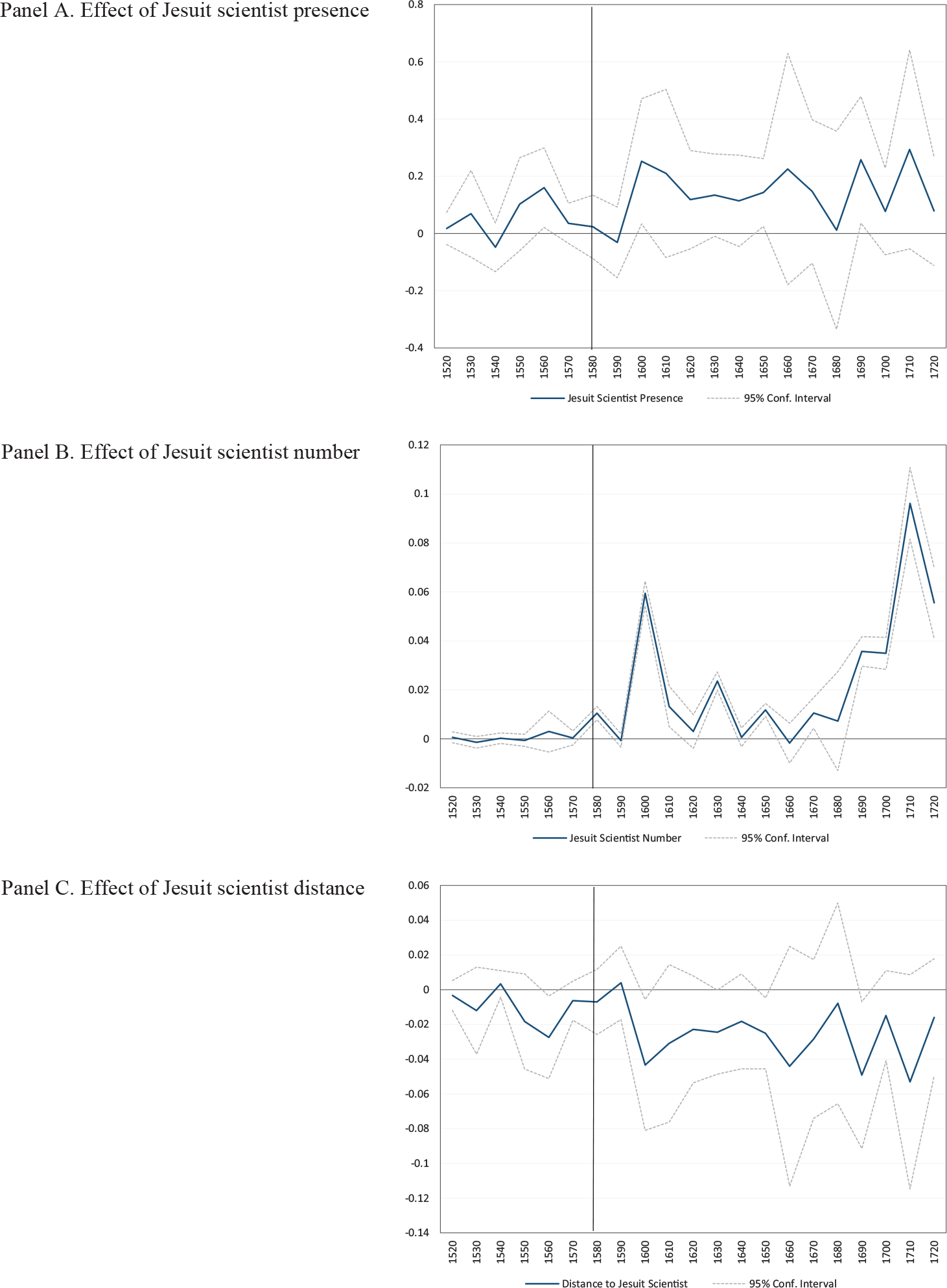
The validity of the previously noted DID estimations is premised on the assumption that there was no significant difference in Chinese scientific production between prefectures with and without Jesuit scientists before 1580. To test this, I interact the Jesuit scientist presence with the decade dummies between 1501 and 1720. Accordingly, I also interact each control variable with a full set of decade dummies to rule out their possibly changing effect on Chinese science over decades.
The decadal coefficient of the Jesuit scientist presence is plotted in Figure 4 (Panel A). In some decades before 1580, prefectures where there were eventually Jesuit scientists produced more Chinese scientific works than did the prefectures without Jesuit scientists. But this difference is not statistically significant. More importantly, there was not an increasing trend in the number of Chinese scientific works in prefectures with Jesuit scientists until 1580. After 1580, the effect of Jesuit scientist presence becomes significantly greater.
THE DECADAL EFFECT OF THE JESUIT SCIENTISTS ON CHINESE SCIENCE
Notes: The figures plot the coefficients of the distribution of Jesuit scientists (1581–1720) on the number of Chinese scientific works by decades. The measures of Jesuit scientists are the same as those in Table 2. The estimations are in a flexible DID setting (the interactions between decade dummies and the distribution of Jesuit scientists). The reference decade is 1501–1510. All regressions have controlled for the prefectural and decade fixed-effects and the interaction terms between decade dummies and prefectural controls used in Table 2.
Source: See the text.

The Jesuit scientist number produces consistent results (Panel B of Figure 4). Before 1580, there is no significant difference in Chinese scientific production across prefectures that eventually varied in the number of the Jesuits. The difference emerges only after the Jesuits come to China. Likewise, the proximity to Jesuit scientist residence does not affect the number of Chinese scientific production until 1580 (Panel C).
Figure 4 also reveals the fluctuation of the Jesuit effect on Chinese science after 1580. Consistent with historians’ narratives (Tsien Reference Tsien1954; Gernet Reference Gernet and Lloyd1985; Brockey Reference Brockey2007), the Jesuit effect is remarkable in the first 30 years after the Jesuits entered China. A possible reason is that the early Jesuit pioneers to China were mostly eminent scientists such as Matteo Ricci, Johann Adam Schall von Bell, and Johann Terrenz Schreck. They made distinct efforts to introduce European science in order to set up their China mission.Footnote 27 Meanwhile, the “shock effect” of European science on Chinese literati should be most prominent at the time when the Jesuits had just entered China. The Jesuit effect turns to be moderate from the 1610s, possibly due to the occasional suppression of the Jesuits by Chinese authorities and the chaos during dynastic change (from the Ming to the Qing).Footnote 28 A new climax of the Jesuit effect on Chinese science came after 1680, thanks to the arrival of the King’s mathematicians from France.
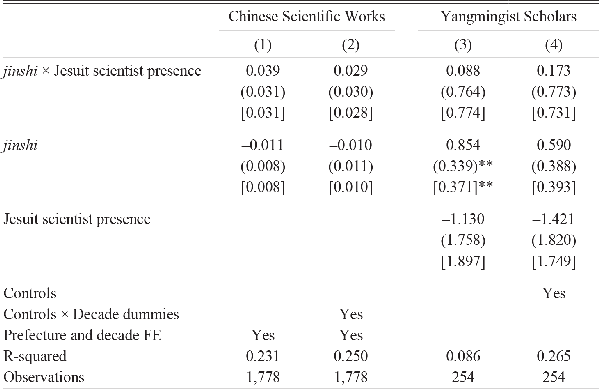
A related concern is whether the Jesuit scientists may have chosen to enter prefectures where the literati were more receptive to science or new ideas. To test this possibility, I examine whether the effect of the number of literati on the number of Chinese scientific works was significantly greater in prefectures with Jesuit scientists than in the other prefectures before the Jesuit arrival. The number of literati in a prefecture is measured by the number of degree holders who received the highest qualification (jinshi) in the imperial examinations in the past 30 years.Footnote 29 As the crème de la crème of Confucian scholars, jinshi were held in the greatest regard and were also the primary group that the Jesuits tried to pursue and influence. In Columns (1) and (2) of Table 3, I regress the number of Chinese scientific books on the interaction term between the number of jinshi and the presence dummy of the Jesuit scientists in the pre-Jesuit period of 1501 to 1580. The coefficient of the interaction term remains insignificant irrespective of the inclusion of prefectural controls or not, suggesting that the literati in prefectures with Jesuit scientists did not demonstrate a distinct pursuit of science before 1580.
THE EFFECTS OF THE LITERATI ON SCIENCE AND NEW SCHOOLS OF THOUGHT BEFORE THE JESUIT ARRIVAL, 1501–1580

* = Significant at the 10 percent level.
** = Significant at the 5 percent level.
*** = Significant at the 1 percent level.
Notes: Columns (1) and (2) compare the prefectures with Jesuit scientists to the other prefectures in terms of the pre-1580 trend of literati scientific production. Columns (3) and (4) examine whether the literati were more receptive to new schools of thought in prefectures with Jesuit scientists than were those in other prefectures before 1580. The new schools of thought are measured by the number of Yangmingist scholars, who were adherents of a new Confucian school (Yangmingism) that arose in the early sixteenth century. Literati are measured by the prefectural number of the highest (jinshi) degree holders in the past 30 years (in log) in Columns (1) and (2), and by the total number of jinshi between 1501 and 1580 in each prefecture in Columns (3) and (4). All columns report the OLS estimates. Controls are the same as those of Table 2, except that Columns (3) and (4) additionally control for the log distance to the hometown (Shaoxing Prefecture) of Wang Yangming (the founder of Yangmingism). Standard errors in Columns (1) and (2) follow the same ways of clustering as those of Table 2. Columns (3) and (4) report the robust standard errors in parentheses and the standard errors clustered within a radius of 136 kilometers in brackets.
Source: See the text.
In addition, I test whether the literati in prefectures with Jesuit scientists had already shown they were more open to new schools of thought than the literati in other prefectures before the Jesuit arrival. The openness to new forms of thought is measured by the number of Yangmingist scholars in each prefecture. Yangmingism was a new Confucian school that arose in the early sixteenth century. The school became influential for its new philosophy (of Mind or xinxue) that contended with the classical, dominant Confucian Rationalistic school or lixue.Footnote 30 Thus, the number of Yangmingist scholars can reflect local literati’s inclination or open-mindedness to new types of thought on the eve of the Jesuits’ arrival. If the literati in prefectures with Jesuit scientists were more receptive to new schools of thought, there should be more Yangmingist scholars among these literati in the sixteenth century.Footnote 31
I regress the number of Yangmingist scholars on the interaction term between the number of jinshi and the presence dummy of the Jesuit scientists (Columns (3) and (4) of Table 3). Given the lack of information on the specific years when a literatus adopted Yangmingism, I run cross-prefectural regressions by respectively aggregating the number of Yangmingist scholars and the number of jinshi at the prefectural level between 1501 and 1580. Again, the jinshi in prefectures with Jesuit scientists did not produce more Yangmingist scholars (and hence were unlikely to be more receptive to new forms of thought) than seen in other prefectures.
Comparing Jesuit Scientists with Jesuit Priests
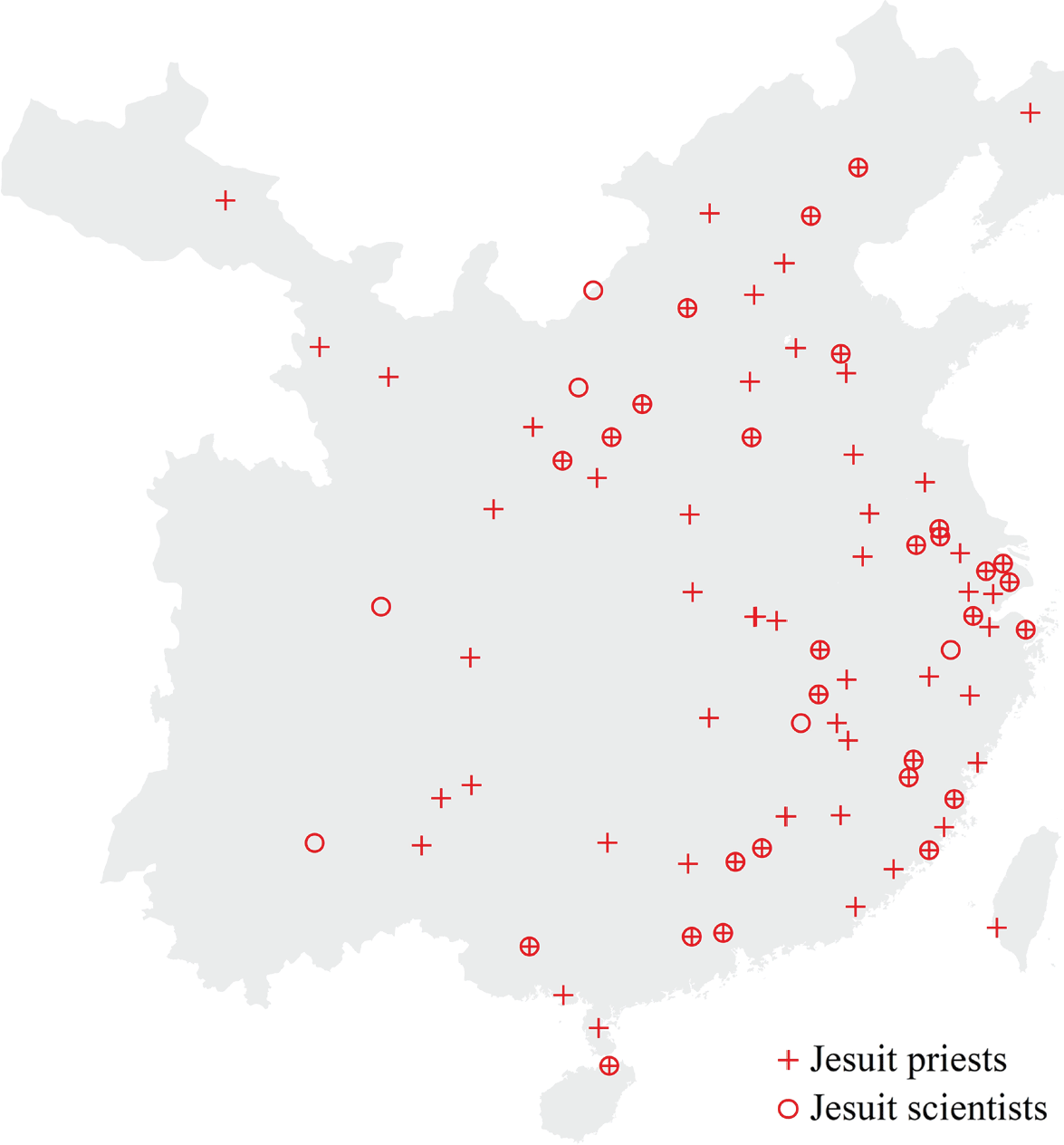
To rule out the possible violation of the results by unobserved prefectural factors, I restricted the sample to the 81 prefectures where there were Jesuits between 1581 and 1720 (henceforth, Jesuit prefectures). By doing so, I compared the 34 prefectures where there were Jesuit scientists with the remaining 47 prefectures where there were Jesuit priests (but no Jesuit scientists) in terms of Chinese scientific production (Figure 5).
DISTRIBUTIONS OF JESUIT SCIENTISTS AND JESUIT PRIESTS, 1581–1720
Notes: This figure shows the distribution of the Jesuit presence. “Jesuit scientists” refers to the Jesuits who were involved in scientific activities in China. “Jesuit priests” refers to the Jesuits who only did missionary work.
Sources: The data is based on Dehergne (Reference Dehergne1973) and Li and Zha (Reference Li and Yongping2002).

The validity of using the Jesuit priest prefectures as the control group is based on the reasoning that the Jesuit priests were similar to Jesuit scientists in all respects of their China mission, except for the latter’s introduction of European sciences. Specifically, both of them were European missionaries under the authority of the same Catholic order—the Society of Jesus. Both entered mainland China in the 1580s and were subject to the same temporal trends (and shocks) in the missionary expansion and decline in China. Accordingly, the distributions of Jesuit scientists and priests were subject to similar prefectural factors.
To examine this, I compared the Jesuit scientist prefectures with the Jesuit priest prefectures in terms of economic conditions and geography (Online Appendix Table A3). Statistically, there is no significant difference between the two groups in terms of urbanization rate (1580), potential agricultural productivity, and geography (distance to coast, distance to river, distance to Macau, latitude, longitude, and land area). In addition, there is no significant difference between the two groups in terms of the pre-1580 number of Chinese scientific works. This suggests that, relative to the Jesuit priests, the Jesuit scientists did not settle in prefectures where there was a stronger tradition of science before their arrival.
The results using the Jesuit prefectures sample are reported in Table 4. Consistent with the full sample, after 1580, prefectures with Jesuit scientists produced more Chinese scientific works than did the Jesuit priest prefectures (Column (1) of Panel A). The effect remains robust to the inclusion of all the control variables (Column (2)) and when the works of outlier authors (Mei Wending and Xu Guangqi) were excluded (Column (3)). The marginal effect of the Jesuit scientists is almost identical to that of the full sample, suggesting that the effect of the Jesuit scientists on Chinese scientific production came from their introduction of European sciences to China.
RESULTS OF THE JESUIT PREFECTURES: COMPARING JESUIT SCIENTISTS WITH JESUIT PRIESTS, 1501–1720

* = Significant at the 10 percent level.
** = Significant at the 5 percent level.
*** = Significant at the 1 percent level.
Notes: All columns report the OLS estimates at the prefecture-decade level between 1501 and 1720. They exclude prefectures where there were no Jesuits at any time from 1581 to 1720, and compare the prefectures of Jesuit scientist residence with the prefectures of Jesuit priest residence only. Column (3) excludes 49 books written by two outlier authors, Mei Wending and Xu Guangqi. Column (4) excludes prefectures where urbanization rate was below the sample mean (5.6 percent). The dependent variable in Column (5) is a dummy that equals one if a prefecture-decade has at least one Chinese scientific work and zero otherwise. Measures of Jesuit scientists, controls, and the clustering of standard errors are same as those of Table 2.
Source: See the text.
Given that the Jesuits tended to live in big cities, I further restricted the Jesuit prefectures to those where there were big cities, in other words, the urbanization rate was above the sample mean of 5.6 percent. This removed 25 Jesuit prefectures with relatively lower urbanization levels. Jesuit scientists still have a significantly positive effect on Chinese science (Column (4) of Table 4). Finally, I converted the dependent variable into a dummy on whether a prefecture had scientific work(s) in each decade; the positive effect of the Jesuit scientists remains significant (Column (5)). The results are consistent with those of the full sample when I use the number of Jesuit scientists and the distance to Jesuit scientists as alternative measures of the Jesuit influence in Panels B and C of Table 4, respectively.Footnote 32
An alternative way to find a comparable control group is propensity score matching. In Online Appendix A1, I use the propensity score to identify a control group (prefectures without Jesuit scientists) that is similar to the treatment group (prefectures with Jesuit scientists) in terms of the likelihood of being selected by the Jesuit scientists as their residence. Given that the distribution of the Jesuit scientists mainly correlates with the urbanization rate (1580), I use the urbanization rate to predict the propensity scores on a prefecture’s likelihood of being selected by Jesuit scientists. To further improve the similarity between the treatment and the control group, I also do the same matching but within the Jesuit prefectures only. Using the sample of matching, the positive effect of the Jesuit scientists on the number of Chinese scientific works remains robust (Online Appendix Table A5).
To further allay the concern that the Jesuit effect might be driven by unobserved prefectural factors, I employ an instrumental variable approach in Online Appendix A2. I instrument the prefectural distribution of the Jesuit scientists using a prefecture’s shortest great circle distance to the early missionary route explored by the Jesuit pioneer Matteo Ricci between 1582 and 1601. The early missionary route taken by Ricci played an important role in directing the entry and expansion of the later Jesuit scientists but is orthogonal to Chinese science. The instrumented results reaffirm the Jesuit effect on Chinese science.
Works in the Liberal Arts in China
If the effect of Jesuit scientists on Chinese scientific production was driven by unobserved local cultural or human capital factors, these factors should also bear on the book production of other fields. I conducted a falsification test using the number of book titles on two major fields of “liberal arts” in imperial China, history and literature, as the dependent variables. Relative to the works on sciences, works in the liberal arts should be less likely affected by European sciences.Footnote 33
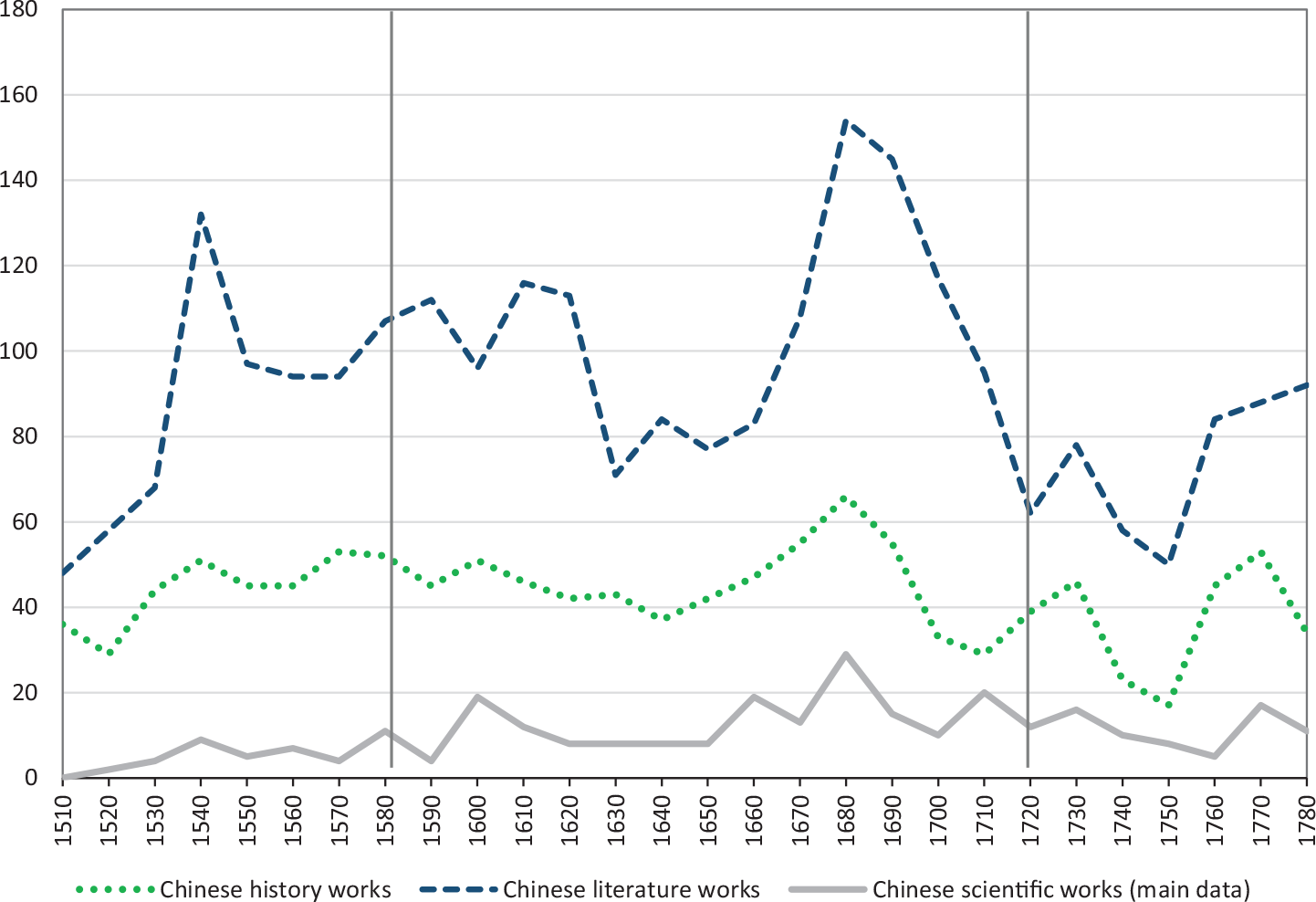
The data on works of history and literature is obtained from the Siku Quanshu (Complete Library of the Four Treasuries).Footnote 34 Siku Quanshu contains 985 titles that pertain to history and 2,131 titles on literature that were written between 1501 and 1720. Based on the biographies of the authors, I enumerated the number of titles by prefecture and decade. The temporal change in the number of works of history and literature is depicted in Figure 6. Indeed, neither has a rising trend upon the Jesuit arrival, unlike what is found for scientific works. Between the 1630s and the 1650s, production in both the liberal arts and science declined, possibly due to the social unrest caused by dynastic change.
NUMBERS OF CHINESE WORKS ON HISTORY, LITERATURE, AND SCIENCE
Notes: “Works” refers to book titles.
Sources: Data on books of history and literature are obtained from Siku Quanshu, and that of books on science are obtained from Zhongguo Kexue Jishu Dianji Tonghui.

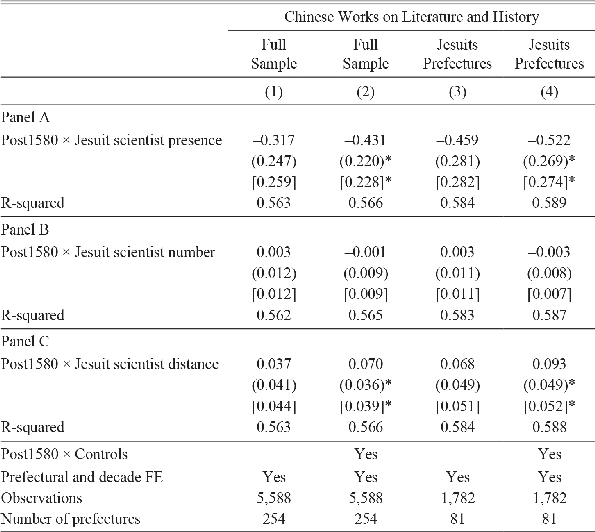
Following the same strategy used in analyzing the publication of scientific works, I found that the Jesuit scientists did not stimulate the growth of Chinese works on history and literature (Table 5). A remaining concern is that Siku Quanshu may be different from the source of scientific works (the Collection) in counting historical books. This would undermine the effectiveness of the comparison of books between the two sources. For robustness, I employ the number of Chinese astronomical works recorded in Siku Quanshu and regress it on the distribution of the Jesuit scientists.Footnote 35 The results show that, when the sample is restricted to the Jesuit prefectures, the Jesuit scientists have a significantly positive effect on the number of astronomical works (Panel C of Online Appendix Table A2).
CHINESE “LIBERAL ARTS” AS A PLACEBO, 1501–1720

* = Significant at the 10 percent level.
** = Significant at the 5 percent level.
*** = Significant at the 1 percent level.
Notes: All estimations are the same as in Table 2 except that the dependent variable is the number of Chinese books (titles) on history and literature. Columns (3) and (4) exclude prefectures where there were no Jesuits at any time from 1581 to 1720, and compare the prefectures of Jesuit scientist residence with the prefectures of Jesuit priest residence only. Measures of Jesuit scientists, controls, and the clustering of standard errors are same as those in Table 2.
Source: See the text.
Flexible Times of Entry of the Jesuits
The foregoing analyses examine the overall effect of the Jesuit scientists on Chinese scientific production after 1580. They ignore the prefectural variations in the time of Jesuits’ entry. This section exploits the prefectural variation in the time of entry and examines in a DID setting whether Chinese scientific works increased after the “entry shock” of the Jesuit scientists.
The period of the analysis is still 1501 to 1720. The variable of interest is the Jesuit scientist entry, which is a dummy variable that equals 1 for the decades after the Jesuit scientists first entered a prefecture. After controlling for the prefectural fixed-effects, I compare the difference in Chinese scientific production within the same prefecture pre- and post-Jesuit entry. Hence the causality relies on whether the time of entry was endogenously determined by correlates of Chinese scientific production.
Historical narratives suggest that the time of Jesuit entry into a prefecture was random. Although the Jesuits may have tended to preach in prefectures with a favorable economic or cultural environment, they could not decide the possibility or time of entry. This is because the imperial authorities of China prohibited contact between Chinese and foreigners, let alone allowing the European missionaries to reside and preach in China.Footnote 36 That is why historians describe the Jesuit mission to China as a great adventure (Gernet Reference Gernet and Lloyd1985; Brockey Reference Brockey2007).
Instead, whether and when the Jesuits could enter a prefecture largely depended on coincidence.Footnote 37 After the Jesuits arrived in Macau in 1562, they painstakingly tried many ways to enter mainland China but were expelled by local officials without exception. The chance did not come until December of 1582, when the provincial governor of Guangdong suddenly agreed to let the Jesuits live in the city of Zhaoqing in Guangdong, and giving them the right to build a church and houses. Such unpredictability is best summarized by the Jesuits themselves at the time:
Such a sudden change as that must be attributed to the grace of God rather than to any human merit. Far be it from us to assert that it was our accomplishment. Indeed, it should serve as a lesson for the future to keep on hoping even after every human effort has failed, and never to give up hope of better things (Ricci and Trigault 1953 [1615], p. 144).
Another representative case of such random entry comes from Matteo Ricci. He had been planning to establish a missionary station in the imperial capital of Beijing. But he did not have an opportunity to do so until he met a prestigious eunuch in Nanjing who appreciated Ricci’s talent. When he returned to Beijing, he took Ricci and recommended Ricci to the emperor in 1601. After waiting for six months, Ricci was finally called in by the emperor and was approved to reside in the capital. Ricci viewed this as “completely unexpected.”
Although Ricci’s success in the imperial capital facilitated the Jesuit mission in China, the Jesuits who came after him still needed to rely on occasional, informal ways to expand their mission to other Chinese cities. For example, Lazzaro Cattaneo could open the new mission in Songjiang only when his friend Xu Guangqi had to return to his hometown of Songjiang in 1608 to mourn his deceased father for three years according to Chinese custom. Three years later, he opened a new parish in the nearby city of Hangzhou, the hometown of his friends, Li Zhizao and Yang Tingjun, who were officials. Likewise, Francesco Sambiasi could not enter the city of Jiading in Jiangsu Province until he obtained the assistance of the official Sun Yuanhua in 1622 (Ricci and Trigault 1953 [1615]).
To further confirm the “haphazard” pattern of the time of entry, I checked the records from the Jesuits’ diaries (Ricci and Trigault 1953 [1615]) and studies by historians (Brockey Reference Brockey2007) for the specific means of entry. There were 20 prefectures for which pertinent records were available (Online Appendix Figure A12). This is a representative sample in the sense that these prefectures were the sites of the major Jesuit residences, accounting for 68 percent of the total number-decade of the Jesuit presence in China between 1581 and 1780. The records show that the Jesuits entered all of these 20 prefectures by chance (Online Appendix Table A8). Of course, we cannot ensure that all the entries of the Jesuits were random events; they might also have been shaped by unobserved time-varying factors in the prefectures they wanted to enter.
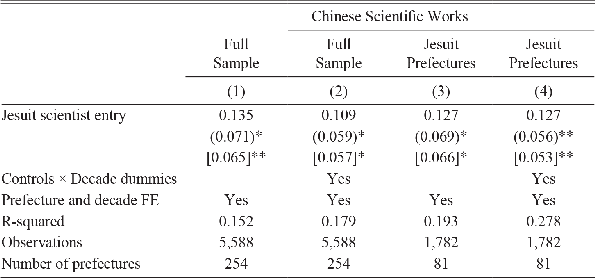
The regression results are reported in Table 6. After a Jesuit scientist entered a prefecture, the number of scientific works produced in that prefecture per decade increased by 0.135 (Column (1)). The effect remains robust in Column (2), where I control for the same set of prefecture factors used in Table 2. Given the time-varying nature of the Jesuit scientist entry, I interact each prefectural factor with the decade dummies. Columns (3) and (4) restrict the control group to the prefectures with Jesuit priests only. Doing so does not change the positive effect of the Jesuit scientists’ entry on Chinese science.
FLEXIBLE ENTRIES OF THE JESUITS, 1501–1720

* = Significant at the 10 percent level.
** = Significant at the 5 percent level.
*** = Significant at the 1 percent level.
Notes: Jesuit scientist entry is a dummy indicating the period after the first Jesuit scientist arrived in a prefecture. All columns report the OLS estimates. Columns (3) and (4) exclude prefectures where there were no Jesuits at any time from 1581 to 1720 and compare the prefectures of Jesuit scientist residence with the prefectures of Jesuit priest residence only. Controls and the clustering of standard errors are same as those in Table 2.
Source: See the text.
No trend of increase in the number of Chinese scientific works before the Jesuit scientist entry is observed (Online Appendix Figure A6). I lagged seven decades before the time of Jesuit entry for each prefecture. While the difference between prefectures with Jesuit scientists and those without in terms of Chinese scientific works fluctuated over the decades, none of them was statistically significant. The difference in Chinese scientific works rose significantly only after the entry of Jesuit scientists.
To gauge the long-term effect of the Jesuit scientists after they entered a prefecture, I use the cumulative number-decades of the Jesuit scientists since they first entered that prefecture as the proxy. It has a significantly positive effect on the number of Chinese scientific works (Online Appendix Table A9).Footnote 38
Finally, I provide evidence in Online Appendix A3 on the importance of the interaction between the literati and the Jesuit scientists in the production of Chinese science. This coincides with historical anecdotes on the cases of Xu Guangqi, Li Zhizao, and Wang Zheng, who made remarkable achievements in science only after meeting and learning from their Jesuit friends.Footnote 39
THE EXPULSION OF THE JESUITS
After 1700, however, the influence of the Jesuits began to decline in China. The main reason was the Chinese Rites Controversy, which lasted roughly from 1700 to 1775. The Popes Clement XI, Benedict XIV, and Clement XIV successively decreed that Chinese Catholics had to abandon the Confucian rites of ancestor worship since the latter constituted a religious rite that contradicted the Catholic faith. The Qing Emperor Kangxi could not tolerate this stance and, after this diplomatic failure, he began in 1704 to restrict the Catholic missionary activities in China.
The adverse effect of the Controversy became substantial from 1723. In that year, the Yongzheng Emperor (r. 1723–1735) ordered the Decree of Suppression, which forbade the Chinese from accepting Christianity and began to expel missionaries. Consequently, the number of Jesuits in China plummeted (Figure 1). The prohibition of Christianity was sustained during the reign of the succeeding Qianlong Emperor (1735–1795). Meanwhile, the Jesuits had also gradually lost their position in Europe. Portugal and France, for example, banned Jesuit activities in 1759 and 1764, respectively. The Jesuits finally ended their China missions after the dissolution of the order by the Pope in 1773 (Brockey Reference Brockey2007). The only exception is that some Jesuits were still allowed to stay in Beijing to serve the royal family. The last Jesuit in China, L. de Poirot, died in Beijing in 1813 (Standaert Reference Standaert1991).
The expulsion of the Jesuits undoubtedly interrupted the knowledge exchange between China and Europe. For instance, no further European mathematics was introduced into China after the 1720s. China missed the European discovery of dynamic calculus and engineering. Likewise, China’s astronomical books in the eighteenth century were out of date by European standards (Elman Reference Elman2005).
Testing the Expulsion Effect
It is impossible to quantify the change in the nature and quality of Chinese science in response to the expulsion of the Jesuits. Nevertheless, I can investigate whether the expulsion systematically discouraged the overall scientific production of Chinese literati. Empirically, I examine whether the effect of the Jesuit scientists on Chinese scientific production turned to be smaller after the emperor began to expel the Jesuits in 1723. Accordingly, I employ the same DID approach as that of Equation (1), except that the sample is extended to the period of expulsion (1721 to 1780). I end the period by 1780, soon after the Jesuit mission was formally dismissed by the Pope.Footnote 40 In this case, I examine the interaction terms between the variables of Jesuit scientists and two-period dummies: one is the period of Jesuit presence (1581–1720), whereas the other is the period of Jesuit expulsion (1721–1780). Both take as their reference the pre-Jesuit period of 1501 to 1580.Footnote 41
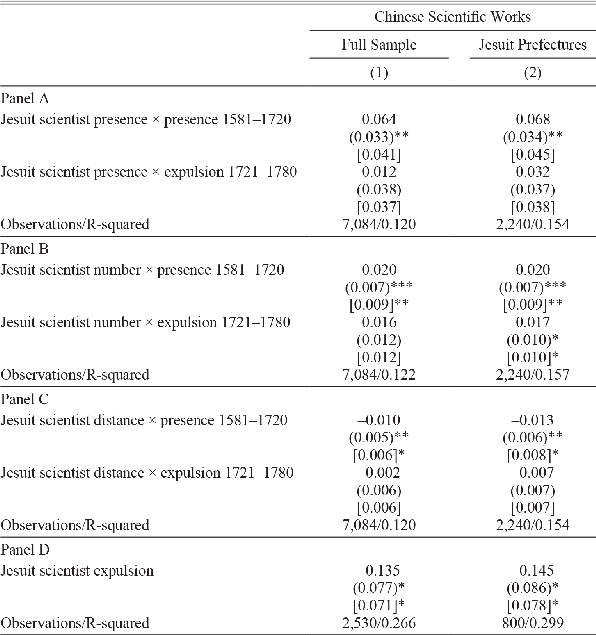
The results are reported in Table 7. While Jesuit scientists significantly increased Chinese scientific works after 1580, this effect became smaller and insignificant after 1720 (Panel A). In terms of magnitude, prefectures with Jesuit scientists produced 0.064 more Chinese scientific works per decade than did prefectures without Jesuit scientists during the period of Jesuit presence (1581–1720). However, this difference shrinks to 0.012, an 81 percent reduction, after the Jesuits began to be expelled (1721–1780). The results remain consistent when using Jesuit scientist number to measure the strength of European knowledge diffusion (Panel B). The effect of the distance to Jesuit scientists also turns to be insignificant after 1720, suggesting that the previous spillover of the Jesuits’ knowledge did not persist after the Sino-European contact was broken (Panel C). These results remain robust when I compare the prefectures of Jesuit scientists with the prefectures of Jesuit priests only.
THE EFFECT OF JESUIT EXPULSION ON CHINESE SCIENCE

* = Significant at the 10 percent level.
** = Significant at the 5 percent level.
*** = Significant at the 1 percent level.
Notes: This table reports the change in Chinese scientific production after the Jesuits were expelled from China beginning from the 1720s. In Panels A to C, the sample period is 1501–1780, in which 1501–1580 is the reference (pre-Jesuit) period, 1581–1720 is the period of Jesuit presence, and 1721–1780 is the period of Jesuit expulsion. Panel D examines the expulsion effect taking into account the prefectural variations in the timing of Jesuit retreat, in which Jesuit scientist expulsion is a dummy indicating the period after all the Jesuit scientists had been expelled from a prefecture. The sample period of Panel D begins from the heyday of Jesuit presence in China (1681) to the end of the Jesuit China mission (1780). Beijing as an outlier was excluded. Column (2) compares the prefectures of Jesuit scientist residence with the prefectures of Jesuit priest residence only. All columns report the OLS estimates with prefectural and decade fixed effects and a full set of controls that are the same as those of Table 2. Standard errors in parentheses are clustered at the prefectural level by periods (pre-Jesuits 1501–1580, Jesuit presence 1581–1720, and Jesuit expulsion 1721–1780) in Panels A to C, and are clustered at the prefectural level in Panel D. Standard errors in brackets are arbitrarily clustered within a radius of 136 kilometers and within a time window of a century based on Colella et al. (Reference Colella, Rafael, Seyhun O and Mathias2019).
Source: See the text.
The analyses noted previously reveal an overall negative effect of the Jesuit expulsion on Chinese scientific production. However, the time of the Jesuits’ withdrawal also varied across prefectures. After the Yongzheng Emperor ordered the expulsion of Catholic missions from China, the departure of the Jesuits followed a gradual process that was sustained until the late eighteenth century. Following the same DID strategy in examining the entry effect, I test whether Chinese scientific works decreased after all the Jesuit scientists retreated from a prefecture.
The Jesuits’ retreat can also, arguably, be treated as an exogenous shock, simply because it was caused by the emperor’s prohibition of Catholicism due to the Chinese Rites Controversy with the Pope. It was not initiated by the Jesuits or Chinese literati in each prefecture. Certainly, in a prefecture, when and to what extent the government implemented the emperor’s decree of expulsion may have been shaped by some time-varying local factors; for instance, the turnover of local governors, who had different attitudes towards the missionaries. Given this unobservable confounding factor, the coefficient of the expulsion may be biased and hence should be interpreted with caution.
The analysis is restricted to the period between 1681 and 1780, that is, from a year when the Jesuit mission to China was in its heyday to a year after all the Jesuits had retreated from China. I construct a dummy variable of Jesuit scientist expulsion, which equals 1 for the period after all the Jesuit scientists had left a prefecture. The results are reported in Panel D of Table 7. After the Jesuit scientists were expelled, the average number of Chinese scientific works per prefecture per decade decreased by 0.135. The reduction becomes greater (0.145) when I restrict the control group to the prefectures with Jesuit priests only.
SCIENCE WITHOUT DEVELOPMENT
Since Jesuit scientists stimulated many Confucian literati to study science, did these new sciences translate into economic progress? China did not see industrial or modern growth until the late nineteenth century—a century after the retreat of the Jesuits from China. Then, the question remains as to whether the Jesuits’ knowledge diffusion affected China’s pre-industrial growth and whether this effect, if any, persisted into the time of modern growth.
To measure pre-industrial growth, I use population density as the proxy, reasoning that only a high agricultural output or commercialization could support a dense population in a Malthusian economy. Based on Cao (Reference Cao2001, Reference Cao2017), I constructed prefectural population density spanning five time points of 1393, 1580, 1630, 1776, and 1820. They cover the entire period of the Jesuit China mission. The population density in 1393 and 1580 measures the pre-Jesuit trend in economic development, whereas population density in 1820 measures economic prosperity on the eve of China’s modern transition.Footnote 42 If Chinese scholars’ scientific achievements under Jesuit influence generated remarkable economic benefits, we should expect a significant increase in population density in or near the prefectures with more Jesuit scientists after 1580.
In addition, given the predominance of the agrarian economy at the time, I employ agricultural tax revenue (in silver liang per 1,000 mu) at the prefectural level as an alternative measure of economic prosperity.Footnote 43 The data is obtained from Liang (Reference Liang1980) and is only available for the year 1820. After controlling for the initial economic conditions (urbanization rate in 1580), I examine whether the Jesuits’ scientific influence would improve Chinese agricultural output in a cross-sectional setting.
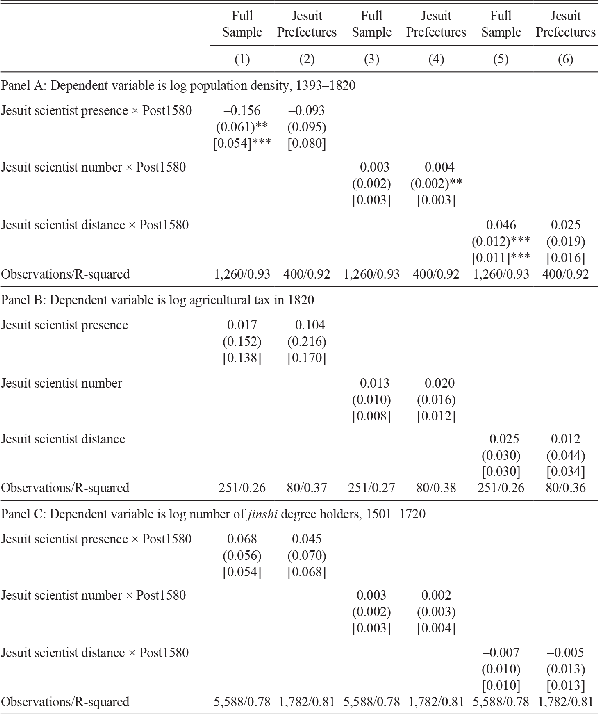
Following the same DID approach as used in Table 2, I examine whether population density had a greater increase in prefectures with Jesuit scientists than that in other prefectures after 1580. As reported in Panel A of Table 8, both the presence and the number of the Jesuit scientists did not increase population density (Columns (1)–(4)). The Jesuit science also did not generate an economic spillover to the nearby regions (Columns (5) and (6)).Footnote 44 Likewise, although some literati applied European methods in agricultural science, as a whole, Jesuit science did not bring to China a significant increase in agricultural revenue (Panel B).Footnote 45 In sum, while the Jesuits inspired Chinese literati’s scientific endeavors, this did not translate into economic development. This contrasts with the contribution of the Jesuits to Latin America, where their efforts in knowledge diffusion generated long-lasting income growth until the present. I attempt to explain this puzzle.
THE EFFECT OF THE JESUIT SCIENTISTS ON ECONOMIC DEVELOPMENT

* = Significant at the 10 percent level.
** = Significant at the 5 percent level.
*** = Significant at the 1 percent level.
Notes: Population density is measured at the prefectural level and spans five time points of 1393, 1580, 1630, 1776, and 1820. Agricultural tax is measured at the prefectural level in 1820 (in silver liang per mu). “Jinshi degree holders” refers to the number of candidates who obtained the highest civil examination qualification from each prefecture in each decade between 1501 and 1720. Columns (2), (4), and (6) compare the prefectures of Jesuit scientist residence with the prefectures of Jesuit priest residence only. Panels A and C report the OLS estimates with prefectural and time fixed effects and a full set of controls (interacted with Post1580) same as those of Table 2. Panel B reports the OLS estimates at the prefectural level with a full set of controls that are the same as those of Table 2. Panel A reports in parentheses the standard errors clustered at the prefectural level by pre- and post-1580 periods, and reports in brackets the standard errors clustered within a radius of 136 kilometers and within the full sample period. Panel B reports in parentheses the robust standard errors and reports in brackets the standard errors clustered within a radius of 136 kilometers. Panel C reports in parentheses the standard errors clustered at the prefectural level by pre- and post-1580 periods, and reports in brackets the standard errors clustered within a radius of 136 kilometers and within a time window of a century.
Source: See the text.
Institutional Environment
The first and foremost factor is that Ming-Qing China lacked an institutional environment for scientists to pursue economic progress, and the Jesuits did not bring to China such an institutional change. China’s human capital institution was designed for civil service. The civil examinations offered scholars a stable “ladder of success,” by which they could enter officialdom and enjoy the highest status, esteem, and pecuniary benefits. Under the scholar-to-official incentive scheme, the members of the learned elite were absorbed into this meritocratic system. Although they had an interest in European science, literati scientific endeavors were directed to serve the needs of statecraft, which could bring them career success in the bureaucracy, rather than to apply the new methods in manufacturing, seafaring, and experiments.
Specifically, the literati’s scientific applications concentrated on imperial needs and interests. They mainly adopted the Jesuits’ science to improve China’s calendar, mapping, music, and military affairs, among others. For example, given the importance of the calendar in consolidating the rulers’ monopoly of time and their legitimacy, Chinese mathematicians used logarithms and trigonometry they learned from the Jesuits to make new star tables and to predict solar and lunar eclipses (Landes Reference Landes2006). Therefore, mathematical astronomy was among the most “useful knowledge” in China (Elman Reference Elman2000). Indeed, astronomical and mathematical publications accounted for more than 64 percent of Chinese scientific works produced in the Jesuit period (Online Appendix Figure A1). Another example is cartography. Because of the policy of autarky, voyages abroad and the outside world remained relatively unimportant to Chinese elites. The new cartographical knowledge introduced by the Jesuits was thus only appreciated for its value in mapping the frontier and naval defense rather than in sea voyages and maritime commerce.Footnote 46
Therefore, under the state monopoly of education, knowledge, and social mobility, the literati’s scientific pursuits were closely tied with imperial needs rather than with the “market for ideas” seen in contemporaneous Europe.Footnote 47 Moreover, the new scientific philosophy and methods were not transmitted to artisans, craftsmen, and merchants, as they were excluded from elite circles. As Mokyr (Reference Mokyr2017, p. 321) has incisively observed, China lacked the institutional bridge found in eighteenth-century Europe “between those who possessed propositional knowledge (who knew things) and those who controlled prescriptive knowledge (who made things).”Footnote 48
The Limitations of the Jesuit China Mission
Without any colonial power in China to support them, the Jesuits could only carefully pursue the Confucian elites within the already highly-institutionalized scholar-official system. They could not develop schools and thus expand their human capital influence to the mass of Chinese as their colleagues in the New World did.Footnote 49 The consequence was that the Jesuits mainly inspired the scientific curiosity of a small group of learned elite men rather than challenged the education system of China. Classical education to enter civil service still dominated Chinese intellectual life. This is evidenced by the finding that the Jesuits’ knowledge diffusion did not reduce the number of civil examination degree-holders (jinshi) in China (Panel C, Table 8). Although some eminent scientists, including Xu Guangqi and Mei Wending, had apprentices and even formed a small network of the so-called “Western learning school,”Footnote 50 an active community of scientists never appeared in Ming-Qing China. There were not regular scientific meetings, salons, and correspondence, let alone the kind of scientific associations and societies that prospered in Enlightenment Europe.
Even within elite circles, the Jesuits did not bring to the literati modern science for industrial use. The Jesuit sciences were basically classical natural philosophy (Gernet Reference Gernet and Lloyd1985; Sivin Reference Sivin1995). Their astronomy was built on the Tychonic system, and their mathematics was essentially static geometric mathematics based on Euclid and Aristotle. They did not introduce China to the revolutionary analytical geometry, dynamic calculus, and mechanics used by engineers (Elman Reference Elman2005).Footnote 51
China’s industrial enlightenment had to wait until the late nineteenth century, when the Qing dynasty was forced to open up to the West (Spence Reference Spence1990). Under the pressure of the Western industrial powers, the imperial authorities had to modernize their institutions for “self-strengthening.” In particular, the collapse of the civil examination system in 1905 finally released the learned elite to enter the industrial or modern sectors. Their efforts, along with unprecedented Western influence, finally brought to China the genesis of modern growth (Bai and Jia Reference Bai and Ruixue2016; Bai Reference Bai2019).
Since the Jesuits’ intellectual influence did not divert elite interest from statecraft to the material world, it is no wonder the Jesuits left no legacy for China’s modernization era. As shown in Table 9, the Jesuit scientists have no long-term effect on the number of industrial establishments in local prefectures in the 1930s (Columns (1) to (4)).Footnote 52 Certainly, the Jesuits’ local influence may have faded out in the long run because of the spatial diffusion of scientific books and knowledge. However, when I use the distance to the Jesuit scientist prefectures to (partially) proxy for the spatial diffusion of science, it still does not bear on the distribution of industrialization (Columns (5) and (6)).Footnote 53
JESUIT SCIENTISTS AND INDUSTRIALIZATION IN THE EARLY TWENTIETH CENTURY

* = Significant at the 10 percent level.
** = Significant at the 5 percent level.
*** = Significant at the 1 percent level.
Notes: All columns report the OLS estimates at the prefectural level. Columns (2), (4), and (6) compare the prefectures of Jesuit scientist residence with the prefectures of Jesuit priest residence only. Controls include those of Table 2, the civil examination quotas assigned to each prefecture in 1865 to 1904, and a treaty port dummy (1842 to 1933). Robust standard errors are in parentheses. Standard errors in brackets are clustered within a radius of 136 kilometers to account for possible spatial correlation based on Colella et al. (Reference Colella, Rafael, Seyhun O and Mathias2019).
Source: See the text.
CONCLUSION
During the sixteenth to eighteenth centuries, the Jesuits developed a global enterprise that produced significant human capital and economic legacies (Banchoff and Casanova Reference Banchoff and José2016; Valencia Caicedo Reference Valencia, Mitch and Cappelli2019b). However, unlike in their New World mission, the Jesuits encountered a powerful Confucian elite in China. This clash of culture forced the Jesuits to adopt in China a distinct missionary strategy of “elite with science.” Although the Jesuits did not bring to China institutional and economic changes, they did evoke within the elite an intellectual movement toward science and Western learning. Such an intellectual change in a Confucian civilization, albeit one that did not persist in the long run, again demonstrates the distinct human capital contribution of the Jesuit enterprise in pre-modern times.
Although the Chinese scientific movement was small in scale and less revolutionary compared to that of contemporaneous Europe, its existence suggests that Confucian elites in the Ming-Qing period may not intrinsically have lacked interest in science, nor were they necessarily opposed to learning from the West. Instead, they could contribute to China’s scientific progress upon comprehension of frontier knowledge from Europe, though their scientific pursuits were aimed not at the material world but rather were in the service of the state. It is beyond the scope of this paper to examine the reasons why Ming-Qing China did not succeed in developing modern science and industrialization. However, its findings suggest that the reasons may not be simply cultural but are more likely to be institutional, in particular imperial China’s principle of autarky and state control over human capital. The industrial contribution of China’s intelligentsia had to wait until an institutional environment conducive to modernization took shape in the early twentieth century.