1. Retrospective
Since the late 1980s, the ZKM’s Institute for Music and Acoustics has been involved in the creation of over 300 new works, some of which take up an entire evening and encompass theatrical dimensions. Looking back at these two decades of successful productions, a national circumstance of international significance moves increasingly into focus. At the time of the ZKM’s founding, no one could have suspected that 1989 would also be the year of the peaceful revolution in East Germany. Nor could they have foreseen that the reunification, which had been fundamentally anchored as a constitutional goal, would follow a year later, or that the ‘Iron Curtain’ separating the Eastern bloc from the West would be opened for ever. A major art institution in Germany was born in the midst of an exceptional historical situation. This necessitates a reassessment of the ZKM, and in particular of the Institute for Music and Acoustics, with regard to its position in a unified Germany, as part of a European Union that has also expanded towards the East.
It is true that electronic music in Eastern Europe was always subjected to suspicions of formalism and decadence. Composition using electronic resources, both in the production of the sound as well as within the sound itself, appeared to conflict with the concept of a socialist realism with its maxims of direct comprehensibility and agitation. Even though the Academy of the Arts in East Berlin had a studio for electronic music, maintained by Georg Katzer, the equipment for the studio was primarily acquired through more illegal than legal means. It was often brought back by East German rock groups that were allowed to travel to the West. In a conversation with the author, composer Georg Katzer reported that the equipment with which electronic composers also had to work often consisted of effects pedals intended for live rock music performances. It was then Georg Katzer who, immediately after the fall of the Wall, used Erich Honecker’s statement that ‘The Wall will still stand in 50 and also in 100 years’ as the basis for an electroacoustic composition. By means of a continually increasing amount of reverberation in its sound, his composition contradicted exactly that which the sentence meant to express.
Nevertheless, the studio was indeed involved with eminent composers, such as Luigi Nono. Nono was one of the most prominent composers of electroacoustic music as well instrumental work, and was a member of the Academy of the Arts in East Berlin. His works were, and still are, principally maintained and performed by the Experimental Studio in Freiburg, for instance in a concert at East Berlin’s Theatre in the Palace in September of 1989 (Dibelius and Schneider Reference Dibelius and Schneider1999: 401 ff.). Armin Köhler, editor of the Southwest German Radio and director of the Donaueschingen Music Festival after the reunification, was an editor at Edition Peters in Leipzig prior to the reunification and directed a ‘sound house’ project at the Dresden Palace of Culture as part of the Dresden Music Festival in 1958. Nicolaus Richter de Vroe’s ‘Heroische Szene’ for clarinet and live electronics was among the works performed throughout the rooms. Starting in 1983, the Academy of the Arts in East Berlin held its ‘Kontakte’ festival, which was principally for live-electronic works. A year before the fall of the Wall, the 8th East German Music Festival placed an even greater emphasis on electroacoustic music. All of this could imply that this area of artistic production may perhaps indeed possess dissident potential. It was a kind of artistic activity that the party was unable to control and monitor in a clearly defined manner, particularly in its technological environment of electronic media. In other words: actual progress was being made, in the form of free thought and the capacity to individually determine the shape of one’s own reality. Having begun in artistic circles, these tendencies were also gradually beginning to win through in society as a whole, and creating a political turning point. The utopian dreams of a better East Germany, which was the original intention, were then over with the reunification.
If one compares the situation in East Germany with that in West Germany, the cloistral existence of electro-acoustic and electronic music in the West nearly gives the impression that the field might not have had it much better there – a bold but not completely irrefutable proposition. What was the situation in 1989, the year Wall came down and the year in which the ZKM was founded? The studio of the West German Radio, where the groundbreaking works of composers like Karlheinz Stockhausen were once created, was now practically non-existent. Another electro-acoustic facility in Cologne was the Feedback Studio, directed by Johannes Fritsch. (Koch, Fritsch and Hopp Reference Koch, Fritsch and Hopp2006)
Even though it still exists today, its lack of equipment has always rendered it incapable of ever attaining the same standard of productions as the studios of the West German Radio. All the same, it should be noted that this first group of German composers and publishers (analogous to the Frankfurt Authors’ Publishing House – Verlag der Autoren) – including Klarence Barlow, Johannes Fritsch himself, Peter Eötvös and Mesias Maiguashca – united a number of composers who also played an important role in the field of electronic music. These were composers who had previously been members of the Stockhausen Ensemble and had now broken away from him in order to emancipate themselves and thereby formulate an opposing standpoint.
Festivals that prioritised electronic or electroacoustic works didn’t really exist either. Musique concrète plays a dwindlingly minor role in the musical history of the Federal Republic of Germany, if it plays any role at all. Only the Experimental Studio of Freiburg, as a facility of the Southwest German Radio and thus of the German broadcasting corporations in general, actively toured through the musical landscape – including that of East Germany, as mentioned earlier. In addition to being very involved with Nono’s legacy, the Experimental Studio put on concerts at the Darmstadt Summer Courses for New Music, the Witten New Chamber Music Festival, and the Donaueschingen Music Festival on an annual and biennial basis. Their stipend programme resulted in the continual creation of new works. However, the Freiburgers had no competition, which could have spurred on developments in compositional aesthetics.
The university studios, on the other hand, operated in more of the hidden realm of third-level education, invisible to the public music culture – although this is to some extent, of course, an unfair assessment. But even at the universities, the electronic studios were run in the shadow of the composition classes. The students themselves sometimes even merely tolerated the studios as a necessary evil, having to complete an electronic composition in order to attain their degree. One reason for this, of course, is that even today no one can be completely satisfied by electronic composition alone. The commissioning and performance of electronic music is ultimately a disaster. The broadcasting companies themselves allow less and less room for acoustic art, which has in part needed to migrate over to the radio play collections in order to stay alive at all.
The vacuum described here was by no means filled through the founding of a studio for Music and Acoustics at the ZKM (first director: Johannes Goebel; since 2003 Ludger Brümmer). However, the specific purpose of this new facility was to enable the exploration of music’s fundamental requirements, the examination of their current relevance, and the development, performance and conveyance of new musical and media-based concepts by providing the necessary technological and digital resources. The canon of works created to date encompasses several hundred new compositions, compellingly testifying to the fulfilment of this task. At the ZKM, one finds composers from former East Germany, just as one finds Asian or American new media artists and musicians. Nicolaus Richter de Vroe and Georg Katzer have produced works in the composition ateliers of the ZKM, as have, for instance, Peter Eötvös, Wolfgang Rihm and Vinko Globokar, Ludger Brümmer and Kiyoshi Furukawa, Iannis Kyriakides and Matthias Ockert. It should again be noted that the Karlsruhe ZKM | Institute for Music and Acoustics (IMA) has been entrusted with a function that serves the whole of Germany, due to the historical moment of its founding and the further developments that ensued. This is a role which it shares with the Experimental Studio in Freiburg, on the part of the broadcasting corporations, and the studio of the Academy of the Arts in reunified Berlin.
New works are continually being produced at the ZKM | IMA. Interdependencies continue to be identified, and innovations in presentation and storage continue to be tested. These activities continue to merge together in numerous individual artistic events and in international cooperations for the creation of new alternatives in artistic communication and its media-based manifestations.
Aside from all of the aesthetic ramifications, two general directions can be distinguished within the productions at the ZKM: A solely electronic music, created with and performed using a computer, and music involving instrumentalists and performers with live electronics, with ensembles numbering in size up to that of a full-fledged opera. The latter case most commonly consists of a real-time composition that runs as smoothly as possible and fulfills the technical standards necessary to meet all aesthetic demands. In the best scenario, such pieces first achieve their complete, final form in the moment of their performance. The early works of composer Karlheiz Stockhausen obviously provide the inspiration for this desire and way of thinking. A presentation of real-time compositions that have been produced at the IMA in recent years will provide examples illustrating the possible spectrum of such art productions by highlighting their various aesthetic positions.
2. Aesthetic positions
The studios and institutions of electronic music find themselves in utter upheaval as the result of software development. Media-based sound art has long since transcended the realm of university music programs, yet the term ‘composition’ (Latin componere – arrange, compile, construct) cannot fully shed its music-historical origin – nor should it. Perhaps the traditional profession of composing is merely ‘spending the winter’ in the multimedia environment. It is generally accepted that the best thing that ever happened to the opera was the sociopolitically motivated, extreme oppositional reactions within the genre in the late 1970s. Operas with and without tableaux or with and without libretto have resulted in the emergence of the very kind of opus that is found in the equally open field of electronic music and new media art. Equipment that used to fill a space the size of a sports hall can now be produced in a unit the size of a book (with the exception of the loudspeaker systems, which are more compact nonetheless). The IMA has been involved in the production of works by nearly 200 guest artists that have resided in its composition studios, the majority of which have also been presented in Karlsruhe. The IMA itself is also repeatedly asked by the important festivals of contemporary music and new media art to act as a cooperation partner. Gerhard E. Winkler’s interactive opera Heptameron, for example, would not have been possible without the skills of the IMA. Not only were the sensors that generated the real-time scores and the overall progression of the work modified to suit the stage, but the entire software which controlled this highly complex process was also specially programmed. Looking back at the year 2002, the project fully exhausted the interactive possibilities created by the combination of theatre and music. Magnificent teamwork.
The commission awarded to Karlheinz Stockhausen by the CCMIX Studio of Paris and the Arts Foundation of North Rhine-Westphalia turned out to be no less spectacular. Entitled Licht-Bilder, for ensemble, synthesiser, sound designer and slide projections, the piece was composed for the Donaueschingen Music Festival in 2004. Licht-Bilder was the final work in Stockhausen’s opera cycle Licht – die sieben Tage der Woche. The fact that this monumental work found its conclusion in the efforts and resources of the IMA again highlights the central importance of this institution, the only of its kind in Germany.
3. Real-time requirements for Stockhausen
I imagined a music in which – like in life – splinters or contours of memories were audibly superimposed on one another at certain moments and the soloist could play commentaries, completions, or new ideas in response to them: A music in which one senses that the instrumentalist is ‘thinking out loud’, and in which one experiences the arising and fading away of many-layered processes.
Karlheinz Stockhausen’s explanation of the aesthetic for his 1966 composition Solo for Melody Instrument with Feedback is still a valid description for a contemporary, interactive, musical work of art that occurs in real-time. However, what reads so easily as an aesthetic and sounds so romantic in its literal sense – as an excerpt taken from life – required the utmost effort during its original performance. Four assistants were needed at the 1966 premiere of the nearly 20-minute composition in Tokyo (version for trombone: Jasusuke Hirata). Their active involvement was essential in order to actually stage the overlapping of various ‘memories’ and the instrumentalist’s ‘thinking out loud’ from one of the five possible performance versions. Everything took place with several large tape machines in real-time: the live music of the trombonist, the recording of the live-performed music on tape, the processing of the tape, and then the playback of the processed tape part in dialogue with the constantly playing instrumentalist. Then, twenty years ago, an 8-track tape was created that was played synchronously to the solo part, and on which the different versions performed by the instrumentalist (flutist Dietmas Wiesner) had been previously recorded. This was, in other words, an electroacoustic work with tape, without the risks that accompany real-time processing. The next stage of development for this very prominent example of an interactive, electronic, real-time work was the production of a computer version by the International Ensemble Modern Academy. They undertook their performance on the basis of the software Max/MSP and presented the work in the autumn of 2005 in Frankfurt and at the ZKM | Center for Art and Media in Karlsruhe. Flutist Karolin Schulz was indeed able to have the music she played arise in the same moment that she played it, ‘like a wisp of memory’ (Wiesner), and enter into dialogue with it. The software allowed her to multiply reproduce herself, as it were, and prismatically disperse her own sounds ‘in the instant of Eternity’ (Stockhausen).
What had been formulated as a distant vision forty or fifty years ago could only be manifested into audible reality with great personal effort and material complexity at that time. Today it requires little more than the appropriate software and a sound engineer and instrumentalists who are sufficiently virtuosic and experienced in dealing with digital technology and performance practice – as long as the programmer has adequately prepared the production. In this context, the sound engineer has advanced to the role of an artist. As the sound designer in a performance situation, he or she shares a considerable degree of influence on the interpretation and the tonal conditions in the performance space.
Today, the goal is no longer to give artists as many different pieces of electronic hardware as possible – they have these on their laptops in software form. Instead, the artist is offered freedom to experiment with the newest software for sound synthesis and spatialisation. Making music in real-time: this magic phrase of contemporary electronic and electroacoustic music appears to have been largely realised. Now the composers, above all the solely electronic composers, have the desire to improvise with the software themselves in real-time. The undertaking can be reflected in the question: how can a software application transform itself within a composition in such a way that the resulting sounds are literally unforehearable and new – yet without completely passing the responsibility for the entire work over to the machine? Jazz and electronic music converge at this point, and not subtly. For instance, Canadian guest artist David Berezan is currently endeavouring to develop such a software application for improvising electronic music at the ZKM.
4. Heptameron
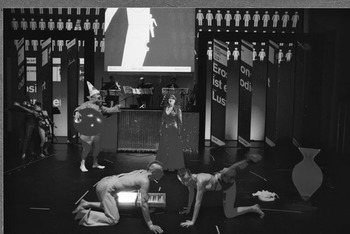
One early highpoint in the development of real-time environments can certainly be seen in the interactive opera Heptameron, composed by Gerhard E. Winkler for the 2002 Munich Biennale. For this work, an enormously elaborate system of sensor technology and video tracking was used to stage a magnificent occasion of ensemble achievement that is still unparalleled today. The score, the sequence of the scenes, the stage design projections, and the lighting were essentially generated in real-time and led to constantly new performance situations of these archetypical communication scenes, based on texts by Margaret of Navarre (figure 1). The entire technology for the work was constructed by the developers at the ZKM | Institute for Music and Acoustics based on the conceptions of the composer. The result was a digital, interactive group of instruments, which in its complexity can be considered a digital equivalent to the acoustic instruments of Harry Partch. A cymbalom-sized version of Max Matthew’s radio baton was built and converted into an ethereal data transducer with two antennas that were used like mallets.
Heptameron, living touchscreen. Everything that moves influences the sequence of the action and the musical structure. Photo: copyright ZKM.

Distances were measured by ultrasound and infrared. Acceleration sensors and touch sensors were fixed to the costumes and props and selectively triggered calculation processes that directly influenced the generation of the real-time score. The video tracking was connected to the Max/MSP performance software through a MIDI interface, while the sensor values were transferred wirelessly. Here the computer is used as a tool for ‘musical self-organization’ (Winkler). The concrete form of the work develops during the performance on the basis of dynamic models that were entered beforehand. Winkler’s ‘Theatre of Relations’ simultaneously made the sequences of visual, colour-related, scenic and tonal processes visible and transparent. ‘Without the friendly technical teamwork, which continued right into the individual performances, the technical side of this project could never have been realized’ (Winkler).
5. The Queen is the Supreme Power
The musical-theatre work The Queen is the Supreme Power in the Realm, by Dutch composer Yannis Kyriakides and Norwegian video artist HC Gilje, turned out to be no less innovative. It was created as the product of a joint commission from the MusikTriennale in Cologne, the musikFabrik, and the ZKM | Institute for Music and Acoustics. The work aimed for the freest possible organisation of processes, within which the instrumentalists of the musikFabrik could improvise. ‘The title of the work refers to Slater’s telegraph code from the year 1870. Words in the code were assigned to specific numerical combinations. This simple encryption principally served the transmission of secret messages by telegram. Telegraphic encryptions comprise the reference point of the work’ (Kyriakides). The Dutch composer, born 1969 in Cyprus, uses the various encryptions of speech to create flexible structures for an overt musical setting. The basis for this is the ABC code, by which phrases are encrypted from numbers and words, as the following example from the beginning of his piece illustrates:
2 6 8 6 4. nageklost. natives very quiet.
2 6 8 6 5. nagekneed. natives very unsettled.
2 6 8 6 6. nagelag. natives becoming very troublesome.
2 6 8 6 7. nagelartig. natives rebelling.
The work derives a clearly defined organisational structure and feel from this approach, yet it is determined on the basis of decisions made by the musicians during the performance. The musicians’ decisions influence the manipulation of computer algorithms within the electronic sound processing. Specific pitches are allocated to specific letters, words or syllables, comparable to the patterns of the Morse code, ‘which are determined by the real-time processing of the computer’ (Sylvia Sistermans). The speech fragments themselves are played back by an electronic, computer-generated voice in repeating, slowly transforming phrases. The vividly coloured video installation put together by the film and multimedia artist HC Gilje, born 1969 in Trondheim, Norway, subdivides the performance space into different imaginary zones. At any time throughout the duration of the performance, the musicians can freely move from one zone to another. In each zone, they play according to the rules that define that individual zone. ‘Speech is translated into music and is the source for a score of possible music’ (Kyriakides). The real-time component is particularly critical in this work. It is beyond doubt that the processing operations and the interaction between the musicians, projection and processing provide for a considerable degree of fragility in the performance.
6. Primum Mobile
It was not only the institution of opera that was harried by a sociopolitically motivated, extreme oppositional reaction in the politicised 1960s. In a legendary interview with Spiegel magazine in 1967, Pierre Boulez suggested that the opera houses should be ‘blown up’. He alleged that the opera was antiquated, both socially and from a historical perspective of composition; the subsidies were being poured into the wrong channels. The antipsychiatry movement taken up in the USA at the same time, on the other hand, called for the abolishment of psychiatric clinics. They were felt to be outdated: ‘The mentally ill person,’ as it was exaggeratedly put, was ‘actually the socially healthy person.’ These reform endeavours took on their most radical scope in Italy, where the law 180 (‘Legge centottanta’) was ratified in 1978. This law ordered the dissolution of all psychiatric institutions in Italy and challenged the psychiatric concepts of mental illnesses. The communication theorist and psychotherapist Paul Watzlawick issued this watchword at the time: ‘healthy in an unhealthy environment’. Marxist-oriented antipsychiatry supporters even saw psychiatry as an instrument of the ‘capital owners’, who were attempting to use it to secure their dominant position within society. The French structuralists Gilles Deleuze, Felix Guattari and Michel Foucault saw a direct causality between schizophrenia and capitalism. In his Marat/Sade drama of 1964, Marxist Peter Weiß had already given the French revolutionary Marat the role of preaching the vision of a better world as the inhabitant of a bathtub in a mental asylum. In the mid-1970s, author Michael Fröhling created an ideally matched libretto for Wolfgang Rihm’s neo-subjective chamber opera Jakob Lenz (1977/78). The libretto was based on Georg Büchner’s 1835 novella of the same name, about the Sturm und Drang poet Jakob Reinhold Michael Lenz, who was haunted by hallucinations and heard voices. The central message of the text was, ‘What I demand in all things is life’. What he meant by this was the right to subjectivity and an unrestricted development of individuality: to be allowed to follow the momentum of his own heart, regardless of aesthetic and societal norms. Rihm compared the act of composing to cutting ‘into one’s own flesh’. Shortly thereafter he wrote the Wölfli Songbook, based on texts by the Swiss schizophrenic Adolf Wölfli (1864–1930). Wölfli spent 35 years of his life, until 1930, in a clinic near Bern and left behind an enormous collection of poems and drawings. His psychiatrist, Walter Morgenthaler, dedicated to Wölfli his 1921 book Madness and Art (Ein Geisteskranker als Künstler), which for the first time took a patient suffering from schizophrenia seriously as an artist. Wölfli’s artistic and poetic work, which eludes standard aesthetic categories, was not familiar to a broader public until long after his death: the French painter Jean Dubuffet exhibited 120 of Wölfli’s drawings at the Paris Compagnie de l’Art Brut in 1948; in 1972 the Documenta 5 exhibition in Kassel dedicated the ‘Art by the Mentally Ill’ section to him. Austrian composer Georg Friedrich Haas wrote a chamber opera based on Wölfli at the beginning of the 1980s.
Whether or not people with medically diagnosed mental disorders can be unconditionally regarded and judged as artists remains an open question. Many serious representatives of the corresponding professional fields doubt that they can. The compulsive nature of their actions and their affliction, for example, tremendously distances patients of schizophrenia from artistic creators and the free decisions of planning individuals, in spite of their obsessive drive. However, from a Nietzschean perspective, the difference between artists and people suffering from schizophrenia isn’t as great: in general accordance with Nietzsche’s genius aesthetic, both are situated outside of society and beyond good and evil. The neo-romantics of the 1970s unreservedly employed an element of despondency in artistic expression for its own sake in both visual art and music, elicited to some degree through inner compulsion.
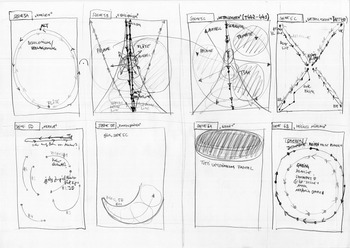
The composer, architect, guitarist, and former Rihm student Matthias Ockert builds upon exactly this neo-romantic and neo-subjective trend of thirty years ago in his evening-filling composition Primum Mobile, for three voices, ensemble and electronics (figure 2). With his musical setting – or, better, his musical illustration – of texts from Dante’s Divine Comedy, and having been inspired by the mad drawings and lists of the schizophrenic Joseph Heinrich Grebing (1879–1940), Ockert too cuts into his own flesh. However, unlike the musical trend of thirty years ago, which came to be labelled New Simplicity, Ockert, who ultimately as a guitarist is never satisfied with mere sounds, uses electronic means to gesturally animate the architectonically modelled sounds in which his instrumental theatre takes place.
Antipsychiatry: outline of the sound movement within the musical scenes of Primum Mobile. Copyright Matthias Ockert.

The impetus for the composition was the book ‘Primum Mobile – Dante’s Journey to the Afterlife and Modern Cosmology’ by Bruno Binggeli from 2006. The Swiss astronomer compares modern astronomy’s view of the world with the medieval view of the geocentric cosmos, through whose spheres Dante’s visionary path leads in the ‘Divine Comedy’. Dante’s Primum Mobile (‘first moving sphere’), the final, outermost space before the timeless and spaceless Empyrean, gives rise to the force that brings about the transition from one space to the next.
My composition takes up the idea of the spheres and transformations of Dante’s Paradise using ‘scenes’ in different sound spaces, through the spatial positioning and movement of the amplified sounds of the ensemble and the recorded sounds. The spaces and transformations are also reflected in the selection of the vocal texts. Some of the texts were taken from Dante’s Matelda, the incarnation of the muse in the Earthly Paradise at the peak of the Mountain of Purgatory – a place of actions that exist for their own sake. One can see the double-sided page with rows of numbers and sequences of letters, written by the sanitarium patient Josef Heinrich Grebing (1879–1940), to be a result of this. The page belongs to the Prinzhorn Collection in Heidelberg, and sections of it are played back as speech samples. Other of the vocal texts are taken from Beatrice, Dante’s guide from the Earthly Paradise through the celestial spheres of the planets and stars, across the Primum Mobile into the Empyrean, and to transcendence. (Matthias Ockert)
Ockert, who has also bathed in the waters of rock and jazz, makes seismic decisions concerning whether to pursue or discard his own ideas. This can be seen in his choice of instrumentation, in the technical setup, and in the programming of his software for processing the sounds. Grebing’s sequences of letters and numbers are playfully filtered out of the seemingly meaningless columns of numbers and letters, providing Ockert with a kind of tonal foundation for the majority of his processing operations. Ockert generates a kind of system from Grebing’s compulsive scribblings of numbers and letters. More specifically, he creates for himself a scale of phonemes through his systematisation of Grebing’s vocabulary, which he then uses both for his further process of creation and the transformation processes which accompany it.
Zero One Two Three Four Five Six Seven Eight Nine Ten Eleven Twelve Twen Ty Six Ty Hundred Thousand
H S N T F M O Z
These constant decisions and perpetual transformations of the phonemes allow Ockert to ultimately refine his perception of what is appropriate and sustaining for the further progress of his work. Having arrived at this through both empirical and fully subjective means, he then applies it to his grand vocal scene, with electronic lining and synthetic intermezzi, whose thorough structure is already nearly number-like. Of course it must be paradise, both divine and earthly, when it is possible for a composer to create a section of sounding form from what can be seen as an infinite stream of music. Ockert’s electroacoustic machinery is truly capable of providing an infinite – and thereby neo-romantic – number of new forms and fragments from this basis of vocabulary and sounds. Ockert himself, however, never withdraws behind the performed material as an artist. Instead, he retains control over the realisation of his music in concrete space during the soundspace scene ‘Earthly Paradise’, which has its entire origin in Grebing’s madness. In the interplay between fixed notation, on the one side, and pitches and durations that are triggered by numerical proportions on the other, Ockert constructs spaces of time in which electronic media, the human voice and instrumental sounds, either with a classical inflection or as a jazz ensemble, merge into, as he puts it, one uniformly breathing organism.
7. Étude d’après Séraphin by Wolfgang Rihm for instrumental and electronic sounds
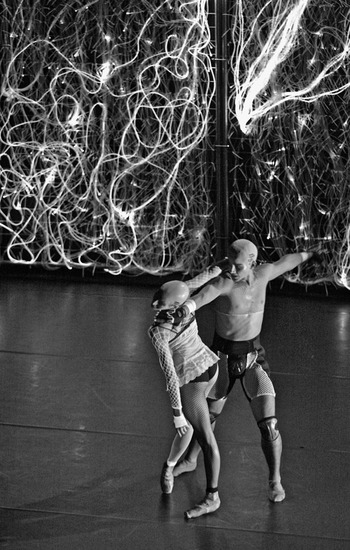
With his composition Étude d’après Séraphin (1997), Wolfgang Rihm presented a composition inspired by Antonin Artaud’s atavistic theatre aesthetic. In this work, commissioned by the ZKM to mark the official opening of the current ZKM buildings in 1997, Rihm once again illustrated his ideal of a ‘music in the environment in which it grew’. The issue is always one of the greatest possible spatiality and plasticity of sound, especially of the instrumental sound of the low-pitched instruments used here, such as harps, trombones, double basses and bass drum. Electronics were used to slow the instrumental sounds down in time and bring them down lower in their frequency envelopes. ‘There is a shift of balance between the electronic and instrumental sounds: through close microphone placement, the instrumental sounds become noisier, coarser and more present, while the electronic sounds become flatter and less voluminous’ (Christian Venghaus). The work was performed at the ZKM again in 2007, in a version with dance, to mark the tenth anniversary of the opening of the museum (figure 3).
Séraphin. Séraphin is glowing. Dancers of the Karlsruhe State Theatre in front of the light sculpture ‘Séraphin’ by rosalie. Choreography: Terence Kohler. Photo: copyright ZKM, Fotographer. ONUK.

The Séraphin compositions are created like sediments of time. Sound particles from previous states are infused into new contexts, more recent structural layers rest upon older ones. Dispersions from the Etude pour Séraphin already appear in the music theater piece Séraphin, in the form of a tape. The entire first state of Séraphin itself became a stratum: from the recording of the first performance, I created a tape composition in the ZKM studio which constitutes the fundamental layer for the Séraphin-Spuren. For this, I also composed live music for seven soloists. The resulting piece, in which ‘Séraphin’ left its ‘traces’ – blurred, painted over or expanded – also took on a new form along the way: It became part of the material tape layer to which a live ensemble of four trombones, two harps, two contrabasses and three percussionists performs: Etude d’après Séraphin.
In this piece, which should actually carry the title ‘Levels of Memory’, I worked for the first time with electronically formed material. This material (in particular the very low brass sounds that were transposed to extreme depths) also derives from the Etude pour Séraphin which I include in my group of ‘anamnestic’ compositions. These are compositions (as are also the orchestral pieces Sub-Kontur, IN-SCHRIFT or La Lugubre Gondola/Das Eismeer) in which I attempt, step by step, to enter into instinctive, atavistic regions. They are perhaps also attempts to escape art through art. I was especially excited to observe that it is possible to probe into quasi pre-civilized areas of expression with the aid of the highly advanced technical capabilities of the ZKM studio. Leviathan? Titanic? We will not escape.
The Séraphin shadow theater, in the sense of Baudelaire and Artaud, set a series of works in motion for me (self-propagation, plasmatic generation …) that preserves each preceding one as a faint reflection, sets the present as imprint and trace, and lets the one yet to come shine through as projection. I am referring here only to the musical manifestation of these continuously self-generating musics. They make possible the varying forms of scenic approach and distancing; presence/absence of the picture, the movement, the organized visible space. These areas are called upon (in this case, music is also invocation) to find their expression. Always new and different. Or the same. Or not. Sound has taken flight. Perhaps in this way, Artaud’s text takes shape. Or in silence: by becoming LOUD.
Without the knowledge and artistic sensitivity of Torsten Belschner and Christian Venghaus, I would never have been able to grab the electronic sounds from thin air or to shape them like clay in such a way as was made possible to me in the ZKM studio.
Thank you!’ (Rihm Reference Rihm1997)
8. Differences – Trends
Different compositional and aesthetic positions on the interplay and handling of instruments and electronic media can be gleaned from the work examples commented on here. Although these positions can be regarded as historically distinctive, no claim is being asserted that they form an ideal typology.
If the goal in the beginning was to create overlapping time structures during one and the same concert event, and to be able to make these available as new musical material at all, then the next step was to allow this material to enter into dialogue with the instrumentalists and the natural acoustics of the space as a ‘real-time’ event, in a moment as close to its emergence as possible. Musical synchronies and asynchronies could be more or less used as independent compositional parameters. Karlheinz Stockhausen’s Solo is an early, very illustrative example of this and laid both the theoretical and practical foundation for further development. The functions of composer, instrumentalist, technician and sound designer were completely separate. Although work was nearly performed in real-time, the material, being physical tape, presented considerable obstacles to any synchrony.
Heptameron represents the greatest contrast to this. The musical material, the sequence of scenic events, and the causality of a story line, however one may define that, are generated and controlled in the moment of the performance. The composer essentially writes the program and provides a pool of material. The musicians active on the stage are both the performers and at the same time also the controlling elements. In an interactive environment, people themselves become an interface, become operating devices. This may sound somewhat audacious; however, a violinist too is nothing more when he produces and interprets a tone on the violin. But, from an outside perspective, the path between intention, intonation and concrete sound in space – without a technical environment – is shorter. Issues of the aesthetics of inspiration, however, remain without consideration in such a description.
Kyriakides and Ockert create new scales and algorithms for their works, which also allow them to generate new sound combinations within a new system, to define and implement new technical combinations. And yet – all in all – the rigid, binding nature of these new scales and algorithms also enables them to conduct themselves within the system in conformity with the system. However, this does not mean that one spiritlessly defers to self-established laws. Instead, one by all means also sets new technical constellations in accordance with both traditional harmonic (vertical) and melodic (horizontal) logic, which in effect equates to a traditional handling of motives and their development, full of suspense and release. As the instrumentalist, the musician is found at the beginning of the tonal action in most cases. However, the composer controls the various processing operations, including the very individual, subjective expressiveness of the instrumental and vocal lines, in real-time – that is, simultaneously. Here, the electronics, digital processes and interaction essentially serve the construction of a tonally integral aura to the work, in which the people, instruments and technology complement one another while still expressly asserting their individuality and distinctiveness.
In Wolfgang Rihm’s Étude d’après Séraphin, complex technical processes aid the search for an authentic, precultural tonal event, which, however, the terms ‘ritual’ or ‘rite’ can only inadequately describe. Even when the textual source material by Antonin Artaud points in exactly this direction with regard to content, this music is still tonally and scenically set and performed in a chronologically and technically very demanding context due to its instrumental and theatrical nature. As with Stockhausen, Rihm’s music comes back to itself, with all of the conditions that lead to its creation. It becomes real in the moment that it is played, in ‘the instant of Eternity’. The ‘present as imprint and trace’ is set in time, and ‘the one yet to come’ shines through ‘as a projection’ (Rihm) – this too is a real-time concept. The human component always remains distinctly identifiable in this configuration – orchestra with fixed media playback produced in advance – as instrumentalists in the traditional sense, as organic performers. However, the protagonist of this more or less carefully prepared story line is the music, the sound itself.
To a large extent, the music played back from fixed media has the function of bridging the instrumental-acoustic deficits and limitations. More specifically, it allows one to continue composing and to generate sound from within the act of composing and the spatial realisation of the work, where the instrument would not be able to create this without technology. For example, low frequencies are made even deeper using electronic means, until the listeners can practically see and feel the artificially slowed frequencies tangibly oscillating before them in the concert hall. (This is how Wolfgang Rihm explained it at the ZKM in October of 2007, during rehearsals of the Séraphin production for the tenth anniversary of the ZKM’s move into its current building.) Rihm again puts his concept of sound sculpture into practice here by vividly setting the process of a sculptural moulding of the object into space, splayed in time by electronic means and, of course, in advance through the instrumentation and the treatment of the voices. Technology in effect functions as a magic wand, as tonal elongation – not denaturation – of the instrumental sound, which Wolfgang Rihm conceives and sets here as a natural sound.