Relativism is usually a derogatory word in philosophical
bioethics in the West. If people make the mistake of trying to
understand radically “different” points of view, an
accusation of relativism is quickly forthcoming.1
This can be seen especially well in Macklin R. Against
Relativism—Cultural Diversity and the Search for Ethical
Universals in Medicine. New York: Oxford University Press; 1999.
But the phenomenon is common, and can be seen in such diverse
contributions as Beauchamp TL, Childress JF. Principles of
Biomedical Ethics, 5th ed. New York: Oxford University Press;
2000; Singer P. Practical Ethics. Cambridge: Cambridge
University Press; 1979; Gillon R. Philosophical Medical
Ethics. Chichester: Wiley; 1985; Harris J. The Value of Life:
An Introduction to Medical Ethics. London: Routledge; 1985;
Pellegrino ED, Thomasma DC. For the Patient's Good: The
Restoration of Beneficence in Health Care. New York: Oxford
University Press; 1988; Maclean A. The Elimination of Morality:
Reflections on Utilitarianism and Bioethics. London: Routledge;
1993; Rachels J. The Elements of Moral Philosophy, 2nd ed. New
York: McGraw-Hill; 1993; Häyry M. Moral relativism and the
philosophical criticism of other cultures. Science Studies
1992;5:53–56; and Häyry M. Liberal Utilitarianism and
Applied Ethics. London and New York: Routledge; 1994.
But
why should this be an accusation? My aim in this paper is to
demonstrate that it should not.
My demonstration is simple, and it consists of filling in the empty
boxes of Table 1. Once I have done this, it
should be clear to anybody that “relativism” is a
profoundly misused concept, and that if it is understood correctly,
there is no shame in being a relativist in one's bioethical
work.
A periodic table of “isms”
Sources and Attitudes
Let me start by explaining what I mean by the “isms”
featured in Table 1.
The ethical norms and values that in fact guide our actions and moral
thinking come from three closely related sources, and we can have
roughly three attitudes concerning their validity, or prescriptive
(normatively action-guiding) power.
The sources from which my norms and values are
derived are
- myself,
- other people, and
- objective reality (whatever that means).
The same observation can, of course, be extended to other people,
where their norms and values are derived from themselves,
others, and objective, or extrahuman, sources.
Note that I am not offering these observations as topics for
critical discussion; this is simply how things are. Everyone has their
(or at least I have my) own life, thoughts, and characteristics, and
these do guide, to some extent, human actions, whether they
should do so or not. We also live with other people, and their
habits and ideas have a guiding effect on our values, norms, and
actions. (We call people of whom this is not true
“psychopaths”—another derogatory word that I will not
go into here.) And as for objective factors, we at least live in a
physical world that we cannot fully control, and we must somehow
accommodate its demands in our behavior, if not always in our
attitudes, simply to survive.
The prescriptive power, or bindingness, or validity of these norms
and values is a different matter, and we can, as I said, take three
different attitudes toward any one of them. One possibility is to say
that at least some of them are absolutely binding, and that it
would be morally wrong not to abide by them. Another option is to say
that all or some of them are relatively binding; that for
certain specified people in certain specified contexts it would be
wrong not to live by them. And yet another choice is to say that the
validity or normative bindingness of some or all of these values and
norms is nil; implying that we should either avoid complying
with them or that it does not matter whether we do or not.
By crossing these two lists we end up with my original table, where
the springs of norms and values provide the vertical dimension and the
views regarding their validity the horizontal dimension. Let me
describe the contents of the table one column at a time.
Absolutism
First, absolutism is the creed that states that some norms
and values should be observed absolutely, or without exception. Because
this view has been the traditional starting point of Western moral
philosophy since Greek antiquity, many explanations and justifications
have been presented for this requirement during the last 2400 years or
so.
Starting from the “objective” version of this doctrine,
Plato argued that there is, apart from this changing and observable
world, an eternal world of ideas, which is, in fact, more real than the
one we can see, hear, smell, and touch here. Moral norms and values
reside in the world of ideas, and it is our task to seek knowledge
concerning them and to observe them the best we can, rejecting, if
necessary, the customs of our society, and our own transitory
desires.2
Plato. The Republic.
Harmondsworth, Middlesex: Penguin Books; [c. 360 BCE]
1955.
Thomas Aquinas echoed the Platonic notion in his natural
law theory, in which God and Reason provide us with the right moral
guidance,
3 Aquinas T. Summa
Theologica. In: Sancti Thomae Aquinas Opera Omnia. New
York: Musurgia Publishers; 1948; Aquinas T. St. Thomas Aquinas on
Politics and Ethics. Sigmund PE, transl. and ed. New York and
London: WW Norton; 1988; Aquinas T. Saint Thomas Aquinas on Law,
Morality, and Politics. Baumgarth WP, Regan RJ, eds. Indianapolis:
Hackett Publishing Company; 1988; Finnis J. Natural Law and Natural
Rights. Oxford: Clarendon Press; 1980; Finnis J. Fundamentals
of Ethics. Oxford: Clarendon Press; 1984.
and Immanuel
Kant followed a similar path by arguing that human rationality, or
universal reason, is the only legitimate source of moral norms.
4 Kant I. Grundlegung zur Metaphysic der
Sitten (1785) and Metaphysische Anfangsgründe der
Tugendlehre (1797). In Kant I. Ethical Philosophy. 2nd
ed. Ellington JW, transl. Indianapolis: Hackett Publishing Company;
1994; Scheewind JB. The Invention of Autonomy: A History of Modern
Moral Philosophy. Cambridge: Cambridge University Press;
1998.
The utilitarianism of Jeremy Bentham is also a form of
absolute objectivism in that it finds the objective basis of morality
in pleasure and pain—and requires us always to aim at the
greatest happiness of the greatest number in our actions.
5 Bentham J. An Introduction to the
Principles of Morals and Legislation. London and New York:
Methuen; [1789] 1970.
Whether or not “absolute intersubjectivism” as a
normative doctrine exists is a question in itself. In theory, it would
mean that contractually assumed or traditionally shared social or
communal values should rule absolutely. But the question is, why should
people who have not actually made the contract, or people who are not
members of the specified society or community, observe the designated
norms and values?6
Cf. Hobbes T.
Leviathan. Macpherson CB, ed. Harmondsworth, Middlesex:
Penguin Books; [1651] 1985; Locke J. Two Treatises of
Government. London: Dent; [1690] 1924; Rousseau JJ.
Du Contrat Social. In: Rousseau JJ. The Social Contract
and Discourses. Cole GDH, transl. Brumfitt JH, Hall JC, eds.
London: JM Dent; [1762] 1986.
John Rawls in his
theory of justice fell back on the “objective,” Kantian
idea that all reasonable people ought to make the contract he
outlined.
7 Rawls J. A Theory of
Justice. Oxford: Oxford University Press; 1972.
And
Alasdair MacIntyre, Rawls's “communitarian” critic,
also eventually found his way back to the natural law theory of Thomas
Aquinas.
8 MacIntyre A. After Virtue: A
Study in Moral Theory. London: Duckworth; 1981; MacIntyre A.
Whose Justice? Which Rationality? London: Duckworth; 1988;
MacIntyre A. Three Rival Versions of Moral Enquiry. Notre
Dame: University of Notre Dame Press; 1990.
So perhaps this
box should remain empty.
The “subjective” version says that my norms and
values ought to rule absolutely over all other values, including those
derived from universal reason, God, and community ideals. This is
certainly a possible program, but it is not clear that it has ever been
philosophically defended. The character of Callicles in one of
Plato's dialogues defends a view that comes close to this
docrtine. He argues, in the dialogue, that strong individuals are
entitled to do whatever they like, regardless of legal or social norms
by which the weak try to slow them down.9
Plato. Gorgias. Waterfield R, transl. Oxford:
Oxford University Press; [c. 380 BCE] 1998.
But
despite his popularity as a scarecrow in the history of Western moral
philosophy, Callicles is a fictional character invented by the father
of absolute objectivism, so we should approach him with some
caution.
Relativism
Second, relativism is the doctrine that says that the
validity of norms and values is always related to some changing, or
diverse, phenomenon or viewpoint. It does not say that all norms and
values should be rejected, although it is opposed to the idea of
absolute rules and principles.
The relativization of manners, customs, and laws in Western moral
philosophy started in the 18th century with challenges against an
immutable notion of reason as the basis of (objective) historical
progress. Adam Smith argued, following many of his contemporaries, that
human history is basically economic history, and that changes in the
production and distribution of goods and services, rather than changes
in the way people think about them, are the prime mover of legislation
and political developments.10
Smith A.
The Wealth of Nations. Skinner A, ed. Harmondsworth,
Middlesex: Penguin Books; [1776] 1982.
Georg Wilhelm
Friedrich Hegel, in his turn, said that although both ideas and
material circumstances mold historical progress, the development of new
forms of government and legal regulation has a certain schedule, or
dialectic, in which fundamental moral concepts change, and forms of
reason follow one another.
11 Hegel GWF.
Lectures on the History of Philosophy. Haldane ES, Simson FH,
transl. Lincoln: University of Nebraska Press;
[1833–1836] 1995.
And Karl Marx assumed
elements from both Smith and Hegel when he put together his theory of
the laws of history, and rejected most Western moralities as bourgeois
deception.
12 Marx K. Karl Marx:
Selected Writings. MacLellan D, ed. Oxford: Oxford University
Press; 2000.
During the 20th century, relativism was extended more directly to
(intersubjective) societies. At the turn and in the first half of the
century, social anthropologists shocked Westerners by giving vivid
descriptions of the alien manners of some other cultures.13
Westermarck E. The History of Human
Marriage. New York: Macmillan; 1891; Westermarck E. The Origin
and Development of Moral Ideas, 2 vols. London: Macmillan;
1906–1908; Mead M. Coming of Age in Samoa: A Psychological
Study of Primitive Youth for Western Civilization. New York:
Morrow; [1928] 1988; Mead M. Growing Up in New Guinea: A
Comparative Study of Primitive Education. New York: Morrow;
[1931] 1976; Mead M. Sex and Temperament in Three
Primitive Societies. New York: Morrow; [1935]
1988.
After the second world war, nation states started, in
the form of the United Nations and in other ways, seriously to forge
contracts to regulate international affairs, including international
moral codes.
14 United Nations.
Universal Declaration of Human Rights. Adopted and proclaimed
by General Assembly resolution 217 A (III) of 10 December 1948. Cf.
Häyry M. Another look at dignity. Cambridge Quarterly of
Healthcare Ethics 2004;14:7–14.
And this is where
we still are, trying to find ways to understand each other's
cultures, religions, and moralities, and trying to ensure that people
can change their circumstances if they feel that they cannot live with
certain features of their inborn culture.
The subjective variation of relativism reminds us that every
individual (and, metaphorically speaking, every culture and nation) has
her or his or its own viewpoint.15
Westermarck E. Ethical Relativity. London: Kegan
Paul; 1932. Cf. Herder JG. Ideen zur Philosophie der Geschichte der
Menschheit. Frankfurt am Main: Deutscher Klassiker Verlag;
[1784] 1989.
“Rational egoism” teaches
that we are allowed, and even required, to cherish our own viewpoints,
but at the same time understand that other people have others, and that
these are equally valuable to them.
16 Nozick R. Anarchy, State, and Utopia. Oxford:
Basil Blackwell, 1974; Narveson J. The Libertarian Idea.
Philadelphia: Temple University Press; 1988; Gauthier D. Morals by
Agreement. Oxford: Clarendon Press; 1986.
This
“prudential” and “tolerant” form of egoism
should not be confused with the Callicles-type absolute egoism, in
which one person is set at the center of our shared universe.
Nihilism
Third, nihilism does say that some, or all, norms and values
are invalid, and to be rejected. The motivation for this rejection in
different forms of nihilism varies from intellectual irritation to
moral concern. There are also two main “deontic” strands of
the creed; one stating that we are allowed to disregard
certain values, and the other insisting that we must do
so.17
I use the term
“deontic” here in the sense defined by von Wright GH.
Deontic logic. Mind 1951;60:1–15.
When nihilistic ideas are applied to objectivist moral theories,
there are two possible conclusions. If we say that people are permitted
to ignore, for instance, the main Kantian or Benthamite rules (which
are predominantly altruistic), then we automatically advocate some sort
of egoism.18
Rand A. The
Virtue of Selfishness: A New Concept of Egoism. New York: New
American Library; 1961; Wilson EO. Sociobiology: The New
Synthesis. Cambridge, MA: Belknap Press; 1975.
If, on the
other hand, we wage a moral or intellectual war against the
universality of these (or contractual or communal) values, then we are
more likely to end up in the camps of
existentialism or
emotivism.
19 Nietzsche F. On
the Genealogy of Morality: A Polemic. Clark M, Swense A, transl.
Indianapolis: Hackett; [1887] 1998; Ayer AJ. Language,
Truth and Logic. London: Victor Gollancz; 1936; Stevenson CL.
Ethics and Language. New Haven: Yale University Press;
1944.
The requirement to reject subjective and intersubjective norms and
values is usually a part of traditional forms of absolute objectivism.
This means that as regards human (individual- or community-based)
values, then, Plato, Aquinas, Kant, and Bentham can all be seen as
nihilists. Perhaps this is an excessively weird way to use the concept,
but the fact is that they do deny the validity of some values. From the
viewpoint of existentialism, this also means that the named
dignitaries encouraged people to live “inauthentically,” or
in “bad faith.”20
Sartre J-P.
Being and Nothingness: A Phenomenological Essay on Ontology.
Barnes HE, transl. New York: Simon & Schuster; [1943]
1993; de Beauvoir S. The Second Sex. Parshley HM, transl.
London: Vintage Books; [1949] 1989.
What is Relativism?
I have now filled in the blanks of Table 1.
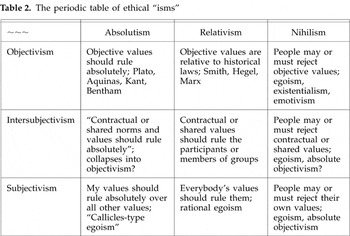
Table 2 shows the completed form.
The periodic table of ethical “isms”
Let me now recap my findings against the information contained in
Table 2.
First, what, in the light of my observations, is relativism?
Very briefly, it seems to be the doctrine that (from the bottom up in
the center column of Table 2)
- places value on individuals—all individuals, not just one;
- seeks for, finds, and defines valid norms in terms of contracts and
shared values—that is, in terms of human interaction and its
outcomes; and
- recognizes cultural, historical, and other differences between
norms and values—but does not undermine the validity of any one
of them.
Secondly, what is relativism not? Well, it is not mindless
political or communal loyalty, and it is not absolute
egoism—these notions seem to be invented by the competing schools
of thought. Nor is it nihilistic—it does not deny the validity of
all norms and values. (It does reject some, but so do all moral
theories.)
And finally, what would the alternative to relativism be? If
the alternative is absolute objectivism, then what is required is a
giant jump, or a leap of faith, into one particular view of human
nature and morality. And because this view can, for me, only be mine,
the alternative to relativism is … well, absolute egoism. This
is not too encouraging, and hence I think that relativism is, after
all, not such a bad idea.