Implications
The offspring of ewes consuming high amounts of salt during pregnancy have an altered hormonal system, particularly the hormones of the renin–angiotensin system, in early postnatal life. In addition, the morphology of their kidneys is altered, suggesting modification to nephrogenesis. The changes in the renin–angiotensin system did not impair the capacity of the offspring to deal with a salt challenge; however, in the long term, these changes may influence the adaptive response of the animal to high-salt diets while grazing on saltbush for extended periods.
Introduction
The renin–angiotensin system is highly active during foetal development and is a prerequisite for normal renal development (Gomez and Norwood, Reference Gomez and Norwood1995). There is a strong association between expression of the renin–angiotensin system genes and kidney morphology and development (Gomez et al., Reference Gomez, Lopez, Fernandez, Chenavvsky and Norwood1999; Moritz and Wintour, Reference Moritz and Wintour1999). In mice, a change in the activity of the renin–angiotensin system may be associated with renal abnormalities (Hilgers et al., Reference Hilgers, Norwood and Gomez1997). Mice treated with angiotensin II blockers during nephrogenesis had marked renal abnormalities such as fewer glomeruli (Friberg et al., Reference Friberg, Sundelin, Bohman, Bobik, Nilsson, Wickman, Gustafsson, Petersen and Adams1994; Gomez et al., Reference Gomez, Lopez, Fernandez, Chenavvsky and Norwood1999).
The relationship between the renin–angiotensin system and renal development may be altered by the consumption of a high-salt diet during pregnancy. Offspring of ewes that were fed a high-salt diet during pregnancy had an altered postnatal regulation of their renin–angiotensin system, evidenced by increased plasma aldosterone concentration and lowered plasma renin activity when the animals ingested a high-salt diet (Chadwick et al., Reference Chadwick, Vercoe, Williams and Revell2009; Digby et al., Reference Digby, Masters, Blache, Hynd and Revell2009). The reduced renin activity and, therefore, angiotensin II and aldosterone production (Morgan, Reference Morgan2001) means that the offspring of ewes that consume a high-salt diet during pregnancy may have a reduced number of renal glomeruli. Such abnormalities can be triggered during foetal nephrogenesis, which starts at around day 27 of gestation (Moritz and Wintour, Reference Moritz and Wintour1999; Guron and Friberg, Reference Guron and Friberg2000). Hundreds of thousands of nephrons are formed during the differentiation process and nephrogenesis is complete by about 3 weeks before birth in sheep, at ∼day 135 of gestation (Moritz and Wintour, Reference Moritz and Wintour1999). Alterations of the kidney because of perturbations of nephrogenesis process may persist into adulthood (Guron et al., Reference Guron, Adams, Sundelin and Friberg1997; Moritz and Wintour, Reference Moritz and Wintour1999; Guron and Friberg, Reference Guron and Friberg2000) and have long-term consequences.
In an individual with fewer glomeruli, there are two possible outcomes: renal function may be adversely affected or the individual may adapt, in order to avoid major consequences from the deficit (McMillen and Robinson, Reference McMillen and Robinson2005). A reduced number of glomeruli, with no other adaptation, leads to a reduced surface area for renal sodium filtration. In addition, a reduced glomerular number may reduce an individual's capacity to excrete a sodium load (Matsuoka et al., Reference Matsuoka, Shibao and Leone2007) both under basal conditions and when given an acute oral salt load. The compromised capacity to excrete salt may lead to higher renal sodium retention, and subsequently renal-related diseases such as hypertension (Brenner et al., Reference Brenner, Garcia and Anderson1988). Moreover, a reduction in nephron number in early life can lead to a greater tendency to glomerulosclerosis in later life (Kiprov et al., Reference Kiprov, Colvin and McCluskey1982; Wikstad et al., Reference Wikstad, Celsi, Larsson, Herin and Aperia1988), which would affect glomerular filtration and thus salt excretion. Alternatively, the kidney may be able to adapt and compensate for a reduction in glomerular number by increasing glomerular size, so that renal filtration surface area and homoeostasis is maintained (Bertram et al., Reference Bertram, Johnson, Hughson and Hoy2001; Cullen-McEwen et al., Reference Cullen-McEwen, Kett, Dowling, Anderson and Bertram2003; Kett and Bertram, Reference Kett and Bertram2004). In rats, for example, in utero exposure to high salt did not alter postnatal sodium excretion in response to a salt load (Myers et al., Reference Myers, Smidt, Doig, Di Nicolantonio and Morgan1985).
On the basis of these findings, we hypothesise that maternal high-salt intake during the second half of pregnancy will affect nephrogenesis in the foetus, resulting in a reduction in glomerular number and an increase in glomerular size (hypertrophy) in the offspring. To determine whether the changes to glomeruli would compromise homoeostasis in the weaned offspring, we also examined glomerular filtration rate (GFR) and sodium excretion.
Material and methods
All animal procedures were approved by the Animal Ethics Committee for the Commonwealth Scientific and Industrial Research Organisation Livestock Industries, Floreat, Western Australia (Project number: 0801).
Unless otherwise specified, the term ‘high salt’ in this paper refers to high NaCl.
Experimental diets
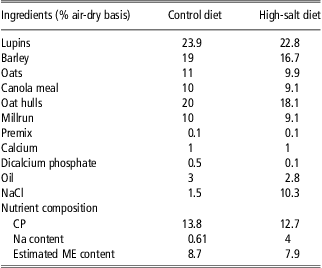
Both the control and treatment (high-salt) diets used in the current study were pelleted, and their ingredient and nutritional composition are shown in Table 1. The high-salt pellets contained 10.3% NaCl, formulated to meet energy, protein and mineral requirements to mimic the salt content in a saltbush-based diet (Norman et al., Reference Norman, Dynes and Masters2002). Pellets were prepared by a commercial manufacturer (Thompson & Redwood Produce Supplies Pty Ltd, Upper Swan, Western Australia) and analysed for sodium content by inductively coupled plasma atomic spectrometry using a Spectro CIROS ICPAES machine (Kleve, Germany) operated by Waite Analytical Services (The University of Adelaide, Adelaide, Australia).
Composition of diets fed to both pregnant ewes (prenatal) and their lambs (postnatal diet) during the animal house experiments
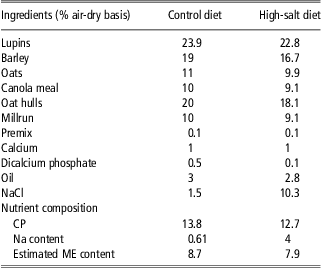
ME = metabolisable energy.
Lambing ewes
Six-year-old multiparous Merino ewes (Ovis aries) were synchronised for oestrus through the use of progesterone intra-vaginal sponges (Chronogest® Sponges, Intervet Australia Pty Ltd, Victoria, Australia). Following oestrus synchronisation, the ewes were split into six groups (each of 25 ewes) and each group was mated to a different sire. The rams remained with the ewes for a period of 7 days. The midpoint of the mating period was assigned day 0 of pregnancy. After mating, the ewes were allowed to graze pasture until day 65 post mating. The ewes were pregnancy-tested and the number of foetuses carried determined by ultrasound scanning. A total of 80 ewes (40 single-bearing and 40 twin-bearing) were selected from across the six groups for the animal house experiment. Twin-bearing ewes were used in this study because there were insufficient single-bearing ewes to make up the total number of lambs required. From day 68 of pregnancy, the ewes were individually penned and monitored through to the 1st week of lactation (under natural photoperiod). The animals were weighed and condition-scored every fortnight starting at mating.
The ewes were split into two groups: control group (ewes received a standard pellet ration containing 1.5% NaCl) and high-salt treatment group (ewes received the same pellets as those fed to the control group, but with 10.3% NaCl added; Table 1). The ewes in the high-salt treatment group were fed ad libitum. Each ewe in the control group was pair-fed on an organic matter basis to a ewe in the high-salt treatment with similar live weight and same number of foetuses. The amount of organic matter consumed by each ewe in the high-salt treatment group was measured daily and the same amount of organic matter was offered to the paired animal in the control group on the following day. Both groups were fed their respective diets from day 78 of gestation through to lambing to cover the second half of the nephrogenesis period. All animals were given ad libitum access to fresh drinking water. After lambing, high-salt feeding was discontinued and all ewes were fed a mixture of hay, lupins and control pellets to meet nutritional requirements of lactation. Ewes and lambs were moved outside at ∼1 week post lambing, and were kept together in a single paddock and grazed pasture until the lambs were weaned at 3 months of age. The lambs were weighed within 24 h of birth, at 2 months of age and at slaughter.
Outcomes during pregnancy
Organic matter intake was similar (P > 0.05) in ewes fed either the control or high-salt diet throughout pregnancy, as intended by using a pair-feeding regime. Weight gain during pregnancy was also similar (P > 0.05) in both the ewes fed the control and high-salt diets.
The average gestational length was unaffected by the diet fed during late pregnancy, at 152 days (range 149 to 156 days) and 151 days (range 146 to 154 days) for the ewes fed the control and high-salt diets, respectively. Lamb mortality between pregnancy scanning and weaning was 16.5%, divided equally between twins and singletons, and among the ewes on the control and high-salt diets. Only 30 pairs of twins and 39 singletons survived postnatally because of ewe and lamb mortality. The number of twin-bearing ewes was equal between the control and high-salt diet groups, and 20 of the 39 singletons were born to ewes fed the high-salt diet. The average birth weight of lambs was 5.1 kg, with no significant difference (P > 0.05) between those born to the ewes fed the control or high-salt diets.
Response of weaned lambs to high-salt challenge
Between 4 and 5 months of age, the lambs were tested for their response to an oral salt load. In all, 60 lambs were selected to balance the average and standard deviation of body weight between treatments, just before the start of the high-salt challenge experiment. Half of the lambs were offspring of ewes fed the control diet during pregnancy (control offspring), whereas the other half were from ewes fed the high-salt diet (high-salt offspring). Fourteen twins and 16 singletons (both males and females) that were the offspring of ewes fed the high-salt diet during pregnancy, and 14 twins and 16 singletons that were the offspring of ewes fed the control diet during pregnancy, between 19 and 31 kg live weight, were selected for the high-salt challenge experiment. For the first 12 days, the lambs were fed the control pellets and allowed to acclimatise to the new environment and the pelleted diet. Following the adaptation period, half of the animals (n = 30; 15 control offspring and 15 high-salt offspring) were given ad libitum control pellets, whereas the remaining animals (n = 30; 15 control and 15 high-salt offspring) were fed ad libitum high-salt pellets over a period of 17 days (experimental feeding), both with ad libitum access to fresh water. Composition of the diets fed to both the ewes and the lambs is shown in Table 1. Daily voluntary food and water intakes were measured throughout the acclimatisation and experimental feeding period (29 days), and blood samples were collected at the end of the experimental feeding period for haematocrit measurements.
The animals were placed in metabolism crates during the last 4 days of the experiment, 1 day to allow the lambs to acclimatise and 3 days for the measurements of water intake, urine collection and measurement of total urine volume. With only 20 metabolism crates available, urine collection and measurement were staggered, with three batches of 20 lambs (2 weeks between each group). All offspring and dietary treatment groups were equally represented in each batch.
Urinary volume was measured twice daily over the 3-day data collection period, and the values were totalled to give a total daily volume. Similarly, urine samples were collected twice a day and pooled before a sample representative of the 24-hour period was taken. Urine samples were then stored at 4°C. Fractions included in each pooled sample were proportional to the respective volumes excreted in the morning and afternoon. Blood samples were collected twice a day over the 3-day period at 0800 h before the animals were fed and at 1600 h. Blood samples were collected in vacutainers containing heparin (BD Australia) via venipuncture of the jugular vein. Collection tubes were kept on ice and centrifuged at 1500 × g at 4°C for 15 min to collect the plasma. The plasma collected was stored at −80°C. Daily voluntary food intake and daily water intake were measured during this period, and the animals were weighed just before being placed in the metabolism crates.
Urinary sodium and potassium
Urinary sodium and potassium concentrations were analysed using an Ion Selective Electrode on an Olympus AU400 analyser (Animal Health Laboratories, Department of Agriculture and Food, South Perth, Western Australia).
Creatinine clearance/GFR
Creatinine clearance was used to measure GFR. Urine and plasma samples for the lambs collected at the end of the 29-day experimental period (when the lambs were 5 months old) were analysed for creatinine concentration by the kinetic colour test (Jaffé method) on an Olympus AU400 analyser (Animal Health Laboratories, Department of Agriculture and Food, South Perth, Western Australia). Briefly, creatinine forms a yellow-orange compound with picric acid in an alkaline medium. The rate of change in absorbance at 520/800 nm is proportional to the creatinine concentration in the sample. Creatinine clearance was calculated using the following formula (Hurley et al., Reference Hurley, Kirkpatrick, Pitlick, Friedman and Mendoza1977; Langenberg et al., Reference Langenberg, Wan, Bagshaw, Egi, May and Bellomo2006), and expressed as ml of clearance/minute:
 $$\frac{{{\rm{Urinary}}\;{\rm{creatinine}}\;({\rm{\mu mol}}/{\rm{l}})}}{{{\rm{Plasma}}\;{\rm{creatinine}}\;({\rm{\mu mol}}/{\rm{l}})}}\,\times \,\frac{{{\rm{Total}}\;{\rm{urinary}}\;{\rm{volume}}\;({\rm{l}})\,\times \,1000\;{\rm{ml}}}}{{{\rm{24}}\;{\rm{h}}\,\times \,60\;{\rm{min}}}}$$
Creatinine clearance was expressed per unit of kidney weight using the weight of both left and right kidneys, collected after slaughter.
Haematocrit measurement
For plasma collection, a capillary tube (Chase Scientific Glass Inc., Rockwood, TN, USA) was filled with ∼100 μl of blood and centrifuged in a microhaematocrit centrifuge (Clements Medical Equipment, NSW, Australia) and haematocrit values were determined on a Micro Haematocrit Reader (Hawksley, Sussex, England).
Tissue collection
At the end of the 17-day dietary treatment period, the animals were euthanised by captive bolt and exsanguination. Kidneys, liver, lungs and heart were weighed (wet weight), and the kidneys were retained for further analysis. The left kidney was perfused via the renal artery with 25 ml of rinsing solution (1 × phosphate-buffered saline pH 7.4 (PBS) + heparin), then with 50 ml of ice-cold 4% paraformaldehyde (Sigma-Aldrich Pty Ltd, NSW, Australia) in 1 × PBS. It was then immersed in 4% paraformaldehyde in 1 × PBS for 24 h at 4°C, after which the kidney was stored at 4°C in 10% sucrose in 1 × PBS + 4% paraformaldehyde.
Cortex–medulla ratio
During tissue collection, right-side kidneys were cut longitudinally into halves and the cortex and medulla were measured to obtain a cortex–medulla ratio. The width of the medulla and cortex was measured at three separate sections in each kidney.
Glomerular number and radius
Slides for kidney histology were prepared by the Veterinary Services Division, Institute of Medical and Veterinary Science, Gilles Plains, South Australia. Tissues were embedded in paraffin, cut into 6 μM sections, mounted onto slides and stained with haematoxylin and eosin (H & E).
Glomerular number and size were measured for 24 animals: six selected randomly from each of the four offspring/treatment groups. Slides were viewed at 250× magnification on a Leica DC 100 light microscope (Leica Microsystems Pty Ltd, North Ryde, NSW, Australia). The tissue was divided into 10 transects horizontally, from one end of the tissue to the other, and sub-divided into seven to ten fields of vision vertically, starting from the edge of the cortex to the junction between the cortex and the medulla. The number of glomeruli in each field of vision was counted. The total number of fields counted was between 70 and 100, depending on the size of individual tissues.
Glomerular radii were measured using the Image-Pro Plus version 5.0 software (Media Cybernics Inc., Bethesda, MD, USA). A midpoint was selected from the intersection of two perpendicular lines drawn across each glomerulus. For each glomerulus, ∼15 to 17 radii were measured from the midpoint to the edge of the glomerulus, at ∼20°C intervals, and the average radius was calculated (the coefficient of variation (CV) of the 15 to 17 radii was 11.5%). Ten glomeruli per kidney were measured and the values were converted into μm units using a micrometer as a scale. In the region measured, the two-dimensional surface area of the glomeruli was calculated using the formula: Number of glomeruli × πr 2 (where r is the glomerular radius) and assuming a circular cross-section for each glomerulus.
Statistical analysis
Statistical analyses were performed using the Genstat statistics programme (10th Edition, VSN International Ltd, Hamel Hempstead, UK). The main effects of maternal exposure to high salt during pregnancy and high-salt challenge on the offspring and their interactions on all of the variables were analysed by 2-way ANOVA. Each batch of lambs was used as a block effect. Gender and birth status (single or twin) of the offspring were also incorporated into the fixed effects. A probability of less than 0.05 was deemed to be significant. A probability of between 0.051 and 0.10 was considered a trend. There was no batch effect on the variables measured.
Results
The term ‘foetal origin’ refers to whether the lambs were the offspring of ewes fed the control or high-salt diet. The offspring's postnatal diet refers to that fed during the high-salt challenge at 5 months of age. Gender and birth status (single or twin had no significant effect on any of the variables measured (P > 0.05).
Glomerular histology
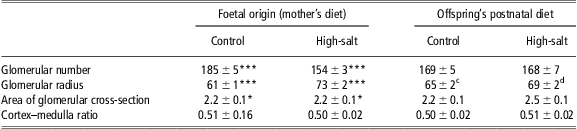
The number of glomeruli was ∼20% lower (P < 0.001) in the high-salt offspring than in the control offspring (Table 2). There was no difference between the lambs fed either the control or high-salt postnatal diet (P > 0.05), and there was no interaction between the foetal origin and the offspring's postnatal diet (P > 0.05). The radii of the glomeruli of the high-salt offspring were 18% larger (P < 0.05) than those of the control offspring, and there was a trend (P = 0.067) towards larger glomerular radii in lambs fed the high-salt diet. The cross-sectional area of glomeruli was 19% larger (P < 0.001) in the high-salt offspring than the control offspring (Table 2). There was no difference between the offspring fed either the control or high-salt diet (P > 0.05), and there was no interaction between foetal origin and the offspring's postnatal diet (P > 0.05).
Average glomerular number and radius (μm), area of glomerular cross-section (mm2) and cortex–medulla ratio of kidneys of lambs at 5 months of age (mean ± s.e.)
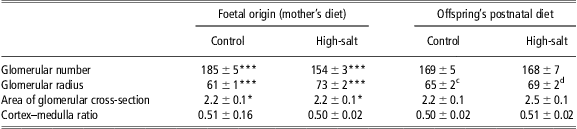
*P < 0.05; ***P < 0.001 for comparison with their respective control treatments; c,dP = 0.067.
Microscopic examination of the kidneys revealed a mild degree of protein leakage into the Bowman's space, tubular and collecting duct lumina, of similar severity in animals from both offspring groups. The cortex–medulla ratio was similar between the control and high-salt offspring and between the offspring fed either the control or high-salt diet (P > 0.05; Table 2). There was no interaction between foetal origin of the lambs and the offspring's postnatal diet (P > 0.05).
GFR
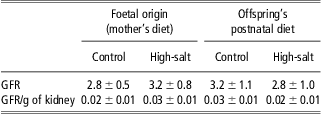
GFR did not differ between the two groups of offspring (P > 0.05; Table 3), or between the lambs fed the two diets postnatally (P > 0.05). There was no interaction between foetal origin and the offspring's diet on GFR (P > 0.05). GFR per unit of kidney weight was similar between the control and high-salt offspring (P > 0.05), and there was no interaction between foetal origin and the offspring's postnatal diet (P > 0.05).
GFR (ml/min) and GFR (ml/min per g kidney) of lambs at 5 months of age (mean ± s.e.)
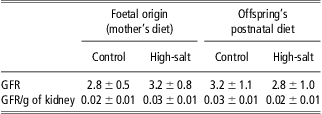
GFR = glomerular filteration rate.
Daily urine volume and urinary sodium excretion
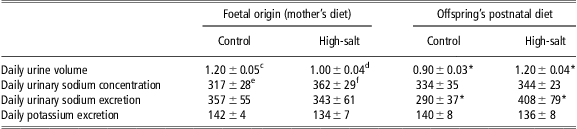
The high-salt offspring excreted 15% less urine per day (P = 0.09) than the control offspring (Table 4), but the sodium concentration in the urine in the high-salt offspring was 15% higher (P = 0.08). Consequently, there was no difference in the daily sodium excretion between the control and high-salt offspring (P > 0.05). There was also no difference in daily potassium excretion between the control and high-salt offspring (P > 0.05). Lambs fed the high-salt diet excreted 25% more urine per day than did the lambs fed the control diet (P < 0.05; Table 4) and excreted 28% more sodium per day (P < 0.05; Table 4). There were no interactions between the foetal origin and the offspring's postnatal diet (P > 0.05).
Daily urinary volume (l/day), sodium concentration (mmol/l) and urinary sodium excretion (mmol/day) of lambs at 5 months of age (mean ± s.e.)
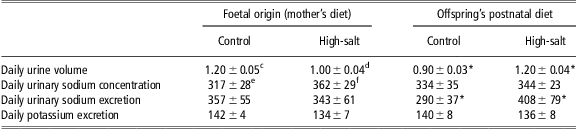
*P < 0.05 for comparison with their respective control treatments; c,dP = 0.09; e,fP = 0.08.
Organic matter and water intakes
Daily organic matter intake and water intakes were similar in both the control and high-salt offspring (P > 0.05). Organic matter intake in the offspring fed the high-salt diet was 13% lower than in offspring fed the control diet (Table 5), with no difference in water intake between the two dietary treatment groups (P > 0.05). There were no interactions between foetal origin and the offspring's postnatal diet (P > 0.05).
Daily OM (kg OM/day) and water (l/day) intakes of lambs at 5 months of age (mean ± s.e.)

OM = organic matter.
*P < 0.05 for comparison with their respective control treatments.
Organ weights
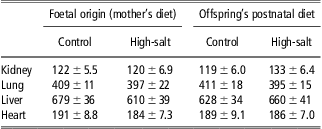
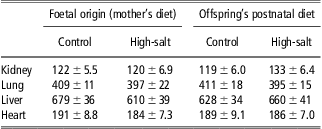
Organ weights did not differ between the control and high-salt offspring (P > 0.05; Table 6) or between the offspring fed the control or high-salt diet (P > 0.05). There was no interaction between foetal origin and the offspring's postnatal diet (P > 0.05).
The weights of kidneys, lungs, livers and hearts (g) of lambs at 5 months of age (mean ± s.e.)
Haematocrit
There was no difference in the haematocrit between the control and high-salt offspring (32 ± 0.8 v. 32 ± 0.4; P > 0.05), or between the animals fed either the control or high-salt diet (31 ± 0.7 v. 33 ± 0.5; P > 0.05). There was no interaction between the foetal origin and the offspring's postnatal diet (P > 0.05).
Body weights at birth, 2 months of age and at slaughter
Body weights of lambs from ewes that consumed the high-salt or control diets were similar at birth (high-salt: 5.4 ± 0.1 v. control: 5.3 ± 0.2; P > 0.05), 2 months of age (high-salt: 24 ± 0.8 v. control: 24 ± 0.6; P > 0.05) and at slaughter (high-salt: 36 ± 0.7 v. control: 37 ± 0.6; P > 0.05). There was no difference in body weight between the offspring fed a high-salt or control diet at 5 months of age (high-salt: 36 ± 0.5 v. control: 37 ± 0.7; P > 0.05).
Discussion
Our results support our hypothesis that maternal high-salt intake by ewes during pregnancy decreases glomerular number but increases glomerular size. Our data on renal morphology and sodium excretion allow us to evaluate whether the changes in the glomeruli of high-salt offspring altered their capacity to manage sodium balance when consuming either a control diet or when challenged with a high-salt diet. Although other studies have shown that, under basal conditions, a reduction in nephron number leads to a reduction in the ability to excrete sodium (Brenner et al., Reference Brenner, Garcia and Anderson1988; Luyckx and Brenner, Reference Luyckx and Brenner2005; Singh et al., Reference Singh, Denton, Bertram, Jefferies and Moritz2010), our data showed that daily sodium excretion was not compromised by a reduced density of glomeruli. In fact, the high-salt offspring excreted urine that tended to be more concentrated in sodium than control animals. Singh et al. (Reference Singh, Denton, Bertram, Jefferies and Moritz2010) showed that lambs born with a nephron deficit due to uninephrectomy excreted more salt after an acute challenge with intravenously infused salt, suggesting a degree of overcompensation in sodium excretion following the uninephrectomy. In our situation without surgical modification of the animals and with 17 days of feeding a high-salt diet (in contrast to the uninephrectomy and single dose of sodium in the study of Singh et al., Reference Singh, Denton, Bertram, Jefferies and Moritz2010), the more concentrated urine of high-salt offspring did not lead to an increase in the daily excretion of salt because urinary volume was proportionately reduced. One reason for this capacity to maintain sodium excretion equal to the control offspring could be glomerular hypertrophy that allowed for total filtration area to be maintained or even increased.
Compensating for a reduction in glomerular number by hypertrophy of the glomeruli is a finding consistent with the data of others (Nagata et al., Reference Nagata, Scharer and Kriz1992; Nyengaard, Reference Nyengaard1993; Black et al., Reference Black, Briscoe, Constantinou, Kett and Bertram2004). The compensation of filtration capacity following a reduction in glomerular number by an increase in glomerular size, however, is not always seen in the foetal or early postnatal kidney, suggesting that filtration is sufficient for the body size at this age, even in animals with fewer glomeruli (Zohdi et al., Reference Zohdi, Moritz, Bubb, Cock, Wreford, Harding and Black2007). In our case, though, the larger glomerular area in the high-salt offspring suggests a larger filtration area and adequate compensation for the reduction in glomerular number. The absence of a difference in GFR between the two groups of offspring provides evidence of the compensatory mechanism (Mulroney et al., Reference Mulroney, Woda, Johnson and Pesce1999). The lack of change in renal cortex–medulla ratio further supports the conclusion that the young lambs were able to adapt to the foetal environment induced by a high-salt diet consumed during pregnancy.
The altered density and size of glomeruli in the high-salt offspring was likely caused by events that occurred during foetal nephrogenesis, which takes place from day 27 of gestation. Nutritional interventions such as protein deficiency during this period can affect the nephrogenesis process, leading to a decrease in nephron endowment (Langley-Evans et al., Reference Langley-Evans, Welham and Jackson1999). The reduction in glomerular number in the high-salt offspring in our study would not have been caused by protein/nutritional deficiency in the maternal diet because our ewes had consumed the same amount of organic matter and protein, regardless of whether they were fed the control or high-salt diet, and our high-salt lambs were similar in birth weight to the control lambs, unlike the offspring of protein-deficient mothers, which tend to have lower birth weights (Bhasin et al., Reference Bhasin, van Nas, Martin, Davis, Devaskar and Lusis2009). Our data, therefore, suggest that the delivery of nutrients to the developing foetus was not affected in the high-salt lambs. Therefore, we have demonstrated that a high-salt intake by the mothers during pregnancy can cause a reduction in glomerular number in their offspring. In our study, the ewes were fed a high-salt diet between days 75 and 150, which coincides with the third (and final) phase of nephrogenesis. Hence, it is evident that kidney development in the foetus during this last phase is responsive to a high-salt environment in utero.
Water intake of lambs fed the high-salt diet was not higher than those fed the control diet, which was unexpected as an increase in sodium in the diet, or consumption of saltbush, is nearly always associated with a two- to fourfold increase in daily water intake (Casson et al., Reference Casson, Warren, Schleuter and Parker1996; Chadwick et al., Reference Chadwick, Vercoe, Williams and Revell2009; Digby et al., Reference Digby, Masters, Blache, Hynd and Revell2009). An increase in the shorter term would also be expected; for example, offspring born to ewes fed either a high-salt or control diet during pregnancy consumed 30% more water during the 1st hour after an oral salt dose (Chadwick et al., Reference Chadwick, Vercoe, Williams and Revell2009). Similarly, water intake increased from ∼100 to ∼700 ml/h 2 h after an oral salt dose in offspring of ewes fed either a high-salt or control diet during pregnancy (Digby et al., Reference Digby, Masters, Blache, Hynd and Revell2009). Nonetheless, our animals fed the high-salt diet consumed sufficient water because their haematocrit was similar to that of the animals fed the control diet. Moreover, the average water consumptions of our lambs were within the range reported for dry sheep grazing pasture (2 to 4 l/head per day for weaners; Markwick, Reference Markwick2007) or when grazing saltbush (4 to 12 l/head per day; Markwick, Reference Markwick2007). We might have failed to detect a difference in water intake because the lambs in the control diet groups were at the high end of the range of normal water intake. The lack of difference in GFR, cortex–medulla ratio, daily water intake and urinary volume are all evidence that the high-salt offspring remained adapted postnatally.
We have shown that, in sheep, a high-salt intake during the second half of pregnancy alters renal development in the offspring, particularly a decrease in glomerular number and an increase in size. There may not be any negative consequences to the reduction in glomerular number if the kidney remains adapted to a nephron deficit throughout life. In fact, if animals are able to maintain sodium excretion into adulthood, even when given an oral salt load, it indicates a capacity to adapt to reduced density of glomeruli.
Acknowledgements
The authors would like to thank Andrew Toovey and Nathan Phillips (CSIRO) for their assistance with the animal work, and Dr John Finnie (Institute of Medical and Veterinary Science, Adelaide) for the preparation of slides for histological analysis. This work was jointly supported by an Australian postgraduate award, CSIRO, Future Farm Industries Cooperative Research Centre and The University of Western Australia.