Introduction
People sometimes refer to themselves or others as ‘tone-deaf’. A Canadian study carried out among over 2000 first-year psychology students, for example, found that 17% self-identified as tone-deaf (Cuddy et al., Reference CUDDY, BALKWILL, PERETZ and HOLDEN2005). Individuals who self-identify as ‘tone-deaf’ may also see themselves as ‘unmusical’ or ‘non-musical’, although that is not always the case, and they may simply refer to themselves as a ‘non-singer’. One thing that stands out from the literature is that ‘tone-deafness’ equates with poor singing, and this is summarised by Sloboda et al.: ‘people are very articulate about a tone-deaf stereotype, which is of someone singing very badly and often very loudly, either not knowing or not caring that they sound bad’ (2005, p. 257).
Singing abilities
Believing that one cannot sing does not necessary mean that one cannot sing. Small (Reference SMALL1998) outlined the study of one of his students who worked with a group of self-identified ‘tone-deaf’ adults teaching them at least one simple song. Small suggested that all of them could sing, many of them could sing well, but that even when the researcher tried to show the participants that they could sing, they would counter her claims with the argument that what they were doing wasn't ‘real singing’. Small proposed that someone had taught these self-proclaimed ‘tone-deaf’ singers that they could not, and must not, sing.
Criticism of singing ability seems to have a stronger influence on an individual's perception of their musical self than criticism of other musical abilities such as instrumental skills. This is because the voice, unlike other instruments, comes from within an individual; the body is the instrument, whereas instruments are played externally (Green, Reference GREEN1997; Boyack, Reference BOYACK2000). Criticism of the singing voice is often interpreted by the individual concerned as a personal attack, because the voice is so directly linked to the person's own self (Bodkin-Allen, Reference BODKIN-ALLEN2009). The voice is ‘at the centre of all musical activity, but it is all too easy to silence and very hard to reactivate’ (Small, Reference SMALL1998, p. 212). Once criticised, individuals may alter their singing behaviours. West (Reference WEST and Baker2009) calls this scenario Selective Mutism for Singing (SMS). This is where an individual's singing ability remains intact but is not used in particular circumstances for psychosocial reasons. SMS has a range of types, depending on the circumstances and the amount of anxiety they create. West lists a variety of categories: from refusing to sing in any situation, through to singing in some situations but not others, or changing the singing behaviour in certain contexts (such as adjusting the voice or body so to sing quietly). The higher the level of anxiety related to singing, the stronger the reaction.
In a study of primary teacher trainees, Abril (Reference ABRIL2007) focused on three students who self-identified as having a high level of anxiety related to singing. Abril attempted to capture the way that the participants understood their beliefs about singing. Of particular significance were incidents in the participants’ childhoods where they had tried out for a school choir and been rejected, an experience which had negatively affected their singing confidence. A contributing factor to the anxiety that the participants experienced at the thought of singing in front of others was linked to the fear of being judged, with one participant describing singing as ‘an intimate reflection of one's self’ (p. 12). Abril suggested that music teachers and family members have the most influence on shaping beliefs. Likewise, Ruddock (Reference RUDDOCK2010) outlines a number of participants who had negative experiences at school with choirs: Lily, for example, after being rejected for the school choir at the age of 5 states, ‘I went home and I cried’ (p. 5) and Jamie tells of miming the words after a teacher knocked her confidence (p. 5).
Perceptions of singing/tone-deafness
Other literature also suggests that socio-cultural influences have a strong effect on SMS. Another qualitative study (Whidden, Reference WHIDDEN2010) focused on 12 adult non-singers. The primary cultural perception that came out of the data was that ‘in order to be called a singer, one must be able to perform to a high standard in front of an audience’ (p. 5). A number of Whidden's participants lacked confidence in singing, and related feelings that reiterated this belief and the need to reach the cultural standard. In short, they were not talented as singers, as defined by the society in which they lived. Whidden's findings reflect the concepts of talent and musicality in Western cultures outlined by Small (Reference SMALL1977, Reference SMALL1998), Campbell (Reference CAMPBELL1998) and Ruddock and Leong (Reference RUDDOCK and LEONG2005). Kingsbury (Reference KINGSBURY1988) also suggested that musical talent is not something that is ever proved or disproved, but rather validated with reference to the same social process in which it first arose. Hence, families, schools or peers will assist with the creation of one's self-perception of musical ability or talent. Lamont (Reference LAMONT, Hallam, Cross and Thaut2009) also explores the myth of talent in relation to musical self-concept and has challenged the view that musical development should be ascribed to talent. She posits that ‘although there is little evidence to support its actual impact in predicting or helping develop musical expertise, the illusion of talent still exerts considerable influence on people's musical self-concepts’ (p. 372). This socio-cultural concept is also discussed by Bodkin-Allen (Reference BODKIN-ALLEN2009) whose research into early childhood teachers in Aotearoa/New Zealand showed that many teachers felt they lacked the talent and expertise that Pākehā culture requires to be considered musical.
Conversely, in a study that explored some of the conceptions of tone-deafness, Sloboda et al. (Reference SLOBODA, WISE and PERETZ2005) found that unmusicality and tone-deafness were not always linked. Their findings suggest that tone-deafness is not seen as a barrier to learning an instrument, for example, and some participants saw themselves as tone-deaf, but not unmusical (and the opposite as well). However, tone-deafness was regarded as a permanent condition and one that could limit musical potential (p. 258). Most of the issues relating to self-report of tone-deafness identified in this study had a social construction: unfavourable comparison with others (also identified by Bodkin-Allen, Reference BODKIN-ALLEN2009); the concept of the myth of talent (that ‘musical people’, either through training or talent or both, have access to privileged understanding about music); lack of self-confidence in one's skills accompanied by the fear of a negative response from others.
Sloboda et al. suggest that people who falsely self-label as tone-deaf may be helped by something to reassure them that they are musical, which can promote a clearer understanding of tone-deafness, with the Montreal Battery of Evaluation of Amusia (MBEA) being the implied answer here. Self-identifying as ‘tone-deaf’ is not to be confused with the condition of amusia, a musical impairment disorder (Ayotte et al., Reference AYOTTE, PERETZ and HYDE2002; Peretz et al., Reference PERETZ, AYOTTE, ZATORRE, MEHLER, AHAD, PENHUNE and JUTRAS2002; Hyde & Peretz, Reference HYDE and PERETZ2004; Mandell et al., Reference MANDELL, SCHULZE and SCHLAUG2007). Congenital amusia is a musical disability that cannot be explained by brain lesion, hearing loss, cognitive deficits, socioaffective disturbance or lack of environmental stimulation (Peretz et al., Reference PERETZ, AYOTTE, ZATORRE, MEHLER, AHAD, PENHUNE and JUTRAS2002). Individuals affected by it show deficiencies in processing pitch variations, music memory, recognition, singing and inability to tap in time to music (Ayotte et al., Reference AYOTTE, PERETZ and HYDE2002). The MBEA has been developed to measure and test individuals for this disorder (Peretz et al., Reference PERETZ, CHAMPOD and HYDE2003) and this consists of six subtests that each focuses on a different musical component: contour, interval, scale, rhythm, meter and memory. Studies that have examined whether self-labelled ‘tone-deaf’ individuals have the condition of amusia have generally shown that there is little, if any, correlation between the two. The study of Cuddy et al. (Reference CUDDY, BALKWILL, PERETZ and HOLDEN2005) suggested that true amusia among the self-reported ‘tone-deaf’ participants, according to their MBEA and factor score results, may be very rare and they posit that the label reflects ‘different referents, two of which were uncovered here – self-assessment of poor singing and lack of musical interest and exposure’ (pp. 320–321). Similarly, Wise and Sloboda (Reference WISE and SLOBODA2008) found that a group of self-identified ‘tone-deaf’ participants, whilst scoring marginally less well than those who self-identified as not tone-deaf, could in no way be considered to have amusia.
The term ‘tone-deaf’ has been criticised, with the suggestion that it should be avoided due to being so vague it is without meaning (Kazez, Reference KAZEZ1985). The term ‘tone-deaf’ has been labelled ‘odious’ (Small, Reference SMALL1998), and called ‘problematic’ with no agreed definition because it is seen as a lay-term (Wise & Sloboda, Reference WISE and SLOBODA2008). ‘Tone-deaf’ is actually a misnomer because it implies that pitches cannot be distinguished, yet anyone who could not distinguish pitches would have difficulties understanding speech (Small, Reference SMALL1998). We use it here only because it is still in common use. Previous New Zealand research has suggested that the myth of tone-deafness persists in New Zealand families and schools (Boyack, Reference BOYACK, Barrett, MacPherson and Launceston1999) and that it is still a term used by some early childhood teachers to describe their lack of musical ability and singing confidence (Bodkin-Allen, Reference BODKIN-ALLEN2009).
Tone deafness in early childhood teachers
Most of the literature that examines ‘tone-deafness’ has looked at the concept as it relates to the population generally; here we concentrate on early childhood teachers. This is because early childhood teachers play an important role in bringing music education to young children in New Zealand. The benefits of music education are well known and include academic, cognitive, social and personal benefits (Russell-Bowie, Reference RUSSELL-BOWIE2009). As initial contexts of musical exploration and discovery, early childhood centres are significant places for music education (Roy et al., Reference ROY, BAKER and HAMILTON2012). In New Zealand over 90% of 3- and 4-year-olds attend some form of licensed early childhood education (Ministry of Social Development, 2010), and in these centres music often takes the form of a teacher-directed activity (Naughton & Lines, Reference NAUGHTON and LINES2011). Moreover, music in early childhood contexts is about ‘recognising and supporting the infant, toddler or young child as a musically aware individual who is keen to interact with the world around them through their sense of sound’ (Roy et al., Reference ROY, BAKER and HAMILTON2012, p. 127). Singing is an important way of interacting musically with young children. Singing songs is a way to develop, enrich, and consolidate a wide range of knowledge and skills in early childhood, which are both musical and non-musical (Chen-Hafteck & Mang, Reference CHEN-HAFTECK, MANG, McPherson, McPherson and Welch2012). Therefore the ability and confidence to sing is an important skill for an early childhood teacher (Campbell & Scott-Kassner, Reference CAMPBELL and SCOTT-KASSNER2009).
While singing is important, as we have seen, not all teachers feel it is a skill with which they feel comfortable. A large American survey of early childhood teachers found that teachers felt ill-prepared to deliver meaningful music instruction (Lee Nardo et al., Reference LEE NARDO, CUSTODERO, PERSELLIN and BRINK FOX2006). Previous research carried out in New Zealand also suggests that leading music sessions in the early childhood centre, and in particular, singing, may be difficult for many teachers (Willberg, Reference WILLBERG2001; Bodkin-Allen, Reference BODKIN-ALLEN2009). Boyack's exploration of primary trainee teachers in New Zealand found that a significant number lacked confidence in their singing ability (1999, 2000). Another study into early childhood teachers in New Zealand found that many did not see themselves as musical and that this was nearly always connected to a poor self-perception of their own singing ability (Bodkin-Allen, Reference BODKIN-ALLEN2009).
What the literature consistently shows is that people who identify as ‘tone-deaf’ often restrict their engagement in singing in later life (Ruddock & Leong, Reference RUDDOCK and LEONG2005; Abril, Reference ABRIL2007; Ruddock, Reference RUDDOCK2007; Whidden, Reference WHIDDEN2008, Reference WHIDDEN2010). While limited information is available that relates directly to early childhood teachers, restriction of singing participation has implications for this group in particular, because of their daily interactions with young children.
Early childhood music in New Zealand
In early childhood education in Aotearoa/New Zealand, music is not a specialist area. All teachers are expected to join in singing and other musical activities. It has an even deeper significance when the bicultural and multicultural layering of Aotearoa/New Zealand society is considered. ‘Learning in and through the Arts is a powerful way to recognise and value the unique bicultural and multicultural character of Aotearoa New Zealand’ (Roy et al., Reference ROY, BAKER and HAMILTON2012, p. 45). Music is a strong element of Māori and Pacific Island cultures, and this can be seen in early childhood centres in Aotearoa/New Zealand (Bodkin-Allen, Reference BODKIN-ALLEN, Campbell and Wiggins2013). Waiata or songs and chants are an important part of Māori culture, for example, as the words and expressions preserve ancestral wisdom (Mihaka, Reference MIHAKA2008). The singing of songs from Māori and Pacifica cultures is mentioned in Te Whāriki (Ministry of Education, 1996), the early childhood curriculum in Aotearoa/New Zealand and it is not uncommon for early childhood centres to have their own Kapa Haka groups (traditional Māori performing art involving singing and dancing).
Teachers are transmitters of culture and behaviour. Campbell and Scott-Kassner (Reference CAMPBELL and SCOTT-KASSNER2008) outline three main qualities of good teaching practice in music: know the subject matter, model the musical behaviours, and present with enthusiasm and energy. They reinforce that young children learn through watching and encourage teachers to teach through example, ‘as you model what you would have them do’ (p. 39). In further discussion of the enthusiasm and energy that is needed when teaching young children, Campbell and Scott-Kassner outline the ways that this can be conveyed: through a broad spectrum of vocal inflections and facial expressions, steady eye contact, varied gestures and demonstrative movements of the body. Te Whāriki also specifies the need for teachers to monitor their own body language, so that they are interacting appropriately with children and using expressive actions and songs to interact with children (Ministry of Education, 1996, p. 73).
Purpose of the present study
The purpose of this study is to focus on a group of early childhood teachers in Aotearoa/New Zealand who self-identify as ‘tone-deaf’ and to examine how they feel about singing. We look at their levels of singing confidence and the experiences that led them to self-identify as ‘tone-deaf’ individuals. We ask if their singing behaviours have been affected by their self-imposed classification. This work will have implications for teacher development and findings will be used to support an education programme.
Method
This is a qualitative study which seeks to understand the viewpoint of a group of early childhood teachers through the use of self-report questionnaires. We ask a group of self-reported tone-deaf teachers to interpret their musical experiences. The analysis chosen for the study was the General Inductive Approach (Thomas, Reference THOMAS2006). This approach was considered appropriate as it allows themes to be derived from the data, rather than imposing an analytical structure. The limited previous research on this topic precluded the development of a priori theory or hypotheses on which to base an analytical structure. It is noted that the questionnaire may cause individuals to confirm their negative self-perceptions. This was accounted for by immediately beginning a tone-deafness remediation workshop series.
Participants
Early childhood centres in two urban Aotearoa/New Zealand regions were phoned by a research assistant and introduced to the study. This included both public centres (kindergartens, 3–5-year-olds only) and private centres (childcare, 0–5-year-olds). The researcher then visited each centre and spoke to all staff individually, asking them if they had ever referred to themselves as ‘tone-deaf’. Any teachers who fell into this category were invited to join the study. Participants received $10 store vouchers to attend an evening workshop. Forty teachers responded to the request and came to the first session. No data are available on what proportion of teachers the 40 who self-selected represent.
The mean age of participants was 41 (range 22–62 years). Thirty-nine teachers were females. Most of the participants identified themselves primarily as NZ European (85%), with 12.5% identifying as Maori and one person responding as Other. All participants identified English as their first language. Seventy-three per cent were employed full-time in the centres.
Measures
A questionnaire was used to collect demographic information on age, gender, employment, education and ethnicity. All participants were tested using one of the six subtests from the Montreal Battery of Evaluation of Amusia (MBEA) subtest that required them to rate 30 pairs of melodies as same or different (Peretz et al., Reference PERETZ, CHAMPOD and HYDE2003). The whole test takes one and a half hours and was considered inappropriate for this setting. The contour subtest was chosen as it was also used by Douglas and Bilkey (Reference DOUGLAS and BILKEY2007) as a representative subtest. These data were collected to be able to compare our sample to population norms.
As no existing questionnaire could be found to measure these beliefs a questionnaire was designed by the researchers to measure singing confidence and beliefs and musical experiences. The questionnaire contained 15 questions which were a mixture of Likert-type responses and open-ended responses. The researchers used their collective experience in the field to plan questions which were both open-ended and targeted to perceptions of tone-deafness. See Appendix 1 for the questionnaire details.
Procedure
This project was reviewed and approved for ethical considerations by the Department of Psychological Medicine, University of Otago. All participants received information sheets and signed consent forms before taking the MBEA test, filling out the questionnaire and attending workshops.
Participants came to an evening workshop and were asked to fill in the demographics form and complete the MBEA subtest. They then filled in a questionnaire created by the researchers to examine their musical experiences and levels of confidence when taking part in particular activities that involved singing. These data were collected as the first exercise contained in a series of four workshops that focused on improving the participants’ singing confidence.
Data coding and analysis
Open-ended questions were analysed using the General Inductive Approach to identify emerging categories (Thomas, Reference THOMAS2006). After three close readings of the transcripts the primary researcher developed the coding categories for the data (Thomas, Reference THOMAS2006; Elo & Kyngäs, Reference ELO and KYNGÄS2007). Following Thomas’ recommendations (Reference THOMAS2006), to assess the clarity of the categories that had been developed, a second coder reviewed the categories and some coded text, and then assigned a section of a coded text to the categories. Suggested modification of the coding structure by the second rater was discussed until consensus was reached and the coding structure was confirmed with minor modifications (Elo & Kyngäs, Reference ELO and KYNGÄS2007). Coding consistency between the two raters was 100%.
Results
The MBEA contour subtest revealed scores ranging from 16 to 30 out of a possible 30. The mean was 25. The mean for normal participants is 27 and the suggested cut-off score for amusia is 22 (Peretz et al., Reference PERETZ, CHAMPOD and HYDE2003). Using this criterion 5 (12.5%) participants are below the cut-off compared with 1% in a normal sample. In the present sample two participants (0.05%) scored a perfect score, which compares with 9% in a normal sample. The average for this group falls around one standard deviation (SD) from the mean (average of 25). Normed data report an average score of 27 (SD 2.2; Peretz et al., Reference PERETZ, CHAMPOD and HYDE2003).
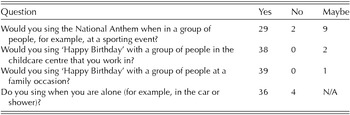
The questionnaire asked if participants would sing in certain settings and these were followed by six Likert-type questions, four of which asked participants to rate their level of confidence for singing in that situation, the other two related to enjoyment of singing and whether the participants considered themselves musical. Table 1 represents the responses to the scenario questions. The data show that the majority of participants believed they were able to sing in most group situations, and singing the National Anthem was the scenario that elicited the most negative response.
Number of participants responding to questions about singing behaviour

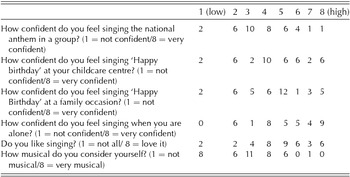
The Likert response questions show mixed levels of confidence and are shown below in Table 2. If participants answered Yes or Maybe to a scenario question then they were asked to rate their level of confidence singing in that situation. Participants were also asked to rate how much they liked singing and whether they considered themselves musical. Table Two shows the number of participants who selected each category.
Likert question responses reported in number of participants

The singing of the national anthem in a group elicited the lowest levels of confidence, while singing alone elicited the highest. Overall participants were more confident singing ‘Happy Birthday’ in their childcare centre than at a family gathering. The results show that participants have a reasonable enjoyment of singing but did not consider themselves as musical.
The following sections report the results from the open response questions. All 40 participants provided answers to these questions.
On a normal day how many minutes/hours would you spend listening to music?
The range of responses was 0–3 hours with the mean being 43 minutes. Six participants responded that they spend no time each day listening to music.
What are your favourite genres/types of music to listen to?
A wide range of music was enjoyed by the participants, most often pop or rock but also classical, country, reggae, alternative and grunge, with some saying they had no preference for style. Thirty-two participants listed more than one type of music or used words like ‘all’, ‘most’ or ‘everything’.
Do you like singing?
The teachers were asked if they liked to sing (see Table 2). In addition to the rating scale they were asked to explain their answer. Thirty-eight participants provided a description of their rating. Three categories emerged: I feel bad about singing (21%), I like to sing by myself (39%) and I enjoy singing (39%). These categories are similar to those suggested by Chong (Reference CHONG2010), who surveyed 90 non-vocalists about their attitudes to singing (Enjoyment of singing, enjoyment of singing alone, no enjoyment of singing). Examples of I feel bad about singing: ‘Enjoy singing but cannot sing in tune/am useless at it’ (P30), ‘I know I am not that good at it; therefore I am very self-conscious’ (P19). Some participants in this category brought up bad memories associated with singing, such as ‘being kicked out of the choir that everyone can join’ (P1) or the judgements of others ‘I don't sing out loud around people because I am flat – tone-deaf. My son tells me to stop singing’ (P28).
Examples of the category I like to sing by myself include: ‘Don't think I sing very well so tend not to sing in front of others’ (P15) and ‘I love singing by myself but lose total confidence when am around others’ (P21).
The final category of I enjoy singing included statements such as: ‘I love to sing and listen to music but does not mean I am any good at it’ (P18) and ‘I feel really happy when I sing especially when it's a song I really know all the words to’ (P5). It is interesting to note that while all participants identified as ‘tone-deaf’, this did not preclude nearly half of them enjoying singing.
How much of a problem is singing for you at work?
Fourteen (35%) of the teachers said they had no problems singing at work. The majority (53%) made comments classified as not too bad. Participants made statements such as: ‘It's ok, slightly nervous when leading singing’(P33) and ‘not too bad if others are singing I’m OK, feel fine when singing with children as I know they are not judgemental – but I am not a very good role model (tune wise)’(P30). Thirteen per cent of teachers made comments that singing was a big problem at work. These included: ‘It is a huge problem. It has stopped me doing my early childhood training’ (P11) and ‘I get nervous taking music/mat times and try to avoid these if I can’ (P21). Other statements included comments about sweating (with nerves), feeling embarrassed, and lacking confidence in front of others.
List the singing activities you participate in at work
Of the 40 teachers who responded to this question 14 specifically mentioned ‘mat time’, a teacher-led time when all the children come together for stories and songs and are seated on a mat. Most could list a variety of types of songs including nursery rhymes, action songs and waiata.
Please list the singing activities you would like to participate in at work but are unable to do so because of your tone-deafness
Twenty-two (55%) teachers felt their ‘tone-deafness’ was not having an impact on their participation in singing activities. Of the 45% whose involvement in activities was affected this included singing unaccompanied, and many statements were related to initiating or leading singing or teaching new songs. One participant stated she would stop singing when an adult entered the room (P11).
Can you think of any previous experiences that have affected how you feel about singing?
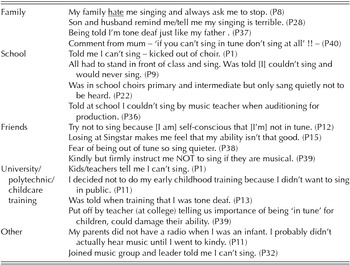
This question had five headings for participants to group their experiences under (family, school, friends, training and other). The headings were designed to prompt multiple answers in more than one domain, with the fifth heading being ‘other’ to stimulate as much comment as possible. The comments from all participants who responded in each of the sections are presented in Appendix 2. Punctuation (such as exclamation marks) and emphasis (such as underlinings) are presented as in the original.
Illustrative examples responding to ‘Can you think of any previous experiences affecting how you feel about singing?’

The participants’ responses reveal a number of common traits. Family members making negative comments about singing ability, being told by music teachers that they can't sing, unsuccessfully (and sometimes humiliatingly) auditioning for choirs: all these are frequent. Performing badly on the Playstation game Singstar is mentioned by three participants as affecting the way they feel about singing, others refer to embarrassing public singing events. Comparison with friends who are ‘great’ singers or ‘musical’ also rates a mention from some participants. Several participants show ways they have altered their singing behaviours, by singing quietly, for example, or lip syncing in situations where others are around, or just not singing at all. Significantly, one participant refrained from completing her training because she didn't want to sing in public.
Not all participants reported negative feelings about singing, however, with the experiences during training boosting singing confidence for some of the teachers.
Emotional content of open-ended questions
The most common emotional response was to do with confidence, mentioned in 11 answers. The context included wanting to feel more confident and expressing what had given them confidence. Love was also used in multiple responses (10), usually in the context of ‘I love music’, or ‘I love singing’. Other emotional words with more than one response were: self-conscious (9), enjoy (8), embarrassed (4), worried (3), happy (3), enthusiastic (2), nervous (2). Emotional words used in single responses were predominantly negative: proud, shyish, inadequate, uncomfortable, terrible, fear, intimidated, suffered, awkward, judgemental. While there are many negative emotions expressed, the picture that emerges is of a group of early childhood teachers who perhaps love music, but lack confidence.
Discussion
This study examined the singing confidence of a group of early childhood teachers who self-identified as ‘tone-deaf’. It focused on what had led to the development of this self-imposed classification and how it affects the singing behaviours of these teachers, in a job that requires regular participation in singing activities.
While tone-deafness is sometimes confused with amusia, a congenital musical disability, past research has shown that individuals who self-identify as ‘tone-deaf’ are unlikely to have amusia (Cuddy et al., Reference CUDDY, BALKWILL, PERETZ and HOLDEN2005; Wise & Sloboda, Reference WISE and SLOBODA2008). As a group, the participants’ results in a sub-test of the MBEA indicated lower ability than the general population to distinguish tones, and five may have met criteria for amusia had the full test been given. A potential limitation of the study is the inability to discern true amusia from perceived tone-deafness.
As a group, the early childhood teachers did not show a lack of musical interest. In contrast, the majority reported listening to a wide range of genre, and for an average of 43 minutes a day. One participant did report that she didn't think she heard music until her first early childhood education experience, suggesting limited exposure. However, all stated that they participated in singing on some level in the centres they worked in, with ‘mat time’ being a typical singing environment. The teachers may not have shown a lack of musical interest, but they did illustrate a self-assessment of poor singing.
Small (Reference SMALL1998) once observed that a group of self-declared ‘tone-deaf’ singers had been taught that they could not sing. The same observation can be made from our study. Many of the early childhood teachers in this group were told that they could not sing: by teachers, family members, choir conductors, friends. Some could pinpoint the exact moment when this occurred. The responses from a number of participants regarding auditions for school choirs echo many of the stories told elsewhere (Abril, Reference ABRIL2007; Bodkin-Allen, Reference BODKIN-ALLEN2009; Ruddock, Reference RUDDOCK2010). Abril's suggestion that music teachers and family members are highly influential on the formation of beliefs about singing also holds true for this group of early childhood teachers.
Other influential factors on the early childhood teachers’ self-perceived ‘tone-deafness’ included comparing their own ability with others who were ‘good singers’ or ‘musical’; feeling self-conscious; and poor performance on the Playstation game Singstar. Unfavourable comparision with others and the concept that some people are ‘musical’ while others are not, were two of the socially constructed aspects of self-reported ‘tone-deafness’ outlined by Sloboda et al. (Reference SLOBODA, WISE and PERETZ2005), as well as lack of confidence and fear of a negative response from those listening. The confidence levels of the group of early childhood teachers were highly varied, with a small group feeling very confident singing ‘Happy Birthday’ at their centre, while the majority lacked confidence in singing at a public occasion such as a rugby game. The open questions showed that many teachers felt awkward while singing; they used words like self-conscious and nervous, and reported they worried about being in tune.
Many of the participants altered their singing behaviours according to circumstances. The early childhood teachers here provide examples of nearly all of West's (Reference WEST and Baker2009) categories of Selective Mutism for Singing (SMS): from not singing in certain situations, such as the national anthem singing at a sporting event; to singing in some circumstances but believing their voice is untuneful, or having a functional problem with singing that is not physiological; through to adjusting their voice or body in certain circumstances to reduce or mask the impact of singing, particularly singing quietly around others. Two of the participants talked about miming, rather than vocalising, in earlier settings involving singing.
The setting of the early childhood centre involves a great deal of singing and teachers are particularly important because they are transmitters of culture and behaviour (Campbell & Scott-Kassner, Reference CAMPBELL and SCOTT-KASSNER2008). In Aotearoa/New Zealand singing is fundamental to the bicultural and continually developing multicultural society with many songs from Māori and different Pacific Island cultures being sung in early childhood centres (Bodkin-Allen, Reference BODKIN-ALLEN, Campbell and Wiggins2013). Several participants mentioned the singing of waiata in their centres, and some made reference to finding Kapa Haka difficult and being criticised for poor pronunciation of Māori language. It might be assumed that because this group of early childhood teachers self-identify as ‘tone-deaf’ they don't participate in singing in the centres they work in. What emerges from the data, however, is a group who still engage in singing activities within the setting of the early childhood centre, but with conflicting emotions and altered behaviours. Teachers spoke of being ‘self-conscious’, of finding it difficult leading or initiating a song, or introducing a new song. Many felt ‘embarrassed’ about their singing being heard by other adults in particular and often sang quietly to avoid being heard.
Limitations of this study include the nature of participant selection. All participants self-identified as ‘tone-deaf’ in the workplace. Those most impaired may not have volunteered for this type of study, due to fear of further embarrassment or being put ‘on the spot’ having to sing by themselves, something that previous research with early childhood teachers has found (Bodkin-Allen, Reference BODKIN-ALLEN2009). However participants were below average on the MBEA, showing some level of impairment. Answers to questions reported here are also self-reported and have no outside verification, so participants may under-represent, or over-represent, the way they are affected, or have an inclination to answer in a socially or professionally acceptable way. Furthermore, this research was conducted in two South Island (NZ) cities which may not represent the ethnic spread of the entire country.
‘Tone-deaf’ is a common self-description by adults, including early childhood teachers. The term ‘tone-deaf’ for the teachers in the present study seems to be a result of past experiences, sometimes in performance situations or through interactions with friends or family members and manifested itself in negative feelings about their own singing. Singing is usually a pleasurable activity, but not for people who have labelled themselves as non-singers (Whidden, Reference WHIDDEN2010) or as is the case here, ‘tone-deaf’. This negative association might most directly affect job satisfaction but also indirectly affect job performance. Non-singers and self-evaluated ‘tone-deaf’ teachers need support both in the education and training system (Whidden, Reference WHIDDEN2010) and in the workplace. Future work to develop early childhood teachers’ positive feelings towards singing could be developed which would be aimed at improving confidence and attitude. A promising therapy known as Acceptance and Commitment Therapy (ACT) will be trialled in a future study. This should be compared with actual singing training as suggested in the literature.
Conclusions
Data from the present study suggest several early childhood teachers feel anxious when they sing in their workplaces. Labelling of ‘tone deafness’ is likely to have arisen throughout childhood and adolescence due to the influence of family, friends and schools. Participants provided examples of sensitivity to criticism of the voice. Our ‘tone deaf’ participants enjoy or even love singing and are willing to participate in singing activities – although they do not consider themselves musical and often lack confidence. These issues impact on the professional lives of early childhood teachers and may have flow-on effects on child development, transmission of culture and behaviour. This has particular importance in multicultural societies like Aotearoa/New Zealand. Targeted interventions to address these issues may be worthwhile. We believe tone-deafness in early childhood teachers can be remediated, and future research should examine effective ways of doing this. We can change early childhood teachers who can't sing or won't sing into confident singers.
Appendix 1. Questionnaire of self-perception of musical ability
-
(1) How musical do you consider yourself to be (please circle a number)?

-
(2) On a normal day, for how many minutes/hours would you spend simply listening to music?
-
(3) What are your favourite genres/types of music to listen to (e.g. Pop, rock, classical, instrumental, reggae etc.)?
-
(4) Would you sing the National Anthem when in a group of people, for example at a sporting event?
YES/NO/MAYBE
If you answered YES or MAYBE, how confident would you be when you sang?
-
(5) Would you sing ‘Happy Birthday’ with a group of people in the childcare centre that you work in?
YES/NO/MAYBE
If you answered YES or MAYBE, how confident would you be when you sang?
-
(6) Would you sing ‘Happy Birthday’ with a group of people at a family occasion?
YES / NO / MAYBE
If you answered YES or MAYBE, how confident would you be when you sang?
-
(7) Do you sing when you are alone? (e.g. in the car or shower)
YES / NO
If you answered YES how confident would you be when you sang?
-
(8) Do you like singing?
Please explain your answer
-
(9) How much of a problem is singing for you at work?
-
(10) Please list the singing activities you participate in at work:
-
(11) Please list those singing activities you would like to participate in at work but feel unable to because of your ‘tone-deafness’
-
(12) Can you think of any previous experiences that have affected how you feel about singing?
-
a. Family
-
b. School
-
c. Friends
-
d. University/polytechnic/childcare training
-
e. Other
-


Appendix 2. All answers responding to ‘can you think of any previous experiences affecting how you feel about singing?’

Nicola Swain, Senior Lecturer at the Dunedin School of Medicine, studied Music and Psychology at university. Her research involves using psychological treatments to assist pain management, and to treat tone deafness. She also researches well-being of children, childbirth satisfaction and communication. She believes music has a powerful influence in psychological well-being.
Sally Bodkin-Allen studied ethnomusicology and composition at university. Her research interests lie in early childhood music education, and in the concept of ‘tone-deafness’. Other research areas include music and sport, and fostering student engagement, as well as the use of Facebook in tertiary education. She is a board member of MENZA (Music Education New Zealand Aotearoa) and editor of Tune Me In, the MENZA magazine.