Introduction
There are fewer Certified Organic producers in the Mid-South US (southern half of Missouri, western Kentucky and Tennessee, northern Arkansas and eastern Oklahoma) than in other regions of the country such as the Upper Midwest, West Coast, or Northeastern US (Marasteanu and Jaenicke Reference Marasteanu and Jaenicke2016). Marasteanu and Jaenicke (Reference Marasteanu and Jaenicke2016) found ‘cold spots’ of organic operations across the South, even in areas with significant agricultural activity and across different types of organic operations—crop, livestock and other establishments. Taus et al. (Reference Taus, Ogneva-Himmelberger and Rogan2013) posit that these clusters suggest regional characteristics impact on the adoption of organic agriculture, and admit that regional studies lack consensus on the role of factors that drive adoption. This paper seeks to understand if there are regionally distinct challenges and opportunities for organic production in the region. Based on interviews with a sample of 14 certified organic producers in Missouri, we suggest that further regional organic agriculture is needed in the Mid-South.
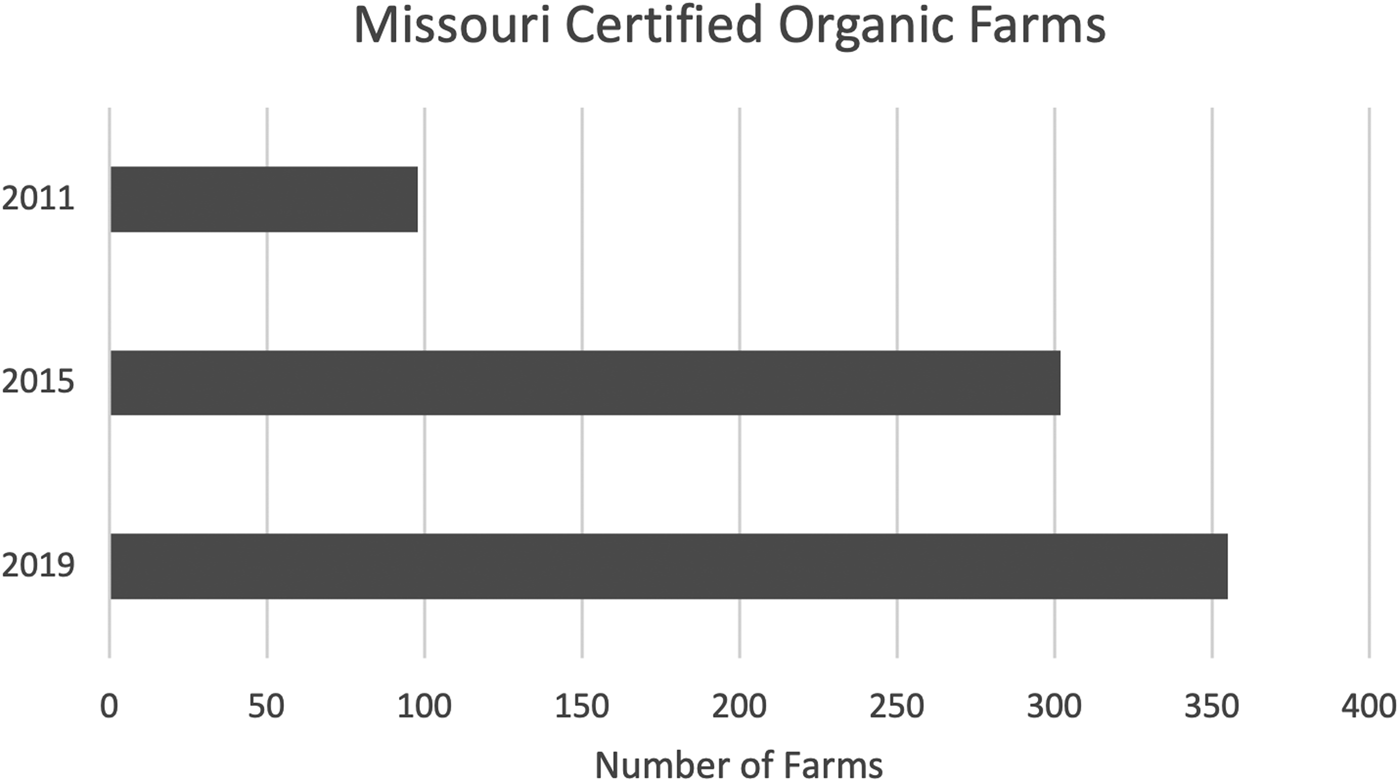
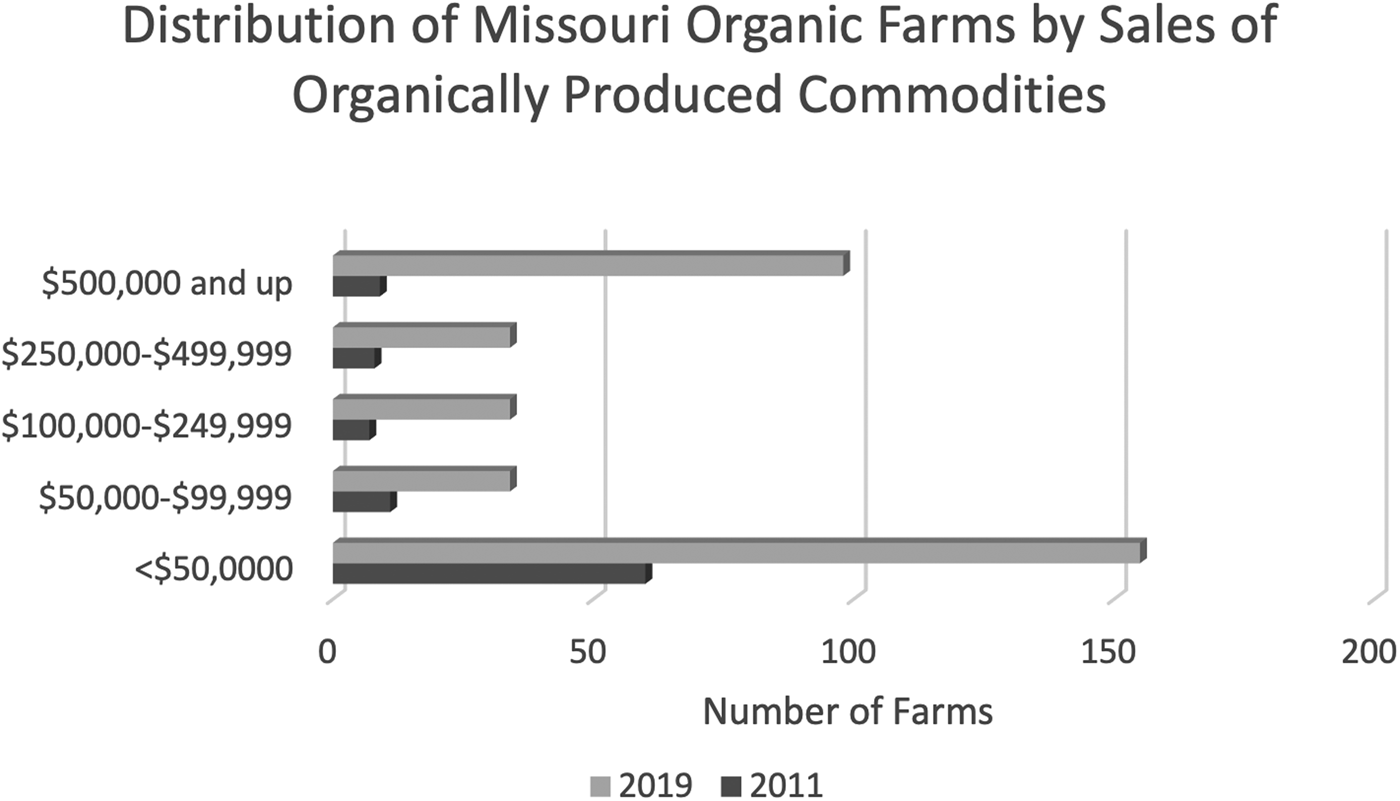
The 2016 United States Department of Agriculture (USDA) Certified Organic Survey showed a total of 14,217 certified organic farms, with Missouri accounting for 302 farms, an impressive 72% growth since 2015. However, five Mid-South states only accounted for 2% of total 2016 US certified organic sales (USDA NASS, 2015; 2016), demonstrating room for growth. As the USA is the global leader in organic consumption, and the importer of close to $200 million of organic corn, soybeans and wheat (Carusi et al., Reference Carusi, Gurda, McNair, Pfeiffer and Silva2015), farmers in the Mid-South ought to have as equitable a chance to opt-in to a federal certification as their counterparts in other US regions; potentially fulfilling unmet domestic demand (Figs. 1 and 2).
Missouri certified organic farms
Source USDA National Agricultural Statistics Service Organic Surveys.

Distribution of Missouri organic farms by sales of organically produced commodities
Source USDA National Agricultural Statistics Service Organic Surveys.

The organic adoption literature indicates many possible barriers for farmers seeking to certify. Access to sector infrastructure (organic processors, feed mills and markets) plays a crucial role in the diffusion and adoption of organic production throughout a region. Veldstra et al. (Reference Veldstra, Alexander and Marshall2014) analyzed survey data from US fruit and vegetable producers in 16 states, separated into four geographical regions to control for location impacts, and found that the farm location played a statistically significant role in the use of organic practices. Constance et al. (Reference Constance and Choi2010) surveyed ‘pragmatic conventional producers’ in Texas who identified the largest constraints were those regarding infrastructure, in addition to many technical barriers to organic adoption. Lack of organic infrastructure may impact the Mid-South in a similar fashion. Finally, Marasteanu and Jaenicke's (Reference Marasteanu and Jaenicke2016, p 517) findings that locations of organic ‘hot spots’ do not coincide with ‘agricultural strongholds, such as the corn and soybean belts’ implicitly suggests there are barriers to ‘extending agricultural success in these prevalent and highly valued crops to similar success in their organic counterparts.’
Biophysical regional characteristics may also impact the adoption of organic farming methods. The Mid-South has more weathered soils than the Upper Midwest, where glaciation patterns provided greater topsoil reserves (Bäumler et al., Reference Bäumler, Zech, Heuberger and Weber-Diefenbach1991; Lambers et al., Reference Lambers, Raven, Shaver and Smith2008). Despite soil degradation from poor management across the USA, organic practices provide an opportunity to build soil health and organic matter (Fließbach et al., Reference Fließbach, Oberholzer, Gunst and Mäder2007) to achieve higher yields and climate resilience, which could be an incentive to adopt organic certification. Considering this, organic production could be more difficult in the Mid-South as producers begin with poorer soil. Further, experiencing higher temperatures and rainfall, building soil health may occur at a slower rate for Mid-South producers than their counterpoints in other regions (Sheldon et al., Reference Sheldon, Retallack and Tanaka2002).
Veldstra et al. (Reference Veldstra, Alexander and Marshall2014) found that producer perceptions of biophysical characteristics, not just the biophysical characteristics themselves, impacted certification decisions. Those who perceived yield loss due to weather, weeds, pests, diseases and soil fertility as a barrier had 17.02% less production under organic practices than those who did not. Another perceived biophysical risk is the variable weather patterns; which is reasonable as climate change is increasing the frequency of hot and humid days, subsequently increasing weed, pest and disease (WPD) pressures (Mader et al., Reference Mader, Fließbach, Dubois, Gunst, Fred and Miggli2002 in Azadi et al., Reference Azadi, Schoonbeek, Mahmoudi, Derudder, Maeyer and Witlox2011).
Financial barriers to adoption may be the higher cost of organic inputs such as seeds, pesticides, and fertilizers (Greene et al., Reference Greene, Dimitri, Lin, Mcbride, Oberholtzer and Smith2009; Uematsu & Mishra, Reference Uematsu and Mishra2012). Even so, some farmers adopt organic production for financial gain (Reganold and Wachter, Reference Reganold and Wachter2016), yet, Uematsu & Mishra (Reference Uematsu and Mishra2012) analyzed farm-level data from the 2008 Agricultural Resource Management Survey and found that household incomes of organic producers were no better off than those of conventional producers.
Agricultural professional perception of organic agriculture may impact regional adoption and could have been shaped by previous policy movements in the USA. As the organic movement was progressing without a federal policy, many states had established certification standards, and a federal-level Organic Resources Coordinator position was created at USDA, later to be cut by the Reagan Administration. The politicization of organics throughout the DC bureaucracy, and the Land Grant University System hindered scientific organic research, and utilizing ‘uncooperative and uniformed extension agents’ to conduct organic outreach failed to attract producers (Constance et al., Reference Constance and Choi2010). Internationally, telephone surveys with agricultural professionals (n = 119) demonstrated that beliefs regarding organic agriculture impact their professional capacity for market development and producer information availability, ultimately impacting the adoption within the region (Wheeler, Reference Wheeler2008).
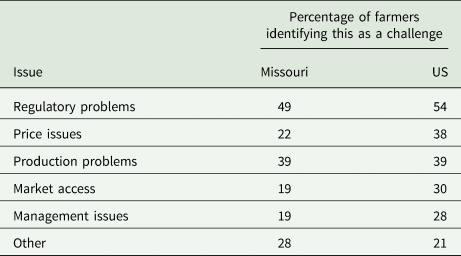
While the literature is very clear about numerous challenges to adopting and continuing organic agriculture, much of the work has not considered regional challenges that could account for lower adoption of organic agriculture by producers in places like Missouri and the rest of the Mid-South. Confounding this literature are the responses of Missouri farmers regarding major production challenges in USDA's 2019 Certified Organic Survey. In almost every case, fewer Missouri farmers regarded the specific issue as a major production challenge as compared to US farmers in total (see Table 1).
Major production challenges identified by certified organic producers.

Methods
Key informants were selected from different organic sectors through the list of certified operations in Missouri maintained by the USDA. Fourteen producers were interviewed in 13 interviews using semi-structured protocols from June 2019–August 2019 and February 2020–March 2020. Semi-structured interviews included themes of producer farm descriptions, production challenges, production opportunities, farmer networks, and future organic industry insights. The use of an open-ended interview protocol allowed the interviewer to encourage participants to bring up anything they found important. Interviews lasted anywhere from 20 to 75 min. Interviews were in person (nine) and over the phone (four), and were recorded with participant consent.
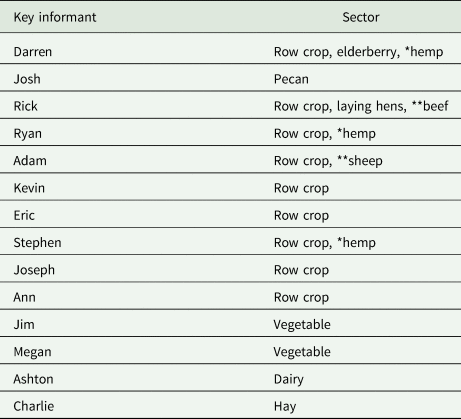
Producer pseudonyms and sectors are included in Table 2. Data were coded by the first author with Nvivo12 software using pre-identified themes of biophysical factors, market access and policy. Two interviews were checked by other members of the team for code agreement before the rest were coded. For each of the major a priori themes, the opportunities and challenges of producers were identified. This methodological approach allowed the authors to understand the unique considerations of farmer adoption of organic certification in the region.
Producer pseudonym and sector.

*Product not eligible for USDA Organic Certification.
**Product not certified.
Findings
Producers identified areas of challenges and opportunities specific to their certification within the three a priori themes of (1) biophysical characteristics (14 citing challenges and 10 citing opportunities); (2) marketing infrastructure (13 citing challenges and 12 citing opportunities) and (3) financial feasibility (11 citing challenges and 10 citing opportunities). Emergent intervening factors of climate change (nine farmers), and structural organization of the agrifood system (seven farmers) posed as compounding factors buttressing an already complex production landscape.
Challenge: biophysical characteristics
WPD pressure was a biophysical production challenge cited by all producers in the sample. Challenging for most US organic producers, it is especially concerning in Missouri where persistent heat and humidity foster difficult growing conditions. Compounding WPD challenges are the limited and costly Organic Materials Review Institute (OMRI) approved inputs.
All interviewed row crop producers expressed susceptibility to weed pressures. Tillage was the main form of weed management, despite four producers concerned with its negative impact on soil tilth, one describing it as the ‘necessary evil of organic.’ Flame and electric shock weed control implements were utilized by those able to purchase and/or rent the equipment. All vegetable and specialty crop producers cited pest and disease complications at the fore of their management considerations. Josh, a pecan producer, tried testing concentration ratios for an organic approved insecticide: ‘With the mixed solution they…didn't die…So then we sprayed them with the full concentrate of the stuff, and they just ate it like it was lunch, they didn't care.’
Soil quality and fertility
Successful organic production requires productive soils. Missouri's poorer soil quality puts its’ organic producers at a disadvantage. To compensate, they altered their soil management practices by increasing tillage and applying more inputs. Darren explained wrestling with an ‘organic paradox’: ‘Tillage, … like before [transitioning to organic] I was doing no-till, …which was nice.’
Another disadvantage for Missouri row croppers was establishing crop rotations that corresponded to reliable markets. Four farmers struggled to include corn in a rotation more than once every five years due to soil nitrogen deficiencies, forced to decide between sacrificing soil health or increased yield. Conversely, neither vegetable nor speciality crop farmers struggled with regional soil quality differences. The latter may be more able to be selective with production acreage, flexible in crop rotations or able to adjust soils in a shorter time period.
Further, four-row crop farmers struggled with limited seed technology available to them to aid their WPD management. Stephen explains, ‘…there's a lot of genetics for organics up in the Iowa, Wisconsin area. But…we get a lot of yield drag with those.’ This illustrates a distinct need for Mid-South specific research and development of organic seed varieties and WPD management tactics.
Opportunities: biophysical characteristics
Organic production allowed producers to build the overall health of their farm—namely, their soil health. Other opportunities expressed were on-farm adaptability and diversity as a strength, as well as eligibility for USDA—Natural Resource and Conservation Stewardship (NRCS) programs.
Seven farmers expressed that they learned to embrace diversity on the farm. The four who previously farmed conventionally shared they had not fully appreciated on-farm diversity, now viewing it as a strength in their organic system. Diversity for two producers included grazing livestock, although, they chose not to certify their livestock due to certification costs. Ashton, previously farming in the Northeast, was able to graze his dairy herd three months longer upon relocating to Missouri. Methods utilized to improve soil health and establish crop diversity were aided by grant funding through USDA–NRCS programs. While not exclusive to organic producers, their certification allows them to rank higher in award priority than conventional or transitioning farmers. An opportunity exists to appropriate increased funds to NRCS programs, in addition to investigating ways to incentivize organic animal systems in Missouri.
Challenge: markets and infrastructure
Accessibility to organic markets was perceived to be limited regardless of the production sector. Seven row crop producers indicated marketing challenges including distantly located markets requiring higher transportation costs, limited transition crop markets, and international trade uncertainty. All vegetable and speciality farmers relied on direct or aggregated wholesale markets. Two row crop and the single forage farmer noted frustration with lack of markets available for the National Organic Program required cover crops, ‘And cover crops are very expensive, and…they want you to use organic seed. Well that's great, but when you're piling on a bunch of money and it fails on you, then you don't really feel like using organic seed anymore especially when you're not trying to harvest a crop from it (Rick).’
Opportunities: markets and infrastructure
To overcome marketing challenges, producers have opted for growing food-grade crops, adapting their markets to better suit their needs, or creating their own. For instance, three row crop farmers turned to produce organic food-grade products, which typically bring a higher premium per bushel. Food-grade crops must be in an exceptional condition requiring rigorous WPD management and additional labor hours. One producer found buyers that contract on a per-acre basis rather than per bushel basis, preferring this structure as it shifted some yield variability risk away from the farmer.
Producers have altered their production to access higher profit markets through product diversification, niche production, and marketing under enhanced labels. In some cases, producers created their own markets: two participating in transitional crop cooperatives, one in aggregation and marketing food hubs for speciality crops, two in value-added processing member coalitions, and two in enhanced labeling plans. These have allowed producers to bypass market structures that are too costly or time-consuming to navigate in Missouri.
Challenge: financial feasibility
Financial feasibility in operating an organic farm underscored most producer decisions in the sample. In particular, labor was identified as a limiting consideration of eight interviewed farmers. Three row crop farmers struggled to find skilled labor to run equipment intended for weed control, finding themselves using tactics that sacrificed soil health for the sake of time. Both vegetable farmers grappled with stifling their production and expansion plans because of extra labor costs, in addition to costs incurred to build facilities that would support farm employees such as parking, restrooms and break rooms.
Equipment for organic farming is different than for conventional operations, often requiring more implements. Ten producers cited needing more implements, especially for tillage and other means to address the increased WPD of the region. Equipment needs are greater if producers have parallel production schemes, as they do not have the time or labor needed to disinfect equipment between use in conventional and organic fields. This was especially troublesome for farmers wishing to transition their farm in phases. With market instability, four producers invested in greater on-farm storage capacity to hedge against and offset financial risk. Even when considering the possible premium, or increased profits from expansion, producers were still cognizant of financial risk, ten citing specific uncertainties they faced.
Opportunities: financial feasibility
All farmers perceived organic premiums as a way to sustain livelihoods without having to scale-up or expand acreage. Financial risk was perceived to be lessened by federal grant programs available to organic producers, including NRCS programs, the Beginning Farmer and Rancher Development Program, and the Socially Disadvantaged Farmers and Ranchers, and Veteran Farmers and Ranchers Program. One producer received a grant through a nonprofit organization. Expansion of these programs would be beneficial, as they allowed producers to implement practices and infrastructure that would have otherwise been financially impossible.
Conclusion
These findings suggest regional factors offer distinct challenges and opportunities to organic farmers in the Mid-South, consistent with findings from Marasteanu and Jaenicke (Reference Marasteanu and Jaenicke2016). From challenging biophysical characteristics and resulting WPD pressure, organic farmers experience higher input costs, increased labor needs, and require specialized equipment and on-farm infrastructure. However, they also perceived the ecological benefits of organic production in terms of building soil health and diversity was recognized as a key opportunity, as was better access to a variety of federal agricultural programs. Farmers also identified access to markets, regionally specific varieties, and specialized equipment as challenges, but appreciated the opportunity for organic premiums as a way to sustain livelihoods. Just as farmers found place-based innovations like cooperative processing and marketing as an opportunity, further regional, place-based studies could offer an opportunity to researchers, professionals, and policymakers to better understand the needs of farmers. This exploratory fieldwork reinforces calls for regionally specific research, outreach, and policies that can encourage organic producers in one of the ‘cold spots’ of organic production in the USA.
The data that support the findings of this study are available from the corresponding author, EMM, upon request.
Funding information
This work was supported by the Integrated Research, Education and Extension Competitive Grants Program—Organic Transitions grant number 2017-51106-27007 from the USDA National Institute of Food and Agriculture.