


Introduction
Political developments and decisions by universities have brought name, image, and likeness (NIL) policy into the national spotlight, not only as athletics and economic issues but increasingly as questions of fairness and gender equity in college sports. Arkansas passed a law in 2025 exempting NIL earnings from state taxes, and Mississippi considered a similar measure in 2026. Wisconsin continues to debate direct state funding for the University of Wisconsin–Madison’s athletics program, and Texas is considering bills allowing universities to directly strike NIL deals with athletes. These actions show that state lawmakers view NIL as an active policy arena. At present, forty-one states have at least one NIL policy on the books (Lovell Reference Lovell2025). State discussions about expanding NIL coincide with debates regarding federal legislation. In 2025, the House of Representatives attempted to pass the SCORE Act, a bill that would have strengthened the NCAA’s authority by providing antitrust protection, introducing revenue sharing, standardizing state laws governing permissible athlete activities, and limiting employee status. The bill ultimately failed in May 2025. As of the writing of this manuscript, the Protect College Sports Act is scheduled for a vote on the Senate floor in fall 2026. The bill would build on the House settlement and provide limited antitrust protection for the NCAA while establishing stronger standards for revenue sharing and transfer activity, and it seeks to create guardrails for institutions considering separation from the NCAA. Critics argue that the bill grants the NCAA excessive immunity, does not incorporate student–athlete input, and risks limiting athletes’ earning potential.
NIL is one of several major issues in higher education involving the balance of political oversight and administrative discretion. The presence of diversity, equity, and inclusion (DEI) on college campuses is another. Between 2021 and 2026, lawmakers introduced 149 pieces of legislation addressing DEI in hiring, admissions, student services, and teaching across thirty–two states (Chronicle of Higher Education 2026). Restrictive DEI legislation is most common in conservative–led states, while states with mixed or liberal control have sought to protect DEI. Similar debates are taking place at the federal level. During his second term, President Trump has signed executive orders and directed federal grant and funding decisions toward reducing the footprint of DEI in higher education. Under his administration, the Department of Government Efficiency and the Department of Education targeted DEI grants and programs and used the restriction or cancellation of federal funds to limit their impact. Because both NIL and DEI are politically salient, public attitudes toward these issues are likely structured by broader ideological frames and by the cultural significance of college athletics.
Although NIL and DEI are often debated separately, both involve institutional responsibility for equity and are shaped by ideological conflict. DEI directly addresses policies and practices affecting specific populations on college campuses. NIL has become part of an equity debate about earnings and opportunities for male and female athletes (Boston Reference Boston2022; Lovell Reference Lovell2025). Research applying sport capitalism (Cor et al. Reference Corr, Weiner and Stokowski2023; Sorbe et al. Reference Sorbe, Custis and Weinandt2022) and neoliberalism (Lovell Reference Lovell2025) frames NIL as a free–market model with limited systemic attention to gender equity. There is little research on how public demand and value branding (Collins Reference Collins2024) shape public views of NIL policy from this perspective.
To expand on this work, I examine how public opinion and issue salience surrounding NIL intersect with attitudes toward DEI, and whether NIL is understood by the public as an equity issue shaped by political ideology and sport identity. I focus on public demand as a product of opinion and salience (Burnstein Reference Burstein2003; Bromley–Trujillo and Poe Reference Bromley-Trujillo and Poe2020; Oehl et al. Reference Oehl, Schaffer and Bernauer2017; Park Reference Park2025; Schaffer et al. Reference Schaffer, Oehl and Bernauer2022) and apply this framework to support for gender equity in the implementation of NIL. As Park (Reference Park2025) notes, political action is often measured by how people perceive and pay attention to a policy topic. I approach public demand from the view that public opinion is shaped by the salience of the issue (Oehl et al. Reference Oehl, Schaffer and Bernauer2017; Schaffer et al. Reference Schaffer, Oehl and Bernauer2022). Working from this premise, I use proportional odds logistic regression models of two narrative statements that measure public agreement with institutional responsibility for gender equity and levels of pay in NIL. These models contextualize public demand for gender equity in NIL and estimate how this view is associated with discussions of DEI and sport policy.
To provide a more complete view of these perceptions, I report on the intensity of agreement across populations and in relation to views of NIL and DEI. This allows me to assess how the salience of these policies affects the odds of supporting gender equity. From this analysis, I conclude that public support for gender equity in NIL is embedded within the broader DEI debate and shaped by political ideology, NIL salience, and sport identity. These dynamics position NIL as an emerging equity policy domain where public attitudes reflect the same political and cultural forces that structure views of DEI in higher education.
Literature review
History of NIL
Name, image, and likeness (NIL) refers to a person’s right to profit from their identity and personal brand. Individuals have long been able to earn money from their NIL through social media, endorsements, or selling photographs unless they participated in NCAA athletics. For most of its existence, the NCAA prohibited athletes from profiting from their NIL to preserve amateurism (Crabb Reference Crabb2017; Holden et al. Reference Holden, Edelman and McCann2022; Lazaroff Reference Lazaroff2007). The modern NIL era began with O’Bannon v. NCAA, when former UCLA basketball player Ed O’Bannon sued EA Sports for using his likeness without compensation, a practice NCAA rules forbade (Lodge Reference Lodge2016). The court ruled in his favor, finding that the NCAA’s prohibition on NIL profit violated antitrust law, ending college sports video games and serving as the Trojan horse for NIL reform (O’Bannon vs. the NCAA 2014). In 2019, California passed the first state law allowing college athletes to profit from their NIL, contradicting NCAA rules and triggering rapid policy diffusion (Colvin and Jansa Reference Colvin and Jansa2024; Lovell and Mallinson Reference Lovell and Mallinson2023). By 2021, nine additional states had enacted similar laws, leading to Alston v. NCAA, where the Supreme Court unanimously held that the NCAA’s compensation limits violated the Sherman Act. Justice Kavanaugh noted that the NCAA’s business model would be illegal in any other United States industry. After the ruling, as Lovell and Mallinson (Reference Lovell and Mallinson2023) notes, the floodgates opened. As of 2026, thirty-five states have active NIL laws, and four others have executive orders.
NIL created new opportunities for athletes to earn money, but implementation revealed challenges. Many states and the NCAA initially prohibited NIL from serving as direct compensation for athletic performance or as a recruiting inducement, restrictions that proved difficult to enforce because the NCAA lacked legal authority to regulate rapidly expanding NIL markets and booster led collective activity (Lovell and Mallinson Reference Lovell and Mallinson2026). In 2025, a California judge awarded $2.8 billion to former athletes previously barred from profiting from their NIL as part of the House settlement, opening the door to revenue sharing and direct institutional payments (Edelman and Carrier Reference Edelman and Carrier2025) as well as challenges to how they would be divided equitably as the model favors men’s sports that generate revenue and challenges the concepts and protections of Title IX (Perkiss Reference Perkiss2026; Sniffen and Wolff Reference Sniffen and Wolff2026). As of 2026, NIL remains a complex and evolving policy arena. The patchwork of state laws, inconsistent enforcement, and escalating financial stakes have prompted renewed calls for federal legislation to stabilize college athletics. The Protect College Sports Act is the most aggressive federal proposal as of 2026 and is intended to preserve non-revenue sports and the long-term viability of college athletics. It limits athlete transfers to one without penalty, caps agent fees at five percent, empowers the NCAA to evaluate NIL deals, and provides antitrust protection. Critics argue that the bill does not empower student athletes and goes too far in strengthening the NCAA (Lovell and Mallinson Reference Lovell and Mallinson2026; Marcello Reference Marcello2026). NIL’s emergence as a policy domain brings issues of fairness and equity to the forefront, which links it to public attitudes toward DEI.
Challenges of NIL and public demand
As noted in the introduction, public demand is measured as an interaction between salience and opinion (Oehl et al. Reference Oehl, Schaffer and Bernauer2017; Park Reference Park2025; Schaffer et al. Reference Schaffer, Oehl and Bernauer2022). Salience reflects the importance and visibility of a problem (Wlezien Reference Wlezien2005). Although the National Collegiate Athletics Association (NCAA) has long regulated college sports, legal challenges related to NIL, including disputes over antitrust protection and the NCAA’s authority, have shifted attention to state governments and potentially the federal level. The popularity of college sports and sustained legal and media focus contribute to NIL’s high salience. NIL has expanded the reach of athletic goals and reshaped how universities approach compliance, student services, compensation, and academics (Colvin and Jansa Reference Colvin and Jansa2024; Lovell and Mallinson Reference Lovell and Mallinson2023). These developments elevate NIL beyond an economic issue and positions it within broader debates about fairness and equity central to DEI.
Universities face scrutiny for implementing NIL in ways that disproportionately benefit male athletes in revenue sharing due to systemic imbalances that prioritize sports such as football and men’s basketball due to longstanding revenue differences and resource development, underscoring the need to assess public support for gender equity measures within NIL (Boston Reference Boston2022; Meyer et al. Reference Meyer, Evans and Luis Irizarry2025). Gender has long shaped how sports are administered on college campuses, as Title IX requires equity in resources and opportunity regardless of sport, and compensation and leadership roles remain central to debates linking gender equity, sports, and administration (Evans and Knepper Reference Evans and Knepper2024). Because NIL now influences access to opportunities and compensation, it intersects directly with the equity concerns that animate DEI discussions in higher education.
While NIL has roots in neoliberalism and sport capitalism (Lovell Reference Lovell2025), questions persist about how it addresses gender. Female athletes often engage with NIL by navigating gender norms and building personal brands on social media rather than through direct performance (Lobpries et al. Reference Lobpries, Bennett and Brison2018), internalizing their experiences through this lens (Harris and Brison Reference Harris and Brison2024). These dynamics exist alongside systemic factors – revenue, television access, and overall popularity – that limit female athletes’ access to NIL opportunities (Lovell Reference Lovell2025). These challenges have fueled student activism focused on fairness in NIL implementation (Thomas Reference Thomas2025). The University of Oregon beach volleyball team’s lawsuit against the NCAA highlights how collectives, composed of boosters, alumni, and donors, can concentrate opportunities in male-dominated sports, raising questions about whether NIL practices violate Title IX. These disputes further situate NIL within the broader equity landscape that DEI seeks to address.
Early state NIL policies prohibited universities from participating in the process (Lovell and Mallinson Reference Lovell and Mallinson2024). Political developments and the House settlement, which allowed institutions to engage in revenue sharing with athletes, have shifted perceptions of where responsibility for NIL opportunities lies. The settlement (House v. NCAA 2025) permits institutions to share up to $20.5 million of revenue with athletes, creating additional complications. These policy changes place a greater burden on institutions, which must determine how athletes are compensated while complying with Title IX’s requirements for equitable access and fair treatment. Early research treated Title IX and NIL as separate policies (Jessop and Sabin Reference Jessop and Sabin2021), but Boston (Reference Boston2022) connects them by arguing that female athletes are entitled to equal treatment under U.S. law. NIL therefore operates within a complex market (Boston Reference Boston2022) that includes state political interests (Lovell and Mallinson Reference Lovell and Mallinson2024), universities balancing academic and financial goals, third-party collectives operating without oversight (Lovell and Mallinson Reference Lovell and Mallinson2026), and athletes and their representatives seeking to benefit from the system. This complexity reinforces NIL’s position as a policy domain where equity concerns mirror those found in DEI.
State laws create a patchwork of mandates regarding university responsibility (Jessop et al. Reference Jessop, Baker, Tweedie and Holden2023; Moorman and Cocco Reference Moorman and Cocco2023). In the first year of NIL, athletes in college football and men’s basketball reportedly received up to 90% of revenue sharing and university-supported opportunities (Toppmeyer Reference Toppmeyer2025). Overall, an estimated 80% of NIL money goes to male athletes (Hawley-Alexander Reference Hawley–Alexander2025). A study by Opendorse (2025) shows that female athletes perform well outside revenue sharing and collective agreements; when college football is removed, female athletes outperform male athletes in the open market by a 60–40% split. This performance does not offset systemic factors tied to revenue and sport capitalism that keep NIL centered on male athletes (Lovell Reference Lovell2025). These developments have raised questions about revenue sharing and compliance with Title IX. Understanding public demand for action on these issues provides insight into the implementation challenges institutions face regarding NIL and highlights how NIL has become intertwined with broader DEI-related concerns about fairness, access, and equity.
DEI and higher education
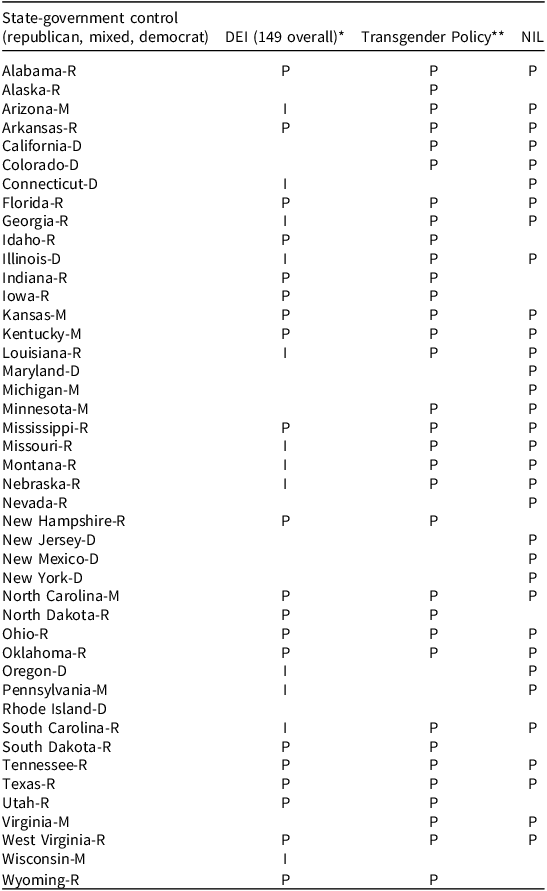
DEI has been a prominent policy topic in higher education since 2020. The debate stems from political disputes between liberals and conservatives over how DEI concepts should be applied in public institutions. Higher education is a politically advantageous setting because teaching topics such as critical race theory (CRT), maintaining offices for underrepresented populations, and using DEI considerations in hiring and admissions create opportunities for political messaging and narrative framing. According to the Chronicle of Higher Education (2026), lawmakers have introduced or passed 149 DEI–related laws in thirty–two states since 2021 (Table 1).
Breakdown of DEI, transgender, and NIL policies by state

Table 1. Long description
A table comparing state government control and policies on DEI and transgender issues across different states. The table has 4 columns and 32 rows. The columns are labeled ‘State-government control (republican, mixed, democrat)’, ‘DEI (149 overall)’, ‘Transgender Policy’, and ‘NIL’. Each row lists a state and its corresponding policies. For example, Row 1: Alabama-R, P, P, P; Row 2: Alaska-R, P, P, P; Row 3: Arizona-M, I, P, P; and so on. The table provides a detailed breakdown of the policies in each state.
* Chronicle of Higher Education, https://www.chronicle.com/article/here-are-the-states-where-lawmakers-are-seeking-to-ban-colleges-dei-efforts
** Movement advancement project, https://www.lgbtmap.org/equality-maps/youth/sports_participation_bans
P = Passed legislation, I = Introduced legislation.
Much early DEI legislation focused on teaching divisive concepts (Jackson Reference Jackson2025), including CRT (Carbone et al. Reference Carbone, Harell and Soroka2024; Giersch et al. Reference Giersch, Liebertz, Duquette and Yao–Kouame2024; Jones and Briscoe Reference Jones and Briscoe2025). More recent legislation and executive actions have centered on systemic practices (Haber Curran et al. Reference Haber–Curran, Dean Scott and Moreno2025; Miller et al. Reference Miller, Garcia and Duran2025). Anti–CRT laws illustrate how politicization can overtake substantive debate (Collins Reference Collins2024). Collins applies the idea of policy branding, arguing that political elites use limited public knowledge to shape policy narratives. I test this idea in the context of gender equity in NIL by examining the effects of political ideology and connections to conservative views of DEI within the proportional–odds model.
Policies tied to the systemic impacts of DEI provide further areas for discussion. In conservative states such as Texas, state law has banned DEI training for employees and prohibited the use of DEI statements in faculty hiring. Texas and Florida have also moved to close campus offices serving underrepresented groups and shifted their responsibilities to general operations (Conyers and Field Reference Conyers and Wright Fields2025). Supporters of anti–DEI laws often frame them as efforts to create equal conditions and prevent individuals from feeling “uncomfortable” because of their race, with conservatives identified as the primary group of concern (Deshpande et al. Reference Deshpande, Blatte, Margalit, Lezama, Schaffner, Shivakumar and Wingens2024; Kamola Reference Kamola, Mégret and Ramanujam2024; Richmond et al. Reference Richmond, Toosi, Wellman and Wilkins2024). For liberals, the broad nature of DEI creates uncertainty about how it should be approached (Safarpour et al. Reference Safarpour, Trujillo, Green, Pippert, Lin and Druckman2024). States such as California and Illinois have passed laws protecting DEI and expanding support for cultural competency in hiring and training, while reducing scrutiny of public servants engaged in DEI–related work (Fowler and Schneider Reference Fowler and Schneider2024). Minnesota has passed laws supporting underrepresented students by providing resources for those from the foster care system and funding programs to address hunger on campuses. Under the second Trump administration, the Department of Education has sought access to admissions data to evaluate DEI measures and used funding decisions to limit the scope of DEI (Conyers and Fields Reference Conyers and Wright Fields2025; Ng et al. Reference Ng, Fitzsimmons, Kulkarni, Ozturk, April, Banerjee and Louise Muhr2025). These contrasting approaches provide a backdrop for examining gender equity in NIL and whether public views of NIL share characteristics with public views of DEI.
The debate surrounding DEI is deeply tied to party identification. Although classroom instruction and hiring practices are central areas of focus, college sports have also become part of the DEI policy landscape. The participation of transgender athletes in college sports is one of the most visible examples (Frias et al. Reference Javier and Torres2024). As of March 2026, twenty–nine states have passed laws or issued executive actions prohibiting transgender women from competing in female college sports. Table 1 provides a breakdown of states that have passed or introduced policies in the areas of DEI and NIL. Four states – California, Colorado, Illinois, and Minnesota – have passed laws protecting access to sports for transgender athletes. Supporters argue that these laws protect women’s rights and ensure a fair competitive environment consistent with Title IX (Martin and Rahilly Reference Martin and Rahilly2025). Opponents argue that transgender athletes have a right to participate and that these laws risk entrenching exclusionary practices (Frias et al. Reference Javier and Torres2024; Martin and Rahilly Reference Martin and Rahilly2025). These laws create challenges for athletic directors and departments that must implement them while navigating administrative and political pressures (Bowden and McCauley Reference Bowden and McCauley2016).
There is an ongoing question in the literature about whether increased information asymmetry regarding DEI leads to inconsistent public responses (Clinton and Grissom Reference Clinton and Grissom2015), which may contribute to a conservative echo chamber (Kamola Reference Kamola, Mégret and Ramanujam2024). In the absence of clear information, a high–profile policy can be shaped by political elites who create an exaggerated narrative (Collins Reference Collins2024). The framing of NIL and its debates about gender equity suggests that NIL shares contextual features with DEI policy debates. Both involve fairness, access, and institutional responsibility, and both can be shaped by ideological cues when public knowledge is limited. Understanding public perceptions of these goals provides needed context for the NIL policy debate and helps set expectations for implementation.
Research advancement
DEI is often associated with curriculum and equitable opportunities, while sports provide a different lens through which to view policy expectations and implementation priorities in the equity landscape. Research presented above suggests that gender equity is a politically charged topic with high salience. Conservative states and the federal government have moved away from supporting DEI measures, while NIL has gained prominence in higher education and sports policy because of its evolving economic, managerial, and implementation challenges. NIL has roots in a neoliberal approach to higher education (Andrews and Silk Reference Andrews and Silk2018; Collins Reference Collins2022; Haws Reference Haws2022; Lovell Reference Lovell2025), and its features align with broader patterns of sport capitalism (Chen Reference Chen2022; Jozsa Reference Jozsa2017; Lovell Reference Lovell2025). The equity factors associated with college sports and the current debate on NIL create a dynamic interaction with contemporary DEI approaches that require examination. If NIL is intertwined with equity through Title IX and fair compensation between male and female athletes, it alters how the policy is viewed and complicates the support it receives from conservative lawmakers. This study advances theory by demonstrating that NIL functions as an equity policy domain shaped by the same political and demographic forces that structure DEI attitudes. These dynamics lead to expectations about how NIL salience, DEI attitudes, and political ideology shape public support for gender equity in NIL. I therefore test whether NIL is viewed as an equity issue and how salience shapes that perception.
I focus on gender equity in NIL and examine how the salience of NIL and DEI shapes public demand for a more institutional approach to addressing equity concerns. Highlighting public demand for increased institutional awareness expands understanding of NIL and situates it within the broader DEI debate in higher education. As researchers continue to study NIL and DEI, gender equity in NIL offers a way to assess public views of male and female student-athletes in a specialized environment. The data reported here, along with the accompanying discussion, offer insight into how sports intersect with DEI policy debates and add a new dimension to ongoing policy discussions in higher education.
These dynamics create three expectations about how the public evaluates gender equity in NIL. When legislative action on NIL is supported, support for institutional equity should increase. If the public views DEI and NIL through similar ideological lenses, higher agreement with anti-DEI positions should align with lower support for gender equity in NIL. Because political ideology structures attitudes toward both DEI and college athletics, conservative respondents should be less supportive of interventions that enhance equity in NIL. Finally, as NIL becomes more salient as a sports policy issue, stronger support for gender equity in NIL should follow.
H1: Greater support for legislative action and stronger connections between sports and institutional reputation will increase support for gender equity in NIL.
H2: Higher agreement with anti-DEI positions and more conservative political ideology will decrease support for gender equity in NIL.
H3: Higher salience of NIL as a sports policy issue will increase support for gender equity in NIL.
Methodology
To address the research questions on public views of gender equity in NIL, I developed and conducted and original Qualtrics survey of 1,510 respondents across five states – Texas, Kentucky, Maryland, Florida, and New York – in the fall of 2024 and again in the fall of 2025 with a response rate of 91%. The sample was recruited through Qualtrics’ online panel using demographic quotas to approximate state–level population distributions; no post–stratification weights were applied. The states were selected because each has higher education institutions with large alumni bases and strong connections to college athletics. Each also has at least one high–profile institution competing in a College Football Bowl Subdivision Power 4 conference (the SEC, Big Ten, Big 12, or ACC). These conferences generate the highest athletic revenues in college sports, largely through television contracts for football and men’s basketball. All five states also have institutions competing in lower divisions, including the Group of 5, the Football Championship Subdivision, Division II, and Division III. Each state currently has an NIL policy in effect and at least one prominent men’s basketball program. Men’s basketball is the second–highest revenue sport behind college football, although football remains the primary driver of NIL policy diffusion and activity (Lovell and Mallinson Reference Lovell and Mallinson2024).
Respondents were presented with narrative statements about higher education policies, including DEI and NIL, and asked to indicate their level of agreement. These statements were developed through qualitative aggregation of public and media commentary and were used to construct a perception of narrative views of NIL policy. To create these statements, core concepts from an interview project with faculty about higher education policy served as the foundation. These concepts suggested divergences in how the public, politicians, and faculty frame higher education policy and potential activity. I applied this premise to major talking points regarding NIL based on generalized media coverage (Scovel Reference Scovel2024; Woods et al. Reference Woods, Love and Graham2023), including statements on gender equity, paying athletes directly and through NIL, and broader DEI and divisive–concepts debates in higher education. Agreement was measured on a five-point scale ranging from significantly disagree to significantly agree. Respondents were also asked to report their knowledge of NIL and the importance they place on it on a scale from one to ten. The sample provides a demographic cross section that allows for generalizable conclusions about the research questions.
Analysis method
To address the research questions, I use a proportional odds ordinal regression model to estimate the odds that respondents support the outcome variables based on a set of predictors. The dependent variables measure levels of agreement with two statements related to NIL and gender equity. The first captures agreement with the idea that male and female athletes should have equitable access to NIL opportunities (equity access). The second captures agreement with the idea that institutions should ensure similar NIL pay for male and female athletes (similar NIL pay). Both statements measure acceptance of institutional responsibility for treating male and female athletes similarly within the NIL policy environment.
Agreement levels for both statements were high. On the five-point scale, the mean response for equity access was 3.85, and the mean response for similar NIL pay was 3.76. The median response for both was four (agree). Of the 1,510 respondents, 1,010 expressed some level of agreement with equity access, and 950 expressed some level of agreement with similar NIL pay. These descriptive results indicate broad support for gender equity in NIL. The sparse responses also caused the original variables to fail the parallel lines test and indicate the need to focus on level of agreement with statements rather than treat the scale from disagreement to agreement.
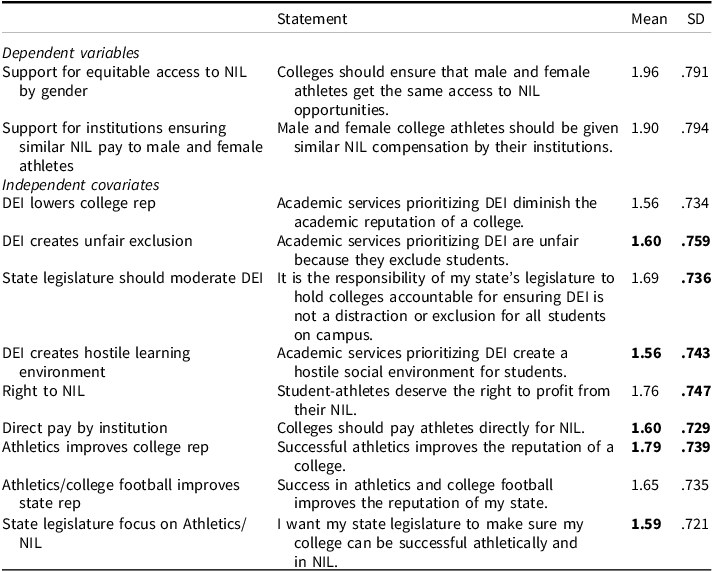
Given these distributions, two steps were taken to refine the regression model. First, sparse responses create a risk of overfitting and can inflate estimates of agreement, which limits the model’s reporting power (Greenland et al. Reference Greenland, Mansournia and Altman2016; Tibshirani Reference Tibshirani1996). To address this, I collapsed the three categories of the five-point scale that capture non-agreement into a single category which captures (1) non-agree, (2) agree, and (3) significantly agree. As the focus is to measure the level of agreement with the narrative statements, the justification for collapsing the categories is that it allows the analysis to focus on the severity of agreeing with the statements to provide an accurate measure of the narrative acceptance rather than simply focusing agreement versus non-agreement. Having this level of specificity in agreement provides a more objective view of support for gender equity in NIL. Taking this approach also addresses neutrality or midpoint bias, which occurs when respondents choose the neutral option as a path of least resistance or to avoid making a choice (de Winter and Dodou Reference de Winter and Dodou2010; Garland Reference Garland1991; Nadler et al. Reference Nadler, Weston and Voyles2015). Collapsing the categories allows the model to meet the parallel lines assumption and provides a clearer theoretical picture of the data (Agresti Reference Agresti2018). When responses cluster heavily at one end of the scale, a standard ordinal regression can produce misleading results. Table 2 provides descriptive results and prompt statements for the recoded dependent variables and the independent variables used as covariates.
Descriptive breakdown of Likert scale variables
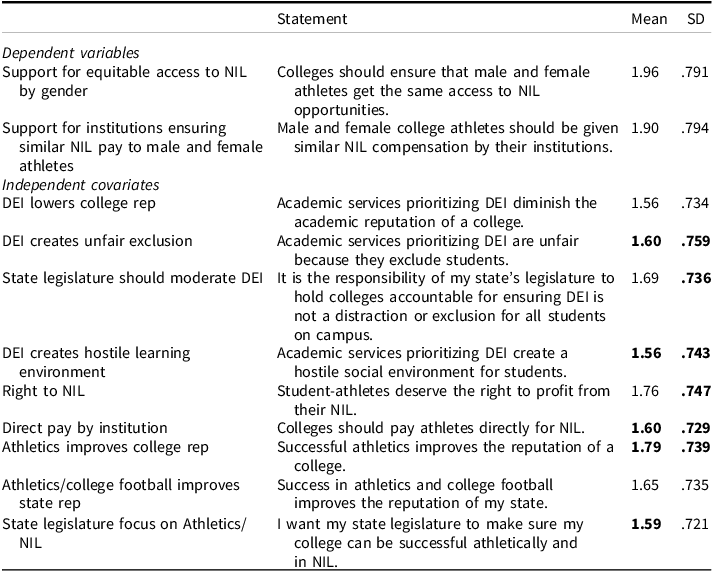
Table 2. Long description
A table with 14 rows and 3 columns. The columns are labeled Statement, Mean, and SD. The table is divided into two main sections: Dependent variables and Independent covariates. Each row lists a statement related to gender equity in Name, Image, and Likeness (NIL) opportunities, along with the mean and standard deviation (SD) values. The statements cover topics such as support for equitable access to NIL by gender, support for institutions ensuring similar NIL pay, and various opinions on Diversity, Equity, and Inclusion (DEI) initiatives. The mean values range from 1.56 to 1.96, and the SD values range from 0.721 to 0.794. The table provides a descriptive breakdown of the variables used in the regression model.
To further account for the distribution of responses, I use a cauchit link method (Nunnally and Bernstein Reference Nunnally and Bernstein1994) within the ordinal model to address heavy outliers at the edges of the scale.
A main-effects model including all independent variables is estimated for both dependent variables. The variables reflect four dimensions of public demand: (1) policy salience and engagement, (2) ideology and DEI views, (3) institutional reputation and legislative cues, and (4) demographic and media exposure. These categories align with expectations that support for gender equity in NIL is shaped by familiarity with college sports and NIL policy, broader ideological commitments, and perceptions of institutional responsibility. Together, they represent mechanisms through which public demand forms and provide a framework for testing the study’s hypotheses.
Policy salience and engagement are measured through views on NIL (importance, knowledge), support for college sports at different levels, and parent status. NIL salience captures how closely individuals follow the issue, which shapes opinion formation. Support for college athletics – categorized as non-DI/non-sports, Group of 5, or Power 4 – and parent status serve as proxies for personal investment in sports and higher education, increasing awareness of NIL debates and expectations about equity. Ideological and DEI variables include attitudes toward anti-DEI policies, political ideology (1 = significantly liberal to 5 = significantly conservative), gender, race, age, and education. These factors capture broader ideological orientations and demographic characteristics known to structure attitudes toward equity initiatives and higher education policy.
Institutional reputation and legislative cues are measured through agreement with statements about NIL and athletic success improving state and institutional reputation, as well as support for legislative involvement in DEI and NIL. These variables assess how respondents view the role of public institutions and state governments in shaping equity outcomes and reflect the study’s argument that NIL sits at the intersection of higher education governance and DEI policy domains. Media exposure is captured through primary information sources – social media, traditional media, or political statements – to account for the environments in which individuals encounter NIL and DEI debates. Distinguishing these sources allows the model to test whether different media contexts produce different equity attitudes.
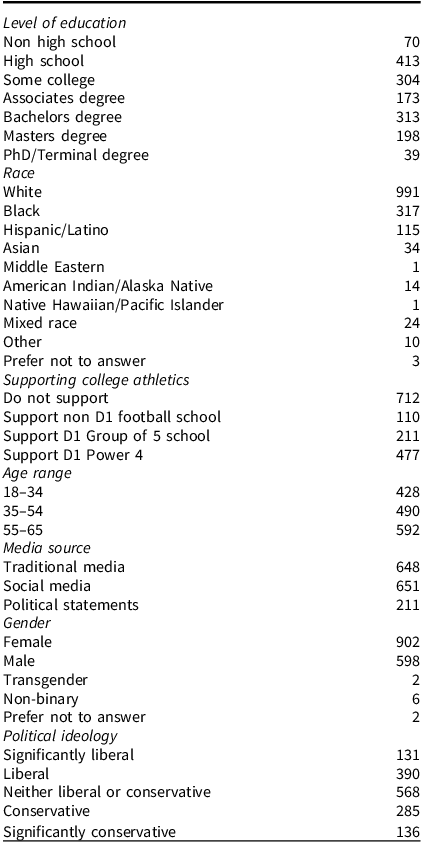
As shown in Table 3, the sample is majority white, female, and college-educated, with quotas ensuring an even age distribution. A total of 798 respondents report supporting college athletics, including 477 who support Power 4 programs. Traditional and social media are the most common information sources; a dummy variable for traditional media captures reliance on legacy news. The sample is ideologically moderate, with most respondents falling in the middle three categories, indicating it is not hyperpolarized.
Breakdown of survey respondents
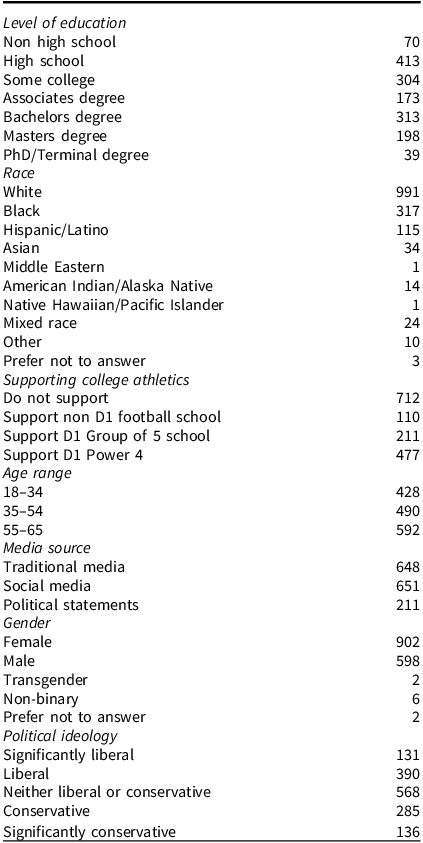
Table 3. Long description
A table summarizing survey respondents’ demographics and preferences. The table has 16 rows and 2 columns. The first column lists categories such as level of education, race, support for college athletics, age range, media source, gender, and political ideology. The second column lists the number of respondents in each category. Row 1: Level of education, Non high school, 70. Row 2: Level of education, High school, 413. Row 3: Level of education, Some college, 304. Row 4: Level of education, Associates degree, 173. Row 5: Level of education, Bachelors degree, 313. Row 6: Level of education, Masters degree, 198. Row 7: Level of education, PhD/Terminal degree, 39. Row 8: Race, White, 991. Row 9: Race, Black, 317. Row 10: Race, Hispanic/Latino, 115. Row 11: Race, Asian, 34. Row 12: Race, Middle Eastern, 1. Row 13: Race, American Indian/Alaska Native, 14. Row 14: Race, Native Hawaiian/Pacific Islander, 1. Row 15: Race, Mixed race, 24. Row 16: Race, Other, 10. Row 17: Race, Prefer not to answer, 3. Row 18: Supporting college athletics, Do not support, 712. Row 19: Supporting college athletics, Support non D1 football school, 110. Row 20: Supporting college athletics, Support D1 Group of 5 school, 211. Row 21: Supporting college athletics, Support D1 Power 4, 477. Row 22: Age range, 18-34, 428. Row 23: Age range, 35-54, 490. Row 24: Age range, 55-65, 592. Row 25: Media source, Traditional media, 648. Row 26: Media source, Social media, 651. Row 27: Media source, Political statements, 211. Row 28: Gender, Female, 902. Row 29: Gender, Male, 598. Row 30: Gender, Transgender, 2. Row 31: Gender, Non-binary, 6. Row 32: Gender, Prefer not to answer, 2. Row 33: Political ideology, Significantly liberal, 131. Row 34: Political ideology, Liberal, 390. Row 35: Political ideology, Neither liberal or conservative, 568. Row 36: Political ideology, Conservative, 285. Row 37: Political ideology, Significantly conservative, 136.
N = 1,510.
Results
Odds ratios are reported in Tables 4 through 7 and show the likelihood that a respondent indicates a higher level of agreement based on the predictors and covariates in the model. Ninety-five percent confidence intervals are included in brackets. Odds ratios above 1 indicate an increased likelihood of agreement with the statement, while those below 1 indicate lower agreement. Percent change is calculated using the formula (expB − 1) × 100.
Proportional odds results for equity access to NIL
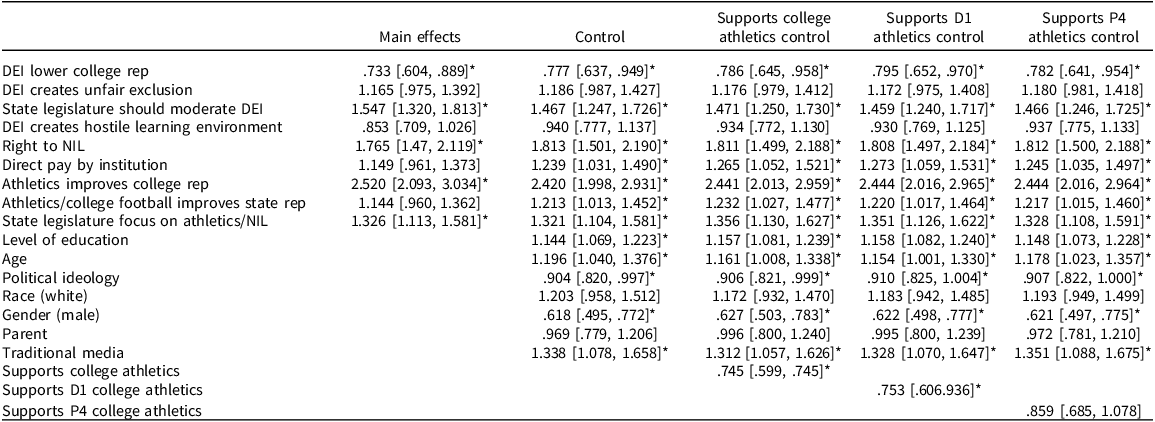
Table 4. Long description
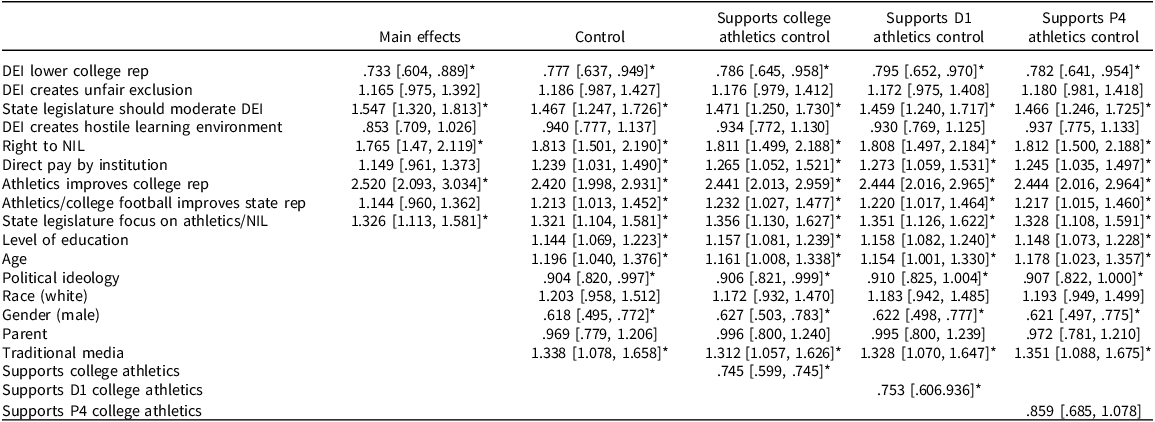
The table presents proportional odds results for equity access to NIL, showing odds ratios and 95 percent confidence intervals for various predictors and covariates. The table has 20 rows and 5 columns. Column headers are Main effects, Control, Supports college athletics control, Supports D1 athletics control, and Supports P4 athletics control. Row labels include DEI lower college rep, DEI creates unfair exclusion, State legislature should moderate DEI, DEI creates hostile learning environment, Right to NIL, Direct pay by institution, Athletics improves college rep, Athletics/college football improves state rep, State legislature focus on athletics/NIL, Level of education, Age, Political ideology, Race (white), Gender (male), Parent, Traditional media, Supports college athletics, Supports D1 college athletics, and Supports P4 college athletics. Each row lists the odds ratios and confidence intervals for the respective predictors and covariates across the different models.
* p <.05, odds ratio reported with 95% confidence intervals in brackets.
DEI and gender equity in NIL
To assess how public demand and salience shapes the connection between NIL and DEI, four measures that capture a negative view of DEI are used in the proportional odds model predicting the level of agreement with similar pay and gender equitable opportunities in NIL. These measures suggest that DEI lowers college reputations and create unfair exclusions and a hostile learning environment and support for legislative intervention. Higher agreement is evidence of more support for limiting DEI in higher education.
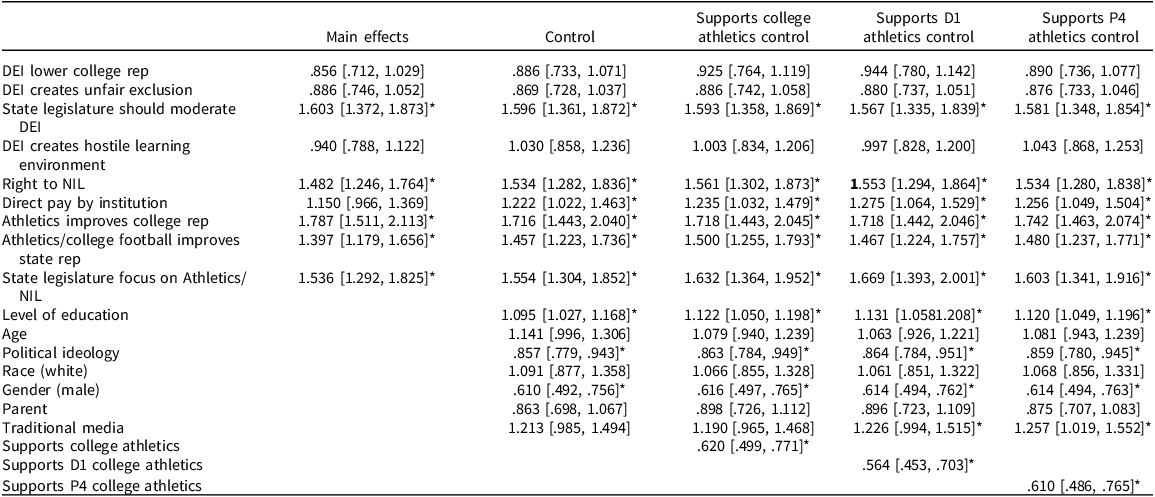
The results shown in Tables 4 and 5 suggest mixed support for H2 that predicts that anti-DEI attitudes would reduce support for gender equity in NIL. Only the belief that DEI policies lower college reputations are significantly associated with lower support for equitable access to NIL (OR = 0.73, p <.05). This result extends to all control models but not to support similar pay in NIL. Other DEI measures, including beliefs that DEI creates unfair exclusions or fosters a hostile learning environment, do not reach significance in either model. Notably, the odds ratios for unfair exclusion trend positive, suggesting that anti–DEI sentiment does not uniformly translate into opposition to NIL equity. Contrasting these results, there is a consistently significant association across the models for state legislatures to intervene to minimize the effect of DEI for both equitable access and similar pay in NIL. These results support H1 that connects gender equity to driving for NIL legislation. Respondents endorsing legislative intervention show substantially higher odds of supporting equitable access (OR = 1.55) and similar NIL pay (OR = 1.60), with stable effects across all specifications.
Proportional odds for similar pay in NIL
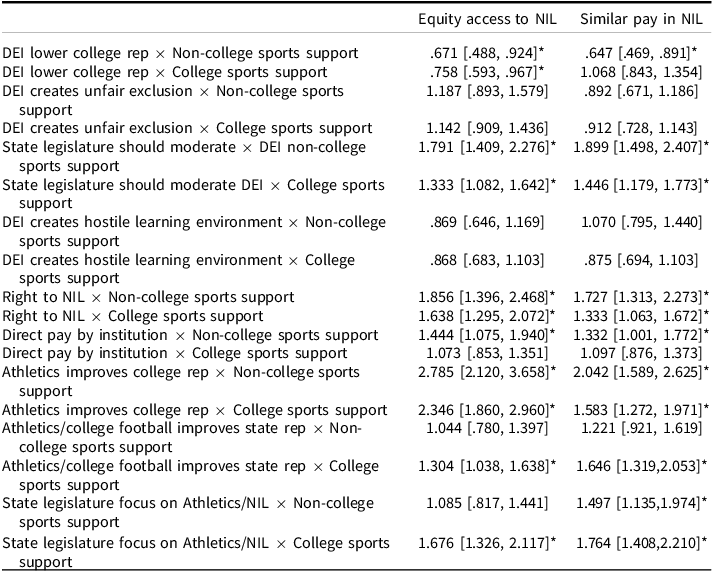
Table 5. Long description
The table presents proportional odds for similar pay in NIL across various models and factors. It includes columns for Main effects, Control, Supports college athletics control, Supports D1 athletics control, and Supports P4 athletics control. Each column lists odds ratios with confidence intervals for different factors such as DEI lower college rep, DEI creates unfair exclusion, State legislature should moderate DEI, and more. The table has 20 rows, each representing a different factor influencing the odds. Notable trends include significant associations for state legislatures intervening to minimize the effect of DEI for both equitable access and similar pay in NIL.
* p <.05, odds ratio reported with 95% confidence intervals in brackets.
These findings indicate that DEI attitudes are not monolithic predictors of NIL equity preferences. Only concerns about reputational harm and preferences for legislative intervention show consistent associations, and in opposite directions. These data highlight the complexity of how broader equity attitudes shape public views on NIL policy.
NIL: Overall support and gender equity
The relationship between NIL salience and support for gender equity in NIL shows positive associations across both dependent variables. Five covariates capture NIL salience: agreement that student-athletes deserve the right to earn from their NIL, support for institutions directly paying athletes for NIL, beliefs that athletics improves college and state reputations, and preferences for increased legislative focus on athletic and NIL success. Together, these measures reflect how respondents evaluate NIL as a policy domain and the extent to which they view athletics as central to institutional and state identity. Across all models, individuals who view NIL positively exhibit higher odds of supporting gender equity in NIL, consistent with H3 which suggests that higher salience for NIL as a sports-based policy will increase support for gender equity.
In the equity-access models (Table 4), several NIL-salience covariates show strong and significant effects. Agreement with the right to NIL is associated with substantially higher odds of supporting equitable access (OR = 1.81, p =.000), as is the belief that athletics improves college reputation (OR = 2.44, p =.000). Respondents who want greater legislative focus on athletics and NIL also show higher odds of supporting equity access (OR = 1.33, p =.002). Support for direct institutional pay and the belief that athletics enhances state reputation are significant in some specifications, and all effects remain stable when demographic and athletics-support controls are added.
Results for similar NIL pay (Table 5) follow the same pattern. Four of the five NIL-salience covariates are significant in the main-effects model. Belief that athletics improves college reputation again produces the strongest association (OR = 1.79, p =.000). Support for the right to NIL (OR = 1.53, p =.000), belief in athletics’ contribution to state reputation (OR = 1.40, p =.000), and preferences for legislative attention to NIL (OR = 1.54, p =.000) all increase support for similar pay. Direct pay becomes significant once controls are added. These results provide clear support for H3, demonstrating that NIL salience is strongly and consistently associated with support for gender equity in NIL.
Overall, the strong and consistent effects of NIL salience suggest that the public increasingly understands NIL through an equity–oriented lens, where support for athlete rights and the perceived institutional value of athletics translate into expectations for gender–equitable treatment. These findings support the theoretical argument that NIL occupies a growing space within the broader DEI landscape and is evaluated through the same ideological and institutional dynamics outlined in theory section.
NIL and population support
Controlling for population characteristics and levels of sport support reveals demographic and ideological patterns that help explain how respondents evaluate gender equity in NIL. These controls capture socioeconomic and informational factors that shape how individuals understand higher education and its equity responsibilities. Tables 4 and 5 include ordinal measures of education and age, political ideology, and categorical indicators for race, gender, parental status, and reliance on traditional media.
For both dependent variables, support for equitable access to NIL opportunities (Table 4) and support for universities ensuring similar NIL pay (Table 5), education emerges as the most consistent demographic predictor. Higher levels of education correspond with a 14.4 percent increase in the odds of supporting equity access (p =.000) and a 10.9% increase in the odds of supporting similar NIL pay (p =.000). These results suggest that education may heighten awareness of fairness norms and institutional responsibility, reinforcing the expectation that more educated respondents are more receptive to equity-oriented policy interventions.
Age and traditional media use show more conditional effects. In the equity-access model, older respondents show a 19.6% increase in the odds of support (p =.012), and traditional media users show a 33.8% increase (p =.000). Although age is not significant in the similar-pay model, traditional media becomes significant when controlling for support of Division I athletics (OR = 22.6%, p =.000) and Power 4 athletics (OR = 25.7%, p =.033). These patterns suggest that certain demographic groups – particularly older respondents and traditional media consumers – may view NIL equity through broader concerns about institutional legitimacy or trust in established information sources.
Political ideology and gender show the clearest negative associations. Movement from liberal to conservative positions corresponds with lower support for equity access (−9.6%, p =.044) and similar pay (−14.3%, p =.001). Men are 38.2% less likely to support equity access (p =.000) and 39% less likely to support similar pay (p =.000). These findings align with expectations that ideological orientations and gendered perceptions of fairness shape attitudes toward equity in college sports. Race and parental status are not significant in either model. Support for college athletics, measured at the general, Division I, and Power 4 levels, is consistently associated with lower odds of supporting gender equity in NIL. These results reinforce the theoretical expectation that stronger allegiance to competitive college sports corresponds with reduced support for institutional equity measures, consistent with H1 and H3.
Overall, these demographic and sports-focused results suggest that gender equity in NIL is connected to a broader ideological view of fairness, institutional responsibility, and the place of athletics in higher education. These results support the argument that NIL functions as an emerging policy domain for equity in higher education and is shaped by and reinforces the broader political and demographic tropes that influence the traditional policy landscape of DEI.
Interaction results
Two sets of interaction models assess whether political ideology and support for college athletics condition the relationships observed in the main-effects models. While the main effects models provide results about whether DEI, NIL salience, and athletics predict gender-equity attitudes, the interaction models provide how these relationships get stronger or weaker. These interactions clarify how broader political orientations and sport identities shape public evaluations of gender equity in NIL. As reported here, these interaction models show that conservativism amplifies anti-DEI sentiments while doing the same for pro-NIL views. This suggests polarization in opposite directions and provides that NIL is a hybrid-DEI policy.
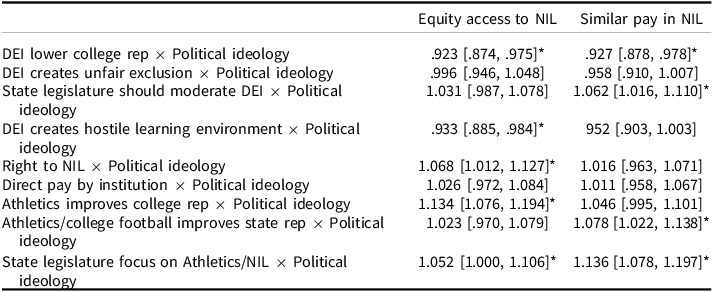
The first set of models interact each DEI and NIL covariate with political ideology to evaluate how becoming more conservative alters their associations with support for gender equity in NIL (Table 6). The results reveal a polarizing ideological pattern rather than a uniform dampening effect. For DEI attitudes, conservatism strengthens negative associations. The interaction between political ideology and the belief that DEI lowers college reputation is significantly negative for both equity access (OR =.923, p <.05) and similar pay (OR =.927, p <.05). A similar negative interaction appears to be the belief that DEI creates a hostile learning environment (OR =.933, p <.05 for equity access). These findings indicate that anti-DEI sentiment becomes a stronger predictor of opposition to NIL equity as respondents become more conservative, consistent with H2.
Proportional odds for political ideology interaction models

Table 6. Long description
A table with 8 rows and 3 columns. The columns are labeled ‘Equity access to NIL’, ‘Similar pay in NIL’, and interaction terms with political ideology. Each row represents a different interaction term. Row 1: DEI lower college rep x Political ideology, Equity access to NIL: .923 [.874, .975]*, Similar pay in NIL: .927 [.878, .978]*. Row 2: DEI creates unfair exclusion x Political ideology, Equity access to NIL: .996 [.946, 1.048], Similar pay in NIL: .958 [.910, 1.007]. Row 3: State legislature should moderate DEI x Political ideology, Equity access to NIL: 1.031 [.987, 1.078], Similar pay in NIL: 1.062 [1.016, 1.110]*. Row 4: DEI creates hostile learning environment x Political ideology, Equity access to NIL: .933 [.885, .984]*, Similar pay in NIL: .952 [.903, 1.003]. Row 5: Right to NIL x Political ideology, Equity access to NIL: 1.068 [1.012, 1.127], Similar pay in NIL: 1.016 [.963, 1.071]. Row 6: Direct pay by institution x Political ideology, Equity access to NIL: 1.026 [.972, 1.084], Similar pay in NIL: 1.011 [.958, 1.067]. Row 7: Athletics improves college rep x Political ideology, Equity access to NIL: 1.134 [1.076, 1.194], Similar pay in NIL: 1.046 [.995, 1.101]. Row 8: Athletics/college football improves state rep x Political ideology, Equity access to NIL: 1.023 [.970, 1.079], Similar pay in NIL: 1.078 [1.022, 1.138]*. Row 9: State legislature focus on Athletics/NIL x Political ideology, Equity access to NIL: 1.052 [1.000, 1.106], Similar pay in NIL: 1.136 [1.078, 1.197]*.
* p <.05, odds ratio reported with 95% confidence intervals in brackets.
In contrast, several NIL-salience interactions move in the opposite direction. Conservatism amplifies positive NIL effects, particularly for beliefs that athletics improves college reputation (OR = 1.134, p <.05 for equity access) and enhances state reputation (OR = 1.078, p <.05 for similar pay). Legislative focus on athletics and NIL also shows a positive interaction for similar pay (OR = 1.136, p <.05). These results suggest that among conservatives, NIL salience becomes an even stronger driver of support for gender equity in NIL, aligning with H3.
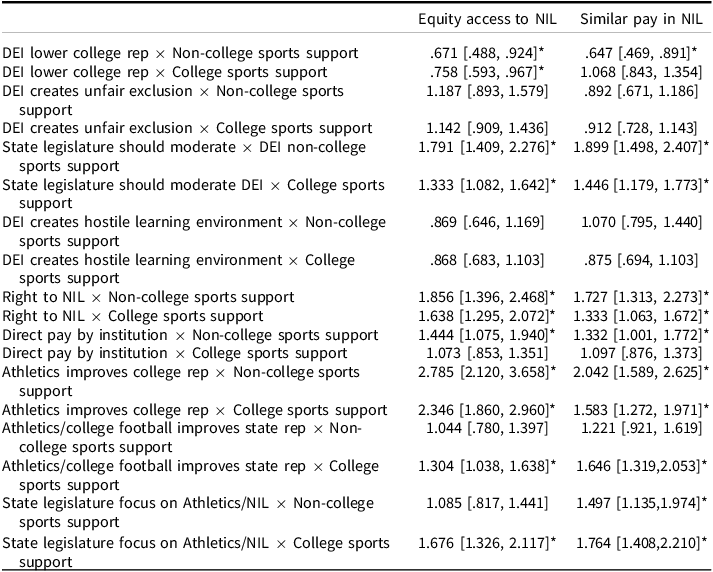
The second set of models interacts DEI and NIL covariates with support for college athletics (Table 7). A consistent pattern emerges, respondents who do not support college athletics show stronger positive associations between most covariates and support for gender equity in NIL. For example, the interaction between “DEI lowers college reputation” and non-support for college sports is strongly negative for both outcomes (ORs =.671 and.647), indicating sharper opposition to equity among non-fans holding anti-DEI views. In contrast, sports supporters show amplified positive NIL-salience effects, particularly for beliefs that athletics improves college reputation (ORs = 2.785 and 2.042). These results reinforce the theoretical expectation that sport identity shapes how NIL is interpreted as an equity issue, consistent with H1 and H3.
Proportional odds for support for college athletics interaction models
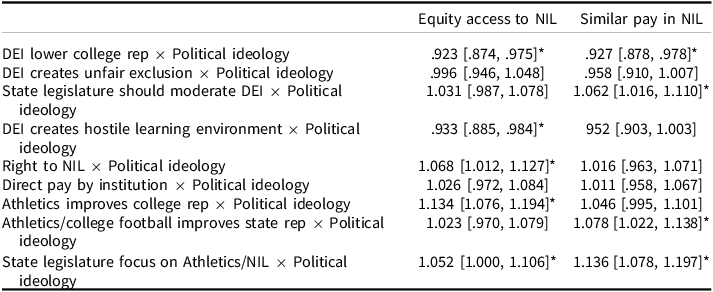
Table 7. Long description
A table with 16 rows and 3 columns comparing odds ratios for support of college athletics interactions. The columns are labeled ‘Equity access to NIL’, ‘Similar pay in NIL’, and values are reported with 95 percent confidence intervals in brackets. Row labels include various interaction terms such as ‘DEI lower college rep x Non-college sports support’, ‘DEI lower college rep x College sports support’, and so on. Each row provides odds ratios and confidence intervals for two different models. Notable trends include varying levels of support indicated by odds ratios above or below 1, reflecting increased or decreased likelihood of agreement with statements related to college athletics interactions.
* p <.05, odds ratio reported with 95% confidence intervals in brackets.
The interaction results demonstrate that ideology and sport identity operate as interpretive lenses that structure how respondents translate DEI and NIL attitudes into positions on gender equity. Conservativism increases the divide between DEI-based opposition and support for NIL. The connection to college sports increases the impact of how athletics view these policies.
These dynamics support the expectation that NIL occupies a hybrid policy space where equity norms and sport identities jointly shape public opinion.
These results show that across all models there is a pattern that attitudes toward gender equity in NIL are not driven by one factor, but by an intersection of views on politics, NIL, and the salience of college athletics. DEI attitudes and public demand for NIL show consistent effects, while demographics and ideological factors shape the intensity and direction of the relationship between DEI and NIL. The interaction model shows that ideology and sport identity are filters that enhance or reduce the influence of DEI and NIL cues. Theoretically, these results affirm the broader argument that NIL equity attitudes are embedded in the same political and cultural frameworks as those that shape DEI in higher education.
Discussion
Policy and administration scholarship is centrally concerned with how institutions interpret political signals, allocate resources, and implement equity mandates under conditions of legal and organizational constraint. NIL provides a clear case for examining these dynamics. Universities must make administrative decisions about compensation, resource distribution, compliance, and equity while balancing NIL with other educational policies and institutional goals. This work therefore offers an analysis of how overlapping policy domains and public service mandates – athletic objectives under NIL and compliance with equity requirements such as Title IX – create classic public administration challenges related to discretion, institutional capacity, and navigating political mandates.
Based on these data, this study provides a clearer understanding of public demand at the intersection of gender equity, DEI, and NIL. Consistent with the view that public demand reflects the interaction of opinion and issue salience (Burnstein Reference Burstein2003; Bromley-Trujillo and Poe Reference Bromley-Trujillo and Poe2020; Edelman and Carrier Reference Edelman and Carrier2025; Oehl et al. Reference Oehl, Schaffer and Bernauer2017; Park Reference Park2025; Perkiss Reference Perkiss2026; Schaffer et al. Reference Schaffer, Oehl and Bernauer2022), the findings demonstrate how attitudes toward DEI meaningfully shape public support for gender equity in NIL. This establishes a baseline for how the public connects gender equity to broader equity debates in higher education and how those connections extend into college sports through NIL. Although NIL presents well-documented challenges related to gender equity in earnings and implementation (Boston Reference Boston2022; Edelman and Carrier Reference Edelman and Carrier2025; Hawley-Alexander Reference Hawley–Alexander2025; Jessop et al. Reference Jessop, Baker, Tweedie and Holden2023; Lovell Reference Lovell2025; Moorman and Cocco Reference Moorman and Cocco2023; Perkiss Reference Perkiss2026; Sniffen and Wolff Reference Sniffen and Wolff2026; Toppmeyer Reference Toppmeyer2025), the results show strong public support for institutions ensuring equitable access to NIL opportunities and similar pay across genders. By demonstrating that public attitudes toward gender equity in NIL are structured by ideology, salience, and views of DEI, this study shows that NIL is not an isolated athletics concern, but an emerging equity policy domain shaped by the same forces that influence hiring, admissions, and student services. This positions NIL as a consequential site of public governance where administrators must balance legal mandates (e.g., Title IX), political pressures, and public expectations.
This work identifies NIL as a policy domain that simultaneously requires administrative action and is shaped by public salience and political influence. These findings bridge equity debates in higher education with the administrative challenges that define governance of this public service. Overall, the findings reveal three takeaways that address each of the three hypotheses and offer clarity into how public demand is applied to gender equity in NIL.
Takeaway 1: legislative cues and institutional reputation provide partial support for gender equity in NIL (H1)
The results show that support for legislative involvement in higher education and agreement with statements linking NIL to institutional or state reputation are associated with higher odds of supporting gender equity in NIL. Covariates measuring support for legislative action in both NIL and DEI were associated with stronger agreement that universities should ensure equitable access to NIL opportunities and similar pay for male and female athletes. This suggests that public demand for equity is partly tied to expectations of political action and the symbolic value of college sports (Lovell and Mallinson Reference Lovell and Mallinson2023). At the same time, the model results indicate that this demand is not uniform. Once additional ideological and DEI–related factors are introduced, the influence of legislative cues becomes more conditional. This is apparent in the interaction models as conservatism has influence, but in different directions.
Considering these takeaways, H1 receives partial support: legislative and reputation–based salience matters, but they are not the dominant forces shaping equity attitudes. This suggests a shift in thinking by suggesting that policy-specific cues are not the dominant factor in explaining public demand for gender equity in NIL. Instead, there is a broader ideological influence that better explains how individuals interpret equity issues in higher education. Expanding the understanding that ideological cues are the primary influence, this study positions NIL as an emerging equity policy domain that is shaped by political and cultural factors.
Takeaway 2: NIL is interpreted through the same ideological and DEI-structured lens that shapes broader equity debates (H2)
Across all models, higher agreement with anti–DEI positions corresponds with significantly lower odds of supporting gender equity in NIL. This pattern appears consistently across both dependent variables and aligns with research showing that gender equity and DEI debates in higher education are politically contested (Bowden and McCauley Reference Bowden and McCauley2016; Edelman and Carrier Reference Edelman and Carrier2025; Evans and Knepper Reference Evans and Knepper2024; Frias Lopez et al. Reference Javier and Torres2024; Martin and Rahilly 2023; Meyer et al. Reference Meyer, Evans and Luis Irizarry2025; Perkiss Reference Perkiss2026; Sniffen and Wolff Reference Sniffen and Wolff2026). Demographic results reinforce this connection: higher education and older age increase support for gender equity in NIL, while conservative ideology and being male reduce it. Of all demographic factors, being male shows the lowest odds of supporting gender equity, mirroring populations that favor increased regulation of DEI. These findings provide strong support for H2 and demonstrate that NIL – though tied to institutional reputation and alumni pride – shares the same ideological and demographic structuring as DEI. This indicates that NIL can be studied within the broader DEI policy framework, with similar political and policy dynamics applied. This is a key takeaway as it shows that NIL is viewed and interpreted through the same ideological and demographic frameworks that shape DEI debates. This is evidence of a spillover across the policy domains and shows that DEI opinions are among the strongest predictors of the public demand for equity in NIL and suggests universities should treat it similarly to DEI policies.
Takeaway 3: NIL salience increases support for equity, but strong allegiance to college sports reduces it (H3)
Building public demand often involves identifying gaps in public information and filling them with favorable narratives (Clinton and Grissom Reference Clinton and Grissom2015). As noted by Collins (Reference Collins2024), value branding suggests that political officials use partisanship to shape narratives in policy areas where information asymmetry is high, which can be manipulated when public information is low (Kamola Reference Kamola, Mégret and Ramanujam2024). Respondents who view NIL as important or who support direct institutional involvement show higher odds of supporting gender equity, consistent with expectations that salience increases public demand (Bromley–Trujillo and Poe Reference Bromley-Trujillo and Poe2020; Burnstein Reference Burstein2003; Wlezien Reference Wlezien2005).
In contrast, as salience for college athletics increases – particularly for high–revenue Power 4 competition – the odds of supporting gender equity in NIL decline sharply. These results show a more nuanced pattern. This divergence suggests that while NIL salience promotes equity support, sport salience does the opposite. The interaction model reinforces the pattern that respondents with low allegiance to college sports are more likely to view NIL through an equity lens, while those deeply invested in competitive athletics prioritize competitiveness over equity. These findings provide nuanced support for H3 and highlight a tension between equity goals and the competitive logic of college sports. This challenges the traditional expectation in public demand literature that higher salience increases support for legislative action. Instead, it suggests that salience can operate in different ways, in this case NIL salience promotes support for equity while salience in college sports suppresses it. This split shows a rift highlighting a core tension in higher education governance, showing that public demand for equity is shaped not only by policy awareness but also by the competitive identities and cultural attachments to activities such as colleges sports.
Limitations of the study
Some limitations of the study have been noted above, particularly those related to sparse data. It is difficult to gain a complete view of political influence without surveying individuals in every state. To address the political landscape, the sample includes two states controlled by Democrats in both the legislature and the executive branch (Maryland and New York), one with divided government (Kentucky), and two controlled by Republicans (Florida and Texas). These states also differ in their primary sport focus. For example, New York and Kentucky are more closely associated with basketball, while Texas is more closely associated with football. In addition, although the five states included in the sample offer political and athletic diversity, they do not represent the full range of higher education environments in the United States. States with different political cultures, athletic traditions, or institutional structures may exhibit different patterns of public demand for gender equity in NIL.
Survey metrics were used to balance respondent categories, although there is still some randomness in the data. Even with this limitation, the survey population and the distribution of states provide a randomized sample that is sufficient to make general observations about public views of gender equity in NIL. Also, the narrative statements used to capture opinion toward NIL and DEI policies reflect common themes but cannot fully represent the complexity of how individuals understand these issues. Finally, there is always a limitation in survey research regarding self-reporting knowledge and opinions that introduce a level of bias in how respondents estimate different factors. These limitations do not diminish the work here but should be taken into consideration. Future research can expand the longitudinal nature of this study as well as incorporate more states to provide a deeper understanding of the topic.
Conclusion
To date, no direct connection has been drawn between NIL and DEI policies, even though both shape higher education and involve debates about fairness and the treatment of athletes. This study makes that connection by examining how the public views NIL, DEI, and gender equity. As NIL evolves, gender equity challenges have emerged in how institutions balance market-driven athletic goals with long-standing equity mandates under Title IX and related administrative policies. These challenges place NIL within the broader DEI policy debates that shape actions on college campuses. Because these arenas are politically charged, understanding public perceptions offers a clearer view of the complexity of NIL and its relationship to DEI.
The results show that the public associates NIL with DEI, as both policies share similar ideological and demographic divides. When focusing on gender equity and institutional responsibility, public demand follows the same patterns that structure DEI debates. Although sport policy is tied to civic pride and institutional reputation, the salience of college sports does not translate into consistent support for equity in NIL, even though NIL salience itself increases support. This divergence suggests that NIL extends beyond the boundaries of sport policy and occupies a broader equity-oriented policy space.
Establishing a baseline of public demand for NIL provides a foundation for future research on how the public engages with NIL and with equity in higher education more broadly. The findings point to the need for research comparing the narrative strategies used in NIL debates with those used in DEI policy discussions, particularly in conservative states where support for high-revenue athletics coexists with strong opposition to DEI practices. Understanding these dynamics will be essential as institutions and policymakers navigate the evolving landscape of NIL and its implications for equity in higher education.
Data availability statement
Replication materials for this study are not publicly available due to compliance with the approved IRB protocol (WTAMU.2024.10.011) but are available from the author by request. A code file has been uploaded to the Harvard Dataverse, https://doi.org/10.7910/DVN/ZHRIYS.
Acknowledgments
The author would like to thank Dr. Haley Lovell and Dr. Daniel Mallinson for their help with this project.
Funding statement
This work was funded in part by grants from the Kilgore Research Center at West Texas A&M University and the Institute for Humane Studies at George Mason University.
Competing interests
The author has no relevant financial or non-financial interests to disclose.
Ethical standards
The survey has been reviewed and approved by the West Texas A&M University Institutional Review Board (WTAMU.2024.10.011).
Use of artificial intelligence (AI) tools
During the revision of this manuscript, the author used Microsoft co-pilot for editing purposes to improve language and readability. After using the tool, the author edited the content as needed and takes full responsibility for the publication’s content. The AI tool was also used to generate Figure 1. The author ensures that all information has been verified as their own and represents their own analysis and research.
. Conceptual model linking NIL salience, DEI attitudes, political ideology, and athletics salience to public demand for gender equity in NIL.
Note: Public support for gender equity in NIL reflects four influences: NIL salience increases support; DEI attitudes align with broader equity debates; political ideology moderates these relationships; and athletics salience reduces support as engagement with high–revenue sports grows. This image was generated with Microsoft copilot.



 Open access

