Introduction
Selective breeding has been the basis for successful crop improvement since the very beginning of agriculture. Although this method has delivered great yield dividends, it has led to many serious diseases and insect pest problems due to reduced genetic variability, improved cultural practices and continuous increase in rice cropping area. In this context, researchers in the past have tried to increase crop diversity not only from the primary gene pool but also from the secondary and tertiary gene pools (Smartt, Reference Smartt1981).
World population is expected to reach nine billion by 2050 (UN, 2009). As cereals contribute to the majority of calorie intake in tropics, increase in rice productivity would play a pivotal role in food security. In this context, hybrid rice technology offers a potentially viable option for increasing rice yield. The yield advantage of hybrids (20–30%) in comparison with conventional varieties offers great potential in this direction (Ma and Yuan, Reference Ma, Yuan, Virmani, Mao and Hardy2003; Virmani, Reference Virmani, Virmani, Mao and Hardy2003). In addition, hybrids possess better adaptability to diverse crop environments. However, current challenges to the increased adaptability of hybrids in farmers' fields include high yield, resistance to key pests and diseases, and desirable quality traits. For the development of rice breeding and production of high-yielding rice varieties, it is important to use genetically diverse germplasm resources to expand and enrich the genetic base of parental lines.
There are a number of methods to study genetic divergence among genotypes. One of them is the analysis of coefficient of parentage (COP), which is an inexpensive indicator of genetic diversity for the cultivars of self-pollinating species with known pedigrees (Almanza-Pinzón et al., Reference Almanza-Pinzón, Khairallah, Fox and Warburton2003; Murphy et al., Reference Murphy, Cox and Rodgers1986; Souza and Sorrells, Reference Souza and Sorrells1989; St. Martin, Reference St. Martin1982). Genetic variation in gene pools of self-pollinated crops has been analysed by studying the pedigree relationship between cultivars released over a period of time. To date, COP values have been estimated for oats (Souza and Sorrells, Reference Souza and Sorrells1988), soybean (Zhou et al., Reference Zhou, Carter, Cui, Miyazaki and Burton2002), winter wheat (Van-Beuningen and Busch, Reference Van-Beuningen and Busch1997) and rice (Wang and Lu, Reference Wang and Lu2006), among other crops. However, there are limited studies where genetic diversity has been reported for parental lines of hybrid rice using COP and molecular markers.
Molecular marker analysis has emerged as an alternative approach for assessing the genetic diversity among a given set of genotypes (Lapitan et al., Reference Lapitan, Brar, Abe and Redoña2007). There have been a number of studies in the past where various genetic markers have been used for studying genetic diversity. However, simple sequence repeat (SSR) markers are still the preferred molecular markers for assessing genetic diversity due to their characteristic features such as high polymorphism rate, reproducibility, genome-wide coverage, co-dominant nature, amenability to high-throughput genotyping and cost-effectiveness (Varaprasad and Rani, Reference Varaprasad and Rani2010).
The objectives of the present study were (1) to determine the overall genetic diversity among a set of advanced breeding lines of rice based on COP and molecular marker analyses, (2) to identify prospective restorers and maintainers for wild abortive (WA) cytoplasm, and (3) to validate fertility restoration-linked markers among the restorers and maintainers identified in the study.
Materials and methods
Plant material
In all, 124 genotypes comprising lines with resistance to bacterial blight (51), blast (23) and brown planthopper (11) and tolerance to salinity (19), abiotic stress (6), drought (5), acid sulphate (1) and iron toxicity (1), one line with high iron content, and six lines with new plant types (NPTs) were studied. These lines were made available to the Barwale Foundation, Hyderabad, India, by the International Rice Research Institute (IRRI), Los Baños, Philippines (Table S1, available online).
Evaluation of fertility restoration
The experimental plant material was raised at the Barwale Foundation Research Farm, Hyderabad, India (coordinates: 17°24′22″N and 78°12′40″E), during the wet season of 2009. The genotypes were crossed with a WA-cytoplasmic male sterile (CMS) line IR 58025A to produce 10–15 F1 seeds per cross during the dry season of 2009–10. The recommended package of cultivation practices was followed. Care was taken to plant only a single seedling per hill. All distinct 124 F1 plants were evaluated for spikelet fertility, which was computed as the percentage of seeds set based on panicles of the main tiller and two side tillers of individual plants (bagged with parchment paper before flowering) of each F1 plant. The number of seeds set in each panicle was counted and used for calculating the percentage of spikelet fertility. The percentage of spikelet fertility of individual plants was taken as the average of spikelet fertility of an individual panicle selected from each plant. Based on the percentage of spikelet fertility, plants in each population were grouped into four classes, namely fertile (more than 70% fertility), partially fertile (31–70% fertility), partially sterile (1–30% fertility) and sterile (0% fertility) as detailed in Sheeba et al. (Reference Sheeba, Viraktamath, Sivaramakrishnan, Gangashetti, Khera and Sundaram2009). Furthermore, data on days to 50% flowering, plant height, productive tillers per plant and panicle length were also recorded.
Computation of COP among the genotypes
COP analysis was carried out using the International Rice Information System (IRIS) software (McLaren et al., Reference McLaren, Bruskiewich, Portugal and Cosico2005). To calculate COP values for each pair of the 124 entries, first a list of all the genotypes used in the study was created in the SETGEN module of the IRIS software. Then, using the BROWSE module embedded in the IRIS software, COP values were calculated. COP values were obtained in the output file BROWSE.LOG, which were then copied to an excel file for the sake of simplicity and better management of data. COP values obtained for all pairs in the list were ordered as the lower triangular part of the COP matrix in a.LOG file by rows in sections of ten columns.
Assumptions made in the algorithm to compute COP values included the following: (1) if two lines are derived from different crosses, the COP between the lines is unaffected by inbreeding; (2) a line derived from a cross obtains one-half of its genes from each parent; (3) if the progenitors of a line Z are unknown, then FZ
is set as 1 in self-fertilizing crops and 0 in out-crossing crops; (4) all ancestors are unrelated (COP = 0); (5) if the number of selfing generations is unknown, then the number of filial generations is considered to be F4; (6) all ancestors and lines are homozygous and homogeneous; (7) the COP between a line and a reselection from it equals 0.75; (8) the COP between two selections from the same line or ancestor is
 $$(0.75)^{2} = 0.5625 $$
; and (9) if P and Q are sister lines, then their COP is affected by selfing up to their most recent common ancestor Z and
 $$COP_{PQ} = (1 + F_{z} )/2 $$
. For all pairwise combinations of lines, COP values were computed from pedigree information using the method of Cox et al. (Reference Cox, Lookhart, Walker, Harrell, Albers and Rodgers1985).
Selection of SSR markers for genetic diversity and validation study
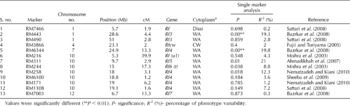
For genetic diversity analysis, a total of 58 SSR markers were used for the 124 germplasm lines, with an average of five markers per chromosome. Among these, 13 markers were found to be linked to Rf genes on chromosomes 1, 4, 7, 10 and 12 (Table 1). The association of the 13 Rf markers with the restorer and maintainer lines identified in the study was determined using single-marker analysis (SMA) with a t-test and regression analysis using SPSS 16.0 (SPSS Inc. Released 2007. SPSS for Windows, Version 16.0. Chicago, SPSS Inc.)
List of the reported Rf markers and single marker analysis showing P and R2 (%) values of the simple sequence repeat markers and genotypes used in the study

WA, wild abortive; CW, Chinese wild rice; cM, centimorgans.
Values were significantly different (**P< 0.01); P- significance; R 2 (%)- percentage of phenotype variability.
a Dissi, an indica variety DS97A from Senegal.
DNA isolation and SSR genotyping
Genomic DNA was isolated from young and healthy leaf samples following the protocol of Dellaporta et al. (Reference Dellaporta, Wood and Hicks1983). For SSR genotyping, a polymerase chain reaction (PCR) was carried out using 15–20 ng of template DNA, 0.05 mM of dNTPs (Eppendorf, Hamburg, Germany), 5 pM of each of the forward and reverse primers (Sigma, Banglore, India), 0.5 units of Taq DNA polymerase (Merck, Mumbai, India) and 1 × PCR buffer (Merck, Mumbai, India) in a total volume of 15 μl. The PCR was carried out using a Bio-Rad MyCycler thermal cycler with initial denaturation being carried out at 94°C for 5 min, followed by 35 cycles of PCR product amplification under the following conditions: 15 sec at 94°C, 30 sec at 55°C, and 45 sec at 72°C, followed by final extension at 72°C for 6 min. The PCR-amplified products were resolved on 8% polyacrylamide gels in 0.5 × TBE buffer at 100 V. Following staining with ethidium bromide, the gels were visualized under UV light in a gel documentation system.
Scoring and marker data analysis
The banding pattern, as revealed by gel analysis, was scored on the basis of the number of alleles present for a particular marker for each genotype. The software PowerMarker version 3.25 (Liu and Muse, Reference Liu and Muse2005) was used for calculating the average number of alleles, allele frequency, allele diversity and polymorphism information content (PIC) values.
Cluster analysis based on COP values and molecular marker genotyping data
The COP matrix was used for generating a dendrogram between pedigree levels and genetic diversity with the DARwin version 5.0.158 program (Perrier and Jacquemond-Collet, Reference Perrier and Jacquemond-Collet2006). The DARwin program was used for generating COP and molecular marker matrix, employing the UPGMA method of clustering in neighbour-joining procedure, developed by Saitou and Nei (Reference Saitou and Nei1987). Tree construction was performed using the axial tree representation mode.
On the basis of their respective fertility restorer phenotypes, the lines were classified into four groups, namely maintainer, partial maintainer, partial restorer and restorer. Furthermore, the mean COP and marker values for the four groups were calculated based on the COP and marker-based dissimilarity matrix. Also, according to the trait of interest in these breeding lines, COP values were computed for seven categories. The mean COP and marker values of the categories were considered to be indicators of their relative diversity (Table 2).
List of the frequencies of maintainers, partial maintainers, partial restorers and restorers identified in the study

COP, coefficient of parentage; SF, spikelet fertility
a As there was only one line for the categories-high iron content, acid sulphate tolerant and iron toxicity tolerant, COP and genetic diversity values are not reported for these lines.
b Computed using the DARwin-based UPGMA method.
c SF percentage of the F1 plants from crossing the maintainer line IR58025A.
d Number of genotypes studied.
Results
Cluster analysis using COP and marker genotyping data and fertility restoration
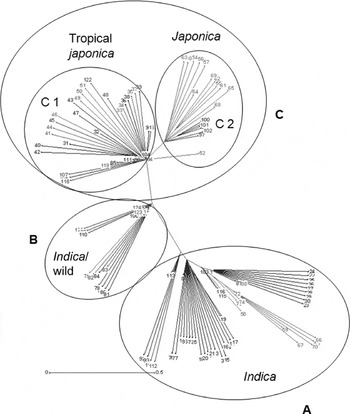
Approximately 3441 distinct ancestral genotypes were identified to be involved in the formation of the 124 genotypes studied. Cluster analysis carried out using COP values revealed a total of three clusters: A, B and C (Fig. 1). Cluster A largely comprised indica genotypes, cluster B comprised indica/wild pedigree genotypes, and cluster C comprised tropical japonica genotypes, japonica genotypes and a few indica genotypes, with 52, 17 and 55 individuals being present in each cluster, respectively. In addition, cluster C was further divided into two subclusters: C1 and C2. Subcluster C1 largely comprised tropical japonica lines and some indica lines, while subcluster C2 comprised only japonica lines.
Unweighed neighbour-joining cluster tree of 124 genotypes by coefficient of parentage values.

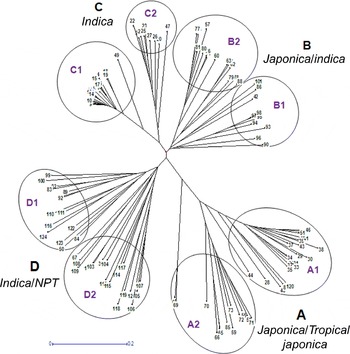
A total of 58 reported SSR marker pairs, distributed across 12 chromosomes, were used for genetic diversity analysis among the 124 genotypes studied. A total of 268 alleles were detected, with the number of alleles per marker ranging from 2 (RM7466, RM272, RM443, RM188, RM20705, RM6344 and RM22123) to 9 (RM21), with an average 4.62 alleles per locus (Table S2, available online). The PIC values ranged from 0.02 for RM22123 to 0.85 for RM21, with a mean of 0.53. Single-marker analysis revealed that of the 13 Rf-linked markers, five markers, namely RM443, RM6344, RM244, RM258 and RM311, were associated with phenotypic variations of 19.3%, 19.8%, 8.8%, 12.3% and 21%, respectively. The 23 japonica lines were excluded from this validation study, as the sterility in the F1 plants of japonica lines could be due to hybrid incompatibilities. Cluster analysis carried out using the molecular marker data revealed four major clusters A, B, C and D, comprising 39, 24, 29 and 32 genotypes, respectively (Fig. 2). All the four clusters were divided into two subclusters each. Subclusters A1 and A2 largely comprised genotypes with all japonica pedigrees, except for one indica genotype and one tropical japonica genotype and one indica genotype and one NPT genotype, respectively. Subcluster B1 comprised japonica genotypes, except for one indica genotype. In contrast, subcluster B2 largely comprised indica genotypes, except for one tropical japonica genotype and two japonica genotypes. Subclusters C1 and C2 exhibited distinct grouping and comprised only indica genotypes. Subclusters D1 and D2 largely comprised indica and NPT genotypes along with a few tropical japonica and japonica genotypes.
Unweighed neighbour-joining cluster tree of 124 genotypes by simple sequence repeat markers.

Trait-wise analysis of genetic diversity and fertility restoration
COP values were computed for all pairwise combinations, and the mean COP value for the 124 genotypes was 0.11. However, mean COP values within the maintainer, partial maintainer, partial restorer and restorer groups were higher than the overall mean COP value, i.e. 0.41, 0.24, 0.12 and 0.21, respectively. The mean genetic distance value based on the dissimilarity matrix obtained from the molecular marker data was 0.58. However, mean genetic distance values for the maintainer, partial maintainer, partial restorer and restorer groups were 0.50, 0.58, 0.57 and 0.53, respectively. Furthermore, restoration behaviour, measured as the percentage of spikelet fertility in F1 plants, exhibited variation among the genotypes studied (Table S1, available online). The overall frequencies of maintainers, partial maintainers, partial restorers and restorers were 18.5, 12.1, 22.6 and 46.8%, respectively. Among the 67 indica-type genotypes, there were 2 maintainers, 3 partial maintainers, 16 partial restorers and 46 restorers. Among the 21 tropical japonica genotypes, 1 was identified as a maintainer, 9 as partial maintainers, 3 as partial restorers and 8 as restorers. However, in the case of 29 japonica genotypes, 19 were identified as maintainers, 1 as a partial maintainer, 6 as partial restorers and the remaining 3 as restorers. In addition, among the 6 NPT lines, 1 was identified as a maintainer, 1 as a partial maintainer, 3 as partial restorers and 1 as a restorer. If trait-wise genotypes are considered, the bacterial leaf blight (BLB)-resistant lines had highest number of restorers (33). Similarly, the blast-resistant lines had the highest number of maintainers (20). The COP value and the number of maintainers, partial maintainers, partial restorers and restorers calculated for each category are given in Table 2.
BLB-resistant genotypes
BLB, caused by Xanthomonas oryzae pv. oryzae (Xoo), is one of the oldest and most devastating diseases of rice. A total of 51 lines were studied for resistance to BLB, and the mean genetic distance values based on the COP and SSR markers were 0.41 and 0.49, respectively, indicating a medium degree of genetic diversity. Among the 21 near-isogenic lines (NILs) studied, 16 were found to be restorers, while the remaining 5 were partial restorers. These NILs had resistant Xa genes in singular and in various combinations known for their resistance to BLB. Thirty genotypes with introgression from wild species accessions of O. brachyantha, O. longistaminata, O. officinalis and O. minuta were also studied. All the 9 genotypes in the background of IR56 with introgression from O. brachyantha were found to be restorers. In addition, the 21 genotypes with introgression from O. longistaminata, O. officinalis and O. minuta in the background of IR 6500-81-5-3-2 exhibited a mixed trend. Among these lines, 1 was identified as a maintainer, 9 as partial maintainers, 3 as partial restorers and 8 as restorers.
Blast-resistant genotypes
Blast disease, caused by the fungus Pyricularia grisea Sacc., affects rice production in almost all rice agroecological regions. The blast-resistant lines studied had overall COP and marker-based genetic distance values of 0.46 and 0.50, respectively, indicating a medium degree of genetic diversity. All the 19 NILs with Lijiangxintuanheigu (LTH) background were found to be maintainers, whereas 1 maintainer, 2 partial maintainers and 1 partial restorer were identified in the indica NIL CO39 background.
Brown planthopper (BPH)-resistant genotypes
BPH, Nilaparvata lugens (Homoptera: Delphacidae), is an enormously destructive insect pest of rice in Asia. Eleven BPH-resistant genotypes, including 9 genotypes with introgression from O. officinalis, O. australiensis and O. minuta, were studied for their response to the fertility restoration trait. The mean COP and marker-based genetic distance values for these lines were 0.49 and 0.38, respectively. The results indicated 7 genotypes to be restorers and 2 genotypes to be partial restorers. Also, IR 31 917-45-3-2 and IR 73 382-7-12-1-1-B were identified as a partial maintainer and a restorer, respectively.
Abiotic stress-tolerant genotypes
A total of 33 lines having tolerance to various abiotic stresses, such as drought, salinity, micronutrient deficiency and mineral toxicity, were studied. Among the 33 lines, the COP and marker-based genetic distance values of six lines having overall abiotic stress tolerance trait were 0.33 and 0.46, respectively. Among these six lines, half were restorers and the remaining were partial restorers. A low mean COP value of 0.11 was obtained for the 19 lines with salinity tolerance, while the genetic distance value for these lines was 0.52. Among these lines, 1 was identified as a maintainer, 1 as a partial maintainer, 8 as partial restorers and 9 as restorers. Five drought-tolerant lines had mean COP and marker-based genetic distance values of 0.19 and 0.42; among these lines, 3 were restorers and 2 were partial restorers. Furthermore, for the categories-high iron content, acid sulphate tolerant and iron toxicity tolerant, one line each was found to be a restorer, a partial restorer and a partial maintainer, respectively.
New plant types
The genetic potential of high-yielding lines is well known, and with the development of NPTs and availability of elite tropical japonica rice cultivars, it may be possible to develop indica/tropical japonica hybrids using CMS or thermosensitive genic male sterile systems. These hybrids would yield significantly higher than indica/indica hybrids and tropical japonica hybrids. A low mean COP value of 0.11 and a medium SSR-based genetic distance value of 0.55 were obtained for the NPTs. Among the 6 NPT lines, 1 was identified as a maintainer, 1 as a partial maintainer, 1 as a restorer and the remaining 3 as partial restorers.
Discussion
COP analysis involves a number of assumptions, and these assumptions may lead to factual errors during COP estimation (Messmer et al., Reference Messmer, Melchinger, Herrmann and Boppenmaier1993). As popularly known, plant breeding is a combination of art and science; it requires altering the genetic make-up of plants for producing genotypes with desirable characteristics. Also, selection pressure leads to genetic drift towards the allelic frequency (Wang and Lu, Reference Wang and Lu2006) of the genotype, which otherwise is assumed to receive half the alleles from either parent. Consequently, the COP estimates might illustrate a considerable deviation for the true COP value (Schut et al., Reference Schut, Qi and Stam1997). Unlike the assumption that all ancestors are unrelated, it is also quite possible that a few ancestors may be related by descent (St. Martin, Reference St. Martin1982). Furthermore, the totality and dependability of the data serve as added suppositions.
Currently, whole-genome survey using molecular markers is being widely employed to study genetic variation for crop improvement (Glaszmann et al., Reference Glaszmann, Kilian, Upadhyaya and Varshney2010). In the present study, genetic characterization of 124 advanced breeding lines was done using COP values, SSR markers and fertility restoration data. The mean COP value for all the lines was 0.11 and the mean genetic distance value based on SSR markers was 0.58. The low COP value is due to 32% of the genotypes being completely unrelated within themselves. Moreover, genetic diversity among the identified restorer lines was narrower than that among the maintainer lines. These observations are on par with those reported by Wang and Lu (Reference Wang and Lu2006) and Duan et al. (Reference Duan, Mao and Zhu2002).
Cluster analysis based on COP values and molecular marker genetic distance values clearly distinguished the major subspecies groups in rice, i.e. indica, tropical japonica and japonica. The COP-based clustering was informative, as it clustered indica/wild and indica groups separately. Also, cluster C branched off into japonica and tropical japonica groups (Fig. 1). Moreover, the ‘Daeyabyeo’ pedigree group in this case was categorized under the japonica cluster. There was only one exception with respect to the group of salinity-tolerant japonica genotypes having the ‘Daeyabyeo’ pedigree. Despite being japonica, these lines fell into the indica cluster. This is consistent with the results of the study carried out by Zeng et al. (Reference Zeng, Kwon, Liu, Wilson, Grieve and Gregorio2004), where the salt-tolerant genotypes were grouped based on molecular markers and morphological traits.
For developing high-yielding three-line rice hybrids, the initial step is to identify maintainers (having recessive fertility restorer gene/s) and restorers (having dominant fertility restorer gene/s) from a large germplasm collection (Siddiq, Reference Siddiq, Ahmed, Viraktamath, Ramesha and Vijaya Kumar1996). The use of molecular markers linked to Rf genes can enhance selection efficiency and help save time, thereby avoiding the various complications that are usually associated with phenotype-based screening. Furthermore, markers linked to Rf genes could be of significant help in understanding the inheritance of this trait and targeted identification and introgression of Rf genes in breeding programmes. However, the reported Rf gene-linked markers have not been validated in alternate populations and nor have the different restorer lines used in India been characterized for their allelic status with respect to these markers. Extensive research work on the identification of restorers and maintainers and inheritance of fertility restoration has been conducted for the WA cytoplasmic source (Xie, Reference Xie, Xie and Hardy2009). Among the various sources of cytosterility, CMS lines derived from the WA system have proved to be the most stable, owing to their complete pollen sterility (Brar et al., Reference Brar, Zhu, Ahmed, Jachuk, Virmani, Virmani, Siddiq and Muralidharan1998). Hence, all the lines were crossed with a popular indica maintainer line IR58025A for deciphering the fertility restoration behaviour of the genotypes under study. The results indicated that restorers occurred more frequently than maintainers. However, owing to the hybrid incompatibility factor, the maintainer phenotype of most of the japonica lines studied could not be considered as true maintainer. On the other hand, there have been many studies in the past where some japonica lines have exhibited partial fertility when crossed with indica CMS lines (Hossain et al., Reference Hossain, Singh and Zaman2010). Therefore, to explore the possibility of obtaining similar results, japonica lines were also included in phenotyping for fertility restoration ability. Several authors, viz. Singh and Singh (Reference Singh and Singh2000) and Malarvizhi et al. (Reference Malarvizhi, Thiyagarajan, Manonmani and Sankar2003), have reported a higher frequency of restorers than of maintainers for WA-CMS lines, while Kumari et al. (Reference Kumari, Valarmathi, Joseph, Kankamany and Nayar1997) and Salgotra et al. (Reference Salgotra, Katoch and Kaushik2002) have reported a higher percentage of maintainers than of restorers. In addition, most of the lines identified as restorers were indica and those identified as maintainers were japonica. Thus, the frequency of restorers for a WA system is relatively high among the improved indica cultivars than among the japonica rice cultivars (Zhuang et al., Reference Zhuang, Qian, Lu, Lin and Zheng1997).
In rice, about 31 bacterial blight resistance (R) genes have been identified (Wang et al., Reference Wang, Wen, Lin and Zhang2009). Recently, two new genes, namely Xa33 (t) (Natarajkumar et al., Reference Natarajkumar, Sujatha, Laha, Viraktamath, Reddy, Mishra, Balachandran, Ram, Srinivasarao, Hari and Sundaram2010) and Xa34 (t) (Ram et al., Reference Ram, Laha, Gautam, Deen, Madhav, Brar and Viraktamath2010a), have been discovered, escalating the total number of BLB genes to 33 (24 dominant and 9 recessive). The wild species of rice possess a reservoir of various disease-resistant genes such as Xa21 from O. longistaminata (Song et al., Reference Song, Wang, Chen, Kim, Pi, Holsten, Gardner, Wang, Zhao, Zhu, Fauquet and Ronald1995), Xa23 from O. rufipogon (Zhang et al., Reference Zhang, Lin, Zhao, Wang, Yang, Zhou, Li, Chen and Zhu1998), Xa27 from O. minuta (Gu et al., Reference Gu, Tian, Yang, Wu, Sreekala, Wang, Wang and Yin2004), Xa29 (t) from O. officinalis (Tan et al., Reference Tan, Ren, Weng, Shi, Zhu and He2004), Xa30 (t) (Cheema et al., Reference Cheema, Grewal, Vikal, Das, Sharma, Lore, Bhatia, Mahajan, Gupta and Singh2008) and Xa33 (t) from O. nivara and Xa34 (t) from O. brachyantha. Also, upto 60 blast-resistant genes have been identified (Khush and Jena, Reference Khush, Jena, Wang and Valent2009). In the present study, 23 NILs with single and multiple genes for blast resistance in the backgrounds of indica variety CO39 (Mackill and Bonman, Reference Mackill and Bonman1992) and japonica variety LTH were examined (Kobayashi et al., Reference Kobayashi, Yanoria, Tsunematsu, Kato, Imbe and Fukuta2007). Furthermore, 19 genes have been reported for BPH resistance (Zhang, Reference Zhang2007). In this study, IR 65 482-7-216-1-2-B, a line having major resistance gene Bph18 (t) introgressed from the wild species O. australiensis (Jena et al., Reference Jena, Jeung, Lee, Choi and Brar2006), was identified as a restorer. In addition to these two lines, IR 71 033-62-15-8 and IR 71 033-121-15-B, were identified as a partial restorer and a restorer, respectively. These two lines are derived from the wild species O. minuta, having Bph22 (t) gene (Ram et al., Reference Ram, Deen, Gautam, Ramesh, Rao and Brar2010b). Hence, the total number of BPH resistance genes to date stands at 20.
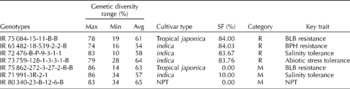
Apart from the high spikelet fertility of F1 plants, there are few other desirable traits of a good restorer line. If a restorer qualifies to have most or all of these traits, only then could it be used in hybrid rice breeding programmes. The traits include tall stature (10–15 cm taller than A line), sturdy culm, non-synchronous tillering and long panicles, high pollen production capability and high amounts of residual pollen, and resistance to insect pests and diseases. Based on the high genetic diversity range, high restoration ability and desirable agromorphological traits, four lines, namely IR 75 084-15-11-B-B (bacterial blight resistant), IR 65 482-18-539-2-2-B (BPH resistant), IR 72 476-B-P-9-3-1-1 (salinity tolerant) and IR 73 759-128-1-3-3-1-B (abiotic stress tolerant), were identified as putatively good restorers among the total 58 lines. These lines can be used for developing high-yielding stress-tolerant medium-duration rice hybrids.
The frequency of maintainers among the elite breeding lines is rather low, and even among them, all are not ideal because of one or the other defect. Hence, combining desirable traits takes centre stage in hybrid rice breeding programmes. At times, even partial maintainers possessing a number of desirable traits can be used. Some of the desirable traits of maintainer lines are relatively dwarf/semi-dwarf stature, good and synchronous tillering, high stigma exsertion, high out-crossing potential, sturdy culm, resistance to insect pests and diseases, and complete and stable maintenance of sterility. Among the total 23 lines, three lines, namely IR 75 862-272-3-27-2-B-B (bacterial blight resistant), IR 71 991-3R-2-1 (salinity tolerant) and IR 80 340-23-B-12-6-B (NPT), were identified to be putatively good maintainers, owing to their high genetic diversity range, high restoration ability and desirable agromorphological characteristics (Table 3). These lines can be exploited for the development of new CMS lines.
Lines identified as good maintainers and restorers on the basis of genetic diversity range (simple sequence repeat), restoration ability and agromorphological traits
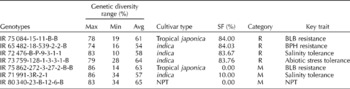
SF, spikelet fertility; R, restorer; BLB, bacterial leaf blight; BPH, brown planthopper; M, maintainer; NPT, new plant type.
Worldwide, crop growth and productivity are mostly affected by abiotic stress (Witcombe et al., Reference Witcombe, Hollington, Howarth, Reader and Steele2008), thus resulting in drastic and sometimes complete yield loss (Wang et al., Reference Wang, Vinocur and Altman2007). Consistent efforts in the past have led to the identification of quantitative trait loci (QTL) for several abiotic stresses. SALTOL, a major QTL for salinity tolerance on chromosome 1 (Singh et al., Reference Singh, Gregorio and Ismail2008), is associated with selective ion uptake. Similarly, qtl12.1, a QTL with a large effect on grain yield under drought stress, has been identified on chromosome 12 (Bernier et al., Reference Bernier, Kumar, Ramaiah, Spaner and Atlin2007). Hence, with the help of molecular markers, mapped genes/QTL can be moved to a desirable background and directly utilized for the development of biotic and abiotic stress-resistant parental lines of hybrid rice using the marker-assisted backcross approach (Zhang, Reference Zhang2007).
The COP provides an excellent estimation of genetic diversity when the entire pedigree is well known, though the consequence of selection results in the undermining of its effect. Furthermore, concurrent use of molecular marker-based genetic diversity analysis and COP analysis may assist in the calculation of the breeding value of offspring from parent combinations (Almanza-Pinzón et al., Reference Almanza-Pinzón, Khairallah, Fox and Warburton2003). Moreover, owing to the extra cost of molecular markers, COP analysis would be favoured as the initial method for calculating genetic diversity, except when whole pedigree information is not available or when selection pressure is severe for the accessions used. In these situations, molecular marker analysis would provide paramount estimates.
Supplementary material
To view supplementary material for this article, please visit http://dx.doi.org/10.1017/S147926211400063X
Acknowledgements
The authors thank the Barwale Foundation, Hyderabad, and Dr. Usha B. Zehr, Director, Barwale Foundation, for providing all the facilities for execution of this research work and Dr. K. Govinda Raj for his critical evaluation of the manuscript before submission.