




Introduction
There is growing consensus that global food systems are not delivering adequate food and nutrition for all and are causing environmental degradation and loss of biodiversity, aggravated by the growing consequences of climate change. Changes are needed to meet the challenges of persistent malnutrition and rural poverty, with agriculture having the potential to produce sufficient nutritious food, provided declines in soil health and fertility can be reversed (HLPE, 2019). FAO (2020a) estimated that, in order to meet food demand in 2050, annual world production of crops and livestock will need to be 60% higher than in 2006. Most of this increase will need to come from higher yields and increased cropping intensity rather than ongoing expansion of arable land often into marginal areas. Intensification will also require practices such as converting organic wastes into productive inputs as well as soil and water conservation practices (AGRA, 2021).
Highland areas in Sub Saharan Africa (SSA) are important repositories of biodiversity as well as sources of water for large lowland and urban populations. The highlands of Ethiopia are no exception being home to a host of endemic species and globally renowned biodiversity hotspots. At the same time, highlands have historically been home to disproportionately large human populations attracted by good rainfall and relatively good soils (Hurni, Reference Hurni1998), resulting in rapid population growth, unprecedented land-use changes (Zhou et al., Reference Zhou, Minakawa, Githeko and Yan2004), expansion into marginal hilly areas, increasing soil and water loss and destruction of unique habitats (Amede et al., Reference Amede, Belachew and Geta2001). Addressing degradation of land and water resources remains crucial to reversing the loss of ecosystem services and achieving sustainable development goals (Mekuria et al., Reference Mekuria, Diyasa, Tengberg and Haileslassie2021). Although progress has been made in increasing agricultural productivity in Ethiopia, the sector remains predominantly cereal-based relying on subsistence-oriented systems. Rural off-farm employment creation remains below expected targets and productivity is well below its potential with millions of Ethiopians facing hunger, food insecurity and malnutrition (Cordonnier et al., Reference Cordonnier, Covarrubias and de la O Campos2022).
The dominant farming systems across the Ethiopian Highlands include cereals, notably wheat, maize, teff, sorghum and barley with faba bean being the most widely grown legume. Key constraints limiting yields are soil degradation, low soil fertility and soil acidity on some soil types, more especially in higher rainfall environments (GIZ, 2015; Hurni et al., Reference Hurni, Abate, Bantider, Debele, Ludi, Portner, Yitaferu, Zeleke, Hurni and Wiesmann2010). Despite progress, farmers’ practices are still characterised by traditional approaches and technologies, although use of improved seed and inorganic fertiliser has been promoted by extension services and are increasingly used. Ploughing repeatably using oxen and broadcasting inputs remain common. At the same time, access to many farm inputs is limited. This low input–low output agriculture results in large yield gaps, this being the difference between actual and potential yields. Estimates vary across crops, regions and soil types, but authors agree that production could be doubled if constraints are addressed (Getnet et al., Reference Getnet, Descheemaeker, van Ittersum and Hengsdijk2022; Silva et al., Reference Silva, Reidsma, Baudron, Jaleta, Tesfaye and van Ittersum2021; van Dijk et al., Reference van Dijk, Morley, van Loon, Reidsma, Tesfaye and van Ittersum2020). As an example, the main food import is wheat, which despite covering an area of 2.1 million ha and producing 6.7 million tonnes of grain (Tadesse et al., Reference Tadesse, Zegeye, Debele, Kassa, Shiferaw, Solomon, Negash, Geleat, Bishaw and Assefa2022), the country is a net importer of wheat, with just over 70% of demand being met from domestic production while importing nearly 30% of its needs, about a quarter of this being from food aid (USDA, 2022).
The Ethiopian Government has for many years prioritised agriculture as the sector to lead national development and to support greater industrialisation in the country. However, despite ongoing interventions to improve soil fertility, Ethiopia’s soils are far from reaching their full health and fertility potential for sustainable increases in agricultural production (FAO, 2020b; MoANR, 2013).
ISFM is defined (Vanlauwe et al., Reference Vanlauwe, Bationo, Chianu, Giller, Merckx, Mokwunye, Ohiokpehai, Pypers, Tabo, Shepherd, Smaling, Woomer and Sanginga2010) as ‘A set of soil fertility management practices that necessarily include the use of fertiliser, organic inputs, and improved germplasm combined with the knowledge on how to adapt these practices to local conditions, aiming at maximising agronomic use efficiency of applied nutrients and improved crop productivity’. As such, ISFM has the potential to meet farmers’ immediate needs for increased production, whilst also contributing to efficient and sustainable use of resources providing the basis for optimising the use of nutrients. Various combinations of ISFM include the use of improved varieties, line seeding, inorganic fertilisers used in combination with organic ones, legumes inoculated with rhizobia, as well as associated practices of agroforestry, crop residue management, rain-water conservation and lime application on the highly acidic soils found in many areas of the Ethiopian Highlands. ISFM includes many of the components needed for Climate Smart Agriculture and represents an important component of an agroecological approach. As such, ISFM is intended to enable a move from current practices (nutrient mining, insufficient soil organic matter, declining soil fertility and low yields) at a field level in the short to medium term, while agroecology seeks transformation at wider watershed and landscape levels (HLPE, 2020). ISFM is a systems-wide set of practices that have been promoted widely over the past 15 years in a number of SSA countries with research promoting its contribution to sustainable agricultural intensification on small-scale farms (Bekunda et al., Reference Bekunda, Chikowo, Claessens, Hoeschle-Zeledon, Kihara, Kizti, Okoro, Sognigbe, Thierfelder, Bekunda, Hoeschle-Zeledon and Odhong2022).
Despite a long history of fertiliser research and development to improve soil fertility management practices, studies have revealed that the agronomic and economic efficiency of fertilisers in Ethiopia shows mixed results. In some localities, increased applications result in increased yields with high agronomic efficiency and productivity, while efficiency in other locations has been marginal or depressing. In explaining fertiliser use efficiency, the key question is whether the right fertiliser is being applied at the right dose, time and place and whether other yield-limiting factors are being addressed. This is because variations in soils, climate and physiographic factors, together with the crop type and genotypes used, and agronomic management practices play vital roles in determining the performance of fertilisers (Erkossa et al., Reference Erkossa, Laekemariam, Abera and Tamene2022). It is also highly dependent on farmer management practices related to the financial, physical, social, human and natural resources available to individual households. These include oxen for manure and land preparation, biomass and labour for organic matter production and incorporation in the soil as well as access to the funds to purchase and therefore use improved seed and inorganic fertilisers, which may mean sub-optimal rates are used.
Many studies have demonstrated the heterogeneity of the smallholder production environment. Yet agronomic research aiming to identify the best options for increasing productivity has not consistently adapted its approach to such conditions. It is increasingly recognised that smallholder farming environments are notoriously heterogeneous as exemplified by a large variation in both biophysical and socio-economic conditions. In such situations, farms and farmers have different characteristics, so they cannot usefully be considered as ‘replicates’ of anything, hence making research problematic. At the same time, it is recognised that farmers and extension workers need to be integrated into both the development, validation and improvement of improved soil fertility and agronomy options (Vanlauwe et al., Reference Vanlauwe, Coe and Giller2019).
This study had the aims of first to show the achievable yield increases and N-efficiency gains when using ISFM and lime on acid soils over farmers’ practices and second to determine which practices contributed to what extent with the baseline for the study being reflected in the farmer practices on the control plots on the demonstrations. A specific hypothesis included, ‘the greater the number of ISFM practices used, the higher would be the resulting yield.’
Methods
The project with its partners in the Ethiopian Ministry and Bureaus of Agriculture (BoA) operated over a six-year period (2016–2021) encouraging farmer-led demonstrations across five regional states of Ethiopia, Amhara, Oromia, SNNP, Sidama and Tigray. The project collected and analysed crop yield data from 2,173 farmer-managed demonstration plots planted in the long rain Meher season (June to October) over this period. The Meher is the main crop production season, while the short less reliable Belg season (February to May) tends to be used for short-cycle crops and in the case of this project for green manure (Lupinus perennis) production and its subsequent incorporation into the soil.
Two types of demonstrations were established, first ‘long-term’ (LT), which were repeated annually on the same fixed plots, the purpose being to observe the long-term impact of ISFM technologies on crop productivity. Second, ‘short-term’ (ST), where yields were measured from randomly selected annual plots to evaluate the immediate effects of ISFM technologies on yields. The crops grown on the demonstrations included the main crops grown across these areas namely, Triticum aestivum (wheat), Zea mays (maize), Eragrostis tef (teff), Hordeum vulgare (barley), Sorghum bicolor (sorghum), Vicia faba (faba bean) and some Phaseolus vulgaris (haricot bean) and Glycine max (soyabean), all of which were chosen by and established by farmers. The objective of the demonstrations was to identify, learn from and showcase ISFM and its yield benefits. The practices applied included those aimed at meeting the immediate-, short- and medium-term needs for increasing on-farm biomass production and soil organic matter, while contributing to long-term goals of efficient and sustainable use of natural resources through appropriate crop residue management and nutrient recycling.
A participatory learning approach (PLA) based on working with and strengthening existing farmer groups or establishing new ones, called farmer research and extension groups (FREGs) underpinned the demonstrations. Initial discussions were facilitated by extension agents to identify and prioritise local agricultural challenges and opportunities, then agreeing and implementing the ISFM demonstrations. These were undertaken by individuals selected by each group and included participatory monitoring and evaluation of the demonstrations during training sessions and field days, facilitated by either the extension agents or farmer group leaders. At the same time farmer-to-farmer extension was encouraged through the model farmers and ISFM ambassadors, who promoted the use of ISFM practices among members of their communities. Capacity building of both extension agents and farmers involved the use of innovative extension material with backstopping by BoA extension specialists. Farmers selected the crops and the ISFM practices for both the controls and treatments with ISFM changes made each year reflecting farmer learning and preferences over the duration of the project.
The ISFM practices included the use of improved varieties, line seeding, inorganic fertilisers (mostly NPS 19:38:0 + 7S and where other micronutrient deficiencies were known to occur NPSB 18.9:37.7:0 + 6.95S + 0.1B, NPSZn 17.7:35.5:0 + 7.6S + 2.2Zn or NPSZnB 17.8:35.7:0 + 7.7S + 2.2Zn + 0.1B) and urea (46:0:0), these having been promoted by ongoing extension programmes. Newly introduced ISFM practices included organic fertilisers namely compost, vermicompost, green manure incorporated into the soil before crop planting, rhizobium on legumes and lime application on acidic soils, where the pH was <5.5. Lime application rates were adjusted according to acidity with the intention of repeat applications every five years depending on pH. Other associated ISFM management practices included crop residue retention, soil and water conservation measures such as stone bunds or terraces and agroforestry. Agroforestry included the planting of species such as Cytisus proliferus (tree lucerne), Faidherbia albida and Sesbania spp., grown for fodder, incorporation into the soil or used as a mulch. In some cases, these ISFM practices were already in use with further increases being attributed to farmer learning especially on the LT demonstrations but also adoption across those areas covered by the ST demonstrations.
On both sets of demonstrations, comparisons were made between farmers’ practice or control and treatment plots on two adjoining areas with similar if not identical conditions, allowing differences in yields to become clearly visible and comparable. In total, yields from 103 LT demonstrations maintained for six years and 2070 ST demonstrations maintained for a single season also for six years were measured. On the treatment plots, farmers were encouraged to implement three or more ISFM practices of their choosing, these being in addition to any they may have implemented on their controls with the assumption that these would provide additive interaction between the practices. To generate accurate and comparable yield data across all plots, a uniform methodology was applied for yield assessments allowing yields from the treatment plots to be compared to existing practice control plots. Although plot sizes varied most were 600 m2, from which 20 m2 was randomly selected and sampled to measure yields after drying. Harvesting both grain and crop residues was undertaken at agronomic maturity and then dried for 10–15 days before yield measurement. This involved weighing air- and sun-dried above-ground biomass using a scale balance, threshing the samples on strong and wide plastic sheets thus avoiding grain losses and weighing grain samples using an electronic balance. To establish the weight of crop residues, the weight of grain yields was subtracted from the total biomass yield. All data was then recorded on recording sheets and entered into an Excel spreadsheet database. Grain loss by pests was not noticeably visible.
Initial analysis of the ST data compared crop yield increases with six years of data from the Ethiopian Central Statistics Agency (CSA, 2021). This helped to validate the datasets (Doldt et al., Reference Doldt, Yilma, Ellis-Jones and Schulz2022). Statistical analyses were then carried out using R 4.1.0 (R Core Team, 2021). Prior to conducting this analysis, minor data cleaning and manipulation was undertaken. Some variables, specifically planting method, soil acidity and crop name were modified to create a unified coding system as these had been stored in different ways for different observations. This was due to the free-text nature of many questions in data collection forms. Additionally, for the purposes of analysis, many variables from both the LT and ST datasets were transformed into binary alternatives (1, 0). Some were transformations from existing (Yes, No) codes, others were transformed from a numeric quantity. At the same time, minor filtering was applied to the datasets. Initial analysis included basic frequency tables and production of data visualisations particularly of individual crop yields, then by the number of ISFM practices used and finally and importantly by individual crop and ISFM practice. This revealed the importance of likely additive responses as more and different ISFM practices were used, recognising that crops respond in different ways on different soil types and differing soil health/fertility levels. Additionally, correlation analysis was undertaken to explore the effects of lime application. For each crop comparison, t-tests comparing the treatment and control plots were undertaken using pairwise post hoc comparisons using the Tukey test (Tukey, Reference Tukey1977) to ascertain significance. This compares the means of every treatment to the means of every other treatment; it applies simultaneously to the set of all pairwise comparisons and identifies any difference between two means that is greater than the expected standard error.
Further analysis using the R programme included a series of multiple linear regressions for each crop (four for the LT and six for the ST data) with separate models built for each. Thereafter, each variable was fitted as having a fixed effect in the models, distinguishing between treatments and controls. This included the year of the demonstration, the region and a series of binaries reflecting 12 different ISFM management practices. Each variable in the model was regarded as a categorical factor interpreted as the difference between a specified level and its reference level, with each practice representing a binary, where individual use is compared with no use. At the same time, ‘Year’ represents the relative difference to demonstrations in 2016, this being a normal year with regards to rainfall, while ‘Region’ was the relative difference to those in Amhara, while ‘treatment/control’ used the control as a reference level. This made the constant term fitted by the models reflective of the expected yield for a control plot planted in 2016 in Amhara using no ISFM or other improved management practice, with all the practices then adjusting to that value.
Model specifications were determined through an iterative model-building process to maximise the yield variability that could be attributed to individual ISFM practices (the adjusted R-squared or R 2). At the same time, the variables were fitted to account for the natural variability of each year and region before determining the significance of each practice on each crop. Finally, a ‘treatment/control’ factor was included in the model to account for any differences that still needed to be explained in the treatment-control comparison. This was then used to assess what variability could be explained on the treatment plots and what variability could not be directly attributed to individual practices. These can be difficult to estimate or complex to interpret due to either the unbalanced structure of the data, farmers’ own bias in managing the treatment plots, or data collectors’ bias in recording information, although the latter is unlikely to be substantial. Each model also included an adjusted R2 derived from the output of the linear regression model using the same model specification as the ANOVA. These estimated the proportion of the variation in the yields of each crop explained by the factors included in the model. It should be noted that the adjusted R2 differs from the standard R 2 by making a correction to account for the number of variables included in the model.
A limitation of the study’s observational nature has meant that it was not possible to assess the effect of substituting inorganic fertilisers with organic fertilisers. This was due to the design of the demonstrations, which allowed farmers to choose the management practices of both control and treatment plots. While this design enhanced farmer participation, observation, learning and farmer-to-farmer extension, it limited the questions that could be answered from the data collected.
Results
Participating farmers selected and grew a wide range of different crops across the demonstrations, 90% being cereals and 10% legumes, largely faba bean. These comprised in order of numeric popularity across regions and years, wheat (1975, 38%), teff (1028, 21%), maize (1088, 20%), faba bean (446, 8%), barley (310, 6%), sorghum (240, 5%), with some haricot bean (>1%) and a very limited area of soyabean, the latter two being consequently excluded from the analysis.
Table 1 shows the wide range of different ISFM practices used on both the controls and treatments as well the increased use of individual practices on the treatments over the controls. The order of increase in some cases from very low levels reflects the level of learning. These were lime application (54%), compost (43%), line seeding (42%), crop residue retention (18%), green manure incorporation (18%), vermicompost (18%), urea (16%), inorganic blended fertiliser (15%), improved varieties (14%), agroforestry (7%) and soil and water conservation (6%). Crop residues were often removed either totally or partially for other priority purposes including livestock feed, making compost or use as fuel. The already high use of improved varieties, line seeding and inorganic fertilisers is attributed to ongoing extension programmes promoting their use. No evidence was apparent of the use of different practices on the same crop in different areas with rates of application differing depending on farmer decisions.
Total number and percentage use of ISFM practices on control and treatment plots (LT and ST)

* Reflecting farmer learning and adoption on the demonstrations.
Yield comparisons of individual crops showed highly significant but highly variable differences between controls and treatments with wide variation across regions and years, due to variations in agro-ecological conditions (Figure 1). The increase in average yields (tonnes ha−1 and percentage) of the treatments over the controls was in descending order were maize (3.8 t ha−1, 81%), sorghum (2.7t ha−1, 62%), wheat (1.85 t ha−1, 66%), barley (1.6t ha−1, 76%), faba bean (1.5 t ha−1, 83%) and teff (0.9 t ha−1, 65%) with faba bean and maize showing the greatest percentage increases.
Individual crop yields (LT and ST) across control and treatment plots1 (2016–2021). 1 Each crop box shows the 25th percentile, median and the 75th percentile for controls and treatments with points indicating outlier yields. The shape around the box, a violin plot, represents the density of yield distribution points.

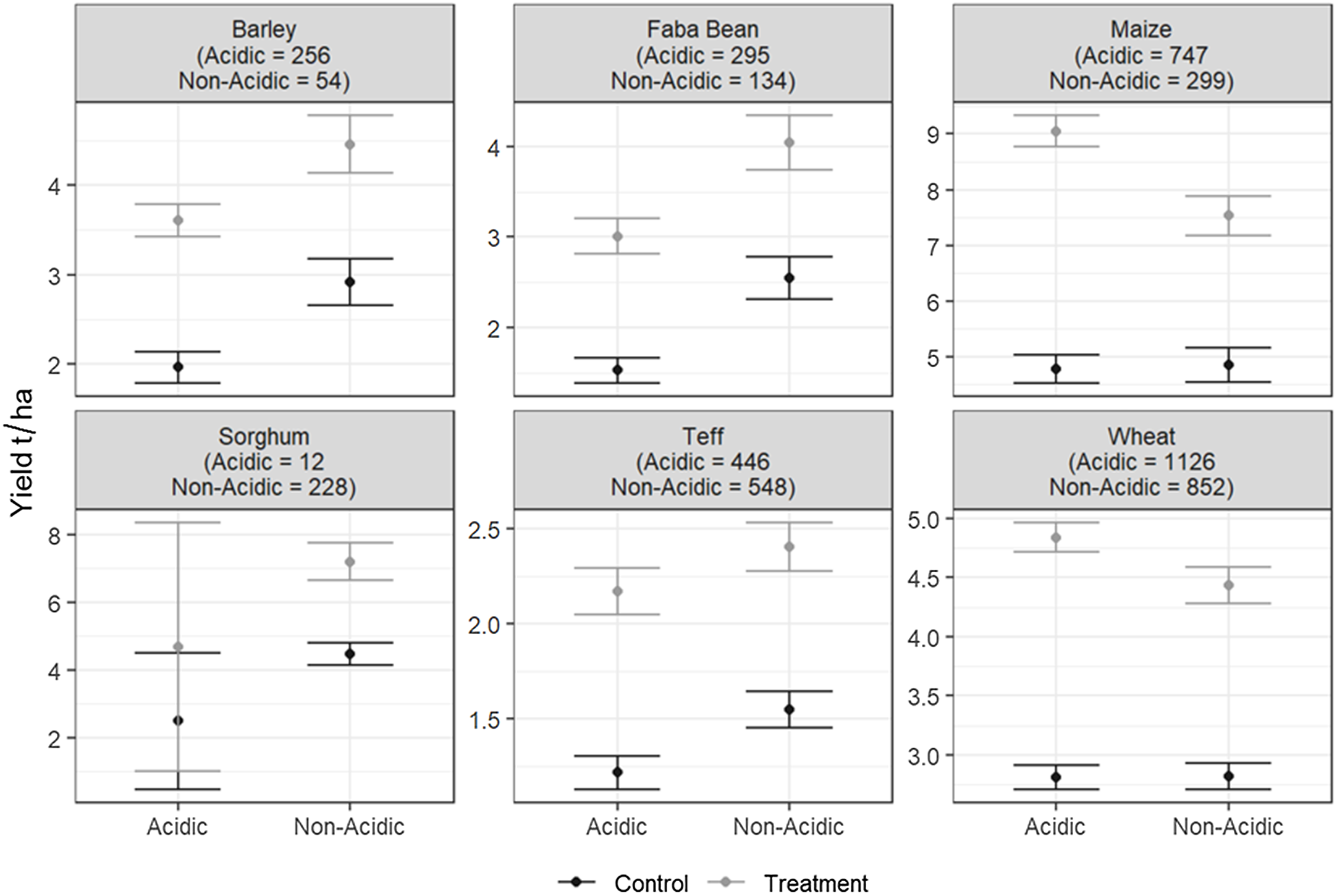
On the acidic soils, application of lime together with other ISFM practices on the treatment plots also resulted in large and highly significant yield increases of over the controls (Figure 2). The mean increase for all crops was 85% or 2.09 t ha−1 being greatest in percentage terms for faba bean (97%, 1.48 t ha−1) and maize (89%, 4.27 t ha−1). These compared to increases of 57% (1,82 t ha−1) on the non-acidic soils with increased faba beans yields of 59% or 1.5 t ha−1 and increased maize yields of 55% or 2.67 t ha−1. Overall yields on the acidic control plots were considerably less (29% or 0.73 t ha−1) than those on the non-acidic soils. This confirms the extreme importance of raising pH levels on acid soils. It was noticeable that maize and wheat yields on the acid soils after lime application were considerably higher than those on the non-acidic soils. In contrast, barley, faba bean and teff yields were higher on the non-acid treatment soils where no lime was applied. It should be noted that there were very few demonstrations of sorghum on acid soils, as this crop is largely grown in drier areas where soils are not acidic.
Comparison of control and treatment effects (LT and ST) on yields on acidic and non-acidic soils with lime being applied to the treatments on acidic soils.
The effects of increasing rates of application of blended inorganic fertilisers on yields were mixed. While some crops responded to increased applications, other crops showed little or no effect of an increasing application. This indicates that other soil nutrient factors are limiting the yield warranting further investigation. In contrast, increasing N application rates resulted in increases in the yield of cereal crops particularly noticeable in maize and wheat, where application rates were greater (Figure 3). However, teff did not appear to react to the N applied although doing so for other ISFM practices. N applications were purposefully kept lower on barley, sorghum and faba bean, as recommended by extension agents as well as practiced by farmers, but still showed significant responses. The difference in vertical distance between the two lines for the nitrogen level measures the difference in yields. The intercepts of controls and treatments and the percentage increase in yields for each crop were barley (1.9/3.3, 73%), maize (4.3/8.1, 88%), sorghum (4.3/7.2, 67%), teff (1.3/2.3, 77%) and wheat (2.6/4.2, 62%). Although the slope varied for each crop, the yield per kg of N applied (0–250 kg ha−1 in the case of maize, wheat and teff and 0–100 kg ha−1 or less in the case of barley, faba bean and sorghum) was consistently higher for the ISFM treatment plots, other than for teff. However, no clear tendency was apparent.
Comparison of the yield effects of total nitrogen application on LT and ST demonstrations.

Individual crop yields plotted against the number of ISFM practices demonstrate the cumulative effect of using an increasing number of ISFM practices (Figure 4). Some control plots included more than six ISFM practices and some treatment plots more than nine ISFM practices, although the average number of ISFM practices used on the controls and treatments increased over time from 2.3 and 4.6, respectively, in 2016. This reached a peak of 3.5 and 6.1 in 2020, before declining to less than three and five in 2021, the reason as stated earlier being the non-availability of certain inputs in particular inorganic fertilisers. As could be expected crop yields increased with increasing use of ISFM practices for both sets of data across years and regions with clear clustering around the trendline, barley (r = 0.41), faba bean (r = 0.49), maize (r = 0.48), sorghum (r = 0.44), teff (r = 0.38) and wheat (r = 0.46).
Individual crop yields (LT and ST) related to the number of ISFM practices across control and treatment plots (2016–2021).

The full ANOVA model specifications of context (location and time) and individual ISFM practices explain the variations in yields across years, regions and crops, showing the individual contribution of the different ISFM practices (Table 2).
ANOVA models showing significance levels† of ISFM practices for individual crop yields on long term (LT) and short term (ST) demonstrations

†,***highly significant, **moderately significant, *significant, – insignificant, na = ISFM practice not applied.
Location (region) and time (year) could both be expected to play important roles in yield variations due to the different climatic and geographical conditions that could not be included in the data. ‘Region’ was significant in every model except for wheat-LT and maize-LT suggesting greater variability in yields for these two crops across the regions. ‘Year’ was also significant across all ANOVAs except faba bean (LT and ST), suggesting consistent yields for faba bean across years.
The use of improved varieties was consistently and highly significant in every model with one exception, sorghum-ST, where there was no significant yield difference between local and improved varieties (also Table 2). Unfortunately, there was insufficient data on sorghum-LT to see if this result was consistent.
There were highly significant yield increases for line seeding over traditional seed broadcasting with only maize-LT being insignificant (also Table 2). Although maize-ST was highly significant, it should be noted that in many demonstrations both control and treatment, maize was mostly line seeded. Notwithstanding, there were sufficient observations of broadcast maize seed to show that line-seeding yields were significantly higher.
Amongst the inorganic blended fertilisers, there was less consistent significance. While the use of blended fertiliser was highly significant for maize and faba bean (LT and ST) and for teff-LT, there was no significant difference for other crops (Table 2). With urea, there was consistent significance for the first dressing, only not being significant for teff-ST, indicating the importance and need for N. The application of the second urea dressing was less clear but still largely significant for most crops (also Table 2). Use of urea is neither recommended nor rarely practiced on faba bean and other legumes, with rhizobium used as a seed dressing to initiate nodulation and N capture.
Amongst the organic fertilisers, compost use was not as consistently significant as had been expected being so only for wheat-ST and LT, teff-ST, maize-ST and faba bean-ST (also Table 2). This may be attributable to variations in compost quality and rates of application. However, the use of vermicompost was significant for all crops except maize and faba bean, both LT, indicating some disparity between the two datasets. Rhizobium used only on faba beans was highly significant in both ST and LT datasets. The use of green manure was only significant in wheat-LT, this being the crop on which it was most used (also Table 2).
Amongst the other complementary management practices (also Table 2), agroforestry as defined earlier proved to be highly significant in the variation of maize yields-LT and ST, as well as for barley-ST, wheat-ST and teff-LT. Crop residue retention also proved to be a highly significant practice in yield variation across all crops in the LT. Soil and water conservation or water harvesting was surprisingly rarely significant after accounting for the previous factors, being so only for faba bean-LT, barley and teff-ST plots. This could be attributed to these crops being more common in the drier areas where soil moisture is more critical, while maize and wheat are more common in the higher and more reliable rainfall areas with sorghum being a more drought-resistant crop grown mostly in drier areas.
On acid soils, the application of lime was highly significant across all crops-LT and ST plots, again confirming the extreme importance of correcting soil acidity.
Finally, the ‘treatment/control’ effect (also Table 2), included after accounting for as much variation as possible by all the ISFM practices, was highly significant in every model except sorghum, meaning that the residual unexplained differences cannot be directly attributed to individual ISFM practices. Instead, they are attributed to other unidentified factors, most likely to the cumulative and additive effects of the simultaneous use of an increasing number of ISFM treatments as well as to unrecorded beneficial farmer management practices or biases.
The adjusted R2 derived from the output of the linear regression model, adjusted from the standard R2 by making a correction to account for the number of variables, estimates the proportion/percentage of the variation in each crop yield explained by the factors included in the model (also Table 2). In the case of the wheat-LT model, approximately 46.3% of the variation in wheat yields can be attributed to the ISFM practices with 53.7% being unexplained and therefore attributed to the additive effects of multiple ISFM practices or unrecorded farmer management practices. The adjusted R 2 ranges from a high of 71.8% for faba beans-LT to a relatively low of 27.7% for teff-ST. In highly controlled research conditions, a high R2 can be expected, but with wide ranging field demonstrations of this nature, lower percentages of variability can be explained using this regression model.
Discussion
In an observational study of this nature managed by farmers, where participatory learning and extension were important components and where comparisons between treatments and controls have been assessed across a large number of demonstration plots over a number of years in many different agro-environments in multiple regions, high levels of variability can be expected. Furthermore, there are often challenges with yield measurements being prone to error due to varying dry matter content, human bias and mistakes. However, the large sample size and comparable yields from the Ethiopian Central Statistics Agency (CSA, 2021) indicate the reliability of the data quality.
Data analysis proved difficult especially for attributing yield increases to specific ISFM practices, as decisions on the use of each practice encompass a diverse set of choices made independently by farmers in light of their individual circumstances and resource availability leading to highly diverse input choices and rates of input application. Hence, the analysis required an approach not commonly used in research experiments under controlled conditions.
Results confirm that the treatment plots of all crops performed significantly better than the controls. The differences between them show that a combination of ISFM practices significantly improved the performance of all crops across all conditions, with continuing yield increases as more ISFM practices were used. The decline of ISFM practices used in 2021 reflected the difficult political situation in many parts of the country with inputs especially urea becoming less available and often unaffordable. Evidence in the shift of the whole population of yields is substantial, indicating the benefits of additive effects of ISFM practices and likely synergies between them.
Improved varieties and organic fertilisers generally produced the expected increases in yield, but with concerns that under many conditions including acid soils response to blended inorganic fertiliser was limited. However, their inclusion in the model allowed the contribution of the other ISFM practices used in the treatment plots to be ascertained. A limitation of this approach has been that it has not been possible to assess the effect of substituting inorganic fertilisers with organic fertilisers. This can be attributed to the use of PLA and consequent design of the demonstrations, which encouraged farmers to choose the management of both control and treatment plots. While contributing to farmer participation, observation and learning, it limited the research questions that could be answered from the data collected. Notwithstanding, these farmer-led managed demonstrations played a key role not only in demonstrating ISFM practices, but more importantly encouraging farmers to learn from and adapt their practices to their own biophysical and socio-economic circumstances. It is likely that ongoing learning and improvement, adoption and adaptation to the practices will continue into the future with increased use of ISFM.
The application of lime on acid soils, being highly significant for all crops, demonstrated the positive effect of its use on acid soils with yields on the controls being considerably lower for all crops, highlighting the negative effect of low soil pH on yields. Additionally, including lime with other ISFM practices on acid soils further increased yields. However, treatment yields split by acidic/non-acidic soils did show a mixed picture (Figure 2). While lime application led to considerably increased yields in wheat and maize on the acidic plots, yields of teff, faba bean and barley were higher on non-acidic plots where ISFM was used. This could indicate that either lime application rates on acidic soils was too low or that additional factors such as lower application of other ISFM inputs on those plots receiving lime or other unresolved soil fertility problems. This requires further research to determine these factors.
It was interesting to note the limited effect of inorganic blended fertiliser on yield. While this certainly was not an omission trial, one can only speculate on the reasons for this. It is in accordance with emerging evidence from trials across Ethiopia conducted by the Ethiopian Institute of Agricultural Research, in which they identified that the first limiting factor for yields is nitrogen followed closely by phosphorus with very limited effect of either sulphur, potassium or micronutrients (EIAR, 2023; Tamene et al., Reference Tamene, Amede, Kihara, Tibebe and Schulz2017). Our research confirms this by showing a clear correlation between yield and nitrogen application but not between yield and blended fertiliser application. At the same time, it has been recognised that while inorganic fertiliser use can be an entry point to increasing soil health, this will not likely happen on degraded soils where responses to fertiliser are limited. In such cases, investments to rehabilitate degraded soils should come first (Vanlauwe et al., Reference Vanlauwe, Amede, Bationo, Bindraban, Breman, Cardinael, Couedel, Chivenge, Corbeels, Dobermann, Falconnier, Fatunbi, Giller, Harawa, Kamau, Merckx, Palm, Powlson, Rusinamhodzi, Singh, Stewart, van Ittersum, Witt, Zingore and Groot2023). Whitson and Walster (Reference Whitson and Walster1912) stated that plant yields are limited by a deficiency of any one element even when all the others are present in adequate amounts.
Examining yield plotted against N application, the absence of an effect in teff and possibly sorghum is noted. Teff is a small grain crop prone to lodging when fertilised heavily. It could be that the lower yields recorded with higher N application rates caused lodging thus lowering the recorded yield. Another possible explanation is that teff has adapted to a low-N-environment over millennia and hence the yield is often water constrained rather than soil nutrient constrained (Asfaw et al., Reference Asfaw, Gedamu, Abushe, Mekonen, Muhamed and Shibeshi2020; Mulugeta et al., Reference Mulugeta, Smith, Ambaye and Moral2018). This would also explain the effect of rain-water harvesting measures and ISFM with its organic inputs as important factors. In general, it seems ISFM increases mineral N-use efficiency as indicated by the generally higher intercept and often equal or higher gradient. Whether or not this has a substitution potential cannot be deduced.
The relatively lower significance of individual organic fertilisers including green manure for increasing crop yields was unexpected, as there is consensus that organic inputs increase water holding capacity and other yield influencing parameters positively (Bekunda et al., Reference Bekunda, Chikowo, Claessens, Hoeschle-Zeledon, Kihara, Kizti, Okoro, Sognigbe, Thierfelder, Bekunda, Hoeschle-Zeledon and Odhong2022). The use of rhizobium to promote nodulation on faba beans was, as expected, highly significant. A possible reason for the lower-than-expected performance of the organic fertilisers is repeated soil disturbance by multiple ploughings during land preparation and subsequent weeding when oxen are used. Discussions with farmers indicate that 4–5 passes with a traditional plough are common practices, reasons for this being given as to ensure a fine seed bed and to control weeds. However, such practices do expose the organic matter to oxygen-driving accelerated decomposition and mineralisation.
Research (Amede et al., Reference Amede, Gashaw, Legesse, Tamene, Mekonen, Thorne and Schultz2022) has shown that crop yields are more strongly and significantly affected by landscape position than by nutrient source or rate of application, with crop response to fertilisers being considerably higher on foot slopes than on hillslopes. With increasing slope, there was a decrease in crop fertiliser response due to significant decreases in soil organic carbon, clay and soil water content. It was suggested that hillslopes are better served by the application of organic fertilisers together with conservation measures. However, in these ISFM demonstrations, the confounding effects of highly variable topography, slopes and microclimates over small distances without exact geolocations make detailed analysis highly problematic.
Amongst the other complimentary management practices, agroforestry practices were seen to contribute to the yield increases, particularly noticeable in wheat and maize, attributable to helping to increase soil organic matter and the recycling of nutrients. The contribution of soil and water conservation practices unexpectedly appeared limited except for teff. This could be explained by the relatively high rainfall environments of much of Amhara and Oromia, with Tigray having lower rainfall, where teff is also widely grown and where some significance was recorded. Crop residue retention in the LTs was shown to be highly significant for most crops indicating its importance, as exemplified by conservation agriculture practices which advocate leaving as much as possible of the crop residues in situ after harvest. This contributes not only to reduced soil loss but importantly to improved soil moisture content and reduced soil temperature fluctuations, whilst increasing soil organic matter and recycling nutrients over time, more especially when combined with reduced or zero tillage and crop rotations (FAO, 2011). Research from elsewhere shows that although the exact mix of practices will differ, the health of soils can be restored or if already good, maintained by keeping a vegetative cover over the soil throughout the year. This includes the appropriate and timely returning of crop residues to the soil, other conservation practices as well as combined use of inorganic fertilisers and organic inputs (Thierfelder et al., Reference Thierfelder, Bauldron, Setimela, Nyagumbo and Mpungwa2018). Further, it has been shown that large additions of organic matter are a necessary prerequisite for achieving resilient agricultural systems in most areas of Africa. Soils that are high in organic matter retain moisture for longer periods and help plants cope with dry spells. Because inorganic fertilisers contain no carbon, organic inputs must be part of the equation for soil health (Sanchez, Reference Sanchez2019).
The fact that every model in the analysis was significant with unexplained differences between control and treatment plots being attributed to other factors, including the cumulative and additive effects of the use of an increasing number of ISFM treatments and complementary farmer management practices provides confidence that ISFM has a key role to play in not only raising yields but also mitigating the effects of climate change and providing a firm base for introduction of further agroecology approaches.
Conclusions
It can be concluded that a combination of ISFM practices including lime application once every five years to reduce acidity on acid soils is of paramount importance for improving soil health and consequently substantially increasing yields on an intensified and sustainable basis in the Ethiopian Highlands. Their use would help in ensuring improved yield stability and hence food security from both individual household’s and national perspectives. This includes a reduction of expensive grain imports wheat in particular, while at the same time improving the efficiency of inorganic fertiliser particularly urea use by ensuring an adequate soil pH, both particularly important as fertiliser prices escalate. However, availability, cost and transport pose major challenges, and these challenges are likely to remain.
Expanding the use of ISFM, or taking it to greater scale, requires collaboration among stakeholders. Farmer demonstrations based on the use of participatory learning approaches, supported by extension services, remain vital for learning, knowledge transfer, selection and practice modification for different agro-climatic conditions and local resource availability. Simultaneously, advocacy is crucial to enlighten decision makers about ISFM’s role in boosting soil health. However, ISFM input access in Ethiopia is limited with purchased inputs facing serious supply challenges to meet demand adequately or timeously. Farm-supplied inputs are limited by a lack of on- and off-farm biomass. The production of compost requires additional biomass, which often conflicts with other demands in particular for livestock feeding and fuel for cooking. Although the application of ISFM increases biomass production, more efficient fuel/energy use and feeding practices, including fodder production with cut and carry systems, livestock reduction, energy saving stoves and biogas production are necessary to ensure the required biomass resources are available for use in crop production. This depends on increased awareness raising, learning and importantly policy support promoting these alternatives.
At the same time, greater involvement of the private sector in supplying external inputs would help in ensuring availability and provide incentives. This will require ongoing commitment from all stakeholders, government, donors, the private sector, extension agents, farmer organisations and farmers together with the private sector.
Acknowledgements
The authors acknowledge the logistical support and funding from Deutsche Gesellschaft für Internationale Zusammenarbeit, who supported this study. We thank the farmers, extension officers and specialists, field coordinators and researchers from the national programme of Ethiopia for their work in facilitating the demonstrations and collecting the data. We also thank Professor Ken Giller and Dr. Teklu Erkossa, who provided helpful comments on early drafts of this paper.
Contributions of Authors
Julia Doldt, Kidist Yilma and Steffen Schulz designed and carried out the study, helped formulating research questions, interpreting the findings and contributed to writing the article. Jim Ellis-Jones helped formulate research questions and contributed to writing the article. Alex Thompson and Carlos Barahona were responsible for data analysis and contributed to writing the article.
Financial support
This work was supported, in whole or in part, by the Bill & Melinda Gates Foundation [INV-005460]. Under the grant conditions of the Foundation, a Creative Commons Attribution 4.0 Generic License has already been assigned to the Author Accepted Manuscript version that might arise from this submission.
Competing Interests
‘The authors declare none.


 Open access

