Children from low socioeconomic families face risks to their literacy development and academic success. It is well recognized that children's language abilities at formal school entry lay an important foundation for literacy and that how readily children acquire this crucial academic skill is partly predicted by the various language skills that they bring to the task. These skills are commonly seen as falling into two main categories: code-related skills and oral language skills (Storch & Whitehurst, Reference Storch and Whitehurst2002). Code-related skills such as phonological awareness are particularly important at the initial phases of learning to read, but oral language skills become increasingly important as children move past the code-breaking phase into learning how to read fluently and comprehending what they read. This preliminary report focuses on two oral language skills that have been identified as independently contributing to the success of children's literacy achievement, specifically vocabulary and productive narrative skills. We first summarize research showing the important predictive role of these two language skills in literacy attainment by children, and then explore a couple of factors that potentially affect these language skills: child temperament and parenting stress. Importantly, this report focuses on a high-risk group, namely low-income children. These children are at considerably increased risk for poor literacy achievement and school failure, and thus it is particularly important to understand not only what language skills that they bring to the task of learning to read, but also what factors affect these skills. The present study looks at a sample of economically disadvantaged preschoolers prior to a larger language intervention.
Socioeconomic status
Children living in poverty face heightened risks to their cognitive development as compared to their non-poor counterparts (for a review see Bradley & Corwyn, Reference Bradley and Corwyn2002). In fact, economic disadvantage is predictive of children's cognitive abilities even with the effects of maternal education controlled (Smith, Brooks-Gunn & Klebanov, Reference Smith, Brooks-Gunn, Klebanov, Duncan and Brooks-Gunn1997). It is thought that poverty affects children's development because economic disadvantage increases family stressors, creates psychological distress and impairs the quality of parent–child interactions (McLoyd, Reference McLyod1998). Children exposed to poverty earlier in life are more likely to have poorer achievement as compared to those exposed to economic disadvantage later in life (Duncan & Brooks-Gunn, Reference Duncan and Brooks-Dunn2000). Moreover, children who face chronic as opposed to transitory economic disadvantage perform poorer on measures of school-readiness and language skills (NICHD Early Child Care Research Network, 2005a). Other research has also documented a link between low socioeconomic status (SES) and poorer preliteracy skills (Peterson, Reference Peterson1994; Rescorla & Alley, Reference Rescorla and Alley2001). Because of the importance of early literacy development for children's later academic and life achievement, it is important to locate factors that affect early language development among economically disadvantaged children.
Vocabulary
It is well established that children's vocabulary ability is a crucial precursor to their later reading comprehension (Storch & Whitehurst, Reference Storch and Whitehurst2002). Children's vocabulary at formal school entry is one of the best predictors of reading comprehension in the third and fourth grade (Sénéchal, Ouellette & Rodney, Reference Sénéchal, Ouellette, Rodney, Dickinson and Neuman2005; Storch & Whitehurst, Reference Storch and Whitehurst2002) and has been linked to reading success into the eighth grade (Wood, Hill, Meyer & Flowers, Reference Wood, Hill, Meyer and Flowers2005). It is also well documented that children from lower SES backgrounds develop their vocabularies at slower rates than children from higher SES backgrounds (Rescorla & Alley, Reference Rescorla and Alley2001). Because children of lower socioeconomic status face threats to their vocabulary development and later literacy, it is important to identify factors that affect these skills, particularly among financially deprived families. Moreover, given that the prediction of literacy is more accurate when other oral language skills are considered in addition to vocabulary (NICHD Early Child Care Research Network, 2005b), the present study focuses on both vocabulary and narrative ability and two factors that potentially affect these skills: child temperament and parenting stress.
Narrative ability
Narrative skills are distinct from vocabulary knowledge (McCabe, Peterson & Conners, Reference McCabe, Peterson and Conners2006; Peterson, Reference Peterson1994; Storch and Whitehurst, Reference Storch and Whitehurst2002), although narrative abilities have also been found to predict children's later literacy development (Paul & Smith, Reference Paul and Smith1993; Tabors, Snow & Dickinson, Reference Tabors, Snow, Dickinson, Dickinson and Tabors2001) and vary as a function of SES (Peterson, Reference Peterson1994). In a longitudinal study of narrative skill and reading comprehension, narrative ability in kindergarten significantly predicted children's reading comprehension into the seventh grade (Tabors et al., Reference Tabors, Snow, Dickinson, Dickinson and Tabors2001). Likewise, Paul and Smith (Reference Paul and Smith1993) found narrative ability to be one of the best predictors of children's literacy acquisition and school success. Narrative ability has also been found to correlate strongly with prereading skills (Dickinson & Snow, Reference Dickinson and Snow1987). Every child enters school with discourse skills that have been influenced by the community that they inhabit and, as such, not all children's skills are suitably matched to the discourse requirements of their school (Dickinson & McCabe, Reference Dickinson, McCabe and Kavanagh1991). Children cannot learn effectively when their skills do not match the expectations of their teachers, and as a result, teachers have been shown to be considerably less successful with these children (Michaels, Reference Michaels, McCabe and Peterson1991). Perhaps the most disturbing finding relevant to this mismatch in skills is that of Roth (Reference Roth1986) who found that children who do not possess these expected skills are more likely to be defined as learning disabled. Thus, there is a need to bring these children to the skill level consistent with the assumption teachers already have of them by kindergarten; otherwise, they may fall victim to poor performance, damaging labels and self-fulfilling prophecies.
Child temperament
Aspects of children's temperament have been found to be predictive of their academic achievement, cognitive abilities and language development. This was demonstrated in a study by Coplanand colleagues (Reference Coplan, Barber and Lagace-Seguin1999) on the role of child temperament as a predictor of literacy and numeracy skills in preschoolers. Specifically, children who scored higher on measures of attention span and lower on activity level and negative emotionality also tended to score higher on measures of early literacy, counting and numeracy skills. Furthermore, these temperament characteristics uniquely contributed to preschoolers' literacy and numeracy skills over and above well-established factors of achievement, such as parental education, child gender and vocabulary. These findings add further empirical support to the notion of temperament as a predictor of children's cognitive abilities and as a mediating factor in their learning (Matheny, Reference Matheny, Kohnstamm, Bates and Rothbart1989). It appears that children who are able to sit still (lower activity level), demonstrate a high attention span and are not easily aroused and upset (lower emotionality) are more likely to acquire the cognitive skills necessary for academic success.
Likewise, other researchers have documented links between temperament characteristics and children's cognitive abilities. Miller (Reference Miller2000), in her retrospective study of temperament as a moderating influence on preschoolers' educational achievement, found temperament characteristics at kindergarten entry were related to later school achievement. She longitudinally studied at-risk preschoolers from low SES backgrounds and examined the relationship between parent-rated child temperament and school achievement in grades 1, 4 and 7. She found that the temperament characteristics of intensity, distractibility and adaptability were significantly related to first-grade achievement. These temperament qualities were associated with children's reading and math scores even with the effects of ability controlled. Hence, these correlations are consistent with a model in which temperament is presumed to influence children's cognitive development.
There is also considerable empirical support for the relationship between child temperament and early language development (Dixon & Smith, Reference Dixon and Smith2000). Moralesand colleagues (Reference Morales, Mundy, Delgado, Yale, Neal and Schwartz2000) examined the relationship between language and early child temperament in a longitudinal study with infants (aged 0 ; 6–1 ; 0). Their results showed that dimensions of temperament (orienting, soothability, smiling and laughter) were related to children's receptive vocabulary at 1 ; 9, a finding that is consistent with the results of other studies that examined the link between temperament and early language (Dixon & Shore, Reference Dixon and Shore1997). It is thought that temperament influences the development of joint attention and its relationship to children's language (Mundy & Gomes, Reference Mundy and Gomes1998). Salley and Dixon (Reference Salley and Dixon2007) recently found an inverse relationship between aspects of temperamental difficulty (low executive control and high negative affect) and language development among children at 1 ; 9. They also found that infants who rated high on negative affect showed low levels of joint attention. These findings suggest that temperament influences children's language development and parent–child interactions from very early in life.
Parenting stress
Parenting stress is also associated with a host of adverse cognitive and behavioral outcomes among children (Crnic & Low, Reference Crnic, Low and Bornstein2002). It seems to be a multifactorial concept that involves the parent, child and the context within which parent–child interactions occur (Abidin, Reference Abidin1995). Particularly in the preschool period, parenting and its associated responsibilities generally create high levels of stress (Kuczynski & Koeske, 1990; as cited in Guthermuth-Anthony, Anthony, Glanville, Naiman, Waanders & Shaffer, Reference Guthermuth-Anthony, Anthony, Glanville, Naiman, Waanders and Shaffer2005). Although there is some evidence supporting a direct link between parenting stress and child outcomes (Crnic, Gaze & Hoffman, Reference Crnic, Gaze and Hoffman2005; Guthermuth-Anthony et al., Reference Guthermuth-Anthony, Anthony, Glanville, Naiman, Waanders and Shaffer2005), most research provides evidence for an indirect effect, which is mediated by parenting behavior and the quality of parent–child interactions (Crnic & Low, Reference Crnic, Low and Bornstein2002). It is not stress in itself that affects children, but rather, stress seems to affect parent–child interactions, which in turn affects the quality of children's developmental functioning across social, affective and cognitive domains (Crnic & Low, Reference Crnic, Low and Bornstein2002). Furthermore, higher parenting stress has been associated with more parental reports of difficult child temperament, which is a salient factor involved in literacy development (Keogh, Reference Keogh2003). Hence, parenting stress should not be viewed as an entirely environmental variable but rather a phenomenon that is likely substantially influenced by child characteristics.
Child temperament has been identified as a factor involved in the relationship between stress and child outcomes. This was illustrated in a study conducted by Rende and Plomin (Reference Rende and Plomin1992) on the relations between first-grade stress, temperament and behavior problems. Their results suggested that aspects of children's temperament can act as a protective factor to buffer the detrimental effects of stress. They found interactions between stress and temperamental characteristics in predicting externalizing behavioral problems. In particular, children who were rated on the EAS Temperament Survey (Buss & Plomin, Reference Buss and Plomin1984) as being less emotional and active and more sociable, also demonstrated more positive responses to stress. Hence, temperament was thought to play a role in determining how a child actually responds to stress.
Parenting stress and child temperament were examined by Calkins and colleagues (Reference Calkins, Hungerford and Dedmon2004) in their study of mothers' interactions with infants who had different degrees of frustrated temperaments. They found that maternal physical stimulation was predicted by an interaction between infant temperament and mothers' reported parenting stress. Specifically, mothers of less frustrated infants provided more physical stimulation than mothers of easily frustrated infants under conditions of low or moderate parenting stress. However, mothers who reported high parenting stress provided low levels of physical stimulation regardless of child temperament. That is, highly stressed mothers of both less frustrated and easily frustrated infants provided low levels of physical stimulation. Hence, parenting stress seems to affect children by impairing parent–child interactions and lowering maternal responsiveness. Moreover, these results imply a need to assess both temperament and parenting stress together in order to gain a clear picture of how either variable affects the parent–child dynamic, and consequently child outcomes.
Hypotheses
Although child temperament and parenting stress are both related to children's cognitive abilities and academic achievement, less is known about the specific language skills that they affect. Due to the importance of language skills for literacy development, it is imperative to identify factors that promote these skills, especially among at-risk children prior to school entry. The present preliminary study assesses how child temperament and parenting stress relate to preschool-aged children's vocabulary and productive narrative ability among an economically disadvantaged sample prior to intervention. Specifically, we hypothesize that children with easier temperaments (high sociability, low activity and low emotionality) will have more advanced oral language skills as will children whose parents report less parenting stress.
METHOD
Participants
Participants were 56 preschoolers and their mothers from economically disadvantaged backgrounds (33 girls and 25 boys, mean age=4 ; 0, SD=6·25, range=2 ; 8–4 ; 10). All children had English as their first language, resided in urban settings and were Caucasian. They were a homogeneous sample of low SES individuals as all of the children were enrolled in government-subsidized daycares or partook in subsidized community center programs. Participants were recruited in preschools, daycares and community centers that provide services for children from low-SES backgrounds. Economic disadvantage was defined as individuals who receive financial subsidy from the provincial government (‘Income Support Assistance’). All of the mother–child dyads in this study fell into this category, as verified by daycare and community center personnel.
Measures
Expressive and receptive vocabulary
Children's vocabulary was assessed with the Peabody Picture Vocabulary Test (3rd edition; PPVT; Dunn & Dunn, Reference Dunn and Dunn1997) and the Expressive Vocabulary Test (1st edition; EVT; Williams, Reference Williams1997). The PPVT assesses receptive language and has been shown to have good test–retest reliability (r=0·92; Dunn & Dunn, Reference Dunn and Dunn1997). The EVT assesses expressive vocabulary and also shows good test–retest reliability (ranging from r=0·77 to r=0·99; Williams, Reference Williams1997).
Productive narrative ability
The following narrative properties were assessed (see Data coding section for examples):
(a) narrative length. This was measured by both the total number of words in the narrative and the overall number of subject–predicate clauses.
(b) elaboration. This measure indicates how descriptive the narratives were. Descriptive vividness was measured by the number of adjectives and adverbs, including their repetitions (also temporal, location, emotion and cognitive terms).
(c) cohesion. This was measured by the number of interclausal connectives in the narrative. It is an indicator of how smoothly and intricately the narrative was knit together.
(d) coherence. This indicates the narrative's overall organizational structure, that is, how events were temporally and causally linked (causal/conditional and temporal linking terms).
(e) informativeness. This was measured by the total amount of information provided that was both new and unique.
Temperament
To assess aspects of the child temperament, parents completed the EAS Temperament Survey for Children: Parental Ratings (Buss & Plomin, Reference Buss and Plomin1984). This short 20-item measure assesses four aspects of temperament: emotionality, activity, sociability and shyness. Emotionality refers to the tendency to become intensely and easily aroused; it is a global pattern of distress among young infants that later evolves into fearful and angry tendencies with age. Activity refers to the child's speed of action and preferred level of activity. Sociability describes the child's tendency to prefer the presence of others as opposed to being alone. Conversely, shyness refers to a tendency to display awkwardness and inhibition in new social contexts.
Each item on the EAS is rated on a scale from 1 (not characteristic of your child) to 5 (very characteristic of your child) with five items representing each of the four temperament dimensions. Moreover, the measure is well suited to the present sample as it is recommended for one- to nine-year-olds. In research on one- to four-year-olds, the measure was shown to have moderately high internal consistency (average alpha coefficient for four-year-olds=0·70; Mathiesen & Tambs, Reference Mathiesen and Tambs1999). Likewise, it showed high stability from one measurement to the next (stability coefficients ranged from 0·68–0·79; Mathiesen & Tambs, Reference Mathiesen and Tambs1999). Other research has also found the EAS scales to have high internal consistency and inter-rater agreement among elementary school aged children (Boer & Westenberg, Reference Boer and Westenberg1994).
Parenting stress
Parents also completed the Parenting Stress Index – short form (3rd edition; PSI-SF; Abidin, Reference Abidin1995), which is a measure of stress occurring within the parent–child system and regarding their role as parents. The PSI-SF consists of three subscales: Parental Distress, Parent–Child Dysfunctional Interaction and Difficult Child. Each subscale is comprised of twelve items rated on a scale from 1 (strongly disagree) to 5 (strongly agree) for a possible range of 12–60 for each subscale score. To obtain a Total Stress score (the specific stress score assessed in the present study), the three subscales were combined to produce a score that could range from 36–180. Higher PSI-SF Total Stress scores indicate greater levels of stress. Total stress on the full length PSI correlated 0·94 with PSI-SF total stress. Hence, the PSI-SF is a brief but psychometrically sound measure that is comparable to the longer form from which it is adapted. It has also been shown to have good to excellent internal consistency in a low-income Head Start population (Reitman, Currier & Stickle, Reference Reitman, Currier and Stickle2002).
Procedure
Upon agreeing to participate, parents signed a consent form documenting this and permitting the researcher to audiotape their child. Interviews took place in the participants' homes where one researcher completed the parent measures with the mother while another (in a separate room) individually conversed with the child, conducted vocabulary assessments and elicited narratives. Parents completed a demographic questionnaire, the PSI-SF and the EAS. For the child, the PPVT and EVT were administered first to help build rapport before narrative elicitation. Narratives were elicited by incorporating standardized lists of a dozen narrative prompts into play interactions with the children, such as: ‘One time I fell down and bumped my head. Did you ever fall down and hurt yourself?’; ‘Last weekend I went to a birthday party. Have you ever gone to a birthday party?’ Once the child began narrating about a specific topic, the researcher encouraged elaboration through backchannel responses such as ‘yeah?’, ‘uh-huh?’, ‘and?’, ‘tell me more’. Such responding techniques have been shown to eliminate experimenter-generated structure while encouraging the child to continue narrating (Peterson & McCabe, Reference Peterson and McCabe1983). Once a child introduced a new story or indicated that they had nothing more to say about a given topic, the interviewer moved on and began eliciting a different narrative. The number of narratives that children produced ranged from six to ten. Children's narratives were audio-recorded and transcribed verbatim.
Data coding
Each interview was subdivided into complete narratives, of which the three longest (with respect to clause count) were analyzed. This was done based on Peterson and McCabe's (Reference Peterson and McCabe1983) research demonstrating that narrative length from preschoolers is an excellent measure of narrative ability. Narrative properties of length, elaboration, cohesion, coherence and informativeness were assessed, all of which were adapted from the extensive coding system outlined by Peterson and Roberts (Reference Peterson and Roberts2003). This scoring procedure has been successfully used in previous research involving children's narratives (e.g. Fivush, Haden & Reese, Reference Fivush, Haden and Reese2006; McCabe et al., Reference McCabe, Peterson and Conners2006; Peterson, Jesso & McCabe, Reference Peterson, Jesso and McCabe1999). The narratives were subdivided as follows:
Elements of length
An important property of narratives is how long they are. Length was measured by:
(a) word count, i.e. the total number of words in the narrative.
(b) clause count: a clause was considered to be a subject–predicate proposition.
Elements of elaboration
Children's narratives are often more than a simple account of what happened through the provision of new information; they often elaborate and repeat information for emphasis. Therefore, in the following section, a word was counted and coded each time it was produced:
(a) descriptors, adjectives and adverbs (e.g. my shirt was blue).
(b) time (e.g. yesterday, one time, once, etc.).
(c) location (e.g. I went to Ottawa).
(d) emotion (e.g. I was a little bit scared on the waterslide).
(e) cognition (e.g. I knew that I shouldn't go outside).
Elements of cohesion
Narratives include events that must be smoothly woven together. Hence, cohesion was measured by the amount of linguistically explicit links that specified how events were related to each other interclausally:
(a) connectives. Connectives are defined as any word that joins two clauses together, e.g. and, but, or (excluding those implying cause or condition as well as temporal terms and causal connectives – see coherence below).
Elements of coherence
Narratives are essentially about a series of temporally and causally linked events. The organizational coherence of a narrative was measured by the amount of linguistically explicit links that specified how events were related to each other temporally, causally or conditionally. Thus, coherence was measured by the following elements:
(a) causal/conditional connectives. These are words that link two causally or conditionally connected events (e.g. because, so, while, until).
(b) temporal terms. These are defined as terms which temporally link things together (e.g. first, next, later, before, after).
Elements of informativeness
This measures the information the child provides that is new and different, that is, how informative the narrative is. For example, if a child said ‘It was a big, big, big, party’, the attribute ‘big’ would be scored only once, whereas in terms of elaboration (described above), it would be scored three times: Each instance of a word is scored only once. The present study focused on the total unique units of information, which is the sum of the following subcategories of information:
(a) person (e.g. Jenny was at my party).
(b) object (e.g. I had a band-aid on my foot).
(c) activity (e.g. I was shouting to my brother).
(d) attributes. This element differs from descriptors only in the fact that each instance of a word is counted only once (e.g. the sky was a bright red).
(e) location (e.g. She was in Cuba).
(f) emotion (e.g. I was happy to go to see my nanny).
(g) cognition (e.g. I was allowed to go to Freddie's house).
(h) time (e.g. Yesterday I went to the park).
RESULTS
Expressive and receptive vocabulary
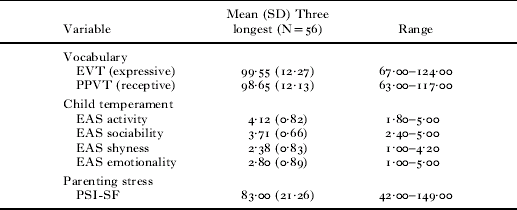
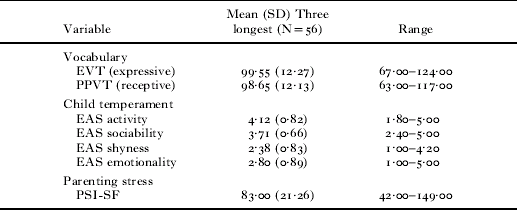
Expressive and receptive vocabulary was measured with the EVT and the PPVT respectively. The means, standard deviations and ranges are shown in Table 1. The mean expressive vocabulary score on the EVT was 99·55, corresponding to an age equivalent of 3 ; 11. Children had an average receptive vocabulary score on the PPVT of 98·65, corresponding to an age equivalent of 3 ; 10.
Mean scores (and standard deviations) on measures of vocabulary and parent reported measures of child temperament and parenting stress (N=56)
Narrative ability
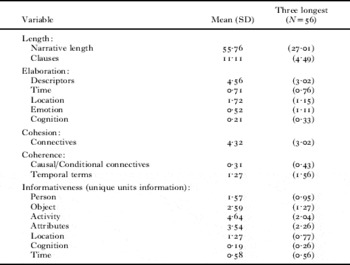
Scores for children's three longest narratives (in terms of number of clauses) were averaged and used in the analyses (see means and standard deviations in Table 2). The mean number of clauses per narrative was 11·11. Some types of elaboration were more frequent than others: participants used many more descriptor words (M=4·56) per narrative than references to emotion (M=0·52) or cognition (M=0·21). The average number of unique units of information was 14·70, with words referring to activities (verbs) used the most (M=4·64) while references to cognition were least common (M=0·19).
Mean number of occurrences of each narrative variable measured (and standard deviations) for the three longest narratives (N=56)

Temperament and parenting stress
Temperament was measured with the EAS and parenting stress was measured with the PSI-SF. The means, standard deviations and ranges are shown in Table 1. Across temperament subscales, the means for each temperament dimension was around 3, with low standard deviations. Thus, on average, parents did not rate their children as having extreme temperaments. Overall, children were rated as being highly active (M=4·12) and sociable (M=3·71).
The average PSI-SF total stress score across all mothers was 83·00, indicating that the average stress level experienced within the mothers' role as a parent fell within the 83rd percentile. Since a total stress score of 90 indicates clinically significant levels of stress (warranting closer diagnostic studies and professional assistance; Abidin, Reference Abidin1995), and our total stress scores ranged from 42·00 to 149·00, the sample widely varied on, and represented both extremes of, the total parenting stress dimension.
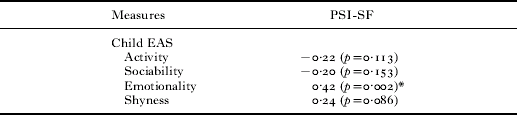
The correlations between the EAS dimensions and the total PSI-SF score are shown in Table 3. Child temperament was significantly related to parenting stress. Parents who rated their children as being highly emotional also rated themselves as experiencing higher levels of parenting stress (r=0·42, p<0·01).
Bivariate correlations between parent-reported child temperament (EAS) and total parenting stress (PSI-SF)
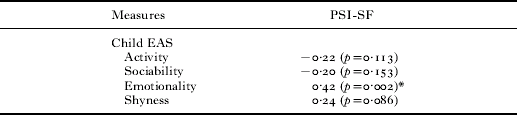
note: All correlations significant at p=0·05 are labeled with asterisk (*).
A second scorer scored fourteen of the participants' EAS and PSI-SF measures (25%) for reliability purposes. Inter-rater correlations for the EAS and the PSI-SF were both 1·00.
Relations between temperament and vocabulary
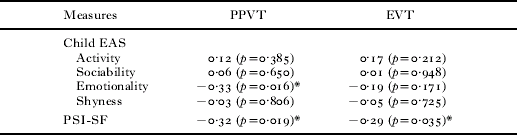
The bivariate correlations between the EAS temperament subscales and the PPVT and EVT measures are shown in Table 4. Temperament showed no relationship with expressive language ability, suggesting that children's ability to produce synonyms is not affected by how sociable, active or emotional they are. However, children's receptive vocabulary was significantly related to emotionality. Children who were rated as being highly emotional were less likely to perform well on the PPVT (r=−0·33, p<0·05).
Bivariate correlations between parent-reported temperament (EAS) and parenting stress (PSI-SF) and receptive (PPVT) and expressive (EVT) vocabulary
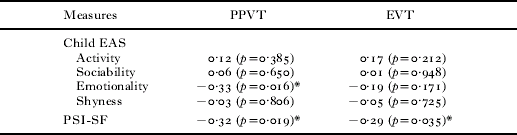
Note: All correlations significant at p=0·05 are labeled with asterisk (*).
Relations between temperament and narrative ability
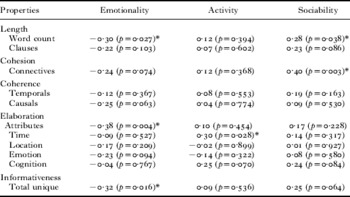
The bivariate correlations between child temperament subscales and narrative properties are shown in Table 5. In particular, child emotionality was negatively related to both length of the narratives and amount of description that the child provided. Child emotionality was negatively related to the total number of words in the narratives (r=−0·30, p<0·05): children who were higher in emotionality provided shorter narratives. Also, highly emotional children did not use many descriptors and were therefore less elaborative in their narratives (r=−0·38, p<0·01). High scores on this temperament subscale were also related to fewer total unique terms (r=−0·32, p<0·05). Thus, children who were rated to be higher in emotionality also tended to provide less informative narratives.
Bivariate correlations between the Child EAS subscales and the narrative properties

Note: Correlations significant at p=0·05 are labeled with an asterisk (*).
Child sociability was positively correlated with overall narrative length (r=0·28, p<0·05) and number of connectives (r=0·40, p<0·01). Thus, children rated as higher in sociability were more likely to produce longer and more cohesive narratives.
Interestingly, child activity levels were positively related to the number of terms mentioned related to time (r=0·30, p<0·05). That is, children rated as being highly active were more likely to use specific time references in their narratives. These children's narratives were more contextually embedded in time and were therefore more elaborative.
Relations between parenting stress, vocabulary and narrative ability
The bivariate correlations between the PSI-SF and the PPVT and EVT measures are shown in Table 4. Children's expressive vocabulary was significantly related to their mothers' reported parenting stress: parents reporting higher levels of stress had children with poorer expressive vocabularies (r=−0·29, p<0·05). Likewise, children's receptive vocabularies were significantly related to their mother's reported parenting stress: parents reporting higher levels of parenting stress had children who demonstrated poorer receptive vocabularies (r=−0·32, p<0·05). Interestingly, parenting stress showed no relationship with any aspect of narrative ability.
Summary
Child temperament was related to parenting stress, such that mothers who rated their children as being highly emotional also rated themselves as having high levels of parenting stress. Child temperament was also related to receptive vocabulary and narrative ability. Highly emotional children exhibited poorer receptive vocabularies, and also shorter, less descriptive and less informative narratives. Highly sociable children tended to produce narratives that were longer and more cohesive. Children who were rated as being highly active tended to produce more elaborative narratives that were contextually embedded in time. Parenting stress was related to both children's expressive and receptive vocabularies. Mothers who reported high levels of parenting stress had children with poorer expressive and receptive vocabularies. Conversely, parenting stress was not related to any aspect of children's narrative ability.
DISCUSSION
The results of this preliminary study support the prediction that child temperament is related to children's language skills among economically disadvantaged preschoolers. Child temperament was related to children's receptive (although not expressive) vocabulary: children rated as low on emotionality tended to score higher on a measure of receptive vocabulary. In terms of narrative skills, less emotional and highly sociable children demonstrated advanced narrative skills compared to their more emotional and less sociable counterparts. Children rated as low on emotionality produced longer, more descriptive and more informative narratives and highly sociable children tended to produce narratives that were longer and more cohesive.
Although parenting stress was also related to children's language skills, the pattern of relationships was quite different. Children of parents who rated themselves as having low levels of parenting stress performed better on measures of both expressive and receptive vocabulary. However, these children did not exhibit more advanced narrative skills. Taken together, this preliminary study suggests that economically disadvantaged children with easier temperaments promoting social interaction, and who have parents who perceive low levels of parenting stress, have more advanced oral language skills. While both child temperament and parenting stress are related to language skills, the nature of their relationship to these skills differs. Temperament seems to be more related to narrative ability and receptive vocabulary whereas parenting stress is linked to children's vocabulary, both receptive and expressive.
Child temperament
Although temperament was related to many aspects of narrative ability, children's emotionality was the only measured temperament dimension that was significantly related to vocabulary. Specifically, children rated as highly emotional tended to exhibit less advanced receptive vocabulary skills. None of the temperament dimensions were related to the children's expressive vocabulary skills. This is surprising in light of past research that revealed clear relationships between aspects of children's temperaments and their vocabulary skills (Dixon & Smith, Reference Dixon and Smith2000; Morales et al., Reference Morales, Mundy, Delgado, Yale, Neal and Schwartz2000; Salley & Dixon, Reference Salley and Dixon2007). However, children's narrative ability and vocabulary competence are qualitatively different and are sometimes not related to each other (McCabe et al., Reference McCabe, Peterson and Conners2006; Peterson, Reference Peterson1994). In a study of low-income children, Peterson (Reference Peterson1994) found that they had relatively poor-quality narratives with little new information while their receptive language abilities were well within the normal range for their age. It seems that children's ability to acquire and recognize new vocabulary words is different from their ability to create coherent, cohesive and elaborative narratives. Moreover, since narrative ability is related to later literacy and school success (Paul & Smith, Reference Paul and Smith1993) and vocabulary is also related to later reading comprehension (Sénéchal et al., Reference Sénéchal, Ouellette, Rodney, Dickinson and Neuman2005), children's temperament is both an important risk factor and predictor of later learning. Additionally it is an indicator of a preschooler's readiness for the school arena.
Previous research has established a link between children's temperament and early literacy. Coplan and colleagues (Reference Coplan, Barber and Lagace-Seguin1999) found that children's performance in the academic domain is related to aspects of their temperament. Specifically, children who scored lower on negative emotionality also tended to score higher on measures of early literacy. Furthermore, these temperament characteristics uniquely contributed to the preschoolers' literacy skills over and above well-established factors of achievement, such as parental education, child gender and vocabulary. The findings of the present study add further empirical support to the notion of temperament as a predictor of children's cognitive abilities and extend these findings to include narrative and receptive vocabulary skills.
Why might child temperament be related to narrative ability? The specific temperament aspects that were found to be important all foster positive parent–child interactions. Narrative skills are built through elaborative parent–child conversations early in development and are directly related to the quality of these interactions (Fivush et al., Reference Fivush, Haden and Reese2006; Peterson & McCabe, Reference Peterson, McCabe, Pratt and Fiese2004). In these conversations, parents encourage their children to talk extensively about each event being discussed. They stay on topic and help their children develop their verbal reconstructions of each memory. Through appropriate scaffolding, they also teach their children what type of information should be included and how that information should be organized (Fivush et al., Reference Fivush, Haden and Reese2006; Peterson & McCabe, Reference Peterson, McCabe, Pratt and Fiese2004). In other words, these conversations extend across time as well as take place frequently. A child who easily becomes frustrated or is prone to emotional displays and is less sociable is unlikely to encourage the kind of interactions that foster the development of narrative and vocabulary skills. Given that narrative ability and vocabulary emerges within the context of parent–child interactions, it is likely that the relationship between child temperament and these oral language skills are mediated by the quality of these interactions.
Parenting stress
Among the economically disadvantaged preschoolers in the present study, parenting stress was related to both expressive and receptive vocabulary. Children of parents reporting lower levels of parenting stress tended to have more advanced expressive and receptive language skills. The results suggest that parenting stress is tied to early expressive and receptive vocabulary competence and is not related to early narrative ability. Previous research has shown that children's vocabulary, measured at formal school entry, is one of the best predictors of reading comprehension in grades three and four (Sénéchal et al., Reference Sénéchal, Ouellette, Rodney, Dickinson and Neuman2005; Storch & Whitehurst, Reference Storch and Whitehurst2002), and even as far into the future as the eighth grade (Wood et al., Reference Wood, Hill, Meyer and Flowers2005). Hence, parenting stress appears to be an important factor in children's expressive and receptive language skills and in their later reading comprehension.
The quality of parent–child interactions may also mediate the relationship between parenting stress and children's vocabulary ability. Parenting stress is an important predictor of parent–child behavior and dyadic interaction such that higher parenting stress is associated with less dyadic pleasure (Crnic et al., Reference Crnic, Gaze and Hoffman2005). Mother–child interactions are related to levels of parenting stress and the quality of this dynamic has been found to be the biggest predictor of children's cognitive development, over and above that of the school and child-care environments (NICHD Early Child Care Research Network, 2005c). Moreover, the rate of children's vocabulary development is related to how their mothers talk to them (Hoff & Naigles, Reference Hoff and Naigles2002). For example, children who acquire more extensive vocabularies have parents who take the time to label objects in the environment and describe their attributes in nuanced ways (Hart & Risley, Reference Hart and Risley1995). Parent–child interactions are impaired among highly stressed mothers, and vocabulary development occurs within the context of these interactions. It is likely that highly stressed mothers do not have the kinds of conversations and interactions that foster vocabulary.
Conversely, higher parenting stress was not significantly related to lower scores on any of the narrative properties studied. This is unexpected given the wealth of literature documenting both direct and indirect links between higher parenting stress and poorer cognitive outcomes among children (Crnic et al., Reference Crnic, Gaze and Hoffman2005; Crnic & Low, Reference Crnic, Low and Bornstein2002). However, previous research has not specifically looked at the relationship between parenting stress and narrative ability, and different sorts of parent–child interactive contexts foster narrative skill development versus vocabulary acquisition. Learning new words requires frequent parent–child conversations that label, describe and provide explanations. In contrast, learning narrative skills requires extended conversational exchanges where parents encourage children to provide information on the who, where and when of the event under discussion, develop the sequence of actions (with appropriate temporal and causal links), provide emotional reactions to and evaluation of those events and bring the entire narrative to a conclusion.
It is also important to consider the limitations inherent in research using a small sample size such as the one assessed in the present study. Due to the relatively small number of participants, we were unable to explore possible mediating effects and interactions. As such, the generalizability of the present findings is limited and future research is needed to clearly define the relationship between these parent and child factors and their important relationship to children's early language development. Moreover, although this study only focused on a homogeneous sample of low-SES preschoolers, it is likely that similar underlying mechanisms affect the language abilities of preschoolers from other SES distributions. Future research is needed to explore the relationship between these parent and child factors and early language development among preschoolers from other SES backgrounds.
Intervention
The present study provides a preliminary glimpse at where economically disadvantaged preschoolers' vocabulary, narrative skills, temperaments and mothers' parenting stress lie prior to intervention. The results suggest that child temperament is related to narrative ability and receptive vocabulary and parenting stress is related to both expressive and receptive vocabulary. Future research will reveal whether fostering proactive ways of interacting with children in turn improves their preliteracy skills. Peterson and colleagues (Reference Peterson, Jesso and McCabe1999) found one-on-one intervention to be effective at improving both vocabulary and narrative skills and future research will extend this intervention to group settings with the expectation that children will show a similar improvement in these oral language skills. Other research has also been successful at teaching mothers to employ decontextualized language and encouraging children to adopt these strategies (Morgan & Goldstein, Reference Morgan and Goldstein2004). Additionally, Huebner (Reference Huebner2000) found that community-based intervention not only improved children's narrative ability but also decreased parental reports of stress.
If parents can be taught effective communication skills, parent–child relationships should improve, resulting in less parenting stress, more effective parenting techniques and, importantly, more advanced vocabulary and narrative competence. Hence, future research aims to investigate whether fostering improved parent–child interactions will lower parenting stress and enhance children's oral language skills among economically disadvantaged parent–child dyads. Given that social engagement between parents and children is a buffer against the risks posed by poverty among low income samples (Chase-Lansdale & Brooks-Gunn, Reference Chase-Lansdale and Brooks-Gunn1995), future intervention holds rich potential for equipping at-risk children and mothers with the skills necessary to succeed in their academic, familial and interpersonal worlds.