The main interest in studying monodominant forests in the tropics (i.e. single-dominant forest sensu Richards Reference RICHARDS1996 and Connell & Lowman Reference CONNELL and LOWMAN1989) is that processes leading to monodominance may highlight mechanisms controlling species diversity (Hart et al. Reference HART, HART and MURPHY1989). Among the various cases of monodominant forest (Hart Reference HART1990), the most intriguing are the rare ones that stand in contact with a considerably more diverse forest, without apparent environmental boundaries, and for many generations (i.e. type I sensu Connell & Lowman Reference CONNELL and LOWMAN1989). Rather than a single mechanism, it is likely that this type of monodominance results from a suite of interacting traits (Torti et al. Reference TORTI, COLEY and KURSAR2001). This has been well illustrated for the neotropical tree Dicymbe corymbosa whose monodominance relies on: (1) ectomycorrhizal symbiosis (Henkel et al. Reference HENKEL, TERBORGH and VILGALYS2002) linked to (2) mast fruiting (Henkel et al. Reference HENKEL, MAYOR and WOOLLEY2005), (3) high seedling survival rate (Henkel et al. Reference HENKEL, MAYOR and WOOLLEY2005, McGuire Reference MCGUIRE2007a, Reference MCGUIRE2007b) and, potentially, (4) slow litter decomposition (Mayor & Henkel Reference MAYOR and HENKEL2006, McGuire et al. Reference MCGUIRE, ZAK, EDWARDS, BLACKWOOD and UPCHURCH2010), moreover, (5) the reiterative habit of D. corymbosa slows the gap dynamics, and reduces species richness (Woolley et al. Reference WOOLLEY, HENKEL and SILLETT2008). Thus, a comprehensive understanding of monodominance may only emerge from the comparison of many case studies to point out shared mechanisms. Here, we report a new case of a monodominant species: Spirotropis longifolia (DC.) Baill.
Spirotropis longifolia is endemic to the Guiana Shield, ranging from Bolivár (Venezuela) to French Guiana (Stirton & Aymard Reference STIRTON, AYMARD, Steyermark, Berry, Yatskievych and Holst1999). We recorded only 30 collections in major herbaria (NY, U, CAY, P), most of them from French Guiana. The western Guiana Shield is known to hold several monodominant forests (Davis & Richards Reference DAVIS and RICHARDS1934, Henkel Reference HENKEL2003, Richards Reference RICHARDS1996). However, the dominance of S. longifolia has never been investigated nor reported.
Only 16 French Guianan sites are known to host S. longifolia. We prospected eight of them and selected the two most accessible to evaluate S. longifolia dominance: a 20-ha population at Piste de Saint-Élie (PSE: 5°16΄36΄΄N, 53°3΄0.5΄΄W), and a 7-ha one at Montagne des Chevaux (MDC: 4°42΄47΄΄N, 52°23΄41΄΄W).
We set three 1-ha plots on upland areas at each site, two in forest dominated by S. longifolia (Ps1, Ps2 at PSE ; Cs1, Cs2 at MDC) and one on adjacent mixed forest (Pm1 at PSE; Cm1 at MDC). We censused all living trees with trunk ≥10 cm in diameter at 130 cm above the ground (dbh). As most S. longifolia individuals produce basal sprouts, we pooled all stems ≥ 10 cm in dbh to calculate the basal area of each individual. We also counted the number of shoots with 5 cm ≤ dbh ≤ 10 cm, and evaluated the number of thinner sprouts. Soils characterization followed Lescure & Boulet (Reference LESCURE and BOULET1983). In order to evaluate the dominance of S. longifolia in the recruitment pool, we censused all individuals ≥ 2 cm in dbh on eight 20 × 20-m plots, five of them within Ps1 (Ps1-subplot). Individuals were most often identified to species or at least assigned to genus or family. Finally, we evaluated the mycorrhizal status of six S. longifolia sampled at PSE. Fine roots and mycorrhizas were cleared and stained according to the method described by Kormanik & McGraw (Reference KORMANIK, MCGRAW and Schenck1982).
In all sites, S. longifolia was present from hilltops to marshy bottomlands, and always aggregated. Populations covered areas ranging from 0.5 ha to hundreds of hectares, in which dominance varied from 20% to 70% of stems ≥ 10 cm in dbh (data not shown).
At PSE, topography and soil-cover of the whole S. longifolia stand matched the last stage of transformation of a ferralitic cover on schist, as described by Sabatier et al. (Reference SABATIER, GRIMALDI, PRÉVOST, GUILLAUME, GODRON, DOSSO and CURMI1997). At MDC, erosion of the sandstone bedrock (quartzite) produced steep slopes, on which top soil (30 cm depth) was sandy. In spite of their differences in bedrock, topography and soil thickness, the two sites shared thin, superficially drained, hydromorphic soils. Soils of the mixed-forest plots did not differ from those of their neighbouring dominated plots.
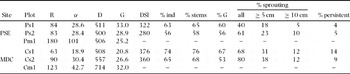
In our plots, S. longifolia exceeded 50% of stems and/or basal area for trees ≥ 10 cm in dbh (Table 1), the standard threshold of monodominance proposed by Connell & Lowman (Reference CONNELL and LOWMAN1989). In Ps1-subplot, S. longifolia accounted for 35% of the recruitment pool. Furthermore, we found a significant positive relationship between the relative abundances of S. longifolia trees (dbh ≥ 10 cm) and its own recruitment pool in our 20 × 20-m plots (Pearson r = 0.79, P < 0.01). Tree species richness and diversity were high in mixed-forest plots and considerably lower in dominated plots (Table 1).
Species richness, diversity and forest structure, for trees ≥ 10 cm in dbh, on 1-ha plots of Spirotropis longifolia-dominated forest (Ps1, Ps2, Cs1, Cs2) and mixed forest (Pm1, Cm1) at Piste de Saint-Élie (PSE) and Montagne des Chevaux (MDC) sites. R: species richness; α: Fisher's alpha diversity index; D: plot density (ind. ha−1); G: basal area (m2 ha−1); DSl: plot density of S. longifolia (ind. ha−1); relative abundance (%) of S. longifolia, as % ind: among all individuals, % stems: among all stems and % G: of basal area; % sprouting: proportion of sprouting S. longifolia for three sprout diameter limits (%); % persistent: proportion of S. longifolia with at least one dead stem.

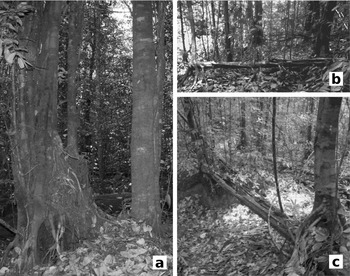
In the eight prospected sites, S. longifolia was always found as a low-stature tree, 20–25(–30) m high with a maximum observed dbh of 75 cm. Within our plots, 40–80% of S. longifolia trees produced collar sprouts (Table 1), and 18–38% had at least one reiterated trunk ≥5 cm in dbh (Table 1, Figure 1a). On Cs1 and Cs2 we estimated that for 10% and 30% of S. longifolia individuals, respectively, the dead main stem has been replaced by one or more reiterated trunks (Table 1). Sprout production was concomitant to the proliferation of basal adventitious roots of two kinds: (1) dense mound of roots, often disconnected from the ground, able to accumulate organic matter and (2) strong arching stilt roots that stabilized the clumps (Figure 1a).
Sprouting abilities of Spirotropis longifolia. Two S. longifolia showing different habits; the right one was a mono-stemmed tree, the left one was a mature clump made of several reiterated trunks with small arching stilt roots and small mound of roots at its base (a). S. longifolia ‘walking’ in the forest and producing layers (b). Two large layers and their ancient connection now rotted (c). (Photographs: É. Fonty.)

At all stages of development, uprooted S. longifolia were able to layer, i.e. to produce sprouts, able to become autonomous, along prostrate or fallen stems (Koop Reference KOOP1987) (Figure 1b, c). Layers grew all along the fallen stems and often remained connected to each other, sharing multiple root systems (Figure 1b). On Cs1 and Cs2, respectively 5% and 11% of S. longifolia ≥ 10 cm in dbh were identified as layers. These figures are conservative estimates, since signs of layering disappear with time (Figure 1c). Roots of S. longifolia hosted arbuscular mycorrhizas but we did not find evidence of ectomycorrhizas.
Together with Pterocarpus officinalis, which dominates the rear mangrove swamp (Migeot & Imbert Reference MIGEOT and IMBERT2011), S. longifolia is one of the rare Papilionoideae forming monodominant stands in tropical forests. Although absent from deep, freely draining soils, it showed a wide environmental amplitude. Surrounding species-rich forests (Table 1) were similar in diversity to those observed elsewhere in the Guiana Shield (ter Steege et al. Reference TER STEEGE, SABATIER, CASTELLANOS, VAN ANDEL, DUIVENVOORDEN, DE OLIVEIRA, EK, LILWAH, MAAS and MORI2000) and on the same soils at PSE (D. Sabatier, unpubl. data). Yet, S. longifolia-dominated forests were relatively species-rich (Table 1). Thus, its monodominance seems to result neither from peculiar environmental conditions nor from a lack of competitors.
Our results emphasized that S. longifolia recruits beneath its own canopy. Indeed, as for some other monodominant species (Hart Reference HART1985, Henkel et al. Reference HENKEL, MAYOR and WOOLLEY2005), S. longifolia seeds are dispersed autochorously, less than 10 m from the parent tree. Moreover, seeds germinate within 2 d (pers. obs.) thus post-dispersal movement is limited. This set of life traits places S. longifolia among the Type I monodominant species (Connell & Lowman Reference CONNELL and LOWMAN1989).
Through layering, S. longifolia is also able to reproduce and propagate vegetatively. Layering does not only allow the survival of the genet, but also its spread in the understorey, increasing the relative abundance of the species in the recruitment pool (Gavin & Peart Reference GAVIN and PEART1999). Moreover, in case of tree uprooting, layering species may pre-empt the recruitment niche, not only at the stump, but also all along the fallen stem (Negrelle Reference NEGRELLE1995). As basal sprouts do, young layers benefit from larger resources than seedlings and saplings (Dietze & Clark Reference DIETZE and CLARK2008), and may have access to an already settled root system and even to a still functional photosynthetic system (Sakai et al. Reference SAKAI, SAKAI and AIKIYAMA1997), allowing them to compete with pioneer species in gap closure (Negrelle Reference NEGRELLE1995).
Bond & Midgley (Reference BOND and MIDGLEY2001) introduced the concept of the persistence niche (i.e. the capability of an established plant to persist in situ) and pointed out its potential impact on species richness. Indeed, by the constant rejuvenation of their stems and the stabilizing effect of their arching stilt roots, the persistence of the clumps of Dicymbe altsonii and D. corymbosa reduces the gap dynamic, thus contributing to their monodominance (Woolley et al. Reference WOOLLEY, HENKEL and SILLETT2008, Zagt et al. Reference ZAGT, MALTA, RIJKS and Zagt1997). The long-lasting ability of S. longifolia to form coppice clumps strongly suggests a similar efficiency to exploit a persistence niche and supports this trait as a realistic mechanism leading to monodominance. On the other hand, we found no evidence that ectomycorrhizal symbiosis could be related to the monodominance of S. longifolia.
Thus, S. longifolia monodominance seems to rest on the simultaneous use of two strategies: a supporting one (i.e. a competitive advantage for its own recruitment pool by layering) and a suppressive one (i.e. a depletion of the recruitment opportunities of the other species through the persistence niche). However, the relative advantages of these strategies for S. longifolia remain to be evaluated. Meanwhile, we suggest that both strategies are not limited to monodominant species and should be better taken into account to explain the variations in alpha diversity observed in tropical rain forests.
ACKNOWLEDGEMENTS
We are grateful to G. Elfort, J.-L. Smock and M. Tarcy for their help during the fieldwork and to E. Louisiana for her willingness to teach techniques of mycorrhizal research. We also thank H. De Foresta, P. Couteron, F. Munoz and the reviewers for valuable comments. This study was supported by the National Association for Research and Technology and by the European Regional Development Fund in the frame of the DyGePop research programme.