Introduction
Family history is a known risk factor for many cancers (Bevier et al., Reference Bevier, Sundquist and Hemminki2012). Discussing cancer family history in palliative care may help providers to identify at-risk relatives eligible for predictive genetic testing and preventive measures (Hartmann and Lindor, Reference Hartmann and Lindor2016). A recent paper from our group reported that most palliative care providers face questions from patients and family members regarding their cancer family history (Cleophat et al., Reference Cleophat, Pelletier and Joly2019). Although the integration of genetics-related activities in palliative care has been favorably perceived by palliative care providers (Dearing and Taverner, Reference Dearing and Taverner2018; Cleophat et al., Reference Cleophat, Pelletier and Joly2019), they seem little inclined to engage in discussions about cancer family history with patients and families at the end of life. Potential barriers to such discussions, including fear of negative psychological impacts among family members and providers’ lack of knowledge, have been debated in the literature (Dearing and Taverner, Reference Dearing and Taverner2018; Gonthier et al., Reference Gonthier, Pelletier and Gagnon2018). Factors that might help foster such discussions have not been clearly identified yet. In addition, how providers envision their role and their ethical concerns regarding such discussions have received little attention. The present study aimed to identify palliative care providers’ main needs, potential roles, and ethical concerns regarding cancer family history discussions at the end of life.
Methods
Participants and data collection
To be eligible for this study, potential participants had to be healthcare professionals providing palliative care and services to end-of-life patients. Management team members, academic and research personnel without clinical responsibilities, as well as volunteers, recreation therapists, spiritual care providers, music, and pet therapists were not targeted by this study. Indeed, we considered that potential participants had to have sufficient medical or health-related knowledge to assess and take a stand on issues related to cancer family history. An invitational email was sent by the President of the Quebec Palliative Care Association (AD) in November 2016 to the attendees of the Association 2015 annual meeting. A link to a web-based questionnaire was inserted into the invitation letter. On April 10, 2017, 50 providers had answered the questionnaire. As a larger sample was desired, a similar procedure was repeated with the attendees of the Association 2017 meeting with the invitation email sent in May 2017. Each invitation was followed by two reminders. The link to the online questionnaire was kept functional until July 2017.
Online questionnaire
We devised the survey questionnaire using the information provided by 12 experienced palliative care providers who were asked, during semi-structured interviews conducted from December 2015 to February 2016, to provide their perspective on three illustrative cases. These providers specifically shared their view on potential barriers and facilitators to cancer family history discussions, the role of palliative care providers in such discussions, the feasibility of genetic testing in dying cancer patients and DNA banking, and the issues related to the communication of genetic test results to families. The survey questionnaire included background information about the possible association between family history and cancer development, as well as three case examples in which patients and family members express their concerns regarding a potential familial predisposition to cancer. Moreover, the questionnaire comprised 32 items about the five following themes: (1) Factors that may facilitate cancer family history discussions in palliative care; (2) providers’ knowledge and skills needs to hold such discussions; (3) their information needs on legal and ethical issues related to these discussions; (4) their potential roles when discussing cancer family history; (5) their perception of ethical issues surrounding such discussions. Participants were asked to rate the items, according to their relevance, or the extent to which they agree with them, using a 7-point Likert-type scale. For the first four themes, participants also had to indicate which item was the most relevant among those proposed. Three additional questions evaluated the participants’ self-perceived level of knowledge of cancer genetics, their interest in training, and their preferences for educational media. The survey questionnaire thus devised was pretested among six palliative care providers leading to improved clarity and face validity, and determining completion time (20 min).
Statistical analysis
Continuous variables were presented as means with standard deviations (SD) and range. Proportions were used to summarize categorical variables. Scores on the 7-point Likert-type scale were dichotomized as follows: 1–4 for responses ranging from “not important/relevant at all” to “more or less important/relevant”, and 5–7 for responses ranging from “important/relevant” to “extremely important/relevant”. Complete-cases analyses were carried out using SAS software (version 9.4; SAS Institute Inc, Cary, NC, USA). Proportions of missing data ranged from 1% to 10%. We report the proportions of respondents who rated the items as relevant (5–7 on the Likert scale). For each of the first four themes of the questionnaire, we also report the most relevant item and the proportion of providers who identified this item as such.
Ethical considerations
This study was approved by the Research Ethics Review Board of the CHU de Québec-Université Laval on November 19, 2015 (Project number: 2016-2662, SIRUL 110731). The invitation letter provided prospective participants with all the necessary study information to make an informed decision about their participation and their rights as participants. Completing the online questionnaire was considered as consenting to participate in the study. The survey was anonymous and participants were informed that their email address would not be linked to the survey results.
Results
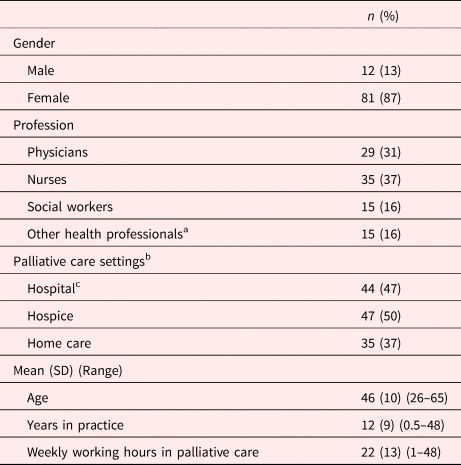
The invitation letter was sent to the 1,191 attendees of the 2015 and 2017 annual meetings of the Quebec Palliative Care Association among whom 461 were found to be ineligible. Seven hundred thirty attendees were potentially eligible for the study. Ninety-eight completed the online questionnaire. Thereafter, four respondents were excluded since they did not match the study inclusion criteria. The analyses were conducted over the 94 remaining participants (13%). They were mostly female (87%), physicians and nurses (68%), aged 26-65, with 6 months to 48 years of experience, and working 1–48 h weekly in palliative care (Table 1).
Characteristics of the study population (N = 94)

a Pharmacist, occupational therapist, health manager with clinical experience, nursing assistant, nursing care clinical advisor, home care coordinator.
b Providers may work in more than one setting.
c Hospital department, outpatient clinic, long-term care facility.
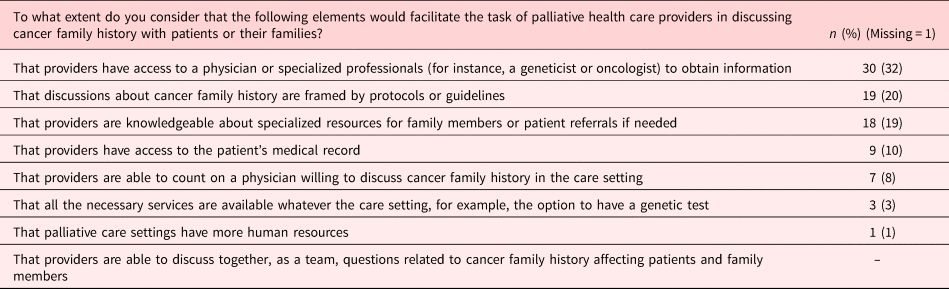
All the survey items concerning the facilitating factors to cancer family history discussions, providers’ knowledge, and skills needs, their roles and information needs on legal and ethical issues regarding such discussions were deemed relevant by 73–95% of providers. About one third of respondents considered access to genetics specialized or knowledgeable professionals the most facilitating factor for these discussions (Table 2). One fifth considered, respectively, availability of protocols or guidelines that frame end-of-life discussions, and being aware of genetics resources for patients or relatives referral the most facilitating factor to discussions on cancer heritability.
Proportions of respondents who ranked items as the most important factor to facilitate discussions about cancer family history in palliative care (n = 93)

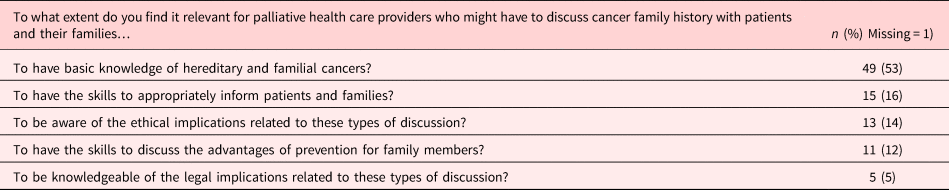
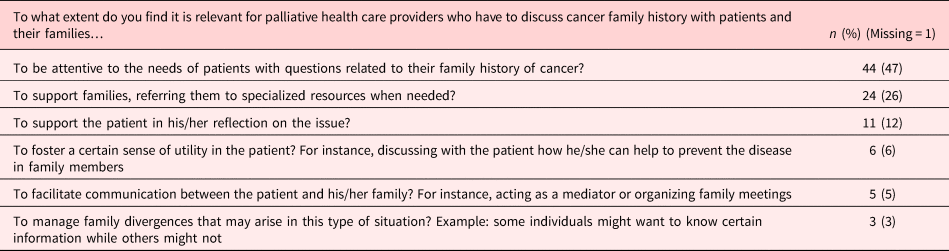
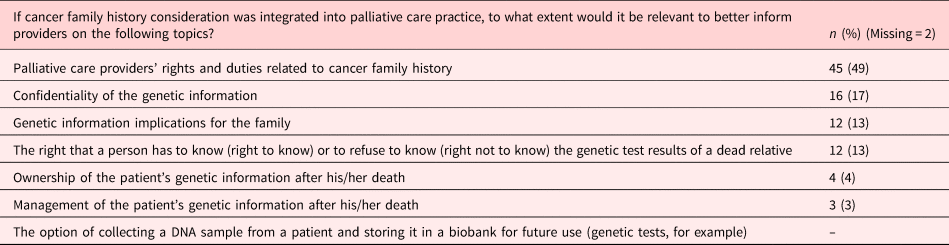
Knowledge regarding basic concepts of hereditary cancers was considered essential to discuss cancer heritability by just over half of the respondents (Table 3). Also, 31% reported having a good or very good level of knowledge of cancer genetics. Fifty-two to 68% expressed interest in receiving training related to hereditary cancers, prevention opportunities, and related legal and ethical issues. A dedicated website (60%) was the preferred training or information medium. Respondents reported that the most important provider role consists in being attentive to patients’ concerns regarding cancer family history (47%) and referring families to genetics resources when needed (26%) (Table 4). Nearly, half responded that the rights and duties of palliative care providers are the most relevant ethical and legal issues about which they should be informed regarding discussing cancer family history (Table 5).
Proportions of respondents who ranked items as the most important knowledge or skill needed to discuss cancer family history in palliative care (n =9 3)

Proportions of respondents who ranked items as the most important role of palliative care providers when discussing cancer family history (n = 93)

Proportions of respondents who ranked items as the most important factor involving ethical or legal aspects related to cancer family history discussions in palliative care (n = 92)

Most respondents agreed that there should be no difference in the way questions related to cancer family history are addressed in palliative care in comparison to curative care (57%), and other health-related requests from patients or relatives (72%). They generally agreed that cancer family history discussions in palliative care might create needs that providers might not be able to meet (64%). Fifty-one (58%) agreed that such discussions should be initiated only if beneficial to family members. Half considered that these discussions might create value conflicts among palliative care providers.
Discussion
This study showed that better knowledge of hereditary cancers is, according to palliative care providers, a key factor in being able to address cancer family history at the end of life. No consensus was found among providers regarding the most facilitating factor to cancer family history discussions in palliative care, the most relevant provider role, and information need on ethical and legal aspects related to these discussions. Some providers notably expressed interest in knowing and having access to genetics professionals, and applicable protocols or guidelines to foster cancer family history discussions. These providers wished they received information on their rights and duties regarding these discussions. They also considered of high importance to be attentive to patients’ questions concerning their family history of cancer and referring families to genetics specialists. Palliative care providers generally agreed that the heritability of cancers should be addressed in palliative care settings in the same way as in other specialities, particularly, when such discussions are expected to benefit patients and their relatives. Moreover, they were concerned that these discussions might create needs in patients and relatives that will remain unmet.
Previous studies have identified education gaps about hereditary cancers among palliative care providers (Metcalfe et al., Reference Metcalfe, Pumphrey and Clifford2010; Lillie et al., Reference Lillie, Clifford and Metcalfe2011; Dearing and Taverner, Reference Dearing and Taverner2018; Gonthier et al., Reference Gonthier, Pelletier and Gagnon2018). This lack of knowledge coupled with the lack of confidence that it may cause (Metcalfe et al., Reference Metcalfe, Pumphrey and Clifford2010; Dearing and Taverner, Reference Dearing and Taverner2018; Gonthier et al., Reference Gonthier, Pelletier and Gagnon2018), and the families’ perception that palliative care providers are not the appropriate professionals to consult for cancer heritability matters (Cleophat et al., Reference Cleophat, Marin and Pelletier2020) may contribute to hinder discussions on cancer family history and genetic testing at the end of life. Knowing and having access to specialized, or genetics knowledgeable resources seem to be, for providers in this study, an important lever to initiate discussions on cancer family history. Consistent with this finding, nearly half of providers in Quillin et al. (Reference Quillin, Bodurtha and Siminoff2011) wished for the addition of a genetic counselor to their team to support them in dealing with issues related to the hereditary component of cancers. In Dearing and Taverner (Reference Dearing and Taverner2018), most providers did not have on hand the contact information for specialists in cancer genetics. Most of them did not know the patient referral pathway nor the appropriate professionals to consult when facing issues related to cancer heritability. They also showed interest in more access to genetics services in palliative care.
Providers in the present study rather see their involvement in cancer family history discussions as paying careful attention to dying patients’ concerns or referring their families to specialized resources, when needed. Roeland et al. (Reference Roeland, Dullea and Hagmann2017) envisioned circumstances in which palliative care providers might be called to play an expansive role. According to these authors, genetic testing might be requested straightforwardly by patients or family members, and DNA banking might emerge as the sole option given the patient's inaptitude or imminent death, and families’ unpreparedness to take a stance regarding genetic testing. The authors thus offered guidance to providers about the identification of patients eligible for genetic testing or DNA banking and proposed an adapted process to obtain pre-genetic testing informed consent. They suggested the selection of a contact person in the family with whom key genetic decisions will be discussed, and who will be responsible for communicating genetic test results to other surviving relatives. Quillin et al. (Reference Quillin, Bodurtha and Smith2008) also suggested a larger role for palliative care providers who, according to the authors, could use available tools to document family history, assess familial disease risk, and offer DNA storage.
While a significant number of respondents in the present study expressed the need to know their rights and duties regarding cancer family history discussions, providers in Dearing and Taverner (Reference Dearing and Taverner2018) went further. While acknowledging the emotional overload that such discussions might cause in families, they considered engaging in these discussions as their duty from a moral, legal, or medical standpoint. This point of view allows for a better understanding of respondents in this study who agree that cancer family history discussions might create value conflicts among palliative health care professionals. Providers may be torn between not warning families about the hereditary aspect of cancers or drawing attention to a potential cancer predisposition that could have negative psychological impacts. Concerns of most respondents in the present study about the clinical utility and the benefits that cancer family history discussions should involve for family members are also legitimate. Indeed, undertaking such discussions without the motive of obtaining an evidence-based benefit for patients or families might create needs that could remain unanswered and cause psychological harm. These discussions should be held preferably when preventive or therapeutic options are available and accessible, and the benefits of these options outweigh the associated risks (Valdez et al., Reference Valdez, Yoon and Qureshi2010; Green et al., Reference Green, Berg and Grody2013). Respondents’ desire that questions related to cancer family history not be overlooked in palliative care might also reflect their concerns regarding the potential medical and psychological prejudices to patients and their relatives.
This study is unique in that it captured the perception of a diverse group of providers working in different palliative care settings. Previous studies were conducted in providers belonging to one professional category (Metcalfe et al., Reference Metcalfe, Pumphrey and Clifford2010; Lillie et al., Reference Lillie, Clifford and Metcalfe2011; Quillin et al., Reference Quillin, Bodurtha and Siminoff2011), and known to be working in only one care setting (Lillie et al., Reference Lillie, Clifford and Metcalfe2011) or one type of palliative care setting (Metcalfe et al., Reference Metcalfe, Pumphrey and Clifford2010). Providers were allowed to share their perspective on factors that can be viewed as critical to the optimal conduction of cancer family history discussions. Such a survey has never taken place before among palliative care providers. However, we did not conduct a validity and reliability analysis of the study questionnaire. Yet, we worded the survey questions according to the perceptions of palliative care providers consulted during a qualitative pilot study. Adjustments made according to providers’ feedbacks and recommendations during pretesting confer to the questionnaire an acceptable face validity. The generalizability of the study findings appears limited because of the relatively small sample size, the low response rate, and the fact that the study sample might not be representative of providers who did not participate in the annual meetings of the Quebec Palliative Care Association. The small sample size did not allow for comparisons between professional groups nor the search of associations between participants’ characteristics and their answers to the questionnaire items.
The diversity observed among providers concerning the most important factors capable of influencing the initiation and unfolding of cancer family history discussions might reflect respondents’ diversity in terms of occupation, experience, work environment, and type of care setting. Priorities might be different from one care setting or profession to another. Items of almost equal importance or relevance might also be present under each theme. Although differing opinions were observed here among palliative care providers, their most frequently expressed needs and concerns deserve attention due to their potential in optimizing clinicians’ attitudes towards cancer heritability-related matters. Thus, to be prepared to answer families’ concerns and navigate issues related to their cancer family history, palliative care providers should receive training about cancer genetics including the ethical, legal, and psychosocial issues related to hereditary cancers. Websites are a convenient canal to spread knowledge on such matters and help develop cancer risk assessment and management skills among providers (Quillin et al., Reference Quillin, Bodurtha and Siminoff2011; Dearing and Taverner, Reference Dearing and Taverner2018; Gonthier et al., Reference Gonthier, Pelletier and Gagnon2018). Yet, providers’ decision to initiate cancer family history discussions in palliative care should comply with applicable policies, laws, and ethical restrictions. Saulnier et al. (Reference Saulnier, Cinà and Chan2018) analyzed the ethical, legal, and policy frameworks for communicating genetic information in palliative care in France, Belgium, and Quebec. In light of their findings, they recommended initiating such discussions with palliative care cancer patients, or their substitute decision-maker, as soon as permissible by applicable laws, and with relatives, after obtaining patients’ or their substitute's consent. The authors judged that palliative care providers are free to broach the topic with relatives, under the principle of non-malfeasance, following the patient's death. The providers’ decision should also be based on the willingness of family members to discuss their cancer risks. Indeed, in Cleophat et al. (Reference Cleophat, Marin and Pelletier2020), family members did not perceive palliative care as an appropriate setting to hold such discussions and thought it best to hold them before the palliative care period or postpone them until after their relative's death. Saulnier et al. (Reference Saulnier, Cinà and Chan2018) advocated for the development of approaches for genetic information communication that takes into account the social, cultural, and end-of-life context. The development of clinical guidelines that take into account the legal and ethical frameworks and the diversity of social and familial dynamics might be needed to support providers in discussing familial cancers. These guidelines could also help in standardizing providers’ approach when facing a potential familial predisposition to cancer. Further studies among relatives, patients, providers, bioethicists, and legal professionals might help elaborate such guidelines. Collaboration between palliative care providers and genetics services might need to be reinforced to facilitate knowledge transfer, appropriate patients and relatives referral, and even genetic testing or DNA collection for storage. Discussing hereditary cancers with families in palliative care might also require a specific approach as patients (Mishra et al., Reference Mishra, Bhatnagar and Philip2010; Baile et al., Reference Baile, Palmer and Bruera2011), and relatives (Heckel et al., Reference Heckel, Heynsbergh and Livingston2019) may be already overwhelmed. Development of psychosocial support skills (Hopwood, Reference Hopwood2005) and resources (McClellan et al., Reference McClellan, Kleiderman and Black2013) adapted to genetic information communication might be needed in palliative care. Health authorities and professional associations might have a leadership role to play in devising and implementing an approach for the routine consideration of the hereditary component of cancers in palliative care (Aday and MacRae, Reference Aday and MacRae2017). More resources specialized in cancer genetics will be required in this regard.
Conclusion
Addressing cancer family history in palliative care may help identify individuals harboring a deleterious genetic mutation. Personalized care or treatment can be provided to those individuals, whether they are affected or not. New therapeutic agents have shown promising results in lengthening the survival time in patients with deleterious mutations and advanced breast, ovarian (Livraghi and Garber, Reference Livraghi and Garber2015; Lyons and Robson, Reference Lyons and Robson2018), and prostate cancer (Mateo et al., Reference Mateo, Carreira and Sandhu2015). Educating palliative care providers on hereditary cancers, developing adapted tools, guidelines, as well as ethical and legal frameworks for initiating and conducting cancer family history discussions, might contribute to appropriate cancer risk assessment and management, and the adequate identification of individuals eligible to receive preventive or therapeutic options.
Acknowledgments
We thank Sue-Ling Chang for the linguistic editing of the manuscript.
Funding
This study was supported by the Fonds de Recherche du Québec-Santé and the Direction Générale de Cancérologie du Québec. JEC is a recipient of scholarships from the Fonds d'Enseignement et de Recherche (Faculty of Pharmacy, Laval University), Laval University Cancer Research Center, the Laval University Research Chair in Palliative Care, and the Fonds de Recherche du Québec-Santé. HN holds an Investigator Award (Junior 2) from the Fonds de Recherche du Québec-Santé.
Conflict of interest
The author(s) declared no potential conflicts of interest with respect to the research, authorship, and/or publication of this article.