INTRODUCTION
Interest in strategies to improve palliative and end-of-life care has been fueled by national concerns about appropriate and respectful care at the end of life (Institute of Medicine, 1997), an aging population (Morrison & Meier, 2004), the growing burden of chronic illnesses (Morrison & Meier, 2004), and escalating costs of medical care (Hogan et al., 2001). Effective communication has become an essential component of quality of care, including communication among providers and between providers and patients and their families (Clarke et al., 2003). Governmental and professional groups have articulated the importance of communication, including major topics for discussion (Curtis et al., 2001; Wenrich et al., 2001; Griffin et al., 2003).
Although early concern about quality of palliative and end-of-life care focused on cancer care, more recent work has drawn attention to the need to consider other illnesses and their related trajectories and the implications for processes of palliative care (Teno et al., 2001; Gibbs et al., 2002; Lunney et al., 2003). Heart failure (HF) is a serious condition that affects nearly 5 million people in the United States, with 550,000 new cases diagnosed each year (American Heart Association, 2005). HF is most common in people aged 65 years and older. It is caused by other diseases such as coronary artery disease and hypertension that alter the heart and vascular system and impact effective blood circulation. Although medications are used to treat the underlying causes and the complex neurohormonal and structural alterations of the disease, most patients experience limiting symptoms and reduced quality of life despite some improvement in function and improved longevity (Hunt et al., 2005).
Predicting prognosis in HF is challenging because the disease progression is highly variable (Hauptman & Havranek, 2005). Unlike cancer, patients will not usually present with a fairly linear decline in function but rather display periods of intermittent exacerbations that respond to treatment, or poor but stable function, and sudden death (Goodlin et al., 2004). Although some patients improve and live for years, the 1-year and 5-year mortality rates from HF are very high, making advance care planning necessary. Palliative measures should include discussion of prognosis, advance directives, management of symptoms and comormidities, and hospice (Pantilat & Steimle, 2004). As the number of aged in America increases and the prevalence of HF continues to rise, supportive care including palliation of symptoms and other distress must be integrated with medical, interventional, and surgical treatment of the disease.
Previous studies have linked team collaboration and communication with improved patient quality of care (Rosenstein, 2002). Palliative care is an interdisciplinary team approach that optimizes symptom management and quality of life (Gillick, 2005). Interdisciplinary support is needed in HF to manage the distressing symptoms and burdens associated with the disease (Goodlin et al., 2004). An interdisciplinary team can also help patients cope with the reality of dying even though they are feeling reasonably well (Albert et al., 2002).
Given the challenges of managing heart failure, the need for improved palliative care, and skilled multidisciplinary support, a continuing education program was designed. This article describes a pilot of an educational intervention for multidisciplinary health professionals “Advanced Heart Failure: A Workshop on Clinical Guidelines and Healing Words.” It describes the workshop content and methods, the participants' ratings of their skills and attitudes related to end-of-life care, and provides data on the short-term impact of the workshop experience.
METHODS
Collaboration and Planning
The educational workshop was a collaborative effort between the South Carolina Area Health Education Consortium (AHEC) and the Medical University of South Carolina (MUSC). Lowcountry AHEC is one of four regional centers of the South Carolina Area Health Education Consortium and has a 30-year history of continuing education planning, programming, and evaluation, notably in counties with a high proportion of underserved residents. One lowcountry county was selected based on its wide geographic area and underserved population including a large proportion of minorities, its expressed interest in the topic, and lack of a nearby teaching university.
An interdisciplinary planning group was coordinated by Lowcountry AHEC. The group included members from the local regional hospital, community health center, hospice, South Carolina State University College of Nursing faculty, and MUSC. Planning member disciplines included medicine, nursing, social work, hospital chaplain, and public health. The planning group met monthly. At these meetings, local heart failure end-of-life issues were discussed. This local needs assessment, along with state and national data, was used in planning objectives and content of the educational sessions. The group recommended the educational setting, target groups, and promotion methods. Two interdisciplinary, 4-h sessions were planned. A marketing brochure was mailed to health professionals in the regional and local area, with the goal of attracting an interdisciplinary group. Continuing education credit was made available for nurses, social workers, and other health professionals.
Workshop faculty consisted of a geriatrician, palliative care nurse, behavioral scientist/health service researcher, and hospice social worker.
Program Description
A 4-h workshop curriculum was designed to address the primary goal of improving care via communication regarding prognosis and advance planning among interdisciplinary health professionals and patients with advanced heart failure.
Several themes guided the methods and content of the interdisciplinary workshop.
- Skills needed are reflected in clinical practice guidelines.
- Words make a difference—“Hope for the best, prepare for the worst” (Back et al., 2003a).
- Modeling of behaviors and words is critical to clinician skill development (Wilkinson et al., 2002; Fineberg, 2005).
- Teams are key to management of patients with advanced heart failure (Riegel et al., 2000).
- All HF patients need introduction to prognosis and supportive care and this is an integral part of clinical care (Goodlin et al., 2004).
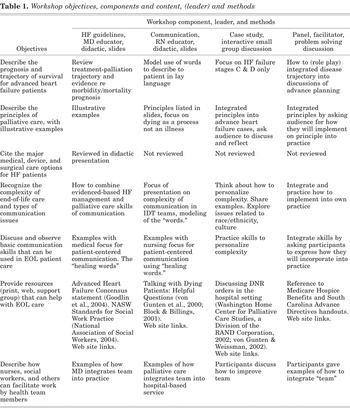
Using adult learning principles, learning objectives, educational methods, and content were specified. There were four major components, using a variety of didactic and interactive teaching methods (Tomey, 2003; Zapka et al., 2006). Table 1 reports the workshop objectives and content within the four components.
Workshop objectives, components and content, (leader) and methods

Evaluation Design and Data Collection
The evaluation used a pre- and posttest nonexperimental design. At the start of each workshop, participants created a unique identifier code and completed a self-administered confidential survey. Upon completion of the workshop, participants completed a very brief workshop rating form and were told that they would be receiving a posttest evaluation survey in about 4–5 weeks.
The posttest packet was mailed out to workshop participants by the AHEC office 5 weeks after the workshops. The packet included a letter, the survey itself, a $5 incentive gift certificate to a national yogurt/ice cream chain, and a return stamped envelope. The participant's name was printed on the return envelope in order to track who had not returned their surveys. No identification was on the survey itself. Reminder packets were mailed out 2 weeks after the original mailing, and included a reminder letter, the survey, and a return stamped envelope. A follow-up call was made 10 days after the reminder packet to any participants who had not returned the survey asking them to mail in their survey and offering to mail out another survey if needed. Once the disposition of all participants (passive refusal, unable to locate participant, survey completed) was known, surveys were returned to the research office. Surveys had codes only and all logs with identifiers were destroyed.
Measures
The self-administered survey, which was adopted from previous work (Sullivan et al., 2005; Zapka et al., 2006), included the following groups of measures. Demographic information included primary discipline of clinician (nursing, social work, etc.), specialty (open ended), years in practice, number of patient deaths in the past 6 months, and work setting (hospital inpatient, hospice, etc.).
Self-assessed skill preparation items included 18 items with five response categories from not well prepared to very well prepared. A not applicable response was offered. One item referred to overall skills, four items related to assessment and management of physical and emotional symptoms, nine items considered skills related to communication with patients and family, three to health team communications, and one to documentation. These were asked at pretest and in the mailed posttest. A summary score of nine patient communication skills (items 6–14) was created, as was a summary team communication score (items 15–17).
Attitudes about end-of-life care were measured by 23 items, with four response categories from strongly disagree to strongly agree. These were assessed at pretest and the mailed posttest. In addition, a brief participant feedback survey was administered directly after the workshop to assess participants' ratings of the workshop learning objectives, physical facilities, methods, and speaker, case, and panel effectiveness.
Data Analyses
Descriptive statistics were derived. A chi-square goodness of fit statistic was computed to test for differences in characteristics among the pretest to posttest respondents. The distribution observed at baseline was used as the expected distribution at the posttest.
To create the skill preparation summary score, the dimensionality of the summated score was verified using the item-total correlations. Because each item was positively correlated with the total score, the total score was calculated as the sum of the items. If a participant failed to complete all items, the mean of the reported items was rescaled to reflect a 9-item summary. The imputed total scores were modeled longitudinally using SAS PROC MIXED, (SAS Institute Inc., 2004) allowing for the inclusion of subjects that provided only a pretest or posttest assessment. A random intercept was included in the model and the variance structure of the two total scores within individuals was modeled using the unstructured correlation pattern. Essentially, this approach allowed for the total score variances to differ at pretest and posttest while estimating the covariance of the two time points.
The Wilcoxon signed rank statistic using the paired before and after scores was calculated to test a null hypothesis of zero of change between the pre- and the posttest on individual items of the self-assessed skill preparation and attitudes about end-of-life care.
The repeated measures analyses treated primary discipline, setting, years in practice, number of patients died over past 6 months, and workshop session as fixed covariates. The first reported value for these variables was selected. That is, the value given at the time of the pretest was used unless it was missing. In the case of missing pretest values, the value given at posttest was used if given.
All analyses were conducted using the SAS System Version 9.0 (SAS Institute Inc., 2005). The Type I error rate was established at .05. Given the limited sample size of this study, however, marginal statistical significance to .15 supports additional study. No correction for multiple comparisons was implemented.
FINDINGS
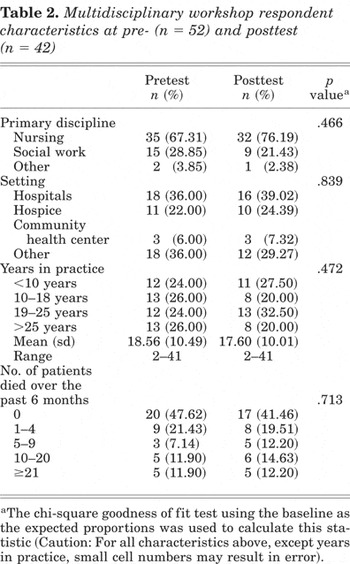
Fifty-nine participants attended the workshops, and 52 (95%) completed the preworkshop assessment, 56 (88%) completed the program rating scale at the end of the workshop, and 42 (71%) completed the follow-up assessment approximately 1 month after the workshop. The respondent characteristics are reported in Table 2. The majority of participants were nurses or social workers, practicing in a wide variety of settings such as community long-term care facilities, a community mental health center, the Department of Social Services, a dialysis center, home health care, and nursing homes. The participants were experienced practitioners, although 24% reported being in practice for less than 10 years. Notably, many participants had not experienced a patient death in the previous 6 months. There were no significant differences between characteristics of pre- and posttest respondents.
Multidisciplinary workshop respondent characteristics at pre- (n = 52) and posttest (n = 42)

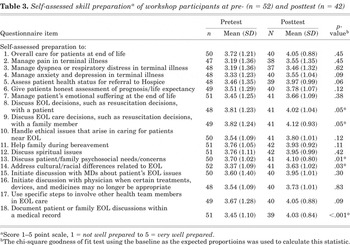
As reported in Table 3, at baseline the mean score for the self-assessed skill preparation items ranged from 3.19 to 3.82 (range 1–5) with the lowest items being related to physical symptom management (pain, dyspnea) and the highest related to end-of-life care decisions. The scores are fairly high at baseline, yet there were modest improvements between pretest and posttest. Of the 18 skill items, statistically significant increases were observed for 5 items: (1) discussing end-of-life (EOL) decisions, such as resuscitation decisions, with a patient; (2) discussing EOL care decisions, such as a resuscitation decisions, with a family member; (3) discussing patient/family psychosocial needs and concerns; (4) addressing cultural and racial differences related to EOL; and (5) documenting EOL discussions with patient or family in a medical record. All these issues were stressed in the curriculum. There was a nonsignificant trend toward improved self-assessed preparedness in all other items queried from pre- to posttest.
Self-assessed skill preparationa of workshop participants at pre- (n = 52) and posttest (n = 42)

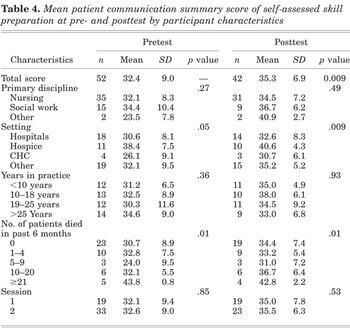
Table 4 reports the communication skill preparation summary score by participant characteristics. There was a significant higher rating in the mean score postworkshop even though it was high at baseline (p < .01). This improvement did not vary by discipline, years in practice, or which workshop session was attended. There were significant differences, however, based on practice setting and experience with patients dying in the past 6 months. Least improvement was reported by participants working in hospitals and hospice and those reporting work with greater numbers of patients who died.
Mean patient communication summary score of self-assessed skill preparation at pre- and posttest by participant characteristics

A three-item score related to health team communication score was also investigated (data not shown). There was a borderline significant improvement from pre- to posttest (10.2 to 11.3, P = .06). As with the patient/family communication score, greater improvement at posttest was significant by setting, with less improvement reported by participants working in hospitals and hospice and those reporting work with greater number of patients who died.
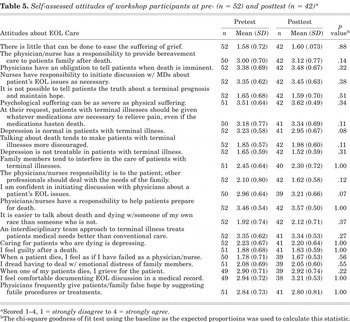
There were no statistically significant changes in any of the survey questions related to attitudes about end-of-life care between pretest and posttest. See Table 5. Highest agreement ratings at baseline related to agreement that psychological suffering can be as severe as physical suffering and that physicians and nurses have a responsibility to help patients prepare for death. Items with borderline change in a positive direction at posttest related to the normality of depression in terminally ill patients and confidence in initiating discussion with physicians about patients' end of life issues, both topics of discussion during the workshop.
Self-assessed attitudes of workshop participants at pre- (n = 52) and posttest (n = 42)a

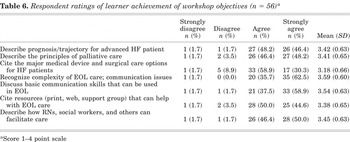
On a four-point scale (strongly disagree to strongly agree) the ratings for physical facilities, teaching methods, speaking effectiveness, and the case study and conversation panel were very high, with no mean score below 3. Table 6 reports the measures related to learner's achievement of objectives. For six of seven measures, at least 90% of participants agreed or strongly agreed with all survey items. For one learning objective, the ability to cite major medical, device, and surgical care options for heart failure patients, 89.2% of participants agreed or strongly agreed, which was not a focus of the workshop.
Respondent ratings of learner achievement of workshop objectives (n = 56)a

DISCUSSION
This collaborative continuing education workshop demonstrated the feasibility of designing, marketing, and implementing a brief workshop to an interdisciplinary group of health care providers, as well as effectiveness in improving self-perceived preparedness for patient and family communication and documentation. Interestingly, however, although the workshop included modeling of interdisciplinary team roles and conversations, the educational intervention did not improve participant's self-assessment of comfort initiating interdisciplinary communication. No significant changes were seen in attitudes in any domain following the intervention.
The skill rating items (Table 2) reflected the skills and experience of the professionals who self-selected to attend the workshop. For example, at baseline several of the lowest items related to physical symptoms, and highest ratings were given to patient communication discussion items. Significant improvements, from pre- to posttest, were primarily with patient communication items. A substantial portion of attendees were not clinical nurses and so had less physical symptom management background, and all had selected to attend the workshop advertised to improve communication (“healing words”).
Participants from the hospice setting had highest self-reported communication skill. Booth et al. (1996) have reported that even hospice nurses, however, do not all have prior training in communication skills, and without specific training and in the absence of support from other staff may utilize communication techniques that are undesirable.
As introduced in the methods section, the evaluation measures were adopted from the work of others (Block & Sullivan, 1998; Sullivan et al., 2005). Sullivan and colleagues (2005) investigated the potential for response-shift bias—the tendency of interventions to change participants' perception of their skill levels and the standards by which they rate themselves (Pratt et al., 2000). This was done by having CME participants complete surveys using the traditional pre–post administration. In addition, however, a retrospective preprogram rating was administered. Interventions that are effective in improving knowledge and skills are likely to cause participants to reappraise (and lower) their initial assessments. The analysis reported by Sullivan and colleagues proved this to be true, reinforcing that the phenomenon of response-shift bias may indeed underestimate positive impact when traditional pre–post measures are used.
The attendees at this workshop attended out of professional and personal interest (it was not required), suggesting a bias of selection—an openness to and interest in the issues. The evaluation instrument used in this study had also been used previously with a small sample of inpatient nurses (Zapka et al., 2006). In that study, all shift nurses were required to attend. When comparing the baseline scores in the two studies, they were noticeably higher in the self-selected group. The mean posttest scores in the present study are still greater than the posttest scores reported by Sullivan et al. (2005), but the scores of the “mandatory” attendees were the lowest. Additionally, the amount of improvement from pre- to posttest detected by the evaluation was lower for participants working in hospital and hospice settings, suggesting greater experience and skill at baseline. It is encouraging that all three studies received a very high course evaluation rating, regardless of self-selection.
Although there was not significant change in attitudes from pre- to posttest, the ratings of participants suggest areas for further inquiry. The self-selection interest is suggested in high attitude ratings related to clinician responsibility for end-of-life communication and supportive care and disagreement with more of the negative perspectives. Interestingly, however, when the attitudes of this self-selected group are compared with the hospital nurses study, the attitudes, although slightly different, were not substantially so. Apparently, the professional attitudes about the issues may reflect professional norms.
We acknowledge several limitations to this study. The measures need further psychometric work, which requires a larger sample. For example, factor analyses may suggest that the attitude items reflect several important subsets of scales, each of which may be more or less sensitive to change. Given the sample size limitations, it is difficult to tease out the confounding in ratings that might be evident for participant characteristics. For example, a nurse working in a hospice for many years may report very high ratings for skills related to physician communication interaction. The assessment utilized was a self-report of preparedness rather than a direct assessment of skills. Others have documented, however, that self-reported comfort with advance directives and discussions result in more frequent actual discussion (Lipson et al., 2004). Clinician-patient communication skills can be taught through a variety of techniques, including role-play and simulated patients or the observed simulated clinical encounter (Back et al., 2003b). Although others have documented the effectiveness of teaching communication skills with these methods, our brief workshop intervention was limited to teaching the technique of lecture, modeling, and role-play. Nonetheless the intervention appears to have improved clinicians' appraisal of their abilities. Even with its limitations, this pilot provides valuable process and outcome data to refine brief continuing education in programs. More needs assessment in certain settings is warranted, given variable baseline by settings.
CONCLUSIONS
A brief interdisciplinary workshop focused on communication skills in the care for persons with advanced heart failure improved participants' self-reported preparedness to communicate with patients and families about prognosis and supportive need. The evaluation additionally showed a trend toward improvement of participants' assessment of their preparedness to manage a variety of clinical problems and communicate with other members of the health care team (physicians).
ACKNOWLEDGMENTS
This research was supported by Grant EXCEED PO11HS10871 from the Agency for Healthcare Research and Quality and RCMAR 5P30AG21677 from the National Institute on Aging. The findings reported here are those of the authors and do not necessarily represent the views of AHRQ. We acknowledge the support and assistance of David Garr, M.D., Barbara Tilley, Ph.D., Landis Williams, and Shannon Hancock and the manuscript review by Amy Sullivan, Ed.D.