





Impact statement
Gypsum soils have unique physical and chemical properties that foster rare and endemic species of both vascular plants and biological soil crust (biocrust) organisms. Gypsum soil habitats are often intensely disturbed, as gypsum is mined for use in construction, agriculture and other industries, as well as being a particularly popular destination for off-road recreation. Restoration in arid lands is already challenging, and the unusual characteristics of gypsum soils further complicate restoration plans. We tested the use of biological soil crust inoculation and soil stabilization via psyllium husk powder alongside the more traditional methods of direct seeding and shrub out-planting to improve soil stability and the biotic community of disturbed gypsum habitat in the Mojave Desert, USA. Our results demonstrate that active restoration with seeding and biocrust addition is necessary to support recovery of Mojave gypsum ecosystems, and biocrust recovery was more promising and faster than vascular plant recovery.
Introduction
Pockets of unusual soils with high contents of rare minerals can contain a disproportionate amount of floristic biodiversity (Mota et al., Reference Mota, Garrido-Becerra, Merlo, Medina-Cazorla and Sanchez-Gomez2017). These edaphic endemic plant communities, such as those found on serpentine, dolomite or gypsum, contain obligate and facultative endemic species that either cannot survive or compete in adjacent soils (Damschen et al., Reference Damschen, Harrison, Ackerly, Fernandez-Going and Anacker2012; Moore et al., Reference Moore, Mota, Douglas, Olvera, Ochoterena, Rajakaruna, Boyd and Harris2014). These unique plant communities are often at risk of habitat degradation because the rare soil types that they grow in may have physical or chemical properties that delay or discourage ecosystem recovery. In gypsum soils specifically, it has been documented that plant and soil recovery after intense disturbance is unlikely to occur without management intervention, including seeding and planting native species, indicating a need to identify best active restoration practices (Ballesteros et al., Reference Ballesteros, Cañadas, Foronda, Fernández-Ondoño, Peñas and Lorite2012; Lorite et al., Reference Lorite, Agea, García-Robles, Cañadas, Rams and Sánchez-Castillo2020, Reference Lorite, Ballesteros, García-robles and Ca2021).
Gypsum soils, which refer to any soils with sufficient gypsum content to influence the nature of the soil, are found primarily in semi-arid and drier landscapes (Herrero and Porta, Reference Herrero and Porta2000; Casby-Horton et al., Reference Casby-Horton, Herrero and Rolong2015). While gypsum-rich parent materials occur in wetter environments, gypsum’s solubility means that it leaches from mesic soils (Herrero et al., Reference Herrero, Artieda and Hudnall2009). In contrast, in more arid landscapes, the dissolution of gypsum during precipitation events is balanced by evaporation and gypsum is retained in the soil. Gypsum has a complex and dynamic relationship to soil moisture, with gypsum itself (CaS04*H2O) containing water which is potentially accessed by plants (Moret-Fernández et al., Reference Moret-Fernández, Castañeda, Pueyo, Bueno and Herrero2013; Palacio et al., Reference Palacio, Azorín, Montserrat-Martí and Ferrio2014; Moret-Fernández and Herrero, Reference Moret-Fernández and Herrero2015). Heating gypsum-bearing soil horizons causes the gypsum to take hemi- or an-hydrous forms, which will differently dissolve, precipitate and retain water (Moret-Fernández and Herrero, Reference Moret-Fernández and Herrero2015). The chemical and hydrological properties of gypsum filter out other, more cosmopolitan organisms, resulting in a high degree of endemism (Poch and Verplancke, Reference Poch and Verplancke1997; Palacio et al., Reference Palacio, Escudero, Montserrat-Martí, Maestro, Milla and Albert2007; Escudero et al., Reference Escudero, Palacio, Maestre and Luzuriaga2015; Bolukbasi et al., Reference Bolukbasi, Kurt and Palacio2016).
The unusual properties of gypsum make it a desirable material for the agricultural and construction industries and a target for intense disturbance, including mineral extraction (Herrero and Porta, Reference Herrero and Porta2000; Casby-Horton et al., Reference Casby-Horton, Herrero and Rolong2015). Gypsum mining is driven by demand for gypsum-based drywall boards as well as for its use as an agricultural and wildland soil restoration amendment (Herrero et al., Reference Herrero, Artieda and Hudnall2009; Kuttah and Sato, Reference Kuttah and Sato2015; Nolan et al., Reference Nolan, Bilodeau and Stratton2020). In some regions, such as the desert southwest of the United States, gypsum soils are also threatened by urban sprawl and the construction of power grid infrastructure, and are popular for off-highway vehicle (OHV) recreation because of their undulating topography (Janish, Reference Janish1977; Megill et al., Reference Megill, Walker, Vanier and Johnson2011; Cornelisse et al., Reference Cornelisse, Donnelly and Tyler2019).
Arid-land restoration is notoriously difficult, and working in gypsum soils adds to the challenge (Abella and Newton, Reference Abella, Newton, Fernandex-Bernal and De La Rosa2009; Caldwell et al., Reference Caldwell, McDonald and Young2009). Seeding and planting native species is costly, time-intensive and often fails to re-establish plant communities. For these communities, which are so heavily influenced by their soils, incorporating soil-focused restoration methods may increase the success of plant-focused restoration (Abella et al., Reference Abella, Chiquoine, Newton and Vanier2015). One such method is the active restoration of biological soil crusts (biocrusts; Antoninka et al., Reference Antoninka, Faist, Rodriguez-Caballero, Young, Chaudhary, Condon and Pyke2020).
Biocrusts are the community of mosses, lichen, cyanobacteria, fungi and other organisms that live together on the soil surface (Weber et al., Reference Weber, Belnap, Büdel, Antoninka, Barger, Chaudhary, Darrouzet-Nardi, Eldridge, Faist, Ferrenberg, Havrilla, Huber-Sannwald, Malam Issa, Maestre, Reed, Rodriguez-Caballero, Tucker, Young, Zhang, Zhao, Zhou and Bowker2022). They are a hallmark of healthy arid ecosystems where biocrusts occupy the soil surface between sparse vegetation. Biocrusts have varied ecological functions valuable in restoration, including: (1) stabilizing soil surface against wind and water erosion, (2) regulating surface hydrology, (3) fixing of nutrients, including the often growth-limiting nitrogen and (4) complexly influencing plant establishment and growth (Rodríguez-Caballero et al., Reference Rodríguez-Caballero, Castro, Chamizo, Quintas-Soriano, Garcia-Llorente, Cantón and Weber2018; Eldridge et al., Reference Eldridge, Reed, Travers, Bowker, Maestre, Ding, Havrilla, Rodriguez-Caballero, Barger, Weber, Antoninka, Belnap, Chaudhary, Faist, Ferrenberg, Huber-Sannwald, Malam Issa and Zhao2020; Weber et al., Reference Weber, Belnap, Büdel, Antoninka, Barger, Chaudhary, Darrouzet-Nardi, Eldridge, Faist, Ferrenberg, Havrilla, Huber-Sannwald, Malam Issa, Maestre, Reed, Rodriguez-Caballero, Tucker, Young, Zhang, Zhao, Zhou and Bowker2022). The influences of biocrusts on plants are varied and context dependent (Havrilla et al., Reference Havrilla, Chaudhary, Ferrenberg, Antoninka, Belnap, Bowker, Eldridge, Faist, Huber-Sannwald, Leslie, Rodriguez-Caballero, Zhang and Barger2019). Biocrust can create optimal germination micro-habitats or exclude germinants by forming a physical barrier, in some cases advantaging native plants over invasives (Rodríguez-Caballero et al., Reference Rodríguez-Caballero, Castro, Chamizo, Quintas-Soriano, Garcia-Llorente, Cantón and Weber2018; Havrilla et al., Reference Havrilla, Chaudhary, Ferrenberg, Antoninka, Belnap, Bowker, Eldridge, Faist, Huber-Sannwald, Leslie, Rodriguez-Caballero, Zhang and Barger2019; Moreira-Grez et al., Reference Moreira-Grez, Tam, Cross, Yong, Kumaresan, Nevill, Farrell and Whiteley2019; Eldridge et al., Reference Eldridge, Reed, Travers, Bowker, Maestre, Ding, Havrilla, Rodriguez-Caballero, Barger, Weber, Antoninka, Belnap, Chaudhary, Faist, Ferrenberg, Huber-Sannwald, Malam Issa and Zhao2020; Bowker et al., Reference Bowker, Doherty, Antoninka, Ramsey, DuPre and Durham2022). Returning function to degraded soil could facilitate the establishment of native plants by improving habitat quality (Bowker et al., Reference Bowker, Doherty, Antoninka, Ramsey, DuPre and Durham2022). Biocrust may also have a more specific influence on vascular plants, as has been found in Spanish gypsum soils where species-specific interactions between lichen and plants influence plant germination rates (Escudero et al., Reference Escudero, Martínez, de la Cruz, Otálora and Maestre2007). Reestablishing biocrust communities in disturbed soils may not only be a worthwhile goal for restoration practitioners to recover ecosystem functions, but could also be used as a tool to aid the establishment of vascular plants.
We investigated plant-focused restoration techniques in combination with biocrust inoculation and the addition of a plant-based soil stabilizer in highly disturbed gypsum soils of the Mojave Desert in southern Nevada. We hypothesized that (1) biocrust inoculation would promote biocrust cover and functions, improving erosion resistance, (2) seeding and out-planting would aid in the reestablishment of native plants, (3) biocrust-improved habitats would aid in the establishment and survival of native plants and (4) the use of a soil-stabilizer would aid in both biocrust and plant establishment. Identifying the most successful combination of techniques will guide land managers toward much-needed restoration approaches suitable for gypsum soils.
Materials and methods
Study sites
We established our experiment on Bureau of Land Management lands in the Rainbow Gardens Areas of Critical Environmental Concern, and within Gold Butte National Monument (southern Nevada, USA). Gold Butte is wetter and slightly cooler, with a mean annual precipitation of 160 mm and temperature of 19.9°C, compared to Las Vegas (adjacent to Rainbow Gardens) which receives 115 mm of annual precipitation with a mean temperature of 20.6°C (30 Year Normal, PRISM Climate Group, Oregon State University, https://prism.oregonstate.edu, data created 4 Feb 2014, accessed 27 April 2022). Sites were selected based on disturbance history that prohibited vascular plant and biocrust recovery on gypsic soils. The sites spanned a climate gradient and were heterogeneously distributed based on these characteristics, as well as permitted by the land management agencies.
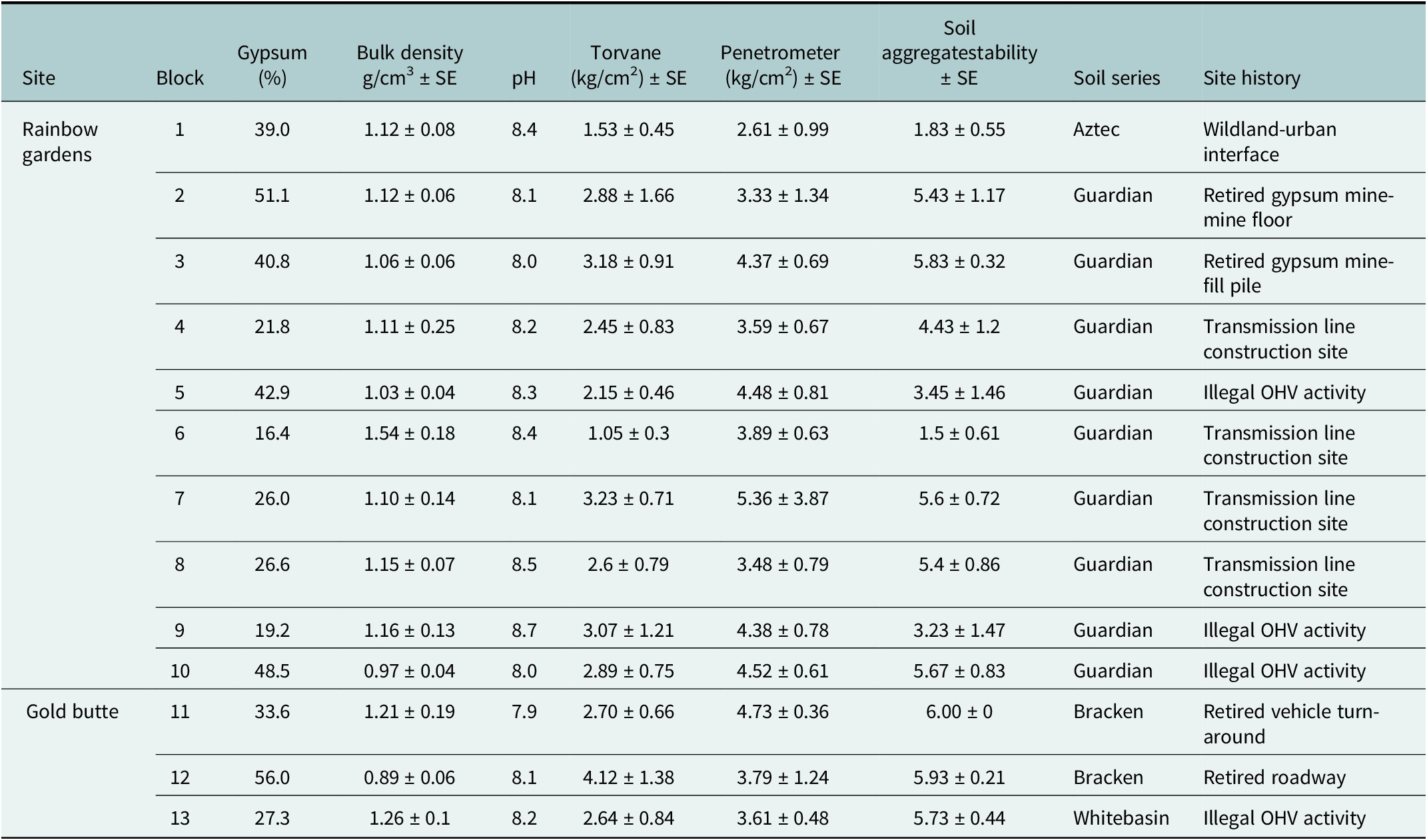
We selected 13 sites for replicate experimental blocks, each containing one full set of experimental plots described in Section ”Experimental design.” Selected blocks were on gypsid suborder soils, specifically the Aztec, Guardian, Bracken and Whitebasin soil series, which have at least one gypsum-rich horizon. All blocks consisted of an area of at least 220 m2 and had a land use history that caused disturbance with little to no reestablishment of biocrust and vascular plant communities (Table 1). These blocks have diverse histories, including decommissioned gypsum mines, construction scars, recently decommissioned roads, recurrent off-highway vehicle usage and wildland – urban interfaces (Table 1). In January 2018, we installed one complete replicate in all experimental plots at 13 blocks as detailed below (10 in Rainbow Gardens, three within Gold Butte; Table 1).
Soil properties and disturbance history at each of the 13 experimental blocks

Note: We collected soil property data before treatment installation, including gypsum content via the water by hydration methods, bulk density, pH and soil stability via sheer torvane, penetrometer and soil aggregate stability kits. We collected aggregate samples across the block for gypsum content and pH, five bulk density samples per block and recorded three of each of the soil stability metrics per plot. The soil series was based on USGS SSURGO maps.
Baseline data collection
At each block, we collected one composite soil sample from five locations evenly spaced along a transect spanning the block to analyze for gypsum content and bulk density. To do this, we subtracted four meters from the total length to avoid sampling in disturbed corners and divided it by five to get an even interval for sampling. After moving two meters from the corner, we began our sampling, moving the set distance to the next sampling point until we spanned the entire block with five samples. We analyzed each sample for gypsum content by the water of hydration method and pH (Nelson, Reference Nelson, Page, Miller and Keeny1982). We collected five cores per block to determine bulk density of the top 5 cm of soil by measuring the oven dried weight of a soil sample of known volume (Smith et al., Reference Smith, Petersen and Needelman2000). At the plot scale (10-2 m × 2 m plots) prior to treatments (as detailed below in 2.2), we recorded three replicates each of three soil stability measurements: resistance to shear stress via torvane, resistance to crushing via penetrometer (Li et al., Reference Li, Okin, Herrick, Belnap, Munson and Miller2010) and soil aggregate stability (Herrick et al., Reference Herrick, Whitford, De Soyza, Van Zee, Havstad, Seybold and Walton2001). Gypsum content, which influences hydrology, soil texture and chemistry at volumes greater than 10%, ranged from 16 to 56% (Nelson, Reference Nelson, Page, Miller and Keeny1982; Casby-Horton et al., Reference Casby-Horton, Herrero and Rolong2015; Table 1). Mean bulk density per block ranged from 0.89 to 1.54 g/cm3, torvane from 1.0 to 4.12 kg/cm2, penetrometer from 2.61 to 5.36 kg/cm2 and soil aggregate stability from 1.83 to 6.0 (Table 1).
Experimental design
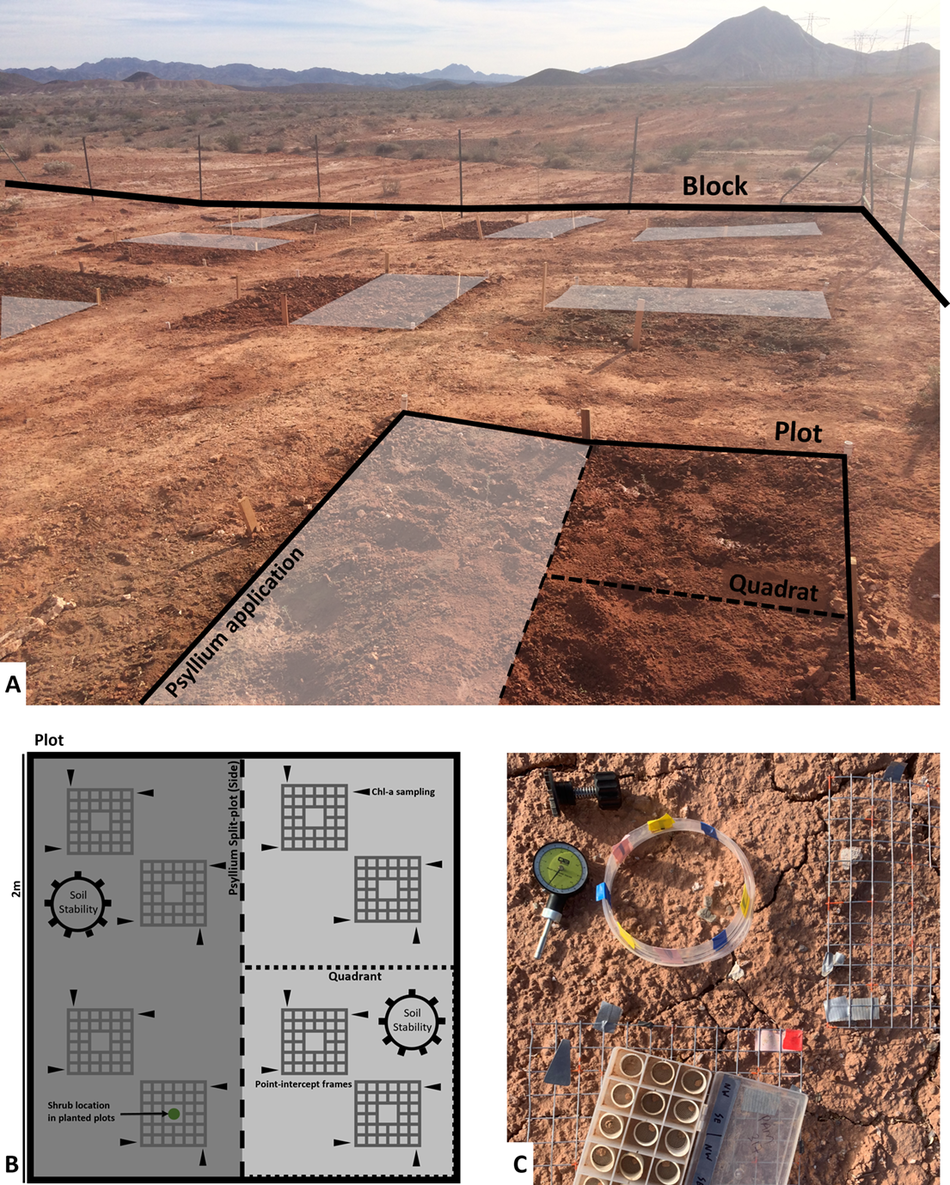
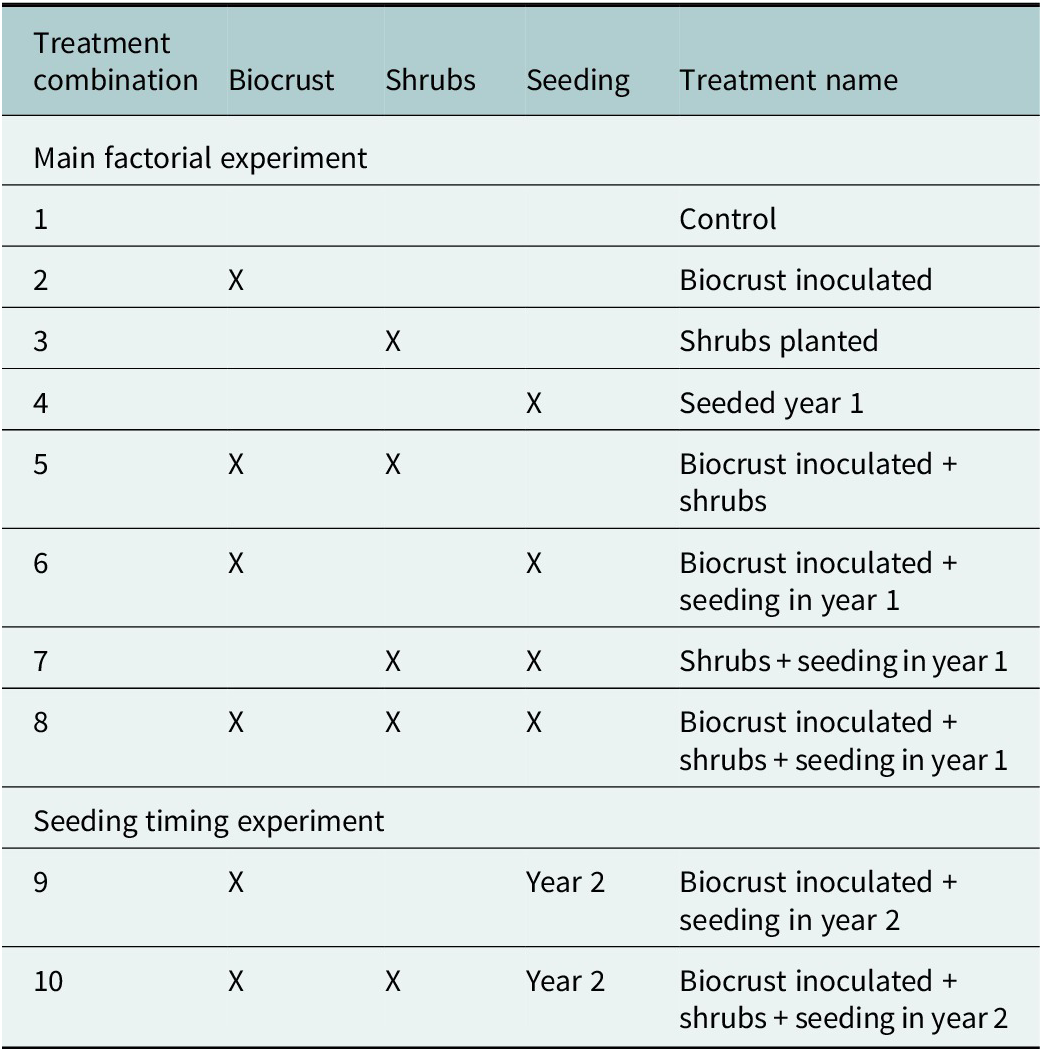
Each of the 13 blocks contained ten 2 m× 2 m plots with a minimum of at least a 1 m buffer between plots to provide a buffer between plots and treatments (Figure 1A). Eight of the plots received one of the following full-factorial treatment combinations (Table 2) of three factors: biocrust inoculation (inoculated/not inoculated), direct seeding (seeded/not seeded) and shrub planting (planting/no planting). The two remaining plots in each block were set up to test the effects of delayed seeding (post-biocrust inoculation); they were both inoculated with biocrust, one received shrub planting and one did not and both were seeded in year two, with other treatments set up at the same time as the original plots. All treatments and methods for addition are explained in detail in Sections “Biocrust inoculation treatment,” “Shrub treatment,” “Seed treatment,” “Psyllium treatment.”
Overview of experimental block layout, plot layout, and monitoring locations for all 13 replicate blocks. A) Block layout with an example randomization of the split plot psyllium applications shown with white overlays. Each plot was 2x2m and at least 2m apart. B) Illustration of an example plot with psyllium split plot treatments and monitoring quadrants. Grids represent the grid point-intercept monitoring area including the empty center zone to allow monitoring quadrats to pass over shrubs. Arrows indicate the location of the first chlorophyll-a collection points, with subsequent monitorings moving one cell over on each side of the quadrat. Circle indicates the location of the end-point soil stability data collection locations. C) Photo of primary monitoring methods: point intercept grids, soil aggregate stability kit, torvane, and penetrometer. Color-coded ring marks the collection location of the three soil stability metrics.

Treatment combinations applied to the 10 plots within each of the 13 replicate blocks for restoration of gypsum soils in southern Nevada

All plots also had an additional factor applied in a split-plot design: with or without psyllium husk addition. Psyllium is a plant-based soil stabilizer that becomes mucilaginous when wet, and may be a useful additive in biocrust restoration as it can bind inoculated materials to the soil surface and increase soil stability (Fick et al., Reference Fick, Day, Duniway, Hoy-Skubik and Barger2020; Schultz et al., Reference Schultz, Sluiter, Allen, Machado-de-Lima and Muñoz-Rojas2022). We randomly selected both the direction of the axis of the split (N-S or E-W) and the side receiving psyllium for each plot (Figure 1B).
An additional split was made for plots receiving shrubs, along the opposite axis of the psyllium treatment. On one side of this split, we planted shrubs grown with an inoculation of live rhizosphere soils. On the other side, we planted the shrubs grown in the same soil, which was first steam sterilized. This double split plot design results in each plot being subdivided into four quadrants that are monitored separately, half with and half without psyllium, and half with and half without live rhizosphere soil (Figure 1B).
Materials
Biocrust inoculation treatment
We salvaged the biocrust for the entire experiment from the Lima Gypsum mine, 10 kilometers northeast of Las Vegas, from an area of planned disturbance. Biocrust source material was dominated by dark cyanobacteria (~75%) and lichens (~25%) from the genera Inchylium and the Placidium-Clavicidium complex. We collected the biocrust using trowels to a maximum depth of 2 cm, scraping off as much adhering soil as possible ahead of sieving it through a 1 cm mesh screen to remove gravel and rocks, and to homogenize. After collection, all the biocrust was mixed by stirring with shovels and moving among the buckets. Biocrust was stored for approximately a month before use. It was collected dry and stored in a temperature-controlled storage room in the dark until application. We mixed the biocrust again by stirring with shovels before application at each block to minimize settling and compaction, which could result in uneven volumes or quality of biocrust inoculum between plots. Each inoculated plot received 6 L of sieved, homogenous biocrust, equivalent to an inoculation rate of 20% cover. This was done by measuring the crust into pitchers and sprinkling it over the plot within ten centimeters of the soil surface, which allowed us to minimize material drifting into untreated areas.
Shrub treatment
From the Rainbow Gardens Area of Critical Environmental Concern, we collected seeds and rhizosphere soil of four shrubs common to the region: Larrea tridentata, Atriplex confertifolia, Atriplex hymenelytra and Ambrosia dumosa. These species were chosen because they are the dominant perennial shrub species found on gypsum soils in both the Rainbow Gardens management area and Gold Butte National Monument. We seeded the shrubs in 20 cm deep × 1.5 cm diameter tapering containers filled with steam-sterilized gypsum soil mix (1 part potting mix: 2 parts sand +250 ml gypsum/ 30 l of soil), with 10 ml of the rhizosphere soil per container, and grew them in the Northern Arizona University research greenhouse. Half of the containers for each species received live rhizosphere soil to inoculate their roots with local soil microbiota, while half received steam-sterilized rhizosphere soil. All seeds were surface sterilized by soaking for 5 minutes in a 10% bleach solution, rinsed, soaked for 5 minutes in a 10% ethanol solution, and then rinsed. We had high germination rates for L. tridentata and A. dumosa, with over 90% of containers producing a seedling within 4 weeks, but lower germination rates for both Atriplex spp., which we found was improved by vigorously rubbing the seeds between our hands to remove their papery wings and soaking overnight in water in the fridge. Due to the low initial germination rates for Atriplex spp., the L. tridentata and A. dumosa seedlings were 7 months old at the time of planting, while the Atriplex seedlings ranged from 4 to 7 months old. At each block, we planted two of the three genera, selected randomly, during the project installation in January 2018.
Seed treatment
We used two Mojave gypsum endemic species. Enceliopsis argophylla (Asteraceae; Silver Leaf Sunray) is locally abundant in Mojave gypsum ecosystems but was absent or greatly reduced in the blocks (Meyer, Reference Meyer1986). Arctomecon californica (Papaveraceae: Las Vegas Bearpoppy) is listed as endangered by the Nevada State Division of Forestry, with a current petition for federal listing of both this species and its pollinator, the Mojave poppy bee (Perdita meconis) (Cornelisse, Reference Cornelisse2018; Cornelisse et al., Reference Cornelisse, Donnelly and Tyler2019). Two of the largest A. californica populations are in our working areas in Rainbow Gardens and in Gold Butte National Monument. We acquired seeds of these species collected from Rainbow Gardens through seed accessions of the Las Vegas BLM. We used the same seed lot and amounts for plots seeded in year one and year two, storing them in a cool, dark and dry location between years.
Due to logistical challenges, our planned experimental installation was delayed until January 2018, but fall seeding is preferred for most Mojave species because winter precipitation and temperatures are necessary to break seed dormancy (Pereira et al., Reference Pereira, Chiquoine, Larranaga and Abella2021). To improve the likelihood of germination, we subjected our seed to a supplemental overwintering treatment beginning in October 2017 at the Las Vegas Springs Preserve, described in more detail in Bailey et al. (Reference Bailey, Pereira, Sion, Kobelt, Gentilcore, Antoninka and Bowker2024). To summarize, we buried the seeds in mesh bags in between layers of gypsum soil and biocrust gathered from Rainbow Gardens to expose them to the winter fluctuations in water and temperature from November 2017 to February 2018 for the year one seeds and from October 2018 to March 2019 for the year two seeds. Seeds were hand scattered onto the plots at a rate of 2.66 g (60 seeds/m2) of E. argophylla and 0.32 g (50 seeds/m2) of A. californica per plot. Year one seeds were applied in January 2018 during experimental installation, and year two seeds were applied in March 2019.
Psyllium treatment
We applied 60 g/m2 in sub-plots receiving psyllium. In biocrust plots, we mixed the psyllium into the inoculum for the treated side to maximize the potential for contact and adherence between biocrust fragments, psyllium and the soil surface. In non-biocrust plots, we hand-spread the psyllium directly onto the ground. Psyllium treatments were applied by carefully sprinkling the psyllium or psyllium/biocrust mixture from a container onto the soil surface from a maximum height of 10 cm to minimize the material drifting into untreated areas.
Plot preparation and installation
All plot preparation and restoration material installation occurred in January 2018, except for plots that received year two seeding in March 2019. Because the age since last disturbance and soil surface texture varied within and between blocks, we broke up the surface of each plot with rakes to a depth of 5 cm to homogenize the surfaces across all plots and blocks. We leveled the surface and removed rocks greater than 15 cm along their longest axis. For shrub plots, we bored two holes 20 cm deep × 3.75 cm wide in each planted quadrant using a hand-drill auger and rock bars (see Figure 1B for shrub locations). We tightly packed moist soil around the plantings before watering until surface pooling. After shrub planting, we applied biocrust and/or psyllium to plots and then hand-scattered seeds over the entire plot surface. We watered each plot using municipal water immediately to ensure adhesion of our treatments (Ballesteros et al., Reference Ballesteros, Ayerbe, Casares, Cañadas and Lorite2017). We first misted each plot surface with 3.8 liters using a hand sprayer to reduce the hydrophobicity of psyllium powder, and then applied an additional 19 liters with watering cans for a total of 5.7 l/m2. We did not apply any additional supplemental water after the initial plot installation.
Data collection
We monitored multiple metrics of soil stability before plot preparation and again 2.5 years after treatment (Figure 1B,C). We measured soil resistance to water with a soil aggregate stability kit (Synergy Resource Solutions Inc, Belgrade, MT, USA), soil shear strength with a Torvane shear tester (Durham Geo, Tucker, GA, USA) and soil surface penetration resistance with an FT 011 fruit penetrometer (QA Supplies, Norfolk, VA, USA). Before treatment in January 2018, we took three readings of each measurement in the northeast corner of the plot. In December 2020, we re-measured these metrics on each side (psyllium and control) with three replicates per measurement.
For soil surface cover and plant community, we monitored each individual quadrant so we could compare treatments along both splits in each plot (Figure 1B). We monitored soil surface cover using two 30×30 cm gridded point intercept frames per quadrant (Figure 1B). We used point intercept methods to read 32 intersections per frame in April 2018, Nov 2018, March 2019 and December 2020 in order to capture the soil surface cover changes at the beginning and end of each winter growing season. At each time point, we also monitored the maximum unmanipulated height of the tallest live or dead point on the shrubs and shrub mortality. In each quadrant, we counted individuals of plants by species when possible, or by functional group (annual or perennial, forb or grass) when identification was unreliable due to the state of the plant, which occurred in Oct 2019, June 2020 and Dec 2020. We intended to capture the plant community before and after the winter wet season, though our timing intervals were affected by travel limitations due to the COVID-19 pandemic. Because we could not time our monitoring to coincide with peak growing conditions, we counted any plant rooted within the quadrant, regardless of its apparent health.
We also collected 12–0.75 cm3 cores of the soil surface to 0.5 cm deep from each side of the plot along the psyllium split in winter 2018 and 2020 and quantified chlorophyll a, a proxy for biocrust biomass. We extracted chlorophyll a using an ethanol double-extraction protocol and analyzed samples with a Biotek Synergy Ht (Winooski, VT, U.S.A) spectrophotometric microplate reader (Gregor and Maršálek, Reference Gregor and Maršálek2004; Castle et al., Reference Castle, Morrison and Barger2011).
Data analysis
All data analysis was done in R version 4.0.3 using the lme4, glmmTMB and DHARMa packages (Bates et al., Reference Bates, Maechler, Bolker and Walker2015; Brooks et al., Reference Brooks, Kristensen, van Benthem, Magnusson, Berg, Nielsen, Skaug, Mächler and Bolker2017; Hartig, Reference Hartig2022). For the main factorial analysis, we excluded the plots seeded in year two. We conducted an additional analysis focused on comparing plots seeded in years one and two (see 2.6.2 for more detail).
Factorial analysis
To accommodate the hierarchical structure of our data, where the psyllium split plot is nested within plot nested within block, we used linear mixed-effect models for our analysis (Aarts et al., Reference Aarts, Verhage, Veenvliet, Dolan and Van Der Sluis2014). Our models all had the same basic structure, where we nested plot within block as a random effect. Our fixed effects were the interaction of our three main treatments (biocrust inoculation, seeding and shrub planting) and the split-plot treatment of psyllium application. The secondary split within the shrub plots (live vs steam-sterilized soil microbial inoculation) was ultimately excluded from analysis after we confirmed through linear mixed effect models that there was no treatment effect, which we expected given the rapid mortality. For response variables that we measured multiple times after treatment, we also included the time of sampling as an interactive fixed effect to add a repeated measures component. We used AIC comparisons to ensure we selected the best model for each response variable, comparing model iterations with varying error distributions, time as an interactive or additive effect, and holding the slope of the random error either randomly or to time as appropriate for a given variable. For each of the three soil stability metrics, we averaged the three replicates measured per plot at each time point and then calculated a rate of change as (Pre-Treatment – Post-Treatment)/Pre-Treatment (hereafter referred to as the Δ of each metric). We used this rate of change as the response in simple linear mixed effect models in the lme4 package, as the Δ soil stability metrics were normally distributed (Bates et al., Reference Bates, Maechler, Bolker and Walker2015, Hartig Reference Hartig2022). For the chlorophyll a content of the soil, we used an lme4 model where the year of sample collection was both an additional interactive factor and used to fit the slope of the random effects, which had a lower AIC value than the same model using a random slope. For the remaining response variables, which were all zero-inflated, we used glmmTMB to fit repeated measures generalized linear mixed effect models with zero-inflated distributions appropriate for each response variable and confirmed the model fit using DHARMa (Brooks et al., Reference Brooks, Kristensen, van Benthem, Magnusson, Berg, Nielsen, Skaug, Mächler and Bolker2017). We included time of sampling as an interactive effect and used a random slope for our random effects because fitting the slope to time caused model convergence problems. From the soil surface cover frames, we calculated the percent biocrust habitat occupation rate as [Number of biocrust hits/ (Total hits – Rock hits)]. We did this because rocks are not a potential habitat for biocrust organisms, and rock soil surface cover can vary widely across the study area. For biocrust occupation, we fit a zero-inflated beta distribution model. For our plant metrics, we analyzed both the total number of plants and an index of nativeness of the plant community. This index was calculated as Native Plants/Total Plants, where zero indicates either complete dominance by exotics or no plants whatsoever, both undesirable outcomes, and one indicates a purely native plant community, which is the desired state. We fit both plant responses with zero-inflated negative binomial distribution models, which had better fits based on AIC than a zero-inflated Poisson distribution.
Seeding year analysis
We used glmmTMB to test the influence of the additive effects of seeding year and psyllium treatment on the presence/absence of seeded species in a repeated measures model. This was the most complex model for which we had model convergence. The seeding year factor had three levels: no seeding, seeded in year one and seeded in year two.
Model assumptions
For all models, we assessed our model adherence to assumptions using the DHARMa package (Hartig, Reference Hartig2022). We examined residual plots, the dispersion measurements and, when appropriate, used the zero inflation tests to ensure our models were adequately fit.
Results
Functional soil stability metrics
Across all plots, the soil resistance to penetration increased by ~25% ± 5% through time after the experiment installation, potentially as a response to the physical disturbance of the soil surface, which all plots received, and increases in soil surface gypsum evaporative deposits, which form a strong physical crust (Meyer, Reference Meyer1986). None of our treatments influenced change in penetration resistance (Supplementary Table S1). Psyllium application yielded a greater increase in soil aggregate stability than control (t = −2.48, p = 0.01, Psyllium: 43 ± 15%, Control: 31 ± 13%), but our other treatments did not influence soil aggregate stability, which overall increased (Supplementary Table S3).
We found that biocrust inoculation (t = −2.6, p = 0.01) resulted in a lesser increase in shear strength through time (12% ± 7%) than non-inoculated plots (37% ± 8%). Shrubs, whose planting created microtopography and depressions in the soil surface, and psyllium, had a counterbalancing interaction (t = −2.01, p = 0.05) wherein the greatest changes occurred when these treatments were applied independently (Psyllium application: 34% ± 12%, Shrub planting: 28 ± 18%), but applying them together yielded a lower change in shear strength than the control plots (Psyllium+Shrub: 14 ± 9%, No Psyllium+Shrub: 23 ± 9%). Conversely, shrub planting and seeding (t = 1.7, p = 0.09) resulted in the highest change in shear strength when both or neither were applied (Shrub+Seeding: 33 ± 10%, No Shrub+No Seeding:33 ± 11%) but there was a smaller change when either was applied alone (Shrubs: 9 ± 9%, Seeding 23 ± 11%). Shrub planting, biocrust inoculation and seeding interacted (t = −1.96, p = 0.05) such that the control plots and the shrub planting plus seeding plots had a high increase in shear strength (No Shrubs, Seeding or Biocurst: 56 ± 17%, Shrub+Seeding: 54 ± 16%) while plots receiving shrubs, biocrust and no seed experienced little change in their shear strength (Shrubs+Biocrust: −4.71 ± 9%).
Biocrust metrics
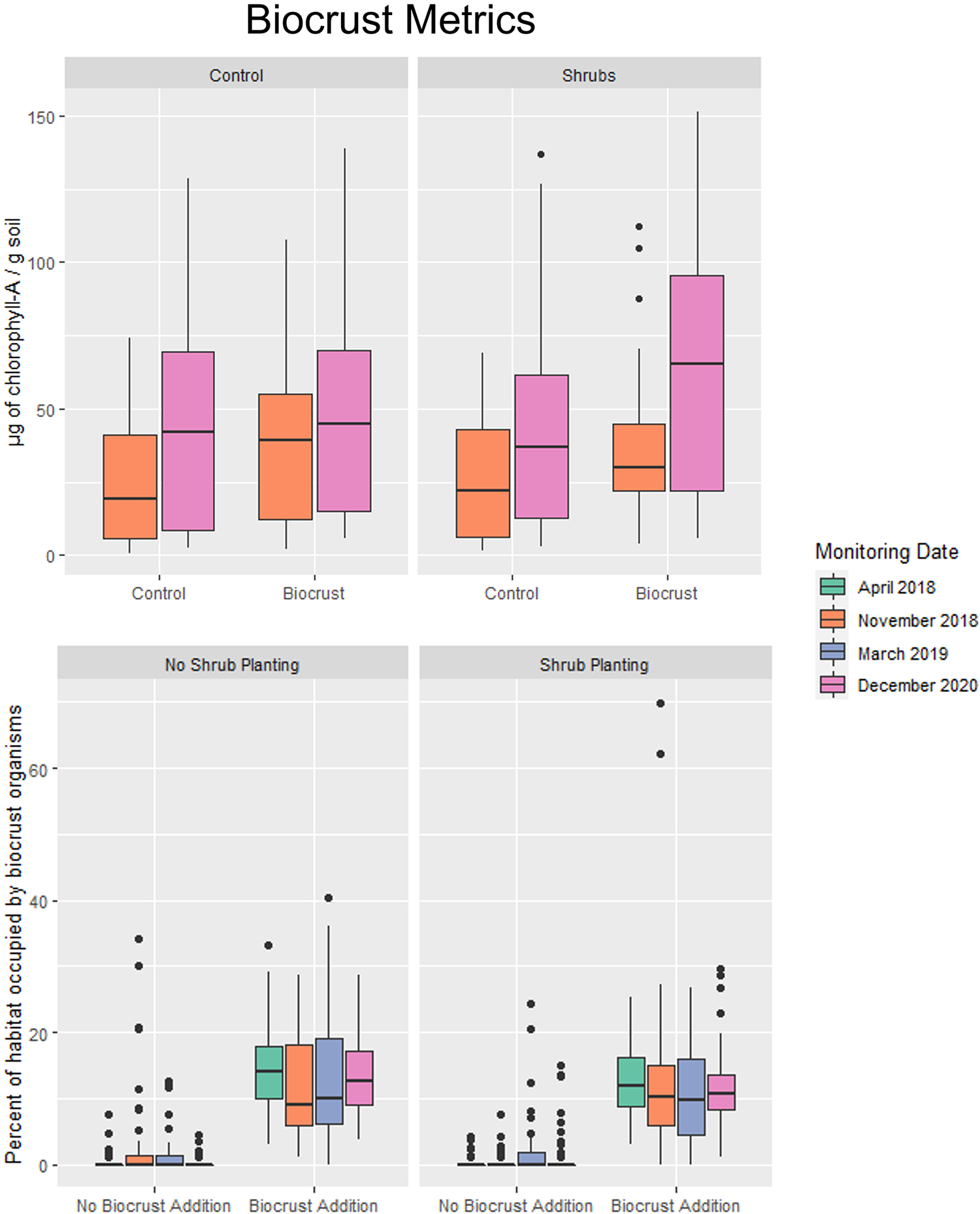
Biocrust inoculation alone increased chlorophyll-a content (t = 4.04, p < 0.001, Figure 2, Biocrust: 44 ± 6, No Biocrust:35 ± 6 μg g soil −1). The positive impact of interaction between biocrust and shrub planting increased over time (t = 2.53, p = 0.01); between 2018 and 2020 the greatest gain in chlorophyll-a was in plots treated with both biocrust and shrubs (Shrubs+Biocrust: 2020 64 ± 7, 2018 34 ± 7; Biocrust: 2020 47 ± 7, 2018 38 ± 7; Shrubs: 2020 42 ± 7, 2018: 26 ± 7; Control: 2020 43 ± 7, 2018 27 ± 7 μg g soil −1). We found some similar patterns in biocrust habitat occupation rates from point-intercept cover frames, where biocrust inoculated plots (z = 10.38, p < 0.001, Figure 2) had much higher rates of biocrust habitat occupation (13 ± 0.4%) compared to non-inoculated plots (1 ± 0.1%). However, we did not find an overall increase in biocrust occupation over time across any other treatments, and shrub planting did not have the same positive interactive effect with biocrust inoculation on biocrust occupation rate.
Change over time of biocrust organism abundance as measured by concentration of chlorophyll-a in the soil, a proxy for biomass, and the percent of potential habitat occupied by biocrust organisms measured with point intercept frames. We found that biocrust inoculation increased biocrust abundance in restoration sites after two and a half years. Chlorophyll-a was most increased by the combination of biocrust inoculation and shrub planting despite the highly mortality of shrubs, potentially by creating microtopography. While there was natural recovery of early successional communities such as cyanobacteria as measured with chlorophyll-a, the late successional community of primarily lichens did not recover without biocrust inoculation.

Plant community
The clearest influence on the total number of plants was not our experimental treatments, but the sampling date (z = 14.8, p < 0.001; June 2020: 25 ± 5, Dec 2020: 17 ± 3, Oct 2019: 5 ± 1 plants/2 m2). We used a plant nativeness index calculated from Native Plants/Total Plants, where zero indicates either complete dominance by exotics or no plants whatsoever, both undesirable outcomes, and one indicates a purely native plant community, which is the desired state. We found no relationship between the nativeness of the plant community and any treatment factor or date of sampling.
Seeding and timing
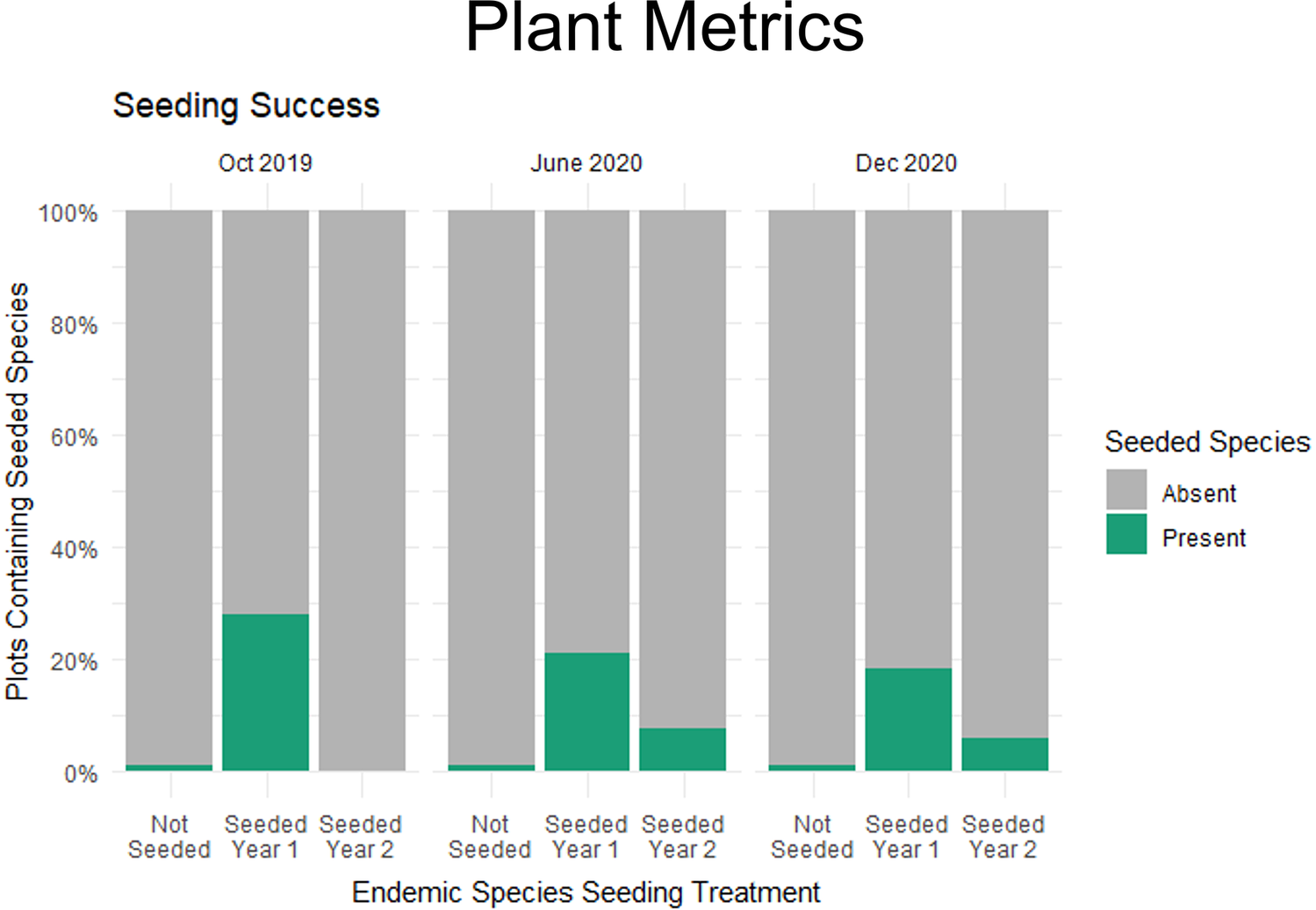
Seeding greatly increased the likelihood of a plot containing at least one individual of A. californica or E. argophylla, with the majority of germinates being E. argophylla, while psyllium application did not have any statistically significant effect (Figure 3). All six of the A. californica that germinated did so from the psyllium-treated sides of plots, but this was too small a sample size to analyze separately from E. argophylla. At each monitoring, between 18 and 28% of plots seeded in year one contained at least one individual of interest (z = 3.71, p < 0.001) while plots seeded in year two had 0–8% of treated plots occupied (z = 1.64, p = 0.1). Unseeded plots had virtually no recruitment of species of interest, with only a single plot side out of 104 unseeded plot sides containing an individual (Supplementary Table S12).
The seeds of two endemic plant species, Arctomecon californica and Enceliopsis argophylla, were applied at 13 replicate blocks in gypsum soils of the Mojave Desert. Within each block, four plots were unseeded, four were seeded in 2018, and two were seeded in 2019 as part of a factorial treatment matrix (see Table 2 for plot treatment details). There was no unassisted recovery of the gypsum endemic plant community within unseeded plots after two and a half years. Seeding in year one resulted in seedlings of at least one target species in 18-28% of plots. Seeding in year two had lower success, with ~8% of treated plots containing seedlings.

Shrub survival
The shrub seedlings suffered high mortality rates, with only 25% of the shrubs surviving 3 months after planting with no treatment differences (Supplementary Table S13). After the first summer, only 5% of shrubs persisted. The majority of surviving shrubs, 10 of 13 as of October 2021, are concentrated in a single block.
Discussion
Biocrust inoculation, but not psyllium, promotes biocrust cover
In plots with no natural biocrust recovery after as much as 40 years without disturbance, our biocrust inoculation promoted biocrust cover based on both chlorophyll-a content and biocrust habitat occupation rate in support of our hypothesis. Contrary to our hypothesis, psyllium had no effect on biocrust establishment. Chlorophyll-a and biocrust cover metrics show different community components, with chlorophyll-a more sensitive to the early developmental light cyanobacteria compared to biocrust habitat occupation, which reflects the later-stage and more easily visible community members of lichens and dark cyanobacteria. The overall increase in chlorophyll-a through time indicates a baseline level of recovery of early community members across treatments, enhanced by biocrust inoculation and shrub planting. The latter is potentially due to the creation of microtopography, which increases shade and moisture. The increase in chlorophyll-a in non-inoculated plots could be due to natural colonization by wind-borne cyanobacteria or movement of biocrust materials from treated plots onto untreated plots, but did not reach the levels of chlorophyll-a found in treated plots. Moreover, we did not see increases in biocrust occupancy over time in non-inoculated plots, indicating that there was no appreciable natural recovery of the later-stage community. This parallels the findings of Lorite et al. (Reference Lorite, Agea, García-Robles, Cañadas, Rams and Sánchez-Castillo2020), who found natural regeneration of cyanobacteria but not lichens in abandoned gypsum quarries, and suggests that biocrust inoculation can be successful without the habitat amelioration measures taken in Román et al. (Reference Román, Chamizo, Roncero-Ramos, Adessi, De Philippis and Cantón2021). Some studies have found relatively fast rates of unaided cyanobacteria recovery, including on gypsum soil, but the scale of these studies (0.01 m2–1 m2) is much smaller than the disturbances in our experiment, aside from Mendoza-García and Godínez-Alvarez (Reference Mendoza-García and Godínez-Alvarez2021), whose study area receives double the precipitation of the Mojave. Our disturbances were up to 40 years old and had not recovered their biocrust community; the contrast between our sites and those of others highlights the heterogeneity of biocrust recovery rates (Weber et al., Reference Weber, Bowker, Zhang, Belnap, Weber, Büdel and Belnap2016). Biocrust inoculation success is highly variable depending on the soil and environmental properties of the target site (Chandler et al., Reference Chandler, Day, Madsen and Belnap2019; Faist et al., Reference Faist, Antoninka, Belnap, Bowker, Duniway, Garcia-Pichel, Nelson, Reed, Giraldo-Silva, Velasco-Ayuso and Barger2020); our study illustrates that inoculation can be effective on Mojave gypsum soils. Inoculation alone was a relatively low-effort restoration method that bolstered biocrust development and did not require continued inputs for success. We also suggest that the use of large restoration “islands” (2×2m inoculated plots) could allow continued biocrust development within plots and expansion to surrounding areas over time, which we hope to address in the future with additional monitoring.
Soil stability increased across the experiment, with varied treatment effects
While inoculation promoted biocrust establishment, it did not always produce the expected effects in soil stability, contrary to our hypothesis. As in other studies, we did find that psyllium increased soil aggregate stability and could therefore be a useful amendment to enhance soil function until biocrusts can establish (Fick et al., Reference Fick, Barger and Duniway2019, Reference Fick, Day, Duniway, Hoy-Skubik and Barger2020; Schultz et al., Reference Schultz, Sluiter, Allen, Machado-de-Lima and Muñoz-Rojas2022). However, this potential benefit should be weighed against the additional cost. Biocrust did not have a detectable influence on soil aggregate stability or penetration resistance. However, biocrust inoculation had a clear effect on soil shear strength, where inoculated plots increased resistance to wind erosion much less than non-inoculated plots. This is counter to our expectations that biocrust would increase soil stability (Eldridge and Leys, Reference Eldridge and Leys2003; Chaudhary et al., Reference Chaudhary, Bowker, O’Dell, Grace, Redman, Rillig and Johnson2009; Kimmell et al., Reference Kimmell, Fagan and Havrilla2023), but in line with the unique nature of gypsum soils. All three of the soil stability metrics increased regardless of treatment, potentially and counterintuitively driven by the physical disturbance from raking each plot while establishing the experiment. Gypsum is sometimes used as a soil amendment to increase stability through cementation, and can have differing effects on soil properties, including soil hydrology, compaction and strength based on the interaction of soil texture and gypsum content (Kuttah and Sato, Reference Kuttah and Sato2015). Though surface disturbance tends to decrease soil stability in many environments, disturbance in gypsum soils could increase the formation of a physical crust, which is prohibitive for plant establishment (Meyer, Reference Meyer1986; Chiquoine et al., Reference Chiquoine, Abella and Bowker2016). The physical crusts may have higher stability than biocrusts when measured dry, but because gypsum is a soluble mineral, the physical crust becomes less stable than biocrust when saturated, resulting in dynamic soil stability based on moisture (Casby-Horton et al., Reference Casby-Horton, Herrero and Rolong2015). There is little information available about the desirable reference conditions of Mojave gypsum soils, making it challenging to create well-informed goals in the management of these soils, but lower shear strength measured in biocrust-treated plots likely indicates that our inoculation not only increased biocrust cover but also altered soil function. Further study and longer monitoring are needed to understand if these changes support improved ecosystem function.
Biocrust establishment did not influence native plant establishment and survival
Contrary to our hypothesis, we did not find that biocrust addition, or the addition of seed or shrubs, aided in the establishment of native plants and forbs. In the Mojave Desert, which is severely water-limited, it is uncommon to successfully restore vegetation through out-planting or seeding without additional interventions such as supplemental watering, herbivore protection, nurse plants or vertical mulching (Abella and Newton, Reference Abella, Newton, Fernandex-Bernal and De La Rosa2009; Caldwell et al., Reference Caldwell, McDonald and Young2009; Defalco et al., Reference Defalco, Esque, Nicklas and Kane2012; Rader et al., Reference Rader, Chiquoine, Weigand, Perkins, Munson and Abella2022). We did not provide continued care for our shrubs, and this likely caused high mortality; additional watering events may have aided survival. In 2018, the first year of the experiment, the Las Vegas area received 72 mm of precipitation, 65% of its average annual precipitation, with no rain events during multiple summer months (PRISM Climate Group, Oregon State University, https://prism.oregonstate.edu, accessed 06 March, 2022 for Las Vegas, NV). Though 2019 was wetter than average, with 186 mm of precipitation, there was less than 1 mm of rain total from June through October. While biocrust can mediate hydrology in some ways and at some scales, our biocrust-inoculated plots did not counteract the fatal stresses experienced by our shrubs (Eldridge et al., Reference Eldridge, Reed, Travers, Bowker, Maestre, Ding, Havrilla, Rodriguez-Caballero, Barger, Weber, Antoninka, Belnap, Chaudhary, Faist, Ferrenberg, Huber-Sannwald, Malam Issa and Zhao2020). We also found rabbit droppings surrounding shrub holes, indicating that herbivory contributed to mortality; caging might help with herbivory. Nor did biocrust inoculation influence the number of plants naturally regenerating on plots, the ratio of native to invasive species, or the success of seeded species. However, we should be cautious in drawing conclusions only 3 years after treatment, as plant communities are known to remain in flux for more than 10 years after restoration treatments (Copeland et al., Reference Copeland, Munson, Bradford and Butterfield2019). Though shrub out-planting may be a successful tool for restoration of gypsum habitats of Spain and has been effective in other Mojave Desert soils, successful out-planting into Mojave Desert gypsum soils may require careful consideration of site conditions and additional irrigation or herbivore protections (Rincón et al., Reference Rincón, De Felipe and Fernández-Pascual2007; Abella et al., Reference Abella, Craig and Suazo2012; Ballesteros et al., Reference Ballesteros, Cañadas, Foronda, Peñas, Valle and Lorite2014; Scoles-Sciulla et al., Reference Scoles-Sciulla, DeFalco and Esque2015; Foronda et al., Reference Foronda, Pueyo, Castillejo, Giner and Alados2020).
While our shrub planting was unsuccessful overall, one block was an outlier in having a relatively high survival. As of October 2021, 50% of the shrubs in block 10 survived. This could be due to specific site characteristics of this block, such as bulk density, gypsum content, soil chemistry, including nutrient content, or landscape position (Table 1). We were not able to determine an exact cause with our experimental design, and because gypsum content influences the solubility and extractability of soil nutrients, we did not collect nutrient data (Matula and Pechová, Reference Matula and Pechová2005). We have provided all available information about our blocks in the hopes that future research will do the same, allowing for cross-experiment comparisons to learn how these factors influence restoration success. Doing so would allow land managers to customize their methods to the unique nature of the site and could increase the efficacy of future projects.
Seeding was necessary for plant establishment, but timing relative to biocrust inoculation did not matter
In support of our hypothesis, seeding of native plants was necessary to establish our seeded species. Despite the high likelihood of an existing seedbank of A. californica and E. argophylla, these species almost exclusively grew in seeded plots. Supplemental seeding has been found to be both necessary and cost-effective in the restoration of Spanish gypsum communities (Ballesteros et al., Reference Ballesteros, Cañadas, Foronda, Fernández-Ondoño, Peñas and Lorite2012; Lorite et al., Reference Lorite, Ballesteros, García-robles and Ca2021). Not only did natural recovery of these species not occur in the 3 years of our project, but natural recovery had not occurred in the period of time since the initial disturbances occurred. As major disturbances in some of our blocks ceased 40 years ago, this implies that unaided regeneration of gypsum endemic species of Mojave Desert ecosystems is unlikely even decades after a severe disturbance. For permitted disturbance in these habitats, advanced planning and seed collection could provide the necessary plant materials required to facilitate the changes of successful restoration post-disturbance.
The results of seeding, however, may be highly variable between years. Any potential benefits to the seeds of established biocrust by year two versus year one were not enough to overcome stronger drivers of plant establishment. This is in line with the findings of Chaudhary et al. (Reference Chaudhary, Akland, Johnson and Bowker2020) that biocrust amendment did not overcome site conditions to influence plant communities, though a study of gypsum systems in particular has found that the loss of biocrust did increase the vulnerability of the plant community to drought stress (Sánchez et al., Reference Sánchez, Peralta, Luzuriaga, Prieto and Escudero2022). We had much higher success rates in plots seeded in 2018 than in 2019, potentially due either to variations in precipitation patterns (see Section “Biocrust establishment did not influence native plant establishment and survival” for details on precipitation) or in the pre-seeding treatment. The seeds used in 2018 were overwintered as discussed in the methods, but the 2019 overwintering failed as the seeds were severely molded when we extracted them. We therefore used fresh, unwintered seeds, which could be an additional year behind the year one seeds, as they did not receive an overwintering treatment before seeding. This molding was likely due to the unusually wet winter months of early 2019, which may also have greatly benefited the seeds planted in 2018. The seeds planted in 2018 had the opportunity to germinate and establish in ideal conditions that have not reoccurred since the year two seeds were planted. We cannot judge the true potential benefit of seeding into more or less developed biocrust with such major differences in inter-annual precipitation and seed preparation, which could drive both germination rate and crust development. However, one benefit of seeding is that the seeds from both seeding treatments can remain dormant but present until better germination conditions occur, which may be many years after treatments are applied (Copeland et al., Reference Copeland, Munson, Bradford and Butterfield2019). While a benefit of biocrust was not seen, raking and psyllium addition to the plots may have helped the seeds find shelter until establishment. We observed that our six A. californica seedlings all occurred on quadrants that were treated with psyllium, a plant-based soil tackifier. Tackifiers are a frequent component of hydroseeding mixtures, including in hot deserts (Abella et al., Reference Abella, Gunn, Daniels, Springer and Nyoka2009), but have also been effective outside of hydroseeding for seed retention in the Mojave (DeFalco et al., Reference Defalco, Esque, Nicklas and Kane2012) and the Great Salt Lake (England, Reference England2019). While we cannot draw any conclusions about the potential importance of psyllium from our study due to the small sample size, the addition of soil tackifiers, including psyllium husk, should be further explored and could be incorporated experimentally into management applications for restoration of sensitive species in gypsum soils.
We found seeding to be a valuable method for supporting the recovery of A. californica and E. argophylla in highly disturbed soils. While establishment is low, that is common in arid systems; any establishment should be considered a success. Furthermore, compared to cultivation and out-planting, seeding is (1) relatively low effort, and (2) may be more resilient to inter-annual fluctuations of rainfall following treatment because seeds can persist in the seedbank (Abella and Newton, Reference Abella, Newton, Fernandex-Bernal and De La Rosa2009; Lorite et al., Reference Lorite, Ballesteros, García-robles and Ca2021). Additions of raking and soil stabilizers can help retain the seedbank until conditions are good for germination.
Conclusions
Active restoration using biocrusts and native seeds, and long-term monitoring is needed to support the recovery of biocrust and vascular plants of disturbed Mojave gypsum habitats. Using a diversity of restoration materials that can remain dormant and persist through harsh inter-annual variation in conditions, such as biocrust inoculum and seeds, may be more cost-effective than growing and planting out containerized plants, especially in challenging and arid environments (Rader et al., Reference Rader, Chiquoine, Weigand, Perkins, Munson and Abella2022). Our study highlights the need for additional evaluation of specific treatments for restoration in unique soil types and for sensitive species. For restoration in disturbed sensitive species habitats, relying on the soil seed bank for recovery does not appear to be a viable mitigation option. Advance seed collection, storage and strategic timing of seeding may improve restoration success of sensitive species. Use of psyllium and investigation of the mechanism of action for use in sensitive species seeding efforts warrants further study. By stacking multiple restoration methods targeting different components of ecosystem function and community, including improving soil and vascular plant communities, practitioners increase the likelihood of meeting their restoration goals.
Open peer review
For open peer review materials, please visit http://doi.org/10.1017/dry.2026.10032.
Supplementary material
The supplementary material for this article can be found at http://doi.org/10.1017/dry.2026.10032.
Data availability statement
The data that support the findings of this study are available on request from the corresponding author, L.B.
Acknowledgments
We thank the editors and reviewers of this manuscript for their insightful feedback. We thank the many people who contributed their time to the field work for the project, including Steve Dudrow and the Friends of Gold Butte National Monument, Michael Sloan, Jasmine Anenberg, Sedona Spann, Cristina Rengifo, Landon Sawaya, Pete Chuckran, Bri Finley, Casey Henson, Colin Tucker, Caio Vissicaro, Cedric Gammon, Nelly McCustion, Juliana Monteiro and Julia Stuart. This work is derived from doctoral dissertation research in Bailey 2022 (Soil, Plants and the Biocrust Between: Innovations in Mojave Desert Restoration and Management, PhD dissertation, School of Forestry, Northern Arizona University).
Author contribution
L.B., A.A. and M.B. contributed to the experimental conception and design. L.B. led data collection, analysis, interpretation and drafting of the manuscript. All authors provided critical feedback and contributed to the final manuscript.
Financial support
This work was supported by the United States Bureau of Land Management (L16AC00342, L20AA00012).
Competing interests
The authors declare no conflicts of interest.


 Open access


Comments
Dear Editor-in-Chief,
I am writing to submit our manuscript “ Biocrust inoculation and seeding are necessary for restoration of Mojave desert gypsum soil habitats” for consideration to Drylands.
Our study investigates the use of soil biota in restoration of gypsum soils to enhance soil biodiversity, soil function, and vascular plant communities. Biocrusts, the community of moss, lichen and cyanobacteria that live in the soil surface of arid lands, play a crucial role in soil stability, nutrient cycling, and hydrology. They are highly resilient to the harsh challenges of arid conditions, but vulnerable to physical disturbance. We tested the efficacy of applying biocrust propagules alongside vascular plant seeds into intensely disturbed gypsum soils in the Mojave desert to improve soil function and restore the biologic community. Though we did not find any direct interaction between biocrust and vascular plant species in the three years of our study, we did find that natural regeneration was not occurring and applying propagules is effective at increasing the cover of biocrust and native plants. Our findings not only demonstrate the efficacy of biocrust restoration but also offer practical solutions for ecosystem restoration and conservation efforts in gypsum soil environments.
We feel that our research aligns well with the aims and scopes of Drylands, as we investigate the potential interactions of soil biota on soil function and vascular plants through an applied lens. Our manuscript addresses critical gaps in current restoration practices by providing evidence-based strategies tailored to specific soil types and environmental conditions.
This is original work which is not under consideration elsewhere. We hope that our work will be of interest to your readership. We appreciate your time in considering our manuscript, and look forward to hearing from you.
Sincerely,
Lydia Bailey, Anita Antoninka, Lara Kobelt, Matthew Bowker