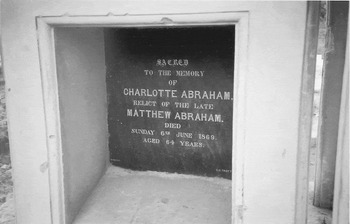
Recent contributions to the historiography of modern India have focused on court cases or official investigations.Footnote 1 This essay describes another court case, Abraham v. Abraham (1863), which involves a property dispute within a mixed race family. The family resided in the South Indian cantonment town of Bellary.Footnote 2 The case provides insights into the dynamics of a mixed race household and its encounter with the identity categories of colonial courts. It involves a woman of Anglo-Portuguese descent, Charlotte Fox, who was born in Goa and raised in Bangalore as an Anglican. In 1820, Charlotte married Matthew Abraham, a “very dark-skinned” Tamil, who haled from a family of Roman Catholic paraiyar converts originally from Madras. Matthew produced and sold liquor to colonial troops stationed at the cantonment in Bellary. He acquired wealth not only as a distiller, but also as an auctioneer of army surplus items.
After Matthew died without a will in 1842, a dispute arose over who was entitled to his property—Charlotte and her two sons (Charles Henry and Daniel Vincent) under English law, or Francis, Matthew's younger brother, under Hindu law. In order to decide which law of inheritance to apply, the courts had to examine the customs and habits of the Abraham family and families “similarly situated.” Were the Abrahams predominantly English or Tamil in their lifestyles and ways of relating to each other? Tried initially in the Bellary District Court, the case went all the way to London's Privy Council, whose decision in 1863 went in favor of Charlotte and her two sons.
The main story told by this case concerns what Thomas Metcalf calls the “creation and ordering of difference.”Footnote 3 Historians often tell this story in order to distinguish a pre-colonial society of overlapping identities from a colonial society of bounded ones. The formation of Muslim, Hindu and Sikh identities under British rule illustrates this transition from fuzzy to fixed boundaries.Footnote 4 The story of the Abrahams, however, is not as concerned with the transition to British rule as it is with two distinct dimensions of it: namely, the courts and the cantonment-centered economy of Bellary. While the story of the court case creates the appearance of immutable differences along lines of race and religion, the story of the family itself, I argue, is one of extraordinary boundary crossing and relative indifference to difference.
On the one hand, the family illustrates how, within a cantonment town, members of different races could occupy the same household.Footnote 5 It also illustrates how a Tamil Christian of low ranking paraiyar origins could acquire wealth and status through commercial dealings with Europeans, Muslims, and Hindus. During the course of Matthew's adult life, he worked as a writer (recording sales), a distiller, a state auctioneer, and a moneylender. These different roles hardly illustrate an entrenched social hierarchy reinforced by the colonial state. They reflect social mobility, assimilation and dynamic interactions between members of different races, religions and castes.
The legal dispute between Charlotte and Francis, on the other hand, nurtured a “clash of civilizations” by radically bifurcating the worlds of those who fall under English and Hindu law.Footnote 6 The “difference” created through the process of litigation, however, was not between Englishness and Hinduness. It was between Charlotte Abraham's highly bounded notion of East Indian identity and Francis' attempt to be recognized by the judiciary as a complex person, i.e., one who assimilated into some dimensions of East Indian culture, while retaining important aspects of his familial origins.
Charlotte's claim to her husband's estate and distillery business also raises questions about her status as a woman within her household. Throughout her sworn statements, Charlotte denied that she was at all dependent upon Francis after her husband's death and refused to recognize him as head of the family. On the contrary, she demoted him to the status of a household servant or, at best, hired help. In doing so, she challenged the paternalism implied in Francis' case and in the administration of personal laws at the time.Footnote 7 Charlotte, however, never appealed to her rights as a woman under English law. She based her case entirely upon her status as an East Indian Protestant and her insistence that Matthew had joined her community through marriage and assimilation. Her aim was not to challenge joint families, but to argue that the Abrahams did not constitute one.Footnote 8
The following sections describe how this legal dispute not only manufactured cultural and religious differences, but also rendered competing versions of the family's history. The knowledge generated through the process of litigation undermined what was otherwise an unusual story of cultural and racial interactions within a cantonment-centered economy. After providing background to Bellary District and the Abraham family, the essay explores three aspects of family history that were crucial to the case: Charlotte's argument that her husband “became” an East Indian, Francis' insistence that he and Matthew were “undivided brothers,” and Francis' correspondence with Charles Henry Abraham (Charlotte's eldest son and second plaintiff) while Charles was studying at Cambridge.
Bellary District
In his study of agrarian society in colonial India, David Washbrook notes the sharply contrasting objectives of public and personal dimensions of Anglo-Indian law. Under the Permanent Settlement of 1793, the public law sought to stimulate the economy by promoting the ownership and sale of private property. The personal law impeded these goals by privileging “immemorial rights” held by groups. It solidified Hindu social traditions by sanctioning practices of Hindu joint families.Footnote 9
Such inconsistency between the aims of the law and the market are reflected in the experiences of the Abrahams. The judiciary attempted to “traditionalize” this family by subjecting it to one law or the other.Footnote 10 Its efforts were complicated by the family's status as both Christian and multi-racial. Matthew's rise as a Bellary entrepreneur, however, was not the result of a free market, but one that was dependent upon the cantonment and the contracts it extended to Indian service providers. His life experiences, as we shall see, occurred within an economic climate that was largely shaped by Bellary's cantonment and its demands.
In order to appreciate Matthew's ability to acquire wealth and his family's bridging of multiple cultural spaces, both idiosyncratic and contextual factors must be considered. The court documents—to which most of this article is devoted—tend to focus on Matthew's Protestant work ethic, his and Francis' adoption of Western clothes, and how they conducted their business. These aspects of their story, however, are only meaningful within the context of Bellary's location, experience of the colonial transition, and industries.
Located in a central, dry land region of southern India, Bellary was bound on the north by the Nizam's dominions and on the south by the princely state of Mysore. During the late 19th century, slightly more than half the population of the district spoke Kannada (or “Canarese”), and nearly a third Telugu, which also was the language of the courts in all the taluks.Footnote 11 The Abraham brothers themselves were Tamil speaking migrants from Madras city.
Toward the end of the turbulent eighteenth century, Bellary stood in the crossfire of confrontation between the Marathas, the Nizam of Hyderabad, the East India Company and Tipu Sultan of Mysore.Footnote 12 The Company's first step toward assuming control over Bellary was to form an alliance with the Marathas and the Nizam to confront the armies of Tipu Sultan. The alliance overwhelmed Tipu's army in 1792 (in the Third Mysore War) and Tipu consented to humiliating terms. He ceded half of his territories to the allies and the size of Mysore was diminished.Footnote 13 In the year following the fall of Srirangapatnam and Tipu's death in 1799, the Nizam then ceded four districts to the Company in exchange for stationing Company troops at Hyderabad. The four “Ceded Districts” were Bellary, Anantapur, Cuddapah and a portion of Kurnool.
The consolidation of power by the Company in the south did not eliminate all violence. Competition between rival powers during the eighteenth century was replaced by threats of rebellion against the Company from subdued princes and warrior powers.Footnote 14 Thomas Munro, the Company's first Principal Collector for the Ceded Districts, devoted much of his energies to subordinating the Poligar chieftans, who retained control over numerous forts and villages in the region.
In 1839, the Company came to suspect that the nawab of Kurnool (located to the northeast of Bellary near the southern border of Hyderabad state), Ghulam Rasul Khan, was planning a revolt. The army raided the fort at Kurnool, imprisoned the nawab, and auctioned off his possessions.Footnote 15 Such operations required a steady flow of revenue to equip the military and supply various services to support Company troops. Matthew Abraham capitalized on this demand by running his distillery, acquiring and selling army surplus items, and eventually becoming the one who auctioned off the nawab's possessions.
Bellary's dry climate contributed to a somewhat stagnant economy. Munro described the city of Bellary as a “poor place [which] was almost desolate before the arrival of the troops.”Footnote 16 When, however, the Company's cantonment was established in 1801, it became an important source of employment for Europeans and Indians alike. To earn a livelihood, Indians found employment within the offices of the cantonment, provided services for the troops, or acquired the right to work state institutions (e.g., Abkari contracts) for profit.Footnote 17 Matthew's father worked as a mess butler for the 22nd Regiment of Native Infantry (also known as the Cumbum Battalion).Footnote 18 Such employment tended to involve regular interaction with Europeans and higher degrees of assimilation into their culture.Footnote 19
As a cantonment station and capital of the district, Bellary contained many offices that are typical of such towns. Bellary eventually became a station of the Guntakal Hubli branch of the Southern Maratha Railway. By the late nineteenth century, the Railway would employ many East Indians in the region. Bellary was also the headquarters of the Assistant Commissioner of the Salt, Abkari and Customs Department. This department extended contracts to Indian bidders, enabling them to produce and sell abkari (liquor and other intoxicating substances) primarily to European troops stationed in the cantonment. Matthew Abraham obtained the Abkari Contract in 1827, and his brother Francis renewed the Contract under his own name after Matthew's death.Footnote 20
The city itself consisted of the cantonment to the northwest and the upper and lower forts in the center. The District Court and Deputy Collector's office were located in the southeastern region of the city. Toward the center was the crowded district of Cowl Bazaar, where many small businesses, including Matthew's distillery, were located. The term cowl literally refers to a “promise” or “agreement,” which granted tax exempt status for those providing services to soldiers in the cantonment. Cowl Bazaar's streets were named after the various services—liquor vendors, dobies, barbers, washers, etc.—who served the soldiers.
Northeast of Cowl Bazaar was the lower fort. It contained several key public buildings along with several churches. The most prominent church was Holy Trinity Church, where many of Bellary's East Indians and Europeans had been baptized and become members. As the Abraham family began to acquire wealth, they resettled from Cowl Bazaar to the lower fort.
In the southeast was the suburb of Bruce Pettah, named after Peter Bruce, who had been in charge of one of the taluks of Bellary, Harpanahalli, and from 1806 to 1820 had served as a judge in Bellary. In 1806 and 1807, in order to create more space to house the troops, Munro removed 670 Indian houses, shops, and other buildings from the lower fort and relocated them to Bruce Pettah, paying the owners up to twenty thousand rupees for compensation. Indians who remained in the lower fort often became objects of white prejudice, being blamed for declining sanitation and morals in the region.Footnote 21
Meet the Abrahams
Matthew and Francis Abraham were fourth generation Roman Catholics from Madras. They belonged to the low ranking, paraiyar community, whose name derives from the Tamil parai, or “drum.” In early colonial times, the term pariayar (English “pariah”) could refer generically to all “untouchable” people. However, within Tamil society, it referred more frequently to those who served as drummers at weddings, cremations, festivals, or special government functions.Footnote 22 Key witnesses claimed that the Abraham family came from the “Vullungampeter” community, most likely a right hand, paraiyar subcaste.Footnote 23 Significant numbers of paraiyar laborers within Tamil speaking districts had converted to Catholicism. As with Telugu Malas and Madigas, also prominent within Bellary district, Tamil paraiyar occupations involved contact with beef and poultry, liquor and classes of people who routinely consumed these substances. Lacking inhibitions of persons from higher castes, the Abraham brothers were well positioned to enter the service sector of Bellary society.
Matthew's father, called “Abraham,” was employed for much of his life by the Company army. Initially, he worked as a dressing boy for a Company official. He later acquired a contract to serve as a mess butler for the Cumbum Battalion. His job was to supply the mess with materials needed for meal preparations. For this he often had to obtain large quantities of meat and vegetables on credit from Muslim and Parsi vendors. This work, along with his “extravagant drinking habit,” led Abraham to accumulate significant debts. He also contracted a disease (quite likely syphilis) that resulted in “the loss of his nose.”Footnote 24 Eventually this disease and his inability to pay his lenders resulted in his dismissal from the camp.
Matthew helped pay off his father's debts through his job as a writer at the Bellary Arsenal. He had held this job since 1813, roughly the year when his brother Francis was born. Shortly after being hired, he constructed a thatched house of his own down the street from an aunt. While working at the Arsenal, Matthew, over the next decade, generated additional income by acting as an agent for various shopkeepers. Matthew used to “purchase condemned Government stores at Public Auctions and speculate on them.” He also used also to make and sell tents, knapsacks, pick axes, etc., for the troops.Footnote 25 From these earnings, he was able in 1823 to open a shop of his own in Bellary. In 1827, he appointed Francis as a writer and attendant in his shop and five years later, admitted both Francis and a Mr. Richardson as partners.
Thus began the story of Matthew Abraham, the paraiyar turned Bellary entrepreneur and his younger brother Francis. Rather than inheriting honorable social status or ancestral property from his father, he inherited only his debts. What father Abraham did pass on to his sons, however, was exposure and access to the colonial culture centered upon Bellary's cantonment and its limited opportunities for wealth and mobility. Matthew exploited these opportunities with remarkable discipline and skill.
Very little is mentioned in the case about when or why the brothers renounced Catholicism and became Protestants. The only references to their conversion came from Charlotte's witnesses. These witnesses linked conversion to Protestantism inseparably to the adoption of Western clothes and values of hard work, illustrating what Gauri Viswanathan refers to as “conversion as assimilation.”Footnote 26
Catholic origins in Bellary trace back to 1733, when Carmelite missionaries had arrived from Goa. To a greater extent than Protestant missions, Catholic missions in India are known for their embrace of and adaptation to local cultural practices, including the observance of caste customs and distinctions.Footnote 27 In contrast to Charlotte's witnesses, who stressed assimilation, Francis' witnesses were drawn heavily from among Catholic converts. They stressed cultural continuities reflective of the Abraham family's Catholic origins. Many originated from Bellary's Anantapur taluk and continued to divide their property like Hindu undivided families.
The brothers converted to the Protestant faith under the auspices of the London Mission Society (LMS), which had arrived in Bellary roughly eighty years after the Catholic missions. With some resistance from the Government, the Reverend John Hands began the work of the LMS in 1810, primarily among Kannada-speaking residents of the District.Footnote 28 Hands and other LMS missionaries worked individually with Matthew and were instrumental in his conversion. Over the next twenty years, the LMS was engaged in Bible translation and established several Protestant churches and schools, a press, and an orphanage.
The most frequent references to the brothers' identification with Protestantism came from Charlotte's witnesses, but these references, again, were framed not as a change in religious convictions, but as one facet of their assimilation into Bellary's East Indian community. The witness, Frederick Seymour, for instance, knew Matthew's father while he was employed as a Mess Butler and became acquainted with Matthew just as he was coming under the influence of the LMS:
When I first knew Matthew Abraham he was undergoing religious instruction under Mr. Hands and others, and I constantly met him in the Chapel in the petta. Mr. Hands was a Dissenting Missionary. Matthew Abraham was then in his noviciate and was dressed in plain linen clothes, and was constantly seen at the Chapel. His appearance at the time did not indicate the possession of any property whatever. His father was generally called Abraham. He was pointed out to me as the father of the Convert from the Roman Catholic faith who used to attend the chapel.Footnote 29
Seymour's testimony is significant because he knew Matthew before and after he “joined” the East Indian community. He dated his conversion around the year 1813, but offered no explanation as to what his motivations might have been. Just before he spoke of Matthew's work with Hands, Seymour had discussed Matthew's father's drinking habit, disease and dismissal from the mess. From this we may only speculate that Matthew's movement into Protestantism may have had something to do with a sense of shame in his father and a desire to shape a very different future for himself.
The Protestant missionary, William Howell also knew Matthew during his days as a writer at the Arsenal. For witnesses such as Howell, Matthew's adoption of Western clothes was just as radical a break from his past as becoming a Protestant Dissenter.Footnote 30 Most likely, Matthew adopted the Western dress between 1818 and 1820.Footnote 31 Implied both in the questions posed to Howell and his replies were cultural assumptions about Protestant identity, which included frequent references to work ethic and dress:
Q. What were Matthew Abraham's character and habits, with reference to business, were they such as would naturally lead to the acquisition of property?
A. He was a man of steady character and well adapted to habits of business so as to become a man of property.
Q. Do you recollect Matthew Abraham's leaving off the Native costume, and assuming the European dress?
A. Yes, I do recollect very well.
Q. What was it that led him to take this step?
A. His intention in doing so was, I think, to make a respectable appearance to move into the society of Europeans.
Q. Did he afterwards formally renounce the Roman Catholic religion, and embrace the Protestant faith; and under what auspices was this done?
A. Yes, under the Missionaries of the London Missionary Society.
Q. Was any point raised on the occasion of his marriage with reference to the East Indian Community of Bellary? If so, please to state what it was and how it was disposed of?
A. There was an objection raised, but it was overruled, by the East Indian community at Bellary agreeing to admit him and his wife into the Society.
Q. With what class of the community did he thenceforward identify himself, and to what customs and usages did he conform in all matters without exception?
A. He identified himself as an East Indian and followed all the customs and usages etc., of the East Indian community without exception.Footnote 32
Much is revealed in the above exchange not only about the defining values of Bellary's East Indians, but also, by implication, what “Indian” characteristics must look like. Testimonies such as Howell's constructed a binary that defined East Indians (and Europeans) by values of industry, thrift, individualism, and Western dress, and Indians by social inertia, caste consciousness, and “native” religiosity and dress.
Becoming “East Indian”
The centerpiece of Charlotte's case was that the East Indian community was comprised not only of persons of mixed blood, but also of “natives” who had joined their community through marriage and assimilation. This claim, however, contradicts much of the literature on “Anglo-Indians,” which highlights their status as offspring of inter-racial unions, usually between European men and their Indian concubines.
The East Indian community from which Charlotte haled was based in Bangalore and consisted of a mixture of religions and ethnicities. Its origins trace back to the early 16th century, when a Portuguese, Roman Catholic community in Madras had supported itself through trade with the East India Company and with a number of influential Indian communities. East Indians could include persons of mixed Portuguese-Indian descent or Indian converts to Catholicism who adopted Portuguese customs and names (D'Souza, Soares, Fernandes, etc.). They also could descend from marriages between English officials and either Indian or Indo-Portuguese women.Footnote 33
The vast literature dealing with colonial concubines and their offspring describes the conflicted legacy of East Indians. Their blood was mixed, but their outlook was bounded, marked by its valorization of English cultural values and contempt for Indian ones. They occupied a liminal space between the native culture, which they shunned and the pure blooded European society, which shunned them. Charlotte's willingness to marry a Tamil paraiyar becomes more plausible when one considers how East Indian prejudice toward “natives” had been tempered by their own economic hardships and experiences of European prejudice.
As empire builders of the early nineteenth century became increasingly preoccupied with notions of racial purity centered upon “Aryan-ness,” East Indians came to be viewed as genetically compromised offspring of colonialism.Footnote 34 They also were perceived as a potential threat to Company security, due to their growing numbers and grievances with the Company's hiring practices. Legislation passed in 1791 barred persons of mixed blood from civil, military or maritime employment as covenanted civil servants. Barred from the highest circles of colonial privilege but still enjoying higher status than Indians, East Indians would eventually monopolize employment in the postal, telegraph and railway services.Footnote 35
Charlotte's lineage was a somewhat confusing mixture of English and Portuguese elements. Her description of her family reveals that her mother had been married twice, presumably to Englishmen:
My parents were Sergeant Fox and Mary Gray; the latter the widow of Sergeant Hall Gray. My father was an Englishman, and my mother a Portuguese. I was brought up amongst Europeans and East Indians. My parents did not keep Native Society of any kind. . . . Footnote 36
When Charlotte arrived in Bellary from Bangalore, she claims that she was “received into the Society of East Indians and Europeans.” Elsewhere she states that she “was brought up amongst Europeans and East Indians” and that her parents “did not keep Native society of any kind.”Footnote 37 Such comments suggest that she viewed East Indians and Europeans as distinct classes, which nevertheless shared similar customs and an elevated status relative to “native” society. They also suggest that Charlotte might have had an Indian element in her ancestry, perhaps through her maternal grandfather's marriage to an Indian woman. It was quite common for Portuguese in Madras to be partially Indian in descent.Footnote 38
Charlotte had been in Bangalore for roughly three years prior to her marriage to Matthew. She married Matthew in 1820 in Bangalore, before he had acquired wealth. Even though both were Protestants, they opted for a marriage within a Roman Catholic Chapel for financial reasons. According to Charlotte, Matthew “could not afford to pay seventy rupees for the license, and he could not wait until the banns could be published.”Footnote 39 Her description of her marriage reveals complex negotiations of social and cultural variables:
Before my marriage there was a question raised as to whether Mr. Matthew Abraham would be received into East Indian society. He was admitted into the East Indian society of Bellary. My marriage took place at Mr. Platcher's house. He was my brother-in-law and Sergeant Major of a Battalion. He was a European. The question at the time of my marriage was raised because Mr. Matthew Abraham was a Native before; when I married him he was in the European costume. He was received in the family where I was living in the same manner as a friend, and as we receive Europeans and East Indians.Footnote 40
Although she did not provide details, Charlotte indicated (as did William Howell above) that Matthew's admittance into the East Indian community was not a given, but required conscious deliberation. In explaining that such deliberation was needed because Matthew had “previously been a Native,” Charlotte desired to eliminate race as a factor that precluded one from becoming East Indian.
Perhaps the most interesting feature of the Abraham household after Charlotte's marriage to Matthew was that it resembled a mixed race joint family. Charlotte's half sister (the daughter of Mary Gray and Sergeant Hall Gray) and her family occupied the same household as Matthew and Charlotte. Charlotte's half-sister, simply called “Mrs. Platcher” in the court records, married an Anthony Platcher, who, as indicated above, was the Sergeant Major of a battalion.Footnote 41 They had a son, Henry, and three daughters, Elizabeth, Caroline and Louisa. It appears likely that Anthony Platcher died, leaving his wife and children in need of support. That being so, the Abraham household consisted of the five Platchers, Charlotte, Matthew and their two sons, Francis, and Charlotte's younger brother, John Fox. In spite of their prejudices toward “native society,” the Platchers seemed largely dependent upon their Tamil brother-in-law, who was steadily acquiring wealth as a distiller. They were in “poor whites”Footnote 42
Charlotte's witnesses raised important questions about words used to designate either persons of mixed blood or Indian Christians who had assimilated into European culture. Were the terms Eurasian, East Indian, half-caste, topikara, Indo Briton or Hindu Briton used synonymously? At least five witnesses—three were English Protestant clergy and two were East Indian—insisted that possessing mixed blood was essential for being East Indian.Footnote 43 Among them was Elizabeth McBride (formerly Platcher), a Protestant East Indian residing at Madras. As one of the daughters of Charlotte's half-sister, she had lived for nine years with the Abraham family:
Q14: Has the term East Indian as limited a meaning as the name Indo Briton or Eurasian and does it necessarily and exclusively mean a person of mixed European and Native blood to whatever dress and manners and customs he may conform, or does it comprehend all others in British India as well, that dress and live like the generality of persons of that description, speak the same language and conform to European manners and customs in all the circumstances of life, whatever their birth, blood or parentage?
A: I think a mixture of European blood is necessary to constitute an East Indian or Indo Briton or Eurasian; I consider the terms synonymous.
Q15: Which of the two following descriptions of persons is an East Indian viz. A Christian of mixed European and Native blood who has been brought up as a Native, that is who wears the Native dress, speaks a Native language as his mother tongue, marries a Native wife, brings up his children as Natives and conforms to Native habits, manners, customs, and usages in all the details of daily life, public, private, domestic and social, or another situated as Matthew Abraham and Francis Abraham?
A: I should say the former from his mixed blood.
Q16: Would the former be considered an East Indian at all?
A: I think so.
Q17: What is the most essential requisite or requisites, the presence or absence of which would prove whether a person was or was not an East Indian?
A: Birth.Footnote 44
The testimonies of witnesses such as McBride who stressed the “mixed blood” criterion are significant precisely because they undermined Charlotte's case. Their voices show that attorneys were not always able to steer witnesses along by putting words in their mouths or by asking leading questions.
Some witnesses, on the other hand, recognized the presence of persons of “pure Native blood” among the East Indians. One witness included Matthew Abraham in this category and designated him a “Jatheewadoo.”Footnote 45 Much more often, however, witnesses referred to such persons as Dorays (or Thorays).Footnote 46 This designation could either apply to a white skinned person, an Indian who had assimilated into European culture, or any person holding official rank or title. Some witnesses had designated Matthew and Francis as “Pedda” and “Chinna” (big and little) Doray.Footnote 47 This designation suggests that South Indians had developed a category of their own for a Westernized “Native Christian.” It does not, however, reveal any consensus concerning the precise criteria for being a Doray or whether an Indian Doray adheres to the English law of inheritance. Some witnesses maintained that Western dress was the crucial factor for being a Doray. To this, others added “eating beef steaks and drinking beer.” One witness stressed the criterion of having a fair complexion, which clearly would have ruled out the Abraham brothers.Footnote 48
In spite of the highly contested nature of East Indian identity, the plaintiffs attempted to boil it down to a set of twelve cultural characteristics. The first nine related to such issues as dress, use of the English language, table habits, homes and surnames of East Indians. The final three dealt with rules of association that governed East Indians. They were central to Charlotte's larger aim of proving that her Tamil-speaking and “very dark-skinned” husband had joined her community:
10) Receiving Europeans and persons of European habits as guests in their houses, but no others; 11) Associating exclusively with Europeans and East Indians and conforming to their habits, manners, customs, and usages, in all the details of daily life, moral and physical, public, private, domestic, secret, social and religious, and so far as can be judged from their conduct, entertain the feelings, ideas, tastes, desires and prejudices of East Indians in all matters, and 12) Studiously avoiding all social and familiar intercourse with those specially designated “Natives” that is persons, who wear the Native dress except upon such terms as Europeans and East Indians meet them; especially their own nearest blood relations of this description, of whom they are ashamed, and whom they never allow to enter their houses, or even meet or correspond with on terms of equality, and whom they regard and treat as strangers, under all circumstances?Footnote 49
Such criteria clearly demonstrate how colonial courts had manufactured and institutionalized cultural differences. Most striking about this template is its attempt to gauge not only the outward manifestations of the East Indian lifestyle, but also the attitudes of mind, including shame in one's Indian relatives.
East Indian contempt for “things Indian” turned up in many testimonies. In some instances, these prejudices were expressed through the unwillingness of Indian “Dorays” to associate with their own relatives. Charlotte stated that Matthew's family at the time of their marriage consisted of him and Francis, both of whom had adopted the Western dress, and their mother Chinthathri (also, Chinthamma and Chinthathriamma), who had remained “a Native.” As a married couple, they routinely received East Indians and Europeans into their home, but Chinthathri, who dressed in a sari and wore bangles, remained excluded from the household. Francis too lived separately from the family, but according to Charlotte, “was more about the place than his mother.”Footnote 50
Francis described how his relatives stopped visiting him after he and his brother began wearing Western clothes:
Since MA and myself assumed the English dress, I have mixed with the East Indians. Since I assumed the English dress none of my Native relations have visited me. I have not received any. None have come to me. Matthew Abraham has not received any to my knowledge. I never saw Chouriah come to Bellary. I never saw him. I never even heard of his coming. Since I have assumed the English dress, no native has ever come to me and claimed relationship.Footnote 51
These words of Francis lend credibility to his overall case, by complicating his self-description. Francis never hid his high degree of assimilation into East Indian culture; yet he maintained that he and Matthew had remained significantly “Indian” in other ways and continued to abide by the rules of undivided families.
Charlotte's description of her own family dynamics resembles that of one of her Indian witnesses whose family was not multi-racial. Mark Moothoo, an Indian Christian Butler in Bellary, also described the tendency of Indians who have “moved up” in society to dissociate from their “Native” relatives:
When my elder brother was dressed like us (as a Native) we all lived together as one family. We did not live together after he assumed the English dress. . . . My brother did not after his assumption of the English dress associate with me. I have seen him after his assumption of the English dress. When my brother was going from Trichinopoly to Nagpore he put up at a place between the two rocks, and I went there and saw him and spoke to him. He gave me 12 Rupees and went away. My younger brother, my mother, and myself went to see him on that occasion. He received us secretly, having shut the door of his tent, which faced the Battalion. He called us in by the back way.Footnote 52
The tendency of upwardly mobile members of a downtrodden class to disassociate from that class can be found within many contexts. At issue in this case, however, was whether such dissociation was so systematic that it could be formalized, so as to warrant a change in personal law. The fundamental issue on which Charlotte and Francis disagreed was not over whether the brothers had assimilated, but whether the nature and extent of this assimilation had any bearing upon their law of inheritance.
By far, Matthew's most significant move forward as a young, Bellary entrepreneur was to acquire in 1827 the “Abkari Contract” from the Government. This contract entitled him to produce and sell liquor and other intoxicating substances to English troops stationed at Bellary. Within Company ruled districts, abkari contracts were usually farmed out to Indian bidders, who then managed the sale of liquor through retail shopkeepers.Footnote 53 Located in Cowl Bazaar, Matthew's distillery employed both East Indian and “native” workers. The Tamil speaking Camalnadam Pillay had served Matthew as the head accountant of the distillery. His job was to oversee the other accountants as they recorded sales and disbursed funds for purchases of raw materials. Pillay reviewed and signed off on their account books, referred to as the “daily coorpoo:”
The things sold at the Distillery were viz. Arrack, Toddy, Brandy, Ganjah, Opium, Battavia Arrack and Bang. Particulars of things bought to carry on the business of this Distillery were viz. Wood, Bark, Jaggree, Battavia Arrack, Brandy, Ganjah, Opium, pots, etc. The particulars of the books of accounts kept in the Distillery, were the Surruk Iroopoo, book, i.e., the book of balance of things on hand, the daily Coorpoo, Cash Book and Toddy memorandum.Footnote 54
At least one Muslim, Goolam Moideen, had worked at the distillery, before and after Matthew's death. He often accompanied Matthew to the distillery to “test” the quality of the liquor, opium, ganja, and bang. Matthew must have possessed a remarkable range of skills in order to manage his staff, interact with various kinds of businessmen, and oversee the daily operations of the distillery. Based upon the trust that he had earned, the Government renewed his contract for nearly fifteen consecutive years.
Matthew's status within the East Indian community was enhanced by his success as a distiller. No witness ever objected to his Protestant work ethic being placed in the service of abkari. In fact, many witnesses identified him as a leader in the community. While Matthew was a member of the Bellary Mission Church of the LMS, he was asked occasionally to “conduct a religious service for a short period (on a week day) in the Mission house for the servants in the Tamil language.”Footnote 55 While no explanation is given for why Matthew eventually abandoned these duties and left the Mission Church, these events seem to have coincided with his mounting duties as an abkari vendor.Footnote 56
By the mid 1830's, the Abrahams had acquired considerable wealth. While this came primarily through the abkari business, they earned additional income by buying and selling military surplus items at Government sponsored auctions. Not all such business dealings, however, were equally lucrative.
In 1839, Company officials had come to suspect that the Nawab of Kurnool, Ghulam Rasul Khan, was secretively importing large quantities of military stores and was planning a rebellion. Fears of these “secret accumulations” coupled with rumors about an anti-British, Wahabi conspiracy led the Company to depose the Nawab, and confiscate his possessions at the Kurnool fort.Footnote 57 Matthew Abraham was involved in auctioning off the Nawab's possessions to local bidders.
Henry Platcher, Charlotte's nephew who had lived with the family and worked for Matthew for many years, had accompanied Matthew to Kurnool and described his extensive transactions with Muslims:
M. Abraham kept a little shop at Kurnool. He was also Government Auctioneer and sold all the Nabob's property. He also lent money there mostly to the relatives of the Nabob. He had also something to do with the saltpeter transactions. The saltpeter was sent to Hyderabad. The loans to the Nabob's relatives were secured by bonds. . . . . When Matthew Abraham, the 3rd Plaintiff and myself were selling the Nabob's arms, an Arab by the name of Khan Mahomed purchased a large number of guns, pistols and swords, and he prevailed upon M. Abraham to allow him to take these arms to Hyderabad and sell them there, promising to return with the profits and the price. Nothing more was heard of Khan Mohamed or the Arms afterwards.Footnote 58
According to Platcher, the Abraham brothers often “cried the articles for sale themselves at these auctions.” In Kurnool the Abrahams had acquired several rather exotic items, most likely from the deposed Nawab. These included an assortment of “native jewelry” along with two hunting cheetahs, a young female elephant, and two horses, a white one and a black one. Matthew's Kurnool agency house was a source of bitter disagreement between him and his brother Francis. Francis frequently expressed his concern over the accumulating debts, estimated as high as Rs. 37, 570, stemming largely from loans to unreliable borrowers.Footnote 59
The family's business dealings often involved huge investments, which sometimes required loans taken off mortgages on family property. The Abrahams had constructed up to five houses in the Bellary cantonment, which they rented to English soldiers. They also owned three or four small bungalows, their shop business and the distillery. In 1838, Matthew purchased a bungalow in the Bellary Fort, where he and his family came to reside. The family often hosted parties and balls in their homes.
A central question taken up in the case concerned the relationship between Matthew and Francis. Even if the brothers had in many respects been Anglicized, questions remained as to what vestiges of “Hinduness” remained in their own relationship. Did they relate to each other as “undivided brothers” in matters relating to the distillery? In addressing this question, the focus now shifts to Francis—his place within the Abraham home, involvement in the distillery, and attempt to prove that he was the head of the household after Matthew's death.
Charlotte and the “Undivided Brothers”
Under the Mitakshara School of Hindu inheritance law, male members of a joint family were by nature “undivided” with respect to property. “All legitimate sons, living in a state of union with their father at the time of his death, succeed equally to his property, real or personal, ancestral and acquired.”Footnote 60 The wife of the deceased is entitled to maintenance, but not to an equal share in his property. For Hindu law to apply to Matthew and Francis, their relationship had to be that of “equals”—not according to the Western liberal tradition, but according to classical Sanskrit smrti literature.Footnote 61 But could ancient, Sanskritic precepts apply to the Abraham brothers, given the social context in which they were situated? Charlotte clearly did not think so.
Francis was twenty-two years younger than Matthew, an age gap so wide that Charlotte had once called into question his status as Matthew's brother.Footnote 62 As a child and teenager, Francis did not live with Matthew and his family, but resided separately in one of the godowns (a warehouse or shack) attached to the shop business in the lower Fort. Charlotte's brother, John Fox, lived with Francis in the godown.
When Francis was seventeen or eighteen, he began working as an accountant at the distillery. Charlotte claimed that Francis pleaded with her to persuade her reluctant husband to hire him. She claimed that only because of her intervention was Francis eventually hired to replace Camalnadam Pillay as the head accountant. Sometime around 1841, Francis married the second of Mrs. Platcher's daughters, Caroline.Footnote 63 By marrying an East Indian woman, he followed his older brother's footsteps and came to enjoy significantly higher degree of status within the family. According to Charlotte, it was only after his marriage that Francis could attend the occasional parties she hosted, which brought European officers and their wives to the family home. Soon after their marriage, he and Caroline moved into a bungalow that Matthew had purchased from Colonel Bremner, the Commissariat officer at Bellary (who oversaw the abkari contracts), and had given as a wedding gift to Caroline.Footnote 64 Francis and Caroline had seven children who were baptized in Bellary's Church of England.
As Francis grew in age and experience and as Matthew's health declined in the 1830's, Francis assumed more and more responsibilities at the distillery. After Matthew's death, he became chiefly responsible for administering the distillery, having obtained power of attorney from Charlotte to conduct business in the family name. In 1845, Francis renewed the Abkari Contract under his own name.
These peculiar circumstances raise important questions about whether Hindu law could apply to the brothers. Was Francis ever an equal to Matthew? Or did Matthew, as Charlotte had claimed, care for young Francis like an adopted child, raise him out of “charity” or “pity,” and eventually hire him to serve the distillery not as a partner (as he was at the shop business) but as a subordinate, paid agent? Was Francis subordinate to Charlotte after Matthew's death or vice versa? In addressing these questions, witnesses commented extensively on the physical spaces that Francis had occupied within the Abraham home and on the fact that Matthew had often flogged him like a servant.
According to Rebecca Aitkens (formerly “Fox”), Charlotte's younger sister, Francis' position was “far too humble and obedient, and Mr. Matthew Abraham was too much an East Indian to think that any one but his family, his wife and children, would succeed him in his property.”Footnote 65 In order to establish his subordinate status, she stressed how the young Francis had lived separately from the family, had taken his meals separately, and had always been treated as a servant. While children of an East Indian family typically took their meals separately from the adults, Francis never ate with the rest of the children. Instead, Charlotte prepared and sent his meals to his godown. After Francis was hired at the distillery, Matthew told Charlotte to stop sending him meals. According to Daniel Vincent Abraham, Charlotte's youngest son and the third plaintiff in the case, Francis “never used to join our assemblies and used to creep into the house as if by stealth.”Footnote 66
Venkapa, a carpenter who had worked with Matthew at the Arsenal and later at his shop business, highlighted Francis's subordinate relationship to Matthew and to the other employees at the shop business. When Francis did not do what he was told, a senior employee, Mr. Dyce, used to “wring his ears.” Francis never spoke to Matthew as an equal, but in fact used to “go aside” when Matthew would enter the shop unexpectedly.Footnote 67 Venkapa also described Francis' status relative to other members of the Abraham household:
The Defendant has a small room in the verandah of the shop, and his meals used to be sent to him there by Matthew Abraham, and he used to eat and stay there; but he used not to go into the house and speak with the family. . . . I recollect Mrs. Platcher and her children living in Matthew Abraham's house. Matthew Abraham used not to treat Francis Abraham as he had treated Mrs. Platcher. In Matthew Abraham's family, his wife's authority was greater than the Defendant's. Matthew Abraham treated his children with great consideration. In an undivided Hindoo family when the head is alive, he is the sole master, and after him his younger brother is the sole master and proprietor. In an undivided Hindoo family, where the elder brother is the head of the family, the younger brother is treated with respect by the people of the house. A brother of the head of an undivided Hindoo family is never kept in the position in which Francis Abraham was placed in Matthew Abraham's family.Footnote 68
Venkapa's testimony reinforced the distinction between someone “raised in charity” and an undivided brother. Arguments were based not on the fine print of Hindu textual law, but on physical space, the wielding of authority, and other objective manifestations of status within the Abraham household.
In order to establish Francis' inferior status, witnesses also described how Matthew frequently beat Francis, both privately and publicly. Venkatapa, a Telugu Reddy cultivator from Bellary, distinguished an impersonal, “servant's” beating from a familial one. He noted that Matthew beat Francis “as a servant is flogged when he misbehaves himself but not like a father beating his son.”Footnote 69 Charlotte claimed that Francis had appealed to her “intercessions” from time to time in order to be spared the “severe beatings” that he often received from Matthew on account of his “inattention to business.”Footnote 70 These beatings presumably became less frequent after Francis' marriage to Caroline Platcher and as Matthew came to rely more heavily upon his skills at the distillery.
Goolam Moideen, the Muslim arrack vendor in Bellary who had worked at the distillery, described the brothers as highly “English:”
During Matthew Abraham's lifetime, when I served in the shop, he and the defendant lived and did business as English brothers, but not as Hindoo brothers. . . Mussolmen used to consider Matthew Abraham and defendant as sirdars (gentlemen) and not as Hindoos. A man who always wears the English dress, speaks the English language, marries a European wife, and lives like an Englishman is not regarded by us as a Native or Hindoo; but we consider him a Christian.Footnote 71
As one of few Muslim witnesses in the case, Moideen's testimony revealed how Muslim vendors in Bellary had equated “Englishness” with being Christian. Through their eyes, the Abraham brothers were not Dorays, but sirdars. Moideen either was unaware of the existence of “Native Christians” or simply did not identify the brothers as such.
Moideen also stressed Francis' subordination both to Matthew and to Charlotte. According to Moideen, it had been the practice of arrack vendors in Bellary to take flowers and fruits to Matthew Abraham's home on Christmas day. After Matthew's death, Moideen had remained in the distillery as a “shop servant.” From that point on, he observed, the arrack vendors continued to present flowers and fruits to Charlotte, but did not honor Francis in this manner.Footnote 72 At one point, Francis dismissed Moideen from the distillery after a heated argument. When Moideen reported the matter to Charlotte, she insisted that Francis had no authority to fire him. She told him to return to his duties and he complied. Afterwards, Francis said, “Why did you mention this matter to [Charlotte], she has become very angry with me.”Footnote 73
Considerable evidence points to a souring relationship between Francis and Charlotte (and between Charlotte and Francis' wife, about which very little is mentioned) in the years preceding Matthew's death. Around 1835, Matthew had suffered a stroke. From that point on, he apparently developed a bad drinking habit and struggled with various health problems. When he was too ill to work, Francis assumed responsibilities for the business. Most likely, his rising visibility within the distillery and its business networks and the family's growing dependence upon his labors aroused mistrust and anxiety within Charlotte.
After Matthew died without a will in July of 1842, accounting for the profits of the distillery became a point of contention between Francis and Charlotte. From 1843 to the time of her suit (1854), Charlotte had repeatedly asked Francis to provide her with accounts and was met with varied responses. These ranged from total avoidance, to assurances of compliance, to Francis “beating his chest” in remorse for not having complied. Francis had once claimed that he could not provide Charlotte with the accounts, because they were written in Tamil. He later promised to translate them, but never followed through.Footnote 74
The matter came to a head in 1849 when Charlotte complained that Francis had provided no accounts since Matthew's death. Francis then asked her what formal position she had assigned to him in the affairs of the distillery. Charlotte replied, “You are my man of business and we are your constituents.” Angrily, Francis retorted, “Do you mean to say that you constitute me?” In September of 1850, the two had reached an agreement whereby Francis would provide accounts if Charlotte would persuade her second son Daniel to return to the business for work. When Daniel returned, Francis reportedly stated that instead of handing over accounts, he could actually proclaim himself heir to the property under Hindu law.Footnote 75
Charlotte accused Francis of having manipulated her into granting him power of attorney to conduct business in the family name. She resented how Francis had been directing business contacts away from her and meeting with them on his own terms. She viewed him as silently arrogating to himself the status of head of the household, while demoting her to that of a mere dependent. This outraged her. In a letter to a Captain Deere, Charlotte spoke her mind:
The Commissioner for the occasion was Captain Rolland who graciously waited on me for the purpose, next day Francis sent me a power of attorney to sign with Witnesses nominated by himself, with his own name inserted in the paper as my sole attorney without ever consulting my wishes or ascertaining my mind on the subject, and this method is adopted by him in everything concerning me as if he would imply the necessity to be under his control. My Ponies are ordered out of the stables for his use without ever asking me, and it is with pain I acknowledge my grievance that he has by his speciousness prevailed upon my household to look upon him in the light of its master and to the respectable Natives of the station who were on terms of friendship with Mr. Abraham, he represents me as entirely dependent upon him, and this is the description of life I fear is in reserve for me till consigned to my last home.Footnote 76
According to Charlotte, Francis had dictated the terms of his own salary and siphoned family wealth. She recounted how he had taken possession of the “native jewelry” that Matthew had purchased at Kurnool along with several animals.
Francis Speaks
Francis and his witnesses painted a very different picture, which stressed his integration into the Abraham household. While Charlotte portrayed him as a weak, helpless servant, whom his elder brother had raised in charity, Francis described the close partnership that he enjoyed with Matthew and his tireless labors on behalf of the family after Matthew's death. Francis described Charlotte as remaining aloof from the affairs of the business, and both dependent upon and distrustful of his leadership. On one occasion (no date), Matthew had urgently sent for Francis at the home. When he arrived, he saw Charlotte, Matthew and Charlotte's mother embroiled in a heated argument. Francis recounted Matthew saying, “I have sent for you to tell you that for the last fifteen years, this person [Charlotte] has been trying to poison my mind against you.” Charlotte retorted, “Have I succeeded?” Matthew replied, “No, nor a hundred like you could.”Footnote 77
Francis claimed that he made decisions jointly with Matthew, and freely interacted with the rest of the family:
Matthew Abraham did not purchase a house from Colonel Bremner and give it to me or my wife on my marriage. [he produces the deed of purchase, which shows Francis' signature next to Bremner's]. . . Colonel Bremner's house was purchased jointly by my brother and myself. . . . No deed of gift was made to my wife of this house. It was an understood thing between my brother and myself that it was purchased to be a gift to my wife on her marriage. I continued to live in the same house that I occupied in the Fort, when my brother moved out of the Fort. I had meals in common with the other members of the family previous to their removal from the Fort, but I lived in a separate room. When I was a youngster, I took my meals with the other members of Matthew Abraham's family. Subsequently I could not leave the shop and my meals were consequently brought to my room.Footnote 78
Francis, then, described his separate room and meals as accommodations to special circumstances, not as indications of status. In the years following Matthew's death, he denied that Charlotte had frequently requested accounts from him, or that he ever was in a position of financial accountability to Charlotte. Out of courtesy, he verbally informed Charlotte about family business from time to time.
While Charlotte dichotomized the worlds of East Indians and Natives, Francis presented a more complex picture of his and Matthew's cultural location. Not only did his description of family life dispute Charlotte's facts, it created an entirely different feel. Without concealing the ways in which he had assimilated, Francis described an enduring South Indian cultural presence that pervaded the Abraham business and household. This presence can be noted in the names used to designate family members and in the detailed descriptions of native dress, jewelry and other physical features of Matthew's parents.
Henry Platcher was the brother of Francis' wife, Caroline. Since 1826, he had lived with the Abraham family intermittently for a total of thirteen years. By the time he was deposed in 1858, he had become a District Moonsiff (judge) in Bellary. His testimony significantly contradicted that of Charlotte, particularly in how he portrayed Francis as freely mingling with the Platcher daughters and the Abraham children:
I came to Bellary in 1826. The Defendant at this time spent all his evenings in the family house. His age being about the same as the elder of the children, he spent most of his time with them. He was our companion in our walks, which we took regularly every morning. He also accompanied us when we paid visits to our grandmother. We used constantly to ride out with him on horseback, that is, we the boys. I mean by “our companion” the companion of my three sisters, the 2nd and 3rd Plaintiffs and myself. He also attended all balls and parties given at the time with the family. I mean parties and balls given between the years 1830 and 1835.Footnote 79
Francis never entered the Abraham home “by stealth,” as Daniel Vincent had claimed, but entered through the front door like everyone else. When he was not playing with the other children, Francis used to sit in the hall of the family home and read Hindustani with John Fox, Charlotte's brother.
Platcher also provided detailed descriptions of the place Francis had occupied within the Abraham home. Charlotte's witnesses had observed that Francis lived in a “godown” (warehouse) attached to the shop where he was sent his meals. According to Platcher, this was no indication of subordinate status. Charlotte's brother, John Fox, had occupied the same godown as Francis. In fact, Platcher recounted how there was a “row” of godowns attached to the Abraham home. Francis occupied one of them, and Matthew another. Occasionally, Francis entered the family home through the door of Matthew's godown. Matthew used to “dress and lounge there when he was at leisure.” The roof of the place was infested with rats and Matthew used to shoot them with a hand pistol while lying down on a cot.Footnote 80
Tamil servants in the Abraham family used to call Mrs. Platcher “Budda ammah” and Charlotte “Chota amma.” Family members referred to them with the same names when speaking to the servants.Footnote 81 Matthew was addressed by the Hindustani name of “Budda Sahib” and by the Tamil name of “Peria Doray.” Francis was called “Chota Sahib” and “Chinna Doray.” The brothers, however, were known by these names not only by the servants, but also by all “respectable Natives, and in fact by every person of the family.”Footnote 82 Even Charles Henry, in his letters to Francis, referred to his father Matthew as “Budda Sahib”, or simply “B.S.”Footnote 83
The relationship between Matthew and Francis was “kind and affable.” They made use of the same servants, horses and other means of transportation while conducting their business. Neither Francis nor his witnesses mentioned anything about floggings. On the contrary, Matthew frequently sought the advice of his younger brother in making business decisions. He addressed him as “Francis,” while Francis addressed him “Brother.”Footnote 84
Chouriah Maistry had lived with the Abraham family in Madras and taken care of father Abraham and Chinthathri toward the end of their lives. He claimed that the brothers sustained relations with their Indian relatives even after they had assumed the Western dress and married East Indian women. Not only had Chouriah traveled to Bellary, entered the family home at Matthew's request, and “[taken] breakfast sitting with him,” but he also had received family members in Chepauk.
Charlotte's sister, Rebecca Aitkens stated that she had visited Chouriah's home in 1853, but only to solicit information for Charlotte's suit (see note #62). She would not otherwise have entered his home or shared a meal with him. Chouriah, however, described no hesitation on the part of his East Indian relatives to visit him. He noted that Rebecca Aitkens “came to my house and remained eating food for days.” Just as race had not been an issue for him, he perceived no segregation on the basis of dress. He himself dressed like an Indian, but dressed his son in Western clothes. This made no impact on their life within the same home. Furthermore, Chouriah stated that Matthew's mother, Chinthathri, had lived with Matthew and Charlotte while “dressing like native,” but eventually moved out due to a quarrel with Charlotte.Footnote 85
Francis' witnesses came predominantly from low caste, Roman Catholic backgrounds. They consisted not only of Tamil paraiyars, but also of Telugu Malas, Madigas, Kammas and Reddys, from places such as Guntur, Madura, and Cuddapah. Within such regions, Francis found large numbers of Native Christian families who continued to divide their property like undivided Hindu families. For several generations, Francis' own family had belonged to these South Indian networks of indigenous Catholicism. In spite of having left that fold and entered an Anglo-Protestant world, Francis drew upon his Catholic origins in court in order to make a case for his enduring Indian-ness.
His first witness was the Reverend P. Doyle, who in 1840 had become head of the Catholic mission in Bellary. He remained in charge of the mission for the next thirty-seven years. He and Francis remained in contact with each other even after Francis became Protestant.Footnote 86 Doyle (whom local converts had referred to as Dayananda, or “father of mercy”Footnote 87) shared detailed information about the cultural habits of low caste Telugu converts within Bellary, Kurnool and Cuddapah Districts. He stressed how Telugu Christians adhered to the practices of their castes in marriages, divisions of property, and rules of association. He also described the role played by village panchayats in resolving inheritance disputes involving Christians.Footnote 88
Francis deposed many of the converts under Doyle's care. The questions put to them followed a pattern, which was geared toward proving that Native Christians—even those who had adopted the Western dress—often continued to follow the laws of their castes. The following deposition of Chinnapareddy of the Neridoo Capoo caste (a Telugu Reddy and a cultivator) was a case in point:
1. How long have you and your ancestors been Christians?
A. We have been Christians from the time of my father, i.e., for the last 80 years.
2. Before your ancestors became Christians to what religion did they conform?
A. My father belonged to the Siva religion before embracing Christianity.
3. Do you conform to the same usages as your ancestors with reference to the acquisition and division of property, or in consequence of your having changed your religion do you observe any usages?
A. We divide property in the same way after embracing Christianity as our ancestors used to do before becoming Christians.
4. If either you or others, to your knowledge, have divided their property as above, you are to describe the same?
A. One deceased Cundookoory Chinnaroyapah, Defendant's 19th witness, who lived in my village, though a Christian from the time of his grandfather, divided his property, I heard, according to the religion to which he formerly belonged—besides this 14 years ago the said Chinnaroyapah and his brothers divided their property in the same manner. I saw this.
Upon cross-examination, the plaintiffs tried to expose the inconsistencies of such accommodation. Why did they conform to some aspects of Hindu law, but not to all? It was also their aim to show that many of Francis' witnesses were not from Bellary and therefore were not “similarly situated” to the Abraham brothers:
5. To what particular class or community do you belong; and by what designation is that class or community called?
A. We belong to, and are called Neridoo Capoo Caste amongst the inhabitants of this country.
6. In case you and your community, though Christians, actually do conform to Hindoo law, and Hindoo customs and usages as such, in the acquisition, inheritance, and division of property, do you not also avowedly and from preference conform to Hindoo law and Hindoo customs and usages, as such, in all other matters besides, in which they are not directly opposed to the Christian religion?
A. We and others of our class adhere to the Hindoo law only in the acquisition, inheritance and division of property; and we adhere to the Christian religion in some other usages and customs.
7. Do you keep up caste and caste usages, and do you entertain caste feelings like Hindoos?
A. We preserve caste prejudices according to the Christian religion and we pay homage to those priests and others whom we had before becoming Christians.
8. Have you ever been in the Bellary District or at Madras? . . . .
A. I have been living from the time of my grandfather in the village called Papally in the Zillah of Bellary. I never lived in any other village. . . .Footnote 89
Chinnapareddy and others like him highlighted the continuities that converts maintained with their past, rejecting the “conversion as assimilation” model of Charlotte's witnesses.
Indeed, each side of the dispute spun the issue of caste differently. Doyle had spoken at length about the rules of “consanguinity” that governed marriages and social interactions of Telugu converts. While culturally, Francis shared little in common with Doyle's converts, his reference to them countered the binary upon which Charlotte had built her entire case.
Questions posed to Charlotte's witnesses expressed a different kind of curiosity about caste, understood in “Orientalist” of terms of purity and pollution.Footnote 90 A Brahmin witness, for instance, was asked if he had ever visited the “house of pariahs” or whether Francis, when dealing with him “had touched him with his hand.”Footnote 91 For Charlotte, caste observances were inconsistent with Christian identity. They functioned as a litmus test for proving that someone did not belong to the same community as Matthew and Francis.
Francis and Charles Henry
Francis' correspondence with Charles Henry Abraham reveals important details about their relationship and the lives each had lived both before and after Matthew's death. In July 1840, Charles embarked for England to study law. In December of 1841 he was admitted to Queen's College Cambridge; and in November 1845 he was called to the bar at Middle Temple.Footnote 92 To fund his education, the family had made arrangements to remit funds to the lending house, Grindlays and Company, who disbursed them to Charles to cover his tuition and living expenses.
Prior to Matthew's death, Francis often complained of Charles' excessive spending in England, which Charles preferred to call “extravagantly unaccommodating notions of refinement.” Francis insisted that Charles had overestimated the family's wealth and often informed him of the growing debts. Nevertheless, Charles continued to spend at Cambridge more than what the family had budgeted for him. He explained his growing debts to Grindlays and Company with references to the horse he had kept, his health problems and hernia operation in 1845, and certain “sharpers who swindled [him] out of a large sum of money.”Footnote 93 He also explained that unlike other university students, he had no family to return to during vacations and had to support himself. Apparently, his misconduct at Cambridge had resulted in his being rusticated for a year.
The discussion of Charles' lifestyle at Cambridge often found its way to the issue of Francis' exertions on behalf of the family. This theme surfaced in letters written before Matthew's death, but became even more pronounced afterward. As Matthew's health declined and Francis' relations with Charlotte soured, Francis looked for supporters within the family who would attest to his labor on their behalf. At least in his own mind, Francis found such an ally in Charles. At times the relationship between the two seemed more intimate than that between Charles and his own father (Charles' references to “the Budda Sahib” seemed somewhat distancing). Francis did not hide tensions with Charlotte from Charles:
But I can hardly say your Ma confides in me. True she has no alternative, but to leave the management to me, because none but myself know aught respecting it, or would deal honestly by you all; but I fear being shackled by constant interference, and annoyed by distrust. I shall be glad therefore of your sentiments on this matter, and also by your writing to your mother . . . I cannot endure being spoken to sweetly to my face and slandered behind my back.Footnote 94
As the oldest son, Charles held—or would eventually hold—considerable influence in the family. His support, even from Cambridge, would give Francis much needed validation back home and would potentially spare him the fate of total disenfranchisement:
My dear Charles, I have written to you, in this confidential manner, because you have always been candid with me, and have not hesitated in saying that the family are in some measure indebted to my exertions. . . .[your mother] has never once alluded to any future provision for myself, (although she expects me to do everything and to devote every fraction of the gains for the liquidation of claims against the property). I am therefore led to request you to write to her on this subject, and to apprize me of what you may say to her, because there is no chance of her telling me direct. There is however no immediate necessity for all this. I merely wish to secure myself against being at last left to the “mercy of the world.”Footnote 95
Charles, stunned by his uncle's desperate pleas, responded with profuse assurances of his support and recognition of his standing within the family. “As long as your brother's son draws the breath of life,” Charles declared, “the day will never come, when he will consider his father's brother, any but the same essentially important, respected and influential member of the family. . .”Footnote 96 Charles insisted that he would “sooner sell the coat off [his] back than allow [Francis] to suppose for one moment that [his] interests were at all neglected or forgotten by [him].”Footnote 97 Already acquiring the skills of a fine barrister, Charles avoided any language that would carry legal implications.
As family tensions in Bellary increased, concerns over Charles' lifestyle in England appeared to recede. By October 1842, Francis was urging Charles to remain in England and carry out “to the utmost” his dreams of securing a respectable profession for himself. He pleaded with him not to “injure himself by an over-pinching economy.”Footnote 98 Charles returned to Madras in 1853, and in 1857 and 1858 provided very brief testimonies related to the lawsuit. But the support that Charles had promised “as long as he drew the breath of life” proved fortuitous. Charles died of unknown causes not long after his 1858 deposition.
Conclusion
This essay has argued that the life experiences of the Abraham family paint a very different picture from the “clash of civilizations” produced through litigation. The journeys of both sides of the family illustrate a series of accommodations to the economic and social realities of a South Indian cantonment. The absence of rigidly observed caste hierarchies in Bellary set the stage for the Abraham's pursuit of occupations that were atypical of their caste. Still, their paraiyar origins made it easier for them to render services requiring the handling of meat and the production and sale of abkari.
Charlotte's mixed ethnic heritage and interest in marrying Matthew, even before he had acquired wealth, displayed an indifference to racial difference, notwithstanding the cultural boundaries she tried to establish in court. Both Charlotte and the Platcher sisters would have explained Matthew's rise to prominence in a Kiplingesque manner, stressing not only the benefits of Company rule, but also the promise of mobility for those who assimilate. And yet, the utter dependence of the Platchers upon Matthew's labors and Charlotte's own admission that they were “recipients of his generosity” complicated their prejudice toward Indians.
The transactions of Matthew and Francis with Muslim, Hindu and Parsi vendors, their involvement with both Catholic and Protestant domains of South India, and their literacy and skill at running a business all show possibilities for mobility and cross cultural engagement within Bellary's service sector. Such transactions undermine perceptions of Christian converts as being confined to the “missionary compound” and cut off from the mainstream. Their bridging of the worlds of the Nawab of Kurnool, the Nizam of Hyderabad, the international lending house, Grindlays and Company, abkari and the London Missionary Society, and Cambridge University undermine the categories of identity produced by the colonial judiciary. They also undermine the bounded world of East Indian Protestantism in which Charlotte had located her family.
No suggestion is being made that this micro-story is reflective of the larger impact of Company rule upon South India's economy. It is one among many stories that can be told. The wealth of the Abrahams depended entirely on their perpetual ownership of the Abkari Contract. This rested upon the will of the Commissary General, who extended contracts to the highest and most reliable Indian bidders. Hence, for the brothers to operate the distillery and enjoy its profits they had to maintain what were often fragile relations with Company officials. For every Matthew Abraham, there were many other service providers in Cowl Bazaar—washers, barbers, cake makers, mess butlers, dressers, etc.—whose lives would never experience the degree of mobility or status known by Matthew and his brother. Matthew's father was a case in point.
What, then, do we make of the sense of difference generated through litigation? Is this to be viewed as purely invented by colonial courts and imposed upon an otherwise integrated family? Such a top down conclusion would ignore the vital role of litigants in the production of knowledge. Charlotte, after all, filed the suit after nearly two decades of escalating tension over Francis' role in the family. Francis responded with his own description of events. Hundreds of witnesses commented on whether the Abrahams were Dorays, undivided brothers, East Indians, etc. Their voices—however much shaped by the questions posed to them and by the nature of the dispute—offer real glimpses into the social landscape of that region.
What is important to observe is how these voices were projected through the judiciary's technology of identification and its discourse about personal law. By going to court, the family attached itself to a wider, statewide debate over Hindu inheritance law and its application to South Indian families.Footnote 99 Had it not been for Charlotte's decision to go to court, the affairs of this family would have been shaped almost entirely by the socio-economic realities of Bellary and its location between Hyderabad and Mysore. Through the court case, the family accessed a larger pool of knowledge being implemented by the judiciary.
At each stage of the case (district, appellate, and Privy Council), Charlotte and Francis employed different barristers, pleaders and vakils, some no doubt being better trained than others. In 1853, Francis had consulted William Donnellan, a solicitor who had studied law, but had not been called to the bar.Footnote 100 In his letter to Donnellan, Francis expressed concerns that English lawyers would not understand the nuances and ambiguities of Indian law:
I fear that English lawyers do not understand the question [of undivided families]. It does not come their way at all in their practice in the Queen's Courts, but those men who are engaged in the Sudder Court ought to know, and perhaps could cite precedents. . . . There is such a material difference between English law and the practice of our Indian courts which is really not law at all, but some sort of higgledy piggledy proceedings which is neither law nor equity . . . Footnote 101
Others, however, were more knowledgeable about the codified Hindu law. J.D. Mayne, Charlotte's pleader at the Bellary District Court, had written his own treatise. So had T.L. Strange, who, from 1845 to 1851, had served as a judge in Bellary and had officiated at the hearing of the Sudder court.Footnote 102 Francis' pleader, J.S. Shrieves was accompanied by two Indian vakils, G. Narayanapah and B. Ragavendarao.
By employing such counsel, Charlotte and Francis became educated about the parameters and categories in which their property dispute was to be conceived and fought. Their local story of interracial marriage, upward mobility and wealth was attached to an evolving taxonomy of identity, being instituted by the courts. Litigants acquired a new vocabulary for defending their interests and constructing their family history to suit those interests. The decision of each court, then, amounted to a verdict about the family's history and identity.
The decision of the Bellary District Court cited an enquiry conducted by the Indian Law Commission in 1840 concerning the so-called “civil disabilities” of Indian Christians. At that time, the Commission collected evidence concerning Christian inheritance practices. Based on those findings, the District Court ruled that the general state of “Native Christians” was to remain “divided,” with the “undivided” state being the exception. In keeping with this observation, the Civil Judge, P. Irvine, ruled that the Abraham brothers lived according to European customs and manners.Footnote 103 Francis acted as the hired agent of Matthew, not as a Hindu undivided brother. The Judge ordered that accounts be taken, and that an allowance be paid to Francis for his share of the shop and earnings at the distillery, but that the ownership and profits of the distillery and the houses go to Charlotte and her two sons.
Upon appeal, the Sudder Adalat (Appeals Court) viewed the evidence in a manner more sympathetic with Francis' cause, just as he had anticipated (see quote above). It disputed the Bellary District Court decision on two issues: First, it held that the District Court had failed to make a pronouncement on the law of inheritance that applied to the family. The District Court simply had assumed that a change in dress and other social customs implied a change in the law of inheritance observed by the brothers. Second, the Sudder court was persuaded by Francis' evidence concerning his exertions on the family's behalf, before and after Matthew's death. The court noted Francis' willingness to manage the business during Matthew's years of ill health and his joint ventures with Matthew in Kurnool, where they had incurred huge debts. Such actions demonstrated that Francis was acting instinctively, as an undivided brother, and not merely as a paid, subordinate agent.
On the question of law, the Sudder court turned to Brahmin pandits, hired by the Court to interpret Hindu law. The pandits were presented with two questions. The first was a fact situation, which was designed to be analogous to the relationship between the Abraham brothers. The second supposed that both brothers were ignorant of their respective rights under the law. Would this preclude one party from recovering his share in a lawsuit? Footnote 104 In consultation with the pandits, the Sudder court concluded that the brothers were descendants of “natives of India of pure Hindoo stock, who have seceded from the Hindoo religion.”Footnote 105 Hindu law applied to the brothers, irrespective of their customs and Protestant beliefs or prior knowledge of their legal rights. The advice of the pandits appeared to stress the determining role of race over custom. It also took account of the extent and manner in which the brothers conducted their business:
Where an elder brother may acquire property and afterwards associate his younger brother with him in the conduct of his business; where the two may borrow money jointly for the purposes of the business, and jointly labor therein; and where the chief exertions for the development of the business have been on the part of the younger brother, the latter has a share in such property to the extent of one half.Footnote 106
That the pandits would recognize “native Christians” as sharers in the cultural fabric of Hindu society is significant, considering the tendency to equate conversion with de-nationalization. But their exact motives are unclear. Were they keen on including Christians within the orbit of Hindu law, or were they more intent on safeguarding the patriarchal order of Hindu society from a decision that would favor an East Indian woman?
Upon appeal by Charlotte and Daniel Vincent Abraham, the Judicial Committee of the Privy Council overturned the decision of the Sudder Court and concluded that English law applies to the Abrahams, based upon the evidence. If the Sudder Court emphasized race as a determining factor behind law, the Privy Council emphasized conscience and choice. Converts, it held, do not have to follow Hindu law, but they may do so if they can demonstrate that they have retained the characteristics of undivided families. This Francis failed to demonstrate. On the contrary, the Abraham family, their Lordships contended, “lived in all respects like an East Indian family.” That being so, how could Hindu law ever apply?
It could only be imposed by passing over the actual family springing from the marriage, and by absorbing all its members in the original family of which the two brothers were members; by passing over all actual usages, customs and ways of living; and by supposing, contrary to fact, the prevalence of Hindu customs which had been deliberately abandoned.Footnote 107
Based on a re-reading of the evidence submitted in court, the Privy Council reversed the decision of the Sudder Adalat, essentially reinstating the decision of the Bellary District Court to award Charlotte her husband's property.
Charlotte Abraham was able to enjoy this property for only six years. In 1869, she was buried next to her husband in a European cemetery located near Trinity Church in the lower fort. Alongside their huge tombstones was that of Daniel Vincent, the youngest son and third plaintiff. The absence of any tomb for either Francis or Charles Henry in this particular cemetery might sadly reflect the conflict that had afflicted this family for more than twenty years; a conflict that followed them through nine years of court proceedings and finally to their graves.
The tomb of Charlotte Abraham.