INTRODUCTION
The Roll Back Malaria initiative (RBM) was launched in 1998 to tackle malaria, a disease affecting 3·2 billion people worldwide (Nabarro, Reference Nabarro1999). In 2000, African countries committed to provide proper treatment and long-lasting insecticidal nets (LLINs) to 60% of the highest malaria risk population by the end of 2005 (WHO, 2000). In 2005, the RBM revised the goal to protect 80% of people at risk for malaria by 2010 (RBM, 2005). For universal coverage, the current goal is to distribute one LLIN to every 1·8 persons (WHO, 2014).
Once LLINs were delivered to the targeted population, a persisting challenge is how to increase and maintain the use of LLINs, particularly, among older children who have been found to often use LLINs far less than younger children and adults (Alaii et al. Reference Alaii, van den Borne, Kachur, Shelley, Mwenesi, Vulule, Hawley, Nahlen and Phillips-Howard2003; Mugisha and Arinaitwe, Reference Mugisha and Arinaitwe2003; Baume et al. Reference Baume, Rithinger and Woldehanna2009; Larson et al. Reference Larson, Minakawa, Dida, Njenga, Ionides and Wilson2014). A plausible explanation for low LLIN use among older children is that most LLIN delivery programs have historically prioritized pregnant women and caretakers who have young children sleeping with them (Noor et al. Reference Noor, Kirui, Brooker and Snow2009). On the other hand, older children are more likely to sleep in areas other than bedrooms, and sometimes sleep on the floor without a LLIN even when a sufficient number of LLINs are available (Iwashita et al. Reference Iwashita, Dida, Futami, Sonye, Kaneko, Horio, Kawada, Maekawa, Aoki and Minakawa2010). In areas such as living rooms, communal eating areas and kitchens, LLINs need to be hung and removed on a daily basis, an inconvenient task for adults and complicated for children. Even if a LLIN is hung, without a bed frame, the net may not spread well, and children’ extremities may lie outside the net unprotected. Consequently sleeping on the floor may increase risk of Plasmodium infection in children. However, the relationship between sleeping location and Plasmodium infection has not been sufficiently investigated. The present study aimed to discover whether sleeping location is associated with an increased risk for Plasmodium infection in children under 5 years of age.
MATERIALS AND METHODS
Study area
The study area (46 km2; the coordinates of the geographical centre: 0°30′24″S, 34°20′48″E) was the entire Gembe East in Mbita District in Nyanza Province, Kenya. This area was divided into 12 sub-areas based on the boundaries of 14 villages as part of the design for a future vector control study. Because the land areas and populations of four villages were small, they were merged into two different and larger sub-areas. Furthermore, sub-area boundaries were slightly modified to make each sub-area to have a similar land area and population.
Most houses are constructed using a stick framework plastered with a mixture of mud and cow dung, and a corrugated iron roof. In a full survey of all household in the area performed in 2011, nearly 90% of them had open eaves, and 95% of houses did not have more than three rooms (Larson et al. Reference Larson, Minakawa, Dida, Njenga, Ionides and Wilson2014). The majority of residents belong to the Luo ethnic group. Although Dholuo is the main language spoken, most residents speak English and Kiswahili. The main income sources are fishing, traditional small-scale farming and cattle breeding (Iwashita et al. Reference Iwashita, Dida, Sonye, Sunahara, Futami, Njenga, Chaves and Minakawa2014).
Data collection
Prior to the study, all households in the area were visited in early January 2011, and the survey recorded 11 125 residents whose ages were confirmed. Of 11 125 residents, 2757 (24·8%) were under 5 years of age (7–59 months old). The number of children under 5 years of age in each sub-area ranged from 111 to 312, and the median number was 220. The survey also recorded the presence of material goods such as radios, electricity and various types of livestock, and also noted types of roof and wall construction. From this, a composite household material wealth index (socioeconomic status) was created using a principal components analysis (Larson et al. Reference Larson, Minakawa, Dida, Njenga, Ionides and Wilson2014). The number of LLINs in each building was also counted, and LLIN availability (net per person) was calculated as the number of LLINs divided by the number of residents.
Sample size was determined by constraints of time, costs and logistical accessibility. From previous work it was found that survey teams were not able to feasibly examine more than 100 children in a day. As noted above 12 areas were targeted for the survey, it was hoped that all data collection would be complete in 2 weeks’ time for a total target sample size of 1200. The 2010 Malaria Indicator Survey found that prevalence in the Lake Victoria region for Plasmodium falciparum by rapid diagnostic test (RDT) was 50·8%. A power calculation indicated that 1200 would be more than enough to detect this level of prevalence in this area. Children were selected at random within each of the 12 survey areas.
Field assistants explained the study to caretakers of the children who were selected to participate in the survey during late January 2011. Then, informed written consent was obtained from the caretakers of all participating children. Axillary temperature of each child was measured, and a finger prick blood sample was taken to conduct a RDT (Paracheck-Pf, Orchard Biomedical System, Goa, India) for P. falciparum infection and to measure haemoglobin concentration using a portable haemoglobin photometer (Hemocue, Angelholm, Sweden). Artemether-lumefantrine was given to each child who had a positive RDT and body temperature above 37·5 °C. However, some children whose symptoms did not follow the above criteria were also given the treatment based on WHO guidelines and diagnosis by a clinician (WHO, 2010). Children with haemoglobin concentration below 11·0 g dL−1 were given iron supplementation. A Giemsa-stained blood thick film was also made for detection and quantification of P. falciparum parasites. Malaria parasites were counted per 200 white blood cells (WBCs), and the parasite density was calculated on the basis of putative mean of WBC count of 8000 µL−1. Two independent microscopists read each slide, and slide reading was blinded. In case of positive/negative discordance, a third technician re-examined the slides. Then, parasite densities were averaged. Blood was also drawn into a capillary tube (20 µL) to standardize the blood volume, and it was preserved on a filter paper. Later, the sampled blood was examined to detect P. falciparum using nested polymerase chain reaction (PCR) (Snounou et al. Reference Snounou, Viriyakosol, Zhu, Jarra, Pinheiro, do Rosario, Thaithong and Brown1993).
While waiting for results of RDT, caretakers were interviewed on whether their children slept under a LLIN the previous night, a standard protocol to assess LLIN use (Noor et al. Reference Noor, Moloney, Borle, Fegan, Shewchuk and Snow2008; Baume et al. Reference Baume, Rithinger and Woldehanna2009; Ahmed and Zerihun, Reference Ahmed and Zerihun2010; Eisele et al. Reference Eisele, Miller, Moonga, Hamainza, Hutchinson and Keating2011; Iwashita et al. Reference Iwashita, Dida, Sonye, Sunahara, Futami, Njenga, Chaves and Minakawa2014). A previous study in the adjacent area found that the results from interviews for LLIN use were similar to those from direct observations in the early morning (Iwashita et al. Reference Iwashita, Dida, Sonye, Sunahara, Futami, Njenga, Chaves and Minakawa2014). Assuming direct observation as a gold standard, the sensitivity of interviews was 0·93, the specificity was 0·85 and the kappa coefficient for agreement between the two methods was 0·69 in the study. Therefore, LLIN use was not directly observed in early morning. Caretakers were also asked about each child sleeping location. Sleeping locations were categorized as a bed or floor. A mattress directly on the floor without a bed frame was considered as floor.
Ethical clearance
This study was approved by the Ethics Committees of the Kenya Medical Research Institute (SSC No. 2131) and Nagasaki University (No. 10121655-2).
Data analysis
Generalized logistic linear mixed effect models (GLLMM) were employed to study the impact of sleeping location on the odds ratios for malaria infection detected by PCR and slide examination. The 12 sub-areas were included as a random factor in the models. GLLMMs were also employed for P. falciparum parasite infection with fever (parasite >0 µL−1, and ⩾37·5 °C) and high parasitemia (with parasite ⩾2500 µL−1, and ⩾37·5 °C). The later criteria are often used for defining severe malaria for research purposes (Smith et al. Reference Smith, Schellenberg and Hayes1994; ter Kuile et al. Reference ter Kuile, Terlouw, Phillips-Howard, Hawley, Friedman, Kolczak, Kariuki, Shi, Kwena, Vulule and Hahlen2003; Mwangi et al. Reference Mwangi, Ross, Snow and Marsh2005; Bejon et al. Reference Bejon, Berkley, Mwangi, Ogada, Mwangi, Mithland, Williams, Scott, English, Lowe, Peshu, Newton and Marsh2007; Olotu et al. Reference Olotu, Fegan, Williams, Sasi, Ogada, Bauni, Wambua, Marsh, Borrmann and Bejon2010). Age, LLIN use, LLIN availability, gender and socioeconomic status were considered as confounding factors. Each covariate was examined using a univariate analysis, and then, significant covariates were re-analysed using a multivariate analysis. GLLMM was also employed to study the effects of age, gender and socioeconomic status on sleeping location, and the effects of age, LLIN availability, gender, sleeping location and socioeconomic status on LLIN use. All models were fit by Restricted Maximum Likelihood (Faraway, Reference Faraway2006).
RESULTS
LLIN use and sleeping location
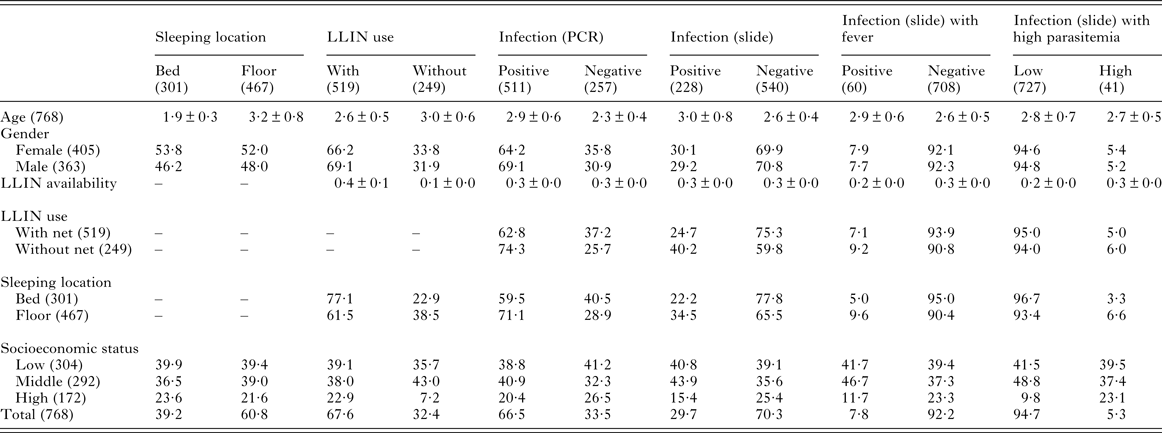
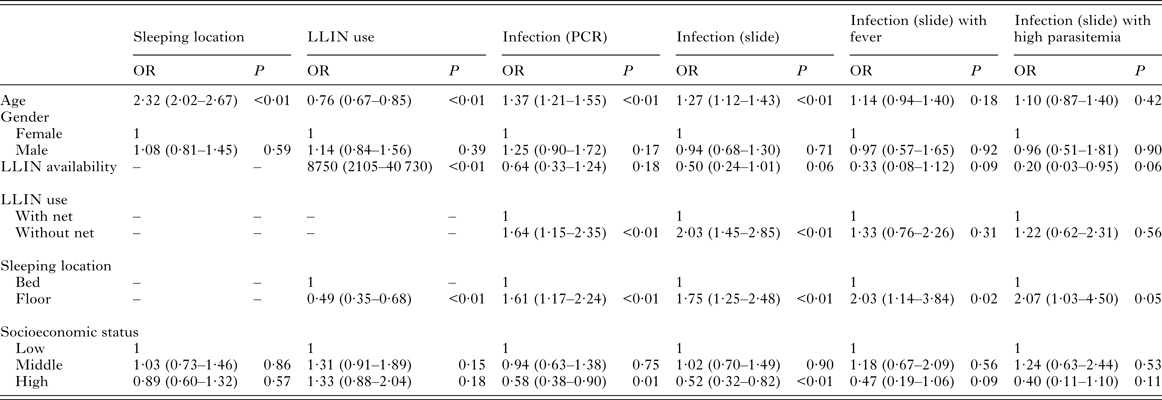
Of 1200 randomly selected children, only 852 children participated in the survey. Subsequent analyses excluded data from 84 children who lacked complete information. The data from 768 children were used for the following analyses. A total of 467 children (60·8%) slept on the floor (Table 1). When sleeping location was analysed as function of three covariates, age, gender and socioeconomic status, the univariate analyses revealed that only age was statistically significant. Younger children were significantly more likely to sleep in beds (Table 2).
Proportions or means ± s.e. of seven variables associated with sleeping location, LLIN use, PCR based P. falciparum infection, slide based infection, slide based infection with fever (⩾37·5 °C), and high parasitemia (⩾2500 µL−1) among children under 5 years of age. The values in parentheses are the numbers of samples

LLIN, long-lasting insecticidal nets
Odds ratios [OR (95% confidence interval (CI))] and P-values from univariate analyses that examined the effects of seven variables on sleeping location, LLIN use, PCR based P. falciparum infection, slide based infection, slide based infection with fever (⩾37·5 °C), and high parasitemia (⩾2500 µL−1) among children under 5 years of age

LLIN, long-lasting insecticidal nets
Caretakers reported that 519 children (67·6%) slept under LLINs the previous night (Table 1). The mean number of LLINs per person in hut was 0·28. When LLIN use was analysed as function of age, gender, LLIN availability, sleeping location and socioeconomic status, the univariate analyses revealed that age, sleeping location and LLIN availability were statistically significant (Table 2). LLIN use among children who slept on the floor was significantly less than ones sleeping in beds. LLIN use was significantly higher in houses with greater LLIN availability. A multivariate analysis was not applied to these significant covariates, because multicollinearity (the regression coefficients changed dramatically when each covariate was added or deleted) was detected when they were included in the analysis.
Parasitemia
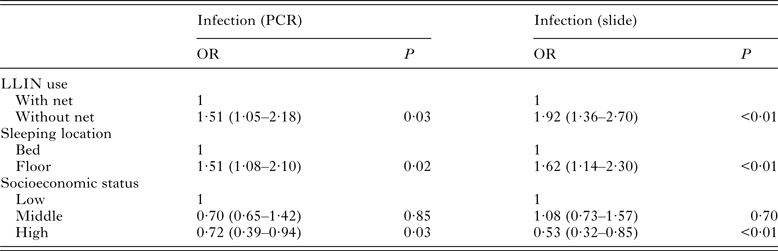
The PCR based P. falciparum infection rate and slide based infection rate were 66·5 and 29·7%, respectively (Table 1). The univariate analyses revealed that PCR based infection and slide based infection were significantly higher among children slept on the floor (Table 2). Age, LLIN use and socioeconomic status were also statistically significant for PCR based infection and slide based infection. When multivariate analyses were applied, sleeping location was still significant for PCR based infection and slide based infection (Table 3). Age was not included in the multivariate analyses, because multicollinearity (the regression coefficients of sleeping location changed dramatically when age was added or deleted) was detected when both age and sleeping location were included in the analyses. Infection with fever and high parasitemia cases were found in 7·8 and 5·3%, respectively. The univariate analyses revealed that only sleeping location was statistically significant.
Odds ratios [OR(95% confidence interval (CI))] and P-values from multivariate analyses that examined the effects of three variables, LLIN use, sleeping location and socioeconomic status, on LLIN use, PCR based P. falciparum infection and slide based infection among children under 5 years of age

LLIN, long-lasting insecticidal nets
DISCUSSION
The present study showed that sleeping location was associated with the four types of P. falciparum infections among children. The association was still seen for PCR based infection and slide based infection even though the regression models included LLIN use and socioeconomic variables that have potential effects on malaria infection (Graves et al. Reference Graves, Richards, Ngondi, Emerson, Shargie, Endeshaw, Ceccalo, Ejigsemahu, Mosher, Hailemariam, Zerihun, Teferi, Ayele, Mesele, Yohannes, Tilahun and Gebre2009; West et al. Reference West, Protopopoff, Rowland, Cumming, Rand, Drakeley, Wright, Kivaju, Mosha, Kisinza and Kleinshmidt2013). On the other hand, LLIN availability was not a significant factor for the infections. This result suggests that children were infected by sleeping on the floor regardless LLIN availability.
The significant association between sleeping location and P. falciparum infection is explained by the fact that children sleeping on the floor were less likely to use LLINs (Iwashita et al. Reference Iwashita, Dida, Futami, Sonye, Kaneko, Horio, Kawada, Maekawa, Aoki and Minakawa2010). Without a bed, a LLIN hardly remains hung throughout a day, because it interferes the daily activities (Baume et al. Reference Baume, Rithinger and Woldehanna2009). Hanging and removing a LLIN on a daily basis is not an easy task without climbing on to a bed or chair, especially for small children who cannot easily reach the ceiling or ceiling joints to which a LLIN is usually tied. A typical Luo homestead consists of multiple small huts. Once children leave their mother's bed as they grow, they sleep in a separate room or hut with their siblings, and a bed is rarely available in their sleeping places. Moreover, help from adults is not readily available for handling a LLIN in a separate hut. In some cases, children tie a LLIN with chairs or tables nearby, or use it as a sleeping cover, because they are not able to hang it properly. Even though children manage to hang a LLIN, they may not be able to spread the LLIN properly without a bed frame. If they use a mattress on the floor, they could tuck a LLIN under it; however, the net will not be firmly fixed without a bed frame. A LLIN has to be fixed firmly between a bed frame and mattress. Consequently, children body parts may be attached to the net or outside the net during the sleep. This may further explain the results that LLIN availability was not a significant factor for P. falciparum infection while sleeping location was significant. In other words, a LLIN was less effective for children sleeping on the floor even though they used it.
These results are convincing evidences to support the hypothesis that sleeping location affects P. falciparum infection among children. To prove the hypothesis rigorously, details about the interactions between mosquitos and children on the floor should be understood by estimating Entomological Inoculation Rate and observing the children's behaviour associated with using a LLIN. The study may produce further information for improving current control tools or even developing a new tool.
Protecting children sleeping on the floor is a key to reduce malaria cases further. One plausible solution for this problem is to screen eave gaps and cover ceilings with nets. Intervention studies in Gambia showed that screening house ceilings and eave gaps is effective in reducing malaria vectors and anaemia children (Lindsay et al. Reference Lindsay, Jawara, Paine, Pinder, Walraven and Emerson2003; Kirby et al. Reference Kirby, Ameh, Bottomley, Green, Jawara, Milligan, Snell, Conway and Lindsay2009). Screening eave gaps and ceilings with LLINs also reduced the number of indoor resting malaria vectors in experimental huts in the study area of this present study (Kawada et al. Reference Kawada, Dida, Ohashi, Sonye, Njenga, Mwandawiro, Minakawa and Takagi2012). Although this approach may be costly, it could be used with other existing tools for further reducing malaria transmission among children sleeping on the floor (Gimnig and Slutsker, Reference Gimnig and Slutsker2009).
ACKNOWLEDGEMENTS
We thank all the participating children and parents, and the local communities for understanding the importance of our research, and all the local staff members for their dedication to this project. We are very grateful to Ms Junko Sakemoto, Ms Naoko Mori, Mr Tadahisa Sakata, Mr Masayuki Kotani and Ms Yukie Saito for providing administrative support. This paper is published with the permission of the Director of KEMRI.
FINANCIAL SUPPORT
This study was supported by the Global Center of Excellence Program, Nagasaki University, Japan (there is no grant number).