1. Introduction
In recent years, manned and unmanned vessels (Naus et al., Reference Naus, Wa̧ż, Szymak, Gucma and Gucma2021; Rutkowski, Reference Rutkowski2021; Specht et al., Reference Specht, Stateczny, Specht, Widźgowski, Lewicka and Wiśniewska2021) have played a key role in various ocean engineering such as maritime rescue, ocean exploration (Liang et al., Reference Liang, Zhang, Ma and Zhang2017; Stateczny et al., Reference Stateczny, Specht, Specht, Brčić, Jugović, Widźgowski, Wiśniewska and Lewicka2021) and resource development. Ship motion control has received widespread attention to meet the needs of different tasks, realise the intelligence and automation of ships, and ensure the safety and economy of ships. The research on ships in recent years includes path planning (Lyu and Yin, Reference Lyu and Yin2019), collision avoidance (Li and Zheng, Reference Li and Zheng2020; Xu et al., Reference Xu, Pan, Huang and Zhang2020) and track control. Track control is divided into trajectory tracking and path following. Trajectory tracking (Wang and Su, Reference Wang and Su2021) is strictly constrained by time, enabling the ship to track the desired trajectory in real-time; Path following (Nie et al. Reference Nie, Wang, Lu, Lin, Sheng, Zhang and Song2021) is not subject to time requirements, it only needs to track the geometric position of the target path. In actual ship navigation, it generally not needed to arrive at the designated location at a specific time, so ship path following is more extensive. In some special marine engineering operations, such as engineering drilling platforms and engineering experimental ships which require a high degree of freedom, the control performance of underactuated ships (Hou et al., Reference Hou, Ma, Ding, Yang and Chen2020; Xie et al., Reference Xie, Reis, Cabecinhas and Silvestre2020; Zhang et al., Reference Zhang, Wang, Wei and Wang2020) can no longer meet the engineering requirements. Therefore, the fully actuated (Zheng et al., Reference Zheng, Huang, Xie and Zhu2018a; Del-Rio-Rivera et al., Reference Del-Rio-Rivera, Ramirez, Donaire and Ferguson2020) path following surface vessel with higher degree of freedom and stronger performance has great research value and significance.
Aimed at the problem of surface vessel path following control, the main methods include the Serret–Frenet (SF) frame (Liu et al., Reference Liu, Chen, Zou and Li2017), logical virtual ship (LVS) guidance (Zhang et al., Reference Zhang, Zhang and Zheng2015), line-of-sight (LOS) guidance and so on. The LOS guidance can reduce the output dimension of the system and greatly simplify the design of the path following controller. The LOS-based surface vessel path following control system is composed of a kinematics-level LOS guidance control system and a dynamics-level heading and speed tracking control system. The former provides a heading guidance angle for the surface vessel by designing a guidance law, and the latter designs a heading and velocity tracking controller to realise the surface vessel can follow the desired path at a certain desired speed. LOS guidance has been extensively studied and applied by many researchers in different aspects. These LOS guidance can be divided into three main categories. The first category is compensation for sideslip angle and disturbance. The integral LOS (ILOS) (Lekkas and Fossen, Reference Lekkas and Fossen2014) guidance method introduces an integrator based on the traditional LOS, which can compensate for the influence of constant sideslip angle on the path following control system. Zhang et al. (Reference Zhang, Li, Li and Zhang2019) applied ILOS and a robust adaptive algorithm to the path following control of an unmanned robot sailboat. Adaptive integral LOS (AILOS) (Fossen and Lekkas, Reference Fossen and Lekkas2017) adds an adaptive rate to the ILOS guidance. It overcomes the impact of unknown sideslip angles and unknown time-varying ocean currents in kinematics on the system and enhances the robustness of the system. Predictor-based LOS (PLOS) (Liu et al., Reference Liu, Wang, Peng and Wang2016b) introduces the predictor into the design of LOS guidance. This guidance uses a predictor to estimate the unknown constant drift angle to improve the accuracy of the sideslip angle estimation. However, the sideslip angle involved in the above method is constant or slowly time-varying, and it does not solve the problem of time-varying sideslip angle. Extended state observer-based LOS (ELOS) (Liu et al., Reference Liu, Wang and Peng2016a) based on extended state observers (ESOs) solves the problem of time-varying sideslip angle. A real ship simulation can be used to verify the feasibility of the guidance. The second category is to optimise parameters such as lookahead distance and desired velocity in LOS guidance. Lekkas and Fossen (Reference Lekkas and Fossen2014) presented the forward distance that varies with the cross-track error in ILOS guidance. When the ship is far from the desired path, a smaller forward distance is obtained, which will make the bow of the ship more perpendicular to the desired path and increase the error rate. Surge-guided LOS (SGLOS) (Wang et al., Reference Wang, Sun, Yin, Zou and Su2019) is designed with a time-varying speed that varies with the lateral error. Compared with the traditional single constant speed, this guidance method has a faster convergence speed and is more reasonable. The third category is to constrain the tracking error. In actual navigation, especially in complex sea conditions or narrow waters, if the navigation path and tracking error of the ship are not restricted, there will be great safety hazards. Zheng and Feroskhan (Reference Zheng and Feroskhan2017) used the logarithmic error transformed functions to construct the LOS guidance. This guidance can convert performance constraints into an equivalent unrestricted range, ensuring the prescribed performance in the path following process. Zheng et al. (Reference Zheng, Sun and Xie2018b) proposed error-constrained LOS (ECLOS) guidance based on the barrier Lyapunov function (BLF), and used the tan-type BLF to limit the steady-state performance of the surface vessel in path following.
The heading and velocity control part of path following is similar to the principle of trajectory tracking. At present, the common controller design methods include backstepping control, fuzzy control, sliding mode control, robust control and so on. Among them, Fossen and Berge (Reference Fossen and Berge1997) first proposed the backstepping and applied it to ship control, by constructing the Lyapunov function to inverse the controller. Because of its simple and direct design, it has been studied by many researchers. Swaroop et al. (Reference Swaroop, Hedrick, Yip and Gerdes2000) added the dynamic surface control technique (DSC) to the backstepping, which avoids the ‘differential explosion’ caused by the derivation of the virtual control rate in backstepping and simplifies the computational complexity. In actual sea conditions, unknown disturbances such as wind, waves and currents are inevitable. Additionally, the weight of the ship may change with the load, so the ship may have model uncertainties. Shen et al. (Reference Shen, Zhang, Zhang and Guo2018) used neural networks with adaptive laws to construct a fully actuated surface vessel trajectory tracking controller, which can not only approximate the model uncertainties and unknown disturbances, but also effectively improve the robustness of the system. Shen et al. (Reference Shen, Wang, Yu and Guo2020b) proposed a finite-time observer, which can observe unmeasurable speed values and unknown interference within a limited time. This method simultaneously solves the problem of an unmeasurable system state and unknown disturbances. Although the theoretical research results on unknown disturbances and model uncertainties are fruitful, few researchers have considered the physical constraints of a surface vessel in actual navigation.
On the one hand, the surface vessel itself has the problem of input saturation. For example, the torque generated by the rudder and propeller cannot be infinite. When the input signal of the actuator is too large, saturation will occur. The most direct result will make the ship unable to track the desired path or even cause the system to oscillate and become unbalanced. For a class of nonlinear systems with input saturation, Chen et al. (Reference Chen, Ge and Ren2011) proposed constraint adaptive control and designed a command filter controller (CFC). It can not only solve the problem of system input saturation, but also solve the problem of ‘differential explosion’ caused by the backstepping method. By virtue of constructing an auxiliary dynamic system to deal with output saturation, Du et al. (Reference Du, Hu, Krstić and Sun2016) designed a robust nonlinear controller for ship dynamic positioning, which effectively solves the impact of limited output on the system. Shen et al. (Reference Shen, Bi, Wang and Guo2020a) introduced the smooth Nussbaum function to construct the auxiliary system, which has the property that the upper and lower bound integrals tend to infinity. This auxiliary system can well compensate the nonlinear part caused by the input saturation. Shen et al. (Reference Shen, Wang, Yu and Guo2020b) and Yang and Chen (Reference Yang and Chen2016) apply an adaptive auxiliary system to overcome the influence of input saturation on the system, which can make the system stable in the presence of input saturation. Compared with that used by Shen et al. (Reference Shen, Bi, Wang and Guo2020a), this adaptive auxiliary system is simpler.
On the other hand, from the external water environment, a surface vessel may be affected by the output constraint. In narrow waterways or specific engineering operations, it is forbidden for ships to have large path following errors in path following, so it is necessary to limit the output of the system. At present, the methods to solve the output constraint include the prescribed performance function (PPF) and the barrier Lyapunov function (BLF). Bechlioulis and Rovithakis (Reference Bechlioulis and Rovithakis2008) first proposed the prescribed performance control method. Through the error transformed function constructed by PPF, the constrained performance is converted to the equivalent unconstrained range. Jia et al. (Reference Jia, Hu and Zhang2019) combined the prescribed performance with the backstepping and designed an underactuated trajectory tracking controller with preset performance. However, obtaining the inverse function of the logarithmic error transformed function is very complicated, which is not convenient for the design of the controller, and will lead to the singularity of the system. To solve this problem, Li et al. (Reference Li, Du, Sun and Lewis2019) improved the error transformed function based on the work of Jia et al. (Reference Jia, Hu and Zhang2019), and proposed a non-logarithmic error transformed function, which effectively simplified the complexity of system design. The prescribed performance function can constrain the steady-state and transient performance of the system, but it has the disadvantages of poor scalability, sensitivity to the initial position and complicated controller design. The BLF is an improvement on the Lyapunov function. Compared with the error transformed function, the BLF solves the problem of output constraint more directly. BLF starts directly from the starting point (Lyapunov function) of the controller design, and directly constrains the error by constructing an appropriate BLF. This method does not need to convert the errors, thus simplifying the controller design and solving the singularity problem. Xu and Jin (Reference Xu and Jin2013) proposed a tangential barrier Lyapunov function (TBLF), which is used for the design of a multi-input multi-output nonlinear control system with output constraints. However, when deriving the TBLF, the denominator contains a trigonometric function term, which complicates the design of the controller. Zhao et al. (Reference Zhao, He and Ge2014) used the symmetric barrier Lyapunov function (SBLF) to solve the problem of trajectory tracking of the ship with input constraints. Since the SBLF is the logarithmic form, the derivative is the regular fractional form, which can solve the problem of increased complexity of the system caused by the time derivative of the trigonometric function term. However, the initial restricted area of the SBLF is symmetrical, and the upper and lower bounds of the output constraints may not be the same in the system, which makes the SBLF have great limitations. To solve this problem, Qiu et al. (Reference Qiu, Liang, Dai, Cao and Chen2015) proposed the asymmetric barrier Lyapunov function (ABLF) to solve a problem of a class of nonlinear systems with output constraints. The ABLF relaxes the restriction that the initial restricted area must be symmetrical. However, in special cases, such as when the constraint boundary approaches infinity, no matter how large the error is, the traditional ABLF approaches zero, which cannot be used as a basis for judging the stability of the system. Chen et al. (Reference Chen, Chen, Sun and He2020) first proposed the asymmetric modified barrier Lyapunov function (AMBLF) to realise the full-state constrained control of spacecraft. AMBLF is an improvement of the traditional ABLF. When the constraint boundary is infinite, the AMBLF can be transformed into a traditional quadratic BLF by using L'Hospital's rule, which makes the AMBLF more general. However, in the above literature (Xu and Jin, Reference Xu and Jin2013; Zhao et al., Reference Zhao, He and Ge2014; Qiu et al., Reference Qiu, Liang, Dai, Cao and Chen2015; Chen et al., Reference Chen, Chen, Sun and He2020), the BLF can only realise the steady-state constraints of the system, and cannot achieve dynamic constraints and improve the steady-state constraint's transient performance of the system.
Inspired by the above research, to efficiently complete complex and accurate engineering tasks, we propose a BLF-based surface vessel path following controller which is suitable for model uncertainties, unknown disturbances, input saturation and prescribed performance. The main contributions and innovations of this paper are summarised.
(i) We propose the prescribed performance asymmetric modified barrier Lyapunov function (PPAMBLF). Compared with the traditional AMBLF (Chen et al., Reference Chen, Chen, Sun and He2020), the PPAMBLF is a combination of the AMBLF and PPF, which can not only constrain the steady-state performance of the system, but also has the prescribed performance characteristics of the PPF.
(ii) This paper proposes the prescribed performance line-of-sight (PPLOS) guidance law for the first time. PPLOS guidance is based on the PPAMBLF, which can ensure that the tracking errors of the path following kinematics guidance part converge within the expected constraint range in real-time, ensuring the prescribed performance of the guidance system. Compared with ECLOS (Zheng et al., Reference Zheng, Sun and Xie2018b), PPLOS has three obvious advantages: (1) PPLOS avoids the complexity of the system caused by the trigonometric function term of the TBLF; (2) PPLOS can make the restricted area asymmetric, which is more general; (3) PPLOS can not only meet the steady-state constraints of the guidance system, but also meet its transient performance.
(iii) Zheng et al. (Reference Zheng, Sun and Xie2018b) and Zheng and Feroskhan (Reference Zheng and Feroskhan2017) only limited the position error of the ship by designing guidance in kinematics, and did not restrict the error between the heading guidance angle and the actual heading angle in dynamics. In this paper, the PPAMBLF is further applied to the heading control of ship path following, so that the heading error can also meet the prescribed performance requirements and the tracking accuracy of the system is further enhanced.
(iv) This paper constructs a fully actuated surface vessel path following controller based on PPLOS, introduces the adaptive assistant systems to compensate for the impact of input saturation, uses RBF neural networks to approximate the model uncertainties, and designs adaptive laws to estimate the bounds of the neural network approximation errors and unknown external environmental disturbances. Finally, combining the backstepping, DSC and PPAMBLF, we design a surface vessel path following adaptive backstepping control with prescribed performance and input saturation.
The specific arrangement of the paper is as follows: Section 1 provides an introduction; Section 2 includes the problem description and preliminary work; Section 3 presents the design of the surface vessel path following controller; Section 4 gives the strict stability proof; Section 5 carries out MATLAB simulation, and analyses the experimental result; and Section 6 includes the conclusions.
2. Problem description and preliminaries
2.1 Problem description
2.1.1 Surface vessel model
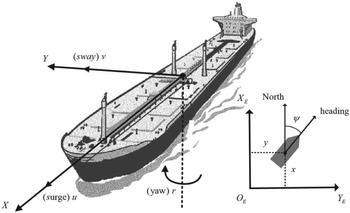
Figure 1 shows the surface vessel motion. In this paper, we define the inertial reference frame (IRF) as ${O_E} - {X_E}{Y_E}$ and the body-fixed reference frame (BRF) as $O - XY$
 . Considering the three-degrees-of-freedom surface vessel in the presence of model uncertainties and external disturbances, the nonlinear mathematical model (Shen et al., Reference Shen, Bi, Wang and Guo2020a; Wang et al., Reference Wang, Shen, Wang and Yu2021) for a surface vessel can be expressed as


where $\boldsymbol \eta = {[ {x,y,\psi } ]^{\rm {T}}}$ is the surface vehicle position vector in the earth-fixed frame, where $({x,y})$
 is the surface vehicle actual position and $\psi$
 is the heading angle; $\boldsymbol \upsilon = {[ {u,v,r} ]^{\rm {T}}}$
 is the velocity vector in the body-fixed frame, consisting of surge $u$
 , sway $v$
 and yaw $r$
 ; $\Delta \boldsymbol f = [\Delta {f_u},\Delta {f_v},\Delta {f_r}]$
 are the uncertainties of the surface vessel model; $\boldsymbol {d} = {[ {{d_u},{d_v},{d_r}} ]^{\rm T}}$
 is the unknown external environmental disturbance; $\boldsymbol {J}(\psi )$
 is the rotation matrix; $\mathbf {M}$
 is the positive definite inertia matrix including the vessel mass and the hydrodynamic inertia; $\boldsymbol {C}(\boldsymbol \upsilon )$
 is the Coriolis centripetal; and ${\bf D}$
 is the damping matrix. The specific form is as follows:

$\boldsymbol \tau {\rm {\ =\ }}[ {{\tau _u},{\tau _v},{\tau _r}} ]$ is the actual control input consisting of surge force ${\tau _u}$
 , sway force ${\tau _v}$
 and yaw moment ${\tau _r}$
 . Considering the input saturation, ${\rm sat}(\boldsymbol \tau )$
 is the system input subject to saturation, and the specific description is as follows:

where $\tau _i^+ > 0$ , $\tau _i^- < 0$
 are the maximum and the minimum control force or moment of the surface vessel path following control system. Let $\Delta {\tau _i} = {\rm sat}_i({\tau _i}) - {\tau _i},\ i = u,v,r$
 . We can expand Equation (2.1b) as

Assumption 1 The disturbance of the external environment experienced by the surface vessel is unknown, but the disturbance is bounded, and its rate of change is also bounded, that is, ${\| {\dot d(t)} \| \le {C_d} < \infty}$ .
Motion of surface vessel

Assumption 2 The parameter matrices $\boldsymbol M$ , $\boldsymbol C(\boldsymbol \upsilon )$
 and $\boldsymbol D$
 of the surface vessel model are known. In addition, the model uncertainties are unknown but bounded.
2.1.2 Control objective
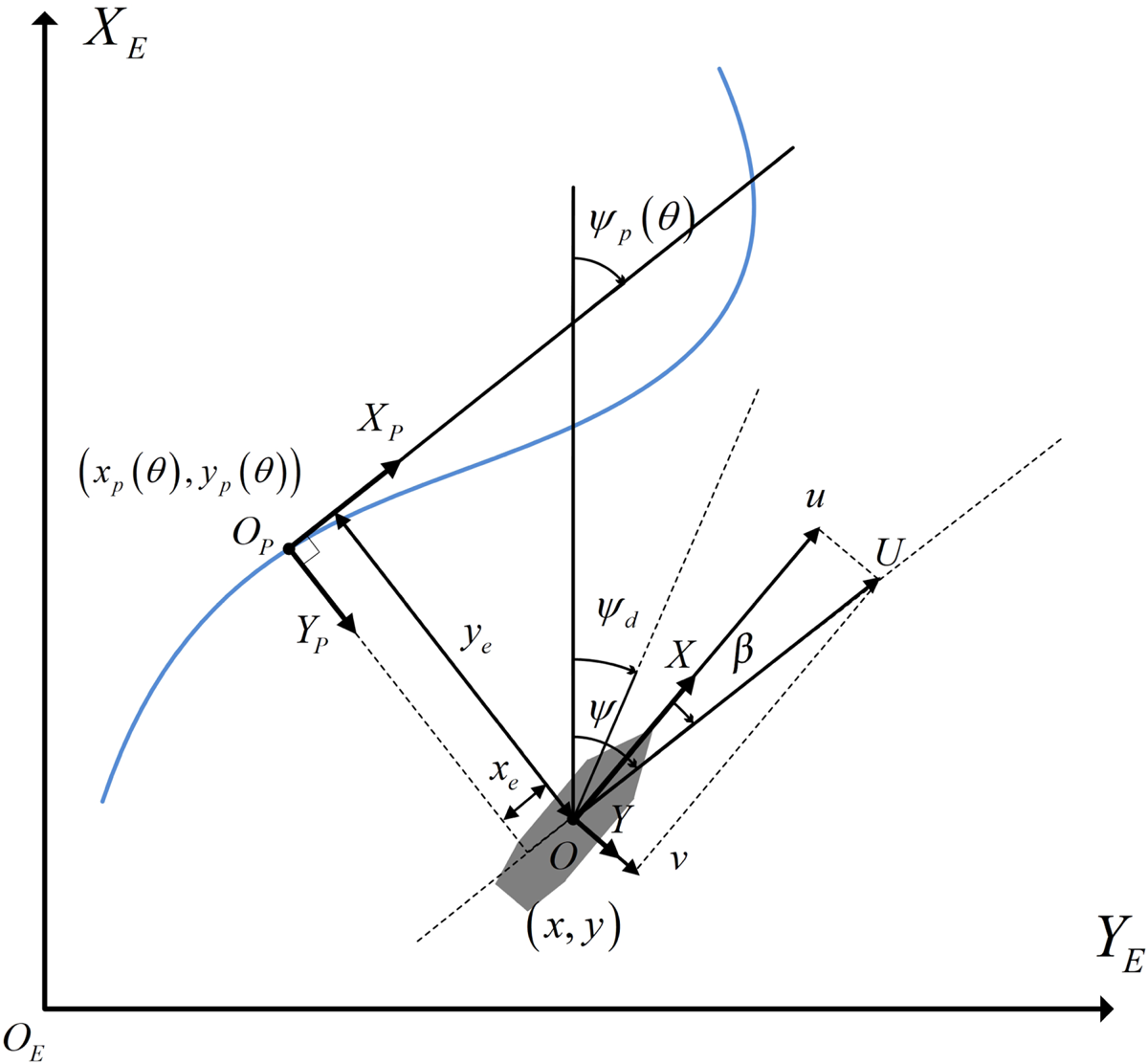
The surface vessel's LOS guidance method is shown in Figure 2. We define the path reference frame (PRF) as ${O_p} - {X_p}{Y_p}$ . Then the desired path to be followed is defined as ${\eta _p}(\theta )= [ {{x_p}(\theta ),{y_p}(\theta )}]$
 , where ${\eta _p}(\theta )$
 is the desired path parameter, and ${\psi _p}(\theta )$
 is the path-tangent angle of the desired path, defined as ${\psi _p}(\theta ) = \arctan 2({y'_p}(\theta ),{x'_p}(\theta ))$
 .
Remark 1 For ${(\,\cdot\, )^\prime }_p(\theta )$ , we have ${(\,\cdot\, )^\prime }_p(\theta ) \overset {\Delta }{=} {d{{(\,\cdot\, )}_p}} / {d\theta }$
 .
Line-of-sight guidance

For the surface vessel with positions, the along-tracking error and cross-tracking error (as shown in Figure 2) of the position in the IRF can be expressed in the PRF as

The derivative of ${x_e}$ is

According to Equation (2.1a), the ${a_1}$ and ${a_2}$
 in Equation (2.5) can be further rewritten as


where $U= \sqrt {{u^2} + {v^2}} \ge 0$ is the actual velocity of the surface vessel, $\beta = {\rm arctan}2(v,u)$
 is the sideslip angle (as shown in Figure 2) and $\phi = {\rm arctan}2(- {y'_d}(\theta ), - {x'_d}(\theta )) = - {\psi _d}$
 .
Because the simplification of ${\dot x}_e$ and ${\dot y}_e$
 are similar, the derivative of the tracking errors become

where $\dot {\psi }_p = ((-x''_p y'_p + y''_p x'_p)/({x'}_p^2 + {y'}^2_p))\dot {\theta }$ .
Assumption 3 For the desired path ${\eta _p}(\theta )$ , its first and second derivatives ${\dot \eta _p}(\theta )$
 , ${\ddot \eta _p}(\theta )$
 exist and are bounded. Furthermore, ${\eta _p}(\theta )$
 is a regular curve, guaranteeing ${x'^2}_p(\theta ) + {y'^2}_p(\theta ) \ne 0$
 .
Assumption 4 The desired surge ${u_d} > 0$ and its derivative ${\dot u_d}$
 are bounded. Since this paper is for a fully actuated surface vessel, the sway $v$
 is controllable. The desired sway ${v_d}$
 should be considered. To ensure the sideslip angle is small, the desired sway ${v_d}$
 is defined as ${v_d}{\rm {\ =\ 0}}$
 . That is, $\lim _{v \to 0} \beta = {\rm arctan}2(v,u) = 0$
 .
2.2 Prescribed performance function
According to the idea of Bechlioulis (Bechlioulis and Rovithakis, Reference Bechlioulis and Rovithakis2008), the prescribed performance function can be expressed as

where ${\bar \delta _a}(t)$ and ${\underline \delta _b}(t)$
 satisfy being smooth and bounded. Moreover, ${\bar \delta _a}(t) \ge 0$
 , ${\underline \delta _b}(t) \ge 0$
 , $\lim _{t \to \infty } {\bar \delta _{}}(t) = {\delta _{a,\infty }} > 0$
 , $\lim _{t \to \infty } {\underline \delta _b}(t) = {\delta _{b,\infty }} > 0$
 . Here, ${\bar \delta _a}(t)$
 and ${\underline \delta _b}(t)$
 can be expressed as

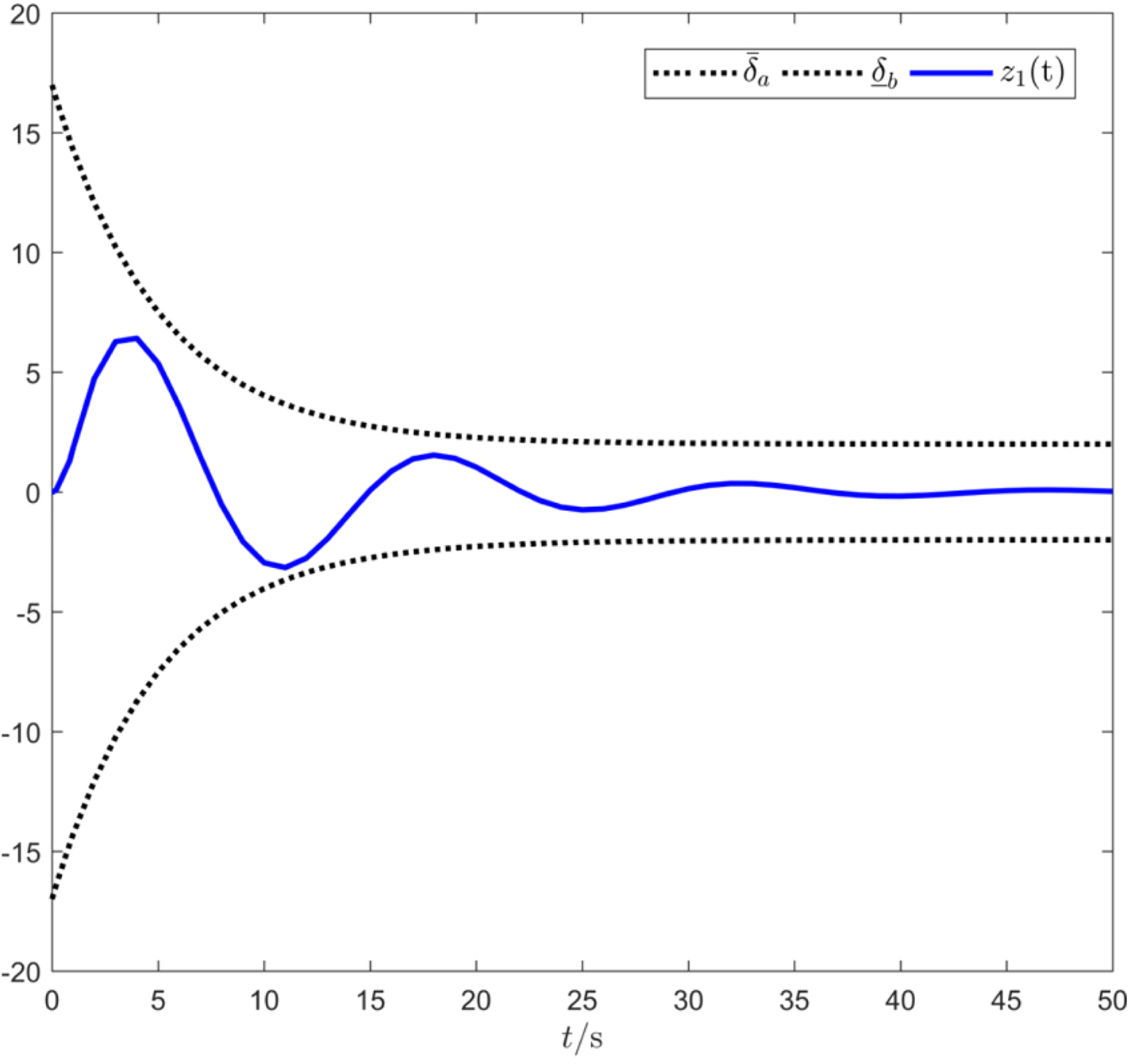
where ${\delta _{\bar a,\max }},{\delta _{\underline b,\min }},{\bar l_a},{\underline l_b}$ is the design constant. The pictorial illustration of prescribed performance is shown in Figure 3.
Pictorial illustration of prescribed performance

2.3 Barrier Lyapunov function
2.3.1 Asymmetric modified barrier Lyapunov function
The asymmetric modified barrier Lyapunov function (AMBLF) (Chen et al., Reference Chen, Chen, Sun and He2020) can be expressed as

where $z(t)$ is the variable that needs to be constrained, which generally is the systematic error. We define ${k_a}= {k_c} - {Y_0}$
 , ${k_b} = {k_d} - {Y_0}$
 . Here, ${k_c} > 0$
 , ${k_d} > 0$
 are the upper and lower bounds of constant value constraints, and ${Y_0}$
 is the expected value. Hence, $- {k_b} < z(0) < - {k_a}$
 , $q(*) = \left \{\begin {smallmatrix} 1, & * > 0\\ 0, & * \le 0 \end {smallmatrix}\right.$
 .
Remark 2 Through simple calculations, we can get ${V_b}({{0^+ }})= {V_b}({{0^- }})= 0$ , $\lim _{z \to {0^+ }} {{d{V_b}}}/{{dz}}= \lim _{z \to {0^- }} {{d{V_b}}}/{{dz}} = 0$
 , which explain that ${V_b}$
 is a continuous derivable function.
Remark 3 When ${k_a} \to \infty,{k_b} \to \infty$ , $\lim _{{k_a} \to \infty } \frac {1}{2}\ln ({{k_a^2{e^{{z^2}}}}}/{{(k_a^2 - {z^2})}})= \lim _{{k_b} \to \infty } \frac {1}{2}\ln ({{k_b^2{e^{{z^2}}}}}/ {{(k_b^2 - {z^2})}})= \frac {1}{2}{z^2}$
 can be obtained using L‘Hospital's rule. That is, when the system is unconstrained, the AMBLF can be converted to a general quadratic Lyapunov function.
2.3.2 Prescribed performance symmetric modified barrier Lyapunov function
To ensure that the surface vessel path following position errors meet the prescribed performance requirements, we further improve the AMBLF. We combine the PPF with AMBLF to design the PPAMBLF, which can make the system meet the steady-state performance and transient performance. For compact $Z = \{ {z(t): - {\underline \delta }_a< z(t) < \bar \delta _b } \}$ , there are the following equations:

where, $\bar \delta (t)$ and $\underline \delta (t)$
 are the prescribed performance functions such as in Equation (2.8).
Remark 4 Finding the value of the function on both sides of the zero point of the PPAMBLF and its first derivative, we can get ${V_b}({{0^+ }})= {V_b}({{0^- }})= 0$ , $\lim _{z(t) \to {0^+ }} {{d{V_b}}}/{{dz(t)}}= \lim _{z(t) \to {0^- }} {{d{V_b}}}/{{dz(t)}} = 0$
 . That is, the PPAMBLF is a continuous derivative function.
Theorem 1 From Chen et al. (Reference Chen, Chen, Sun and He2020), we can get the following inequality:

where ${ - {k_a} < z(t) < {k_b}}$ .
Let ${K_a} = {\bar \delta _a}$ , ${K_b} = {\underline \delta _b}$
 . Because ${\bar \delta _a}$
 and ${\underline \delta _b}$
 have no direct functional relationship with $z$
 , we can obtain

Remark 5 When $\bar l_a \to 0,\underline l_b\to 0$ , limiting to the prescribed performance functions, we can get $\lim _{\bar l_a \to 0} {{\bar \delta }_a}(t)= {\delta _{a,\max }}, \lim _{\underline l_b \to 0} {\underline \delta _b}(t) = = {\delta _{b,\min }}$
 . That is, the PPAMBLF proposed in this paper can be simplified to the AMBLF. On this basis, we continue to let ${\delta _{a,\max }}= {\delta _{b,\min }}= \infty$
 , so the PPAMBLF proposed can be simplified to the general quadratic Lyapunov function.
Remark 6 A conventional AMBLF can only guarantee the steady-state performance of the system. While ensuring steady-state performance, the PPAMBLF further restricts the transient performance of the system according to the prescribed performance function. the PPAMBLF can ensure that the system has a better tracking effect in the initial and mid-stage tracking. The specific performance is shown in the intermediate time period from the start of the path following of the system ($t = 0$ ) to the steady-state stage of the expected path ($t = {t_0}$
 ).
3. Design of surface vessel path following controller
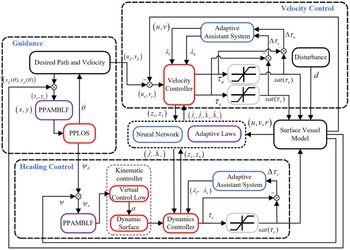
Assuming that there are input saturation, model uncertainties, unknown disturbances and all the states of the surface vessel are measurable, we first design the PPLOS guidance, which enables the surface vessel's position tracking errors to meet the consistent asymptotic stability while remaining within the prescribed performance constraints. The PPAMBLF is further used to constrain the heading of the surface vessel, so that the heading error also meets the prescribed performance requirements. We use backstepping and DSC to design the heading control system and velocity control system. The adaptive assistant systems are used to compensate for input saturation. Neural networks are introduced to approximate the model uncertainties. The adaptive laws are designed to estimate the bounds of the neural network approximation errors and the unknown. This method achieves the following control objectives: (1) the surface vessel can track the desired path and meet the prescribed performance; (2) the surface vessel can reach the desired velocity and maintain it; (3) all signals in the system are consistent asymptotic stability. A block diagram of the control system is shown in Figure 4.
Block diagram of the control system

3.1 PPLOS guidance
We introduce the PPAMBLF to the along-track error ${x_e}$ and the across-track error ${y_e}$
 as follows:

where ${\bar \delta _{a1}}$ , ${\underline \delta _{b1}}$
 , ${\bar \delta _{c1}}$
 , ${\underline \delta _{d1}}$
 are prescribed performance functions, $q(*) = \left \{ \begin {smallmatrix} 1, & \textrm {if}\ * > 0\\ 0, & \textrm {if}\ * \le 0 \end {smallmatrix}\right.$


Together with Equations (2.7) and (3.2), we have

where ${\xi _{12}}$ , ${\varpi _{11}}$
 , ${\varpi _{12}}$
 , $\vartheta$
 are as follows:


Remark 7 Because $- {\underline \delta _{b1}} < {x_e} < {\bar \delta _{a1}}$ , when $0 < {x_e}$
 , we can get ${\xi _{11}} = 1 + {1}/{(\bar {\delta }_{a1}^2 - x_e^2)} \ge 1 > 0$
 , and when ${x_e} \le 0$
 , we can get ${\xi _{11}} = 1 + {1}/{(\underline {\delta }_{b1}^2 - x_e^2)} \ge 1 > 0$
 . In summary, ${\xi _{11}} > 0$
 , and by the same token, ${\xi _{12}} > 0$
 .
We design the desired heading angle ${\psi _d}$ and the update law of $\theta$
 as


Assumption 5 Since the design of the guidance law is based on kinematics and does not consider the dynamics, we assume the actual heading angle $\psi$ of the surface vessel can perfectly track the desired heading angle ${\psi _d}$
 given by the guidance. That is, $\psi = {\psi _d}$
 .
3.2 Heading tracking control
To compensate for the impact of input saturation, we introduce a second-order adaptive assistant system (Yang and Chen, Reference Yang and Chen2016; Shen et al., Reference Shen, Wang, Yu and Guo2020b):

where ${\hbar _1}$ , ${\hbar _2} > 0$
 are design constants, ${\lambda _1}$
 , ${\lambda _2}$
 are auxiliary variables. The heading error ${z_1}$
 and yaw error of ${z_2}$
 of the surface vessel are given as

Step 1: According to ${z_2}$ , the time derivation of ${z_1}$
 is

To ensure the prescribed performance of the system, we introduce the PPAMBLF of ${z_1}$ as

where ${{\bar \delta }_{a2}}(t) > {z_1}(0) > - {\underline \delta _{b2}}(t)$ , ${\bar \delta _{a2}}(t)$
 , ${\underline \delta _{b2}}(t)$
 are prescribed performance functions, which are used to restrict the upper and lower bounds of ${z_1}$
 .
Similar to Equation (3.2), the time derivation of Equation (3.9) is

where the expressions of ${\xi _2}$ and ${\varpi _2}$
 are

The designed virtual control law is $\alpha$ used to stabilise ${z_1}$
 :

where ${k_1} > 0$ .
To avoid derivation of the virtual control law $\alpha$ , we introduce the dynamic surface control. Let $\alpha$
 pass the following first-order low-pass filter:


where ${r_d}$ is the state variable of the first-order low-pass filter, $T$
 is the filter time constant and ${y_1}$
 is the filter output error.
According to Equations (3.6)–(3.13) and the Young's inequality, ${\dot V_2}$ can be further written as

Step 2: According to Equations (2.3) and (3.7), the time derivation of ${z_2}$ is

Consider that there are model uncertainties $\Delta f = [\Delta {f_u},\Delta {f_v},\Delta {f_r}]^{\rm T}$ in the three-degrees-of-freedom surface vessel. According to the universal approximation characteristics of the RBF neural network, we first approximate $\Delta {f_r}$
 , where the output expression is given as

where $z = {[ {u,v,r} ]^{\rm T}}$ is the input vector of the neural network.
Here, $\boldsymbol h(\boldsymbol z) = {[ {{h_1}(z),{h_2}(z),\ldots,{h_n}(z)} ]^{\rm T}}$ is the vector of radial basis function. The specific expression is given by

where ${b_j} > 0$ is the width of the Gaussian function; ${c_j} = {[ {{c_1},{c_2}, \ldots,{c_m}} ]^{\rm T}} \in \boldsymbol {R}^m$
 is the centre of the Gaussian function, which has the same dimension as the input vector $\boldsymbol z$
 ; ${e_{wr}}(\boldsymbol z)$
 is the approximation error of neural network; and $\boldsymbol W^*_{r} = {[ {{w^*_{r,1}},{w^*_{r,2}}, \ldots,{w^*_{r,n}}} ]^{\rm {T}}} \in \boldsymbol {R}^{n \times 1}$
 is the ideal weight vector, that is, the value of the vector $\boldsymbol W^*_{r}$
 which makes $| {{e_{wr}}(\boldsymbol z)} |$
 the smallest for all $\boldsymbol z \in {\Omega _z}$
 . Here, $\boldsymbol W_r^{*}$
 is given by

In practical applications, the ideal weight vector $\boldsymbol W_r^{*}$ cannot be obtained, so the estimation $\hat {\boldsymbol {W}}_r$
 of $\boldsymbol W_r^{*}$
 needs to be used in the controller design, and $\tilde {\boldsymbol {W}}_r= \hat {\boldsymbol {W}}_r- \boldsymbol {W}_r^*$
 .
Assumption 6 For all $\boldsymbol z \in \boldsymbol {\Omega }_z$ , the ideal weight vector $\boldsymbol W_r^{*}$
 of the neural network and the approximation error ${e_{wr}}(\boldsymbol z)$
 are bounded, that is, there are positive constants $\boldsymbol {W}_{r,\max }$
 and bounded functions ${e_{wr,\max }}(\boldsymbol z)$
 that satisfy $\| \boldsymbol {W}_r^* \| \le \boldsymbol {W}_{r,\max }$
 and ${e_{wr}}(\boldsymbol z) \le {e_{wr,\max }}(\boldsymbol z)$
 . By Assumption 1, path following external environmental disturbance ${d_r}$
 and approximation error ${e_{wr}}(\boldsymbol z)$
 , there is a bounded function ${\lambda\unicode{x0304}_r} > 0$
 , which makes $| {{e_{wr}}(\boldsymbol z)} | + | {{d_r}} | < {\lambda\unicode{x0304}_r}$

Remark 8 To simplify the description, in this paper, the neural network approximation error ${e_{wr}}(\boldsymbol z)$ and environmental disturbance ${d_r}$
 are collectively referred to as compound disturbance, where ${\lambda\unicode{x0304}_r}$
 is the bounding of compound disturbance.
Then, we design the control input ${t_r}$ as

where ${\gamma _1} > 0$ and ${\sigma _1} > 0$
 are the design constants, $\phi ({{z_2}}) = \tanh ({z_2}/\varepsilon _1)$
 , ${\varepsilon _1} > 0$
 is the design constants and $\lambda\unicode{x0304}_r^0$
 is the prior estimate of ${\hat {\lambda\unicode{x0304}_r}}$
 .
The weight update law and the adaptive law of the estimation ${\hat { \lambda\unicode{x0304}}_r}$ are designed as


where ${\gamma _1} > 0$ and ${\sigma _1} > 0$
 are the design constants, $\phi ({{z_2}}) = \tanh (z_2 /\varepsilon _1)$
 , ${\varepsilon _1} > 0$
 are the design constants and $\lambda\unicode{x0304}_r^0$
 is the prior estimate of ${\hat {\lambda\unicode{x0304}}_r}$
 .
Remark 9 For the design of control input ${t_r}$ at this stage, the neural network and the adaptive law only approximate the model uncertainties $\Delta {f_r}$
 and disturbances ${d_r}$
 . In the next design of control input ${t_u}$
 and ${t_v}$
 , $(\Delta {f_u},\Delta {f_v})$
 and $({d_u},{d_v})$
 will be estimated, the specific process is similar.
3.3 Velocity tracking control
To compensate for saturation of controller inputs ${\tau _{{u}}}$ and ${\tau _v}$
 , two first-order adaptive assistant systems are introduced as

The surface vessel's surge error ${z_1}$ and sway error ${z_2}$
 can be obtained as

Remark 10 Since the research object of this paper is a fully actuated surface vessel with three controller inputs, which is different from an underactuated surface vessel, we cannot only control the surge, but can also control the sway of the surface vessel.
According to Equations (2.3) and (3.22), we can find the time derivative of ${z_3}$ and ${z_4}$
 as

Similarly, two neural networks are designed to approximate the model uncertainties $\Delta {f_u}$ and $\Delta {f_v}$
 , and the output expression of the neural network is

Let $\hat {\boldsymbol {W}}_u$ be the estimated value of $\boldsymbol {W}_u^*$
 and $\hat {\boldsymbol {W}}_v$
 be the estimated value of $\boldsymbol {W}_v^*$
 . We design the control input ${t_u}$
 and ${t_v}$
 as

We design the weight update law and the adaptive law of the estimation as


where ${\Gamma _2} > 0$ , ${\Gamma _3} > 0$
 , ${\vartheta _2} > 0$
 , ${\vartheta _3} > 0$
 , ${\gamma _2} > 0$
 , ${\gamma _3} > 0$
 , ${\sigma _2} > 0$
 , ${\sigma _3} > 0$
 and $\phi ({{z_3}}) = \tanh (z_3/ \varepsilon _2)$
 , $\phi ({{z_4}}) = \tanh (z_4/\varepsilon _3)$
 , ${\varepsilon _2} > 0$
 , ${\varepsilon _3} > 0$
 are the design constants. The bounds ${{\lambda\unicode{x0304}}_u}$
 and ${{\lambda\unicode{x0304}}_v}$
 of the compound disturbance satisfy $| {{e_{wu}}(\boldsymbol z)} | + | {{d_u}} | < {{\lambda\unicode{x0304}}_u}$
 , $| {{e_{wv}}(\boldsymbol z)} | + | {{d_v}} | < {{\lambda\unicode{x0304}}_v}$
 , where ${\lambda\unicode{x0304}}_u^0$
 is the prior estimate of ${\hat {\lambda\unicode{x0304}}_u}$
 and ${\lambda\unicode{x0304}}_v^0$
 is the prior estimate of ${\hat {\lambda\unicode{x0304}}_v}$
 .
4. Stability analysis
Consider the candidate Lyapunov function as

where $\tilde {\boldsymbol {W}}_u=\hat {\boldsymbol {W}}_u-\boldsymbol {W}_u^*$ , $\tilde {\boldsymbol {W}}_v=\hat {\boldsymbol {W}}_v-\boldsymbol {W}_v^*$
 and $\tilde {\boldsymbol {W}}_r=\hat {\boldsymbol {W}}_r-\boldsymbol {W}_r^*$
 are the weight approximation errors of three neural networks. Here, ${\tilde {\lambda\unicode{x0304}}_u} = {{\lambda\unicode{x0304}}_u} - {\hat {\lambda\unicode{x0304}}_u}$
 , ${\tilde {\lambda\unicode{x0304}}_v} = {{\lambda\unicode{x0304}}_v} - {\hat {\lambda\unicode{x0304}}_v}$
 and ${\tilde {\lambda\unicode{x0304}}_r} = {{\lambda\unicode{x0304}}_r} - {\hat {\lambda\unicode{x0304}}_r}$
 are the estimation errors.
In light of Equations (3.3)–(3.5), (3.14)–(3.17), (3.19)–(3.20) and (3.23)–(3.26), the time derivation of $V$ is


According to the nature of the hyperbolic tangent function, for any $\varepsilon > 0$ , $\iota \in R$
 , $0 \le | \iota | - \iota \phi (\iota ) = | \iota | - \tanh (\iota /\varepsilon ) \le 0\,{\cdot }\,2785\varepsilon$
 , we have

and consider the following inequalities:


According to Equation (3.13), the time derivation of $y_1$ is

For ${B_0} > 0$ , ${\Theta _{\rm {0}}} > 0$
 , consider the following compact sets:


where ${\Omega _{\rm {d}}} \times {\Omega _1}$ is also compact set, and the nonlinear continuous function ${\zeta _\alpha }(\,\cdot\, )$
 has the maximum value ${N_{\rm {u}}}$
 on the compact set ${\Omega _{\rm {d}}} \times {\Omega _1}$
 .
In light of Equations (4.5) and (4.6), we can get

where ${\alpha _1}$ is the design constant.
According to Equations (4.3), (4.4) and (4.7), $\dot V$ can be written as

According to Theorem 1, Equation (4.7) can be rewritten as

where


Hence, we can get

Since $\lim _{t \to \infty } V(t) = {{{C_1}} / {{V_1}}}$ , we known $V(t)$
 is uniformly ultimately bounded. From Equation (49), the signal ${x_e}$
 , ${y_e}$
 , ${z_1}$
 , ${z_2}$
 , ${z_3}$
 , ${z_4}$
 , ${y_1}$
 , ${\tilde {\lambda\unicode{x0304}}_r}$
 , ${\tilde {\lambda\unicode{x0304}}_u}$
 , ${\tilde {\lambda\unicode{x0304}}_v}$
 , $\tilde {\boldsymbol {W}}_r$
 , $\tilde {\boldsymbol {W}}_u$
 , $\tilde {\boldsymbol {W}}_v$
 is consistent and finally bounded. From the boundedness of ${x_p}$
 , ${y_p}$
 and ${x_e}$
 , ${y_e}$
 , we know that ${x}$
 , ${y}$
 is bounded. Then from Equation (3.7) and the boundedness of ${z_1}$
 , $\psi$
 is also bounded. From Equations (3.7), (3.13b) and the boundedness of ${z_1}$
 and ${y_1}$
 , ${r}$
 is bounded. Moreover, from the boundedness of ${z_3}$
 , ${z_4}$
 and ${u_d}$
 , ${v_d}$
 , we know ${u}$
 and ${v}$
 are bounded. Because ${\tilde {\lambda\unicode{x0304}}_r}$
 , ${\tilde {\lambda\unicode{x0304}}_u}$
 , ${\tilde {\lambda\unicode{x0304}}_v}$
 are bounded, we know that the estimated values ${\hat {\lambda\unicode{x0304}}_r}$
 , ${\hat {\lambda\unicode{x0304}}_u}$
 , ${\hat {\lambda\unicode{x0304}}_v}$
 are bounded. Similarly, because $\tilde {\boldsymbol {W}}_r$
 , $\tilde {\boldsymbol {W}}_u$
 , $\tilde {\boldsymbol {W}}_v$
 are bounded, $\hat {\boldsymbol {W}}_r$
 , $\hat {\boldsymbol {W}}_u$
 , $\hat {\boldsymbol {W}}_v$
 are bounded. Finally, all signals in the closed-loop system of fully actuated surface vessel path following are consistent and ultimately bounded.
5. Simulations
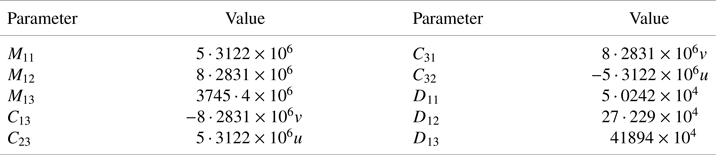
To verify the effectiveness of the designed controller, this paper adopts a 76$\,{\cdot }\,$ 2 m supply surface vessel (Fossen and Strand, Reference Fossen and Strand1999) as the object for path following control simulation experiments, and two sets of simulations are carried out. The positive definite inertia matrix, Coriolis centripetal matrix ${\mathbf {M}}$
 and damping matrix $\boldsymbol {C}(\boldsymbol \upsilon )$
 are in Table 1.
Model parameters of surface vessel simulation

The external environmental disturbance $\boldsymbol d$ and model uncertainties $\boldsymbol {\Delta _f}$
 are

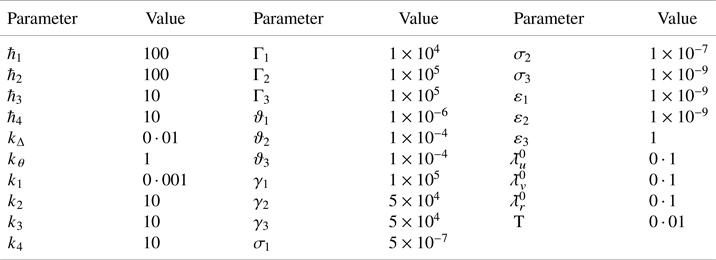
The neural network has 61 hidden nodes, and the ${c_{j,1}}$ and ${c_{j,2}}$
 are evenly distributed in the interval $[ { - 18,18} ]$
 , ${b_{1,j}} = {b_{2,j}} = 3$
 , ${b_{{\rm {3}},j}} = 1$
 , $j = 1, \ldots,61$
 and the initial value of the network weight estimation is $0$
 . The range of system input saturations is ${\tau _{r}} \in [ { - 2 \times {{10}^5},2 \times {{10}^5}} ]$
 (kN$\,\cdot\,$
 m), ${\tau _{u}} \in [ { - 2\,{\cdot }\,5 \times {{10}^3},2\,{\cdot }\,5 \times {{10}^3}} ]$
 (kN), ${\tau _{v}} \in [ { - 1\,{\cdot }\,5 \times {{10}^3},1\,{\cdot }\,5 \times {{10}^3}} ]$
 (kN). The other control parameters of the surface vessel simulation are in Table 2.
Control parameters of surface vessel simulation

In addition, we will give the following simulation comparison. The comparative guidance adopts the ECLOS (Zheng et al., Reference Zheng, Sun and Xie2018b). In this paper, we choose Equation (3.4) as the desired heading angle ${\psi _d}$ , and choose Equations (3.3) and (3.1) as the update law of $\theta$
 where ${k_{cs}} = 1500$
 , ${k_{ce}} = 800$
 . For better comparison, we use the same surface vessel model, model uncertainties and disturbances. The remaining parameters are the same.
5.1 Straight line path following
In this simulation, the desired straight line path is ${\eta _p} = {[ {{x_p},{y_p}} ]^{\rm T}} = {[ {\theta,\theta } ]^{\rm T}}$ , the desired velocities are $[ {u,v} ] = [ {10,0} ]$
 , and the initial position and velocity of the surface vessel are

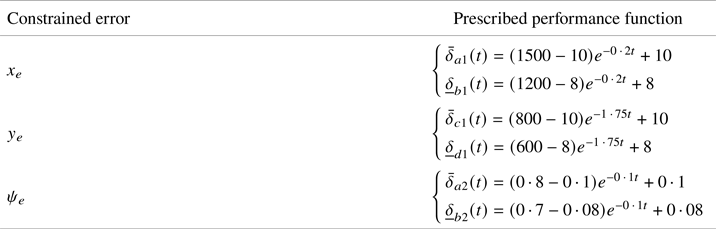
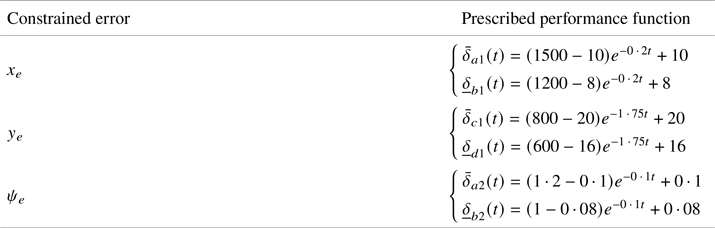
The prescribed performance functions used in straight line path following are in Table 3.
Prescribed performance functions of surface vessel simulation

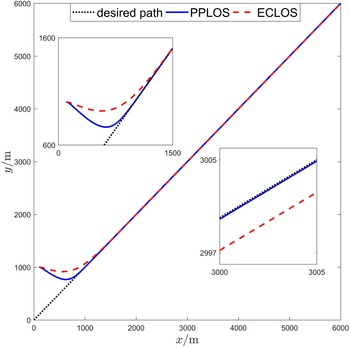
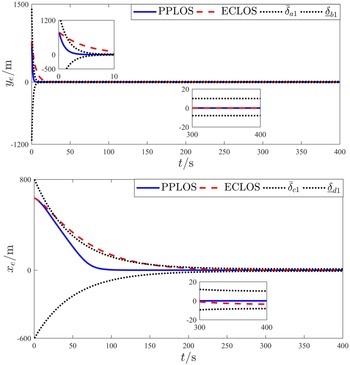
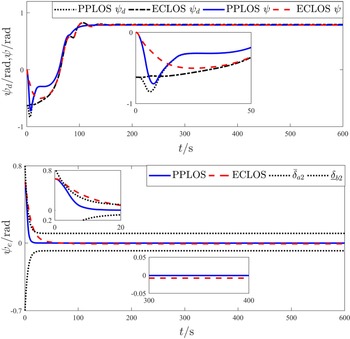
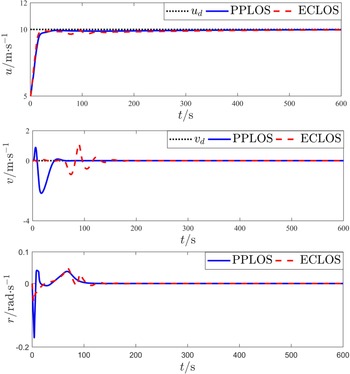
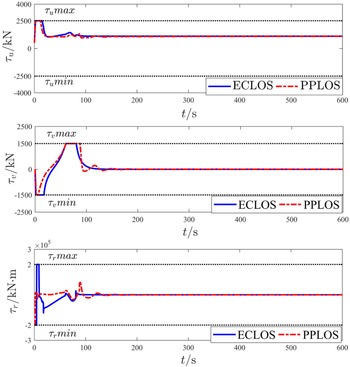
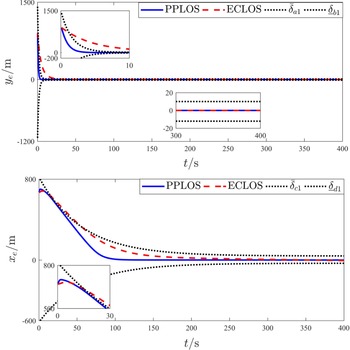
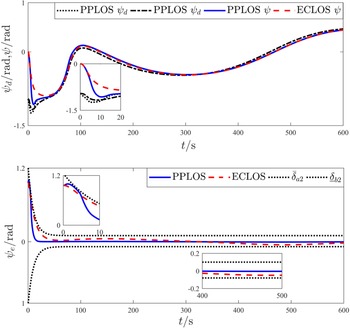
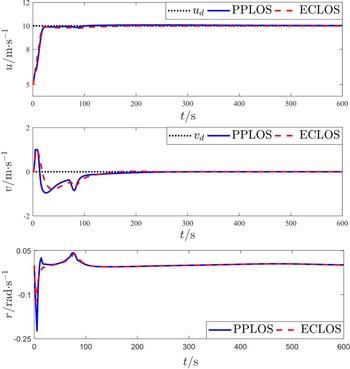
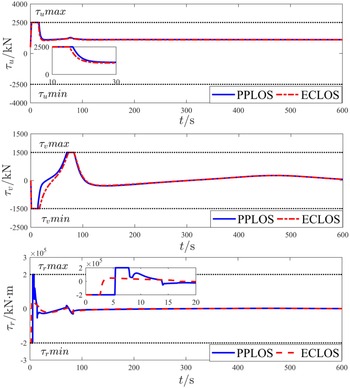
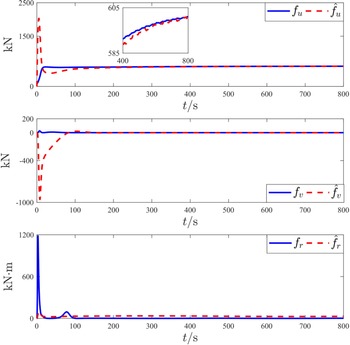
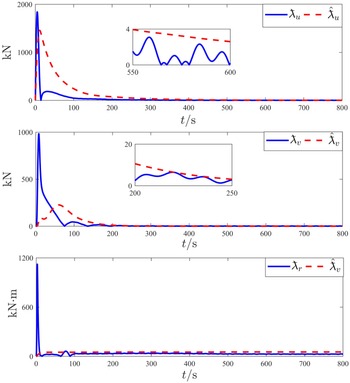
The straight line path following simulation results on the proposed PPLOS and comparison with the ECLOS (Zheng et al., Reference Zheng, Sun and Xie2018b) method are demonstrated in Figures 5–11. Figure 5 displays the straight line path following curves. It shows that, compared with ECLOS guidance using the traditional tan-type BLF, the prescribed performance path following controller of PPLOS guidance based on the PPAMBLF can make the surface vessel reach the desired path quicker and more accurately, and the steady-state error is reduced to a certain extent. Figure 6 shows the long-track error and the across-track error of straight line path following curves. It illustrates that compared with the ECLOS, the path tracking error of PPLOS completely converges within the prescribed performance requirements, which improves the transient performance and steady-state performance of the system. From Figure 7, we can see that the guidance desired heading angle calculated by PPLOS is slightly better, which can make the ship follow the desired path slightly sooner. Moreover, the heading angle error is also within the prescribed performance requirements, the convergence speed is greater and the steady-state error is a little smaller. Figure 8 shows the actual velocity of straight line path following. It can be seen that the surge, sway and yaw of the surface vessel can quickly track the desired velocity. The input signal of straight line path following is presented in Figure 9, which shows that the input signal is within the preset saturation range, so the system can remain stable. The neural network curves are shown in Figure 10, which shows that the model uncertainties can be estimated around 100 s of the straight line path following. Furthermore, Figure 11 shows the curves of the bounds of the compound disturbance and its estimation. It is obvious that the adaptive laws can approach the bound of compound disturbance.
Straight line path following

Position errors of straight line path following

Desired heading angle, heading angle and heading errors of straight line path following

Actual velocity of straight line path following

Input signal of straight line path following

Approximation curves of model uncertainties of straight line path following

Curves of the bounds of the compound disturbances and its estimation

5.2 Sin curve path following
The desired sin curve path is ${\eta _p} = {[ {{x_p},{y_p}} ]^{\rm T}} = {[ {10\theta, 500\sin (0\,{\cdot }\,01\theta )} ]^{\rm T}}$ , the desired velocities are $[ {u,v} ] = [ {10,0} ]$
 , the initial position and velocity of the surface vessel are

The prescribed performance functions used in sin curve path following are in Table 4.
Prescribed performance functions of surface vessel simulation

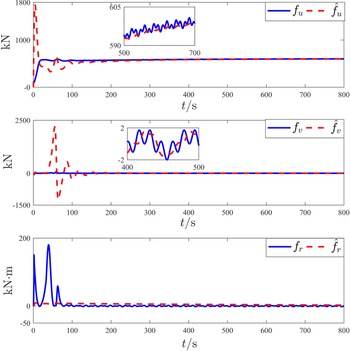
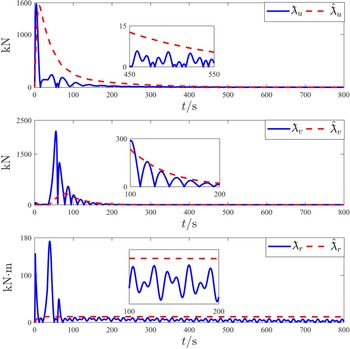
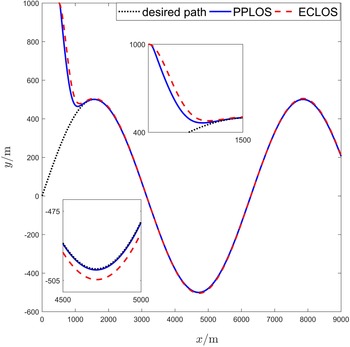
The sin curve path following simulation results on the proposed PPLOS and comparison with the ECLOS method are demonstrated in Figures 12–18. The sin curve path following curves are shown in Figure 12, from which we can see the method in this paper can ensure that the surface vessel reaches the desired path sooner, and the steady-state error is reduced to a certain extent. As shown in Figure 13, when tracking more complex sin curves, the long-track error and the across-track error can also completely converge within the prescribed performance requirements. Compared with ECLOS, PPLOS slightly improves the transient performance and steady-state performance. From Figure 14, we can see that the PPLOS guidance desired heading angle is better, which can make the ship follow the desired path sooner. In addition, the heading angle error is also within the prescribed performance requirements. It converges slightly faster and its steady-state error is slightly smaller. Furthermore, Figure 15 shows the actual velocity of sin curve path following. The surge, sway and yaw of surface vessel can quickly track the desired velocity. Figure 16 displays the input signal of sin curve path following, which shows that the input signal is within the preset saturation range, while the system can remain stable. Figure 17 shows the neural network curves, and the model uncertainties can be estimated around 100 s of the sin curve path following. As shown in Figure 18, the curves of the bounds of the compound disturbances and their estimation, we can see the adaptive laws can approach the bound of compound disturbance. Consequently, we can conclude that the PPLOS-based path following controller proposed in this paper can track the desired path quicker, and has smaller steady-state errors and better transient performance.
Sin curve path following

Position errors of sin curve path following

Desired heading angle, heading angle and heading errors of sin curve path following

Actual velocity of sin curve path following

Input signal of sin curve path following

Approximation curves of model uncertainties of sin curve path following

Curves of the bounds of the compound disturbances and its estimation

6. Conclusion
In this paper, aimed at the path following control problem of a fully actuated surface vessel, for the system to meet the prescribed performance requirements, we have further improved on the basis of ECLOS and proposed the PPLOS guidance. The guidance is based on the PPAMBLF, which can well converge the position error of path following within the prescribed performance requirements, and improve the steady-state performance and transient performance of the system. Furthermore, the PPAMBLF is also applied to the heading control of surface vessel path following, which can further constrain the heading angle error. We use the backstepping and dynamic surface technique to design the surface vessel path following controller. Furthermore, adaptive assistant systems are constructed to compensate the influence of input saturation on the system, which make the system stable with input saturation. Considering the model uncertainties and the external environment disturbances, the neural network is used to approximate the model uncertainties. At the same time, the neural network approximation errors and external disturbance are combined into compound disturbances, and the upper bound of the compound disturbances are approximated by the adaptive law. The proposed path following controller can guarantee that all signals are semi-globally uniformly ultimately bounded. Finally, the experimental results show the effectiveness of the proposed control in this paper which restricts the steady-state and transient performance of the system.
Acknowledgements
The authors are grateful to the editors and reviewers for their comments, which have improved the quality of this study. This work was supported in part by National Natural Science Foundation of China under Grant 51809028 and Grant 51879027, in part by the China Postdoctoral Science Foundation under Grant 2020M670733, in part by the Doctoral Start-up Foundation of Liaoning Province under Grant 2019-BS-022 and in part by the Fundamental Research Funds for the Central Universities under Grant 3132019318.
Competing interest
The authors declare that they have no personal competition or interest relationship that could have influence the work reported in this paper.
Authors contribution
Z.S. – Conceptualisation and supervision; A.L. – Writing-original draft, Writing-review and editing; L.L. – Resources; H.Y. – Funding acquisition, Writing-review and editing.