Introduction
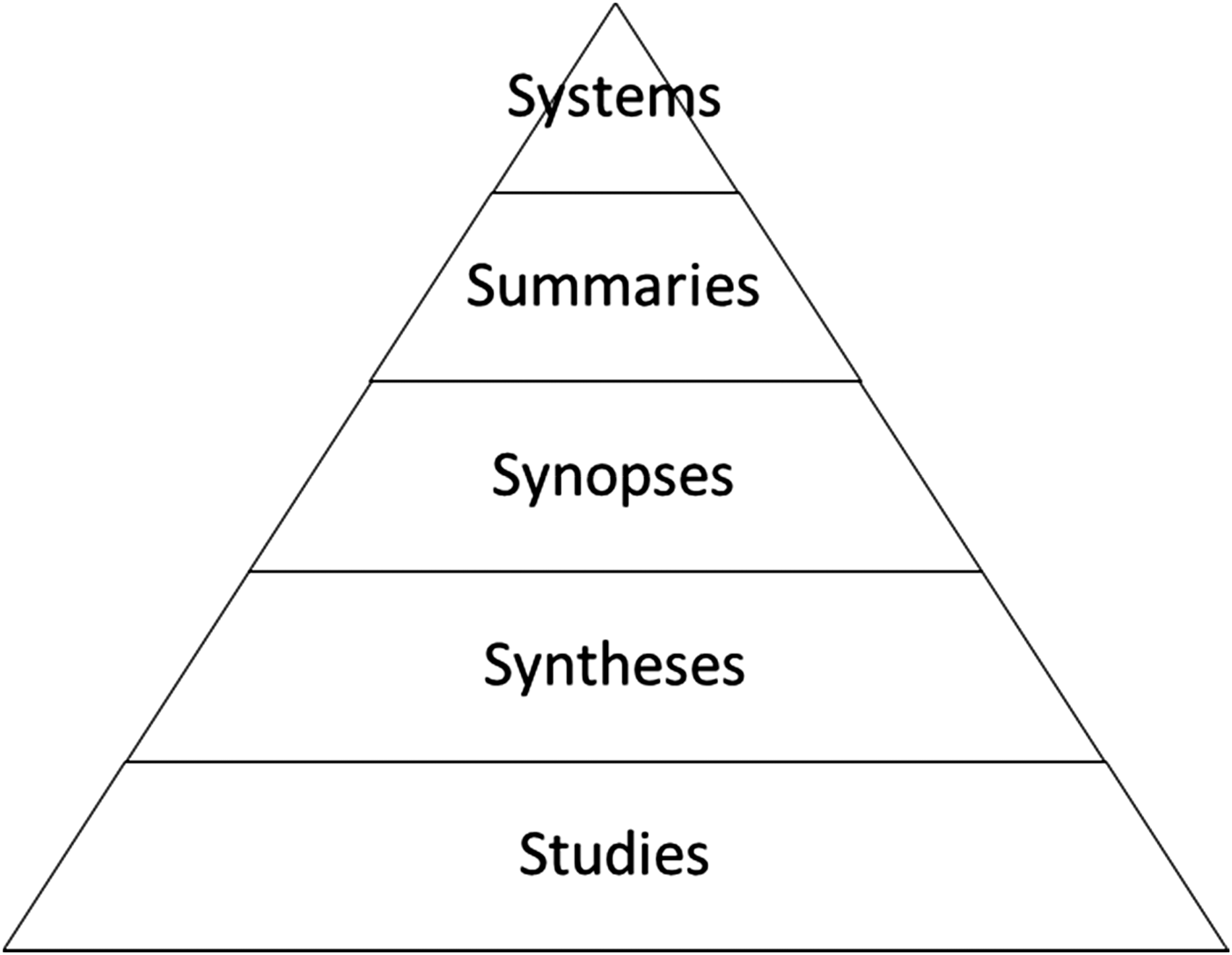
Clinicians are increasingly required to practice evidence-based medicine, but the accumulation of published literature can complicate access to evidence. Over the past decade, many high quality resources have compiled and integrated important research from primary studies to provide pre-appraised evidence at different levels for clinicians.Reference Haynes1–Reference Greenhalgh3 Therefore, a 5S model has been proposed to help clinicians navigate the pre-appraised evidence (Figure 1).Reference Haynes1
5S levels of evidence organisation

Evidence-based medicine should be guided by pre-appraised evidence at the highest available level in the 5S model.Reference Haynes1, Reference Haynes2 With progression to the higher levels of the pyramidal 5S model, evidence becomes increasingly compiled and integrated. System level evidence represents the highest available level of pre-appraised evidence. Systems and summaries integrate the best available evidence from the lower tiers to provide comprehensive management options for a given clinical condition. The lower levels (synopses, syntheses and studies) usually examine a single aspect of management, leaving clinicians to perform their own integration and, in the case of studies, their own critical appraisal of the evidence. Studies in the lowest 5S level provide a foundation of original high quality randomised controlled trial (RCT) data which are compiled and integrated to generate higher levels of pre-appraised evidence within the 5S model (Figure 1). Without a scientific basis of RCTs, it is impossible to deliver evidence-based medicine.Reference Haynes1, Reference Haynes2
The primary objective was to identify sources of available evidence on the management of otitis media at each level of the 5S model. The secondary objective was to review the highest available level of pre-appraised evidence on the management of all subsets of otitis media: acute otitis media and recurrent acute otitis media in children and adolescents; chronic otitis media with effusion in children; chronic suppurative otitis media (CSOM) in children; CSOM in adults; cholesteatoma in children; and cholesteatoma in adults.
Materials and methods
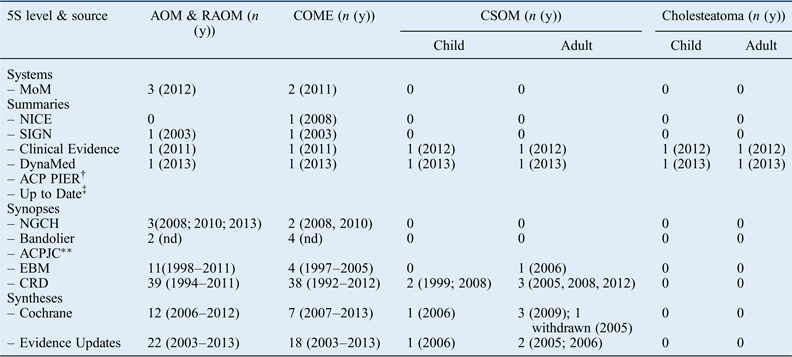
Sources of evidence for each level in the 5S model were identified (Table I),Reference Haynes1–Reference Greenhalgh3 and individually searched for evidence on different otitis media subsets (Table II). Only sources freely available or accessible via Athens, Shibboleth or a free trial were considered in this review. The 5S model principle was rigorously applied to summarise the sources of evidence available at the highest 5S level and thus determine best practice for the management of otitis media. Pre-appraised evidence contained within systems, summaries, synopses and syntheses data sources were identified for this review. Individual studies were not considered in isolation because the scope of otitis media is huge and higher 5S level sources of evidence were available for the management of each otitis media subset (Table II).
Sources evidence

MoM = Map of Medicine; NICE = National Institute for Health and Care Excellence; SIGN = Scottish Intercollegiate Guidelines Network; ACP PIER = American College of Physicians, Physicians’ Information and Education Resource; NGCH = National Guideline Clearing House; ACPJC = American College of Physicians Journal Club; EBM = Evidence Based Medicine; CRD = Centre for Reviews and Dissemination; DARE = Database of Abstracts of Reviews of Effects; NHSEED = National Health Service Economic Evaluation Database; INAHTA = International Network of Agencies for Health Technology Assessment
Publications available for different subsets of otitis media within each evidence source*

* All online resources accessed 17 August 2013, except for ACP PIER, Up To Date and ACPJC. †Available only to ACP members, subscribers or customers; ‡Available only to subscribers; **Available only to ACP members, subscribers or customers. AOM = acute otitis media; RAOM = recurrent acute otitis media; COME = chronic otitis media with effusion; CSOM = chronic suppurative otitis media; y = year; MoM = Map of Medicine; NICE = National Institute for Health and Care Excellence; SIGN = Scottish Intercollegiate Guidelines Network; ACP PIER = American College of Physicians, Physicians' Information and Education Resource; NGCH = National Guideline Clearing House; nd = no publication date cited in online resource; ACPJC = American College of Physicians Journal Club; EBM = Evidence Based Medicine; CRD = Centre for Reviews and Dissemination; DARE = Database of Abstracts of Reviews of Effects; NHSEED = NHS Economic Evaluation Database; INAHTA = International Network of Agencies for Health Technology Assessment
Results
Pre-appraised evidence at the highest available level of the 5S model for the management of each subset of otitis media is summarised in this section.
Acute otitis media in children and adolescents
System level evidence for this condition was obtained from the Map of Medicine online resource.4
Definition
Acute otitis media is defined as an infection of the middle ear, characterised by the presence of middle-ear effusion and associated with acute symptoms and signs of middle-ear inflammation.5, 6
Management
Initial acute otitis media management is to treat pain and fever with paracetamol or ibuprofen if not contraindicated.5 Topical oils should not be prescribed.6 There are three antibiotic strategies: no prescribing, delayed prescribing and immediate prescribing.5, 7, Reference Gunasekera, Morris, McIntyre and Craig8 A no antibiotic or delayed antibiotic prescribing strategy is advised for most individuals because resolution occurs in 60 per cent of acute otitis media cases within 24 hours without antibiotics.5, 9
No antibiotics
Children with acute otitis media should be provided with symptomatic relief for 48–72 hours, with a scheduled review.6
Delayed antibiotics
A 48- to 72-hour delay in prescribing antibiotics should be considered for children aged 2 years or younger with bilateral acute otitis media or bulging membrane, or for children of any age with otorrhoea.9, 10 Antibiotics should be commenced if symptoms do not reduce within four days with no antibiotics or if symptoms significantly worsen at any time with either no antibiotics or delayed antibiotics.5, 7
Immediate antibiotics
Antibiotics should be prescribed immediately for children who are systemically unwell, children suspected of having a serious illness and/or complications or at risk of serious complications, and children who are significantly unwell after 48–72 hours.5, 7, 11 Depending on the severity of illness, immediate antibiotics should be considered for children with bilateral acute otitis media, those younger than two years of age, those with perforation and/or discharge in the ear canal associated with acute otitis media, and those with otorrhoea who have acute otitis media.5, 7
First-line antibiotics
Amoxicillin is the first-line antibiotic unless contraindicated.5, Reference Gunasekera, Morris, McIntyre and Craig8–10, 12 Alternative first-line antibiotics are erythromycin or clarithromycin.5 Decongestants or antihistamines are not indicated.6
Length of antibiotic treatment
A five-day antibiotic treatment is recommended for children aged two years and above with uncomplicated acute otitis media.5, 11, 13 A 10-day antibiotic treatment is recommended for children less than 2 years of age, and for those presenting with tympanic membrane perforation.11, Reference Hoberman, Paradise, Rockette, Shaikh, Wald and Kearney14 Patients should be reviewed after 48–72 hours, particularly if there is no symptomatic improvement.10, 11
Second-line antibiotics
A swab should be considered and second-line antibiotics prescribed in cases of persistent treatment failure, if moderately severe symptoms worsen three to five days after antibiotic treatment, or if there is continued pressure and inflammation behind the tympanic membrane.11 Co-amoxiclav is the second-line antibiotic of choice if not contraindicated.11, 12 Alternatively, azithromycin, or intramuscular ceftriaxone should be prescribed.12
Follow up
A follow-up period of four to eight weeks is recommended for patients with uncomplicated acute otitis media to respond to treatment.12
Recurrent acute otitis media in children
Summary level evidence for this condition was obtained from the clinical evidence journal.Reference Damoiseaux and Rovers15
Definition
Recurrent acute otitis media is defined as 3 or more episodes of acute otitis media in 6 months, or 4 or more episodes in 12 months.5
Management
Antibiotic prophylaxis
Prophylactic antibiotics are more effective for reducing the incidence of acute otitis media in children at risk of otitis media compared with placebo or no treatment.Reference Leach and Morris16 However, there is insufficient evidence about which antibiotic to use and for how long, and how many episodes of acute otitis media justify treatment.
Pneumococcal vaccine
Pneumococcal conjugate vaccine (7–11 valent) may be more effective than placebo or control vaccine for reducing the incidence of acute otitis media when administered during infancy, but may be no more effective when given to children aged 1–7 years with recurrent acute otitis media.Reference Jansen, Hak, Veenhoven, Damoiseaux, Schilder and Sanders17
Tympanostomy
Compared with no surgery or myringotomy alone, tympanostomy (or ventilation tubes) may be more effective for reducing recurrent acute otitis media after 6 months but not after 18 months, and may increase the risk of tympanosclerosis.Reference McDonald, Langton and Nunez18, Reference Le, Freeman and Fireman19 There is limited evidence for only a short-term benefit from tympanostomy.
Influenza vaccine
Influenza vaccine seems no more effective than placebo for preventing acute otitis media in children aged six months to seven years.Reference Jefferson, Rivetti, Harnden, Di Pietrantonj and Demicheli20
Xylitol syrup or gum
When given five times (but not three times) daily, xylitol may be more effective for reducing recurrent acute otitis media in children aged up to seven years, compared with placebo. Xylitol may be no more effective for reducing recurrent acute otitis media when given only during an acute respiratory tract infection. Issues related to compliance with five times daily dosing render xylitol treatment unrealistic.Reference Uhari, Kontiokari, Koskela and Niemelä21–Reference Hautalahti, Renko, Tapiainen, Kontiokari, Pokka and Uhari24
Chronic otitis media with effusion in children
System level evidence for this condition was obtained from the Map of Medicine online resource.25
Definition
Chronic otitis media with effusion (OME) is characterised by an accumulation of fluid within the middle-ear space, without signs of acute inflammation.26
Management
Management of children with Down's syndrome and chronic otitis media with effusion
Hearing aids should normally be offered. Careful consideration must be given before offering ventilation tubes as an alternative.26
Management of children with cleft palate and chronic otitis media with effusion
Insertion of ventilation tubes at primary closure of the cleft palate should be performed only after a careful otological and audiological assessment. For children with a cleft palate who have chronic OME and persistent hearing loss, ventilation tube insertion should be offered as an alternative to hearing aids.26
Management of persistent chronic otitis media with effusion
A three-month period of active observation is advised before considering surgical intervention for chronic OME.26, 27
Non-surgical intervention for chronic otitis media with effusion
Autoinflation may be considered for treating children with chronic OME whilst awaiting resolution.6, 26, 28 Hearing aids should be offered to children with persistent bilateral chronic OME and hearing loss when surgery is contraindicated or not acceptable.26
Surgical intervention for chronic otitis media with effusion
Children with persistent bilateral chronic OME and with documented hearing over three months in the better ear 25–30 dB HL or worse averaged at 0.5, 1, 2 and 4 kHz should be considered for surgical intervention. Children with persistent bilateral chronic OME with hearing loss less than 25–30 dB HL which impacts on their developmental, social or educational status should also be considered. Insertion of ventilation tubes is recommended.26
Following ventilation tube extrusion or removal, up to 50 per cent of children will suffer further chronic OME requiring additional surgery. Adjuvant adenoidectomy is a second-line treatment option for children with recurrent chronic OME because it reduces the need for further surgery by 50 per cent.28
Grommet extrusion time is estimated to be 39 weeks; therefore, patients should be reviewed 6 weeks post-operatively and at 6 monthly intervals thereafter.26
Chronic suppurative otitis media
Summary level evidence for this condition was provided by the Clinical Evidence journal and the DynaMed online database.Reference Morris29, 30
Definition
Chronic suppurative otitis media (CSOM) is defined as persistent inflammation of the middle ear or mastoid cavity, characterised by recurrent or persistent otorrhoea over two to six weeks through a tympanic membrane perforation.Reference Morris29
Management of chronic suppurative otitis media in adults
Topical antibiotics plus topical corticosteroids
Topical antibiotics plus topical corticosteroids (gentamicin plus hydrocortisone) may be more effective than placebo for reducing persistent otorrhoea in adults with CSOM.Reference Browning, Gatehouse and Calder31, Reference Picozzi, Browning and Calder32 Unlike topical corticosteroids alone, topical antibiotics plus topical corticosteroids (gentamicin plus hydrocortisone) may be more effective than the topical corticosteroid betamethasone for reducing disease activity after three weeks.Reference Crowther and Simpson33 It is unknown whether topical antibiotics plus topical corticosteroids are more effective than topical antibiotics alone in adults with CSOM.Reference Kaygusuz, Karlidağ, Gök, Yalçin, Keleş and Demirbağ34, Reference Miro35 Topical antibiotics combined with topical corticosteroids may improve symptoms more than placebo or either treatment alone in adults, although few adequate studies have been reported. There is a lack of good evidence to confidently support the benefit of topical antibiotics plus topical corticosteroids.
Systemic antibiotics
Systemic antibiotics seem less effective than topical antibiotics for reducing persistent otorrhoea after one to two weeks in adults.Reference Macfadyen, Acuin and Gamble36–Reference Yuen, Lau, Chau, Hui, Wong and Wong41 Oral antibiotics and topical antiseptics seem equally more effective than topical antiseptics alone for reducing persistent discharge after two to four weeks in adults.Reference Browning, Picozzi, Calder and Sweeney37 It is unclear which systemic antibiotic is more effective for reducing persistent otorrhoea.Reference Legent, Bordure, Beauvillain and Berche42, Reference Cannoni, Bonfils, Sednaoui, Sevenier, Joubert-Collin and Nisse43 Pre-operative intravenous ceftazidime may be more effective than no antibiotic for reducing otorrhoea in adults two months after mastoidectomy or tympanoplasty.Reference Lildholdt, Felding, Juul, Kristensen and Schouenborg44 It is unknown whether systemic antibiotics are beneficial in reducing symptoms.
Topical plus systemic antibiotics
It is unknown whether a two-week treatment of systemic antibiotics plus topical antibiotics are more effective than topical antibiotics alone for reducing otorrhoea.Reference Esposito, D'Errico and Montanaro38, Reference Picozzi, Browning and Calder45, Reference Supiyaphun, Kerekhanjanarong, Koranasophonepun and Sastarasadhit46 It is unknown whether topical antibiotics plus systemic antibiotics is more effective than systemic antibiotics alone for increasing discharge resolution in adults.Reference Esposito, D'Errico and Montanaro38, Reference Mira and Benazzo47 There is no direct information from randomised controlled trials (RCTs) assessing whether topical plus systemic antibiotics are better than no active treatment in adults with CSOM. Antibiotics against Gram-negative bacteria may reduce otorrhoea more effectively than other classes of antibiotics or placebo. When antibiotics of the same class were compared,Reference Esposito, D'Errico and Montanaro38 the addition of systemic antibiotics to topical antibiotics did not seem to produce an added benefit. In contrast, a topical quinolone antibiotic was more effective than topical plus oral non-quinolones,Reference Mira and Benazzo47 suggesting that drugs against Gram-negative bacteria (in particular, Pseudomonas aeruginosa) may be especially effective for reducing otorrhoea.
Topical antibiotics
Topical ciprofloxacin may be more effective than placebo for reducing persistent otorrhoea after seven days in adults with CSOM.Reference Esposito, D'Errico and Montanaro38 Topical quinolones and topical non-quinolones seem equally effective after one and three weeks for reducing otorrhoea in adults with CSOM.Reference Macfadyen, Acuin and Gamble48 It is unknown whether topical antibiotics are more effective than topical antiseptics for reducing otorrhoea after two to four weeks in adults with CSOM.Reference Macfadyen, Acuin and Gamble48 Treatment with topical antibiotics seems no more effective than no treatment for closing tympanic membrane perforations in adults who have undergone tympanoplasty.Reference Tong, Yue, Ku and van Hasselt49 Topical antibiotics may lead to greater symptom improvement in adults compared with placebo or no treatment, although few adequate studies have been reported. The consensus recommendation is that topical antibiotics should be combined with ear cleansing to be effective.
Topical antiseptics
It is unknown whether topical antiseptics are beneficial for reducing symptoms. No systematic review or RCT has compared topical antiseptics with placebo in adults with CSOM.
Ear cleansing
No systematic review, RCT or observational study of sufficient quality has compared ear cleansing with no treatment in adults with CSOM. However, ear cleansing is important in the management of persistent otorrhoea.
Tympanoplasty with or without mastoidectomy
It is unknown whether tympanoplasty plus mastoidectomy is more effective than tympanoplasty alone for improving discharge resolution in adults three months after surgery.Reference Bhat, Naseeruddin, Nagalotimath, Kumar and Hegde50
Management of chronic suppurative otitis media in children
Systemic antibiotics
Systemic antibiotics seem more effective than placebo or no treatment for reducing persistent otorrhoea after six months in children with CSOM.Reference Fliss, Dagan, Houri and Leiberman51 It is unknown which systemic antibiotic is more effective for reducing otorrhoea.Reference Fliss, Dagan, Houri and Leiberman51, Reference Somekh and Cordova52 It is unknown whether systemic antibiotics are more effective than placebo or other treatments for improving symptoms. There is no clear evidence from RCTs that different systemic antibiotics have different efficacies. Studies in children reported similar results to those in adults.
Topical antibiotics
It is unknown which topical antibiotic is most effective for improving discharge resolution after two weeks in children with CSOM.Reference Macfadyen, Acuin and Gamble48, Reference Van Hasselt53 Topical antibiotics alone seem as effective as topical antibiotics plus topical corticosteroids for reducing persistent otorrhoea after 6–28 weeks and for improving hearing thresholds after four to seven months.Reference Leach, Wood, Gadil, Stubbs and Morris54 It is unknown whether topical antibiotics are better than placebo or other treatments for improving symptoms in children with CSOM. Topical antibiotics have a greater effect on otorrhoea resolution compared with topical antiseptics.
Topical antibiotics plus corticosteroids
It is unknown whether topical corticosteroids combined with antibiotics are more effective than placebo or other treatments for improving symptoms in children with CSOM. No RCTs have compared topical antibiotics plus topical corticosteroids with placebo in children.
Topical antiseptics
It is unknown whether topical antiseptics are more effective than placebo or no treatment for reducing otorrhoea after two to six weeks in children with CSOM.Reference Thorp, Gardiner and Prescott55, Reference Eason, Harding, Nicholson, Nicholson, Pada and Gathercole56 Topical antiseptics seem less effective than topical antibiotics for reducing persistent discharge after one to four weeks.Reference Macfadyen, Acuin and Gamble48, Reference Van Hasselt53, Reference Macfadyen, Gamble, Garner, Macharia, Mackenzie and Mugwe57 It is unknown whether topical antiseptics are more effective than placebo or other treatments for improving symptoms in children with CSOM. Topical antibiotics (particularly quinolones) are better than topical antiseptics for improving otorrhoea resolution.
Topical corticosteroids
It is unknown whether topical corticosteroids alone are better than placebo or other treatments for improving symptoms in children with CSOM.
Ear cleansing
It is unknown whether ear cleansing is more effective than no treatment for drying or healing perforations after 6–16 weeks in children with CSOM.Reference Eason, Harding, Nicholson, Nicholson, Pada and Gathercole56, Reference Smith, Hatcher, Mackenzie, Thompson, Bal and Macharia58 In fact, the benefits of ear cleansing in children with CSOM are unknown, although this treatment is usually recommended.
Tympanoplasty with or without mastoidectomy
There are currently no clinically relevant results from RCTs about the benefits of tympanoplasty with or without mastoidectomy compared with no surgery in children with CSOM without cholesteatoma. Thus, the clinical efficacy of this treatment is currently unknown.
Surgical management of cholesteatoma
Definition
Cholesteatoma is defined as an abnormal accumulation of squamous epithelium in the middle-ear cavity and mastoid process of the temporal bone. The condition can be either congenital or acquired.Reference Morris29
Surgical management of cholesteatoma in adults and children
Currently, no RCTs or systematic reviews have investigated the efficacy of surgical intervention for cholesteatoma in either adults or children. Therefore, it is unknown whether surgery or, indeed, which surgical techniques can improve symptoms in adults or children with this condition.Reference Esposito, D'Errico and Mantanaro39, 59
Discussion
System level is the highest level of pre-appraised evidence; it is defined as an evidence-based clinical information system which electronically links a patient's clinical presentation to the most relevant summarised and integrated research.Reference Haynes1 No system yet has this level of sophistication, but the Map of Medicine comes closest. System level evidence was only available for acute otitis media and otitis media with effusion in the Map of Medicine.4, 25 Summary level evidence was the highest level available for the management of recurrent acute otitis media and for the medical management of CSOM in children and adults. Two summary level sources are readily available without payment subscription: the Clinical Evidence journal and the DynaMed online database.Reference Morris29, 30 There is a paucity of evidence to support the surgical management of CSOM and cholesteatoma in both adults and children. This review identified only one randomised controlled trial (RCT) comparing tympanoplasty plus mastoidectomy with tympanoplasty alone for CSOM in adults, but this provided inconclusive evidence.Reference Bhat, Naseeruddin, Nagalotimath, Kumar and Hegde50 Furthermore, no RCTs which have aimed to investigate the potential benefit of surgical intervention for either CSOM in children, or cholesteatoma in both adults and children could be identified. Therefore, it is currently unknown which surgical techniques or whether surgery at all can improve symptoms in adults or children with either CSOM or cholesteatoma. The currently available information is based on observational studies alone.Reference Morris29, 30, 59
Similarly, a recent systematic review of the management of tympanic membrane retraction pockets identified no high level evidence to support any surgical intervention over watchful waiting.Reference Neumann and Yung60 The authors speculated that this lack of evidence was due to variations in surgical management that cannot be standardised, including inter- and intra-observation error of disease stage among surgeons, differing anatomy among patients, and varying skill sets and experience among surgeons. The authors subsequently published a consensus document on the management of retraction pockets formulated using the Delphi technique.Reference Neumann and Yung61
It is likely that heterogeneity in surgical management combined with ethical barriers to research account for the lack of evidence to support surgical intervention for CSOM and cholesteatoma in both adults and children. Until high quality evidence is generated, we suggest that further consensus documents should be generated using robust techniques to guide the best surgical practice for those treating chronic otological diseases.
The 5S model provides a useful hierarchy to help clinicians navigate the various pre-appraised evidence resources and deliver evidence-based medicine.Reference Haynes1, Reference Haynes2 However, this is not yet a perfect system. Evidence progression through the pre-appraised 5S hierarchical levels requires the progressive compilation and integration of original studies. Generation of pre-appraised evidence at the higher 5S levels depends on the publication of lower level evidence. Therefore, by the time system level pre-appraised evidence is generated or updated, some references may be outdated. For example, Map of Medicine guidelines on acute otitis media management4 cite the American Academy of Pediatrics guidelines on acute otitis media management published in 2004,10 which were revised in 2013.Reference Lieberthal, Carroll, Chonmaitree, Ganiats, Hoberman and Jackson62 Map of Medicine will not capture this update until the planned revision of acute otitis media management guidelines in 2015.4 Providers of pre-appraised evidence must therefore deliver expeditious guideline updates so that they remain clinically meaningful, and clinicians must be receptive to recent publications at lower levels of the 5S model when delivering evidence-based medicine, particularly when higher level pre-appraised evidence is not current.