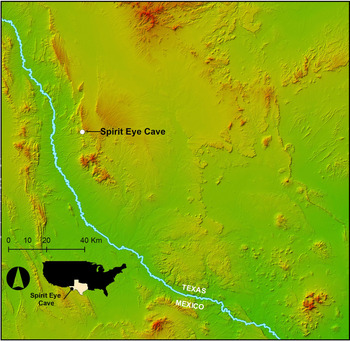


It took months of unanswered calls, hours of driving, several visits, circuitous conversations, multiple missed connections, and a follow-up detailed letter explaining the reason for the persistence. The result of these efforts was the hesitant admission on the other end of the phone that they still held Native American ancestral human remains that were stored in the attic. We set a date when I could visit. When I arrived, after some small talk, the woman led me to a large wall and removed one of the dozens of sepia-toned portraits. After putting a key in a hidden lock, the wall swung open. Behind it, surrounded by dozens of perishable artifacts, corncobs, and fake pictographs in a replica cave built under the staircase were the Native American ancestral remains for which I had been searching. They had been disinterred from an occupied cave system in a remote region of Far West Texas near the US-Mexico border, where the private possession of Indigenous ancestral human remains is common (Figure 1).
Location of Spirit Eye Cave in the Big Bend Region of West Texas (map by Bryon Schroeder).

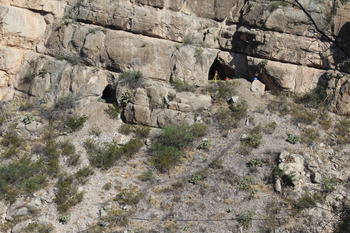
The site, now known as Spirit Eye Cave in Presidio County (41PS25), was occupied from at least the mid-Holocene through the historic ranching period (Schroeder Reference Schroeder2017). This name comes from the resemblance of the cave's dual triangular openings to the Eye of Providence (a defining characteristic of the site for many visitors; Figure 2). The cave, held in private hands for well over a century, was a pay-to-dig site for at least two decades (the 1950s–1960s) and was extensively excavated by former landowners and their friends during other periods. This past has left an undeniable mark, best described as systematic mining of the cultural materials and Indigenous human remains from the site. Confronting this history has led to interaction with a diverse assemblage of stakeholders, seen here as “individuals or groups of individuals who, whatever their location, have a specific interest in the way cultural heritage is managed” (Fernandes and Pinto Reference Fernandes, Maia Pinto, Agnew and Bridgland2006:137). Some are responsible and responsive stewards (RRSs); others could not be further from it (Pitblado et al. Reference Pitblado, Shott, Brosowske, Butler, Cox, Espenshade and Neller2018:16).
Overview of Spirit Eye Cave showing the dual triangular openings (photo by Bryon Schroeder).

Spirit Eye Cave is a case study that spans the spectrum of collectors ranging from recreational hobbyists to for-profit traffickers (Goebel Reference Goebel2015; Hollowell-Zimmer Reference Hollowell-Zimmer, Zimmerman, Vitelli and Hollowell-Zimmer2003; LaBelle Reference LaBelle, Zimmerman, Vitelli and Hollowell-Zimmer2003; Pitblado Reference Pitblado2014a, Reference Pitblado2014b; Watkins Reference Watkins, Zimmerman, Vitelli and Hollowell-Zimmer2003, Reference Watkins2015). As I discovered, the trafficking end of this heuristic scale is fraught with complex and uncomfortable ethical difficulties that are situational, and engagement must consider what was trafficked and what is retrievable. I did not anticipate the events that brought me to engaging with collectors who possess the remains of Indigenous ancestors or the challenges associated with ensuring the long-term care of artifact collections in private hands. As an archaeologist, I went to the site knowing that to the south of it, in northern Coahuila, Mexico, caves in Cuatro Cienegas produced an artifact collection with a 20:1 perishable to stone-tool ratio (Jolie Reference Jolie, Sutton and Arkush2014; Taylor et al. Reference Taylor, Demerath, Kennedy, Watson, Quilter, Brownman and Adovasio2003:49–53). My attraction was the chance to study the perishable and directly datable portion of the archaeological record not encountered in open sites (cf. Ives et al. Reference Ives, Froese, Janetski, Brock and Ramsey2014). The high frequency of artifacts and deep middens at both entrances attest to the significance of the site. However, since the interior deposits had been mined for artifacts, it was understandable why multiple professionals had avoided the cave.
Because this significant site was far from pristine, my original goal was to (1) conduct a limited excavation to determine if anything of archaeological value was left in the cave; (2) if possible, understand the historical sequence of past excavations and follow up by interviewing involved collectors; and (3) possibly relate this sequence of events to larger sociocultural patterns (Schroeder Reference Schroeder2017). The hope was to develop methods to approach other impacted rockshelters, because collectors affected many of these sites across West Texas. This large region has a high prevalence of sheltered sites with good preservation, most of which are now on private land in unpopulated areas. This has created a situation in which pristine rockshelters are almost nonexistent (Mallouf Reference Mallouf1996). For years, collectors have excavated hundreds of shelters to bedrock on the same 60,000-acre ranch where Spirit Eye Cave is located, and this scenario is repeated across West Texas. Although not ideal for conducting traditional field methods, the region offers a perfect laboratory for diachronic studies of both the social and economic variables that led to the destruction of these key sites—an important step forward in collector-based research.
With the permission of the current private landowner, my investigation began with fieldwork at Spirit Eye Cave in 2017, and I found very little undisturbed after decades of collecting. This excavation confirmed that artifact-rich sediments remained in the cave, but they were from collectors screening and discarding material inside the main chamber rather than in situ deposits. As new excavation began in 2017 (in most circumstances, it is not necessary to submit research designs to any agency in Texas to excavate on private land), I knew that collectors had removed Indigenous ancestral human remains from the site, but I was only beginning to understand the true scope of this history. I also knew that the discovery of Indigenous burials in similar sheltered site contexts is higher when intact sediments are present, but I was unsure how much of the site was preserved, given the evident impact to Spirit Eye Cave from the years of amateur digging. So in prefieldwork conversations with the Texas Historical Commission (THC) and State Historic Preservation Office, it was agreed that excavation would cease if articulated human remains were discovered. The remains would be left undisturbed, and the provisions of the Texas and Health and Safety Code followed. No additional human remains were found as a part of the renewed excavation efforts.
Concomitant with fieldwork, background research began into who requested the site Smithsonian trinomial (henceforth, trinomial). The assigned number is early and in an area where very little professional work had been done; this was the most straightforward place to delve into the history. The request came from the El Paso Archaeological Society (EPAS), and associated notes that current EPAS volunteers gave me referred to it as a cave associated with the surnames of two individuals. I have not used these names here because one of the two individuals sold human remains on the black market. After multiple conversations with current EPAS members about their early work at the cave, several leads for potential people to contact emerged. Follow-up conversations with these individuals produced a detailed photographic and letter exchange record detailing a four-year window of excavation from 1964 to 1968 by a group of pay-to-dig collectors. Their collecting at the cave stopped in 1968 when they found and exhumed a flexed Indigenous burial.
The 1968 exhumation of Native American ancestral remains at Spirit Eye Cave was a separate event from the one (which had been removed by a group referred to here as Al's Group—a pseudonym—in the early 1960s) I relocated under the staircase of a private residence/museum. Additional sleuthing found another party, the Perry family (also a pseudonym), which had removed human burials in the early 1950s. Altogether, three different parties removed four Indigenous ancestors from the cave (although only three sets of Indigenous remains could be confirmed), all with landowner permission. My attempt to find the Indigenous ancestral remains taken from Spirit Eye Cave put me in regular contact with the THC about legal recourse for recovering them. After numerous conversations with the THC, we determined no legal avenue to recover these remains out of private holdings. Some provisions of the Texas Penal Code were suggested, but we could find no precedent for extending them to archaeological disinterments. Texas Health and Safety Code 711 does outline the documentation and protection of newly discovered unverified and abandoned cemeteries (a single intact interment is designated a cemetery). This code, however, does not retroactively extend to burials removed from the cave in the 1950s/1960s that are now in private possession. Under the abandoned cemetery provisions in the Texas Health and Safety Code, landowners must report cemeteries, and they retain possession of them. Texas does not have a state law that requires Native American consultation but does encourage it under the provisions laid out in the Health and Safety Code (Chapters 711–714) if a new burial is discovered on private land. The letters and conversations that detail this history of exhumation spanning the 1950s through the late 1960s are jarring. It was apparent from the voluminous written correspondence that these different cave patrons had collected these human remains. It was, however, unclear what had happened to these Indigenous ancestors after they were collected.
Spirit Eye Cave is a significant case that illustrates how difficult it can be to establish the best practices for collectors and archaeologists to work together because it falls into an ethical and a legal gray area—private lands researched with private funds and minimal-to-no state laws protecting cultural heritage sites. The collectors, too, represent a spectrum. At one end are individuals interested in the past who were offered a legal opportunity to dig. Some of these individuals tried to engage the professional community but were unsuccessful. At the other end of this spectrum are individuals who sought to profit from the artifacts and Indigenous ancestral remains they collected. All groups on this spectrum removed Indigenous ancestors, and this was the impetus for engaging with individuals across the spectrum. As I would learn, the reality is that the private possession of Indigenous ancestral human remains is common in Texas (undoubtedly a situation that extends to other states with large tracts of private land), and cases dealing with this issue are sensitive but of great importance. At Spirit Eye Cave, the ethics of finding and relocating the Indigenous ancestors took precedence over all other archaeological matters. The subsequent history of excavation, trafficking, and possession this investigation unraveled presents a case for establishing practices for other archaeologists faced with heavily impacted archaeological sites.
BACKGROUND AND HISTORY
Amateur collectors targeted sites like Spirit Eye Cave because past peoples persistently occupied them and left a remarkable material record. Unfortunately, the most important sites for researching the human past can also be those most heavily impacted by years of illicit collecting. At Spirit Eye Cave, I began reconstructing the historical events that led to the site's present condition first through institutional archives and then through conversations with all stakeholders. I considered an understanding of the history of collecting at the cave as a necessary first step to recovering artifacts and re-creating the site's occupational history.
Researching the request for the trinomial at Spirit Eye Cave led to the discovery of a lengthy correspondence that helped unravel a significant period of collecting and the names of those involved. The only remaining living person involved with the trinomial request—an amateur archaeologist of long standing in Texas archaeology—provided additional names and details of decades of other collectors. From these conversations and correspondence, it was clear that most collectors retained possession of the materials they had removed from the cave. It was establishing the chronology of each extractive chapter that clarified where to find these cultural materials, which served as a baseline for how the conversations with involved collectors should progress, the longevity of each period of amateur excavation, and the specific materials removed. The resulting chronology is presented from the earliest mention through several periods of disinterment, legal pay-to-dig, trespassers who looted, the current research, and results of the collaboration with individuals and institutions from each of these periods.
The Earliest Mention of Collecting at Spirit Eye Cave
The collecting in Spirit Eye Cave begins with a legend best summarized by Smithsonian archaeologist Frank Setzler (Reference Setzler and True1931:139): “Texas cowboys have inherited countless myths concerning Spanish gold buried in caves of the Big Bend country. Search for this nonexistent treasure has brought destruction to the cultural remains of the unknown prehistoric Indians.” Smithsonian archaeologist Neil Judd solicited information about caves in the Big Bend region of Texas. A letter dated December 4, 1929, from R. E. MacDonald (a US Department of Agriculture cattle inspector) to Neil Judd details this scenario unfolding in Spirit Eye Cave. MacDonald writes that he passed “Wilson's place (sheep, goats, and cattle) and there met an old man who had been hunting Spanish bullion in nearby caves. The old man reported having found matting, cotton textiles, and other relics in the cave.” Given that Spirit Eye Cave is the largest sheltered site in the Pinto Canyon region, it is highly likely this letter details the beginning of what would become a sordid history of collecting from the cave.
The Disinterment of Indigenous Ancestors
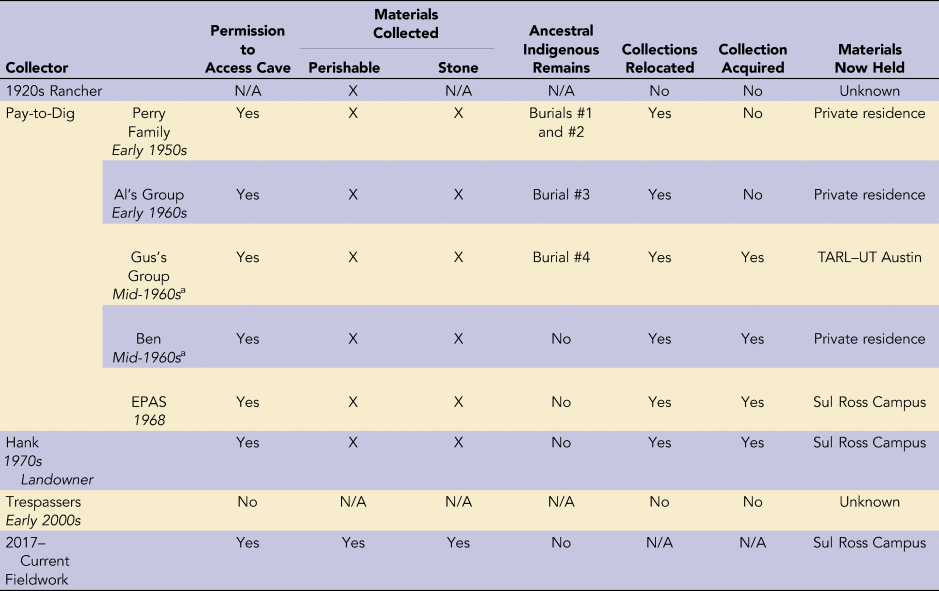
Most of the collection history brackets three periods of excavation, defined by the disinterment of Indigenous ancestral remains at Spirit Eye Cave (Table 1). The first is a 1952 episode (Burial #1 and Burial #2); the second was an early 1960s episode (Burial #3); and the final period began in the mid-1960s and ended in 1998 (Burial #4). During these periods of excavation by collectors, each group legally removed hundreds of nonmortuary perishable and stone artifacts in addition to the ancestral remains. The destruction was evident, but the history was unknown. I reconstructed each of these collecting episodes at Spirit Eye Cave through photographs and letters or communication with specific people, establishing the association of items with the cave. Many individuals associated with this history are no longer living, and conversations with the remaining spectrum of collectors had varied results.
Periods of Collecting from Spirit Eye Cave, Known Materials Collected, and the Current Known Location of Collections.

a Gus's mid-1960s Group and Ben dug in the cave together, but two members of Gus's Group took control of Burial #4 after the excavation.
The first definitive excavation in the cave is detailed in a student paper from Marfa High School, housed in the Junior Historian's Collection at the Marfa Public Library (Anonymous Reference Anonymous1968). It describes a 1952 amateur expedition to the cave by the previously mentioned Perry family (see Table 1). The Perry family wrote that they disinterred two child burials (Burials #1 and #2), allegedly donated one to the Smithsonian, and—astonishingly—put the other on display for years in different business lobbies in Marfa, Texas. The high school report also describes an assemblage of perishable artifacts removed from the cave.
I contacted an individual associated with the 1952 Perry family chapter by talking with landowners and an employee at a small local museum who pointed me to a specific person. A phone call confirmed that he had been in the cave but was reluctant to speak of what he had recovered (Burial #1 and Burial #2). Follow-up conversations with the Smithsonian confirmed that no Indigenous ancestral remains had been sent to them from the Big Bend region (Bill Billeck, personal communication 2017). Further investigation confirmed that they are still held at the private residence. Since the initial contact, this individual has declined additional recent requests to be involved.
The majority of excavation at Spirit Eye Cave happened during the 1960s under a single private landowner, who allowed access for a fee. The first account during this period comes from an undated, anonymous letter. This letter, kept in the files housed at the Center for Big Bend Studies and accompanied by a picture of human remains, had not previously been connected to Spirit Eye Cave. The typed letter details a single day of uncontrolled excavation and describes the distinct double opening of Spirit Eye as well as the numerous ground stone metates still located at both entrances. The unnamed author details what Al's group collected, as well as who excavated and who screened. The letter lists recovered materials ranging from atlatl dart foreshafts and other perishables to various classes of stone tools. The majority of the letter details the recovery of a desiccated adult buried (Burial #3) in a flexed position. The author concludes that they never returned because of the dust but does say, “We could see other caves and cliffs, which we will at a later date explore.”
Tracking down members of Al's party and verifying details of their removal of the Indigenous remains (Burial #3) from the cave in the early 1960s was challenging. It began with the donation of a large archaeological collection to the Graham County Historical Society Museum in Thatcher, Arizona. The museum is now permanently closed, and the artifacts are housed in a storage facility. The letters suggest that a member of the group donated the collection; the former museum staff confirmed that only artifacts from the collector's Arizona property were donated. Having confirming that the collection did not contain Texas artifacts, I turned my focus to where they had last been seen—in a small private museum/residence.
Several letters concerning the burial (Burial #3) were recovered while talking with the Graham County Historical Society staff. They were written on the letterhead of a small private residence/museum in Texas, under whose staircase the remains were last seen. After months of phone calls and several in-person meetings with the associated individuals, they reluctantly admitted that Burial #3 was still in their possession. After consultation with that individual and Xoxi (see Epilogue), an analysis was agreed on to establish the antiquity and prove the ethnic affiliation of the remains (i.e., the story that opens this article). As part of this agreement, both the remains and artifacts were photodocumented, and a small sample was taken for radiocarbon and mtDNA analysis (Schroeder et al. Reference Schroeder, Blohm and Snow2021).
Consultation with American Indians and Indigenous peoples in West Texas is complicated because much of the local population has Indigenous ancestry but does not belong to federally recognized Indigenous groups. Consultation with local nonrecognized groups is essential because many are trying to reestablish their Indigenous identity after centuries of denial. This is admittedly messy. The decision to sample ancestral human remains resulted from early conversations with regional Indigenous peoples. In tandem with fieldwork, I gave several public lectures and an interview on a podcast (Gover et al. Reference Gover, Johnen and Ian Howe2020) and pleaded with local community members to help me unravel the history of the collections and track down the materials. After one presentation, Xoxi Nayapiltzin approached me about pursuing DNA if I were able to relocate the ancestral remains. I have since maintained a solid collaborative relationship with Xoxi and his affiliated Mexica group (Xoxi's account of events appears in the Epilogue). Following this visit, additional requests to transfer Burial #3 to a more appropriate curation facility or descendant community have been denied. This delicate dialogue will continue until the remains are transferred.
The most well-documented period of extensive pay-to-dig excavation begins with the discovery of another flexed adult individual (Burial #4). On September 15, 1968, “Ben” (not his real name) wrote a letter to the University of Texas at Austin (UT Austin) that details the recovery of the remains and requests help. Ben followed up by phone and talked to a student, who instructed him to write a detailed letter to Dr. T. N. Campbell of UT Austin. Ben wrote a letter on September 16, 1968, detailing the recently discovered burial and describing the results of two years of legal pay-to-dig excavation in the cave. This description included several rough sketches of recovered projectile points, the burial location, a basic site sketch map that detailed the extent of their excavation in the main cave chamber, and a list of additional discoveries.
There was some internal dialogue between Dr. Campbell and other UT Austin faculty members regarding a course of action for coordinating with the collectors. On September 25, 1968, representatives of UT Austin wrote to Rex Gerald of the Centennial Museum of the University of Texas El Paso (UTEP) regarding the letter. The UT Austin author informed the collectors that personnel from the university were not located near the cave, and representatives of the Centennial Museum at El Paso would contact them directly about visitation of the site. Rex Gerald of the Centennial Museum passed all the information to avocational archaeologists Leslie Davis and Jack Hedrick of EPAS.
A letter dated October 21, 1968, from EPAS to UT Austin faculty discussed a plan to meet with collectors at the Thunderbird Restaurant in Marfa, Texas. The purpose of the trip was to assess the access to the site, as well as perform an initial recording. The meeting between EPAS and the collectors must have occurred because photos exist in EPAS files of the artifact collection that match the sketches accompanied by Ben's first letter. EPAS also requested the site trinomial after a late 1968 field visit. Whether the two collectors accompanied EPAS to Spirit Eye Cave is unclear, given that only rudimentary notes dated November 3, 1968, exist. These notes include outline sketches, not drawn to scale, of various ground and chipped stone tools cataloged at “one of the openings.” During the visit, a rough site map was sketched, placing the location of Burial #4 and several other items, possibly suggesting that the collectors accompanied them. This initial visit provided the necessary locational information to request a site number for the cave (41PS25). Following the visit, EPAS groups got various Texas Archeological Society (TAS) members from across West Texas interested in a site visit.
On December 28, 1968, 19 avocational members of EPAS and TAS signed a roster at the Ruidosa Hot Springs at 5:00 p.m. for the “Mt. Chinati Expedition.” A phone interview and in-person interviews with Evans Turpin (the only living member of the excavation group, who has since passed away) confirmed that the group stayed at the local hot springs and transported a generator and lights to the cave. Notes exist from the EPAS excavation but are too faded to be of use. Additional conversations with individuals from this trip and the photographs they provided indicate they excavated a cross-shaped set of standard 1 m units in the cave. The artifacts from their excavation were tracked to the El Paso Museum of Archaeology in El Paso and were transferred to Sul Ross State University on June 7, 2017, where they are temporarily being housed before final transfer to the Texas Archeological Research Laboratory (TARL) to centralize the collection.
Unresolved with the acquisition of the artifacts from EPAS was the location of Burial #4, which was the impetus for the visit to the site. Appallingly, there was some resolution in an ad found in the files at TARL, where Burial #4 is still housed. The ad in The Shotgun magazine on October 1, 1988, was for an “Ancient Burial and Cultural Display Collection” (Leneave Reference Leneave1988). It referenced the remains and a portion of the associated artifacts found in Spirit Eye Cave in 1968 that resulted in the EPAS excavation of the site. The subsequent correspondence is dated October 31, 1988, from the seller (now deceased) to the buyer who resided in Palm Springs, California. The letter, which includes some false claims about the excavation, describes the recent purchase and is the only correspondence between the traffickers.
The individual who bought the remains displayed them in their living room until the summer of 1998. Sometime in early June 1998, the California Department of Fish and Wildlife entered the home with a search warrant to recover protected wildlife. The Fish and Wildlife agents immediately noticed the human remains in the living room and called the Riverside County coroner. The coroner's report details the initial visit by a forensic archaeologist on June 12, 1998. The initial coroner's report suggests the remains were from either the American Southwest or the Great Basin because of the associated artifacts. But it was the letter kept near the remains that put the coroner in contact with the state of Texas.
The California coroner established contact with the Texas Office of the State Archeologist to ensure return of the remains to the state of origin. On August 27, 1998, they were transported back to UT Austin, and the associated artifacts and remains are currently housed in the Human Osteology Collection at TARL in Austin. Background research at the cave confirmed and expanded on this history, and the next important step was to contact all the individuals named in Ben's letters to UT Austin archaeologists. How the excavation progressed from outreach requesting the aid of professionals to black-market trafficking remained unclear. Ben had a reputation in the professional community as the most notorious looter in West Texas. This characterization was at odds with the letters on file with EPAS, which were from a collector desperate to get a professional archaeologist involved in excavations at the cave. Ben also allowed EPAS to document artifacts and followed up with TARL to stay current with regional archaeological literature. These actions seemed inconsistent with an individual who trafficked, but perhaps he reformed after the fact. The discrepancies could only be rectified by talking with Ben. After some effort, he was located (the only surviving member of the party of four individuals), and formal conversations were conducted.
The conversations with Ben were difficult because there were real concerns with his role in trafficking and the long-term destruction of sites in the region, and before we collaborated, I needed to resolve several issues. First, I had to understand Ben's involvement in destroying other sheltered sites in the West Texas region. Second, what was his participation in and knowledge of the trafficking and transfer of Indigenous ancestors from Spirit Eye Cave? Last, did he participate in the buying and selling of artifacts? Was I talking with an RRS or a trafficker (Pitblado et al. Reference Pitblado, Shott, Brosowske, Butler, Cox, Espenshade and Neller2018)?
Ben's recollection of events associated with the Indigenous ancestral remains was corroborated through separate interviews with Ben, his wife, and the son of one of the deceased party members. Both Ben and his wife independently told a similar story: the remains of Burial #4 had been transported to their house, but two other party members (Gus's party) wanted and gained control of the remains to transport them to the Witte Museum. Before speaking with Ben, the son of one of these deceased party members had told a similar version of the events in an e-mail (dated January 2, 2018). When asked if either Ben or his wife had followed up with the Witte Museum, they said they had not but were certain the remains were still held there. They were shocked and disgusted when I told them the remains had been sold on the black market in the 1980s by a member of Gus's party (now deceased). Upon learning about this event, they wanted to see if they could pursue legal action against this party member (they had no knowledge of that person's death).
In our conversations, it was apparent that Ben and his wife had not participated in illicit excavation at other shelter sites in the West Texas region. They had only paid for access to Spirit Eye Cave and did not buy or sell artifacts. This local legend was likely a result of displayed frames of artifacts from the family's private ranch in its public business. The photographs EPAS had taken in 1968 confirmed Ben's artifact collection had not changed since it was documented. Still, in the challenging case of Spirit Eye Cave, Ben is a problematic figure. Removal of an Indigenous ancestor from their intended resting place is an act that cannot be forgotten—nor can the inaction of the professionals. But he consistently tried to engage experts and was ignored by them for years. Since 1968, Ben has allowed access to his entire collection, which contains numerous rare perishable materials linked to the site through multiple drawings and photographs. He has also allowed radiocarbon dating, which produced the oldest date on a basketry fragment and the first direct dates on atlatls from the West Texas region. His health is failing, and the family does not seem to share an interest in these artifacts. Conversations are ongoing about donation of his private collection.
More Recent History
Following the pay-to-dig chapter, a new landowner stopped allowing access to the cave. However, the new landowners led multiple excavations at the cave in the mid-1970s. Upon hearing about my current research in the cave, Hank (a pseudonym), the son of the former landowner, allowed documentation of his father's artifacts and photographs from their excavations. Hank also recounted playing in the cave as a child and offered detailed accounts of where and when specific artifacts were removed. Unlike the other collectors, his collection contains fewer formal artifacts and has a large assemblage of cultigens. Radiocarbon dates taken on maize (Zea mays ssp. mays) from this collection have pushed the known use in the region back a millennium (Schroeder Reference Schroeder2021). Consultation under Native American Graves Protection and Repatriation Act (NAGPRA) regulations before sampling cultural artifacts and cultigens for radiocarbon dating was not considered because the artifacts were not parts of funerary assemblages or identified as sacred objects.
The most recent collecting activity at the site was an illegal act committed by trespassers in the mid-2000s. Bureau of Land Management officials associated with the Cerberus Action operation in Blanding, Utah, solicited information from federal archaeologists in the arid West about pictures they found of a cave excavation during the sting (Shelbourn Reference Shelbourn2014). The former Texas state archaeologist, who was working in the region and knew of the cave, viewed the pictures and quickly identified Spirit Eye Cave. These pictures show three distinct individuals digging and screening the upper entrance using gear that remained at the site until it was removed during the 2017 work at the cave. These unknown individuals dug a section at the upper entrance down to bedrock. They are the only unnamed individuals traced to looting the cave, and because they were involved in looting sites on federal land in Utah, they may have been prosecuted. I have not yet followed up with anyone associated with Cerberus Action to see if there are any associated artifacts from the cave.
RESULTS
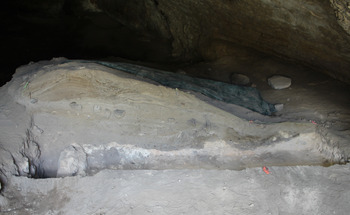
Fieldwork and mapping at the cave began in late 2017, and the first professional excavation work was focused on locating intact sediments at the upper entrance. This work indicated that most of the cave was impacted by collectors, and the sediment within the internal chamber was loess-capped screened fill from decades of uncontrolled excavation (Figure 3). From these screened deposits, new excavation recovered thousands of formal stone artifacts. Overall, there was a high recovery rate from the internal deposits of nonperishable formal stone artifacts (n = 25,873; this includes formal chipped stone tools and sampled debitage) and fewer perishable items (n = 9,249; this includes prepared fiber, cordage, and formal perishable items such as parching trays). A local collector (who did not dig in Spirit Eye Cave) told me most people paid at Spirit Eye Cave for the chance to find perishable artifacts, and this behavior seems reinforced by the low artifact counts of perishable items. Also, while mapping the complete cave system, formal perishable items and cultigens were collected for radiocarbon dating, and a combination of surface-collected and excavated materials was selected.
Profile of excavation at Spirit Eye Cave. All the laminated deposits are from screening by past collectors (photo by Bryon Schroeder).

During this initial fieldwork, I also contacted individuals who had collected from the cave, which allowed for sampling of additional materials that were provenienced to the site through historic photos and intensive interviews. Combined, a total of 12 samples were submitted for radiocarbon dating—three from fieldwork and nine from private collections. All materials for radiocarbon dating were submitted to DirectAMS in Bothell, Washington. The goal of the radiocarbon dating was twofold. The first was to establish an occupational chronology for the site, because perishable artifacts were manufactured with short-lived plant species directly procured by cultural groups in the past. The second concerned the long-term care and accountability of the collection, especially regarding the human remains (Schroeder et al. Reference Schroeder, Blohm and Snow2021).
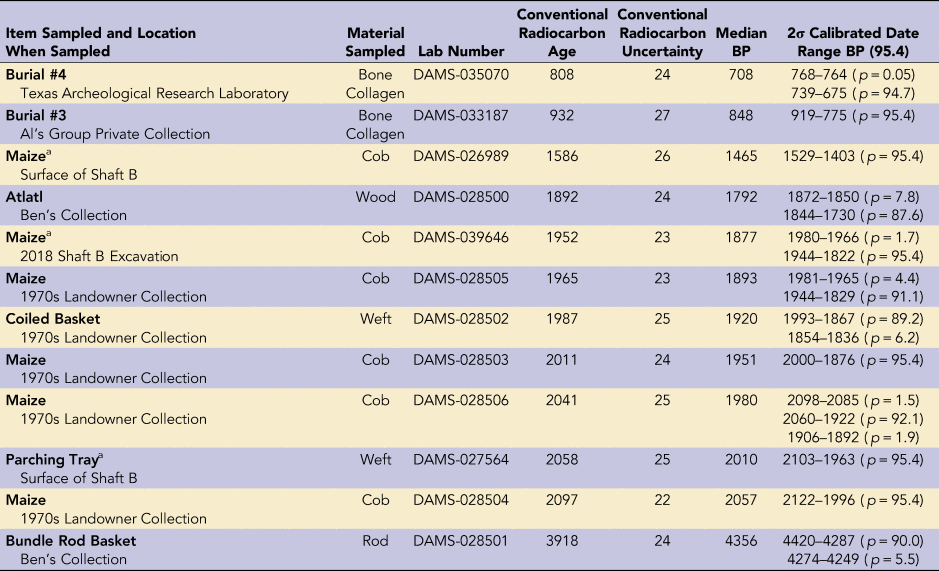
The additional artifacts sampled for radiocarbon dating from private collections provided a much clearer understanding of the occupational history of the cave. The collection held by Hank, the former landowner's son, contains a large assemblage of maize and a single formal basket fragment. Ben allowed complete access to his collection, which includes more weaponry and formal perishable artifacts than Hank's. Of the five artifacts selected for dating from Ben's collection, only two produced dates. The seven successful dates (from Ben and Hank's collection) returned assays significant to the region: (1) the oldest directly dated basket fragment from the Big Bend region of Texas (D-AMS 028501); (2) the first directly dated atlatl from the region (D-AMS 028500); and (3) the oldest directly dated maize in Texas, expanding the use of this cultigen in this region back by a millennium (D-AMS 028504; Table 2).
Radiocarbon Dates from Relocated Collections and Original Fieldwork.

Notes: Radiocarbon dates calibrated using OxCal version 4.4 (Bronk Ramsey Reference Bronk Ramsey2021); IntCal20 Calibration Curve (Bronk Ramsey Reference Bronk Ramsey2009; Reimer et al. Reference Reimer, Austin, Bard, Bayliss, Blackwell, Ramsey and Butzin2020). Artifacts sampled from 2017 to 2019 fieldwork are highlighted in gray.
a Samples collected from site during renewed fieldwork.
All the radiocarbon results from the collections were older than anticipated, so basketry and maize collected from mapping and surface work were also submitted for further assays. The radiocarbon assays returned from artifacts recovered during fieldwork in the cave are coeval with those returned from private collections (the three gray highlighted AMS dates in Table 2). The 12 radiocarbon assays from different collections indicate a nearly 4,000-year occupation in the cave and offer a complete occupation record. Without working with collectors and tracing collections back to the site, the timing of the mortuary history of the cave would have been lost. Collaboration also provided the initial dates for extending the duration of cultigen use in the region and the earliest evidence of occupation at the site (D-AMS 028501). Additional fieldwork found two small undisturbed pockets of Late Pleistocene Shasta ground sloth (Nothrotheriops shastensis) dung, making it one of only 12 known North American caves with such a record preserved (Mead et al. Reference Mead, Schroeder and Yost2021). Together, these data provide the foundation for future research, direct future collaboration at the site, and indicate that the site held deposits from the Pleistocene to the modern historic and can contribute significantly to the understanding of the region.
In sampling each of the private collections, the hope was to increase the education of the collectors about the importance of the material in their possession as much as to advance the collective understanding of the occupational history of the site. The results provided confirmation of the antiquity and contemporaneity of the fieldwork and private collections to build site interpretations, but determining the overlap in time and space between each separate collection was a starting point to dialogue with the collectors about the importance of centralizing all the cultural material from the cave (many have been receptive to this approach). The main focus is to move collections and Indigenous ancestral remains out of private possession (an ongoing process) and either into an accredited curation facility or toward repatriation, respectively.
When it was determined that Burial #4 was at TARL in Austin, I drafted a research design and submitted a request to collect a DNA sample. After TARL approved the research design, I collected samples in their human osteology lab under TARL supervision. Because the Burial #4 remains were (and are still) housed there, TARL completed NAGPRA consultation, and no Indian tribe sent a written claim when we sampled. Burial #3 is held in a private residence/museum; I sampled at the request of the person who is still in possession of the human remains and with the knowledge of and request by local Indigenous individuals. The University of Montana Molecular Anthropology Laboratory processed the samples and used a comparative database constructed of mitogenomes pulled from the literature and another set of mitogenomes in prep (Achilli et al. Reference Achilli, Perego, Lancioni, Olivieri, Gandini, Kashani and Battaglia2013; Flores-Huacuja et al. Reference Flores-Huacuja, Garcia-Ortiz, Snow, Contreras-Cubas, Matinez-Hernandez, Cid-Soto, Piñero-Dalmau, Leblanc and Orozco-Orozco2021). The genome analysis revealed the haplotype B2a4a1 in various populations across Mexico, which includes
individuals in Chihuahua, Jalisco, and Durango, Mexico. Unpublished data from additional modern individuals in Mexico also carried this haplotype and were collected from the Native Mexican individuals in Nayarit (a member of the Cora population), Sonora (Guarijío), Durango (Mexicanero), Guanajuato (Otomi), and San Luis Potosi (Pame) [Schroeder et al. Reference Schroeder, Blohm and Snow2021:6].
The radiocarbon dates and mtDNA suggest that a related matrilineal group used Spirit Eye Cave beginning as early as 920 BP and persisting until as late as 675 BP (Schroeder et al. Reference Schroeder, Blohm and Snow2021:3; Table 2). Despite the sordid history of the individuals who were removed and trafficked, Schroeder and colleagues (Reference Schroeder, Blohm and Snow2021:7) found that a “matrilineal connection existed between the modern populations of indigenous individuals in Mexico and those in the prehistoric Paquimé and West Texas region.” The DNA results were received the same day Xoxi came into our offices for an unrelated visit. He had spent years working on his genealogy and family history and had a deep understanding of the specific haplogroup of his ancestors who shared his maternal lineage. Quite unexpectedly, Xoxi shares the same matrilineal haplogroup as both sets of ancestral remains sampled from Spirit Eye Cave. Considering these results, we are now working to establish him as the lineal descendant defined under NAGPRA and to get the remains still housed at TARL repatriated to him. The response has been positive, and by the time of this publication, we anticipate that Burial #4 will be in the process of reburial. We are working with the individuals who possess Burial #3 also to repatriate, but thus far we have been unsuccessful in our efforts. The results of this genetic and radiocarbon work fundamentally changed the ongoing conversations with the private collectors about the importance of their collection.
DISCUSSION
The Spirit Eye Cave example illustrates how fraught but integral the collaboration and outreach can be in situations where private land and private possession intersect. The code of ethics for the Society for American Archaeology “encourages collaboration between archaeologists and ‘responsible and responsive stewards’ (RRS) in ways that do not conflict with the professional ethical principles and codes that archaeologists have pledged to uphold” (Pitblado et al. Reference Pitblado, Shott, Brosowske, Butler, Cox, Espenshade and Neller2018:16). Undoubtedly, some readers of the Spirit Eye Cave case will view it as a test of this ethical code—not as a good example of collaboration with RRS. But, Spirit Eye Cave is about conversations not happening in print—specifically, Indigenous materials legally acquired from private lands that are held in private collections. Although most of the collectors in this example meet the definition of RRS, some do not. What they still possess should not be locked in closets or treated as kitsch to be displayed under glass in private dining rooms. In these instances, interactions with the entire spectrum of collectors/traffickers must consider what they collected as much as what they did. This does not excuse or condone the actions of bad stewards. However, if an effort is not made to communicate with them, an incredible amount of local heritage information and, unfortunately, ancestral human remains will not be recovered from privately controlled areas such as the Big Bend region of West Texas, where many of the significant Indigenous archaeological sites have been impacted by collectors.
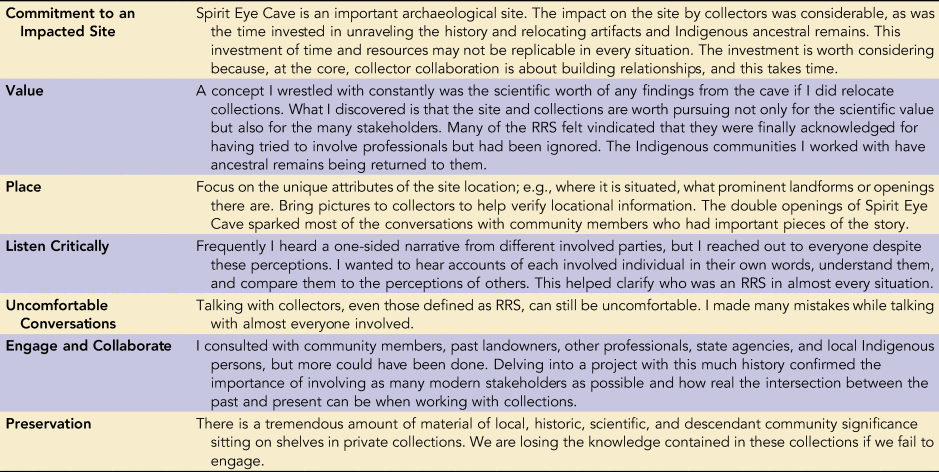
As a professional archaeologist, I am part of a continuum of collectors that will impact Spirit Eye Cave. This spectrum is situated in different social, cultural, and economic backgrounds, and educational levels. As a professional, I am in a privileged position to bridge the gap between the various stakeholders and to open communication between the collectors and other stakeholders. At Spirit Eye Cave, these conversations have been challenging but necessary for establishing history and assessing collections (the dialogue will continue, and stakeholders will be added). Table 3 illustrates some of the essential lessons that Spirit Eye Cave has provided me and what I think will be essential to anyone working to recover collections.
Lessons from Spirit Eye Cave Relevant to Cases of Other Collectors.

Spirit Eye Cave illustrates how the spectrum of heritage stakeholders is diverse, and balancing all of their conflicting interests can be incredibly challenging. Ben was the most visible collector, and he became the face of the destruction for this and most sheltered sites in the region. It took a written record and focused conversations to verify that he consistently reached out to professionals for aid but was often turned down and ignored. Contrast this with a private collector who still possesses artifacts and Indigenous ancestral remains from the cave and is unwilling to even speak to me. These and other collectors of the region hold most of the region's physical Indigenous history. In this case, understanding and talking with all of the collectors shifted the goal of work at the site toward accountability and visibility and provided meaningful research results for the region. The radiocarbon and mtDNA results opened a difficult dialogue with tangible proof for these collectors that their materials are important and sensitive, and that they are part of a much larger community of stakeholders. Because of this, their (the collections’ and ancestors’) long-term care needs to be addressed. Dialogues are ongoing concerning these collections, but committing to research at this cave has been the catalyst for important and sustained conversations.
EPILOGUE
by Xoxi Nayapiltzin
I was born and will be buried in Alpine at the foot of my mother's grave. Our mother is buried 75 feet from her mother. Our grandmother is buried one and a quarter miles from her mother. Our great-great-grandmother is buried 205 miles away in San Angelo, Texas. Our great-great-great-grandmother is buried 27 miles away in Marathon, Texas. Two of our great aunts, over 100 years old, still living in Alpine recall her, their great-grandmother Nana Tana, as being a “doctora de los indios” because of her visits to the backcountry of the Big Bend. The Arroyo de la Sebastiana somewhere southeast of Marathon was named after her. All this I know from our family oral history and, as our mother and grandmother did before me, I visit the ancestral grave sites often. I go there to seek their blessing and continuing guidance.
But our oral family history does not go beyond our great-great-great-grandmother Nana Tana. I wanted to know more, so 52 years ago I started doing genealogical research. I found her 1833 baptismal record in Meoqui along the Rio Conchos, 180 miles southwest from Alpine. The extant church records document three more generations of our grandmothers. Meoqui is 15 miles from the Mission of Tapalcolmes. History books state that in 1753 the mission was relocated there along with the native Tapaxkolmeh from their homes at what is now Redford, Texas, on the Rio Grande, and that some Yolihua had been displaced from their homes in the Chisos Mountains 75 miles from Alpine and settled there in 1693.
When the written record was exhausted, I turned to the new science of genetics and had my mtDNA tested. The result was that I belong to Haplogroup B, common to the Indigenous people of what is now the southwestern United States and north-central Mexico. As the science evolved and new tools became available, I was able to decipher my HVR1 mutations as being of the B2a4a1 family.
Recently, I learned that two ancient burials—dated approximately 710 and 860 years old and located just 55 miles from my birthplace—were sampled for mtDNA. They were classified as being of the B2a4a1 family; that is, they are my direct maternal ancestors. Modern science now confirms what the wind, the mountains, xegoy (Larrea tridentata), xíkuri (Lophophora williamsii), and wikókuri (Phrynosoma cornutum) continually tell me: we, my family, belong to this land. It would seem that this was good news. But sadly, there was the most horrifying news a grandchild can receive: two of my ancestral grandmothers had been removed from their burial grounds! One is now in an unrelated person's attic and the other in an institutional laboratory. They do not belong there. They belong in Mother Earth with their family in our homeland.
No natural person would unearth their relatives, nor should they any other human being. Sadly, the trans-Atlantic immigrants to our homelands did not recognize us as fellow human beings and relegated our human remains to artifacts, and now many of our relatives are in a plastic bag in a cardboard box sitting on a shelf. Worse, some have been exhibited like curios in museums, private houses, and even storefronts. They belong in Mother Earth with their families in their homelands.
But who are their families, and where are their homelands? Genetics hold the answer. Some of us do not want our relatives’ bodies further molested with DNA studies. However, after all the abuse and humiliation that our ancestors’ unearthed human remains have suffered, the dignity of having their families and homelands accurately identified is well worth a DNA verification.
Over the years, thousands of our ancestors’ remains have been unearthed from their resting places—some by institutional archaeologists during sanctioned excavations, others by nonprofessionals seeking a profit in the antiquities markets or for their private collections. Those removed by academic institutions from federal lands or during federally funded projects are well documented and easily traceable, and their repatriation is mandated by the Native American Graves Protection and Repatriation Act (NAGPRA), which was enacted in 1990. But what about the thousands of graves disturbed before and outside the purview of NAGPRA? Where are they now? And when will those human remains rest in peace?
Recent collaboration between professionals and private collectors has revealed the locations of some of these previously unaccounted for human remains. Negotiated agreements between the parties have permitted radiocarbon and mtDNA analyses that confirm my family's continual habitation of our homelands and contradict the historical fallacy of the mysterious disappearance of our people. This new archaeological research approach is not only allowing for the discovery and proper identification of looted ancient human remains but permitting repatriation to the direct lineal descendants.
Acknowledgments
Spirit Eye Cave is a collaborative project, and there are so many people to recognize. The current landowners of Spirit Eye Cave were instrumental in pushing for research and have long seen the importance of the site. Kay and Bill Luther (formally of EPAS) scanned and sent the lead author all the early EPAS documents and lined up the donation of artifacts to the Center for Big Bend Studies. Teddy Lou Stickney had all the EPAS photos/slides of their excavation in the cave in the late 1960s and donated them to the Center. Taylor Greer helped the lead author find and reach out to former museum board members in Arizona and came with him to Ben's house on multiple trips. Lauren Bussiere and Marybeth Tomka of TARL have helped us work with the collections housed there from Spirit Eye Cave. The lead author also needs to recognize the collectors who donated or allowed him to date portions of their collection that have helped both authors understand the history of this site. We would also like to thank Drew Stuart for his thoughtful broadcast on the impact of this research. No permits were required for the fieldwork, but the permissions to work in the cave and with the collections are described throughout the article.
Data Availability Statement
The raw radiocarbon data for this project are housed the Center for Big Bend Studies. E-mail correspondence with the lead author is the easiest way to gain access to this information. Data collection occurred solely on private land and did not require archaeology permits. Collection sampling was done under the purview of all the owners and with a specific research design in place. All photos taken were by the lead author.