Introduction
Vestibular evoked myogenic potential testing is a relatively new vestibular diagnostic method which is used clinically for the evaluation of saccular function and inferior vestibular nerve integrity.Reference Colebatch, Halmagyi and Skuse1, Reference Murofushi, Halmagyi, Yavor and Colebatch2 In recent years, vestibular evoked myogenic potential testing has been successfully applied to the investigation of a number of peripheral and central vestibular disorders.
Idiopathic sudden hearing loss remains probably the most controversial of all inner-ear lesions, despite the great efforts made worldwide to clarify its pathophysiology. Due to the close proximity and anatomical correlation of the two components of the inner ear, the pathology of idiopathic sudden hearing loss is expected to involve not only the cochlea but also to some extent the vestibule.
Most studies of idiopathic sudden hearing loss have attempted to estimate vestibular involvement based on abnormal electronystagmography (ENG) findings, and to correlate the clinical appearance of vertigo (i.e. rotatory, non-rotatory and benign paroxysmal positional vertigo (BPPV)) with caloric test results. Abnormal ENG findings have been reported in 39 to 74 per cent of patients with idiopathic sudden hearing loss.Reference Laurikainen, Aantaa and Kallinen3–Reference Bosatra and De Stefani9 In addition, vertigo has been reported in between 30 and 66 per cent of such patients.Reference Hallberg4–Reference Park, Jung and Rhee12 However, it is well known that vestibular symptoms and ENG findings do not parallel one another in any predictable fashion.Reference Mattox and Simmons7
Only a few recent studies have attempted to include vestibular evoked myogenic potentials in the test battery for patients with idiopathic sudden hearing loss. In a population of 20 patients with idiopathic sudden hearing loss, Wu and YoungReference Wu and Young13 failed to show any abnormal vestibular evoked myogenic potential results. In contrast, Chen and YoungReference Chen and Young14 found that 21 per cent of their patients had vestibular evoked myogenic potential abnormalities, whereas Iwasaki et al. Reference Iwasaki, Takai, Ozeki, Ito, Karino and Murofushi15 found a much higher rate (77 per cent) of such abnormalities in their population of 22 patients with idiopathic sudden hearing loss and vertigo. Recently, Hong et al. Reference Hong, Byun, Park, Lee, Park and Cha16 also reported abnormal vestibular evoked myogenic potential responses in 27 per cent of their 52 patients suffering from idiopathic sudden hearing loss without vertigo.
Due to the small patient populations used in pre-existing studies, as well as their contradictory results, the aims of the current study were (1) to investigate the occurrence of vestibular evoked myogenic potential abnormalities in a larger patient population, (2) to determine any correlations between vestibular evoked myogenic potential results and ENG findings, and between vestibular evoked myogenic potential results and the clinical nature of balance disturbances, and (3) to evaluate the influence of advancing age on the type of vestibular dysfunction, in patients with idiopathic sudden hearing loss.
Materials and methods
Eighty-six consecutive patients (39 men and 47 women; mean age 51 years, standard deviation (SD) 13.25) with unilateral idiopathic sudden hearing loss were enrolled in the study. The right side was affected in 41 patients, and the left in 45 patients. All patients were hospitalised in the otorhinolaryngology department, Hippokration Athens Hospital, University of Athens, between February 2006 and September 2008, and were treated similarly.
The inclusion criteria comprised sensorineural hearing loss greater than 30 dB HL occurring in at least three contiguous frequencies in less than 72 hours.Reference Wilson, Byl and Laird17 Vertigo was considered to be any type of reported dizziness, ranging from slight unsteadiness to severe rotatory vertigo with vomiting. Thus defined, vertigo was reported by 31 patients (36 per cent). None of the study patients received vestibular sedatives during the study period.
All patients were evaluated prior to or on the first day of treatment, and most of them within two weeks of the onset of hearing loss (median 10 days), using a standard diagnostic protocol that included pure tone audiometry, tympanometry with acoustic reflex, ENG and caloric testing, vestibular evoked myogenic potential testing, and magnetic resonance imaging (MRI) of the brain and the internal auditory canal.
For comparison, we assembled a control group consisting of 35 healthy adults (17 men and 18 women; mean age 37.3 years) with no previous hearing, vestibular or neurological disorders. These control subjects underwent the same neurotological test battery.
Test procedures
All vestibular evoked myogenic potential recordings were performed using a GN Otometrics (Taastrup, Denmark) EP version 5.2 analyser with a two-channel averaging capacity.
Patients were seated in an upright position, keeping their heads turned contralaterally to the stimulated ear, in order to achieve sufficient and constant contraction of the sternocleidomastoid muscle during recordings, and were instructed to maintain intense muscular effort during the whole recording period of each trial. The acoustic stimuli (short tone bursts, 95 dB HL, 500 Hz, rate 5.1/second, ramp = 1 millisecond (msec), plateau = 0 ms) were delivered monaurally through headphones (TDH-40; Telephonics, New York, USA) with no contralateral masking, and the myogenic potential was recorded ipsilaterally by surface electrodes. The skin was scrubbed, and the impedance of the recording electrodes was maintained below 5 kOhms.
The two active electrodes were placed symmetrically over the midpoint of each sternocleidomastoid muscle, the reference electrode was applied to the upper forehead, and the ground electrode was positioned at the middle of the forehead. The electromyographic (EMG) activity of the ipsilateral sternocleidomastoid muscle was recorded, and every trial of 150 stimuli was averaged and repeated twice to verify the reproducibility of the waveform, and to provide the final vestibular evoked myogenic potential result. The EMG signal from each side was amplified and bandpass-filtered (high-pass 2 Hz, low-pass 500 Hz). The stimulus analysis time for each run was 100 msec.
The peak latencies of the first positive-negative component of the vestibular evoked myogenic potential response (i.e. P1 and N1) were measured for each patient. The vestibular evoked myogenic potential response was considered to be absent when there were no recognisable or reproducible biphasic waveforms, or when the amplitude of the potential was less than 20 µV.
Electronystagmography recordings were performed with a Life-Tech model 3002 electronystagmograph (Houston, Texas, USA). A Hortmann Airmatic (Neurootometrie, GN Otometrics, Taastrup, Denmark) air irrigator was used for the bithermal air caloric tests. The methodology has been reported in detail elsewhere.Reference Korres, Balatsouras and Ferekidis18 In our laboratory, any caloric asymmetry of more than 22 per cent was defined as canal paresis.Reference Korres, Balatsouras and Ferekidis18
Statistical analysis
The Statistical Package for the Social Sciences version 11.0 software was used for statistical analysis. A one-way between-subject analysis of variance (ANOVA) was used to compare age averages in the groups defined by inner-ear lesion. Chi-square testing was used to assess the possible relationship of vertigo for the four clinical groups (see below).
Results and analysis
Controls
Vestibular evoked myogenic potential waveforms were obtained on both sides in all of the 35 healthy volunteers (70 ears). The mean P1 value was 16.26 ms (SD 1.32) and the mean N1 value was 24.42 (SD 2.52).
The P1 and N1 delay was defined as any value greater than the mean plus two SDs of the normal population, i.e. any P1 value greater than 18.9 ms and any N1 value greater than 29.46 ms was considered delayed.
Patients
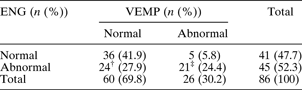
On the unaffected side, normal biphasic vestibular evoked myogenic potential responses were observed in all 86 sudden hearing loss patients. On the affected side, 60 patients (69.8 per cent) exhibited normal biphasic vestibular evoked myogenic potentials, whereas 26 patients (30.2 per cent) showed abnormal vestibular evoked myogenic potential responses. In total, ENG testing revealed that 41 of the 86 patients (47.7 per cent) had normal caloric responses, whereas 45 patients (52.3 per cent) had abnormal findings on the affected side. Clinical eye movement examination revealed no central vestibular signs in these patients. The absolute numbers and percentages for both vestibular evoked myogenic potentials and caloric results in the affected ears of the idiopathic sudden hearing loss patients are shown in Table I.
VEMP and ENG* results in patients with idiopathic sudden hearing loss
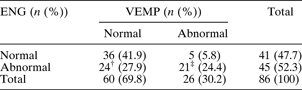
* With caloric measurement. †Seventeen patients had canal paresis and seven had spontaneous nystagmus. ‡Eighteen patients had absent waveforms and three had delayed latencies; in addition, 20 patients had canal paresis and one had spontaneous nystagmus. VEMP = vestibular evoked myogenic potentials; ENG = electronystagmography
When the results for both vestibular evoked myogenic potentials and ENG testing were combined, 21 (24.4 per cent) of the 86 patients showed abnormal findings on both tests. Twenty-nine patients (33.7 per cent) presented an abnormal response either on ENG testing (n = 24) or on vestibular evoked myogenic potential testing (n = 5). Thirty-six patients (41.9 per cent) exhibited normal responses to both diagnostic methods (Table I).
The results of vestibular evoked myogenic potential testing correlated with the results of caloric testing in 57 patients (66.3 per cent), showing either normal or abnormal responses on both tests. Chi-square testing showed a statistically significant relationship between the results of the two tests (p < 0.01). On the other hand, the combination of the two methods identified abnormality in 50 of the 86 (58.1 per cent) patients, i.e. showing abnormal findings on vestibular evoked myogenic potential testing, on ENG testing, or on both tests. Of these 50 patients, vertigo or imbalance was reported by 23 (46 per cent).
In order to study the correlation between vestibular lesion, patient age and clinical occurrence of vertigo, in patients with idiopathic sudden hearing loss, the following four groups of patients were defined, according to the terminology proposed by Iwasaki et al. Reference Iwasaki, Takai, Ozeki, Ito, Karino and Murofushi15
Group C patients had normal results for both vestibular evoked myogenic potential and caloric tests, indicating that the inner-ear lesion was located only in the cochlea.
Group C+S patients had normal vestibular evoked myogenic potential test results but abnormal caloric test results, indicating that the lesion involved the cochlea and the horizontal semicircular canal.
Group C+O patients had abnormal vestibular evoked myogenic potential test results but normal caloric test results, meaning that the lesion involved the cochlea and the otolithic organs (i.e. the saccule and possibly the utricle).
Group C+O+S patients had abnormal results for both vestibular evoked myogenic potential and caloric tests, meaning that the lesion involved the cochlea, semicircular canal and otolithic organs.
Electronystagmographic testing revealed that, in group C+S, 16 patients had canal paresis, one had an absent caloric response and the remaining seven showed spontaneous nystagmus. In the C+O+S group, 14 patients had canal paresis, six had an absent caloric response and only one showed spontaneous nystagmus.
One-way between-subject ANOVA was performed to compare age means among the groups. The main effect of age was found to be statistically significant. In the post hoc multiple comparisons, statistically significant differences were found between the C group and the C+O+S group, as well as between the C+S group and the C+O+S group. The age means of the four groups are shown in Table II.
The four clinical groups: patient numbers, age and vertigo incidence

A statistically significant difference was found between the mean patient ages, C vs C+O+S and C+S vs C+O+S (p < 0.05, chi-square). See text for explanation of clinical groups. Pts = patients; SD = standard deviation; yrs = years
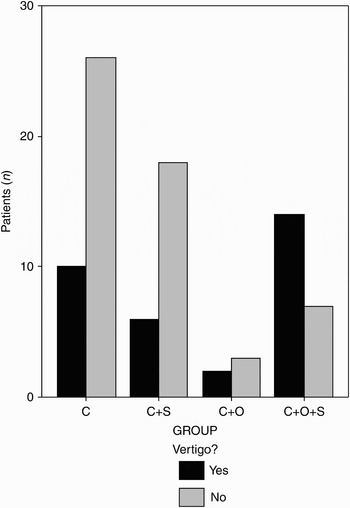
Chi-square testing was performed to compare the percentage of vertigo sufferers in the four groups. A statistically significant relationship was found between the type of vestibular lesion in idiopathic sudden hearing loss and the occurrence of vertigo (p < 0.05). Figure 1 indicates the incidence of vertigo in the four clinical patient groups. The percentages of patients with vertigo in each one of the four groups are also shown in Table II.
Distribution of vertigo amongst patients in each clinical group. See text for explanation of clinical groups.

There were no pathological MRI findings that could be related to the clinical appearance of sudden hearing loss or vertigo in any of the patients tested. However, ischaemic lesions were noticed in two patients in group C, in five in group C+S, in one in group C+O and in three in group C+O+S. In total, MRI brain scanning showed ischaemic lesions in 11 out of the 86 patients (12.8 per cent).
Discussion
The first series of patients with idiopathic sudden hearing loss combined with balance disorder was reported in 1949.Reference Rasmussen and Helmer19 Over the next few decades, a number of relevant studies provided important evidence of vestibular dysfunction in a considerable number of cases. Despite this, the role of vestibular involvement in the pathophysiology of sudden hearing loss remains unclear.
Measurement of vestibular evoked myogenic potentials is a useful way to investigate the function of otolithic organs, because the saccule is considered to be the starting point of their neural pathway. Furthermore, temporal bone studies in idiopathic sudden hearing loss patients have offered clear evidence of saccular damage in a considerable number of cases.Reference Schuknecht, Kimura and Naufal20–Reference Khetarpal24 On the other hand, it has been known for many years that the labyrinth is involved in idiopathic sudden hearing loss to a certain extent, because of the vertigo experienced by many patients. A few recent efforts to study otolithic organs using vestibular evoked myogenic potentials in patients with idiopathic sudden hearing loss have given conflicting results.
Iwasaki et al. Reference Iwasaki, Takai, Ozeki, Ito, Karino and Murofushi15 used both click vestibular evoked myogenic potentials and galvanic vestibular evoked myogenic potentials, and found that all idiopathic sudden hearing loss patients with absent click vestibular evoked myogenic potentials had normal galvanic vestibular evoked myogenic potentials; this indicates an intact neural pathway from the vestibular nerve to the sternocleidomastoid muscle. The absence of click vestibular evoked myogenic potentials in these patients indicated that the lesion was located within the labyrinth. It was therefore supposed that patients with pathological or absent vestibular evoked myogenic potentials would have lesions in the otolithic organs, particularly the saccule.
Park et al.,Reference Park, Jung and Rhee12 too, commented on the possible involvement of the otolithic organs, based on the high incidence of BPPV in idiopathic sudden hearing loss patients.
In contrast, Chen and YoungReference Chen and Young14 considered that the abnormal vestibular evoked myogenic potentials they detected in three of 14 patients with idiopathic sudden hearing loss were probably due to brainstem hypoperfusion; these patients also had central findings on ENG. However, the number of patients studied was rather small for such a definite conclusion.
Recently, Hong et al. Reference Hong, Byun, Park, Lee, Park and Cha16 reported deterioration of saccular neuroepithelium in 27 per cent of their non-vertiginous patients suffering from idiopathic sudden hearing loss.
In our study, 30 per cent of patients showed abnormal vestibular evoked myogenic potentials, and 52 per cent of patients showed abnormal ENG findings. These results confirm the fact that, in idiopathic sudden hearing loss patients, the lesion involves the labyrinth in a considerable number of cases. Combining these results offers a clearer picture of the pathology of the disease. Of the four study groups, the largest (representing 41.9 per cent of patients) was group C, with normal vestibular evoked myogenic potentials and normal caloric results – i.e. patients with a lesion confined to the cochlea. The next most frequent finding was normal vestibular evoked myogenic potentials and abnormal caloric results (group C+S; 27.9 per cent), i.e. patients whose lesion involved the cochlea and semicircular canal, followed by abnormal vestibular evoked myogenic potentials and abnormal caloric results (group C+O+S; 24.4 per cent), i.e. patients whose lesion involved both the cochlea, semicircular canal and otolithic organs. The least frequent finding was abnormal vestibular evoked myogenic potentials and normal caloric results (group C+O; 5.8 per cent), i.e. patients whose lesion involved the cochlea and otolithic organs. Abnormal vestibular evoked myogenic potential responses in the presence of normal caloric responses have previously been reported in cases of sudden hearing loss with vertigo.Reference Iwasaki, Takai, Ito and Murofushi25 This series found a higher proportion of the latter type of lesion (i.e lesion involving the cochlea and the otolith organs), whereas the current, much larger series found lesions of the semicircular canal and cochlea to be more frequent than those of the otolithic organs and cochlea.
The results of vestibular evoked myogenic potential testing correlated with the results of caloric testing in most (66.3 per cent) but not all of our patients, and a statistically significant relationship was found between these two results. This finding supports the theory that, in most cases, the posterior labyrinth is either spared or extensively involved (i.e. both vestibule and semicircular canal(s)); however, researchers must keep in mind that the two vestibular diagnostic methods are complementary to each other and cannot substitute one another.Reference Zapala and Brey26 In some instances, only vestibular evoked myogenic potential testing can detect the vestibular dysfunction; the ENG will remain normal. However, when the abnormal results of the two vestibular diagnostic methods were considered together, they managed to identify abnormality in 58.1 per cent of the idiopathic sudden hearing loss patients. This further confirms the general proposal of Zapala and Brey,Reference Zapala and Brey26 that a combination of the two testing procedures increases the overall sensitivity of the vestibular diagnostic test battery, and improves the ability to detect any possible inner-ear dysfunction within the vestibular apparatus, even in cases of idiopathic sudden hearing loss.
Comparing the mean ages of each patient group, it was evident that patients with both otolithic organ and semicircular canal lesions were older than those with an intact labyrinth, and also older than those with a lesion in the horizontal semicircular canal. This finding implies that as age advances, the structures of the vestibule become more sensitive and the lesion more extensive. The degenerative changes of the otoconia and the decrease in the gelatinous layer in both utricle and saccule occurring with advancing age have already been documented in the literature.Reference Welling, Parnes, O'Brien, Bakaletz, Brackmann and Hinojosa27 The implication that ageing vestibular structures are more sensitive to possible viral or ischaemic injury could also explain the fact that our patient group with abnormal vestibular evoked myogenic potentials and normal caloric results had a mean age similar to that of the patient group with abnormal results for both tests; however, statistical significance was not achieved, probably due to the small number of patients in the group C+O. However, it should at this point be emphasised that all these patients exhibited normal vestibular evoked myogenic potentials in the opposite ear, so it is rather improbable that vestibular evoked myogenic potential abnormality is irrelevant to idiopathic sudden hearing loss.
On the other hand, it is interesting that the presence of vertigo as a clinical symptom appears to correlate with otolithic organ dysfunction, as well as with the extent of inner-ear pathology in both the saccule and the semicircular canals (Table II). The relative data are not exactly in agreement, but they are interesting.
KhetarpalReference Khetarpal24 investigated the histopathological characteristics of the temporal bone in patients with sudden deafness, and found no direct relationship between the presence of vertigo and damage to the vestibular apparatus. Khetarpal hypothesised that the disturbance of the labyrinth, which led to vertiginous symptoms in patients with idiopathic sudden hearing loss, was due to transmission of changes in the inner-ear fluid from the cochlea to the labyrinth.
In addition to this, Park et al. Reference Park, Jung and Rhee12 reported that a significant proportion of their patients who complained of subjective vertigo had normal caloric test results (these authors did not use vestibular evoked myogenic potential measurement during investigation). Park et al. suggested that this finding may be due to a small or transient lesion in the vestibular apparatus which had normalised by the time of testing. This could also have been the case in several of our patients with normal caloric results and vertigo (27.8 per cent of the total).
• The results of vestibular evoked myogenic potential testing and electronystagmography with caloric testing were found to correlate significantly in cases of idiopathic sudden hearing loss
• Combination of the results of these two test procedures increased the overall sensitivity of the diagnostic test battery, and improved the ability to detect any possible vestibular dysfunction in sudden deafness
• Advancing age seems to correlate with more extensive lesions of the posterior labyrinth, mostly including both semicircular canals and otolithic organs
• The prevalence of vertigo as a clinical symptom is greater in patients with inner-ear lesions of both the saccule and the semicircular canals, and appears to correlate with otolithic organ dysfunction
In the present study, vertigo was taken to be not only the usual, rotational sensation but also any type of unsteadiness or ‘dizziness’, which could equally derive from otoliths. It seems that any type of vestibular lesion involving the otolithic organs is associated with a more severe symptomatology, i.e. a higher percentage of these patients had vertigo (Table II, Figure 1). A possible explanation could be that otolithic organ involvement was mostly connected to more extensive involvement of the posterior labyrinth, being found on its own in only a few cases. Consequently, a more severe symptomatology could be expected in cases of more extensive posterior labyrinth lesion.
Conclusions
These study findings lead to several conclusions.
Firstly, investigation of idiopathic sudden hearing loss with an elaborate test battery including both vestibular evoked myogenic potential and ENG studies (including caloric testing) may lead to a more thorough picture of the pathophysiology of the disease. A significant relationship was found between the results of these two tests. Additionally, the use of vestibular evoked myogenic potentials proved vestibular involvement to a considerable extent in many patients, and allowed a new estimation of the severity of the disease.
Secondly, the severity of the vestibular lesion in cases of idiopathic sudden hearing loss appears to increase with age, a fact attributed to the degeneration of vestibular structures already occurring in older individuals. This must be kept in mind during neurotological evaluation, treatment decisions and follow-up study of older patients.
Finally, the presence of vestibular disturbances in these patients, in the form of rotatory vertigo or imbalance, appears to correlate better with cases involving saccular lesions rather than those involving semicircular canal dysfunction alone. This is probably because the otolithic organ involvement is connected to more extensive inner-ear damage.