Introduction
Language serves a variety of functions. During everyday interactions with infants, mothers provide information about objects and events; use language to regulate their infants’ actions and behaviors; and ask questions and encourage infants to communicate and vocalize. Each of these functions serves a unique purpose in teaching infants about the world and how to engage in that world.
Mothers’ use of didactic language – utterances that name or provide information about objects and events in the environment – has received enormous attention in previous research on language input (Olson & Masur, Reference Olson and Masur2015; Tamis-LeMonda, Kuchirko, & Tafuro, Reference Tamis-LeMonda, Kuchirko and Tafuro2013; West & Iverson, Reference West and Iverson2017; Wu & Gros-Louis, Reference Wu and Gros-Louis2015). Yet, although didactic/referential utterances are prevalent in interactions between non-Latina White, middle-income mothers and their infants (Haden & Fivush, Reference Haden and Fivush1996; Tamis-LeMonda, Custode, Kuchirko, Escobar, & Lo, Reference Tamis-LeMonda, Custode, Kuchirko, Escobar and Lo2018), the study of didactic language may be grounded in mainstream beliefs about the importance of certain pragmatic functions for later language learning. Missing from the literature is a description of language inputs to infants by mothers from diverse ethnic backgrounds.
Our goal was to describe the pragmatics of US mothers’ language to infants in dyads from diverse backgrounds (African American, Mexican, Dominican). We asked: (1) To what extent do mothers from ethnically diverse backgrounds use three language functions (referential language, regulatory language, vocalization prompts) when interacting with their infants? (2) How do mothers of different ethnicities compare in their functional language inputs to infants? (3) Do mothers’ years of education, mothers’ years in the US, and infant sex relate to mothers’ use of specific language functions?
Functions of Language
Our first aim was to describe the pragmatic functions of speech to infants in a sample of ethnically diverse mothers and their infants. Language is a tool that serves many purposes, including teaching infants about the world, encouraging vocalizations and communication, and directing infant attention and action (Bruner, Reference Bruner1981; Tamis-LeMonda & Song, Reference Tamis‐LeMonda and Song2012). Yet, the over-representation of non-Latinx, White, highly educated US samples in developmental science has led to a predominant focus on certain functions of language to the exclusion of others (Schieffelin & Ochs, Reference Schieffelin and Ochs1986).
In particular, many studies focus on referential or didactic language – utterances that provide labels and descriptors that refer to objects and events in the environment (e.g., “That's a spoon” and “The rabbit's hopping”) (e.g., Bornstein et al., Reference Bornstein, Putnick, Heslington, Gini, Suwalsky, Venuti and Zingman de Galperín2008; Masur, Flynn, & Eichorst, Reference Masur, Flynn and Eichorst2005; Tamis-LeMonda, Song, Leavell, Kahana-Kalman, & Yoshikawa Reference Tamis-LeMonda, Song, Leavell, Kahana-Kalman and Yoshikawa2012; Wu & Gros-Louis, Reference Wu and Gros-Louis2015). Referential utterances contain nouns, verbs, adjectives, and adverbs that expose infants to different word classes and types, typically during bouts of joint attention (Tomasello & Farrar, Reference Tomasello and Farrar1986) or in response to infants’ actions (Messer, Reference Messer1978; Tamis-LeMonda, Kuchirko, & Song, Reference Tamis-LeMonda, Kuchirko and Song2014). As a result, referential language supports infants’ vocabulary, grammar, and speech processing skills, which in turn predict cognitive and language outcomes later in childhood (Bornstein, Haynes, & Painter, Reference Bornstein, Haynes and Painter1998; Fernald, Perfors, & Marchman, Reference Fernald, Perfors and Marchman2006; Hoff, Reference Hoff2006; Hoff & Naigles, Reference Hoff and Naigles2002; Hurtado, Marchman, & Fernald, Reference Hurtado, Marchman and Fernald2008; Huttenlocher, Waterfall, Vasilyeva, Vevea & Hedges, Reference Huttenlocher, Waterfall, Vasilyeva, Vevea and Hedges2010; Marchman & Fernald, Reference Marchman and Fernald2008; Rowe, Reference Rowe2012; Tamis-LeMonda et al., Reference Tamis-LeMonda, Song, Leavell, Kahana-Kalman and Yoshikawa2012). However, culture and language are inextricably bound, and the high use of didactic language directed to infants in largely European-American communities may not generalize to other ethnic groups within the US (Bruner, Reference Bruner1996; Rogoff, Mistry, Göncü, Mosier, Chavajay, & Heath, Reference Rogoff, Mistry, Göncü, Mosier, Chavajay and Heath1993; Schieffelin & Ochs, Reference Schieffelin and Ochs1986).
Another important and often-studied function of language is to invite participation from interlocutors. Vocalization prompts are utterances in which mothers encourage infants to vocalize through the use of questions (e.g., “What is this?) or by directly eliciting vocalizations (“Can you say ball?”). Vocalization prompts entice infants to communicate through the verbal channel, perhaps reflecting the expectation that infants join conversations and show their knowledge, even if in rudimentary ways. The emphasis on vocalization prompts extends to research on early book-sharing interactions, where dialogic reading is found to elicit participation through the use of questions and prompts (Luo & Tamis-LeMonda, Reference Luo and Tamis-LeMonda2017; Mol, Bus, de Jong, & Smeets, Reference Mol, Bus, de Jong and Smeets2008; Parish-Morris, Mahajan, Hirsh-Pasek, Golinkoff, & Collins, Reference Parish-Morris, Mahajan, Hirsh-Pasek, Golinkoff and Collins2013; Strasser, Larrain, & Lissi, Reference Strasser, Larrain and Lissi2013; Whitehurst et al., Reference Whitehurst, Falco, Lonigan, Fischel, DeBaryshe, Valdez-Menchaca and Caulfield1988). Indeed, wh-questions (as opposed to simple yes/no questions) challenge children to identify and use the appropriate words, and as a result promote vocabulary growth and verbal reasoning skills (Kuchirko, Tamis-LeMonda, Luo, & Liang, Reference Tamis‐LeMonda and Song2016; Rowe, Leech, & Cabrera, Reference Rowe, Leech and Cabrera2017).
Language can also be used to regulate or guide infant behavior. Regulatory language functions to direct, correct, or prohibit infants’ behavior and attention. Regulatory language often contains pronouns (e.g., “Look at that”, “Stop that”), repetition, and low lexical diversity compared to referential language (Tamis-LeMonda et al., Reference Tamis-LeMonda, Kuchirko and Tafuro2013), which can possibly explain why regulatory and directive functions of language – such as commands – are sometimes unrelated or negatively related to infants’ early language development (e.g., Baumwell, Tamis-LeMonda, & Bornstein, Reference Baumwell, Tamis-LeMonda and Bornstein1997; Hoff & Naigles, Reference Hoff and Naigles2002; Masur et al., Reference Masur, Flynn and Eichorst2005; Paavola, Kunnari, Moilanen, & Lehtihalmes, Reference Paavola, Kunnari, Moilanen and Lehtihalmes2005). Yet, regulatory or directive language serves important social and cultural functions: it signals to infants where to look, what to do, and how to behave, and is thus a critical feature of all language exchanges.
Ethnic differences in language functions
Our second aim was to compare the pragmatics of language in mothers from different ethnic communities, with focus on US 3+ generation African Americans and Latina immigrant mothers. We previously found that Dominican and Mexican mothers used more regulatory language than African American mothers (Kuchirko, Tafuro, & Tamis-LeMonda, Reference Kuchirko, Tafuro and Tamis LeMonda2018; Tamis-LeMonda et al., Reference Tamis-LeMonda, Kuchirko and Tafuro2013). The high use of regulatory relative to referential language by Latina mothers may reflect cultural values of socializing proper behavior in infants (Harwood, Miller, & Irizarry, Reference Harwood, Miller and Irizarry1997). Latina mothers may use language to socialize infants’ attention and action, in line with cultural values of tranquilo (i.e., being calm) and respeto (i.e., respectful) (Calzada, Fernandez, & Cortes, Reference Calzada, Fernandez and Cortes2010; Halgunseth, Ispa, & Rudy, Reference Halgunseth, Ispa and Rudy2006).
However, within these broad language functions, nuanced differences might exist in the types of information mothers provide their infants, the strategies they use to elicit language, and the behaviors mothers choose to regulate. Referential language can be analyzed into subcategories, such as whether mothers describe observable concrete objects and events or reference covert thoughts and emotions. Vocalization prompts can likewise be broken down into open-ended questions that seek an infant response (e.g., “What is this?”) and those that directly encourage infants to repeat or say words (e.g., “Can you say ball?”). Regulatory (or directive) language can guide infant attention or prompt infant action – both of which encourage participation – or conversely prohibit behavior. These various forms of regulatory language are typically collapsed (e.g., Heller & Baker, Reference Heller and Baker2000; Hoff-Ginsberg, Reference Hoff-Ginsberg1986; Tamis-LeMonda et al., Reference Tamis-LeMonda, Song, Leavell, Kahana-Kalman and Yoshikawa2012; Taylor, Eisenberg, Spinrad, & Widaman, Reference Taylor, Eisenberg, Spinrad and Widaman2013), despite the meaningful distinctions among them. Moreover, ethnic communities differ in their emphases on verbal and non-verbal interactions (Kärtner et al., Reference Kärtner, Keller, Lamm, Abels, Yovsi, Chaudhary and Su2008; Kärtner, Keller, & Yovsi, Reference Kärtner, Keller and Yovsi2010; Keller, Reference Keller2013). Mothers from different ethnic groups might diverge in their use of language functions to direct infants’ vocalizations (questions and elicitations), gaze (attention directives), or behavior (action directives). To what extent do mothers from different ethnic backgrounds use these specific language functions?
The demographic context of language input
Ethnicity is embedded in a broader context. Mothers from different heritages experience unique cultural practices, patterns of immigration, family composition, and social, human, and economic capital, all of which influence parenting and infant development (Harwood, Schölmerich, & Schulze, Reference Harwood, Schölmerich and Schulze2000; Shneidman & Goldin-Meadow, Reference Shneidman and Goldin-Meadow2012).
Socioeconomic status is one of the strongest predictors of mother–infant interactions, including how much language mothers direct to infants overall (Bergelson, Amatuni, Dailey, Koorathota, & Tor, Reference Bergelson, Amatuni, Dailey, Koorathota and Tor2019; Hart & Risley, Reference Hart and Risley1995; Hoff-Ginsberg, Reference Hoff-Ginsberg1991: Rowe, Reference Rowe2018) and the pragmatic functions of mothers’ speech (Hoff-Ginsberg, Reference Hoff-Ginsberg1991; Snow, Arlman-Rupp, Hassing, Jobse, Joosten, & Vorster, Reference Snow, Arlman-Rupp, Hassing, Jobse, Joosten and Vorster1976). Years of education – a critical facet of socioeconomic status – predicts the quantity and diversity of mothers’ language to infants (Rowe, 2017), which in turn promotes children's language, literacy, cognitive skills, and academic achievement (e.g., Hoff, Reference Hoff2003; Marchman & Fernald, Reference Marchman and Fernald2008; Weisleder & Fernald, Reference Weisleder and Fernald2013). Our third aim was to investigate associations between two key demographic factors previously unstudied in relation to the pragmatics of mothers’ language to infants: mothers’ education and immigration history. We also asked whether mothers’ language inputs differ by infants’ age and sex.
Mothers’ education might relate to the functions of language use. Schooling may equip mothers with complex vocabulary and grammar and knowledge about the importance of talking to infants. Additionally, mothers with high levels of education may be likely to describe objects and events in the environment to build vocabulary and encourage infants to vocalize through questions and elicitations. Conversely, mothers with relatively fewer years of education may use language primarily to socialize behavior, which might result in the high use of regulatory language.
Beyond education, Latina immigrant mothers vary in how long they have lived in the US. Recent immigrants may adhere closely to the language norms of their cultures of origin and reflect those norms in their interactions with infants. Mexican Mayan mothers who were recent immigrants placed high emphasis on observational learning, and their children were keen observers, compared to Mexican Mayan mothers who had earned higher education levels and resided in the US for more years (López, Correa-Chávez, Rogoff, & Gutiérrez, Reference López, Correa-Chávez, Rogoff and Gutiérrez2010). Mothers of Mexican heritage were unlikely to provide didactic language to their children, compared to US mothers who were described as emphasizing ‘assembly-line teaching’ (Rogoff, Reference Rogoff2014). As years in the US increase, mothers might begin to incorporate the cultural norms and values of the new culture into their parenting, which they then express in the use of referential language and encouragement of infant vocalizations.
Child sex likely affects how mothers use language. When compared to mothers of sons, mothers of daughters are more likely to talk to their infants and young children (Berry, Poortinga, Segall, & Dasen, Reference Berry, Poortinga, Segall and Dasen1992; Clearfield & Nelson, Reference Clearfield and Nelson2006; Golombok, Fivush, & Fivush, Reference Golombok, Fivush and Fivush1994; Leaper, Anderson, & Sanders, Reference Leaper, Anderson and Sanders1998), imitate vocalizations (Masur, Reference Masur1987), use state and emotion language to interpret their children's feelings, and encourage conversations (Adams, Kuebli, Boyle, & Fivush, Reference Adams, Kuebli, Boyle and Fivush1995; Aznar & Tenenbaum, Reference Aznar and Tenenbaum2015; Fivush, Reference Fivush1989). With regard to regulatory language, mothers of sons are more likely to use directive language than are mothers of daughters (Clearfield & Nelson, Reference Clearfield and Nelson2006; Endendijk, Groeneveld, Bakermans-Kranenburg, & Mesman, Reference Endendijk, Groeneveld, Bakermans-Kranenburg and Mesman2016; Leaper et al., Reference Leaper, Anderson and Sanders1998). However, most studies on sex differences in maternal language to children have been conducted with European-American samples, and patterns may not necessarily generalize to mothers from Latinx backgrounds (Melzi & Fernández, Reference Melzi and Fernández2004). Moreover, prior work has not distinguished different types of regulatory language mothers use with sons versus daughters.
Last, infant age might shape mothers’ use of language functions. Mothers may adjust their language as infants grow in their communicative skills by using more vocalization prompts and referential language. Moreover, as infants become better at managing their attention and actions, mothers may decrease the use of certain forms of regulatory language over time (Deák, Walden, Kaiser, & Lewis, Reference Deák, Walden, Kaiser and Lewis2008).
Current study
We examined maternal language functions in US Mexican, Dominican, and African American families at two infant ages (1;2 and 2;0) and investigated subcategories of three broad language functions: (1) referential language: labels/descriptions and emotion/state language; (2) vocalization prompts: questions and elicitations; and (3) regulatory language: attention directives, action directives, and prohibitions. We tested whether mothers of different ethnicities, with different levels of education, and with varying years in the US differed in their functional language input to infants. Our research questions were generally exploratory, serving to illuminate how mothers from different backgrounds talk to their infants, without imposing assumptions developed on mainstream samples.
The first aim was to describe mothers’ use of specific language functions. Replicating prior work, we expected mothers to use more regulatory utterances than referential statements and vocalization prompts, thus diverging from the pattern seen in White non-Latina mothers (Tamis-LeMonda et al., Reference Tamis-LeMonda, Custode, Kuchirko, Escobar and Lo2018). But, within the broad category of regulatory language, we expected mothers to primarily use attention directives and action directives, and to rarely use prohibitions. This would indicate that mothers use language to guide rather than hinder children's engagement with the materials.
The second aim was to compare mothers’ use of language functions across the three ethnic groups. Do mothers of the three ethnic groups differ in their eliciting or guiding of infants’ vocalizations versus eliciting or guiding infants’ behavior? We chose to include African American, Mexican, and Dominican families because they represent prominent ethnic groups in New York City, yet experience high poverty and low education relative to the most often studied middle-income, North American, White families. The Latina samples were contrasted with African American families, who differ in citizenship, length of generational time in the US and thus exposure and acculturation to US norms (all 3+ generation). We expected African American mothers to use more referential language than Dominican and Mexican mothers, and speculated that African American mothers might use vocalization prompts to engage infants in conversation. In contrast, we expected Latina mothers be more likely to elicit or guide infants’ behavior through regulatory language, specifically attention directives and action directives. An emphasis on observational learning has been documented among Latinx families, particularly of Mexican American and Mexican Mayan descent (López et al., Reference López, Correa-Chávez, Rogoff and Gutiérrez2010; López, Ruvalcaba, & Rogoff, Reference López, Ruvalcaba, Rogoff, Caldera and Lindsey2015; Silva, Correa-Chávez, & Rogoff, Reference Silva, Correa-Chávez and Rogoff2010). Mothers in our sample might use attention and action directives to instill respeto in their toddlers and to socialize children to be keen observers of ongoing activities. Likewise, we expected Latina mothers to be low on vocalization prompts based on the young children's role as audience during interactions with their mothers (Caspe & Melzi, Reference Caspe, Melzi, McCabe, Bailey and Melzi2008).
Our third aim was to examine whether mothers’ education, mothers’ years in the US (for the two Latina samples specifically), and infant sex relate to language functions. We hypothesized that mothers’ years of education and years in the US would positively relate to the use of referential language and vocalization prompts, such that, as Latina mothers live longer in the US, the pragmatic of their language would begin to resemble that of African American mothers. Recent immigrants were expected to use high regulatory language, and perhaps to use high attention directives, in line with the keen observation skills documented in Mexican children by prior researchers (López et al., Reference López, Correa-Chávez, Rogoff and Gutiérrez2010). Finally, we expected mothers of daughters to use more referential language, particularly references to states and emotions, than mothers of sons, in line with prior findings (Adams et al., Reference Adams, Kuebli, Boyle and Fivush1995; Aznar & Tenenbaum, Reference Aznar and Tenenbaum2015). In contrast, mothers of sons might seek to direct and prohibit infants’ behaviors, and thus use more regulatory language. These patterns might be pronounced in African American but not Latina mothers.
We tested these hypotheses at each infant age, asking whether patterns of pragmatic language use grow over development as infants gain communication skills. Further, within broad categories of language functions, we expected questions, elicitations, action directives, and prohibitions to increase with infant age, but attention directives to decline as infants become better at following and monitoring the actions of others (Butterworth & Cochran, Reference Butterworth and Cochran1980; Butterworth & Jarrett, Reference Butterworth and Jarrett1991; Carpenter, Nagell, Tomasello, Butterworth, & Moore, Reference Carpenter, Nagell, Tomasello, Butterworth and Moore1998; Deák et al., Reference Deák, Walden, Kaiser and Lewis2008).
Methods
Participants
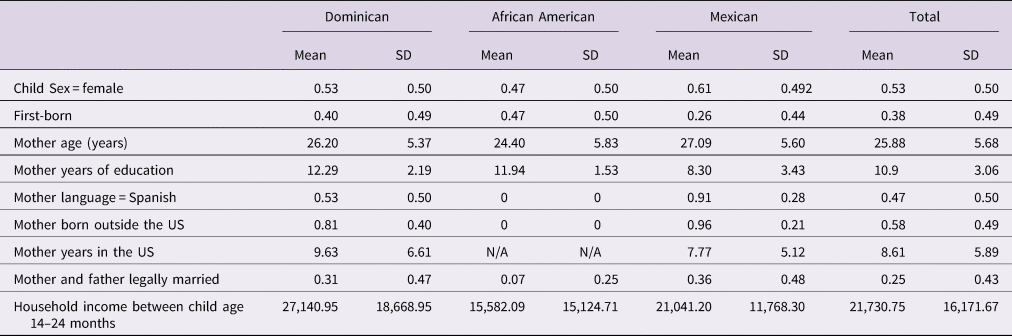
Participants were drawn from a longitudinal sample of mothers and infants, followed from infants’ birth through first grade. Mothers (N = 190), who self-identified as Dominican, Mexican, or African American, were recruited at public hospitals after giving birth to their full-term, healthy infants. Mothers were interviewed in their native language by researchers who were native speakers. Participant demographics are presented in Table 1. Mexican mothers reported significantly fewer years of education (M = 8.30, SD = 3.43) than both African American (M = 11.94, SD = 1.53) and Dominican (M = 12.29, SD = 2.19) mothers (ps < .001). No other differences emerged on demographic variables.
Participant demographics

Procedure
Mothers and infants were visited in their homes and video-recorded sharing two books (wordless number book and wordless emotion book) and playing with large beads and a string. The wordless number book included pictures of everyday objects of varying numbers (e.g., five cookies), sometimes with numerals. The emotion book featured photographs of infants expressing various emotions (e.g., crying, smiling). The books were not accompanied by any text so as to elicit mothers’ spontaneous language input. The beads were colorful wooden shapes such as spheres and squares that included strings for threading. Mothers were told: “We would like to video-record you and (CHILD) sharing some of the toys we brought.” We transcribed, coded, and analyzed language across the three segments, which totaled 7 minutes (2 min per book; 3 min for the beads).
Coding
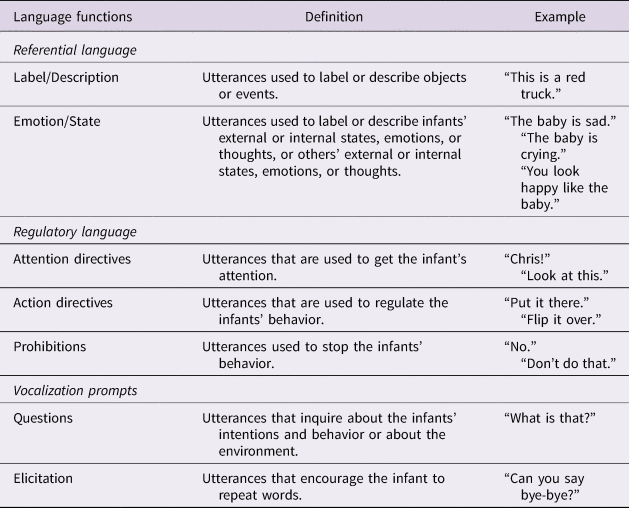
Mother–infant interactions were coded with INTERACT Software (Mangold, Reference Mangold2010). From video-records, bilingual coders noted the occurrence of each of seven utterance types (Table 2): labels/descriptions (e.g., “That's blue” ‘Eso es azul’), emotion/state language (e.g., “How does the baby feel?”), attention directives (e.g., “Mira!” ‘Look!’), action directives (e.g., “Ponlo ah” ‘Put it there’), prohibitions (e.g., ‘stop that’), questions (e.g., “Que color es este?” ‘What color is this?’), and elicitations (e.g., “Decir ‘silla’” ‘Say “chair”’). We did not consider affirmations (e.g., such as ‘Good job!’), conversational fillers (e.g., uh-huh?), or other statements that did not fit these categories, although such utterances may function to facilitate turn-taking in dyadic conversations (Benuš, Reference Benuš2013). Together, the seven language functions accounted for 83% of utterances at the 14-month assessment and 85% at the 24-month assessment, thus representing a substantial proportion of the speech that mothers directed to infants.
Definitions and examples of mothers’ language functions

The resulting seven language functions were classified into the broad categories of (1) referential language (i.e., mother provides or asks for information about objects or ongoing activities; includes labels/descriptions and emotion/state language); (2) vocalization prompts (i.e., mother encourages infant to use words); questions and elicitations; and (3) regulatory language (i.e., mother directs, prohibits, or corrects infants’ actions; includes attention directives, action directives, and prohibitions). Kappa inter-coder reliabilities for variables ranged from .89 to 1.0.
Results
Results are structured around the three research questions: (1) What language functions do mothers direct to their infants? (2) How do mothers of the three ethnicities compare in their functional language input to infants? (3) Do years of education, years in the United States, and infant sex relate to mothers’ language functions?
We conducted two General Linear Models with language functions to address research questions (1) and (2). In the first model, vocalization prompts, regulatory language, and referential language served as dependent variables; infant age, infant sex, and mother ethnicity served as between-subject factors; and mothers’ years of education was entered as a covariate. In the second model, mothers’ language functions were analyzed by their further breakdowns. Thus, the seven subcategories of maternal language functions – labels/descriptions and emotion/state language comprising referential language; attention directives, action directives, and prohibitions comprising regulatory language; and questions and elicitations comprising vocalization prompts – served as dependent variables. Again, infant age, sex, and mother ethnicity served as between-subject factors, and mothers’ years of education served as a covariate in analyses of the pragmatic subcategories. For question research (3), Pearson correlations tested associations between mothers’ education and language functions, and between years in the US and maternal language functions (the latter for first-generation Mexican and Dominican mothers only).
Maternal language functions: overall sample
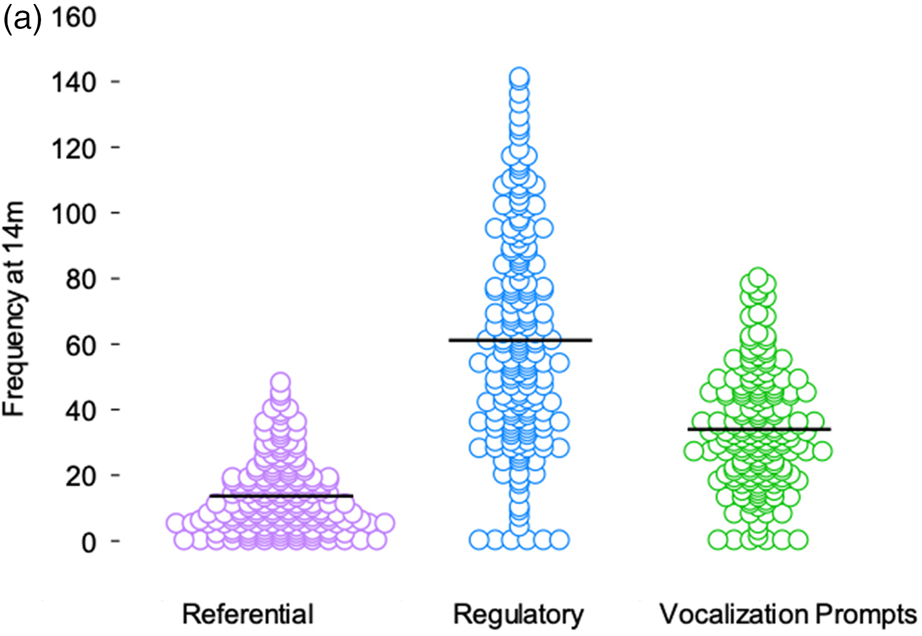
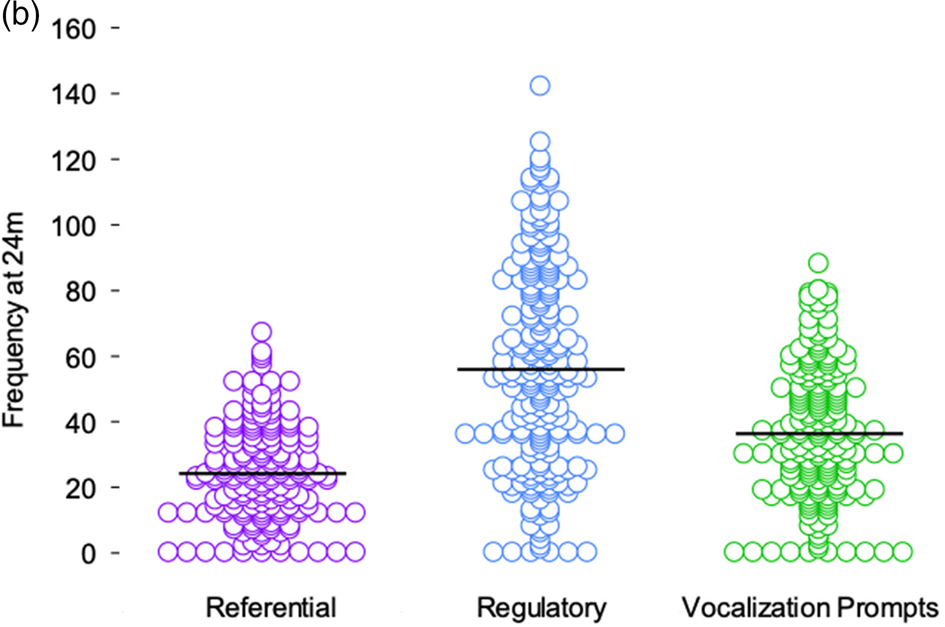
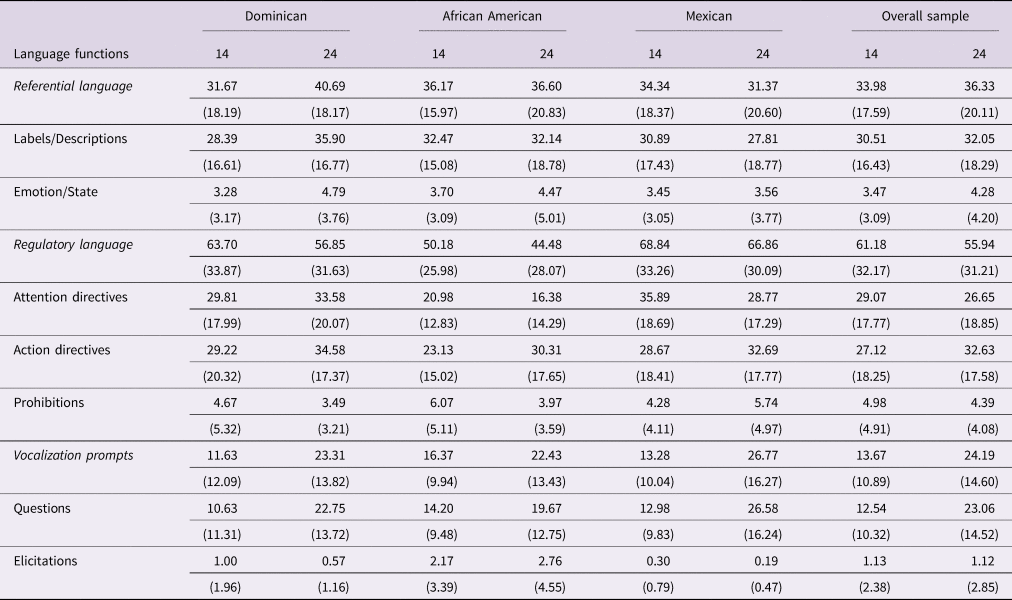
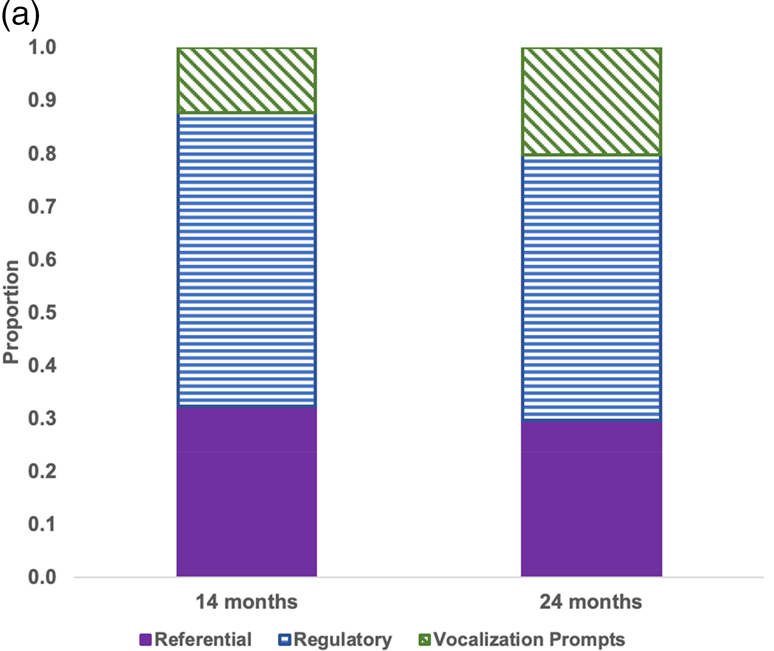
Mothers varied substantially in their use of the three language functions, within and across ethnic groups (Figures 1a and b; Table 3). On average, mothers used regulatory language most frequently, followed by referential language, then vocalization prompts, as indicated by a language main effect (F(2,294) = 20.13, p < .001). Post-hoc analyses confirmed that speech was distributed similarly across the three functions at both infant ages (ps < .001) (Referential: 14-month M = 33.97, SD = 17.59; 24-month M = 36.33, SD = 20.11; Regulatory: 14m M = 61.18, SD = 32.17; 24m: M = 55.94, SD = 31.21; Vocalization Prompts: 14m M = 13.67, SD = 10.89; 24m: M = 24.19, SD = 14.60). Thus, the language type × age interaction was not significant (F(2,294) = 1.39, p = .25).
Variation in language input at 14 months.

Variation in language input at 24 months.

Descriptive statistics for maternal language functions by ethnicity

Nonetheless, although the relative prevalence of language types remained constant across age, with rates of regulatory and referential language being high relative to elicitations, we explored the data further. When the language variables were tested separately, elicitations doubled from 14 to 24 months (t(154) = 8.74, p < .001), suggesting that mothers grew in their expectations around infant language participation, even if this function of language was infrequent relative to the others.
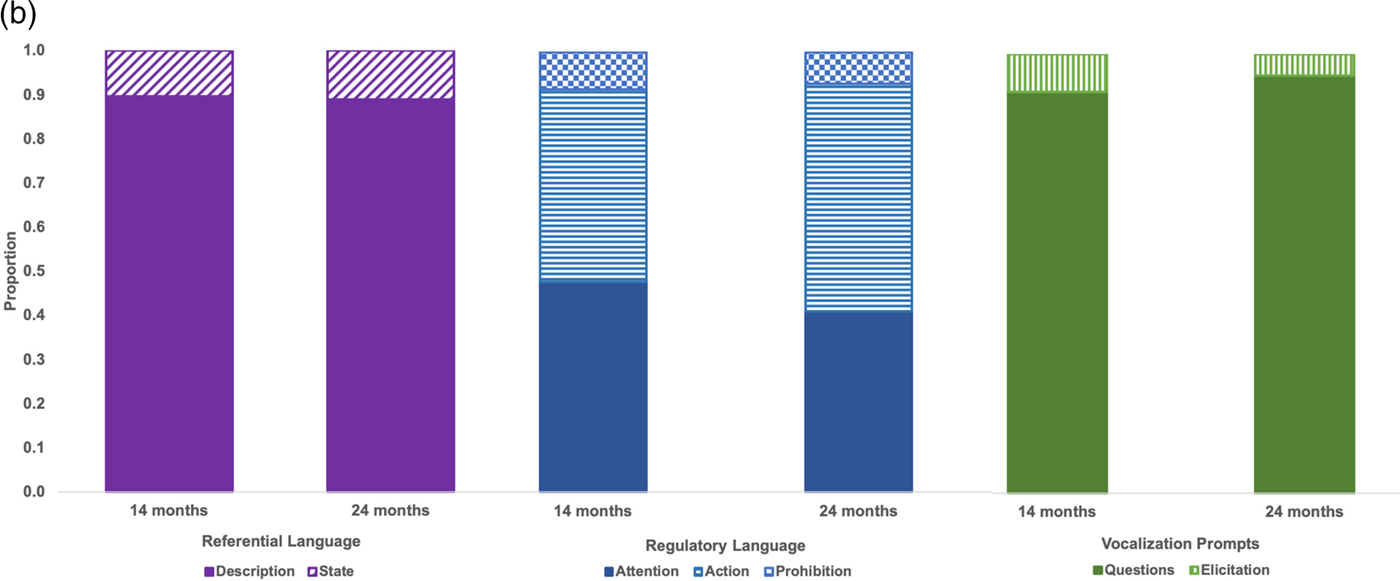
Analyses for subcategories within the three pragmatic functions revealed a language function main effect (F(6,882) = 9.64, p < .001). At 14 and 24 months, most subcategories of language functions differed significantly from one another. The vast majority of referential utterances were labels/descriptions at both ages (Ms = 90% and 89%), with the remaining being emotion/state language (Ms = 10% and 11%). As hypothesized, within regulatory language, mothers primarily used attention directives (Ms = 48% and 41%) and action directives (Ms = 44% and 52%), with few prohibitions (Ms = 8% and 7%). Mothers primarily prompted infant vocalizations through questions (Ms = 91% and 95%), followed by elicitations (Ms = 9% and 5%) (Figures 2 and 3).
Proportion of referential, regulatory, and vocalization prompts out of total language.

Proportion of subcategories of referential language, regulatory language, and vocalization prompts, respectively.

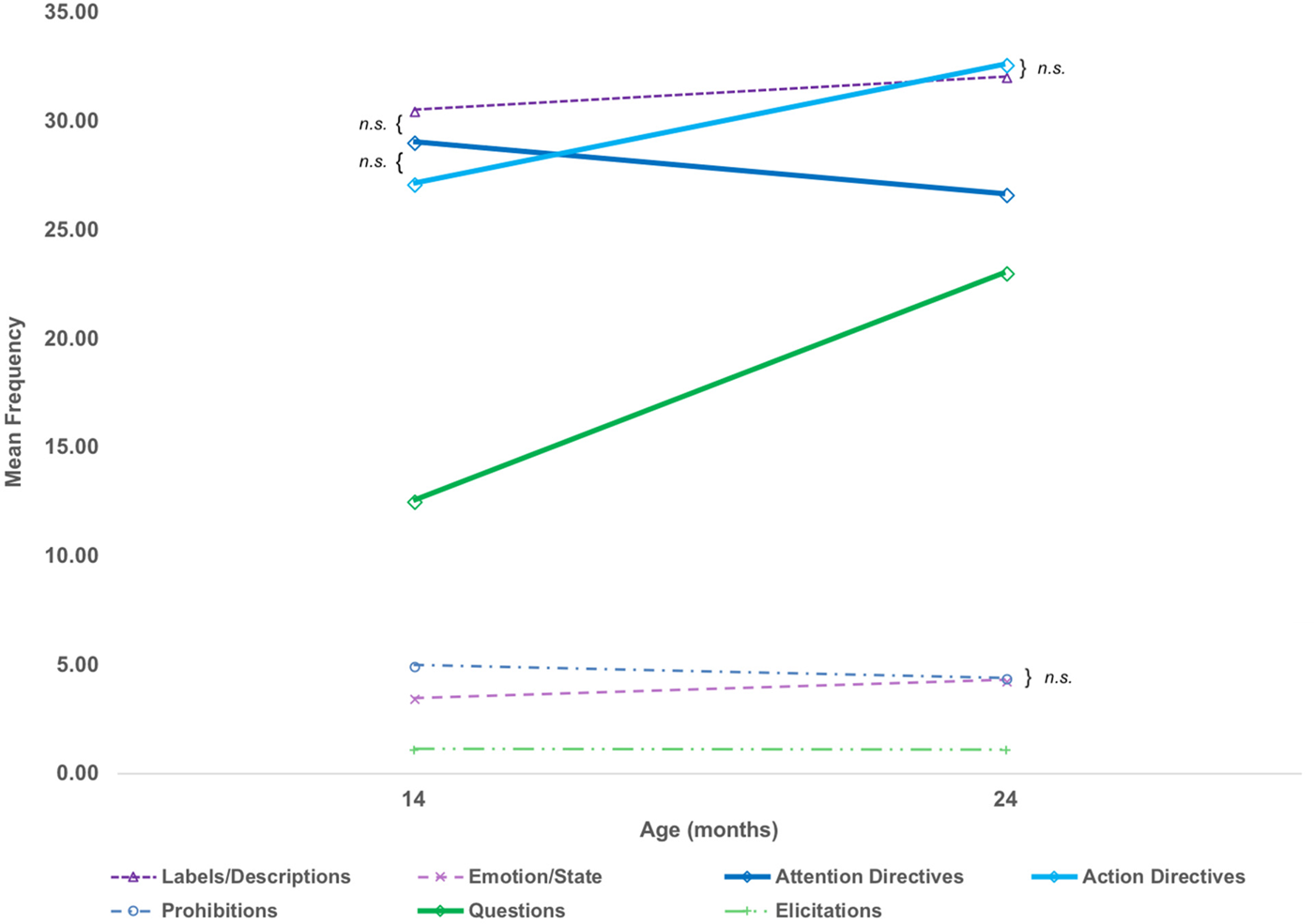
Change in mean frequency of subcategories between 14 and 24 months. Significant developmental changes denoted in solid, bolded lines. All differences between language subtypes at each age are significant, unless noted otherwise (n.s.).

A language subtype by × age interaction indicated that mothers changed in their use of language function subcategories between the two infant ages (F(6,882) = 2.36, p < .05). Mothers increased questions from 14 months to 24 months (t(154) = 8.8, p < .001), prompting older infants to participate in more conversations than younger ones. Mothers also increased action directives (t(154) = 2.75, p < .01) between the 14- and 24-month assessment; at the same time they decreased their attention directives (t(154) = 2.01, p < .05) (Figure 3). Thus, mothers shifted from directing infant attention to directing infant action, likely revealing attunement to infants’ growing skills to attend and engage with the materials.
Maternal language functions: ethnic comparisons
To address our second research question, we examined ethnic differences in mothers’ language functions. An omnibus test for the language type × ethnicity interaction confirmed that mothers from the three ethnic groups differed in their frequencies of referential language, regulatory language, and vocalization prompts (F(4,294) = 5.44, p < .001). Similarly, ethnic differences emerged in mothers’ use of the seven language function subcategories, as indicated in an omnibus language subtype × ethnicity interaction (F(12,882) = 6.08, p < .001).
Referential language
Post-hoc analyses indicated that mothers from the three ethnic groups did not differ in their referential language when infants were 14 months of age (F(2,184) = 1.055, p = .35). However, when infants were 24 months, Dominican mothers used more referential language than did Mexican mothers (F(2,186) = 3.56, p < .05). Further, follow-up analyses of the language subcategories under referential language at the 24-month assessment showed that Dominican mothers used more labels/descriptions than did Mexican mothers, with African American mothers falling between the other ethnic groups when infants were 24 months (F(2,184) = 3.22, p < .05). There were no differences in labels/descriptions by ethnicity when infants were 14 months of age. Mothers’ use of emotion/state language did not differ by ethnicity at either age (ps > .05). Mothers of boys versus girls did not differ in referential language or its subcategories.
Regulatory language
Mexican and Dominican mothers used more regulatory language than did African American mothers at the 14-month assessment (F(2,188) = 5.81, p < .01) and 24 months (F(2,188) = 9.98, p < .001). Mexican and Dominican mothers used more attention directives specifically than did African American mothers at the 14-month assessment (F(2,188) = 12.29, p < .001) and at 24 months (F(2,188) = 15.67, p < .001). Mothers did not differ on action directives across ethnic groups at the 14- or 24-month assessments. Differences in mothers’ use of prohibitions emerged at 24 months (F(2,188) = 5.59, p < .01). Mexican mothers used more prohibitions with their infants than did Dominican and African American mothers.
Subcategories of regulatory language differed by infant sex. When infants were 14 months, mothers of sons used more prohibitions than did mothers of daughters (t(189) = 2.92, p < .01). When infants were 24 months, mothers of sons used more action directives and attention directives than did mothers of daughters (t(189) = 2.04, p < .05 and t(189) = 2.14, p < .01, respectively). Thus, the functional use of language to socialize behavior was stronger in mothers of sons than of daughters.
Vocalization prompts
As hypothesized, African American mothers used more vocalization prompts than did Dominican and Mexican mothers with their 14-month-old infants (F(2,188) = 3.13, p < .05). Delving more deeply into this difference, African American mothers used more elicitations when infants were 14 months than did Dominican and Mexican mothers (F(2,188) = 10.67, p < .001). Similarly, African American mothers continued to use more elicitations than Dominican mothers and Mexican mothers when infants were 24 months (F(2,188) = 16.46, p < .001). Mothers from all ethnic groups increased their vocalization prompts between the 14- and 24-month assessments (t(154) = 8.74, p < .001). However, vocalization prompts, which were low overall, did not differ by ethnicity when infants were 24 months of age (F(2,188) = 1.52, p = .22).
There were no differences by infant sex for mothers’ vocalization prompts and its subcategories.
Maternal language functions: demographic correlates
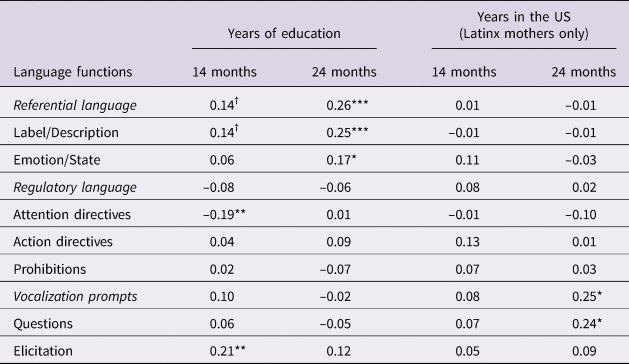
We conducted bivariate Pearson correlations to examine associations from mothers’ years of education and years in the US and functional language (Table 4).
Correlations between subcategories of maternal language types and selected demographic variables

Notes. †p < .08, *p < .05, **p < .01, ***p < .001.
Years of education
As hypothesized, mothers’ years of education related to more frequent use of referential language and prompting of infant vocalizations. Specifically, maternal education related to mothers’ use of referential language when infants were 14 months (r(185) = 0.14, p = .056), albeit marginally, and when infants were 24 months (r(183) = 0.26, p < .001). At the 14-month assessment, the association between education and referential language was seen for subcategories of elicitations (r(185) = 0.21, p < .01) and labels/descriptions (r(185) = 0.14, p = .058). At the 24-month assessment, education related to mothers’ use of labels/descriptions (r(183) = 0.25, p < .001) and emotion/state language (r(183) = 0.17, p < .05). In contrast, years of education negatively related to attention directives when infants were 14 months (r(185) = –0.19, p < .01). Thus, with increasing education, mothers tended to use language as a tool to teach rather than as a tool to regulate infant attention.
Years in the US
Last, we analyzed whether mothers’ language related to years in the US. Because all African American mothers were at least third-generation US citizens, we conducted analyses on Dominican and Mexican families born outside the US (81% of Dominicans, and 96% of Mexicans). At the 14-month assessment, years in the US did not relate to mothers’ language functions. But, by the 24-month assessment, years in the US related to mothers’ vocalization prompts (r(103) = 0.25, p < .05), particularly questions (r(103) = 0.24, p < .05). Thus, mothers who had spent more time in the US were more likely to use language to encourage infant vocalizations than those with fewer years in the US.
Discussion
Infants are socialized to learn through language and to use language (Schieffelin & Ochs, Reference Schieffelin and Ochs1986). Language functions to convey information about the world and encourage infants to participate in conversational turn-taking. Additionally, language is a primary means to socialize infants’ attention and actions through imperatives. The current sample of ethnically diverse families, largely low-income mothers, primarily used regulatory language, which contrast with the high use of didactic or referential language in White non-Latina middle-class mothers (e.g., Bergelson et al., Reference Bergelson, Amatuni, Dailey, Koorathota and Tor2019; Rondal, Reference Rondal1980; Tamis-LeMonda et al., Reference Tamis-LeMonda, Custode, Kuchirko, Escobar and Lo2018). Further, mothers’ being African American versus Latina, years of education, and years in the US corresponded to a heightened use of language as a tool to teach and prompt infant vocalization and the decreased use of language to regulate behavior, particularly attention.
Closer examination of language subcategories revealed ethnic differences in attention-directive language, rather than action directives and prohibitions, particularly for Mexican immigrant mothers. Latina mothers, who comprised two-thirds of our sample, might use regulatory language to socialize their infants to be well behaved, inculcating in them the value of educado and respeto (Halgunseth et al., Reference Halgunseth, Ispa and Rudy2006). Mothers’ use of attention directives aligns with previous research on the cultural emphasis on children learning through observation rather than from direct instruction (Shneidman, Gaskins, & Woodward, Reference Shneidman, Gaskins and Woodward2016; Shneidman & Goldin-Meadow, Reference Shneidman and Goldin-Meadow2012). In a culture where observation precedes learning, visual attention – and prompts for attention when a child is not focused – may be central to mother–child interactions.
The pragmatics of mothers’ language may reflect, in part, the specific context of the activities in which dyads participated. Indeed, contextual influences on language are well documented (Hoff, Reference Hoff2010; Soderstrom & Wittebolle, Reference Soderstrom and Wittebolle2013; Tamis-LeMonda et al., Reference Tamis-LeMonda, Custode, Kuchirko, Escobar and Lo2018; Tamis-LeMonda et al., Reference Tamis-LeMonda, Song, Leavell, Kahana-Kalman and Yoshikawa2012; Tardif, Gelman, & Xu, Reference Tardif, Gelman and Xu1999). Structured play and book reading typically promote more language input from parents than do other activities such as mealtimes and transitions (Soderstrom & Wittebolle, Reference Soderstrom and Wittebolle2013), with an emphasis on nouns during book-reading and verbs during play (Tardif et al., Reference Tardif, Gelman and Xu1999). Moreover, different forms of object play afford unique language input from parents: labels and descriptions during early object exploration; spatial language during block building and puzzle play; and internal state language during pretend play (Tamis-LeMonda & Schatz, Reference Tamis-LeMonda, Schatz, Horst, von Koss and Torkildsenin press).
Here, the structured play task consisted of beads and a string, a fine motor task that may have lent itself to frequent behavior directives, and differs from toys typical used in structured play tasks (e.g., dolls, nesting cups, blocks, trucks, stuffed animals, and kitchen set) that elicit higher levels of referential language (Bakeman & Adamson, Reference Bakeman and Adamson1986; Bigelow, MacLean, & Proctor, Reference Bigelow, MacLean and Proctor2004; Hirsh-Pasek et al., Reference Hirsh-Pasek, Adamson, Bakeman, Owen, Golinkoff, Pace, Yust and Suma2015). The books provided to mothers in this study were wordless, removing many of the cues and supports for dense language exchanges that are typically associated with shared book-reading (Hoff, Reference Hoff2010; Montag, Jones, & Smith, Reference Montag, Jones and Smith2015). In the absence of words or narrative plots, the books in this study may have prompted mothers to use greater levels of regulatory language to guide infants’ attention to each image. Future work should examine mothers’ language to infants in different activity contexts in greater detail by focusing on how the features of books and objects elicit different forms of speech mothers use with their infants.
Findings also shed light on the nuanced ways that mothers communicated information, guided action, and elicited infants’ participation. Although mothers used regulatory language at a relative high frequency, they rarely prohibited their infants’ actions. Rather, mothers most frequently elicited infants’ attention and guided infants’ action. These patterns show the importance of distinguishing between supportive directives versus directives that inhibit infant participation (Vallotton, Mastergeorge, Foster, Decker, & Ayoub, Reference Vallotton, Mastergeorge, Foster, Decker and Ayoub2017). Furthermore, developmental context shaped the pragmatics of mothers’ language. With age, mothers increased in their use of action directives and questions but decreased in their use of attention-directive statements, presumably reflecting infants’ growing skills at focusing attention, engaging in the tasks at hand, and contributing verbally to interactions (Deák et al., Reference Deák, Walden, Kaiser and Lewis2008). Notably, all forms of regulatory language were higher in mothers of boys than in mothers of girls, perhaps reflecting mothers’ greater focus on managing the behaviors of boys (Endendijk et al., Reference Endendijk, Groeneveld, Bakermans-Kranenburg and Mesman2016).
Mothers’ education and years in the US were associated with higher use of referential language and/or the use of language to encourage infant vocal participation. Others show that education maps to greater amount, diversity, and grammatical complexity in language inputs (Hoff, Reference Hoff2003; Huttenlocher, Vasilyeva, Waterfall, Vevea, & Hedges, Reference Huttenlocher, Vasilyeva, Waterfall, Vevea and Hedges2007). Our research extends those findings to the pragmatics of language, suggesting that educational differences in traditional measures of language (such as word types and tokens) might play out in how frequently mothers use language to provide information or guide children's behavior.
Limitations and cautions
Three limitations warrant mention. The structured nature of the tasks may have predisposed mothers toward high engagement and high language input. Therefore, our findings are only a snapshot of the kinds of language inputs mothers provide infants during everyday routines. Longer observational periods might yield very different pictures about the amount and type of language that mothers direct to infants (Bergelson et al., Reference Bergelson, Amatuni, Dailey, Koorathota and Tor2019; Soderstrom & Witterbolle, Reference Soderstrom and Wittebolle2013; Tamis-LeMonda, Kuchirko, Luo, Escobar, & Bornstein, Reference Tamis-LeMonda, Kuchirko, Luo, Escobar and Bornstein2017). Interestingly, although structured tasks such as book-sharing and play pull for high referential language (e.g., Tamis-LeMonda et al., Reference Tamis-LeMonda, Custode, Kuchirko, Escobar and Lo2018), mothers in our sample used regulatory language most frequently, and of different forms, which might be explained by cultural and demographic factors and the tendency of bead-stringing to pull for this form of language.
Second, our measures of family context and sampling of families were narrow. We did not account for family structure, income and economic mobility, or neighborhood and home environments, which certainly play a role in infants’ language environments. Moreover, the families within each ethnic group may neither generalize to other members of the same ethnic background, nor reflect the values of their ethnicity as much as their behaviors in a specific cultural context and point in time. For example, Mexican mothers were largely from the rural Puebla region, and were now living as ethnic minorities in a specific region in the US context.
Third, effect sizes, which were based on averages, were moderate, and sometimes small. Thus, although mother ethnicity, education, years in the US, and child age and gender each contributed to how mothers used language with their infants, variation among mothers was striking for every language measure we studied.
Conclusion
Language is a tool that serves a variety of functions, ranging from imparting new knowledge to guiding attention and actions. Most research emphasizes the didactic, informative functions of language. However, when the lens of inquiry is broadened beyond mainstream assumptions about language inputs to children, to consider families from different ethnic and SES backgrounds, regulatory language surfaces as a primary way that mothers engage their infants, by informing infants about where to look and what to do.
In closing, our study takes a small step toward expanding inquiry on mothers’ language inputs to infants to US families who are typically under-represented in the developmental literature. In doing so, we show that multiple factors at the intersection of culture, development, and context contribute to the pragmatics of mothers’ language – including infant age and sex and mothers’ ethnicity, education, and years in the US. Whether and how differences in the pragmatics of language affect children's developing language constitute important next steps.
Acknowledgment
We acknowledge funding by NSF BCS grant #021859 and NSF IRADS grant #0721383.