





Suicide has been one of the leading direct causes of maternal death in the UK for over a decade, Reference Knight, Nair, Tuffnell, Kenyon, Shakespeare and Brocklehurst1 and remains among the leading causes of maternal mortality in other high-income countries. Reference Diguisto, Saucedo, Kallianidis, Bloemenkamp, Bodker and Buoncristiano2 For example, between 2021 and 2023, a third (34%) of maternal deaths in the UK occurring between 6 weeks and 1 year after birth were attributable to mental health causes, with suicide the leading direct cause in this period. Reference Felker, Patel, Kotnis, Kenyon and Knight3 Globally, prevalence varies: suicide accounts for 5–20% of maternal deaths in high-income countries Reference Grigoriadis, Wilton, Kurdyak, Rhodes, Vonder Porten and Levitt4–Reference Trost, Beauregard, Chandra, Njie, Berry and Harvey6 and 1–5% in low- and middle-income countries, Reference Fuhr, Calvert, Ronsmans, Chandra, Sikander and De Silva7 although differences in reporting systems and classifications may underestimate true rates. Reference Howard and Khalifeh5,Reference Chin, Wendt, Bennett and Bhat8,Reference Simmons, Gong, Daskalopoulou, Quigley, Alderdice and Harrison9 Estimates of suicidal ideation in pregnancy and after birth are harder to establish because of variation in samples, designs and measures, but a recent review across 23 countries reported a pooled prevalence of 8%. Reference Xiao, Hu, Huang, Wang, Zhao and Lei10
Identifying maternal suicidality
Identifying suicidal ideation and behaviours could lead to preventative intervention and reductions in suicide. However, identifying suicidality is difficult. Suicide is a complex phenomenon that encompasses a spectrum of thoughts and behaviours, including suicidal ideation (thinking about ending one’s life), suicidal planning or intent (formulating a method or plan) and suicide attempts (engaging in potentially self-lethal behaviour). Universal screening for common perinatal mental health problems is not currently recommended in the UK, 11 and stigma, shame, guilt and fear can inhibit disclosure. Reference Dudeney, Coates, Ayers and McCabe12,Reference Dudeney, Meades, Ayers and McCabe13 As a result, many women requiring specialist care go unidentified. Risk is shaped by multiple factors, including psychiatric history, Reference Martini, Bauer, Lewitzka, Voss, Pfennig and Ritter14 comorbidity, Reference Howard and Khalifeh5 substance misuse, Reference Modini, Leske, Roberts, Whelan, Chitakis and Crompton15 intimate partner violence, Reference Alhusen, Frohman and Purcell16 adverse childhood experiences, Reference Jasthi, Nagle-Yang, Frank, Masotya and Huth-Bocks17 pregnancy or infant loss, Reference Knight, Bunch, Tuffnell, Patel, Shakespeare and Kotnis18 unplanned or unwanted pregnancy, Reference Fellmeth, Nosten, Khirikoekkong, Oo, Gilder and Plugge19 sleep disturbance Reference Palagini, Cipriani, Miniati, Bramante, Gemignani and Geoffroy20 and health complications. Reference Molla, Nigussie and Girma21 Sociodemographic risks include younger age, non-White ethnicity, deprivation, being unmarried Reference Orsolini, Valchera, Vecchiotti, Tomasetti, Lasevoli and Fornaro22 and lack of social and partner support. Reference Arditi-Arbel, Hamdan, Winterman and Gvion23 Nonetheless, meta-analytic evidence suggests that research on specific risk factors for perinatal suicide risk is lacking. Reference Gelabert, Plaza, Roca-Lecumberri, Bramante, Brenna and Garcia-Esteve24
Although there is evidence that pregnancy and having a baby can protect against suicide, Reference Khalifeh, Hunt, Appleby and Howard25 the extent of these protective effect may be inflated, Reference Chin, Wendt, Bennett and Bhat8 and the postnatal period carries higher risk of suicide deaths. Reference Felker, Patel, Kotnis, Kenyon and Knight3
Inequalities in maternal suicidality
Women from ethnic minority groups are disproportionately affected, facing barriers and inequalities in maternity mental health care that increase risks of untreated mental health problems and suicidality. Reference Conneely, Packer, Bicknell, Jankovic, Kaur Sihre and McCabe26,Reference Jankovic, Parsons, Jovanovic, Berrisford, Copello and Fazil27 Targeted, evidence-based approaches to identification, intervention and prevention are therefore needed. This priority is recognised in the UK’s cross-government suicide prevention plan, which calls on maternity services to explore suicide risk factors at every contact. 28
Methodological considerations
Most studies on prevalence, correlates and risk factors for perinatal suicidality use cross-sectional designs, Reference Xiao, Hu, Huang, Wang, Zhao and Lei10,Reference Arditi-Arbel, Hamdan, Winterman and Gvion23,Reference Reid, Pratt, Edge and Wittkowski29 which limit inferences about directionality or temporal associations. Longitudinal approaches are needed to establish patterns, identify when risk is greatest and explore factors over time. This study therefore aimed to (a) determine the prevalence of suicidal intent in pregnancy and postpartum; and (b) examine associated risk factors for suicidal intent during pregnancy and the early postnatal periods – an understudied outcome. Improved understanding will help identify women at risk and inform prevention and intervention.
Method
Study design and population
Secondary analysis of the Methods of Assessing Perinatal Anxiety (MAP) longitudinal cohort of 2243 women recruited in the first trimester of pregnancy from November 2020 to November 2021 (research registry reference 5980). Reference Ayers, Coates, Sinesi, Cheyne, Maxwell and Best30 Participants in the MAP study completed mental health assessment questionnaires at four time points: early pregnancy (mean gestation 11.4 weeks, s.d. 2.0, range 5–16), mid-pregnancy (mean gestation 23.0, s.d. 1.3, range 21–27), late pregnancy (mean gestation 31.9, s.d. 1.2, range 30–35) and postpartum (mean 7.9 weeks, s.d. 2.4, range 4–17). Women were eligible for the MAP study if they were aged 16 years or over, <15 weeks pregnant at the time of recruitment, able to provide written informed consent and had sufficient English to understand and complete questionnaires. A 10:1 ratio of participants from England and Scotland were recruited to reflect the number of annual births for the two nations.
Secondary analyses were based on 2210 women who completed the measure of suicidal intent on at least one time point. Participants were aged 16–50 years (mean 31.34, s.d. 5.18). Most were married or cohabiting (n = 1749, 87.84%), of White ethnicity (n = 1548, 77.25%) and educated to undergraduate degree level or above (n = 1235, 61.62%). Around a third (n = 741, 36.34%) reported a history of mental health problems (see Supplementary Table 1). For analysis of risk factors, participants were grouped into those who expressed suicidal intent at any time point (n = 72) and those who did not (n = 2138).
Measures
Suicidal intent and general distress were measured with the Clinical Outcomes in Routine Evaluation (CORE-10). Reference Barkham, Bewick and Mullin31 The CORE-10 is a ten-item measure of psychological distress derived from the larger CORE – Outcome Measure. It asks respondents about how they have been feeling over the past week. The ten items are scored on a 0–4 Likert scale. Suggested cut-off scores are as follows: 5–10 indicate low-level problems, 10–15 indicates mild psychological distress, 15–20 indicates moderate distress, 20–25 indicates moderately severe distress and 25–40 indicates severe psychological distress. Reference Barkham, Bewick and Mullin31
Suicidal intent was measured by the item on the CORE-10 ‘I have made plans to end my life’, with response options of ‘not at all’, ‘only occasionally’, ‘sometimes’, ‘often’ or ‘most or all of the time’. Suicidal intent was coded as present for participants who made any response other than ‘not at all’.
The CORE-10 has good psychometric properties with perinatal women and performs better than measures of anxiety (Generalised Anxiety Disorder-2) and depression (Whooley Questions) at identifying women worried about their psychological health. Reference Ayers, Coates, Sinesi, Cheyne, Maxwell and Best30 The CORE-10 is recommended by the UK Royal College of Psychiatrists as a core outcome measure for perinatal services. 32
Anxiety was assessed with two measures. The Generalised Anxiety Disorder-7 (GAD-7) Reference Spitzer, Kroenke, Williams and Lowe33 consists of seven self-report items used to identify probable cases of generalised anxiety disorder. Items are scored on a 0–3 scale and higher scores reflect greater anxiety severity. Total scores range from 0 to 21, with a recommended cut-off score of 10. Reference Ayers, Coates, Sinesi, Cheyne, Maxwell and Best30 The Stirling Antenatal Anxiety Scale (SAAS) Reference Sinesi, Cheyne, Maxwell and O’Carroll34 is a ten-item, clinically derived measure developed specifically for anxiety in pregnancy and subsequently validated for use postpartum. The SAAS includes general anxiety and pregnancy-specific anxiety items. The pregnancy-specific items are about the birth and baby, meaning the scale can be used postnatally. Items are scored on a 0–4 Likert scale, with a cut-off score of 9 and above giving optimal sensitivity and specificity in diagnosing anxiety disorders. The scale has good diagnostic accuracy and there is some evidence it performs better than the GAD-7 at identifying women with perinatal anxiety. Reference Ayers, Coates, Sinesi, Cheyne, Maxwell and Best30
Depression was assessed with the Whooley Questions, Reference Whooley, Avins, Miranda and Browner35 two yes/no questions widely used in UK maternity services. 36 Answering ‘yes’ to one or both of the questions indicates possible depression. The GAD-7, CORE-10 and Whooley Questions are included in UK clinical guidance on perinatal outcome measures and care pathways for perinatal mental health. 36,37,38
Difficulty with daily life was assessed by one item asking how difficult psychological symptoms made it for participants to ‘do your work, take care of things at home, or get along with other people?’. Answers were scored on a four-point scale (not at all difficult, somewhat difficult, very difficult, extremely difficult).
Participants were also asked in early pregnancy whether they had ever experienced psychological or mental health problems (yes/no/don’t know) and, if so, to indicate which mental health problem(s) from a list of anxiety or anxiety related problems, depression, bipolar disorder, post-traumatic stress disorder, borderline/personality disorder, psychosis, dissociation/dissociative disorders, eating disorders, sleep or wake disorders, attention-deficit hyperactivity disorder, obsessive–compulsive disorder, schizophrenia and other.
Sociodemographic characteristics were measured using standard classifications for England 39 or Scotland, 40 and included age, ethnicity, education and relationship status.
General health was measured with the EuroQoL EQ-5D-5L. Reference Herdman, Gudex, Lloyd, Janssen, Kind and Parkin41 The EQ-5D-5L is a preference-based measure of health status and quality of life widely used in health research. It includes a visual analogue scale asking participants to assess their overall health that day, on a scale from 0 to 100. In addition to the EQ-5D-5L, participants were asked at baseline to indicate whether they had existing health conditions (high blood pressure, stroke, diabetes, angina/heart attack, anxiety/depression, arthritis, back problems, thyroid problem, eczema/psoriasis, liver disease, kidney disease, asthma, chronic bronchitis, emphysema, cancer, irritable bowel syndrome, migraine, other).
Pregnancy experiences were measured with individual items which asked women whether their pregnancy was planned (yes/no), how they felt about becoming pregnant (five-point scale from very unhappy to very happy), whether women had a previous pregnancy (yes/no) how many children women had before the current pregnancy and whether they had previously experienced a miscarriage or stillbirth (yes/no/prefer not to say).
Procedure
All participants were recruited by research midwives/nurses or clinical midwives around the time of their antenatal booking appointment or pregnancy scan. Information about the study was given at this point, and participants could either provide informed consent and be given the first questionnaire at that point or consent for their contact details to be shared with the research team who would follow up with them, provide more information, answer questions and gain consent. Questionnaire measures were sent and completed online or by post, according to participants’ preferences. The order of presentation of the assessment measures was counterbalanced to minimise risk of bias in response patterns.
Safeguarding protocols were in place for participants who reported suicidal intent. Participants who scored any response other than ‘not at all’ on the suicide item on the CORE-10 were contacted by telephone within 24 h of receiving their questionnaire and a suicide risk assessment was conducted. If participants did not answer they were messaged by email or text to explain the research team were trying to contact them. Three contact attempts were made and risk assessments discussed with the clinical leads for the MAP programme. Action was taken if appropriate (e.g. referral or contact with participant’s local specialist mental health midwife or general practitioner).
Regardless of a participant’s responses to the item on suicide, if they scored above clinical thresholds for anxiety and/or depression, they were contacted by post or email to encourage them to see a health professional and provide information about options such as helplines and self-referral to mental health services.
Ethical approval
The authors assert that all procedures contributing to this work comply with the ethical standards of the relevant national and institutional committees on human experimentation and with the Helsinki Declaration of 1975, as revised in 2013. All procedures involving human patients were approved by the National Health Service West of Scotland Research Ethics Service (WoSREC 3. reference 20/WS/0065), Health Research Authority (reference IRAS 274901) and City St Georges, University of London (reference ETH1920-0572).
Statistical analysis
As women completed the questions at four time points, their responses were analysed in two ways: by observation and by participant.
Sociodemographic characteristics that were stable over time and/or were only assessed at baseline (highest level of education, age, ethnicity, previous experience of mental health problems, previous treatment, type of treatment, number of children, previous pregnancy loss, whether the pregnancy was planned, previous mental health problems, health conditions) were analysed at the level of participant. Results are presented as number and percentage of participants in each category, and are reported separately for those who ever reported suicidal intent during the study waves versus those who never reported suicidal intent. The association of suicidal intent with categorical independent variables was assessed with Firth logistic regression, which uses penalised maximum likelihood and is suitable for rare outcomes. Reference Firth42 For continuous independent variables, the association was assessed through independent samples t-tests.
For independent variables that were captured as repeated measures over multiple time points, these were analysed as observations nested within participants. The association of mental health continuous independent variables (scores on the CORE-10, GAD-7, Whooley Questions and SAAS) with suicidal intent at the same time point was examined with Bayesian mixed-effects models. Bayesian mixed-effects models were employed because of the sparseness of the outcome variable. A weakly informative prior was used (time point and independent variables coefficients distributed normal (0,2.5), and constant distributed normal (0,10)). The outcome was coded as a binary variable of any suicidal intent at that time point versus none. A random effect of participant was included in the model to account for correlation of repeated measures on individuals, and time point was included as a covariate. The mental health continuous independent variables (scores on the CORE-10, GAD-7, Whooley Questions and SAAS) were converted to standard scores (mean 0, s.d. 1) to enable direct comparison of the odds ratios. Odds ratios are reported with their 95% confidence interval. Because of the low prevalence of suicidal intent, it was not possible to fit multivariable models including multiple predictors simultaneously. Therefore, each independent variable was examined in a separate model, with longitudinal analyses adjusted for time point and clustering within individuals. Analysis was conducted with Stata version 16 or above for Windows (StataCorp LLC, College Station, TX, USA; https://www.stata.com).
Results
Prevalence of suicidal intent in pregnancy and after birth
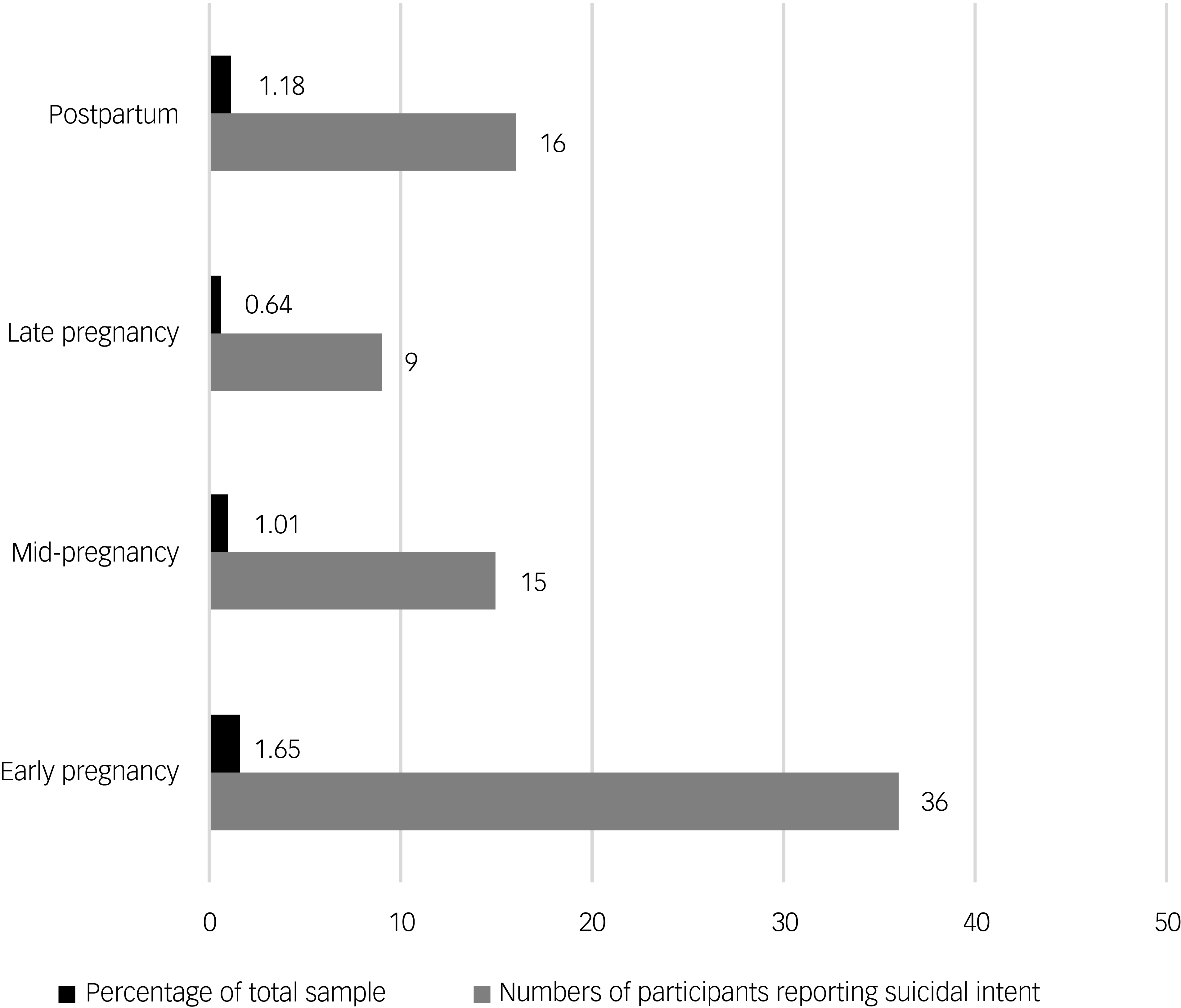
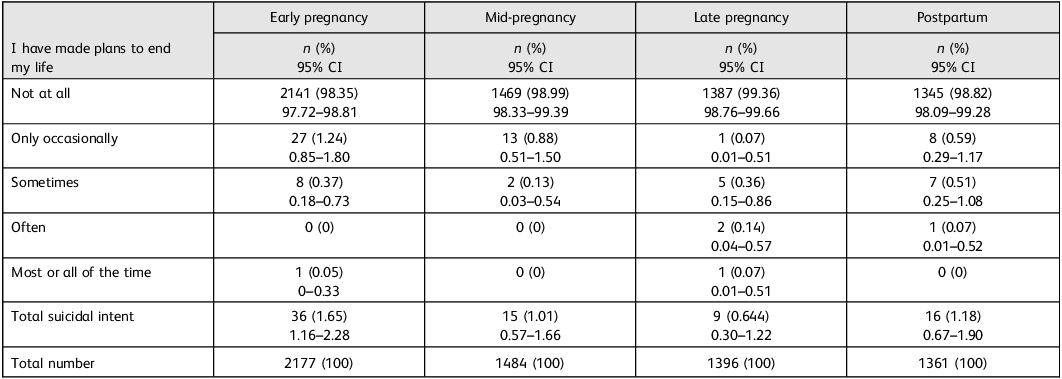
The number of participants who reported suicidal intent is shown in Fig. 1, with the corresponding prevalence. In this sample, 72 participants (3.26%, 95% CI 2.56–4.09) reported some level of suicidal intent on at least one time point during pregnancy or after birth. Of these 72 participants, nearly all (n = 69) only reported suicidal intent at one time point, two reported suicidal intent at two time points and one participant reported suicidal intent at three time points. The prevalence of suicidal intent ranged from 1.65% (95% CI 1.16–2.28) in early pregnancy to 0.64% (95% CI 0.30–1.22) in late pregnancy (see Table 1). Women were more likely to report suicidal intent in early pregnancy compared with the late pregnancy time point (odds ratio 2.59, 95% CI 1.22–5.51). There were no other significant differences between time points in the probability of reporting suicidal intent.
Number of participants and proportion of sample reporting suicidal intent.

Prevalence of suicidal intent at different time points

Table 1 Long description
A table showing the prevalence of suicidal intent during different stages of pregnancy and postpartum. The table has 6 rows and 5 columns. The columns are labeled as Early pregnancy, Mid-pregnancy, Late pregnancy, and Postpartum. The rows are labeled with different frequencies of suicidal intent: Not at all, Only occasionally, Sometimes, Often, Most or all of the time, Total suicidal intent, and Total number. Each column contains the number of participants (n), the percentage (%), and the 95% confidence interval (95% CI) for each category of suicidal intent. The table shows that the majority of participants reported not having plans to end their life at all stages, with percentages ranging from 98.82% in the postpartum period to 99.36% in late pregnancy. The total number of participants varies slightly across the stages, with 2177 in early pregnancy, 1484 in mid-pregnancy, 1396 in late pregnancy, and 1361 in the postpartum period. The table also includes the total suicidal intent and the total number of participants for each stage.
Factors associated with suicidal intent
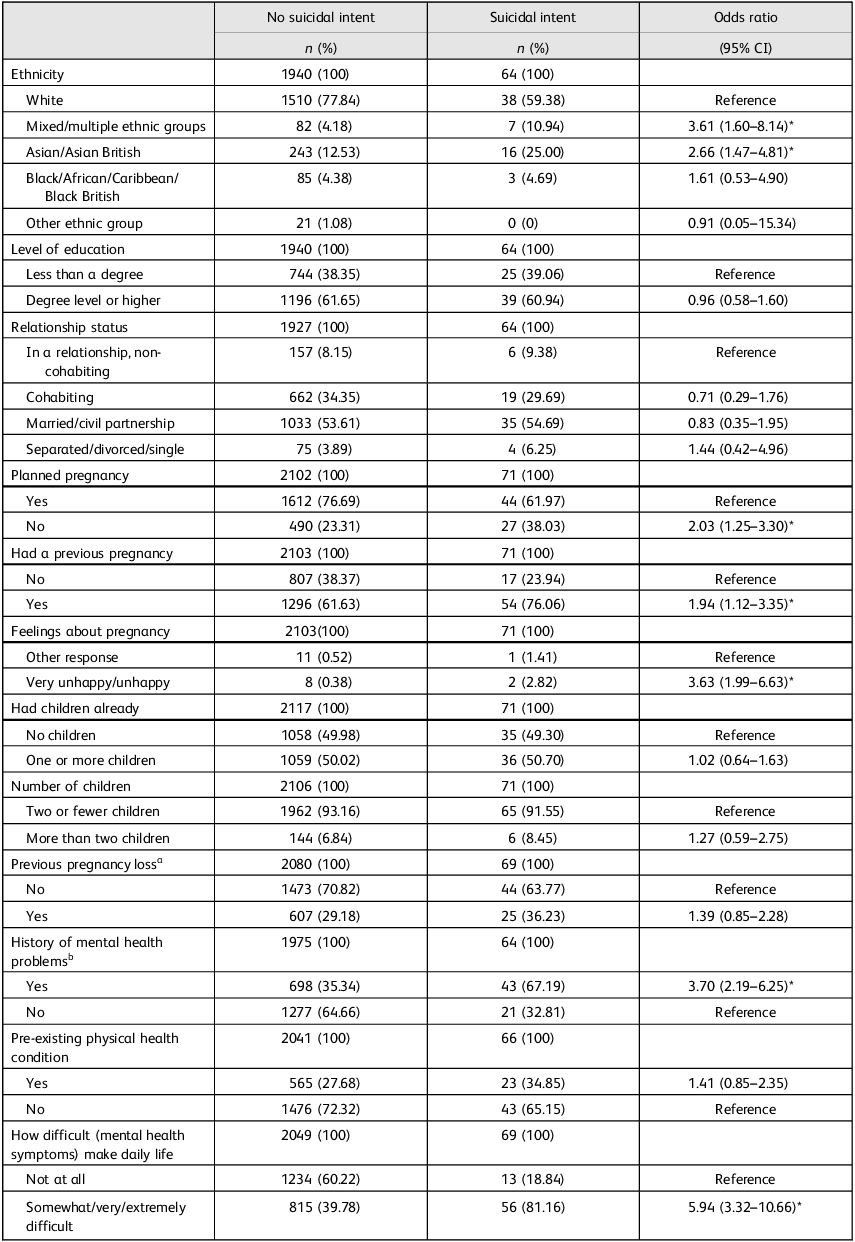
Associations between suicidal intent and sociodemographic, pregnancy and health risk factors are shown in Table 2.
Associations between suicidal intent and sociodemographic, pregnancy and health-related risk factors

Table 2 Long description
A table comparing sociodemographic, pregnancy, and health-related factors with suicidal intent. The table has 19 rows and 5 columns. The columns are labeled ‘No suicidal intent’, ‘Suicidal intent’, ‘Odds ratio’, and ‘95% CI’. The row labels include Ethnicity, Level of education, Relationship status, Planned pregnancy, Had a previous pregnancy, Feelings about pregnancy, Had children already, Number of children, Previous pregnancy loss, History of mental health problems, Pre-existing physical health condition, and How difficult (mental health symptoms) make daily life. Each row provides the count and percentage of individuals with and without suicidal intent, along with the odds ratio and 95% confidence interval for each factor. Notable trends include higher odds ratios for mixed/multiple ethnic groups, unplanned pregnancy, previous pregnancy, very unhappy/unhappy feelings about pregnancy, history of mental health problems, and significant difficulty in daily life due to mental health symptoms.
a. Data for participants who responded ‘prefer not to say’ are not reported in the table and were excluded from this analysis.
b. Data for participants who responded ‘don’t know’ were excluded from this analysis.
*p < 0.05.
Sociodemographic factors
Suicidal intent at any time point was significantly associated with being younger (mean age: no suicidal intent 31.40, s.d. 5.15 years; suicidal intent mean 29.54, s.d. 5.55 years; t = 2.91, d.f. = 2116, p = 0.004) and of Asian/British Asian ethnicity (see Table 2). Although most participants reporting suicidal intent were of White ethnicity (n = 38, 59.38%, 95% CI 46.78–70.85), Asian and Asian British participants comprised 12.89% (95% CI 11.48–14.42) of the sample, but 25% (n = 16, 95% CI 15.77–37.24) of those reporting suicidal intent. The odds ratio for suicidal intent in women from Asian backgrounds was 2.62 (95% CI 1.44–4.77) compared with participants from White ethnicity. The odds ratio was 3.43 (95% CI 1.49–7.93) for women from a mixed ethnic background compared with women from a White background. There was no significant association between suicidal intent and level of education or relationship status.
Pregnancy factors
Suicidal intent was significantly associated with unplanned pregnancy, negative feelings about pregnancy and having had a previous pregnancy (see Table 2). Unplanned pregnancy was reported by 23.81% (n = 520, 95% CI 22.07–25.64%) of the sample, but 38.03% (n = 27, 95% CI 27.37–49.98%) of participants who reported suicidal intent. Women who reported they were unhappy or ambivalent (‘not happy or unhappy’) about their pregnancy were more likely to report suicidal intent at some point in the perinatal period (odds ratio 3.63, 95% CI 1.99–6.63). Women who had a previous pregnancy were more likely to report suicidal intent (odds ratio 1.94, 95% CI 1.12–3.35). However, there was no significant relationship between suicidal intent and previous pregnancy loss, having no children versus one or more children, or having two or less children versus three or more children.
Mental and physical health
Suicidal intent was also associated with previous mental health problems, which were reported by 67.19% of those reporting suicidal intent compared with 35.34% of the sample overall (see Table 2). Analysis of different types of previous mental health problems found nearly all were associated with increased risk of suicidal intent (anxiety, attention-deficit hyperactivity disorder, personality disorder, depression, obsessive–compulsive disorder, post-traumatic stress disorder, psychosis, sleep disorders, dissociative disorders). The exceptions were bipolar disorder, eating disorders and schizophrenia, but only a small number of participants reported these disorders, so our results should be interpreted with caution (see Supplementary Table 2).
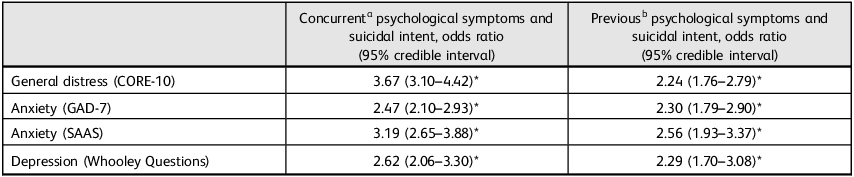
Table 3 shows the association between suicidal intent and concurrent or previously reported psychological symptoms of anxiety, depression and distress. Suicidal intent was significantly associated with current psychological symptoms on all measures. The odds of reporting suicidal intent increased by three times for every additional one standard deviation increase in a score on the CORE-10 or SAAS. Similarly, the increase in odds of reporting suicidal intent more than doubled for every standard deviation increase in score on the GAD-7 and the Whooley Questions. Mental health symptoms reported on questionnaires at the preceding time point were also significantly associated with suicidal intent. If participants rated their current mental health symptoms as making daily life difficult, the odds of them reporting suicidal intent were almost six times higher than respondents who did not (odds ratio 5.94, 95% CI 3.32–10.66) (Table 2).
Odds of reporting suicidal intent by concurrent and previous psychological symptoms

Table 3 Long description
A table comparing the odds of reporting suicidal intent by concurrent and previous psychological symptoms. The table has four rows and three columns. The columns are labeled ‘Concurrent psychological symptoms and suicidal intent, odds ratio (95% credible interval)’, ‘Previous psychological symptoms and suicidal intent, odds ratio (95% credible interval)’, and the row labels are ‘General distress (CORE-10)’, ‘Anxiety (GAD-7)’, ‘Anxiety (SAAS)’, and ‘Depression (Whooley Questions)’. Row 1: General distress (CORE-10), 3.67 (3.10-4.42), 2.24 (1.76-2.79). Row 2: Anxiety (GAD-7), 2.47 (2.10-2.93), 2.30 (1.79-2.90). Row 3: Anxiety (SAAS), 3.19 (2.65-3.88), 2.56 (1.93-3.37). Row 4: Depression (Whooley Questions), 2.62 (2.06-3.30), 2.29 (1.70-3.08).
CORE-10, Clinical Outcomes in Routine Evaluation; GAD-7, Generalised Anxiety Disorder-7; SAAS, Stirling Antenatal Anxiety Scale.
a. Concurrent psychological symptoms are scores on each of the listed measures at the same time point as suicidal intent.
b. Previous psychological symptoms are scores on the measures from the lagged time point relative to suicidal intent.
*p < 0.05.
Suicidal intent was also significantly associated with poor physical health in early pregnancy (t = 6.37, d.f. = 2108, p < 0.001). The mean self-rated health score on the visual analogue scale of the EQ-5D-5L at the early pregnancy time point was 80.05 (s.d. 16.58) in participants who never experienced suicidal intent, compared with 66.84 (s.d. 21.18) in participants who had experienced suicidal intent. Mixed-effects logistic regression indicated that across all time points, better physical health scores were associated with lower odds of suicidal intent (odds ratio 0.96, 95% CI 0.95–0.97). There was no significant relationship between suicidal intent and having specific pre-existing physical health conditions such as arthritis, asthma, cancer, diabetes or other health conditions. However, there were relatively few women with pre-existing health conditions, so the lack of association may be attributable to the small sample size in the group with suicidal intent.
Discussion
This study aimed to determine the prevalence of suicidal intent in pregnancy and the early postnatal period, and examine factors associated with suicidal intent in a large UK sample. Results showed that suicidal intent was most strongly associated with experiencing difficulties with daily life, previous mental health problems and being unhappy about being pregnant. Suicidal intent was also associated with being younger, of mixed or Asian ethnicity, having poor current mental health, poor current physical health, unplanned pregnancy and previous pregnancies. Women were most likely to report suicidal intent in early pregnancy. This is an important finding because it suggests that although most suicides in the perinatal period happen after birth, assessment or discussion of suicidal ideation, behaviours and/or intent with perinatal women needs to be considered from the beginning of pregnancy. Reference Felker, Patel, Kotnis, Kenyon and Knight3 The observed associations between suicidal intent and both negative feelings about the pregnancy and unplanned pregnancy may reflect experiences of entrapment, a construct implicated in contemporary models of suicidality in which individuals perceive themselves as unable to escape an adverse or unwanted situation. Reference Reid, Pratt, Edge and Wittkowski43,Reference O’Connor and Kirtley44 Because these are pregnancy-specific factors routinely assessed in antenatal care, maternity practitioners are well placed to identify potential risk and act early, representing an important opportunity for prevention.
Ethnicity and age were the only sociodemographic variables with a significant relationship to suicidal intent in this study. In line with previous research, being younger and from a mixed ethnic background was associated with suicidal intent. Reference Orsolini, Valchera, Vecchiotti, Tomasetti, Lasevoli and Fornaro22,45 There is less previous evidence that women from Asian backgrounds have an increased risk of suicide, 45 but, overall, evidence shows that Asian and Black women are two to three times more likely than White women to die from any cause during pregnancy. Reference Felker, Patel, Kotnis, Kenyon and Knight3 Research also shows that perinatal women from ethnic minority groups experience more inequality and barriers in maternity care services than White women, which can increase their risk of poor mental health and/or suicidality and affect their access to perinatal mental healthcare. Reference Conneely, Packer, Bicknell, Jankovic, Kaur Sihre and McCabe26,Reference Jankovic, Parsons, Jovanovic, Berrisford, Copello and Fazil27 These findings reflect the need for targeted approaches that consider ethnicity, religious and cultural beliefs, stigma, and attitudes and beliefs in mental health for identifying and supporting perinatal women from different ethnic backgrounds who may be experiencing suicidality.
An important finding from this study is the indication that mental and physical health have a relationship to suicidal intent. A higher proportion of women who reported suicidal intent had previous and current mental health problems, as well as reporting existing health conditions in early pregnancy. Having a diagnosis of severe physical illness is associated with suicide risk in the general population, Reference Nafilyan, Morgan, Mais, Sleeman, Butt and Ward46 but research also suggests that the effect of physical ill health in terms of disruption to a person’s daily activity is another important predictor for suicide. Reference Onyeka, Maguire, Ross and O’Reilly47
In the perinatal literature, there is some evidence that having a chronic medical illness is significantly associated with suicidal behaviour during pregnancy, Reference Molla, Nigussie and Girma21 and other research has reported that physical pregnancy-related factors, such as severe hyperemesis gravidarum, pregnancy-induced hypertension, gestational diabetes mellitus, Reference Girardi, Pompili, Innamorati, Serafini, Berrettoni and Angeletti48 perineal laceration, caesarean delivery Reference Kim, La Porte, Saleh, Allweiss, Adams and Zhou49 and obesity, Reference Kalmbach, Cheng, Ong, Ciesla, Kingsberg and Sangha50 increase the risk of suicidal ideation. Although we did not ask women how their physical health affected daily functioning, our results showed that the perceived impact of mental health difficulties on daily functioning was associated with suicidal intent. Taken together, these findings underscore the importance of the link between physical and mental health, and suggest that the impact on functioning in the perinatal period may be a possible focus for assessing need for support. Given that universal maternity service appointments largely focus on the mother’s physical health, and that midwives are more used to asking about physical health, this provides an opportunity to explore the interface between mothers’ physical and mental health and feelings about being pregnant.
Although multivariable modelling was not possible because of the low prevalence of suicidal intent, these findings provide an important foundation for future research in an underexplored area. Larger or pooled data-sets, including linkage to routine health records, are needed to enable adequately powered analyses of independent risk factors and extend these findings to more diverse populations.
Strengths and limitations
This is the first study to assess suicidal intent (rather than suicidal ideation or self-harm) at multiple time points over pregnancy and in the early postpartum period in a representative and ethnically diverse UK sample. The characteristics and prevalence of perinatal women who endorse the item ‘I have made plans to end my life’ on the CORE-10 have not been explored previously in a representative sample. This item is different to many other self-report items that only ask about suicidal or self-harm ideation. Although the sample was recruited through routine antenatal care and is broadly reflective of UK maternity populations, it was relatively socioeconomically advantaged and required sufficient English to complete questionnaires, which may limit applicability to more diverse and underserved groups. Also, although this is a large study, the low prevalence of suicidal intent in this population means that multivariate analysis was not possible. Nevertheless, this is the first study to have a sufficiently large sample to examine suicidal intent by sociodemographic characteristics in a perinatal population, so it makes an important contribution to this area. A further limitation is that because women received a follow-up telephone call as part of the safeguarding procedure if they reported suicidal intent, this may have affected their response to follow-up questionnaires.
Conclusions
Our findings suggest that difficulties in daily life caused by mental health symptoms, negative feelings about being pregnant and previous mental health problems were significantly associated with suicidal intent. Young age, Asian or mixed ethnicity, poor current mental health, poor current physical health, unplanned pregnancy and previous pregnancy were also risk factors. These findings emphasise the link between physical and mental health, suggesting that assessing daily functioning in the perinatal period could identify support needs. Given the focus on physical health in maternity appointments, this offers an opportunity to explore the intersection of physical health, mental health and women’s feelings toward their pregnancy.
Supplementary material
To view supplementary material for this article, please visit https://doi.org/10.1192/bji.2026.10117
Data availability
Individual participant-level data are currently not available, but authors can provide sample-level data and information on request, after publication. The study protocol is available at https://njl-admin.nihr.ac.uk/document/download/2034506.
Acknowledgements
We gratefully thank the women who took part in the MAP study for their time and generosity. We are also grateful for the input and advice of colleagues in the MAP Study Team and Steering Committee in conducting this research. The MAP Study Team includes the authors, Georgina Constantinou, Simon Gilbody, Debra Salmon, Agnes Hann, Una Hutton, Jennifer Holly, Nazihah Uddin and Cassandra Yuill.
Author contributions
A.S., C.B., F.A., H.C., J.J., J.S., L.R.W., M.M., R.M., S.A. and J.W. all contributed to the conceptualisation of the study, methodology and oversight. Additionally, R.M., A.S. and L.R.W. were involved in data collection, data validation and project administration. C.B. and S.M. provided statistical expertise and conducted the analyses. The manuscript was drafted by R.M. and E.D. All listed authors and the MAP study team (see Acknowledgements) reviewed and approved the manuscript.
Funding
This work was supported by the National Institute for Health Research (NIHR), Health Services & Delivery Research Programme (NIHR 17/105/16). The views expressed are those of the authors and not necessarily those of the NIHR or the Department of Health and Social Care.
Declaration of interest
A.S., H.C. and M.M. developed and published one of the measures used in this study, the Stirling Antenatal Anxiety Scale. All other authors have no conflicts of interest to declare.


 Open access


eLetters
No eLetters have been published for this article.