Vowel mergers before /l/ are widespread in American English. Different patterns of pre-/l/ conditional mergers render pairs such as hill and heel, gel and jail, pull and pool, bowl and bull, haul and hull, and doll and dull homophonous. The research presented here examines the pre-/l/ allophones of vowels in five lexical sets—GOOSE, FOOT, GOAT, STRUT, and THOUGHT—in one community, Kansas City. A customized version of Wells's (Reference Wells1982) lexical sets is used throughout to refer to allophones of vowels occurring before /l/: POOL for GOOSE with following /l/, FULL for FOOT, GOAL for GOAT, HULL for STRUT, and TALL for THOUGHT.
Kansas City is a metropolitan area of over two million people that spans the western border of Missouri and eastern border of Kansas in the United States. Language in Kansas City has been the focus of two dissertations, Lusk (Reference Lusk1976) and Strelluf (Reference Strelluf2014), and has received some attention in a number of projects, including Ash (Reference Ash, Murray and Simon2006), Gordon (Reference Gordon, Murray and Simon2006), and Labov, Ash, and Boberg (Reference Labov, Ash and Boberg2006). Labov et al. (Reference Labov, Ash and Boberg2006:266–271) described Kansas City as a prototype of the Midland dialect region, displaying all the sound change patterns that characterize the Midland in the Atlas of North American English (ANAE): fronting of the vowels GOOSE and GOAT after coronals, fronting of the nucleus of MOUTH, “transitional” merger of LOT and THOUGHT, and fronting of STRUT. If language in Kansas City is indeed more broadly reflective of language elsewhere in the Midland, developments with regard to POOL, FULL, GOAL, HULL, and TALL in Kansas City may inform developments in these vowel subsets in other communities.
These subsets have received varied levels of attention in sociolinguistic research. POOL and FULL is the most studied, and Thomas (Reference Thomas2001:50) noted that the conditional merger of POOL and FULL seems to be the most common pre-/l/ merger in American Englishes. It is frequently discussed as a feature of speech in Pittsburgh and nearby areas of western Pennsylvania (e.g., Dickey, Reference Dickey1997; Johnson, Reference Johnson1971; Johnstone, Bhasin, & Wittkofski, Reference Johnstone, Bhasin and Wittkofski2002; McElhinny, Reference McElhinny1999). Labov, Yaeger, and Steiner (Reference Labov, Yaeger and Steiner1972:236–242) also observed a “near” merger of POOL and FULL in Albuquerque, New Mexico. Di Paolo and Faber (Reference Di Paolo and Faber1990) explored POOL and FULL as an “apparent” or near merger in Utah, and Faries and Lance (Reference Faries, Lance and Frazer1991:255) anecdotally noted “considerable instability in the loss (or maintenance) of the tense-lax distinction” between POOL and FULL among young people in Missouri.
The conditional merger of FULL and GOAL has also been identified across a large swath of the United States. Ash (Reference Ash, Murray and Simon2006:43) noted that, while ANAE’s data for FULL and GOAL is sparser than data for POOL and FULL, in the Midland the “weakening of the distinction” between FULL and GOAL is more advanced than it is for POOL and FULL. Research often treats FULL and GOAL in connection with mergers of POOL and FULL, as either an alternative configuration or an intermediate stage in the development of a three-way merger among the non–low back vowels before /l/. Thomas (Reference Thomas1989/1993, Reference Thomas and Schneider1996) identified FULL and GOAL as being merged by some speakers around Columbus, Ohio, with both often also being merged with POOL (Arnold [Reference Arnold2015] found similar results in Youngstown, Ohio). Bowie (Reference Bowie2000) traced the development of a three-way conditional merger in Waldorf, Maryland. In Bowie's (Reference Bowie2000) findings, the merger of FULL and GOAL appears to lead the merger of POOL and FULL and appears to proceed faster in speaker judgments than productions, so that speakers judge the vowels to be phonemically “same” while still producing them different phonetically.
Thomas (Reference Thomas1989/1993, Reference Thomas and Schneider1996) included mergers of HULL and TALL in his descriptions of Columbus and Johnstown, Ohio. Thomas's (Reference Thomas2001:75, 84–99) vowel plots show the merger of HULL and TALL to be characteristic of Ohio speakers. Other attested combinations include FULL merging with TALL in Tangier Island, Virginia (Shores, Reference Shores1985) and HULL merging with GOAL in California (Guenter, Reference Guenter2000).
The volatility of the back vowel space in the pre-/l/ environment, in combination with the variety of patterns of merger and distinction observed across dialects in the United States, illustrates the value of continued study of all five vowels. This research seeks, as such, to document the structural relationships among POOL, FULL, GOAL, HULL, and TALL in Kansas City, while also examining how these structural relationships can help inform knowledge about the phonetic and phonological factors underlying the development of vowel mergers and maintenance of distinctions. The pre-/l/ environment has, indeed, provided a complex acoustic space for researchers in American Englishes to examine how mergers progress, are resisted, or something in between. Di Paolo and Faber's (Reference Di Paolo and Faber1990; also Faber & Di Paolo, Reference Faber and Di Paolo1995) work on apparent mergers before /l/, for instance, shows speakers regularly producing distinctions that they claim not to perceive (for distinctions being produced but not perceived in other near mergers, see Di Paolo, Reference Di Paolo1992; Herold, Reference Herold1990, Reference Herold1997; Labov, Reference Labov1994:349–370; Nunberg, Reference Nunberg and Labov1980). The multiple potential sites for maintenance or loss of distinction among POOL, FULL, GOAL, HULL, and TALL creates numerous opportunities to examine phonetic overlap or separation, and phonological merger, near merger, or distinction.
For this reason, the starting point of this study is not to presume that close or same productions (or judgments) of vowels necessarily indicate progress toward, or completion of, merger. Rather, this research will attempt to build an acoustic profile of POOL, FULL, GOAL, HULL, and TALL in order to describe the configurations among these vowels that Kansas Citians produce and encounter. Acoustic data will be presented in terms of “overlap” in distributions, which represent empirically observable measurements, rather than in terms of “mergers,” which reflect a speaker's phonemic inventory. It will then examine interviewee judgments about POOL, FULL, and GOAL to look at interactions between overlap and phonology.
METHODS
This research draws on sociolinguistic interviews with 67 Kansas Citians born between 1955 and 1999. All interviewees lived for their entire lives (barring short periods away for college or military service) in a city designated by the US Census Bureau as part of the Kansas City Metropolitan Statistical Area. The primary sample includes 51 speakers who were interviewed for Strelluf (Reference Strelluf2014). The supplementary sample of 16 speakers were interviewed by Matthew J. Gordon and his students for several projects between 2000 and 2009.
In the combined sample reported here, 4 speakers were born between 1950 and 1959, 12 between 1960 and 1969, 9 between 1970 and 1979, 15 between 1980 and 1989, and 27 between 1990 and 1999. Thirty-four interviewees are female and 33 are male. Twenty-four interviewees are identified as working class, 34 as middle class, and 9 as a part of a “transitional” class of speakers whose movements between working and middle class prevented them from being assigned to either side of that binary.
The primary sample of interviews was recorded on a Zoom H4N Handy Recorder (Hauppauge, New York) and sampled directly to WAV file at 44.1 kHz in 16-bit resolution (De Decker & Nycz, Reference De Decker, Nycz, Mallinson, Childs and Van Herk2013:119–120; Thomas, Reference Thomas2011:25–26). Interviewees wore a Sony ECM-44B lavaliere microphone (New York, New York), connected by XLR to the Handy. Interviews in the supplementary sample were recorded on tape cassette and sampled into WAV files at 44.1 kHz in 16-bit resolution by a Panasonic RR-830 tape deck (Kadoma, Japan) connected to the audio input on a laptop with IDT High Definition Audio (San Jose, California) sound card. All interviewees participated in a loosely structured interview, followed by reading a few short passages, a word list, and a set of minimal pairs. The minimal pairs instrument used for the supplementary sample did not include tests for mergers among POOL, FULL, GOAL, HULL, and TALL, so these 16 interviews are excluded from discussions of minimal pair judgments. The interviews comprising the primary sample included minimal pair responses to POOL, FULL, and GOAL. HULL and TALL were not tested.
All vowels examined in this study were measured using the University of Pennsylvania's Forced Alignment and Vowel Extraction (FAVE) suite (Rosenfelder, Fruehwald, Evanini, & Yuan, Reference Rosenfelder, Fruehwald, Evanini and Yuan2011). FAVE works in two stages. First, FAVE-align, based on the Penn Phonetics Lab Forced Aligner (Yuan & Liberman, Reference Yuan and Liberman2008), aligns the acoustic signal with an orthographic transcription. Second, FAVE-extract, based on the work of Evanini (Reference Evanini2009) and further developed by Ingrid Rosenfelder and Josef Fruehwald (see Fruehwald, Reference Fruehwald2013:46), measures all vowels in the recording based on the aligned file. This step returns a spreadsheet that includes formant measurements for all vowels that the system was able to analyze, as well as some information on preceding and following phonetic environment, vowel duration, and a few other factors. FAVE returns these in raw measurements and in normalized measurements calculated by the Lobanov's (Reference Lobanov1971) transformation. Labov, Rosenfelder, and Fruehwald (Reference Labov, Rosenfelder and Fruehwald2013:34–38) provided a succinct overview of the suite.
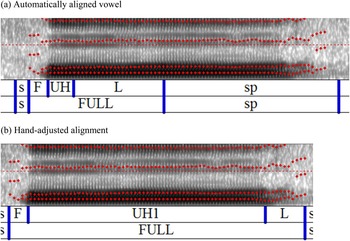
Strelluf (Reference Strelluf2014:65–81) described issues that emerge in using FAVE to measure vowels. Of crucial importance to the present study is that FAVE is inconsistent in marking boundaries between a vowel and a following liquid. Figure 1a shows one token of full returned by FAVE-align, where a seemingly arbitrary boundary has been set between the FOOT vowel (indicated with “UH”) and /l/, and where “sp” (for “short pause”) is marked while the token is still being produced. Vowels marked like this one in FAVE-align were dropped from FAVE-extract, generally because their duration is below the minimum threshold for FAVE measurement of .05 sec. While it is possible to set the minimum duration lower in FAVE, in practice doing so introduced problematic measurements from vowels that speakers had actually reduced, creating new problems for the dataset.
Token of full returned by FAVE-align (a) and corrected (b).

All the FAVE-aligned files were, therefore, reviewed in Praat (Boersma & Weenink, Reference Boersma and Weenink2013). For this study, boundaries were hand-adjusted so that the entire vowel and coda-/l/ were included within phones that FAVE would read as POOL, FULL, GOAL, HULL, and TALL. Figure 1b shows the hand-corrected boundaries of the token of full. This approach treats the vowel+/l/ pair the same way that FAVE measures diphthongs such as CHOICE, MOUTH, and PRICE. Phonologically, this approach seems justified in the Kansas City dataset, because speakers in this sample nearly always vocalized coda /l/ after back vowels, realizing coda-/l/ impressionistically as [ʊ] or [ə]. More practically, in a small pilot study, this method best replicated hand-measured F1 and F2 for back vowels before /l/.
This resetting of boundaries dramatically increased FAVE-extract's effectiveness at measuring tokens. For example, an initial run of FAVE-extract without hand-adjustment returned just 37 tokens of FULL. After hand-adjustment, a second run of all data through FAVE-extract yielded 610 tokens of FULL. The dataset built from this approach also includes 1345 tokens of POOL, 1155 tokens of GOOSE, 260 tokens of HULL, and 2137 tokens of TALL.
This study reports F1 and F2 for vowels, measured with FAVE's default FAAV setting, which measures most vowels near one-third of their duration (relevant exceptions are GOOSE after coronal consonants, which is measured at the beginning of the vowel segment, and GOAT, which is measured halfway between the beginning of the segment and maximum F1; Labov et al. [Reference Labov, Rosenfelder and Fruehwald2013:36] indicated that these exceptions “reduce measurement errors due to choosing a measurement point too far into the nucleus-glide transition”). This study reports normalized measurements calculated by FAVE's built-in Lobanov (Reference Lobanov1971) routine. Included are only vowels that occur in primary stress position and only vowels with /l/ coda (e.g., Zulu, the name of a rollercoaster in Kansas City, is excluded). FAVE also returns measurements taken at the 20%, 35%, 50%, 65%, and 80% of vowel duration; these are used to examine vowel contours. This is an important dimension to consider in the context of overlap among allophones of diphthongal vowels such as POOL and GOAL and allophones of monophthongal vowels such as FULL, because distinctions might be maintained across a vowel's trajectory that do not show up in single-point measurements of F1 and F2 that attempt to represent a vowel's central tendency.
Plots are generated in R (R Core Team, 2016) with custom scripts. Vowel means are estimated from outputs of mixed-effects regressions calculated by the {lme4} package for R (Bates, Maechler, Bolker, & Walker, Reference Bates, Maechler, Bolker and Walker2015), with individual interviewee and lexical item as random effects (cf. Johnson, Reference Johnson2009, Reference Johnson2010).
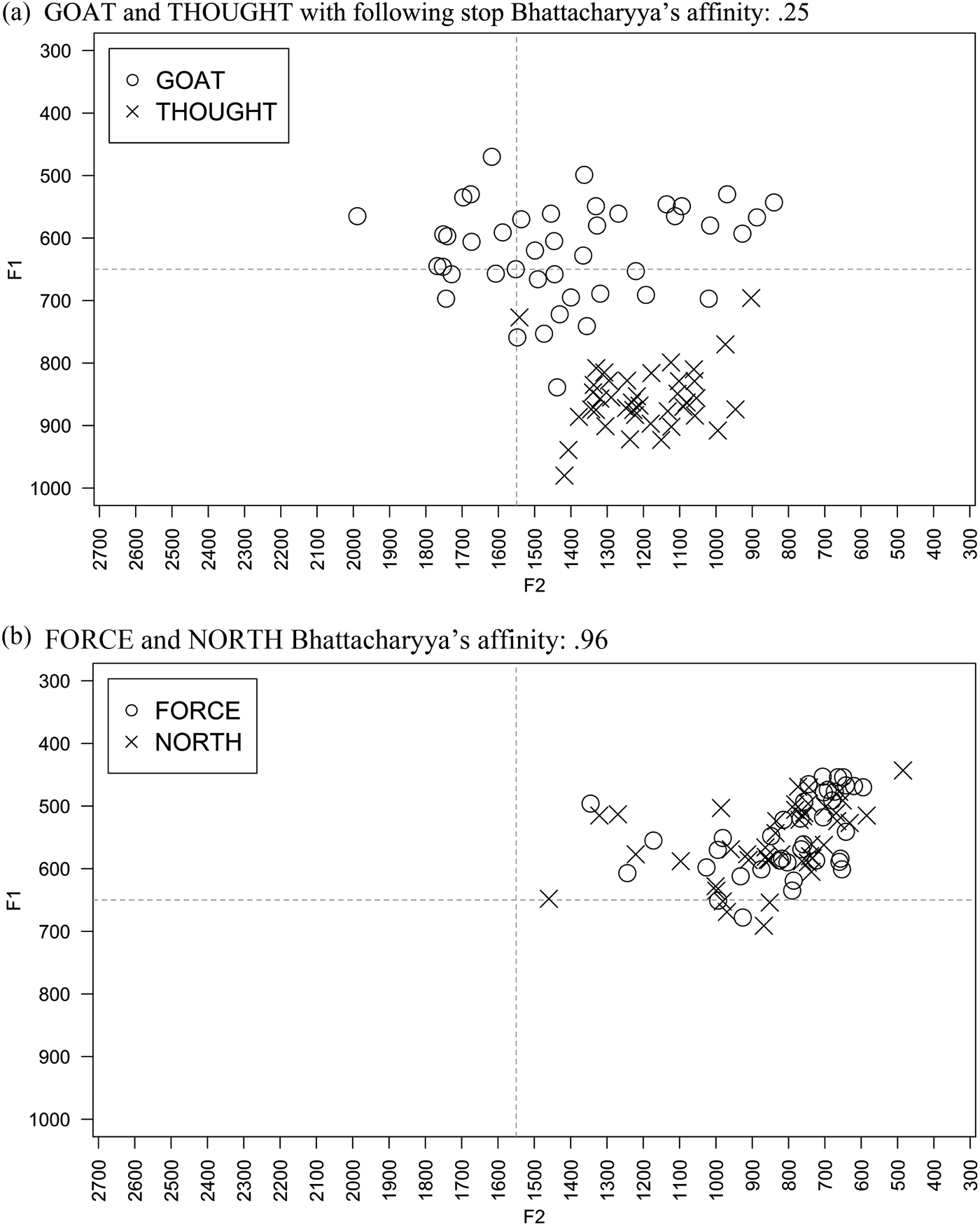
Overlap between vowel classes is measured as Bhattacharyya's affinity. Bhattacharyya's affinity was introduced for the study of vowel mergers by Johnson (Reference Johnson2015) as a preferable alternative to measures such as Euclidean distance (e.g., Evanini, Reference Evanini2009; Herold, Reference Herold1990; Johnson, Reference Johnson2010) and Pillai's trace (e.g., Hall-Lew, Reference Hall-Lew2010; Hay, Warren, & Drager, Reference Hay, Warren and Drager2006). Bhattacharyya's affinity measures overlap between distributions of points in two-dimensional space, making it neatly suited for studies that represent vowel space with F2 as x-axis and F1 as y-axis. Bhattacharyya's affinity is also relatively less sensitive than other approaches to between-samples imbalances in token counts, so that a large number of measurements in one vowel class being compared against a smaller number of measurements in a second vowel class is less problematic than it would be to a study relying on Pillai's trace (Johnson, Reference Johnson2015). The calculation generates a coefficient of 0 for distributions that are completely separate and a coefficient of 1 for distributions that perfectly overlap (Bhattacharyya, Reference Bhattacharyya1943).Footnote 1 Bhattacharyya's affinity is included in the {adehabitatHR} package for R (Calenge, Reference Calenge2006) and does not return a significance score.
Figure 2 shows subsets of the vowels of one speaker (Amber, born in Kansas City, Missouri in 1996) to contextualize Bhattacharyya's affinity values against the more familiar measures of Pillai's trace and Euclidean distance. In Figure 2a, tokens of GOAT and THOUGHT with a following stop are separate distributions with just a few tokens overlapping. They return a Bhattacharyya's affinity of .25 (1-Pillai = .21, p < .001; Euclidean distance = 407.9 Hz). In Figure 2b, tokens of FORCE and NORTH overlap and return a Bhattacharyya's affinity of .96 (1-Pillai = .99, p = .574; Euclidean distance = 63.9 Hz).
Low-overlap (a) and high-overlap (b) vowel classes measured with Bhattacharyya's affinity.

OVERLAP PATTERNS OF POOL, FULL, GOAL, HULL, AND TALL
Figure 3 shows the Bhattacharyya's affinity of each speaker's productions of POOL and FULL, FULL and GOAL, and POOL and GOAL. Each speaker's values for these three potential sites of overlap are plotted on a vertical line, so that the relative overlaps among these classes can be compared directly on a speaker-by-speaker basis.
Bhattacharyya's affinity measurements of POOL~FULL, FULL~GOAL, and POOL~GOAL for 67 Kansas Citians, born 1955–1999.

The Bhattacharyya's affinity values of speakers reveal a range of overlap relationships among POOL, FULL, and GOAL. Configurations include speakers who show little overlap among the three classes, speakers with overlap between POOL and FULL, speakers with overlap between FULL and GOAL, and speakers with overlap among all three classes. One speaker, Tom, even shows Bhattacharyya's affinities that suggest greater overlap between POOL and GOAL than FULL (however, a plot of his tokens suggests that this is a result of a few POOL tokens encroaching into GOAL space, rather than a more general pattern of overlap).
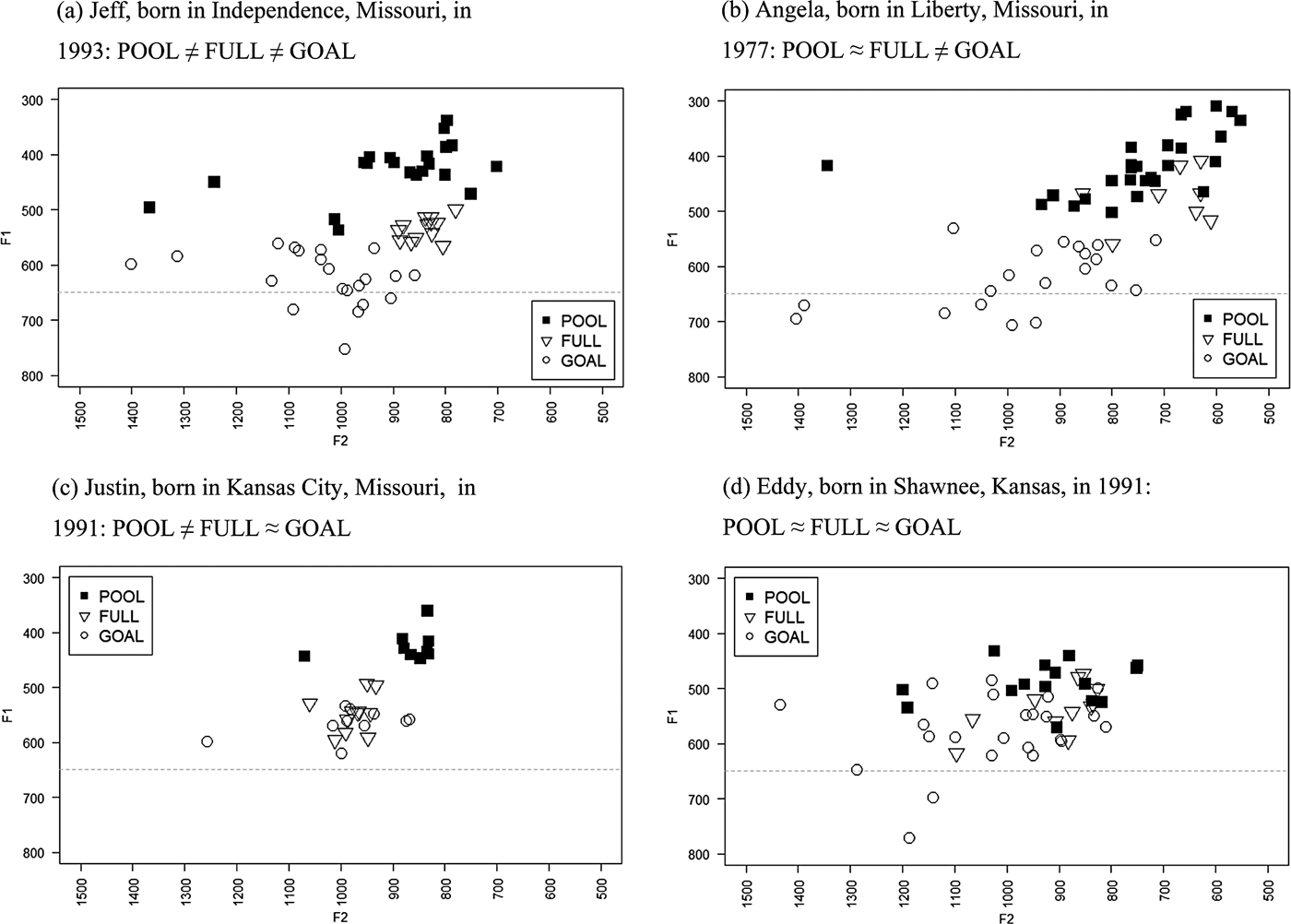
Figure 4 displays representative plots of tokens for four speakers based on these measurements of overlap. Jeff (4a), born in Independence, Missouri, in 1993, shows a fairly tightly constrained PULL class that separates POOL from GOAL. Angela (4b), born in Liberty, Missouri, in 1997, has GOAL separate from POOL and FULL. Her POOL tokens overlap with FULL, though FULL remains in the lower half of her POOL distribution, suggesting that she still maintains some phonetic distinction between these classes in these central tendency measurements. Justin (4c), born in Kansas City, Missouri, in 1991, has a POOL class that is clearly separated from FULL and GOAL, which show a high degree of overlap. Finally, Eddy (4d), born in Shawnee, Kansas, in 1991, has a high degree of overlap among all three classes—though there is a slight tendency for GOAL tokens to plot in the lower left corner of space, suggesting that GOAL may remain phonetically distinct from POOL.
Configurations of POOL, FULL, and GOAL in Kansas City.

Across all overlap configurations in Figure 3, FULL and GOAL tend to show higher Bhattacharyya's affinities than POOL and FULL (the difference between these overlap configurations is significant by Welch's t-test at p = .011). FULL and GOAL have a mean Bhattacharyya's affinity of .50 (SD = .22). Thirty-seven of the 67 Kansas Citians in the sample have a Bhattacharyya's affinity closer to 1 than 0. The mean Bhattacharyya's affinity of POOL and FULL is lower at .40 (SD = .22), with 22 speakers with values >.5. The mean Bhattacharyya's affinity of POOL and GOAL is .36 (SD = .20) with 16 speakers >.5.
While this indicates that FULL and GOAL overlap most among the possible configurations, the sample does not suggest an obvious pattern of change. No statistical model describes a trend in apparent time. In the case of FULL and GOAL, for instance, younger speakers tend to have more extreme Bhattacharyya's affinities at both ends of the spectrum. Among nine speakers who have Bhattacharyya's affinity greater than 1 SD above the mean value for FULL and GOAL, four were born in the 1980s and five in the 1990s. Among 12 speakers 1 SD below the mean Bhattacharyya's affinity for FULL and GOAL, five were born in the 1980s and four in the 1990s, along with one each from the 1950s, 1960s, and 1970s. Of 15 speakers with Bhattacharyya's affinity 1 SD above the mean for POOL and FULL, six were born in the 1990s, four in the 1980s, and two each in the 1950s and 1970s. Nine speakers were 1 SD below the mean for POOL and FULL, including one each from the 1950s, 1960s, and 1980s, and six from the 1990s. Finally, of nine Kansas Citians with Bhattacharyya's affinity more than 1 SD above the mean for POOL and GOAL, five were born in the 1990s, three in the 1980s, and one in the 1970s. Below 1 SD from the POOL and GOAL mean, three are from the 1960s, three are from the 1980s, and five are from the 1990s.
In short, many of the speakers who show the greatest degree of overlap among these three vowel classes in F1 and F2 central tendency are the youngest Kansas Citians in the sample. However, many of the speakers with the least overlap are also among the youngest Kansas Citians. This data, then, shows multiple patterns of overlap for POOL, FULL, and GOAL in Kansas City, but does not clearly show a trend in the development of these overlap patterns.
Figure 5 plots Bhattacharyya's affinity measurements for several potential overlap configurations among FULL, GOAL, HULL, and TALL. FULL-GOAL is omitted, because it is depicted in Figure 3, and FULL-TALL is excluded because just one speaker returned a Bhattacharyya's affinity >.5. Several speakers, especially those from the supplementary sample, did not provide enough HULL tokens for analyses related to that vowel.
Bhattacharyya's affinity measurements of FULL~HULL, GOAL~HULL, GOAL~TALL, and HULL~TALL for 67 Kansas Citians, born 1955–1999.

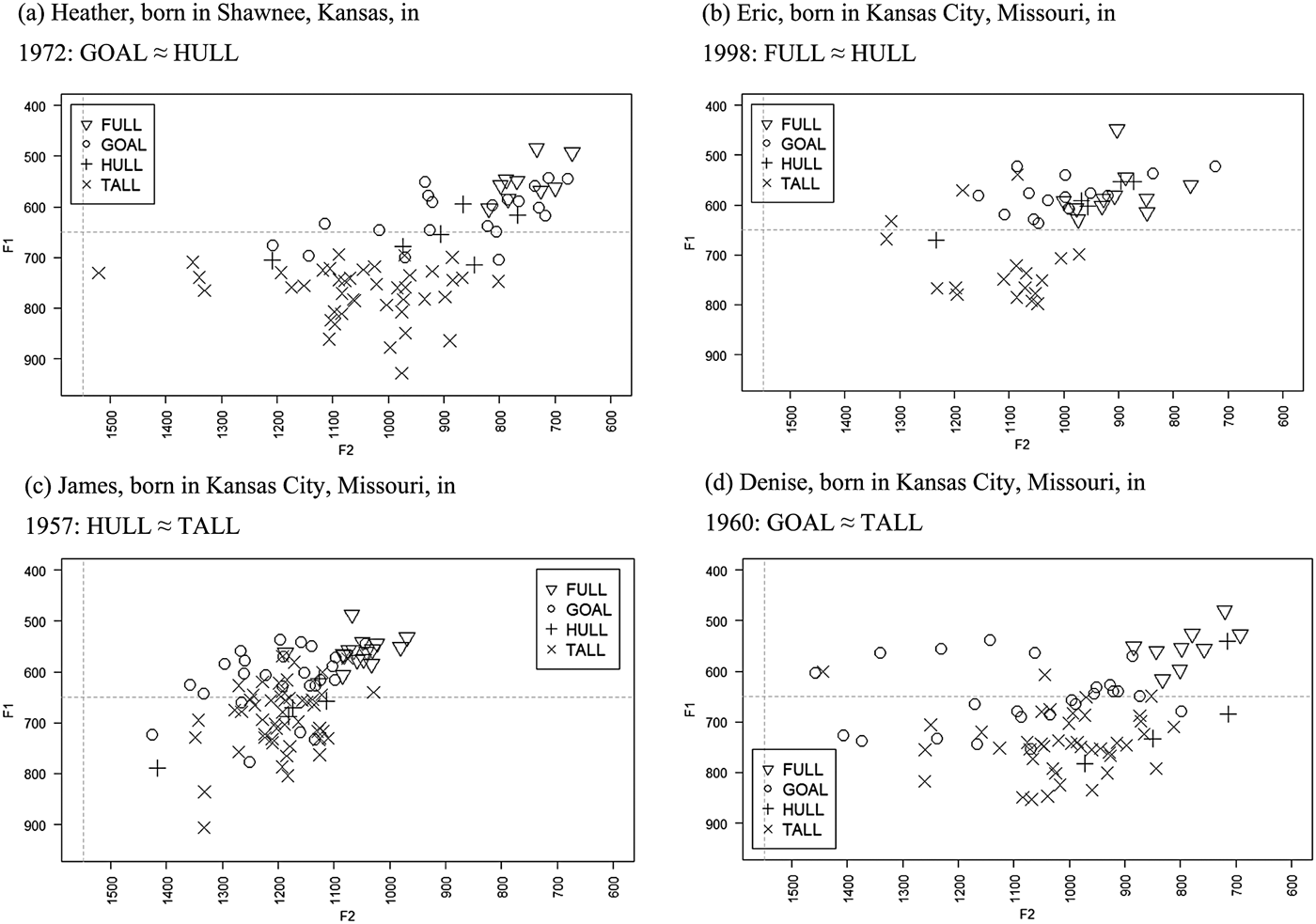
Overlap among GOAL and HULL tokens is particularly high in Figure 6, with a mean Bhattacharyya's affinity of .72 for the 21 speakers with enough HULL tokens for calculation. These higher GOAL-HULL Bhattacharyya's affinities are highly significantly different from all other overlap configurations in this study (p < .001). Indeed, only two speakers show Bhattacharyya's affinity < .5. Figure 6a shows representative tokens of Heather, born in Shawnee, Kansas, in 1972. Her GOAL tokens spread across a fairly wide swath of space in F2 to encompass all of her HULL tokens.
Configurations of FULL, GOAL, HULL, and TALL in Kansas City.

FULL and HULL have a mean Bhattacharyya's affinity of .46. Importantly, as an anonymous reviewer points out, overlap measurements of FULL and HULL could be reduced by phonetic context, because FULL traditionally occurs only after oral labials (e.g., bull, full, pull), while HULL with a preceding labial (e.g., bulb, pulp, pulverize) occurs relatively infrequently in this sample. Future work to capture more HULL with preceding labials is necessary to fully test the structural relationship between FULL and HULL. Tokens from Eric, born in Kansas City, Missouri, in 1998, demonstrate overlap between the two vowels in Figure 6b. With the exception of one token of color that is produced among TALL tokens, Eric's HULL tokens plot clearly within the space of his FULL tokens (and both occur within space where GOAL is pronounced).
HULL and TALL have a mean Bhattacharyya's affinity of .45. HULL and TALL, however, show a hint of a trend in apparent time, as among four speakers whose Bhattacharyya's affinities are more than 1 SD above the mean, three are born between 1956 and 1960, against one born in 1995. Of six speakers who are 1 SD below the mean for HULL and TALL, one was born in 1962, two in 1972, and three in the 1990s. A linear model of HULL and TALL shows a statistically significant decrease in Bhattacharyya's affinity measurement of .06 for each decade that passes, with a modest R 2 of .16 (intercept: 12.17, p = .039). James, born in Kansas City, Missouri, in 1957, displays overlap between HULL and TALL in Figure 6c. HULL occurs within the range of his widely distributed TALL tokens. The prevalence of this pattern among the oldest speakers in this sample suggests that overlap between HULL and TALL represents an older arrangement in the Kansas City vowel system.
GOAL and TALL show the least overlap among the configurations reviewed here, with a mean Bhattacharyya's affinity of .40 and SD of .18. (However, GOAL-TALL Bhattacharyya's affinities are significantly different only from GOAL-HULL [p < .001].) Nineteen speakers have values >.5. Denise, born in 1960 in Kansas City, Missouri, is plotted in Figure 6d. While her Bhattacharyya's affinity of .71 is reflected in overlap between GOAL and TALL, it is also clear that most of this overlap occurs in the margins between the two vowels’ ranges, suggesting that GOAL and TALL generally occupy separate phonetic space for her. Of note, though, her four HULL tokens clearly plot within the space of her TALL tokens. She did not provide enough HULL tokens to calculate Bhattacharyya's affinity, but she seems to reflect the older configuration in Kansas City described for James where HULL overlaps with TALL.
These presentations of overlap in F1 and F2 central tendencies show a variety of configurations present among POOL, FULL, GOAL, HULL, and TALL in Kansas City. Broadly speaking, Kansas Citians show a preference for overlap between GOAL and FULL and between GOAL and HULL. Kansas Citians also show overlap between POOL and FULL, in some cases keeping GOAL separate and in others developing three-way overlap. There is some evidence that younger speakers’ vowel systems show more overlap than older speakers’, but this is an interpretative observation, rather than one based on modeling. Only the decrease in overlap between HULL and TALL describes a statistically significant apparent-time development.
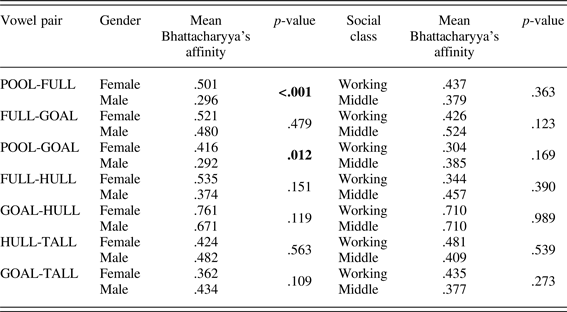
The foregoing focus on apparent time may fail to capture important social dimensions underlying these overlap patterns. Table 1 explores two social variables: speaker sex and social class. Both are presented here as simplistic binaries to compare females against males and Kansas Citians identified as working class against middle class. It presents mean Bhattacharyya's affinities for each group within seven potential vowel overlap patterns and tests the samples by Welch's two-sample t-tests. Statistically significant values appear bold.
Average Bhattacharyya's affinity measurements between vowel classes, by social factors

With regard to gender, only two vowel pairs show statistically significant differences: POOL-FULL and POOL-GOAL. The mean Bhattacharyya's affinity among females for POOL and FULL is .50 compared with a male mean of .30, and that difference is highly significant. Females also show significantly more overlap between POOL and GOAL than males, with mean Bhattacharyya's affinities of .42 and .29, respectively. Females show higher overlap measurements for FULL and GOAL, FULL and HULL, and GOAL and HULL. Males display more overlap between HULL and TALL, as well as GOAL and TALL. While these five pairs do not show statistically significant differences according to gender, it is worth noting that males show greater overlap in a pattern that appears to be receding in apparent time (HULL and TALL) and a pattern that is not especially widespread in the sample (GOAL and TALL), while females show greater overlap in pairs that are better established in Kansas City. These differences are suggestive of the general pattern in sociolinguistic research showing that females lead changes in progress (e.g., Labov, Reference Labov2001:147–322; Wolfram & Schilling-Estes, Reference Wolfram and Schilling-Estes2016:245–280)—though, again, this research is not positing a change in progress for most of these patterns of overlapping productions.
No vowel pair shows a statistically significant difference for social class. The class similarity is most striking for the pair GOAL and HULL, the means of which are separated by less than one-thousandth. Working-class speakers show slightly greater overlap for POOL and FULL, HULL and TALL, and GOAL and TALL, while middle-class speakers show more overlap for FULL and GOAL and for POOL and GOAL. These small differences do not point toward social differentiation with regard to overlap patterns among these vowels. No overlap pattern appears to be clearly connected with or led by either working-class or middle-class speakers.
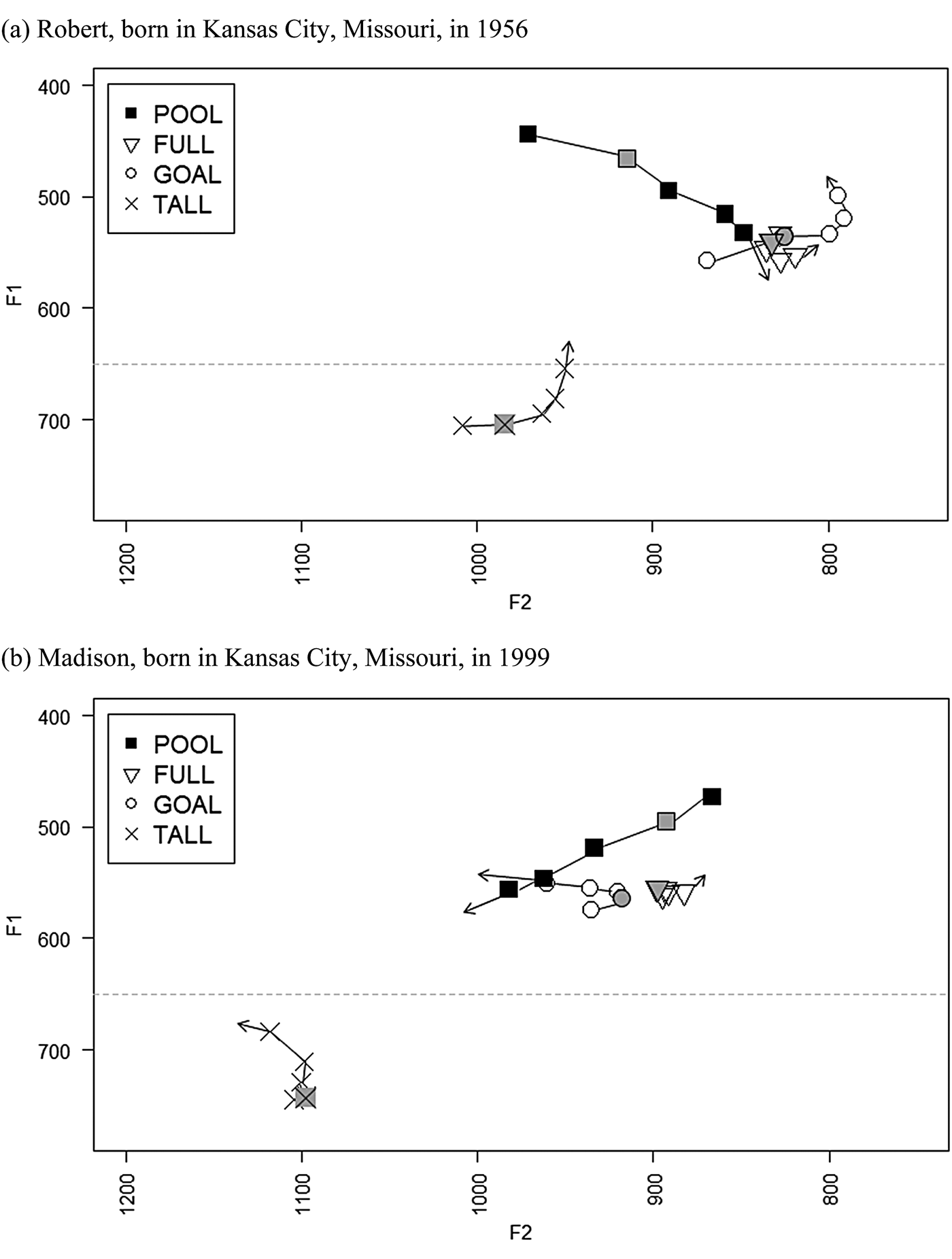
While the examination to this point has revealed a range of overlap patterns among these vowel classes, the acoustic profile is incomplete if it is limited to measurements of central tendency. In this vein, Figure 7 provides a slightly more complex look at four of the vowel classes of interest. It plots mixed-effects estimated mean productions (with word as random intercept) at 20%, 35%, 50%, 65%, and 80% of the duration of POOL, FULL, GOAL, and TALL; there are not enough HULL types for the speakers shown in Figure 7 to allow mixed-effects modeling. The 35% measurements are filled in with gray to approximate the point that would be captured in central tendency measurements, and an arrow is tacked onto 80% measurements as a visual cue to the direction of glides.
Contour plots of POOL, FULL, GOAL, and TALL.

Figure 7 plots Robert (7a) and Madison (7b), a father and daughter from Kansas City, Missouri. Robert, born in 1956, has Bhattacharyya's affinities in Figure 3 that suggest relatively low overlap among POOL, FULL, and GOAL. Figure 5 shows him displaying the older pattern of overlapping HULL and TALL. By contrast, Madison, born in 1999, appears to have a high amount of overlap among POOL, FULL, and GOAL, and little overlap between HULL and TALL.
The vowel contour plots in Figure 7 add an interesting nuance to the overlap data. POOL, FULL, and GOAL are tightly clustered at the back edge of vowel space for Robert and Madison, even though Robert's Bhattacharyya's affinities suggest less overlap among his vowel classes than Madison's. Robert and Madison also share an obviously monophthongal FULL. Differences are apparent, though, in POOL and GOAL. Robert's GOAL starts slightly front of his FULL, and then glides back and upward in vowel space, while Madison's GOAL appears to mirror her FULL as relatively monophthongal. Robert's POOL starts front and glides backward, while Madison's starts back and glides frontward. Madison's TALL appears to be more monophthongal than Robert's.
Among these differences, the similarity between Madison's FULL and GOAL stands out as most noteworthy. It suggests that, in addition to the vowels being produced with a high amount of overlap when measured in F1 and F2 in central tendency, they are also produced similarly across their trajectories (indeed, Welch's two-sample t-tests of F1 and F2 at each of the five points in trajectory return just one statistically significant difference in Madison's FULL and GOAL F2 at 80% [p = .023]).
Robert's and Madison's vowel contour plots are intended to be suggestive of differences and similarities that may be present in vowel productions and obscured by F1 and F2 central tendency. While it is unfortunately not possible to provide detailed vowel plots for all speakers, these contour plot complement the broader illustration of overlap among vowel classes and round out the acoustic profile of back vowels before /l/ in Kansas City.
SPEAKER JUDGMENTS OF POOL, FULL, AND GOAL IN KANSAS CITY
Having established the close phonetic productions among POOL, FULL, GOAL, HULL, and (to a lesser extent) TALL that are present in Kansas City, this section examines the phonemic status of the back vowels before /l/. It draws on responses to the minimal pairs pull-pool and bowl-bull given during interviews in the primary sample of 51 Kansas Citians. Minimal pair responses do not inform whether respondents produce vowels differently or whether they perceive acoustic differences between vowels. However, they can show how respondents think about vowels, which can provide important insights into phonemic statuses.
Figure 8 represents interviewee judgments of the minimal pairs pull-pool and bowl-bull as “same,” “close,” or “different.” Interviewees are divided according to an older group, born between 1955 and 1975, and a younger group, born between 1989 and 1999. Responses within each age group are split between females and males.
Interviewee judgments of pull-pool and bowl-bull as same, close, or different (n refers to number of speakers).

The pair pull-pool shows a slight increase in being judged “same” in apparent time. Three older interviewees judge the pair “same” or “close,” compared with eight younger respondents. Females show a slight lead in judgments of the pair as “same” or “close,” including one older female and two younger females who judge the pair “same.” This result seems basically consistent with production data, which showed a number of Kansas Citians with overlapping distributions of POOL and FULL but did not show it to be the dominant configuration in the community, and which showed greater overlap between POOL and FULL among females.
By contrast, in Figure 8 the pair bowl-bull is much more widely judged to be “same” or “close.” In comparison with the acoustic results—where FULL and GOAL overlapped for many speakers across the sample with only suggestions of a trend in apparent time—judgments of bowl-bull as “same” and “close” increase dramatically from older to younger interviewees. Among older interviewees, there are five judgments of “same” or “close,” with a male lead over females. In the younger group, judgments of “same” or “close” are the norm. Eight younger females and five males report bowl-bull as “close,” and five younger males and three females judge them “same.” Just six younger interviewees judge the pair “different.”
These minimal pair responses suggest that important changes are happening phonemically with regard to POOL, FULL, and GOAL in Kansas City. While the vowels acoustically show a range of overlapping distributions in F1 and F2 across the time depth of the sample, minimal pairs responses suggest that POOL and FULL and, even more so, FULL and GOAL are being judged as less distinct by Kansas Citians in apparent time.
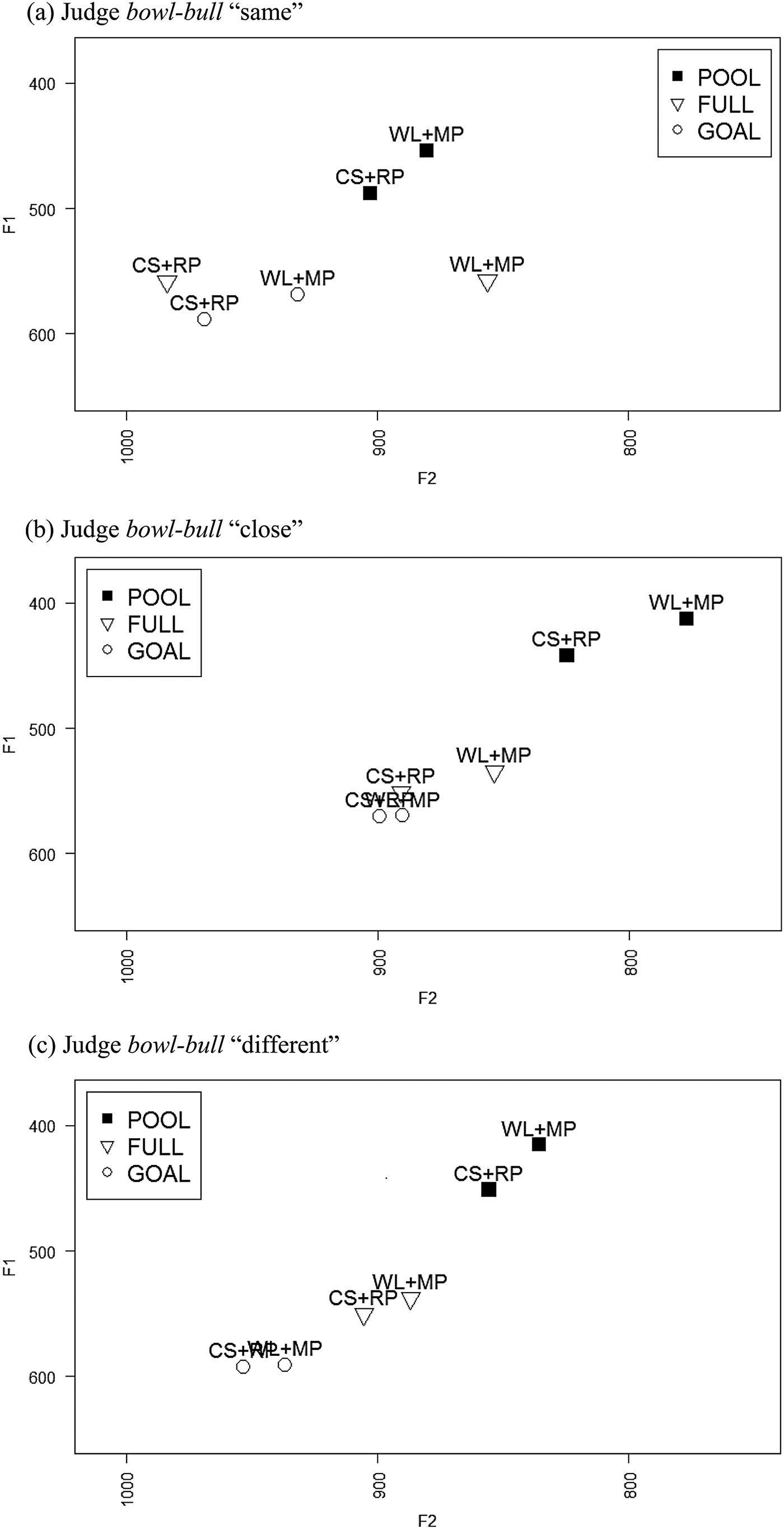
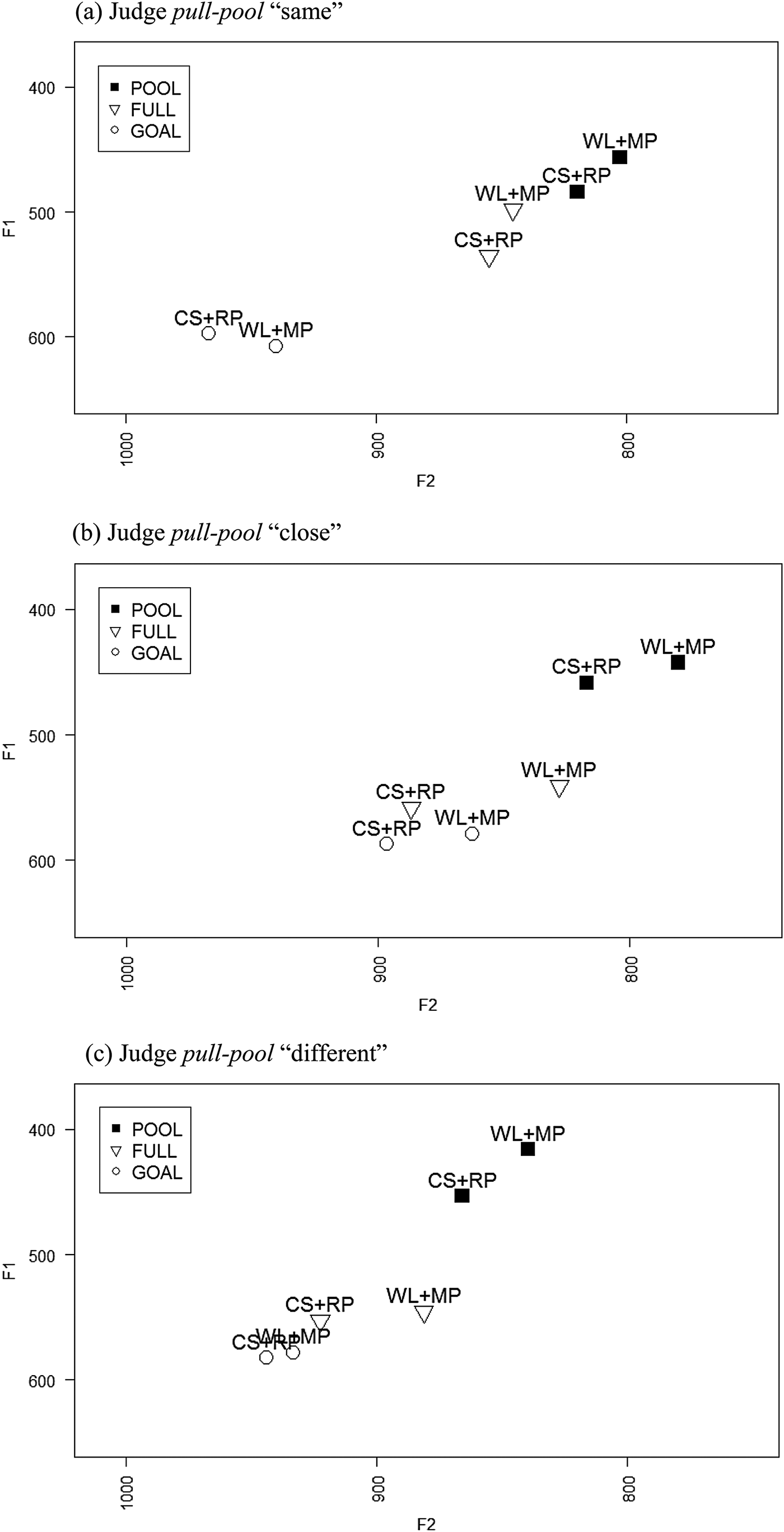
Figures 9 and 10 examine the interaction of these judgments with acoustic productions of POOL, FULL, and GOAL. The three vowel classes are divided between the interview tasks of casual speech and reading passages, representing relatively lower attention-to-speech, and word lists and minimal pairs, representing relatively higher attention-to-speech. Single-point measurements of F1 and F2 are plotted according to interviewee judgments of the pull-pool and bowl-bull minimal pairs as “same,” “close,” or “different.” In order to reduce differences in phonetic environment among the three classes, phonetic context is here limited to POOL, FULL, and GOAL preceded by an oral labial. Means are estimated by mixed-effects regression with speaker as a random intercept; word is not included as a random intercept here since the word list and minimal pairs sections limit lexical items to just a few types.
POOL, FULL, and GOAL in Kansas City in lower- and higher-attention-to-speech interview tasks, divided by speaker judgments of bowl-bull (CS = casual speech; RP = reading passage; WL = word list; MP = reading list).

POOL, FULL, and GOAL in Kansas City in lower- and higher-attention-to-speech interview tasks, divided by speaker judgments of pull-pool (CS = casual speech; RP = reading passage; WL = word list; MP = reading list).

Figure 9 plots productions according to interviewee judgments of bowl-bull. Generally, attention-to-speech does not appear to affect productions of POOL, FULL, and GOAL dramatically. Noteworthy exceptions are word list and minimal pairs productions of FULL among interviewees who judge bowl-bull as “same,” who produce FULL with greater separation from GOAL when paying more attention to speech than they do in lower attention-to-speech tasks. This separation contrasts with the “Bill Peters effect” of Labov et al. (Reference Labov, Yaeger and Steiner1972:235–242) and Labov (Reference Labov1994:359–364), as well as in reports in Di Paolo (Reference Di Paolo1992), Faber and Di Paolo (Reference Faber and Di Paolo1995), and Herold (Reference Herold1990), where speakers who believe themselves to pronounce minimal pairs the “same” produce the pair more similarly during a minimal pairs task than they do in casual speech. The separation introduced in Figure 9a suggests that, for speakers who have collapsed FULL and GOAL phonemically, judgments of similarity tolerate a good bit of phonetic distance between productions. By contrast, speakers who judge the pair “close” or “different” carve out unique phonetic space for POOL, FULL, and GOAL. The relationships among FULL and GOAL remain fairly consistent as these speakers shift from lower to higher attention-to-speech, though they produce POOL higher and backer in vowel space as their attention-to-speech increases.
Figure 10 shows productions according to speaker judgments of pull-pool. Speakers who judge the pair as “same” stand out for phonetically close productions of POOL and FULL in both lower and higher attention-to-speech tasks. Kansas Citians who judge the pair as “same” clearly produce the vowel subsets similarly. Their POOL and FULL also plot with a fair degree of separation from GOAL in lower attention-to-speech tasks, suggesting that a phonemic collapse of POOL and FULL may impede (or at least be unconnected with) phonetic closeness between POOL-FULL and GOAL—though these speakers actually produce GOAL phonetically closer to POOL and FULL when attention-to-speech increases. Productions among speakers who judge pull-pool as “close” are very similar to productions of speakers who judge the pair “same.” POOL is separated from FULL and GOAL, and the classes maintain similar structural distances in transitioning from lower to higher attention-to-speech. It is perhaps most noteworthy here that the relationship between POOL and FULL in word list and minimal pair productions is basically the same for speakers who judge pull-pool “close” as it is for speakers who judge the pair “same.” Similar to observations for FULL and GOAL judgments, this may suggest that, for speakers who are reducing the phonemic separation between POOL and FULL, their judgments of similarity can accommodate a fairly large amount of phonetic space.
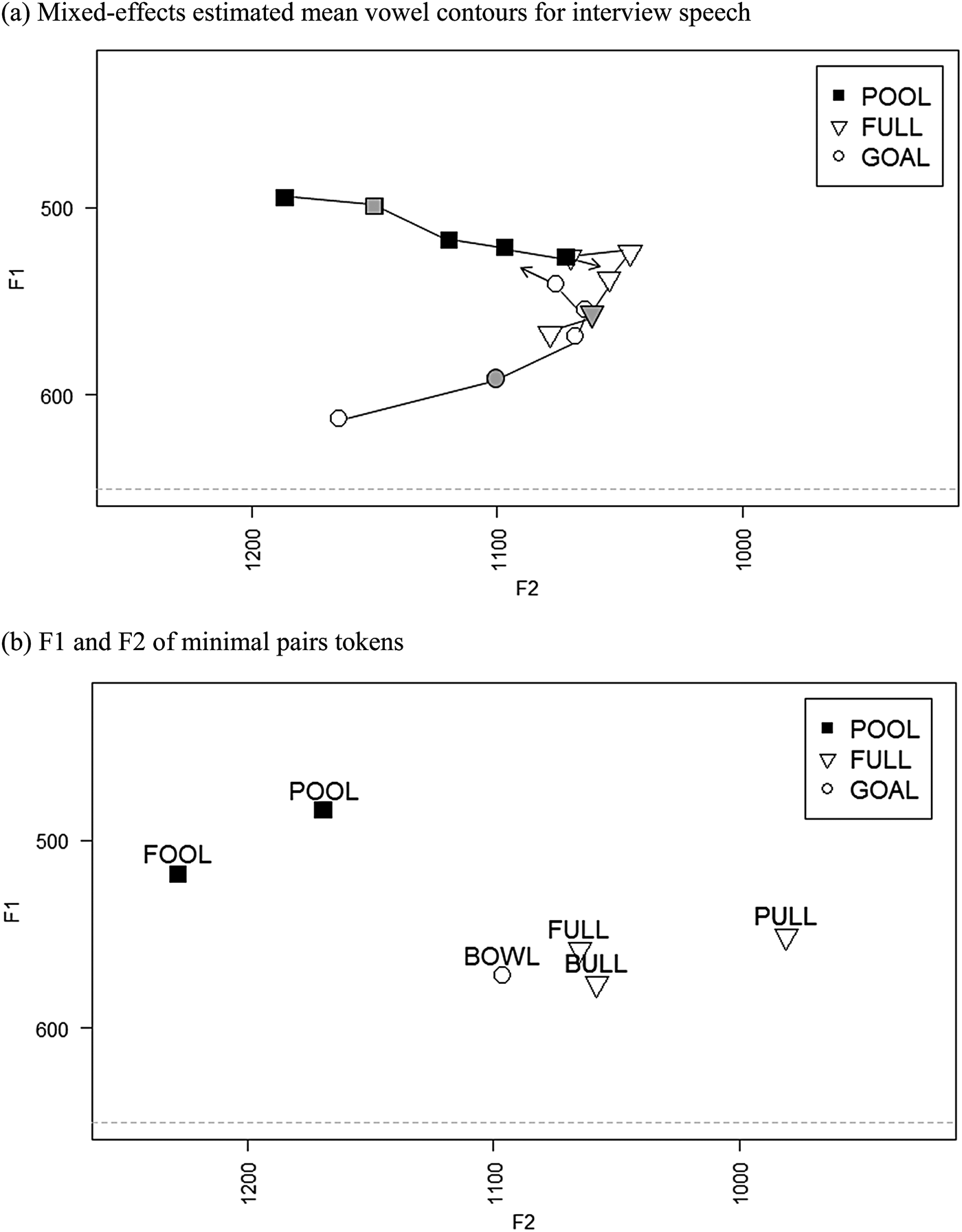
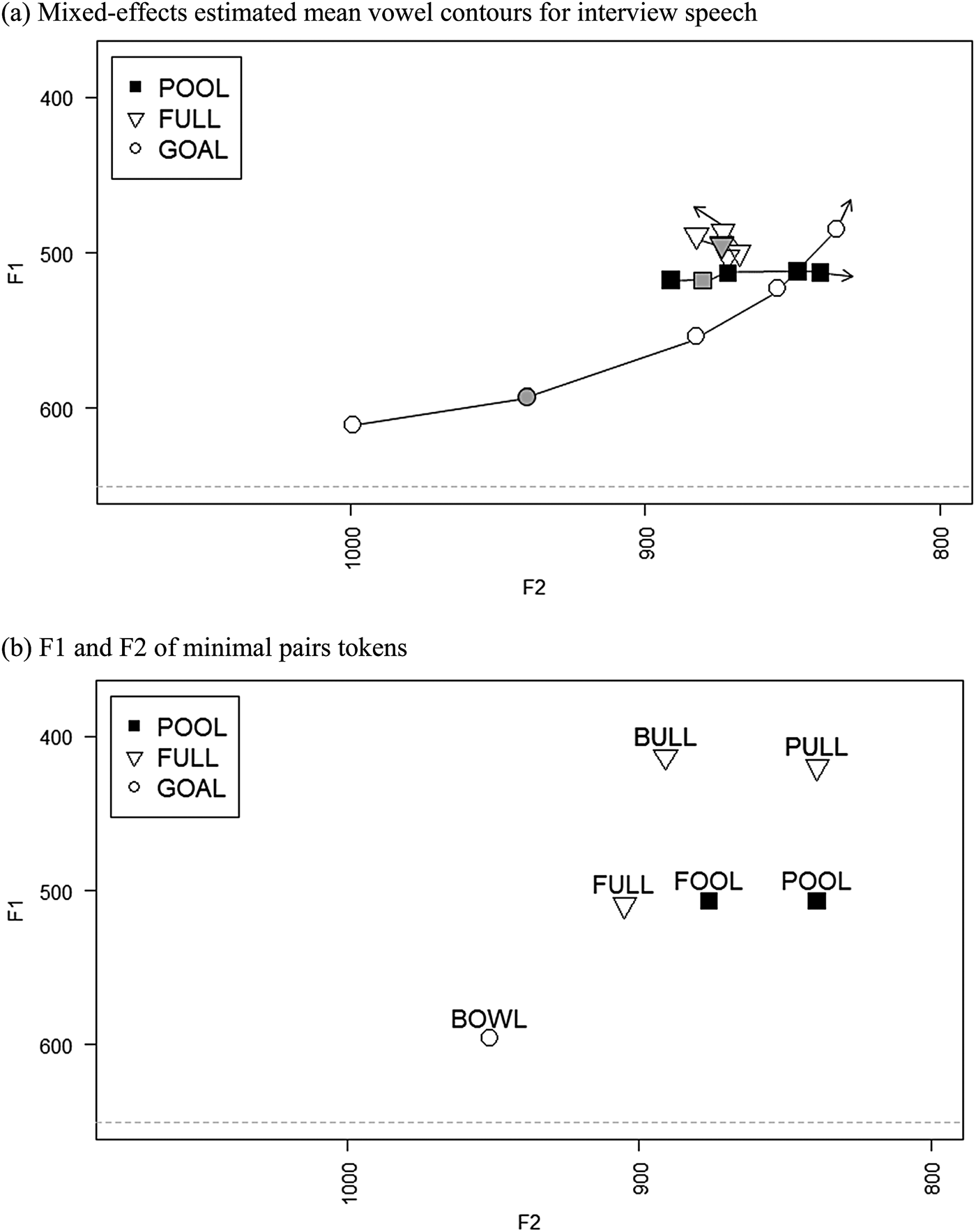
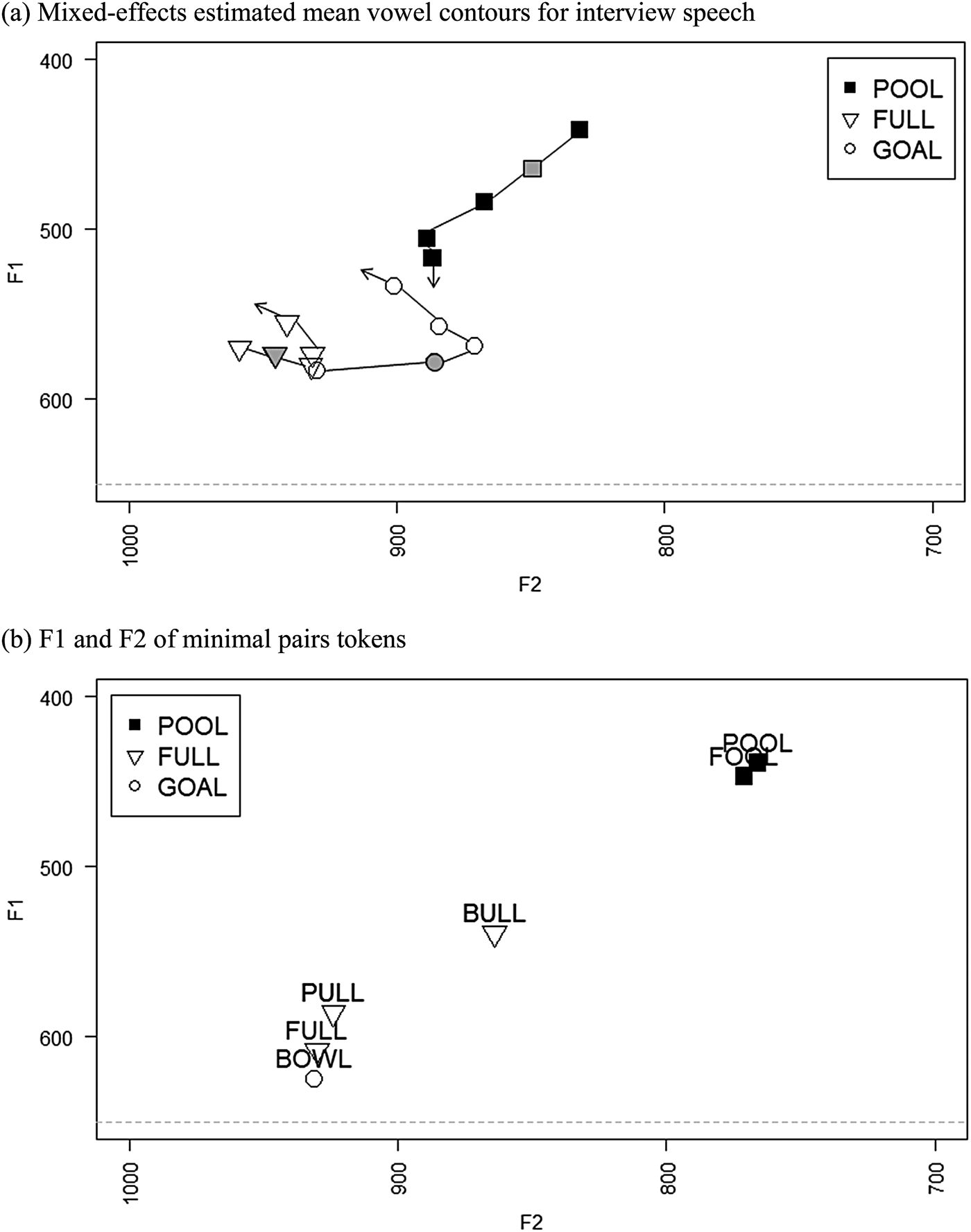
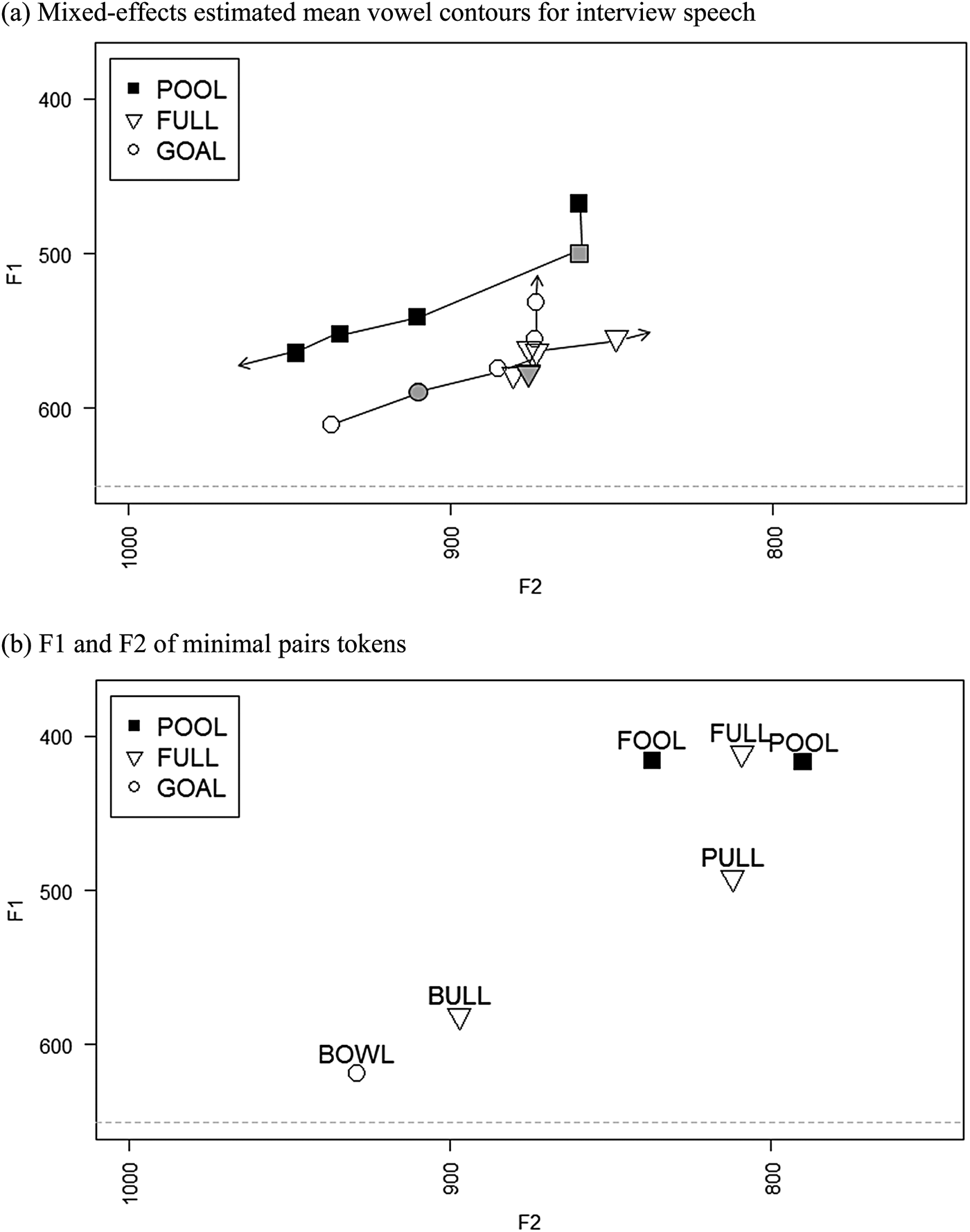
Figures 11 through 14 examine individual speaker productions of POOL, FULL, and GOAL as interactions with minimal pair judgments. Each figure provides vowel contours of POOL, FULL, and GOAL for a speaker; as in Figure 7, these plot F1 and F2 at five points along vowel duration, estimated by mixed-effects regression with word as a random intercept. The 35% measurement is grayed and arrows indicate glide direction. The figures also show central tendency plots for each speaker's minimal pairs responses. (The pair full-fool, not discussed in the judgment data, was also included as a minimal pair and those tokens are plotted.)
POOL, FULL, and GOAL for James, born in Kansas City, Missouri, in 1957 (pull-pool “different”/bowl-bull “same”).

Figure 11 shows James, who was born in Kansas City, Missouri, in 1957. James's FULL, GOAL, HULL, and TALL tokens are also plotted in Figure 6c. He judged pull-pool “different” and bowl-bull “same.” His contour plot (11a) shows the overlap among all the vowel classes, but greatest overlap between FULL and GOAL, as GOAL glides across the space occupied by FULL. FULL and GOAL clearly show different trajectories, though, with FULL being virtually monophthongal and GOAL gliding back and upward. POOL is also back-gliding (showing a similar trajectory to the POOL contour plotted for Robert in Figure 7a). Despite these contour differences, though, the central tendency plots of James's minimal pairs tokens (11b) suggest productions that match his judgments about the vowel classes. The tokens bowl and bull are produced together. The FULL tokens of full and pull are pronounced far from their POOL counterparts, in the acoustic space near his GOAL token of bowl.
Figure 12 shows POOL, FULL, and GOAL for Susan, born in Independence, Missouri, in 1958. She judged pull-pool “same” and bowl-bull “different.” Her contour plot (12a) shows FULL being produced as a monophthong, while POOL has a slight backward glide. The two vowels are produced in a similar range within her vowel space. Her GOAL plots as a long diphthong that glides back and up through space occupied by POOL and FULL. Her minimal pairs contrast with James's. The tokens of full and fool plot very near each other. The tokens of pull and bull actually plot higher in vowel space than her POOL tokens and are impressionistically [u]. This is particularly noteworthy in the case of bull, where Susan seems to emphasize the [u] production of the vowel to differentiate it from bowl.
POOL, FULL, and GOAL for Susan, born in Independence, Missouri, in 1958 (pull-pool “same”/bowl-bull “different”).

Figure 13 shows Isabella, who was born in Shawnee, Kansas, in 1995. She judged both pull-pool and bowl-bull to be “different.” While her vowel contours (13a) are phonetically close, they seem to occupy discrete portions of vowel space. Of note, her FULL plots front of her GOAL, which is a reversal of the configuration seen in token and mean plots to this point. Her GOAL is more monophthongal than the contours plotted for GOAL for James and Susan, and visually resembles her plot of FULL. Her POOL is front-gliding, showing the same trajectory as Madison's POOL in Figure 7b, which again reverses the trajectory measured for men born in the 1950s. Isabella's minimal pair productions (13b) emphasize distance between pairs. The POOL tokens of pool and fool are pronounced very high and back, while the FULL tokens of pull and full are pronounced far away, exactly where Isabella produces bowl. However, when Isabella reads the pair bowl-bull, she produces bull higher and backer. This suggests a fairly robust maintenance of productions that mirror her judgments of phonemic categories, but, at the same time, slippage in the actual phonetic spaces that are connected to those phonemic categories.
POOL, FULL, and GOAL for Isabella, born in Shawnee, Kansas, in 1995 (pull-pool “different”/bowl-bull “different”).

Finally, Figure 14 shows Kennedy, who was born in Shawnee, Kansas, in 1997. She judged both pull-pool and bowl-bull to be “same.” The juxtaposition of her judgments against Isabella's is remarkable because Isabella and Kennedy are sisters, who grew up in the same house and attend the same school. Kennedy's vowel contours (14a) show several differences from her sister's. Kennedy's FULL is a monophthong back of GOAL, and her GOAL is a diphthong that glides through the space of FULL—in these regards, her FULL and GOAL configuration is more like James's in Figure 11a than Isabella's in Figure 13a. On the other hand, Kennedy's POOL is a front-gliding diphthong, like Isabella's (Figure 13a) and Madison's (Figure 7b). As such, even though Kennedy's POOL is very close to her GOAL acoustically, the classes appear to be produced with opposite trajectories. Despite her vowel contours suggesting productive distinctions among all three vowel classes, though, her minimal pair productions again seem to match her judgments about the statuses of her vowels, at least in terms of central tendency. While she clearly maintains distinct spaces for POOL and for GOAL, her FULL tokens appear to adjust so that they are produced near their minimal pair counterparts in POOL and GOAL. The FULL tokens of full and pull plot near fool and pool in a high-back position, and bull plots lower and fronter near bowl.
POOL, FULL, and GOAL for Kennedy, born in Shawnee, Kansas, in 1997 (pull-pool “same” /bowl-bull “same”).

These sisters’ opposed POOL, FULL, and GOAL judgments may hold a key to understanding relationships among these vowels in Kansas City. While their biographies are nearly identical, their personalities are very different. Isabella presented herself as a high-achieving student, who was involved in extracurricular activities at school and performed regularly in the regionally prestigious Kansas City Ballet. She was oriented toward city life, including attending monthly “First Fridays” events in the Crossroads Arts District in downtown Kansas City with her friends. By contrast, Kennedy described her dislike of school and lack of interest in college. She and her friends hung out at a nearby mall, and she described wanting to live away from a large city in a place where she could have space from neighbors. Isabella's and Kennedy's differing orientations to school and the broader community are reminiscent (if different in respect to orientation toward downtown versus suburban hangouts) to Eckert's (Reference Eckert1989, Reference Eckert2000) famous dichotomy of Jocks and Burnouts, where she found linguistic variation to be tightly bound with high school students’ identification with peer groups and orientations to school and community.Footnote 2
DISCUSSION
This study has revealed a range of overlap patterns in Kansas City in productions of POOL, FULL, GOAL, HULL, and TALL. Furthermore, these vowel subsets themselves show a range of central tendencies and durational trajectories.
Overlapping distributions between FULL and GOAL and between GOAL and HULL are the best established patterns across this sample. Though some speakers certainly overlap POOL and FULL, this is a less common overlap pattern, suggesting that Kansas City differs somewhat from areas such as Pittsburgh (e.g., Johnstone et al., Reference Johnstone, Bhasin and Wittkofski2002; Labov et al., Reference Labov, Ash and Boberg2006:70) and Texas (Bailey, Wikle, & Sand, Reference Bailey, Wilke and Sand1991) where mergers of POOL and FULL are the norm. This finding also posits a change from the pattern anecdotally reported in Faries and Lance (Reference Faries, Lance and Frazer1991:255), who observed the merger of POOL and FULL advancing rapidly among their students at the University of Missouri, a fair number of whom presumably would have come from Kansas City. Similarly, some Kansas Citians overlap POOL and GOAL. This is more common among younger speakers, which may suggest movement toward closer productions in apparent time and toward even greater overlap in the future. However, this overlap pattern does not seem to point, at this time, necessarily in the direction of an eventual three-way merger among POOL, FULL, and GOAL. This may contrast with developments observed in Ohio (e.g., Thomas, Reference Thomas1989/1993, Reference Thomas and Schneider1996) and Maryland (Bowie, Reference Bowie2000). (Arnold's [Reference Arnold2015] profile of Youngstown, Ohio, however, more nearly matches that of Kansas City.)
While it is not clear that productions of POOL, FULL, GOAL, HULL, and TALL are changing in Kansas City in the direction of any of the potential mergers, the phonemic statuses of these subsets are changing. Young Kansas Citians judge POOL and FULL and (especially) FULL and GOAL as more similar to one another than older Kansas Citians do. The interesting phonemic ground appears to be occupied by FULL. When FULL is produced in the context of minimal pair judgments, some Kansas Citians adjust their productions of FULL to match their minimal pair judgments. This is most strikingly the case in the minimal pair plots shown in Figures 11 through 14, where FULL tokens are variously realized with [u], [ʊ], or [o] to differentiate them from or make them similar to POOL and GOAL, as required to match the speakers’ minimal pair judgments. Here, then, despite the Bill Peters effect not being present in aggregated mean productions (e.g., in Figure 9a), at the individual level something like the Bill Peters effect does emerge.
This suggests that the advance in judgments of pull-pool and bowl-bull as “same” or “close” among younger Kansas Citians may reflect a collapse in the phonemic status of FULL, rather than a merger in a traditional sense between FULL and another vowel class. For younger Kansas Citians, FULL may be phonemically ambiguous, rather than transferred to, combined with, or subsumed within either POOL or GOAL. From the perspective of the language learner or language user, it is easy to imagine that the variety of overlap patterns present in Kansas City could create such phonemic ambiguity. When FULL routinely occurs in a range of positions in vowel space, both between speakers and within the speech of individuals, a language learner/user might have little reason to assign it firmly to a phonemic representation. This cyclically would lead to FULL being realized in a range of positions in vowel space.
Such phonemic ambiguity could help inform the apparent-time trend in Kansas City that appears to be making HULL and TALL more distinct from one another, even though overlap patterns among older speakers might suggest that the two classes should have moved toward merger (e.g., Herzog's Corollary, Herzog, Reference Herzog1965; Labov, Reference Labov1994:313, Reference Labov2010:130). Perhaps—even though older speakers seemed to produce HULL most often amid their TALL class, varying productions in the community of HULL as [o], [ʊ], [ʌ], or [ɔ] could have left the class phonemically ambiguous rather than allowing it to merge with TALL. While language learners/users may have retained TALL as a vowel class, HULL may have remained a sort of free agent that could co-occur with TALL, but did not do so exclusively. HULL could then remain free to show greater preference for other overlap patterns, affording a change in apparent time that looks, from one view, like the reversal of a merger.
This explanation is appealing because it offers some explanatory value to the understanding of near mergers as explored extensively by, for example, Di Paolo and Faber (Reference Di Paolo and Faber1990), Di Paolo (Reference Di Paolo1992), Faber and Di Paolo (Reference Faber and Di Paolo1995), Herold (Reference Herold1990, Reference Herold1997), Labov et al. (Reference Labov, Yaeger and Steiner1972), or Labov (Reference Labov1994, Reference Labov2010). What is referred to as the Bill Peters effect or a hypercorrection in the direction of mergers in higher attention-to-speech tasks might reflect snap or temporary judgments on the part of speakers about phonemically ambiguous vowels. This explanation is also highly speculative. More work needs to be done to probe speaker judgments about the phonemic statuses of the vowels explored in this research.
HULL, in particular, merits such attention. HULL provides a valuable site for investigation not only because of its apparent-time movement away from TALL, but also because of its overlap with GOAL that does not, necessarily, extend to overlap with FULL (even though FULL also overlaps with GOAL). Phonetically, research on FULL and HULL can examine whether they are produced with greater overlap when preceding phonetic environment is controlled. Phonemically, speaker judgments can test whether speakers distinguish FULL and HULL phonemically, or whether they are marked with phonemic ambiguity that correlates with shifts in their productions as phonemic status is called to attention. As an anonymous reviewer noted, though, testing the phonemic status of HULL presents methodological challenges; because HULL types occur infrequently, speakers may not have good judgments about their pronunciations of HULL when they encounter HULL in print.
Several other questions are raised by this research. Vowel contour plots for males born in the 1950s and presented in Figures 7a and 11a, and for females born in the 1990s and presented in Figures 7b, 13a, and 14a, showed that the trajectory of POOL reversed from the older males to the younger females. This trajectory change bears exploration.
The role that /l/ vocalization plays in changes in the phonemic statuses of vowels also requires further study. Impressionistically, all speakers in this sample vocalized coda-/l/ after back vowels, so this sample was unsuitable for exploring this interaction.
Finally, this research raised the possibility that different overlap patterns may do different social work. This was suggested in the context of Isabella's and Kennedy's minimal pair productions. The analysis presented here does not offer answers in this regard, but creates space for a new way to examine the sociology of overlap among POOL, FULL, GOAL, HULL, and TALL.