Introduction
Complications, such as sialocele and salivary fistulas, are well-documented side effects of parotid gland surgery or facial trauma to the parotid area.Reference Krausen and Ogura1 The reported rate of sialocele following parotidectomy ranges from 4.6 to 14.7 per cent, while parotid fistulas occur in approximately 1–3 per cent of cases.Reference Liu, Yuan, Sun, Su, Kong and Huang2, Reference Sadok, Bastian, Voss, Stähr, Arweiler-Harbeck and Lang3 Although the overall rate is low, these complications lead to prolonged recovery, repeated clinical visits and patient distress, particularly in high-volume parotid surgery centres. Chronic lesions can cause patient pain, facial asymmetry, cosmetic defects and prolonged wound healing. Conventional treatments include repeated suction, compressive dressings, anticholinergic medication and, in more difficult cases, surgical revision or radiotherapy. However, these techniques are associated with significant recurrence rates or morbidity.Reference Landau and Stewart4, Reference Cavanaugh and Park5
Botulinum toxin (BTX) use has been developed as a feasible minimally invasive therapy for sialocele and fistulas during the last two decades, thanks to its ability to temporarily reduce cholinergic stimulation of salivary production.Reference Naumann and Jost6 It has shown utility in decreasing salivary flow and allowing the closure of epithelialised fistulous tracts without surgical intervention. Despite its increasing use in clinical practice, there is still a shortage of detailed information on its indications, administration procedures, efficacy and safety.
Recent studies have revealed an increasing interest in BTX type A (BTX-A) as a preventive or therapeutic option for salivary sialocele and salivary fistulas.
The systematic review by Maharaj et al.Reference Maharaj, Mungul and Laher7 provided foundational evidence for the therapeutic use of BTX-A, including 15 studies and 47 patients. Since that publication, three controlled studies evaluating prophylactic BTX-A in over 600 patients have been published,Reference Johnson, Burian, Santer, Strasser, Steinbichler and Hofauer8–Reference Sheykhveisi, Khaauthori, Mashhadi, Esmaily and Khazaeni10 representing a qualitatively new evidence domain not captured in prior work. Furthermore, the existing literature spans diverse populations, surgical indications, toxin types, doses and outcome measures, precluding a formal systematic review or meta-analysis. A scoping review methodology was selected because the available literature is characterised by significant heterogeneity in study design (case reports, case series, retrospective and prospective cohorts and one randomised controlled trial [RCT]), patient populations, interventions (BTX type, dose and technique) and outcome measures, which preclude a formal meta-analysis.
In many cases, formal systematic reviews are not possible due to the heterogeneity of the studies, populations or interventions. In these cases, scoping reviews are ideal for mapping a broad and increasing body of evidence across various research designs and therapeutic contexts. This technique allows the characterisation of interventions, explanation of key concepts and detection of knowledge gaps.Reference Aromataris, Lockwood, Porritt, Pilla and Jordan11
This scoping review systematically identifies, characterises and synthesises the available published evidence on the use of BTX to prevent sialocele and salivary fistulas and update data on its therapeutic use. Specifically, the review answers the following question: What is known about the use, efficacy, safety and delivery methods of BTX and other therapies for the prevention or treatment of sialoceles and salivary fistulas?
Material and methods
This scoping review used the Joanna Briggs Institute (JBI) methodology for scoping reviewsReference Aromataris, Lockwood, Porritt, Pilla and Jordan11 and was reported using the Preferred Reporting Items for Systematic Reviews and Meta-Analyses Extension for Scoping Reviews (PRISMA-ScR) checklist.Reference Tricco, Lillie, Zarin, O’Brien, Colquhoun and Levac12
Eligibility criteria
Population
Studies that evaluated individuals with sialocele or salivary fistulas involving salivary gland were included.
Concept
The major area of interest was prophylactic or therapeutic intervention for sialocele and fistulas, with emphasis on the use of BTX.
Types of sources
We considered primary research studies (RCTs, non-randomised studies, case series and case reports). Reviews, editorials and expert comments were not considered unless they presented primary data relevant to the study.
Information sources and search strategy
A comprehensive search for literature was made in the PubMed/MEDLINE and Scopus electronic databases, from January 1, 1966, to January 31, 2026. In addition, grey literature (defined as non–peer-reviewed sources including conference proceedings, theses, technical reports and institutional publications) was searched using Google Scholar and the reference lists of the included research. The search did not include any language or publication date limitations. A preliminary search strategy was developed using MeSH terms (“Parotid Gland”[MeSH] OR “parotidectomy”) AND (“Sialocele” OR “fistula” OR “salivary”) AND (“Botulinum Toxins”[MeSH] OR “botulinum toxin” OR “Botox”). We used the Shiny app to develop the flow diagram.Reference Haddaway, Page, Pritchard and McGuinness13
Selection of sources of evidence
All references found using the search strategy were imported into a reference manager and checked for duplication. Titles and abstracts were reviewed separately. Full texts of possibly relevant papers were obtained and evaluated for inclusion based on predetermined criteria.
Data processing
Data extraction was independently performed by two reviewers (C.A. and A.S.). utilising a standardised data charting form that had been previously created and piloted. Discrepancies were resolved by consensus discussion. The extracted data were cross-checked in two separate phases. The following variables were extracted: author, year of publication, country and study design. Patient characteristics include age, gender, diagnosis and surgery history, type and details of intervention (e.g., BTX dose and technique), outcomes stated (e.g., remission, recurrence, complications) and follow-up period. According to JBI guidelines for scoping reviews,Reference Aromataris, Lockwood, Porritt, Pilla and Jordan11 critical appraisal of included studies was not done.
Synthesis of results
The findings were summarised narratively and given in tabular format. The studies were classified based on the intervention type. Results from comparative studies are presented as Forest plots. Descriptive summaries were provided for patterns, frequencies and evidence gaps.
Results
This scoping review included 35 studiesReference Johnson, Burian, Santer, Strasser, Steinbichler and Hofauer8–Reference Sheykhveisi, Khaauthori, Mashhadi, Esmaily and Khazaeni10, Reference Marchese Ragona, Blotta, Pastore, Tugnoli, Eleopra and De Grandis14–Reference Palacios, Holley and Park45 with 681 patients (Figure 1). These were single case reports, case series, observational studies and one randomised controlled trial on the use of BTX to treat or prevent sialocele and salivary fistulas (Table 1).
PRISMA flow diagram. PRISMA, Preferred Reporting Items for Systematic Reviews and Meta-Analyses.

Figure 1 Long description
PRISMA flow diagram showing study selection. Of 335 identified records, 200 duplicates were removed, leaving 135 records screened. Ninety-seven records were excluded. Thirty-eight reports were sought for retrieval, 2 were not retrieved and 36 full-text reports were assessed for eligibility. One systematic review was excluded, resulting in 35 studies included in the review.
Characteristics of included patients

Table 1 Long description
Table summarizing characteristics of included patients from studies evaluating BTX-A for prophylactic or postoperative management of salivary fistula and sialocele. Three prophylactic studies included 608 patients, while postoperative reports and case series included 73 patients from multiple countries. Most studies involved the parotid gland and evaluated fistula treatment. Variables include study author, country, number of patients, gland involved, condition, sex, and age.
*P = parotid; S = submaxillary; F = fistula; SL = sialocele; T = trauma; D = dermatological surgery; M = maxillofacial surgery; Surg = salivary gland surgery. SS = esthetic surgery.
Prophylactic treatment approach
Johnson et al.Reference Johnson, Burian, Santer, Strasser, Steinbichler and Hofauer8 conducted a retrospective cohort study to assess the effects of intra-operative intra-glandular BTX-A injections (150-200 U) on post-operative complications in 418 salivary gland tumour surgeries. The study found that BTX-A use was related to an increased rate of salivary fistula but no significant increase in facial nerve dysfunction. However, the study’s retrospective design restricts causal interpretation of outcomes, and there is a significant likelihood of confounding-by-indication bias, as BTX-A was used preferentially in high-risk or technically demanding situations.
Lee et al.Reference Lee, Lee, Park, Lee and Cha9 conducted a prospective study on the preventive use of intra-operative BTX-A injection in 36 patients having partial superficial parotidectomy (PSP) for benign parotid tumours, comparing results to a retrospective control group of 54 patients. During surgery, the BTX-A group was given 25 U of BTX injected into five specified locations in the parotid parenchyma. The BTX-A group showed a numerically lower sialocele rate (2.8 per cent vs. 20.4 per cent) and no fistulas versus 7.4 per cent in controls; however, these differences did not reach statistical significance (p = 0.147), likely due to the limited sample size and retrospective control group. Additionally, the BTX-A group had lower post-operative drainage volumes and shorter hospital stays. Some drawbacks were the limited sample size, the retrospective nature of the control group and the lack of randomisation.
Sheykhveisi et al.Reference Sheykhveisi, Khaauthori, Mashhadi, Esmaily and Khazaeni10 conducted a randomised, double-blind, bicentric clinical study to assess the effectiveness of intra-operative BTX-A injections in preventing post-parotidectomy complications, especially sialocele development. The trial included 100 patients with benign superficial parotid tumours who were randomised to receive either BTX-A (100 U administered intra-operatively) or routine surgical therapy. Although the BTX group had a lower rate of sialocele (4 per cent) compared to the control group (12 per cent), the difference was not statistically significant (p = 0.269). The BTX group had lower drainage volumes at 24 and 48 hours after surgery, indicating a physiological effect on salivary flow. There were no major complications in either group. Although the BTX-A group had lower sialocele rates (4 per cent vs. 12 per cent), this difference was not statistically significant (p = 0.269). The trial was likely underpowered to detect differences in this low-frequency complication.
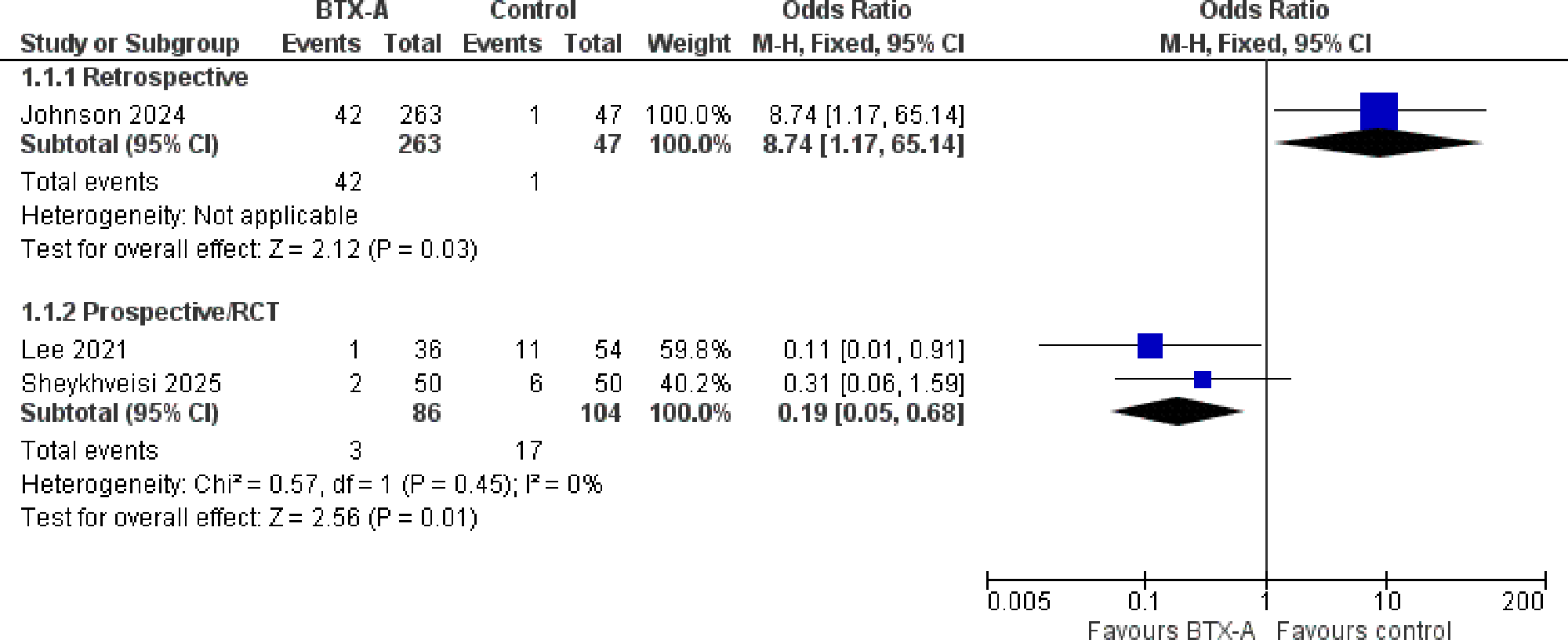
A pooled analysis revealed differences between the findings of a single retrospective study (highly prone to bias) and two recent prospective studies. The latter, with better methodological validity, demonstrated a tendency to reduce the rate of sialocele. Figure 2
Forest plot of clinical trials comparing BTX-A in a prophylactic setting. BTX-A, botulinum toxin type A.

Figure 2 Long description
Forest plot comparing prophylactic BTX-A versus control. One retrospective study favored control with an odds ratio of 8.74 (95% CI 1.17–65.14). Two prospective randomized trials favored BTX-A with a pooled odds ratio of 0.19 (95% CI 0.05–0.68). Squares indicate study estimates, horizontal lines represent confidence intervals and diamonds indicate pooled effects.
Post-operative treatment approach
The 32 studiesReference Marchese Ragona, Blotta, Pastore, Tugnoli, Eleopra and De Grandis14–Reference Palacios, Holley and Park45 included were mostly conducted in European countries and evaluated disorders in the parotid region. There was a total of 73 patients. The vast majority were case reportsReference Marchese Ragona, Blotta, Pastore, Tugnoli, Eleopra and De Grandis14, Reference Guntinas-Lichius and Sittel16–Reference Breuer, Ferrazzini and Grossenbacher23, Reference Capaccio, Cuccarini, Benicchio, Minorati, Spadari and Ottaviani25–Reference Hill, Mortimer, Hitchcock and Salmon28, Reference Lim and Choi30, Reference Krishnan, Clark and Donnelly31, Reference Pantel, Volk, Guntinas-Lichius and Wittekindt33–Reference Jeffe and Sulman35, Reference Hong, Kwon, Kang and Park37, Reference Ahuja, Natarajan, Galinde and Asnani39–Reference Bancalari, Llombart, Requena and Vendrell41, Reference Palacios, Holley and Park45 (n = 23) or small case seriesReference Vargas, Galati and Parnes15, Reference Marchese-Ragona, Marioni, Restivo and Staffieri24, Reference Arnaud, Batifol, Goudot and Yachouh29, Reference Laskawi, Winterhoff, Köhler, Kottwitz and Matthias32, Reference Tighe, Williams and Howett36, Reference Melville, Stackowicz, Jundt and Shum38, Reference Costan, Dabija, Ciofu, Sulea, Popescu and Boisteanu42–Reference Send, Bertlich, Eichhorn, Bootz and Jakob44 (n = 9). The patient population ranged in age from 3 months to 88 years, with the majority being men (60). The studies mostly examined aetiologies, such as salivary gland surgery, trauma and dermatological surgery. Except for three studies,Reference Marchese Ragona, Blotta, Pastore, Tugnoli, Eleopra and De Grandis14, Reference Pantel, Volk, Guntinas-Lichius and Wittekindt33, Reference Jeffe and Sulman35 all reported the use of BTX-A. The doses ranged from 10 to 225 U (median, 45), with the majority done with one application and in one session. Most injections were intra-glandular or subcutaneous, with some performed under ultrasound guidance. Approximately 92 per cent (n = 67) of treated individuals had their sialocele or fistulas completely resolved. However, the median follow-up was three weeks (range 1–52). There was just one major adverse event reported among all cases (temporary facial nerve palsy) (Tables 1 and 2).
Characteristics of BTX administration and outcomes

Table 2 Long description
Table summarizing BTX administration protocols and outcomes in prophylactic and postoperative treatment studies. Most studies used botulinum toxin type A after surgery-related salivary fistula or sialocele. Doses ranged from 10 to 225 units, usually administered in a single session. Most reports described successful treatment outcomes. Median dose was 45 units, with one application and one treatment session.
P = parotid; S = submaxillary; F = fistula; SL = sialocele; T = trauma; D = dermatological surgery; M = maxillofacial surgery; Surg = salivary gland surgery. SS = esthetic surgery.
Discussion and summary of evidence patterns and gaps
There is a common misunderstanding about the many forms of evidence synthesis in biomedical research.Reference Munn, Peters, Stern, Tufanaru, McArthur and Aromataris46 Systematic reviews are only appropriate when a specific research question can be developed (PICO framework), and the available studies are sufficiently homogeneous in design, population, treatments and outcomes to allow for structured comparison or meta-analysis. In contrast, when the evidence is heterogenous, fragmented or emergent, or when the goal is to map ideas, identify knowledge gaps or explain the range and nature of current evidence rather than estimate impact sizes, a scoping review is more appropriate. This distinction is clearly defined in the Cochrane Handbook for Systematic Reviews of Interventions and the JBI Manual for Evidence Synthesis,Reference Aromataris, Lockwood, Porritt, Pilla and Jordan11, Reference Higgins, Thomas, Chandler, Cumpston, Li and Page47 which emphasise that systematic reviews are designed to answer narrowly defined questions and test specific hypotheses, whereas scoping reviews investigate broader questions to inform research priorities, policy and practice. The use of BTX-A in the treatment of sialocele and post-operative fistula is a highly particular example of this scenario.
This scoping review identified and synthesised existing information on the use of botulinum toxin, specifically type A (BTX-A), to prevent or treat post-operative sialocele and salivary fistulas. Most studies were case reports or small case series, with just a few prospective or retrospective cohort studies and one randomised controlled trial.
The most recent clinical trialsReference Johnson, Burian, Santer, Strasser, Steinbichler and Hofauer8–Reference Sheykhveisi, Khaauthori, Mashhadi, Esmaily and Khazaeni10 evaluating the preventive use of BTX-A in more than 600 patients with parotid gland surgery have provided useful insights, but they also showed significant shortcomings that preclude definitive therapeutic recommendations. The absence of randomisation, different toxin doses and inconsistently reported results all impair the Johnson et al.Reference Johnson, Burian, Santer, Strasser, Steinbichler and Hofauer8 study internal validity. The prospective trial by Lee et al.Reference Lee, Lee, Park, Lee and Cha9 adds to the evidence for BTX-A as a preventive adjuvant after parotidectomy, although the retrospective nature of the comparator group and limited sample size raise questions regarding selection bias and statistical power. In contrast, Sheykhveisi et al.Reference Sheykhveisi, Khaauthori, Mashhadi, Esmaily and Khazaeni10 conducted a randomised controlled study with greater methodological rigour and discovered a nonsignificant trend towards lower sialocele rates in the BTX group.
The pooled data in Figure 2 illustrate the differences in outcomes after controlling for research design (retrospective versus prospective), but they also suggest that prophylactic use of BTX-A may play a significant role in avoiding sialocele and fistulas after parotidectomies. This impact may be especially significant after partial parotidectomies or extracapsular dissection, when the salivary bed is exposed.
Notably, considerable decreases in early post-operative drainage volumes indicate that BTX-A has a physiological effect, while the trial was underpowered to detect differences in uncommon complications. Together, these investigations reveal a trend of promising but unclear results. BTX-A reduces salivary production and may lessen the likelihood of sialocele formation, particularly when administered intra-operatively.Reference Lovato, Restivo, Ottaviano, Marioni and Marchese-Ragona48 The clinical applicability of prophylactic BTX-A must be weighed against the low baseline rate of parotid fistula (1–3 per cent) and sialocele (5–15 per cent) following parotidectomy. Given this context, prophylactic BTX-A may be most appropriately considered in selected high-risk patients (e.g., total parotidectomy, prior radiation and revision surgery), where the number needed to treat would be more favourable. Routine prophylactic use in all patients cannot be recommended based on current evidence. In addition, variability in patient selection, dose procedures, comparator groups and outcome criteria limits the robustness of the current findings. Standardised, sufficiently powered RCTs with long-term follow-up are necessary for assessing BTX-A preventive and therapeutic effects in a variety of surgical situations. Furthermore, future research should focus on appropriate time, dosage and injection methods to create clear therapeutic guidelines.
BTX-A represents a promising minimally invasive option for treating persistent parotid fistulas and sialocele, with a resolution rate of approximately 92 per cent in uncontrolled observational studies. However, the absence of comparative trials limits the strength of this evidence, and publication bias favouring positive outcomes cannot be excluded. Although Maharaj et al.Reference Maharaj, Mungul and Laher7 conducted a systematic review on the subject in 2019, it focused exclusively on the therapeutic applications of BTX-A and included 15 studies and 47 patients. The recent analysis doubled the number of treatment-focused studies and raised the number of participants by more than 60 per cent. Its minimally invasive nature, low complication rate and high cure rate make BTX-A an appealing alternative to re-exploration or more invasive procedures. The data collected show that an average dose of 40–50 U in a single application and session is sufficient for clinical usage and can reproduce the outcomes of the published studies. However, the present body of data is marked by a lack of comparative research, variability in BTX-A doses and technique (which are frequently inadequately standardised) and underreporting of treatment protocols and injection guiding systems (e.g., ultrasonography). These limitations highlight the importance of conducting prospective, multicentre trials with defined treatment regimens to assess the reliability of outcomes and define effective therapy methods.Reference Khalil, Jia, Moraes, Munn, Alexander and Peters49
The latest studies by Santos et al.Reference Santos, McGill, Kerendi and Nahai50 and Chettuvatti et al.Reference Chettuvatti, Panda, Sood, Konkimalla, Thakar and Mitra51 give important supplementary insights into the use of BTX-A for the treatment and prevention of salivary fistulas and sialoceles. Santos et al.Reference Santos, McGill, Kerendi and Nahai50 are especially concerned with cosmetic facial surgical issues, such as those resulting from rhytidectomy and neck lift surgeries, and they propose for preventive injection into the remnant submandibular gland after partial resection. Chettuvatti et al.,Reference Chettuvatti, Panda, Sood, Konkimalla, Thakar and Mitra51 on the other hand, provide a research in oncology that compares BTX-A to conservative therapy in patients with surgical oral and pharyngocutaneous fistulas. These two investigations increase BTX-A therapeutic scope.
Clinically, BTX-A provides a less invasive, low-risk alternative for treating challenging salivary leakage, especially in patients who are poor surgical candidates or have failed standard conservative treatment. Its usage intra-operatively may also show potential in some high-risk groups, although the data are not yet conclusive. For physicians, understanding the spectrum of BTX-A protocols and the parameters associated with treatment effectiveness is critical for improving results.Reference Witmanowski and Blochowiak52
From a scientific standpoint, this review emphasises the critical need for well-designed controlled trials to assess BTX-A effectiveness in both preventive and therapeutic contexts. Future trials should use uniform techniques, incorporate long-term follow-up and stratify patients based on risk profile. A multicentre registry of salivary problems and BTX-A therapies might help with observational comparisons and real-world effectiveness assessments. The absence of strong clinical guidelines for the treatment of sialocele and fistulas indicates an opportunity to develop consensus recommendations based on increasing data.
This scoping review has some limitations. First, despite a thorough search of major databases and grey literature sources, inclusion was limited to papers that were available, potentially excluding some studies. Second, the heterogeneity of research design, reporting and results means that pooled results should be evaluated with caution. Finally, given the dependence on case reports and retrospective data, publication bias may have benefited research with good results.
• Sialocele and salivary fistula are recognised complications following parotidectomy, traditionally managed with compressive dressings, anticholinergic agents or surgical revision
• Botulinum toxin type A (BTX-A) has emerged as a minimally invasive alternative by temporarily reducing cholinergic stimulation of salivary secretion
• This scoping review identified 35 studies and 681 patients, more than doubling the scope of the only prior review on this topic
• Prophylactic BTX-A was associated with a lower sialocele rate (3.4 per cent vs. 16.4 per cent in controls), though without statistical significance; therapeutic use achieved resolution in approximately 92 per cent of cases.
• Evidence is limited by small sample sizes, heterogeneous protocols and predominance of case reports, with only one randomised controlled trial available
• Standardised, well-powered multicentre trials are needed before definitive recommendations can be made
Conclusion
Current evidence, predominantly derived from case reports and small case series, suggests that BTX-A may reduce salivary output and facilitate resolution of parotid fistulas and sialocele. However, the only RCT available did not demonstrate a statistically significant reduction in post-parotidectomy complications. Prophylactic use cannot be recommended outside high-risk selected cases due to the low baseline rate of these complications. Well-designed, multicentre RCTs with standardised protocols, appropriate follow-up and stratified patient populations are essential to establish definitive recommendations.
Competing interest statement
Cesar Alturo and Alvaro Sanabria declare not to have any kind of conflict of interest.
Funding
Cesar Alturo and Alvaro Sanabria declare that did not receive funding.
Authorship
Alvaro Sanabria, Cesar Alturo: Conceptualisation, Methodology, Validation, Investigation, Data Curation, Formal Analysis, Writing - Original Draft and Writing - Review & Editing.
Data availability statement
The data that support the findings of this study are available from the corresponding author, upon reasonable request.