INTRODUCTION
Enhancing agricultural productivity through scientific water management is one of the challenges confronting India. Rainfed agriculture remains the most important livelihood for most farmers. Soil moisture conservation for agricultural crops has therefore attracted major research interest; however, problems caused by excess rainwater have received little attention. Understanding the water dynamics of soils that are subjected to seasonal impounding is a prerequisite for crop planning, yield simulations or water management decisions.
Soil water retention characteristics (SWRC) and saturated hydraulic conductivity (K s) are the two soil properties that are vital to any such simulation. Measurement of soil hydraulic properties in the laboratory is complex, time-consuming and arduous. Therefore, over the last two decades, the use of pedotransfer functions (PTFs) to estimate the hydraulic properties from basic soil data has increased (Rawls & Brakensiek Reference Rawls and Brakensiek1983; Cosby et al. Reference Cosby, Hornberger, Clapp and Ginn1984; Saxton et al. Reference Saxton, Rawls, Romberger and Papendick1986; Vereecken et al. Reference Vereecken, Maes and Feyen1990; van Genuchten Reference Van Genuchten, Leij, Lund, van Genuchten, Leij and Lund1992; Leij et al. Reference Leij, Schaap, Arya, Dane and Topp2002; Jain et al. Reference Jain, Singh and Van Genuchten2004; Pachepsky et al. Reference Pachepsky, Rawls and Lin2006). PTFs relate hydraulic properties to easily measured or available soil properties. PTFs have been developed using different techniques (Wösten et al. Reference Wösten, Pachepsky and Rawls2001) such as regression (Rawls & Brakensiek Reference Rawls, Brakensiek, Jones and Ward1985; Wösten et al. Reference Wösten, Finke and Jansen1995) or artificial neural networks (ANN; Pachepsky et al. Reference Pachepsky, Timlin and Varallyay1996; Schaap et al. Reference Schaap, Leij and Van Genuchten1998; Minasny et al. Reference Minasny, McBratney and Bristow1999; Minasny & McBratney Reference Minasny and McBratney2002; Jain et al. Reference Jain, Singh and Van Genuchten2004). Recently, genetic programming was employed (Parasuraman et al. Reference Parasuraman, Elshorbagy and Si2007) to estimate K s from basic soil data. Most of the reported studies, however, make use of neural networks (ANNs). For instance, Schaap et al. (Reference Schaap, Leij and Van Genuchten1998) developed an ANN-based PTF, using a dataset of 4515 samples in the USA, which reportedly performed better than four published PTFs in estimating water retention data and six published PTFs in estimating K s. Later, Schaap et al. (Reference Schaap, Leij and Van Genuchten2001) developed an ANN-based computer code, Rosetta (public domain), which implements five hierarchical PTFs for the estimation of water retention and the saturated and unsaturated hydraulic conductivity. The dataset used for calibrating Rosetta was derived from soils in temperate to subtropical climates of North America and Europe. These studies have shown the effectiveness of ANNs in prediction of hydraulic properties. However, the PTFs were based on large datasets.
Unfortunately, in India, no large datasets on soils are available. Routinely collected information generally includes particle size distribution, bulk density (dry) together with intermittent data on water held at −33 kPa (field capacity) and −1500 kPa (permanent wilting point). In the absence of hydraulic information, use of generic PTF is an attractive option to predict properties such as SWRC and K s, which are difficult to measure. However, estimation of properties using PTFs developed elsewhere is often fraught with errors of unacceptable magnitude. The PTFs developed at one scale (regional, national and continental) may not be suitable for another (Nemes et al. Reference Nemes, Schaap and Wösten2003). For example, Romano & Palladino (Reference Romano and Palladino2002) examined the prediction of soil hydraulic properties from soil physical properties and terrain information. They concluded that the use of ‘external’ PTFs was not advisable if the scale varied. PTFs derived from a small local database were shown to perform better than the large but general database. Recent publications focus on comparing PTF predictions with independent datasets of hydraulic properties measured in the laboratory. Some publications indicate good (Schaap & Leij Reference Schaap and Leij2000; Cornelius et al. Reference Cornelius, Ronsyn, Van Meirvenne and Hartmann2001; Rawls et al. Reference Rawls, Pachepsky and Shen2001; Wagner et al. Reference Wagner, Tarnawski, Hennings, Muller, Wessolek and Plagge2001) or moderate agreement (Givi et al. Reference Givi, Prasher and Patel2004), while some discrepancies are also reported (Chen & Payne Reference Chen and Payne2001; Pachepsky & Rawls Reference Pachepsky and Rawls2003; Soet & Stricker Reference Soet and Stricker2003).
The very popular PTF Rosetta (Schaap et al. Reference Schaap, Leij and Van Genuchten2001) was selected for the present work because it has been developed from large multinational databases containing soil data from a wide range of soil types. The main advantage of such a PTF is that the soils for which it is applied need not be similar in characteristics (or be subjected to similar soil forming conditions) to the database soils included in the calibration of PTF. Rosetta constitutes one of the most recent PTFs which, overall, has shown reasonable predictions in evaluation studies (Gérard et al. Reference Gérard, Tinsley and Mayer2004). The functional performance of Rosetta was shown to be reasonably good by Nemes et al. (Reference Nemes, Schaap and Wösten2003) in a four-year study that simulated soil moisture variations in the field with different sets of input data. The hierarchical structure of Rosetta enables the use of flexible input of limited and more extended sets of predictors. The available reports on evaluation of Rosetta indicate improvements in its performance with increases (hierarchical) in input. A trend of improvement was reported by Nemes et al. (Reference Nemes, Schaap and Wösten2003) with an increasing number of predictors. Rawls et al. (Reference Rawls, Pachepsky and Shen2001) and Wösten et al. (Reference Wösten, Pachepsky and Rawls2001) have also reported such a trend in evaluation studies of PTFs. In some of the studies in which validation was not possible, researchers opted for Rosetta because of its wider database. Vanderlinden et al. (Reference Vanderlinden, Giráldez and Van Meirvenne2005) preferred Rosetta for estimating available water capacity (difference between water content at field capacity and at wilting point) in preparing a map of soil water holding capacity for southern Spain. Gérard et al. (Reference Gérard, Tinsley and Mayer2004), in an attempt to avoid measurement of hydraulic characteristics, identified Rosetta as a PTF recognized for its predicting capacity in the context of great scarcity of information on soil properties and stated that Rosetta showed good predictive ability for simulating daily average values of the measured water content over a four-year period in the field site at Rhone, France. In another evaluation study, Rubio & Llorens (Reference Rubio and Llorens2005) concluded that the Rosetta model is adequate for the estimation of water content at field capacity, but underestimates permanent wilting point.
Little is known about the predictive quality of generic PTFs when employed to predict hydraulic characteristics of problem soils such as seasonally impounded clay soils. The present study was conducted: (i) to evaluate the performance of Rosetta in predicting SWRC and K s and (ii) to calibrate PTF for predicting saturated hydraulic conductivity K s from readily available soil properties data including particle size distribution, bulk density, organic carbon content, field capacity (soil water retained at −33 kPa) and permanent wilting point (soil water retained at −1500 kPa).
MATERIALS AND METHODS
The study area is located in the Jabalpur district, Madhya Pradesh state, India (22°49′ to 24°80′N and 78°21′ to 80°58′E). Average annual rainfall is 1300–1500 mm, falling mostly during rainy season (June to September). The soils of the area are mainly clayey and classified as Vertisols and associated soils (Tomar et al. Reference Tomar, Tembe, Sharma, Bhadauria and Tomar1996). Low infiltration rate (poor vertical drainage) of the soils combined with flat terrain (poor horizontal drainage) and high rainfall in a relatively short period of time make nearly 50 000 km2 (0·5 of area of the district) agricultural lands seasonally inundated. Crops are grown in winter using residual moisture in the soil. For sampling purposes, a ‘Haveli’ tract, delineated by Rajput et al. (Reference Rajput, Singh, Shrivastava, Kewat and Sharma2004), was traversed to mark representative sites. Surface (0–200 mm) soil samples at intervals of 3–6 km or shorter intervals depending upon the soil heterogeneity were collected from 102 fields. The bulk sample (approx. 2–3 kg) collected from each site was air dried and ground to pass though a 2 mm sieve. All the samples were analysed for particle size distribution by the International Pipette method using sodium hexametaphosphate as a dispersing agent (Black et al. Reference Black, Evans, White, Ensminger and Clark1965). The textural classes used were those of USDA (Soil Survey Staff 2006). Bulk density was determined by a dry clod (25–30 g natural cleavage clod collected during sampling) coating technique (Black et al. Reference Black, Evans, White, Ensminger and Clark1965). Organic carbon content was determined by the Walkley and Black rapid titration method (Jackson Reference Jackson1973). A nine point soil water retention curve was derived by measuring water retained at −10, −20, −33, −50, −100, −300, −500, −1000 and −1500 kPa using pressure plate apparatus. The sieved soil sample(s) were placed in rubber soil retainer rings (60 mm diameter, 10 mm high) on ceramic plates at the requisite capacity. The soil in the ring was allowed to saturate for 24 h with an excess of water and the pre-determined pressure from a source of compressed air was applied the next day. Moisture was determined gravimetrically after the soils had attained equilibrium at the particular pressure. Since soils of the study area are of a shrink-swell type (smectitic clay), measurements on water retention at various suction points were corrected for overburden caused by soil swelling. Coefficient of linear extensibility (COLE) was calculated as suggested by Schafer & Singer (Reference Schafer and Singer1976) :

where Lm is moist soil–cylinder length (mm) and Ld is the dry soil–cylinder length (mm). Soil porosity was assumed at 0·5 for calculating overburden caused by swelling. At each suction point, water-retaining pores were calculated using a standard capillary equation. Positive potential created by overburden of water retained in the swelled portion was calculated as a product of mass of water in pores (g) and linear swelling (mm/mm). These values were converted to Pascals and added to the applied equilibrium pressure. Soil water characteristics curves were thus obtained using the corrected nine-point data applying varied suction.
Saturated hydraulic conductivity was determined using the constant head permeameter method. Water was introduced into the soil sample by maintaining inflow and outflow reservoirs at constant positions relative to the sample. The steady flow rate, sample length and cross-sectional area, and difference in reservoir elevations were used to calculate hydraulic conductivity according to Darcy's equation.
Deriving PTF
Statistical and neural regression PTFs were derived. Five levels of input information were identified for establishing dependencies between basic soil properties and saturated hydraulic conductivity (K s).
• Input level 1: textural data (data on sand, silt and clay fraction-SSC)
• Input level 2: level 1+bulk density data (1+BD)
• Input level 3: level 2+organic carbon content (2+OC)
• Input level 4: level 3+field capacity data (3+FC)
• Input level 5: level 4+permanent wilting point data (4+PWP)
In neural regression, the feed forward neural network (FF-NN) model with three hidden nodes (Schaap et al. Reference Schaap, Leij and Van Genuchten1998) was preferred. According to Maier & Dandy (Reference Maier and Dandy2000), FF-NNs are the most widely adopted network architecture for the prediction and forecasting of geophysical variables. Typical FF-NN consists of three layers: an input layer, a hidden layer and an output layer. The number of nodes in an input layer corresponds to the number of inputs considered for the PTF. The input layer is connected to the hidden layer with weights that determine the strength of the connections. The hidden layer provides the network's non-linear modelling capabilities. As a general rule, the hidden units should be half the number of input units. Thus, because the maximum inputs in the present analysis were seven, three hidden units were considered optimum. The data set was partitioned into ‘training’ (76 samples) and ‘test’ (26 samples) sets. Upon finding an appropriate network model (ANN), the PTF was derived. For network training, the Levenberg–Marquardt (L–M) algorithm was chosen because the dataset was small. Mayr & Jarvis (Reference Mayr and Jarvis1999), van Genuchten et al. (Reference Van Genuchten, Leij, Lund, van Genuchten, Leij and Lund1992) and other researchers have used the same algorithm to develop PTFs. Further, for fair comparison between regression and ANN PTF, it was desirable to seek minimization of sum of squares error. Estimates of SWRC and K s were obtained using hierarchical rules in the PTF Rosetta, beginning with textural composition (sand, silt, clay content-input level 1), adding incremental variable bulk density (BD-input level 2), field capacity (FC-input level 3) and permanent wilting point (PWP-input level 4) at each step. Thus, the input levels in derived PTF and Rosetta predictions were identical (except level 3) to facilitate comparison of performance.
Performance evaluation
Performance of the PTF was evaluated based on one to one correspondence between measured and predicted values of SWRC and K s. The statistical index root mean square error (RMSE) is commonly used for such evaluations and the linear correlation coefficient (r), was also calculated to compare measured and predicted data. The RMSE statistic indicates the model's ability to predict away from the mean. It imparts more weight to high values because it involves square of the difference between observed and predicted values. Ideally, the model should have the smallest overall dispersion (RMSE).
RESULTS
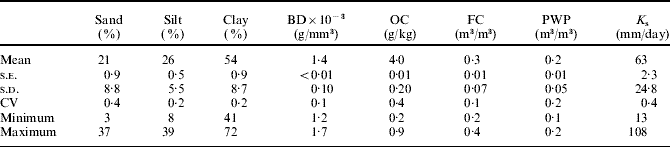
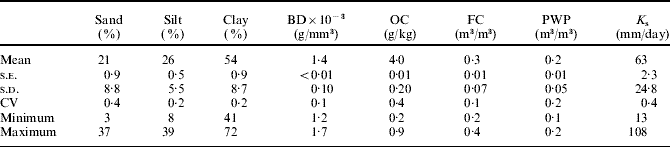
Descriptive statistics of the entire dataset are presented in Table 1. Particle size distribution revealed that clay content in surface soils of the seasonally inundated tract ranged from 0·40 to 0·71. While clay content and bulk density showed the least variation, sand content showed the highest variation. Inhibited drainage in the tract was corroborated by low saturated hydraulic conductivity values (Table 1). Units of SWRC and K s in the present paper are m3/m3 and mm/day.
Statistical summary of basic properties of 102 clay soil samples from Jabalpur district, Madhya Pradesh, India
Irrespective of suction pressure, moisture retention was positively correlated with clay fraction. The regression coefficients ranged from 0·38 to 0·42 (P<0·01) except at −50 kPa, where it was relatively low (R 2=0·23). Sand fraction was negatively correlated (R 2=0·51–0·59), again with an exception at −50 kPa (R 2=−0·34). The influence of silt fraction was relatively low (R 2=0·19–0·34). Thus, the moisture retention was affected in order by sand, clay and silt content.
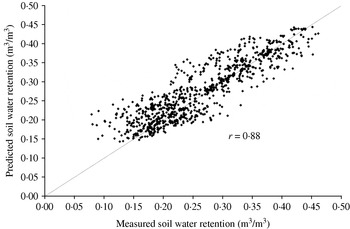
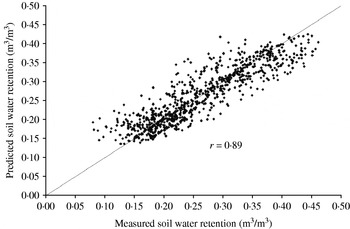
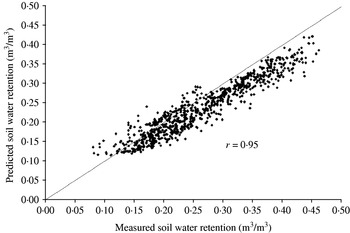
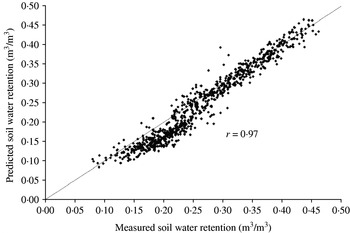
Water retention estimates obtained with maximum input (level 4) in Rosetta were closer to the laboratory-measured data as compared with the estimates obtained with lower levels of input. In general, the predictions improved with increases in input variables (Figs 1–4) as r increased from 0·88 to 0·97. The RMSE in estimation of water retention ranged from 0·0121 to 0·0549 m3/m3 (Table 2). The standard deviation in measured soil water retention data ranged from 0·03 to 0·04 m3/m3; an RMSE limit of 0·05 m3/m3 was considered appropriate to accept predictions by Rosetta. It can be seen from Fig. 3 that there was underestimation in moisture content above 0·3 m3/m3 when FC was used as the input in hierarchical PTF, while inclusion of PWP resulted in underprediction in a lower range (0·1–0·25 m3/m3).
Measured and estimated soil water retention in seasonally impounded clay soils using textural composition as an input in Rosetta.

Measured and estimated soil water retention in seasonally impounded clay soils using textural composition and bulk density as an input in Rosetta.

Measured and estimated soil water retention in seasonally impounded clay soils using textural composition, bulk density and field capacity as an input in Rosetta.

Measured and estimated soil water retention in seasonally impounded clay soils using textural composition, bulk density field capacity and permanent wilting point as an input in Rosetta.

RMSE indicating accuracy of Rosetta in predicting soil water retention at varied suction pressure(s)

SSC, percentages of sand, silt and clay; BD, bulk density; FC, field capacity; PWP, permanent wilting point.
Inclusion of bulk density as an input variable did not improve the predictions in greater suction (<−300 kPa), but predictions improved in ranges with lower suction. A similar trend was observed when FC and PWP were included as predictor variables. These findings indicate that the bulk density data of these soils is not necessary and data on particle size distribution could also be used for estimating SWRC without loss of acceptable accuracy.
Though the estimates improved with increases in input, the difference in error indicated that at lower suction ranges (<−300 kPa) the estimates from input level 3 (texture, BD and FC) were better than those from input level 4. Inclusion of input data on the permanent wilting point (−1500 kPa) improved estimates in higher suction ranges, but under-estimated retention in lower suction ranges. Similarly, inclusion of information on field capacity (input level 3) did not lower RMSE in the suction range >−500 kPa. At this input level, SWRC were mostly underestimated (Fig. 3).
PTF to predict Ks
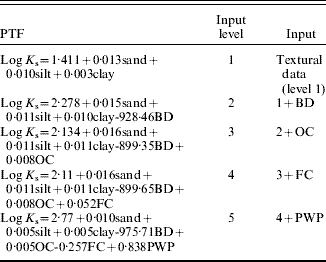
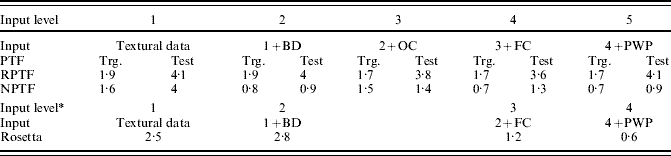
PTFs derived using statistical regressions are presented in Table 3. Evaluation of derived regression and neural PTFs against Rosetta can be judged from the RMSE values presented (Table 4). When textural data (input level 1) was used for training, the neural models performed better (lower RMSE) than regression models. However, testing of the models using subsets indicated that regression and a neural PTF did not differ in their predictive ability. It was interesting that the performance of Rosetta in predicting K s using textural data as input was better (Table 4, Figs 5 and 6) with lower RMSE (2·5) than the derived PTF (RMSE 4·1 and 4·0). This was unexpected as Rosetta is developed using external data in contrast to the PTF which, being based on local data, was expected to perform better.
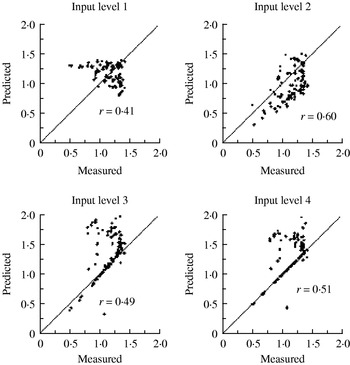
Measured and predicted saturated hydraulic conductivity log (cm/day) using hierarchical inputs – input level 1 (textural data), level 2 (1+BD), level 3 (2+FC) and level 4 (3+PWP) in Rosetta.

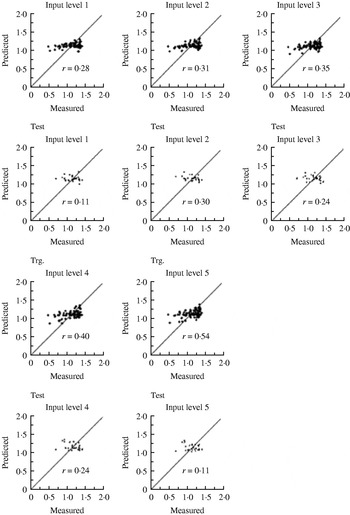
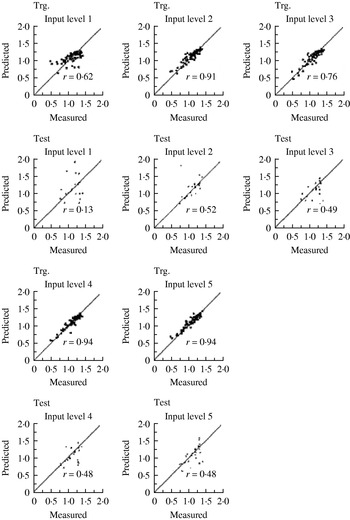
Measured and predicted saturated hydraulic conductivity (log cm/day) by regression PTF using training and testing data.

Regression PTF to estimate saturated hydraulic conductivity
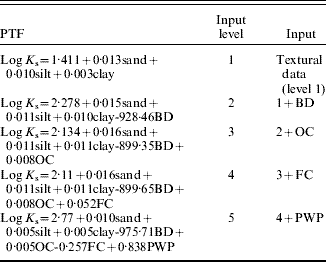
K s: mm/day, soil fractions in % by volume; OC in g/kg; BD: g/mm3; FC and PWP m3/m3.
RMSE denoting ‘accuracy’ and ‘reliability’ of the derived PTF using different input levels of prediction
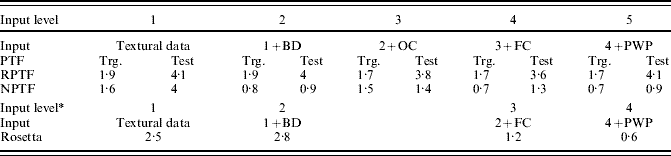
RPTF, regression PTF; NPTFs, neural PTFs; Trg., training set.
* Rosetta does not include OC as a predictor variable.
While the RMSE values suggested a definitive improvement in predictions by Rosetta with increased input, the r values (Fig. 5) denote relatively poor agreement between measured and predicted K s. Best estimates of K s using Rosetta were obtained with input level 2 (textural data and BD), as indicated by r. The derived PTFs were less precise than the Rosetta predictions (r=0·6 for Rosetta and r=0·52 and 0·3 for neural and regression PTFs, respectively, for the same input level (Figs 6 and 7). Inclusion of BD along with textural data in training improved performance of the neural PTF, while the performance of the regression PTF was almost unchanged. Again, the RMSE in predictions using Rosetta with input level 2 (RMSE=2·8) compared with input level 1 (RMSE=4·0) was lower than the regression PTF. The RMSE in neural PTF (training) was reduced from 1·6 to 0·8. However, the estimates of K s by Rosetta were less precise (higher RMSE), despite the input of additional information. The greatest RMSE (2·8) for predictions by Rosetta was at input level 2. The corresponding RMSE for the neural PTF was 0·9.
Measured and predicted saturated hydraulic conductivity (log cm/day) by neural PTF using training and testing data.

The impounded clay soils of the tract were very poor in organic carbon (<10 g/kg) status. The data (Table 4) indicates no significant change in predictive ability of PTF after including OC as a predictor variable.
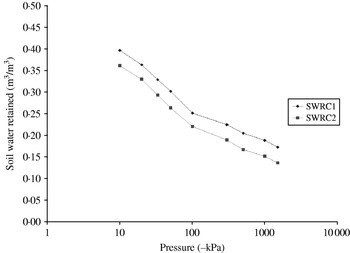
Inclusion of FC and PWP as predictor variables resulted in overprediction of K s by Rosetta. A slight improvement was noted with inclusion of PWP at input level 4 (r=0·51) as compared to input level 3 (r=0·49). The derived neural PTFs were almost the same as Rosetta, as indicated by the r values. The samples associated with overpredictions by Rosetta were separated and compared with the rest of the samples for their properties. Mean sand content in these was almost 4% by volume higher (23% as against 19%) than the other samples. There was little change in silt content (<1% by volume) and the increase in sand content was almost entirely at the expense of decreased clay content (from 54 to 51% by volume). Thus, the overpredictions by Rosetta could not be explained by the available data. The measured SWRC of the two soil groups clearly indicated a decline in retention (Fig. 8) for samples associated with overpredictions, as the mean sand content increased. Thus, it was evident that the predictions of SWRC correspond well with the measured data. Estimates of K s, however, illustrated limitations of Rosetta and derived PTFs. The hydraulic behaviour of the study soils is thus unique and it will be interesting to investigate further, to understand factors influencing K s of these soils.
Measured soil water retention in soil samples associated with overestimation of saturated hydraulic conductivity by Rosetta (SWRC 2) and remaining samples (SWRC 1).

Rosetta does not include OC as an input variable so its performance with OC as one of the inputs could not be compared. The neural networks are expected to improve in modelling ability with increases in input variables that are believed to affect the predicted property. The present results were mixed, with RMSE (testing) in prediction of K s being 0·9, 1·4, 1·3 and 0·9 with incremental inclusion of BD, OC, FC and PWP, respectively, as against 4·0 with the lowest input level 1 (textural data only). Thus, an increase in the number of variables did not lead to consistent improvements in performance. Rosetta estimates of K s were closest to the measured data when the number of input variables was increased to include two soil moisture constants, FC and PWP (RMSE 1·2 with inclusion of FC and 0·6 with inclusion of PWP). While these results were expected, the relatively poor performance of the neural PTF, despite increased variable inputs, indicated that the soils were unique in their hydraulic behaviour (especially K s) and the neural networks could not be trained for precise predictions. However, neural models outperformed regression models, as indicated by lower RMSE (0·7–1·6) in training and almost same range (0·9–4·0) for testing dataset.
DISCUSSION
The derived PTF were judged to be acceptable for prediction based on the upper limit of RMSE in prediction of SWRC (0·055 m3/m3). This was marginally higher than the generally reported limit of 0·05 m3/m3 (Wösten et al. Reference Wösten, Pachepsky and Rawls2001) in PTFs. Evaluation of Rosetta indicated agreement with earlier results of improvement with an increasing number of predictors (Rawls et al. Reference Rawls, Pachepsky and Shen2001; Wösten et al. Reference Wösten, Pachepsky and Rawls2001; Nemes et al. Reference Nemes, Schaap and Wösten2003). In the present study, using the FC together with other soil physical properties in Rosetta increased the precision of SWRC predictions. This could be due to better information provided by these soil moisture constants about soil pore structure. However, systematic errors in underestimation were observed at the dry (Fig. 3) and the wet (Fig. 4) ends of SWRC after inclusion of soil moisture constants FC and PWP. This could be attributed to the shrink-swell nature of the study soils. While laboratory measured SWRC were corrected for possible underestimation, Rosetta predictions did not account for shrink-swell characteristics.
However, the errors were within acceptable limits and hence Rosetta could be used for estimating water retention in soils of the study area. Thus, resource-intensive laboratory work to measure SWRC could be avoided. In a similar, previous study Givi et al. (Reference Givi, Prasher and Patel2004) evaluated 13 PTFs and concluded that Rosetta was of intermediate value in estimating FC and PWP of the fine textured soils of ‘Zagros’ in Iran. The present study suggests that the entire water retention curve, including FC and PWP, could be predicted using Rosetta with acceptable accuracy. Although there have generally been reports of improvement in predictions by Rosetta with hierarchical increases in predictor variables (e.g. Parasuraman et al. Reference Parasuraman, Elshorbagy and Si2007), in contrast, the present results showed no improvement.
Performance of Rosetta in predicting K s was worse at input level 2 with an input of texture and soil bulk density. This could again be attributed to the shrink-swell nature of the study soils. It can be observed (Fig. 5) that all the estimates of K s with an input of texture only (input level 1) and texture plus BD (input level 2) varied within a narrow range of 10–12·5 mm/day. Estimates improved only after inclusion of moisture constants as an input, implying that the measures of soil structure had less influence in predicting K s of the soils. This could partly be due to lack of adequate data on shrink-swell soils in the development of Rosetta. However, PTFs derived using statistical regression improved prediction to a limited extent, despite inclusion of FC and PWP as input variables, perhaps suggesting the spread of data was insufficient to develop robust regression equations. The coefficient of variation (CV) for measured K s data was relatively low (0·39). These limitations had less effect in neural regression. However, the addition of OC as a predictor variable did not improve the neural PTF derived (Table 4, Figs 6 and 7). Contrary to expectations, the error increased. Soil aggregation is assumed to improve with increased organic matter, which is confirmed by several reports finding positive correlation between K s and OM or OC (e.g. Auerswald Reference Auerswald1995; Mbagwu & Auerswald Reference Mbagwu and Auerswald1999; Lado et al. Reference Lado, Paz and Ben-Hur2004).
The present study demonstrated the successful application of Rosetta and neural PTFs to predict two fundamental soil hydraulic properties, namely SWRC and K s. It has implications in water management options in seasonally impounded soils. Currently, farmers rely on their experience to take decisions regarding the drainage schedule and decide on the crop to be raised depending on the residual moisture likely to be available. Information on basic hydraulic properties will help in better simulations of soil water dynamics and hence better assessment of residual moisture. The crop plan then could be altered to suit the hydromorphic environment.
The main conclusions from the present work are that the global PTF Rosetta could be used to estimate SWRC of seasonally impounded clay soils, while the neural PTF proposed could be used to predict K s. Estimates obtained with inputs maximal information (particle size distribution, bulk density, field capacity and permanent wilting point) in Rosetta were closer to the laboratory measured data than estimates obtained with fewer inputs. It was significant that Rosetta predicted SWRC with acceptable accuracy even with data on soil texture only. Therefore, the use of Rosetta is recommended to predict SWRC of the study soils. The derived neural PTF performed better in predicting K s. Comparison of Rosetta and statistical regression PTF to predict K s was inconclusive.
The study resulted in a better understanding of hydraulic properties of seasonally impounded clay soils and indicated possible estimation of these properties using PTF that will help in assessing water management options for large area.