Although most people experience traumatic events during their lifetime, individuals’ reactions to these events vary widely. Some individuals experience chronic debilitating distress, which significantly interferes with their daily functioning. Other individuals experience less intense, short-term trajectories of distress, whereas others appear asymptomatic initially but begin exhibiting symptoms later on in life. Yet a significant number of people successfully cope with the potentially distressing experience and show no disruption in their interpersonal relationships or other aspects of functioning.Reference Bonanno 1 , Reference Bonanno, Westphal and Mancini 2 These individuals are considered resilient, a term that refers to the ability of individuals to maintain stable, healthy levels of psychological and physical functioning in the face of adversity.Reference Bonanno 1 , Reference Garmezy and Rutter 3 , Reference Rutter 4 Research in the last several decades has increasingly focused on the concept of disaster response resilience, conceptualized as a movable construct affected by multiple complex systems, which collectively influence the reactions of individuals in the face of adversity, in an effort to identify protective factors that foster the development of positive outcomes among individuals exposed to potentially disruptive life events, such as a natural disaster.Reference Bonanno 1 , Reference Abramson, Grattan and Mayer 5 - Reference Rutter 11 An improved understanding of factors associated with resilience is crucial in facilitating the design and implementation of strength-based treatment interventions and informing the efficient utilization of resources.
Impact of Disasters in Louisiana
There is a large body of evidence that indicates that community-wide disasters lead to increased mental and physical health problems.Reference Fergusson, Horwood, Boden and Mulder 12 , Reference Goldstein, Osofsky and Lichtveld 13 In a meta-analysis examining mental health outcomes, referred to as post-disaster psychopathology, following natural and technological disasters, Rubonis and BickmanReference Rubonis and Bickman 14 found that rates of psychopathology (eg, anxiety, substance abuse, depression, posttraumatic stress disorder) increased by 17% post-disaster compared with a predisaster or control-group rate with the highest level of impairment in anxiety. One particular geographic region of interest is Louisiana, a culturally diverse yet poor state with limited resources, frequently plagued by disasters including tropical storms, hurricanes, and flooding of the Mississippi River. Notably, on August 29, 2005, Hurricane Katrina struck Louisiana and Mississippi, breaching the levees and causing extensive damage. In heavily affected areas, everything was lost, including homes, businesses, schools, hospitals, and communities. All residents were forced to evacuate, and families who lost everything were displaced for months, some even for years.
A significant portion of the general medical and mental health infrastructure was destroyed by Hurricane Katrina, including Charity Hospital, the major public hospital in New Orleans, which never reopened following the hurricane.Reference Osofsky, Osofsky, Wells and Weems 15 Most mental health professionals left the region and resettled in other places in the country as a result of the reduced population and damage to their homes, offices, and medical records.Reference Osofsky and Osofsky 16 Children were forced to attend multiple schools, and parents often lived apart for employment opportunities to support their families.Reference Osofsky, Osofsky and Hansel 17 Increased symptoms of anxiety, depression, posttraumatic stress, and mental illness were substantial in both adults and children, persisting at elevated levels post-Katrina.Reference Osofsky, Palinkas and Galloway 18 - Reference Osofsky, Osofsky and Kronenberg 20 A cross-sectional survey of 222 survivors of Hurricane Katrina indicated that over half (52%) continued to report poor mental and physical health 15 months after Hurricane Katrina.Reference Kim, Plumb and Gredig 21 In a study of the health effects of Hurricane Katrina in a sample of adults from New Orleans, Sastry and GregoryReference Sastry and Gregory 22 found a significant decline in health and a rise in disability from 20.6% to 24.6% because of both mental and physical impairments in adults 1 year after Hurricane Katrina. While considerable resilience was noted in these areas, research indicates that mental health symptoms persisted after Hurricane Katrina as the residents struggled to rebuild their homes, businesses, schools, hospitals, and communities.
Less than 5 years after Hurricane Katrina, the Deepwater Horizon (DWH) oil rig exploded on April 20, 2010, approximately 50 miles southeast of the mouth of the Mississippi River, spewing an estimated 5 million barrels of oil for 3 consecutive months. 23 The oil spill, deemed the largest technological disaster in US history, led to feelings of anxiety and anger in residents whose livelihood depended on the fishing and oil industry. This subsequent experience likely exacerbated lingering mental health symptoms as a result of Hurricane Katrina, may have contributed to a level of chronic, unresolved stress,Reference Couch and Coles 24 and increased the vulnerability of the population affected by the oil spill. 23 During the first 3 months following the initial DWH explosion, the Department of Psychiatry of the Louisiana State University Health Sciences Center conducted interviews and focus groups with residents living in the most heavily affected areas in Louisiana.Reference Osofsky, Palinkas and Galloway 18 Individuals interviewed reported uncertainty about the future, anger, symptoms of generalized anxiety and acute stress reactions with early symptoms of posttraumatic stress, as well as more general health concerns, including an increased use of alcohol, drugs, and cigarettes and increased somatic symptoms. In a study by Osofsky and colleagues,Reference Osofsky, Osofsky and Hansel 17 the previous impact of Hurricane Katrina was associated with anxiety, depression, and posttraumatic stress in a sample of 452 individuals from areas of southeastern Louisiana (Lafourche, Plaquemines, Terrebonne, and St. Bernard parishes) affected by the oil spill. However, authors also found evidence of resiliency in the communities examined. The ability to rebound after experiencing the oil spill was associated with decreased symptoms of anxiety, depression, and posttraumatic stress. However, there is a paucity of research investigating the role of resilience in alleviating physical health symptoms in communities exposed to Hurricane Katrina and the Gulf oil spill.
Mental and Behavioral Health Capacity Project in Louisiana (MBHCP-LA)
The Mental and Behavioral Health Capacity Project in Louisiana (MBHCP-LA), a Gulf Region Health Outreach Program, was funded from the Deepwater Horizon Medical Benefits Action Settlement to provide evidence-based services in communities highly affected by the Gulf oil spill. These communities had little access to behavioral health services and showed vast disparities in care because of limited resources and lingering effects from previous disasters. MBHCP-LA developed and implemented a stepped-care collaborative model that integrated behavioral health services into primary care clinics in the parishes of Louisiana identified in the class action settlement as the most affected by the oil spill.Reference Osofsky, Osofsky, Wells and Weems 15 MBHCP-LA developed an interprofessional collaborative program comprising adult and child psychiatrists (and residents), psychologists (and post-doctoral clinical psychology fellows), and social workers. To provide quality care in an efficient manner, services were provided at multiple levels, including regular collaborative and consultation meetings with the primary care providers (PCPs) to provide support with complex behavioral health problems, direct mental health screening and assessment, emergency supportive care, and ongoing treatment provided directly from the MBHCP-LA clinicians through either on-site or telemedicine services. Preliminary analysesReference Osofsky, Osofsky, Wells and Weems 15 indicate significant decreases in psychiatric symptoms and somatic symptoms at 1-month and 3-month follow-up time points.
Given previous research indicating the positive effects of resiliency on mental health outcomes in communities exposed to multiple disasters, as well as research suggesting positive physical health outcomes related to resilience, the present study aimed to build upon previous research by Osofsky and colleaguesReference Osofsky, Osofsky, Wells and Weems 15 by examining the association between resiliency and physical health in a population exposed to multiple disasters. Specifically, the authors hypothesized that there would be increases in perceptions of personal resilience among those involved in the MBHCP-LA program. Second, the authors hypothesized that resilience would be negatively associated with physical health symptoms. The study also aimed to investigate the effects of age, gender, minority status, and previous disaster exposure because these individual-level variables have been associated with post-disaster vulnerability in past research.Reference Galea, Tracy, Norris and Coffey 25 - Reference Weems, Taylor and Costa 27
METHODS
Sample
The sample was composed of 762 adults (72% female; 28% minority), ages 18-92 years (mean age=40 years) enrolled in a modified interprofessional stepped-care treatment program at Federally Qualified Health Centers (FQHCs) and community primary care clinics in designated heavily impacted parishes in south Louisiana. The stepped-care treatment model involved a close collaboration and communication between primary care and behavioral health care professionals. The model provided both physical and mental health care within the patient’s primary care clinic, increasing access to care and efficiency of receiving services. Patients were identified through a PCP referral to mental health clinicians working within the FQHCs. Mental health clinicians conducted initial evaluations to establish need for specialized mental health services and form treatment plans.
Measures
Overall disruption of life as a result of the oil spill was assessed at intake with a modified version of the Sheehan Disability Scale.Reference Sheehan, Harnett-Sheehan and Raj 28 Participants were asked to rate the extent of how the oil spill disrupted their employment/school work, social life/leisure activities, and family life/home responsibilities on a 5-point Likert scale ranging from 1 (not at all) to 5 (extremely). A cutoff score of 2 on any of the 3 items was used in the current study to indicate disruption of life as a result of the oil spill (n=215, 28.2%; ie, employment/school work, social life/leisure activities, or family/home). Cronbach alpha for the current sample showed good internal consistency of responses (coefficient alpha=0.93).
Previous exposure to natural disasters were assessed with a single item. Participants were asked whether they had experienced a natural disaster and the item was coded 1=yes and 0=no. Based on responses assessing exposure to traumatic experiences collected at intake, 63% (n=477) of the sample reported exposure to a natural disaster.
Resilience was assessed by adapting 2 items from the Connor-Davidson Resilience Scale: “able to adapt to change” and “tend to bounce back from setbacks” (CD-RISC)Reference Connor and Davidson 29 following Osofsky and colleagues.Reference Osofsky, Osofsky and Hansel 17 Responses were measured on a 5-point Likert scale of 1 (not true), 2 (rarely true), 3 (sometime true), 4 (often), 5 (true nearly all of the time). The sum of the 2 items was used in this study, with higher ratings indicating more resilience. This 2-item version of the CD-RISC scale has demonstrated reliability and sensitivity to treatment change.Reference Vaishnavi, Connor and Davidson 30 Reliability on the scale for the current sample at intake was moderate (coefficient alpha=0.74).
Physical health symptoms were measured with the Patient Health Questionnaire (PHQ-15). The PHQ-15 is a 15-item scale developed to assess physical complaints and has previously been used to assess somatic symptom severity and somatization associated with somatoform disorders.Reference Kroenke, Spitzer and Williams 31 , Reference Spitzer, Williams and Kroenke 32 Participants rate how often 15 physical symptoms have bothered them in the past month on a 3-point scale of 0 (not at all), 1 (several days), or 2 (more than half the days). Higher scores indicate more physical symptoms. The scale is reliable, valid, and sensitive to treatment change.Reference Kroenke, Spitzer and Williams 31 The internal consistency reliability estimate for the PHQ-15 in the current study was good (alpha=0.84).
Procedures
Patients were referred for mental health services by their PCPs based on providers’ clinical impressions or patient request. After patients were referred for mental health services, they were screened for inclusion and exclusion criteria. All participants completed an informed consent. Following informed consent, participants were assessed at intake between October 2012 (approximately 7 years after Hurricane Katrina, 2.5 years after the oil spill) and March 2015, and at 1, 3, and 6 months following their intake date. Intake assessments were completed by paper-and-pencil measure, and follow-up assessments were completed by phone interview or through a mailed paper-and-pencil measure. Upon entrance to specialty mental health services, patients were evaluated by a psychiatrist or licensed psychologist and given either psychopharmacology and medication management, a brief course of cognitive-behavioral psychotherapy, or both as deemed appropriate by the mental health providers. Patients were then transitioned back to their PCPs for continued care with a consultation with PCPs and direct services for patients available as needed. The study protocol was approved by the Institutional Review Board at Louisiana State University Health Sciences Center.
Data Analysis
Hypotheses were tested using hierarchical linear model (HLM) analyses.Reference Raudenbush, Bryk and Cheong 33 In the first stage of the analysis, HLM is used to estimate the within subject change over time (random effects, level-1) to test the appropriateness of linear trends versus quadratic trends. Given the nature of the design, missing data were common (intake, n=762; 1-month follow-up, n=391; 3-month follow-up, n=282; 6-month follow-up, n=227). Missing data were tested for bias, and no statistically significant effects were observed. Because analyses suggested that “missingness” occurred at random,Reference Crawford, Tennstedt and McKinlay 34 missing data were treated as missing in the HLM analyses. HLM provides an efficient approach to modeling complex trends in individual outcomes over time, including the curvilinear relations, and has the additional advantage for use with missing data common in follow-up data that are problematic for conventional, repeated measures techniques.Reference Tate and Hokanson 35
RESULTS
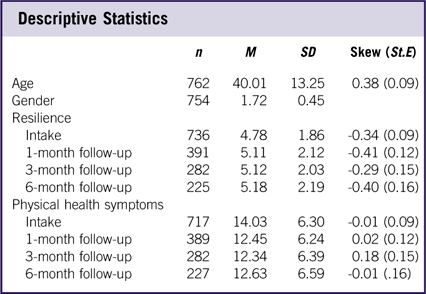
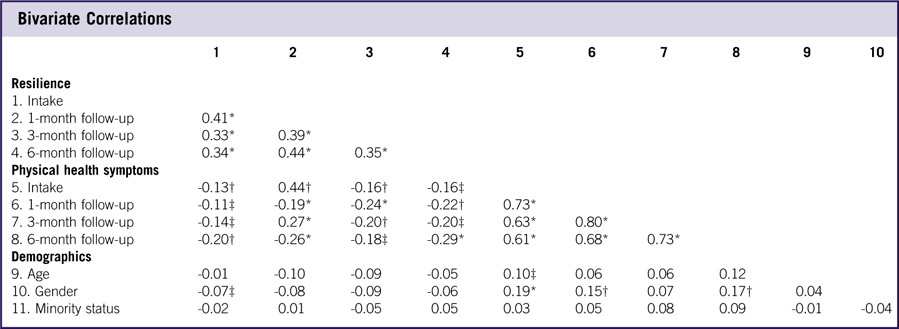
Means, standard deviations, and skewness of the study variables are summarized in Table 1. Distributions of resilience and physical health symptoms were fairly normally distributed. As summarized in Table 2, results of bivariate correlations indicated that resilience was correlated over time, physical health symptoms were correlated over time, and resilience was negatively correlated with physical health symptoms. Females reported significantly higher physical health symptoms at intake (females M=14.78, males M=12.07), 1-month follow-up (females M=12.99, males M=10.91), and 6-month follow-up (females M=13.33, males M=10.72), whereas males reported significantly higher resilience at intake (males M=5.00, females M=4.70).
Descriptive Statistics

Bivariate Correlations

*P<0.001 †P<0.01 ‡P<0.05
Multilevel Modeling
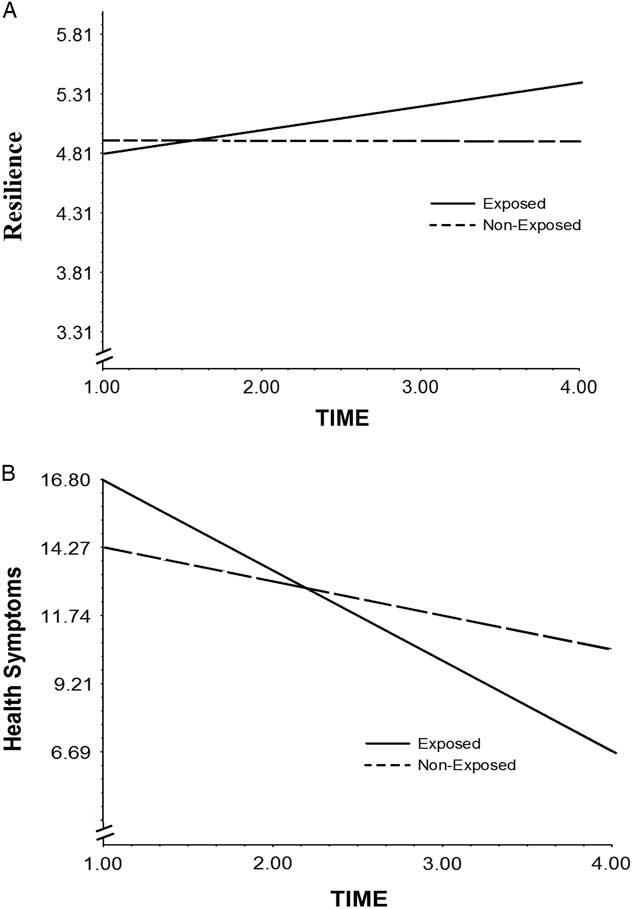
Multilevel modeling was conducted using the software program HLM 7.0Reference Raudenbush, Bryk and Cheong 33 to examine the change in resilience from baseline to post-treatment. The outcome variable was resilience, and time (coded 1=baseline, 2=follow-up 1, 3=follow-up 2, 4=follow-up 3) and time-squared were entered as the level-1 predictors to determine whether there was linear or curvilinear change over time. Results indicated a significant linear (coefficient=0.511, t[718]=2.366, P<0.05) effect of resilience over time, such that resilience significantly increased from the baseline to the follow-up. Next, age (grand-mean centered), gender (coded 1=male and 2=female), and minority status (coded 0=not minority and 1=minority) were entered as level-2 predictors to assess whether they influenced the resilience trajectory over time. Results indicated that gender was a significant predictor of the intercept of resilience (coefficient=-0.437, t[715]=-2.025, P<0.05), with females reporting less resilience than males. Age and minority status were not found to be significant predictors of the intercept of resilience. Age, gender, and minority status were not significant predictors of change in change in resilience over time. Exposure to natural disasters (coded 1=yes, 0=no) was also tested as a level-2 predictor of the linear effect of time, and results indicated a significant effect of exposure on this linear trajectory (coefficient=0.20, t[717]=2.23, P<0.05) with an increase in resilience for those with exposure (see Figure 1, Panel A).
Effects on Perceptions of Resilience and Reported Physical Health Symptoms Over Time By Exposure Status

Identical analyses on physical health symptoms indicated a significant linear (coefficient=-2.651, t[718]=-5.355, P<0.01) and curvilinear (coefficient=0.433, t[718]=4.226, P<0.01) effect of physical health over time, such that physical health symptoms declined from the baseline to follow-up 3 then increased slightly from follow-up 3 to 4. Next, age (grand-mean centered), gender (coded 1=male and 2=female), and minority status (coded 0=not minority and 1=minority) were entered as level-2 predictors to assess whether they influenced the physical health trajectory over time. Results indicated that gender (coefficient=2.460, t[715]=3.816, P<0.05) and age (coefficient=0.045, t[715]=2.107, P<0.05) were significant predictors of the intercept of physical health symptoms with older age and females reporting the higher symptoms than males and younger participants. A minority status was not found to be a significant predictor of the intercept of physical health symptoms. Age, gender, and minority status were not significant predictors of change in physical health symptoms over time. The exposure to natural disasters (coded 1=yes, 0=no) was also tested as a level-2 predictor of the linear and curvilinear effect of time on physical health symptoms, and results indicated a significant effect of exposure on the linear trajectory (coefficient=-2.12, t[717]=-2.11, P<0.05) with a steeper decrease in physical health symptoms for those with exposure (see Figure 1, Panel B). This effect was not significant for the curvilinear effect on time.
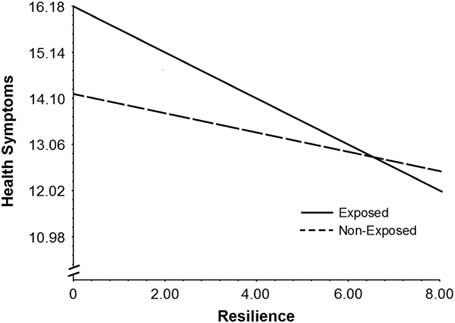
A final HLM analysis was conducted to examine the association between physical health symptoms and resilience across time. Resilience was entered as a level-1 predictor of physical health symptoms. Age, gender, minority status, and exposure to natural disasters were entered as level-2 predictors. Results indicated that resilience and physical health symptoms were significantly negatively correlated (coefficient=-0.96, t[714]=-2.36, P<0.05), such that more resilience was related to less physical health symptoms. However, there was a significant effect of exposure on the association (coefficient=-0.30, t[714]=-2.03, P<0.05), with a stronger association between physical health symptoms and resilience for those with exposure (Figure 2). Age, gender, and minority status were not statistically significant predictors of the association between resilience and physical health symptoms over time.
Association Between Resilience and Reported Physical Health Symptoms By Exposure Status

DISCUSSION
The present study aimed to examine changes in self-reported resiliency and physical health as well as the association between resiliency and physical health in a sample referred for behavioral health services through FQHCs and community primary care clinics in designated parishes in south Louisiana following the Gulf oil spill. As hypothesized, the results showed decreased physical health symptoms and increased resilience over time, particularly for those with previous exposure. These results were consistent with Osofsky and colleagues’Reference Osofsky, Osofsky, Wells and Weems 15 findings, indicating decreases in trauma and somatic symptoms at 1- and 3-month follow-ups following the initiation of treatment with MBHCP-LA clinicians as part of a stepped-care collaborative model, which integrated behavioral health services into primary care clinics in the parishes of Louisiana, which were identified in the class action settlement as the most affected by the oil spill. Results of the current study indicated that females reported higher physical health symptoms, whereas males reported a higher resilience. This is consistent with previous post-disaster research,Reference Caldera, Palma, Kullgren and Penayo 36 , Reference Kessler, Galea, Jones and Parker 26 which has shown increased psychological symptomatology and post-disaster impairment in women following disasters (we found no effect of gender on the trajectory of resilience or trajectory of physical health symptoms over time). Results indicated no individual-level differences according to age or minority status. Results showed increased resilience for those with previous exposure to natural disasters (see Figure 1, Panel A). Moreover, there was a steeper decline in physical health symptoms for those with exposure to natural disasters, and the negative association between resilience and physical health symptoms was stronger for those with previous exposure. Although any conclusion about benefits must be tempered against the non-controlled design and be understood as speculative until controlled trials are conducted, such findings highlight the potential benefits of integrated health and mental health services in disaster areas to build resilience among those suffering multiple severe stressors.
Although this study points to potential benefits of integrated services in disaster areas, it is not without limitations. The main limitation is the non-controlled design precluding causal interpretation. There are also limitations to generalizability. Other regions with different experiences might respond differently. Because of the unpredictability of disasters inherent in disaster research,Reference Masten and Osofsky 37 the study design does not allow for the conclusion that physical health symptoms assessed were directly linked to the experience of disaster because physical health symptoms were not assessed in the sample prior to the experience of disaster. Similarly, although the current study findings showed increased resilience from pre- to post-treatment, causal inferences cannot be assumed based on the study design, and the length of time between the disaster and treatment must be considered while drawing conclusions. It may be that the effects on resiliency are temporary, may be a result of the extraneous variables not examined in the current study (eg, social support, time elapsed since disasters), or may have occurred naturally without treatment.
Yehuda and colleaguesReference Yehuda, Flory, Southwick and Charney 38 theorize that resilience-related characteristics develop in reaction to environmental challenges, such that exposure to an adverse event activates the psychological mechanisms that promote an adaptive response to trauma exposure similar to the neurobiological fight-or-flight response, which prepares the body to react in a dangerous short-term situation. It may be a more general readiness or set of capacities to make a positive change in one’s life that impacted physical health symptoms and resilience over time. For example, Norris and colleaguesReference Norris, Stevens and Pfefferbaum 39 describe resilience as a set of adaptive capacities, resting on both the resources themselves and the attributes of those resources. From this perspective, taking action to improve one’s health may be the mechanism promoting positive change for the sample, but this would only be an opportunity for those to which the intervention was available. Furthermore, while the HLM analyses allowed for the use of all available data, the individuals dropping out over time may also be those who had better physical health (ie, survivor effect). Future research with a randomized control group is needed to clarify the nature of treatment effects indicated in the present study. In an integrated care setting, access to quality physical and behavioral health care is the foremost goal; thus, services and interventions are the primary services, and research evaluation is secondary. Although the natural design (without a randomized control group) limits causal conclusions, the findings add to the growing evidence on resiliency as a target for integrated health services. The current study provides correlational evidence of the role of resilience in promoting improved health outcomes post-disaster and overall community wellness following adversity.
Future randomized designs and studies examining resiliency and strength-based treatment models are needed, ideally longitudinal studies with pre-disaster baseline data. In summary, results indicated overall growth in resiliency following treatment mainly for those with previous exposure to natural disasters. Results also indicated that a higher resilience was associated with lower physical health symptoms again mainly for those reporting previous exposure. These findings are promising for integrated health, in that strength-based programs geared to supporting resiliency hold promise as a short-term intervention with effects on both mental and physical health post-disaster.
Acknowledgments
This research is partially supported as a component of the Gulf Region Health Outreach Program developed jointly by BP and the Plaintiffs’ Steering Committee as part of the Deepwater Horizon Medical Benefits Class Action Settlement, which was approved by the U.S. District Court in New Orleans on January 11, 2013, and became effective on February 12, 2014. We also thank the LSU Health Sciences Center, Department of Psychiatry team, that worked on this project.