1 Introduction
Strongly coupled plasmas have received considerable attentions since dense plasmas have been found in various laboratory nano-scale objects such as nano-wires, quantum dots, semiconductor devices and laser produced dense plasmas, as well as in space environments such as the atmospheres of neutron stars, i.e. astrophysical compact objects (Ramazanov & Kodanova Reference Ramazanov and Kodanova2001; Ramazanov & Dzhumagulova Reference Ramazanov and Dzhumagulova2002; Ramazanov, Dzhumagulova & Omarbakiyeva Reference Ramazanov, Dzhumagulova and Omarbakiyeva2005; Marklund & Shukla Reference Marklund and Shukla2006; Akbari-Moghanjoughi Reference Akbari-Moghanjoughi2010, Reference Akbari-Moghanjoughi2012, Reference Akbari-Moghanjoughi2013; Ramazanov et al. Reference Ramazanov, Moldabekov, Dzhumagulova and Muratov2011; Shukla & Eliasson Reference Shukla and Eliasson2012; Akbari-Moghanjoughi & Eliasson Reference Akbari-Moghanjoughi and Eliasson2016). In recent years, the dynamics and structure of gases and plasmas containing charged aerosol or dust grains exhibiting collective correlations and strong electrostatic interactions between highly charged dust grains has received considerable attention because of wide applications of the nano- and micro-sized particles in high-tech industries as well as scientific interest (Shevelko & Vainshtein Reference Shevelko and Vainshtein1993; Baimbetov, Nurekenov & Ramazanov Reference Baimbetov, Nurekenov and Ramazanov1995; Bouchoule Reference Bouchoule1999; Shukla & Mamum Reference Shukla and Mamum2001). It is also shown that the transverse dust-lattice wave (Shukla & Mamum Reference Shukla and Mamum2001) can exist due to the collective interactions of dust grains in the lattice structure of complex dusty plasmas. It has been shown that the nonlinear wake field due to the influence of ion flow distorts the Debye-shielding cloud and also alters the interaction potential near the dust grains in complex dusty plasmas (Kompaneets, Morfill & Ivlev Reference Kompaneets, Morfill and Ivlev2009). In various plasmas, the standard Yukawa-type Debye–Hückel model (Shevelko & Vainshtein Reference Shevelko and Vainshtein1993) obtained by the linearization of the Poisson equation with the Maxwell–Boltzmann distribution function has been widely used to describe the screening interaction potentials since the average kinetic energy of a particle in a plasma is usually greater than the average interaction energy between plasma particles (Baimbetov et al. Reference Baimbetov, Nurekenov and Ramazanov1995). Hence, it would be expected that the physical characteristics of dust-lattice wave in crystallized dust strings in complex dusty plasmas containing the ion flow would be quite different from those in standard Debye–Hückel plasmas due to the influence of nonlinear wake field since the ion flow can distort the Debye-shielding sphere and also alters the interaction potential near the surface of the charged dust grain. However, the nonlinear ion wake-field effects on the dispersion relation of the dust-lattice wave have not been investigated as yet. Thus, in this Letter, we investigate the influence of the nonlinear ion wake field on the dust-lattice wave in complex dusty plasmas using the effective dust–dust interaction potential since the dispersion relation provides detailed on the physical characteristics of the plasma wave as well as the physical properties of the surrounding plasma. The effective interaction potential, taking into account the influence of the nonlinear ion wake field, is employed to obtain the equation of motion and the dispersion relation in complex dusty plasmas. The dispersion relation for the dust-lattice wave is obtained from the equation of motion including the contribution due to the two nearest-neighbour dust grains. The variation of the dust-lattice wave due to the change of Mach number and plasma parameters are also discussed.
2 Theory and calculations
In complex dusty plasmas composed of electrons, ions and negatively charged dusty grains, the quasi-neutral condition (Mendis & Rosenberg Reference Mendis and Rosenberg1994) at equilibrium would be represented by
 $$\begin{eqnarray}n_{e0}+Zn_{d0}=n_{i0}=n_{0},\end{eqnarray}$$
where
 $n_{\unicode[STIX]{x1D6FC}0}~(\unicode[STIX]{x1D6FC}=e,i,d)$
are, respectively, the equilibrium densities for electrons (
 $e$
), ions (
 $i$
) and dust grains (
 $d$
), where
 $Z$
is the charge number of the dust grain and
 $n_{0}$
is the total plasma density. It would be expected that the influence of an ion wake generates the additional acceleration part since the ion flow modifies the field configuration near the dust grain. Recently, the analytic expression form of the effective potential (Kompaneets et al.
Reference Kompaneets, Morfill and Ivlev2009)
 $\unicode[STIX]{x1D711}_{eff}(r)$
of a dust grain with charge
 $Q$
, including the spherical polarization with the nonlinear wake field, due to the presence of ion flow in complex dusty plasmas at arbitrary distances
 $r$
for the domain of
 $M\leqslant 1$
has been shown to be represented by
 $$\begin{eqnarray}\displaystyle \unicode[STIX]{x1D711}_{eff}(r) & = & \displaystyle \frac{Q}{r}\,\text{e}^{-\,r/\unicode[STIX]{x1D706}}\left\{1+\frac{\unicode[STIX]{x03C0}M^{2}}{48}\left(\frac{16}{\unicode[STIX]{x03C0}}-1-\frac{r}{\unicode[STIX]{x1D706}}\right)\frac{r}{\unicode[STIX]{x1D706}}\right.+\frac{\unicode[STIX]{x03C0}M^{4}}{10}\left[\frac{1}{8}\left(3+\frac{5\unicode[STIX]{x03C0}}{32}\right)\left(1+\frac{r}{\unicode[STIX]{x1D706}}\right)\right.\nonumber\\ \displaystyle & & \displaystyle +\,\frac{1}{\unicode[STIX]{x03C0}}\left(\frac{r}{\unicode[STIX]{x1D706}}-7\right)\left.\left.-\,\frac{1}{8}\left(1-\frac{\unicode[STIX]{x03C0}}{16}\right)\frac{r^{2}}{\unicode[STIX]{x1D706}^{2}}+\frac{\unicode[STIX]{x03C0}}{768}\frac{r^{3}}{\unicode[STIX]{x1D706}^{3}}\right]\frac{r}{\unicode[STIX]{x1D706}}\right\},\end{eqnarray}$$
where
 $\unicode[STIX]{x1D706}~(\equiv \unicode[STIX]{x1D706}_{De}\unicode[STIX]{x1D706}_{Di}/\sqrt{\unicode[STIX]{x1D706}_{De}^{2}+\unicode[STIX]{x1D706}_{De}^{2}})$
is the dusty plasma Debye length (Shukla & Mamum Reference Shukla and Mamum2001),
 $\unicode[STIX]{x1D706}_{De}$
and
 $\unicode[STIX]{x1D706}_{Di}$
are, respectively, the electron and ion Debye lengths, and
 $M$
is the Mach number of the ion flow in complex dusty plasmas. Hence, if we assume that the dusty strings are composed of the same dust grains, the effective dust–dust interaction potential
 $U_{eff}(\boldsymbol{r}_{i},\boldsymbol{r}_{j})$
between two dust grains with charge
 $-Z_{d}\text{e}$
at the positions
 $\boldsymbol{r}_{i}$
and
 $\boldsymbol{r}_{j}$
in the dust lattice, including the influences of the nonlinear ion wake field and plasma shielding, would be represented by
 $$\begin{eqnarray}U_{eff}(\boldsymbol{r}_{i},\boldsymbol{r}_{j})=\frac{Z_{d}^{2}\text{e}^{2}}{|\boldsymbol{r}_{i}-\boldsymbol{r}_{j}|}\exp \left(-\frac{|\boldsymbol{r}_{i}-\boldsymbol{r}_{j}|}{\unicode[STIX]{x1D706}}\right)\left[1+\frac{\unicode[STIX]{x03C0}M^{2}}{48}\left(\frac{16}{\unicode[STIX]{x03C0}}-1-\frac{|\boldsymbol{r}_{i}-\boldsymbol{r}_{j}|}{\unicode[STIX]{x1D706}}\right)\frac{|\boldsymbol{r}_{i}-\boldsymbol{r}_{j}|}{\unicode[STIX]{x1D706}}\right].\end{eqnarray}$$
Hence, the transverse plasma oscillations in the dust lattice in complex dusty plasmas, including the nonlinear ion wake field, would be then represented by the equation of motion of the perturbed dressed dust grain at the position
 $\boldsymbol{r}_{j}$
such as
 $$\begin{eqnarray}\displaystyle \frac{\text{d}^{2}}{\text{d}t^{2}}\,\unicode[STIX]{x1D6FF}z_{j}(t) & = & \displaystyle -\,\mathop{\sum }_{i\neq j}\frac{1}{m_{d}}\frac{\unicode[STIX]{x2202}}{\unicode[STIX]{x2202}z_{j}}\,U_{eff}(\boldsymbol{r}_{i},\boldsymbol{r}_{j})\nonumber\\ \displaystyle & = & \displaystyle -\,\mathop{\sum }_{i}\frac{Z_{d}^{2}\text{e}^{2}}{m_{d}}\frac{(z_{i}-z_{j})}{\left|\boldsymbol{r}_{i}-\boldsymbol{r}_{j}\right|^{3}}\exp \left(-\,\frac{\left|\boldsymbol{r}_{i}-\boldsymbol{r}_{j}\right|}{\unicode[STIX]{x1D706}}\right)\nonumber\\ \displaystyle & & \displaystyle \times \,\left[1+\frac{\left|\boldsymbol{r}_{i}-\boldsymbol{r}_{j}\right|}{\unicode[STIX]{x1D706}}+\frac{\unicode[STIX]{x03C0}M^{2}}{48}\left(\frac{16}{\unicode[STIX]{x03C0}}-1-\frac{\left|\boldsymbol{r}_{i}-\boldsymbol{r}_{j}\right|}{\unicode[STIX]{x1D706}}+\frac{\left|\boldsymbol{r}_{i}-\boldsymbol{r}_{j}\right|^{2}}{\unicode[STIX]{x1D706}^{2}}\right)\right],\end{eqnarray}$$
where
 $z_{j}~[=z_{0j}+\unicode[STIX]{x1D6FF}z_{j}(t)]$
is the position of the
 $j$
th dust grain,
 $z_{0j}$
is the equilibrium position of the
 $j$
th dust grain,
 $\unicode[STIX]{x1D6FF}z_{j}(t)$
is the vertical displacement of the
 $j$
th dust grain,
 $k$
is the wavenumber,
 $\unicode[STIX]{x1D714}$
is the frequency and
 $m_{d}$
is the mass of the dust grain. Here, we assume that the dust string is composed of an equally spaced chain of equal dust grains with mass
 $m_{d}$
. After some mathematical manipulation, taking into account the nearest-neighbour interactions, i.e.
 $i=j\pm 1$
, the equation of motion of the dressed dust grain in complex dusty plasmas is given by
 $$\begin{eqnarray}\displaystyle \left.\mathop{\sum }_{i=j\pm 1}\frac{\unicode[STIX]{x2202}U_{eff}(\boldsymbol{r}_{i},\boldsymbol{r}_{j})}{\unicode[STIX]{x2202}z_{j}}\,\right|_{\left|z_{j}-z_{i}\right|=a} & = & \displaystyle \frac{Z_{d}^{2}\text{e}^{2}}{a^{3}}\left[1+\frac{a}{\unicode[STIX]{x1D706}}+\frac{\unicode[STIX]{x03C0}M^{2}}{48}\left(\frac{16}{\unicode[STIX]{x03C0}}-1-\frac{a}{\unicode[STIX]{x1D706}}+\frac{a^{2}}{\unicode[STIX]{x1D706}^{2}}\right)\right]\nonumber\\ \displaystyle & & \displaystyle \times \,\exp \left(-\,\frac{a}{\unicode[STIX]{x1D706}}\right)(\unicode[STIX]{x1D6FF}z_{j+1}+\unicode[STIX]{x1D6FF}z_{j-1}-2\unicode[STIX]{x1D6FF}z_{j}),\end{eqnarray}$$
where we assume that the dust string is composed of an equally spaced chain of equal dust grains, where
 $a(\equiv |z_{j}-z_{j-1}|=|z_{j+1}-z_{j}|)$
is the separation between two consecutive dust grains.
3 Results and discussion
Since the travelling wave solution can be written as
 $$\begin{eqnarray}\unicode[STIX]{x1D6FF}z_{j}(t)=z_{j,0}\exp [\text{i}(jka-\unicode[STIX]{x1D714}t)],\end{eqnarray}$$
the scaled form of the dispersion relation
 $\bar{\unicode[STIX]{x1D714}}_{DL}(\bar{k},\bar{a},\bar{\unicode[STIX]{x1D706}},M)[\equiv \unicode[STIX]{x1D714}_{DL}(m_{d}a_{d}^{3}/4Z_{d}^{2}\text{e}^{2})^{1/2}]$
for the dust-lattice wave in complex dusty plasmas, including the influence of the nonlinear ion wake field, is then found to be
 $$\begin{eqnarray}\displaystyle \bar{\unicode[STIX]{x1D714}}_{DL}(\bar{k},\bar{a},\bar{\unicode[STIX]{x1D706}},M) & = & \displaystyle \left|\sin \left(\frac{\bar{k}\bar{a}}{2}\right)\right|\,\bar{a}^{-\,3/2}\exp \left(-\,\frac{\bar{a}}{2\bar{\unicode[STIX]{x1D706}}}\right)\nonumber\\ \displaystyle & & \displaystyle \times \,\left[1+\frac{\bar{a}}{\bar{\unicode[STIX]{x1D706}}}+\frac{\unicode[STIX]{x03C0}M^{2}}{48}\left(\frac{16}{\unicode[STIX]{x03C0}}-1-\frac{\bar{a}}{\bar{\unicode[STIX]{x1D706}}}+\frac{\bar{a}^{2}}{\bar{\unicode[STIX]{x1D706}}^{2}}\right)\right]^{1/2},\end{eqnarray}$$
where
 $a_{d}$
is the size of the dust grain, the parameter
 $\bar{k}~(\equiv ka_{d})$
is analogous to the scaled wavenumber for continuous lines,
 $\bar{a}~(\equiv a/a_{d})$
is the scaled dust spacing and
 $\bar{\unicode[STIX]{x1D706}}~(\equiv \unicode[STIX]{x1D706}/a_{d})$
is the scaled Debye length. Since the structure factor
 $|\sin (\bar{k}\bar{a}/2)|$
encompasses the periodic character, the dispersion function
 $\bar{\unicode[STIX]{x1D714}}_{DL}(\bar{k},\bar{a},\bar{\unicode[STIX]{x1D706}},M)$
would be oscillating with the variable
 $\bar{k}\bar{a}$
. If we neglect the effect of the nonlinear ion wake field on the dust-lattice wave in complex dusty plasmas, i.e. keeping the Yukawa-type potential term only without the nonlinear wake-field correction
 $U_{ij}^{\prime }=(Z_{d}^{2}\text{e}^{2}/|\boldsymbol{r}_{i}-\boldsymbol{r}_{j}|)\,\text{exp}(-|\boldsymbol{r}_{i}-\boldsymbol{r}_{j}|/\unicode[STIX]{x1D706})$
, the scaled dispersion relation (Shukla & Mamum Reference Shukla and Mamum2001)
 $\bar{\unicode[STIX]{x1D714}}_{DL}^{\prime }(\bar{k},\bar{a},\bar{\unicode[STIX]{x1D706}})$
is given by the following expression:
 $$\begin{eqnarray}\bar{\unicode[STIX]{x1D714}}_{DL}^{\prime }(\bar{k},\bar{a},\bar{\unicode[STIX]{x1D706}})=\left|\sin \left(\frac{\bar{k}\bar{a}}{2}\right)\right|\bar{a}^{-3/2}\exp \left(-\frac{\bar{a}}{2\bar{\unicode[STIX]{x1D706}}}\right)\left(1+\frac{\bar{a}}{\bar{\unicode[STIX]{x1D706}}}\right)^{1/2}.\end{eqnarray}$$
Hence, the characteristic function
 $F_{DL}(\bar{a},\bar{\unicode[STIX]{x1D706}},M)$
taking into account the nonlinear ion wake field and plasma-shielding effect on the dust-lattice wave in dusty plasmas is found to be
 $$\begin{eqnarray}F_{DL}(\bar{a},\bar{\unicode[STIX]{x1D706}},M)=\left[1+\frac{\unicode[STIX]{x03C0}M^{2}}{48}\left(\frac{16}{\unicode[STIX]{x03C0}}-1-\frac{\bar{a}}{\bar{\unicode[STIX]{x1D706}}}+\frac{\bar{a}^{2}}{\bar{\unicode[STIX]{x1D706}}^{2}}\right)\bigg/\left(1+\frac{\bar{a}}{\bar{\unicode[STIX]{x1D706}}}\right)\right]^{1/2}.\end{eqnarray}$$
Since the term
 $(16/\unicode[STIX]{x03C0}-1-\bar{a}/\bar{\unicode[STIX]{x1D706}}+\bar{a}^{2}/\bar{\unicode[STIX]{x1D706}}^{2})$
is always positive for all values of
 $\bar{a}/\bar{\unicode[STIX]{x1D706}}$
, the characteristic function
 $F_{DL}(\bar{k},\bar{a},\bar{\unicode[STIX]{x1D706}},M)$
is greater than unity. It would then be expected that the influence of the nonlinear ion wake field enhances the frequency
 $\bar{\unicode[STIX]{x1D714}}_{DL}$
of the dust-lattice wave. Recently, the physical characteristics of dust-lattice waves (Ishihara Reference Ishihara1998; Nam & Jung Reference Nam and Jung2012; Ki & Jung Reference Ki and Jung2013) have been investigated in complex dusty plasmas. In addition, the various atomic collision processes (Jung & Hong Reference Jung and Hong2012; Hong & Jung Reference Hong and Jung2014) including the influence of the ion wake field have been investigated in complex dusty plasmas. However, the influence of the nonlinear ion wake field on the dust-lattice wave has not been investigated as yet. Hence, the dispersion relation
 $\bar{\unicode[STIX]{x1D714}}_{DL}(\bar{k},\bar{a},\bar{\unicode[STIX]{x1D706}},M)$
(3.1) and the characteristic function
 $F_{DL}(\bar{a},\bar{\unicode[STIX]{x1D706}},M)$
(3.4) would be quite useful to investigate the dispersion properties of the dust-lattice wave including the nonlinear ion wake-field effect in complex dusty plasmas. Very recently, the wave probation and instability have been extensively explored in quantum dusty plasmas (Jamil et al.
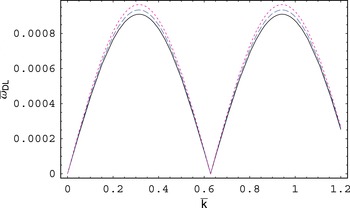
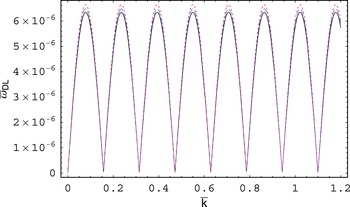
Reference Jamil, Mir, Asif and Salimullah2014, Reference Jamil, Ali, Rasheed, Zubia and Salimullah2015) including the quantum-mechanical effects. Hence, the quantum-mechanical and nonlinear ion wake-field effects on the dust-lattice wave in complex quantum dusty plasmas will be treated elsewhere. Figures 1 and 2 represent the scaled wave frequency
 $\bar{\unicode[STIX]{x1D714}}_{DL}$
for the dust-lattice wave in complex dusty plasmas including the nonlinear ion wake-field effects for small and large dust spacing
 $\bar{a}$
as a function of the scaled wavenumber
 $\bar{k}$
for various values of the Mach number
 $M$
. As shown in these figures, the influence of the nonlinear ion wake field enhances the wave frequency at the maximum peak positions since the additional terms due to the ion flow in the wave frequency are given by
 $(\unicode[STIX]{x03C0}M^{2}/48)(16/\unicode[STIX]{x03C0}-1-\bar{a}/\bar{\unicode[STIX]{x1D706}}+\bar{a}^{2}/\bar{\unicode[STIX]{x1D706}}^{2})$
. Hence, we have understood that the wave–particle interaction due to the ion flow in the dust lattice increases the frequency of the dust-lattice wave. It is also found that the oscillatory behaviour of the dust-lattice wave enhances with an increase of the spacing of the dust grains. Hence, we have found that the oscillating character of the dust-lattice wave is more significant when the dust spacing
 $\bar{a}$
is greater than the Debye radius
 $\bar{\unicode[STIX]{x1D706}}$
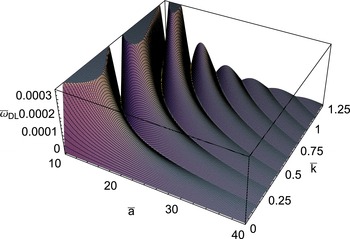
. Figure 3 shows the surface plot of the frequency
 $\bar{\unicode[STIX]{x1D714}}_{DL}$
of the dust-lattice wave as a function of the dust spacing
 $\bar{a}$
and the scaled wavenumber
 $\bar{k}$
. As seen, the frequency
 $\bar{\unicode[STIX]{x1D714}}_{DL}$
of the dust-lattice wave significantly decreases with an increase of the dust spacing
 $\bar{a}$
due to the exponential suppression factor
 $\exp (-\bar{a}/2\bar{\unicode[STIX]{x1D706}})$
in (3.2). It is also interesting
The scaled wave frequency
 $\bar{\unicode[STIX]{x1D714}}_{DL}$
for the dust-lattice wave in complex dusty plasmas as a function of the scaled wavenumber
 $\bar{k}$
when
 $\bar{a}=10$
and
 $\bar{\unicode[STIX]{x1D706}}=20$
. The solid line represents the case of
 $M=0$
, i.e. without the nonlinear ion wake field. The dashed line represents the case of
 $M=0.4$
. The dotted line represents the case of
 $M=0.6$
.

The scaled wave frequency
 $\bar{\unicode[STIX]{x1D714}}_{DL}$
for the dust-lattice wave in complex dusty plasmas as a function of the scaled wavenumber
 $\bar{k}$
when
 $\bar{a}=40$
and
 $\bar{\unicode[STIX]{x1D706}}=20$
. The solid line represents the case of
 $M=0$
, i.e. without the ion wake field. The dashed line represents the case of
 $M=0.4$
. The dotted line represents the case of
 $M=0.6$
.

The surface plot of the frequency
 $\bar{\unicode[STIX]{x1D714}}_{DL}$
of the dust-lattice wave as a function of the dust spacing
 $\bar{a}$
and the scaled wavenumber
 $\bar{k}$
when
 $\bar{\unicode[STIX]{x1D706}}=20$
and
 $M=0.6$
.

to note that the frequency
 $\bar{\unicode[STIX]{x1D714}}_{DL}$
of the dust-lattice wave is oscillatorily decreasing with an increase of the separation between two consecutive dust grains
 $\bar{a}$
for large values of the wavenumber
 $\bar{k}$
. However, the scaled frequency
 $\bar{\unicode[STIX]{x1D714}}_{DL}$
of the dust-lattice wave is monotonically decreasing with an increase of the dust spacing
 $\bar{a}$
for small values of the wavenumber
 $\bar{k}$
since the frequency
 $\bar{\unicode[STIX]{x1D714}}_{DL}(\bar{k}<<1,\bar{a},\bar{\unicode[STIX]{x1D706}},M)$
is represented by
 $(\bar{k}/2)\bar{a}^{-\,1/2}\exp (-\bar{a}/2\bar{\unicode[STIX]{x1D706}})(\unicode[STIX]{x03C0}M^{2}/48)(16/\unicode[STIX]{x03C0}-1-\bar{a}/\bar{\unicode[STIX]{x1D706}}+\bar{a}^{2}/\bar{\unicode[STIX]{x1D706}}^{2})$
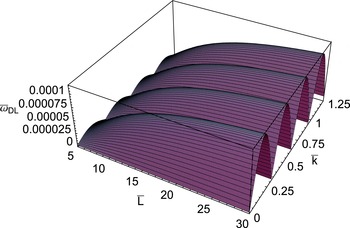
. Figure 4 represents the surface plot of the frequency
 $\bar{\unicode[STIX]{x1D714}}_{DL}$
of the dust-lattice wave as a function of the scaled Debye length
 $\bar{\unicode[STIX]{x1D706}}$
and the scaled wavenumber
 $\bar{k}$
. From this figure, it is found that the amplitude of the of the dust-lattice wave increases with increasing Debye length
 $\bar{\unicode[STIX]{x1D706}}$
since the Yukawa screening term
 $\exp (-\bar{a}/2\bar{\unicode[STIX]{x1D706}})$
becomes unity for large values of the Debye length
 $\bar{\unicode[STIX]{x1D706}}$
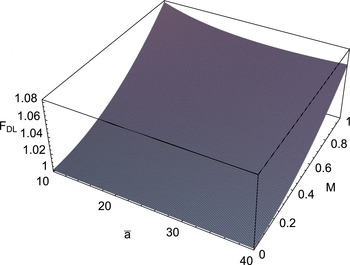
. Figure 5 shows the surface plot of the characteristic function
 $F_{DL}$
of the dust-lattice wave as a function of the dust spacing
 $\bar{a}$
and the Mach number
 $M$
. As shown, it is found that the effect of the nonlinear ion wake field on the dust-lattice wave is more important in smaller dust spacing configurations since the term
 $(\unicode[STIX]{x03C0}M^{2}/48)(16/\unicode[STIX]{x03C0}-1-\bar{a}/\bar{\unicode[STIX]{x1D706}}+\bar{a}^{2}/\bar{\unicode[STIX]{x1D706}}^{2})/(1+\bar{a}/\bar{\unicode[STIX]{x1D706}})$
in (3.4) increases with decreasing
 $\bar{a}$
. It is also found that the influence of the nonlinear ion wake field decreases with an increase of the dust spacing
 $\bar{a}$
. Since the effective interaction including the nonlinear wake field in the dust lattice is related to nonlinear forces between nearest neighbours for lattice vibration in crystals, it is interesting to note that the physical characteristics of the nonlinear wake field in the dust lattice have some physical similarities with the nonlinear solutions in the (Toda Reference Toda1967; Whitham Reference Whitham1999) chain. In this paper, it is shown that the influence of the ion wake generates the additional acceleration part since the ion flow modifies the field configuration near the dust grain. This phenomenon is quite similar to the potential field of a test charge in a turbulent plasma since it is known that the potential field of a test charge in a turbulent plasma would be affected by the random fluctuating electric fields since the response of the random electric field fluctuations has played an important role in the binary encounters and interaction potentials in turbulent plasmas (Tsytovich Reference Tsytovich1972; Shukla & Spatschek Reference Shukla and Spatschek1973; Tegeback & Stenflo Reference Tegeback and Stenflo1975). From this work, we have found that the nonlinear ion wake-field effect plays a crucial role on the physical characteristics of the dust-lattice wave in complex dusty plasmas since the wake-field effect enhances the wave frequency. These results would provide useful information of the physical characteristics of the influence of ion flow on the dust-lattice wave as well as the physical properties of streaming in complex dusty plasmas.
The surface plot of the frequency
 $\bar{\unicode[STIX]{x1D714}}_{DL}$
of the dust-lattice wave as a function of the scaled Debye length
 $\bar{\unicode[STIX]{x1D706}}$
and the scaled wavenumber
 $\bar{k}$
when
 $\bar{a}=20$
and
 $M=0.6$
.

The surface plot of the characteristic function
 $F_{DL}$
of the dust-lattice wave as a function of the dust spacing
 $\bar{a}$
and the Mach number
 $M$
when
 $\bar{\unicode[STIX]{x1D706}}=20$
.

Acknowledgements
This paper is dedicated to the late Professor P. K. Shukla in memory of exciting and stimulating collaborations on physical processes in dusty plasmas. The authors gratefully acknowledge Professor H. J. Lee for useful comments and discussions. One of the authors (Y.-D.J.) gratefully acknowledges Dr M. Rosenberg for useful discussions and warm hospitality while visiting the Department of Electrical and Computer Engineering at the University of California, San Diego. This research was initiated while one of the authors (Y.-D.J.) was affiliated with UC San Diego as a visiting professor. This research was supported by Basic Science Research Program through the National Research Foundation of Korea (NRF) funded by the Ministry of Science, ICT & Future Planning (grant no. 2016R1A2B4011356).