Introduction
Parent–Child Interaction Therapy (PCIT; Eyberg & Funderburk, Reference Eyberg and Funderburk2011) is a behavioral parent training (BPT) program that was developed to treat disruptive child behavior (Ward et al., Reference Ward, Theule and Cheung2016), and research supports its effectiveness for a variety of presenting issues, including child depression and parenting difficulties (e.g., Campbell et al., Reference Campbell, Hawes, Swan, Thomas and Zimmer-Gembeck2023; Thomas et al., Reference Thomas, Abell, Webb, Avdagic and Zimmer-Gembeck2017). There exists a large evidence base demonstrating the effectiveness of PCIT at addressing child maltreatment behaviors (e.g., Chaffin et al., Reference Chaffin, Silovsky, Funderburk, Valle, Brestan, Balachova, Jackson, Lensgraf and Bonner2004; Hakman et al., Reference Hakman, Chaffin, Funderburk and Silovsky2009; Kennedy et al., Reference Kennedy, Kim, Tripodi, Brown and Gowdy2014; Skowron et al., Reference Skowron, Nekkanti, Skoranski, Scholtes, Lyons, Mills, Bard, Rock, Berkman, Bard and Funderburk2024; Thomas & Zimmer-Gembeck, Reference Thomas and Zimmer-Gembeck2011; van der Put et al., 2018; Vlahovicova et al., Reference Vlahovicova, Melendez-Torres, Leijten, Knerr and Gardner2017). Given that significant main effects of PCIT on parent cognitions have not been found, the focus of the current research was to examine individual differences in change in parent cognitions based on family treatment experience. PCIT consists of two treatment phases: Child Directed Interaction (CDI) and Parent Directed Interaction (PDI). In CDI, the treatment is focused on building the positive relationship between caregiver and child. Caregivers are taught a variety of positive parenting skills, known as the PRIDE skills. These include Praise, verbal Reflection of child statements, Imitation, Description of child behavior, and Enjoyment. Praise, Reflection, and behavior Descriptions are readily quantifiable, while Imitation and Enjoyment are more qualitative behaviors. Parents are taught to let the child lead the play during these sessions and are asked to avoid questions and commands in service of this goal (Lieneman et al., Reference Lieneman, Brabson, Highlander, Wallace and McNeil2017). Next, in PDI, parents are taught an approach to positive discipline. Parents learn to form effective, developmentally appropriate commands and to follow through by providing specific labeled praise when children cooperate, and learn a time-out procedure for noncompliance (Lieneman et al., Reference Lieneman, Brabson, Highlander, Wallace and McNeil2017). During both phases of PCIT, the parent and child play together in a treatment room while the therapist watches using cameras and a one-way mirror. The parent wears an earpiece during treatment sessions so that the therapist can provide live, in-the-moment coaching on parent behaviors. The live-coaching format of PCIT may provide an intuitive setting for studying individual differences in parent attributions.
PCIT has a robust evidence base as an effective treatment for child-welfare involved families and other families at high risk of child maltreatment (Chaffin et al., Reference Chaffin, Silovsky, Funderburk, Valle, Brestan, Balachova, Jackson, Lensgraf and Bonner2004; Kennedy et al., Reference Kennedy, Kim, Tripodi, Brown and Gowdy2014; Skowron et al., Reference Skowron, Nekkanti, Skoranski, Scholtes, Lyons, Mills, Bard, Rock, Berkman, Bard and Funderburk2024; Thomas & Zimmer-Gembeck, Reference Thomas and Zimmer-Gembeck2011; Timmer et al., Reference Timmer, Urquiza, Zebell and McGrath2005). Importantly, PCIT is one of a number of interventions that are effective at treating child maltreatment (Skowron & Reinemann, Reference Skowron and Reinemann2005; van IJzendoorn et al., Reference van IJzendoorn, Bakermans-Kranenburg, Coughlan and Reijman2020; e.g. ABC, Dozier et al., Reference Dozier, Meade, Bernard, Timmer and Urquiza2014; the Incredible Years, Webster-Stratton, Reference Webster-Stratton, Hibbs and Jensen2005). This intervention has been shown to be effective at strengthening positive parenting skills and reducing negative parenting behaviors in child-welfare involved families (Thomas & Zimmer-Gembeck, Reference Thomas and Zimmer-Gembeck2011; Timmer et al., Reference Timmer, Urquiza, Zebell and McGrath2005). In addition, PCIT has demonstrated improvements in parent self-regulation over the course of treatment (Skowron et al., Reference Skowron, Nekkanti, Skoranski, Scholtes, Lyons, Mills, Bard, Rock, Berkman, Bard and Funderburk2024). Perhaps most importantly, PCIT reduces the risk of future child maltreatment for families receiving the intervention (Chaffin et al., Reference Chaffin, Silovsky, Funderburk, Valle, Brestan, Balachova, Jackson, Lensgraf and Bonner2004; Thomas & Zimmer-Gembeck, Reference Thomas and Zimmer-Gembeck2011). These findings are encouraging, since child-welfare involved families are at high risk of experiencing negative outcomes in a variety of domains. Thus, it is important to determine how we might best improve outcomes for these families. One understudied aspect of parenting that has implications for child maltreatment are parent cognitions about their children. Parent cognitions are a critical factor driving caregiving behavior and impacting parenting decisions (i.e., Johnston et al., Reference Johnston, Park, Miller, Sanders and Morawska2018). Maladaptive parent attributions are associated with harsh parenting and increased child maltreatment risk (i.e., Camilo et al., Reference Camilo, Calheiros and Vaz Garrido2023; Dadds et al., Reference Dadds, Mullins, McAllister and Atkinson2003). Thus, more attention is needed to determine the ways in which parent cognitions change in response to treatment, particularly in child-welfare-involved families. Research is needed to increase understanding of the individual differences in parent attributions that are associated with changes that support optimal parenting. While standard PCIT does not explicitly target parent cognitions, this intervention may have a positive impact on some parents’ cognitions about their child.
Parent cognitions about their children can take several forms, including beliefs about a child’s personality, interpretations of their actions, affective feelings about the child, and thoughts about the child’s internal psychological processes (e.g., reflective functioning and mind-mindedness) (Garon-Bissonnette et al., Reference Garon-Bissonnette, Bailes, Kwasneski, Lempres, Takemoto, Li, DeLuca, Salo and Humphreys2024). Parent cognitions about their child underlie many of the processes involved in parenting, as parents are constantly thinking about and interpreting all aspects of their relationship with their child and their interactions with them (Bugental et al., Reference Bugental, Johnston, New and Silvester1998). Thus, parent cognitions color nearly all aspects of the child’s experience of caregiving (Bornstein et al., Reference Bornstein, Putnick and Suwalsky2018). Parent attributions are one particular kind of parent cognition which tend to take the form of interpretations for a child’s behavior and beliefs about their personality traits (Bugental & Corpuz, Reference Bugental, Corpuz and Bornstein2019). The current study focuses on parent attributions about their child’s typical behavior.
Attributions can be either situational, interpreting a behavior that is occurring in the moment, or stable, representing a belief about the other person that extends across contexts (Miller, Reference Miller1995). Parent attributions about their child’s personality tend to be stable across time, with parents experiencing relatively little change in their view of their child’s personality under normal conditions (Bugental & Corpuz, Reference Bugental, Corpuz and Bornstein2019). The current study focuses on these more stable, personality-based attributions. Parents can simultaneously hold high levels of positive and negative attributions about their child, or low levels of both valences of attribution (Bugental et al., Reference Bugental, Johnston, New and Silvester1998). Positive attributions take the form of favorable evaluations of the child, including beliefs such as “my child is very warm and loving towards me,” or “my child is very smart.” Negative attributions, on the other hand, are harsh evaluations of the child such as “my child misbehaves in order to upset me,” or “my child is bossy and controlling.” Maltreating parents are more likely to hold these “threat-sensitive” attributions (i.e., Bugental, Reference Bugental and Sameroff2009; Bugental et al., Reference Bugental, Blue and Cruzcosa1989), characterized by caregivers who view challenging caregiving situations as threats and respond defensively to these interactions. Caregivers who hold these “threat-sensitive” attributions are more likely to interpret their child’s actions as motivated to harm the caregiver or make their life harder (Bugental et al., Reference Bugental, Blue, Cortez, Fleck, Kopeikin, Lyon and Lewis1993; Bugental, Reference Bugental and Sameroff2009). The current study investigated both positive and negative parent attributions about their child, by defining and quantifying each as separate constructs and examining each type of attribution in the context of treatment engagement and parent outcomes.
Negative parent attributions about their child have been shown to be associated with harsh and abusive parenting behaviors, particularly in the context of parenting stress (Beckerman et al., Reference Beckerman, van Berkel, Mesman and Alink2018; Beckerman et al., Reference Beckerman, van Berkel, Mesman, Huffmeijer and Alink2020). Levels of negative attributions about child behavior reported by parents have also been associated with more insensitive parenting behaviors (Bailes & Leerkes, Reference Bailes and Leerkes2021). Negative attributions have also been associated with lower parental sensitivity to distress, and in this study, the parenting behaviors of parents with greater experiences of childhood maltreatment were more likely to be impacted by these negative attributions (Girod et al., Reference Girod, Leerkes and Zvara2023). This is important to consider, as many child-welfare-involved parents have themselves experienced maltreatment in childhood (Widom et al., Reference Widom, Czaja and DuMont2015). In addition, negative parent attributions are associated with poorer treatment engagement in parent behavioral training interventions like PCIT, with parents presenting to treatment with more negative attributions being less likely to persist with treatment sessions (Skoranski et al., Reference Skoranski, Skowron, Nekkanti, Scholtes, Lyons and DeGarmo2022) and showing poorer outcomes from treatment (Sawrikar et al., Reference Sawrikar, Hawes, Moul and Dadds2018).
While the majority of research in this area has focused on parents’ negative attributions, positive attributions also have clear implications for child development and outcomes. Parents with more positive child attributions have children who show fewer problem behaviors based on multiple reporters (Park et al., Reference Park, Johnston, Colalillo and Williamson2018) and have children who show more prosocial behavior (Grusec et al., Reference Grusec, Chaparro, Johnston, Sherman, Killen and Smetana2013). The attributions that parents hold about their children play an important role in how they parent. Parents who show highly positive attributions of their children demonstrate more observed positive parenting behaviors when interacting with their child (Park et al., Reference Park, Johnston, Colalillo and Williamson2018). Specifically, parents who view their children as highly responsible for their positive behavior use fewer harsh parenting practices (Park et al., Reference Park, Johnston, Colalillo and Williamson2018). Similarly, mothers’ hostile attributions have been associated with increased use of harsh discipline practices (Nix et al., Reference Nix, Pinderhughes, Dodge, Bates, Pettit and McFadyen-Ketchum2003). Thus, it follows that increasing the positivity of parent attributions about their children should positively impact their parenting practices.
There are several theoretical reasons why PCIT, an effective behavioral parenting intervention, may also influence parents’ cognitions about their child though cognitions are not directly targeted. Researchers have long known that behaviors and cognitions influence each other (Verplanken & Orbell, Reference Verplanken and Orbell2022). Notably, research has demonstrated that behaviors can influence beliefs, and change in behavior therefore, may be expected to alter cognitions over time, and vice versa (Granados Samayoa & Albarracín, Reference Granados Samayoa and Albarracín2025). Interventions targeting either actions or thoughts have often been shown to improve outcomes in both domains (Borkovec et al., Reference Borkovec, Newman, Pincus and Lytle2002; Longmore & Worrell, Reference Longmore and Worrell2007). PCIT is effective at strengthening parenting skills (Thomas & Zimmer-Gembeck, Reference Thomas and Zimmer-Gembeck2011; Timmer et al., Reference Timmer, Urquiza, Zebell and McGrath2005), so it follows that it may also be effective at modifying parenting cognitions. In PCIT, parents are coached by the therapist to praise their child’s prosocial behavior, and they may find their views about their child become more positive as they attend to their child’s positive behavior. Similarly, harsh parent attributions are observed more frequently in parents who engage in negative parenting (Beckerman et al., Reference Beckerman, van Berkel, Mesman and Alink2018; Reference Beckerman, van Berkel, Mesman, Huffmeijer and Alink2020). Thus, it stands to reason that some parents who achieve decreases in their harsh parenting in PCIT may also display some softening in their harsh attributions. PCIT therapists coach parents to cocreate more positive caregiving interactions, often resulting in new, more pleasant interactive patterns that may shift how parents think about their child over time.
Parents enter treatment with varying levels of warm and harsh attributions about their child, and these starting points may influence their treatment outcomes. Based on these different starting points, parent attributions can change, or remain stable, in numerous ways. In the current study, we sought to characterize patterns of change and stasis in parents’ attributions about their children over the course of treatment. We were particularly interested in beneficial change over treatment – maladaptive or low positive attributions at treatment entry that improve over time in treatment; iatrogenic change over treatment – adaptive or moderate attributions that change over time towards more maladaptive attributions; and finally, low or no change in child attributions, most notably, stable, maladaptive attributions. Stable, maladaptive attributions about the child have different implications for parents than seeing iatrogenic change in attributions that started out as adaptive. Prior research has shown that parents whose attributions remain maladaptive over the course of treatment see poorer family outcomes from parenting interventions (Sawrikar et al., Reference Sawrikar, Hawes, Moul and Dadds2018). In another study of PCIT, parents’maladaptive attributions of their child predicted treatment dropout in the second, but not the first, phase of treatment (Skoranski et al., Reference Skoranski, Skowron, Nekkanti, Scholtes, Lyons and DeGarmo2022).
Of note, past research has found that interventions are capable of modifying parents’ attributions about their children. In a sample of depressed mothers, a combination of CBT and BPT, an intervention that teaches positive parenting skills similar to those utilized in PCIT, was able to increase mothers’ positive attributions related to their child’s behavior (operationalized as child-crediting), but it was not able to decrease mothers’ negative attributions about their child’s behavior (operationalized as child-blaming) (Novick et al., Reference Novick, Lorenzo, Danko and Tuscano2022). In another study of BPT, treatment was associated with decreased negative child attributions for both mothers and fathers (Sawrikar et al., Reference Sawrikar, Hawes, Moul and Dadds2018). A parenting intervention targeting parents of children with ASD was found to decrease beliefs that child misbehavior was inherent to the child and increase beliefs that this behavior might change in the future (Whittingham et al., Reference Whittingham, Sofronoff, Sheffield and Sanders2009). One RCT of a parenting intervention found that Group Triple P, another parenting intervention providing instruction on positive parenting skills, was able to decrease parents’ negative attributions about their child (Caro Schulz, Reference Caro Schulz2020). In another study of a family communication intervention, it was found that parents in the psychoeducational active control group experienced greater increases in positive cognitive appraisals of their children (Punamaki et al., Reference Punamäki, Paavonen, Toikka and Solantaus2013). Research has shown that an intervention as simple as providing an alternative explanation for child behavior can begin to shift parent attributions in positive ways (Butcher & Niec, Reference Butcher and Niec2017). It appears that interventions providing direct instruction on positive parenting skills and psychoeducation on child behavior are able to impact parent attributions of their children. Importantly, none of the above interventions included the in-the-moment coaching component of PCIT, which may have unique effects on attributions. This body of work provides an encouraging precedent and indicates that PCIT may be able to impact parent attributions.
The larger RCT from which the current study takes its data found a main effect of PCIT on parents’ self-attributions, or the schema they hold about themselves, with parents randomized to PCIT reporting greater increases in positive, affirming perceptions of themselves than parents randomized to a child-welfare services-as-usual (SAU) control condition (Skowron et al., Reference Skowron, Nekkanti, Skoranski, Scholtes, Lyons, Mills, Bard, Rock, Berkman, Bard and Funderburk2024). Although the intervention did not show main effects of PCIT on parent negative attributions about their child (Skowron et al., Reference Skowron, Nekkanti, Skoranski, Scholtes, Lyons, Mills, Bard, Rock, Berkman, Bard and Funderburk2024), parents showed considerable variation in the direction and magnitude of reported change in attributions over the course of the study. Parent attributions about their children are an important individual difference factor associated with variations in parenting behavior (Beckerman et al., Reference Beckerman, van Berkel, Mesman and Alink2018; Reference Beckerman, van Berkel, Mesman, Huffmeijer and Alink2020). Therefore, the purpose of this study was to characterize patterns of stability and change in parent attributions in a high-risk population, and to investigate predictors of and outcomes related to positive and negative parent attributions over the course of an evidence-based treatment.
This study examines treatment dosage as a predictor of interest in understanding stability and change in parent attributions. The total dosage received of PCIT may predict change in parent attributions. It may be that attending more sessions of any variety increases the likelihood of beneficial change in attributions. Alternatively, the two phases of PCIT may act uniquely on parent attributions. The first phase of PCIT, CDI, focuses on coaching positive parenting skills and strengthening the warm relationship between parent and child. CDI sessions may improve parents’ positive attributions about their child by increasing the child’s warmth and affection towards the parent (Woodward et al., Reference Woodward, Boeldt, Corley, DiLalla, Friedman, Hewitt, Mullineaux, Robinson and Rhee2018) or by making caregiving interactions more rewarding for the parent (Granados Samayoa & Albarracín, Reference Granados Samayoa and Albarracín2025). The second phase of PCIT is referred to as PDI, which focuses on helping parents develop safe, effective child management skills. In PDI sessions, parents practice teaching their children how to cooperate with clear instructions. Given this focus, we reasoned that more PDI sessions may be associated with positive change in (i.e., decreasing) parents’ harsh attributions about their child, facilitated by skill in effective limit-setting or increased child cooperation with parent directives. However, both CDI and PDI sessions aim to improve the parent–child relationship, and given evidence that child behavior problems improve early in the course of PCIT (e.g., Lieneman et al., Reference Lieneman, Quetsch, Theodorou, Newton and McNeil2019), it may be that dosage of each phase of treatment acts similarly to predict stability and change in parent attributions.
First, we examined whether dosage of PCIT predicts change and stability in parent attributions. Families’ treatment experiences may impact the ways their attributions about their child change over the course of an intervention. It may be that receiving a greater total dosage of treatment sessions increases the chances of seeing adaptive change in parent attributions over the course of the intervention. It may also be that one or the other of PCIT’s two treatment phases has a greater impact on attributional change. Second, differences in how parent attributions about their child change over time may impact their treatment outcomes. Thus, we also examined whether stability and change in parent attributions was associated with positive parenting outcomes. It may be that parent attributions influence parenting behavior, and that parents with increasingly adaptive attributions may demonstrate more positive parenting behaviors at the end of the intervention. It may also be that improvements in attributions help sustain gains in positive parenting behaviors in families presenting to treatment. The present study investigates whether treatment dosage is associated with beneficial change in parent attributions, and whether beneficial change in parent attributions is associated with gains in positive parenting behavior at the end of treatment.
Method
Sample
The current study took its data from a randomized controlled trial of Parent Child Interaction Therapy in child-welfare-involved families (clinical trial ID: NCT02684903). All materials, outcome measures, and protocols for this randomized controlled trial received ethics approval from the University of Oregon Institutional Review Board as well as the State of Oregon Department of Health and Human Services (DHHS). Additionally, a DHHS certificate of confidentiality further protected the identity of research subjects in the study. Parents consented to all study procedures, children assented to all study activities, and all participants were informed that they could opt out of study participation at any time. All families were recruited through the Oregon Department of Human Services. Families with a history of sexual abuse were excluded, because sexual abuse is contraindicated in PCIT. In total, 204 parent–child dyads were randomized to either receive PCIT or to a SAU control group in which they had access to typical services in the community. All parent–child dyads lived together at the beginning of their involvement in the study. The families in this sample were headed by 180 (88%) mothers and 24 (12%) fathers. At study entry, children were between three and seven years old (M = 62.21 months, SD = 17.01 months; see Nekkanti et al., Reference Nekkanti, Jeffries, Scholtes, Shimomaeda, DeBow, Norman Wells, Lyons, Giuliano, Gutierrez, Woodlee, Funderburk and Skowron2020 for more detail).
In order to assess change in parent attributions over the course of the study, all families included in the current analyses must have attended both pre- and post-treatment assessments and have reported on their attributions about their child at both visits. Of the 204 families randomized in the clinical trial, 55 were excluded from this study (i.e., 36 did not complete a posttreatment assessment, with some families lost due to COVID shutdown, and 19 completed both assessments but were missing attributions scores, 2 pre- and 17 post-treatment respectively; Skowron et al., Reference Skowron, Nekkanti, Skoranski, Scholtes, Lyons, Mills, Bard, Rock, Berkman, Bard and Funderburk2024). T-tests were used to investigate missing data. There were no differences in rates of missing data between the treatment and control groups (p = .91), nor were there demographic differences observed between families with and without missing data, including parent race (p = .28), child race (p = .89), child age (p = .95), parent age (p = .65), parent ACEs (p = .17), child ACEs (p = .26), or parent gender (p = .26). The only significant demographic difference tested was in child gender (p = .03), with families of girls being slightly more likely to have missing data. In total, 149 parent–child dyads are included in the current analyses. Missing data on attributions was not imputed due to how little is known about change in attributions over the course of treatment (e.g., Sawrikar et al., Reference Sawrikar, Hawes, Moul and Dadds2018).
A majority of parents and children identified as White, although a large minority of participants reported identifying as a racial or ethnic minority. In total, 107 (72%) parents identified as White, 30 (20%) identified as multiracial, 2 (1%) as Black, 2 (1%) as Indigenous, 1 (< 1%) as Pacific Islander, and 3 (2%) identified as another racial identity. Additionally, 17 (11%) identified as Hispanic. More children in the sample held multiple racial identities than parents. In total, 88 (59%) children were identified as White, 52 (35%) as multiracial, 1 (< 1%) as Black, 1 (< 1%) as Indigenous, and 2 (1%) were identified as another racial identity. Additionally, 23 (15%) were identified as Hispanic. The majority of parents identified as female (n = 134; 90%); children were 50% male (n = 75) and 50% female (n = 74). Both parents (M = 5.07, SD = 2.65) and children (M = 3.35, SD = 1.92) had high levels of adverse childhood experiences compared to the general population (ACES; Felitti et al., Reference Felitti, Anda, Nordenberg, Williamson, Spitz, Edwards and Marks1998). Dyads were disproportionately low-income and tended to have a low level of parent education. Throughout the study, some families experienced housing and food insecurity.
Study procedures
This RCT was conducted in accordance with CONSORT guidelines (Moher et al., Reference Moher, Hopewell, Schulz, Montori, Gøtzsche, Devereaux, Elbourne, Egger and Altman2010) with the protocol, measures, and methods reported in Nekkanti et al., (Reference Nekkanti, Jeffries, Scholtes, Shimomaeda, DeBow, Norman Wells, Lyons, Giuliano, Gutierrez, Woodlee, Funderburk and Skowron2020) and Skowron et al. (Reference Skowron, Nekkanti, Skoranski, Scholtes, Lyons, Mills, Bard, Rock, Berkman, Bard and Funderburk2024). All participants completed pre- and post-treatment assessments, both of which consisted of two visits separated by a week. The posttreatment assessment took place 9–12 months after participants entered the study. All survey measures were provided in interview format to account for the differing reading levels of participants. In order to assess parenting behaviors this study used the Dyadic Parent–Child Interaction Coding System, Fourth Edition (DPICS-IV) Assessment (Eyberg et al., Reference Eyberg, Nelson, Ginn, Bhuiyan and Boggs2013). This assessment is commonly used in PCIT research and consists of three tasks during which parent and child behaviors are coded. Parents received a standard set of instructions through an earpiece while they and their child were in a room containing a standardized set of toys scattered around. In the first task, children led the direction of play for five minutes. Parents then led the direction of play for five minutes. During the final five minutes, parents were instructed to have their children clean up all of the toys in the room. PCIT and control group dyads completed this assessment at pretreatment and posttreatment, which was video recorded coded by trained research assistants. Measures utilized in the current study are described in more detail in the following sections (see Skowron et al., Reference Skowron, Nekkanti, Skoranski, Scholtes, Lyons, Mills, Bard, Rock, Berkman, Bard and Funderburk2024; Nekkanti et al., Reference Nekkanti, Jeffries, Scholtes, Shimomaeda, DeBow, Norman Wells, Lyons, Giuliano, Gutierrez, Woodlee, Funderburk and Skowron2020 for more detail).
PCIT intervention
PCIT treatment consisted of two phases: CDI followed by PDI. During the CDI phase, parents learned positive parenting skills (known as the PRIDE skills), and to avoid negative parenting skills. This first phase focused on building a warm and positive relationship between the caregiver and child. In the PDI phase, parents learned child management skills, including how to structure direct, developmentally appropriate commands and to follow through on these commands. Treatment in this phase focused on teaching effective positive discipline skills to manage child behavior. Each treatment phase began with one “Teach” session in which parents learned target skills through roleplay with the therapist before transitioning to live-coaching sessions with their child. Families were able to receive up to nine sessions of CDI and up to 11 sessions of PDI. No families were denied fewer than 22 sessions. At the outset of the study, the PCIT treatment was intended to consist of unlimited sessions, but this turned out to be unfeasible at scale, so these time limits were implemented after the first few families (see Nekkanti et al., Reference Nekkanti, Jeffries, Scholtes, Shimomaeda, DeBow, Norman Wells, Lyons, Giuliano, Gutierrez, Woodlee, Funderburk and Skowron2020 for more details). Any family in the current sample with more than the maximum number of sessions was recoded so that their session number was set at that maximum for the sake of dosage analyses. In order to be included in dosage analyses, families must have attended at least one session of PCIT. The number of CDI sessions, PDI sessions, and the total number of sessions were all considered separately.
Measures
Parenting behaviors
The DPICS-IV (Eyberg et al., Reference Eyberg, Nelson, Ginn, Bhuiyan and Boggs2013) that accompanies the DPICS Assessment procedures captures a few categories of parent behaviors coached in PCIT as well as child response to commands. All parent verbalizations were coded. In the current study, the DPICS system was used to calculate a summary measure of Positive Parenting skills and a specific measure of Labeled Praise . Positive Parenting was defined in Child Led Play as the proportion of all parent statements that were a PRIDE skill - that is, a Description of child behavior (e.g., You are stacking blocks), a Reflection of child speech (e.g., Yes, that is blue), or a specific Labeled Praise of child behavior (e.g., Great job building a tower). Positive Parenting during Clean Up was defined as the proportion of parent statements that were a PRIDE skill, after covarying all compliable, direct (i.e., good) commands. Note that compliable, direct commands were excluded from tallies of total parent statements during the cleanup task so as not to penalize parents for their use of effective limit-setting skills while instructing their child to clean up. Labeled Praise was defined in Child Led Play as the proportion of all parent statements that were a specific Labeled Praise of child behavior. Labeled Praise was defined in Clean Up as the proportion of parent statements, excluding compliable, direct commands, that were a specific Labeled Praise of child behavior. Thus, a higher score on Positive Parenting or the subset of specific Labeled Praise indicates that parents were using these behaviors more often during the interaction with their child, relative to the total amount of statements they made. In the current study, Positive Parenting and Labeled Praise were considered separately in Clean up and Child Led Play. Proportions were chosen over raw frequencies as a way to account for individual differences in the amount of speech produced by each parent. DPICS coders underwent 20 hours of training to a standard of 80% IRR and were blinded to participant treatment condition and wave of study (Nekkanti et al., Reference Nekkanti, Jeffries, Scholtes, Shimomaeda, DeBow, Norman Wells, Lyons, Giuliano, Gutierrez, Woodlee, Funderburk and Skowron2020). Transcripts and video recordings were used to code assessments in Noldus Observer XT. Coders achieved 84% agreement on pretreatment videos and 83% agreement on posttreatment videos after double-coding 20.4% of videos (Skowron et al., Reference Skowron, Nekkanti, Skoranski, Scholtes, Lyons, Mills, Bard, Rock, Berkman, Bard and Funderburk2024).
Parent attributions
Parent attributions about their child were measured using the Structural Analysis of Social Behavior (SASB) Intrex Questionnaire Short Form (Benjamin et al., Reference Benjamin, Rothweiler and Critchfield2006). Participating parents were asked a series of questions assessing their views of themselves, their children, and other significant people in their lives. The current study focused on parents’ views of their child as measured by this questionnaire. The SASB Intrex Questionnaire is based on the SASB circumplex model of social behavior (see Benjamin, 1996; 2011; Benjamin & Cushing, Reference Benjamin and Cushing2000 for more information on this model). In the current study, there were two kinds of attributions under consideration. First, warm attributions were assessed using the SASB weighted affiliation score. This score reflects parent perceptions of how warm and affiliative their child behaves towards them, and was calculated by combining several statements about child warm and friendly behavior and weighting them based on the amount of affiliation in each statement, while counting child unfriendly behavior against this score. Additionally, negative attributions were measured by summing the SASB cluster 15 (strict control) and 16 (blaming/criticizing) scores, capturing the extent to which parents viewed their child as engaging in harsh control toward them. Test-retest reliabilities on the SASB Intrex Short Form range from .66 to .92, with substantial convergence between the Short and Long Forms (Benjamin, Reference Benjamin1988; Pincus et al., Reference Pincus, Gurtman and Ruiz1998).
Attributional stability and change
Participants were sorted into low, moderate, and high attribution scores groups at pretreatment and again at posttreatment according to their SASB Intrex Warm Attributions and Negative Attributions scores at each wave (pre- and post-treatment) by splitting the sample approximately into thirds by percentile, in order to characterize the direction and extent of pre- to post-change in parents’ attributions of their children. In this way, all attributions were defined relative to the current sample. Next, to operationalize change over time, participants’ attributions were compared at both time points, then grouped based on the amount and direction of change in their attributions. All participants reporting attribution scores which remained within the same tertile were classified as having stable attributions. This created three kinds of stable attributions: adaptive, moderate, and maladaptive. All participants reporting large enough increases in attributions to change tertiles were classified as showing beneficial change, and all participants reporting large enough decreases in attributions to change tertiles were classified as showing iatrogenic change.
Altogether, this process created five groups. The final groups created for analysis were stable adaptive attributions, beneficial change in attributions, stable moderate attributions, iatrogenic change in attributions, and stable maladaptive attributions. High levels of warm attributions were defined as adaptive, and low levels of harsh control attributions were defined as adaptive. Over time patterns in warm and harsh control attributions were analyzed separately due to the majority of families displaying different patterns of change on the two measures. Only 62 (41.62%) families displayed in the same category (e.g., beneficial change, iatrogenic change, stable adaptive) on both warm and harsh control attributions, while 87 (58.39%) families showed different patterns for the two attributions.
Analytic plan
All analyses were conducted in RStudio version 2023.12.1 (Posit Team, Reference Team2024). Due to the exploratory nature of the hypotheses, the study was not pre-registered. Families were categorized based on their attributional change in order to best investigate the predictors of key patterns of change. Clinically, the raw value of change in attributions, on a continuous scale, provides less information than the directionality of change. For example, a parent with highly warm attributions who experiences a three-point decrease has more adaptive attributions than a parent who displayed a ten-point increase but started with low warmth attributions. The approach taken here allowed us to distinguish between clear patterns of stability and change. Next, the impact of PCIT intervention dosage, specifically total number of sessions and dosage partitioned by CDI-phase and PDI-phase sessions, on parent attributions was investigated through multinomial logistic regression analyses using the package “nnet” (Venables & Ripley, Reference Venables and Ripley2002). Families randomized to the control group were coded as having received 0 sessions. Effects were quantified using odds ratios. Multinomial logistic regression was used as a way to investigate the observed variation in the over-time change in parent attributions. This method enabled us to investigate differences between multiple patterns of change, such as beneficial change or stable, adaptive attributions. Then, the impact of parent attributions on parenting behavior outcomes was investigated through analysis of covariance (ANCOVA) models using base R. Partial eta squared effect sizes were calculated for statistically significant ANCOVA analyses using the package “effectsize” (Ben-Shachar et al., Reference Ben-Shachar, Lüdecke and Makowski2020). Randomization to treatment or control group was considered in both sets of analyses to best investigate individual differences.
Finally, sensitivity analyses were conducted to verify the explanatory power of the change groups used in this study. We ran permutation tests by randomly assigning participants to change groups in the same proportions as the original data, then computing the odds ratios for this new dataset. This process was repeated 100,000 times to create a null distribution. Once the null distribution was obtained, the true parameters were then compared with the null distribution. The p-value was obtained by taking the proportion of randomly generated parameters that were equal to or larger than the true-model’s parameter estimate.
Results
Descriptive statistics
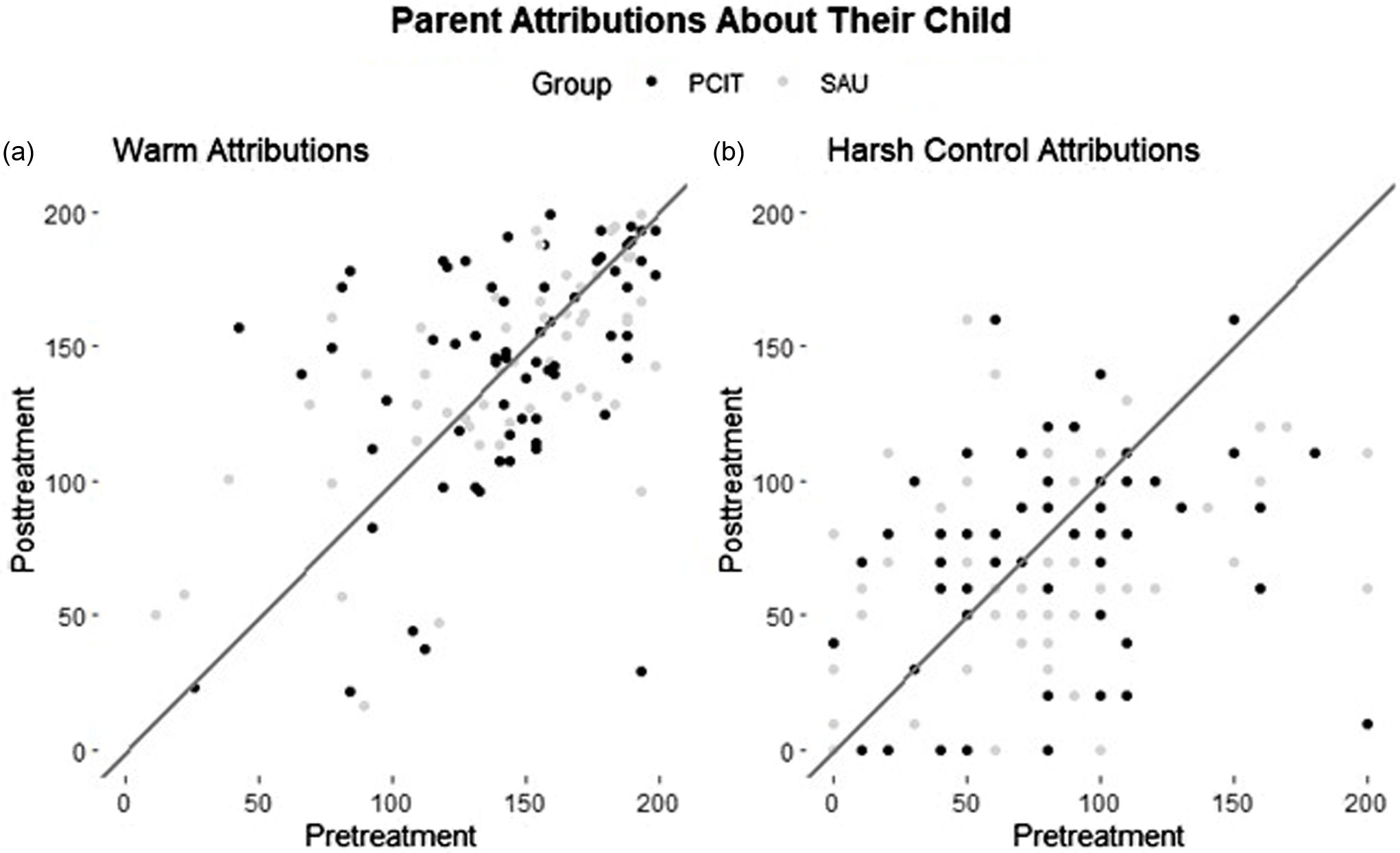
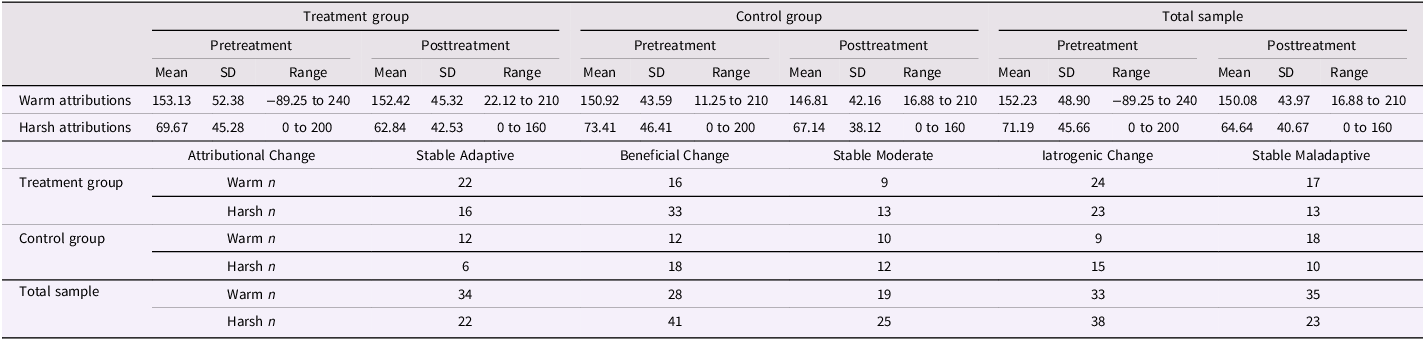
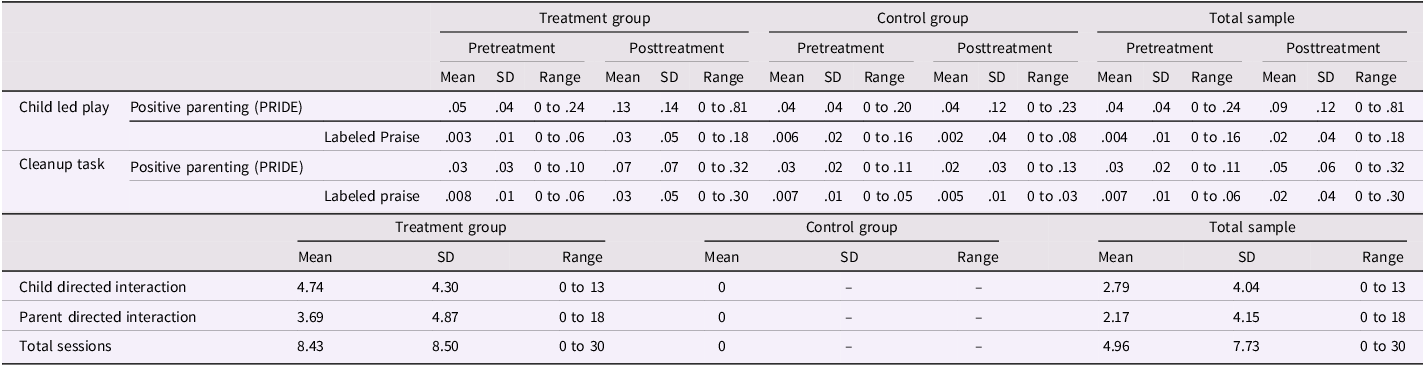
Parents demonstrated considerable spread on both warm and harsh attributions, at pretreatment and at posttreatment (Figure 1). Figure 1 shows parents’ SASB Intrex scores on warm and harsh control attributions about their child at pre- and post-treatment. Points on the plotted line indicate parents reporting the same attributions at posttreatment as at pretreatment. The further a point is from this line, the greater the magnitude of change in attributions reported over the course of the study. All points below the line indicate lower levels of an attribution at posttreatment than at pretreatment, whereas all points above the line indicate higher levels of an attribution at posttreatment than pretreatment. The color of a point indicates a family’s treatment group. Table 1 contains descriptive statistics for both warm and harsh attributions in the PCIT and control group, separated by study wave. Table 1 also contains a count of how many parents populated each of the five attribution change groups for each attribution type. Table 2 contains information on observed parenting behaviors and treatment sessions attended.
Parent attributions. Note. Parent reported scores on (a) warm attributions and (b) harsh control attributions at pretreatment and posttreatment. The diagonals are plots of y = x, intended to help visualize the direction of attributional change. Participant scores on this line represented the same attributions at pre-and post-treatment, whereas participant scores above the line represented increasing (a) positive or (b) negative attributions, and participants below the line reported decreasing (a) positive or (b) negative attributions.

Parent attributions

Note. Descriptive statistics of parent-reported warm and harsh attributions at pre- and post-treatment by condition. Warm Attributions scores on the SASB weighted affiliation scale range from −200 to 200, while Harsh Control Attributions on the SASB Clusters 15 and 16 reflecting strict and harsh control range from 0 to 200, with higher scores reflecting warmer attributions and harsher attributions, respectively.
Parenting skills and treatment dosage

Note. Observed proportion of parent verbalizations that were Positive Parenting skills. Number of PCIT sessions completed, by type, attended by participants.
Attributional change and PCIT intervention dosage
Warm attributions
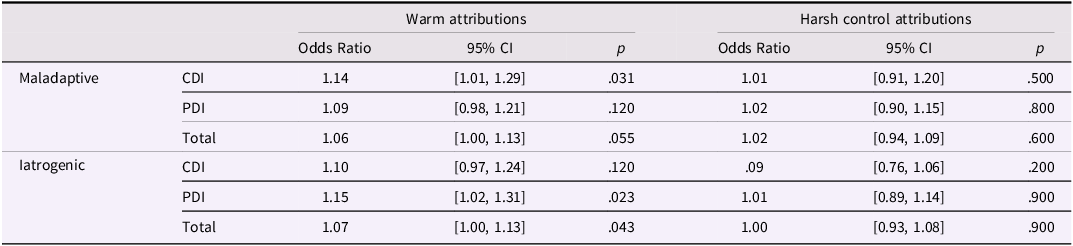
Analyses were conducted to determine the impact of total PCIT session dosage on parent warm attributions about their child, using odds ratios to investigate the likelihood of parent attributions becoming warmer over the course of treatment. When comparing parents who reported beneficial change in warm attributions to a reference group of parents reporting iatrogenic change in warm attributions, each additional treatment session that families attended was associated with a significant odds ratio of 1.07 (p = .043), indicating that each additional PCIT session attended across both treatment phases increased a parent’s odds of seeing beneficial change in warm child attributions over the course of treatment relative to those who showed declines in their warm attributions. Similarly, when comparing beneficial change in warm child attributions to a reference group of parents reporting stable low levels of warm attributions, each treatment session that families attended was associated with an odds ratio of 1.06 (p = .055), indicating that each additional session attended across both treatment phases nonsignificantly increased a parent’s odds of seeing beneficial change in warmth attributions over the course of treatment, relative to those with consistent low-warm attributions over time.
Further, the different PCIT treatment phases appeared to drive the effect of dosage on the odds of seeing beneficial change in warm attributions. When using a reference group of iatrogenic change, each PDI session that families attended was associated with an odds ratio of 1.15 (p = .023), indicating that each additional PDI session increased a parent’s odds of seeing beneficial change in their warmth attributions, whereas each additional CDI session did not have a significant impact on the odds of seeing beneficial change (p = .120; Table 3). A conceptually consistent, but opposite pattern appeared when the reference group was stable, maladaptive (i.e., low) warm attributions. When using a reference group of stable, maladaptive warm attributions, each CDI session that families attended was associated with an odds ratio of 1.14 (p = .031), indicating that each additional CDI session increased a parent’s odds of seeing beneficial change in warmth attributions, whereas each additional PDI session did not have a significant impact on the odds of seeing beneficial change (p = .120; Table 3). Thus, it appears that more CDI sessions were associated with increased positive attributions in parents entering the study with stable, maladaptive attributions, while more PDI sessions were associated with increased positive attributions when compared to the odds of positive attributions worsening. Additional probing revealed that randomization to treatment or control group was not significantly associated with a change in the odds of seeing beneficial change in warm child attributions for either reference group.
Dosage effects

Note. Odds of reporting beneficial change in parent attributions for each additional session attended, compared to maladaptive, stable attributions, and iatrogenic change.
Harsh control attributions
Next, analyses determined the impact of total PCIT session dosage on parent harsh control attributions about their child, using odds ratios to investigate the likelihood of parents viewing their child as less harshly controlling over the course of treatment (i.e., beneficial change in harsh attributions). When comparing beneficial change in harsh control attributions to the reference groups of iatrogenic change and stable maladaptive attributions, the number of total PCIT sessions attended did not significantly shift a parent’s odds of displaying beneficial change in harsh control attributions relative to either reference group (Table 3). Further, analyses of phase-specific PCIT sessions showed that neither the number of CDI sessions nor PDI sessions attended had a statistically significant impact on a parent’s odds of viewing their child as less harsh and controlling at the end of PCIT treatment. Again, probing revealed that randomization to treatment or control group was not significantly associated with a change in the odds of seeing beneficial change in harsh child attributions for either reference group.
Attributional change and parenting behavior outcomes
Warm attributions
Next, we examined the association between change in parent warm attributions and parent behavior during a cleanup task at posttreatment. There was a significant relation between parents’ warm attributions of their child and greater positive parenting skills observed at outcome, F (3, 1, 3, 120) = 4.71, p = 0.004, partial eta squared 0.11. The effect of parent warm attributions on positive parenting was driven by a difference between parents who displayed beneficial change in warmth attributions over the course of treatment and all other groups. Parents in the beneficial change showed more positive parenting behaviors at outcome. Additionally, there was a significant relation between positive parenting and treatment condition, F (3, 1, 3, 120) = 13.86, p = 0.0003, partial eta squared 0.10, in which parents in the PCIT condition displayed more positive parenting behaviors. However, there was not a significant interaction of change in parent warm attributions and treatment condition on positive parenting, F (3, 1, 3, 120) = 0.72, p = 0.544, partial eta squared 0.02.
When Labeled Praise was examined on its own, there was a significant relation between change in parent warm attributions of their child and the proportion of posttreatment clean up statements that were Labeled Praises, F (3, 1, 3, 120) = 3.58, p = 0.016, partial eta squared 0.08. The effect of parent warm attributions on Labeled Praises was driven by a difference between beneficial change in attributions and the reference groups of stable adaptive warm attributions and iatrogenic change in warm attributions. Additionally, there was a significant relation between treatment condition and the proportion of clean up statements that were Labeled Praises, F (3, 1, 3, 120) = 16.68, p < 0.001, partial eta squared 0.12. The effects of treatment condition were driven by a difference between PCIT and SAU, in which parents in the PCIT group used more Labeled Praises at the end of treatment. However, there was not a significant interaction of parent warm attributions and treatment condition on the proportion of clean up statements that are Labeled Praises, F (3, 1, 3, 120) = 0.81, p = 0.493, partial eta squared 0.02.
In the analyses of parenting skills during the Child Led Play task, no significant relations were observed between parent warm attributions about their child and positive parenting scores at outcome, F (3, 1, 3, 120) = 1.79, p = 0.152, or specific Labeled Praises, F (3, 1, 3, 120) = 1.49, p = 0.220. Though there was a significant treatment effect on gains in positive parenting favoring parents in the PCIT condition, F (3, 1, 3, 120) = 19.98, p < 0.0001, there was no significant interaction between treatment condition and parent warm attributions. Similarly, there was no significant relation between change in parent warm attributions and the proportion of positive parenting observed in posttreatment child led play. However, there was a significant relation between treatment condition and the proportion of Child Led Play statements that were Labeled Praises, F (3, 1, 3, 120) = 19.08, p < 0.001. There was not a significant interaction between treatment condition and parent warm attributions. Thus, it appeared that the effect of change in parent warm attributions on gains in positive parenting skills in general, and use of labeled praise in particular, was specifically observed during the cleanup task.
Harsh control attributions
We investigated the association between change in parent harsh control attributions and parent behavior during the Clean Up and Child Led Play Tasks at posttreatment. There was no significant relation between positive parenting and parent harsh control attributions about their child, F (3, 1, 3, 114) = 0.89, p = 0.451. However, there was a significant relation between positive parenting and treatment condition, F (3, 1, 3, 114) = 15.99, p = 0.0001, in which parents in the PCIT condition used more positive parenting behaviors. There was not a significant interaction between treatment condition and parent harsh control attributions. Similarly, there was no significant relation between change in parent harsh control attributions and the proportion of posttreatment clean up statements that were Labeled Praises, F (3, 1, 3, 114) = 0.18, p = 0.908. However, there was a significant relation between treatment condition and the proportion of clean up statements that were Labeled Praises, F (3, 1, 3, 114) = 14.32, p < 0.001. There was not a significant interaction between treatment condition and parent harsh control attributions. The effects of treatment condition were driven by a difference between PCIT and control conditions, in which parents in the PCIT group used more Labeled Praises at the end of treatment, than parents in the SAU control group.
Next, we investigated the association between parent harsh control attributions and positive parenting behaviors during child led play. There was no significant relation between parent harsh control attributions and positive parenting, F (3, 1, 3, 114) = 0.42, p = 0.743. However, there was a significant relation between positive parenting and treatment condition, F (3, 1, 3, 114) = 20.15, p < 0.0001, in which parents in the PCIT condition used more positive parenting behaviors. There was not a significant interaction between treatment condition and parent harsh control attributions. Similarly, there was no significant relation between change in parent harsh control attributions and the proportion of posttreatment child led play statements that were Labeled Praises, F (3, 1, 3, 114) = 1.06, p = 0.369. However, there was a significant relation between treatment condition and the proportion of clean up statements that are Labeled Praises, F (3, 1, 3, 114) = 24.09, p < 0.001. There was not a significant interaction between treatment condition and parent harsh control attributions. Thus, it appeared that stability and change in parent harsh control attributions had no impact on positive parenting behaviors observed at posttreatment.
Sensitivity analyses
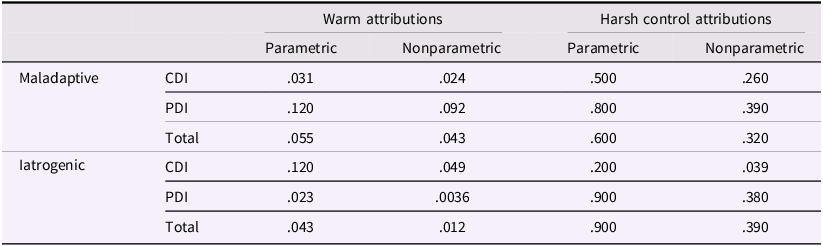
Sensitivity analyses were run by performing permutation tests to examine the stability of the results in a nonparametric manner. All models were estimated in an identical fashion to analyses using the real distribution of the data. Sensitivity analyses revealed that, for the multinomial logistic regression analyses, the p-values obtained using nonparametric methods were similar to those obtained using parametric procedures, indicating that the groupings developed to categorize parent attributions provided a meaningful representation of the data. In particular, the five categories appeared to capture meaningfully distinct groups of change in warm attributions, as all but one of the p-values for the simulated distributions were below .05. However, for harsh control attributions, the categories appeared to fit less well. Importantly, the original analyses and these sensitivity analyses for harsh control attributions were well aligned in that they all showed nonsignificant p-values. The p-values obtained in the original analyses and their corresponding sensitivity analyses can be found in Table 4.
Sensitivity analyses

Note. For the primary effects of interest, p-values were largely consistent.
Discussion
The current study explores parent attributions about their child in the context of PCIT in child-welfare involved families. Total treatment dosage was found to impact the odds of parents achieving positive change in their warm child attributions over time, relative to (a) those who maintained low-warm attributions of their child throughout treatment, and (b) those whose warm child attributions declined over time. Greater dosage of CDI sessions, focused on positive parenting skills, was most beneficial at improving attributions for parents reporting low-warm attributions over the course of treatment. Greater dosage of PDI sessions, focused on behavior management skills, was most impactful at preventing parents from reporting a decline in warm attributions over the course of treatment. Additionally, the study found that parent attributions impacted treatment outcomes, in that parents who achieved greater positive change in their attributions (i.e., viewed their child as warmer at posttreatment) used more positive parenting behaviors with their child during the cleanup task at posttreatment. Together, these findings demonstrate that parent attributions about their child are shaped by the extent of engagement with an evidence-based BPT intervention, and add to the growing literature documenting associations between attributional change and observable gains in positive, responsive parenting skills following PCIT treatment. Future research is needed to leverage knowledge about the malleability of parent attributions to improve treatment outcomes for parents presenting with maladaptive attributions about their child.
Each additional CDI session increased parents’ likelihood of reporting beneficial change in their attributions compared to their odds of maintaining stable, maladaptive attributions over time. It may be that for parents entering treatment with low-warm attributions about their child, increasing the positivity of their interactions with their child enabled them to view their child in warmer ways over time. In CDI sessions, parents are coached to let their child lead the play and to avoid directing or controlling their child. Parents practice these skills at home during “Special Time” play in which they follow their child’s lead in play. The positive parenting skills taught in the CDI phase of treatment have been shown to improve parenting behaviors (Harwood & Eyberg, Reference Harwood and Eyberg2006). It may be that the generalization of positive parenting across interactions influences how parents view their child more holistically. It may also be that shifts in parent behavior, through gains in positive parenting skills, are in turn shifting their cognitions, leading to more positive attributions about the child. It is well documented across interventions that targeting behavior also tends to shift cognitions (e.g., Borkovec et al., Reference Borkovec, Newman, Pincus and Lytle2002; Longmore & Worrell, Reference Longmore and Worrell2007). Thus, the greater number of CDI sessions completed provided these parents with the positive parenting skills practice that may be especially helpful for those parents entering treatment with low positive attributions of their child. Parent attributions may also change based on actual behavior change in the child. The positive parenting skills parents develop in CDI sessions, which are reinforced by the therapist and then practiced with the child at home, may make interactions more rewarding for the child, thus leading them to be a more positive interactive partner (e.g., Cicchetti & Toth, Reference Cicchetti, Toth and Cicchetti2016). It may be that parents who viewed their child as warmer at the end of this study were basing that view on actual increases in their child’s warmth towards them.
In contrast, each additional session of PDI increased parents’ likelihood of reporting beneficial change in positive attributions rather than iatrogenic change. The PDI dosage effect on strengthening positive attributions suggests that more time spent practicing behavior management skills in sessions may make child misbehavior easier to handle and buffer against parent warm attributions getting worse over time. During PDI, parents learn to implement and follow through on a positive discipline sequence, from structuring clear, direct commands to providing consequences for noncompliance (Eyberg & Funderburk, Reference Eyberg and Funderburk2011). The ability to effectively structure commands and follow-through allows children to demonstrate prosocial behavior by providing opportunities to cooperate with parent instructions (Dong et al., Reference Dong, Dubas, Deković, Wang, van Aken and Wu2021; Feng et al., Reference Feng, Hooper and Jia2017), and the discipline strategies employed in PCIT have been associated with increased child compliance (Leijten et al., Reference Leijten, Gardner, Melendez-Torres, van Aar, Hutchings, Schulz, Knerr and Overbeek2019). This may be especially important for the high-risk families in this sample, as parents at high risk for child maltreatment are more likely to respond aggressively to child noncompliance (Rodriguez, Reference Rodriguez2016). Taken together, these findings suggest that more practice with the positive discipline sequence taught in PCIT’s PDI, in which therapists also help parents to identify child compliance with commands in real time, may have active ingredients which help some parents to view their child as more prosocial and warm. The structure and scaffolding that PDI sessions provide for parent management of child behavior may increase parenting self efficacy, that is, the capacity of parents to feel effective in their role. It may be that parents who feel more effective in their parenting role are better able to view their child in more positive ways because they feel more confident in their parenting interactions, which future studies could explicitly measure. Thus, the skills learned in PDI are generalizable to a large proportion of everyday parenting tasks, and parents are taught to use the same positive discipline sequence whenever needed. In sum, higher PDI dosage appeared to prevent iatrogenic change in positive attributions.
This study found that parents who viewed their child as warmer at the end of treatment than the beginning used more positive parenting skills in a posttreatment cleanup task than other parents, while improvement in parent harsh control attributions had no impact on positive parenting outcomes. Gains in positive parenting related to attributions were specific to behaviors observed in the cleanup task, in which parents had to scaffold child behavior with instructions, and did not extend to a child led play task in which parents were instructed to follow the child’s lead. The cleanup task requires parents to use positive parenting in a different and more difficult context, in which they also must actively manage child behavior. The transitioning between structured commands and letting the child lead that is necessary for positive parenting during clean up requires more from parents than simply following along with the child during child led play (Eyberg & Funderburk, Reference Eyberg and Funderburk2011). However, it may actually be due to this increased difficulty that parents with increased warm attributions of their children were able to produce more positive behaviors during clean up than other parents. Parents who view their children as warmer towards them may have an easier time bringing their positive parenting skills to the cleanup task. These parents may be less worried that their child will be difficult during clean up, since they view the child as warm and prosocial, which may make it easier to produce praises and other positive behaviors.
Parents in the current study showed considerable variability in their harsh attribution scores at pre- and post-treatment. Some parents reported stable harsh attributions, and others reported increases or decreases in these attributions. However, contrary to expectations, stability or change in parent harsh attributions over time was unrelated to parenting behavior outcomes. Although harsh attribution scores at intake have been shown to moderate PCIT’s impact on parenting behavioral outcomes, such that parents with harsher attributions at intake achieved greater parenting skills gains at outcome (Skowron et al., Reference Skowron, Nekkanti, Skoranski, Scholtes, Lyons, Mills, Bard, Rock, Berkman, Bard and Funderburk2024), findings here suggest the extent of stability or change in harsh attributions over time were unrelated to parenting outcomes. It may be that PCIT improves parenting skills regardless of change in harsh parent attributions.
Alternatively, the approach to grouping stability and change in harsh parent attributions used in this study may have obscured important individual differences in how harsh attributions shifted over time. Whether parents report moderate or low levels of harsh attributions at the end of treatment might lead to quite different clinical presentations, even if those parents experienced similar magnitudes of change. For example, the beneficial change group did not distinguish between parents whose pre-to-post scores changed from highly harsh to moderately harsh and parents whose scores shifted from moderately harsh to low in harshness. Each of these parents displayed similar magnitudes of reduction in their harsh attributions, but arguably the latter parents may have “resolved” their negative views of their child, whereas the former set of parents continue to hold moderately harsh views of their child at posttreatment. Similarly, the iatrogenic change group consisted of parents whose scores changed from low in harshness to moderately harsh, together with parents who entered with moderately harsh attributions that changed to highly harsh by posttreatment. It is possible that the specific start and end points are more critical to operationalizing change in harsh attributions. Results of the sensitivity analyses provide some support for this interpretation, in that the groupings of harsh attributions used in this study did not provide as much explanatory power as the groupings of warm attributions. It may be that treatment outcomes are dependent on the endpoint of harsh attributions, in addition to the amount of change. Families may experience the greatest gains when very harsh attributions drop even to moderate levels, or alternately experience significant gains only when harsh attributions drop to low levels.
The current study focused on stability and change in parent attributions over treatment in a high-risk, child-welfare-involved sample, examining the role of treatment dosage and parenting skills outcomes. In lower risk families presenting with child behavior problems, BPT interventions appear to soften harsh attributions about the child (Caro Schulz, Reference Caro Schulz2020; Novick et al., Reference Novick, Lorenzo, Danko and Tuscano2022; Sawrikar et al., Reference Sawrikar, Hawes, Moul and Dadds2018; Whittingham et al., Reference Whittingham, Sofronoff, Sheffield and Sanders2009). The present work extends past findings detailing the positive impact of family interventions on softening parent attributions in lower risk families, to child-welfare-involved families for whom attributions can have a greater impact on parenting behavior (Girod et al., Reference Girod, Leerkes and Zvara2023). In this high-risk, child-welfare-involved sample, PCIT dosage positively impacted parents’ positive attributions about their child, in treatment phase-specific ways, but had no effect on changing harsh attributions. Additionally, parents that reported increases in positive attributions of their child demonstrated the greatest gains in positive parenting skills at outcome.
Limitations and future directions
The current study has some notable limitations. As with all measures of cognitions, attributions about the child were self-reported by the parent. This study employed relatively narrow definitions of positive and negative parent attributions about their child, and future research should explore additional domains of parent positive and negative views of their child, such as the extent to which parents view their child as cooperative or oppositional. The positive parenting behaviors considered in the current coding system were relatively specific. Additional information about parent behaviors, including their level of warmth and amount of engagement with the child, would provide additional information about the impact of parent attributions about the child on parent child interactions. Further, this study did not take into account how the child’s behavior may shape parent perceptions. It may be that some parents view their child as being not particularly warm towards them because their child does not act warmly towards them, and that other parents may view their child as not particularly warm despite outside observers noting very warm and loving behavior from the child. Future studies should consider including a measure of actual child behavior in studies of parent attributions in order to assess how child behavior influences parent perceptions of the child.
This paper employed discrete categories of stability and change drawn from a continuous measure of parent attributions to investigate differences between families, however the use of categories of attributional change comes with some limitations. The reduced statistical power that results when categorizing a continuous measure means that the analyses were vulnerable to yielding false null results. Though the sensitivity analyses indicate that the warm attributions groupings constructed for this study were a good fit for modeling stability and change, the harsh attributions groupings were not as robust and might benefit from reconceptualizing in future work. As noted earlier, the study did not distinguish between parents whose harsh attributions decreased to moderate levels from those whose harsh attributions decreased to low levels, which may hide important clinical differences. Future research is needed to clarify the relation between level of and change in harsh attributions and document the intervention parameters that best account for meaningful reductions in child-welfare-involved parents.
The current project generates several questions to inform future research. The finding that child welfare involved parents who report beneficial change in attributions also demonstrate greater increases in positive parenting behaviors over time raises additional questions about treatment efficacy. Future research should investigate whether these gains in positive parenting skills last longer in families who report beneficial change in parent attributions about their child. It may be that viewing the child in more positive ways makes it easier to use the positive parenting skills targeted in PCIT and other parenting interventions. It may also be that it is more rewarding to use positive parenting skills with a child who is seen as a more positive interactive partner. Future studies could follow families over time to see whether parents who reported beneficial change in attributions display better maintenance of gains in positive parenting skills at long-term follow-ups. This may take the form of measuring child behavior and parent attributions at multiple time points over the course of a longitudinal study and modeling the impacts over time. Future work could also investigate whether improvements in child symptoms differ based on the gains their parents make in positive child attributions, as well as the persistence of treatment effects on children’s outcomes over time.
It also is important to better understand the mechanisms through which increased engagement in PCIT sessions are increasing parents’ odds of seeing attributional change in a positive direction. Future research should investigate the pathways through which CDI sessions may be improving parent warm attributions. A future study might have both parents and researchers rate the warmth of children over the course of treatment, which could disentangle whether increases in warm attributions are driven by actual changes in child behavior or by changes in parent perception. Future research should explore how to effectively engage families in PCIT treatment through the second treatment phase, PDI, where child management skills training occurs. As described above, perhaps the focus of work in PDI sessions increases parenting self efficacy, which in turn may bolster parents’ positive views of their child through increasing their confidence during parenting interactions. Future research should investigate parenting self efficacy before and after each phase of PCIT treatment to determine whether parents who report positive changes in self efficacy also achieve positive changes in attributions about their child. Relatedly, future research should examine whether parents’ mastery of PCIT parenting skills over the course of treatment is related to improvement in their attributions of their children.
Clinical implications
These findings have clinical implications for children and families involved with child welfare. Parents at risk of child maltreatment often find parenting to be emotionally overwhelming and stressful (Hillson & Kuiper, Reference Hillson and Kuiper1994; Holden & Banez, Reference Holden and Banez1996), which may contribute to the documented increase in risk of child maltreatment during situations involving child behavior management (Rodriguez et al., Reference Rodriguez, Silvia, Gonzalez and Christl2018; Rodriguez, Reference Rodriguez2016; Urquiza & McNeil, Reference Benjamin1996). The cleanup task in this study was one such behavior management situation, in which parents provided a series of instructions and commands to their child. The content of PCIT’s PDI sessions may provide a structure that decreases some of the overwhelm experienced during parenting interactions through providing a framework to fall back on, which may make parents better able to form more positive attributions about their child. Given the evidence that parents with more negative attributions of their children may be less likely to engage and persist in family interventions (Sawrikar et al., Reference Sawrikar, Hawes, Moul and Dadds2018; Skoranski et al., Reference Skoranski, Skowron, Nekkanti, Scholtes, Lyons and DeGarmo2022), parents who have the most to gain may be least likely to complete enough sessions to achieve significant change in their cognitions about their child. One potential avenue may be to tailor the format of PCIT to better reach families presenting with low positive attributions of their child at the beginning of treatment. Directly targeting parent attributions in treatment, perhaps by leveraging the particular skills that appear most likely to strengthen positive attributions and soften harsh ones may help reach the families least likely to engage in treatment. This might be implemented through assessment of parent attributions about their child during treatment intake, and then utilizing strategies like motivational interviewing to engage families in treatment or increasing the use of therapist statements that reinterpret child behavior in more positive ways. Existing research already demonstrates that motivational interviewing increases the efficacy of PCIT (e.g., Chaffin et al., Reference Chaffin, Funderburk, Bard, Valle and Gurwitch2011). It is clear that parent attributions about their child are an important and understudied factor in the context of family interventions, perhaps especially in families at risk of child maltreatment. Through further investigation of how PCIT and similar treatments act on parent attributions, these treatments can be tailored to better reach and support families at risk of child maltreatment with improved understanding of the particular cognitions held by these caregivers.
The present findings provide new knowledge about the role of parent attributions in PCIT, contributing to a small but growing literature showing that when attributions change for the better, intervention outcomes also improve. Recent studies of PCIT demonstrated that parent cognitions about their children at intake predicted treatment outcomes in families with child conduct disorder (Fleming et al., Reference Fleming, Sawrikar, Kaouar, Neo, McDonogh and Kimonis2025), and child-welfare-involved parents with harsher parent attributions at study entry showed the greatest magnitude of gains in parenting skills at outcome (Skowron et al., Reference Skowron, Nekkanti, Skoranski, Scholtes, Lyons, Mills, Bard, Rock, Berkman, Bard and Funderburk2024). Much of the research on parent attributions has thus far focused on decreasing harsh attributions (e.g., Sawrikar et al., Reference Sawrikar, Hawes, Moul and Dadds2018; Skoranski et al., Reference Skoranski, Skowron, Nekkanti, Scholtes, Lyons and DeGarmo2022). The current study extends this work by documenting that increased positive attributions over the course of treatment improve outcomes in high-risk families, supporting the merits of a strengths-based approach in research on this population. Many high-risk families presenting to treatment do not see the expected benefits, and parent attributions likely play a role. The present findings provide rationale for measuring parent attributions whenever families present to treatment for parenting difficulties. As future studies accumulate a greater understanding of how parent–child interventions can improve parent attributions, this knowledge can be used to improve outcomes for families in treatment.
Data availability statement
Data and code necessary to reproduce analyses available upon request to corresponding author. Analyses were not pre-registered.
Funding statement
This research is supported by the National Institute on Drug Abuse of the National Institutes of Health under award number R01DA036533 (ES; Principal Investigator).
Competing interests
The authors declare no competing interests.