The moral certainties, and the bold, even heroic actions, which gave an epic quality to the democratic transitions in Latin America in the 1980s and 1990s, are a matter of the past. The sweeping economic transformations initiated in the region in the late 1980s and early 1990s reduced the centrality of many of the protagonists of twentieth-century Latin American politics. Additionally, in the wake of successful democratic transitions, Latin American countries acquired the characteristic trademark of functioning democracies: the processing of political conflicts, as a matter of routine, according to widely accepted democratic rules. Thus, there is much truth to the statement that Latin American politics in the early twenty-first century revolved around the results of democratic elections, the institutional relationship between elected legislators and presidents, and the passing of laws regarding various policy domains (for example, economy, health, education, justice, security). Yet politics in Latin America after democratic transitions was not limited to the processing of conflicts according to previously adopted and widely accepted democratic rules: politics within democracy did not bring an end to politics about democracy.
A key aspect of the democracy question concerned the endurance of gains made through democratic transitions. These gains could not be taken for granted. However, a novel question that subsumed this important but rather narrow concern took shape. Increasingly, democracy was seen as hinging on much more than the minimal standard that served as the goal of democratic transitions. Yet actors who both supported and opposed neoliberalism – the key axis of ideological conflict – advocated and resisted political changes in the name of different models of democracy. Frequently, actors’ preferred model was trumpeted as the more democratic one and invoked when advancing projects to democratize a country. But sometimes actors went further and criticized their rival’s model as non-democratic. Thus, the new struggle for democracy had some distinctive features. It was not just about the endurance of democracy but rather about whether democracy simultaneously developed and endured. Moreover, this struggle was driven by different visions of democracy. In a nutshell, the conflict over which model of democracy would prevail shaped Latin America’s post-transition trajectories, determining how democracy developed and, in turn, whether democracy endured.
This article focuses on the travails of democracy in Latin America after its transitions from authoritarian rule and draws on and extends a discussion about Latin American politics largely propelled by Latin American authors. This discussion is richer and more nuanced than the discussion in the mainstream comparative literature on Latin American politics, which all too often ignores that politics in post-transition Latin America is about democracy or assesses democracy in Latin America only in terms of criteria acceptable in Washington. But it also offers some general insights that have not been incorporated into theorizing about democracy. Thus, though throughout this article the focus is put squarely on Latin American realities, the article ends by explicitly addressing the challenges posed by the study of democracy in post-transition Latin America to current theorizing about democracy more broadly. In other words, although this article is mainly concerned with understanding Latin American democracy, it also shows how the study of Latin America has implications for the endeavour of theorizing about democracy in other regions of the world.
After Transitions From Authoritarian Rule
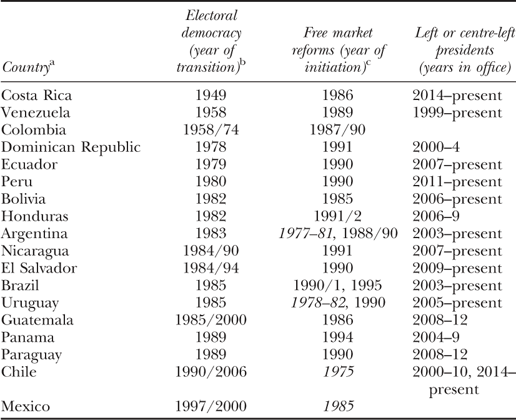
Latin America underwent a sweeping political change in the 1980s and 1990s (see Table 1, column 2). In 1977, only three countries in the region had democratically elected authorities. Yet, starting in 1978, authoritarian, mainly military-based, rule came to an end, as leaders elected in free and fair elections took office. By 1990 all of South America had democratically elected authorities. In the 1990s, the lingering issues from the Central American civil wars of the 1980s were resolved, and the left and right were fully incorporated into electoral politics in Central America by 2000. Thus, alternation in power in Mexico in 2000 capped an extraordinary wave of democratization in Latin America. For the first time in the history of government, democracy was the norm in a developing region of the world. Or, more precisely, through what was widely referred to as democratic transitions, nearly every Latin American country had become an electoral democracy – that is, had a political system in which elections were the only means of access to government offices, elections were based on the universal right to vote and the right to run for office without proscriptions, and elections were devoid of violence or fraud.
Democratization, Marketization and Left Presidents in Latin America

Notes: aCountries are ordered according to the year of their transition to electoral democracy through the holding of contested elections. The years correspond to the time when governments are formed; in some cases the key elections were held in the previous calendar year (e.g. Ecuador) or even earlier (e.g. Bolivia).
bFor Colombia, though electoral politics began in 1958, free electoral competition started only in 1974. For El Salvador and Guatemala, though electoral politics began in 1984 and 1985 respectively, the left was able to start competing in 1994 and 1999 respectively. In Nicaragua, though electoral politics began in 1984, the right only started competing in 1990. In Chile, though competitive elections began in 1989, only in 2006 were all positions in the Congress filled through elections.
cIn three cases (Argentina, Brazil and Uruguay), an initial process of market reform stalled and was resumed after a few years. The first date indicates when reforms were initially launched; the second date when they were resumed. Italicized dates (for Argentina, Chile, Uruguay and Mexico) indicate that reforms were initiated by authoritarian rulers.
Sources: Author’s elaboration; drawing on information on free market reforms in Morley et al. (Reference Morley, Machado and Pettinato1999) and Escaith and Paunovic (Reference Escaith and Paunovic2004); and on presidential ideology in Murillo et al. (Reference Murillo, Oliveros and Vaishnav2010).
These democratic changes notwithstanding, the weight of the past was still evident. Though the pursuit of revolutionary alternatives through arms – a trend that spread from Cuba to many countries in the region in the 1960s – rapidly became a thing of the past, a democratic transition remained a pending challenge in authoritarian Cuba, the Latin American country where the legacy of the Cold War proved hardest to erase. (The guerrillas in Colombia were the other key enduring Cold War legacy in the region.) More generally, countries that made democratic transitions in the 1980s and 1990s could not take for granted that their democratic gains would not be reversed because the military – a dominant actor in Latin America from 1930 onwards – remained a poder fáctico (de facto power) and actively challenged the authority of democratic governments in many countries. Indeed, in the wake of democratic transitions, in countries where the agenda of transitional justice was salient but also in countries where the military was particularly entrenched, the military threatened or attempted – sometimes successfully, other times not – to carry out coups d’état.Footnote 1 In short, the past limited, and threatened the endurance of, democratic gains.
Nonetheless, in retrospect, it is clear that the wave of democratization in Latin America in the 1980s and 1990s was the final act of the conflicts that were generated in the course of the region’s transition to popular politics initiated in the 1920s and 1930s (Collier and Collier Reference Collier and Collier1991; Touraine Reference Touraine1989). Democratic transitions were the product of a compromise among the key actors of this old politics – soldiers, party leaders, industrial and agrarian economic elites, the middle class, organized labour and occasionally guerrillas – who jointly accepted that key government offices would be filled through free and fair elections (O’Donnell and Schmitter Reference O’Donnell and Schmitter1986). But, with the exception of a few stubbornly enduring legacies of the Cold War, the old politics was swept aside in the immediate aftermath of democratic transitions. Though some actors of the old system did not fully accept the democratic compromise and, in the short run, could impose some limits on the democratic transformations in Latin America, the state of democracy increasingly hinged on the conflicts at the heart of the new societies that were being shaped by the introduction of free market reforms (Cavarozzi Reference Cavarozzi1992; Garretón et al. Reference Garretón, Cavarozzi, Cleaves, Gereffi and Hartlyn2003).
The break with the old came as somewhat of a surprise. A few countries had initiated free market reforms, which brought about a rejection of the import substituting industrialization (ISI) model of economic development that had been the norm in Latin America since the 1930s and 1940s, in the context of authoritarian rule (see Table 1, column 3). Chile was the most prominent early example, and Mexico would follow several years later. Yet these countries appeared as exceptions. Their experience, along with those of Argentina and Uruguay, seemed to suggest that such reforms were associated with authoritarianism and hence were unlikely to be adopted in the new democratic age that was dawning in Latin America. But, starting with Bolivia in 1985, the first country to show that it was possible for democratically elected leaders to implement radical economic reforms, a cohort of elected presidents of the right and centre-right launched and then deepened free market reforms in every Latin American country in the 1990s (Edwards Reference Edwards1995; Escaith and Paunovic Reference Escaith and Paunovic2004; Morley et al. Reference Morley, Machado and Pettinato1999).Footnote 2 By the mid-1990s, the region had unexpectedly converged on the twin institutions of democracy and the market.
This was but a moment, however, not the final destination of history, and it did not end the relevance of the left–right distinction, understood here in rather narrow terms as revolving around the issue of economic inequality, seen as natural and acceptable by the right and largely socially constructed and unacceptable by the left.Footnote 3 First, protest movements resisted the implementation of free market reforms and triggered major clashes with the authorities, including the Caracazo in Venezuela in 1989, the Zapatista uprising in Mexico in 1994, the water and gas wars in Bolivia in 2000, 2003 and 2005, and the riots in Argentina in 2001. Then, starting in Venezuela in 1999 and Chile in 2000, left and centre-left presidents came to power through elections in nearly every Latin American country (see Table 1, column 4) and sought to offer more or less radical alternatives to unbridled free market economics and the dominance of politics by economics (Edwards Reference Edwards2010; Flores-Macías Reference Flores-Macías2012; Huber and Stephens Reference Huber and Stephens2012). Thus, the strong convergence on free market policies in the 1990s gave salience to a neoliberal ideology that posited that all decisions in a society, and not only economic ones, are best left to markets or made subservient to market forces. But it also accentuated the divide between forces committed to neoliberalism and those who sought an alternative to neoliberalism. And this divide rapidly became the key axis of ideological conflict in post-transition Latin America.
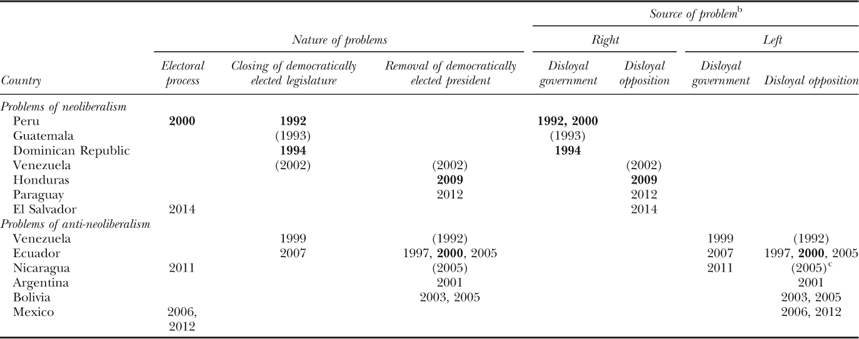
Divergence was not limited to the role of markets. A quick glance at the evolution of electoral democracy provides indisputable evidence that in post-transition Latin America politics was still about democracy and, moreover, that this politics was linked with the divide over neoliberalism.Footnote 4 Indeed, political actors committed to promoting and fighting neoliberalism repeatedly broke the rules of electoral democracy (see Table 2). These data show that these crises of electoral democracy were frequent and widespread: only six of 18 post-transition countries did not experience crises that affected their status as an electoral democracy. In addition, although the decisive actions in these crises – a matter that goes to final responsibility – were carried out either by actors on the right or the left (Venezuela is an exception), the most grave problems were largely due to actions of incumbents seeking to implement neoliberalism (Peru 1992 and 2000, Dominican Republic 1994) or actions of opponents to governments committed to rolling back neoliberalism (Venezuela 2002, Honduras 2009).
Electoral Democracy in Post-Transition Latin Americaa

Note: aThe data include developments following democratic transitions and the initiation of free market reforms; for this information, see Table 1. The more serious problems are highlighted in bold; failed challenges to the rules of electoral democracy are presented in parentheses.
bThe concept of ‘disloyal opposition’, discussed in Linz (Reference Linz1978: 27–38), is adapted and extended to the government, which is considered disloyal inasmuch as it undermines the rules of electoral democracy.
cIn the crisis in Nicaragua in 2005, the conservative forces loyal to Alemán, as well as the leftist Sandinistas, were behind the push to remove President Bolaños.
Source: Author’s elaboration.
These political developments showed that the gains made through democratic transitions could not be taken for granted and that ideological differences were very much alive in post-transition Latin America and affected support for democracy. But these developments were only the most overt manifestations of a conflict that revolved around two interrelated questions: What is democracy and should democracy be supported? The nature and value of democracy had been the subject of a theoretical-political debate in the 1960s which revealed important disagreements within the left. Subsequently, disagreements were largely set aside in the context of the struggles for democracy in the 1980s and 1990s. Indeed, in part as a matter of strategic choice, political action in the context of processes of democratic transitions had relied on a decidedly minimalist concept of electoral democracy, centred on the holding of competitive elections with universal suffrage for key government offices. However, soon after democratic transitions led to the installation of elected governments, and especially as free market economic reforms got underway, the nature and value of democracy again became a subject of discussion.
Latin Americans began to recognize that the work of building democracy had not been completed through democratic transitions. Moreover, they gave bite to rather generic statements about building democracy by asking the question: ‘Which democracy?’ (Weffort Reference Weffort1992). And the response to this question was not a shared one. After a moment of consensus about the meaning of democracy in the context of struggles against authoritarian rulers, it became readily apparent that different ideological groups had different conceptions of democracy and that these differences affected support for democracy (see Doorenspleet’s contribution to this special issue, 2015). Enthusiasm for building democracy was not unconditional; rather, it began to hinge more and more on which democracy was going to be built. Moreover, the endurance of democracy, even in its most basic electoral dimension, would increasingly depend on how projects for the continued democratization of Latin American politics unfolded (Caputo Reference Caputo2011).
The Theoretical-Political Debate
The first serious theoretical-political discussions about democracy in post-transition Latin America were framed by critical intellectuals who focused on the decision-making process of governments, such as those led by Carlos Menem (president of Argentina, 1989–99) and Alberto Fujimori (president of Peru, 1990–2000), that implemented radical neoliberal policies. Particularly influential in this regard was the concept of delegative democracy (O’Donnell Reference O’Donnell1994). This concept recognized the democratic character of these countries – the basic, minimal standard of electoral democracy was taken for granted – but portrayed the concentration of power in the hands of presidents, and the frequent recourse to rule by decree, as a deficiency from the perspective of a broader notion of democracy. In particular, emphasis was put on how strong presidents necessarily weakened parliaments, the prime site where parties can debate and decide on alternative policy options between elections.Footnote 5
With the rise to power of the left in the 2000s, the discussion about democracy changed. Views about democracy were not voiced only by critical intellectuals. Now partisan intellectuals weighed in. Moreover, though the discussion built on an element of consensus – democracy entailed, at the very least, the minimal standard of democracy that had served as a goal of earlier struggles for democracy – it revolved largely around sharp contrasts between countries seen as exemplifying a preferred and a less desirable model of democracy. Thus, a common critical diagnosis by opposition intellectuals was increasingly replaced by a debate about the merits and shortcomings of different, largely incompatible, models of democracy.Footnote 6
In this debate, the liberal democratic model had a prominent status, serving as a somewhat obligatory point of reference. Furthermore, many defenders of liberal democracy in Latin America (Krauze Reference Krauze1984; Vargas Llosa Reference Vargas Llosa2009; Walker Reference Walker2013: ch. 8) – in this region they are correctly labelled as liberal-conservatives (Gargarella Reference Gargarella2013: ch. 2, 197–9) – treated liberal democracy as more or less self-evidently the one legitimate version of democracy. But such a view was questioned by many on the left who proposed their own model of democracy as an alternative to the liberal democratic model.Footnote 7 In other words, the ideological divide between neoliberals and anti-neoliberals affected how democracy was understood in political discourse, and the old tension between liberalism and socialism crept back into the debate about democracy.
One axis of debate concerned the political institutions of decision-making required by democracy. The proponents of a liberal democratic model espoused a rather conventional view. They saw constitutionalism, an independent judiciary, checks and balances, and other means of both dispersing and limiting political power, as central features of democracy. In turn, deviations from these features were considered dangerous deficiencies. In contrast, the left suggested that this was not the only legitimate way to think about democratic political institutions. Indeed, the left rejected the blind embrace of rigid constitutionalism for putting many issues of normal politics out of the reach of electoral majorities; it pointed out that the judges sworn to uphold the constitution are many times actually a poder fáctico, much like the military; and it called for the sanctioning of new constitutions through plainly democratic processes, such as a popular vote to set up a constituent assembly and to ratify the constitution proposed by such an assembly (Garretón Reference Garretón2007: ch. 10, Reference Garretón2012: ch. 12). That is, seeing the various mechanisms proposed by advocates of liberal democracy to limit the power of elected authorities as limits on democracy itself, the left proposed, as a way to make countries more fully democratic, a refounding of politics through constitutional change with popular participation.
The left also offered a perspective on the role of presidents that differed from the one provided in analyses of delegative democracy. Emphasizing how the blocking of programmes for change by entrenched political elites and regional powers was a key problem of democracy in Latin America, some argued that a strong president, relying on plebiscitarian appeals for popular support, was needed to counter the bias toward the status quo (Unger Reference Unger1987: 362–95, 449–80; Reference Unger1990: 315–23, 356–60; Reference Unger1998: 213–20, 264–6). Moreover, while some acknowledged that populism weakens the prospects of an organized civil society and sustained mobilization (Unger Reference Unger1998: 66–70, 79–84), others maintained that populism was sometimes needed as a corrective to the tendency towards oligarchy and, additionally, that the dangers of neoliberalism were greater than those of populism (Laclau Reference Laclau2005, Reference Laclau2006). That is, the left favoured institutions that, in seeking to accentuate the anti-oligarchic potential of institutional arrangements, courted some risks, but that were seen as ultimately more democratic than liberal democratic institutions in that they more fully empowered electoral majorities.
Beyond the difference between liberals and leftists regarding the institutions of democracy, a second axis of debate focused on what might be called the social environment of politics. In some ways, the differences concerning the social environment of politics were not as incompatible as those concerning political institutions. Advocates of liberal democracy in Latin America, as did their counterparts around the world, routinely included in their definition of democracy, in addition to a standard list of institutions, certain civil rights, including the freedom of expression, association, assembly and access to information. And the left did not directly challenge this position. Thus, the distinctiveness of the left was not that it failed to acknowledge the importance of these rights to democracy. Rather, the particularity of the left was that it insisted on also addressing socioeconomic issues (Caputo Reference Caputo2011; Nun Reference Nun2003; Weffort Reference Weffort1992), a point that had important implications.
First, it led the left to emphasize that political rights (for example, to participate in an election as equals) could only be effectively exercised if economic power did not make a mockery of the democratic principle of political equality (Nun Reference Nun2003: chs 14, 21 and 22; Weffort Reference Weffort1992: 14–23). Relatedly, it motivated the left to suggest that a liberal view of democracy was likely to downplay the extent to which the principle of political equality, central to democracy, was violated by the disproportionate power of economic elites. Thus, leftists argued that some aspects of the socioeconomic context had tobe recognized as pre-conditions of a democratic process, much as liberals argued was the case of some civil rights. Second, the emphasis on socioeconomic issues was also behind the left’s adoption of a different view of the standard civil rights included in liberal definitions of democracy. Seeing democracy and socioeconomic inequality as inextricably linked, the left questioned the liberal view that liberty always takes precedence over equality, contextualized what were seen – from a liberal perspective – as absolute rights and asserted that democracy required regulation of the use of money in politics, public financing of parties and candidates, and free access to the mass media (Unger Reference Unger1998: 122–3, 219, 265–6).
In short, in the wake of democratic transitions in the 1980s and 1990s, Latin American intellectuals engaged in a debate about what kind of democracy their countries had and what kind of democracy they wished their countries to have. The discussion focused on criteria of democracy beyond those included in the minimal standard of electoral democracy and was both rich and divisive. While liberals adopted the standard liberal democratic model, the left argued for a different vision of the political institutions of decision-making – one that sees democracy as curtailed when elected authorities are weakened or when power resides in the hands of non-elected agents within the state – and the social environment of politics – one that holds that democracy needs some civil rights but also requires measures to prevent the conversion of economic power into political power. In other words, this discussion essentially led to the proposal of two partly compatible, but also largely contradictory, models of democracy – the model of liberal democracy and what might be called the model of popular democracy – that introduced a fundamental evaluative conflict into discussions of politics. On the one hand, liberal thinkers argued that the liberal democratic model was the only legitimate model of democracy. On the other hand, thinkers on the left questioned that the liberal democratic model was the only model of democracy and countered by arguing that their model of democracy was actually a more democratic model of democracy.
The Record Of Political-Ideological Actors
This theoretical-political debate about models of democracy did not translate directly into political practices. Political actors do not operate with pure models of democracy, sometimes act without an explicit model of democracy and sometimes do not support any model of democracy. Furthermore, political actors are rarely in a position simply to implement their preferred model of democracy; the actual model of democracy is frequently the result of a mixture of conflict and cooperation among actors who support different models of democracy. Nonetheless, the Latin American debate about models of democracy was not just an intellectual exercise. Indeed, a selective survey of post-transition Latin America that highlights cases where either distinctive or problematic trends were most evident gives support to two points. Distinct political-ideological actors have had an effect on democracy not only through their support for the rules of electoral democracy, as indicated previously, but also through their impact on the political institutions of decision-making and the social environment of politics. Moreover, the impact of these actors on democracy can be attributed in part to their different views about the appropriateness of the liberal democracy and popular democracy models of democracy, and conflicts over the prevalence of one or another model of democracy.
The Right
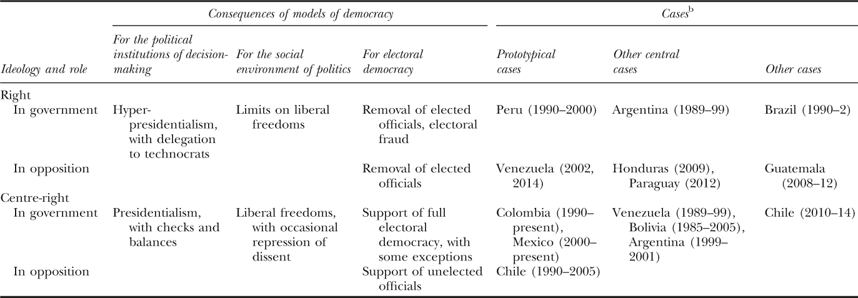
The record of the right in post-transition Latin America can be summarized as follows (see Table 3). Right-wing governments were characterized by hyper-presidentialism, a combination of concentration of power in the hands of the president and the personalization of power. More specifically, right-wing presidents implemented neoliberal reforms by frequently passing legislation through decree (even when this was patently illegal, as in the case of Menem before 1994) and sought, with various degrees of success, to concentrate power in their hands by, among other measures, reforming the constitution so as to allow for their own re-election and pressuring the courts to interpret the constitution so as to allow them to stand for re-election beyond what a strict reading of the constitution would allow.Footnote 8 Right-wing governments also routinely delegated decision-making power to technocrats, particularly within the economic ministries and the central bank. Moreover, these governments accentuated the top-down thrust of power by suppressing liberal freedoms.
Ideology and Models of Democracy in Post-Transition Latin America Ia

Notes: aThe table covers developments following democratic transitions and the initiation of free market reforms; see Table 1 for information on the dating of these events.
bThe list of cases is not comprehensive; that is, it does not cover all Latin American countries nor the entire period under consideration for the countries that are covered.
Sources: Author’s elaboration; drawing on information on presidential ideology in Murillo et al. (Reference Murillo, Oliveros and Vaishnav2010).
The right’s record of defence of the minimal standard of electoral democracy was also negative. President Fujimori’s quest to impose his neoliberal agenda in Peru clashed with the free play of electoral competition and alternation in power, and led to two of the most unequivocal cases of full disregard for the standard of electoral democracy in post-transition Latin America: Fujimori’s decision to close down the elected congress in 1992 and essentially rule with the support of the military, and his later decision to commit outright fraud in the 2000 presidential election. But the right also threatened electoral democracy, and did so more often, when it was in opposition rather than in government.
Once the left surged in post-transition Latin America and began to propose an alternative to the model of liberal democracy, the right went beyond placing the sort of legitimate limits on a government that correspond to an opposition. The right gradually articulated a dangerous argument against left presidents: even if a leftist president came to office by winning a contested and clean election, the minimal standard associated with electoral democracy, their removal from office was justified if such a president was seen as governing – according to their conception of democracy – undemocratically. And the right actually followed through on such an argument. In effect, as exemplified most clearly by the cases of Venezuela (2002 and 2014) and Honduras (2009), the right, at times working with the military, invoked the model of liberal democracy to question the legitimacy of presidents elected in contests that met minimal standards and to justify the removal of these presidents.Footnote 9
In brief, right-wing governments deviated considerably in practice from the model of liberal democracy and only reluctantly espoused liberal democracy; the contrast between their trumpeting of economic liberalism and weak endorsement of liberal democracy was quite stark. Nonetheless, when in opposition, the right was persistent in criticizing the left’s record in government for any deviation from the liberal democracy model and even went to the extreme of using those deviations as justification for removing duly elected presidents. The actions of the right, then, were shaped less by its support for the model of liberal democracy than by its opposition to the model of popular democracy.
The Centre-Right
The centre-right’s record in the post-transition period was quite different from that of the right. While in government, the centre-right supported a presidential system with checks and balances. Moreover, centre-right governments defended some liberal freedoms, such as freedom of the press. However, centre-right governments deviated from the model of liberal democracy in various ways. Uribe’s presidency in Colombia (2002–10) tilted towards hyper-presidentialism.Footnote 10 Several centre-right governments responded to anti-neoliberalism protests with repression, leading to hundreds of dead in the Caracazo in Venezuela in 1989, some 22 dead in Argentina in 2001, and 60 deaths in Bolivia in 2003. Furthermore, in Colombia the killing of trade unionists was a recurring problem, and in Mexico violations of human rights were a major problem after 2006. With regard to electoral democracy, the centre-right’s record was more fully positive. The centre-right never supported the outright breakdown of electoral democracy. Yet, in the instance of Chile, it actively blocked full electoral democracy, specifically by resisting for 15 years a reform to remove the unelected senators envisioned by Pinochet’s constitution.
In sum, the centre-right’s record in the post-transition period was considerably more positive than that of the right. In particular, it demonstrated that a strong liberal–conservative alliance can provide the basis of support for a relatively consistent implementation of a liberal democratic model, even in a context such as Latin America. Nonetheless, it also showed that the centre-right failed to protect some of the most basic liberal rights and, when convenient, supported blatantly undemocratic political institutions.
The Centre-Left
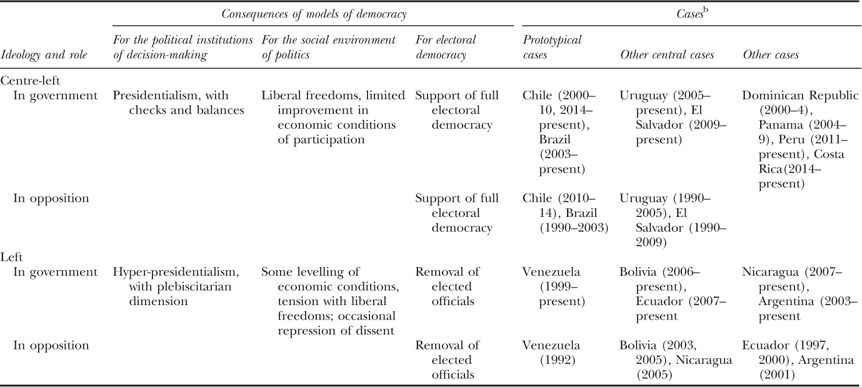
The record of the centre-left was largely positive (see Table 4). Centre-left governments were respectful of checks and balances. They stood out with regard to liberal freedoms; unlike other governments they allowed dissent and did not resort to repression when faced with protests (for example, Brazil 2013–14). Moreover, the centre-left had an impeccable record, both in government and in opposition, of support for electoral democracy. Indeed, since the record of the centre-left was comparatively so positive, it is possible to convey it very succinctly. Yet the record of the centre-left was also full of irony and concealed costs.
Ideology and Models of Democracy in Post-Transition Latin America IIa

Notes: aThe table covers developments following democratic transitions and the initiation of free market reforms; see Table 1 for information on the dating of these events.
bThe lists of cases is not comprehensive; that is, it does not cover all Latin American countries nor the entire period under consideration for the countries that are covered.
Sources: Author’s elaboration; drawing on information on presidential ideology in Murillo et al. (Reference Murillo, Oliveros and Vaishnav2010).
One of the key features of the centre-left in Latin America was that it did not challenge the model of liberal democracy, traditionally espoused by liberal conservatives in Latin America, and was actually rather successful at building real exemplars of liberal democracy. In effect, the centre-left did more than any other political group to build liberal democracies. But this achievement hid an important trade-off. In making the model of liberal democracy its own, the centre-left severely limited its ability to deliver on the left’s traditional aspiration to address the economic conditions of participation and contain the transformation of economic power into political power. Thus, the centre-left’s compromise was good for liberal democracy but entailed a rather severe shortcoming, most evident in Chile: the failure to transform the preferences of electoral majorities into public policy (Garretón Reference Garretón2012).
The Left
The record of the left, in contrast to the centre-left, did exemplify an attempt to build an alternative to liberal democracy in post-transition Latin America, and thus deserves a more elaborate discussion. Left governments favoured a distinctive set of decision-making institutions, overtly fostering the concentration of power in the hands of the president. That is, the left governed in similar ways to the right. Yet the record of left governments differed from those of the right. On the one hand, left governments went further in accentuating hyper-presidentialism than the right, because incumbent presidents not only pushed actively for the right to run for immediate re-election but also took steps to remove barriers to the indefinite re-election of the president.Footnote 11 On the other hand, left governments differed from right governments by rejecting technocratic rule and, more broadly, the placing of key questions out of the reach of voters. In this regard, the left actively confronted de facto powers both within the state and in society,Footnote 12 turned elections into referendums on the president’s agenda and even opened up other avenues for the population to weigh in on the president’s agenda. In effect, one of the distinguishing traits of the left in government was its call to refound the country by initiating a process of constitutional change that called for popular participation both to elect a constituent assembly and to vote on the proposed new constitution.Footnote 13 Thus, left governments such as those of Venezuela (1999–present), Bolivia (2006–present), Ecuador (2007–present) and to a lesser extent of Nicaragua (2007–present) and Argentina (2003–present) largely exemplified the model of popular democracy and are aptly characterized as cases of ‘plebiscitarian superpresidentialism’ (Mazzuca Reference Mazzuca2013: 109–10).
Left governments also had a distinctive record concerning the social environment of politics. In various cases, these governments took measures that could be seen as correcting the excesses of neoliberalism and levelling the playing field, for example by breaking up and deconcentrating the ownership of large media conglomerates and thus reducing the power of actors who are driven by economic interests and have a big impact on public opinion. In these ways, then, the left was somewhat successful in curtailing the political influence of powerful private economic actors. With regard to autonomous social associations and participation, however, the record of the left was decidedly mixed. Though the left facilitated the participation of the indigenous population in Bolivia, it placed restrictions on autonomous participation in Venezuela and Ecuador (de la Torre Reference de la Torre2013; Gargarella Reference Gargarella2013: 172–7, 192–4). Moreover, though the left did more than the right and the centre-right to avoid criminalizing social protest and restricting political dissent, on occasion it engaged in overt intimidation of opponents and, in the context of the protests against the government in Venezuela during the first half of 2014, the Maduro-led government was responsible for the killing of several dozen protestors, the imprisonment and even torture of protestors and the arrest of opposition leaders. In sum, the left sought, with mixed success, to simultaneously address the economic conditions of participation and respect liberal freedoms.
Turning to the impact of the left on electoral democracy, some similarities with the right again deserve mention. When the left was in opposition, it frequently questioned the right to rule of presidents who had won contested and inclusive elections. For example, when Chávez, as an officer in the military, rose up against the government in Venezuela in 1992, he offered a distinct justification for his actions. In his view, the government’s pursuit of neoliberal policies and repression of protests was evidence that it was a government that responded to elite and foreign interests, and this betrayal of democracy trumped any legitimacy due to the electoral origin of the government and justified his disloyal behaviour as a coup plotter (Evo Morales echoed this view in Bolivia in 2003 and 2005). In turn, when the left came to power in Venezuela and Ecuador, it invoked the constituent power vested in the constituent assemblies that were elected soon after the elections that brought them to power to declare just-elected parliaments defunct. Thus, when the left was in opposition and taking its first steps in government, it invoked an alternative to the model of liberal democracy to justify overriding the basic standard of electoral democracy.
However, the potentially most serious threat to electoral democracy coming from the left emerged later on, once the left’s grip on power became consolidated. There is evidence of the commitment of governments of the left to peaceful alternation in office. The left conceded defeat in Venezuela in a constitutional referendum in 2007, and in Ecuador in the municipal elections of 2014. Furthermore, the left conceded defeat in Argentina in the legislative elections of 2009 and, due to the result of the 2013 legislative elections, gave up on its ambition to reform the constitution so as to allow President Cristina Kirchner to run for a third consecutive term.Footnote 14 Nonetheless, certain developments in countries with left presidents raise concerns about the future prospects of peaceful alternation in government. At times, the left has used state resources in ways that are reminiscent of practices of Mexico’s Institutional Revolutionary Party (PRI) during the twentieth century, and has relied on undemocratic practices in local races (such as committing electoral fraud in the 2008 municipal elections in Nicaragua, banning opposition candidates in local races in Nicaragua and Venezuela). Moreover, as the events in Venezuela following the death of Chávez in 2013 showed, the problem of leadership succession in extremely personalistic systems exacerbates the most polarizing features of the model of popular democracy and opens up many dangers for electoral democracy. In short, the decided effort by the left to build an alternative to liberal democracy has generated distinct problems for democracy.
Tendencies In Post-Transition Latin American Democracy
This analysis has important implications for our thinking about democracy in post-transition Latin America. It suggests that the problem is not that there are two different models of democracy. Rather, the problem is that political actors, regardless of the model of democracy to which they more or less explicitly subscribed, sometimes governed in ways that accentuated a top-down form of power that suppressed the role of parliament and extra-parliamentary opposition. Indeed, this way of governing has occasionally been pushed to such an extreme that it has become imperative to confront the question: Have democratically elected governments in Latin America governed democratically? In turn, conflicts over the appropriate model of democracy have led to significant departures from the basic standard of electoral democracy. Legitimate differences over models of democracy have escalated to the point that political actors began to question the erstwhile non-negotiable status of electoral democracy.
More pointedly, the record in post-transition Latin America supports some generalizations. To a considerable extent, this record confirms Linz’s (Reference Linz1978: 15) conclusion that ‘the breakdown of democratic regimes generally seems to be the victory of political forces identified as rightists’. After all, thus far the only indisputable breaches of a minimal standard of democracy (Peru 1992 and 2000, the short-lived coup in Venezuela 2002 and Honduras 2009) are due to actions of the right. But, reinforcing a general point made by Bobbio (Reference Bobbio1996: 20–1), it is important to add that democracy has been put at risk and partially restricted by extreme versions of both the right and the left. Additionally, it is only fair to point out that, at least in Latin America, the centre-right has also been a source of problems for democracy and that only the centre-left has an unimpeachable record of support for democracy.
The analysis of post-transition Latin America also has implications for the future of democracy in the region. It suggests that there are grounds for paying particular attention to the cases where the left is currently in government and where efforts to build an alternative to liberal democracy have gone furthest. These are the cases where the conflicts between government and opposition are most bitter. And, though these cases have not yet produced a breakdown of electoral democracy, as was the case in Peru in the context of President Fujimori’s pursuit of a neoliberal agenda, concerns about the impact of the left on electoral democracy cannot be dismissed lightly.Footnote 15 The possibility that left governments will use their control of the state to prevent a peaceful alternation in government is very real. In sum, the future of democracy in Latin America largely hinges on the trajectory followed by countries where the left currently governs and is likely to govern in the immediate future, that is, Venezuela, Bolivia, Ecuador and Nicaragua. (In Argentina, the Kirchners’ cycle will probably come to an end in late 2015.)
The future of democracy does not depend only on the role of the left in government, however. The record of the right illustrates the tenuous nature of the alliance between conservatives and liberals that brought about the conservatives’ acceptance of democracy, even when this acceptance of democracy was conditional on democracy being understood as a liberal democracy that withdrew key economic questions from consideration by electoral majorities. The right in post-transition Latin America has tended to adopt the old conservative approach to politics, introducing severe deviations from the model of liberal democracy, even stretching the liberal democratic model to the breaking point on many occasions, to enable the imposition of a neoliberal agenda. Thus, the possibility of a backlash from the right cannot be discounted. Moreover, the blatant weaknesses of democracy in two countries governed by the centre-right, Colombia and Mexico, are as urgent as those where the left governs. In brief, it would be a mistake to focus solely on left governments and problems associated with the model of popular democracy, and overlook the internal contradictions of advocates of a liberal democracy.
The experience with democracy in post-transition Latin America could also be shaped by as-yet untried options. No country in the region has been governed by a left–liberal alliance that does not relegate to a secondary status the left’s concerns, among others about economic elites and other de facto powers. Furthermore, no country in the region has experience with a model of democracy that places legislative power firmly in the hands of parliament. Thus, the future of democracy in Latin America should not be envisioned only in terms of a repertoire of past experiences. The history of democracy in Latin America remains open.Footnote 16
Post-Transition Democracy As A Challenge To Democratic Theory
This analysis of democracy in post-transition Latin America also has broader implications for the study of democracy around the world. Concerning the description of democracy, this article suggests the need to move beyond common approaches in the study of democracy after transitions from authoritarian rule. One strand of research on democracy describes the world using a minimal standard of democracy: countries are democratic or not, and countries have been democratic for a longer or shorter time, inasmuch as they meet that standard. Another strand of research describes the world using a standard derived from the concept of liberal democracy: countries are more or less democratic inasmuch as they are governed by elected leaders who abide by certain decision-making procedures and respect certain civil rights. Thus, the common approaches in the literature have important limitations when applied to the study of countries after they have had democratic transition. Using a minimal standard, the only difference among countries after democratic transitions is whether democracy lasts. That is, any variation in democratic-ness is rendered invisible. Using a liberal democratic standard, all differences among countries after democratic transitions are viewed strictly through the prism of liberal democratic values. That is, depictions at variance with liberal democratic standards are simply ignored.
To counter these limitations, this article has relied on a temporary solution. In line with advocates of a minimal concept of democracy, it treats the standard associated with a minimal definition of democracy as non-negotiable. But it diverges from both the standard approaches in positing that the concept of democracy includes standards related to the political institutions of decision-making and the social environment of politics, traditionally excluded from minimal definitions of democracy, and in positing that these aspects of democracy should not be considered solely from the perspective of liberal democracy. That is, this article does not reject out of hand the possibility of models of democracy at variance with the model of liberal democracy and treats the discussion of models of democracy as involving largely legitimate differences. If an error is going to be made, at this stage in the debate, it is preferable to err in the direction of permissiveness – that is, being agnostic about arguments that hold that one model is more democratic than the other and treating them simply as alternative models of democracy – than to hold that the liberal democratic view about the political institutions of decision-making and the social environment of politics is the only legitimate way to think about democracy.Footnote 17
Concerning the explanation of democracy, this article has emphasized the link between the ideology of political actors, the views of political-ideological actors concerning the appropriateness and even legitimacy of alternative models of democracy, and the record of democracy. More specifically, it has sought to develop an old insight that was well understood at the outset of the history of democracy, when liberals argued that institutions had to be designed a certain way to attain certain ends – checks and balances were needed to keep the threat to private property posed by the dangerous classes at bay – and made their support of democracy contingent on the model of democracy adopted. Thus, this article has made a bet on which avenues of theorizing are likely to be more promising. On the negative side, it has not cast its lot with the stream of thinking that goes back to the largely behavioural-inspired studies of democracy of the 1950s and 1960s. These studies see democracy as the result of a process in society in which political institutions play no key role (for example, democracy is the effect of the level of economic development, the relative strength of social classes or the social attitudes of citizens) and thus suffer from economicism and culturalism. On the positive side, this article suggests that a much more fruitful path has been pursued by theorists who pay attention to political institutions, the effects of political institutions and the way political institutions and their effects are factored into the choices of actors. This line of research began to take shape in the 1970s and 1980s (Lijphart Reference Lijphart1977; O’Donnell and Schmitter Reference O’Donnell and Schmitter1986; Przeworski Reference Przeworski1985: ch. 1) and was given further impetus with more recent contributions from a political economy perspective (Acemoglu and Robinson Reference Acemoglu and Robinson2006; Boix Reference Boix2003). Differences aside, these authors elaborated a common theoretical idea that deserves to be placed at the centre of theorizing: actors’ support or rejection of democracy is conditional on their expectations about how they will do, or how they do, living in democracy.
This article adds a significant twist to this line of theorizing, however. The argument presented in this article diverges from the formulation exemplified most clearly by the literature that applies the median voter theory to the study of democracy (Acemoglu and Robinson Reference Acemoglu and Robinson2006; Boix Reference Boix2003). In this work, actors decide to support democracy in light of their interests (economic or otherwise) and, most importantly, a fixed, externally given model of democracy. Different authors posit different models of democracy; for example, some posit a minimal electoral model (Przeworski Reference Przeworski1985: ch. 1), and others a pure majoritarian model (Acemoglu and Robinson Reference Acemoglu and Robinson2006; Boix Reference Boix2003). But all these authors posit one single, and hence unchanging, model of democracy and offer at its core a simple analysis: actors assess whether the consequences of that given model of democracy advances or hurts their interests, and they support democracy when their interests are advanced and authoritarianism when their interests are hurt. In other words, this line of thinking ignores two key ideas highlighted in this article: (1) that democracy is not fixed but rather changing; and (2) that there is no common external model of democracy but rather that actors subscribe to different models of democracy. Thus, this line of thinking fails to recognize that actors do not support or undermine democracy in light of their different interests only – they also factor in how their interests are affected under different models of democracy – and hence that actors’ support for democracy is conditional on which model of democracy prevails.
The argument presented in this article is closer to the work on democratization by O’Donnell and Schmitter (Reference O’Donnell and Schmitter1986). These authors argue, in general terms, that actors’ support of democracy is conditional on their expectations about how they would do under democracy. But they also stress, as this article has, that actors advocate different models of democracy and that the contest over which model prevails is fundamental to the prospects of democracy. Indeed, one of O’Donnell and Schmitter’s (Reference O’Donnell and Schmitter1986: 11–13, ch. 4, 68–72) central arguments is that authoritarian rulers are willing to hold competitive elections on the condition that their opponents limit the scope of power of elected leaders. In other words, these authors do not posit a fixed, externally given model of democracy but, rather, posit actors that have different ideas about what democracy is and make political calculations based on their expectations about which model of democracy will prevail (see also Lijphart Reference Lijphart1977).
Though building on O’Donnell and Schmitter’s (Reference O’Donnell and Schmitter1986) approach, the central theoretical innovation of this article is that it extends O’Donnell and Schmitter’s (Reference O’Donnell and Schmitter1986) analysis, a rare dynamic theory of democracy, beyond the problematic of democratic transitions to that of post-transitional politics. As stressed, once electoral democracy has been attained, it has to be defended. But democratization does not disappear as a political claim once electoral democracy has been attained. Rather, political actors continue to seek to build democracy, engaging in ‘democratic critiques of democracy’ (O’Donnell Reference O’Donnell2007) that lead them to propose models of democracy that go well beyond the standard of electoral democracy. Moreover, the endurance of electoral democracy is strongly affected by the continued politics of democratization (Caputo Reference Caputo2011: 444–7).
The study of democratic transitions and post-transitional politics can and should be integrated, as various authors have argued (Acemoglu and Robinson Reference Acemoglu and Robinson2006: xiii, 80–2; Boix Reference Boix2003: 2–3). But an integrated theory of democracy should be based on a dynamic rather than a static approach; that is, an approach that recognizes that the democratic rules of the game are constantly open to change rather than being fixed, and that theorizes statics as a special case of dynamics. Efforts to fix the idea and the practice of democracy aside, democratic politics is not played, like chess and other games that served as metaphors for game theory, according to fixed and externally set rules. Thus, actors do not simply decide to support or oppose democracy in light of their interests. Rather, actors make choices in light of how their interests are affected by different models of democracy, while actively seeking to change the rules of the political game. To rephrase this article’s argument in more general terms, then, the outcome of the conflict over which model of democracy will prevail determines how a political system democratizes and, since the model of democracy determines how interests are affected by democracy, how a political system democratizes determines whether it is and remains democratic.
Acknowledgements
I would like to acknowledge the useful comments from Max Cameron, Mauricio Rivera Celestino, Juvenal Cortes, Mariana Rangel, Bárbara Zarate, the editors of this special issue, and the participants at the workshop on ‘The Future of Democracy’.