1 Introduction
Control constructions in English are made up of a main clause and an embedded infinitival or non-finite clause. The embedded clause has a phonetically empty understood subject whose interpretation can be gained from various sources. Broadly, control constructions fall into two categories, known as obligatory control and non-obligatory control (see Williams Reference Williams1980). The basis for this demarcation is in the availability of referents for their empty subjects: in obligatory control the referent is restricted, while in non-obligatory control, the empty subject can take variable reference.
In canonical obligatory control, the reference of the empty subject (ec) is confined to a particular antecedent in the main clause.

This may be the subject, as in (1a) or the object, as in (1b), but this is syntactically determined; the antecedent must be in a structurally higher position than the ec it assigns a reference to and must also be local to it (Williams Reference Williams1980). These restrictions are demonstrated in (1c) and (1d), respectively, where the sentences are ungrammatical on the readings indicated by the indices. In (1c), Harry is embedded within the possessive subject NP, which means it no longer c-commands the subject position in the infinitival clause, and in (1d), the object has been skipped over as a referent in favour of the subject.
The other type of control is non-obligatory, in which the ec exhibits flexibility in its interpretation.

In (2), for example, either Harry or Hermione can be understood as the potential agent in the embedded clause, and the choice depends on the context rather than grammar (compare (1b) and (1d) above).Footnote [2]
Non-obligatory control also permits sentence-external referents.

In (3), there is a strong bias to link the reference of the ec to the only sentence-internal referent mentioned, namely Ron, but the link is not mandatory, and it is possible to think of an alternative, if less preferred interpretation, such as Ron listening to someone else read.
In addition to sentence-external specific interpretations, non-obligatory control constructions may also have ecs to which no specific referent is attributed. In this instance, the referent is interpreted generically.

In the absence of any contextual cue, the interpretation of (4) is that for people in general, it is in general tricky to dance in tap shoes.
There are further differences between and within these constructions but the examples above illustrate the two main categories: those in which the reference of the ec is obligatorily determined and regulated by structural principles, and those which admit flexibility in the ec’s reference assignment, where either discourse rules or genericity are relevant. The current paper narrows the focus to cases in which the ec receives a specific interpretation either sentence-internally or sentence-externally, setting aside the ‘generic reference’ type (for its generic interpretation, see especially Bhatt & Izvorski Reference Bhatt and Izvorski1998, Bhatt & Pancheva Reference Bhatt, Pancheva, Everaert and van Riemsdijk2006). Although there is a consensus that the demarcation line between obligatory control (OC) and non-obligatory control (NOC) is a valid one (see Williams Reference Williams1980, Manzini Reference Manzini1983, Petter Reference Petter1998, Landau Reference Landau2000, Manzini & Roussou Reference Manzini and Roussou2000, Hornstein Reference Hornstein2001, Janke Reference Janke2007), where precisely to make the cut is not entirely resolved. For one type of control in particular, this is especially true, namely the construction known as ‘sentence-final temporal adjunct control’, so called because the clause containing the ec is adjoined optionally.

There is a large body of theoretical work on this sub-type of control which assumes an obligatory subject interpretation (see especially Landau Reference Landau2013). Indeed the bulk of the acquisition literature that has tracked children’s development of this construction does so on the assumption that the adult reading is subject-oriented and that any deviation from this is indicative of an interim developmental milestone on the child’s path to an adult grammar (see Guasti Reference Guasti2004 for a review). On the basis of its reported obligatory subject interpretation it is often categorised under OC, but an important difference between it and other types of OC is that the adjunct is not selected by a control verb. Yet it does not fall naturally under NOC either. In particular, it does not exhibit the flexibility of other NOC structures in that neither an arbitrary interpretation nor one with an external referent is possible in (6) and (7), respectively.

A main aim of the current article is to construct a test that can enable a clear distinction between OC and NOC to be made. One of the key properties that seems most promising in being able to distinguish between OC and NOC empirically is whether or not their ecs’ interpretations are fixed sentence-internally or whether they show flexibility within or outside the sentence.Footnote [3] For some of our test items (complement control, verbal gerund subject control and long-distance control), the data corroborate theoretically motivated classifications by providing empirical support for long-reported author-based intuitions and smaller samples of data. For these cases, the current contribution is that of a methodology that tests a large sample of participants in a structured survey on the same number of trials for each construction, where order effects within tasks are controlled for by randomisation. This is in line with the growing body of work arguing that ‘traditional’ introspective syntactic judgements should be subject to experimental validation (e.g. Bader & Häussler Reference Bader and Häussler2010). Having shown that NOC is discourse-regulated, we propose an order of influence of three independent discourse factors that interact when guiding people’s interpretations of the two NOC sub-types examined. For temporal adjunct control, the data demonstrate something not generally reported: it is not obligatorily subject-oriented and pragmatics can affect its interpretation. This necessitates a reassessment of its classification. We present the argument that temporal adjunct control is a structurally regulated control construction, but one with a potentially ambiguous syntax. It is the presence of more than one structural possibility that enables pragmatics to influence the parsing process.
In the next section, we set out the basis for a test which can be used to support or refute the OC/NOC distinction. It uses established notions of topichood (e.g. Reinhart Reference Reinhart1981, Neeleman et al. Reference Neeleman, Titov, van de Koot, Vermeulen and van Craenenbroeck2009) to examine whether or not contextual cues can affect participants’ reference assignment in four control constructions: complement control (which is an uncontroversial example of OC), long-distance control and verbal gerund subject control (both uncontroversially NOC), and sentence-final temporal adjunct control (argued in the literature to be OC).Footnote [4] These were illustrated in (1), (2), (3) and (5), respectively. Having set out the basis for our experimental design, we introduce two other factors which can influence interpretations of discourse-anaphoric elements, namely competition and linear distance. We discuss how these additional factors might interact with our experimentally induced contextual cues during reference determination.
2 Discourse-regulated antecedents
An essential difference between the two types of control outlined above is the locus of the controller of the ec. For OC, it is syntactically licensed by a local, c-commanding element. For NOC, syntactic restrictions are not operative and there are various independent factors that can direct the underspecified argument towards an interpretation. The factors we examine here are discourse topics, competition and linear distance; these will ultimately be ranked according to how they interact as an ec in the two cases of NOC secures its reference.
There is much literature on the influence of pragmatics in NOC (see especially Bresnan Reference Bresnan1982, Williams Reference Williams1994, Adler Reference Adler2006, Landau Reference Landau2013). Bresnan (Reference Bresnan1982) uses the example in (8) below to illustrate how a preceding discourse can determine the reference of an ec in a gerund subject.

In (8), the subject of the preceding sentence is highly preferred as the antecedent of the ec in the second sentence. Aside from being the subject of the preceding sentence, Tom is the topic of that sentence, as the sentence is about Tom, where topichood is intuitively defined by ‘aboutness’ (Strawson Reference Strawson1964, Reinhart Reference Reinhart1981, Givón Reference Givón1983, Vallduví Reference Vallduví1992, Erteschik-Shir Reference Erteschik-Shir1993, Neeleman et al. Reference Neeleman, Titov, van de Koot, Vermeulen and van Craenenbroeck2009) and sentences are typically interpreted as being ‘about’ the subject (Reinhart Reference Reinhart1981). It is in virtue of being the topic that Tom in (8) licenses the ec in the non-obligatorily controlled gerund.
The reference of ecs in pro-drop languages is also topic-led (see Samek-Lodovici Reference Samek-Lodovici1996 for Chinese, Greek, Italian and Hebrew, and Bailey Reference Bailey2011 for a similar phenomenon in colloquial English). In the Italian example below, for instance, the antecedent of the ec in (9b) is the topic in the previous sentence, in (9a).

Proof that it is topichood that is at stake and that a previously mentioned referent is not enough comes from (10), where the potential antecedent occurs in the ‘by’-phrase of a passive and so can no longer license the ec’s reference, since this type of phrase cannot be a topic (see Strawson Reference Strawson1964, Samek-Lodovici Reference Samek-Lodovici1996).

Although a subject is most often associated with topichood, this preference can be cancelled by introducing an alternative. It is well known that the ‘as for’ marker, for example, introduces a sentence topic. Thus, although the subject is the preferred topic in (11), the topic that has been introduced in (12) is Ron, and it is this and not the subject that the discourse-anaphoric expression he refers back to.

From this we can see that a distinction must be drawn between the different degrees to which a topic has been established. A subject might be preferred as a topic when all else is equal but other factors can affect that preference (see Ariel Reference Ariel, Sanders, Schliperoord and Spooren2001). Recognising that topics can be either weakly or strongly established is important as it will inform how we construct the contextual cues to precede the critical sentences in the current tasks. The example in (8) has shown that a topic in one sentence can provide the reference of an ec in another sentence.
Our aim in this paper is to create two contextual cues of very different strengths in terms of the pressure they put on an ec to take a specific referent. We turn to the weak cue first. An established method in the acquisition literature is to provide a child with an introductory sentence that announces what the next sentence is going to be about (for a review of the methodology, see Lust Reference Lust1986) and then see if the child consults this contextual cue when assigning reference to a term in a following sentence:

The same method has been used with children on the ecs in control (see Janke Reference Jankeforthcoming). In (14), the verbal gerund is preceded by a sentence introducing John, which, as an instance of new information, is the focus (Erteschik-Shir Reference Erteschik-Shir1993, Neeleman et al. Reference Neeleman, Titov, van de Koot, Vermeulen and van Craenenbroeck2009).

The sentence promises to make John the topic of discourse in what follows, and in this sense, John is weakly established as a topic. As a discourse-anaphoric element, the ec in the following sentence can take its reference from this weakly established topic, although other, less preferred interpretations can still be reached.
It is also possible to create a stronger contextual cue, which leans very strongly in favour of one referent, by constructing a short narrative about that referent. This has been used to check the degree to which participants remain resilient to interpretation shift even under very strong discourse pressure (Janke Reference Jankeforthcoming). In (15), John is the sentence topic of the first sentence since it is about John (as well functioning as the topic of discourse in what follows). The person John refers to is elaborated on and continues as the topic of discourse in the second sentence. It is now a familiar topic and in this sense can be considered strongly established.

The two examples provide us with two contextual cues of very different strengths, which we will refer to as weakly and strongly established topics of discourse, respectively. The first is designed to assess the effect of a weak cue on reference assignment, and the second, to assess reference assignment choices under severe discourse pressure. They will form the basis against which we measure participants’ interpretation of the ecs in the four control constructions illustrated in Section 1.
Note that contextual cues should only be relevant to pragmatically regulated constructions. Arguments whose referents are syntactically determined should not be susceptible to pragmatic manipulations since those referents are set structurally (see also Cohen Sherman & Lust Reference Cohen Sherman and Lust1993). In (16), the topichood of Harry cannot override the syntactic process that links the reflexive to Ron.

Similarly, we predict that as complement control is syntactically regulated, it should not show any shift in interpretation no matter how strong the contextual cue.
In Ariel’s (Reference Ariel1988, Reference Ariel, Sanders, Schliperoord and Spooren2001, Reference Ariel2004) Accessibility Theory, a number of factors which interact during the process of reference assignment are discussed. These factors can strengthen or detract from a referent’s so-called ‘accessibility’ and the interplay between them makes discourse-governed reference assignment a complex process. One of the main ideas of Ariel’s theory is that referential expressions differ in terms of the amount of information they encode and that the degree of information each has signals how accessible the mental representation of the discourse entity is. Thus, referring expressions are termed ‘accessibility markers’, which are either very elaborate, indicating that the referent is not easily accessible, or at the other extreme very spartan, in which case the referent should be highly accessible to the interlocutor. On this basis, referential expressions are ordered on a so-called accessibility scale. At one end are proper nouns, which are classified as low accessibility markers, and used by a speaker who may even assume no contextual knowledge on the part of their addressee. At the opposite end are zero elements, which, being underspecified, are high accessibility markers, and used when a highly accessible antecedent can be presumed:

Two further independent factors (in addition to topichood and the inherent accessibility of a referential expression) that can contribute to the accessibility of a discourse-derived referent for anaphoric element are competition and linear distance.Footnote [5] Footnote [6] For example, if two arguments are mentioned in a discourse, both are contenders – or in competition – for the ec’s reference, with one nearer to the ec than the other; this is the situation in our original long-distance control example in (2), repeated here for convenience:

In (2), the last argument to be mentioned before the ec is Hermione in the prepositional complement, making it linearly more local to the ec than the subject, which, as we saw above, is often the preferred topic of a sentence. Linear distance is well known to contribute to referent choice in pragmatically regulated reference assignment across sentence boundaries. In (18) below, for example, ‘Pooh’ is the linearly more local argument, and as such is the preferred referent for the pronoun in the subsequent sentence. A question that arises is how competition and linear distance are resolved in NOC.

The current task assesses the degree to which four control constructions are susceptible to pragmatic manipulation. We selected for investigation four examples that involve a specific referent, illustrated in (1b), (2), (3) and (5) in Section 1, repeated here for convenience:

Complement control in (1b) and temporal adjunct control in (5) represent OC by the matrix object and subject, respectively (though see Section 3.4 below for discussion of (5)), while long-distance control in (2) and verbal gerund subject control in (3) represent NOC with the interpretation of the ec varying between subject and object control or internal and external control, respectively.
We have also seen how three independent factors known to contribute to the accessibility of discourse-regulated antecedents combine in these sentences (19), and we will monitor how they interact when participants determine referent choice for the ecs under three different conditions.

3 The current task
To examine the effect of contextual cues on the interpretation of the ecs, we measure participants’ reference assignment choices in three different conditions. Survey 1 ascertains their preferred interpretations of the ecs in the sentences without contextual cues. This is important as the lexical items used might already affect participants’ preferences. Survey 2 tests whether their baseline interpretations shift when cued with a weakly established topic that either contradicts or reinforces their baseline preferences. Survey 3 measures interpretation shift from surveys 1 and 2 when the same sentences are cued by a strongly established topic. Our predictions for the four examples of control are as follows.
3.1 Complement control, e.g. Ron persuaded Hermione ec to kick the ball
We expect referent choice in complement control to be unaffected by any of the contextual cues because the interpretative relation between the antecedent and the ec is structurally constrained. If this is so, participants should choose the matrix object as the antecedent consistently across all three surveys.
3.2 Verbal gerund subject control, e.g. ec Reading the book slowly made Hermione sleepy
The ec in verbal gerund subject control has no structurally superior antecedent from which it can gain its reference. On this basis, it is an NOC relation so the discourse factors we mentioned above (topichood, competition and linear distance) come into play. In survey 1, we expect a strong preference for a sentence-internal interpretation of the ec – Hermione in the example above. In surveys 2 and 3, topichood and competition become relevant, as an alternative referent to the one already in the critical sentence is introduced in the preceding sentence(s). We expect a significant interpretative shift towards the weakly established topic in survey 2 relative to survey 1 and a further visible shift towards the strongly established topic in survey 3 relative to survey 2.
3.3 Long-distance control, e.g. Hermione said to Ron that ec waving the wand slowly was a good strategy
Long-distance control is also categorised as NOC and has two potential antecedents in the main clause, which suggests that topichood, competition and distance are already relevant factors in survey 1. The subject is a possible topic in virtue of its syntactic function but the prepositional complement or object is linearly more local. We leave the order of importance of these two factors open. With their introduction of topics, we expect surveys 2 and 3 to affect participants’ interpretation of the ec relative to their interpretations in survey 1, with survey 3 having a stronger effect than 2, due to its stronger contextual cue. The data should also shed light on how the experimentally induced factors interact with those already present in the baseline condition (i.e. survey 1).
3.4 Final temporal adjunct control, e.g. Harry tapped Luna while ec feeding the owl
The OC/NOC status of temporal adjunct control is not clear. If it is a structurally determined relation with a designated argument as a controller (see Landau Reference Landau2013), it should remain impervious to discourse pressure and so, like complement control, display a consistent (subject) interpretation in all three surveys. If it is NOC, which is a theoretical possibility on the basis of the facts noted in Section 1 above, we expect an interaction of discourse effects along the lines of those predicted for NOC.
4 Method
4.1 Participants
Seventy adults (34 male and 36 female) aged between 19 and 74 years took part in the study. Participants were recruited via calls put out on the university website, by email and on social network websites. All were native speakers of English and none had any neurocognitive impairments. Twenty-eight linguists (where this term includes students of English language and linguistics) and 42 non-linguists agreed to take part.Footnote [8]
4.2 Materials and procedure
Participants were sent the link to one of the three online surveys. The surveys used a forced-choice questionnaire design. They comprised a series of sentences where, for each sentence, the participants needed to indicate their preferred interpretation from a binary choice. For example, when presented with the sentence in (20), they were asked a question for which there were two possible responses:

Participants were told that sometimes a number of interpretations might come to mind but that for each sentence, they should choose the interpretation they preferred from the two provided. One trial appeared on the screen at a time and on making their choice by clicking next to one of the names, they were taken to the next trial. They were familiarised with the procedure with three practice items prior to the start of the experiment, and three further practice items were included after they were informed that the experiment had begun. These were later discarded. Participants were not timed and were instructed to complete the survey at their own pace.
For every participant, there was a gap of ten days between the sending out of each link. The sentences within each survey were pseudo-randomised, with three different orders produced for each survey. Participants were assigned randomly to one of the orders for each of the surveys.
The first survey (baseline) consisted of four critical and two filler conditions. Each critical condition tested one of the four control sub-types. The examples below show one sentence from each (the complete lists of all three surveys are in the appendix). The order in which the choices appeared underneath each question was counterbalanced throughout the trials.

Each condition used three verbs twice (with the arguments reversed), amounting to six trials in each one. Thus, with the fillers, survey 1 totalled 36 trials.
The second survey included the same set of sentences as the first, with one modification: in front of each critical sentence was a sentence providing a weakly established topic of discourse. This primed either the subject or the object/prepositional complement as the ec’s referent, or, in the case of the verbal gerund subjects, the internal or external argument as the ec’s referent. The sentences below illustrate one trial from each construction set.

For each sentence, there were two different referents to be primed, which doubled the trials in the critical conditions in this survey. With four sub-types of control, two potential referents and two filler conditions, the second survey had 60 trials.
The third survey employed the same set of sentences as survey 1 with one modification: each critical sentence was preceded by two sentences creating a strongly established topic. This topic primed the subject or the object/prepositional complement as the ec’s referent or, in the case of the verbal gerund subjects, the internal or external argument as the ec’s referent. A sample from each construction set is illustrated below.

As with survey 2, for each sentence, there were two referents to be primed, thereby doubling the trials in the critical conditions. Thus, with four sub-types of control, the priming of two referents, and two filler conditions, survey 3 also had a total of 60 trials.
5 Results
Each construction set included three verbs presented twice, amounting to six trials in each condition. For complement control, long-distance control and temporal adjunct control, the responses were summed according to the number of times the object was chosen as the referent, which gave a seven-point scale, ranging from 0 (
 $=$
not chosen at all) to 6 (
 $=$
chosen in every trial). Comparisons focused on the degree to which the participants’ initial preferences for the object altered as a function of the primes. For verbal gerund subject control, responses were summed according to the number of times the internal referent was chosen. This gave the same seven-point scale and the comparison focused on the degree to which the participants’ initial preferences for the internal or external referent were altered as a function of the primes. The fillers, which achieved a 100% correct response rate, were discarded prior to analysis.Footnote
[10]
5.1 Complement control
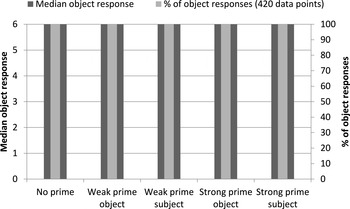
We first looked at object responses in complement control across the five different levels of prime: no prime, weak priming of the object (weak prime-O), weak priming of the subject (weak prime-S), strong priming of the object (strong prime-O) and strong priming of the subject (strong prime-S). The median matrix object score was uniform in all five conditions (6, 6, 6, 6, 6), and from a total of 420 data points, 100% were object responses. This demonstrates that neither the weak nor the strong primes affected interpretation choice in complement control. Figure 1 illustrates the uniformity of object responses across all conditions.
Median number and percentage of object choices in complement control.

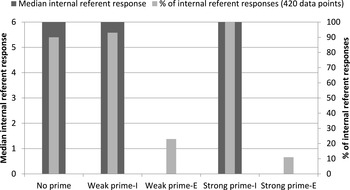
Median number and percentage of internal referent choices in verbal gerund control.

5.2 Verbal gerund subject control
Comparisons of participants’ responses in verbal gerund subject control did reveal an effect of the primes on referent choice. The median internal referent scores across the five conditions – no prime, weak priming of the internal referent (weak prime-I), weak priming of the external referent (weak prime-E), strong priming of the internal referent (strong prime-I) and strong priming of the external referent (strong prime-E) – were 6, 6, 0, 6 and 0, respectively. These medians and percentages can be seen in Figure 2.
The medians pointed to the source of the difference being the external-referent primes rather than the internal-referent ones. However, we first checked the internal-referent primes and a Friedman test conducted on the no prime, weak prime-I and strong prime-I conditions did reveal a difference (
 $p$
< .001). A subsequent Wilcoxon test (Bonferroni adjusted) comparing the no prime condition and the weak prime-I condition indicated no contrast (
 $p=.107$
) but one comparing the no prime condition with the strong prime-I condition did (
 $p$
< .001). Thus, for the minority of participants who opted for a sentence-external referent in the baseline condition (10% of 420 trials), their choices switched to the internal referent when it was strongly primed but not when weakly primed.
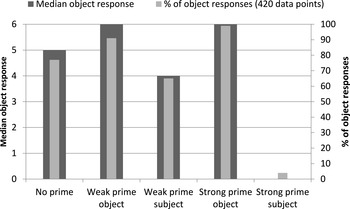
Median number and percentage of object choices in long-distance control.

We then compared the no prime condition with the two external-referent prime conditions. A Friedman test confirmed that the external-referent primes induced interpretative effects (
 $p$
< .001). A Wilcoxon text (Bonferroni adjusted) conducted on the no prime condition and the weak prime-E condition revealed a difference (
 $p$
< .001) as did the same test comparing the weak prime-E and strong prime-E conditions (
 $p=.001$
). This indicates a contextual effect whereby the shifts in interpretation towards the external referent increased in line with the strengths of the primes.
5.3 Long-distance control
For the long-distance control trials (no prime, weak priming of the object (weak prime-O), weak priming of the subject (weak prime-S), strong priming of the object (strong prime-O), strong priming of the subject (strong prime-S)), we examined the effects of priming the object first. The respective medians (5, 6, 4, 6, 0), illustrated in Figure 3, were suggestive of a topic effect between the no prime and weak prime-O condition but not between the weak prime-O and strong prime-O conditions.
However, a Wilcoxon test (Bonferroni adjusted) conducted on the no prime condition and the weak prime-O condition was significant (
 $p$
< .001), as was the same test conducted on the weak prime-O condition and strong prime-O conditions (
 $p=.001$
). This demonstrates that the weak priming of the object was sufficient to steer a significant number of participants with an initial preference for the subject in the baseline condition (23% of 420 data points in survey 1) towards an object reading and the stronger prime continued to increase that shift. This again indicates an effect of the primes, whereby interpretations changed in line with the strength of the primes.
With respect to the subject primes, the medians indicated a strong effect: 5 in the baseline condition reduced to 4 in the weak prime-S condition and to 0 in the strong prime-S condition. These large differences in referent choices were confirmed by a Friedman test (
 $p$
< .001). A subsequent Wilcoxon test (Bonferroni adjusted) comparing the no prime and weak prime-S condition revealed a difference (
 $p=.002$
), as did the same test comparing the weak prime-S and strong prime-S (
 $p$
< .001). These tests illustrate that although the largest effect is seen in the strong subject prime condition (as supported by the median differences), the weak subject prime is also sufficient to switch interpretation choice to the topic for a significant number of trials.
5.4 Final temporal adjunct control
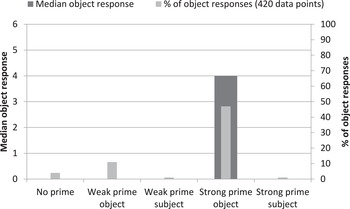
Comparisons for temporal adjunct control also focused on the number of object choices across conditions (no prime, weak prime-O, weak prime-S, strong prime-O, strong prime-S). As illustrated in Figure 4, the median scores for object responses were 0, 0, 0, 4 and 0, and a Friedman test indicated a contrast (
 $p$
<
.001).
Median number and percentage of object responses in adjunct control.

We examined the effects of priming the subject first. Despite the medians suggesting no (0, 0, 0) and the percentages very little (4%, 1.2%, 1%) variation in interpretations between the no prime condition and the subject prime conditions, a Friedman test showed a contrast (
 $p=.002$
). Using a Wilcoxon test (Bonferroni adjusted), we found a difference between the no prime and weak prime-S conditions (
 $p=.005$
), but not when we carried out the same test on the weak-prime-S and strong prime-S conditions (
 $p=.516$
). In other words, the weak prime was sufficient to shift interpretation in a few trials away from the object towards the subject but the stronger prime did not continue to increase that shift.
The medians for the no prime, weak prime-O and strong prime-O conditions, did, however, indicate a marked difference between conditions (0, 0, 4) and a Friedman test confirmed this (
 $p$
< .001). Two Wilcoxon tests (Bonferroni adjusted) compared responses in the no prime and weak prime-O condition and also the no prime and strong prime-O conditions. The first narrowly missed significance (
 $p=.02$
)Footnote
[11]
but the latter was significant (
 $p$
< .001). Viewed in conjunction with the percentages of object choices (no prime 4%; weak prime 11%; strong prime 51%) and median scores, this indicated that although a weakly primed object did influence some trials, it was the strong priming of the object which led to the substantial shift in participants choosing an object-oriented reading over a subject-oriented one.
6 Discussion
This study took four control sub-types (complement, verbal gerund subject, long-distance and temporal adjunct control) and tested 70 participants’ interpretations of the empty subject in three surveys. The first served to establish a baseline condition, which assessed preferred interpretations of the ec in the absence of any contextual cues. The second constituted a weakly primed condition, where the critical sentences from survey 1 were preceded by a sentence creating a weakly established topic. The third survey was the strongly primed condition, in which the critical sentences from survey 1 were preceded by two sentences that created a strongly established topic. The questions approached were which sub-types of control were open to pragmatic manipulations and which were not, and of those that were, whether they differed in terms of the strength of cue necessary before a shift in interpretation became detectable. For those examples of control whose interpretations did shift under discourse pressure, a further question we posited was whether three different discourse factors could be ranked according to their effect on participants’ referent choices. The overall aim was to provide further empirical support for the theoretical divisions drawn between obligatory and non-obligatory control and to see if this experimental method could provide a means for classifying a construction whose status was not clear, namely temporal adjunct control.Footnote [12]
The data showed that contextual cues could not interfere with judgements on complement control and that both types of contextual cue could alter judgements for verbal gerund subject control and long-distance control. This provided empirical justification for the existing classification of these constructions. The results for temporal adjunct control were more surprising in that they revealed flexibility in interpretation not previously reported in the literature for this construction. Although most participants preferred a subject reading in the baseline survey, this was not so for all, unlike the results for complement control, which were uniformly object-oriented in this condition. The survey using a weak prime revealed a marginal effect on original interpretations in terms of switching to the object but the strongly primed survey indicated a shift to the object in just over half of the trials. We now consider these results in this order, establishing how they support and build upon, but also present challenges for, existing literature, and the implications they have for the classification of these control structures.
The results for complement control, where neither cue could affect participants’ interpretations, corroborate the long-established obligatory-control classification of this construction. Controlled complements are selected by a control verb and the interpretation of the understood subject in that complement is constrained structurally (see Williams Reference Williams1980; Manzini Reference Manzini1983; Landau Reference Landau2000, Reference Landau2013; Hornstein Reference Hornstein2001; Janke Reference Janke2007, Reference Janke2008). Note also that there is no ambiguity with respect to the structure of object-controlled complements: the complement, selected by the head, is sister to that head. Any material inside the complement falls within the domain of the matrix object, which is also the most local c-commanding argument. Canonical complement control then, as an example of a control construction with an unambiguous syntax, has a unique interpretation, and thus resists pragmatic interference.
The interpretation of ecs in verbal gerund subject control and long-distance control is widely reported as being regulated extra-syntactically (Williams Reference Williams1980, Bresnan Reference Bresnan1982, Landau Reference Landau2000, Janke Reference Janke, Kolokonte and Janke2013). We have seen that in contrast to complement control, there need not be a syntactic antecedent at all (demonstrating the lack of c-command and locality vacuously) but when there is, it is not restricted to a designated argument. As illustrated in Section 1 above, these types of control have arbitrary instantiations, where the ec is interpreted generically, but they can also host specific interpretations, where the ec receives its specification from the discourse. The present study focused on the latter type in order to test how strong a contextual cue was needed before a shift in specific interpretations could be induced.
We turn to verbal gerund subject control first. Firstly, we note that in the baseline survey, participants’ responses were not uniform. Although the majority of participants did opt for the sentence-internal referent, 10% of choices were for an unspecified sentence-external referent (i.e. ‘Someone other than X’). In terms of the discourse factors set out in the introduction, the sentence-internal referent is the most local and most salient antecedent (there being no other competitors) so participants were predicted to exhibit a strong preference for this argument (see Adler Reference Adler2006), as indeed they did. A degree of fluctuation, however, is expected in a pragmatically regulated construction, as unlike a structural constraint, a discourse metric should guide but not decide interpretation (Ariel Reference Ariel1988, Reference Ariel, Sanders, Schliperoord and Spooren2001). In the second survey, a topic was weakly established prior to the critical sentence. Recall that in one of these conditions, the cue reinforced the argument in the critical sentence (I’m going to tell you something about Luna. ec Pouring the water quickly made Luna wet). In this condition, there was a marginal effect of the weakly established topic in the preceding sentence: 97% (a rise of 3% from the baseline) of responses now equated with the sentence-internal referent. Of greater note is the shift apparent in the trials in which the weakly established topic was a sentence-external referent not reinforced in the critical sentence (I’m going to tell you about Harry. ec Pouring the water quickly made Luna wet). In these sentences, there are two competitors: the weakly established topic in the priming sentence and the sentence-internal referent. With respect to the example above, Harry is not only the weakly established topic but is also more local to the ec, where for discourse-regulated reference resolution, we have taken linear locality as the relevant measure of distance (see Section 2), predicting a strong preference for Harry. The current data bore this out, as witnessed by the huge shift in interpretation: 75% of trials resulted in external-referent responses, indicating an overwhelming shift from participants’ original, non-primed, sentence-internal interpretations.
Given such a substantial change in reference choice under the weak priming in survey 2, the still stronger effects of the strong prime demonstrated by the results in survey 3 were expected. In the condition in which the two priming sentences collectively reinforced the referent in the critical sentence, the number of data points corresponding to this referent being chosen as the antecedent rose to 100%. In this instance, the strongly established topic and locality map together in terms of the antecedent each favours, and there is no other contender. In the condition in which the two preceding sentences primed a topic that was not reinforced in the critical sentence (Luna is making a potion. Luna holds the jug clumsily. ec Pouring the water quickly made Harry wet), the constellation of competing factors is altered. The topic of discourse is again more local but there is also a sentence-internal competitor, namely Harry in the example above. Despite this element of competition, there was still a significant shift in favour of a sentence-external reading of the ec: 89% of trials, which was an increase of 14% from survey 2. The difference between survey 2 and 3 for verbal gerund subject control overall provides empirical support for the intuition that a strongly-established topic of discourse has a stronger effect on referent choice than a weakly-established topic of discourse.
So far we have discussed the lack of interpretative shifts in complement control and the presence of them in verbal gerund subject control, using an accessibility-motivated metric to capture the pattern in the latter. At this interim point, the test we have applied supports the theoretical division between obligatory and non-obligatory control. As predicted in Section 3, the ec in complement control cannot be affected by topics, whereas the same in verbal gerund subject control can. The differing effects of weakly established topics of discourse versus strongly established topics of discourse are visible in the NOC conditions, where the latter have a stronger effect than the former. This is in line with the literature and the general assumption that an unmarked sentence is ‘about’ the established topic of discourse. However, the influence of the discourse topics in relation to locality cannot yet be assessed, as we have yet to encounter an example in which there is a mismatch in terms of the referent each of these factors would favour. Thus, our first approximation of the scale of influence is limited to topics:

We turn now to long-distance control, where, on the basis of its NOC classification, discourse effects were expected. However, we anticipated that the results in long-distance control might diverge from verbal gerund subject control as the constructions are rather different. In particular, in long-distance control (22), there are two arguments in the main clause that could serve as antecedent for the ec in the embedded clause, whereas in verbal gerund subject control (23), there is only one.

The availability of two arguments in (22) introduces an element of competition already in the baseline. The two arguments serve different syntactic functions, where one is the subject and the other is in a prepositional complement. Subjects are more frequently associated with topichood (Reinhart Reference Reinhart1981, Lambrecht Reference Lambrecht1996, Neeleman et al. Reference Neeleman, Titov, van de Koot, Vermeulen and van Craenenbroeck2009) so the subject’s preferred topic status might have given it precedence independently of any topic-based primes. In terms of linear distance, Luna is more local to the ec so this construction enabled us to compare the influence of linear distance with that of topichood. What our results in fact demonstrated was a resounding preference of the object/prepositional complement over the subject in the baseline survey (77% of 420 trials), suggesting linear distance to be the deciding force for most. However, the remaining 23% of responses were subject-oriented, illustrating a role for this weakest example of topichood for a sizeable minority of trials. As a possible topic, the subject is a contender. In this baseline condition, then, when other pragmatic influences are held in check, the salience afforded the subject in virtue of being a possible topic is competitive but not sufficiently so to win over locality, which proves the more dominant force. Thus, locality must be placed before this topic in terms of its influence on the ec’s interpretation.Footnote [13]

The results for long-distance control in survey 2 provide support for an expanded version of the rankings in (21) and (24). The prime in survey 2 created the weakly established topic (I’m going to tell you something about X/
 $Y$
). Primed with the subject, subject responses for long-distance control did rise by 12% to 35%, yet 65% of responses remained object-oriented, which suggests that locality acts as a stronger force than a weakly established topic. This order of influence is supported by the results of the object-primed condition, where the object/prepositional complement responses rose to 91% (from the baseline of 77%), leaving only 9% as subject responses.
Lastly, the responses to long-distance control in the final survey further corroborate that strongly established topics have the most influence of all: when the object/prepositional complement was strongly primed, 99% of responses were object-oriented and when the subject was strongly primed, 96% of responses were subject-oriented.
To summarise, the test we have applied supports an NOC classification for this construction, since both types of topic affected interpretation significantly, again like verbal gerund subject control and unlike complement control. We therefore see the test working as predicted on a second type of NOC. A complete metric, incorporating all the different factors we measured here, would look like this:

The data so far support a clear divide between OC and NOC, where the former cannot be manipulated pragmatically and the latter can. We turn now to temporal adjunct control. One surprising finding in the current surveys was that interpretations of temporal adjunct control were susceptible to manipulation by the primes, which appears to point towards an NOC classification of temporal adjunct control. Yet we have seen in the introduction that this example of temporal adjunct control is reported widely not to share other properties with NOC. In fact, like OC, it liberally permits non-animate controllers, and does not permit arbitrary interpretations or those linked to sentence-external referents.Footnote [14]
One question is why temporal adjunct control, which is widely reported to be obligatorily subject-oriented, permits an object reading at all. The current data show that in the absence of a contextual cue, the majority of people do opt for a subject reading. The weakly established topic altered this initial choice for a minority of trials. Effects were most visible in the last survey, however, where the strongly established topic steered 51% of the trials to an object-oriented interpretation. Importantly, this is not the same pattern as that found for complement control, which demonstrated a 100% object-response rate in the baseline, as well as complete resilience to either level of pragmatic interference, but neither is it the same as the pattern seen in either of the non-obligatory control cases, where the strongly established topic determined referent choice definitively.
One possibility that needs to be ruled out for this pattern is that participants were not paying attention to the whole trial before making their interpretative choice. A less focused participant might, for example, register the topic being established in the prime and choose it as the referent without properly processing the adjunct control sentence. There are two reasons this can be dismissed. Firstly, for any individual who was not paying attention we would expect that all trials in the strong-prime subject condition would result in subject-oriented interpretations and all those in the strong-prime object condition would result in object-oriented interpretations. There was no participant for whom this was the case.Secondly, this account ought to generalise to the complement control trials, which remained 100% resilient to pragmatic interference.Footnote [15]
We therefore argue that this shift in reference is permitted by the adjunct’s flexibility in terms of where it attaches. Multiple attachment sites answer for the availability of more than one interpretation in sentences which host adjuncts. In well-known examples of the type The policeman tortured the witness in his pyjamas, for example, either the subject or the object can be associated with the pyjamas. On an object-oriented reading, the adjunct is attached inside the VP in the domain of the object (see Larson Reference Larson, Wolf and Moulton2004), whereas on a subject-oriented reading, it is attached higher at the VP level, in the structural domain of the subject.
With respect to temporal adjunct control, we need to account for the baseline survey, which demonstrated an overwhelming preference for a subject-oriented reading, while not excluding the few who preferred an object-oriented one. An analysis in which temporal adjunct control is a structurally constrained relation that permits two attachment sites can account for these available, yet not equally preferred, interpretations. For the majority of people, the adjunct attaches at the VP level. In this configuration, only a subject-control reading is possible, as only the subject c-commands into the CP, as seen in (26).

For the people who permit an object reading, a different attachment site is necessary. Using an analysis of English VP structure developed in Janke & Neeleman (Reference Janke and Neeleman2012), we suggest that people who switch to an object reading of temporal adjunct control under severe discourse pressure permit the adjunct to attach low, merging directly with the verb (see also Larson Reference Larson, Wolf and Moulton2004). In this instance, a VP-shell is generated, as in English a verb must be left-adjacent to an argument dependent on it for accusative case (see Janke & Neeleman Reference Janke and Neeleman2012 for further motivation). Under this configuration, the object is the closest c-commanding DP of the adjunct.

Given that the majority of people prefer a subject-oriented reading, it would seem that there is a general preference not to attach these modifiers low. However, if some pressure is put upon the system, as in the primed conditions created here, an increasing number of people will opt for an object-oriented interpretation. It is the availability of these two syntactic structures that permits a choice between the two referents: when the syntax provides more than one structural possibility, pragmatics can influence the parsing process. Note that this analysis correctly predicts that this type of temporal adjunct control will not allow an external-referent reading.
The availability of two structures can account for the possibility of the two readings in temporal adjunct control but a remaining question is why one reading should be substantially preferred over the other. Janke & Neeleman (Reference Janke and Neeleman2012) propose that VP-shell formation is subject to economy, where a structure with no movement is more economical than one with movement. Since the subject-oriented reading is possible in structures without VP-shell formation, it should be preferred over the object-oriented reading, which is marked due to the verb movement it relies on.Footnote [16] VP-shell formation in temporal adjunct control is triggered by sentence-external factors, which may also account for its resilience to interpretation shift, relative to other instances of VP-shell formation motivated by sentence-internal considerations and so more routine.Footnote [17] That there should only be the VP-shell structure available for object control is expected, because the control verb selects a CP and it is obligatorily merged as complement to the verb (see also Larson Reference Larson1991).
A prediction arising from this structural account is that people who accept an object reading of the adjunct should revert back to subject-oriented readings when a c-command relation between the object and the adjunct phrase is made impossible. Here we outline two small-scale experiments that corroborate this expectation. The first blocks low attachment of the adjunct and the second embeds the matrix object inside a selected prepositional phrase.Footnote [18]
One expectation regarding the claim that the object reading is a product of low attachment (rather than being an example of NOC) is that when low attachment of the adjunct is blocked independently, an object-oriented reading will not be permissible, no matter what the context. High attachment of the adjunct, where the adjunct has a subject-oriented reading, means that there is no VP-shell structure, as shown in (26). Low attachment of the adjunct, where the adjunct has an object-oriented reading, means that there is a VP-shell structure as illustrated in (27). Constituency tests such as ellipsis are sensitive to VP-structure, disallowing omission/replacement of the moved verb and the post-verbal DP in a VP-shell structure. Thus, when VP-shell formation has taken place, as in (28), neither do so-substitution nor VP-ellipsis is possible:

If VP-fronting is now performed on temporal adjunct control, we preclude the generation of a VP-shell structure so the possibility of an object-oriented reading of the adjunct should disappear. That is, in (29), an object reading should not be possible.

Twenty-six participants who permitted an object reading of temporal adjunct control were asked to give a considered judgement on the sentence above. Twenty-one of them chose a subject-oriented interpretation of the ec.
Since a number of participants did not like the construction in (29) per se, we conducted a further small-scale study on 22 participants who had previously allowed an object reference for the ec. We constructed six test sentences in which the matrix object was embedded in a possessive, which itself was in a selected prepositional phrase:

The sentences were pseudo-randomised and interspersed with six fillers, and the three options were randomised for each question. Participants were invited to choose as many referents that they thought could, in principle, be interpreted as engaging in the relevant activity. A practice set was given as an illustration. From a possible 132 data points (22 participants on 6 trials), none at all were object-oriented: all referents for the ec were the subject, indicating that the object reading had become impossible.Footnote [19] Larger-scale experiments based upon that conducted in the main part of this paper could further corroborate these results, which provide preliminary support for the analysis within.
7 Summary
This study adopted a method to test how discourse factors interact with individual properties of control constructions to affect people’s interpretations of the ecs within them. For two examples of NOC constructions, namely verbal gerund subject control and long-distance control, three independent factors affecting interpretation were ordered on a scale in terms of their influence, a scale whose validity can now be tested on further NOC constructions. The relevant factors were defined by building on established notions of topichood (Reinhart Reference Reinhart1981), competition and linear distance (Ariel Reference Ariel1988, Reference Ariel, Sanders, Schliperoord and Spooren2001). Strongly established topics had more influence than linear distance and weakly established topics, whereas linear distance was more influential than weakly established topics. One important difference between verbal gerund subject control and long-distance control is that the latter construction needed a stronger contextual cue than the former to substantially switch referent choices. As predicted, no prime had any effect on complement control, which, being analysed as a construction with an unambiguous syntax, and therefore a unique interpretation, was expected to remain unaffected by contextual cues. By demonstrating a significant effect of pragmatics on temporal adjunct control judgements, our results for this construction are novel. This has long been analysed as obligatorily subject-oriented, yet the significant shift in interpretation in the strongly primed condition suggests a revision is in order. Our suggestion here is that it is the availability of more than one structure in temporal adjunct control that permits pragmatics, when pressure is put on the system, to influence the way in which the structure is parsed. When attached low, the matrix object c-commands into the adjunct and an object interpretation is licensed. The availability of an external referent for the ec, a hallmark of NOC, remains impossible, supporting our classification of final temporal adjunct control as a further type of structurally constrained control. We concluded this study by formulating and conducting some initial testing of some further predictions for this account, which could be examined in more detail in a future study, using a similar method to that employed here.
APPENDIX
Survey data
I. Sentence list for survey 1


N.B. For the verbal gerund subject control sentences, the choice was either the internal referent, where the name was given (e.g. Ron), or the external referent, where a name was not given:


II. Sentence list for survey 2
Survey 2 consisted of the same sentences as survey 1 but in front of every critical sentence, a preceding sentence, priming the subject, object, internal referent or external referent appeared: I’m going to tell you something about X/Y. For the verbal gerund subject control sentences, there was one modification in terms of the choices available. Now that the external referent was explicitly mentioned in the prime, both the referential possibilities were mentioned by name:

III. Sentence list for survey 3