


Introduction
Efforts to increase the effectiveness of cognitive behavioural therapy (CBT) for social anxiety disorder (SAD) are an important endeavour. Empirically supported treatments for SAD have focused systematically on fear of negative evaluation (FNE). Fear of positive evaluation (FPE), the sense of dread associated with being evaluated favourably and publicly, is also an important cognitive feature of SAD (for a review, see Reichenberger and Blechert, Reference Reichenberger and Blechert2018). Specifically, FPE begets direct social comparison of the self with others and therefore causes the recipient to feel highly conspicuous (e.g. see Weeks, Reference Weeks2010). However, published CBT protocols for the treatment of SAD have not systematically targeted FPE. FPE has been shown to improve in response to both exposure therapy (Fergus et al., Reference Fergus, Valentiner, McGrath, Stephenson, Gier and Jecius2009) and CBT (Weeks et al., Reference Weeks, Heimberg, Rodebaugh, Goldin and Gross2012) for SAD with large effect sizes; nevertheless, effect sizes for FPE were smaller than those for FNE in the above studies, suggesting that there is room for improvement in the effects of CBT on FPE, and possibly, SAD more broadly.
We developed a manualized CBT protocol targeting FPE to be delivered across two sessions in an individual format. Cognitive restructuring in the protocol targeted FPE-specific, negative automatic thoughts such as disqualification of positive social outcomes (Weeks, Reference Weeks2010). Exposures (both in vivo and in-session) focused on either: (a) engaging in self-promotion (Weeks and Zoccola, Reference Weeks and Zoccola2015; Weeks and Zoccola, Reference Weeks and Zoccola2016); or (b) accepting/receiving compliments without disqualifying positive social outcomes (Weeks, Reference Weeks2010).
We administered our brief FPE-specific CBT protocol to individuals seeking treatment for SAD. Our primary aim was to assess the feasibility and potential clinical benefits of a brief FPE-specific CBT protocol with regard to both FPE-specific concerns as well as overall SAD symptoms. The present study is a proof-of-principle trial.
Method
Participants
Participants were recruited at the Adult Anxiety Clinic of Temple University. Inclusion criteria required that patients were actively seeking treatment for SAD, received a principal diagnosis of SAD according to DSM-5 criteria, were aged 18 years or older, and were fluent in English. Exclusion criteria included a current or past diagnosis of any psychotic disorder and/or a diagnosis of a current substance use disorder. All eligible patients were invited to engage in our FPE-specific CBT protocol prior to initiating a full course of CBT for SAD.
Seven patients enrolled in the present study. Three of the seven patients were randomly assigned to and completed immediate CBT with the FPE-specific protocol; the remaining four patients were randomly assigned to and completed a 2-week wait-list period (WL). Additionally, two of the four WL patients completed the CBT protocol following the waiting period (delayed CBT; n = 2). One patient reported at post-CBT follow-up that they had initiated an alternative psychotherapy while also completing the FPE-specific CBT protocol, and one patient reported that they had initiated pharmacotherapy while completing the protocol; results were substantively identical when either of these patients were excluded from effect size calculations, and so they were retained in order to maximize the external validity of the reported effects.
Design
All patients completed baseline questionnaires prior to initiating the FPE-specific CBT protocol. All patients completed the same questionnaires 1 week post-CBT or 1 week post-WL, depending on condition. The two patients in the delayed CBT condition also completed the questionnaires at 1 week post-WL and 1 week post-CBT.
Measures
Diagnostic
Anxiety and Related Disorders Interview Schedule for DSM-5 Lifetime Version (ADIS-5L; Brown and Barlow, Reference Brown and Barlow2014). All patients in the present study completed the full ADIS-5L to confirm a principal diagnosis of SAD.
Self-report
Primary outcome measure
Brief FPE Outcome Scale (BFOS). Given the brief time frame of our FPE-specific CBT protocol, we developed a brief (3-item), face-valid outcome scale that focused directly on FPE-specific symptoms relevant to the exposures that patients were asked to complete (i.e. ‘How anxious would you be to show off your positive qualities to others right now?’, ‘How distressing would it be for you to talk about yourself in front of others and in a positive way right now?’ and ‘How anxious would it make you to receive a compliment in front of others right now?’). BFOS items were rated on a 10-point Likert-type scale, ranging from 0 (not at all true) to 9 (very true). The BFOS demonstrated adequate internal consistency in the present sample (α = .75).
Additional state measures
Social Interaction Phobia Scale-state version (SIPS-s). The original 14 SIPS (Carleton et al., Reference Carleton, Collimore, Asmundson, McCabe, Rowa and Antony2009) items were modified for state administration by adding the phrase ‘right now’ (e.g. ‘I’d be uncomfortable mixing socially with others right now’) to examine changes in social anxiety (hereafter, the SIPS-s) in response to our FPE-specific CBT protocol. The SIPS-s demonstrated excellent internal consistency in the present study (α = .89).
State social anxiety ratings. Patients reported their state anxiety on a 100-point Subjective Units of Discomfort Scale throughout the in-session exposures. State anxiety ratings were recorded immediately before, at 1 min intervals throughout, and immediately upon completion of each exposure.
The intervention
Our protocol was designed to target situations in which individuals with social anxiety tend to fear positive evaluation (Weeks, Reference Weeks2010; Weeks and Zoccola, Reference Weeks and Zoccola2015; Weeks and Zoccola, Reference Weeks and Zoccola2016). The protocol was delivered by clinical psychology doctoral students in an individual format over two sessions, scheduled 1 week apart, with no contact between sessions. The first session lasted 120 min; the second session lasted 60 min. We explained to patients that the goal of the protocol was to reduce FPE given that it has been shown to be an important cognitive component of social anxiety, regardless of whether patients presented for treatment of FPE.
Session 1 of the protocol focused on: (i) psychoeducation pertaining to FPE; (ii) cognitive restructuring of FPE-specific, negative automatic thoughts; (iii) conducting an in-session exposure focusing on either (a) engaging in self-promotion (e.g. highlighting one’s strengths at work during a performance review with a [role-played] employer to demonstrate that one is worthy of a promotion) or (b) accepting/receiving compliments (e.g. demonstrating a self-identified skill during a session [e.g. playing a song on a guitar] with the expectation of being complimented on one’s performance); and (iv) designing of a first in vivo exposure focusing on either (a) engaging in self-promotion (e.g. directly speaking to one’s employer about one’s strengths at work with the expectation that the employer will agree with the patient’s positive self-assessment) or (b) accepting/receiving compliments (e.g. playing a song on a guitar for an acquaintance who has never heard the patient play guitar before, with the expectation that the acquaintance will appreciate the patient’s skill). All patients were instructed to complete in vivo exposures within 1 week of session 1.Footnote 1 Session 2 focused on: (i) additional cognitive restructuring of FPE-specific, negative automatic thoughts; (ii) conducting an in-session exposure focusing on either (a) or (b) above; (iii) structuring of a second in vivo exposure focusing on either (a) or (b) above (to be completed within 1 week of session 2); and (iv) recommendations for maintenance of gains. Sessions were scheduled a week apart.
Analysis
At this stage of protocol evaluation, the focus was on feasibility and effect sizes from pre- to post-treatment. Hedges’ g values were calculated to assess change in the outcome measures. Pre-treatment scores were compared with (a) post-CBT and/or (b) post-waiting list scores.
Results
Preliminary analyses
All patients received a principal diagnosis of SAD according to DSM-5 criteria. The majority of patients were men (5/7; 71.4%), with a mean age of 27.3 years (SD = 6.29). The majority of patients identified as Caucasian (6/7; 85.7%); one (14.3%) identified as Hispanic (non-Caucasian).
Feasibility of the brief FPE-specific CBT protocol
As noted above, all five patients who initiated the FPE-specific treatment protocol completed both sessions (n = 3 for immediate CBT, n = 2 for delayed CBT), and all patients completed the protocol within a 2-week period (as expected). Average peak state anxiety ratings across the two in-session exposures were in the expected range (i.e. first in-session exposure: average peak state anxiety rating = 52.5; second in-session exposure: average peak state anxiety rating = 48.75). Four of the five patients who received either immediate or delayed treatment reported that they had successfully completed both assigned in vivo homework exposures within 1 week of each session. One treatment completer reported having completed the first, but not the second, in vivo homework exposure.
Clinical outcomes
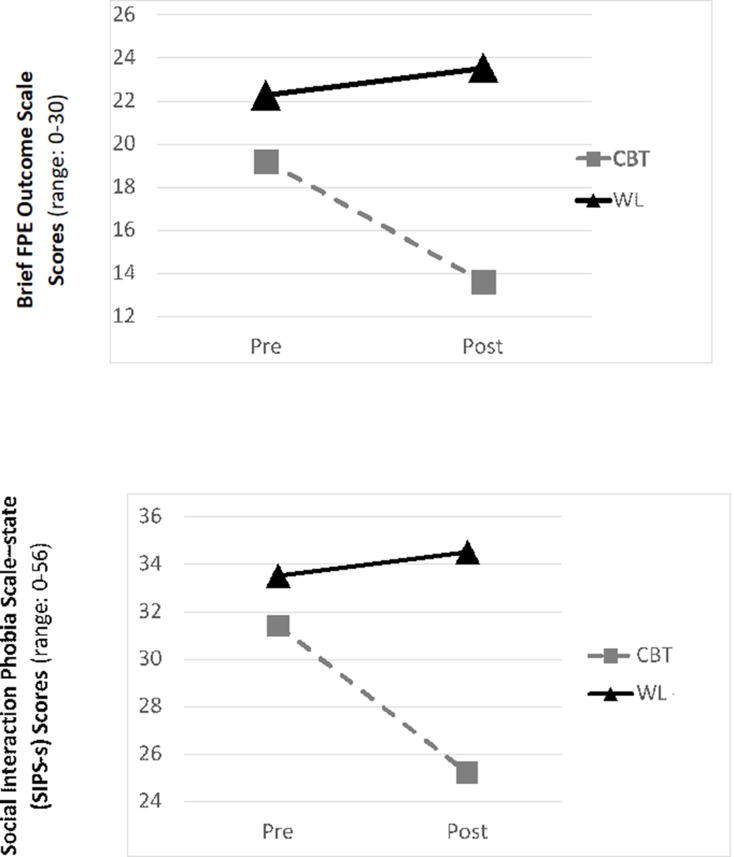
Figure 1 displays changes in FPE-specific symptoms (i.e. the BFOS) and overall social anxiety symptoms (i.e. SIPS-s), respectively. FPE-specific symptoms (i.e. BFOS scores) were roughly equivalent across the CBT (mean = 19.20, SD = 3.56) and WL (mean = 22.00, SD = 0.71) conditions at baseline. However, upon completing the FPE-specific CBT protocol (either immediate or delayed CBT), FPE-related concerns reduced markedly (mean = 13.60, SD = 4.16), Hedges’ within-group g = 1.29. In contrast, FPE-related concerns for patients in the WL condition (either WL only, or prior to undergoing CBT) increased (mean = 23.50, SD = 1.91), Hedges’ within-group g = –0.80 (see Fig. 1a).
Changes in state levels of FPE-specific symptoms from pre- to post-intervention, plotted separately for those patients who completed the FPE-specific CBT protocol (n = 5) versus wait-list patients (n = 4). CBT, cognitive behavioural therapy group (immediate and delayed CBT combined); WL, wait list group (either WL only or prior to undergoing CBT); FPE, fear of positive evaluation.

Similarly, overall social anxiety symptoms (i.e. SIPS-s scores) were roughly equivalent across the CBT (mean = 31.4, SD = 6.99) and WL (mean = 33.5, SD = 12.77) conditions at baseline. Upon completing the FPE-specific CBT protocol (either immediate or delayed CBT), patients’ overall social anxiety symptoms (i.e. SIPS-s scores) reduced considerably (mean = 25.2, SD = 8.35), Hedges’ within-group g = 0.72; in contrast, overall social anxiety symptoms for patients in the WL condition (either WL only, or prior to undergoing CBT) did not change appreciably (mean = 34.5, SD = 8.96), Hedges’ within-group g = –0.08 (see Fig. 1b).
Discussion
Treatment-seeking patients with a principal diagnosis of SAD took part in this first evaluation of a brief CBT protocol targeting FPE. The treatment was well received, in that all patients who initiated the CBT protocol completed it successfully; all five CBT patients completed both in-session FPE-related exposures, and the majority of patients (4/5; 80%) completed both in vivo FPE-related homework exposures. These findings suggest that patients were willing to engage in and able to tolerate FPE-related exposures in a relatively brief time period.
Improvements on outcome measures assessing FPE-specific symptoms and social anxiety symptoms were in the large effect size range for the CBT group and exceeded those of the WL group. The reduction in overall social anxiety symptoms is notable given that the protocol targeted FPE rather than social anxiety in general. These results lend additional support to the idea that FPE is an important cognitive feature of SAD and has value as a direct target of treatment. Moreover, these effects are particularly striking given that we did not recruit patients who endorsed high FPE per se, but rather, we examined the effects of our FPE-specific CBT protocol in an open, treatment-seeking sample of patients with a principal diagnosis of SAD.
To our knowledge, this study was the first evaluation of a FPE-specific CBT protocol. However, this proof-of-principle study has limitations. First, the present findings must be replicated in larger samples of treatment-seeking individuals with SAD. Second, the outcome measures were self-report only, and the present findings must be extended in future studies to include blinded clinician-administered outcome measures; on a related note, we did not assess test–re-test reliability of our modified state versions of the outcome measures. Third, we did not assess treatment credibility/expectancy ratings. Fourth, our CBT protocol was brief, and thus future studies should examine longer, more extensive FPE-specific protocols or incorporate FPE-specific psychoeducation and exposures into existing CBT protocols for SAD. Lastly, long-term follow-up effects were not assessed.
Nevertheless, our brief, FPE-specific CBT protocol, informed by a growing body of empirical evidence (Reichenberger and Blechert, Reference Reichenberger and Blechert2018), demonstrated considerable promise. The current study’s feasibility and preliminary efficacy results are encouraging and warrant further evaluation. We believe that psychotherapy for SAD should target fear of evaluation in general, including fears of both positive and negative evaluation. Our preliminary results suggest that such an approach has utility, and our FPE-specific protocol could potentially augment CBT for SAD.
Supplementary material
To view supplementary material for this article, please visit https://doi.org/10.1017/S1352465820000491
Acknowledgements
None.
Financial support
None.
Conflicts of interest
The authors have no conflicts of interest with respect to this publication.
Ethical statements
All authors abided by the Ethical Principles of Psychologists and Code of Conduct as set out by the American Psychological Association. Ethical approval for the present study was obtained from the Institutional Review Board at Temple University (reference no. 22896), and all patients provided informed consent prior to participation.




Comments
No Comments have been published for this article.