

Introduction
On 11 March 2020, the World Health Organization (WHO) declared COVID-19 a global health pandemic (World Health Organization 2020) and called on states to take urgent measures to tackle it. Accordingly, public health measures followed in the form of lockdowns, individual quarantine and isolation, social distancing (Nerlich and Jaspal Reference Nerlich and Jaspal2021), mask mandates and vaccines (Breakwell, Fino, and Jaspal Reference Breakwell, Fino and Jaspal2021). In the Caribbean, many police departments quickly abandoned their traditional methods of policing and adjusted their modus operandi to suit the “new normal” of “social distancing policing” or policing with health and personal safety as a priority. In this context, the state of policing and general affairs that existed prior to March 2020 witnessed a sudden and tumultuous shift and brought business as usual to a screeching halt.
The COVID-19 pandemic affected policing in anticipated and unexpected ways (Halford Reference Halford2023). For instance, governments issued measures restricting the rights and freedom of their citizens and this upended major facets of the global population, including the activities of police departments (Maskály, Ivković, and Neyroud Reference Maskály, Ivković and Neyroud2021). Further, in an attempt to contain the spread of the COVID-19 virus, governments worldwide mandated their police departments to adopt a new set of functions and play an active role in enforcing new rules (Stone Reference Stone2020). The implementation of these new measures transformed the lifestyles and daily activities of many populations by generating new opportunities for some individuals, while limiting opportunities for others, yet police officers had to remain on the job and perform their duties (Helfers and Nhan Reference Helfers and Nhan2022). This posed new and unique challenges to police departments (Lupia et al. Reference Lupia, Scabini, Mornese Pinna, Di Perri, De Rosa and Corcione2020) whose task of maintaining law and order and ensuring compliance continued, but with new public health laws in pandemic conditions, limited resources and little to no pandemic awareness (Halford Reference Halford2023).
In Trinidad and Tobago, the tasks of managing and controlling public compliance with pandemic regulations were quickly integrated into the policing mandate in an effort to maintain social order, irrespective of the fact that the management and containment of pandemics is predominantly a public health issue. As a result, local police officers were foisted in the unprecedented position of regulating the everyday aspects of citizens’ lives, an act that prior to the COVID-19 pandemic would have created revulsion among human rights activists. The author of this article submits that the aforementioned challenges made an impact on policing, as police officers employed by the Trinidad and Tobago Police Service (TTPS) were mandated to continue their interactions with offenders, victims, witnesses and convicted individuals, despite nationwide social distancing procedures and curfew orders.
Ali et al. (Reference Ali, Baloch, Ahmed, Ali and Iqbal2020) contend that the body of research relating to COVID-19 is still emerging. Thus, while there is a considerable body of available literature on policing the pandemic from Africa, Asia, North America and Europe (Aborisade and Gbahabo Reference Aborisade and Gbahabo2021; Brooks and Lopez Reference Brooks and Lopez2020; Hansen and Lory Reference Hansen and Lory2020; Jones Reference Jones2020; Kyprianides et al. Reference Kyprianides, Bradford, Beale, Savigar-Shaw, Stott and Radburn2022; Papazoglou et al. Reference Papazoglou, Blumberg, Schlosser and Collins2020; Reicher and Stott Reference Reicher and Stott2020; Rooney and McNicholas Reference Rooney and McNicholas2020; Stogner, Miller, and McLean Reference Stogner, Miller and McLean2020), similar scholarship emanating from the Caribbean is limited. Additionally, most of the COVID-19 policing research focuses on lockdown regulations, public perceptions of policing during the pandemic and use of force by the police.
According to the WHO Quality of Life (WHOQOL) User Manual (World Health Organization 1998:11), quality of life refers to “individual’s perceptions of their position in life in the context of the culture and value systems in which they live and in relation to their goals, expectations, standards and concerns”. Therefore, an individual’s quality of life is guided by evaluations with regard to that individual’s objective living conditions. Continuing, in the WHOQOL User Manual, the World Health Organization (1998) points out that quality of life has six dimensions, namely: physical health; psychological state; level of independence; social relationships; spiritual beliefs; and salient features of the environment.
While there is available scholarship on policing during the pandemic, this study expands the scope of such scholarship by examining the impacts of the COVID-19 pandemic on policing, police leadership and police officer quality of life. Four research questions (RQs) will be answered in this study. The RQs were formulated from assessing existing literature which suggested that police departments globally were experiencing a host of challenges to their operations (quality of life, leadership, etc.) due to the COVID-19 pandemic (Stogner et al. Reference Stogner, Miller and McLean2020) and, further, that these challenges could potentially have a disparate range of impacts on policing and police officers. On this basis, the following RQs were explored:
RQ1. How was policing in Trinidad and Tobago impacted by the COVID-19 pandemic?
RQ2. How efficiently was the TTPS managed by the leadership of the organization during the COVID-19 pandemic?
RQ3. What was the extent of organizational readiness of TTPS to police the COVID-19 pandemic in Trinidad and Tobago?
RQ4. How was the quality of life of police officers impacted by the COVID-19 pandemic in Trinidad and Tobago?
Review of the Literature
Policing has always been a very demanding task with multifarious and demanding duties (Stone Reference Stone2020). However, the primary function of policing has always been maintenance of order, and a key component of maintenance of order is the regulation and management of public spaces occupied and used by citizens. This function was not dissipated with the advent of the COVID-19 disease; rather, the nature, scope and demand for policing services were altered in March 2020 with the global spread of the disease. For instance, the traditional pressures that police officers face in Trinidad and Tobago (citizen hostility, citizen apathy) were exacerbated by the requirement for members of the public to comply with new mask wearing, social distancing and self-isolation procedures.
Globally, police officers were expected to coordinate local shutdowns, encourage social distancing, enforce stay-at-home mandates (Miller and McLean 2020; Stogner et al. Reference Stogner, Miller and McLean2020), maintain law and order and deal with criminal offenders, while the COVID-19 virus remained an omnipresent threat. In sum, the COVID-19 pandemic has challenged policing, police officers’ quality of life and police leadership in the twenty-first century in a manner not witnessed in the preceding century. Indeed, challenging times highlight the role that police leaders play in ensuring that the organization is effective (Coelho de Moura et al. Reference Coelho de Moura, Borges, Morgado and Ramalho2022). The COVID-19 pandemic made an impact on police departments (Brooks and Lopez Reference Brooks and Lopez2020; Jones, Jones, and Cantal Reference Jones, Jones and Cantal2020; Maskály et al. Reference Maskály, Ivković and Neyroud2021) in disparate ways, including, but not limited to, reductions in manpower due to officer illness (Nouri and Kochel Reference Nouri and Kochel2022), police officer quality of life, police leadership and police officer well-being (Drew and Martin Reference Drew and Martin2021). There were also impacts on resources, maintenance of law and order, leadership and scope of work. Furthermore, as a result of the pandemic, there were precipitous changes in the demand for police services and more nuanced ways that police officers view their police leaders.
Stone (Reference Stone2020) points out that in Wuhan, China, government figures showed that twice as many police officers died than health workers during the city’s fight against the coronavirus. Continuing, Stone (Reference Stone2020) emphasizes that in New York City, 37 members of the police department had died from COVID-19 as at 25 April 2020 and over 7,000 officers were on sick leave at the peak of the outbreak in mid-April 2020. In Trinidad and Tobago, by 13 June 2021, 306 police officers had tested positive for the COVID-19 virus, over 900 were in quarantine (Dowlat-Rostant Reference Dowlat-Rostant2021) and several had died as a result of having contracted the virus.
The speed, scale and complexity of the COVID-19 outbreak (Kyprianides et al. Reference Kyprianides, Bradford, Beale, Savigar-Shaw, Stott and Radburn2022) had the hallmarks of a “landscape-scale” crisis (an unexpected event or sequence of events of enormous scale and overwhelming speed, resulting in high levels of uncertainty which leads to disorientation, feelings of lost control, and strong emotional disturbance; Howitt and Leonard Reference Howitt and Leonard2007). Despite this landscape-scale crisis, it was incumbent on leadership to respond (D’Auria and de Smet Reference D’Auria and de Smet2020), and this included police leadership, who needed to respond urgently with policies and procedures to protect their manpower resources as police officers were “at a heightened risk of exposure due to their close contact with members of the public” (Jennings and Perez Reference Jennings and Perez2020), while fearing that they would contract the disease and transfer it to family members/loved ones (Laufs and Waseem Reference Laufs and Waseem2020).
The COVID-19 pandemic also created unprecedented and unique challenges for police officer well-being and mental health as a result of police officers acting as first responders in many instances. As essential workers and first responders, police officers not only experienced organizational challenges (staff shortages, lack of personal protective equipment; PPE), but also experienced grave threats to their physical health and emotional well-being, while placing their families at risk for COVID-19 infection when they brought the job home. Additionally, in many instances, supplementary burdens of social-welfare roles were placed on police officers (Lumsden and Black Reference Lumsden and Black2018) during the pandemic and as Guidorzi (Reference Guidorzi2020) explains, COVID-19 was not only a crisis, but a test.
Aims of the Study
New governmental guidelines implemented by the Government of the Republic of Trinidad and Tobago generated a febrile atmosphere and raised questions regarding the police profession, specifically, whether policing persisted or is renegotiated during public health crises (Bowling Reiner, and Sheptycki Reference Bowling, Reiner and Sheptycki2019). In light of the foregoing, a nebulous concern is the limited understanding of COVID-19 impacts on police officers and police departments in the Caribbean, specifically, Trinidad and Tobago. Further, the literature showed that several questions regarding COVID-19 remained unexplored outside of traditionally researched Global Northern realms. With the aforementioned in mind, this study explored the impacts of COVID-19 on policing, police leadership and police officer quality of life in Trinidad and Tobago during the coronavirus pandemic. The author sought to establish whether the pandemic conditions affected policing on the island and how the pandemic was managed by the executive of the TTPS. Achieving these aims are important as they can shed light on how the pandemic affected policing in Trinidad and Tobago. This will then offer insights that can be ruminated in the wider discussions regarding policing during the pandemic.
Importance of the Study
Academic literature on the impact of COVID-19, a public health emergency, is relatively limited regarding policing and this can be attributed to its recency. While there is available literature on the impacts of COVID-19 across disciplines (for support, see Jones et al. Reference Jones, Jones and Cantal2020), the literature is generally available for Western states at the exclusion of countries in the Caribbean. Further, despite increases in research on police and policing generally (Mawby and Ozascilar Reference Mawby and Ozascilar2022), as well as the dramatic growth in evaluations of police performance, there is limited research evaluating police leadership during the COVID-19 pandemic.
The current research sought to understand some of the challenges faced by police officers of the TTPS as a result of the COVID-19 pandemic. This is important, as universalizing problems and solutions, though tempting, is dangerous as it entails erroneously thinking that problems manifest themselves in exactly the same manner everywhere, while disregarding local features to other approaches (Milan and Treré Reference Milan and Treré2019). In sum, the author of this article submits that policing in Trinidad and Tobago should not be viewed as an instance of global alterity but should be seen as an integral component of the world’s policing network and researched accordingly.
Globally, police officers play an important role in protecting communities, but their health and well-being is at increased risk when compared to the general population as a result of the nature of their profession (Hartley et al. Reference Hartley, Burchfiel, Fekedulegn, Andrew and Violanti2011), even before dealing with the uncertainty of life brought about by the COVID-19 pandemic. Based on analyses of previous crises (Stogner et al. Reference Stogner, Miller and McLean2020), increased stress and negative impacts on psychological well-being of police officers were identified as changes to law enforcement. Further, during the COVID-19 pandemic, the role of police officers globally posed a serious threat to their health and well-being (Tehrani Reference Tehrani2022).
The massive scale of the COVID-19 outbreak, as well as its unpredictable nature, made it challenging for police leaders to respond in a one-off manner, though immediacy of response was an urgent need. Therefore, in a real-world sense, as the TTPS pivoted to “pandemic policing” due to the need to provide safety to the public using new legislation and enhanced powers, it is critical to evaluate perceptions of issues affecting operations of the TTPS.
Methodology
This study is premised on the critical realist perspective which denies the possibility of any objectively observable reality within the social world and instead submits that insight into unobservable phenomena can only be gained through an in-depth analysis of rich, subjective, qualitative data (Bhaskar Reference Bhaskar2011). Based on the pronouncement by Bhaskar (Reference Bhaskar2011), the qualitative approach was deemed suitable for the research as the researcher sought to capture rich in-depth data, based on the lived experiences of police officer participants. The qualitative approach using semi-structured interviews was also used due to its flexibility as well as its ability to allow a full examination of aspects of people’s lives according to their interpretation of the subject matter. Semi-structured interviews are also frequently used in social sciences as they allow researchers to delve into the lived experiences, facts, social representations, views and perceptions of persons within a social group as narrated by those with knowledge of the topic under inquiry; this produces rich, contextual data. Semi-structured interviews are widely used to conduct research on employment issues (Kirton and Guillaume Reference Kirton and Guillaume2017; Soni-Sinha and Yates Reference Soni-Sinha and Yates2013; Wright Reference Wright2014), as these interviews yield detailed and vivid information (Gibbs Reference Gibbs2007); this study is no different.
For this study, a hermeneutical phenomenological philosophy underpinned by an interpretivist epistemology (Bryman Reference Bryman2016) was chosen, as hermeneutical phenomenology seeks to understand participants and the meaning they make from their experiences (Pietkiewicz and Smith Reference Pietkiewicz and Smith2012). The use of this approach assisted with the exploration and reporting of police officers’ perspectives of the event under inquiry from their lived experiences (Creswell Reference Creswell2012; Kvale and Brinkmann Reference Kvale and Brinkmann2009). This approach was also used due to challenges in accessing police officers for research as a result of long-standing reservations of researchers as outsiders (Brown Reference Brown1996), and this was even more problematic due to the lack of prior familiar connections (De Camargo Reference De Camargo2022). As a result, the researcher foresaw that a large sample for a quantitative study appeared unlikely and used a smaller sample and a qualitative approach.
Data Collection
Data for this study were gathered from serving police officers of different ranks of the TTPS from 15 July to 15 August 2021, when COVID-19 restrictions were still in place in Trinidad and Tobago. There was no planned recruitment window; however, due to the uncertainty of the COVID-19 pandemic and time sensitivity of continuous problems with PPE and infection rates (De Camargo Reference De Camargo2021), the researcher conducted the interviews as soon as interested police officers consented to participate in the study. Remote data collection was used to gather data. This approach was in response to the need for continued research in the face of the global COVID-19 restrictions. In this study, remote data collection refers to “the collection of data via telephone, online or other virtual platforms, with study participants and researchers physically distanced” (Hensen et al. Reference Hensen, Mackworth-Young, Simwinga, Abdelmagid, Banda, Mavodza, Doyle, Bonell and Weiss2021:360).
Recruitment
Social media were used to recruit the participants, as many police officers are now using social media. Further, there has been a growing interest in social media platforms from police officers in the TTPS from approximately 2010 as they are desirous of engaging with the public to share information and knowledge in their official and personal capacities. With this in mind, call for participants was circulated on social media platforms (Twitter, WhatsApp, Facebook) as well as police chat groups to attain the highest publicity and participation in the study. Purposive sampling and snowball sampling were utilized to recruit participants. Purposive sampling was used to initially recruit participants, as this enabled the recruitment of participants with the best knowledge of the topic under inquiry (Elo et al. Reference Elo, Kääriäinen, Kanste, Pölkki, Utriainen and Kyngäs2014). Digital snowball sampling then followed (O’Connor et al. Reference O’Connor, Jackson, Goldsmith and Skirton2014), with the initial participants sharing the online call for participants with their colleagues. Snowball sampling was utilized due to the unavailability of a sampling frame for police officers due to administrative challenges posed by the COVID-19 pandemic.
The Interviews
The semi-structured interviews were conducted by telephone, Zoom and/or email, as COVID-19 restrictions (social distancing, restrictions on gatherings) prevented face-to-face methods of gathering data and forced qualitative researchers to adopt alternatives to face-to-face data-gathering approaches. Of the interviews, 12 were conducted via telephone, 13 were conducted using Zoom, and seven participants completed the interview guide and returned it to the researcher via email. All participants consented to participate in the study and were asked the same set of questions in the same order, with probing questions asked where necessary to extract additional information. The telephone and Zoom interviews ranged from 45 to 60 minutes. Some participants submitted their responses via email; however, telephone calls were used to clarify some unclear responses. Using telephone and emails as a means of gathering data presents some methodological challenges, but both approaches are still beneficial. Block and Erskine (Reference Block and Erskine2012) observe that while some data are lost when conducting non-face-to-face interviews, the essential information exists and valid studies can combine protocols.
Research Saturation
Data saturation was used to indicate the optimal sample size, as this is the most widely used approach for determining sample size and measuring sufficiency in qualitative studies (Vasileiou et al. Reference Vasileiou, Barnett, Thorpe and Young2018). Creswell (Reference Creswell2007) points out that when conducting qualitative research, a sample size of approximately 25 individuals with common experiences often provides saturation. However, this study achieved saturation (Bowen Reference Bowen2008) at around the 32nd interview and this meant that adding new interviews to the sample would no longer contribute new data. Thus, it is submitted that the sample size for this study is sufficient for its intended purpose and design; this finds support from expert qualitative researchers Guest, Bunce, and Johnson (Reference Guest, Bunce and Johnson2006) and Neuman (Reference Neuman2006).
Data Analysis
Soon after the interviews were conducted and narratives received via email, the responses were collated, transcribed verbatim and responses analysed using the Dew et al. (Reference Dew, Anderson, Skogrand and Chaney2017) approach to phenomenological qualitative analysis. First, the researcher became immersed into the data and examined the narratives of the participants for thoughts and ideas that were reflective of their lived experience that could be used to answer the RQs. The researcher then identified a list of responses for each RQ, while making refinements to the list. Next, the researcher submitted the list of responses for each RQ to two independent qualitative researchers so that a determination could be made regarding the responses and their applicability to the four RQs. There was a high level of agreement between the two independent qualitative experts (93%), and this is deemed acceptable for qualitative studies (Creswell Reference Creswell2013).
In an attempt to ensure validity of the research findings, the qualitative data were validated by utilizing different procedures (Creswell and Miller Reference Creswell and Miller2000), namely: (1) peer debriefing; and (2) member checking. Peer debriefing entailed reviewing the data and findings with individuals who are familiar with the concepts being investigated. Peer debriefing was conducted as the researcher utilized two independent qualitative scholars to review the methodology, transcripts and responses to the RQs; this provided useful feedback which was acted upon by the study’s author. Member checking was conducted as data in the Results section were emailed to a random sample of 16 participants (50%) who were asked to determine whether the results represented their view as expressed through the semi-structured interviews and if there was a need for revisions. The participants recommended two changes (basically to policing terms) and indicated that the results represented their own and their colleagues’ experiences.
Participants
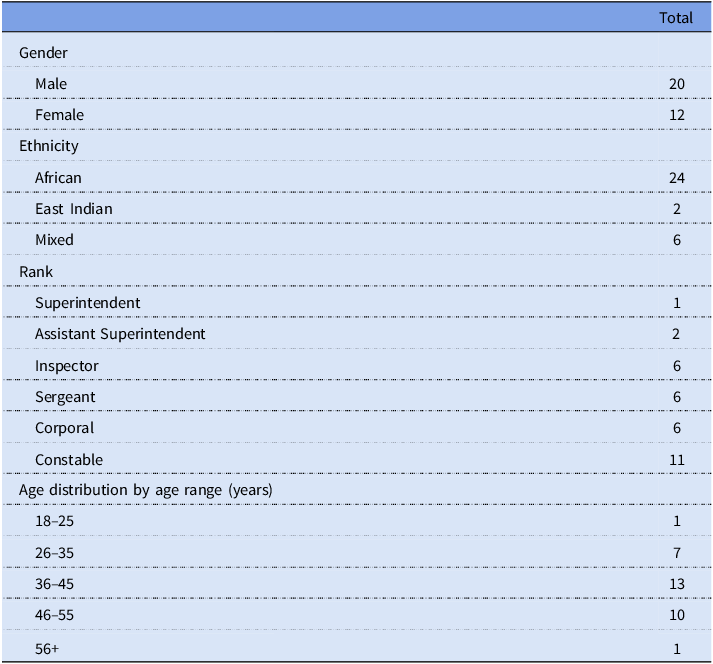
Participants for this study were drawn from different personnel, ranks, police divisions (similar to precincts in some Western jurisdictions), genders and specialties of the TTPS. Of the 32 participants, the majority were males (n=20), and this is in line with the established notions that policing is a highly masculinized profession (Diaz and Nuño Reference Diaz and Nuño2021; Mukherjee Reference Mukherjee2018; Veldman et al. Reference Veldman, Meeussen, Van Laar and Phalet2017). The demographic characteristics of the participants reflect a range of ranks, ethnicities and age distribution (see Table 1). The police participants in this study worked at the Inter-Agency Task Force, Port-of-Spain Division, Court and Process Branch, Police Academy, Gender Based Violence Unit, Guard and Emergency Branch, Special Branch, Parliament Security Unit, Child Protection Unit, the Caribbean Community Implementation Agency for Crime and Security (CARICOM IMPACS), Criminal Investigations Department/Criminal Records Office, Operations and Command Centre, Northern Division, North-Eastern Division and Southern Division. However, the majority of the police participants in this study were from the Northern Division (n=14). The largest number of participants emanated from the 36–45- and 46–55-year age groups. Collectively, the participants had 177 years of policing experience and this is deemed sufficient to draw conclusions regarding the issues under inquiry in this study.
Demographic characteristics of participants

Source: Fieldwork, 2021.
Results
Answers to the RQs are presented as results. Participant views are quoted directly in order to reflect the views of individuals in a dramatic manner (Altunışık et al. Reference Altunışık, Coşkun, Yıldırım and Bayraktaroğlu2001) as well as to “illuminate the voice of the participants”.
Answers to the RQs
The first RQ sought to understand the impacts of COVID-19 on policing in Trinidad and Tobago. Emanating from the narratives of the participants were a wide range of impacts, both positive and negative, for example, communication issues, reduction in crime, backlog of cases, limited investigations, death of colleagues, decreased productivity, less work enthusiasm, inadequate provision of PPE, frequent closure of police stations, malingering by police officers, less police presence, unequal allocation of work, increased family time, improved communication skills, increased use of technology, decreased physical and mental health, burnout, and introduction of virtual courts.
All of the participants indicated that the COVID-19 pandemic had a negative impact on policing in Trinidad and Tobago. For instance, one participant stated, “There were high numbers of police officers on quarantine. This negatively impacted the number of persons working on shifts and many police officers suffered from burnout. There was also hesitancy among police officers to engage members of the public due to fear of being infected” (male police officer, St Margaret’s Police Station). Another police officer submitted that the COVID-19 pandemic had negative impacts on the TTPS as he framed his response in the following manner “There was a disruption of service delivery to members of the public and some police officers suffered from burnout, while others contracted the COVID-19 virus and died. This led to psychological trauma for many of us as we simply had to work while dealing with the death of our close colleagues” (male inspector, Special Branch).
Conversely, 10 of the participants indicated that the COVID-19 pandemic had positive impacts on policing on the island. For example, participant 21 (female police constable, St Margaret’s Police Station) stated, “Had it not been for the pandemic, the implementation of Apps to facilitate the reporting of criminal activities to the TTPS would not have been a reality.” Another supporting view from participant 23 (male sergeant, Tunapuna Police Station) was, “There were major reductions in crime due to implementation of the curfew and other restrictions on the movement of people including the criminal elements.”
The study’s results revealed a slew of positive and negative impacts for the TTPS as a result of the COVID-19 pandemic. However, the five most prevalent negative impacts were: (1) malfeasance by police officers (false reporting of contact with COVID-19-infected individuals); (2) high absenteeism/lack of manpower; (3) overworked and demotivated staff; (4) difficulty providing childcare; and (5) suspension of community activities to aid in crime reduction. On the other hand, the five most prevalent positive impacts were: (1) technological advances (for example, virtual courts, virtual training, apps for reporting of crime); (2) reduction in criminal activities; (3) improved focus on the safety and well-being of police officers; (4) increased family time; and (5) improved sanitation within police stations.
RQ2 sought to measure the level of efficiency of the leadership of the TTPS in managing the organization during the COVID-19 pandemic. Approximately 75% (n=24) of the participants submitted that the leadership of the TTPS during the COVID-19 pandemic was inadequate and ineffective. For example, participant 23 (male sergeant, Tunapuna Police Station) argued, “The leadership response was slow and inadequate in providing information, guidance, and protection to officers on the ground”, while participant 24 (male inspector, Special Branch) stating, “Quality leadership was lacking during this critical period. It was clear that the hierarchy [of the TTPS] has no training as it relates to mass disaster preparedness which would have been critical during this pandemic.” Another view was, “The leadership could have been more measured and diplomatic in responding to questions by various sectors of [the] public including the media and the Prime Minister as there was a lack of timely communication on key issues” (participant 26, male inspector, Criminal Investigation Department and Criminal Records Office).
The third RQ evaluated the extent of organizational readiness of the TTPS to police the pandemic in Trinidad and Tobago. Generally, the participants felt that the TTPS was not ready to police the pandemic, but submitted that all other organizations were not prepared for the pandemic as well. Instructively, several participants proffered the view that despite the experience of the TTPS with the COVID-19 pandemic, the organization appears unready for future pandemics. According to participant 23 (male inspector, Special Branch), “The level of readiness was sub-par. Even with the lack of resources, more could have been done with what was available.” In a similar vein, participant 13 (female corporal, Gender Based Violence Unit) submitted, “In the initial stages the TTPS’s response in the fight against COVID-19 was a bit poorly coordinated, because the virus was new to everyone locally and internationally.” According to participant 29 (female inspector, Tunapuna Police Station), “No one was ready for this [COVID-19 pandemic]. The TTPS in relation to the virus had no training or tools to battle this type of enemy and was generally not ready for this pandemic or any similar pandemic in the future.”
In response to the question regarding organizational readiness, participant 32 (female acting superintendent, Police Administration Branch) expressed the following view:
None whatsoever. The TTPS was not ready to deal with the COVID-19 pandemic nor any health pandemic in the future. They were reactive in their response, but some Second Division Officers were somewhat innovative and sought the welfare of their officers by initially purchasing supplies using their own monies to ensure measures were taken to prevent contamination of the COVID-19 virus.
The impact of the COVID-19 pandemic on the quality of life of police officers in Trinidad and Tobago was RQ4. In this study, quality of life was measured using six dimensions, namely: physical health; psychological (mental) state; level of independence; social relationships; spiritual beliefs; and salient features of the environment. While constraints of space do not allow for a full explication of the six dimensions via participant quotes, it should be noted that approximately 84% (n=27) of the participants experienced deterioration of their physical health, mental health, features of the environment, and levels of independence, while approximately 94% (n=30) of the participants experienced improvements in their spirituality and social relationships.
Two participant quotes are used to demonstrate the deteriorative and enhancement impact of COVID-19 on police officers of the TTPS. According to one participant who opined that his social relationships improved, “I was able to spend more time at home together with family and this allowed me to learn more about each member of the household” (male inspector of police, Special Branch), while a male corporal attached to the Southern Division Task Force stated, “Prior to the pandemic I played outdoor sports regularly, for example, football and basketball. However, during the pandemic all outdoor sports were restricted and I gain weight as a result.”
Discussion
The intention of the author of this article was to access the behind-the-scenes reality, and not the potentially sanitized public version (Rugg and Petre Reference Rugg and Petre2006) of COVID-19 impacts on police officers and policing from frontline police officers and not from the executive of the TTPS. As there was a high level of unfamiliarity with the study’s participants as well as a lack of triangulation of the participants’ narratives, the researcher was unable to sift potentially exaggerated narratives from candid accounts. Instructively, data cannot be omitted on unsubstantiated grounds of exaggeration, as motives for participation in any research effort “are likely to be both multiple and elusive” (Litoselliti Reference Litoselliti2003:23).
As the COVID-19 pandemic created immense leadership and operational challenges for police departments (Kyprianides et al. Reference Kyprianides, Bradford, Beale, Savigar-Shaw, Stott and Radburn2022) while exacerbating policing’s fragilities and vulnerabilities, this provided an opportunity for police executives in the Caribbean to re-think, re-evaluate, re-shape and re-position their policing systems. Instructively, the current study has the potential to assist in this regard. The current research effort is one strand of research by the author of this article examining the impact of the COVID-19 pandemic on policing and is premised on the work of Stogner et al. (Reference Stogner, Miller and McLean2020) who indicated that commentaries on policing the pandemic speculate that COVID-19 has had an impact on police organizational protocols and officers’ health and call on researchers to provide evidence for their claims, and to quantify the scope of these impacts.
The findings of this study, specifically, RQ1 (impacts on policing as a result of COVID-19), were both supported and not supported by previous literature. For example, Sun and Han (Reference Sun and Han2024) in a study on auxiliary police in China found that the participants reported both negative and positive impacts from COVID-19, with the negative impacts being mainly in the work domain and the positive impacts primarily in the life area. However, in this study, both the negative and positive impacts of the COVID-19 pandemic on policing were mainly in the work domain.
In the context of the extent of organizational readiness of the TTPS to police the pandemic in Trinidad and Tobago, there was an almost unanimous thread running through the narratives of the participants that the TTPS was not ready for the pandemic, but with the caveat of limited resources. While this is understandable, the author of this article expected that in the early stages of the pandemic there would be a high level of lack of readiness and lack of PPE and that as the pandemic wore on, earlier experiences would be translated into effective policies; however, this was not experienced by the study participants.
From the six dimensions of quality of life, four deteriorated and two improved. Therefore, it can be stated that, generally, the quality of life of police officers in Trinidad and Tobago deteriorated as a result of the COVID-19 pandemic. Of great importance is the participants’ submission that their psychological (mental) health deteriorated as they witnessed the death of colleagues and family members, suffered from stress and burnout due to being overworked with little avenues for recreation and also experienced constant and heightened fear of contracting COVID-19 from colleagues, members of the public and arrested individuals, all this without any form of counselling and diminished supervision. This finding is aligned with that of a recent study by Sun and Han (Reference Sun and Han2024) on challenges faced by police officers in China during the COVID-19 pandemic which found that negative work-related impacts were linked to depression and anxiety among officers and that effective supervision can mitigate mental health challenges, while accentuating the need for support by supervisors during crises to maintain police officers’ quality of life.
Despite guaranteeing confidentiality and participant anonymity on the interview guide, several police officers decided not to participate in the study after initially agreeing to participate. The withdrawal of enthusiasm by some police officers can be attributed to “technological fatigue”. For as Bussu et al. (Reference Bussu, Pulina, Ashton and Mangiarulo2023) point out, due to the COVID-19 lockdowns, there was a heavy reliance on the Internet and social media by individuals (including police officers) and that this might have contributed to “technological fatigue” and the subsequent resistance of police officers to participate in this mainly online research.
In her writing, Williams (Reference Williams2005) encourages scholars to conduct qualitative research so that they can have enhanced understandings “of the world of others” from diverse social milieus in an effort to improve understanding of social issues plaguing the world. The author of this article agrees with Williams (Reference Williams2005) and submits that understanding and comparing COVID-19 impacts on police departments worldwide cannot be facilitated by using results that are juxtaposed from one location to the other as each of these jurisdictions may differ. Further, there is a need to understand each world before comparing COVID-19 impacts on police departments globally and making pronouncements on the efficacy of their approaches to policing during the pandemic. It is therefore submitted that this study contributes to the multifarious nature of the literature on the impact of COVID-19 on policing locally, regionally and internationally.
Limitations and Directions for Future Research
Despite the study’s results, it is necessary to highlight limitations associated with the study. While the police officer participants might have been “more motivated to speak” (Bullock and Garland Reference Bullock and Garland2020:823) in an effort to illuminate grievances in the TTPS’s handling of the pandemic, their accounts are by no means representative of overall police officer experience of the TTPS. What is important is the value ascribed to the interviews and how the police officer participants made sense of the events as they unfolded from their personal perspectives. This study, with 32 participants, is exploratory in nature, and as the participants were not representative of the nine police divisions of the TTPS, generalizability is unviable. It should be noted, however, that generalizability of the findings was not the purport of this qualitative research effort as the study was designed to access and illuminate the lived experiences of police officers from the TTPS who worked under pandemic conditions. As this study utilized 32 participants, what is needed is a larger sample in order to enhance generalizability. Nonetheless, the study provides a framework for further research with a more representative sample of police officers. Thus, what is offered here is a starting point that will spur further research on the topic under inquiry.
Recommendations
The sections below set out four recommendations that emanated from the study’s participants which were aimed at mitigating the effects of the COVID-19 pandemic, ensuring police officers’ and communities’ safety and serving as mechanisms that can be utilized in the policing of health pandemics in the future.
More Effective Distribution of PPE to Police Officers
The participants intimated that PPE should have been sourced and distributed to police officers for their usage and interaction with members of the public in a quicker and more efficient manner.
Creation of Safe Spaces for the Isolation of Police Officers
The participants submitted that police officers should have been given priority by way of dedicated safe spaces to distance themselves from their household members (for support, see Waseem and Laufs Reference Waseem and Laufs2020). This occurred in Seattle, USA, where the city council contracted an entire hotel to provide accommodation for first responders and other essential city employees (police, firefighters, emergency medical services and transportation workers) (Beekman and Gutman Reference Beekman and Gutman2020) since police officers as first responders were at a high risk of contracting and spreading COVID-19 (for support, see Jennings and Perez Reference Jennings and Perez2020).
Restriction of Police Activities
The suspension of enforcement measures requiring close proximity or physical contact between police officers and members of the public, except in cases where the failure to stop, search or arrest a suspect would create imminent danger, death or serious injury to police officers or to others, was another recommendation (for support, see Brooks and Lopez Reference Brooks and Lopez2020).
Creation of New Staffing Procedures
The study’s participants submitted that there should have been new staffing arrangements, for example, flexible working arrangements to ensure the equitable distribution of workload (for support, see Vasquez Reference Vasquez2021) as many of their colleagues faked contact with persons suspected of being COVID-19 positive and, pursuant to contact tracing, were placed on quarantine for inordinate periods and this created absenteeism and staff shortages.
Conclusion
Studies on policing have proliferated as a result of the COVID-19 pandemic and the subsequent desire to understand its impact on policing. However, there has been a singular focus on COVID-19 and policing without broadening the scope in any study to include the overlapping nature of COVID-19 and police leadership, policing and police officer quality of life. As a result, this study set out to evaluate the impacts of the COVID-19 pandemic on policing, police officer quality of life and police leadership in Trinidad and Tobago and to map out how these experiences and impacts can inform the preparation and development of action plans by the TTPS for future public health pandemics. The police participants indicated that there was a negative impact on policing due to the COVID-19 pandemic, that the quality of life for police officers decreased and that the leadership of the TTPS was unprepared for the pandemic, and though they tried their best in the given circumstances, their efforts were generally weak and inconsistent.
Lupia et al. (Reference Lupia, Scabini, Mornese Pinna, Di Perri, De Rosa and Corcione2020) state that “from a crisis comes opportunity”. Therefore, the police can learn valuable lessons from the COVID-19 pandemic. Importantly, the results of this study have important implications for our understanding of police officer well-being and police officers’ commitment to democratic modes of policing when faced with policing a pandemic. The findings of this study can be used by the executive of the TTPS as well as other police departments throughout the Caribbean as a starting point in planning for future pandemics as the participants indicated low levels of readiness, weak resource allocation and impotent management skills in managing the COVID-19 pandemic by the executive of the TTPS.
Acknowledgements
The author would like to thank the Trinidad and Tobago Police Service (TTPS) for their enthusiasm in facilitating this study as well as the 32 police officers of the TTPS who participated in this study and who shared their experiences under extremely trying circumstances. I am particularly grateful to my MSc supervisee Russel Mason who assisted with the data collection. I am also grateful to my colleagues at the Faculty of Social Sciences, The University of the West Indies, St Augustine who provided insightful comments on the article.
Competing interests
The author declares that there are no competing interests.
Wendell C. Wallace is a criminologist, certified mediator with the Mediation Board of Trinidad and Tobago and a qualified attorney-at-law in Trinidad and Tobago and England and Wales. He is a Senior Lecturer in Criminology and Criminal Justice as well as the coordinator of the Mediation Studies Unit at The University of the West Indies, St Augustine. His research focuses on policing, violence (domestic and school), mediation, gangs and issues in higher education. He is the author/editor of 10 books (edited and sole author) and over 50 journal articles which have been published in international peer-reviewed journals.