Athletic fields are an integral part of society and common throughout the United States, with more than 700,000 managed fields documented in 2003 (NTEP 2003). Hybrid bermudagrass is the most widely managed turfgrass species on athletic fields in tropical and subtropical climates due to its tolerance to low mowing heights (≥0.6 cm) coupled with comparatively superior recuperative abilities following periods of heavy traffic (Turgeon Reference Turgeon2008). Despite its recuperative ability, scenarios can unfold that compromise athletic field surface quality, and weed encroachment may occur, making conditions more favorable for injuries (Puhalla et al. Reference Puhalla, Krans and Goatley1999; Steffen et al. Reference Steffen, Anderson and Bahr2007). To reduce weed encroachment and related injuries, athletic field managers commonly apply herbicides to provide a functional and safe surface.
2,4-dimethylamine salt (2,4-D) is a selective broadleaf herbicide registered for use on cool- and warm-season turfgrass species (USEPA 2005). In 2005, 2.3 million kg 2,4-D ae was applied to turfgrass systems in the United States, including athletic fields (Peterson et al. Reference Peterson, McMaster, Riechers, Skelton and Stahlman2016). 2,4-D use has been questioned since the 1970s due to concerns about its carcinogenicity in humans. While research to date pertaining to this is inconclusive, 2,4-D is a confirmed toxin to blood (causing reduction in hemoglobin and red blood cells) and organs (causing decreased liver enzyme activity and increased kidney weight), and it is a toxicity class I eye irritant (Bus and Hammond Reference Bus and Hammond2007; Garabrant and Philbert Reference Garabrant and Philbert2002; Morgan et al. Reference Morgan, Sheldon, Thomas, Egeghy, Crogan, Jones, Chuang and Wilson2008; USEPA 2005).
Previous research has shown that 2,4-D dislodges from treated turfgrass vegetation, which can result in human exposure via dermal, as well as dietary and nondietary ingestion routes (EC 2001; Morgan et al. Reference Morgan, Sheldon, Thomas, Egeghy, Crogan, Jones, Chuang and Wilson2008; Nishioka et al. Reference Nishioka, Lewis, Brinkman, Burkholder, Hines and Menkedick2001; USEPA 2007). Humans do not readily metabolize 2,4-D, and it is ultimately lost via urine, thus human exposure to 2,4-D is commonly confirmed via urine sampling (Harris and Solomon Reference Harris and Solomon1992; Hubal et al. Reference Hubal, Sheldon, Burke, McCurdy, Berry, Rigas, Zartarian and Freeman2000; Morgan et al. Reference Morgan, Sheldon, Thomas, Egeghy, Crogan, Jones, Chuang and Wilson2008). A notable example of this is the 2001-2002 National Health and Nutrition Examination Survey, which reported urine-2,4-D detection occurrence in over 25% of the 546 children (ages 6 to 11 yr) evaluated (DHHS 2005). Nishioka et al. (Reference Nishioka, Lewis, Brinkman, Burkholder, Hines and Menkedick2001) reported 2,4-D consistently tracked into residences from ten treated residential lawns up to 1 wk following application, with >70% of total household loading attributed to children’s shoes and dogs. Jeffries et al. (Reference Jeffries, Gannon, Brosnan, Ahmed and Breeden2016) reported that 4% of 2,4-D applied to soccer fields was dislodged via soccer ball roll in the morning 1 d after treatment (DAT), and that number declined to 0.1% by the afternoon. However, 2.1% of the applied 2,4-D was dislodged the following morning, at 2 DAT, suggesting human exposure potential does not statically decline following application to turfgrass. This is notable, as in many states human re-entry is permissible on 2,4-D-treated athletic fields after the spray application has dried, suggesting that changes in management practices are needed to reduce dislodgeable 2,4-D foliar residue in turfgrass systems.
Thompson et al. (Reference Thompson, Stephenson and Sears1984) reported that liquid-applied 2,4-D was up to 15-fold more dislodgeable than granular-applied 2,4-D; however, previous research has shown that granular herbicide applications, including 2,4-D in turfgrass systems, can result in reduced efficacy compared to spray applications (Patton and Weisenberger Reference Patton and Weisenberger2012). Thompson et al. (Reference Thompson, Stephenson and Sears1984) also reported that mowing reduced dislodgeable 2,4-D residue 3 DAT; however, the practice did not affect dislodgeability at subsequent sampling timings. Lastly, Jeffries et al. (Reference Jeffries, Gannon, Brosnan, Ahmed and Breeden2016) reported that irrigating 2,4-D-treated hybrid bermudagrass 1 DAT resulted in a 3-fold decrease in dislodgeable residue the following morning. While irrigating reduced 2,4-D dislodgeability, residue detection from irrigated plots continued through 7 DAT. Additionally, this management practice is reserved to systems with irrigation access, which a majority of managed turfgrass in the United States does not possess.
To our knowledge, research to date has not evaluated the effect of sprayer parameters on dislodgeable 2,4-D foliar residue. Research has shown that increasing spray carrier volume and utilizing nozzles with increased droplet size spectra can increase spray penetration into plant canopies (Knoche Reference Knoche1994). Increasing the canopy penetration of the spray may reduce the potential for 2,4-D to dislodge because a greater proportion of the spray is applied where human/object contact is less likely to occur. Ferguson et al. (Reference Ferguson, Chechetto, Hewitt, Chauhan, Adkins, Kruker and O’Donnell2016) reported that spray penetration into an oat (Avena sativa L.) canopy increased as carrier volume increased from 50 to 100 Lha−1 across various nozzle types delivering the entire droplet size spectrum (very fine to ultra-coarse) as defined by the American Society of Agricultural and Biological Engineers. Although differences in plant systems limit comparisons, Zhu et al. (Reference Zhu, Dorner, Rowland, Derksen and Ozkan2004) reported that spray penetration into peanut (Arachis hypogaea L.) canopies was greater from air induction compared to flat-fan nozzles, with the former delivering coarser droplets. This would decrease the amount of applied active ingredient in the upper turfgrass canopy, where it could most readily be dislodged, without compromising weed control efficacy given that 2,4-D uptake occurs via foliage and roots (Anonymous 2014; Shaner Reference Shaner2014; Walters Reference Walters2004).
The objectives of this research were to quantify dislodgeable 2,4-D foliar residue from hybrid bermudagrass following application at various spray carrier volumes and from spray nozzles delivering various droplet size spectra. By doing so, 2,4-D human exposure may be reduced via improved application methods. We hypothesized that 2,4-D dislodgeability would decrease as spray carrier volume and spray droplet size increased.
Materials and Methods
Site Descriptions
Carrier volume field experiments were initiated June 18, 2014 and June 23, 2015 in North Carolina (Lake Wheeler Turfgrass Field Laboratory, Raleigh, NC) on a Cecil sandy clay loam soil (fine, kaolinitic, thermic Typic Kanhapludult) with a pH of 6.4 and 1.9% (w/w) organic matter. Nozzle type field experiments were initiated June 30, 2015 at the aforementioned North Carolina location, as well as August 11, 2015 in Tennessee (East Tennessee Research and Education Center-Plant Sciences Unit, Knoxville, TN) on a Sequatchie loam soil (fine-loamy, siliceous, semiactive, thermic Humic Hapludult) with a pH of 6.6 and 2.1% (w/w) organic matter. Research at both locations was conducted on weed-free, hybrid bermudagrass areas where 2,4-D had not been applied in the 2 yr preceding initiation. All areas were maintained as an athletic field surface with respect to fungicide and insecticide applications, nutrition (147 kg N ha−1 yr−1), irrigation (provided to supplement rainfall), and mowing (1.9 cm height of cut; three events per week; clippings returned) (Turgeon Reference Turgeon2008). Herbicides and plant growth regulators were not applied to experimental areas throughout the research.
Experiment Initiation
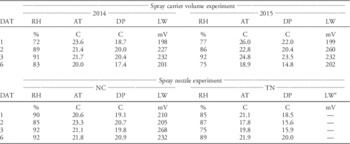
One d prior to trial initiation, areas were mowed (clippings collected) and irrigated to field capacity. Experimental areas were not irrigated or mowed for 6 d following treatment. Furthermore, areas were covered (HDX 6 mil clear plastic; The Home Depot Corp., Atlanta, GA) during rainfall events during this 6 d period. At experiment initiation, 2,4-D (Amine 400 2,4-D Weed KillerTM, PBI/Gordon Corp., Kansas City, MO) was applied at 2.1 kg ae ha−1 to plots measuring 1.8 by 1.5 m (0.5 m alleys between blocks to enable sample collection without human–plot contact). Treatments were applied with a hand-held CO2-pressurized sprayer at 2:00 PM Eastern Standard Time to allow the solution to dry on vegetation with ≥5 h of sunlight remaining that day. Also, it should be noted the 2,4-D application rate used in this research was 20% higher than currently allowed on athletic fields to ensure 2,4-D residue detection through 6 DAT, which we felt was a justifiable compromise to better elucidate the effects of the research variables of interest. To ensure that 2,4-D was applied at the intended rate over the trial area, cellulose-based sheets (387 cm2; Whatman™ 3 MM Chr Chromatography Paper, GE Healthcare Bio-Sciences, Pittsburgh, PA) were randomly placed throughout the trial area. Following 2,4-D spray application over the sheets, residue concentrations were quantified by high performance liquid chromatography with a diode array detector (HPLC-DAD). Finally, air temperature, dew point, and relative humidity were logged throughout the experiments (Table 1). Additionally, leaf wetness (Leaf Wetness Sensor, Decagon Devices Inc., Pullman, WA) was measured in North Carolina with a flat-plate sensor placed facing north at a 45° angle from the ground surface and 0.6 m height, where >203 mV was the threshold for leaf wetness presence (Decagon Devices 2016; SCONC 2013).
Average of hourly climatic conditions from 5:00 AM to 7:00 AM Eastern Standard Time for sample collections 1 to 6 days after treatmentFootnote a , Footnote b , Footnote c , Footnote d

a Abbreviations: DAT, days after treatment; RH, relative humidity; AT, air temperature; DP, dew point; LW, leaf wetness.
b Carrier volume experiments initiated June 18, 2014 and June 23, 2015 in Raleigh, NC; Nozzle type experiments initiated June 30, 2015 (Raleigh, NC) and August 11, 2015 (Knoxville, TN).
c Samples collected from 7:00 AM to 8:00 AM Eastern Standard Time.
d Climatic conditions recorded on site at the Lake Wheeler Turfgrass Field Laboratory (Raleigh, NC) and East Tennessee Research and Education Center-Plant Sciences Unit (Knoxville, TN).
e Leaf wetness data not collected.
Evaluated Treatments
Spray carrier volume was evaluated at three levels, 187, 374, and 748 L ha−1, by holding nozzle type (80015 XR VS flat-fan TeeJet® Nozzles; Spraying Systems Co., Wheaton, IL) and spray pressure (186 kPa) constant and adjusting travel speed. Travel speed for 187, 374, and 748 L ha−1 was 1, 2, and 4 km h−1, respectively. By holding nozzle type and pressure constant, plots were exposed to the same spray droplet size spectrum, which allowed for optimal elucidation of the effect of spray carrier volume on 2,4-D dislodgement (Ferguson et al. Reference Ferguson, Chechetto, Hewitt, Chauhan, Adkins, Kruker and O’Donnell2016; TeeJet 2014). However, previous research has shown that 2,4-D solution concentration can affect plant uptake and translocation; this phenomenon may have had an impact on the results using this experimental approach (Knoche Reference Knoche1994; Wolf et al. Reference Wolf, Caldwell, McIntyre and Hsiao1992).
Three nozzle types were used to evaluate droplet size effects on 2,4-D dislodgeability: air induction extended range (AIXR), drift guard (DG), and extended range (XR) (TeeJet® Nozzles, Spraying Systems Co.). All nozzles were composed of stainless steel, with a 110° spray angle and 1.1 L min−1 orifice size. Additionally, spray carrier volume and travel speed were held constant across nozzle type at 374 L ha−1 and 2 km h−1, respectively. Volume median diameter at the evaluated pressure (206 kPa) for AIXR, DG, and XR was 428 to 622 μm (extra coarse), 218 to 349 μm (coarse) and 136 to 177 (fine) μm, respectively, in accordance with American Society of Agricultural and Biological Engineers classification (TeeJet 2014).
Sample Collection
Dislodgeable 2,4-D. Dislodgeable 2,4-D was quantified by rolling a soccer ball (size 4; Franklin Sports Competition 100, Franklin Sports, Stoughton, MA) over a 3.6 m distance (two 1.8 m side-by-side rolls) within a unique plot. Based on previous research, maximum 2,4-D dislodgement from hybrid bermudagrass occurs near sunrise, and therefore sample collections occurred from 7:00 AM to 8:00 AM Eastern Standard Time (excluding the day of application) (Jeffries et al. Reference Jeffries, Gannon, Brosnan, Ahmed and Breeden2016). This process for testing 2,4-D dislodgement was selected due to soccer’s rank as the most popular international sport, coupled with the frequency of ball-to-turfgrass and subsequent ball-to-hand contacts inherent to the sport (Junge et al. Reference Junge, Dvorak and Graf-Baumann2004). Ball roll distance was equivalent to a soccer ball rolling 20% of the recommended field length (18 m) for youth ages <6 yr in the United States (US Youth Soccer 2013). The soccer ball was double-wrapped with a 5 by 120 cm cellulose-based sorbent strip (Scott Shop Towel™, Kimberly-Clark Corp., Neenah, WI). The soccer ball was mounted to a hand-held PVC apparatus designed such that the ball rotated end-over-end in the same direction as the sorbent strip, thus allowing for constant sorbent strip contact with the treated turfgrass surface. While this is not representative of a ball roll when actively playing soccer, this measure was required to minimize variation in data and determine maximum dislodgeable 2,4-D residue from turfgrass vegetation. Following the ball roll, the entire sorbent strip was removed, placed in a unique glass jar (473 cm3) and stored at −12 C until residue analysis. Dislodgeable 2,4-D residue relative to the amount applied at trial initiation was calculated using the following equation:
 $$\eqalign { &{\rm \,\%\,}\,{\rm dislodged}\,{\rm of}\,{\rm applied\,{\equals}} \cr & \left[ {\left( {{\rm BR}\,{\rm \rmu g}\,{\rm 2,4{\hbox -}D}\,{\rm cm}^{{{\minus}{\rm 2}}} {\rm /20}{\rm .9}\,{\rm \rmu g }\,{\rm 2,4{\hbox -}D}\,{\rm cm}^{{{\minus}{\rm 2}}} } \right){\rm {\times}100}} \right]{\rm ,}$$
where BR represents 2,4-D residue recovered from ball roll samples.
2,4-D In/On Turfgrass Vegetation. 2,4-D in/on turfgrass vegetation was quantified at all sample collections to 1) quantify vegetation spray interception and 2) characterize 2,4-D persistence in aboveground vegetation. This was done by collecting a core (10.8 cm diameter; 92 cm2) such that sampling equipment did not contact aboveground vegetation. Following collection, all samples were frozen and turfgrass vegetation was harvested, weighed, processed (1.7 mm Fitzmill Homoloid model JT 6, Fitzpatrick Co., Elmhurst, IL) and stored at −12 C until residue analysis. 2,4-D residue in/on turfgrass vegetation was calculated as a percentage of the amount applied at trial initiation using the following equation:
 $$\eqalign { & {\rm \,\%\,}\,{\rm of}\,{\rm applied\, {\equals}}\, \cr & \left[ {\left( {{\rm AV}\,{\rm \rmu g}\,{\rm 2,4{\hbox -}D}\,{\rm cm}^{{{\minus}{\rm 2}}} {\rm /20}{\rm .9}\,{\rm \rmu g}\,{\rm 2,4{\hbox -}D}\,{\rm cm}^{{{\minus}{\rm 2}}} } \right){\rm {\times}100}} \right]{\rm ,}$$
where AV represents 2,4-D residue recovered from aboveground vegetation.
Experimental Design
Both trials were conducted as randomized complete block designs with three replicates of a three-by-six factorial treatment arrangement in each experimental run. Factorial levels included three carrier volumes (187, 374, or 748 L ha−1) or three nozzle types (AIXR, DG, or XR), and six sample collection timings (1, 2, 3, 6, 12, or 24 DAT). 2,4-D dislodge samples were also collected immediately following application on 0 DAT; however, these samples were analyzed separately due to differing collection timings from other samples beyond 0 DAT. A nontreated control was included in all experimental blocks to ensure that the trial area was not contaminated.
Residue Analyses
2,4-D residue was quantified with HPLC-DAD (Agilent-1260 Infinity, Agilent Technologies, Inc., Wilmington, DE) methodology. Details pertaining to sample preparation, extraction, and cleanup, as well as analytical parameters, are provided by Jeffries et al. (Reference Jeffries, Gannon, Brosnan, Ahmed and Breeden2016). In summary, limits of detection and quantification were 0.3 and 1.0 mg L−1, respectively, while maintaining the signal to noise ratio at 3:1. 2,4-D residue concentrations were quantified using peak area measurements (OpenLAB CDS ChemStation, version C.01.04, Agilent Technologies, Inc.) and concentrations above the calibration curve were diluted and re-injected for analysis. Fortification recovery checks for sorbent strips and vegetation matrices ranged from 96% to 101% and 92% to 100%, respectively, across all analyses conducted in the presented research. Lastly, application recovery check sheets determined 2,4-D was applied at 88% to 104% of the intended rate across experimental runs.
Statistical Analyses
Statistical analyses were conducted by ANOVA (α<0.05) using MIXED procedures in SAS® version 9.2 (SAS Institute, Inc., Cary, NC). Spray carrier volume, nozzle type, and sample collection timings were considered fixed effects, while experimental run, location, and replicate were considered random, where appropriate, as described by Carmer et al. (Reference Carmer, Nyquist and Walker1989). Main effects and their interactions are presented accordingly, with emphasis given to significant interactions of increasing magnitude (Steel et al. Reference Steel, Torrie and Dickey1997). Means were separated according to Fisher’s Protected LSD (α=0.05) and Pearson correlation coefficients (α<0.05) were determined to quantify relationships between selected climatic conditions and dislodgeable 2,4-D residue.
Results and Discussion
Carrier Volume
Significant interactions were not detected between experimental run and carrier volume (P=0.257) or DAT (P=0.126). Therefore, data were pooled across experimental runs. Due to consistent 2,4-D residue nondetection, dislodgeable 2,4-D data from 12 and 24 DAT were excluded from statistical analysis. At 0 DAT, spray carrier volume did not affect dislodgeable 2,4-D (P=0.384), with 7.2% to 10.9% of the applied 2,4-D dislodged immediately after application (Table 2). ANOVA revealed a significant DAT by spray carrier volume interaction (P=0.048) on dislodgeable 2,4-D foliar residue data from 1 to 6 DAT. Within DAT, dislodgeable 2,4-D residue did not vary between spray carrier volumes at 1, 3, and 6 DAT (0.38% to 0.50%, 0.90% to 1.95%, and 0.18% to 0.45% of applied, respectively), while application at 748 L ha−1 reduced dislodgeable 2,4-D residue at 2 DAT (2.05%) compared to application at 187 or 374 L ha−1 (3.75% to 3.87%). Dislodgeable 2,4-D residue was greatest 2 DAT for all carrier volumes (2.05% to 3.87% of applied), which does not agree with previous research reporting dislodgement was greatest 1 DAT (Jeffries et al. Reference Jeffries, Gannon, Brosnan, Ahmed and Breeden2016; Thompson et al. Reference Thompson, Stephenson and Sears1984). This may be due in part to less favorable climatic conditions for turfgrass canopy moisture at 1 DAT in this experiment, which would affect dislodgeable 2,4-D residue due to the highly water soluble nature of 2,4-D (Jeffries et al. Reference Jeffries, Gannon, Brosnan, Ahmed and Breeden2016).
Spray carrier volume by days after treatment interaction on dislodgeable 2,4-D residue from hybrid bermudagrassFootnote a , Footnote b , Footnote c , Footnote d

a Abbreviations: DAT, days after treatment; NS, nonsignificant.
b Experiments initiated June 18, 2014 and June 23, 2015 in Raleigh, NC.
c Data pooled over two experimental runs.
d Nondetectable dislodgeable 2,4-D residue at 12 and 24 DAT.
e Data from 0 DAT analyzed separately due to differing sample collection time from subsequent timings.
f Percent of the 2.1 kg ae ha−1 spray application rate.
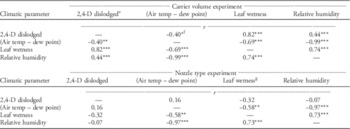
Previous research has shown that climatic conditions such as relative humidity, the difference between air temperature and dew point, as well as leaf wetness measurements, affect 2,4-D dislodgement from hybrid bermudagrass (Jeffries et al. Reference Jeffries, Gannon, Brosnan, Ahmed and Breeden2016). Relative humidity is a measurement of the atmospheric moisture relative to saturated air, and increasing values suggest increased atmospheric moisture (Lawrence Reference Lawrence2005). Kruit et al. (Reference Kruit, Jacobs and Holstag2008) reported that moisture development on grass canopies required a 71% relative humidity threshold, which aligned with research from Jeffries et al. (Reference Jeffries, Gannon, Brosnan, Ahmed and Breeden2016). The authors reported that dislodgeable 2,4-D residue from hybrid bermudagrass at 1 to 3 DAT was greater from 5:00 AM to 9:00 AM (1% to 4% of applied; 81% average relative humidity) compared to from 11:00 AM to 1:00 PM (0.1% to 0.6% of applied; 59% average relative humidity) (Jeffries et al. Reference Jeffries, Gannon, Brosnan, Ahmed and Breeden2016). Dew point is the air temperature that moisture in the air condenses, and as the difference between the dew point and the temperature decreases, dew formation becomes more likely (Lutgens et al. Reference Lutgens, Tarbuck and Tasa2007). Jeffries et al. (Reference Jeffries, Gannon, Brosnan, Ahmed and Breeden2016) reported that 2,4-D dislodgement from hybrid bermudagrass declined as the difference between air temperature and dew point decreased from 1 to 3 DAT, with correlation coefficients ranging from r=−0.55 to r=−0.73 (P<0.01). Leaf wetness in the presented research was measured via dielectric transmission, with a threshold of >203 mV indicating the presence of moisture on leaf tissue (Decagon Devices 2016; SCONC 2013). Pooled over data from 1 to 6 DAT, dislodgeable 2,4-D residue from hybrid bermudagrass following application at various spray carrier volumes was strongly correlated with leaf wetness (r=0.82; P<0.0001) and moderately correlated with relative humidity (r=0.44; P<0.0001), suggesting that dislodgement increased as leaf wetness and atmospheric moisture increased (Table 3). Dislodgeable 2,4-D foliar residue was moderately correlated with the difference in air temperature and dew point (r=−0.40; P=0.0004), suggesting that dislodgeability increased as air temperature approached the dew point. Reduced dislodgeable 2,4-D at 1 DAT compared to 2 DAT may be best explained by leaf wetness, as the 198 and 199 mV values recorded in experimental runs 1 and 2, respectively, did not exceed the wetness threshold. Ultimately, this may have created less favorable conditions for 2,4-D to resuspend on treated vegetation overnight, thereby reducing residue available for dislodgement via soccer ball roll at 1 DAT (Jeffries et al. Reference Jeffries, Gannon, Brosnan, Ahmed and Breeden2016).
Pearson correlation coefficients quantifying the relationships between climatic parameters and dislodgeable 2,4-D residue on hybrid bermudagrassFootnote a , Footnote b , Footnote c , Footnote d

a Carrier volume experiments initiated June 18, 2014 and June 23, 2015 in Raleigh, NC; Nozzle type experiments initiated June 30, 2015 (Raleigh, NC) and August 11, 2015 (Knoxville, TN).
b Average of hourly climatic parameters from 5:00 AM to 7:00 AM Eastern Standard Time prior to dislodgeable 2,4-D sample collection from 7:00 AM to 8:00 AM Eastern Standard Time.
c Climatic conditions recorded on site at the Lake Wheeler Turfgrass Field Laboratory (Raleigh, NC) and East Tennessee Research and Education Center-Plant Sciences Unit (Knoxville, TN).
d Data pooled over experimental runs and 1 to 6 day after treatment sample collections.
e Dislodgeable 2,4-D residue as a percentage of the 2.1 kg ae ha−1 spray application rate.
f ***, **, and * denote significance at P<0.0001, P<0.001, and P<0.01, respectively.
g Leaf wetness data not collected in Knoxville, TN.
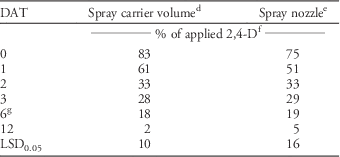
Reduced dislodgeable 2,4-D foliar residue at 2 DAT following application at 748 L ha−1 compared to the dislodgeable residue following application at 187 and 374 L ha−1 was not due to differing persistence in aboveground vegetation: the DAT by spray carrier volume interaction (P=0.405) and spray carrier volume main effect (P=0.142) were not significant. However, ANOVA did reveal a significant DAT main effect (P=0.003). Pooled over spray carrier volumes, 83% of applied 2,4-D remained in aboveground vegetation immediately after application, and this percentage declined 22% by the 1 DAT sample collection (Table 4). 2,4-D persistence decreased from 1 to 2 DAT (33% of applied), and from 2 to 3 DAT (28%). These data suggest that 2,4-D does not persist in hybrid bermudagrass vegetation, as residue declined 2.5-fold from 0 to 2 DAT. The decline from 6 DAT (18% of applied) to 12 DAT (2%) is likely due in part to irrigation and mowing performed following 6 DAT sample collections, which have been shown to reduce 2,4-D persistence in turfgrass vegetation (Jeffries et al. Reference Jeffries, Gannon, Brosnan, Ahmed and Breeden2016; Thompson et al. Reference Thompson, Stephenson and Sears1984). General 2,4-D persistence trends in hybrid bermudagrass aboveground vegetation agree with the results of Jeffries et al. (Reference Jeffries, Gannon, Brosnan, Ahmed and Breeden2016), who reported 18% decline in aboveground vegetation 2,4-D persistence from 0 to 1 DAT, with 24% of the applied 2,4-D present at 7 DAT.
2,4-D persistence in hybrid bermudagrass aboveground vegetation following application at varying spray carrier volumes or with varying spray nozzlesFootnote a , Footnote b , Footnote c

a Abbreviation: DAT, days after treatment.
b Data pooled over two experimental runs.
c 2,4-D residue was nondetectable at 24 DAT.
d Experiments initiated June 18, 2014 and June 23, 2015 in Raleigh, NC.
e Experiments initiated June 30, 2015 (Raleigh, NC) and August 11, 2015 (Knoxville, TN).
f Percentage of the 2.1 kg ae ha−1 spray application rate.
g Irrigation/precipitation and mowing did not occur between the 0 and 6 DAT sample collection times.
Although small numerical differences generally occurred, results confirm the hypothesis that dislodgeable 2,4-D residue decrease as spray carrier volume increases. This is likely due to a comparably greater proportion of the spray application penetrating into the canopy at higher carrier volumes, making it less likely to contact the soccer ball during sample collection. In addition to reducing potential 2,4-D human exposure, increasing carrier volume also has been shown to increase plant uptake and translocation (Knoche and Bukovac Reference Knoche and Bukovac1999; Wolf et al. Reference Wolf, Caldwell, McIntyre and Hsiao1992). Knoche and Bukovac (Reference Knoche and Bukovac1999) reported common bean (Phaseolus vulgaris L.) 2,4-D uptake increased from 16.5% at 10 microliters per leaf to 36.2% at 100 microliters per leaf, while Wolf et al. (Reference Wolf, Caldwell, McIntyre and Hsiao1992) reported doubling 2,4-D droplet concentration decreased translocation approximately 10% in oriental mustard (Sisymbrium orientale L.) leaves.
Nozzle Type
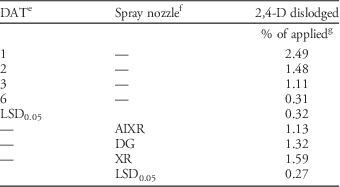
Significant interactions were not detected between location and nozzle type (P=0.613) or days after treatment (P=0.438). Therefore, data were pooled across locations. Due to consistent 2,4-D residue nondetection, dislodged 2,4-D residue data from 12 and 24 DAT were excluded from statistical analysis. Pooled over nozzle type at 0 DAT (P=0.181), 4.6% of applied 2,4-D dislodged immediately after spraying (data not shown). ANOVA revealed significant DAT (P<0.0001) and nozzle type (P=0.011) main effects for dislodgeable 2,4-D from 1 to 6 DAT (Table 5). Pooled over nozzle type, dislodgeable 2,4-D residue showed the following trend: 1 DAT>2 DAT>3 DAT>6 DAT. This is consistent with the trend reported by Jeffries et al. (Reference Jeffries, Gannon, Brosnan, Ahmed and Breeden2016). Pooled over DAT, more 2,4-D dislodged after application with the XR nozzle compared to that which dislodged after application with DG or AIXR nozzles. This may be due in part to reduced canopy penetration from finer spray droplets. Zhu et al. (Reference Zhu, Dorner, Rowland, Derksen and Ozkan2004) reported that spray penetration into the lower region of peanut canopies was greater from air induction nozzles (0.21 μ cm−2 cover) compared to flat-fan nozzles (0.12 μL cm2) at 46 DAT. Additionally, previous research has shown that spray coverage is generally superior as spray droplet size decreases (Kennelly and Wolf Reference Kennelly and Wolf2009; TeeJet® 2014). While this was not measured in the presented research, increasing spray coverage would produce more conducive conditions for 2,4-D dislodgement by maximizing sorbent strip–to–treated turfgrass vegetation contact.
Dislodgeable 2,4-D residue in hybrid bermudagrass over time following treatment with varying spray nozzlesFootnote a , Footnote b , Footnote c , Footnote d

a Abbreviations: DAT; days after treatment; AIXR, air induction extended range; DG, drift guard; XR, extended range.
b Experiments initiated June 30, 2015 (Raleigh, NC) and August 11, 2015 (Knoxville, TN).
c Data pooled over two experimental runs.
d Dislodgeable 2,4-D residue was nondetectable at 12 and 24 DAT.
e Pooled over nozzles. At 0 DAT dislodgeable 2,4-D residue was 4.56% of applied.
f Pooled over DAT.
g Percentage of the 2.1 kg ae ha−1 spray application rate.
Nozzle type did not affect 2,4-D persistence in hybrid bermudagrass aboveground vegetation (P=0.1088); however, persistence declined over DAT (P<0.0001). Generally, 2,4-D persistence in the nozzle type experiment trended similarly to that in the spray carrier volume experiment, with 75% of the applied 2,4-D detected on/in aboveground vegetation immediately after application, and that number declining to 51% by 1 DAT (Table 4). Similar to the carrier volume experiment, 2,4-D residue in aboveground vegetation declined more than 2-fold from 0 to 2 DAT, suggesting short persistence in hybrid bermudagrass turf. Although statistical separation is not permissible, 2,4-D residue declined more than 3-fold from 6 DAT to 12 DAT. This 2,4-D persistence across nozzles is consistent with the results of Wolf et al. (Reference Wolf, Caldwell, McIntyre and Hsiao1992), who reported similar 14C 2,4-D absorption in oriental mustard across 198- to 594-μm diameter droplets; however, they found that translocation decreased approximately 10% with the smallest droplets compared to the largest droplets. Therefore, further research is warranted to ensure that utilizing spray nozzles that reduce dislodgeable 2,4-D residue do not compromise weed control.
Unlike the spray carrier volume experiment, climatic variables were poorly correlated (−0.40<r<0.40) with dislodgeable 2,4-D in the nozzle-type experiment. This is likely due to relatively constant, favorable conditions for turfgrass canopy moisture presence during sample collections, coupled with 2,4-D degradation. Excluding 3 DAT in Tennessee, relative humidity ranged from 85% to 92% at 1 to 6 DAT across locations. Additionally, leaf wetness measured in North Carolina ranged from 205 to 268 mV 1 to 6 DAT, which exceeded our wetness threshold. Therefore, correlations do not encompass unfavorable climatic conditions as in the carrier volume experiment, which these conditions are needed to quantify the response in dislodgeable 2,4-D. Interestingly, leaf wetness across experiments was moderately correlated with the difference between air temperature and dew point (r=−0.58 to r=−0.69; P<0.001) and strongly correlated with relative humidity (r=0.73 to r=0.74; P<0.0001). While utilizing a leaf wetness sensor to monitor canopy moisture conditions may not be practical for in situ practice, future research should attempt to identify more easily monitored climatic variables that affect 2,4-D dislodgement from treated turfgrass, such as air temperature, dew point and relative humidity, that turfgrass managers can utilize to reduce potential human exposure.
This research built on preceding efforts evaluating dislodgeable 2,4-D from treated turfgrass. Our experiment evaluated dislodgeable 2,4-D from the most common turfgrass species utilized as athletic field surfaces in subtropical and tropical climates with a method that simulated a common process in soccer, the most popular international sport. Findings supported the hypothesis that dislodgeable 2,4-D decreases as spray carrier volume and droplet size increase. It should be noted that although 2,4-D is applied to hybrid bermudagrass athletic fields, the turfgrass stand would presumably have broadleaf weeds present for this POST herbicide to be used. Definitive statements are not permissible from this, or preceding, research efforts, but broadleaf weed presence may alter dislodgeable 2,4-D residue from the evaluated treatments. Data from this research agreed with previous reports indicating that 2,4-D residue can dislodge from hybrid bermudagrass up to 6 DAT, as residue detection for this duration occurred across all evaluated spray carrier volumes and nozzle types (Jeffries et al. Reference Jeffries, Gannon, Brosnan, Ahmed and Breeden2016). Therefore, turfgrass managers and athletic field event schedulers should coordinate human activity with caution following 2,4-D application for at least 6 d following treatment; however, this period will vary depending on site-specific conditions and management practices.
Although the numerical differences in dislodgeable 2,4-D residue from our evaluated sprayer setup adjustments are relatively small, it should be reiterated that these data were produced from one soccer ball roll over a 3.6 m distance, covering 0.07% the area of the smallest children’s (U6) soccer field (14 by 18 m) recommended by the US Youth Soccer Organization (2013). While soccer ball–to-field contact area will vary widely across ages and skill level within a practice or game, the dislodgement sampling method used in this research underestimates real-world ball activity. Ultimately, reductions in dislodgeable 2,4-D from applying at increased carrier volumes and with nozzles producing larger droplet size can have a substantial additive impact on reducing potential human exposure in treated turfgrass systems. Future research should evaluate the effects of application at increased carrier volumes and with coarse droplet–producing nozzles, as well as the inclusion of spray adjuvants, on dislodgeable 2,4-D and on broadleaf weed control to provide turfgrass managers with efficacious practices that minimize potential human exposure.