Introduction
Isolated itching of the external auditory canal is the presence of pruritus without a determined cause such as infection, trauma or malignancy.Reference Djalilian and Memar1 This condition was first reported by Shenoy et al. who suggested the term ‘itchy ear syndrome’.Reference Shenoy, Paulose and Sharma2 Although the condition is commonly seen in otolaryngology practice, only a very few studies have investigated its aetiology and/or treatment. In one study, histological and immunohistological evaluations of skin biopsies from patients with isolated itching of the external auditory canal were comparable with those of patients with conductive deafness associated with dry perforation without itching of the ear.Reference Acar, Simsek, Oguztuzun, Zaim and Karasen3 The authors concluded that isolated itching of the external auditory canal was not associated with dermatitis and that psychological factors should be considered in most patients.Reference Acar, Simsek, Oguztuzun, Zaim and Karasen3 Moreover, Acar et al. demonstrated that patients with isolated itching of the external auditory canal did not have allergic contact dermatitis.Reference Acar, Karadag, Karabulut, Babademez, Zaim and Karasen4 In another recent attempt to define its pathogenesis, Tuzuner et al. compared the sebum, pH and moisture levels of ear skin of patients with this condition with those of healthy controls.Reference Tuzuner, Akdagli, Sen, Demirci, Tarimci and Caylan5 Their only finding was that moisture levels were significantly higher in the patient group. It is likely that previous studies failed to clearly identify the underlying pathology in isolated itching of the external auditory canal.
Psychological factors are known to be associated with pruritus.Reference Dalgard, Svensson, Sundby and Dalgard6 The degree of depressive or anxiety symptoms directly correlates with itching severity in a variety of pruritic skin diseases.Reference Sheehan-Dare, Henderson and Cotterill7–Reference Remröd, Sjöström and Svensson9 Conversely, psychiatric patients exhibit increased levels of pruritus.Reference Mazeh, Melamed, Cholostoy, Aharonovitzch, Weizman and Yosipovitch10, Reference Kretzmer, Gelkopf, Kretzmer and Melamed11 It is thus important to assess the psychological status of patients who complain of refractory itching.
The type D personality (i.e. distressed) was established to describe individuals who exhibit both negative affectivity and social inhibition.Reference Denollet12 Persons with high negative affectivity are prone to experience undesired emotions such as anger, distress, hostility and depression. Individuals with high social inhibition tend to experience social difficulties because they hide their emotions in social interactions because they fear rejection or disapproval from others. Relationships between the type D personality and a series of illnesses have recently engendered considerable interest. Type D personality is associated with negative outcomes in various diseases, including irritable bowel syndrome, heart diseases, anal fissure, type 2 diabetes and haemorrhoids.Reference Yildirim, Alçelik, Canan, Aktaş, Şit and İşçi13–Reference Sit, Yilmaz, Canan, Yıldırım and Cetin18
This study aimed to (1) determine the prevalence of type D personality in patients with isolated itching of the external auditory canal; (2) investigate whether these patients are more likely to report depressive and/or anxiety symptoms and exhibit different degrees of personality traits (i.e. neuroticism, extraversion and psychoticism) compared with healthy controls; and (3) establish a relationship between itch severity and psychological and personality characteristics in these patients.
Materials and methods
Participants
This study recruited a total of 100 patients with isolated itching of the external auditory canal by evaluating consecutive patients complaining of ear pruritus who were admitted to the Department of Otorhinolaryngology, Dicle University (located in south-eastern Turkey) between April 2013 and April 2015. The exclusion criteria were pathological findings upon otoscopic examination (bacterial or fungal infection, dermatological conditions, trauma), the presence of chronic disease (hypertension, diabetes mellitus, hepatic and/or renal diseases, malignancies), the presence of an established ear disorder other than itching, pregnancy, the presence of fever and/or leukocytosis, a diagnosed psychiatric condition, and unwillingness to participate. A total of 143 patients were admitted with ear itching in the two-year period; of these, 43 met the exclusion criteria. The most frequent reason for exclusion was pathological findings upon otoscopic examination (n = 21).
In the same period, 100 healthy control participants were enrolled, with characteristics similar to those of patients regarding age, sex and other sociodemographic features. The exclusion criteria were also applied to the control group.
The study protocol was approved by the Non-invasive Clinical Research Ethics Committee at Dicle University and all participants gave written informed consent before enrollment.
Measures
Type D Scale
The Type D Scale contains 14 items that measure two stable personality traits: negative affect and social inhibition.Reference Denollet12 The negative affect component of the Type D Scale assesses negative emotions using seven items (e.g. ‘I often make a fuss about unimportant things’ and ‘I often feel unhappy’). The social inhibition component evaluates social contact inhibition using seven items (e.g. ‘I find it hard to start a conversation’ and ‘I am a closed kind of person’). All items are rated on a 5-point scale, ranging from 0 (false) to 4 (true), with higher scores denoting higher levels of pathology. Individuals who score 10 or more on both scales are identified as having a type D personality.Reference Emons, Meijer and Denollet19 The Type D Scale is internally consistent (Cronbach's α: for negative affectivity = 0.88, for social inhibition = 0.86) and stable (three-month test–re-test reliability; Cronbach's α: for negative affectivity = 0.72, for social inhibition = 0.82). The Turkish version of the Type D Scale was reported to be reliable and valid in haemodialysis patients.Reference Alçelik, Yıldırım, Canan, Eroğlu, Aktaş and Şavlı20 Cronbach's α was 0.82 for negative affectivity and 0.84 for social inhibition. Moreover, the Turkish Type D Scale was stable over a one-month period (r = 0.84 for negative affectivity, r = 0.78 for social inhibition).
The Hospital Anxiety and Depression Scale
The Hospital Anxiety and Depression Scale is a 14-item self-report questionnaire used to measure the symptoms of anxiety (7 items) and depression (7 items) over the previous 2 weeks in both in-patient and out-patient populations.Reference Zigmond and Snaith21 The scale was designed to evaluate cognitive and psychological symptoms rather than somatic symptoms, thus avoiding false-positive results in patients with a physical illness. All items are rated on a 4-point scale (from 0 to 3), with higher scores indicating more severe depression or anxiety. The Hospital Anxiety and Depression Scale has been validated in a Turkish population.Reference Aydemir, Güvenir, Küey and Kültür22 In the study cohort, Cronbach's α coefficients for anxiety and depression were 0.77 and 0.81, respectively, indicating good reliability.
Eysenck Personality Questionnaire Revised: abbreviated form
An abbreviated version of the revised Eysenck Personality Questionnaire (‘EPQR-A’) was used.Reference Francis, Brown and Philipchalk23 It comprises 24 items to be answered ‘yes’ or ‘no’. This questionnaire measures three personality dimensions: neuroticism, extraversion and psychoticism. It also has a lie subscale which evaluates the validity of the scale; however, it does not measure a personality dimension. Individuals with a high score in the neuroticism dimension are emotionally unstable and distressed, while those with low scores are placid and emotionally level. Persons with high scores on the extraversion dimension are socially active, open and good communicators, while those low in this dimension are generally socially inactive, withdrawn and shy. Similar to the original scale, factor analysis of the Turkish version of this scale revealed four factors (neuroticism, extraversion, psychoticism and lie), with acceptable validity and reliability.Reference Karanci, Dirik and Yorulmaz24
Modified Itch Severity Scale
The Modified Itch Severity Scale is a self-report scale. The original Itch Severity Scale was developed by Majeski et al.Reference Majeski, Johnson, Davison and Lauzon25 It was modified by Acar and colleagues to assess itching of the external auditory canal by excluding two unrelated items.Reference Acar, Karabulut, Sahin, Babademez, Karadag and Karasen26 The five items of the scale are the frequency, intensity and type of itch, and the effect of the itch on sleep quality and mood. The different component responses to each of the five items are added separately and divided by the highest possible total score for the respective item. The total score from this scale ranges from 0 to 15, with higher scores indicating more severe itching.Reference Acar, Karabulut, Sahin, Babademez, Karadag and Karasen26 In the study sample, the α coefficient for the Modified Itch Severity Scale was 0.85, showing good reliability.
Statistical analysis
Statistical analysis was performed using IBM SPSS Statistics software version 20.0 (Armonk, New York, USA). Continuous variables (i.e. age and scale scores) were checked for normal distribution with the Kolmogorov–Smirnov one-sample test for goodness of fit. None of the continuous variables were normally distributed; therefore, the Mann–Whitney U test was used to assess between-group differences (patients vs controls and patients with vs without a type D personality). Data are presented as the median and interquartile range. The χ2 test was used to compare frequency distributions of categorised variables between different groups. Spearman's correlation coefficient was used to determine continuous variables. Multiple linear regression analyses were used to investigate relationships between the dependent variable (itch severity) and multiple independent variables (age, sex and scale scores). Statistical significance was set at a p value of less than 0.05.
Results
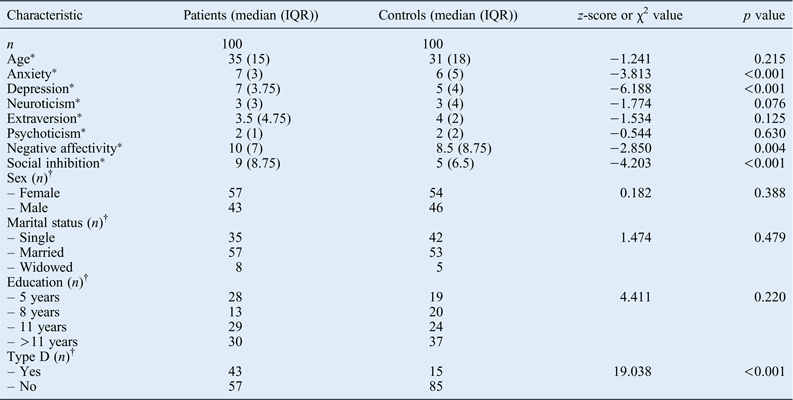
Sociodemographic features and the median scores of each scale in the isolated itching of the external auditory canal and control groups are shown in Table I. There was no significant difference in socio-demographic variables between patients and healthy controls. The proportion of individuals with a type D personality was higher in patients with isolated itching of the external auditory canal (43 per cent) than in control participants (15 per cent; p < 0.01). Patients with isolated itching of the external auditory canal had higher negative affectivity, social inhibition, and anxiety and depression scores compared with healthy participants (p < 0.01).
Characteristics and scale scores in IIEAC patients and healthy controls

*Mann–Whitney U test. †χ2 test. IIEAC = isolated itching of the external auditory canal; IQR = interquartile range.
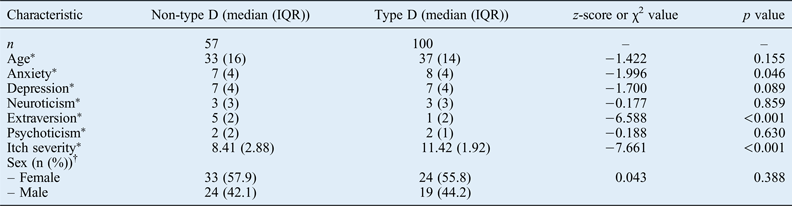
Table II shows a comparison of the sex distribution, median age and median score in type D and non-type D patients with isolated itching of the external auditory canal. Type D patients with isolated itching of the external auditory canal had higher anxiety scores compared with their non-type D counterparts (p < 0.05). In addition, patients with a type D personality had significantly higher levels of itch severity (p < 0.01) and lower levels of extraversion (p < 0.01) compared with those without a type D personality.
Characteristics of IIEAC patients with or without a type D personality
*Mann–Whitney U test. †χ2 test. IIEAC = isolated itching of the external auditory canal; IQR = interquartile range
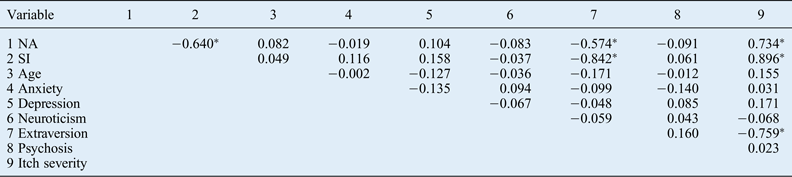
In bivariate analyses, negative affectivity and social inhibition were each associated with a greater itch severity (r = 0.734 and r = 0.896, respectively; p < 0.01) and less extraversion (r = −0.574 and r = −0.842, respectively; p < 0.01) in patients with isolated itching of the external auditory canal (Table III). The extraversion dimension of the abbreviated form of the Eysenck Personality Questionnaire Revised also correlated negatively with itch severity (r = −0.759, p < 0.01).
Bivariate correlations between continuous variables in IIEAC patients
*p < 0.01. IIEAC = isolated itching of the external auditory canal; NA = negative affectivity; SI = social inhibition
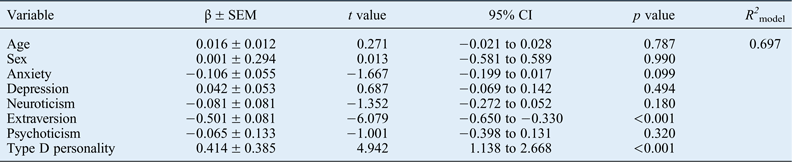
Multiple linear regression analysis revealed that the extraversion dimension and the type D personality were independently associated with itch severity (both p < 0.001; Table IV).
Multiple linear regression analysis with itch severity as the dependent variable
CI = confidence interval; SEM = standard error of the mean
Discussion
This study aimed to investigate the association of psychological and personality factors with pruritus of the external ear canal. Approximately half of patients with isolated itching of the external auditory canal (43 per cent) were found to have a type D personality; this prevalence was significantly higher than that found in individuals without ear itching (15 per cent). These patients also had more depressive and anxiety symptoms compared with control participants. Moreover, itch severity was significantly worse in patients with a type D personality than in those without a type D personality.
Until now, no studies have assessed the frequency of a type D personality in patients with isolated itching of the external auditory canal. However, Bartels et al. evaluated 265 tinnitus sufferers and found a significantly higher prevalence of type D personality in tinnitus patients (35.5 per cent) than in an equal number of patients with other ENT diseases (10.6 per cent).Reference Bartels, Middel, Pedersen, Staal and Albers27, Reference Bartels, Pedersen, van der Laan, Staal, Albers and Middel28 These researchers also reported that the type D personality construct was a discriminating factor between the tinnitus sufferers and ENT patients without tinnitus,Reference Bartels, Middel, Pedersen, Staal and Albers27 and that the effect of type D personality on health-related quality of life in tinnitus patients was mainly mediated by anxiety and depression symptoms.Reference Bartels, Pedersen, van der Laan, Staal, Albers and Middel28 The present study showed that the type D personality is strikingly prevalent in patients with isolated itching of the external auditory canal. Both tinnitus and isolated itching of the external auditory canal have an unclear aetiology.Reference Witsell, Hannley, Stinnet and Tucci29 Thus, the high rates of type D personality found in this study are unsurprising because of the similar high rates found in tinnitus studies.
In this study, isolated itching of the external auditory canal patients with a type D personality had higher scores on itch severity scale compared with those without a type D personality. Moreover, social inhibition and negative affectivity correlated positively with pruritus severity, and the type D personality was associated with increased levels of itch severity after controlling for confounding variables (age, sex, anxiety, depression, neuroticism, extraversion and psychoticism). These findings suggest that isolated itching of the external auditory canal patients with a type D personality have a greater perception of itching severity compared with their non-type D counterparts. These findings are consistent with those of previous reports indicating an association between type D personality and increased levels of perceived disease severity in several illnesses, including coronary artery disease, obstructive sleep apnoea syndrome and rheumatoid arthritis.Reference Mommersteeg, Pot, Aarnoudse, Denollet and Widdershoven30–Reference Klaassen, Nyklíček, Traa and de Nijs32
According to the personality theory of Eysenck and Eysenck, extraversion and introversion are opposing traits within a distinct personality dimension.Reference Eysenck and Eysenck33 Extraversion describes talkative, outgoing, energetic, risk-taking and assertive individuals; in contrast, introversion describes reserved, solitary, self-conscious and inward-looking individuals. The present study showed that patients with isolated itching of the external auditory canal had extraversion levels comparable to those of healthy participants. However, type D patients scored significantly lower on the extraversion dimension compared with their non-type D counterparts. Furthermore, negative affectivity and social inhibition scores inversely correlated with extraversion. These findings confirm the negative association between extraversion and the type D personality.Reference De Fruyt and Denollet34 Extraversion correlated negatively with pruritus severity. In addition, it was independently and negatively associated with itch severity. These results suggest that introvert patients with isolated itching of the external auditory canal (i.e. socially inactive, self-conscious) exhibit more severe itching symptoms compared with non-introverts. While the present study shows an independent, negative association between extraversion and itch severity in patients with isolated itching of the external auditory canal, the clinical implications of this finding remain open to question.
• Isolated itching of the external auditory canal is a common condition
• The type D personality combines negative affectivity and social inhibition
• The type D personality was highly prevalent in 100 isolated itching of the external auditory canal patients
• Pruritus was more severe in patients with a type D personality
• Type D personality and extraversion were independently associated with itch severity
Although this study has the largest reported sample size of patients with isolated itching of the external auditory canal (n = 100), it has several limitations. Firstly, it had a cross-sectional design; hence, causal relationships between psychological parameters and isolated itching of the external auditory canal could not be determined. Secondly, data collection relied on self-report scales (not structured or semi-structured interviews), which may limit the reliability of the findings. Thirdly, although those with diagnosed psychiatric conditions were not included in the study, participants did not undergo a mental health examination. Thus, individuals with an undiagnosed mental illness might have been inadvertently recruited.
To the best of our knowledge, this study is the first to investigate anxiety and depression symptoms and personality features in patients with isolated itching of the external auditory canal. The type D personality was highly prevalent in the patient sample. In addition, pruritus was more severe in isolated itching of the external auditory canal patients with a type D personality than in those with a non-type D personality. Moreover, a type D personality and introversion were independently associated with itch severity. These results suggest that psychological and personality factors, particularly the type D personality, are closely associated with isolated itching of the external auditory canal. The cross-sectional study design means that this association is not sufficient to identify certain personality traits (i.e. type D personality and introversion) as risk factors for isolated itching of the external auditory canal. However, the findings may help determine the pathogenesis of isolated itching of the external auditory canal by highlighting the importance of psychological status and personality.
Conclusion
It is crucial that clinicians consider the psychological and personality characteristics when evaluating and treating patients with isolated itching of the external auditory canal. There is also a need for future studies into the effect of psychological and psychopharmacological interventions in the treatment of patients with isolated itching of the external auditory canal.