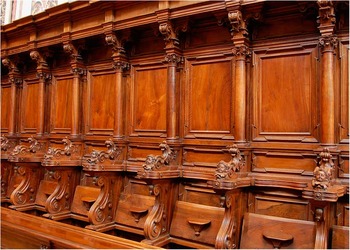
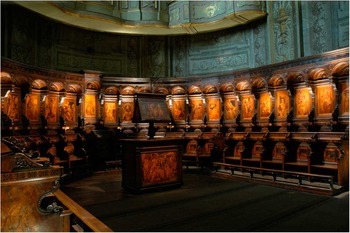
Misericords, the projecting brackets on the undersides of the swing seats of choir stalls, display some of the most inventive, provocative and amusing images in medieval art. Their primary function was to allow occupants to rest during long services while giving the impression that they were standing, the term ‘misericord’ deriving from the Latin for ‘mercy’ or ‘pity’.Footnote 1 The carved supports are ubiquitous across Europe, featuring on medieval stalls in England,Footnote 2 France,Footnote 3 Belgium and The Netherlands,Footnote 4 Germany,Footnote 5 Switzerland,Footnote 6 and Spain and Portugal.Footnote 7 Misericords often depicted genre scenes or folklore – images that Grössinger argued counterbalanced the solemnity of religious services.Footnote 8 Religious iconography was less commonly depicted, perhaps because to cover or turn one's back on such subjects was considered profane. By contrast, Camille has suggested that the action of obscuring secular subject-matter constituted ‘the obliteration of one social group by another’.Footnote 9
The ever-expanding literature on European misericords situates their iconographic schemes in the context of contemporary literature, folklore and social convention.Footnote 10 But a more basic problem than one of interpretation faces the study of misericords: their almost complete absence in Italy. Few art historians have attempted to explain this curiosity, reflecting the lack of scholarly interest on Italian choir stalls in general.Footnote 11 In their survey of European misericords, Dorothy and Henry Kraus offered the following possible reasons for their absence in Italy: ‘shortage of wood, lack of early experience in wood-carving, in which northern countries had a strong tradition, late retention of stone seats because of the more clement weather’.Footnote 12 These cannot fully explain the phenomenon. A general wood shortage, even if true, is unlikely to have affected the production of such small supports, and the supposed lack of a strong history of woodcarving did not hinder the development of intricately carved stall-backs or stall-dividers in Italy. Moreover, although most surviving Italian stalls date from after 1400, documentary evidence shows that wooden stalls were constructed in earlier times.Footnote 13 Indeed, the absence of misericords is just one feature amongst many that makes Italian stalls stylistically different from those produced elsewhere in Europe. Medieval stalls in Italy were generally less complex than the micro-architectural fantasies seen in northern Europe, and several combined wood and stone elements,Footnote 14 while the golden age of choir furniture in fifteenth-century Italy was marked by a distinctive episode in the history of church furniture dominated by the production of intarsia panels depicting perspectival scenes.
The general absence of misericords on Italian choir stalls invites several broader questions. Should misericords be perceived as a regional stylistic motif? Were they considered desirable aids to liturgical performance or not, and how were they used in religious ritual? Crucially, were Italian artists and patrons aware of the existence of misericords and did they consciously renounce their use?
Misericords In North-West Italy From The Early Fourteenth To The Seventeenth Centuries
Misericords can be found on stalls from various periods in the regions of Lombardy, Piedmont and the Valle d'Aosta in north-west Italy. They are, however, generally less sophisticated than many north European examples and tend not to feature the same genre or literary themes. Although treated in general overviews of medieval art, the presence of misericords in this region has not been fully recognized or explained.Footnote 15
Stalls in the cathedral of San Giusto at Susa, near Turin, have simple misericords portraying bearded men and birds dated to 1320–30.Footnote 16 Misericords can also be seen in the stalls of the abbey church at Novalesa, dated to 1430–50;Footnote 17 these are very basic in design, constructed as a T-shape with the support forming a projecting half-moon. In Aosta Cathedral, the stalls were carved in 1469 by the Savoyard workers Jean de Chetro and Jean Vion, whose self-portraits appear on two of the stall-ends; these misericords depict monstrous leering faces and contorted bestial figures.Footnote 18 In the Collegiata di Sant'Orso, in Aosta, carved misericords dated 1487 depict simple subjects in an almost graphic styleFootnote 19 and show close affinities with misericords in the cathedral of Saint-Jean-de-Murienne, sculpted by Pierre Mochet in 1498.Footnote 20 The more detailed carvings in the abbey church at Staffarda, dated to the 1520s, show male heads and folklore figures, including a dog in male clothing and a male figure with oversized ears.Footnote 21
Further east, in Lombardy, misericords are present in a small group of choirs that are late in date. Sixteenth-century examples appear on the stalls of Santa Maria della Passione in Milan (fig 1). These highly simplistic supports consist of two pieces of shaped wood joined to form a T-shape, clearly of utilitarian rather than aesthetic intention. Similar ex situ stalls, displaying identical distinctive mother-of-pearl perspectival ornament on the stall-backs, also have misericords, suggesting that they formed part of the workshop repertoire.Footnote 22 In the Abbazia di Chiaravalle Milanese, stalls constructed by Carlo Garavaglia in the 1640s feature misericords carved with heads, foliage and scrolls.Footnote 23
Santa Maria della Passione, Milan: sixteenth-century choir stalls. Photograph: author

The misericords discussed thus far appear in churches unrelated by religious order or type, but situated within the same geographical sphere. Woodworkers in this region were strongly influenced by French, Swiss and German sources. In some cases, close parallels can be made with furniture north of the Alps, suggesting a degree of direct contact between artists or patrons. For example, carvings in the Collegiata di Sant'Orso compare closely with the dorsal figures and busts of the choir at the abbey of Weingarten (1477–8) and St Peter's Church in Constance (1500–13), both traditionally attributed to Heinrich Iselin.Footnote 24 Even when stalls lacked misericords, French influence on woodworkers in Lombardy was particularly strong. Flamboyant blind tracery stall-backs at San Lanfranco, in Pavia, adopt a French woodworking motif, seen for example in a wooden chapel screen in Laon Cathedral, also dated to the last quarter of the fifteenth century.Footnote 25 In other cases, documentary and visual evidence indicates that northern European woodworkers assisted in the making of choirs in north-west Italy. Stalls from Asti Cathedral were signed by the Italian woodworker Baldino da Surso, but an anonymous Swiss or German artist carved some of the stall-backs, probably those situated at the periphery of the ensemble.Footnote 26
The close contact between woodworkers in north-west Italy and their northern European counterparts probably facilitated the adoption of misericords by some churches in this region, while the political history of the area provides a practical context for the transmission of artistic ideas and techniques. Created as an independent duchy in 1416, Savoy embraced Piedmont and the Valle d'Aosta, together with Maurienne, in present-day France,Footnote 27 and the Savoy heraldic arms feature on the choir stalls in the cathedral and collegiata at Aosta.Footnote 28 French political interest in Lombardy contributed to an enduring artistic exchange between the two regions,Footnote 29 so it is not surprising that the north-west area contains the highest concentration of misericords in Italy, even if Italian influence is evident in the lack of decoration in many of the surviving examples.
Carthusian Choir Stalls
Outside this particular geographical zone, the one exception to the general lack of misericords in Italy occurs in the choirs of the Carthusian monastic order, where misericords can be found across Italy – from Piedmont to Calabria – dating from the fourteenth to the twentieth centuries. This peculiarity has only rarely been noted in the past,Footnote 30 and a full survey of Italian Carthusian churches is problematical, as many are now unused or have been converted to other uses and deprived of their original furniture.Footnote 31 Nevertheless, this hitherto unrecognized correlation reveals that – contrary to general assumptions – artists and patrons in medieval Italy were aware of the existence and function of misericords.
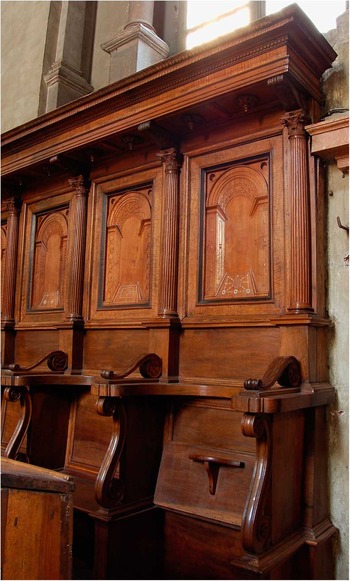
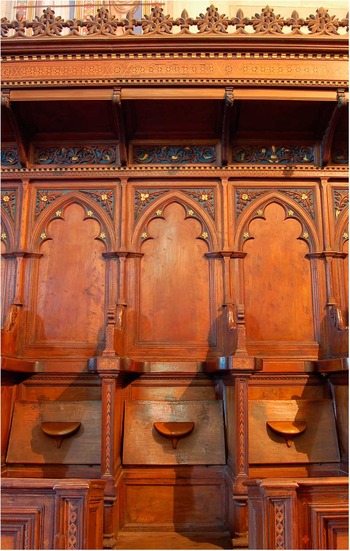
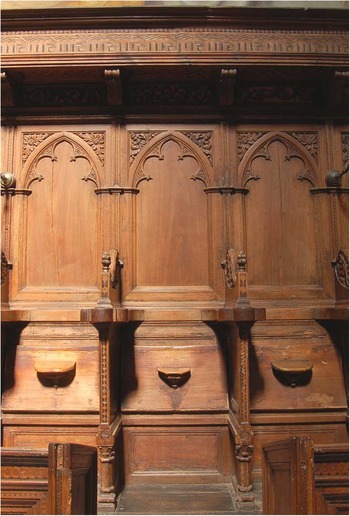
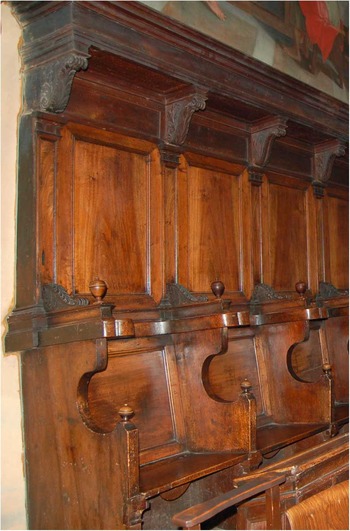
A brief survey of extant misericords in Carthusian churches will illustrate the extent of the phenomenon. Perhaps the earliest example is provided by the fourteenth-century choir in the Certosa di Banda, near Villar Focchiardo, in Piedmont, which displays misericords in the shape of half-moons.Footnote 32 As we have seen, several choirs in this region have misericords, so their presence in the Carthusian church here could form part of this geographical pattern. Further south, however, the choir of the Certosa del Galluzzo in Florence displays carved Gothic cusped arches on the stall-backs, a simple intarsia cornice and plainly carved semicircular misericords (fig 2).Footnote 33 Scantamburlo suggested that the choir could have been constructed in the 1460s by Jacopo di Marco da Villa Basilica, who was also commissioned to complete the choir in the nearby Certosa di Calci, near Pisa.Footnote 34 In the 1462 contract for the Pisan stalls, Jacopo was obliged to create a choir ‘beautiful and good like that of the monastery of Florence’, although the misericords themselves were not mentioned.Footnote 35 The extant Pisan choir is indeed an accurate replication of the Florentine version, displaying similar Gothic stall-backs and simply carved misericords (fig 3).Footnote 36 If these two choirs were indeed constructed by the same workshop, the possibility remains that the misericords formed part of the workshop repertoire, although none of the other choirs attributed to Jacopo survive to enable a comparison.Footnote 37
Certosa del Galluzzo, Florence: mid-fifteenth-century choir stalls. Photograph: author

Certosa di Calci, Pisa: choir stalls of c 1462. Photograph: author

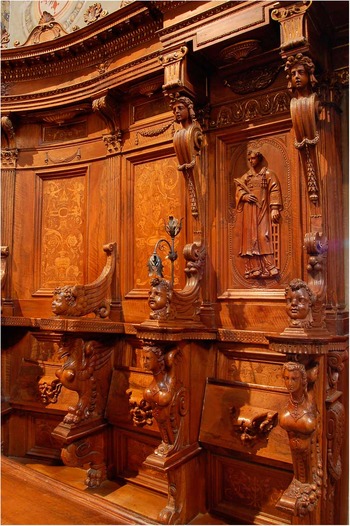
The fifteenth-century stalls in the Certosa del Galluzzo were removed to the smaller church of Santa Maria, also in the monastery, at an undocumented date before the late sixteenth century. New monks’ stalls for the main church were begun in 1570 by Simone di Domenico Colombini, but were later worked on by the Baglioni and Atticciati workshops (fig 4).Footnote 38 These inlaid and carved stalls also feature elaborately carved misericords depicting inventive mask motifs, probably carved by the Baglioni workshop.Footnote 39
Certosa del Galluzzo, Florence: choir stalls dating between 1570 and 1590. Photograph: author

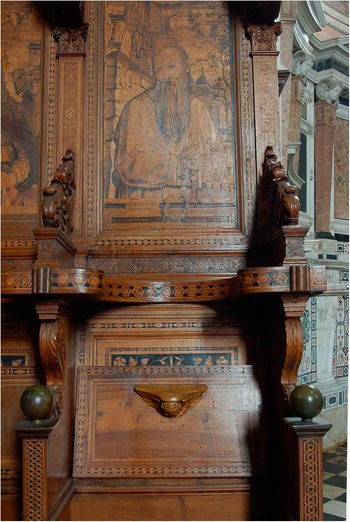
The Certosa di Pavia, constructed from 1487 (fig 5),Footnote 40 has one of the most celebrated intarsia choirs in Italy, with stall-backs depicting highly detailed portraits of saints and prophets. Beneath the swing seats, misericords project to form triangular shapes carved in the form of putti heads. Their placement at diverse heights on the stalls is an uncommon feature that could reflect the woodworkers’ inexperience in constructing such devices.Footnote 41 The stalls were built by a large team of woodworkers comprising Bartolomeo de Poli da Modena, Pantaleone de Marchi da Cremona, Giacomo dei Crocefissi and Cristoforo de Rocchi da Pavia.Footnote 42 Stalls completed by these craftsmen in other religious contexts do not have misericords, further indicating their uniqueness to the Carthusian order. In San Nicola in Rodengo, near Brescia, stalls signed by Cristoforo de Rocchi lack misericords, as do the stalls in San Petronio in Bologna by the De Marchi workshop, possibly worked on by a young Pantaleone.Footnote 43
Certosa di Pavia: choir stalls dating from 1487. Photograph: author

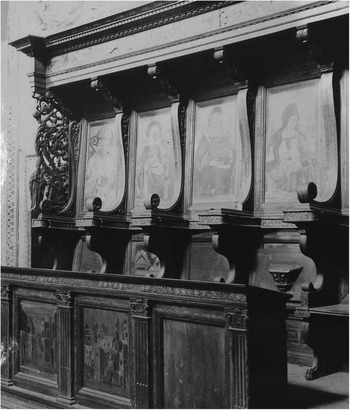
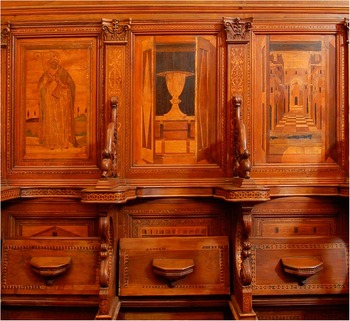
Misericords appear on extant late fifteenth-century stalls in the Certosa di Bologna, now situated in the chapel of San Giuseppe to the north of the apse (fig 6). Originally the monks’ choir of the church, the majority of the stalls were destroyed by fire in 1527.Footnote 44 These stalls are particularly plain, the only decoration consisting of simple foliate designs confined to the volutes on the stall-dividers.Footnote 45 Two sets of choir stalls in the Certosa di Padula, near Potenza, in Campania, exhibit misericords under their swing seats.Footnote 46 Signed by Giovanni Gallo in 1507, the stall-backs of the choir used by the conversi (lay brothers) depict saints and evangelists beneath cusped semicircular blind arches (fig 7), while the monks’ choir (possibly by the same artist) features intarsia scenes from the New Testament.Footnote 47 Gallo is not documented as having constructed any other surviving church furniture, so comparisons cannot be made with his non-Carthusian choirs. Featuring comparable intarsia perspective scenes of landscapes and still lifes, stalls that now form the conversi choir at the Certosa di San Martino, in Naples, were constructed by Francesco d'Arezzo and Maestro Prospero between 1510 and 1524 and also exhibit misericords (fig 8).Footnote 48 In the Certosa di Trisulti, in Lazio, choir stalls were carved by Maestro Jacobo – a French woodworker living in Rome – between 1539 and 1547.Footnote 49 In addition to the presence of small, plain misericords, the stalls are distinguished by carvings of animals and humans on the arm rests and by a series of attached lecterns.
Certosa di Bologna: late fifteenth-century choir stalls in the chapel of San Giuseppe. Photograph: author

Certosa di Padula: choir stalls of c 1507. Photograph: Conway Library, The Courtauld Institute of Art, London

Certosa di San Martino, Naples: choir stalls dating between 1510 and 1524. Photograph: author

Later Carthusian choirs also display misericords, highlighting the persistence of the phenomenon. In the Certosa di San Martino in Naples, richly carved walnut choir stalls, complete with misericords, were constructed from 1629 by Orazio de Orio and Giovanni Mazzuoli to replace the sixteenth-century stalls that now form the conversi choir (fig 9).Footnote 50 Simply carved late nineteenth-century stalls of the oldest Carthusian monastery in Italy, at Serra San Bruno, in Calabria, have misericords,Footnote 51 as do the late nineteenth- or early twentieth-century stalls in the choir of the Certosa di Vedana, near Belluno, where the design is of the utmost elegance, each stall being separated by Corinthian pilasters and carved volutes, the whole surmounted by carved cornices.Footnote 52 Even at such a late date as this, it seems that misericords were considered a vital element of Carthusian choir seating.
Certosa di San Martino, Naples: choir stalls dating from 1629. Photograph: author

The exclusive use of misericords in Carthusian churches is exemplified by the case of the Savona cathedral choir, which was commissioned as an imitation of the Certosa di Pavia choir in 1500 (fig 10). The surviving contract required that the woodworkers, Anselmo de Fornari and Elia de Rocchi da Pavia, reproduce the ‘wood, beauty, quality, height and conditions’ of the specified Carthusian model.Footnote 53 The finished stalls are indeed almost identical in most respects, including the figural intarsia portraits of apostles, evangelists and other saints, and the distinctive intarsia roundels between semicircular canopies above the stalls. However, the Savona stalls diverged from their stylistic model in one fundamental respect: they lack misericords.Footnote 54 This decisive omission suggests that woodworkers and their patrons recognized the distinction between choirs of different religious orders and adapted their designs appropriately.
Savona Cathedral: choir stalls dating from 1500. Photograph: Fulvio Rosso, Ufficio Beni Culturali Ecclesiastici di Savona

Evidence for this comes from another distinctive feature of Carthusian choirs: they only have one row of stalls, rather than two or three, and they incorporate a forma, or kneeling rest, as required by the liturgical statutes discussed below. In the contract for the Certosa di Maggiano choir, the forma was minutely described, indicating both its significance to the monks and possibly the woodworkers’ lack of familiarity with the structure.Footnote 55 The contract, dated 27 August 1511, commissioned Antonio di Neri Barili and Giovanni di Giovanni to construct an intarsia choir complete with figural images on the stall-backs ‘one figure per picture’.Footnote 56 The forma, or kneeler, was identified as the structure upon which occupants of the stalls could kneel, containing a small cupboard (cassetta) ‘for the use of the Carthusians’.Footnote 57 This document, with its specific instructions, clearly indicates that the Carthusians recognized the individuality of their choir furniture.
Carthusian liturgy
The Carthusian order was founded in 1084, when St Bruno, together with six companions, undertook to live a heremitical life in the Chartreuse mountains.Footnote 58 These first Carthusians were completely isolated, but the order subsequently developed a monastic life combining the ideals of solitude and community. St Bruno did not leave a written rule but the fifth prior, Guigo i, compiled the first customs – known as the Consuetudines Guigonis – around 1127. In 1140, priors declared obedience to the general chapter and the order received exemption from episcopal jurisdiction.
In Italy, the first Carthusian houses were founded in the twelfth century in the north-west region (Casotto in 1171; Pesio in 1173) and the order grew slowly; in contrast to other monastic institutions, it experienced its greatest expansion in the fourteenth century, when twenty-one houses were founded, mainly in central and northern Italy.Footnote 59 The start of the nineteenth through to the mid-twentieth century witnessed a further flowering.Footnote 60
Carthusian communities comprised monks and lay brothers (conversi), who lived in separate accommodation and performed distinct, often menial tasks.Footnote 61 The monks – all of whom were ordained priests – lived in small hermitages disposed around a cloister, which had a private garden and a series of rooms for prayer, study and rest. Maintaining a quasi-heremetical lifestyle, monks would recite divine office in their own cell (equipped with a single stall), while matins, vespers and conventual masses were conducted in the choir.Footnote 62 On Sundays and feast days, however, the entire office was performed in the choir.Footnote 63 Carthusian liturgy was noted for its austerity, solemnity and simplicity, reflecting the unique ideology of the order.Footnote 64
Carthusian liturgical guidelines went through several revisions. Following the first customs of around 1127, the Statuta Antiqua were compiled in 1259; a third edition, the Statuta Nova, was written in 1368; while the Tertia Compilatio was compiled in 1509.Footnote 65 In 1510, Johannes Amorbach printed an edition containing all the statutes to date, illustrated with Urs Graf's woodcuts of the Bruno cycle and Tree of St Bruno, and this was widely distributed across Europe.Footnote 66 As in the ceremonial guidelines for other monastic and mendicant orders, instructions were given for when it was appropriate to stand, kneel and sit during services. However, the Carthusian use also gave strict directions for the use of misericords, confirming that they were specifically associated with their liturgy.Footnote 67 Whereas the Consuetudines Guigonis contained few seating instructions, the first part of the Statuta Antiqua, dedicated to the observation of religious ritual, explicitly cites misericords no less than twelve times.Footnote 68 In the chapter on general customs in church, monks were instructed to lean on the misericords or kneel on the forma when they first entered the choir.Footnote 69 Feast days during which monks were allowed to rest on misericords included Palm Sunday, Maundy Thursday and Good Friday.Footnote 70 It seems that monks could lean at more passive sections of the liturgy, such as during prayers and while the priests or deacons were performing ceremonial acts.Footnote 71
Subsequent liturgical publications, including official statutes and books for everyday use during the mass and office, maintained these strict directions. For example, a breviary printed in Venice in 1491 for the monastery of Santi Girolamo e Bernardo, in Padua, contained references to misericords, verifying their use in fifteenth-century Italy.Footnote 72 The much shorter Statuta Nova of 1368 was less concerned with seating positions, but the 1509 Tertia Compilatio returns to guidelines for using misericords.Footnote 73
When, following the Council of Trent, the four main compilations were brought together into one edition – the Nova Collectio Statutorum – the Ordinarium Cartusiense was published first and separately in 1582 with even more detailed instructions for the use of misericords than previous publications. The chapter on the celebration of Divine Office dictated precisely when monks should stand, sit, genuflect or lean upon the misericords. They were obliged to kneel on the forma whilst saying the Pater noster and Ave Maria before the office; during the Gloria patri up to sicut erat; after Deus in auditorium and during the Preces in each office.Footnote 74 However, at certain important festivals, and every day from Easter to Pentecost and during the vigil of Christmas, monks could lean on their misericords instead.Footnote 75 The ceremonial also lists further occasions when the monks could ‘stay leaning on the misericords with covered heads, only the priest standing’;Footnote 76 misericords could also be used during various readings, prayers and hymns, including the Preces and their corresponding prayers in all the offices of the day.Footnote 77 On the other hand, monks were required to stand facing the opposite side of the choir during the singing of canticles, such as the Magnificat, Te Deum and Benedictus, and ‘by no means must we rest upon or cling to our seats, but reverently stand erect’.Footnote 78
Such directions for standing, sitting, kneeling or leaning reflected the solemnity and importance both of the constituent part of the service and of the day in the liturgical calendar. This gestural hierarchy ranged from standing during the canticles to sitting during the readings in Matins.Footnote 79 These (and many other) textual references indicate that the use of misericords was interwoven with Carthusian liturgical practice. Indeed, such complex instructions for the use of misericords sometimes caused confusion amongst Carthusian communities, keen to observe liturgical uniformity. An extended series of liturgical questions from the English Carthusians to the General Chapter, for example, includes one concerning the proper use of misericords on the stalls in monks’ cells.Footnote 80
Services were particularly long in the Carthusian tradition, and the use of misericords might have arisen as a vital measure for alleviating fatigue.Footnote 81 The strict prescription of physical attitudes was also intended to reinforce the monks’ vows of obedience and to enhance the solemnity of their devotion. The prominence of misericords may also reflect the French origins of the order, founded by St Bruno near Grenoble, the location of the Grande Chartreuse, the mother church of the order.Footnote 82 The presence of misericords in French churches generally is attested by numerous other examples,Footnote 83 among them several surviving French Carthusian stalls.Footnote 84
From its foundation, the Carthusian order insisted upon uniformity in liturgical observation, and proposed changes had to be agreed by the General Chapter.Footnote 85 Every monk was expected to keep a copy of the Consuetudines in his cell, reinforcing corporate conformity,Footnote 86 and to study the life of St Bruno, aided by the woodcuts of the St Bruno cycle and Tree of St Bruno in the 1510 Tertia Compilatio.Footnote 87 Since there was a great deal of uniformity too in the design of Carthusian churches and monasteries,Footnote 88 it is not surprising that this should also apply to stall design, accounting for the presence of misericords on Carthusian choir stalls in Italy.
Liturgies of other religious orders
The correct use of misericords was prescribed by Lanfranc's Constitutions (c 1077) and William of Hirsau's Constitutiones Hirsaugienses (c 1077–9), but neither text was originally intended for observance by any particular order.Footnote 89 The official liturgical texts for other monastic, mendicant and secular communities set rules for sitting and standing, but generally made no specific allowance for leaning on misericords except in regional usage. The Cistercian order was the one exception, detailing their usage to a similar extent as the Carthusians. The official compilation of the Ecclesiastica Officia or Liber usum, a liturgical order-book, dates to around 1120–30.Footnote 90 Later reforms to the liturgy saw the addition of feast days, but in essence the Cistercian rite remained intact from then until the seventeenth century.Footnote 91 The Ecclesiastica Officia makes fourteen explicit references to misericords.Footnote 92 During the office of the dead, for instance, monks could ‘lean on the misericords, and say the Our Father in silence’.Footnote 93 Misericords are present in the seventeenth-century stalls in the Cistercian Abbazia di Chiaravalle Milanese,Footnote 94 and the same is true of the early sixteenth-century stalls in the Cistercian monastery of Morimondo, which display intarsia images of saints on the stall-backs and have carved misericords under the swing seats.Footnote 95 Both could be explained, however, by their geographical location in Lombardy, as already discussed. It is therefore possible that misericords also played a part in the design of choir seating in Italian Cistercian churches, but evidence is lacking.
The picture is just as inconclusive for other religious orders. Seating guidelines in the Rule of St Benedict, for example, make no explicit reference to misericords.Footnote 96 Early ceremonials for the Franciscan and Dominican orders give instructions for genuflections and inclinations, but again, do not mention the use of misericords.Footnote 97 Stalls belonging to these communities outside Italy often feature such supports (for example, the Franciscan church in Fribourg in Switzerland has misericords dated to around 1280)Footnote 98 but as we have seen in the case of north-west Italy, their presence is best explained not as a liturgical requirement but influenced by regional-specific morphologies, styles and iconographies, by the practices of specific artists and workshops and even the influence of specific patrons.Footnote 99
Conclusion
Contrary to the prevailing consensus that misericords do not feature in Italy, surviving church furnishings demonstrate that they were indeed present in choirs of the Carthusian order across the country, though rarely as highly decorated as examples north of the Alps. Revealingly, Italian woodworkers produced misericords almost exclusively for Carthusian choirs, on the whole omitting them from the choirs that these same craftsmen built for other religious orders in the same city or region.Footnote 100 Explanations for this absence based on the Italian climate or lack of appropriate materials are inconsistent with this evidence. The decision to renounce misericords in choir seating therefore appears to be conscious and intentional, although an overall explanation for the absence of misericords on Italian stalls cannot be ascertained without further evidence. Italian woodworkers evidently knew how to construct misericords, but they did not fully exploit them as loci of decoration or meaning. Most Italian Carthusian misericords are exceptionally basic in design and construction (those in the Neapolitan Certosa providing a distinctive exception), indicating again that their existence was due to liturgical rather than aesthetic considerations. Whereas the presence of misericords in Piedmont and Valle d'Aosta shows the importance of regional artistic influence on stall design, the Carthusian case introduces a potent liturgical dimension. In Italian Carthusian stalls, the presence of misericords derived both from the rites of the order and from its strict jurisdiction. Despite being small, plain and hidden from view, misericords on Italian Carthusian stalls are not simply a product of stylistic influence or furniture fashion, but of ceremonial considerations and ritual functions that could introduce elements that transcended geographical boundaries.
ABBREVIATIONS AND BIBLIOGRAPHY
- Abbreviations
- BCT
-
Biblioteca Comunale di Trento
- BL
-
British Library, London
- BMD
-
Bibliothèque municipale de Dijon
- BNF
-
Bibliothèque nationale de France, Paris
- Bodleian
-
Bodleian Library, Oxford
- HAB
-
Herzog August Bibliothek, Wolfenbüttel
- NUL
-
National- und Universitätsbibliothek, Ljubljana
Acknowledgements
This paper is based on a section of my doctoral thesis, ‘Choir stalls in Venice and northern Italy: furniture, ritual and space in the Renaissance church interior’, submitted to the University of Warwick in 2009. An earlier version was presented at the International Medieval Congress in 2009. I am greatly indebted to my supervisor, Dr Donal Cooper, and to the Arts and Humanities Research Council for funding the project. I am also grateful to Dr Julian Luxford and Dr Charles Tracy for reading and commenting on earlier drafts.