

The new theories of form in late eighteenth-century instrumental music that have made a deep mark on the music-analytical landscape in the last 15 years have contributed a good deal to our understanding of sonata expositions, but less with regard to the development and, especially, the recapitulation.Footnote 1 In their Elements of Sonata Theory, James Hepokoski and Warren Darcy have seven chapters on aspects of the exposition, but only one on the development and two on the recapitulation. William E. Caplin, in Classical Form, has an insightful theory of the Classical exposition, but he runs into terminological and conceptual difficulties when he comes to the recapitulation. Although isolated studies of recapitulatory practices exist in the literature,Footnote 2 there seems to be a general reluctance to theorize the late eighteenth-century recapitulation. As soon as one lays down a rule, after all, one is likely to be confounded by a counter example, especially in the works of Haydn, who often ‘recomposes’ the recapitulation. Indeed, in that case one might soon find that the (seemingly) more predictable practices of Mozart and Beethoven are once again setting the standard for one's theory, with Haydn sidelined. Hepokoski and Darcy simply treat Haydn's recapitulations as exceptional: they admit that he does not fit their theoretical generalizations.Footnote 3
It might seem wise not to make any definite predictions for recapitulations, and to accept instead a degree of compositional freedom that for Donald Francis Tovey would, after all, represent ‘normality’ in music. For Tovey, the great masters composed without ‘fixed points’.Footnote 4 There are, for instance, ‘no rules whatever for the number or distribution of themes in sonata form’.Footnote 5 Taking his lead from Tovey, Charles Rosen proposed that Haydn, Mozart and Beethoven composed according to principles, not rules; they were led by orderly good taste rather than concepts. The Classical style was determined by a sense of aesthetic balance and a feeling for symmetry and resolution rather than any specific techniques or strategies.Footnote 6 The critical approaches of Tovey and Rosen seem to work especially well for Haydn, who emerges from their writings fully the equal of Mozart and Beethoven.
In the work of Caplin, however, regulative theorizing for late eighteenth-century instrumental music has made a successful return. Caplin's account of the exposition demonstrates a conformance to schemata on the part of Haydn, Mozart and (to an extent) Beethoven with regard to that section of the sonata form. There are indeed ‘fixed points’ and rules for the number, type and distribution of themes in the exposition, as long as one is specific about the repertory and states the rules precisely and in terms of formal functions. In short, what Caplin describes as a ‘tight-knit’ main theme is followed by a transition and then one or more loosely organized subordinate themes – ‘theme’ here being conceived as an ordered succession of formal functions, typically initiating–medial–concluding, arranged as a musical paragraph. Exceptions exist, and there are areas of ambiguity, but they are remarkably few. In this light, comparing the sonata expositions of Haydn, Mozart and Beethoven from the 1770s to about 1800 with earlier instrumental music and other composers’ works of the time, one is struck as much by the overall consolidation of certain syntactic norms and thus the creation of a collective ‘style’ as by their negation for individual expressive effect – what Hepokoski and Darcy call ‘deformation’.
This article extends Caplin's functional approach to the Haydn recapitulation. My argument is that Haydn composed in his instrumental cycles from the 1770s onwards as though following a rule in the recapitulations of fast sonata movements. After 1770 the exceptions to that rule are so few that, I contend, they prove it. On the other hand, the rule does not consistently apply to Haydn's recapitulations before 1770 – a consistent recapitulatory practice emerges in Haydn's instrumental music only at that time.Footnote 7 Ultimately, I am interested in reviving the ‘sonata principle’, restated and limited for the present to fast movements in Haydn's instrumental cycles. This revival comes in response to Hepokoski's article ‘Beyond the Sonata Principle’ (2002), which pointed out ambiguities in past formulations of the principle and exposed a good deal of special pleading in its application.Footnote 8 Although it is a twentieth-century concept, the sonata principle is in fact well matched to eighteenth-century aesthetics shaped around concepts of ‘taste’. It seems less anachronistic than the metaphors of Sonata Theory,Footnote 9 and in this article I attempt to show that it can facilitate imaginative thought about the repertory, not just close it down, as Hepokoski argued. In particular, in this article I am interested in the nature of the ‘sensitivity’ that, according to Rosen, underpins the sonata principle.Footnote 10 Supposing that the sonata principle models Haydn's musical good taste, to what is he sensitive in the exposition, and how must the recapitulation be shaped in consequence?
The scope of this article is thus both very ambitious and rather modest. On the one hand, it claims to have found what is little less than the Haydn analyst's Holy Grail: a concrete principle that governs Haydn's notoriously wayward recapitulatory practices in the three instrumental genres for which he is most renowned. On the other, the results of that discovery are, for the present, mainly classificatory. All the analytical case studies are short. The aims are to state the principle clearly, to demonstrate that its claims are coherent, and then to make a typology of the compositional strategies that Haydn employs in his recapitulations while at the same time observing that principle. The implications of this article for future work lie not so much in new analytical insights into individual movements by Haydn as in the overall approach to the repertory, in the realization that late eighteenth-century composers – even those we think of as most ‘original’ – may have been as much concerned with consolidation as with innovation, and in the potential intersections between compositional practices and the aesthetic ideas of the time.
My theoretical stance in this article is somewhat eclectic, drawing from Caplin and from Hepokoski and Darcy alike, despite the polemical disputes that followed the publication of their respective treatises.Footnote 11 Caplin's concept of formal function, especially ‘intrathematic function’ (a constituent function of a theme), is fundamental to my understanding, and in general I prefer Caplin's terminology for themes and their components. I also follow Caplin in avoiding the concept of ‘closing theme’ or ‘C-space’ as Hepokoski and Darcy's theory has it. In Classical practice there are subordinate themes and (within them) post-cadential closing sections, and the two are different, even if Haydn occasionally explores the grey area between them. That said, in a group of subordinate themes, as Caplin points out, one may be more tightly knit than the others, but it is not always the last. On the other hand, I accept Hepokoski and Darcy's concept of medial caesura, and the necessity of a medial caesura in opening the possibility of a subordinate theme in the first place, at least in the repertory under consideration here. I also accept their concept of medial caesura declined – preferring this to Caplin's idea of a subordinate theme that starts with continuation function – and their view that ‘continuous’ expositions exist, that is, those without a true medial caesura and therefore also without a subordinate theme. In so far as Haydn's recapitulations represent a reinterpretation of their respective expositions, his compositional practice corresponds with these theoretical preferences, and they allow the sonata principle as formulated here to be upheld time after time.
The data on exposition and recapitulation structures assembled in the Appendix below appears to be objective but is not altogether so; behind it stand interpretative decisions based on judgments involving special conditions of individual movements. The reader must tolerate such imperfections if the interesting broader questions about the repertory as a whole are ever to be raised. Areas of debate on expositions would include whether to hear two elided subordinate themes or one with an evaded cadence and a highly extended cadential progression; whether to hear a closing section or a relatively tight-knit subordinate theme; whether to speak of ‘medial caesura declined’ (Hepokoski and Darcy) or a ‘two-part subordinate theme’ with ‘internal half cadence’ (Caplin); and in general how to weigh up passages that project more than one intrathematic function at once (is this genuinely a new start or does it really function to continue a process or re-emphasize the conclusion of what has just ended?). In recapitulations, too, there will be matters of dispute, especially in the later quartets, where multiple discontinuities mean that the number of sections may be unclear. My analyses assume that a listener prefers an interpretation that corresponds – in a way explained below – with the exposition. Non-corresponding sections in this sense, if they can be said to exist at all, are at least very rare, and possible exceptions are singled out in my discussion. Other analysts would doubtless produce different schemes for certain movements, but, in most cases, if the analysis of the exposition changes, that of the recapitulation must, too. In general, then, interpretative differences of this kind do not threaten the sonata principle. When this is not the case I have again pulled out the movement for separate discussion.
The sonata principle reformulated
The Haydn recapitulation consists of one or more themes (in Caplin's functional sense of the term, that is, ‘paragraphs’), and occasionally a transition comparable to the one in the exposition. A coda is not counted here as part of the recapitulation. A recapitulation theme is in the tonic, meaning that it begins and ends in that key (it may digress tonally in the middle without cadencing). A transition, when there is one, will likewise begin and end in the tonic. A recapitulation theme will conclude with a perfect authentic cadence or, as long as it is not the last theme, a half-cadence or some other dominant prolongation. The sonata principle can then be restated for Haydn's fast sonata-form movements post-1770 as follows: ‘The set of basic ideas that express initiating function in exposition themes is identical to the set of basic ideas that express initiating function in recapitulation themes.’
This proposition says nothing about the number of themes with a given basic idea in either exposition or recapitulation. For instance, in Haydn's practice there are quite often two distinct themes in the exposition that share a basic idea, but only one theme in the recapitulation that uses that basic idea, or vice versa. Likewise, the proposition says nothing about the material that expresses medial or concluding functions in either exposition or recapitulation. It says nothing about the development section. It says nothing about the order in which the basic ideas of recapitulation themes will appear in relation to the exposition. (Permutations are uncommon but do occur.) The proposition refers to all exposition themes, not just subordinate themes, as do some formulations of the sonata principle. The basic idea that begins the exposition's main theme will also begin a recapitulation theme; in other words, Haydn avoids ‘binary sonata form’ (Hepokoski and Darcy's ‘Type 2’) in these movements. This understanding of the Haydn recapitulation is not unprecedented: Hepokoski and Darcy touch on it with their concept of the ‘synecdochic strategy’ in Haydn. They point out that Haydn will give a recapitulatory ‘incipit’ to recall the corresponding ‘zone’ of the exposition before reworking the later events within that ‘zone’.Footnote 12 But their account is limited by their reluctance to adopt functional concepts – their terms ‘incipit’ and ‘zone’ are functionally neutral.
The expression of medial and concluding functions in recapitulation themes is free: the material may be new, reordered, or shuffled between the continuations of different themes or between a continuation and a transition; material that in the exposition expressed medial or concluding function may be condensed or omitted altogether in the recapitulation; there may be lengthy interpolations or internal expansions within continuation units; and there may be distant modulations or bold rhetorical surprises within those units. Ten bars before the end of Symphony 96/i (bar 194) there is a sudden ff tutti outburst in the tonic minor that quickly subsides to allow this otherwise cheerful movement to end brightly as though nothing had happened. There is no parallel event in the exposition or even in the development, and the tonic minor has little significance in the rest of the movement. This apparently arbitrary event, however, in no way threatens the sonata principle as formulated here, as it occurs during the expression of a concluding, not an initiating, function. A similar sudden tutti occurs halfway through the recapitulation in Symphony 100/i (bar 239), at a deceptive cadence that might have ended the second recapitulation theme. The ff tutti on an E♭ chord leads to a tonal digression tonicizing E♭ (♭VI) and a big expansion of the theme which draws on material that in the exposition appeared during the transition, along with entirely new material. At first flush, this interruption would seem to hinder tonal stability or resolution. It has a precedent of a kind in the exposition's first subordinate theme, but that went only to the local tonic minor; the tonal digression in the recapitulation is actually bolder – hardly a force for resolution, on the face of it. But this, too, as ultimately merely a form of cadential extension within a theme that begins and ends in the tonic, is perfectly acceptable on the terms of the sonata principle.
Symphony 99/i likewise has a big expansion of the second recapitulation theme, including a turn to the tonic minor (bar 162) and then an unexpected tutti using material from the exposition subordinate theme's closing section (bar 167), now switched to a position before, rather than after, the point of cadential arrival. In Symphony 103/i the solo drumroll and other material from the movement's slow introduction return at a slow tempo and soft dynamic as an interpolation within the otherwise vigorous second recapitulation theme (bars 202–13). In Symphony 46/iv, part of the minuet movement recurs before the second recapitulation theme has cadenced (bar 153). The second recapitulation theme of Symphony 77/i is greatly expanded in comparison with its expositional counterpart, and is marked by hesitation and rhetorically heightened pauses and restarts (bars 176–89). Yet in all these cases, too, the rule about the basic ideas of these themes is observed strictly. In String Quartet op. 54 no. 2/i the brief tonicization of ♭VI in the main theme is expanded in the recapitulation into a full secondary development (from bar 138), while the second of the two versions of the subordinate theme played in the exposition is massively expanded in the recapitulation; new material and textural combinations are introduced, there are unexpected rhetorical hesitations, and the first basic idea recurs within the second recapitulation theme as part of the continuation (from bar 193). Initiating function within the recapitulation themes, however, is articulated by exactly the same pair of basic ideas that did the job in the exposition. The recapitulation of Quartet op. 64 no. 1/i seems about to end, having used only a single theme, by cutting straight to the characteristic cadential figure from the exposition's subordinate theme (both exposition themes use the same basic idea, so such an ending would not in itself contradict the sonata principle). But cadential arrival is postponed by a tonicization of ♭II (from bar 133). When the tonic is reached again (bar 152), a second recapitulation 1-theme begins, but within a dense fugato texture (the entries not at the ‘proper’ pitch levels) based on the first half of basic idea 1. At this late stage the movement undergoes transformation from the courtly style of the Viennese galant in the manner of its mid-century master, Johann Christoph Wagenseil, into a Haydnesque blend of boldness and learned style. The recapitulation uncovers obscure possibilities within the materials, yet, amid the audacious alterations, no new basic ideas are introduced to begin the recapitulation themes. In Symphonies 98/i, 99/i and 101/i the recapitulation theme that shares its basic idea with the exposition's subordinate theme is reshaped in direct response to the treatment of that material in the development. But while the harmonic and phrase structures are radically changed, and even the structure of the basic idea is altered, the identity of that idea is always preserved. In short, Haydn's recapitulations allow freedom in a remarkable range of parameters, but, by contrast, strictly observe the rule about basic ideas, indicating a constraint on Haydn's play with formal syntax: not everything is fair game. In this sense at least, Haydn is not as ‘normal’ (i.e. not as free) as Tovey would have us believe.
Compare my formulation of the sonata principle with Rosen's: ‘What must reappear in the recapitulation […] is the second group, at least any part of it that has an individual and characteristic aspect, and that does not already have its analogue in the first group.’Footnote 13 ‘Individual and characteristic’ suggests initiating function, but characteristic material can express medial functions as well, and characteristic material can appear outside themes altogether, for instance in transitions and closing sections and in medial-caesura-declined strategies. In all those cases, according to my version of the sonata principle, the characteristic material does not need to recur in the recapitulation, and indeed examples can be found in this repertory where it does not. Symphony 96/i has a very tuneful section at the end of its exposition that is absent from the recapitulation (in fact, its expected return is overridden by the unexpected loud tutti in the tonic minor). This section, however, is not a theme in a functional sense but a closing section, as its harmony is merely tonic and dominant chords over a tonic pedal. In Quartet op. 64 no. 1/iv a perky tune from the end of the exposition (bars 31–8) never recurs in the recapitulation. The material is highly characteristic and enters after a perfect authentic cadence and a pause; but this is not an independent theme, it is merely a passage of cadential harmonic content that follows a subordinate theme that had ended too soon, as it were, and corrects its dimensions – one of several amiable tricks in a highly comic movement. The subordinate theme would otherwise be only eight bars long, and would be more tightly knit in its organization than the movement's main theme, which would destroy its interthematic function. On the other hand, material that expresses initiating function within a theme, even if it is less characteristic than one would usually expect, must return in the recapitulation, and must do so not in any casual way but specifically as the expression of initiating function within a theme. This rule Haydn consistently follows.
Notation
The ordered collection of basic ideas in the exposition is represented in a form such as [1(M) 2(S1) 3(S2)], where M = main theme, S1 = first subordinate theme and so on, and the sequence of integers outside the parentheses – ‘1, 2, 3’ – is the numbering of basic ideas in order of their first appearance as the expression of initiating function within an exposition theme. In the example given here, there is a main theme and two subordinate themes, all of which have different basic ideas, numbered 1, 2 and 3. When two exposition themes share a basic idea, the ordered collection is represented in a form such as [1(M S1) 2(S2)]; here, as often, the duplication is between main theme and first subordinate theme, which share basic idea 1, while basic idea 2 is reserved for the second subordinate theme. If two basic ideas are used to express initiating function within a single theme – say, the first subordinate theme – the representation is [1(M) 2(S1) 3(S1) 4(S2)], S1 appearing here twice, once for basic idea 2, once for basic idea 3. The ordered collection of basic ideas in the recapitulation is represented by a list of the numbers by which they were designated in the exposition, such as [12], [11] or [123]. This representation makes no sense without the representation of the accompanying exposition, and the first step to understanding Haydn's recapitulatory strategy in a given movement is to compare the two. Transitions are not indicated in this notation, as the focus is on themes. When a transition is present in a recapitulation it usually echoes the transition of the exposition, at least at the outset, but Haydn often does without an independent paragraph for this purpose altogether. When the exposition is continuous, its scheme is simply [1(M)], even though it obviously consists of much more than a single tight-knit theme. Table 1 shows common exposition/recapitulation patterns in Haydn; uncommon patterns that nevertheless observe the sonata principle; and (hypothetical) forbidden patterns.
| common patterns | ||
| Exposition | Recapitulation | |
| 1(M) 2(S1) | 12 | |
| 1(M S) | 1 | |
| 1(M S) | 11 | |
| 1(M S1) 2(S2) | 112 | |
| 1(M S1) 2(S2) | 12 | |
| 1(M) | 1 | |
| uncommon patterns that are nevertheless permitted by the sonata principle | ||
| Exposition | Recapitulation | Work |
| 1(M S1) 2(S2 S3) | 1121 | Trio 29/iii |
| 1(M S1) 2(S2) | 1212 | Quartet op. 64 no. 6/i |
| 1(M S) | 1111 | Quartet op. 76 no. 3/iv |
| 1(M) 2(S1) 3(S2) | 132 | Symphony no. 52/iv |
| examples of (hypothetical) patterns forbidden by the sonata principle | ||
| Exposition | Recapitulation | |
| 1(M) 2(S) | 1 | |
| 1(M) 2(S) | 123 | |
It is important that the recapitulation schema is independent of the interthematic functions ‘main theme’ and ‘subordinate theme’. On this fundamental point my account departs from Caplin's in Classical Form. By retaining the same interthematic functional terminology for the recapitulation, ‘for the sake of tradition’, he says,Footnote 14 Caplin endangers one of the great strengths of his theory: the distinction between idea and theme. The functions of themes in the recapitulation in fact always change in relation to the exposition themes with which they share their basic ideas. Caplin admits that in a Classical recapitulation the function of the ‘main theme’ is now to signal a sense of return, and that of a ‘subordinate theme’ is now to express the tonic key with special power, not to articulate an alternative tonic. Moreover, on his terms the recapitulation main theme and transition are often ‘fused’,Footnote 15 so that the recapitulation begins with a loosely organized paragraph quite unlike an exposition main theme. (Haydn in particular often devises ingenious strategies at this point.) My approach avoids such difficulties, for I do not make any general claims about the interthematic functions in the Haydn recapitulation, aside from observing that recapitulation themes begin and end in the tonic and do not cadence outside it. In Haydn there are so many different overall designs and strategies for recapitulations that claims about formal functions are soon contradicted or overridden. The best that can be done is a typology of common recapitulatory strategies (see below, ‘Alternative recapitulatory strategies’ and subsequent sections).
It would be a grave misunderstanding to construe this notation as ‘reductive’, as though it were a representation of the essential content of each movement, listing the only aspects that require our attention or forcing Haydn's creativity down a few narrow channels. The statement of the sonata principle given here is in fact deliberately left very loose, and allows Haydn enormous freedom in certain respects. The aim is to determine where we can draw the line between those compositional decisions that can be modelled by a rule and those that cannot. The simplicity of the notation reflects the type of claim being made: precise but limited. The schemata presented here are starting points for the analysis of individual movements, not the final result.
The data
The Appendix shows exposition and recapitulation patterns in fast sonata-form movements in Haydn's multi-movement instrumental compositions in three major genres (keyboard trio, string quartet and symphony) post-1770.Footnote 16 There is only one clear breach of the principle. Symphony 44/iv breaks the rules on one and possibly two counts: the recapitulation lacks a 1-theme and, moreover, since the exposition is continuous, its first (and only) paragraph therefore has to begin with material that had not expressed initiating function in any theme in the exposition (bar 119). (In fact that material is completely new in the finale, although it recalls the opening idea of the first movement.) The 1-idea does recur to start a paragraph (bar 175), but it is very clearly a coda, coming after the cadence and the post-cadential section in the tonic which correspond with the final bars of the exposition. As will become clear from the examples later in this article, minor-key movements are disproportionately represented among movements that adopt unusual strategies or that require special explanations. For example, Symphony 44/iv is in some ways a deliberate rejection of modern sonata-form styles and procedures. This highly contrapuntal movement has close parallels with the fast movements of minor-key symphonies by composers associated with the Habsburg imperial court, who transferred the style of the contrapuntal chamber music beloved of successive Habsburg emperors to their symphonies precisely when they wrote in the minor. Florian Leopold Gassmann, for instance, often avoids a sonata-style ‘double return’ of the 1-idea and the home key two thirds of the way through his fast movements, and in his minor-key symphonies often defers that return to the final bars, but now bringing back the melody in tutti octaves. Haydn 44/iv has exactly the same octave texture at that point. This is an allusion to the manner of a closing ritornello in an old-fashioned concerto movement, another archaic gesture that the imperial composers incorporated into orchestral music only when writing in the minor. With 44/iv, Haydn, very much a court ‘outsider’ for most of his career, for once picks up the habits of the insiders.Footnote 17
There are further, incidental points of interest arising from the data in the Appendix. It confirms Haydn's reputation for motivic economy or, better, economy in basic ideas, as even a movement that uses only one basic idea may have many contrasting motifs expressing continuation or cadential functions. Haydn seldom uses more than two basic ideas per movement in these genres, and never more than three. It is also noticeable at a glance that in the symphonies Haydn had a phase in the later 1770s and early 1780s (nos. 53–68) when he heavily favoured what later became the textbook scheme ‘first subject’/‘second subject’ in both exposition and recapitulation [1(M) 2(S); 12], whereas at other times and in other genres this was just one option among many. That was the time when he was busy directing, arranging and composing opera for the theatre at Eszterháza and put less energy into his instrumental compositions.
Formal organization and dimensions
The formal organization of a recapitulation theme – its degree of tightness or looseness – is not constrained by any relation to the exposition theme or themes with which it shares its basic idea. There is likewise no fixed relationship between the organization of different recapitulation themes in the sense that there is for exposition themes (where a relatively tight-knit main theme will be followed by a looser subordinate theme or themes). One cannot predict that any particular recapitulation theme will be tighter or looser than any other recapitulation theme. All that one can say is that it is rare for a recapitulation theme in Haydn to be more tightly organized than the exposition theme with which it shares a basic idea (assuming that that basic idea is used for only one exposition theme). The first recapitulation theme is a common location for expansion, along with other characteristic loosening techniques such as fragmentation, harmonic instability and digression to flat keys or the tonic minor. These techniques, also sometimes used by Mozart, led Rosen to coin the term ‘secondary development’.Footnote 18 But occasionally expansion will occur in a later recapitulatory theme instead, the beginning of which is then brought forward in relation to the exposition (see Symphonies 99/i and 100/i). Exceptions to the non-tightening rule do occur, but only under special conditions. For example, in 71/i the 1-theme of the recapitulation is compressed in relation to the exposition's main theme, but earlier, in the development, there had been a false recapitulation in which the start of the main theme appeared in the tonic, and the listener could reasonably have believed for some time afterwards that a true recapitulation had started, moving to a secondary development. The compression of the recapitulation 1-theme thus avoids over-exposure of main-theme material in the tonic in the second half of the movement. In Quartet op. 76 no. 1/iv the exposition [1(M S)] is answered by a [111] recapitulation in which the 1-themes become progressively more tightly knit while at the same time turning from the minor to the tonic major. Only the first recapitulation theme is in the minor, and it follows roughly the relatively loose organization of the exposition's main theme; the next two 1-themes have symmetrical statement–response presentations, the last 1-theme being a regular eight bars in total length in its first version. At the same time, the tone of the movement turns from learned, minor-key, old-fashioned style to a comic style: an unusual transformation that underlines the exceptional status of the tightening process.Footnote 19
The overall dimensions of the recapitulation are often close to those of the exposition. When they diverge significantly, it is usually the recapitulation that is longer. The exceptions are three keyboard trios from early in the period, where the recapitulation is much shorter than the exposition. In Trio 5/ii the medial-caesura-declined process – the clear proposition of a caesura to end the transition and prepare the subordinate theme, which is then rejected in favour of the resumption of the transition – is simply eliminated from the recapitulation (bars 15–18 having no equivalent), and in 6/i and 11/i the exposition's first subordinate theme needs no equivalent in the recapitulation because it uses the same basic ideas as the main theme. What is remarkable is that Haydn drew on these two exposition-expanding strategies many times in later works but always compensated for any deletions in the recapitulation by means of alternative expansions, furnishing evidence for Rosen's claims about the ‘symmetrical resolution’ and ‘aesthetic balance’ demanded by the Classical style which, he maintains, may nevertheless be realized in countless different ways. A common strategy for Haydn is to write an exposition in which the subordinate theme, or the first of several subordinate themes, shares its basic idea with the main theme, and for this repetition to be eliminated in the recapitulation but for one or more of the recapitulation themes to be expanded in relation to the exposition, so that the overall dimensions of exposition and recapitulation remain comparable (see, for instance, Symphonies 98/i, 99/i and 100/i). The case for aesthetic balance is especially strong in movements in which the recapitulation is radically reshaped in relation to the exposition, but within very similar overall dimensions, such as in Quartets op. 50 no. 3/i (exposition 44 bars, recapitulation 46 bars), op. 64 no. 4/i (38 bars and 39 bars) and op. 76 no. 1/i (both 86 bars). Recapitulation strategies of the ‘transformation’ or ‘realization’ types (see below) are the most likely to throw up longer recapitulations. Symphony 92/i is a one-off, in which the exposition (58 bars) is ‘continuous’ in terms of Sonata Theory but highly discontinuous and repetitive on the surface, while the much longer recapitulation (104 bars) is strangely static and exceptionally playful and ironic even by Haydn's standards.Footnote 20
Order of recapitulation themes
The order of recapitulation themes usually follows the order in which the basic ideas first appeared in the exposition. Haydn is perhaps surprisingly consistent in this respect, given the freedom he allows himself in other parameters. Sometimes additional 1-themes are added, usually after the others. Such paragraphs may at first sight resemble codas, but not all are well described as such: sometimes the preceding theme will end with a dominant prolongation, meaning that the recapitulation is not yet over; sometimes the dimensions of the rest of the recapitulation will be relatively short; and sometimes the final 1-theme will complete a larger process, as in op. 76 no. 1/iv. Permutation of basic ideas in relation to the exposition is rare. Recapitulation themes with basic ideas deriving from two different exposition subordinate themes are permuted in only two movements in the repertory: Symphony 52/iv ([1(M) 2(S1) 3(S2); 132]) and Trio 26/i ([1(M S1) 2(S1) 3(S2 S3); 1332]). Both are in minor keys, confirming the impression that unusual formal procedures tend to occur disproportionately in the minor. 26/i is an exceptional movement in other ways, too (see below).
Nothing here precludes the possibility of ‘reversed recapitulation’, that is, the presentation of a recapitulation 1-theme only after 2-themes, 3-themes and so on. Thus a [1(M) 2(S)] exposition may be answered by a [21] recapitulation. However, this also occurs only twice in the repertory, and on both occasions it is part of a witty game in the recapitulation in which an attempted or partial 1-theme fails, as it were, and needs to be redeemed after the 2-theme. Hepokoski and Darcy do not allow the concept of reversed recapitulation because it does not make sense from a rotational point of view, yet it seems an attractive explanation for these few movements. Haydn does not write a reversed recapitulation as a matter of course, on equal terms with normal recapitulations; it addresses some kind of problem with an unsatisfactory or aborted recapitulation 1-theme. In Quartet op. 50 no. 3/i ([1(M) 2(S); 21]) a contrapuntal, quasi-fugal, episode in the development contains an entry of the 1-idea in the tonic (bars 64—5) in a less fragmented form than the previous entries, standing out almost like a false reprise. Thereafter, the real and permanent return to the tonic for the recapitulation starts only with material from bar 5 of the movement, omitting the 1-idea (bar 88). The phrase lasts only five bars before leading seamlessly into the recapitulation 2-theme; in functional terms, those five bars hardly amount to a ‘theme’ with a new basic idea, but are simply a fragment that links the dominant prolongation at the end of the development with the start of the 2-theme. The 2-theme repeats the exposition's subordinate theme almost exactly, aside from transposition. When it ends, there is a general pause that lasts more than two bars (bars 112–13), implying to the first-time listener that the movement is over. But then the 1-idea enters to complete the recapitulation with a theme that, although it soon turns into an expanded cadential progression, is still in functional terms an unambiguous theme. That swift turn to cadential function adds to the wit of this passage: in the terms of the sonata principle, a 1-theme is necessary to complete the movement; this fact is, as it were, belatedly ‘realized’ by the players during the general pause; and as soon as the 1-idea is provided at the start of a theme the movement can end, so it moves straight to cadential harmonies. This movement is another reason to extend the scope of the sonata principle to the basic ideas of exposition main themes, even though they are not presented outside the tonic: without a sense on the part of the listener that partway through the recapitulation of op. 50 no. 3/i something is missing, the witty effect of Haydn's eventual resolution is greatly diminished.
The second reversed recapitulation in the repertory is found in Symphony 89/i ([1(M) 2(S); 21]), an example of especially virtuosic recomposition. The main theme is prefaced by two bars of introductory chords. These appear in the tonic to start the recapitulation (bars 111–12), but a harmonically stable, tonic-prolonging version of the 1-idea does not follow. Instead, a secondary development is immediately launched with a fragmented, harmonically unstable version of the 1-idea played in imitation by solo flute and bassoon, tracing a chromatic circle-of-fifths progression. An anticipated tonic perfect authentic cadence is then violently interrupted by a tutti outburst on ♭VI, leading to the lengthy extension of a section that paradoxically lacks the expression of initiating function aside from the introductory chords. One can call this a failed recapitulation 1-theme, which is wittily redeemed by the eventual, complete and well-formed 1-theme that follows the 2-theme (now without the introductory chords; starting in bar 152). This recapitulation permutes the diverse materials of the exposition in an especially complex way, in contrast to the development, which follows the rotational order of all expositional materials rather strictly.Footnote 21
A ‘partially reversed’ recapitulation arguably occurs in Quartet op. 77 no. 1/i ([1(M S1) 2(S2) 3(S3); 213]), if one allows three subordinate themes in the exposition, all elided (a feasible alternative would be to read only one, highly extended subordinate theme, in which case the movement presents fewer problems).Footnote 22 The second of them is very tightly knit for a subordinate theme, and it recurs in the tonic only immediately before the recapitulation 1-theme (bar 121). This theme is again tightly knit, and its seamless integration with the sections preceding it, as well as its closing dominant prolongation, make it sound more like the end of the development than the start of the recapitulation. Here the ambiguous status of the exposition's S2 sanctions the unusual treatment of the ‘theme’ in the second half of the movement. A false reprise effect halfway through the development further confuses the ‘rotational’ structure of the movement, confirming that thematic permutation tends to occur in movements that are exceptional in other ways as well.
Identity
When Haydn writes more than one theme in an exposition on the same basic idea, as he so often does, he may vary the type of theme (e.g. period to sentence) or the type of repetition of the presentation within two sentences (from, say, statement–response to exact repetition). When writing a subordinate theme that shares the main theme's basic idea, he loosens the organization of the theme as a whole and often uses only part of the main theme's idea, either supplementing it with different motifs or simply leaving it shorter. But in both cases he also often varies the shape of the basic idea itself, or whatever part of it remains. It is evidently of crucial importance to establish what amounts to the identity of a basic idea; that is, how much variation and what kind can be tolerated before the idea becomes a different idea. This is because recapitulations often contain a single theme that begins with a basic idea that resembles two or even more from the exposition, even though it may correspond literally with only one of them. Occasionally it may even be a new version that does not correspond literally with any exposition basic idea. In cases such as [1(M S); 1] and [1(M S1) 2(S2); 12] the single recapitulation 1-theme ‘covers’ both exposition 1-themes. One cannot lay down hard-and-fast criteria for identity, since it depends on aural perception. On the evidence of Haydn's practice, the best guideline is as follows: at least one motif must be perceptibly shared by the two ideas, and the most important link is rhythm. Interval content and direction may be altered, but the permitted amount seems to be dependent on the degree to which the melodic material is characteristic. The less characteristic the material, the more variation can be tolerated. This guideline is not derived from studies in music psychology, but is inferred from Haydn's compositional decisions across the repertory. The reformulated sonata principle must be applied with this understanding of the identity of basic ideas if it is to model Haydn's practice successfully.
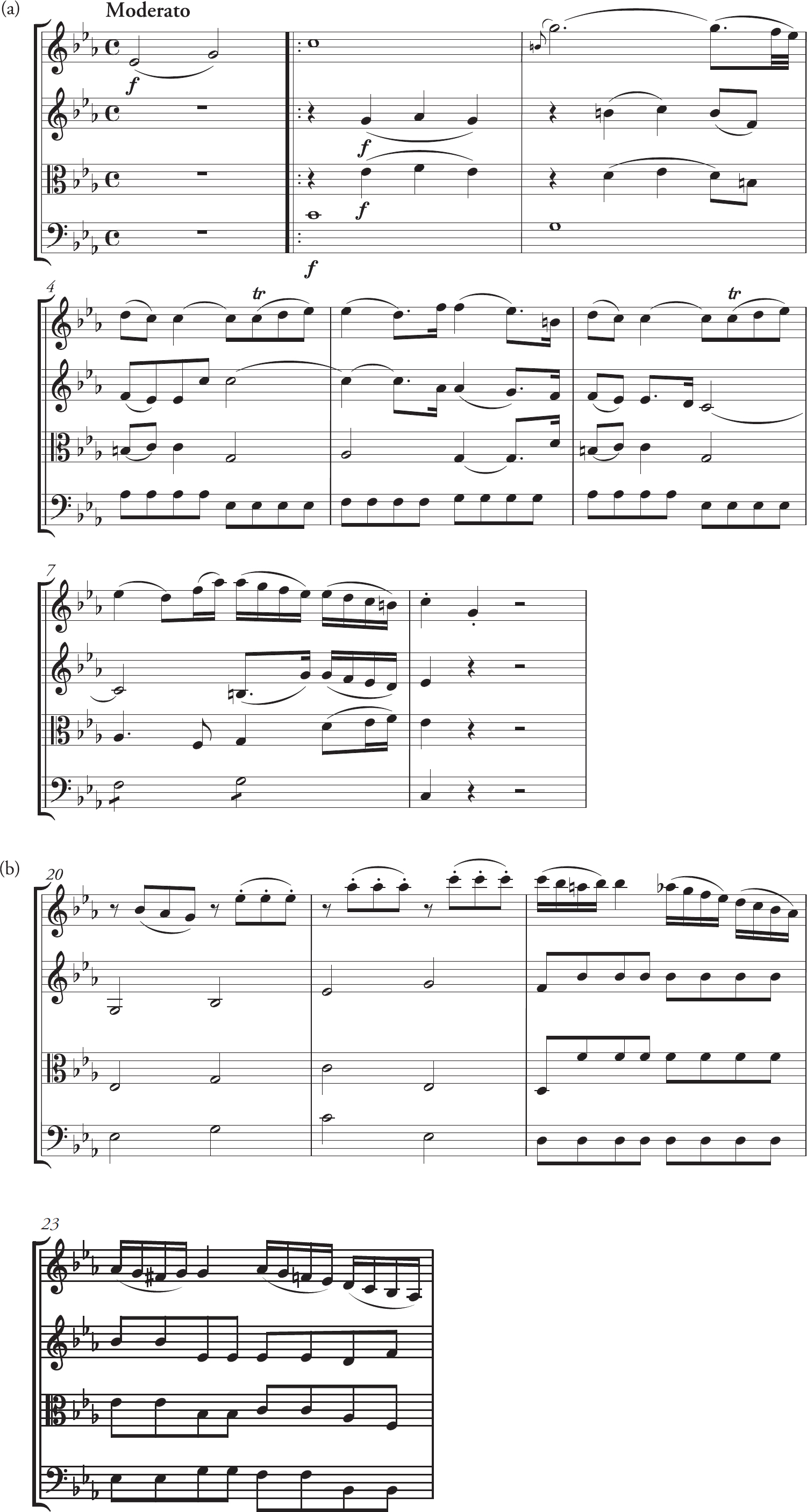
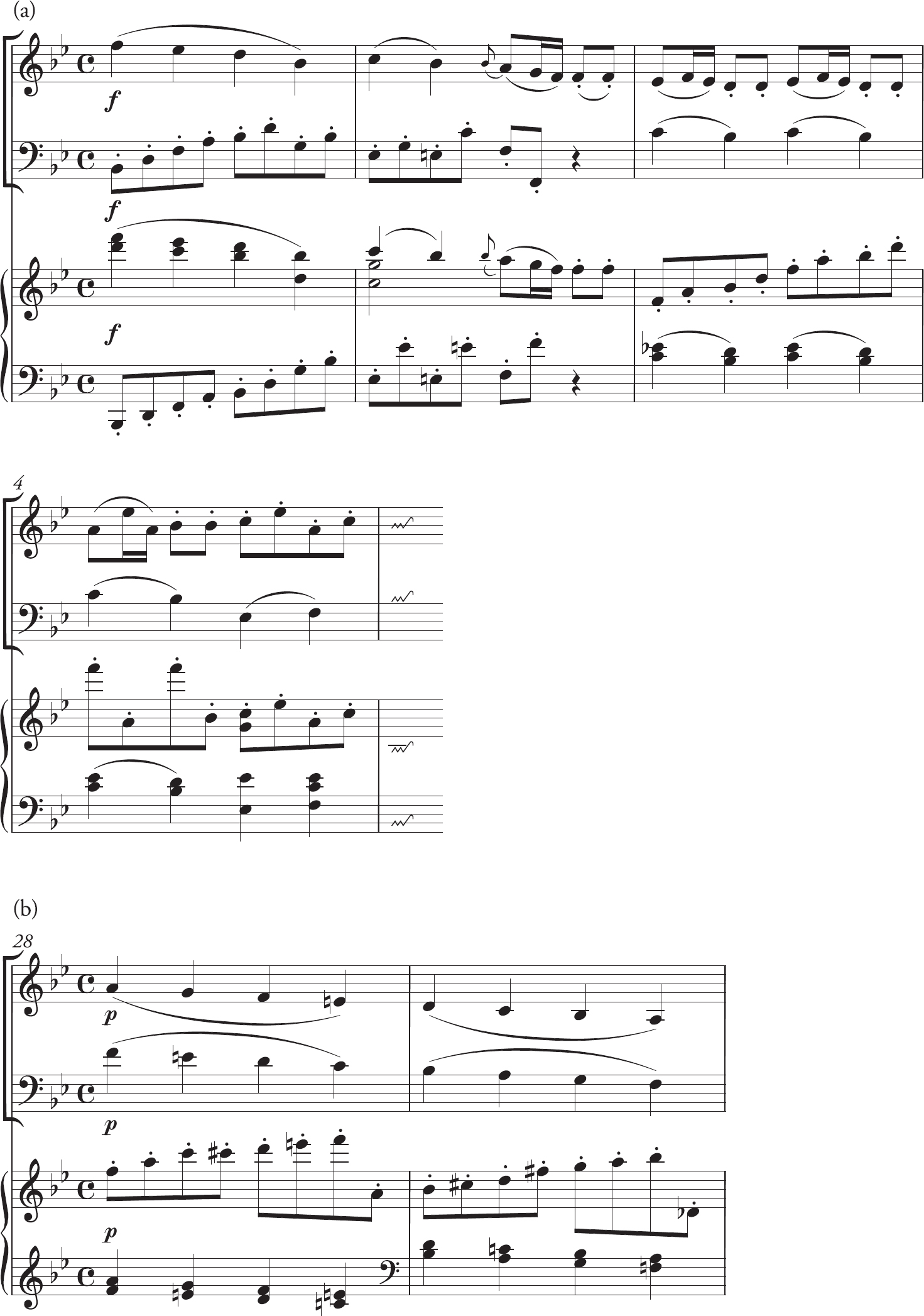
In Trio 15/i ([1(M S); 1]) the repeated crotchets from the M version of the basic idea are deleted for the S version, which features dense repetition of the characteristic dotted figure – fragmentation typical of the S version in this type of movement (bars 2–4 and 45–6). The overall shapes of the presentation phrases of the respective themes are quite different. In Quartet op. 17 no. 4/i ([1(M S); 1]; see Example 1) only the first two minims are shared by the two exposition versions of the basic idea. The connection is tenuous: only the three lower parts have the minims in the S version – they might at first sound like accompanying parts – and the motif is not distinctive in itself, but stands out in relation to the fast note values and characteristic material that follows it in both exposition themes. In Trio 20/i ([1(M S); 1]; see Example 2) the two contrapuntally independent parts of the M version of the basic idea are preserved for the S version, as is their contrary motion, although they are inverted; their contrasted articulation (one staccato, one legato) is preserved; the descending crotchet figure is still doubled in thirds and its direction is still descending, although the contour is now fully conjunct; the rhythm and rising direction of the staccato quaver figure is preserved, but its intervals are changed from leaps to mainly conjunct motion; the dynamic is changed from f to p; the second half of the M version of the basic idea is discarded; and, as is often the case, the S version is shorter. In all three examples, the recapitulation theme uses only the M version – the S version drops out. The exposition of Quartet op. 20 no. 2/i ([1(M) 2(S); 12]) has a two-part subordinate theme that uses different versions of the 2-idea in the respective phases of presentation (bars 21–2 and 33–4). The contour of the first half of the idea is significantly altered, although the even quavers, the imitative texture, the doubling in thirds and the conjunct descent of the second half are all preserved. Only the second version recurs in the recapitulation as the basic idea of a theme (bars 92–3), so the two versions must be considered variants of the same idea if the sonata principle is to be upheld. In Quartet op. 33 no. 4/i ([1(M S1) 2(S2); 12]) the basic idea of the first subordinate theme recurs in the recapitulation, but only to tonicize IV within a secondary development (that is, within the continuation of the 1-theme; bars 64–5). If the sonata principle is not to be breached it must therefore be regarded as a variant version of the 1-idea, even though in this case the rhythm has been altered, the articulation and the texture have been transformed, melodic chromaticism has been added, and – a more regular alteration – the idea has been fragmented. What is preserved in the S1 version is the harmonic scheme V–I and most of the intervallic shape of the initial motif. The initial tied minim from the M version appears in the first violin part in the S1 version. In Quartet op. 76 no. 4/i ([1(M S1) 2(S2); 112]) the melodic contour, melodic direction, phrase lengths and scoring of the ‘sunrise’ 1-idea are extensively modified in the second themes in both exposition and recapitulation (inversion of both texture and melodic contour, fragmentation, altered phrase lengths, melody given to different instruments), but the characteristic rhythm, sustained accompaniment chords and harmonic stasis remain, and ensure that each of these ideas is heard as a variant of the original 1-idea (compare the passages starting at bars 1, 37 and 142).

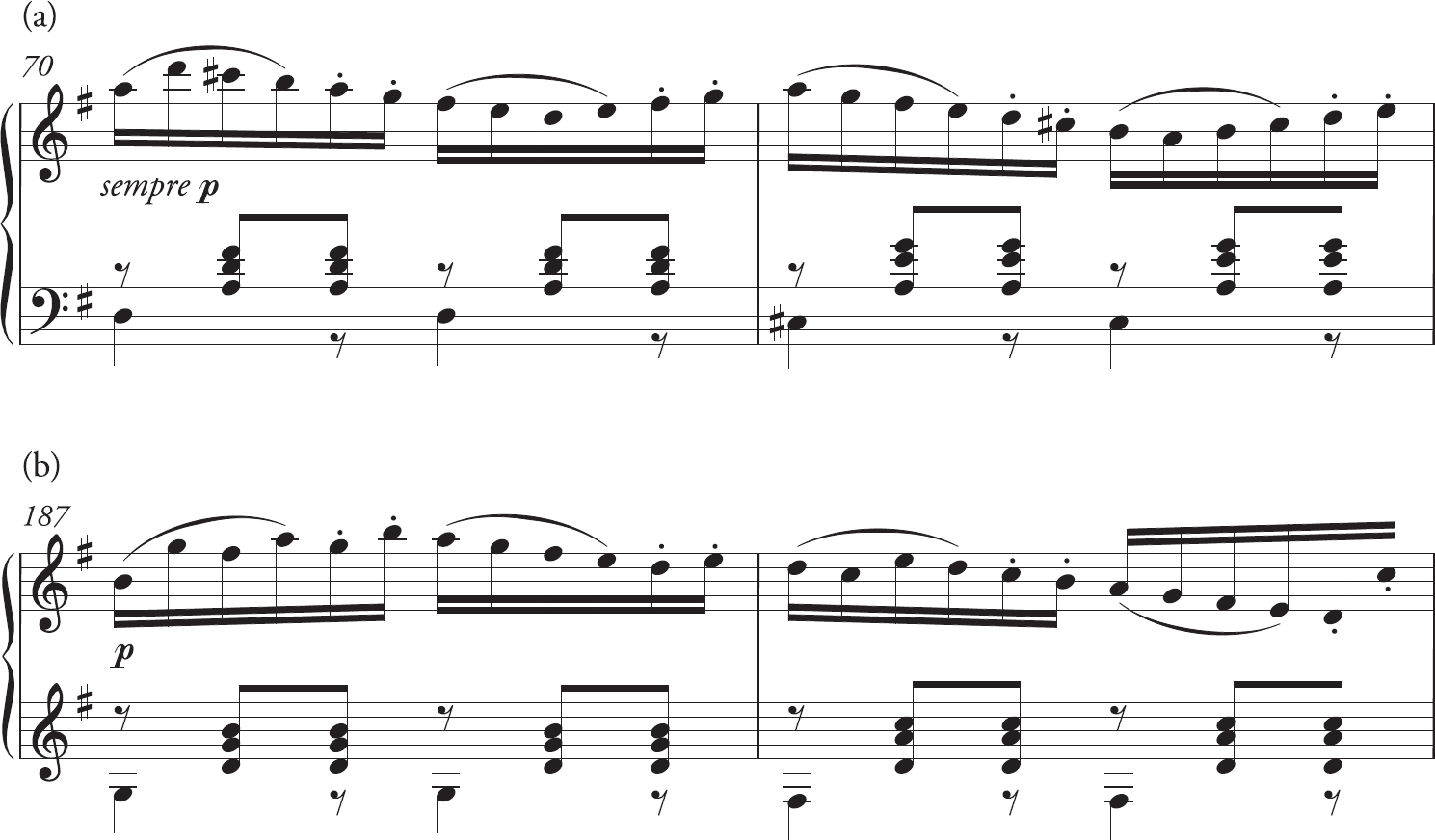
The more conventional and the less characteristic the material from which a basic idea is formed, the more alteration in melodic contour it can suffer while preserving its identity. For Caplin, conventional material is distinguished from characteristic by relatively uniform rhythmic values, melodic direction and intervallic content. A conventional basic idea in Haydn tends to have fast rhythmic values in relation to its surrounding material and thus stands out as passagework. This recognizable rhythm is preserved in the variant, along with dynamics, texture and accompaniment patterns, while the melodic direction and intervallic content may change. Such alterations tend to occur in expositions with two subordinate themes that use different basic ideas, one characteristic, the other conventional. Its contextual status as the ‘non-tuneful one’ of the two is another reason why the conventional basic idea is easily heard as ‘the same’ in the recapitulation, despite the changes. Examples include the 2-themes in Quartet op. 76 no. 1/i ([1(M) 2(S1) 3(S2); 123]) (starting at bars 48 and 71) and Symphony 94/i ([1(M) 2(S1) 3(S2); 123]; see Example 3), and the 3-themes in Symphony 95/i ([1(M) 2(S1) 3(S2); 123]) (starting at bars 44 and 145).


Contrapuntal basic ideas
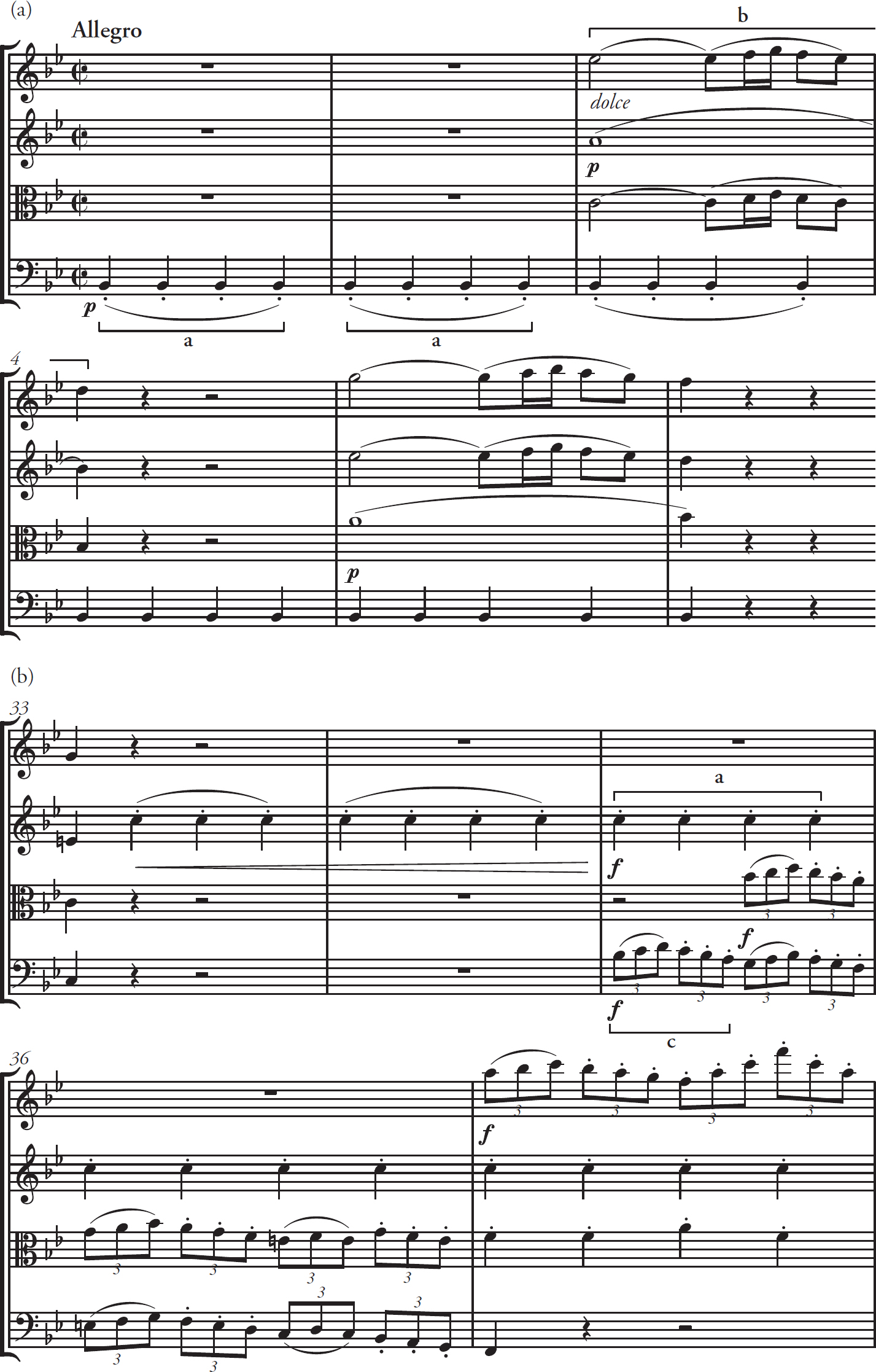
If there are two independent contrapuntal voices in a basic idea, then only one of them needs to be preserved for the sake of identity. Thus to the exposition [1(Mab Sac)], where b and c are distinct counterpoints to a, an acceptable recapitulation is [1ax], where x might be anything – it might, for instance, be b, c, something new or nothing at all. This conception of identity is quite loose in certain ways, but the leeway is needed as Haydn's practice is free. In Quartet op. 54 no. 3/i, x in the abstract example above is simply b (bars 107–8). Here, a is somewhat less characteristic than either b or c, yet c recurs nowhere in the recapitulation, and certainly not within the expression of initiating function of the sole recapitulation theme. Only the fact that its expositional presentation occurs simultaneously with a, making a link back to the basic idea of the main theme, prevents a breach of the sonata principle. In Quartet op. 50 no. 1/i (see Example 4), x (bars 110–11) is again b; here c, which is derived from the continuation of the main theme, does return in the recapitulation, but only to express further continuation (bars 111–22). This is a tricky case, because c has a much more characteristic shape than a (which is nothing more than a repeated note), yet in the recapitulation c is lost as an initiating gesture. The temptation to read this exposition as a standard [1(M) 2(S)], treating the repeated notes merely as accompaniment, would result in a breach of the sonata principle; if it is to be upheld, one must accept that a repeated note in the bass at the start of a string quartet has, in context, a kind of characteristic quality and gives shape to the 1-idea, thus allowing the basic idea of the subordinate theme to be understood as a variant, and producing the scheme [1(M S); 1].

In general, S versions of a basic idea are dispensed with in recapitulations much more readily than M versions. Normally, if there is more than one version of basic idea 1 in the exposition (for the main theme and at least one subordinate theme) and only a single 1-theme in the recapitulation (for instance, [1(M S); 1]), the exposition's M version will be used for the latter, making a correspondence between the first themes in both exposition and recapitulation, articulating the return of the tonic by a thematic return to the start of the movement, and confirming the sense that later expositional versions of the basic idea are variants of an original rather than vice versa. There are very few movements in which a single recapitulatory 1-theme uses the S version of 1 rather than the M version, and they have special events in the development involving 1 in the tonic. In Quartet op. 54 no. 3/iv ([1(M S); 1]) the M version is used in the tonic for a false reprise near the beginning of the development (compare the passages starting at bars 1, 45, 95 and 165).
Sensitivity
To return to Rosen's conception of the sonata principle, what kind of ‘sensitivity’ is modelled by this account of recapitulatory practices in Haydn? Obviously there is a sensitivity to formal function, specifically the distinction between initiating and medial functions at the local level. But what matter most are the basic ideas that express initiating function specifically within exposition themes, not just any initiating function. Exposition transitions, for instance, may be sentential in construction, beginning with a basic idea; however, the account proposed here does not require anything of such a basic idea in the recapitulation. Haydn's closing sections likewise sometimes feature in the first few of their codettas characteristic material which locally expresses a sense of beginning something new. As indicated above, though, such closing sections are occasionally absent from the recapitulations that follow (Symphony 96/i, Quartet op. 64 no. 1/iv). In the fast-movement expositions of his symphonies, Haydn often articulates the arrival on the tonic of the new key with an energetic but stable section, presentational in structure, sometimes following a long dominant pedal, which nevertheless remains within the transition because there is no actual caesura gap. This is a form of ‘blocked medial caesura’ in Hepokoski and Darcy's terms.Footnote 23 If the material at this point is new (not a version of the 1-idea), there is no stipulation on what happens to it in the recapitulation. In Symphony 81/i ([1(M) 2(S); 12]) the harmonically stable, presentational passage in the dominant that blocks the medial caesura (MC) (bars 42–5) recurs in the recapitulation only within the cadential progression of the recapitulation 2-theme – in fact, as a cadential evasion (bars 61–4), thus clarifying its true function in the exposition as an event that ultimately delays and disrupts rather than beginning anew.
By the same token, in cases of what Hepokoski and Darcy call ‘medial caesura declined’, the material that immediately follows the proposed medial caesura may be new, characteristic and harmonically stable, prolonging the tonic of the subordinate key, thus sounding locally like the start of a subordinate theme. This is admittedly rare; usually the declining of the medial caesura is a strong rhetorical gesture that indicates instability and the restarting of continuation function, specifically that of the transition. But occasionally instability is deferred for a few bars, and it seems for a while that the medial caesura has been accepted and a subordinate theme is beginning. At times it is difficult to distinguish the section that follows from a genuine subordinate theme (if the ensuing cadence is a V: PAC – perfect authentic cadence) or from what Caplin calls a ‘two-part subordinate theme’ with ‘internal half cadence’ (if the cadence is V: HC – half-cadence).Footnote 24 Caplin's concept of a two-part subordinate theme can encompass even some regular medial-caesura-declined cases, as Caplin allows ‘beginning with continuation function’ and ‘beginning with cadential function’ as available techniques of loosening the organization of a subordinate theme,Footnote 25 loose organization being typical of its interthematic function. For the present account, it is necessary to favour Hepokoski and Darcy here over Caplin, as long as the music following the first caesura can at some point feasibly be interpreted as a return to the rhetoric of a transition. If it sounds as though the transition is being restarted, even retrospectively, then it seems reasonable to accept that it is. A subordinate theme that sounds like a further stage of transition is no real subordinate theme. In short, the approach adopted here allows that even stable material, if it is convincingly destabilized in a short while so that it seems that the transition has been resumed, need not recur in the recapitulation as the expression of initiating function or as anything else.
There are three movements in the repertory considered here for which this argument is needed. One of them, Quartet op. 64 no. 3/i, was picked up by Hepokoski in ‘Beyond the Sonata Principle’. In the exposition, a proposed medial caesura (bar 32) is followed by a presentation-like phrase over stable harmony prolonging the local tonic (V). The basic idea is new and characteristic – in fact, a lively tune. The idea's repetition, however, turns to the local tonic minor, and transition rhetoric is soon resumed. The genuine medial caesura occurs later (bar 48) and is followed by a syntactically complete subordinate theme ending with a PAC in the dominant. For Hepokoski, this ‘apparent-double-MC effect’ means the implicit rejection of the first attempt at a subordinate theme.Footnote 26 In the second half of the movement, the basic idea of the rejected subordinate theme recurs in the tonic minor during the development but not at all in the recapitulation. Hepokoski points out that these events lead Rosen into some dubious arguments in his attempt to uphold the sonata principle. The present reformulation and application of the principle has been designed so as to avoid them. At the equivalent moment in Quartet op. 17 no. 5/iv, a strong initiating gesture in the dominant (bars 30–6), again based on new, characteristic material, never recurs later in the movement. In the exposition it is given standard statement–response repetition like a presentation phrase, but dissolves into busy transition-style sequential passagework that eventually leads straight to a PAC in the dominant, resulting in a continuous exposition. The MC candidate that precedes it (and is ultimately declined), is itself weak, and might not even be regarded as a genuine candidate, as its cadence has a melodic appoggiatura and there is neither dominant prolongation nor the ‘hammer blows’ typically found before a medial caesura.Footnote 27
In Trio 5/ii ([1(M) 2(S1) 3(S2); 123]) a very early proposed I: HC MC is apparently accepted by new, characteristic and harmonically stable material in the dominant, structured as a symmetrical presentation phrase with standard statement–response repetition (bars 15–18). The following passage remains stable in the dominant for some time, but eventually falters, loses energy and reaches a half-cadence. The material of the presentation phrase recurs nowhere in the movement. The flexible application of the sonata principle proposed here allows the faltering end of this section to mean the failure of a first (and perhaps too early) attempt at a subordinate theme and reversion to transition function; the passage that follows the half-cadence turns out to be the real ST, located at a more suitable, central position within what turns out to be a long exposition. This scheme (early proposed I: HC MC declined; later V: HC MC accepted) could be found in many other Haydn movements; only the relatively stable response to the first proposed MC marks out this one. Trio 16/i ([1(M) 2(S); 12]) is a related, though slightly easier case. After a proposed I: HC MC the music resumes with a statement–response presentation phrase and (new) material very similar to the parallel position in 5/ii, but in the dominant minor, not major (bars 31–4). Later events turn rapidly to distant flat-key regions before a second MC is proposed and unambiguously accepted (bar 46). These cases are much better accounted for if one thinks in terms of an attempted MC and/or proposed ST that fails and is then replaced, rather than an independent first ST or a two-part ST.
In some cases the material following a proposed medial caesura has continuational or cadential, as well as initiating, qualities, and the music moves to a perfect authentic cadence soon after. In Haydn's practice, this material does not always return as the expression of initiating function in a recapitulation theme. It seems better to regard the medial caesura as declined and the exposition as continuous (in Hepokoski and Darcy's terms), than to speak, as Caplin might, of a subordinate theme with very loose organization. This position enables us to understand the events of Quartet op. 50 no. 6/i, in which the material of an apparent presentation phrase at the start of a harmonically stable section after a proposed MC is omitted from the recapitulation. Here the sense of MC declined is subtle: it is the use of the tonic in first inversion (bar 30), the first harmony after the cadential dominant of the proposed V: HC MC, that erodes the sense of initiating function, specifically hinting at the initial tonic in a cadential progression, which, as Caplin points out, is characteristically in first inversion. In fact the rest of the music up to the V: PAC at the end of the exposition turns out to be an expanded cadential progression (ECP). Its busy texture throughout makes it sound convincingly like a return to transition rhetoric (not just a return, indeed, but the final straightening out of what had earlier been a rather directionless transition), and the exposition turns out to lack a subordinate theme at all and to be of the ‘continuous’ type.
In short, in order to model Haydn's practice, the present account of the sonata principle requires that its exposition analyses (the schemata given in the second column of the Appendix) arise from retrospective judgments at the end of the exposition about whether something near the middle of that exposition was a basic idea in a theme. Proposed ‘new starts’ that turn out to have been false do not count. The listener might believe momentarily that a subordinate theme is under way, only to discover a little later that the transition is ongoing, or, on the other hand, that the exposition has bypassed the subordinate theme altogether (continuous exposition). Haydn's ‘sensitivity’, as implied by this account, thus has a synoptic dimension; it is an end-of-exposition review of what has happened. At that point it distinguishes between themes and sentential units that are merely theme-like, such as transitions, the extended, transition-like section within a continuous exposition, theme-like MC-declined passages and closing sections. The listener knows for certain that such units are not true themes only when they are over.
Alternative recapitulatory strategies
Within the strict constraint about basic ideas, Haydn pursues several characteristic strategies in his recapitulations. The most common is well described by Rosen's concepts of ‘symmetrical resolution’ and ‘aesthetic balance’, despite, on occasion, significant changes in length or content of the component parts. The ‘tonal polarity’ of the exposition is resolved by a recapitulation that remains in the tonic (save for local tonal digressions only), covers similar material and lasts for about the same time. The alternative strategies involve either transformation of some materials from the exposition – most often the 1-idea – or realization of some latent feature. Recapitulations that pursue these strategies are most often longer than their expositions, although even if they are roughly the same length, the most striking effect will be change rather than symmetry. The alternative strategies tend to occur in movements with multiple 1-themes, especially in their recapitulations, as the focus is on the treatment and transformation of the movement's first basic idea. James Webster finds in Haydn's ‘free recapitulations’, as he calls them, ‘the infusion of a sense of process into a context of formal and tonal symmetry’. Haydn ‘continues to “compose out” the potential of his ideas to the very end. […] The recapitulatory freedom is often bound up with the gradual increase in importance, within the movement, of an originally subsidiary musical idea, or even a tiny motive.’Footnote 28 There follows a typology of Haydn's alternative recapitulatory strategies. The reformulated sonata principle accommodates them all in a way that earlier versions do not.
Contrapuntal 1-themes in the recapitulation
In this type, the melody of the 1-idea is subjected to contrapuntal treatment, usually fugato, in the recapitulation and sometimes in the exposition as well. There may be contrapuntal passages elsewhere in the movement, especially in the development, perhaps using material other than the 1-idea. The recapitulation is likely to bring out the contrapuntal tendencies of the movement decisively, uncovering latent possibilities in the material, displaying the composer's craft and calling up compositional procedures and highly wrought styles from the past or from sacred music to stand against the default modern, secular style of instrumental music. The recapitulation often responds as much to events of the development as to those of the exposition, heightening or, from the perspective of tonality, stabilizing the contrapuntal treatment first found there.
Haydn first adopted this strategy in his symphonies and later transferred it to his quartets, where it appears in abundance from the late 1780s. Symphony 44/i ([1(M S); 1]) has, strictly speaking, only a single recapitulation theme, but it is split into two parts, the first ending with a pause on a dominant seventh (bar 140), the second beginning with the 1-idea in three-part imitation. This allusion to learned style and the chromatic descending appoggiaturas that saturate the texture make a suitable final touch to a movement that, as a minor-key fast movement, would probably have been composed for performance during Lent in or around a church.Footnote 29 Symphony 46/i ([1(M, S); 1]) does not begin contrapuntally, although its main theme's basic idea is presented in unharmonized octaves, hinting at the possibility. The subordinate theme uses the 1-idea, but with a contrasted countersubject that produces an almost stereotypical two-part contrapuntal texture. The development begins with the basic idea in canon, but soon shifts to homophonic textures. The recapitulation consists of only one theme, though, a little like that of Symphony 44/i, it has two starts, both using the 1-idea. The first is identical to the start of the exposition's main theme, but lasts only four bars. The second (bar 109) is a combination of the S version and the development canon: an intensification of the contrapuntal techniques applied earlier. In Symphony 75/i ([1(M); 11]) the contrapuntal treatment of the 1-idea does not emerge until the development, and it is only in the recapitulation that it expresses initiating function via a series of canons on the 1-idea within the second 1-theme (from bar 133). This movement anticipates Haydn's later practice in quartet movements of this contrapuntal recapitulation-type in that he writes more 1-themes in the recapitulation than in the exposition. Although the first of them ends with a PAC, the second is clearly no coda, for the first is much too short to count as a recapitulation in itself. With two 1-themes, the recapitulation numbers 42 bars compared with the exposition's 45.
In the quartets the contrapuntal type of recapitulation strategy begins with op. 50 no. 2/i, which hints at contrapuntal possibilities with the tied note (potentially a suspension) in the 1-idea that begins its main theme. Again, the development begins the contrapuntal treatment (with conspicuous fugato at its very opening), and, just as in Symphony 75/i, it is taken up again in a more stable harmonic context in the recapitulation after a pause (bar 196). In Quartet op. 64 no. 1/i ([1(M S); 11]) contrapuntal texture appears first in the development, but not using the 1-idea; that occurs only in the second recapitulation 1-theme (from bar 152). In op. 64 no. 6/i ([1(M S1) 2(S2); 1212]) contrapuntal treatment of the 1-idea starts in S1 and is continued in the development. The antecedent of the first recapitulation theme is identical to that of the exposition's main theme, but the consequent (starting at bar 102) is a near-canonic fugato with pairs of entries closely spaced – the densest contrapuntal texture of the movement. The 2-theme is halted abruptly and interrupted by a second contrapuntal 1-theme (bar 123), before a longer 2-theme completes the movement. The dimensions of the exposition (45 bars) and the recapitulation (47 bars) are quite close, given the extensive rewriting and reconception of the materials. Two movements from the Quartets op. 71 are worth mentioning here, even though contrapuntal versions of the 1-idea replace an initial homophonic version already in the exposition, not just in the recapitulation. Quartet op. 71 no. 1/i ([1(M S); 11]) reveals generic ambivalence, alternating throughout between orchestral styles – including concerto-like solo writing – and dense contrapuntal textures. The latter appear at the start of the subordinate theme, including some melodic inversion and canon in the development and during the recapitulation, when the second 1-theme uses the inverted version of the 1-idea from the exposition's subordinate theme (compare bars 39–40 and 123–4). Contrapuntal textures are found throughout op. 71 no. 3/i ([1(M S1 S2 S3); 111]): in the last three of the four 1-themes in the exposition, and the last two of the recapitulation.
Quartet op. 74 no. 1/i ([1(M S1 S2); 111]) is an extraordinary movement that takes Haydn's recapitulatory strategy of counterpoint and multiple 1-themes to its furthest extreme. Contrapuntal rhetoric first appears in S2 as the 1-idea acquires a second voice with contrasted rhythm and articulation like a fugal countersubject (bars 42–4). This combination comes to prominence in the development, before the first recapitulation theme's consequent phrase is transformed (in relation to the exposition's main theme) into a chromatic fugato on the 1-idea with pairs of entries in near canon, just as in op. 64 no. 6/i (starting at bar 105). The next two themes are more freely imitative, before the movement ends with a final extended statement of the idea in unharmonized octaves – the fifth statement of the idea at the start of a section of the recapitulation, although not an actual theme in functional terms – reminiscent of a closing ritornello or the final entry of the subject in a fugue in the Viennese tradition. In fact, in its structure this movement distantly recalls the repertory of imperial contrapuntal chamber music.Footnote 30
Final-theme expansion
In some of Haydn's quartet movements, the final theme of the exposition is transformed in the recapitulation by means of expansion.Footnote 31 In the exposition the last theme is usually relatively tightly knit, so there is a sense that the recapitulation corrects something asyntactic (uncharacteristic of the interthematic function of subordinate theme) or at least disproportionate, by allowing the developmental processes of the second half of the movement to extend to the very end. There are often multiple 2-themes in either exposition or recapitulation or both. This strategy is a feature of the three quartets op. 54. The exposition of op. 54 no. 1/i ([1(M) 2(S); 122]) starts in orchestral and perhaps concerto style, and spends a long time in the tonic before finally reaching a very short, almost stunted, subordinate theme (six bars including the closing section; bars 402–461); these unusual proportions are ‘corrected’ in the recapitulation, where the closing-section material overlaps with a reiteration of the start of the 2-theme (bar 111), which is then extended massively, acquiring the typical subordinate-theme dimensions that the original lacked. The dimensions of the exposition and recapitulation, however, remain balanced (47 bars and 45 bars). A similar pattern emerges in op. 54 no. 2/i ([1(M) 2(S1 S2); 122]), where the second iteration of the 2-theme is massively expanded in the recapitulation (compare the passages starting at bars 64 and 171). Again, in the exposition the subordinate themes are rather more tightly knit in relation to the main theme than would be expected in Classical practice, and this is again corrected in the recapitulation. In op. 54 no. 3/i ([1(M S); 1]) the tonally digressive transition at the end of the exposition that links the exposition's subordinate theme back to the main theme and then to the development is expanded in the recapitulation and leads into a reprise of the 1-idea once the tonic is regained (compare bars 50–8 with the passage starting at bar 152). The exposition's 58 bars are here increased to 83.
In Quartet op. 71 no. 2/i ([1(M) 2(S1 S2); 1222]) the first subordinate theme is again relatively tightly knit, in a light, buffa style (bars 39–42). In the recapitulation a further 2-theme is added before the other two (bars 93–1041), this one with contrapuntal treatment of the 2-idea; the final 2-theme is then extended by lengthening its closing section and including an allusion to that contrapuntal passage (bars 112–25). In op. 76 no. 1/i ([1(M) 2(S1) 3(S2); 123]) the tight-knit second subordinate theme, again with a buffa-style melody, has its basic idea over a drone pedal (bars 72–6); in the recapitulation the drone is disrupted by a chromatic progression before the whole presentation is repeated (bars 195–215). Despite this expansion, however, the exposition and recapitulation both total 86 bars. In op. 76 no. 4/i ([1(M S1) 2(S); 112]) the intensive reworking of the ‘sunrise’ 1-idea is relieved in both exposition and recapitulation by another lively 2-theme, this one very short. In the exposition it could be mistaken for a closing section to the previous subordinate theme (bars 60–8); in the recapitulation it is massively expanded to include, among other things, an allusion to the 1-idea (with its characteristic and very contrasting texture), just as in op. 54 no. 3/i and op. 71 no. 2/i (bars 162–87). The exposition's 68 bars thus become 80 in the recapitulation. The final-theme expansion strategy can facilitate either syntactic standardization and symmetrical proportions in the recapitulation or luxuriant development and broader dimensions, or some combination of both. In both cases, of course, the reformulated sonata principle is upheld.
Rondo
In several finales in Haydn's chamber music, a sonata movement with a rondo-like 1-theme acquires a rondo-like form in the recapitulation through an extra 1-theme after the 2-theme, so that the 2-theme is sandwiched between at least two 1-themes. The movement will be in fast tempo and 2/4 metre; the 1-idea will be lively; and later there will be tonic drones and rustic stomping or violin effects. The final 1-theme is usually very similar to the exposition's main theme, and is approached in such a way that it sounds like the return of a refrain, not like a coda (in Caplin's functional terms, the latter is an addition ‘after the end’, at least on the level of the movement's primary processes).Footnote 32 The 1-idea itself is usually not transformed, but the genre of the movement is, in the sense that in the recapitulation the movement realizes its rondo destiny as implied by the character of the 1-idea, which never quite fitted a sonata movement. Trio 27 is rare for its genre (in Haydn's practice) in having two of its three movements in sonata form; it is thus appropriate that the finale ([1(M) 2(S); 121]) realizes itself as the rondo that it ‘should’ have been from the outset. The frisky main theme is in rounded binary form with a period for its repeated A section, so the 1-idea enters identically six times. In the recapitulation, the 2-theme is brought in earlier than in the exposition and is extended through the evasion of its cadence, making it function like a rondo episode (in the tonic), placed between 1-themes of roughly equal length. In Trio 29/iii ([1(M S1) 2(S2 S3); 1121]) the ratio of 1-themes to 2-themes changes from 1:1 in the exposition to 3:1 in the recapitulation. S2 (bars 79–90) is quite tightly knit, while S3 (bars 91–128) is a more loosely organized second try with the same basic idea. This much is reminiscent of the final-theme expansion strategy, but in this movement the 2-idea recedes in importance in the recapitulation, where only the brief S2 version remains. Quartet op. 64 no. 3/iv ([1(M) 2(S); 121]) is similar in form to Trio 27/iii, with an expanded, episode-like 2-theme in the recapitulation (bars 196–225) before a final 1-theme. Quartet op. 74 no. 1/iv ([1(M S1) 2(S2); 1121]) gestures strongly in the direction of the contrapuntal strategy, with its S1 (from bar 50) and then again in the development and the second recapitulation 1-theme (starting at bar 184). But the return of the 1-idea for the final recapitulation theme (bar 249), despite lingering contrapuntal strands, switches the movement to the rondo type, and by the end, drones dominate the texture.Footnote 33
Minor-key strategies
Haydn's minor-key sonata movements from this period are diverse, but reveal two fairly consistent though contrasted recapitulatory strategies. In the first, a hesitant or fragmentary exposition main theme is answered in the recapitulation by a 1-theme reconceived in structure or character and by the realization of something that in the exposition was merely latent. The movement ends with the intensification of minor-key rhetoric. Movements that adopt this strategy manifest some of the most radical structural changes in Haydn's recapitulations and can be accommodated only on a reasonably generous application of the sonata principle. In the second minor-key strategy, the recapitulation turns to the tonic major at some point after the first 1-theme and stays there. The character of the movement is transformed and sometimes the structure of one or more of the 1-themes is more tightly knit than in the exposition.
The famously ambiguous opening of Quartet op. 33 no. 1/i ([1(M S); 1]) leads to a decisive, tutti-like initiating gesture in the tonic only in bar 11, at what might be interpreted as the beginning of the true main theme but retrospectively turns out to have been the start of an unusually shaped transition. In the recapitulation the 1-idea is presented in even more ambivalent fashion, and the theme is extended by fragmentation, hesitation and silences. When the tutti-like gesture finally occurs (at bar 72), it sounds even more like the start of a genuine theme than in the exposition, perhaps even the start of the recapitulation proper. The sonata principle is not strictly breached – transitions are allowed in recapitulations, after all, even if this one leads to no second theme – but it sounds as though the movement's 1-idea has been replaced by an alternative, and one that is more appropriate as an expression of initiating function. Quartet op. 64 no. 2/i ([1(M S2) 2(S1); 1211]) is from Haydn's only other significant instrumental work in B minor, and the movement is modelled on Quartet op. 33 no. 1/i, though here the 1-idea is not as ambiguous and the tutti-like start of the transition is based on it. The prominence of that tutti-like version in the recapitulation at the start of the second 1-theme (bar 92) is less problematic in terms of the sonata principle, though its shifting to a later position in the order of events is still a kind of transformation.
Trio 26/i ([1(M S1) 2(S1) 3(S2 S3); 1332]) is exceptional in several ways and would admit a number of different formal analyses. The sections are of unusual dimensions and send mixed signals. It is another example of unusual events in a minor-key work, and an unusual minor key at that (F♯ minor). The best candidate for MC comes very early (bar 8), at the end of what is really a modulating consequent within the main theme – a rarity for Haydn in a sonata movement at this time. The first subordinate theme is of Caplin's two-part kind; both parts (beginning at bars 9 and 22 respectively) arguably have multiple basic ideas expressing their initiating functions, with tonic root-position harmony prolonged for an exceptionally long time by means of repetitive chords and figuration. The 2-theme in the recapitulation is in only one part, but at its outset combines conventional material from both parts of the exposition's subordinate theme: left-hand chords from the later stages of presentation from the first part and right-hand figuration from the later stages of presentation from the second part (compare bars 14–15, 233–253 and 92–3). By contrast, the characteristic materials from the beginnings of both parts are eliminated. The recapitulation 2-theme thus sounds rather like a new theme with a basic idea created from material that in the exposition did not yet have full presentational status. The potential of that material to express initiating function is fully realized only in the recapitulation – a move that Haydn normally does not make. The recapitulation brings forward the 3-themes (expanding the second in the manner of the expansion strategy), thus reversing the order of the 2- and 3-themes in relation to the exposition – again very unusual for Haydn – and increasing the rhetorical significance of the 2-theme, which breaks through strongly at the end with its insistent repetitive rhythms, now ominously in the minor. The negative emotional status of the minor mode is fully realized and given heightened expression only at the end of the recapitulation.
Symphony 78/i ([1(M) 2(S); 12]) combines the minor-key intensification strategy with the contrapuntal strategy. The main theme starts with an octave ‘pathotype’ figure (involving the degrees 1, 5, 6 and ♯7 in the minor)Footnote 34 and implies that a complete lamento progression with chromatic descending bass might follow, but instead the theme becomes fragmentary and hesitant, and its harmony is ambiguous (bars 3–4). In the recapitulation the implications are fully realized with the 1-theme transformed and normalized into a full, regular, eight-bar lamento phrase (bars 134–41), the bass chromatically descending to the dominant with, later, intensive imitative textures. The Viennese symphonic repertory from the 1760s to the 1790s reveals close associations between minor mode, counterpoint and old-fashioned styles in general; in Symphony 78/i that connection is implied by the exposition's main theme but is fully realized only in the recapitulation.
Symphony 80/i ([1(M S); 11]) seems likely at one stage to make moves similar to those of Symphony 78/i. Its unstable main theme is answered in even stormier fashion by the first recapitulation 1-theme (starting at bar 128), which ends on a long dominant pedal beneath independent upper parts that suggest contrapuntal textures may be on the way. Instead, after a pause, the second recapitulation 1-theme, in the exposition's more stable S version, enters in the tonic major (bar 147), where the movement remains to the end. The recapitulation thus hints at one minor-key strategy before finally adopting the other. In Symphony 83/i ([1(M) 2(S); 12]) the modal reversal is underlined so firmly that the sonata principle is almost breached. The movement appears at first glance to introduce a new basic idea in the recapitulation at the moment the mode turns to the major (bars 146–7). In the exposition this material was used to articulate an arrival on root-position harmony in the new tonic (III) during the transition and to block the expected medial caesura for a few bars (from bar 33). In terms of intrathematic function, this material retains a good deal of cadential character as well, and does not sound entirely like a new start; instead, it brings to an end the recapitulation 1-theme. Nevertheless, as in Quartet op. 33 no. 1/i, something emerges in the recapitulation to approach the status of a basic idea despite being found nowhere in an exposition theme, and it now occupies a pivotal position. Later, the cadence of the recapitulation 2-theme is evaded with the interruption by a transformed major-mode version of the 1-idea (bar 59), confirming the transformation of mode and mood. Symphony 95/i ([1(M) 2(S1) 3(S2); 123]) likewise turns to the major for the recapitulation 2-theme and stays there. In similar fashion to Symphony 83/i, the cadence of the 3-theme is evaded when a transformed version of the 1-idea in the major interrupts the progression (bar 151). Here its presentation is continuous and symmetrical rather than – as it was before – fragmentary and irregular, reflecting the new confidence of the major-mode conclusion.Footnote 35
Two quartets from op. 76 that begin and end their four-movement cycles in the major nevertheless begin their finales in the minor. Op. 76 no. 1/iv ([1(M S); 111]) tightens the organization of the recapitulation 1-themes by stages (see above, p. 12), while reversing mode in the second recapitulation 1-theme (bar 139) and inverting the melody of the basic idea in the third (bars 181–2) along with transformations of texture, articulation, register and dynamics. The contrapuntal tendencies of the exposition's S1 might have been realized more fully in the recapitulation, but instead are downplayed. Overall, the movement transforms itself from serious to comic, or, more precisely, from a disturbing and intense minor to a cheerful major in which the final 1-theme, as Floyd Grave puts it, ‘unfolds with the charm of a magical musical box’.Footnote 36 The 1-idea of op. 76 no. 3/iv ([1(M S); 1111]) undergoes intensive contrapuntal treatment in the exposition and in the development; this is still present in the recapitulation to a degree, but is not intensified. The mode turns to major for the last three 1-themes of the four (bar 152). Again there is some tightening of the organization at the same time: the first 1-theme has a stormy secondary development for its continuation, against which the major-mode versions stand out as more compact.
Prospects
Despite the quantity of data presented in the Appendix, Haydn's high productivity means that the argument developed in this article yields only a partial perspective on his recapitulatory practices. Future studies might look at his sonata-form slow movements (including the Sieben letzte Worte), the sonata-form movements in the late Masses, and of course other genres such as the solo keyboard sonata. Other composers’ recapitulatory practices remain to be studied systematically – not just Mozart's, but also those of Haydn's Viennese contemporaries such as Johann Baptist Vanhal, Karl von Ordonez, Carl Ditters von Dittersdorf and Leopold Hofmann. At an analytical level, the commentaries offered in this article have been relatively shallow, as their function is to illustrate the reformulated sonata principle and the typology. But that principle could supply a theoretical foundation for more sustained analyses in a way that the writings of Caplin, Hepokoski and Darcy presently do not. Finally, a generation after ‘the idea of Classical style’ was dismissed by Webster as an article of modern musicological ideology,Footnote 37 the results presented here, as a supplement to Caplin's work on the exposition, confirm that the consolidation of compositional procedures was one of Haydn's preoccupations, which he pursued consistently – one might almost say fastidiously – in the most prestigious instrumental genres. The proposition of Jens Peter Larsen that the emergence of the Viennese Classical style should be dated to 1770 seems once again attractive.Footnote 38 The historical and aesthetic correlatives to this change in style remain to be explored fully, partly because of the limited print culture and lack of published music criticism in the Habsburg monarchy. But Haydn's aristocratic patrons surely had some notion of ‘good taste’, through which, in a new world of diverse, abundant and immensely popular untexted instrumental music, they hoped to order and regulate their musical experiences and those of their contemporaries.
Appendix
Basic Ideas of Themes in Expositions and Recapitulations of Fast Sonata-Form Movements by Haydn Post-1770
key
M main theme
| KEYBOARD TRIOS | ||
| Hob. XV: | Exposition | Recap. |
| 5/ii | 1(M) 2(S1) 3(S2) | 123 |
| 6/i | 1(M S1) 2(S2) | 12 |
| 8/i | 1(M) 2(S) | 12 |
| 9/ii | 1(M S) | 11 |
| 10/i | 1(M) 2(S) | 12 |
| 11/i | 1(M S1) 2(S2) | 12 |
| 12/i | 1(M S) | 1 |
| 13/ii | 1(M S1) 2(S2) | 12 |
| 14/i | 1(M S) | 1 |
| 14/iii | 1(M S1) 2(S2) | 112 |
| 15/i | 1(M S) | 1 |
| 16/i | 1(M) 2(S) | 12 |
| 18/i | 1(M S1) | 11 |
| 19/iii | 1(M S1 S2) | 111 |
| 20/i | 1(M S) | 1 |
| 21/i | 1(M S1) 2(S2) 3(S3) | 1123 |
| 21/iii | 1(M) 2(S1 S2) | 122 |
| 22/i | 1(M S1) 2(S2) | 112 |
| 22/iii | 1(M) 2(S1) 3(S2) | 123 |
| 23/i | 1(M) 2(S) | 12 |
| 24/i | 1(M S) | 11 |
| 26/i | 1(M S1) 2(S1) 3(S2 S3) | 1332 |
| 27/i | 1(M) | 1 |
| 27/iii | 1(M) 2(S) | 121 |
| 28/i | 1(M S) | 1 |
| 29/iii | 1(M S1) 2(S2 S3) | 1121 |
| 30/i | 1(M S1) 2(S2) | 112 |
| 32/ii | 1(M) 2(S) | 12 |
| string quartets | ||
| Op. | Exposition | Recap. |
| 17/1/i | 1(M) | 1 |
| 17/1/iv | 1(M S) | 1 |
| 17/2/i | 1(M) | 1 |
| 17/2/iv | 1(M) 2(S) | 12 |
| 17/3/iv | 1(M S) | 11 |
| 17/4/i | 1(M S) | 1 |
| 17/4/iv | 1(M) 2(S) | 12 |
| 17/5/i | 1(M) 2(S) | 12 |
| 17/5/iv | 1(M) | 1 |
| 17/6/i | 1(M) | 1 |
| 17/6/iv | 1(M) 2(S) | 12 |
| 20/1/i | 1(M) 2(S) | 12 |
| 20/1/iv | 1(M S) | 11 |
| 20/2/i | 1(M) 2(S) | 12 |
| 20/3/i | 1(M S) | 1 |
| 20/3/iv | 1(M S) | 1 |
| 20/4/i | 1(M S) | 11 |
| 20/4/iv | 1(M S1) 2(S2) | 112 |
| 20/5/i | 1(M S) | 1 |
| 20/6/i | 1(M) 2(S1) 3(S2) | 123 |
| 33/1/i | 1(M S) | 1 |
| 33/1/iv | 1(M) 2(S) | 12 |
| 33/2/i | 1(M) | 1 |
| 33/3/i | 1(M) 2(S) | 12 |
| 33/4/i | 1(M S1) 2(S2) | 12 |
| 33/5/i | 1(M) 2(S) | 12 |
| 33/6/i | 1(M) 2(S1) 3(S2) | 123 |
| 42/iv | 1(M S) | 1 |
| 50/1/i | 1(M S) | 1 |
| 50/1/iv | 1(M S) | 11 |
| 50/2/i | 1(M) 2(S) | 112 |
| 50/2/iv | 1(M S) | 11 |
| 50/3/i | 1(M) 2(S) | 21 |
| 50/3/iv | 1(M S) | 1 |
| 50/4/i | 1(M S1) 2(S2) | 112 |
| 50/5/i | 1(M) 2(S) | 121 |
| 50/5/iv | 1(M S) | 111 |
| 50/6/i | 1(M) | 1 |
| 50/6/iv | 1(M) 2(S1 S2) | 122 |
| 54/1/i | 1(M) 2(S) | 122 |
| 54/2/i | 1(M) 2(S1 S2) | 122 |
| 54/3/i | 1(M S) | 1 |
| 54/3/iv | 1(M S) | 1 |
| 55/1/i | 1(M) 2(S) | 12 |
| 55/2/ii | 1(M S1) 2(S2) 3(S3) | 123 |
| 55/2/iv | 1(M) | 1 |
| 55/3/i | 1(M) | 1 |
| 55/3/iv | 1(M) 2(S1 S2) | 12 |
| 64/1/i | 1(M S) | 11 |
| 64/1/iv | 1(M) 2(S) | 12 |
| 64/2/i | 1(M S2) 2(S1) | 1211 |
| 64/2/iv | 1(M S1 S2) | 111 |
| 64/3/i | 1(M) 2(S) | 12 |
| 64/3/iv | 1(M) 2(S) | 121 |
| 64/4/i | 1(M S1) 2(S2) | 112 |
| 64/4/iv | 1(M) 2(S) | 12 |
| 64/5/i | 1(M) | 11 |
| 64/6/i | 1(M S1) 2(S2) | 1212 |
| 71/1/i | 1(M S) | 11 |
| 71/1/iv | 1(M S1) 2(S2) | 1121 |
| 71/2/i | 1(M) 2(S1 S2) | 1222 |
| 71/3/i | 1(M S1 S2 S3) | 111 |
| 74/1/i | 1(M S1 S2) | 111 |
| 74/1/iv | 1(M S1) 2(S2) | 1121 |
| 74/2/i | 1(M S) | 1 |
| 74/3/i | 1(M) 2(S) | 12 |
| 76/1/i | 1(M) 2(S1) 3(S2) | 123 |
| 76/1/iv | 1(M S) | 111 |
| 76/2/i | 1(M) | 1 |
| 76/3/i | 1(M S1) 2(S2) | 12 |
| 76/3/iv | 1(M S) | 1111 |
| 76/4/i | 1(M S1) 2(S2) | 112 |
| 76/6/iv | 1(M S1) 2(S2 S3) | 122 |
| 77/1/i | 1(M S1) 2(S2) 3(S3) | 213 |
| 77/1/iv | 1(M S) | 11 |
| 77/2/i | 1(M S) | 11 |
| 77/2/iv | 1(M S1) 2(S2) | 12 |
| symphonies | ||
| No. | Exposition | Recap. |
| 42/i | 1(M) 2(S) | 12 |
| 43/i | 1(M S1) 2(S2) 3(S3) | 1123 |
| 43/iv | 1(M) 2(S2) | 12 |
| 44/i | 1(M S) | 1 |
| 44/iv | 1(M) | 2 |
| 45/i | 1(M) | 1 |
| 45/iv | 1(M) 2(S) | 12 |
| 46/i | 1(M S) | 1 |
| 46/iv | 1(M S) | 11 |
| 47/i | 1(M S) | 12 |
| 47/iv | 1(M S) | 11 |
| 50/i | 1(M) 2(S) | 12 |
| 50/iv | 1(M S) | 12 |
| 51/i | 1(M) 2(S) | 12 |
| 52/i | 1(M) 2(S) | 12 |
| 52/iv | 1(M) 2(S1) 3(S2) | 132 |
| 53/i | 1(M S1) 2(S2) | 12 |
| 53/iv | 1(M) 2(S) | 12 |
| 54/i | 1(M) 2(S) | 12 |
| 54/iv | 1(M) 2(S) | 12 |
| 55/i | 1(M) 2(S) | 12 |
| 56/i | 1(M) 2(S) | 12 |
| 56/iv | 1(M) 2(S) | 12 |
| 57/i | 1(M) 2(S) | 12 |
| 57/iv | 1(M) 2(S) | 12 |
| 60/i | 1(M) 2(S) | 12 |
| 61/i | 1(M) 2(S) | 12 |
| 62/i | 1(M) 2(S) | 12 |
| 62/iv | 1(M) 2(S) | 12 |
| 63/i | 1(M) 2(S) | 12 |
| 63/iv | 1(M) 2(S) | 12 |
| 64/i | 1(M) 2(S) | 12 |
| 66/i | 1(M) 2(S) | 12 |
| 67/i | 1(M) 2(S) | 12 |
| 68/i | 1(M) 2(S) | 12 |
| 69/i | 1(M S1) 2(S2) | 12 |
| 70/i | 1(M S1) 2(S2) | 12 |
| 71/i | 1(M) 2(S) | 12 |
| 71/iv | 1(M S1) 2(S2) | 112 |
| 73/i | 1(M) 2(S) | 12 |
| 74/i | 1(M S) | 11 |
| 74/iv | 1(M) 2(S) | 12 |
| 75/i | 1(M) | 11 |
| 76/i | 1(M) 2(S) | 12 |
| 76/iv | 1(M S) | 1 |
| 77/i | 1(M) 2(S1) 3(S2) | 123 |
| 77/iv | 1(M S) | 1 |
| 78/i | 1(M) 2(S) | 12 |
| 79/i | 1(M) 2(S) | 12 |
| 80/i | 1(M S) | 11 |
| 80/iv | 1(M) 2(S) | 12 |
| 81/i | 1(M) 2(S) | 12 |
| 81/iv | 1(M) | 1 |
| 82/i | 1(M) 2(S) | 12 |
| 82/vi | 1(M) | 1 |
| 83/i | 1(M) 2(S) | 12 |
| 83/iv | 1(M S) | 1 |
| 84/i | 1(M S) | 11 |
| 84/iv | 1(M S) | 1 |
| 85/i | 1(M S1) 2(S2) | 112 |
| 86/i | 1(M S1) 2(S2) 3(S3) | 1123 |
| 86/iv | 1(M) 2(S) | 12 |
| 87/i | 1(M) 2(S1) 3(S2) | 123 |
| 88/i | 1(M) 2(S) | 12 |
| 89/i | 1(M) 2(S) | 21 |
| 90/i | 1(M) 2(S) | 12 |
| 90/iv | 1(M S) | 11 |
| 91/i | 1(M S1) | 11 |
| 91/iv | 1(M S1) 2(S2) | 112 |
| 92/i | 1(M) | 1 |
| 92/iv | 1(M S1) 2(S2) | 12 |
| 93/i | 1(M) 2(S) | 12 |
| 94/i | 1(M) 2(S1) 3(S2) | 123 |
| 95/i | 1(M) 2(S1) 3(S2) | 123 |
| 96/i | 1(M) | 1 |
| 97/i | 1(M) 2(S) | 12 |
| 98/i | 1(M S1) 2(S2) | 12 |
| 98/iv | 1(M S1) 2(S2) | 12 |
| 99/i | 1(M) 2(S) | 12 |
| 100/i | 1(M S1) 2(S2) | 12 |
| 101/i | 1(M) 2(S1) | 12 |
| 102/i | 1(M) | 1 |
| 103/i | 1(M) 2(S) | 12 |
| 104/i | 1(M S1) 2(S2) | 112 |
| 104/iv | 1(M S) | 11 |
S subordinate theme
S1 first subordinate theme within a group of subordinate themes, followed by S2 etc.
1(M) means that the first basic idea of the movement articulates initiating function within the main theme, etc.