Introduction
It is a general observation in clinical practice that patients with persistent pain or fatigue frequently have co-morbid symptoms that show similar clinical features. These symptoms or syndromes include fibromyalgia, chronic fatigue syndrome, irritable bowel syndrome and recurrent headache. An increasing literature has revealed that considerable overlap (Aaron & Buchwald, Reference Aaron and Buchwald2001) exists among these illnesses, which are often referred to as functional somatic syndromes (Barsky & Borus, Reference Barsky and Borus1999; Wessely et al. Reference Wessely, Nimnuan and Sharpe1999; Henningsen et al. Reference Henningsen, Zipfel and Herzog2007), although there is no consensus definition or criteria. These syndromes also share characteristics such as a female predominance and frequent co-occurrence with psychiatric disorders, most notably major depression and generalized anxiety disorder.
In our previous report (Kato et al. Reference Kato, Sullivan, Evengard and Pedersen2006a), we demonstrated elevated risks of co-morbidity with chronic widespread pain in the general population. Furthermore, the extent to which the observed associations are influenced by familial (i.e. genetic and environmental) factors may be illness-specific. Nevertheless, the aetiological structure in the mechanisms underlying the co-occurrence of these syndromes remains unknown. Typically, the discussion over functional somatic syndromes can be characterized as reflecting conceptualizations from ‘lumpers’ and ‘splitters’ (Deary, Reference Deary1999; Wessely & White, Reference Wessely and White2004): The former tend to emphasize the commonalities among the syndromes, whereas the latter tend to emphasize the distinctness of each syndrome. Some studies support the notion that these syndromes can be clustered, by using statistical modelling (Nimnuan et al. Reference Nimnuan, Rabe-Hesketh, Wessely and Hotopf2001; Ciccone & Natelson, Reference Ciccone and Natelson2003; Nisenbaum et al. Reference Nisenbaum, Reyes, Unger and Reeves2004). On the other hand, various studies have found differences among the syndromes (Evengard et al. Reference Evengard, Nilsson, Lindh, Lindquist, Eneroth, Fredrikson, Terenius and Henriksson1998; Parker et al. Reference Parker, Wessely and Cleare2001; Romans et al. Reference Romans, Belaise, Martin, Morris and Raffi2002; Moss-Morris & Spence, Reference Moss-Morris and Spence2006). Thus, at issue is to investigate the balance between splitting and lumping views of these syndromes (Henningsen et al. Reference Henningsen, Zipfel and Herzog2007). To date, no empirical study has explicitly examined whether and to what extent functional somatic syndromes can be attributable to one or a few factors in common to the syndromes, and how important genetic and environmental influences are for the common factor(s), if any.
The present study employed a quantitative genetic approach using twins, a valuable source of information about genetic and environmental bases of complex disorders (Boomsma et al. Reference Boomsma, Busjahn and Peltonen2002). The twins were ascertained from the population-based Swedish Twin Registry, which enabled us to minimize selection biases to which clinical samples are prone (e.g. those seeking medical care tend to have more concurrent disorders). By using the same population-based sample as in our previous report (Kato et al. Reference Kato, Sullivan, Evengard and Pedersen2006a), we aimed in this study to evaluate the multivariate structure of genetic and environmental factors for the co-morbidities of four most common functional somatic syndromes (chronic widespread pain, chronic fatigue, irritable bowel syndrome and recurrent headache) and two psychiatric disorders (major depression and generalized anxiety disorder), all of which were assessed via standard criteria. Based on our previous findings (Kato et al. Reference Kato, Sullivan, Evengard and Pedersen2006a), we already know that the co-occurrence of these illnesses is influenced, in part, by familial factors that are shared among them. However, we now will be able to go further and reveal the structure and relative importance of genetic and environmental influences for the co-occurrence.
Method
Subjects
Subjects were participants in the Swedish Twin Registry, which comprises all twin births in Sweden from 1886 to 2000, with data on place of birth, current vital status, and address of more than 160000 individuals (Lichtenstein et al. Reference Lichtenstein, De Faire, Floderus, Svartengren, Svedberg and Pedersen2002, Reference Lichtenstein, Sullivan, Cnattingius, Gatz, Johansson, Carlström, Björk, Svartengren, Wolk, Klareskog, de Faire, Schalling, Palmgren and Pedersen2006). All living, contactable, and consenting twins born in Sweden between January 1935 and December 1958 were interviewed via the telephone from March 1998 to December 2002. Thus, the interviewees were between 41 and 64 years of age at the time of the interview. The interviews were conducted by trained personnel with adequate medical background using a computer-based data collection system. All participants provided verbal informed consent during this telephone interview which was later confirmed by postcard. Zygosity was based on responses to questions regarding physical similarity in childhood. This method has been validated repeatedly as having 98% or higher accuracy by using DNA markers (Lichtenstein et al. Reference Lichtenstein, De Faire, Floderus, Svartengren, Svedberg and Pedersen2002). This study was approved by the ethical committee of Karolinska Institutet (Stockholm, Sweden).
Assessment procedures
Chronic widespread pain was defined using our previously reported algorithm (Kato et al. Reference Kato, Sullivan, Evengard and Pedersen2006a, Reference Kato, Sullivan, Evengard and Pedersenb) based on the classification criteria for fibromyalgia proposed by the American College of Rheumatology (Wolfe et al. Reference Wolfe, Smythe, Yunus, Bennett, Bombardier, Goldenberg, Tugwell, Campbell, Abeles and Clark1990) without clinical examinations. Interviewees were asked about continuous pain during 3 consecutive months in both the upper and lower body and in both the right and left sides of the body. Those who further endorsed pain on the body axis (assessed as back pain in the last 12 months) in addition to the previous questions were defined as chronic widespread pain cases. Detailed information about the criteria for chronic widespread pain in this study was reported elsewhere (Kato et al. Reference Kato, Sullivan, Evengard and Pedersen2006b).
Screening of chronic fatigue was based on our criteria that emulated closely the 1994 criteria for chronic fatigue syndrome (Fukuda et al. Reference Fukuda, Straus, Hickie, Sharpe, Dobbins and Komaroff1994) without clinical examinations. We defined fatigue as the presence of self-reported abnormal tiredness in the absence of an exclusionary condition. Exclusionary conditions were determined from multiple sources (e.g. Swedish national registers and medical records), as described elsewhere (Evengard et al. Reference Evengard, Jacks, Pedersen and Sullivan2005). Subjects were considered having chronic impairing fatigue when they endorsed that they had felt abnormally tired in the last 6 months and that they experienced impairment. The definition of chronic impairing fatigue corresponds to ‘CF-B’ in our previous report (Evengard et al. Reference Evengard, Jacks, Pedersen and Sullivan2005).
Irritable bowel syndrome was assessed by criteria used in previous studies in the Swedish Twin Registry (Svedberg et al. Reference Svedberg, Johansson, Wallander, Hamelin and Pedersen2002), which is in line with the Rome criteria (Thompson et al. Reference Thompson, Dotevall, Drossman, Heaton and Kruis1989). In brief, subjects who endorsed experiencing recurrent discomfort in the stomach or intestine at least 7 days per month with one of the six symptoms were defined as having irritable bowel syndrome.
A lifetime history of recurrent headache not associated with infection, fever or hangover was assessed through the stem question, ‘Do you or have you ever suffered from recurrent headaches, that were not caused by infection, fever, or hangovers?’, which has been used in previous studies in the Swedish Twin Registry (Svensson et al. Reference Svensson, Waldenlind, Ekbom and Pedersen2004).
Major depression and generalized anxiety disorder were assessed by using the Computerized Composite International Diagnostic Interview short-form adapted from its original design for 12-month prevalence to assess lifetime prevalence (Kessler et al. Reference Kessler, Andrews, Mroczek, Ustun and Wittchen1998). Details on these criteria were described elsewhere (Kendler et al. Reference Kendler, Gatz, Gardner and Pedersen2006b; Mackintosh et al. Reference Mackintosh, Gatz, Wetherell and Pedersen2006).
Statistical analyses
Patterns of similarity in monozygotic and dizygotic pairs are the basis of inferences regarding the likely importance of genetic and family environmental influences. Because monozygotic twins share all their genes and dizygotic twins share only half (of their segregating genes) on average, comparison of similarities in monozygotic and dizygotic twins permits estimating the relative importance of genes and environment. Using structural equation modelling, individual differences in liability to disease may be decomposed into three latent sources of variation: additive genetic, shared environmental, and non-shared environmental variance. Additive genetic influences are indicated when monozygotic twins are more similar than dizygotic twins. Shared (family) environmental influences (environmental influences that make family members similar) contribute equally to the similarity of monozygotic and dizygotic twins. Non-shared (unique) environmental influences, which contribute to the dissimilarity of twins, include measurement errors as well. As a preliminary analysis, we first calculated phenotypic tetrachoric correlations stratified by sex, using the proc freq procedure in SAS statistical software version 9 (SAS Institute Inc., Cary, NC, USA).
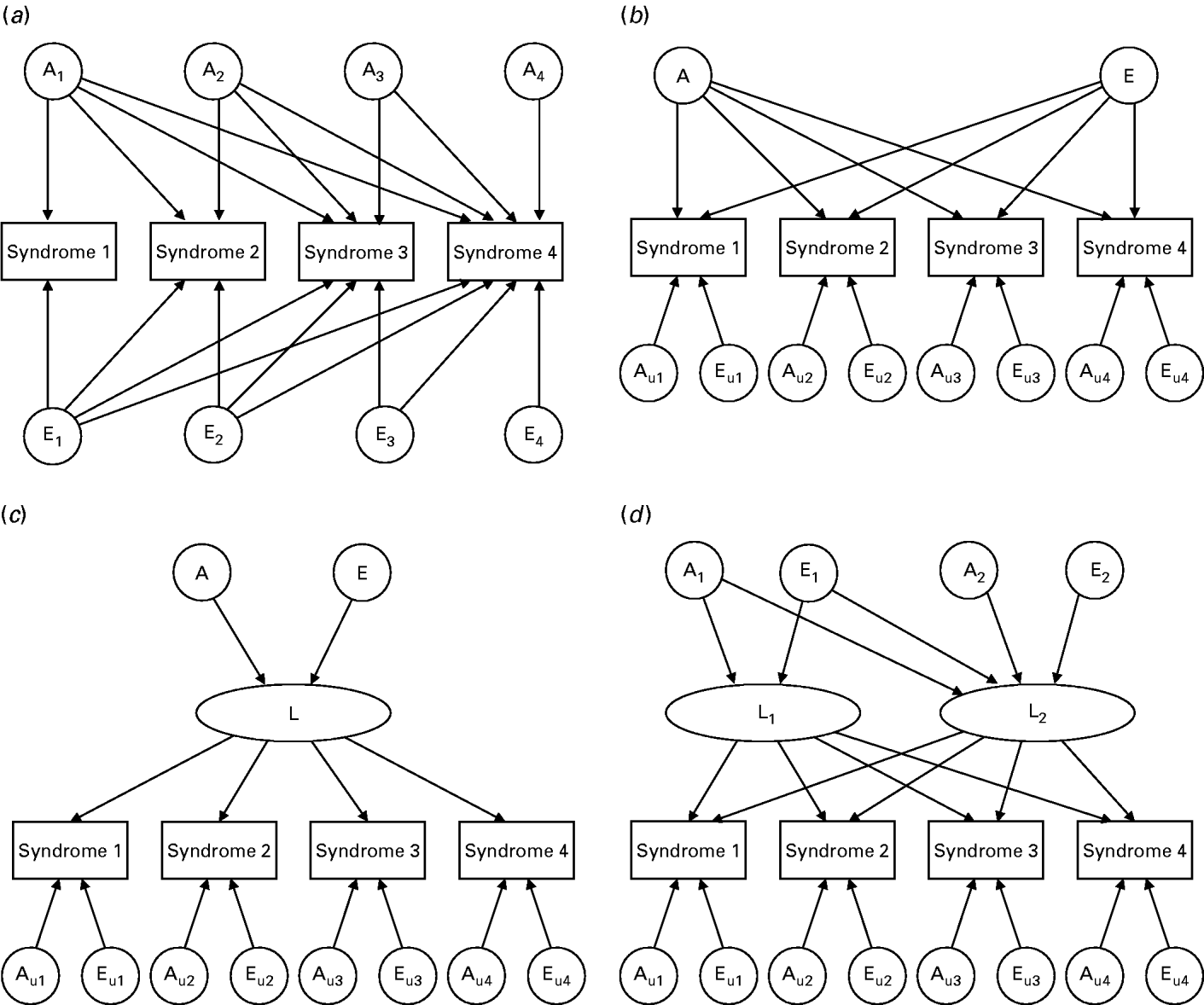
The models examined in this study are based on a liability threshold model (Falconer, Reference Falconer1965). We examined three types of model, each of which depicts a particular hypothesis about genetic and environmental structure for co-morbidities. Fig. 1 illustrates these three models, in which four variables for each are included for simplicity. First, we examined a Cholesky decomposition (also known as a triangular decomposition) model, which included additive genetic (A), shared environmental, and non-shared environmental (E) components (Fig. 1 a). In a Cholesky model, the first factor loads on all the variables, the second factor loads on all but the first one, and so on. Second, we examined an independent pathway model which included one common factor of genetic and environmental components, as well as unique factors for each variable (Fig. 1 b). Third, we examined a common pathway model, where all variables were influenced by a single latent factor that was itself influenced by genetic and environmental components (Fig. 1 c). We further extended our analysis of common pathway models with two (Fig. 1 d) and three latent factors. We compared the Cholesky model, independent pathway model, and common pathway models with one to three latent factors in terms of the Akaike Information Criterion (AIC) (Akaike, Reference Akaike1987). A smaller, more negative value of AIC indicates that the model fits the data better than other models with a greater AIC. Maximum likelihood model fitting was applied to raw data, by using the Mx program (Neale et al. Reference Neale, Boker, Xie and Maes2004). In all analyses, we adjusted trait prevalence (threshold of liability to each illness) for age at the interview and sex using logistic regression coefficients computed by the proc logistic procedure in SAS. Standardized path coefficients were obtained by fixing the total variance of each variable as well as the variance of latent factors (in common pathway models) to be unity. Through an iterative procedure, we ran each model six times, using parameter estimates for one model as the starting values for the next model, and picked the model with the best fit (typically the last).
Examples of models for underlying structures of co-morbidities (multivariate AE models): (a) Cholesky model; (b) independent pathway model; (c) common pathway model (one-factor); (d) common pathway model (two-factor). A, Additive genetic factors; E, non-shared environmental factors; L, latent factor. Factors with a subscript ‘u’ are unique to each syndrome. For simplicity, only one twin of a pair is shown and shared environmental factors are excluded.

Results
Of 41355 eligible individuals under 65 years of age, 31318 responded to the interview. Both members of 12248 twin pairs (24496 pair-wise respondents) and 6822 single respondents were included. Of the pair-wise respondents, 3260 pairs were monozygotic, 4470 pairs same-sexed dizygotic, 4518 pairs opposite-sexed dizygotic, and 127 pairs of unknown zygosity. The mean age of the sample at the time of the interview was 53.7 (s.d.=5.7) years, and 53.1% were women.
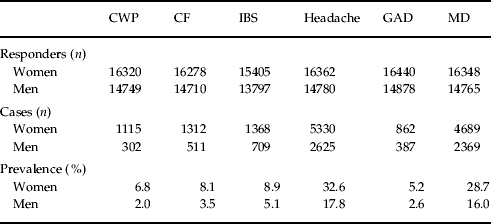
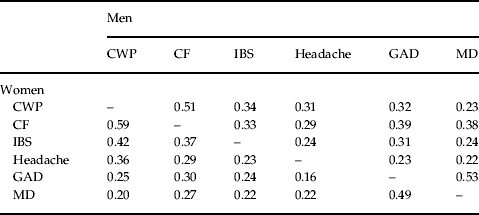
Table 1 summarizes the prevalence estimates for the four functional somatic syndromes and the two psychiatric disorders. Recurrent headache showed the highest prevalence both in women and men, followed by major depression. Table 2 shows phenotypic associations (tetrachoric correlations) stratified by sex. The pattern of correlations was generally similar in men and women. The strongest associations were between chronic widespread pain and chronic impairing fatigue, and between generalized anxiety disorder and major depression. Most other associations were moderate, and all were significantly greater than zero (p<0.001). Due to the scarcity of male pairs concordant for two of the syndromes, only women were used in the subsequent analyses.
Sex-specific estimates of prevalence for the six illnesses in subjects aged 41–64 yearsFootnote a

CWP, Chronic widespread pain; CF, chronic impairing fatigue; IBS, irritable bowel syndrome; GAD, generalized anxiety disorder; MD, major depression.
a Subjects who did not provide usable answers for screening were excluded.
Phenotypic (tetrachoric) correlations among the six illnesses in subjects aged 41–64 yearsFootnote a

CWP, Chronic widespread pain; CF, chronic impairing fatigue; IBS, irritable bowel syndrome; GAD, generalized anxiety disorder; MD, major depression.
All correlations are statistically significant (p<0.001).
a Men are shown above the diagonal (n=14878) and women below (n=16440).
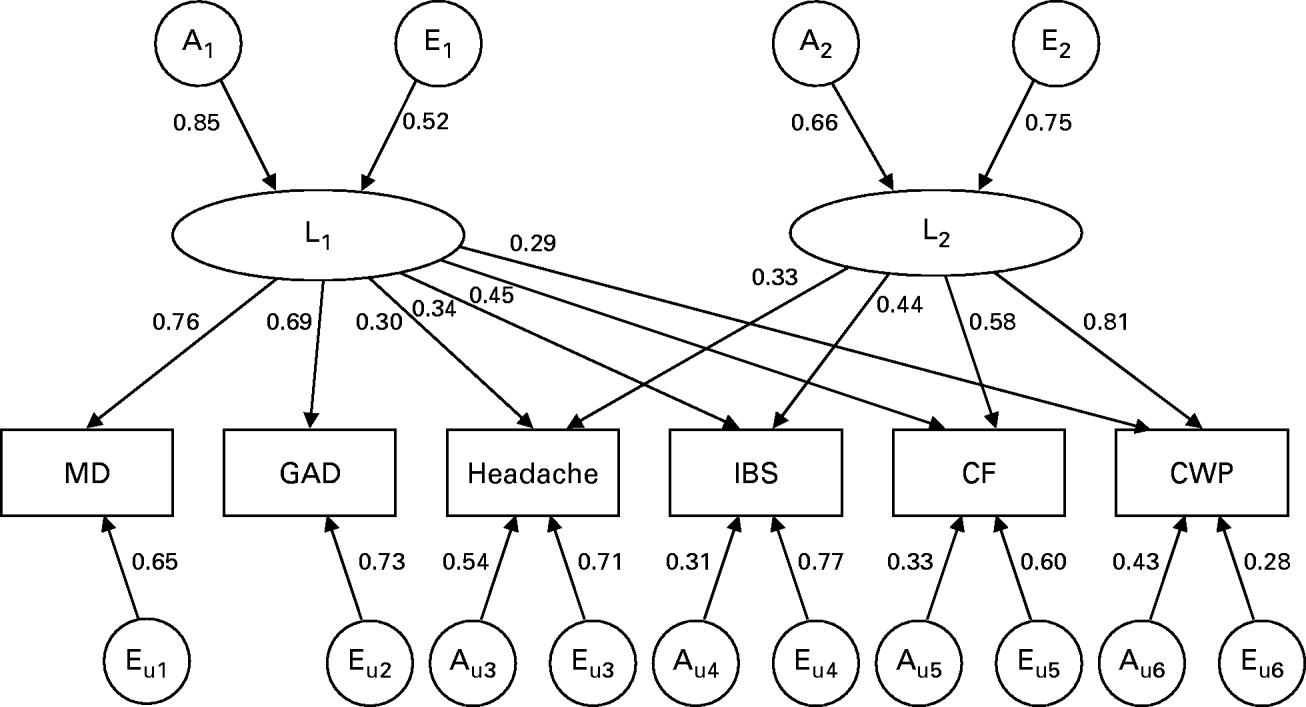
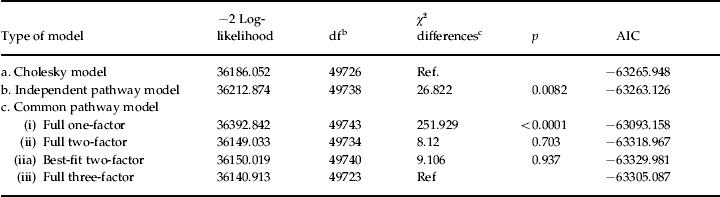
In the model fitting (Table 3), we first tested each model by dropping shared environmental factors, resulting in no significant changes in fit. Thus, only additive genetic factors (A) and non-shared environmental factors (E) were included in the models thereafter (‘AE models’). When we compared the five models [i.e. models a, b, c(i), c(ii) and c(iii) in Table 3] in terms of AIC, the two-factor common pathway model c(ii) fit best, i.e. had the smallest AIC. We then dropped non-significant paths from the two-factor common pathway model in order to obtain the most parsimonious model (Fig. 2). Dropping the paths from A1 and E1 to the second latent factor L2 did not significantly worsen the goodness of fit [c(iia) in Table 3], indicating that these two latent factors are independent of each other both genetically and environmentally. The first latent factor L1 was more greatly influenced by genetic factor A1 than by environmental factor E1, whereas L2 was slightly more influenced by environmental factor E2 than by genetic factor A2. Only L1 loaded on major depression and generalized anxiety disorder. In addition, paths from unique genetic factors to these disorders were not significant, suggesting that genetic influences on major depression and generalized anxiety disorder can be accounted for by the common genetic factor A1 through L1. On the other hand, L2 loaded primarily on chronic widespread pain, followed by chronic impairing fatigue. For all four functional somatic syndromes, the loading from L2 was greater than that from L1. The proportion of variance explained by the two latent factors was 74% (=0.292+0.812) for chronic widespread pain, 54% for chronic impairing fatigue, 31% for irritable bowel syndrome and 20% for recurrent headache. Note that the loadings from L1 and L2 were standardized for each variable, which means that the values of path coefficients indicate the relative importance for liability to each syndrome or disorder and should not be interpreted as reflecting the actual magnitude of the impacts of L1 and L2.
Best-fit (two-factor common pathway) model with age-adjusted, standardized parameter estimates for the six illnesses in women aged 41–64 years. A, additive genetic factors; E, non-shared environmental factors; L1 and L2, latent factors; MD, major depression; GAD, generalized anxiety disorder; IBS, irritable bowel syndrome; CF, chronic impairing fatigue; CWP, chronic widespread pain. Factors with a subscript ‘u’ are unique to each illness. The total variances of L1 and L2 as well as each variable were fixed at 1. Non-significant paths were dropped from the model. For simplicity, only one twin of a pair is shown.

Comparison of goodness of fit among six models examinedFootnote a

df, Degrees of freedom; AIC, Akaike information criterion; Ref., reference.
a The best-fit model is shown in Fig. 2.
b Note that the df reflect the number of paths restricted to unity when calculated. Thus, the full three-factor common pathway model c(iii) has fewer df than the Cholesky model a.
c A difference in −2 log-likelihood is known to asymptotically distribute as a χ2 distribution with df calculated as the difference in the df for the models compared. Comparisons are model b versus model a, and model c(iii) versus model c(i)–(iia) in this Table.
Discussion
In this large, population-based study using a genetically informative sample of women, we found that the co-occurrence of functional somatic syndromes (chronic widespread pain, chronic impairing fatigue, irritable bowel syndrome and recurrent headache) is due to the combined effects of two latent traits. One of the traits is predominantly defined as psychiatric and more influenced by genetic factors, whereas the other is not related to psychiatric disorders but particularly to chronic widespread pain and is more influenced by environmental factors. In addition, we found that each syndrome is also influenced by genetic and environmental factors that are specific to each. To our knowledge, the present study is the first to reveal the structure and relative importance of genetic and environmental influences on complex aetiological mechanisms underlying the co-morbidities of as-yet unexplained functional somatic syndromes.
Researchers have widely debated whether the illnesses known as functional somatic syndromes can be clustered as a single, either physical or mental, disorder, or each of these illnesses should be considered as a distinct entity (Wessely & White, Reference Wessely and White2004). The empirical evidence for women provided by the present study demonstrates the entire aetiological structure wherein both psychiatric and non-psychiatric (or physical) traits influence the co-occurrence. Both the latent traits in common to all the syndromes and those factors unique to each syndrome play some role. Furthermore, the relative importance of the two latent traits for the syndromes varies from illness to illness, ranging between 20% (recurrent headache) and 74% (chronic widespread pain). Our findings suggest a possible solution to controversies over the pathogenesis of functional somatic syndromes. That is, these syndromes co-occur because they share two aetiological components, whereas the syndromes are distinguishable because factors unique to each are also important. Given that these unique factors are predominantly environmental for all the syndromes except chronic widespread pain (Fig. 2), it is likely that differences in symptoms and characteristics observed in each syndrome are primarily due to non-familial, environmental influences experienced by each individual. Collectively, the results in this study lend support for multifactorial pathogenesis in both the aetiology of the syndromes and their co-occurrence.
Latent trait L1, which is common to all six illnesses, indicates that functional somatic syndromes share underlying mechanisms in part with major depression and generalized anxiety disorder. The present finding that these psychiatric disorders contribute to the associations among the functional somatic syndromes through a latent trait with a substantial genetic loading is consistent with our previous findings on the association between major depression, generalized anxiety disorder and chronic widespread pain (Kato et al. Reference Kato, Sullivan, Evengard and Pedersen2006a). Given that emotional instability is a predictor of depression (Kendler et al. Reference Kendler, Gatz, Gardner and Pedersen2006a), the present results are also in line with findings that the association between pre-morbid emotional instability and chronic fatigue was mediated by genetic factors (Kato et al. Reference Kato, Sullivan, Evengard and Pedersen2006c). Furthermore, our recent study has demonstrated that pre-morbid emotional instability is a predictor of not only chronic fatigue but also chronic widespread pain and other related symptoms, and that these prospective associations are partly mediated by genetic influences (Charles et al. in press). Taking into consideration these longitudinal studies as well as the present study, the latent trait L1 is probably related to the predisposition to these psychiatric disorders, and the genetic factor A1 is probably a set of genes responsible for its biological mechanisms, e.g. serotonin transporter genes (Offenbaecher et al. Reference Offenbaecher, Bondy, de Jonge, Glatzeder, Krüger, Schoeps and Ackenheil1999; Camilleri et al. Reference Camilleri, Atanasova, Carlson, Ahmad, Kim, Viramontes, McKinzie and Urrutia2002; Juhasz et al. Reference Juhasz, Zsombok, Laszik, Gonda, Sotonyi, Faludi and Bagby2003; Narita et al. Reference Narita, Nishigami, Narita, Yamaguti, Okado, Watanabe and Kuratsune2003). Similarly, environmental factor E1 may be individual experiences such as stressful life events and social learning. It should be of note, however, that the present results do not mean that psychiatric disorders cause functional somatic syndromes, but rather that these illnesses are likely to share psychobiological pathways in the pathogenesis, e.g. responses to stress or regulatory mechanisms in the brain.
We found a distinct, second latent trait L2, which itself is more influenced by environmental factors than by genetic ones. Given the substantial loading of L2 on chronic widespread pain, we speculate that this trait is related primarily to pain sensation without its affective dimension. Exaggerated pain is common in patients with fibromyalgia (Staud et al. Reference Staud, Vierck, Cannon, Mauderli and Price2001; Price et al. Reference Price, Staud, Robinson, Mauderli, Cannon and Vierck2002), and studies have consistently supported the contribution of central mechanisms to pain hypersensitivity (Staud & Smitherman, Reference Staud and Smitherman2002). Abnormalities of central pain processing similar to fibromyalgia have also been observed in patients with irritable bowel syndrome (Verne & Price, Reference Verne and Price2002) and recurrent headache (Okifuji et al. Reference Okifuji, Turk and Marcus1999), although the evidence for central sensitization in chronic fatigue is limited. These findings suggest abnormal pain processing in the central nervous system as a plausible pathophysiological characteristic in common to functional somatic syndromes. In addition, a study using brain imaging for fibromyalgia patients showed that neither the presence nor the level of depression modulated the sensory dimension of pain; however, depression was associated with neuronal activation in brain regions processing the affective dimension of pain, suggesting that pain in fibromyalgia is regulated by the two distinct, affective and sensory dimensions (Giesecke et al. Reference Giesecke, Gracely, Williams, Geisser, Petzke and Clauw2005). Thus, the two latent traits can be considered analogous to the two dimensions of pain and we propose our model be called the ‘affective–sensory model’ of functional somatic syndromes.
The present study has notable strengths such as using a genetically informative sample of twins who can be considered as representative of the Swedish population. In addition, four major functional somatic syndromes and two psychiatric disorders were assessed by using a structured interview in a blinded manner, which allows us to minimize recall and interviewer biases. Furthermore, the final best-fit model was selected through a series of statistical tests in a conventional manner, which is free from a priori knowledge or biases due to investigators' medical specialty (Wessely et al. Reference Wessely, Nimnuan and Sharpe1999). Nevertheless, some limitations should also be noted. First, our assessment was based on self-reports via telephone interviews, without physical examinations by a physician. Thus, the results may not be directly comparable with those using clinical samples. Second, the data were obtained on only one occasion, although some of the illnesses were diagnosed as lifetime occurrence. Thus, temporal order is unclear. Third, our study design does not preclude the possibility that subjects with these syndromes were heterogeneous and could be categorized into subgroups. For example, the influences of L2 on chronic fatigue may reflect subgroups of subjects who suffered from joint and muscle pain as well as fatigue. To answer this question, further investigations using statistical techniques such as latent class analysis will be needed (Sullivan et al. Reference Sullivan, Pedersen, Jacks and Evengard2005). Fourth, it is possible that the proportion of measurement error in the estimates of specific environmental influences (Eu) differs from illness to illness. Thus, care should be taken when comparing estimates for Eu between or across the illnesses examined. Finally, gene–environment interaction was not addressed in the present analyses. Thus, the estimates reported here may be regarded as a first approximation of the relative contributions of genetic and environmental influences.
In conclusion, the co-occurrence of functional somatic syndromes can be best explained by distinct affective and sensory components that impact all these syndromes, as well as by influences specific to each. The findings suggest that a complex view of the multifactorial pathogenesis of these illnesses is clearly required.
Acknowledgements
This study was supported by NS-041483. The Swedish Twin Registry is supported by grants from the Swedish Department of Higher Education, the Swedish Research Council and AstraZeneca.
Declaration of Interest
None.