Introduction
What do Japanese know about politics? And how, if at all, is the flow of political information in Japan being impacted by its changing media environment? Though considerable attention has been given to assessing Japanese democracy, detailing its apparent shift toward a Western-style, media-driven politics (e.g., Krauss, Reference Krauss2000a; Krauss and Nyblade, Reference Krauss and Nyblade2005; Taniguchi, Reference Taniguchi2007; Saito and Takeshita, Reference Saito, Takeshita, Stromback and Kaid2008; Kabashima and Steel, Reference Kabashima and Steel2010: 61–85), few have addressed these questions. Their importance is self-evident. If citizens lack a basic understanding of public affairs – who their leaders are, how institutions generally work, where parties lie relative to one another – their ability to perform the requisite tasks of popular accountability may suffer. Their interests, moreover, may be both misinterpreted and misrepresented by government; they may be disinclined to participate altogether. And if the media environment increasingly fails to educate – by failing to provide accurate, alternative and actionable political information to that which is provided by the state – a central premise of liberal democracy is undermined. Ample questions have been asked about the balance and independence of the Japanese media (e.g., Nester, Reference Nester1989; Farley, Reference Farley, Pharr and Krauss1996; Freeman, Reference Freeman2000; Krauss and Lambert, Reference Krauss and Lambert2002; Gamble and Watanabe, Reference Gamble and Watanabe2004; Otopalik and Schaefer, Reference Otopalik and Schaefer2008). Few have focused squarely on how it impacts on what Japanese know about their political system.
Our purpose in this paper is twofold. First, we seek to extend the literature on political knowledge by determining who in Japan is politically informed and revealing the factors that explain differences between the more and less knowledgeable. Second, by looking at the sources Japanese use for political news and how those sources impact their knowledge, we seek to provoke a broader discussion over the media itself – the alleged trend toward the softening of political information, in particular.
Our paper follows in four sections. We begin by reviewing what we know and do not know about political knowledge in industrialized democracies and touch upon the debate that has taken place over soft news in the US and European literature. From this point, we develop a general set of expectations for what we believe will be manifest among the Japanese public. After describing our data sources, variables, and specifying our models, we present our analysis. We conclude with some observations on the findings, and consider their implications for Japanese politics and future research.
What we know – and don't – about political knowledge
The question of what publics know about politics has, in the age of probability surveys, overwhelmingly led to a humble response: ‘jar-droppingly little’ (Luskin, Reference Luskin and Kuklinski2002: 282). Philip Converse's landmark essay, ‘The Nature and Belief Systems of Mass Publics’ (1964) helped to establish the dark tone, noting how, at best, Americans could conceptualize politics in terms of roughly sensing ‘the nature of the times’, while, at worst, possessed ‘no issue content’ to their political evaluations. The vast distinctions Converse finds between a minuscule, stable, ‘sophisticated’ elite and a clueless, seemingly-choosing-survey-responses-at-random mass led him to put forth a ‘black and white’ model of the public, dividing those with ‘real’ opinions from those who, to the contrary, possess only ‘non-attitudes’. Although subsequent research, as Luskin writes, has sometimes ‘denied’ the unpleasantness of Converse's conclusions, and creatively sought ways around them, the essence of Converse prevails: some citizens may be capable of cognitive strategies for understanding politics, but, at any given time, their reserves of information are likely to be low. Even the more optimistic theories of American public opinion – from Page and Shapiro's The Rational Public (1992) to Stimson's (Reference Stimson2004) Tides of Consent – accept wide variations in public knowledge/ignorance as a basic premise (Althaus, Reference Althaus2003). As Stimson writes, ‘everyone who has looked at survey data . . . has experienced it’ (2004: 14) and, as longitudinal and comparative studies reveal (e.g., Bennett, Reference Bennett1996; Curran et al., Reference Curran, Iyengar, Brink Lund and Salovaara-Moring2009), this experience is particularly deep in the United States.
An extensive inquiry, by Delli Carpini and Keeter (Reference Delli, Michael and Keeter1996), helps to explain why. Contending that political knowledge is explained by three broad concepts – ability, opportunity, and motivation – they make a case for ‘formal education’ as a ‘central’ agent in the learning process. Education, they believe, is critical because of its influence on ‘behavioral’ factors – social networks, political discussions, news consumption, civic duty – that have a direct bearing on how one learns about current affairs and the political system. At the same time, Delli Carpini and Keeter find vast information inequalities between Americans of different age, gender, and racial groups that hold irrespective of educational attainment. Akin to Converse's ‘black and white’ metaphor, they write of ‘profound’ segmentation in political knowledge. ‘[To] the extent that the real world of politics occurs in the exchanges between elected officials . . . and a small-but-informed elite citizenry, this conversation is one in which the voices of a large segment of the American public are very faint’ (1996: 173).
Is American ignorance unique? Comparative research suggests that, among industrialized democracies, this may be the case (Curran et al., Reference Curran, Iyengar, Brink Lund and Salovaara-Moring2009) as societies that are more egalitarian are more knowledgeable because they produce politically attuned citizens outside of the formal education system (Grönlund and Milner, Reference Grönlund and Milner2006). Media environment appears to play an important role. Where the US media system is thought of as ‘liberal’, one in which market-driven, commercial competition predominates, Denmark and Sweden exemplify what Hallin and Mancini (Reference Hallin and Mancini2004) describe as ‘democratic corporatist’, with a press that is openly partisan and regulated, but highly professional and conscious of its public service role. Not only are there more newspaper readers in Scandinavia than in the US, but the content of news on television is demonstrably ‘harder’ (Strombach and Dimitrova, Reference Stromback and Dimitrova2011) – less interested in the strategic frame of politics and less centered on the personality and opinions of celebrity journalists. Public broadcasting plays a prominent role. Curran and his colleagues (Reference Curran, Iyengar, Brink Lund and Salovaara-Moring2009) link these systemic differences in the media to differences in political knowledge, finding that ‘the public service model makes television news more accessible on leading channels and fosters higher levels of television news consumption’, which, in turn, boosts knowledge. They conclude with an ominous note for the ‘growing number of countries that are converging toward the entertainment-centered model of American television’, arguing that the trend ‘seems set to foster an impoverished public life characterized by declining exposure to serious journalism and by reduced levels of public knowledge’ (p. 22).
The changing media environment in Japan and the soft news debate
Although the power of Japanese media has long been recognized (Kabashima and Broadbent, Reference Kabashima and Broadbent1986; Feldman, Reference Feldman1993), only since the early 1990s has television been given any particular attention as a political variable. This seems likely due to two factors: (1) until that time, NHK held a virtual monopoly on broadcast news; (2) television's role was seen as secondary to newspapers and negligible overall. There were exceptions – Yanai's (Reference Yanai1972) study of Ryokichi Minobe's victory in the 1971 Tokyo gubernatorial election attributed the win to the candidate's personality and frequent TV appearances – but wide-scale survey research, on the whole, found little to challenge conventional thinking: Watanuki's (Reference Watanuki, Watanuki, Miyake, Inoguchi and Kabashima1986) evidence, for example, showed canvasses for the House of Representatives continued to be driven by personal networks and koenkai, much as they always had under the '55 system. A strict regulatory regime in both elections and broadcast communications, combined with a party/voting system incentivizing the personal vote, was thought to be hindering a full-blown Americanization of Japanese campaigns. Attention began to increase, though, as scandals such as Lockheed and Recruit exposed the corrupt practices of longtime officeholders and top LDP leaders. Flanagan's two analyses of the 1976 Japanese Election Study (JABISS) that followed this period – the first appearing in The Japanese Voter (Flanagan, Reference Flanagan, Flanagan, Kohei, Miyake, Richardson and Watanuki1991: 297–331), the second in an edited volume, Media and Politics in Japan (Flanagan, Reference Flanagan, Pharr and Krauss1996) – not only capture the dynamics of these scandals, but exemplify a broader academic shift toward greater scrutiny of media effects on Japanese political attitudes.
Reconsidering the role of the media in Japanese politics
In his work, Flanagan reveals a paradox: Japanese are widely saturated by media and generally retain a high level of trust in it. Yet, in spite of huge volumes of information, wide variations lay between consumers and non-consumers. One of the most significant is with regard to medium: newspaper readers are urban, male, cosmopolitan, and elite – integrated and networked in their communities; frequent TV viewers are instead primarily women: less well off and socially isolated. Newspaper readers, particularly those reading national dailies, are exposed directly to election information and are more psychologically engaged in politics. Those who rely solely or partially on TV are exposed to far less that is political and, as a result, less engaged.Footnote 1 Flanagan finds a modest correlation between overall media exposure and knowledge – the latter measured as the respondent's ability to identify party positions and willingness to comment on parties themselves. Awareness of the Lockheed incident (where several high ranking figures, including Prime Minister Tanaka Kakuei, had taken substantial bribes from the Lockheed Corporation in exchange for lucrative aircraft purchase contracts) appeared to correlate with newspaper consumption, knowledge, and engagement, but Flanagan finds, to some surprise, that disproportionate reliance on TV for information about the scandal correlated with higher voter turnout. Even if its effects are ‘rather limited overall’, and ‘do not exert dramatic, decisive influences on Japanese voting behavior’ (1991: 330–1), television, he contends, helps to shape agendas and candidate images.
Flanagan's retake on the JABISS data in his 1996 piece, by contrast, places media exposure at the center of individual political involvement (p. 297). Where media exposure is the strongest correlate of political knowledge, it exerts stronger effects directly on the attitudinal factors underlying participation. Echoing Watanuki, social networks remain the most powerful predictor of Japanese participation but, within the complex path of politicization, the media appears to have a more prominent role than previously thought. ‘Media exposure’, he writes,
not only increases the citizen's political knowledge, it also enhances a person's ability to translate issue preferences into electoral choices . . . [it] increases people's interest in politics and their proclivity to discuss politics with others . . . [Through] their influence in shifting the issue agenda from position to valence issues, the media have helped to depolarize political competition, enhance electoral volatility and move Japan toward a pattern of regular party turnover . . . [And] by increasing the effect of party leaders' images on the fortunes of their parties, the media bring national issues to the fore in election campaigns and weaken the power of party factions. In short, the media have enhanced the quality, levels and context of political participation in Japan. (p. 304)
Where the Japanese media system may have fit closer to Hallin and Mancini's (Reference Hallin and Mancini2004) conception of ‘democratic corporatist’ through the 1980s, it was clear that it was shifting toward a more Anglo-American, ‘liberal’ style in the 1990s. A critical turning point, detailed by Altman (Reference Altman, Pharr and Krauss1996: 177–84; see also Krauss, Reference Krauss2000a, Reference Krauss, Gunther and Mughan2000b), came in 1993: the first election to break the LDP's uninterrupted 38-year rule and the first where television was credited with a decisive role. A series of forces converged to unseat the Miyazawa Kiichi government – Recruit and taxes, but most significantly, the emergence of ‘new media:’ programs such as Kume Hiroshi's Hōdō Station and Tahara Soichiro's Sunday Project, both on Asahi, that were giving voters unprecedented critical analysis and ‘raw political talk’ and putting LDP politicians in the unfamiliar position of having to appear unscripted and natural. Feldman's pathbreaking work had earlier demonstrated the cozy relationship between establishment Diet members and NHK reporters (1993: 43–8); Hōdō Station and Sun Pro were now rewriting the rules, so much so that the disparate left coalition that displaced the LDP was labelled the ‘Kume-Tahara Government’. Altman describes Miyazawa's fateful appearance on Sun Pro: the first time a prime minister was interviewed without pre-negotiated restrictions. Tahara pinned him to a promise of reform; Miyazawa, facing inter-party turmoil, failed to fulfill it. The leaders of the new opposition parties – eventual Prime Minister Hosokawa Morihiro, among them – took to the airwaves throughout the summer to label Miyazawa a liar. The LDP, skilled in behind-the-scenes, pork barrel politics but lacking in new media skills, stammered. ‘Without television’, Altman concludes, ‘many of the newly elected politicians would not have been successful’ (pp. 174–5).
The presidential election a year earlier, in 1992, was a similar turning point in American elections, as voters not only saw the 12-year Republican regime come to an end after a faulty promise (‘read my lips. . .’), but began to witness, for the first time, candidates' use of non-traditional outlets to convey a softer, humanized image to the public – Bill Clinton's saxophone performances on MTV and Ross Perot's chart shuffling on CNN being the quintessential examples of this ‘new news’ strategy. Research that emerged from the campaign showed a mixed impact on political learning: Chaffee et al. (Reference Chaffee, Zhao and Leshner1994) find a positive impact from talk shows, but find television only boosts ‘people knowledge’; newspapers have a stronger impact on understanding of parties and policy differences. Hollander (Reference Hollander1995) confirms the impact of talk shows, but finds the softest programs, such as MTV and late night comedy, have either a negative or no effect on knowledge. McLeod et al. (Reference McLeod, Guo, Daily, Steele, Huang, Horowitz and Chen1996) finds non-traditional media boosting interest without increasing knowledge of candidate positions.
Koizumi and the ‘Wide Show Cabinet’
By the time Koizumi Junichiro emerged as the head of the Liberal Democratic Party (LDP) in 2001, the shift toward a more personalized, commercial media-driven environment – ‘presidentialization’, in Krauss and Nyblade's (Reference Krauss and Nyblade2005) terms – was already well underway in national politics. As Kabashima and Steel (Reference Kabashima and Steel2007, Reference Kabashima and Steel2010) explain, Koizumi was well suited for the role of in-party ‘outsider’: the man who would eventually serve longer than any modern prime minister (and preside over one of the LDP's biggest landslide victories) recognized, above all, the benefits of going above what he termed ‘the forces of resistance’ to speak directly to the public. The strategy focused on the then new commercial programs –wide shows, in particular – to ‘present [Koizumi] as a beleaguered champion of change and reform, fighting the 'old guard' of his party [and] engaged in a 'civil war' with the anti-reformists’. So prolific was the strategy that Koizumi's government was referred to as 'the Wide Show Cabinet’. But where some denounced the approach as a ‘“dumbing down” of politics’, Kabashima and Steel contend that Koizumi's ‘popularizing could equally be seen as a democratizing of politics. The cozy, mutually beneficial relations among bureaucrats, politicians and political journalists were ruptured as Koizumi sought – and gained – media collaboration in taking his politics directly to the public and asking for their approval’ (2010: 82).
It is difficult to find analogues to wide shows in Western media, given their unique ability to intersperse politics with daily life, health, food, crime, sports, and entertainment news – all within the context of a diverse panel discussion format where style and gossip may take a comfortable place alongside facts and analysis. In the US, a mélange of Good Morning America, The View, and Fox and Friends might come to mind, joined by an eclectic panel that might be akin to something on cable programs Real Time with Bill Maher or Iron Chef America (a US adaptation of a Fuji network program). On Japanese television, elements of the chatty formula extend beyond the typical morning or afternoon program and into evening and weekend programming, where shows may offer ‘hard’ political subjects with a light touch (e.g., TBS’ Sunday Morning) or magazine-style news reports with wide show ‘corners’ (e.g., TBS’ Broadcaster). Hōdō Station or SunPro are credited by many for ushering in a new media landscape by presenting politics from an ‘authentic’ or critical viewpoint, and thus challenging NHK's traditional hegemony over broadcast political information. But programs like Asahi's Super J Channel – or, at the extreme end, Fuji TVs Super News, where nightly features may alternate between undercover probes of convenience store theft to reports on cheap sushi, from ‘house husbands’ to hydrangeas – have offered a different challenge to the information environment with their arrays of sensational, ‘human interest’, and banal content. Even viewers of what Krauss (Reference Krauss2000a: 211) referred to as the ‘bland, neutral, but somehow didactic’ NHK news shows now witness more colorful kyasutas and softened program sets – no doubt the result of growing competition for younger and more demanding segments of news seekers (see Yonekura and Hirotani, Reference Yonekura and Hirotani2011).
What is ‘soft’ – and what is not?
The mixing and mingling of politics and entertainment one sees on Japanese television not only mirrors that which is seen in the US, but is reflective of the murky problem of defining ‘news’ in the contemporary media environment, where scholars have not always been able to pin down clear distinctions between what is meant by ‘hard’ and ‘soft’ political information. Thomas Patterson (Reference Patterson2000: 3–4) contends that ‘soft’ news is essentially that which is not otherwise topically ‘hard’ (‘more sensational, more personality centered, less time-bound, more practical and more incident-based than other news’), but also that it captures a movement that represents a ‘change in the vocabulary of news’, that is ‘more personal and familiar in its form and presentation’. Reinemann et al. (Reference Reinemann, Stanyer, Scherr and Legnante2012: 233) combines these ideas into an operationalized definition, which we adhere to in this paper:
The more a news item is politically relevant, the more it reports in a thematic way, focuses on the societal consequences of events, is impersonal and unemotional in style, the more it can be regarded as hard news. The more a news item is not politically relevant, the more it reports in an episodic way, focuses on the individual consequences of events, is personal and emotional in style, the more it can be regarded as soft news.
It could be argued that this raises as many questions as it clarifies – what, for example, constitutes ‘relevance’? – but what is useful here is that it suggests that softness and hardness in news may be better conceived of as a range of topical and stylistic elements rather than a clear conceptual dichotomy. One of the first efforts to categorize Japanese news programs, by Kobayashi (Reference Kobayashi1982), follows this by presenting his content analysis findings in the form of a ‘hard -> soft’ spectrum, with NHK at the extreme ‘hard’ end and TBS at the extreme ‘soft’ end and others in between. Krauss broadens this into two dimensions to include the ‘style’ and ‘content’ of networks. NHK, for Krauss, is ‘hard’/’factual’, while TBS and Nippon Television (NTV) are in the opposite corner: the ‘soft’/‘opinionated’. Asahi is ‘hard’/‘opinionated’ and Fuji is ‘soft’/‘factual’. This offers three take-away points. First, NHK's general adherence to an objective and disaffective presentation of ‘hard’ information remains, relative to the rest of the Japanese information marketplace, unique; second, there are distinctions to be made between soft and opinionated political information; third, a number of commerical networks – as typified by the wide show format – conflate personality, opinion, and news on soft topics.
Krauss’ matrix is a general representation of the media landscape; it does not account for the variations that occur across programs within networks. As Inamasu and Ikeda (Reference Inamasu and Ikeda2009) find in a rigorous content analysis of political ‘corners’ during the 2007 elections, discussions of politics on Japanese media not only vary from network to network, but vary in substance from program to program, resulting in ‘soft’ talk on otherwise ‘hard’ outlets and vice versa. In the analysis that follows, we attempt to reconcile these inconsistencies, by accounting for programs that mix elements along with those that hew more consistently to ‘harder’ or ‘softer’ topics and formats.
The (alleged) impacts of a softening news environment
More prominent than the conceputal questions about what ‘soft’ is, however, are the instrumental questions about what it is (allegedly) doing. The literature on this topic is too vast to review here (see Reinemann et al., Reference Reinemann, Stanyer, Scherr and Legnante2012), but we can simplify the findings into two sides: optimists and pessimists. Speaking for the optimists, Baum (Reference Baum2002, Reference Baum2005) demonstrates that soft news may increase political attentiveness among the unengaged and make candidates more likeable; Baum and Jamison (Reference Baum and Jamison2006) argue further for an ‘Oprah effect’, where those who watch daytime talk shows practice more consistent voting patterns. On the pessimistic side, most notably, are Prior (Reference Prior2003, Reference Prior2005) and Patterson (Reference Patterson2000). Patterson makes the case that the rise of soft and opinionated news is linked to broader declines in trust, in both government and media. Prior (Reference Prior2003), instead, finds little evidence that it promotes learning. In a subsequent paper (Prior, Reference Prior2005), he suggests that what new information outlets do is foster a type of political segregation. ‘New media do indeed increase political knowledge and involvement among some people’, he writes. But ‘other people take advantage of greater choice and tune out of politics completely. Those with a preference for entertainment, once they gain access to new media, become less knowledgeable about politics and less likely to vote.’ Understanding content preferences, he argues, is ‘the key to understanding the political implications of the new media’ (p. 587).
What of Japan? While much has been made of the changes brought about by commercial competition to NHK News, as well as Koizumi's (and others' – see Taniguchi, Reference Taniguchi2011) increasing use of these new news outlets, scholarship on Japanese politics has only begun to engage the questions surrounding the impact of its increasingly liberal media environment. And there, too, we find some disagreement. Taniguchi (Reference Taniguchi2002) finds Hōdō Station having an impact on cynicism toward politics; Inamasu and Ikeda (Reference Inamasu and Ikeda2009), similar to Baum, find instead that soft news exposure may increase interest in politics. The questions, therefore, beg: does the onset of softer news programs indeed represent a ‘dumbing down’ of politics? How, if at all, are these changes in style and political communication impacting on what the average Japanese knows about politics?
What follows is a first cut at a response, as we examine first the determinants of political knowledge and then the impact of hard, soft, and mixed programs on political learning. We juxtapose their impact vis-à-vis newspapers and place it in the broader context of the sociological, structural, attitudinal, and behavioral factors presumed to be important in the knowledge acquisition process.
What we expect to find among the Japanese public
We expect Japanese political knowledge to be explained, at a base level, by sociological factors – age, marital status, urban residence, and gender. Younger Japanese, closer to the experience of formal education, may be expected to have a better understanding of institutions and possess the cognitive abilities to reconcile complex policy matters; older Japanese, like older Americans (Jennings, Reference Jennings1996; Delli Carpini and Keeter, Reference Delli, Michael and Keeter1996), are likely to have a better knowledge of historical events and leaders, owing to a longer experience as citizens with the political system and attentiveness to current affairs. Steel (Reference Steel2004) and Martin (Reference Martin2011) caution that womens' traditional marginalization from the partisan sphere in Japan should not be mistaken for apolitical detachment, while Mondak and Anderson (Reference Mondak and Anderson2004) add that gender gaps found in knowledge may be artificially driven by measurement error. It nonetheless seems likely to expect a gender gap in the Japanese case, as in the American (Delli Carpini and Keeter, Reference Delli, Michael, Keeter, Tolleson-Rinehart and Josephson2005), given the lingering stratification of women, their underrepresentation in government, and previous work demonstrating their lower exposure to political information (Flanagan, Reference Flanagan, Flanagan, Kohei, Miyake, Richardson and Watanuki1991).
Following Delli Carpini and Keeter, we can build a second set of expectations around structural and behavioral factors. Politically impinged employment (e.g., civil service) has long been associated with higher political knowledge, for the reason that it appears to foster exchanges of information and politically oriented discussions (Luskin, Reference Luskin1990). Education is likely to play a central role. In terms of behavioral factors, we expect those with an interest in politics generally, as well as in specific issues, and those with attachments to the political system, through party identification and koenkai membership, to be more knowledgeable than those who lack them. Given past research on Japanese political behavior, we also expect other variables related to social networks to be important: having a larger group of discussion partners and living in a neighborhood where others are likely to vote. We believe political knowledge may be further influenced by efficacy – the belief that one can have an impact on the political system – as well as a sense of civic duty. (Dis-)satisfaction with the political system may also play a role, given that Delli Carpini and Keeter find that lower trust accounts, in part, for more political knowledge in the United States.
Although the findings of previous studies are mixed, we expect newspaper reading to play a more positive role in political learning than frequent television viewing, given the traditional role that newspapers have played in covering political affairs in Japan. Differences between newspapers, however, are likely to be negligible, although some research suggests that different papers have different socioeconomic readership profiles (Kimura, Reference Kimura2004). By contrast, we expect the differences between television news consumption to be wider. Ceteris paribus, we expect those who watch hard news programs will be more knowledgeable than those who consume soft or mixed news programs. And given the linkages found in other countries between public broadcasting and knowledge (e.g., Holtz-Bacha and Norris, Reference Holtz-Bacha and Norris2001; Curran et al., Reference Curran, Iyengar, Brink Lund and Salovaara-Moring2009), we believe NHK viewers will have higher levels of political sophistication – particularly with regard to the workings of the state and governmental institutions (Krauss, Reference Krauss2000a).
Data, variables and method
We utilize two datasets in this study. The first is the ‘Survey on Japanese Social and Political Attitudes in the 21st century’, conducted by researchers at the Center for Global Political Economy (GLOPE) at Waseda University in November 2005, two months after a lower house election. GLOPE2005 is the first major social survey in Japan to include a systematic battery of political knowledge questions and, as such, has been drawn upon for the pioneering studies published in Japanese on domestic political knowledge (e.g. Imai, Reference Imai2008a; Morikawa and Endo, Reference Morikawa and Endo2005; Yamazaki, Reference Yamazaki2008). The second dataset is the ‘Japan Election Studies (JES) III’, or ‘Nationwide Longitudinal Survey Study on Voting Behavior in the Early 21st Century, 2001–2005’. Of nine waves of panel surveys in the JESIII, we utilize two conducted immediately before and after the 2004 House of Councilors election. These included several questions measuring political knowledge, as well as a battery of items on media usage and the consumption of specific newspapers and TV news programs.
Where the utilization of two different datasets is intended to add rigor to our tests and weight to our inferences, it imposes complications in terms of analysis in that political knowledge is measured differently in both studies. This is a recognized limitation of political information assessments through cross-sectional survey research (e.g., Mondak and Anderson, Reference Mondak and Anderson2004). Delli Karpini and Keeter (Reference Delli, Michael and Keeter1996) address this by focusing on three dimensions of the political system: what the government is (institutions, laws), what the government does (current policies), and who the government is (leaders). They find each of the three dimensions to be intercorrelated, thus allowing for the construction of a simplified, aggregated scale of knowledge. Subsequent studies have employed similar scales (e.g. Althaus, Reference Althaus2003; Dolan and Holbrook, Reference Dolan and Holbrook2001; Imai, Reference Imai2008b; Inaba, Reference Inaba1998), and we adopt a similar approach here, calculating different scores for both the GLOPE2005 and JESIII.
The GLOPE2005 score is constructed from individual responses to: four institutional knowledge questions (concerning the war renunciation article of the Constitution, the number of appeals permitted in the judicial system, the cabinet's responsibility over the Diet, and the lay judge system), seven party placement questions (asking respondents to locate the position of the LDP relative to the DPJ on pension reform and postal privatization as well as their ability to identify various party slogans) and two questions that ask about the positions held by politicians (Kono Yohei and Tony Blair). The JESIII provides three institutional questions (asking about the constitutional position of the prime minister, the requirements for changing the Constitution, and the name of the lower house election system), two party placement questions (concerning their ideological position on a left–right scale and position on Self-Defence Force (SDF) participation) and three questions on leaders (whether they can identify and know ‘very well’ lower house candidates running in their districts). The Appendix (online supplementary material) contains translations of all questions. While the score of GLOPE2005 has been tested for its empirical credibility (e.g., Imai, Reference Imai2008a), this is the first study to develop a three-field political knowledge score from the JESIII.
The overall knowledge score is constructed in two ways. The first is the simple aggregation of all three fields. The second balances the weight of each knowledge field in the overall knowledge scale. Here, each of the fields are divided by the maximum possible score before aggregation. In this way, it assumes that the three different fields in the knowledge scale have different characters, and have equal importance in the overall level of political knowledge. In the analysis that follows, we present the results of both the aggregated and balanced scales, as well as the results for each of the three knowledge fields.
Although we endeavored to construct identical models across the two datasets, some concepts utilized different question wordings and different variables altogether (detailed, again, in the Appendix). The GLOPE2005 model is thus
Y (knowledge) = β0 + β1 (gender) + β2 (age) + β3 (married) + β4 (education) + β5 (politically impinged job) + β6 (city size) + β7 (koenkai) + β8 (party id strength) + β9 (political interest) + β10 (issue interest) + β11 (efficacy) + β12 (civic duty) + β13 (TVnews watching) + β14 (newspaper reading) + β15 (political satisfaction) + ε
where, in the JESIII model, we lack a measure of koenkai membership, but are able to add controls for the size of the respondent's self-reported political discussion network, her/his use of the internet for obtaining political information, and the level of turnout in his/her election district (added by the authors from Nihon Tokei Nenkan 2005 (Japan Statistics Bureau, 2004: 762)). The GLOPE2005 and JESIII measures of general media consumption also differ. The former includes a broad, ordinal measure of generic consumption, while the latter is a (recoded) frequency count of total TV programs/newspapers that the respondent watches/reads ‘often’. The measures are therefore complimentary, but not comparable.
The analysis of specific media usage is based on JESIII questions that ask respondents to identify the sources they ‘often’ use to obtain political information. One question gives respondents a list of 12 newspapers, another a list of 17 TV news shows. Accordingly, we categorized each of the 17 shows into three categories – ‘hard’, ‘mixed’, and ‘soft’, building on the content analysis of Inamasu and Ikeda (Reference Inamasu and Ikeda2009), but adapting it in a handful of cases where we believed that the distinctions between hard and soft were unclear or inconsistent.Footnote 2 The TV news question offers separate, non-specific categories for ‘radio programs’, ‘weekly magazines’, and ‘other TV programs’ which we also include in our analysis.Footnote 3
Findings
The basis of Japanese political knowledge
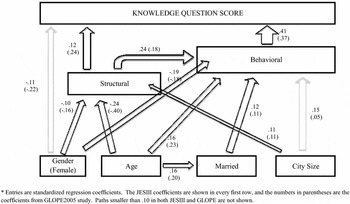
A general image of Japanese knowledge acquisition, based on a similar path analysis by Delli Carpini and Keeter (1996: 181), is displayed in Figure 1 using SPSS Amos. The dependent variable is the balanced score of political knowledge, with the first stage independent variables (at the bottom) – gender, age, city size, and marital statusFootnote 4 – modeled under the assumption that these influence knowledge in subsequent stages. The second stage ‘structural’ variables include education and employment (public servant), modeled as such because they further define an individual's position in Japanese society. The last stage factors – interest, civic duty, party ID strength, and media consumption – are combined into a ‘behavioral’ category, which are those most closely related to the level of knowledge.Footnote 5
A simplified path model of political knowledge

Our path model, overall, explains knowledge fairly well (JESIII: R2 = 0.28; GLOPE2005: R2 = 0.35), with model diagnostics confirming a good fit in both datasets.Footnote 6 As expected, behavioral variables have the largest direct impact on knowledge in both datasets. The structural variables also have some direct impact on knowledge, though it is notably smaller than behavioral factors. In the first stage, only gender has a direct effect; the others are absorbed into the structural and behavioral factors. One thing that should be noted here is the varying age effects. While age has strong negative impact on the structure of political knowledge, it retains a positive impact on the attitudinal/behavioral aspects of knowledge attainment.
Multiple regression
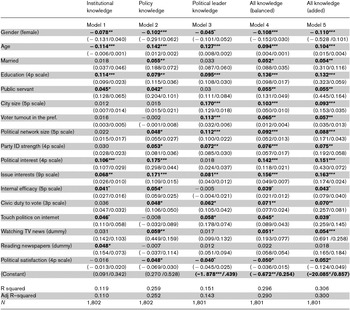
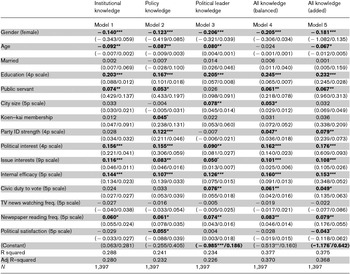
The results of our OLS models appear in Tables 1 (JESIII) and 2 (GLOPE2005). The first three columns indicate the results where the dependent variable is a specific dimension of knowledge. The last two columns show the results for the balanced and added ‘all knowledge’ variables.
The determinants of political knowledge (JESIII)

Notes: ***p<0.001, **p<0.01, *p<0.05, ^p<0.1 (OLS regression coefficients).
Every first row represents standardized coefficients and the second rows show (unstandardized coef./standard error).
The determinants of political knowledge (GLOPE2005)

Notes: ***p<0.001, **p<0.01, *p<0.05, ^p<0.1 (OLS regression coefficients).
Every first row represents standardized coefficients and the second rows show (unstandardized coef./standard error).
Base predictors
Of the base-level predictors in our model, the impact of gender is the most consistent (negative sign, p<0.001 in both datasets); marital status is the least (p<0.05 in JESII policy and all knowledge models; ns in all GLOPE2005 model variants). The effects of age are noteworthy. In JESIII, age appears to depress institutional knowledge, but enhance policy and leader knowledge as well as knowledge on the whole. GLOPE2005 similarly finds a depressive effect on institutional knowledge, but also on policy and overall knowledge. Only in terms of leader knowledge does the GLOPE2005 study find age to have a positive effect. City size influences knowledge of leaders in both datasets, but only in the JESIII does it have a direct impact on overall knowledge. The results are similar for the other contextual variables in the JESIII model – voter turnout in the district and network size. Both appear to influence knowledge of leaders and knowledge overall, without showing much impact on knowledge of institutions or policy. The koenkai variable in the GLOPE2005 marginally boosts policy knowledge, but has no meaningful impact on other types of knowledge or knowledge on the whole.
Structural predictors
Education is strong in both datasets, particularly in the GLOPE2005 model where it claims the greatest predictive power of the variables we specified. Public servant is a weaker predictor and not meaningful in explaining knowledge of leaders. Nonetheless, it is significant at p<0.05 or better in the other GLOPE2005 models and in overall knowledge in the JESIII.
Behavioral predictors
Both the JESIII and GLOPE2005 models reveal that general interest in politics and interest in specific issues (like the environment) strongly predict political knowledge; with education, interest is among the more impactful factors in our analysis. Party identification strength appears to explain policy knowledge better than other types in the GLOPE2005 data, although the same variable in the JESIII is significant in explaining knowledge of political leaders as well (due, supposedly, to its questions relating to local leaders). It has a relevant (p<0.01) influence on overall knowledge in both studies. Internal efficacy – the belief that politics and government are not too complicated to comprehend – shows stronger and more consistent effects in the GLOPE2005. The belief that voting is a civic duty is irrelevant vis-à-vis institutional knowledge, but appears to influence knowledge of leaders and overall knowledge in both surveys.
The coefficients for political satisfaction are consistently negative in our models; only in the policy knowledge models do they reach a p<0.05 standard across both datasets. In the JESIII, (dis)satisfaction appears to explain overall knowledge. Efficacy, in the GLOPE2005, is strongly related with all knowledge fields, while in JESIII, it only shows a positive impact on policy knowledge.Footnote 7
Media exposure: general effects
What the findings indicate is that regular newspaper reading and consumption of a wide range of television programs increases all types of knowledge and knowledge on the whole. Watching TV, in and of itself, has no impact. In the GLOPE2005, a one unit increase in newspaper reading offers a knowledge boost comparable to a one unit increase in party identification strength or working as a public servant. Reading a wider variety of newspapers, as the JESIII results show, does not have the same effect across-the-board as watching a wider range of TV news programs.Footnote 8 It does seem to provide a modest boost to knowledge of political leaders.
The impact of consuming political news on the internet is marginal, as we see in the JESII data in Table 1. While it does seem to have a modest effect on knowledge of leaders, it has no impact on policy awareness. The coefficients in the institutional knowledge and overall knowledge equations only meet a marginal p<0.10 standard.
Media exposure: specific source effects
The impact of specific media sources follows, beginning with descriptive analysis and followed by a summary of regression models that isolate the effect of the news source in a fully specified equation.
Newspapers
Among the largest newspapers tested in the JESIII,Footnote 9 t-tests show that those who read the Yomiuri, Asahi, and Nihon Keizai (Nikkei) are significantly higher in their overall knowledge, while readers of Mainichi and Sankei do not differ from the sample mean (table omitted). Yomiuri readers are distinguished by having higher institutional knowledge in particular, while Asahi and Nikkei readers appear higher on all dimensions. But in a regression model with a full set of controls, the impact of specific newspapers largely disappears (table omitted).Footnote 10 Put another way, whatever influence a paper such as Yomiuri, Nikkei, or Asahi may have on knowledge is explained away by other factors – most likely, education (Kimura, Reference Kimura2004).
Television
Compared to newspapers, TV programs enjoy more varied consumption patterns, with each JESIII respondent watching a little more than three (out of 17 tested) shows. NHK News programs enjoy an audience that is nearly twice as large as the second and third most popular programs in the study, Asahi TV's, Hōdō Station and TBS' News 23.Footnote 11 About one in four watch Sunday Project, making it the most viewed ‘hard’ program other than NHK. With NHK set aside, ‘soft’ and ‘mixed’ programs are, in total, watched more than twice as frequently as ‘hard’ programs.
At first glance, viewers of ‘hard’ programs appear to be more knowledgeable, viewers of soft and ‘mixed’ programs less so. T-tests reveal that Sunday Project Hōdō Station and Sunday Morning on TBS, as well as Tokyo TV's World Business Satellite, have viewers who score higher across knowledge dimensions. NHK viewers are not as knowledgeable on average as those who consume hard programs, although they score higher than the average JESIII respondent. Soft program viewers generally score lower, particularly in institutional knowledge. Consumers of Fuji TV's News Japan and Kyō no Dekigoto on Nippon TV in our ‘mixed’ category are among the least knowledgeable overall.
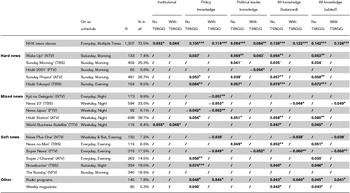
Table 3 presents the results when dummy variables for ‘often’ watching specific TV programs are added to our full regression model. The results of two separate sets of equations are presented: with a control for total TV news consumption (‘TVAGG’) and without.
TV news source effect on political knowledge (JESIII)

Notes: 1. ***p<0.001, **p<0.01, *p<0.05, ^p<0.1 (OLS regression).
2. Entries represents the standardized coefficients from OLS regression with all the variables appeared on Table 1. The coefficients of which did not come out significant are not shown.
3. The TV station names are following: ATV = TV Asahi, TBS = Tokyo Broadcasting System, TTV = TV Tokyo, NTV = Nippon TV, FTV = Fuji TV.
The most prominent finding in the analysis is the effect of NHK. Ceteris paribus, we see that watching NHK news significantly boosts policy and people knowledge and knowledge overall. The effect of watching NHK ‘often’ is comparable to a one unit increase in educational attainment and exceeds the impact of most attitudinal variables in our knowledge model, except interest. Several Asahi TV programs show positive coefficients, but the effects are confined to models without a control for overall news program consumption. World Business Satellite, in our ‘mixed’ category, has an impact on institutional knowledge.
The second noteworthy finding is the apparent depressive impact of softer programs. As the table shows, the coefficients for Super News are negative and significant in two of the three knowledge domains and overall. Those for News Plus One on Nippon TV are negative and borderline at a p<0.10 cutoff standard. The depressive effects also extend into several programs in the ‘mixed’ category, as News 23 appears to diminish policy knowledge. Fuji TV programs appear more consistently with negative coefficients. Among commercial networks, Asahi programs appear consistently with positive coefficients.
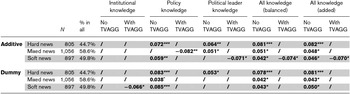
When viewers of ‘hard’. ‘mixed’, and ‘soft’ programs are combined, recoded and reinserted in the full model, the effects of format become clearer. Table 4 displays two results: when hard/mixed/soft is recoded as a ‘dummy’ variable (reflecting that the respondent watches at least one such show ‘often’) and as an ‘additive’ scale (reflecting the total number of shows in each category that the respondent watches.) We see that the ‘hard’ category shows positive and significant (at p<0.001) impacts on the three domains and overall knowledge, although the effects diminish when the amount of TV news watching is controlled.
Hard and soft news source effect on political knowledge (JESIII)

Notes: ***p<0.001, **p<0.01, *p<0.05, ^p<0.1 (OLS Regression standardized coefficients).
Hard news: Wake Up! (NTV), Sunday Project (ATV), Hodo 2001 (FTV), Hodo Tokusyū (TBS), Sunday Morning (TBS).
Mixed news: Hodo Station (ATV), Kyo no Dekigoto (NTV), News 23 (TBS), World Business Satellite (TTV), News Japan (FTV).
Soft news: Super J Channel (ATV), Broadcaster (TBS), Super News (FTV), News Plus One (NTV), The Sunday (NTV), News no Mori (TBS).
The soft program coefficients for people and overall knowledge, by contrast, turn negative when the TVAGG variable is in the equation. Their diminishing effect is equivalent to being one year younger or living in a smaller city and appears to mitigate, at a similar rate, whatever knowledge may be gained from hard news. Noteworthy are that the effects appear when soft program viewing is coded as an additive scale. Put another way, merely watching a particular soft program ‘often’ may diminish institutional knowledge, but the cumulative impact of watching additional soft programs appears to diminish overall knowledge as well. In the ‘mixed’ category, we only witness depressive effects on policy knowledge; in other knowledge domains, such programs appear to have a positive impact, but only in the absence of a control for overall consumption.
Discussion
What we find in this paper confirms and extends previous research on political knowledge. To be more informed about government and political affairs in Japan most likely means being male, better educated, and living in a bigger city. Such a Japanese is likely to be older, although being older does not necessarily make him more competent in his knowledge of political institutions, where someone closer to the experience of formal education may be better informed. If he is married, he is not likely to supplement his political knowledge by talking with his spouse. Having a larger network with which to discuss current affairs (particularly if he works in government) and residing in a community where others vote may, however, make him more informed. Such characteristics are likely to boost his interest in particular issues and politics on the whole – and may induce a sense of civic duty and facilitate stronger attachments to a political party. Such factors may reciprocate and strengthen one another. In turn, he will learn more about leaders and policies. He may be less satisfied with the state of politics in Japan today, but retains the belief that he can have an impact on the political system. He is, above all, a consumer of information: reading a preferred (likely national) newspaper more regularly than others and watching a variety of news programs on television.
What we find, moreover, is that the choices this typological ‘well informed Japanese’ makes for information make a difference. Like a nightly serving of tofu, regular consumption of NHK's neutralized and succinct news appears to boost levels of basic awareness at a rate that exceeds many of the other factors we find to be critical for political learning. Although we have endeavored to isolate the role of news sources in learning, the limitations of this study – relying on a selective set of cross-sectional knowledge measures, lacking any comparable analysis of specific content, as well as lingering uncertainty about causality – led us to be tentative about our conclusions. Does soft news depress knowledge or simply attract those who are already less knowledgeable? The evidence (displayed in Appendix Table 2 in the online supplementary material) is mixed. At the same time, our results remain consistent with those who find NHK viewers to be exceptional even among frequent Japanese TV watchers (e.g., Saito, Reference Saito2008), as well as Prior (Reference Prior2003) who, in the American case, finds that national network news, not soft news, contributes to knowledge.
Distinct from previous research, however, it is not immediately evident that wider consumption of television news is of concern: according to the JESIII, the higher the number of news programs watched, the greater one's overall knowledge. This is consistent with the earliest work on the subject by Flanagan and Feldman. And it makes sense: the political junkie who searches across channels should, by definition, be better informed than the average Japanese. What appears to matter is format – NHK's, in particular – and the way political information is presented. Could it be that political knowledge measures, like factual exam questions, are well suited for those who regularly watch the ‘bland, neutral, but somehow didactic’ NHK broadcasts? Perhaps. But recall that NHK does not merely enhance understanding of the state, it also appears to be linked to applied policy knowledge, measured in both surveys through party placement measures, as well as people knowledge. The latter should theoretically be a strength of the softer programs, but we find little evidence that this is so. Of the programs we labelled as soft, only one – the now defunct News no Mori on TBS – had any individual effect on people knowledge. And when we look at the cumulative effects of such programs, the evidence, in fact, points in the opposite direction.
If we, therefore, were to liken NHK News to hard tofu – a bland, but healthy part of a broad information diet – what can be said of its soft competitors? And what are the implications for a public that appears to be developing a taste for junk food media equivalents? The limitations of this study make it impossible to conclude that reliance on softer news programs is an isolated cause for the inability to recognize parties, leaders, or grasp the work of the Diet and ministries that we find here. At the same time, we can suggest that they may be having the effect of further isolating Japanese who are already poorly informed – the ‘knowledge gap’ hypothesis, which has received supportive evidence in the US (Prior, Reference Prior2005), Europe (Holtz-Bacha and Norris, Reference Holtz-Bacha and Norris2001), and South Korea (Kim, Reference Kim2008). Consider, as political affairs soften through the media, the differences between NHK News programs and Super News become more than stylistic, forcing us to ask if they don't merely reflect – but hold the potential to perpetuate – other gaps between men and women, rich and poor, cosmopolitan and rural, elites and the politically occasional. We hesitate to denigrate soft news entirely: some outlets may offer, as Baum and Jamison (Reference Baum and Jamison2006) and Taniguchi (Reference Taniguchi2011) find, opportunities for politicians to reach voters and one can hardly question changes that help to bring political affairs out of smoke-filled chambers and into more living rooms. But where soft news and wide shows may help to humanize politicians and democratize political discourse, there is little evidence here to suggest that they foster democratic skills or do much to reduce Japan's broader democratic deficit (e.g., Otake, Reference Otake, Pharr and Putnam2000; Pharr, Reference Pharr, Pharr and Putnam2000). Knowing less, in the end, means acting less.Footnote 12
Public television, of course, is neither a panacea for the problems that afflict democratic politics in Japan, nor is it itself immune to controversy. Yet even as questions persist about NHK's ‘public’ status and its critical independence, its reputation as a political institution – providing regular, basic information about the state to the public – is scarcely diminished by the evidence we present here. Akin to the role public news entities play in Canada and Europe (e.g., Holtz-Bacha and Norris, Reference Holtz-Bacha and Norris2001; Curran at al, Reference Curran, Iyengar, Brink Lund and Salovaara-Moring2009), but unique among them (Krauss, Reference Krauss2000a), NHK remains a relevant educator of Japanese democracy. Whether the same can be said of its more opinionated and gossipy competitors is an important question – one that should be at the center of future analyses of Japanese public opinion.
About the authors
Christian Collet (Ph.D., University of California, Irvine) is Senior Associate Professor at International Christian University, Tokyo, where he teaches courses on public opinion, American and comparative politics. During the 2012–13 academic year, he was in residence as Visiting Scholar at the Walter H. Shorenstein Asia-Pacific Research Center at Stanford University where this paper was completed. His work has appeared in Perspectives on Politics, The Journal of Politics, Public Opinion Quarterly, Japanese Journal of Political Science, PS, Amerasia Journal and Race/Ethnicity: Multidisciplinary Global Contexts and several edited volumes.
Gento Kato is an MA Student in the Graduate School of Political Science at Waseda University. In 2012, he graduated with honors from International Christian University, Tokyo, where this work was completed. His interests include Japanese and American politics, public opinion, political psychology, and research methods.
Supplementary material
To view supplementary material for this article, please visit http://dx.doi.org/S1468109913000339.