1. INTRODUCTION
Interest in immigration was already widespread in the pre-industrial societies of Europe, as economic growth always required a sharp increase in the labour force and the ruling elites plainly associated the wealth of a country with its population as well as its natural resources. Recognising the importance of migration, governments have sought since ancient times to quantify, regulate and alter flows into and out of their lands in pursuit of a range of political and economic goals.
Since the mid-1980s, the historical significance of migration has aroused considerable academic interest. This has resulted in the publication of numerous studies of the phenomenon in Europe between the thirteenth and eighteenth centuries, a period of transition between the migration caused by war and religious conflict typical of late medieval times and migration with economic causes, which grew increasingly important in the early modern age to become the chief driver of migration today.Footnote 1 These studies address not only conventional demographic issues but also new social and cultural questions, such as those concerning the perception of immigrants and their integration into their host community.Footnote 2 The majority of studies concentrate on towns and cities, and on immigrant communities displaying a marked ethnic, religious or occupational identity.Footnote 3 Other studies explore the influence on migration policies of new or revised political concepts such as community, state or empire, which emerged in this period, especially as they applied to foreigners.Footnote 4
Logically, the emergence of the state in late medieval and early modern Europe engendered new policies to deal with foreign immigration. Measures of this kind served a wide spectrum of political, fiscal and military goals. However, the new fiscal–military states were still in the process of formation,Footnote 5 and the authority of monarchs and governments differed considerably in the various territories under their control.Footnote 6 Thus a given state could implement measures unhindered in some of its regions, but enjoyed less political and legislative autonomy in others, making it necessary to negotiate with local elites and institutions and to deal with opposition and resistance. Depending on the level of autonomy, the state's measures could be amended and a local migration policy created in defence of the interests of regional elites.
As a regional case study of this complex process of political construction, this paper explores the public policies applied between 1635 and 1697 in Aragon to immigrants from France, the main source of foreign immigration into Spain during the early modern period. Located in the north-east of Spain, the kingdom of Aragon was part of the Crown of Aragon, a federation of realms that coalesced in the late medieval period and also included Catalonia, Valencia, the Balearic Islands, Sardinia, Sicily and Naples. Though it formed part of the nascent Spanish State that grew out of the union of the Crowns of Castile and Aragon under a single dynasty at the end of the fifteenth century, the kingdom of Aragon retained its own fueros or laws and institutions throughout the early modern period until their abolition by the new Bourbon monarchy in 1707. The Spanish monarchy could only levy royal taxes with the permission of the most important of these institutions, the Aragonese Parliament or Cortes. The Cortes were convened at intervals, with decreasing frequency from the middle of the sixteenth century and during the seventeenth century. The four estamentos or social groups with political representation (high nobility, minor nobility, clergy and citizens) could negotiate new laws at the Cortes and present their complaints and requests before the Spanish king. The Diputación of Aragon, a standing committee of the Parliament with representatives from all the estamentos, was charged with the day-to-day governance of the region. Finally, in Madrid, the Council of Aragon assisted the monarch with the government of all the Spanish territories of the Crown of Aragon.Footnote 7 The Council considered political, legal and fiscal issues in Aragon on the basis of information from the Diputación and from royal institutions, such as the viceroy, the governor and the Real Audiencia or the supreme tribunal of justice.
As the Spanish territory of the Crown of Aragon with the most political autonomy, the study of the migratory policies applied in Aragon during the seventeenth century is particularly important because it can modify some of the traditional assumptions of the Spanish and French historiography. In the last 25 years, historical studies of French immigration to Spain have mainly concluded that the policies implemented by the Spanish state did effectively check inflows of migrants in times of economic decline like the seventeenth century, at least in the short term.Footnote 8 However, this case study will argue that these commercial and tax measures were profoundly affected by policies applied by regional public institutions in some autonomous Spanish territories where French migration was highly significant in demographic and economic terms.
This case study also reveals that these regional migratory policies could incorporate changes and adaptations to new economic realities. Initially, these measures did follow the traditional path, seeking to shield regional trade and avert the threat of population loss. As French immigrants had assumed an essential role in Aragon as controllers of commercial transactions and providers of low-skilled labour, the Diputación thus successfully challenged royal measures applied against these immigrants from 1635. Final definition of these policies, however, was marked by the confrontation of interests between different social groups in the Cortes of the second half of the seventeenth century, a period of regional economic decline and reform. Driven by the need for French labour, the powerful agrarian elites of Aragon successfully opposed the more restrictive migration laws favoured by the urban merchants and artisans against their French competitors. Accordingly, the Cortes of 1677–1678 and 1684–1686 only imposed conditions on the French merchant community. While this moderate policy did allow migratory flows to continue, it could not counteract the decline of economic opportunities for the French in this region. The paper will thus demonstrate that political and social circumstances, as well as the degree of integration of immigrants, marked the application of this policy in Aragon throughout the period.
2. FRENCH IMMIGRATION IN SIXTEENTH AND SEVENTEENTH CENTURY ARAGON: A GENERAL OUTLINE
French immigration to Aragon followed contrasting demographic trends during the sixteenth and seventeenth centuries. The region experienced clear demographic expansion in the sixteenth century.Footnote 9 Local studies of parish registers suggest that this growth was fastest in the second half of the century, coinciding with the crest of the economic wave. Having peaked at the end of the sixteenth century, the population of Aragon fell in the seventeenth century in a process that was precipitated in 1610 when Philip III ordered the expulsion of the moriscos (inhabitants of Moorish origin, who had been forced to convert from Islam to Christianity in 1526) from the region. This decision affected around 14,000 families or just under 19 per cent of the population. Even so, a general survey of Aragon carried out between 1646 and 1650 found some 70,729 hearths (qua tax units) or around 318,280 inhabitants compared with 51,540 hearths or approximately 231,930 inhabitants counted in a similar survey carried out in 1495.Footnote 10 However, bubonic plague ravaged the whole region between 1648 and 1654, and the Cortes estimated that only about 60,000 hearths remained in 1677. Recovery did not begin until the last two decades of the seventeenth century, but by 1711 Aragon had 76,613 hearths or approximately 344,785 inhabitants.
Compared with other regions of Spain, where they formed a tiny minority clustered together in the larger cities, French immigrants were present throughout Aragon and Catalonia in the sixteenth and seventeenth centuries, and they were important both economically and demographically.Footnote 11 From the late fifteenth century the migrants crossed into Catalonia, their numbers increasing between 1540 and 1620. After this the trend slackened, slowing to a trickle after 1660.Footnote 12 French immigrants were to be found in Aragon in the first half of the sixteenth century, but inflows rose after 1540 and stabilised around 1560, culminating between 1580 and 1635. Immigration from France into Aragon declined slowly from around the middle of the seventeenth century, though it continued with diminished intensity into the eighteenth century. An anonymous report dating from the mid-seventeenth century provides the most likely estimate of the immigrant population in Aragon, putting their number at some 30,000, including children and grandchildren, making up 9.4 per cent of the headcount obtained in the census of 1646–1650. In 1680 the Marquis de Villars, French ambassador in Madrid, estimated the number of French immigrants in Aragon at 20,000 and in Spain as a whole at 70,000. They would thus have accounted for 7.4 per cent of the Aragonese population in 1677 and 28.6 per cent of all French immigrants living in Spain in 1680.Footnote 13
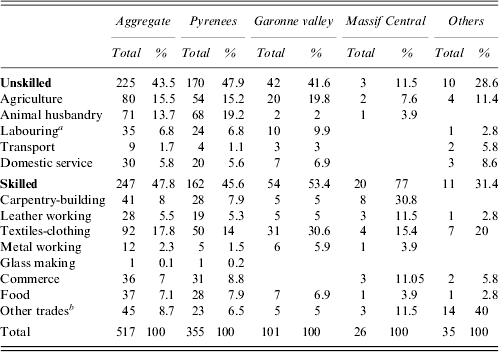
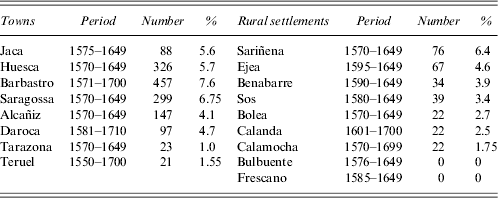
The migrants came to Aragon mainly from Gascony and Béarn in south-western France. Based on an analysis of 517 cases involving Frenchmen opened between 1540 and 1649 in Aragon by the Inquisition, the institution created by the Spanish monarchy at the end of the fifteenth century to police religious orthodoxy in the lands under its control, 68.7 per cent of the migrants concerned were from districts in the Pyrenees or Pyrenean foothills, and a further 19.5 per cent from the Garonne Valley. Another 5 per cent were from the Massif Central (see Table 1). Immigration was partly seasonal. Thus, the Aragonese arbitristas (political economists) and guilds complained in 1684 that both Auvergnese peddlers and shepherds, and grape pickers and millers from south-western France were in the habit of returning home to their waiting families.Footnote 14 Nevertheless, by marrying local women, a large number of Frenchmen showed their willingness to settle definitively in Aragon (see Table 2).
Occupation and region of origin of 517 male French immigrants in Aragon (1540–1649): totals and percentages per region according to the records of the Inquisition

a ‘Labourer’ here translates as a range of terms that could refer either to unskilled agricultural labourers, or to those in construction, or to other temporary workers with undefined occupations. Where the sources have indicated clearly that labourers were working in agriculture, they have been included under ‘agriculture’.
b ‘Other trades’ here includes liberal occupations less integrated into the guild system such as artist, teacher, printer, bookseller, clergyman, doctor, surgeon, chemist or soldier.
Source: C. Langé, La inmigración francesa en Aragón (Siglo XVI y primera mitad del XVII) (Saragossa, 1993), 85.
Male French immigrants in Aragon (1570–1710): number of grooms of French origin as a percentage of all grooms according to parish marriage registers
Sources: Own work based on C. Langé, La inmigración francesa en Aragón (Siglo XVI y primera mitad del XVII) (Saragossa, 1993), 32–49, 111–13; Salas, J. A., ‘La inmigración francesa en Aragón en la edad moderna’, Estudios 85 (1985–1986), 57, 63–4; J. A. Mateos, Auge y decadencia de un municipio aragonés (Saragossa, 1997), 70, 73; J. A. Mateos and R. Ceamanos, Calanda en la Edad Moderna y Contemporánea (Teruel, 2005), 50–5; Benedicto, E., ‘La emigración francesa en Calamocha (1530–1791)’, Xiloca 29 (2002), 18. Estimates for the larger towns are approximate, referring to the registers of the parishes selected by the author because they kept more regular records of the origins of spouses. Secondary studies do not always differentiate between first and subsequent marriages.
There were numerous reasons for these migration flows.Footnote 15 One of the key ‘push’ factors in the migrants' homelands was overpopulation in mountainous districts, so that available crops and pasture were insufficient to feed all of the inhabitants.Footnote 16 Other economic ‘push’ factors included rising prices in the period 1560–1650Footnote 17 and the heavy burden of royal taxes in seventeenth-century France.Footnote 18 Another cause was strife between Protestants and Catholics in south-western France in the second half of the sixteenth and the early seventeenth centuries. The ‘pull’ factors attracting French migrants to Aragon included cultural affinity between the region and the Languedoc. This facilitated an agreement granting Béarnese migrants the right to travel and bring goods into Aragon made in 1514 between the lords of Béarn, the viceroy and the Diputación of Aragon. The main ‘pull’ factor was that French hands were needed to reverse the prolonged shortage of manual labour in Aragon resulting from the economic expansion of the sixteenth century and the demographic decline of the seventeenth. Manual labour of this kind was generally despised in Spain,Footnote 19 and demand for low-skilled labour could not be met from within the local population or through emigration from Castile, where migrants generally looked towards the Americas. Furthermore, Aragon's political autonomy meant that the Spanish monarchy was able to increase royal taxes only in the second and last quarters of the seventeenth century, thus keeping taxation lower than in France.Footnote 20
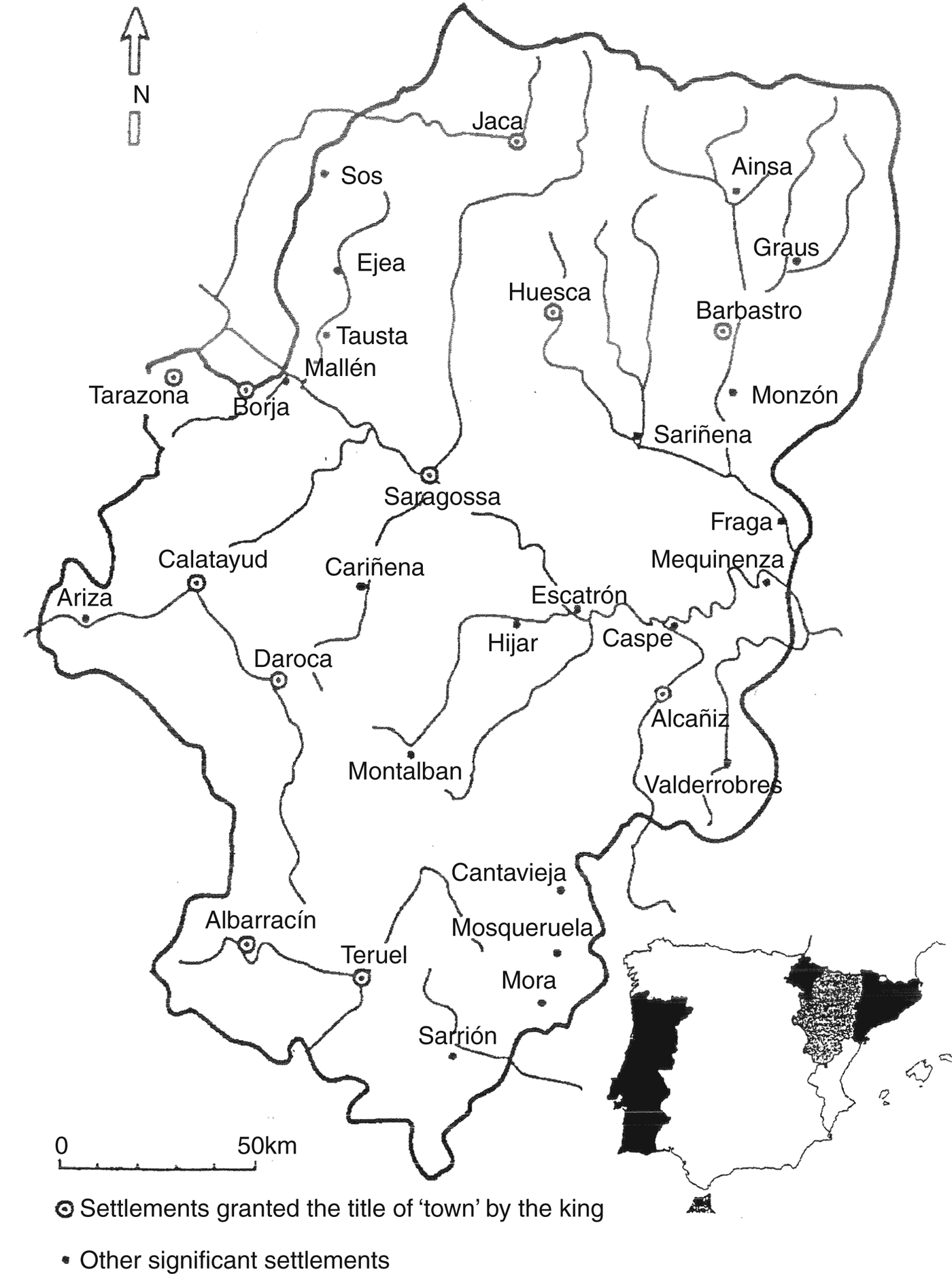
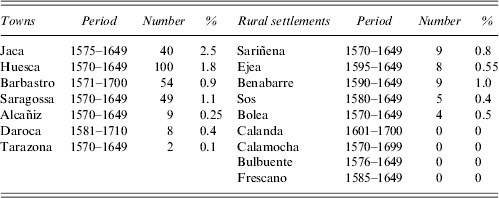
As the comparison of Tables 2 and 3 shows, the majority of the immigrants were men. Women accounted for between just 0 and 8 per cent of all married French immigrants in the towns and villages of southern Aragon, and between 10.5 and 17.5 per cent in Saragossa (in Spanish, Zaragoza) and the towns north of the River Ebro, with some notable exceptions like Huesca (23.5 per cent) or Jaca (31.25 per cent), which had a bigger share due to its proximity to the French border. Both Frenchmen and women tended to settle more intensely in the north of Aragon (except for the Pyrenees) as far as the Ebro Valley, given the geographical proximity of this area to their former homes in France (see Fig. 1; Tables 2 and 3). Though Frenchmen were certainly to be found in small villages, they preferred the towns and larger rural settlements, which provided more scope for their commercial activities and low-skilled craft trades. Thus, the percentages of French husbands in parish registers are higher in the towns (Jaca, Huesca, Barbastro) and sizeable villages (Sariñena, Ejea) lying on the trade routes crossing the region from the border with France to the capital than they are in other smaller, more isolated settlements in northern Aragon (Benabarre, Sos, Bolea). Saragossa was home to numerous immigrants: a local census of 1642 counted some 990 French heads of household among a total of 6,130 households (16.15 per cent).Footnote 21 Aside from market towns (Alcañiz, Daroca), the presence of male immigrants south of the River Ebro was very modest, whether in towns (Tarazona, Teruel) or in rural districts (Calanda, Calamocha), as the lower percentages of French husbands displayed by the parish records show. The demands of feudal dues by the lay and ecclesiastical lords meant that Frenchmen were also disinclined to repopulate the numerous villages (such as Bulbuente and Frescano) affected by the expulsion of the moriscos in 1610, most of which lay on the banks of the river Ebro and its southern tributaries.Footnote 22
The Kingdom of Aragon during the seventeenth century.
Female French immigrants in Aragon (1570–1710): number of brides of French origin as a percentage of all brides according to parish marriage registers
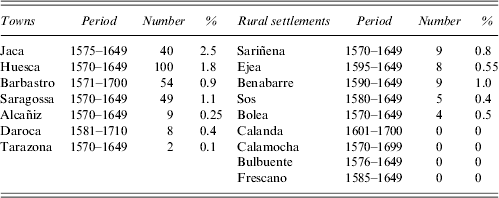
Sources: Own work based on C. Langé, La inmigración francesa en Aragón (Siglo XVI y primera mitad del XVII) (Saragossa, 1993), 32–49, 111–13; Salas, J. A., ‘La inmigración francesa en Aragón en la edad moderna’, Estudios 85 (1985–1986), 57, 63–4; J. A. Mateos, Auge y decadencia de un municipio aragonés (Saragossa, 1997), 70, 73; J. A. Mateos and R. Ceamanos, Calanda en la Edad Moderna y Contemporánea (Teruel, 2005), 50–5; Benedicto, E., ‘La emigración francesa en Calamocha (1530–1791)’, Xiloca 29 (2002), 18. Estimates for the larger towns are approximate, referring to the registers of the parishes selected by the author because they kept more regular records of the origins of spouses. Secondary studies do not always differentiate between first and subsequent marriages.
Based on an examination of the Inquisition proceedings referred to above, it has been possible to identify the trades of 517 male immigrants living in 146 Aragonese towns and villages between 1540 and 1649 (see Table 1). The sample clearly reflects the greater proportion of migrants living in towns. Where the general survey performed between 1646 and 1650 showed that only 16.3 per cent of Aragon's population lived in urban centres,Footnote 23 223 of the sample immigrants (43.1 per cent) were resident in Saragossa and nine other medium-sized towns compared with 294 (56.9 per cent) in villages. The analysis of trades also reveals a sharp contrast with the neighbouring principality of Catalonia, where unskilled immigrants predominated, especially in rural areas, until 1640 when they were gradually replaced by a diminishing number of artisans living in towns.Footnote 24 Though numerous (43.5 per cent), such unskilled immigrants were not the majority in Aragon between 1540 and 1649. Mainly employed in agriculture and animal husbandry, most of them lived in rural districts, though some found work in the towns. In fact, of the 915 Frenchmen for whom occupations were recorded in the Saragossa census of 1642, at least 15 per cent were in farming of one kind or another.Footnote 25 Less pronounced in Catalonia, the expansion of craft trades in Aragon in the sixteenth and early seventeenth centuries encouraged immigrants to specialise, although usually in low-skilled activities (47.8 per cent). It also prompted the integration of many young Frenchmen as guild apprentices.Footnote 26 This specialisation increased the further immigrants had come from their homes, as in the case of the textile workers from the Garonne Valley and Auvergnese stonemasons, builders and tinkers. Certain artisans, such as comb makers, settled in Aragon in the second half of the seventeenth century because Castilian law required goods sold in Castile to be produced in Spanish territory.Footnote 27 These craft trades were predominant in towns and cities, where French domestic servants also found work.
The significant percentages of farm workers (29.2 per cent) and textile workers (17.8 per cent) amongst the migrants shown in Table 1 are a reflection of the Aragonese economy's orientation towards the production and export of agricultural commodities (wheat, meat, oil and wool) to France, Catalonia and Valencia. As this orientation became more marked in the second half of the seventeenth century, more French immigrants would have been drawn into farm work.Footnote 28 Many also sought employment in the textile industry because the raw material, wool, was plentiful and numerous workshops existed throughout the territory. The information in Table 1 is confirmed by other sources. Textile working accounted for some 30 per cent of the occupations of the 335 Frenchmen for whom occupations were recorded in the parish registers of Barbastro between 1540 and 1700, and for 23.8 per cent of the occupations of the 915 Frenchmen for whom occupations were recorded in the Saragossa census of 1642.Footnote 29 As the textile industry declined in the second half of the seventeenth century, some of these immigrants switched to importing and selling cloth from France.Footnote 30 Overall, the French often enjoyed a strong position in trades that required little or no training, but were in demand in the host labour market. Thus, the Diputación affirmed in 1639 that the majority of the millers, bakers and water carriers resident in Aragon were French.Footnote 31
The French merchant community was very active, although its members made up only a small minority (7 per cent) amongst the migrants shown in Table 1. As the only real city, Saragossa was home to the biggest colony living in Aragon. Even so, the 83 merchants, shopkeepers and carters accounted for just 9 per cent of the 915 immigrants with recorded occupations in the Saragossa census of 1642,Footnote 32 and actual merchants numbered only 31 in 1626, 43 in 1642 and 48 in 1684.Footnote 33 The majority of these were small traders, and only a very few were wealthy. They engaged especially in the import of French manufactured goods, particularly cloth and lace, which accounted for 29.8 and 21.9 per cent, respectively, of Aragonese imports from France in 1675. They also exported wheat and oil to Catalonia and, especially, wool to France, where demand was so intense that the commodity made up 77.95 per cent of all exports from Aragon to its neighbour in 1675.Footnote 34 In order to obtain these products, the French merchants leased the rights to collect seigniorial rents, tithes and first fruits from the lay and ecclesiastical lordships of Aragon. However, they did not engage in long-term lending or in the acquisition of land or cattle.Footnote 35 Where shopkeepers and merchants took care of retail trade in towns and cities, it was carters, peddlers and tinkers who sold French goods in the countryside. Following traditional commercial practice, many sold their goods to peasants on credit, taking payment in the form of farm produce after the harvest, a system that was highly profitable. French merchants also used other tradesmen, such as tailors, as intermediaries in their transactions.Footnote 36
Helped by the bankruptcy of the Aragonese merchant bourgeoisie around 1580, followed around 1620 by that of the Genoese merchant colony that had assumed control of regional trade in its place,Footnote 37 French merchants were able to create an extensive professional network, which dominated transactions in Aragon in the seventeenth century. Around 1610, wealthier merchants began to employ French servants in their stores, to whom they would then lend stock to open their own shops as soon as they had completed their training. These new shopkeepers would in turn employ French newcomers to Aragon. The growth of this professional network after 1620 further increased French control over retail trade.Footnote 38 At the end of the seventeenth century, some merchants even acted as the representatives of other traders established in the towns of southern France, who exported goods to Aragon either directly across the border or through the kingdom of Navarre.Footnote 39 Meanwhile, the Aragonese bourgeoisie focused less on commerceFootnote 40 as they gradually recovered from bankruptcy in the second half of the seventeenth century. However, their recovery was not strong enough to crowd out the French merchants, who, as discussed below, became the butt of criticism from individuals and institutions alike, and a target for the measures adopted by the Spanish monarchy and the Aragonese Parliament to regulate the position of foreign immigrants.
3. STATE POLICY: THE SPANISH MONARCHY VERSUS THE KINGDOM OF ARAGON (1635–1697)
In the final 65 years of the seventeenth century, French immigration to Aragon laboured under similar political, tax and military measures as those applied by the Hapsburg monarchy of Spain to other foreign communities in the territories under its control. These measures centred on the colonies of merchants, not only because they enjoyed economic prestige but also because it was believed that they were a factor in the decline of Spain's international trade relative to the country's European competitors.Footnote 41 The renewed outbreak of hostilities with France in 1635 in the context of the Thirty Years' War (1618–1648) marked the systematic application of these measures. The monarchy ordered the end of all trade between Aragon and France, which had been able to sell its manufactured goods across the Pyrenees while obtaining, in return, Aragonese raw materials for economic and military use, as well as Spanish silver ingots and coins. As the cost of the war drained the royal treasury, the monarchy sought to apply special taxes to immigrants or to seize their assets. The immigrants were disarmed to prevent collaboration with the French army, especially after the invasion of Catalonia in 1641–1652 and the eastern borders of Aragon in 1641–1643. Significantly, the monarchy took this action without negotiating with either the Cortes or the Diputación, nor were the damaging effects on the Aragonese economy and population taken into account.
Aware that they were facing a new migration policy, the Aragonese institutions reacted immediately. Initially, they confined themselves to reopening the border with France in 1625–1627, doing nothing to protect the French merchants who complained to the Cortes after their assets were seized in 1626.Footnote 42 However, the Spanish monarchy imposed the same measures again in 1635, triggering the direct opposition of the Diputación, which was responsible for upholding not only the regional laws but also freedom of trade, which it defended in the courts throughout the seventeenth century against the barriers raised in local markets by the Aragonese craft guilds and municipalities, such as abusive quality controls and price-fixing of foreign goods.Footnote 43 Just as other public institutions had done in the period 1536–1554 under Emperor Charles V, the Diputación challenged the authority of the capitán de guerra, the main royal official charged with executing the relevant orders.Footnote 44 It was argued that the interruption of trade with France would be detrimental to the economic interests of Aragon and the fiscal interests of the Diputación, which depended largely on the customs duties raised along the Pyrenean border. It also protested against the seizure of goods from French immigrants in the Corte del Justicia de Aragón. Chaired by the Justicia as main judge of legal conflicts between the monarchy and its subjects in Aragon, this court was charged with guaranteeing the fueros. These were local rights and charters granted by the king to the municipalities since the eleventh century, which, in combination with acts and laws of the Cortes since 1247, formed the dominant legal system of the region until all these laws were repealed in 1707.Footnote 45 The argument made by the Diputación was that the fueros placed French residents in Aragon under royal protection. This defence was intended to prevent the flight of the immigrants, which would have caused depopulation and disrupted trades that were not generally practised by native Aragonese.
In order to prevent demographic and economic decline, the city of Saragossa petitioned King Phillip IV in 1635 to exempt married French residents from the seizure of their assets, providing they had been settled in Aragon for 10 years and worked as millers, bakers, shepherds, labourers or journeymen, all of whom were said to be needed and ‘as servile as slaves’.Footnote 46 The Council of Aragon recommended in the same year that French immigrants who had married local women or who had lived in Aragon for 10 years be considered vassals of the king, along with millers and shepherds. Meanwhile, the regional institutions' scant co-operation with the policy of seizures led to its failure. In dire need of funds, the monarchy itself complicated matters by selling merchants licences to bring goods into Aragon.Footnote 47 The ineffectiveness of the royal policy is clearly reflected in the complaints of the Aragonese merchants and guilds to the 1645 Cortes that the presence of French traders and artisans had actually increased since 1635.
The Spanish monarchy experienced similar difficulties in 1639 when it sought to disarm the French immigrants and exact a variable income-based tax from them in return for the right to stay in Aragon.Footnote 48 Even royal officials such as the governor and the members of the Audiencia Real opposed this tax in view of the poverty of the French and fears that they might flee the region en masse. The Diputación reiterated its argument that any Frenchman resident in Aragon was a vassal of the king and could not be required to have even a fixed address providing he had been naturalised. It also asserted that the immigrants were essential to agriculture, animal husbandry and other low-skilled trades. These arguments protected the interests of ecclesiastics and the nobility, who formed the majority in the Diputación, as landowners, tenants and the recipients of seigniorial rents. Despite the monarchy's insistence on collecting the tax, the results were meagre. It was only after the French invaded north-eastern Aragon that some towns imposed a tax on French merchants and residents in 1642.Footnote 49 The disarmament of the French decreed in 1639 also met with failure, and the measure had to be repeated in 1642 and again in 1645. In 1643 it was recognised that the royal order of 1640 prohibiting French migrants from entering Aragon or moving around the region without a passport had not been obeyed.
In addition to numerous brief border clashes, Spain fought five full-scale wars against France in the seventeenth century (1635–1659, 1667–1668, 1673–1678, 1683–1684, 1689–1697). As it had done in 1635, the Spanish monarchy prohibited trade on the outbreak of hostilities in 1662, 1667, 1673, 1683 and 1689 and ordered the seizure of property belonging to French immigrants, including naturalised residents.Footnote 50 However, the Diputación held that these measures were unlawful and appealed on several occasions to the Corte del Justicia de Aragón, which found in its favour in 1674. Following this victory, the Diputación put up greater legal resistance to royal measures than either Catalonia or Valencia, especially in 1683–1684 and 1689–1697. The Diputación of Valencia had always had more limited political powers and funding, while the Spanish monarchy had increased its political control over the Catalan Diputación, which was in any case hobbled by bankruptcy in the second half of the seventeenth century.Footnote 51 After a last protest to the viceroy in 1675, the Catalan Diputación fell silent in its opposition to royal orders. Both the military occupation of Catalonia in 1641–1652 and 1694–1697 and the annexation of the Roussillon district by France in 1659 persuaded the local elites to co-operate with the monarchy in the last three decades of the seventeenth century.Footnote 52
Though it could not prevent some traders from fleeing to France to escape the seizure of their assets, the Diputación's opposition in Aragon moderated the scope of reprisals there. Except for the restrictions on foreign imports imposed by the Cortes in 1627–1645 and 1678–1685, trade with France remained open. As evidence of this resistance, the Diputación refused in 1689 to seize the goods of French merchants or expel non-naturalised immigrants, and in 1693 it declined to arrest French vagabonds or impose taxes on artisans and servants. On the recommendation of the viceroy, the monarchy sought to sidestep legal obstacles by substituting a ‘donation’ for property seizures, repealing taxes on other immigrants and appealing for municipal help to expel vagabonds from the towns and villages.Footnote 53 Protected by regional laws, the French merchants negotiated with the Diputación in 1689 to pay a ‘donation’ if Navarre or Aragon were attacked, but to receive restitution if and when these circumstances were reversed. All of the Aragonese town councils acted in this way except that of Saragossa, which passed on the moneys collected to the royal treasury. It was only as the war dragged on that the monarchy was finally able, in 1697, to persuade the main Aragonese towns to impose new ‘donations’ on the French merchants.Footnote 54
4. DEBATE, LEGISLATION AND REGIONAL POLICY (1645–1686)
Aside from the interests of the Spanish state, debate over French immigration to Aragon was driven by accelerating economic decline in the second half of the seventeenth century. Aragonese manufacturing became ever less competitive, its decay precipitated by the massive introduction of French goods of better quality and price. The number of looms fell by 42.1 per cent in Barbastro between 1619 and 1680, and by 51.1 per cent in Saragossa between 1642 and 1721.Footnote 55 The reports prepared by the councils of Calcena, Caspe, Daroca, Alcañiz and Albarracín as part of an investigation ordered by the Diputación in 1667 show a similar fall in textile output.Footnote 56 Many institutions and individuals, especially urban merchants and artisans, roundly censured French trading activity in this period. The French were accused of causing poverty and depopulating the region by pushing aside Aragonese traders, carrying off the silver coinage, destroying the livelihoods of local artisans by importing French manufactured goods and exporting the wool needed by weavers, which they could obtain cheaply because they controlled transactions.
Starting in the mid-seventeenth century, both institutions and private individuals began to press for a change in the migration policy applied to the French, eventually sparking a full-blown debate in the Cortes of 1677–1678 and 1684–1686. A key issue was naturalisation. According to an act of the Cortes of 1461, the possibility of naturalisation was linked to two basic rights: the ius sanguinis, which applied to any child of an Aragonese father, even if he/she was born abroad; and the ius soli, which applied to those born in Aragon, even if their parents were not Aragonese. In both cases, the aspiring citizen had to reside in Aragon to maintain his/her naturalised status.Footnote 57 In the absence of any established procedure, naturalisation was associated with being accepted as a vecino or true lay member of the local community, and not just as a habitante or mere resident. After an ill-defined period of residence, town councils would usually grant foreigners the rights associated with this status, such as the eligibility for municipal offices or the vote at the general assembly where decisions considered to be of common concern were submitted for approval, because concession of these rights would increase the town's population and expand its tax base. Foreigners were also granted franquezas or certificates of residence, though they paid higher charges than native Aragonese.Footnote 58 Given the large numbers of temporary immigrants living in Saragossa, the city demanded 10 years' residence by any foreigner to gain these rights, twice the period required of native Aragonese.Footnote 59 Rural councils, particularly in Pyrenean districts close to the French border, often imposed significant charges or raised other barriers to the grant of rights linked to the status of vecino, as these entailed the right to use common assets such as grazing land.Footnote 60 In 1695 the council of Ansó even required French immigrants to own significant property, and they needed two-thirds of the vecinos' votes at the general assembly to become vecinos, themselves.Footnote 61
As well as allowing participation in local politics, naturalisation had been an essential condition to gain access to any important office in Aragon since late medieval times.Footnote 62 According to the fueros passed by the Cortes in 1423 and 1533, only those born in Aragon of Aragonese parents (i.e. persons who enjoyed the rights of both ius sanguinis and of ius soli) could hold any ecclesiastical office except bishop or archbishop, and even these offices were reserved for them in 1646 as well as the post of superior in abbeys, monasteries and military orders. The fuero of 1300, which reserved all offices in Aragon for natural Aragonese, was reiterated in 1423 and again in 1461. Similar laws referring specifically to posts in the judiciary were proclaimed in 1363, 1372 and 1390. Meanwhile, the Cortes of 1626 took the same steps for all military and some civil offices. As a means of ensuring the insertion of the Aragonese elites into the emerging administration of the Spanish state, the Parliaments of 1626 and 1645–1646 succeeded in reserving posts in the royal councils and in the administration of the American colonies for Aragonese naturals.Footnote 63 This possibility had already been accepted by King Philip II and passed into law by the Cortes of 1585.
Closely linked with the ongoing debate over trade policy was the question of French commerce. Aware of Aragon's economic weakness after the expulsion of the moriscos, the Cortes of 1626 prohibited the import of gold and silver brocade, silk and woollens from abroad, not including tapestry work or linens.Footnote 64 Import and export duties were doubled to 10 per cent of the value of the goods between 1628 and 1642 to pay royal subsidies voted by these Cortes. Only wool and essential foodstuffs (wheat, wine, meat and fish) were taxed at a lower rate of around 5 per cent. Neither of these measures prevented the import of French manufactured goods into Aragon by fraud and smuggling. As a result, the Cortes of 1645–1646 repealed the ban on textile imports, but export and import duties were raised to 13 per cent between 1647 and 1650 to pay the royal levy of military troops in Aragon for the war in Catalonia.
The Aragonese merchants and the Saragossa guilds complained of French trading to the Cortes of 1645–1646. The merchant class, formed by wealthy citizens and petty nobles,Footnote 65 proposed banning the import of foreign goods or at least imposing conditions on French traders.Footnote 66 Despite the wishes of the citizens or municipal delegates, these Cortes did not require the French to marry Spanish women or prohibit them from using servants or partners from their own countries to conduct their business.Footnote 67 Furthermore, their export activities were expressly permitted. The main restrictions enacted by these Cortes consisted of the laws De prelaturis and Quod extraneus a regno et de alienigenis ad officia non admitendis.Footnote 68 These fueros prevented immigrants or their descendents to the third degree from holding office or receiving significant honours in Aragon, depriving them of their rights as residents under the ius soli. Despite birth or the possession of property in the region, both immigrants and their children and grandchildren in the male line could not hold posts in government, in the administration or in the judiciary, nor could they hold honorary lay or ecclesiastical office or receive rents assigned by any public or private institutions. Even if they belonged to the nobility, they could not be appointed as representatives in the Parliament. This legislation mainly affected the descendents of French merchants, whose financial status had enabled them to integrate into the ranks of the citizens. Basically, leading merchants, knights, members of the liberal professions, landowners and rentiers controlled the government of town councils and the representation of municipalities in the Parliament.
These two fueros were, of course, enacted to protect the interests of the governing elites, who were keen to restrict access by other social groups to office and titles in order to preserve their status in the seventeenth century. In exchange for the subsidies granted to King Philip IV, these elites had succeeded in reserving not only the major offices of Aragon for native-born Aragonese in the Cortes of 1626 and 1645–1646, but also other posts in the Spanish state and colonial administration.Footnote 69 When these laws were proposed by the high nobility, they were seconded by the other three estamentos or social groups represented in the Cortes (clergy, minor nobility and citizens), who specifically sought the exclusion of the French from ecclesiastical office and posts in the municipalities and the Diputación. Only the church rectified its position in 1646, when it accepted that certain ecclesiastical offices could be granted to the descendents of French immigrants.Footnote 70
The barriers erected by the governing elites reached down to the municipalities, where local legislation raised the property bar for the most important offices, thus excluding artisans and farm workers from these positions. The town council of Daroca had already reserved positions in municipal office for native-born Aragonese in its by-laws in 1630, but after the approval of the law Quod extraneus in 1646 similar measures spread to numerous towns and even to villages such as Tramacastilla de Tena.Footnote 71 This fuero had less effect in the south of Aragon where immigrants were less bound up in the circles of local power, as the town councils of Daroca and Albarracín informed the Diputación in 1648 and 1649.Footnote 72 It did, however, have consequences in the northern towns and in the capital, where greater immigration had allowed some naturalised French immigrants or their descendents access to the offices concerned. After their strict exclusion from office in the 1640s, the descendents of French immigrants in these towns petitioned the king or otherwise gained access to certain positions directly from the municipalities concerned in the third quarter of the seventeenth century.Footnote 73 The fuero was finally repealed in 1678, although some towns and sizeable villages like Daroca and Ejea maintained the exclusion of foreigners from local politics until the end of the century.Footnote 74
Against this background, the debate over French immigration only took shape in Aragon when the viceroy Don Juan José de Austria created, in Saragossa, the Junta de Comercio (Board of Trade) in 1674. This was formed of significant representatives of the main regional institutions such as the Justicia de Aragón or the Diputación, royal advisers and Saragossa main municipal officers. It sought solutions to the region's economic problems, including French control of commercial transactions, industrial decline, the shortage of coinage and depopulation.Footnote 75 The numerous written depositions submitted to the Board of Trade reflect two opposing lines of economic thinking in trade policy. One of these, backed by the Diputación, favoured lowering customs tariffs and removing all impediments to trade. However, the Aragonese towns and, in particular, the city of Saragossa supported the prohibition of imports under pressure from the guilds, who were concerned about competition from foreign manufactured goods. The trade debate in turn shaped the main contributions to migration policy made by the Aragonese arbitristas.
Having gained greater influence, protectionist thinkers suggested to the members of the Board of Trade and to the estamentos and the king attending the Cortes of 1677–1678, the application of restrictions on immigrants but without halting settlement.Footnote 76 In a memorandum submitted to the Board of Trade in 1674, Antonio Cubero Sebastián recommended to the viceroy the prohibition of all trade with France and banning the sale of foreign merchandise in Aragon. French merchants should be obliged to shrink their professional networks and choose Aragonese agents, who would learn their trading techniques and integrate with the merchant bourgeoisie. On the occasion of the Cortes in 1678, he also proposed to King Charles II that foreign immigration could be fostered by removing guild examination fees and drastically lowering the qualifications required to carry on a craft trade. Similarly, Pedro Borruel advised the king in a memorandum submitted to the Cortes in the same year to prohibit the import of manufactured goods from France and to ban unmarried and widowed French merchants from trade, as well as those who had married in their home country. Meanwhile, the integration of French immigrants would be easier than that of the moriscos and could be facilitated by repealing the laws De prelaturis and Quod extraneus approved in 1646. Settlement could be encouraged by productive investments such as the creation of textile factories following the French model, which would use the stocks of wool available in Aragon.
Aside from the measures put forward by the Board of Trade, merchants, artisans and other social groups also presented proposals to the estamentos for discussion amongst them and for negotiation with royal representatives at the Cortes of 1677–1678. The general consensus over the need to restrict trade did not extend to the immigrants' other activities. Despite opposition from the guilds, the proposal to lower the cost of examinations to allow journeymen to carry on their trades included French artisans. The merchants of Saragossa even recommended encouraging them to settle in Aragon by exempting master craftsmen from guild examinations and reducing charges by 50 per cent for immigrants seeking to qualify within 3 years of their arrival.Footnote 77 Meanwhile, their children would be naturalised as Aragonese. In the interest of landowners, tenants and the recipients of rents, who were numerous among the clergy, nobility and wealthier citizens, no measures were debated with regard to French farm workers. The general scarcity of farm workers was a consequence of demographic decline, which had forced many municipalities to fix wages in the local market and limit labour mobility in the second half of the seventeenth century.Footnote 78 While municipal by-laws did not specifically discriminate against French workers, they might sometimes be paid less than local Aragonese doing the same work.Footnote 79
Designed as a reaction against French control of trade, the protectionist policy adopted in 1678 sought to appease both the Spanish monarchy and the main social groups able to influence the Cortes.Footnote 80 Imports of fabrics, peddlers' wares and trinkets manufactured abroad were banned in the interests of merchants and artisans. In order to compensate the Diputación for the reduction in its customs revenues, out of which royal subsidies were paid, both import and export duties were set at 20 per cent of a product's value. Meanwhile, duties on the main Aragonese commodities (wool, cereals, wine, meat and oil) were left unchanged to stimulate exports, satisfying both landowners and tenants. Despite the opposition of the clergy and the high and low nobility, the guilds succeeded with the support of the citizens in maintaining examination fees for native and foreign journeymen.Footnote 81 At the most, the Cortes lowered the charge depending on the trade, and whether the candidate was seeking to work in Saragossa or in other towns and villages. Any artisan rejected by his guild would be entitled to appeal to the town council, which could choose a new examination board that would grant or deny the right to practise the trade. Any person, whether Aragonese or foreign, who set up a new factory in Aragon would be rewarded by the grant of a patent for 2 years, extended to 3 by the Cortes of 1686.Footnote 82
In 1677, a parliamentary commission recommended the repeal of the laws De prelaturis and Quod extraneus. The commission maintained that both fueros were not only contrary to natural law and the ius gentium, but also deprived the French immigrants of their identity, as they were not considered either Aragonese or foreigners, and of any incentive or reward for valour, virtue or skills. It also argued that Aragon could only be repopulated by immigrants from across the Pyrenees and pointed out that many of this region's inhabitants already had French ancestry before the fueros of 1646 were approved.Footnote 83 In order to hasten the integration of the French merchant colony, the Cortes repealed both laws in 1678. However, it also banned foreign merchants from trading unless they were married to Spanish women and were resident in Aragon.Footnote 84 This law was aimed at those French merchants who married Aragonese women as a way of climbing up the social scale, though many other French merchants continued to take brides from their own country.Footnote 85 The Cortes also required foreign merchants to employ half of their servants from among the native Aragonese population as a way of shrinking their professional networks.
Debate reawakened when a new Parliament met in 1684–1686, given the ineffectiveness of protectionist measures to halt the deterioration of the regional manufacturing output. Those who supported the idea of encouraging trade by lowering tariffs valued the contribution made by immigrants. In his Discursos histórico-políticos addressed to the Cortes in 1684, Diego José Dormer argued that Aragon's economic decline was due rather to the weakness of the native mercantile bourgeoisie and the scarcity of skilled tradesmen than to the activities of the French. On these grounds, he advocated allowing Frenchmen resident in Aragon and married to Spanish women to trade and to employ French servants.Footnote 86 However, the protectionist party hardened its position.Footnote 87 In answer to Dormer, José Gracián Serrano advocated in the same year closing down trade with France and stopping Frenchmen resident in Aragon from conducting their business, even if they were married to Spanish women. He argued that they habitually evaded the regulations imposed by the Parliament of 1678 and often returned to France, for which reason they usually invested only in moveable assets. French immigrants should only be allowed to work as servants, farm workers or artisans, given the shortage of native Aragonese workers. In a memorandum submitted to the Cortes in 1684, José Tudela Tarazona recommended preventing French immigrants from entering Aragon and expelling any who were not married to Aragonese women. French residents and their descendents should not be permitted to trade or transact financial business, and they should be permitted only to own real property. The reinstatement of the two fueros repealed in 1678 would prohibit them from holding office or enjoying rents from public or private institutions.
Despite initial support for protectionism from the petty nobility and citizens in the Cortes of 1684–1686, traditional free-trade policies eventually triumphed thanks to combined pressure from regional agrarian elites and the monarchy, which was keen to foster Aragonese trade with Castile and the other Spanish realms.Footnote 88 These Cortes removed the ban on textile imports in 1686, maintaining the prohibition on trinkets and peddlers' wares. Meanwhile, customs duties were again set at 10 per cent of the value of goods in general and again remained unchanged for exports of the main Aragonese commodities. All tolls were abolished and the number of customs posts on the border was reduced. Tobacco and salt monopolies were created to finance royal levies. Access to craft trades was opened up to foreigners, who were allowed to take guild examinations without showing that they had served a previous apprenticeship or qualified as journeymen, and the examination fees approved in 1678 were cut by half. Despite this liberalisation of trade and the labour market, immigration policy hardly changed. The representatives of the petty nobility unsuccessfully sought to ban French immigrants from trade, and to exclude their children and grandchildren from public office and honours. The fueros repealed in 1678 were not reinstated. Foreigners were still allowed to trade only if they were married to Spanish women and were resident in Aragon, and now all of their servants had to be Aragonese.Footnote 89
As had happened with trade policy, the interests of the landowning high nobility and clergy with regard to French immigration eventually carried the day in the Cortes. Given their demand for rural labour especially, but also their use of French trading and manufacturing both to commercialise their production and to consume competitive goods, these agrarian elites achieved the maintenance of relatively lax legislation to the detriment of the urban merchants and artisans, in line with the migratory policy defended by the Diputación, which was based on the fueros. This outcome is in contrast to that for Catalonia and Valencia, the only other regions of Spain where immigration by French farm workers was also significant in the sixteenth and seventeenth centuries.Footnote 90 However, the agrarian elites there were less well able to defend their interests with regard to French immigration in the second half of the seventeenth century, when there were no Cortes convened and the public institutions were weaker. If demand for French farm workers still gave grounds for the elite to protest against sterner royal measures in Valencia, their declining presence in Catalonia dampened opposition towards the end of the seventeenth century.Footnote 91
Aragonese immigration law thus came to focus above all on French merchants. The idea, according to mercantilist principles, was to encourage this active, wealthy social group to reduce its tightly woven professional networks and to curtail exports of silver from Aragon.Footnote 92 This policy was completed by legal action taken at the end of the seventeenth century in the Real Audiencia and in the Corte del Justicia de Aragón against French immigrants who had forged documents to prove their condition as naturalised Aragonese and so trade in the region while avoiding the burdensome regulations established by the Cortes.Footnote 93 Though French farm workers were free of any restrictions, artisans were subject to the same limitations as their Aragonese peers and other foreigners who were not members of the guilds. Despite the difficulty of paying royal levies and the recommendations of some arbitristas, the Parliament never in fact approved any taxes or disarmament orders against French immigrants.
The law thus allowed French immigration to continue, and the arrival of immigrants remained significant until 1650, although it declined somewhat after 1635.Footnote 94 The inflow seems to have waned in the second half of the seventeenth century because of declining job opportunities. French immigration continued to shrink in the eighteenth century even though the restrictive legislation was repealed by the new Bourbon dynasty in 1707. Legislation in fact had little impact on the activities of most immigrants, or it affected them in the same way as it did the behaviour of the native Aragonese. The French merchants, who were the priority target, went on with their business without either dismantling their professional networks or showing any greater intention to settle permanently.Footnote 95 After all, they could elude the restrictions imposed by the Parliaments by employing native Aragonese to run their shops.Footnote 96 In fact, only the right to trade their goods in Castile and the temporary grant of patents persuaded some manufacturers to settle in Aragon at the end of the seventeenth century.Footnote 97
Linked to the idea of naturalisation, the possession of rights associated with the status of vecino provided immigrants with local privileges and ensured they were better able to benefit from the rights recognised by the Cortes and other institutions. Proceeding in the same way as with native Aragonese artisans, towns such as Barbastro allowed immigrants who had enlisted in local militias during the wars between Spain and France to work at their trades without qualifying in guild examinations.Footnote 98 These rights were easily obtained from town councils, although they were harder to win in villages with limited common assets. Despite the abolition of legal obstacles in 1678, the closed nature of the Aragonese elites made it difficult for the French to gain access to public office in Aragon and limited their participation in local politics to just a few towns and cities where they were more numerous and better integrated.
Finally, the legislative activity of the Cortes in Aragon did not prevent continuing complaints against the French, especially merchants. The cofradía de San Joaquin, a guild of small merchants in Saragossa, took legal action against their French competitors in 1689.Footnote 99 It appears that the inability of other immigrant groups to improve their status or gain access to offices and honours protected them from popular anger. Communal violence against immigrants in Aragon was confined mainly to Saragossa in the seventeenth century, where the populace vented its rage on the merchant colony but only in years when the city was shaken by military setbacks and food shortages, such as 1643, 1684 and 1694.Footnote 100 These outbreaks were not allowed to spread to other towns, as the authorities were keenly aware of the importance of the immigrants' activities. Though some town councils (Daroca in 1693, Saragossa in 1695) expelled French residents, those evicted were vagrants and non-naturalised merchants, in accordance with the laws approved by the Cortes of 1686 and the measures imposed by the monarchy in 1693.Footnote 101
5. CONCLUSIONS
This study confirms the demographic and economic importance of foreign migration in early modern Aragon. The result of ‘push’ factors operating in the migrants' places of origin and ‘pull’ factors at their destinations, their constancy was a response to the redistribution of population on both sides of the Pyrenees. As French immigrants were mainly engaged in humble, low-skilled trades, they were essential for many economic activities in Aragon, especially after the expulsion of the moriscos in 1610. Despite the persistence of temporary migration, many Frenchmen showed themselves ready to settle permanently by marrying local women.
In 1635, the Spanish monarchy imposed a series of tax and commercial measures on the immigrant population in pursuit of military victory over France without seeking the approval of the Aragonese Parliament or negotiating with other regional public institutions. This decision provoked serious legal challenges to royal policy throughout the rest of the seventeenth century, far exceeding the opposition aroused in the other Spanish territories of the Crown of Aragon. Aside from the defence of the regional laws, this stance recognised the importance both of trade with France and of the French immigrants in Aragon, including the merchant colony. Led by the Diputación, constant opposition offset and moderated the effects of the Spanish state's immigration policy.
Faced with the economic decline of Aragon, the institutions and individuals began to consider the regulation of French immigration around the middle of the seventeenth century. Given their interest in reserving public and ecclesiastical office for themselves, the Aragonese elites secured a ban on naturalised French immigrants and their descendants in 1646. A wider discussion of immigration policy began in 1674 linked to the debate over trade, maturing in the Cortes of 1677–1678 and 1684–1686, which adopted similar measures. After allowing access to office in Aragon, the Parliaments subjected French merchants to restrictions intended to encourage them to settle permanently. In order to counter the effects of demographic decline, meanwhile, foreign artisans were granted identical rights to natives, and farm workers escaped any specific legislation.
The predominance of agrarian elites in the Aragonese institutions, which were in any case more independent than those of Catalonia or Valencia, was a decisive factor in the continuation of a fairly lax immigration policy in Aragon in the seventeenth century, against the interests of the urban merchants and artisans. Even so, French immigrants had to achieve recognition as vecinos in the towns and villages where they had settled and take part in local political life to exercise their rights, and this became increasingly difficult as local elites choked off access to positions in municipal office. As a result of the moderate legislation, French immigration into Aragon was able to continue, gradually declining as economic opportunities dried up in the second half of the seventeenth century.
ACKNOWLEDGEMENTS
This work is part of the research project HAR2011-29036-C02-01, financed by the Spanish Ministry of Economy and Competition.