Introduction
Facial nerve impairment is one of the most significant complications of vestibular schwannoma surgery, and it has long been recognised that the degree of neurological impairment correlates with the size of tumour excised.Reference Marouf, Noudel, Roche, Regis and Roche1 Furthermore, the effects of facial nerve deficits are felt profoundly by patients; individuals will often feel severely traumatised by a deficit that a surgeon may consider to be a ‘good’ result.Reference Ryzenman, Pensak and Tew2 In cases in which the facial nerve is damaged, patients are often committed to a number of rehabilitative procedures that are costly and time-consuming.
In response to these issues, we have recently adopted a surgical philosophy of prioritising facial nerve preservation over total tumour excision. The aim of this study was to compare facial nerve outcomes in those tumours treated surgically since this change in philosophy (April 2007) with outcomes achieved before this time. In addition, we present data describing post-operative control rates, and we discuss whether less-than-total tumour excision represents a significant risk in terms of tumour recurrence.
Materials and methods
Patients
A database of patients with sporadic vestibular schwannomas (managed from 1997 onwards) was searched in June 2010 to identify patients treated surgically. Those with inadequate data (either a lack of intra-operative information or a lack of post-operative facial nerve evaluation) were excluded from the study.
Data collection
Demographic data were collected regarding the patient's sex and age at the time of surgery. The size of tumour at presentation (measured in the axial plane parallel to the petrous bone at the level of the cochlea) was noted, as was the surgical approach. The operative notes were reviewed to determine whether ‘total’, ‘near-total’ or ‘sub-total’ tumour removal was achieved. Where possible, a note was made of the location of any tumour remnants, and of any particular difficulties during the procedure.
To assess functional recovery, a record was made of facial nerve status (House–Brackmann classification) at the first post-operative visit (usually two weeks following surgery), at three months following surgery and after one year.Reference House and Brackmann3 Facial nerve outcomes reported are those achieved after rehabilitation. A record was also made of any rehabilitation of the facial nerve, whether in the form of physiotherapy or surgery (passive or dynamic).
Finally, details of post-operative imaging were also recorded.
Study design
As noted above, there has been an evolution in surgical practice towards a more conservative approach to surgery over time. In order to assess the effect of this change, two groups of patients were studied: those undergoing ‘functional’ surgery (a term used because the aim of surgery is to preserve nerve function) and those undergoing ‘excisional’ surgery (aiming firstly to remove the tumour, with nerve function important but subordinate to the first aim). After discussion with the surgical team responsible for the cases studied (RMI and RW), it was felt appropriate to define these groups chronologically: the date of 1 April 2007 was felt to represent the time point at which a more functional approach was adopted.
Although the philosophy guiding surgery was as outlined above, it is important to recognise that there was never a dogmatic approach to the prioritisation of tumour excision over facial nerve preservation. Thus, if tumour dissection from the facial nerve proved very difficult, it was always the case that the surgeon could elect to leave fragments of tumour in situ in order to try to avoid facial nerve trauma (hence the inclusion of a number of patients with incomplete tumour excision in the excisional group).
Comparison between groups
As outlined above, two groups were generated: the first undergoing surgery before April 2007 and classified as excisional, the second undergoing functional surgery. These groups were studied in order to determine any differences in facial nerve outcomes, with the primary outcome being facial nerve function at 12 months following surgery. In order to evaluate whether there was a significant ‘learning’ effect, the excisional group was divided chronologically into two equally sized groups, with outcomes in the first cohort of patients compared with those in the second.
Secondary outcome measures were facial nerve function at three months and the need for revision surgery or further treatment. Tumours in the functional surgery group were significantly larger than those in the excisional group. For this reason, a modified excisional group was created by removing patients with smaller tumours from the group, until a mean tumour size (27.6 mm) equivalent to that in the functional group was achieved.
Statistical analysis
In order to compare rates of facial nerve preservation between the functional and the modified excisional group, outcomes at three months and one year were classified as either ‘good’ (House–Brackmann classification grades I–II) or ‘moderate to poor’ (grades III–VI). The two groups were then subjected to a chi-square analysis (using SPSS 16.0 for Mac software).
Ethical considerations
Data were taken from the Birmingham vestibular schwannoma database, which was formally registered with the Queen Elizabeth Hospital audit department. Previous studies using this resource, without requiring additional patient investigations beyond standard clinical treatments and data collection, have been approved by the local ethics committee chairman.
Results and analysis
Demographics, tumour size and surgical approach
We identified 229 patients with a minimum potential follow up of one year following surgery. Of these, 216 had sufficient data for analysis. A total of 44 patients underwent surgery after or during April 2007, whereas 172 underwent excisional surgery prior to this date. Data detailing demographic features, surgical approaches and tumour characteristics are presented in Table I.
Demographic, tumour and surgical data

Pts = patients; yrs = years; M = male; F = female; Trans-L = trans-labyrinthine; Retro-S = Retrosigmoid; Near-T = near-total; Sub-T = sub-total; NR = no record
Findings at surgery
It was not possible to statistically evaluate these data. However, it was possible to identify a number of factors that may have influenced surgical decision-making, and also to identify in some cases the location of tumour remnants in those patients in whom total tumour excision was not achieved.
In 14 cases in which total tumour removal was achieved, the facial nerve was either knowingly sacrificed or unintentionally damaged during surgery, whereas this did not occur in cases in which less than total tumour removal took place. In all but four cases, the nerve was primarily repaired.
In near-total tumour excision cases, the most common location for tumour remnants was on the facial nerve. Of the 57 near- and sub-total excisions, data were available for 43 cases, enabling determination of the location of tumour left in situ. In 41 cases, this was adherent to the facial nerve, usually medial to the porus acousticus. In most cases of near-total excision, the terminology used implied that the bulk of tumour left in situ was very small: terms such as ‘small fragment’, ‘microscopic fragment’ and ‘small nubbin’ were used. In the small number of near-total excisions (n = 3), a more mathematical description was used: the surgeon described ‘greater than 95 per cent removed’ or ‘left on facial nerve medial to porus (5 per cent)’.
Facial nerve outcomes
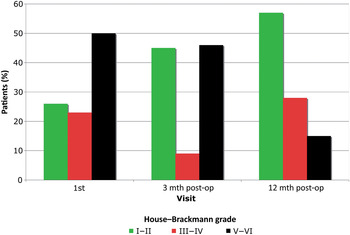
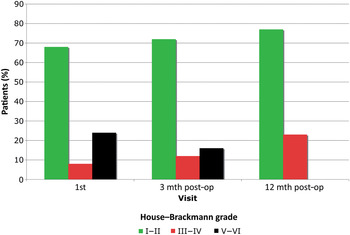
Data for facial nerve outcomes are presented in Figures 1 and 2. Of note, there was a statistically significant improvement in outcomes in the group treated with functional surgery. This difference was significant both in terms of the proportion of patients with good versus moderate to poor outcomes (i.e. House–Brackmann grade I–II vs III–VI), and also in terms of good to moderate versus poor outcomes, with 0 per cent of patients in the functional group suffering a grade V or VI palsy.
Facial nerve outcomes, expressed as House–Brackmann grades, in the size-corrected excisional group. Mth = month; Post-op = post-operatively

Facial nerve outcomes, expressed as House–Brackmann grades, in the functional group. Mth = month; Post-op = post-operatively

A further notable result was that some 61 per cent of all functional group patients were found to have normal (i.e. grade I) facial function at one year. This compares with a rate of 33 per cent in the excisional group with the same follow up.
Analysis of outcomes in the excisional group did not demonstrate any evidence of a learning effect, with early and late cohorts both achieving an almost equal proportion of good outcomes at one year (65 and 66 per cent, respectively).
Follow-up imaging
Routine follow-up magnetic resonance imaging was performed either at two years following surgery, or at one year following surgery if there was thought to be significant tumour residuum. Due to the short duration of follow-up in the functional group, follow-up imaging was assessed with reference to the degree of tumour excision, rather than to the groups used in the analysis above. Data are presented in Table II.
Tumour recurrence data

*On magnetic resonance imaging. †Awaiting first post-operative scan. ‡In 7 cases, patients underwent repeated scanning with no evidence of tumour residuum growth. **Serial imaging showed residual tumour growth; patient successfully treated with stereotactic radiosurgery. §Two patients received stereotactic radiosurgery, one further surgery and one ongoing surveillance. Grp = group; FU = follow up; mth = months
In this table, tumour residuum is defined as any evidence of tumour seen on follow-up scans that is either stable or awaiting further imaging to determine stability; tumour re-growth is defined as any increase in tumour size seen with serial scanning. Of note, the risk of tumour recurrence was consistent with the amount of tumour residuum. Thus, tumours considered totally excised had the lowest rate of tumour re-growth (1 per cent), whereas this was highest in tumours considered to have undergone sub-total excision (40 per cent).
Facial nerve rehabilitation
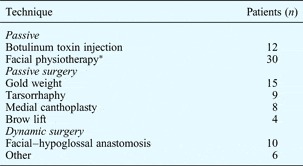
In a number of cases, facial nerve rehabilitation, whether passive or dynamic, surgical or conservative, was offered to patients with impaired facial nerve function. In the functional group, rehabilitation was largely in the form of physiotherapy (n = 2), and, in one case, occuloplastic surgery. In the excisional group, a variety of surgical and non-surgical techniques were employed; these are summarised in Table III.
Facial nerve rehabilitation techniques

*Exercises and facial stimulator. This was the number of patients receiving this treatment as a sole treatment: patients receiving physiotherapy following dynamic surgery are not included in this group.
Discussion
A conservative approach to surgery for vestibular schwannomas dates to the mid-1980s, when Silverstein and colleagues recommended sub-total resection of tumours in elderly patients with large, symptomatic tumours.Reference Silverstein, McDaniel, Norrell and Wazen4 Historically, a decision to limit resection to a sub-total or near-total excision has been made either pre-operatively (as above, in patients for whom a lengthy procedure might prove difficult), or intra-operatively, when total resection of tumour adherent to the facial nerve risked causing significant neurological deficit, or when adverse intra-operative events (for example haemorrhage) led a surgeon to abandon the operation.Reference Freeman, Ramsden, Saeed, Alzoubi, Simo and Rutherford5
The obvious benefits of partial surgical resection are a reduced surgical duration and, perhaps more significantly, the opportunity for improved functional outcomes: an aggressive pursuit of tumour that is adherent to the facial nerve can result in trauma manifest either as nerve division, stretching or ischaemic damage. The principal risk of less than total removal is that the tumour residuum will re-grow, necessitating further treatment.
In cases in which partial tumour removal is achieved, a distinction is drawn between sub-total and near-total excision of tumour. These terms have been defined in the 2003 Consensus Meeting on Systems for Reporting Results in Vestibular Schwannoma document as follows: a sub-total tumour removal removes less than 95 per cent of the original tumour bulk during surgery, whereas a near-total tumour excision is more complete.Reference Kanzaki, Tos, Sanna and Moffat6 Although not all articles discussing these issues adhere to this definition, the terms sub-total and near-total are used commonly. Most authors have found that there is a significantly higher risk of recurrence if a sub-total excision is achieved.Reference Freeman, Ramsden, Saeed, Alzoubi, Simo and Rutherford5–Reference El-Kashlan, Zeitoun, Arts, Hoff and Telian10
As suggested above, the obvious danger presented by less than total tumour excision is tumour recurrence. In some series, rates of recurrence are unacceptably high: Sakaki analysed outcomes in 51 tumours and found recurrence in 29 per cent of near-totally excised tumours.Reference Sakaki, Nakagawa, Hatakeyama, Murakami, Ohue and Matsuoka9 El-Kashlan and colleagues reported a 44 per cent recurrence rate in 39 incompletely resected tumours, with 59 per cent requiring further treatment.Reference El-Kashlan, Zeitoun, Arts, Hoff and Telian10
Freeman et al. reported more optimistic results in a much larger series of patients than either of those described above.Reference Freeman, Ramsden, Saeed, Alzoubi, Simo and Rutherford5 In a total series of 1083 patients with vestibular schwannomas treated surgically, 866 underwent total surgical excision, with a revision rate of only 0.5 per cent. The authors described 128 near-totally excised tumours, with a revision rate of 1.6 per cent, and a further 43 sub-totally excised tumours requiring revision in 26 per cent of cases. In all cases, there were impressively long periods of follow up, close to 10 years.
From these studies, the importance of definitions is clear. Freeman and colleagues defined near-total excision as ‘tiny fragments of tumour capsule left behind, usually on the facial nerve’; anything greater than this in bulk was considered a sub-total excision.Reference Freeman, Ramsden, Saeed, Alzoubi, Simo and Rutherford5 In a large tumour, therefore, a sub-total excision (following this definition) could easily represent less than 5 per cent (the definition offered by the 2003 consensus document).Reference Kanzaki, Tos, Sanna and Moffat6 The implication of these studies is that there is a low risk of recurrence in those excisions in which genuinely minimal amounts of tumour material have been left behind, but that this risk increases significantly if bulky tissue remains (irrespective of the 95 per cent definition offered by the 2003 consensus document).
In our study, we aimed to evaluate the implications of a philosophical shift in surgical practice: a willingness to leave a tumour remnant in situ if there was any concern that a more aggressive surgical resection would cause trauma to the facial nerve.
Figures 1 and 2 demonstrate that this approach was impressively successful in reducing the proportion of our patients suffering significant facial nerve lesions at one year following surgery. These benefits are seen both at initial post-operative follow up and after one year. Perhaps most significantly, we were able to demonstrate preservation of normal facial function (House–Brackmann grade I) in 61 per cent of patients undergoing surgery for medium to large vestibular schwannomas. Furthermore, we would anticipate that a considerable number of secondary rehabilitative procedures (illustrated in Table III) would be avoided as a result of this shift in practice.
The ‘cost’ of these benefits to our cohort of patients was an increased rate of less than total tumour resections. Thus, in the excisional group, rates of total tumour removal were 79 per cent, whereas in the functional group they were only 23 per cent. The obvious risk posed by this change in practice is a significant increase in tumour recurrence over time.
A review of recurrence rates within the group as a whole would suggest that, although recurrence was more common following near-total procedures than total procedures, the difference was small. Of 141 totally excised tumours, 1 per cent demonstrated recurrence; the equivalent proportion of near-totally excised tumours was 2 per cent.
Our follow up of patients who had undergone near-total tumour excision was relatively short. This rate may increase a little over time, but we would expect it to remain low. It was reassuring that, in the majority of patients, the tumour remnant was so small that it was not seen on subsequent imaging. We would anticipate that such small remnants represent a very low risk of recurrence (based on outcomes seen in our own series and that of Freeman et al.).Reference Freeman, Ramsden, Saeed, Alzoubi, Simo and Rutherford5
• Total excision of some vestibular schwannomas is not achievable without significant facial nerve trauma
• In this study, a policy of total tumour removal was altered to favour facial nerve preservation
• Excellent functional outcomes were achieved for large tumours, with a low recurrence risk and minimal rehabilitation requirement
• If adopting this functional approach, a genuinely near-total excision must be achieved: significant tumour remnant is likely to recur
Recurrence in sub-totally excised tumours occurred at a markedly higher rate (40 per cent); however, even in this group, in which a significant tumour bulk was left in situ, a significant proportion of tumours did not demonstrate further growth. The recurrence rate seen in sub-totally excised tumours was significant, and we would not argue that a policy of sub-total tumour excision should be pursued in order to improve facial nerve outcomes. Rather, sub-total excision is an expedient measure pursued in cases in which intra-operative conditions render total or near-total tumour resection impossible.
If an increased rate of tumour recurrence is inevitable following functional surgery, it is important to assess the significance of this change. In the first place, patients undergoing less than total tumour resection require regular follow up with imaging surveillance. It is our current practice to perform an initial magnetic resonance scan one year after surgery and to repeat this every two years; three scans demonstrating stability would allow a relaxation of this programme. Secondly, recurrence in some cases will require further treatment (other centres may allow surveillance). In the majority of patients, this will take the form of radiosurgery, a treatment that is generally well-tolerated by patients, and which was successful in treating the one case of recurrent disease following near-total surgery in our series.
Conclusion
The aim of this paper has been to evaluate a change in surgical philosophy: essentially a relaxation of the principle of total tumour removal in vestibular schwannoma surgery. This policy has led to significant improvements in facial function among our patients with medium-large lesions.