Introduction
The benefits of simulation training have been well documented in medical education, and in other industries such as aviation and military services. Training has been affected in recent years because of continuing changes in the healthcare system.Reference Simpson, Cottam, Fitzgerald and Giddings1–Reference Fitzgerald, Giddings, Khera and Marron3 Barriers to learning include infrequent training opportunities and increased demand for consultant-delivered practice.
The learning and practising of skills by novices on any patient raises patient safety concerns.Reference Nguyen, Bank, Fisher, Mascarella and Young4 Many other specialties have already integrated simulation-based education opportunities into their curriculumReference Nguyen, Bank, Fisher, Mascarella and Young4 and simulation-based education is now considered an integral component of surgical training.Reference Rosenthal, Gantert, Hamel, Metzger, Kocher and Vogelbach5
Currently, it is felt that there is a poor representation of ENT in the medical school curriculum. A recent study of 26 medical schools showed that there were compulsory ENT placements and rotations for just 53 per cent of students, and 10 of the 26 medical schools included in the study did not offer an ENT attachment at all.Reference Steven, Mires, Lloyd and McAleer6 The average duration of an ENT attachment in medical schools varies from 7.5 to 13.4 days.Reference Steven, Mires, Lloyd and McAleer6,Reference Sharma, Machen, Clarke and Howard7 The short length of ENT attachments, or indeed the absence of them, is clearly inadequate, especially as more than 1 in 10 presentations to general practice involve ENT pathology.Reference Griffiths8 A review of the undergraduate curricula revealed that most final year students do not feel adequately prepared to practise ENT because of the limited duration of clinical rotations and the lack of opportunity for practical learning.Reference Ferguson, Bacila and Swamy9
As a trainee, night-time ENT cover is often provided by a junior doctor with little experience in ENT. One study showed that 68 per cent of these doctors (across 91 hospitals in the UK) had no prior ENT experience, with 42 per cent not being comfortable in managing acute ENT conditions.Reference Biswas, Rafferty and Jassar10
To our knowledge, there is no consistent induction programme or induction model currently in use that is aimed at those with little or no ENT experience, and which is designed to allow the practising of practical skills required to deliver acute ENT services. Therefore, a simulation-based induction programme was introduced using a home-made simulation model. The induction programme itself was assessed using a qualitative analysis and the induction model was evaluated via quantitative analysis.
Materials and methods
Quantitative data
We conducted ENT-specific induction programmes with a focus on practical skills using a home-made simulation model (Figures 1 and 2), in the UK and in Australia. The induction involved training on anterior and posterior nasal packing, cautery, microsuction, foreign body removal from ears and nose, and flexible nasendoscopy (Figures 3–5).
Anterior view of home-made induction model.

Lateral view of home-made induction model.

Induction model being used for microsuction.

Induction model being used for flexible nasendoscopy.

Induction model being used for nasal packing.

Altogether, 38 candidates used the model during their induction programmes. There were 14 candidates in the UK induction, with 3 being international students, and 24 candidates in the Australian induction. Therefore, 27 international candidates and 11 national candidates were involved in the quantitative analysis. Of the 14 candidates who participated in the UK induction course, 9 were foundation year 2, 3 were foundation year 1, and 2 had completed their foundation years.
In addition, we ran a lecture-based induction course in the UK for junior doctors. The course included the same content as the simulation-based induction course, but with more of a focus on knowledge-based teaching of practical skills. Thirteen candidates took part in this induction, and all were foundation year 2 doctors.
Candidates were asked to complete anonymous pre- and post-induction surveys regarding anxiety and confidence levels for each of the skills, using a 10-point Likert scale, for both the simulation-based induction and lecture-based induction course.
We asked candidates to complete a written assessment one month after both the simulation-based and lecture-based induction programmes to assess knowledge retention following the course. This involved a multiple choice questionnaire of 20 questions. Candidates were asked to complete the questionnaire in person before collecting their certificates; therefore, use of the internet or additional books was not allowed.
Qualitative data
In order to gain qualitative data, rather than analysing the model itself, we considered the induction programme as a whole. A combination of both convenience and purposeful sampling was utilised to allow trainees with more considered views to identify themselves, therefore providing more valid responses. We aimed to interview 8–10 trainees out of the 11 delegates who participated in the induction session in the UK. Six trainees responded and were interviewed, each of whom had a different grade, with a different motivation for attending the simulation course. All respondents had a different amount of exposure to ENT, whether this was in medical school or working within the specialty. Following initial thematic analysis, further interviews would be conducted if saturation of themes had not occurred.
Structured interviews were chosen as questions can be developed as they arise. Focus groups can risk delegates copying answers from one another and being influenced by others’ views. Furthermore, given the time constraints, it would be difficult to gather enough junior doctors together at the same time. Questionnaires were considered; however, responses may be minimal, and development of further questions is limited. There is also a risk of gaining minimal data for thematic analysis, resulting in a different method of data collection, which is time-consuming.
Example questions for the structured interview are shown in Appendix 1. The interviews were recorded on a voice-recording mobile phone application. Data were stored on an encrypted memory stick and were transcribed. A non-response to the initial e-mail invite was followed up by repeat emails or announcements at their regular teaching sessions as reminders.
The study did not collate any numerical data other than simple participant demographics. Transcribed data from structured interview recordings underwent emergent coding and thematic analysis.
No patients were involved in this study and therefore patient consent was not required. No personal data, patient information or professional information were taken from participants; therefore, ethical approval was also not formally sought for this project, but departmental approval was granted for the project to be undertaken.
Results
Quantitative data analysis
Simulation-based induction
The average confidence level before the induction for all the candidates for the skills taught was 4.09 in the UK induction and 2.2 in the Australian induction. The average anxiety level regarding airway, otological, rhinological and throat emergencies before the induction were 4.5 in the UK induction.
After the induction, the average confidence levels for all the candidates for the skills taught increased to 7.6 for the UK induction and 7.65 for the Australian induction. The average anxiety level regarding airway, otological, rhinological and throat emergencies after the induction decreased to 3.9 in the UK induction.
The Wilcoxon matched pairs signed rank test was used for statistical analysis. This showed a statistically significant increase in confidence levels and a statistically significant decrease in anxiety levels (Figure 6).
Confidence and anxiety levels before and after induction using simulation models. FB = foreign body; FNE = flexible nasal endoscopy

Lecture-based induction
The average confidence level before the induction for all the candidates for the skills taught was 3.46 in the UK and the Australian induction programmes. The average anxiety level regarding airway, otological, rhinological and throat emergencies before the induction was 5.28.
After the induction, the average confidence level for all the candidates for the skills actually decreased to 3.2. The average anxiety level regarding airway, otological, rhinological and throat emergencies after the induction decreased to 3.8 in the UK induction.
The Wilcoxon matched pairs signed rank test was used for statistical analysis. This showed no significant difference in confidence and anxiety levels before and after the lecture-based induction for the skills taught (Figure 7).
Confidence and anxiety levels before and after induction using lecture-based teaching. FB = foreign body; FNE = flexible nasal endoscopy

The written assessment that candidates were asked to complete one month after the course showed an average score of 17 out of 20 after simulation-based teaching (n = 15), and 12.3 out of 20 after lecture-based teaching (n = 13).
Qualitative data analysis
Following an initial e-mail, six trainees agreed to participate in the structured interview after the simulation session. Each trainee had a different amount of exposure to ENT and took part in the simulation session for different reasons (Table 1).
Participant demographics

A&E = accident and emergency; GP = general practitioner
Interviews were conducted using the interview template shown in Appendix 1, which did not need to be modified.
Following emergent coding and thematic analysis, thematic saturation was reached, so no further interviews were required.
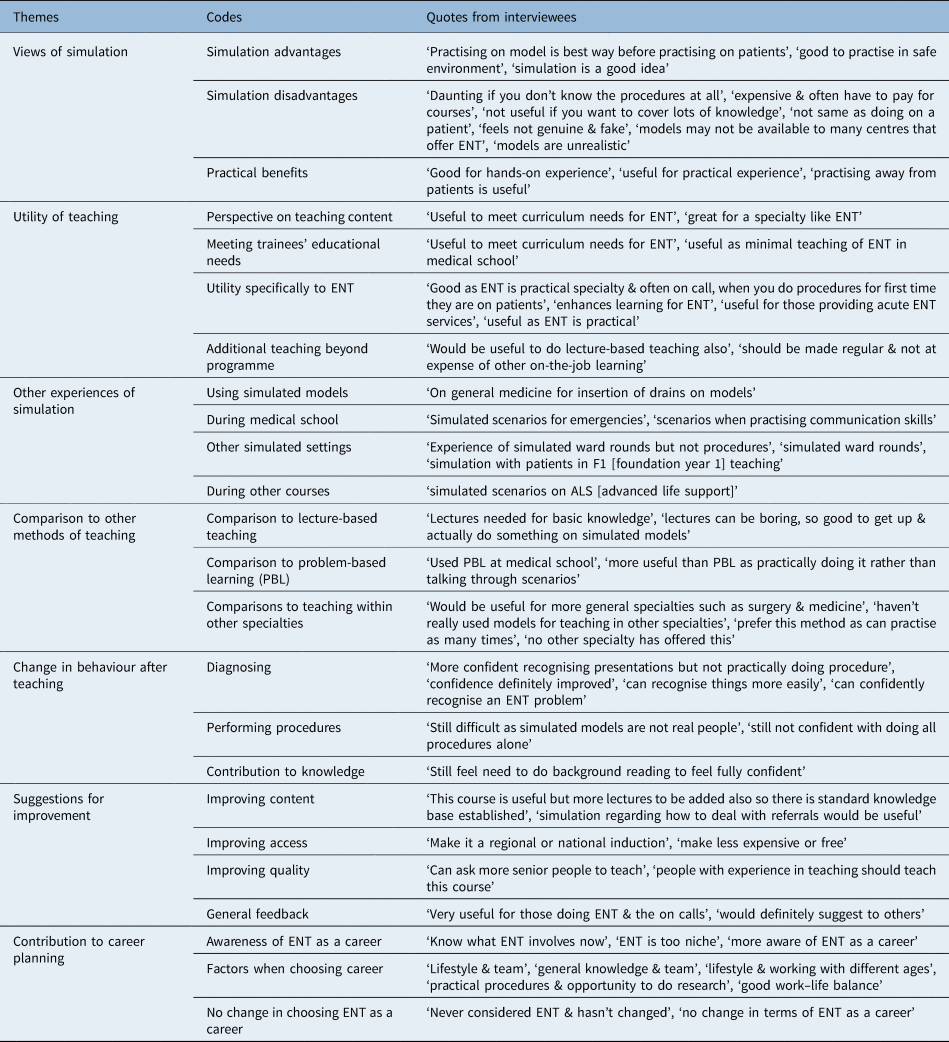
A total of 24 independent codes were identified, which led to the development of 7 themes: (1) views of simulation; (2) utility of teaching; (3) other experiences of simulation; (4) comparison to other methods of teaching; (5) change in behaviour after teaching; (6) suggestions for improvement; and (7) contribution to career planning.
Full details of coding, thematic analysis and supporting interviewee quotes are given in Table 2. Themes are explored below.
Emergent coding and thematic analysis breakdown

Discussion
Our results show a significant increase in confidence levels and a reduction in anxiety levels after simulation-based teaching using the induction model, as compared to lecture-based teaching. The simulation programme consisted of small workshops focusing on different practical skills using the induction model, with a short presentation before each workshop. With lecture-based teaching, there was no opportunity for delegates to practise ENT skills.
The trainees’ views of simulation were generally positive; the majority agreed that as ENT is a ‘practical specialty’, having simulated models on which procedures could be practised was useful. The simulation course allowed for ‘practising in a safe environment’, which has been well documented previously. However, as some of the participants had no previous exposure to ENT or any aspect of ENT within their specialty, they found it was not useful, as there was ‘no base knowledge’ covered within the simulation course. This can be an area of improvement for future courses, and more lecture-based teaching focusing on basic ENT knowledge can be taught before practising on simulated models.
The findings suggest that although simulation is a very useful method of teaching, it should not be the sole method and used ‘as a replacement for other on-the-job teaching’. It has been shown recently that junior doctors perform better in one-to-one viva assessments of ENT emergencies after a combination of both simulation and lecture-based teaching,Reference Smith, Navaratnam, Jablenska, Dimitriadis and Sharma11 and our results also support this.
Although the benefits of simulation, especially for teaching ENT, were recognised, some participants indicated that practising on the models felt ‘fake’ and ‘not genuine’. Simulated models are known not to feel as realistic as when practising on a patient.Reference Nguyen, Bank, Fisher, Mascarella and Young4 The next course could be improved by using only validated models, if resources and funding allow.
This is the first induction model in use that allows delegates to practise multiple ENT skills. The cost of the polystyrene head and the other materials needed is less than £10. Therefore, it is a model that is easily reproducible by different institutions. The plastic inserts used to create the external auditory canals, the nasal cavity and the larynx cost less than £5 each. For our programme, we used soap to represent debris within the external auditory canal, which required microsuction. In order to create the model, relevant areas were cut out of the polystyrene head. The heads were then attached to a foam mat, allowing them to be easily clipped or attached to hard surfaces such as tables. For the purposes of flexible nasendoscopy, different foreign bodies (such as a coin or peanut) were inserted over the plastic insert within the polystyrene head, and delegates had to describe what they saw when performing this skill.
There seemed to be minimal experience using simulated models as a method of teaching, with different methods of teaching being used in other specialties. Simulation was ‘used in many different ways’, including ‘simulated ward rounds’; however, only one participant reported using a simulated model previously, when learning how to perform a medical chest drain. This may be because of the lack of resources available to specific specialties,Reference Simpson, Cottam, Fitzgerald and Giddings1 and the appropriateness of using models to teach certain aspects of a specialty. ENT is known to have many practical procedures; however, in specialties such as emergency medicine, it may be more relevant to have simulated emergency scenarios, rather than using simulated models for training. In addition, the use of models can incur a cost for trainees – ‘simulation courses tend to be expensive’, which is a recognised disadvantage of such courses. Furthermore, some participants suggested that simulation at their level of training was more useful for ‘general medicine and general surgery’, and felt that the course was ‘too niche with regard to ENT’. Therefore, this course may be more useful when aimed at those who are covering ENT services.
In light of the minimal exposure to ENT within medical schools,Reference Steven, Mires, Lloyd and McAleer6 it is obvious why participants did not consider ENT as a career. The majority of participants felt they would consider ENT as a career now that they ‘know what ENT involves’. Gelfand et al.Reference Gelfand, Podnos, Wilson, Cooke and Williams12 showed that the provision of dedicated teaching for a specialty increases the likelihood of students considering that specialty as a career.
Simulation-based teaching has led to improved patient outcomes in many clinical settings, including technical skills and crisis situations,Reference McGaghie, Draycott, Dunn, Lopez and Stefanidis13 allowing time for reflection with the assurance of patient safety.Reference Javia and Sardesai14
Limitations
Candidates who were asked to complete the assessment after the lecture-based and simulation-based induction programmes were forewarned that they would be doing this. Therefore, although we tried to minimise the likelihood of answers being looked up, trainees may have revised prior to the assessment in order to gain higher marks. Hence, our assessment of knowledge retention may have reflected surface learning rather than strategic learning. In addition, the assessment may have been conducted too soon following the induction.
The chosen written assessment was used after simulation-based and lecture-based teaching. Although we tried to teach the same content throughout both induction programmes, using different methods of teaching, the written assessment could reflect more of a knowledge base of ENT rather than the practical aspects taught through simulation. Therefore, the findings could be biased for those candidates with prior ENT knowledge.
• Regular simulation induction programmes should be introduced
• Knowledge retention was increased for simulation-based teaching compared with lecture-based teaching
• Confidence levels were increased and anxiety levels were reduced with the simulation induction
• ENT induction programmes, with a focus on teaching practical skills, do not require vast resources or time
The simulation-based induction programme was half a day, whereas the lecture-based induction programme was 1–1.5 hours. Although the same content was covered in both programmes, the duration of the programmes may have affected the learners’ experience and the assessment outcomes.
Acknowledgements
We would like to thank the simulation team at Imperial College London and the faculty members who helped teach on the induction course.
Competing interests
None declared
Appendix 1. Planned questions for structured interviews
Questions may change prior to launch of interviews and can evolve following initial interview stages.
1. Why did you choose to take part in this course?
2. What stage of your training are you at?
3. What previous experience of ENT teaching have you had? Please inform us how many days/weeks, when during training and what type of teaching it was.
4. What are your views of simulation-based teaching?
(a) What are the advantages?
(b) What are the disadvantages?
5. What are your views of simulation-based teaching as part of ENT training? Has it enhanced your learning experience?
6. Do you have any other experience of simulation teaching in other specialties?
7. Has this course met your educational needs?
8. How do you feel about establishing a regular ENT simulation session as an induction programme for all junior doctors providing acute ENT services?
9. Has your confidence in managing acute ENT presentations changed since the course? Please explain.
10. Has this contributed to future career planning? Please explain.
11. What influences you to choose certain careers?
12. Are there any improvements that can be made?