


Introduction
Psychological treatments for anger are now being added to the growing list of successes in psychotherapy. Biaggio (Reference Biaggio1987) surveyed a number of approaches from social skills training to systematic desensitization that have been adapted for anger management. A meta-analytic review of 50 studies found that cognitive-behavioral interventions for anger management are efficacious (Beck and Fernandez, Reference Beck and Fernandez1998a); collectively, a grand weighted mean effect size of .70 was obtained, indicating that the average treatment subject was better off than 76% of untreated subjects. A more updated meta-analytic review by DiGiuseppe and Tafrate (Reference DiGiuseppe and Tafrate2003) produced an almost identical effect size for anger management. However, much of the existing support for anger management comes from studies of college students and school children. There have also been successful applications to juvenile delinquents (e.g. Hains, Reference Hains1989) and developmentally disabled individuals (e.g. Taylor, Novaco, Gillmer and Thorne, Reference Taylor, Novaco, Gillmer and Thorne2002).
One clinical population identified as having a particular risk for anger and related problems are the chemically dependent (Bain and Kornetsky, Reference Bain and Kornetsky1989; Miczek, Reference Miczek, Iversen, Iverson and Snyder1987; Walfish, Massey and Krone, Reference Walfish, Massey and Krone1990). In the US at least, this group accounts for more than two-thirds of jail inmates, with an even greater representation among female jail inmates (52%) as compared to their male counterparts (Karberg and James, Reference Karberg and James2005). Also revealed in this national epidemiological study is the high co-occurrence of substance dependence/abuse and violent offenses.
Only recently has research turned to the management of anger in chemically-dependent individuals (e.g. Awalt, Reilly and Shopshire, Reference Awalt, Reilly and Shopshire1997; Reilly, Clark, Westley, Lewis and Sorenson, Reference Reilly, Clark, Westley, Lewis and Sorenson1994; Tivis, Parsons and Nixon, Reference Tivis, Parsons and Nixon1998). The outcome data from these studies are encouraging. As with much clinical research, there are certain practical limitations in some of these studies but they do point the way to further improvements. First, the sample sizes are a bit small, the average study having five participants. This may well be due to the problems of continuity in actual clinical subjects seen for anger management (Bradbury and Clarke, Reference Bradbury and Clarke2006; Siddle, Jones and Awenat, Reference Siddle, Jones and Awenat2003). Second, the dependent measures of anger have generally consisted of questionnaires or rating scales. Including self-monitored measures of anger can open the window beyond the clinic to actual naturalistic settings in which anger occurs, although this presents its own problems of compliance. Third, the predominant approach used to deal with anger has been intervention. Some consideration can also be given to other avenues like prevention and postvention.
Recently, Reilly and Shopshire (Reference Reilly and Shopshire2000) published a report of anger management in a relatively large sample of cocaine-dependent men and women. Their findings support the efficacy of cognitive-behavioral techniques (e.g. cognitive restructuring, relaxation training) in reducing self-reported anger and angry behavior. Whilst this study remains one of the most carefully executed and analyzed studies in the area, it did not have a control group and treatment subjects themselves declined in number.
The present study also focuses on anger management in chemically-dependent inpatients, but with certain methodological refinements. Sample size is moderate and divided by gender and treatment condition. In addition to pre- to post-treatment and follow-up phases, the design allows for a control group in addition to the treatment group. Dependent measures are obtained from six subscales of an anger questionnaire as well as the self-monitoring of anger at the place and time of its occurrence. Moreover, multiple parameters of anger are monitored: frequency, duration, and intensity. Previous research has already established the feasibility of such indices and their special value in isolating selective effects of a treatment or manipulation (Beck and Fernandez, Reference Beck and Fernandez1998b; Fernandez and Beck, Reference Fernandez and Beck2001).
Most important, the present study utilizes a comprehensive treatment plan (Fernandez, Reference Fernandez1999, Reference Fernandez2001, in press) to deal with anger over its temporal range. Specifically, anger is addressed prior to its occurrence, during its episodic state, and during its extended recovery period. This corresponds to anger onset, anger progression, and residual anger. To be tailored to these stages of anger, treatment is organized into three phases: prevention, intervention, and remediation (or postvention). Different psychological techniques are appropriate for each phase. Although these are derived from slightly different schools of psychotherapy, they complement one another within the sequential format adopted here.
The prevention phase is designed to forestall anger. It is fundamentally behavioral in orientation and begins with a contingency contract. As detailed in the method section, the contract is designed to promote a commitment against getting angry. Additionally, stimulus control is used for the specific purpose of helping individuals avoid certain situations known to habitually provoke their anger. For anger-provoking situations that are unavoidable, preparatory strategies are indicated. These revolve around the technique of behavioral rehearsal.
Because some preventive efforts will fail, a second phase is in place to reduce anger once it has started. This is the intervention phase in which cognitive strategies predominate. Instruction in this section begins with the simple technique of thought-suppression, followed by the more complex task of reappraisal. The former can abort anger, but should it fail, the latter is available to reinterpret the anger-related situation. The counter-cognitions that result are likely to moderate the anger into more adaptive responses. However, if the individual is frustrated by this attempt at reappraisal, a more achievable goal is to replace the angry schema with images that are incompatible with anger. Relaxation is also interspersed, as needed, in order to control the physiological arousal from anger.
Even intervention may not totally eliminate residual anger, and so a phase called remediation or postvention is added at the end. This is designed to alleviate any lingering anger primarily through the use of experiential techniques. Thus, free disclosure is encouraged either as oral or written communication, preferably to a confidant whose responsibility is simply to attend to rather than analyze information. Finally, any unresolved anger can be relieved by the Gestalt “empty chair” technique. This method of emotional release is especially appropriate when the anger is directed at an individual with whom a confrontation would be inadvisable or impossible.
In summary, this three-phase regimen has a capacity to address the whole course of anger from onset to offset. It is part of a growing trend towards combining anger management techniques (e.g. Deffenbacher, Oetting and DiGiuseppe, Reference Deffenbacher, Oetting and DiGiuseppe2002; Tafrate and Kassinove, Reference Tafrate, Kassinove and Fiendler2006) but it is unique in the way the contrasting techniques are organized into a meaningful sequence. As detailed in Fernandez (in press), the techniques are theoretically as well as technically compatible. Above all, they follow a progression that builds upon skills, from the concrete to the abstract, and then to the experiential; these are linked in a programmatic fashion that offers users multiple options throughout the course of anger.
The present study is designed to evaluate the outcome of this new integrative program on anger in chemically-dependent patients, especially with reference to pre- vs. post-treatment as well as follow-up. Treatment outcome is assessed by questionnaire as well as self-monitoring methods. Additionally, gender effects on treatment outcome will be explored.
Method
Subjects
A total of 58 patients in a residential treatment facility for substance abuse were invited by their counselors to participate in the anger management program. They granted informed consent to participate in the study. Participants fulfilled DSM IV criteria for substance dependence (American Psychiatric Association, 1994) and generally had a record of related legal violations – an average of 1.3 previous attempts at chemical dependency treatment and 1.7 previous arrests. They also reported a history of anger-related difficulties, an assertion corroborated by high baseline scores on the STAXI (Spielberger, Reference Spielberger1988), which placed them at the 88th percentile for State Anger and 82nd percentile for trait anger. Participants had a mean age of 33.5 years, and 51% were male. Most participants had a high school education, the average years of schooling being 11.7. Due to constraints on group size and the number of groups that could be run each week, 38 subjects were randomly assigned to a treatment condition while the remaining 20 were assigned to a no-treatment control condition. Attrition factors (to be discussed later) led to a final sample of 13 males and 13 females who completed the treatment program all the way through follow-up but two individuals who remained in the control condition throughout.
Materials
The standardized questionnaire chosen to assess anger was the State Trait Anger Expression Inventory or STAXI (Spielberger, Reference Spielberger1988). This is a 44-item questionnaire that yields scores on six subscales: state anger, trait anger, anger-in, anger-out, anger control, and anger expression. State anger refers to momentary feelings of anger at the time of questionnaire-completion, whereas trait anger refers to a general tendency to be angry; these two subscales map onto the situational-dispositional dichotomy in affect research. Anger-in refers to the internal suppression of anger, whereas anger-out refers to the externalization of anger typically as aggression. Anger expression refers to the extent to which anger is either experienced or expressed (regardless of direction) whereas anger control refers to attempts to be aware of anger and to limit its outward expression. The STAXI has high internal consistency and retest reliability (Bishop and Quah, Reference Bishop and Quah1998) and factorial validity (Forgays, Forgays and Spielberger, Reference Forgays, Forgays and Spielberger1997) and it appears to be the current instrument of choice for questionnaire-based anger assessment.
To supplement the STAXI (which is ideally administered within a clinical or experimental context) self-monitoring of anger in naturalistic situations was facilitated by pocket-sized cards. On each card was a graph to record the intensity of each anger episode (Y-axis) as it changed over time (X-axis). The Y-axis was a 10-point scale, where 1, 5, and 10 were labeled annoyance, anger, and rage, respectively; the X-axis was a line for marking the chronological time of onset and subsequent changes in the experience of anger. This protocol has been successfully used to gather important measures of the frequency, duration, and intensity of anger as it occurs and unfolds over time (Beck and Fernandez, Reference Beck and Fernandez1998b; Fernandez and Beck, Reference Fernandez and Beck2001). The number of graphs completed is an index of anger frequency, the time elapsed between the start of recording and the end of recording each episode is anger duration, and the highest point on each graph is the peak anger intensity.
Design
The 58 patients were randomly assigned to two groups: treatment (n = 38) and control (n = 20). The former comprised 18 females and 20 males, and the latter consisted of 10 males and 10 females. Attrition factors (to be explained later) led to a control group N = 2; hence, gender became the sole “between factor”. The within factor was phase of study: pre, post, and follow-up. Dependent measures were obtained at each of these phases; they consisted of scores on the STAXI questionnaire as well as self-monitored frequency, duration, and intensity of anger.
Procedure
Subjects met in gender-specific groups of 10 or fewer. The groups were closed to promote constancy of membership over the course of instruction, and were led by the two authors of this study. The entire program consisted of two, hour-long sessions per week for a total of four consecutive weeks. This was partly dictated by insurance considerations that limited the length of stay in the center to no more than 30 days.
The treatment program was structured into four subphases over four successive weeks: psychoeducation, prevention, intervention, and remediation. The first of these was essentially an exercise in group formation and orientation to the program. The remaining three phases, as described earlier, were differentiated by (i) the type or stage of anger addressed, be it anger onset, anger progression, or residual anger, and (ii) the type of techniques, varying from concrete behavioral methods through cognitive strategies to experiential approaches.
In the psychoeducation phase, participants were introduced to a working definition of anger. This was a simplification of the theoretical conceptualization of anger in terms of subjective feeling and cognitive, motivational, behavioral, and biochemical processes. Distinctions were made among the different styles of anger expression. Special attention was paid to the risks posed by anger to mental health, interpersonal relations, cardiovascular function, and overall physical wellbeing.
The prevention phase began with the distribution of a behavioral contract. This was a formal agreement to do one's best to avoid or minimize anger. The contract was signed by the participant and group facilitators in order to encourage each participant to honor its intent. Additional investment in the program was fostered by the promise of a certificate of achievement to be awarded upon successful completion of the course. Anger prevention was aided by a stimulus control technique, requiring participants to avoid common anger-producing situations. Group members listed up to five situations that recurrently provoked their anger, then selected at least one of these situations to be avoided in the future. For example, a participant who had identified rush hour driving as an inevitable source of rage opted to travel outside of rush hour in order to remove the situational context of this anger. For those situations that were unavoidable, participants were trained in the preparatory technique of rehearsal. Specifically, they anticipated a likely scenario, then rehearsed a plan of action. This plan was then role-played within the group setting as a prelude to in vivo application later.
The next phase, intervention, focused on options for dealing with anger incidents that arose in spite of efforts to prevent them. Participants first learned to use the technique of thought-stopping as an interrupt mechanism during the progression of anger. The anger, itself, became a cue to covertly repeat a word or phrase to abort further thoughts of anger. Participants selected such stock phrases as “Time out” and “Let it go” or other private utterances of personal significance to them. If this simple attempt failed, participants were taught to stem the anger by active reappraisal. This entailed the reinterpretation of the anger event: specifically, participants were required to re-evaluate the intentionality, responsibility, and blameworthiness of the offending person, to re-evaluate the severity of the consequences for oneself, and to reflect on some redeeming features of the offending person or event. If anger persisted despite such countercognitions, the next step was imagery. This was a mechanism to extricate the person from self-defeating perseveration about the angry event. Participants were advised to choose from humorous imagery (e.g. imagining an absurd or silly situation), pleasant imagery (e.g. remembering something pleasant), or neutral imagery. Also essential to this intervention phase was relaxation training. This consisted of diaphragmatic breathing and progressive muscle relaxation. Participants were instructed to use this, as needed, to regulate the physiological arousal associated with anger.
Appended in the fourth week of the program was a remediation (postvention) phase. This section was designed to alleviate any feelings of anger left over from previous partially successful attempts to prevent or intervene on anger. Such residual anger was relieved by cathartic approaches, in particular, verbal disclosure and written disclosure. Participants were encouraged to find a willing and trusted confidant to listen to their verbalizations of unresolved anger or to read their written disclosures. An important caveat in both cases was that the confidant was to be a recipient of information instead of a responder to such information. Finally, for intense anger that remained blocked, the “empty chair” technique from gestalt therapy was introduced. In particular, if the offending person was beyond communication for some reason, participants vented unresolved anger towards that person imagined to be seated in an empty chair.
Control patients met with the group facilitators during the same 4-week period. However, the meetings centered exclusively on reviewing their self-monitored records of anger. They received no information or training in any of the techniques purveyed in the treatment condition. Control group members were also expected to attend the follow-up session scheduled 4 weeks after the program. One month after the conclusion of the 4-week program, participants in both groups attended the follow-up session. This session included re-assessment on the STAXI and the opportunity for discussion of personal reactions to the therapy.
Data analyses
Self-monitored data were reduced to three indices. The frequency of anger episodes was determined by tallying the number of graphed plots of anger over the 4 weeks. The duration of each anger episode was simply the time elapsed from recorded onset of anger to the offset of anger. The (peak) intensity of anger in each episode was the highest point reached on each graph. These three measures were analyzed together in a MANOVA, with gender being the between factor, and phase of study being the within factor. The scores on the six subscales of the STAXI were analyzed in a separate MANOVA using the same factors of gender and phase of study as between and within factors, respectively. Univariate ANOVA's and the appropriate post hoc tests were performed on each variable.
Results
As indicated earlier, attrition factors led to a final sample of 26 participants (equally divided between male and female) in the treatment group, and two participants in the control group. These reductions occurred for a variety of reasons including premature discharge from the clinic, no-shows at scheduled sessions, noncompliance with instructions, or unavailability at follow-up. Discharge from the clinic was the primary reason for the small loss of subjects in the treatment group, whereas missed sessions, noncompliance, and unavailability at follow-up accounted for the bulk of attrition in the control group. This will be taken up for discussion in the next section.
Since the standardized questionnaire data and the self-monitored data tap into different domains of anger, it is appropriate to analyze these data sets separately. Moreover, the phases over which the questionnaire data were collected were pre- post- and follow-up, whereas the phases over which the self-monitored data were collected were weeks 2, 3, and 4, corresponding to prevention, intervention, and postvention.
Questionnaire data
The 2 (gender) × 3 (phase) MANOVA on STAXI data revealed a significant multivariate main effect for phase of study [Wilks' Λ = .34, F (12, 86) = 5.13, p < .0001]. The η2 of .42 is an index of the proportion of variance explained by this within factor. There was no significant effect for the between factor, gender, [Λ = .78, F (6, 19) = .89, p = .52] but a marginally significant interaction of gender and phase [Λ = .65, F (12, 86) = 1.73, p = .075] with η2 = .19.
Univariate F-tests were performed on the dependent measures followed by post hoc tests to identify precise differences. The F-tests uncovered significant effects of phase on every one of the dependent measures. On the other hand, gender did not exert a significant effect on any of these six dependent measures. Relevant inferential and descriptive statistics are next provided for the phase effects of the STAXI data (variable by variable) and then followed by details of the gender and interaction effects.
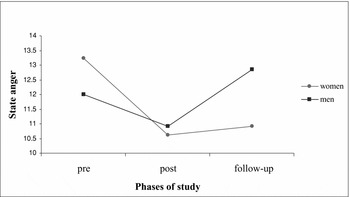
Beginning with state anger, there was a significant main effect of phase on this variable, F (2, 48) = 3.185, p = .05. Post hoc tests revealed a significant drop between the pre (M = 12.62, SD = 3.22) and the post (M = 10.77, SD = 1.36) phases, yielding an effect size (standardized mean difference) of d = +0.80. After that, there was an increase in state anger to the follow-up phase (M = 11.89, SD = 3.24), thus giving rise to a significant quadratic function as illustrated in Figure 1.
State anger by phase and gender

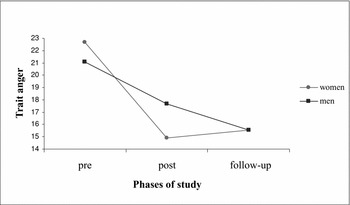
For trait anger, there was a highly significant main effect of phase F (2, 48) = 26.46, p < .0001. Post hoc tests revealed that the significant change was between pre (M = 21.89, SD = 6.57) and both post (M = 16.31, SD = 4.65) and follow-up (M = 15.54, SD = 4.52) phases. Therefore, the pre-post effect size (d) = + 0.99. The significant linear trend is depicted in Figure 2.
Trait anger by phase and gender

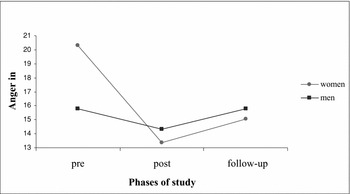
For anger-in, there was a highly significant main effect of phase, F (2,48) = 11.39, p < .0001. Post hoc tests revealed a significant drop from the pre (M = 18.04, SD = 5.07) to post (M = 13.85, SD = 3.79) phase, followed by a slight rise from the latter to follow-up (M = 15.42, SD = 4.05). Thus, a quadratic trend predominates (Figure 3).
Anger-in by phase and gender

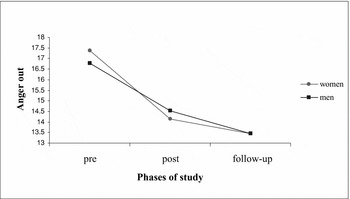
For anger-out, there was a highly significant main effect of phase, F (2, 48) = 10.78, p < .0001. Post hoc tests revealed a significant decline from pre (M = 17.08, SD = 5.09) to both post (M = 14.35, SD = 3.74) and follow-up (M = 13.46, SD = 3.25) phases, respectively. The significant linear trend thus formed is apparent in Figure 4.
Anger-out by phase and gender

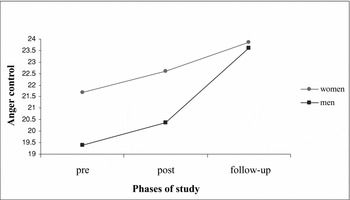
For anger control, there was a significant main effect of phase, F (2, 48) = 3.37, p < .04. Post hoc tests were nonsignificant but there was a significant linear increase across all three phases (M = 20.54, SD = 6.63; M = 21.50, SD = 5.7; M = 23.73, SD = 6.73, respectively) as illustrated in Figure 5.
Anger control by phase and gender

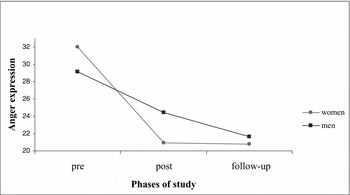
For anger expression, there was a highly significant main effect of phase, F (2, 48) = 12.34, p < .0001. Post hoc tests identified significant drops from pre (M = 30.58, SD = 11.06) to both post (M = 22.69, SD = 9.45) and follow-up (M = 21.19, SD = 9.32) phases, respectively. This is depicted in Figure 6.
Anger expression by phase and gender

Whilst there were significant effects of phase on each dependent measure, there were no main effects of gender. The only significant interaction between gender and phase was for anger-in, F (2, 48) = 6.06, p = .005.
Self-monitored data
The 2 (gender) × 3 (phase) MANOVA on self-monitored data revealed a significant multivariate main effect for phase of treatment [Wilks' Λ = .45, F (8, 90) = 5.46, p < .0001]. The η2 of .33 is an index of the proportion of variance explained by this within factor. There was no significant effect of the between factor, gender, [Λ = .78, F (4, 21) = 1.49, p = .24] but a significant interaction of gender and phase [Λ = .52, F (8, 90) = 4.33, p < .001] with η2 = .29.
Again, univariate F-tests were performed on the dependent measures followed by post hoc tests to identify the precise differences. These F-tests uncovered significant effects of phase of treatment on every one of the four self-monitoring measures. On the other hand, gender only exerted a significant effect on one of the dependent measures. Below are relevant inferential and descriptive statistics for the treatment phase effects (variable by variable) followed by details of the gender and interaction effects.
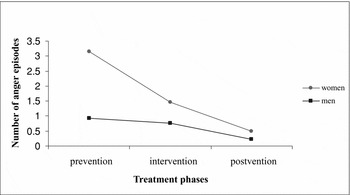
For anger frequency, there was a highly significant main effect of treatment phase, F (2, 48) = 16.60, p < .0001. Post hoc tests revealed significant drops from the week of prevention (M = 2.04, SD = 2.28) to intervention (M = 1.12, SD = 1.11), and from intervention to postvention (M = .365, SD = .84) phases, the pre-post effect size (d) = +1.07. This significant linear trend is illustrated in Figure 7. Other significant main and interaction effects for this variable will be described later.
Anger frequency by treatment phase and gender

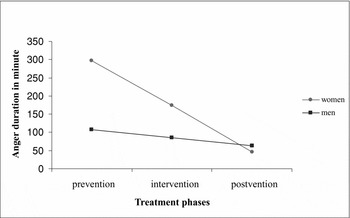
For duration of anger, there was a significant main effect of treatment phase, F (2, 48) = 3.99, p = .025. Post hoc tests related this to a significant drop between prevention (M = 202.08, SD = 256.59) and postvention (M = 55.08, SD = 150.12) phases only, pre-post effect size (d) = 0.72. Figure 8 illustrates this effect.
Anger duration by treatment phase and gender

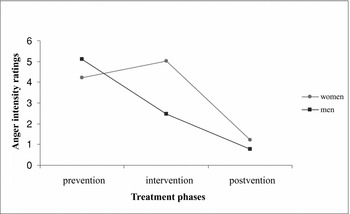
For average peak intensity of anger, there was a significant main effect of treatment phase, F (2, 48) = 12.93, p < .0001. Post hoc tests revealed significant declines from prevention (M = 4.67, SD = 3.54) to postvention (M = .99, SD = 2.13) and from intervention (M = 3.75, SD = 3.53) to postvention phases, the pre-post effect size (d) = +1.30. The resulting linear trend is shown in Figure 9.
Anger intensity by treatment phase and gender

While gender did not exert significant influence on the STAXI variables, it did, however, produce a notable effect in the MANOVA of self-monitored variables. The greatest influence of gender was seen in the frequency of anger, F (1, 24) = 5.85, p < .02. As shown in Figure 7, females had more anger episodes at all three phases of treatment, averaging 1.7 per week (pooled SD = 1.66) as compared to .64 (pooled SD = .76) for males. Females also had a much longer duration of self-monitored anger (M = 172.46 minutes, SD = 226.67) as compared to males (M = 85.28 minutes, SD = 156.85), this difference approaching significance, F (1, 24) = 2.97, .05 < p < .10. Finally, the average peak intensity of anger was greater among females (M = 3.49, SD = 3.05) than males (M = 2.80, SD = 2.95), F (1, 24) = .67, p = .42.
The one interaction effect that turned out significant was anger frequency, F (2, 48) = 6.30, p = .004. Still, the variance explained by this interaction effect was small compared to the variance due to main effects, in particular, the effects of phase of treatment.
Discussion
Phase effects
In general, the results of this study support the efficacy of a comprehensive anger management program for chemically-dependent inpatients. This is indicated by the significant multivariate effect of phase that accounted for 42% of the variance in STAXI scores. Most of this improvement took place between pre- to post-treatment. Further improvement from post-treatment to follow-up was limited but gave an overall picture of maintenance of gains.
While univariate F tests revealed significant effects of phase on all the STAXI measures, the pre-post magnitude of change was greatest for trait anger with its effect size of .+0.99. State anger produced a smaller pre-post effect size of +0.80 and a change that was significant but to a lesser degree. Specifically, state anger declined between the first two phases but reverted to baseline levels between post-treatment and follow-up. This finding is surprising given the prevailing view that traits are more difficult to modify than states. Perhaps the participants in this study perceived themselves as having changed characterologically even more than their actual life circumstances suggested. Similar alteration of trait anger has been reported by Reilly and Shopshire (Reference Reilly and Shopshire2000) and by Siddle et al. (Reference Siddle, Jones and Awenat2003).
Another dichotomy of interest is anger-out versus anger-in. The former declined dramatically over all three phases of the study, whereas the latter decreased from pre- to post- treatment and then increased from post-treatment to follow-up. Patients managed to keep both these types of anger in check while the treatment program was in progress, but after that an inverse relationship emerged: the less the anger was externalized, the more it was internalized. This may reflect an adaptation process in the encounter between newly learned skills and long-standing problems that chemically-dependent patients face.
Similarly, anger expression was an inverse function of anger control. As predicted, treatment did reduce the likelihood of either acting out or suppressing anger, in favor of increased efforts to keep anger within manageable bounds. The treatment program was therefore effective in increasing the motivation to regulate anger even where it could not be abolished altogether.
For the self-monitored variables (as measured during each week of treatment), the most dramatic reduction was in anger frequency, even though this was relatively low to begin with. Anger duration also subsided across phases, while peak anger intensity (though it tended to decline) was moderated by gender effects as well. This is consistent with previous studies (Beck and Fernandez, Reference Beck and Fernandez1998b; Fernandez and Beck, Reference Fernandez and Beck2001) demonstrating that anger frequency and duration are much more modifiable than peak anger intensity; as explained in these previous studies, anger seems to reach a peak early in its onset and does so in almost a reflexive fashion. The individual has a better chance of recovering from this anger (i.e. minimizing its duration) and avoiding subsequent episodes (i.e. minimizing its frequency) than s/he does of controlling the instant rise in anger intensity.
As a whole, the self-monitored anger declined between successive phases of treatment, suggesting a cumulative effect of prevention, intervention, and postvention. In fact, the pre-post effect size was d = +1.03 when averaged across all three self-monitored variables. This reflects a sizeable treatment gain in response to a relatively short dosage of treatment.
Gender variation
Gender-related variations were not as pervasive or pronounced as phase effects in this study. While they were minimal in the STAXI measures, they were discernible in the self-monitored variables. Specifically, females became angry significantly more often, their anger lasted for a substantially longer time, and it peaked at a higher intensity as compared to males. This is consistent with clinical impressions (Ross and Van Willigen, Reference Ross and Van Willigen1996) and research that reports greater overall distress in female than male substance-dependent patients (Wallen, Reference Wallen1992). Three fundamental reasons may explain this gender effect. First, it may be due to actual differences in the threshold of anger and reactivity to provocation. Second, it could be due to differences in the environment, women possibly subjected to more frequent, prolonged, and greater provocation than men. Third, it could reflect bias in the reporting of anger, women being more accurate and compliant than their male counterparts in the self-monitoring and communication of anger. Each of these arguments has been articulated by various scholars (e.g. Sharkin, Reference Sharkin1993; Timmers, Fischer and Manstead, Reference Timmers, Fischer and Manstead1998) and it remains for future investigators to systematically pit these hypotheses against one another. As pointed out by Milovchevich, Howells, Drew and Day (Reference Milovchevich, Howells, Drew and Day2001), the research on anger and gender is so methodologically varied (especially in terms of sampling and measurement) that a verdict on this issue is hardly possible.
It is also worthy of note that in terms of responsiveness to treatment, males and females were very similar. In general, parallel functions appeared for these two subgroups on all measures of anger across phases of the study. This suggests that treatment benefited males and females in an equivalent fashion.
Attrition
The loss of subjects, especially in the control group, merits further discussion. In general, this is not unusual for psychotherapy where the mean dropout rate is about 50% according to a meta-analysis of 125 studies (Wierzbicki and Pekarik, Reference Wierzbicki and Pekarik1993). Dropout rates in substance abuse programs can be even higher (Craig, Reference Craig1985). No-treatment and placebo controls are especially vulnerable to such attrition (Loo, Poirier-Littre, Theron, Rein and Fleurot, Reference Loo, Poirier-Littre, Theron, Rein and Fleurot1997; Mason, Reference Mason1999; Merz, Reference Merz1994).
Attrition in the context of anger management has been pronounced. Reilly and Shopshire (Reference Reilly and Shopshire2000) reported that even in a treatment group for anger, only 55% of the sample was available at end of treatment and 48% at follow-up. In a study comparable to ours, Siddle et al. (Reference Siddle, Jones and Awenat2003) offered six sessions of group CBT for angry clients; of those who met inclusion criteria, acknowledged their anger difficulties and professed a keenness to change, 22% did not attend a single therapy session, and only 11 clients or 16% completed all six sessions. In their recent study, Bradbury and Clarke (Reference Bradbury and Clarke2006), pointed out that even after the anger management group has started, retention remains a problem, with a mean attendance of about 63%.
What is important is to interpret such attrition (Kazdin, Reference Kazdin, Bergin and Garfield1994) and to analyze it (Mason, Reference Mason1999). Bradbury and Clarke (Reference Bradbury and Clarke2006) have explained attrition in anger management groups with reference to life circumstances. Howells and Day (Reference Howells and Day2003) have pointed to the key role of “readiness” for treatment. In the present study, the differential attrition between treatment and control groups can be further explained as follows: treatment group attrition was minimal and when it happened it was largely because of premature discharge from the program; control group attrition was sizeable and largely due to motivational factors as reflected in missed sessions, noncompliance, and absence at follow-up. It should be noted that the control group was not strictly a no-treatment condition but one that engaged in self-monitoring of anger. As in a previous study (Fernandez and Beck, Reference Fernandez and Beck2001), this may well underscore the very importance of actual treatment over mere self-monitoring of anger. Of course, this should not discount efforts to find more appropriate control conditions that minimize attrition and to find other solutions to the broader problems of motivation in anger management groups.
Further considerations
Another point of importance emerging from this study relates to the differences among the dependent measures. Evidently, scores on questionnaires do not always illuminate the intricacies of anger. In such cases, self-monitored parameters may reveal what questionnaire measures are unable to detect. In particular, the self-monitoring of anger seems to be highly suited to naturalistic situations in which most anger is likely to occur unpredictably (Fernandez, Reference Fernandez2005). Along these lines, future research may benefit from adopting an even more comprehensive assessment of anger as endorsed by Eckhardt, Norlander and Deffenbacher (Reference Eckhardt, Norlander and Deffenbacher2004).
Treatment-wise, whilst there is evidence that this treatment program reduces anger, the relative contributions of the three phases (prevention, intervention, and postvention) are yet to be determined for several variables of anger. Research is also needed to determine the efficacy of this program in comparison to alternative forms of treatment and different types of control conditions. There are also the long-range goals of relating treatment outcome to a multitude of patient variables (Deffenbacher et al., Reference Deffenbacher, Oetting and DiGiuseppe2002). These include gender, culture, degree of psychopathology, educational level, and motivational factors. Such systematic steps in research can ultimately enable the tailoring of treatment to the particular needs of chemically-dependent patients.



Comments
No Comments have been published for this article.