Introduction
The state of Tiwanaku emerged around 1500 cal BP, more than 7000 years after mobile hunter-gatherer populations colonised the Lake Titicaca Basin. Tiwanaku had urban centres, monumental public works, specialised art and craft production, political and religious elites, a calendric system and large-scale food production (Kolata Reference Kolata1993; Janusek Reference Janusek2004). Understanding the profound social and economic transformations that occurred over this interval is a central task of Andean archaeology (Moseley Reference Moseley1992; Stanish Reference Stanish2001; Moore Reference Moore2014). Research on Tiwanaku and Formative period (3500–1500 cal BP) archaeology has shed considerable light on the appearance of complex behaviours (Figure 1). Such investigations show that the occupation of permanent villages and committed agro-pastoralism—two complex behaviours of interest here—were firmly in place by at least 3500 cal BP (Stanish Reference Stanish2003; Bandy Reference Bandy, Isbell and Silverman2006: 216; Bruno Reference Bruno, Zeder, Bradley, Emshwiller and Smith2006; Hastorf Reference Hastorf, Silverman and Isbell2008). More-limited research pushes incipient forms of residential sedentism and resource intensification into the Terminal Archaic period, sometime between 5000 and 3500 cal BP. The presence of pit houses, storage pits, groundstone and exotic goods, along with an absence of ceramic technology and masonry architecture has led Mark Aldenderfer and colleagues to characterise the Titicaca Basin Terminal Archaic period as one of low-level food production and incipient social complexity (Aldenderfer et al. Reference Aldenderfer, Craig, Speakman and Popelka-Filcoff2008; Aldenderfer & Flores Blanco Reference Aldenderfer and Blanco2011; Craig Reference Craig2011: 385).
Chronological and geographical context of Soro Mik’aya Patjxa (SMP) and other sites discussed in the text; map projection: UTM19S (WGS 84).

Empirical limitations constrain our understanding of the preceding hunter-gatherer behaviours that precipitated low-level food production in the Terminal Archaic period. Our most robust observations come from four independent settlement-pattern analyses (Cipolla Reference Cipolla, Stanish, Cohen and Aldenderfer2005; Klink Reference Klink, Stanish, Cohen and Aldenderfer2005; Craig Reference Craig2011; La Favre Reference La Favre2011). These studies show that Archaic period sites are characterised by lithic scatters located on alluvial terraces. The assemblages consist of bifaces, scrapers, cores and debitage. Ceramics and visible architecture are absent. All four settlement surveys indicate that Archaic populations peaked during the Late Archaic period before declining subsequently in the Terminal Archaic period. Possible ephemeral habitation structures identified at the Late Archaic period (7000–5000 cal BP) site of Pirco suggest high residential mobility, and minor amounts of groundstone indicate limited seed processing (Craig Reference Craig2011: 375). The interpretative potential of the Pirco site is limited by its poor preservation, which has meant a lack of absolute dates. Better dated evidence for Late Archaic subsistence intensification comes from Qillqatani, a stratified rockshelter located along the western margin of the Basin. Faunal data reveal Archaic consumption of wild ungulates with increasing reliance on neonates and low-utility parts of camelids, which points to intensified camelid use over time (Aldenderfer Reference Aldenderfer, Rice, Stanish and Scarr1989a: 122; Aldenderfer Reference Aldenderfer1989b: 146–47). Beyond population growth and possible camelid intensification, we currently can say little more about how the last hunter-gatherers in the Titicaca Basin precipitated early sedentism and food production in the subsequent Terminal Archaic and Early Formative periods (see also Bandy Reference Bandy, Isbell and Silverman2006: 214–16; Aldenderfer & Flores Blanco Reference Aldenderfer and Blanco2011).
Recent excavations at the hunter-gatherer site of Soro Mik’aya Patjxa (SMP, Ilave 95–259) in the western Titicaca Basin contribute key insights that go some way towards filling the empirical gap. Radiocarbon assays—presented below—place site occupation across the Middle to Late Archaic transition between 8000 and 6700 cal BP, more than 1500 years before the posited onset of low-level food production. The dates come from secure contexts in pit-features, making them the only securely dated cultural features from unequivocal hunter-gatherer contexts and the earliest radiometrically dated cultural features in the Titicaca Basin. The evidence presented here indicates that SMP was a residential site used on a non-permanent basis for more than a millennium. Mobile hunter-gatherers appear to have intensively processed and consumed small seeds or tubers and hunted large game while engaging in interpersonal conflict caused by competition for resources. Such intensification behaviours anticipate the emergence of early sedentism and agriculture in subsequent times. These inferences are detailed below following a summary of the investigations at SMP.
Investigations at Soro Mik’aya Patjxa
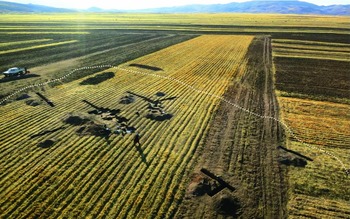
In 2013, we conducted surface and subsurface investigations at the site of SMP. Aldenderfer et al. first recorded the site in 1995 as one of 468 sites in a 41km2 pedestrian survey designed to outline the pre-ceramic prehistory of the Titicaca Basin (Craig Reference Craig2011). SMP is a high-density artefact scatter covering a relatively small area of 2800m2 located at S16º14’2”, W69º43’30”, 3860masl (WGS 84). The site is situated on a relict alluvial terrace in the Ilave Basin (Rigsby et al. Reference Rigsby, Baker and Aldenderfer2003) approximately 1km north of the modern Huenque River and 30km west of the modern shoreline of Lake Titicaca. The landscape today consists of rolling hills and vast grasslands, or pampas, that are cultivated and grazed (Figure 2). The site was selected for subsurface investigation because of its high surface concentration of temporally diagnostic Late Archaic period artefacts and the local community's interest in hosting and participating in the excavation effort.
Kite aerial view looking north-west across the site of Soro Mik’aya Patjxa, located in a vast altiplano pampa near the centre of the Ilave Basin; approximate site boundary shown by dashed white line (photograph: Randall Haas).

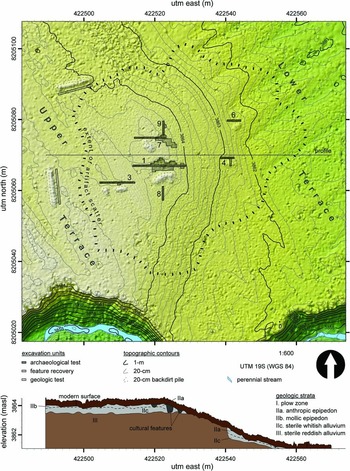
We excavated approximately 21m3 of sediment from 50m2 of surface area at SMP (Figure 3). Fifty metres of 50cm-wide exploratory trenches were extended through areas of high surface-artefact concentration and areas with potential for localised sedimentation and feature preservation. When cultural features were encountered, excavation units were extended to define the spatial extents of the features and excavate their contents. Artefacts were recovered via intensive systematic surface collection and spatially controlled sediment screening (sieving), using 1mm mesh in feature contexts and 6mm mesh in disturbed and extramural contexts. In addition, a sample of sediment from each feature was processed by flotation and screened through 0.5mm, 1mm and 1.7mm mesh. For features containing less than 10l of fill, all sediment was processed by flotation. For features containing more than 10l of fill, a minimum of 10l was processed by flotation. In total, we processed 320l of archaeological sediment by flotation.
Planimetric and profile maps of Soro Mik’aya Patjxa: profile elevation is exaggerated 2× horizontal scale; geological strata and cultural features are generalised from composite observations in excavation units; topographical model derived using kite aerial photography and structure-from-motion image processing (Wu Reference Wu2011).

The excavations revealed a single, thin cultural stratum (stratum IIa) below the modern plough zone (stratum I). The cultural stratum grades horizontally into an A horizon (stratum IIb) and vertically down into culturally sterile alluvium (stratum IIc; see Figure 3), which appears to be redeposited volcanic tuff. We encountered 13 clearly defined cultural pit features, each beginning in cultural stratum IIa and cutting down into IIc and, in a few cases, into stratum III—a reddish, artefact-sterile alluvium. The features were readily identified, appearing as dark, organic-rich sediment dissecting IIc. All of the pits contained ashy fill with flaked stone, bone, charcoal, ochre or groundstone. Eight of the pit features contained between one and three human skeletons, with a total of sixteen individuals. One pit contained four large informal groundstone blocks. The remaining four pits contained general fill materials only.
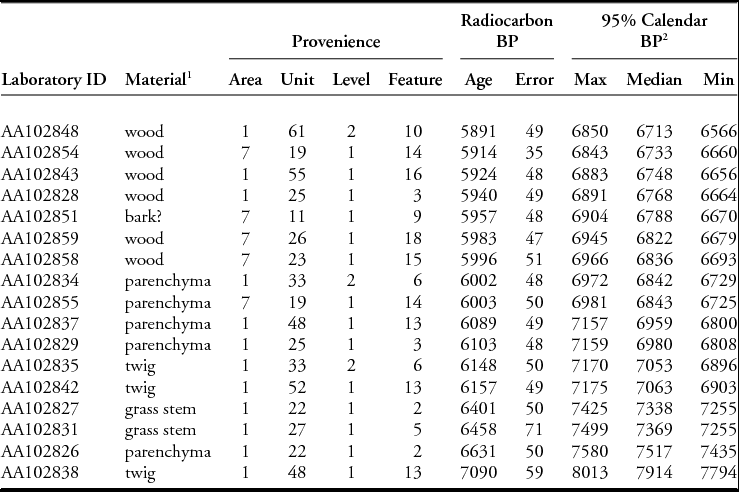
Over 80 000 artefacts were recovered in total. These include lithics (n ≈ 68 000), bone (n ≈ 8000), carbonised plant matter (n ≈ 2000), pigment stone (n ≈ 900), groundstone (n ≈ 400) and ceramic sherds (n = 97). Of the recovered lithics, 233 are temporally diagnostic projectile points, all of which are diagnostic of pre-ceramic (i.e. Archaic) periods (see Klink & Aldenderfer Reference Klink, Aldenderfer, Stanish, Cohen and Aldenderfer2005). Ninety-four of the projectile points are assigned to one of the following Archaic sub-periods: Early Archaic (n = 3), Middle Archaic (n = 20), Late Archaic (n = 70) and Terminal Archaic (n = 1). The trace quantity of ceramic sherds were all recovered from the plough zone and stylistically post-date AD 1000, indicating a minor intrusion into an otherwise Archaic assemblage. Temporally diagnostic artefacts and radiocarbon dates from feature contexts suggest that site use occurred almost exclusively in the Middle and Late Archaic periods between 8000 and 6700 cal BP (Table 1).
Radiocarbon age determinations by accelerator mass spectrometry (n = 17).

1 All charred materials from lower levels of feature contexts.
2 OxCal v4.2.3 (Bronk Ramsey Reference Bronk Ramsey2013); r:5 IntCal13 atmospheric curve (Reimer Reference Reimer2013)
Territoriality and violence at SMP
The combination of population pressure and resource stress is often cited as a catalyst for emergent sedentism and food production in human societies (Rosenberg Reference Rosenberg1998). Archaeological evidence for Late Archaic period population growth in the Titicaca Basin seems firm, but direct evidence of resource stress is currently absent. Michael Rosenburg (1998: 662) has suggested that the most unambiguous indicator of prehistoric stress is evidence of violence.
The 16 human burials from the pits at SMP were examined for signs of violent trauma. Nine of the individuals were sufficiently intact to permit mostly complete evaluation of the crania, long bones and burial contexts. Three of the burials were disturbed but sufficient for partial evaluation of the crania and long bones. The remaining two individuals consisted of highly fragmented crania with little potential for trauma-data recovery.
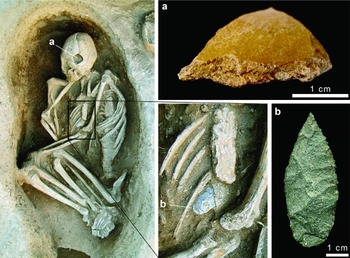
Burial 9, a young adult male, shows two possible indicators of violent trauma (Figure 4). First, a large, serrated, black andesite dart point was found with the blade between the sternum and the vertebral-end of the right ribs. The stratigraphic relationships along with the absence of post-depositional disturbance indicate that the point was probably inside the flesh of the body near the time of death.
Burial 9, a young adult male, showing evidence of violent trauma: a) perimortem head wound with void in the left parietal bone (left image) and corresponding green-fractured fragment (upper-right image) found inside the cranial vault; b) projectile point impalement showing the dart and its position below and in direct contact with the dorsal surface of the sternum cortical bone and above the vertebral end of the right ribs; note also the artificial cranial modification and deer antler above the right arm in the left image (photograph: Randall Haas).

Second, a large hole was observed in the left parietal bone, which was oriented upwards in the burial context. The margins of the hole are highly eroded and do not reveal evidence of perimortem fracture, but the dislodged bone fragment does exhibit perimortem fracture. The fragment was found inside the cranial vault, resting on the interior surface of the right temporal bone near the foramen magnum. As the cranial vault protected the fragment from weathering, its preservation was exceptional. The margins exhibit conchoidal fractures and uniform colouration associated with green fracture, suggesting perimortem trauma (White & Folkens Reference White and Folkens2005: 50–52). In addition, the left ulna of burial 5 exhibits a healed parry fracture near the distal end.
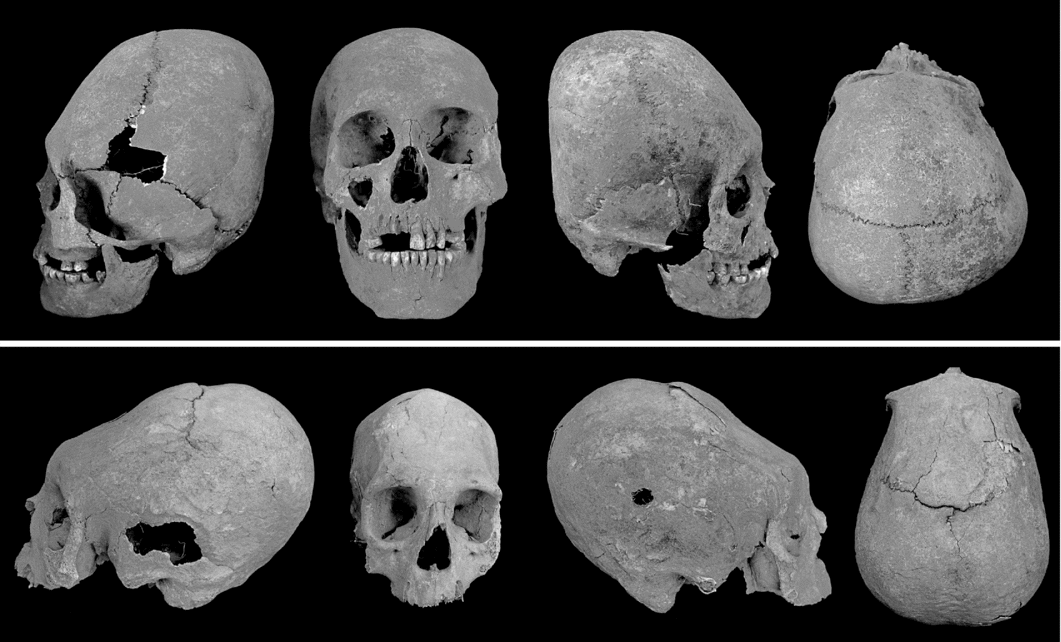
Artificial cranial modification provides less direct evidence for competition. Regardless of the proximate, culturally specific reasons for engaging in artificial cranial modification, an unavoidable outcome is clear and honest signalling of group membership (Blom Reference Blom2005: 17). Such signalling would have been efficacious under conditions of heightened resource competition and territoriality. Five of the crania were sufficiently intact to observe the presence or absence of artificial modification. All five exhibit frontal or rear modification (Figure 5). Given that the cranial modification occurs on both the anterior and posterior sides of the crania and is relatively extreme in some cases, it was probably intentional and not incidental to other behaviours such as cradle boarding (see Blom Reference Blom2005: 8).
Two extreme examples of artificially modified crania at Soro Mik’aya Patjxa: burial 3 (above); burial 5 (below) (photographs: Randall Haas); see also Figure 4.

Occupational redundancy at SMP
SMP does not appear to have been a place of year-round residence, but it does appear to have been a place where hunter-gatherers resided repeatedly on a long-term, non-permanent basis. This conclusion is based on the convergence of several lines of evidence. The sheer quantity and relative diversity of artefacts at SMP indicate high occupation intensity. Eighty thousand artefacts consisting of five artefact classes—flaked stone, bone, carbonised plant matter, groundstone and pigment stone—were recovered from just 1.8% of the site. If we project this density to the rest of the 2800m2 site, we could expect a total of 3.1 million ±60 000 artefacts at SMP. To estimate the total artefact count and error term for the site, we first examined the density distribution of artefacts in each excavation unit. Akaike information criterion (AIC) indicates that an exponential distribution with a maximum likelihood estimated (MLE) rate of 8.93 × 10⁻⁴ artefacts/m2 offers the best fit (99.9%) for the data over normal, lognormal and power law alternatives. Total artefact count estimates were derived using a random exponential function with 2800 iterations (representing the 2800m2 area of the site) and the MLE-estimated rate parameter estimates. This was iterated 10 000 times to generate the mean and error term, reported as a standard deviation. It should also be noted that the majority of the raw materials recovered are not available in the immediate vicinity of the site and so their quantities cannot be explained in terms of local quarrying.
High artefact densities at SMP, combined with the relatively small spatial extent (2800m2, which equates to 60m in diameter assuming a circular boundary), suggests that artefact accumulation represents many hours of occupation by a small group rather than shorter periods of use by many different individuals or groups. The wide range of radiocarbon assays further suggests that the site was occupied over a long period of time.
Ruling out site growth by contemporaneous aggregation of many individuals, we are left with two possible proximate explanations for the growth of SMP: continuous long-term occupation by a small residential group, or high-frequency re-occupation by one or more small groups (Surovell Reference Surovell2009: 88). In other words, those using SMP were either sedentary, occupying the site on a super-annual basis, or mobile, repeatedly occupying the site with each occupation occurring on a sub-annual basis. The evidence supports the latter explanation—that highly mobile groups occupied SMP discontinuously. First, the cultural deposits occur in a single, thin stratigraphic unit (see Figure 3), highlighting a lack of cultural midden accumulation that might be expected in the case of permanent occupation. Second, typical material correlates of permanent occupation, including permanent housing and ceramics, are absent. The lack of house foundations may reflect preservation bias due to erosion or near-surface (to ~30cm) plough disturbance. Yet, as the burial pits evaded disturbance, there is the corresponding suggestion that if substantial pits related to house structures were present, we would probably have detected portions of them.
The absence of permanent residential architecture at SMP contributes to a recurrent theme in the Titicaca Basin. Late Archaic surface architecture is unknown from the four major settlement surveys that documented hundreds of Late Archaic sites (Cipolla Reference Cipolla, Stanish, Cohen and Aldenderfer2005; Klink Reference Klink, Stanish, Cohen and Aldenderfer2005; Craig Reference Craig2011; La Favre Reference La Favre2011). Excavations at the Late Archaic site of Pirco, which is larger than SMP in terms of areal extent and artefact quantity, did not locate permanent house features despite the absence of mechanical plough disturbance (Craig Reference Craig2011). Limited test excavations and ground-penetrating radar survey in two Late Archaic sites in the Rio Ramis Valley did not identify permanent house features either (Aldenderfer & Flores Blanco Reference Aldenderfer and Blanco2008). SMP thus appears to reflect more than a thousand years of short-term occupations by small, mobile hunter-gatherer groups, and this is consistent with previous observations of Late Archaic period contexts in the Titicaca Basin.
Intensive resource use at SMP
Genetic analysis suggests that potatoes may have been domesticated from wild species in the south-central Andes, which includes the Lake Titicaca Basin (Spooner et al. Reference Spooner, McLean, Ramsay, Waugh and Bryan2005). Quinoa (Chenopodium quinoa) is believed to have Andean origins, possibly in the south-central Andes (Pickersgill Reference Pickersgill2007: 929). If hunter-gatherers domesticated these species in this region, we would expect intensive use of the wild progenitor species prior to domestication. Macrobotanicals and faunal remains offer one of the clearest indicators of prehistoric diet. Although the SMP assemblage produced a large quantity of carbonised plant and faunal materials, the materials are highly fragmented, making meaningful taxonomic identifications difficult. Preliminary examination of cheno-am seeds from feature contexts revealed that the seeds are unburnt and hence modern. It is probable that the modern seeds intruded into the features via root and insect disturbances. Whether the absence of charred seeds reflects a lack of use, lack of charring or a problem of preservation remains unclear. The clear evidence for translocation of modern small seeds (~1.5mm in diameter) does, however, suggest that contextual analysis of materials of comparable size or smaller would be problematic. Therefore, we did not pursue phytolith analysis of the sediments.
Larger materials do not appear to have undergone such vertical movement as evidenced by the intact nature of the skeletal materials and the consistent 14C dates, all 17 of which are on plant charcoal and predate 6500 cal BP. The charred macrobotanical remains include small fragments (c. <5mm) of burnt wood and bits of parenchyma tissue. Ongoing analyses seek to locate taxonomically diagnostic features in these samples. Despite these limitations, a rich groundstone assemblage and extreme dental attrition indicate that SMP's inhabitants intensively harvested, processed and consumed wild grains or tubers.
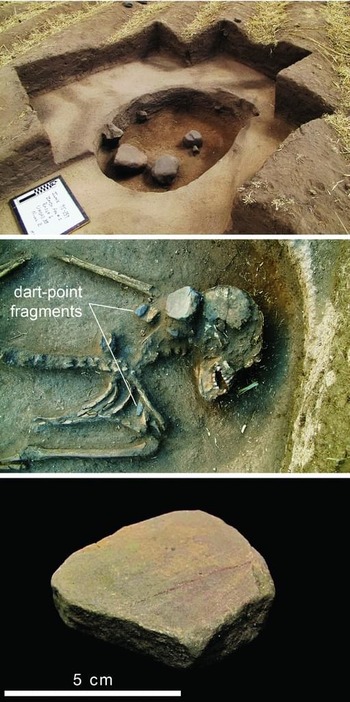
Groundstone artefacts comprise a significant portion of the SMP assemblage (Figure 6). The 430 groundstone artefacts recovered include 92 specimens from the surface and 338 from subsurface contexts. Twenty-four pieces were recovered from 6 of the 13 secure feature contexts. Lacking associated macrobotanical remains and pending starch grain analysis, direct evidence for the function of the groundstone is currently unavailable. Nonetheless, quantitative, material, formal and contextual data (Schiffer & Skibo Reference Schiffer and Skibo1997) for the groundstone lend insight into the range of possible functions and intensity of use.
Groundstone and its context at Soro Mik’aya Patjx: upper) pit feature with large groundstone boulders (feature 6, maximum planimetric length of feature = 1.3m); middle) a typical sandstone grinding slab placed on the neck of burial 10 in feature 14; lower) close-up of the sandstone artefact from burial 10; note also black andesite dart points placed on each shoulder of burial 10 (photographs: Randall Haas).

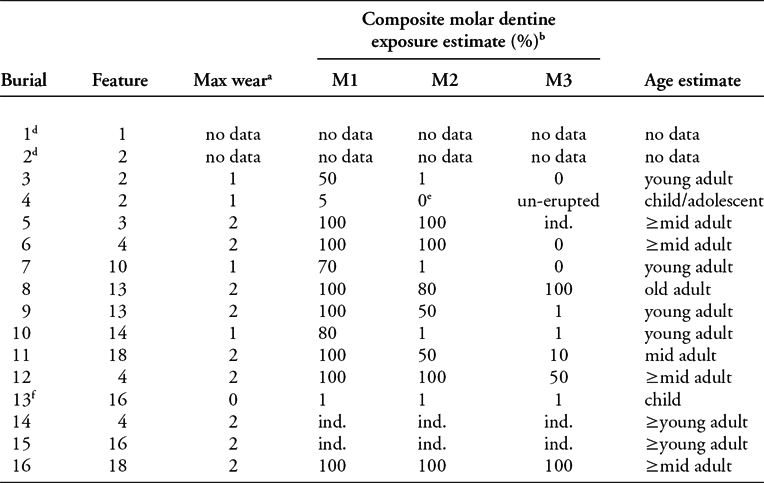
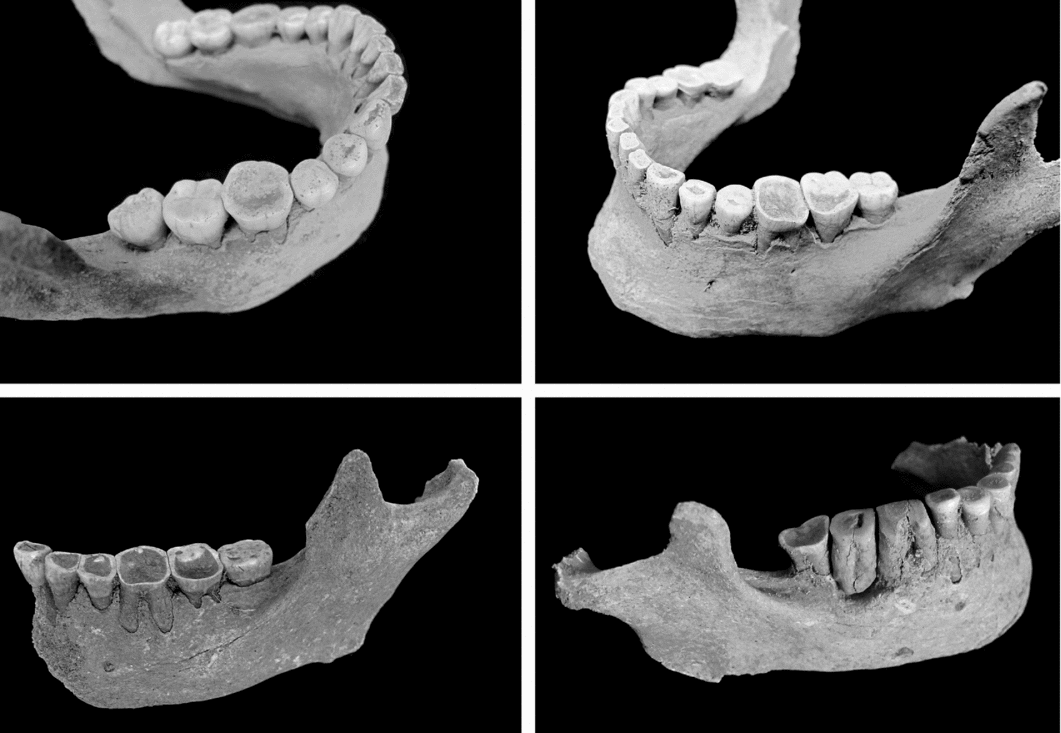
Two hundred and seventy-four of the groundstone artefacts were examined for raw material and morphological variation. The planimetric shapes of all of these tools are irregular, indicating informal design. Tabular cross-sectional forms, which are observed in 75 of the 100 sufficiently intact artefacts, suggest, however, intensive use. Sixty-seven per cent (n = 183) of the examined artefacts are made from metasedimentary materials ranging from friable sandstone to well-cemented quartzite. The grinding surfaces, especially on the sandier, less-cemented materials, tend to be perfectly flat due to intense use, although such wear was probably rapid due to the friable natureof the material. Informal, tabular groundstone made from friable materials tends to be associated with relatively rapid grinding of small seeds for consumption (Buonasera Reference Buonasera2013), suggesting that SMP groundstone served this purpose. The lack of basin morphology, which is necessary to contain small seeds during the grinding process, suggests, however, the possibility of tuber processing. This would be consistent with Rumold's (Reference Rumold2010) groundstone observations at the Terminal Archaic period site of Jiskairumoko. The remaining 33% of the examined groundstone artefacts are made of grey volcanic materials and have informal geometries that are often indistinguishable from alluvial cobbles. It appears that SMP residents invested in the transport and storage of groundstone with the intent to return and re-use the materials. The largest recovered specimen at 11kg represents a fairly substantial transport investment given that the nearest exposed bedrock and potential quarry is 1.5km from the site. Moreover, the four largest of the boulders, with a cumulative mass of 27kg, were found in a storage pit, which implies that they were intended for future use (see Figure 6). The quantity, ubiquity, materials, form and contexts of the artefacts indicate that groundstone was not incidental to the site but an integral part of the SMP subsistence economy. Extreme dental attrition in the associated burials offers additional evidence for ground foods in the SMP diet. Tooth wear was examined in 14 of the 16 recovered human burials (Figure 7). We focus on molars here because they exhibit the greatest variation in wear, and their known eruption times provide an approximation of adult age. Together, molar wear and eruption times can be used to approximate dental attrition rates in the population. In addition to using molar eruption and molar wear for age estimation, cranial suture closures were also used (White & Folkens Reference White and Folkens2005: 363–71). The dental data in Table 2 show that heavy tooth attrition began at a young age in the SMP population. Even with adults of less than 35 years in age, dental attrition extended well into the dentine and occasionally into the roots of the first molar. As a mid adult between the ages of 25–50, at least one tooth could be expected to be worn to the roots, and by old adulthood (50+ years) it was probable that most teeth were worn well into the dentine and, in many cases, into the roots. The high dental-wear rates are probably associated with a high-grit diet, and the groundstone—especially sandstone—was a probable source of the grit. Taken together, the abundant groundstone and extreme tooth wear indicate that SMP inhabitants were grinding and consuming plant foods. Lacking direct observation on macrobotanical remains or starch grains, we can only speculate on the specific taxa that SMP inhabitants consumed. Maria Bruno (Reference Bruno, Zeder, Bradley, Emshwiller and Smith2006) has observed that several wild species of Chenopodium, including C. ambrosioides and C. hircium are endemic to the region, and Late Archaic foragers of the Titicaca Basin probably exploited the seeds of one or more of these species. It is also possible that Graminae seeds, especially Festuca sp., were consumed as has been proposed for the pre-ceramic occupants of Panaulauca cave, which lies at a slightly higher elevation than SMP (Pearsall Reference Pearsall, Harris and Hillman1989). Rumold (Reference Rumold2010) has argued, based on starch-grain observations, that groundstone at the Terminal Archaic site of Jiskairumoko was used to process tubers.
Dental attrition summary.

a Qualitative ranking of the maximum observed depth of wear for all teeth, where 0 = little or no wear, 1 = wear into the dentine and 2 = wear into the roots.
b An average of upper, lower, right and left molars for the given position, M1, M2 or M3; averages are based on qualitative estimates to the nearest 10%, and a value of 1 is used to indicate observable wear that does not expose dentin.
c Age classes follow Buikstra and Ubelaker (Reference Buikstra and Ubelaker1994) as listed: child: 3–12 years, adolescent: 12–20 years, young adult: 20–35 years; mid adult: 35–50 years, and old adult: 50+ years. Determinations based on cranial suture closure, dental eruptions and relative dental attrition.
d Highly fragmented cranium in plough zone—not examined.
e Roots partially formed, degree of eruption uncertain.
f Five fully formed deciduous molars were observed, all with light wear; positions were indeterminate, but the prevalence provides the basis for assuming values of 1 and indicates consumption of stone-ground foods.
Various degrees of dental attrition shown in four different mandibles from Soro Mik’aya Patjxa: upper left) young adult with approximately 20% dentine exposure in first molar (burial 7, feature 10); upper right) young adult with 100% dentine exposure in first molar and approximately 30% in second molar (burial 9, feature 13); lower left) mid adult with 100% dentine exposure in the first molar with attrition nearing the root, 80% dentine exposure in the second molar and 10% dentine exposure in the third molar (burial 11, feature 18); lower right) mid or old adult showing first and second molars ground to the roots and 100% dentine exposed in third molar (burial 16, feature 18) (photographs: Randall Haas).

We have curated unwashed, in situ groundstone blocks, including those shown in Figure 6, with the hope that future starch-grain and phytolith analyses might offer other lines of evidence for groundstone use. Chenopodium starch grains from prehistoric contexts are difficult to identify however, so this line of evidence is unlikely to hold relevance for the question of chenopodium seed grinding (Rumold Reference Rumold2010: 312). Chenopodium phytoliths and starch grains may be detectable in human dental calculus, and we are currently taking steps to explore this possibility.
The groundstone and dental data suggest intensive processing and consumption of plant foods at SMP, but other lines of material evidence indicate that large-game hunting was also an important part of the subsistence economy. Of the 432 flaked-stone tools recovered from SMP, 324 (75%) are projectile points. Other lithic tools include 49 scrapers (11%), 47 bifacial preforms/knives (11%), 5 retouched flakes (1%), a perforator (<1%) and 6 indeterminate forms (1%). Projectile-point technology is clearly emphasised in the SMP lithic assemblage, suggesting an emphasis on large-game hunting. This inference finds additional support in a preliminary analysis of 1915 faunal specimens. Of the 1255 specimens that could be classified as large- or small-bodied mammals, 99% are from large-bodied mammals. More refined taxonomic identification awaits further analysis, but the large-bodied mammal specimens most probably represent two endemic species including (1) the Andean deer, taruca (Hippocamelus antisensis) and (2) the camelid, vicuña (Vicugna vicugna). Cuy (Cavia sp.), viscacha (Lagidium viscacia) and carache fish (Orestias sp.) were identified in trace quantities among the small-bodied animal bones. Fifty-eight per cent of the recovered animal bone was burnt, providing clear evidence of large-game cooking. The emphasis on projectile point technology and the abundance of burnt bone from large-bodied mammals indicate that large-game hunting was an important component of the Late Archaic period economy alongside intensive plant processing and consumption.
Summary and conclusion
Our current understanding of the trajectory to socioeconomic complexity in the Lake Titicaca Basin remains weighted towards the later Formative and Tiwanaku periods. The recent observations at the site of Soro Mik’aya Patjxa contribute to filling a critical gap at the earlier end of the process. In particular, the field and laboratory results presented here have led to the following interpretations of Late Archaic period hunter-gatherer behaviour at SMP:
-
1. Conspecific competition and inter-personal conflict.
-
2. High residential mobility with high-frequency site re-occupation.
-
3. Intensive consumption of plant-foods in the context of a hunter-gatherer economy.
More archaeological observations are needed to test these hypotheses satisfactorily. Nonetheless, the results presented here indicate that population growth, resource stress, widening diet, competition and conflict characterised hunter-gatherer behaviour on the eve of agriculture in the Lake Titicaca Basin.
Acknowledgements
Various members of the Collasuyo Archaeological Research Institute and members of the Ilave, Totorani and Mulla Fasiri communities provided field and laboratory support for the study of Soro Mik’aya Patjxa. BrieAnna Langlie and Gayle Fritz, Washington University in St Louis, provided ethnobotanical support. A debt of gratitude is owed to Langlie for not only examining macrobotanicals but also for allowing us to use her new, custom-built flotation machine. Cecilia Chavez Justo, Collasuyo Archaeological Research Institute, identified the ceramic types. James Watson (The University of Arizona) and Elizabeth Arratia Velasco (Universidad Mayor de San Andrés) provided support for faunal analysis. Radiocarbon sample preparation was performed by the first author under the direction of Greg Hodgins at The University of Arizona Accelerator Mass Spectrometry Laboratory. Mark Aldenderfer, Nathan Craig, Lauren Hayes, Virginia Incacoña, Mateo Incacoña Huaraya, Daniel Pilco Incacoña, Nestor Condori Flores and Albino Pilco Quispe provided logistical support in the field and laboratory. Mark Aldenderfer, University of California Merced; Steven Kuhn and Mary Stiner, The University of Arizona; Steven Lansing, Nanyang Technological University; and two anonymous reviewers provided helpful comments on earlier drafts of this paper. Financial support for this research was provided by a National Science Foundation Doctoral Dissertation Improvement Grant (award BCS-1311626), an American Philosophical Society Lewis and Clark Fund for Exploration and Field Research, the School of Anthropology and the Graduate Professional and Student Council at The University of Arizona and a Marshal Foundation dissertation writing fellowship.